EP0900521A1 - Insecticidal proteins - Google Patents
Insecticidal proteins Download PDFInfo
- Publication number
- EP0900521A1 EP0900521A1 EP19980202882 EP98202882A EP0900521A1 EP 0900521 A1 EP0900521 A1 EP 0900521A1 EP 19980202882 EP19980202882 EP 19980202882 EP 98202882 A EP98202882 A EP 98202882A EP 0900521 A1 EP0900521 A1 EP 0900521A1
- Authority
- EP
- European Patent Office
- Prior art keywords
- lectin
- transgenic plant
- lectins
- sps
- tgt
- Prior art date
- Legal status (The legal status is an assumption and is not a legal conclusion. Google has not performed a legal analysis and makes no representation as to the accuracy of the status listed.)
- Withdrawn
Links
Images


Classifications
-
- C—CHEMISTRY; METALLURGY
- C12—BIOCHEMISTRY; BEER; SPIRITS; WINE; VINEGAR; MICROBIOLOGY; ENZYMOLOGY; MUTATION OR GENETIC ENGINEERING
- C12N—MICROORGANISMS OR ENZYMES; COMPOSITIONS THEREOF; PROPAGATING, PRESERVING, OR MAINTAINING MICROORGANISMS; MUTATION OR GENETIC ENGINEERING; CULTURE MEDIA
- C12N15/00—Mutation or genetic engineering; DNA or RNA concerning genetic engineering, vectors, e.g. plasmids, or their isolation, preparation or purification; Use of hosts therefor
- C12N15/09—Recombinant DNA-technology
- C12N15/63—Introduction of foreign genetic material using vectors; Vectors; Use of hosts therefor; Regulation of expression
- C12N15/79—Vectors or expression systems specially adapted for eukaryotic hosts
- C12N15/82—Vectors or expression systems specially adapted for eukaryotic hosts for plant cells, e.g. plant artificial chromosomes (PACs)
- C12N15/8241—Phenotypically and genetically modified plants via recombinant DNA technology
- C12N15/8261—Phenotypically and genetically modified plants via recombinant DNA technology with agronomic (input) traits, e.g. crop yield
- C12N15/8271—Phenotypically and genetically modified plants via recombinant DNA technology with agronomic (input) traits, e.g. crop yield for stress resistance, e.g. heavy metal resistance
- C12N15/8279—Phenotypically and genetically modified plants via recombinant DNA technology with agronomic (input) traits, e.g. crop yield for stress resistance, e.g. heavy metal resistance for biotic stress resistance, pathogen resistance, disease resistance
- C12N15/8286—Phenotypically and genetically modified plants via recombinant DNA technology with agronomic (input) traits, e.g. crop yield for stress resistance, e.g. heavy metal resistance for biotic stress resistance, pathogen resistance, disease resistance for insect resistance
-
- A—HUMAN NECESSITIES
- A01—AGRICULTURE; FORESTRY; ANIMAL HUSBANDRY; HUNTING; TRAPPING; FISHING
- A01H—NEW PLANTS OR NON-TRANSGENIC PROCESSES FOR OBTAINING THEM; PLANT REPRODUCTION BY TISSUE CULTURE TECHNIQUES
- A01H1/00—Processes for modifying genotypes ; Plants characterised by associated natural traits
- A01H1/12—Processes for modifying agronomic input traits, e.g. crop yield
- A01H1/122—Processes for modifying agronomic input traits, e.g. crop yield for stress resistance, e.g. heavy metal resistance
- A01H1/1245—Processes for modifying agronomic input traits, e.g. crop yield for stress resistance, e.g. heavy metal resistance for biotic stress resistance, e.g. pathogen, pest or disease resistance
- A01H1/127—Processes for modifying agronomic input traits, e.g. crop yield for stress resistance, e.g. heavy metal resistance for biotic stress resistance, e.g. pathogen, pest or disease resistance for insect resistance
-
- A—HUMAN NECESSITIES
- A01—AGRICULTURE; FORESTRY; ANIMAL HUSBANDRY; HUNTING; TRAPPING; FISHING
- A01N—PRESERVATION OF BODIES OF HUMANS OR ANIMALS OR PLANTS OR PARTS THEREOF; BIOCIDES, e.g. AS DISINFECTANTS, AS PESTICIDES OR AS HERBICIDES; PEST REPELLANTS OR ATTRACTANTS; PLANT GROWTH REGULATORS
- A01N65/00—Biocides, pest repellants or attractants, or plant growth regulators containing material from algae, lichens, bryophyta, multi-cellular fungi or plants, or extracts thereof
- A01N65/40—Liliopsida [monocotyledons]
-
- C—CHEMISTRY; METALLURGY
- C07—ORGANIC CHEMISTRY
- C07K—PEPTIDES
- C07K14/00—Peptides having more than 20 amino acids; Gastrins; Somatostatins; Melanotropins; Derivatives thereof
- C07K14/415—Peptides having more than 20 amino acids; Gastrins; Somatostatins; Melanotropins; Derivatives thereof from plants
- C07K14/42—Lectins, e.g. concanavalin, phytohaemagglutinin
-
- Y—GENERAL TAGGING OF NEW TECHNOLOGICAL DEVELOPMENTS; GENERAL TAGGING OF CROSS-SECTIONAL TECHNOLOGIES SPANNING OVER SEVERAL SECTIONS OF THE IPC; TECHNICAL SUBJECTS COVERED BY FORMER USPC CROSS-REFERENCE ART COLLECTIONS [XRACs] AND DIGESTS
- Y02—TECHNOLOGIES OR APPLICATIONS FOR MITIGATION OR ADAPTATION AGAINST CLIMATE CHANGE
- Y02A—TECHNOLOGIES FOR ADAPTATION TO CLIMATE CHANGE
- Y02A40/00—Adaptation technologies in agriculture, forestry, livestock or agroalimentary production
- Y02A40/10—Adaptation technologies in agriculture, forestry, livestock or agroalimentary production in agriculture
- Y02A40/146—Genetically Modified [GMO] plants, e.g. transgenic plants
Definitions
- the present invention relates to the use of certain lectins for the control of insect pests.
- Lectins are a heterogeneous class of (glyco) proteins grouped together based upon their ability to recognize and bind carbohydrate moieties of glycoconjugates.
- Chitin the principal structural carbohydrate of insects, is a polymer of N-acetyl glucosamine [GluNAc] and various lectins with sugar binding specificities for GluNAc have been disclosed with insecticidal activity against certain agricultural pests.
- EP-A-0351924 (Shell Internationale Research Maatschappij B.V.) relates to a transgenic plant comprising a lectin gene expressing a lectin within the plant foreign to the plant as found in nature.
- pea lectin has been inserted into tobacco, and the transgenic plant has some degree of insect resistance.
- EP-A-0427529 (Pioneer Hi-Bred International, Inc) discloses that selected plant lectins have been found to be larvicidal against a number of common insect pests or agricultural crops.
- lectins are known to be toxic to mammals and birds.
- the lectins of Phaseolus vulgaris are poorly digested by rats and thus are able to react with intestinal cells causing disruption of the brush borders of duodenal and jejunal enterocytes.
- abnormal absorption of potentially harmful substances occurs, leading to severe toxic effects (Pusztai et al, 1979).
- this invention relates to the use of lectins having specific mannose-binding ability and/or derived from Amaryllidaceae and Alliaceae for the control of insect pests.
- lectins having specific mannose-binding ability and/or derived from Amaryllidaceae and Alliaceae for the control of insect pests.
- such lectins are presented to insects in amounts likely to cause mortality, reduced larval weight and/or delayed development.
- plants may be protected from damage to leaves, stems, tubers, fruits and other useful parts.
- Such lectins are, on the other hand, non-toxic to mammals and constitute a safer alternative to the use of chemical insecticides.
- the lectins used according to this invention exhibit highly specific mannose-binding properties. Although lectins from some other plants, e.g. legumes, may bind mannose, they also bind glucose and N-acetyl glucosamine. Specific mannose-binding ability is therefore the ability to bind mannose together with inability to bind glucose and N-acetyl glucosamine. Such binding specificity may be established by the techniques of quantitative precipitation, hapten inhibition and affinity chromatography as detailed in Shibuya et al., 1988.
- Amaryllidaceae and Alliaceae lectins are to insert the genes encoding these proteins into plants.
- Previous applications have described the successful insertion of genes for proteins with insecticidal activity such as the Bt toxin (e.g. EP 0 142 924 - Lubrizol Genetics Inc.) and trypsin inhibitors eg. from cowpea. (EP 0 272 144 - Agricultural Genetics Company).
- transgenic plants Various methods are available to those skilled in the art for the introduction and expression of foreign genes in transgenic plants. These include Agrobacterium mediated gene transfer, microinjection of DNA into cells or protoplasts, DNA transfer via growing pollen tubes, DNA uptake by imbibing zygotic embryos, silicon carbide fibre mediated delivery, microprojectile bombardment [biolistic transfer] and direct DNA uptake employing polyethylene glycol, liposomes or electroporation. Once a line of transgenic plants is established the character may be transferred to other cultivars by conventional plant breeding.
- Lectins useful in insect control and the corresponding genes can be obtained from, but are not necessarily limited to, Allium sativum (garlic), Allium vineale, Allium ursinum, Allium moly, Allium cepa, Allium porrum, Narcissus pseudonarcissus, Clivia miniata, Galanthus nivalis (snowdrop) and Hippeastrum hybr .
- these proteins may be administered or co-administered directly to plants using an agrochemical formulation or as part of a pesticidal formulation which may also include Bacillus thuringiensis, Bt toxin, trypsin inhibitors or other insecticidal substances.
- Insects to be controlled include the plant-chewing stages of insects belonging to the orders Coleoptera, Lepidoptera and Orthoptera, including, but not limited to: Acanthoscelides obtectus, Bruchus sps., Callosobruchus sps. [bruchid beetles], Agriotes sps. [wireworms], Amphimallon sps. [chafer beetles), anthonomus grandis [cotton boll weevil], Ceutorhynchus assimilis [cabbage seed weevil], Cylas sps. (sweet potato weevils], Diabrotica sps. [corn rootworms], Epicauta sps.
- Lectins used according to this invention are particularly effective against insect pests of the Coleoptera order.
- Plants which can be protected, preferably by transformation, according to the methods of this invention include, but are not limited to: rice, wheat, maize, cotton, potato, sugarcane, grapevines, cassava, sweet potato, tobacco, soyabean, sugar beet, beans, apple, tomato, oilseed rape and sunflower.
- the bulbs or leaves are homogenized with a blender using 50 ml of 1M ammonium sulphate per gram of fresh tissue. Afterwards the exact is filtered through cheese cloth and centrifuged (4,000 g for 10 minutes). The resulting supernatant is frozen overnight at -20°C. After thawing, the precipitate is removed by a second centrifugation. The clarified supernatant is applied to a column of mannose-Sepharose (50 ml bed volume) equilibrated with 1M ammonium sulphate. Unbound proteins are washed off and lectin is desorbed using unbuffered 20mM 1,3-diaminopropane.
- the affinity purified lectin is brought up to 1M ammonium sulphate by adding the solid salt, and applied to a column of phenyl Sepharose (Trade-mark) (15 x 3 cm) equilibrated with 1M ammonium sulphate. After washing the column, lectins are eluted using distilled water or 1,3-diaminopropane (20 mM, unbuffered solution).
- RNA from bulb tissues is particularly difficult. It has been found that ovary tissue, where lectins have been found to be abundant, is suitable for the extraction of mRNA.
- Total cellular RNA is prepared from ovary tissue essentially as described by Finkelstein and Crouch (1986). Poly A rich RNA is purified by chromatography on oligo-deoxythymidine cellulose (Sigma Chemical Company, St.Louis) as described by Siflow et al (1979) except that poly A rich RNA is eluted at room temperature.
- a cDNA library can be made using the poly A enriched RNA isolated using a cDNA synthesis kit, eg. from Pharmacia, Uppsala, Sweden, and inserted into the Eco RI site of a multifunctional phagemid pT 7 T 3 I8U (Pharmacia, Sweden).
- the library is propagated in E. coli XL1 Blue (Stratagene, La Jolla, California).
- the colonies are screened using a 32p-end-labelled partially degenerate oligonucleotide probe derived from the amino acid sequence of the lectin for residues 41-45 i.e.:-
- Hybridization is carried out for 12 hours at 38°C in 0.9M sodium chloride containing 90 mM, Tris-HCl pH 7.5, 6 mM EDTA, 10 x Denhardts, 0.1% SDS, 180 mg/ml hydrolyzed yeast RNA and 2 x 10 6 cpm/ml 32 p-labelled probe.
- Colonies producing positive signals are rescreened using the same probe under the same conditions. Plasmids are isolated from purified colonies using the alkaline lysis method as described by Birnboim and Doly (1979) and sequenced to identify the lectin gene using the dideoxy method (Sanger et al, 1977).
- the lectin cDNA LECGNA2 contains an open reading frame of 570 nucleotides with a probable initiation codon at position 18. Translation starting with this codon generates a 157 amino acid polypeptide with a calculated molecular weight of 16,917 dalton that corresponds to an in vitro translation product for snowdrop lectin.
- the 3' untranslated region contains six in-frame termination codons and one possible polyadenylation signal at position 532.
- Lectins purified from snowdrop and garlic were incorporated into artificial seed diet (comprising chickpea meal in a cling-film skin) and tested on the bruchid beetle Callosobruchus maculatus .
- Figure 2 and Table 1 show the effect on survival and weight gain of surviving insects. The results show that 5% snowdrop lectin reduces the survival of Spodoptera larvae and substantially reduces the weight gain of surviving insects.
- the LECGNA2 clone contained a 570 base Eco RI linkered snowdrop lectin (GNA) gene cDNA cloned into the phagemid pT7T3 18U.
- the N-terminal and C-terminal peptides that are cleaved during processing to form the mature protein were marked on the sequence data.
- telomere sequence The coding region of the lectin gene was subcloned into pUC19 using standard polymerase chain reaction [PCR] technology [Innis, M.A. et al. eds. PCR Protocols: A Guide to Methods and Applications. Academic Press, San Diego. 1990]. Oligonucleotide primers were made covering the N-terminal and C-terminal regions which incorporated restriction sites so that the resultant amplified fragments could be subcloned using a Bam HI/ Kpn I double digest. These primers comprised the squences:
- the GNA encoding fragment was isolated by digestion of the pUC19-1GNA2 construct with Bam HI/ Kpn I, ligated into Bam HI/ Kpn I digested pROK2 and used to transform E. coli strain MC1022. These recombinants provided the Agrobacterium binary vector constructs which are useful for the constitutive expression of GNA in transgenic plants, illustrated in Figure 3. Colonies were screened by restriction digestion using Bam HI/ Kpn I, Sph I and HindIII , and the correct pRok9GNA1 construct was mobilised into Agrobacterium tumefaciens strain LBA 4404 by triparental mating with pRK2013/HB101 according to established methods [Bevan, M.
- Transgenic plants from lines 15GNA33, 15GNA35 and 15GNA79 express high levels of GNA antigen, equivalent to 40.2, 26.6 and 47.3 ⁇ g/g fresh weight respectively.
- the biological activity of the lectin in these plants may be demonstrated by standard haemagglutination assay procedures using trypsinised rabbit erythrocytes [Liss, H. & Sharon, N. [1973] The biochemistry of plant lectins [phaetohaemagglutinins]. Ann. Rev. Biochem. 42, 541-574] on phosphate buffered saline extracts of free-dried leaf tissue.
- Leaf samples [ca. 600mm 2 ] were removed from transgenic plants and from control tobacco plants and placed in 3oz plastic catering pots [DRG Plastics Ltd.] on top of two moistened filter paper discs. Samples were infested with 5 neonate [ ⁇ 24h old] H . virescens larvae per replicate, sealed and maintained at 25°C. Live insects were removed to fresh leaf samples every 48h. After 7d all live insects were counted and weighed. All leaf samples were pressed and the leaf area eaten over the 7 days measured by image analysis. The results are summarised below:
- the resulting hybrid plants can be used for whole plant bioassays. Insect damage may be determined as described in Example 4.
Landscapes
- Life Sciences & Earth Sciences (AREA)
- Health & Medical Sciences (AREA)
- Genetics & Genomics (AREA)
- Engineering & Computer Science (AREA)
- General Health & Medical Sciences (AREA)
- Chemical & Material Sciences (AREA)
- Organic Chemistry (AREA)
- Zoology (AREA)
- Wood Science & Technology (AREA)
- Molecular Biology (AREA)
- Biotechnology (AREA)
- Bioinformatics & Cheminformatics (AREA)
- Environmental Sciences (AREA)
- Biomedical Technology (AREA)
- Biophysics (AREA)
- Botany (AREA)
- General Engineering & Computer Science (AREA)
- Plant Pathology (AREA)
- Biochemistry (AREA)
- Microbiology (AREA)
- Pest Control & Pesticides (AREA)
- Agronomy & Crop Science (AREA)
- Developmental Biology & Embryology (AREA)
- Physics & Mathematics (AREA)
- Cell Biology (AREA)
- Gastroenterology & Hepatology (AREA)
- Medicinal Chemistry (AREA)
- Proteomics, Peptides & Aminoacids (AREA)
- Natural Medicines & Medicinal Plants (AREA)
- Insects & Arthropods (AREA)
- Mycology (AREA)
- Dentistry (AREA)
- Agricultural Chemicals And Associated Chemicals (AREA)
- Peptides Or Proteins (AREA)
- Breeding Of Plants And Reproduction By Means Of Culturing (AREA)
- Medicines Containing Plant Substances (AREA)
- Medicines Containing Material From Animals Or Micro-Organisms (AREA)
- Preparation Of Compounds By Using Micro-Organisms (AREA)
- Micro-Organisms Or Cultivation Processes Thereof (AREA)
Abstract
Description
- The present invention relates to the use of certain lectins for the control of insect pests.
- Lectins are a heterogeneous class of (glyco) proteins grouped together based upon their ability to recognize and bind carbohydrate moieties of glycoconjugates. Chitin, the principal structural carbohydrate of insects, is a polymer of N-acetyl glucosamine [GluNAc] and various lectins with sugar binding specificities for GluNAc have been disclosed with insecticidal activity against certain agricultural pests.
- EP-A-0351924 (Shell Internationale Research Maatschappij B.V.) relates to a transgenic plant comprising a lectin gene expressing a lectin within the plant foreign to the plant as found in nature. In particular, it discloses that pea lectin has been inserted into tobacco, and the transgenic plant has some degree of insect resistance.
- EP-A-0427529 (Pioneer Hi-Bred International, Inc) discloses that selected plant lectins have been found to be larvicidal against a number of common insect pests or agricultural crops.
- Many lectins are known to be toxic to mammals and birds. For example, the lectins of Phaseolus vulgaris are poorly digested by rats and thus are able to react with intestinal cells causing disruption of the brush borders of duodenal and jejunal enterocytes. As a result, abnormal absorption of potentially harmful substances occurs, leading to severe toxic effects (Pusztai et al, 1979).
- There is a need, therefore, to identify lectins which are toxic to insects but at the same time do not exhibit toxicity to mammals or birds. These would be useful in crop protection applications without restriction on the food use of the material in which the foreign lectin is to be presented.
- We have surpisingly found that a group of lectins, characterized by specific mannose-binding ability, in particular derived from Amaryllidaceae and Alliaceae, are effective for the control of insect pests, but are non-toxic to mammals and birds.
- In its broadest aspect this invention relates to the use of lectins having specific mannose-binding ability and/or derived from Amaryllidaceae and Alliaceae for the control of insect pests. Specifically, such lectins are presented to insects in amounts likely to cause mortality, reduced larval weight and/or delayed development. As a result of the presentation of such lectins to insect pests of plants, plants may be protected from damage to leaves, stems, tubers, fruits and other useful parts. Such lectins are, on the other hand, non-toxic to mammals and constitute a safer alternative to the use of chemical insecticides.
- The lectins used according to this invention exhibit highly specific mannose-binding properties. Although lectins from some other plants, e.g. legumes, may bind mannose, they also bind glucose and N-acetyl glucosamine. Specific mannose-binding ability is therefore the ability to bind mannose together with inability to bind glucose and N-acetyl glucosamine. Such binding specificity may be established by the techniques of quantitative precipitation, hapten inhibition and affinity chromatography as detailed in Shibuya et al., 1988.
- Recent work comparing lectins from Amaryllidaceae and Alliaceae indicates that lectins from Alliaceae strongly resemble those of Amaryllidaceae with respect to their molecular structure, carbohydrate binding specificity, amino acid composition and serological properties. All bind D-mannose exclusively. All contain high amounts of acidic and hydroxylic amino acids, glycine and leucine. All contain subunits of Mr 11,500-14,000, not linked by disulphide bonds and may occur as dimers (eg. garlic) or tetramers (eg. snowdrop). Generally, lectin concentration is higher in bulbs of Amaryllidaceae than it is in bulbs of Alliaceae.
- A preferred use of Amaryllidaceae and Alliaceae lectins according to the invention is to insert the genes encoding these proteins into plants. Previous applications have described the successful insertion of genes for proteins with insecticidal activity such as the Bt toxin (
e.g. EP 0 142 924 - Lubrizol Genetics Inc.) and trypsin inhibitors eg. from cowpea. (EP 0 272 144 - Agricultural Genetics Company). - Various methods are available to those skilled in the art for the introduction and expression of foreign genes in transgenic plants. These include Agrobacterium mediated gene transfer, microinjection of DNA into cells or protoplasts, DNA transfer via growing pollen tubes, DNA uptake by imbibing zygotic embryos, silicon carbide fibre mediated delivery, microprojectile bombardment [biolistic transfer] and direct DNA uptake employing polyethylene glycol, liposomes or electroporation. Once a line of transgenic plants is established the character may be transferred to other cultivars by conventional plant breeding.
- Lectins useful in insect control and the corresponding genes can be obtained from, but are not necessarily limited to, Allium sativum (garlic), Allium vineale, Allium ursinum, Allium moly, Allium cepa, Allium porrum, Narcissus pseudonarcissus, Clivia miniata, Galanthus nivalis (snowdrop) and Hippeastrum hybr.
- Alternatively, these proteins may be administered or co-administered directly to plants using an agrochemical formulation or as part of a pesticidal formulation which may also include Bacillus thuringiensis, Bt toxin, trypsin inhibitors or other insecticidal substances.
- Insects to be controlled include the plant-chewing stages of insects belonging to the orders Coleoptera, Lepidoptera and Orthoptera, including, but not limited to: Acanthoscelides obtectus, Bruchus sps., Callosobruchus sps. [bruchid beetles], Agriotes sps. [wireworms], Amphimallon sps. [chafer beetles), anthonomus grandis [cotton boll weevil], Ceutorhynchus assimilis [cabbage seed weevil], Cylas sps. (sweet potato weevils], Diabrotica sps. [corn rootworms], Epicauta sps. [black blister beetles], Epilachna sps. [melon beetles etc.], Leptinotarsa decemlineata [Colorado potato beetle], Meligisthes sps. [blossom beetles], Melolontha sps. [cockchafers], Phyleotreta sps., Psylliodes sps. [flea beetles], Popillia japonica [Japanese beetle], Scolytus sps. [bark beetles], Sitophilus sps. (grain weevils], Tenebrio molitor [yellow mealworm], Tribolium sps. [flour beetles], Trogoderma granarium [Khapra beetle), Acleris sps. [fruit tree tortrixs], Acraea acerata [sweet potato butterfly], Agrotis sps. [cutworms], Autographa gamma [silver-Y moth], Chilo sps. [stalk borers], Cydia pomonella [codling moth], Diparopsis sps. [red bollworms], Ephestia sps. [warehouse moths], Heliothis sps., Helicoverpa sps. [budworms, bollworms], Mamestra brassicae [cabbage moth], Manduca sps. [hornworms], Maruca testulalis [mung moth], Mythimna sps. [cereal armyworms], Ostrinia nubilalis [European corn borer], Pectinophora gossypiella [pink bollworm], Phthorimaea operculella [potato tuber moth], Pieris brassicae [large white butterfly], Pieris rapae [small white butterfly], Plodia interpunctella [Indian grain moth], Plutella xylostella [diamond-back moth], Sitatroga cerealella [Angoumois grain moth], Spodoptera sps. [armyworms], Trichoplusia ni [cabbage semilooper], Acheta sps. [field crickets], Gryllotalph sps. [mole crickets], Locusta migratoria [migratory locust] and Schistocerca gregaria [desert locust].
- Lectins used according to this invention are particularly effective against insect pests of the Coleoptera order.
- Plants which can be protected, preferably by transformation, according to the methods of this invention include, but are not limited to: rice, wheat, maize, cotton, potato, sugarcane, grapevines, cassava, sweet potato, tobacco, soyabean, sugar beet, beans, apple, tomato, oilseed rape and sunflower.
- For the purposes of extracting lectins from Amaryllidaceae and Alliaceae species the following procedure may be followed.
- The bulbs or leaves are homogenized with a blender using 50 ml of 1M ammonium sulphate per gram of fresh tissue. Afterwards the exact is filtered through cheese cloth and centrifuged (4,000 g for 10 minutes). The resulting supernatant is frozen overnight at -20°C. After thawing, the precipitate is removed by a second centrifugation. The clarified supernatant is applied to a column of mannose-Sepharose (50 ml bed volume) equilibrated with 1M ammonium sulphate. Unbound proteins are washed off and lectin is desorbed using
unbuffered 20mM 1,3-diaminopropane. - To remove all phenolic compounds, the affinity purified lectin is brought up to 1M ammonium sulphate by adding the solid salt, and applied to a column of phenyl Sepharose (Trade-mark) (15 x 3 cm) equilibrated with 1M ammonium sulphate. After washing the column, lectins are eluted using distilled water or 1,3-diaminopropane (20 mM, unbuffered solution).
- The cloning of genes for Amaryllidaceae and Alliaceae lectins poses special problems. Extraction of RNA from bulb tissues is particularly difficult. It has been found that ovary tissue, where lectins have been found to be abundant, is suitable for the extraction of mRNA.
- The following describes a method for obtaining lectin genes from snowdrop (Galanthus nivalis). Those skilled in the art would know that this protocol could be adapted easily for other members of Amaryllidaceae or Alliaceae.
- Flowering plants of snowdrop are collected and the ovaries excised from the flowers, frozen in liquid nitrogen and stored at -80°C. Total cellular RNA is prepared from ovary tissue essentially as described by Finkelstein and Crouch (1986). Poly A rich RNA is purified by chromatography on oligo-deoxythymidine cellulose (Sigma Chemical Company, St.Louis) as described by Siflow et al (1979) except that poly A rich RNA is eluted at room temperature.
- A cDNA library can be made using the poly A enriched RNA isolated using a cDNA synthesis kit, eg. from Pharmacia, Uppsala, Sweden, and inserted into the EcoRI site of a multifunctional phagemid pT7T3I8U (Pharmacia, Sweden). The library is propagated in E. coli XL1 Blue (Stratagene, La Jolla, California).
- In order to select clones recombinant for the lectin gene, the colonies are screened using a 32p-end-labelled partially degenerate oligonucleotide probe derived from the amino acid sequence of the lectin for residues 41-45 i.e.:-
- 5' TGT GTT TGT TGC CCA 3'
- 5' TGT GTT TGT AGC CCA 3'
- 5' TGT GTT TGT GGC CCA 3'
-
- Hybridization is carried out for 12 hours at 38°C in 0.9M sodium chloride containing 90 mM, Tris-HCl pH 7.5, 6 mM EDTA, 10 x Denhardts, 0.1% SDS, 180 mg/ml hydrolyzed yeast RNA and 2 x 10⁶ cpm/ml 32p-labelled probe. After hybridization filters are washed four times in 6 x SSC (1 x SSC = 0.9 M sodium chloride and 0.09 M sodium citrate, pH 7.0) at room temperature for 15 minutes followed by a 5 minute wash at hybridization temperature in 6 x SSC. Filters were blotted dry, wrapped in Saran Wrap and exposed to Kodak-X-Omat film at -80°C. Colonies producing positive signals are rescreened using the same probe under the same conditions. Plasmids are isolated from purified colonies using the alkaline lysis method as described by Birnboim and Doly (1979) and sequenced to identify the lectin gene using the dideoxy method (Sanger et al, 1977).
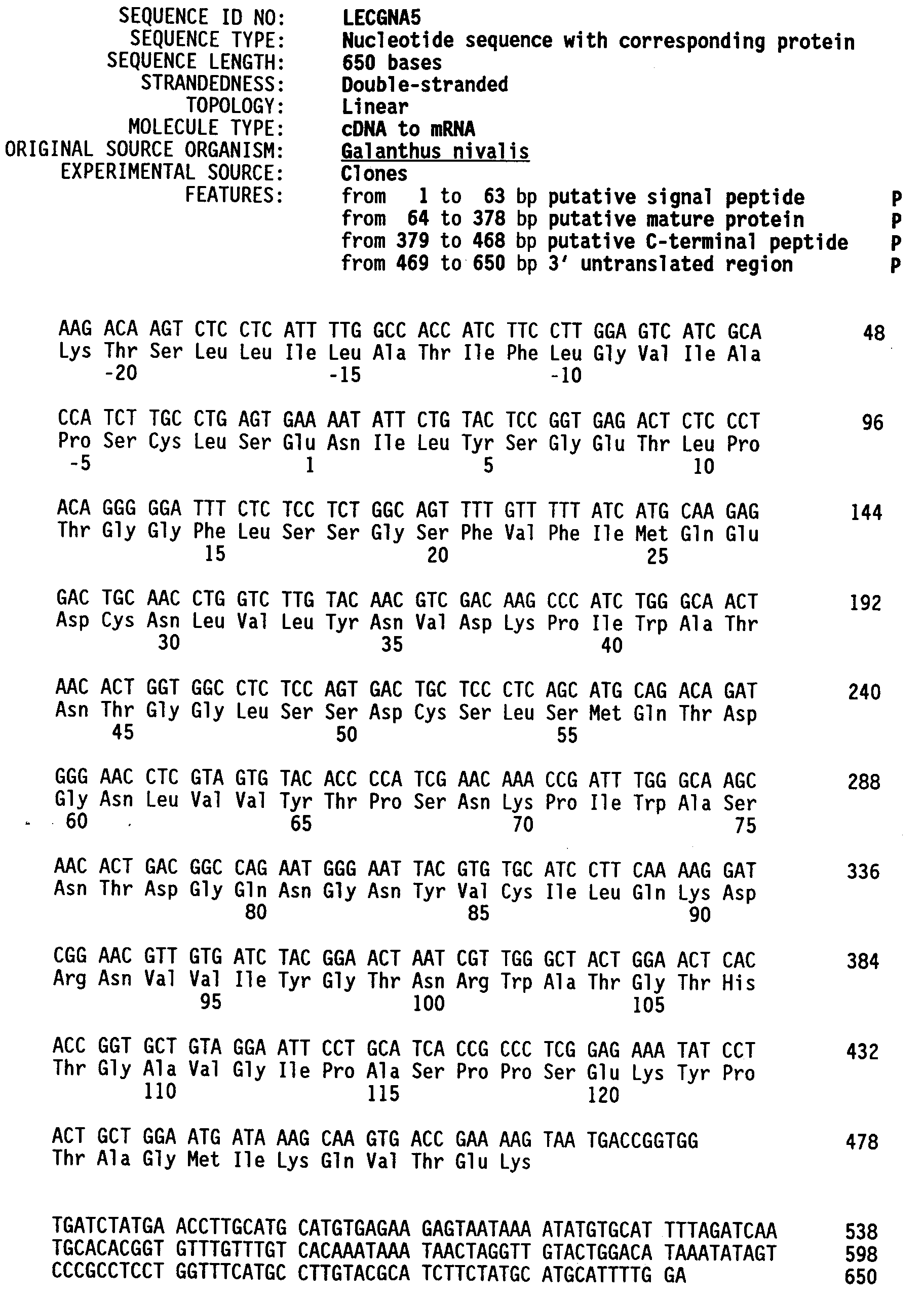
- Complete nucleotide sequences for cDNA's corresponding to several isoforms of snowdrop lectin are shown in the accompanying sequence listings. The lectin cDNA LECGNA2 contains an open reading frame of 570 nucleotides with a probable initiation codon at position 18. Translation starting with this codon generates a 157 amino acid polypeptide with a calculated molecular weight of 16,917 dalton that corresponds to an in vitro translation product for snowdrop lectin. The 3' untranslated region contains six in-frame termination codons and one possible polyadenylation signal at position 532. Comparison of the aminoterminal sequence for the lectin and the deduced amino acid sequence for the lectin clone shows that the lectin is synthesized with a leader (signal) sequence of 23 amino acids (2315 dalton). It is also probable that 22 amino acids (2278 dalton) are removed post translationally from the C-terminal end of the protein.
-
- Etzler, M.E. (1986) Distribution and function of plant lectins. In: The Lectins: Properties, Functions and Applications in Biology and Medicine, pp 371-435, Liener, I.E., Sharon, N., Goldstein, I.J., Eds., Academic Press Inc.
- Shibuya, N., Goldstein, I.J., Van Damme, E.J.M. and Peumans, W.J. (1988) Binding properties of a mannose specific lectin from snowdrop (Galanthus nivalis) bulb. Journal of Biological Chemistry 263 728-734.
- Puztai, A., Clarke, E.M.W., King, T.P. (1979) The nutritional toxicity of Phaseolus vulgaris lectins. Nutritional Society 38 115-120.
- Gatehouse, A.M.R., Dewey, F.M., Dove, J.D., Fenton, K.A. and Puztai, A. (1984) Effect of seed lectins from Phaseolus vulgaris on the development of larvae of Callosobruchus maculatus; mechanism of toxicity. J. Sci. Food Agric. 35 373-380.
- Finkelstein, R.R. and Crouch, M.L. (1986) Rapeseed embryo development of culture on high osmoticum is similar to that in seeds. Plant Physiology 81 907-912.
- Siflow, C.D., Hammett, J.R., Key, J.L. (1979) Sequence complexity of polyadenylated ribonucleic acid from soybean suspension culture cells. Biochemistry 18 2725-2731.
- Birnboim, H.C. and Doly, J. (1979) A rapid alkaline extraction procedure for screening recombinant plasmid DNA. Nucleic Acids Research 7 1513-1522.
- Sanger, F., Nicklen, S. and Coulson, A.R. (1977) DNA sequencing with chain determining inhibitors. Proc. Natl. Acad. Sci 74 5463-5467.
-
- In order to test for the insecticidal properties of lectins from Amaryllidaceae or Alliaceae they may be incorporated into various artificial diets, applied to the surface of leaves or the genes used to transform plants to produce the proteins.
- Lectins purified from snowdrop and garlic were incorporated into artificial seed diet (comprising chickpea meal in a cling-film skin) and tested on the bruchid beetle Callosobruchus maculatus.
- The effect on survival of the insect larvae at various concentrations of lectin incorporation (versus controls) is shown in Figure 1. At lower levels the garlic lectin increased survival of the bruchid beetles, but this effect was completely reversed at levels above 1% of diet and was not observed for the snowdrop lectin. The results indicate an LC50 for the garlic and snowdrop lectins of around 0.9%. Another lectin from tulip (in a closely related family - Liliaceae) showed no insecticidal activity.
- One of the difficulties in bioassaying the activity of such lectins is that in some artificial diets the lectin binds to mannose in the diet and becomes unavailable to the consuming insect. To overcome this problem and to analyze the effect of lectin obtained from snowdrop against Spodoptera littoralis (armyworm) a special artificial diet consisting of communion wafers was devised 5% snowdrop lectin (w/w) was applied to communion wafers in a solution of water. Spodoptera were fed on the wafers, which were replaced every two days.
- Figure 2 and Table 1 show the effect on survival and weight gain of surviving insects. The results show that 5% snowdrop lectin reduces the survival of Spodoptera larvae and substantially reduces the weight gain of surviving insects.

- The LECGNA2 clone contained a 570 base EcoRI linkered snowdrop lectin (GNA) gene cDNA cloned into the phagemid pT7T3 18U. The N-terminal and C-terminal peptides that are cleaved during processing to form the mature protein were marked on the sequence data.
- The coding region of the lectin gene was subcloned into pUC19 using standard polymerase chain reaction [PCR] technology [Innis, M.A. et al. eds. PCR Protocols: A Guide to Methods and Applications. Academic Press, San Diego. 1990]. Oligonucleotide primers were made covering the N-terminal and C-terminal regions which incorporated restriction sites so that the resultant amplified fragments could be subcloned using a BamHI/KpnI double digest. These primers comprised the squences:
- N-terminus:
- 5'-CGGATCCATGGCTAAGGCAAGT
- C-terminus:
- 5'-CGGTACCTCATTACTTTGCCGT
- The GNA encoding fragment was isolated by digestion of the pUC19-1GNA2 construct with BamHI/KpnI, ligated into BamHI/KpnI digested pROK2 and used to transform E. coli strain MC1022. These recombinants provided the Agrobacterium binary vector constructs which are useful for the constitutive expression of GNA in transgenic plants, illustrated in Figure 3. Colonies were screened by restriction digestion using BamHI/KpnI, SphI and HindIII, and the correct pRok9GNA1 construct was mobilised into Agrobacterium tumefaciens strain LBA 4404 by triparental mating with pRK2013/HB101 according to established methods [Bevan, M. [1984] Binary Agrobacterium vectors for plant transformation.
Nucleic Acids Research 12, 103-110]. Single colonies containing the pROK-GNA plasmids were rescreened by digestion with BamHI/KpnI to check for the correct insert size. - Transformation experiments were then carried out with Nicotiana tabaccum var Samsun using the standard leaf disc method [Horsch, R.B. et al. [1985] A simple and general method for transforming genes into plants. Science 227, 1229-1231]. Leaf discs were cultured on selective media containing kanamycin at 100mg/1 to select for transformed shoots. Shoots were rooted on kanamycin to eliminate untransformed escapes. Transformed plantlets were tested for snowdrop lectin expression by standard ELISA methods [Engvall, E. [1980] Meths. Enzymol. 70, 419]. Transgenic plants from lines 15GNA33, 15GNA35 and 15GNA79 express high levels of GNA antigen, equivalent to 40.2, 26.6 and 47.3 µg/g fresh weight respectively. The biological activity of the lectin in these plants may be demonstrated by standard haemagglutination assay procedures using trypsinised rabbit erythrocytes [Liss, H. & Sharon, N. [1973] The biochemistry of plant lectins [phaetohaemagglutinins]. Ann. Rev. Biochem. 42, 541-574] on phosphate buffered saline extracts of free-dried leaf tissue.
- Clonally replicated transgenic plants from lines 15GNA33, 15GNA35 and 15GNA79 [produced as described in Example 3] were transferred to loam based compost [Levingtons M3; Fisons plc] in 5 inch pots and maintained in a growth room with a 12h full, 4h half light day regimen at 26°C, 65% RH.
- Leaf samples [ca. 600mm2] were removed from transgenic plants and from control tobacco plants and placed in 3oz plastic catering pots [DRG Plastics Ltd.] on top of two moistened filter paper discs. Samples were infested with 5 neonate [<24h old] H. virescens larvae per replicate, sealed and maintained at 25°C. Live insects were removed to fresh leaf samples every 48h. After 7d all live insects were counted and weighed. All leaf samples were pressed and the leaf area eaten over the 7 days measured by image analysis. The results are summarised below:
-
G-test of association of number insects surviving with genotype. GENOTYPE CORRECTED MORTALITY Gadj p [H0:exp=con] Control 0 - - 15GNA33 26 4.500 <0.05 15GNA35 3 0.016 N.S. 15GNA79 16 0.710 N.S. Σ15GNA 22 1.212 N.S. -
Non-parametric Mann-Whitney U-test. Data are presented as mean + S.E.M. but note that data was not normally distributed. GENOTYPE N BIOMASS p [H0: exp=con] Control 48 5.06+1.34 - 15GNA33 28 1.49+0.62 <0.05 15GNA35 28 2.05+0.79 N.S. 15GNA79 28 0.75+0.24 <0.01 Σ15GNA 84 1.43+0.35 <0.01 -
Mean leaf area eaten + S.E.M. in mm2. Type I ANOVA. GENOTYPE n MEAN AREA F p [H0: exp=con] Control 48 218+44 - - 15GNA33 28 56+11 7.89 <0.01 15GNA35 28 91+28 4.31 <0.05 15GNA79 28 39+10 9.60 <<0.01 Σ15GNA 84 62+11 19.01 <<0.01 - Anthers were removed from flowering transgenic plants of line 15GNA79 and used to fertilise emasculated untransformed control N. tabacum var. 'Samsun' plants. Resultant hybrid seed was sown in compost. Two leaf discs [5mm diameter] were taken from seedlings at the 4 leaf stage and squashed between two sheets of nitrocellulose [BA85; Schleicher & Schuell]. Radioimmunoassay of the resultant 'squash blot' with rabbit anti-GNA primary antibody and 125I-donkey anti-rabbit IgG [Amersham International plc] secondary antibody using standard techniques [Jahn, R., Schiebler, W & Greengard, P. [1984] A quantitative dot-immunobinding assay for proteins using nitrocellulose membrane filters. Proc. natl. Acad. Sci. USA 81, 1684-1687] allowed the identification of GNA-expressing [GNA+xCON] and non-expressing [GNA°xCON] segregants.
- The resulting hybrid plants can be used for whole plant bioassays. Insect damage may be determined as described in Example 4.



Claims (6)
- A transgenic plant containing and capable of expressing a heterologous gene coding for a lectin having specific mannose-binding ability and derived from Amaryllidaceae or Alliaceae.
- A transgenic plant according to claim 1 expressing said heterologous gene in amounts likely to cause mortality, reduced larval weight and/or delayed development of insect pests.
- A transgenic plant wherein the insect pest is of the order Coleoptera.
- A transgenic plant wherein the gene coding for a lectin having specific mannose-binding ability is capable of hybridizing with at least one of the following oligonucleotide probesat 38°C in 0.9M sodium chloride containing 90 mM. Tris-HCl pH 7.5, 6 mM EDTA, 10 x Denhardts, 0.1% SDS, 180 mg/ml hydrolyzed yeast RNA and 2 x 10⁶ cpm/ml 32p-labelled probe.5' TGT GTT TGT TGC CCA 3'5' TGT GTT TGT AGC CCA 3'5' TGT GTT TGT GGC CCA 3'
- A transgenic plant according to any one of claim 1 to 3, wherein the lectin has a sequence identical to the protein of sequence ID No. LECGNA1, LECGNA2, LECGNA3, LECGNA5 or LECGNA8 (claim 8 as originally filed) of is a sub-unit thereof having specific mannose-binding ability.
- A transgenic plant according to any one of claims 1 or 2, wherein the plant is selected from the group consisting of rice, wheat, maize, cotton, potato, sugarcane, grapevines, cassava, sweet potato, tobacco, soyabean, sugar beet, beans, apple, tomato, oilseed rape and sunflower.
Applications Claiming Priority (5)
| Application Number | Priority Date | Filing Date | Title |
|---|---|---|---|
| GB9016687 | 1990-07-30 | ||
| GB909016687A GB9016687D0 (en) | 1990-07-30 | 1990-07-30 | Insecticidal proteins |
| GB919111346A GB9111346D0 (en) | 1991-05-24 | 1991-05-24 | Insecticidal proteins |
| GB9111346 | 1991-05-24 | ||
| EP91914406A EP0542833B1 (en) | 1990-07-30 | 1991-07-30 | Insecticidal proteins |
Related Parent Applications (1)
| Application Number | Title | Priority Date | Filing Date |
|---|---|---|---|
| EP91914406A Division EP0542833B1 (en) | 1990-07-30 | 1991-07-30 | Insecticidal proteins |
Publications (1)
| Publication Number | Publication Date |
|---|---|
| EP0900521A1 true EP0900521A1 (en) | 1999-03-10 |
Family
ID=26297403
Family Applications (2)
| Application Number | Title | Priority Date | Filing Date |
|---|---|---|---|
| EP19980202882 Withdrawn EP0900521A1 (en) | 1990-07-30 | 1991-07-30 | Insecticidal proteins |
| EP91914406A Expired - Lifetime EP0542833B1 (en) | 1990-07-30 | 1991-07-30 | Insecticidal proteins |
Family Applications After (1)
| Application Number | Title | Priority Date | Filing Date |
|---|---|---|---|
| EP91914406A Expired - Lifetime EP0542833B1 (en) | 1990-07-30 | 1991-07-30 | Insecticidal proteins |
Country Status (10)
| Country | Link |
|---|---|
| US (1) | US5545820A (en) |
| EP (2) | EP0900521A1 (en) |
| JP (1) | JP3322871B2 (en) |
| AT (1) | ATE183884T1 (en) |
| AU (1) | AU654496B2 (en) |
| DE (1) | DE69131576T2 (en) |
| DK (1) | DK0542833T3 (en) |
| ES (1) | ES2138587T3 (en) |
| GR (1) | GR3031644T3 (en) |
| WO (1) | WO1992002139A1 (en) |
Families Citing this family (24)
| Publication number | Priority date | Publication date | Assignee | Title |
|---|---|---|---|---|
| US5604121A (en) * | 1991-08-27 | 1997-02-18 | Agricultural Genetics Company Limited | Proteins with insecticidal properties against homopteran insects and their use in plant protection |
| BR9405668A (en) * | 1993-01-25 | 1995-11-21 | Pioneer Hi Bred Int | Process for the destruction of insects or larvae process to confer resistance to the European corn weevil and the southern corn rootworm isolated DNA sequence expression cassette bacterial cells transformed plant cells cell culture or transformed corn plant larvicidal composition and process of destruction or control of insect pests of harvested plant material |
| GB9406371D0 (en) * | 1994-03-30 | 1994-05-25 | Axis Genetics Ltd | Nematicidal proteins |
| GB9609358D0 (en) * | 1996-05-03 | 1996-07-10 | O R S T O M | Genetically transformed cassava cells and regeneration of transgenic cassava plants |
| US20020132017A1 (en) * | 1996-12-09 | 2002-09-19 | Moore Jeffrey G. | Composition and method for preserving progenitor cells |
| US6991794B1 (en) * | 1997-06-24 | 2006-01-31 | Imclone Systems Incorporated | Progenitor cell preservation factors and methods for and products of their use |
| US6310195B1 (en) * | 1997-06-24 | 2001-10-30 | Imclone Systems Incorporated | Nucleic acid encoding a lectin-derived progenitor cell preservation factor |
| AU5553000A (en) * | 1999-06-24 | 2001-01-31 | Syngenta Limited | Insecticidal and nematicidal proteins |
| JP2004527495A (en) * | 2001-02-27 | 2004-09-09 | ファイロジックス・エルエルシー | Compositions and methods for protecting tissues and cells from damage and for repairing damaged tissues |
| CA2452691A1 (en) * | 2001-07-05 | 2003-01-16 | Phylogix, Inc. | Dendritic cell isolation methods |
| GB0119274D0 (en) * | 2001-08-08 | 2001-10-03 | Univ Durham | Fusion proteins for insect control |
| RU2277586C2 (en) * | 2004-12-30 | 2006-06-10 | Александр Константинович Гапоненко | Method for creating wheat plants resistant to eurygaster integryceps puton |
| SG10201503351RA (en) | 2010-01-19 | 2015-06-29 | Harvard College | Engineered Opsonin for Pathogen Detection and Treatment |
| AU2012284097B2 (en) | 2011-07-18 | 2017-08-03 | President And Fellows Of Harvard College | Engineered microbe-targeting molecules and uses thereof |
| US9545107B2 (en) | 2011-12-28 | 2017-01-17 | Council Of Scientific And Industrial Research | Allium fistulosum leaf agglutinin recombinant protein, its encoding polynucleotide, primer and process for preparation thereof |
| WO2013130875A1 (en) | 2012-02-29 | 2013-09-06 | President And Fellows Of Harvard College | Rapid antibiotic susceptibility testing |
| NZ727213A (en) | 2012-03-09 | 2020-03-27 | Vestaron Corp | Toxic peptide production, peptide expression in plants and combinations of cysteine rich peptides |
| WO2014144325A1 (en) | 2013-03-15 | 2014-09-18 | President And Fellows Of Harvard College | Methods and compositions for improving detection and/or capture of a target entity |
| AU2014227823A1 (en) | 2013-03-15 | 2015-09-03 | Lisa HOLLISTER | Genetically modified plants that are insect-resistant and/or rot-resistant |
| JP6649250B2 (en) | 2013-05-21 | 2020-02-19 | プレジデント・アンド・フェロウズ・オブ・ハーバード・カレッジ | Engineered heme binding constructs and uses thereof |
| US10513546B2 (en) | 2013-12-18 | 2019-12-24 | President And Fellows Of Harvard College | CRP capture/detection of gram positive bacteria |
| EP3331549B1 (en) | 2015-08-06 | 2020-12-23 | President and Fellows of Harvard College | Improved microbe-binding molecules and uses thereof |
| CN110250225A (en) * | 2019-06-28 | 2019-09-20 | 大连大学 | A kind of explant sterilization reagent and preparation method thereof |
| IL297738A (en) * | 2020-05-01 | 2022-12-01 | Vestaron Corp | Insecticide combinations |
Citations (2)
| Publication number | Priority date | Publication date | Assignee | Title |
|---|---|---|---|---|
| EP0351924A2 (en) * | 1988-07-20 | 1990-01-24 | Nickerson Seeds Limited | Improvements relating to transgenic plants |
| EP0427529A1 (en) * | 1989-11-07 | 1991-05-15 | Pioneer Hi-Bred International, Inc. | Larvicidal lectins and plant insect resistance based thereon |
Family Cites Families (3)
| Publication number | Priority date | Publication date | Assignee | Title |
|---|---|---|---|---|
| BR8404834A (en) * | 1983-09-26 | 1985-08-13 | Agrigenetics Res Ass | METHOD TO GENETICALLY MODIFY A PLANT CELL |
| FI875467L (en) * | 1986-12-19 | 1988-06-20 | Agricultural Genetics Co | DNA MOLEKYLER, SOM AER NYTTIGA VID VAEXTSKYDD. |
| CA2071546A1 (en) * | 1989-10-25 | 1991-04-26 | Derek Stewart | Anti-viral material |
-
1991
- 1991-07-30 AU AU83152/91A patent/AU654496B2/en not_active Ceased
- 1991-07-30 DK DK91914406T patent/DK0542833T3/en active
- 1991-07-30 EP EP19980202882 patent/EP0900521A1/en not_active Withdrawn
- 1991-07-30 JP JP51344591A patent/JP3322871B2/en not_active Expired - Fee Related
- 1991-07-30 AT AT91914406T patent/ATE183884T1/en not_active IP Right Cessation
- 1991-07-30 EP EP91914406A patent/EP0542833B1/en not_active Expired - Lifetime
- 1991-07-30 ES ES91914406T patent/ES2138587T3/en not_active Expired - Lifetime
- 1991-07-30 DE DE69131576T patent/DE69131576T2/en not_active Expired - Fee Related
- 1991-07-30 WO PCT/GB1991/001290 patent/WO1992002139A1/en not_active Ceased
-
1995
- 1995-04-17 US US08/425,315 patent/US5545820A/en not_active Expired - Fee Related
-
1999
- 1999-10-27 GR GR990402733T patent/GR3031644T3/en unknown
Patent Citations (2)
| Publication number | Priority date | Publication date | Assignee | Title |
|---|---|---|---|---|
| EP0351924A2 (en) * | 1988-07-20 | 1990-01-24 | Nickerson Seeds Limited | Improvements relating to transgenic plants |
| EP0427529A1 (en) * | 1989-11-07 | 1991-05-15 | Pioneer Hi-Bred International, Inc. | Larvicidal lectins and plant insect resistance based thereon |
Non-Patent Citations (1)
| Title |
|---|
| XP002900202 * |
Also Published As
| Publication number | Publication date |
|---|---|
| GR3031644T3 (en) | 2000-02-29 |
| JPH06502299A (en) | 1994-03-17 |
| JP3322871B2 (en) | 2002-09-09 |
| DE69131576D1 (en) | 1999-10-07 |
| ATE183884T1 (en) | 1999-09-15 |
| DK0542833T3 (en) | 2000-03-27 |
| DE69131576T2 (en) | 2000-03-16 |
| EP0542833A1 (en) | 1993-05-26 |
| ES2138587T3 (en) | 2000-01-16 |
| EP0542833B1 (en) | 1999-09-01 |
| US5545820A (en) | 1996-08-13 |
| AU8315291A (en) | 1992-03-02 |
| WO1992002139A1 (en) | 1992-02-20 |
| AU654496B2 (en) | 1994-11-10 |
Similar Documents
| Publication | Publication Date | Title |
|---|---|---|
| EP0542833B1 (en) | Insecticidal proteins | |
| CA2116449C (en) | Proteins with insecticidal properties against homopteran insects and their use in plant protection | |
| Gatehouse et al. | Insecticidal properties of plant lectins: their potential in plant protection | |
| KR100419438B1 (en) | New insecticidal proteins and strains | |
| EA019574B1 (en) | DELTA-ENDOTOXIN GENE AXMI-150 AND METHODS OF ITS APPLICATION | |
| EA020327B1 (en) | Toxin genes and methods for their use | |
| CN111197051A (en) | Insect inhibitory toxin family having activity against hemipteran and/or lepidopteran insects | |
| EP0948626A2 (en) | Synthetic bacillus thuringiensis gene encoding crylca (crylc) toxin | |
| UA118082C2 (en) | Axmi270 toxin gene and methods for its use | |
| JPS6094041A (en) | Insect resistant plant | |
| UA120608C2 (en) | PURIFIED PTIP-83 POLYPEPTIDE AND METHOD OF APPLICATION | |
| CZ209293A3 (en) | Gene of plant chitinase and use thereof | |
| WO2001021821A2 (en) | Insect-resistant rice plants | |
| UA122046C2 (en) | RECOMBINANT POLYPEPTIDE WITH INSECTICIDAL ACTIVITY | |
| CA2186737A1 (en) | Nematicidal proteins | |
| Omitogun et al. | Isolation of insecticidal lectin‐enriched extracts from African yam bean (Sphenostylis stenocarpa) and other legume species | |
| UA122475C2 (en) | AHMI TOXIN TOXIN 486 GENE AND METHOD OF APPLICATION | |
| CN114277037A (en) | Novel insect inhibitory protein | |
| CN117051017A (en) | Novel insect inhibitory protein | |
| EA012569B1 (en) | Insect peptide having antifungal and/or antibacterial activity and methods of using thereof | |
| UA71901C2 (en) | Compact proteins as proteinase inhibitors | |
| Gatehouse et al. | Genetic manipulation of crops for insect resistance | |
| WO2001000840A9 (en) | Insecticidal and nematicidal proteins | |
| Gatehouse et al. | Control of insect pests by plant genetic engineering | |
| Dolgov et al. | Phytopathogen resistance improvement of horticultural crops by plant-defensin gene introduction |
Legal Events
| Date | Code | Title | Description |
|---|---|---|---|
| PUAI | Public reference made under article 153(3) epc to a published international application that has entered the european phase |
Free format text: ORIGINAL CODE: 0009012 |
|
| AC | Divisional application: reference to earlier application |
Ref document number: 542833 Country of ref document: EP |
|
| AK | Designated contracting states |
Kind code of ref document: A1 Designated state(s): AT BE CH DE DK ES FR GB GR IT LI LU NL SE |
|
| 17P | Request for examination filed |
Effective date: 19990823 |
|
| R17P | Request for examination filed (corrected) |
Effective date: 19990823 |
|
| RAP1 | Party data changed (applicant data changed or rights of an application transferred) |
Owner name: SYNGENTA PARTICIPATIONS AG |
|
| 17Q | First examination report despatched |
Effective date: 20070214 |
|
| STAA | Information on the status of an ep patent application or granted ep patent |
Free format text: STATUS: THE APPLICATION IS DEEMED TO BE WITHDRAWN |
|
| 18D | Application deemed to be withdrawn |
Effective date: 20070626 |