EP0900638A2 - Langfaserverstärkte, thermoplastische Formmasse - Google Patents
Langfaserverstärkte, thermoplastische Formmasse Download PDFInfo
- Publication number
- EP0900638A2 EP0900638A2 EP98116662A EP98116662A EP0900638A2 EP 0900638 A2 EP0900638 A2 EP 0900638A2 EP 98116662 A EP98116662 A EP 98116662A EP 98116662 A EP98116662 A EP 98116662A EP 0900638 A2 EP0900638 A2 EP 0900638A2
- Authority
- EP
- European Patent Office
- Prior art keywords
- thermoplastic resin
- filaments
- inorganic
- molding material
- long fiber
- Prior art date
- Legal status (The legal status is an assumption and is not a legal conclusion. Google has not performed a legal analysis and makes no representation as to the accuracy of the status listed.)
- Granted
Links
Images

Classifications
-
- B—PERFORMING OPERATIONS; TRANSPORTING
- B29—WORKING OF PLASTICS; WORKING OF SUBSTANCES IN A PLASTIC STATE IN GENERAL
- B29B—PREPARATION OR PRETREATMENT OF THE MATERIAL TO BE SHAPED; MAKING GRANULES OR PREFORMS; RECOVERY OF PLASTICS OR OTHER CONSTITUENTS OF WASTE MATERIAL CONTAINING PLASTICS
- B29B15/00—Pretreatment of the material to be shaped, not covered by groups B29B7/00 - B29B13/00
- B29B15/08—Pretreatment of the material to be shaped, not covered by groups B29B7/00 - B29B13/00 of reinforcements or fillers
- B29B15/10—Coating or impregnating independently of the moulding or shaping step
- B29B15/12—Coating or impregnating independently of the moulding or shaping step of reinforcements of indefinite length
- B29B15/122—Coating or impregnating independently of the moulding or shaping step of reinforcements of indefinite length with a matrix in liquid form, e.g. as melt, solution or latex
-
- B—PERFORMING OPERATIONS; TRANSPORTING
- B29—WORKING OF PLASTICS; WORKING OF SUBSTANCES IN A PLASTIC STATE IN GENERAL
- B29B—PREPARATION OR PRETREATMENT OF THE MATERIAL TO BE SHAPED; MAKING GRANULES OR PREFORMS; RECOVERY OF PLASTICS OR OTHER CONSTITUENTS OF WASTE MATERIAL CONTAINING PLASTICS
- B29B9/00—Making granules
- B29B9/02—Making granules by dividing preformed material
- B29B9/06—Making granules by dividing preformed material in the form of filamentary material, e.g. combined with extrusion
-
- B—PERFORMING OPERATIONS; TRANSPORTING
- B29—WORKING OF PLASTICS; WORKING OF SUBSTANCES IN A PLASTIC STATE IN GENERAL
- B29B—PREPARATION OR PRETREATMENT OF THE MATERIAL TO BE SHAPED; MAKING GRANULES OR PREFORMS; RECOVERY OF PLASTICS OR OTHER CONSTITUENTS OF WASTE MATERIAL CONTAINING PLASTICS
- B29B9/00—Making granules
- B29B9/12—Making granules characterised by structure or composition
- B29B9/14—Making granules characterised by structure or composition fibre-reinforced
-
- B—PERFORMING OPERATIONS; TRANSPORTING
- B29—WORKING OF PLASTICS; WORKING OF SUBSTANCES IN A PLASTIC STATE IN GENERAL
- B29K—INDEXING SCHEME ASSOCIATED WITH SUBCLASSES B29B, B29C OR B29D, RELATING TO MOULDING MATERIALS OR TO MATERIALS FOR MOULDS, REINFORCEMENTS, FILLERS OR PREFORMED PARTS, e.g. INSERTS
- B29K2105/00—Condition, form or state of moulded material or of the material to be shaped
- B29K2105/06—Condition, form or state of moulded material or of the material to be shaped containing reinforcements, fillers or inserts
- B29K2105/12—Condition, form or state of moulded material or of the material to be shaped containing reinforcements, fillers or inserts of short lengths, e.g. chopped filaments, staple fibres or bristles
- B29K2105/14—Condition, form or state of moulded material or of the material to be shaped containing reinforcements, fillers or inserts of short lengths, e.g. chopped filaments, staple fibres or bristles oriented
-
- B—PERFORMING OPERATIONS; TRANSPORTING
- B29—WORKING OF PLASTICS; WORKING OF SUBSTANCES IN A PLASTIC STATE IN GENERAL
- B29K—INDEXING SCHEME ASSOCIATED WITH SUBCLASSES B29B, B29C OR B29D, RELATING TO MOULDING MATERIALS OR TO MATERIALS FOR MOULDS, REINFORCEMENTS, FILLERS OR PREFORMED PARTS, e.g. INSERTS
- B29K2105/00—Condition, form or state of moulded material or of the material to be shaped
- B29K2105/25—Solid
- B29K2105/251—Particles, powder or granules
-
- Y—GENERAL TAGGING OF NEW TECHNOLOGICAL DEVELOPMENTS; GENERAL TAGGING OF CROSS-SECTIONAL TECHNOLOGIES SPANNING OVER SEVERAL SECTIONS OF THE IPC; TECHNICAL SUBJECTS COVERED BY FORMER USPC CROSS-REFERENCE ART COLLECTIONS [XRACs] AND DIGESTS
- Y10—TECHNICAL SUBJECTS COVERED BY FORMER USPC
- Y10T—TECHNICAL SUBJECTS COVERED BY FORMER US CLASSIFICATION
- Y10T428/00—Stock material or miscellaneous articles
- Y10T428/29—Coated or structually defined flake, particle, cell, strand, strand portion, rod, filament, macroscopic fiber or mass thereof
-
- Y—GENERAL TAGGING OF NEW TECHNOLOGICAL DEVELOPMENTS; GENERAL TAGGING OF CROSS-SECTIONAL TECHNOLOGIES SPANNING OVER SEVERAL SECTIONS OF THE IPC; TECHNICAL SUBJECTS COVERED BY FORMER USPC CROSS-REFERENCE ART COLLECTIONS [XRACs] AND DIGESTS
- Y10—TECHNICAL SUBJECTS COVERED BY FORMER USPC
- Y10T—TECHNICAL SUBJECTS COVERED BY FORMER US CLASSIFICATION
- Y10T428/00—Stock material or miscellaneous articles
- Y10T428/29—Coated or structually defined flake, particle, cell, strand, strand portion, rod, filament, macroscopic fiber or mass thereof
- Y10T428/2904—Staple length fiber
-
- Y—GENERAL TAGGING OF NEW TECHNOLOGICAL DEVELOPMENTS; GENERAL TAGGING OF CROSS-SECTIONAL TECHNOLOGIES SPANNING OVER SEVERAL SECTIONS OF THE IPC; TECHNICAL SUBJECTS COVERED BY FORMER USPC CROSS-REFERENCE ART COLLECTIONS [XRACs] AND DIGESTS
- Y10—TECHNICAL SUBJECTS COVERED BY FORMER USPC
- Y10T—TECHNICAL SUBJECTS COVERED BY FORMER US CLASSIFICATION
- Y10T428/00—Stock material or miscellaneous articles
- Y10T428/29—Coated or structually defined flake, particle, cell, strand, strand portion, rod, filament, macroscopic fiber or mass thereof
- Y10T428/2904—Staple length fiber
- Y10T428/2907—Staple length fiber with coating or impregnation
-
- Y—GENERAL TAGGING OF NEW TECHNOLOGICAL DEVELOPMENTS; GENERAL TAGGING OF CROSS-SECTIONAL TECHNOLOGIES SPANNING OVER SEVERAL SECTIONS OF THE IPC; TECHNICAL SUBJECTS COVERED BY FORMER USPC CROSS-REFERENCE ART COLLECTIONS [XRACs] AND DIGESTS
- Y10—TECHNICAL SUBJECTS COVERED BY FORMER USPC
- Y10T—TECHNICAL SUBJECTS COVERED BY FORMER US CLASSIFICATION
- Y10T428/00—Stock material or miscellaneous articles
- Y10T428/29—Coated or structually defined flake, particle, cell, strand, strand portion, rod, filament, macroscopic fiber or mass thereof
- Y10T428/2913—Rod, strand, filament or fiber
-
- Y—GENERAL TAGGING OF NEW TECHNOLOGICAL DEVELOPMENTS; GENERAL TAGGING OF CROSS-SECTIONAL TECHNOLOGIES SPANNING OVER SEVERAL SECTIONS OF THE IPC; TECHNICAL SUBJECTS COVERED BY FORMER USPC CROSS-REFERENCE ART COLLECTIONS [XRACs] AND DIGESTS
- Y10—TECHNICAL SUBJECTS COVERED BY FORMER USPC
- Y10T—TECHNICAL SUBJECTS COVERED BY FORMER US CLASSIFICATION
- Y10T428/00—Stock material or miscellaneous articles
- Y10T428/29—Coated or structually defined flake, particle, cell, strand, strand portion, rod, filament, macroscopic fiber or mass thereof
- Y10T428/2913—Rod, strand, filament or fiber
- Y10T428/2933—Coated or with bond, impregnation or core
- Y10T428/2964—Artificial fiber or filament
-
- Y—GENERAL TAGGING OF NEW TECHNOLOGICAL DEVELOPMENTS; GENERAL TAGGING OF CROSS-SECTIONAL TECHNOLOGIES SPANNING OVER SEVERAL SECTIONS OF THE IPC; TECHNICAL SUBJECTS COVERED BY FORMER USPC CROSS-REFERENCE ART COLLECTIONS [XRACs] AND DIGESTS
- Y10—TECHNICAL SUBJECTS COVERED BY FORMER USPC
- Y10T—TECHNICAL SUBJECTS COVERED BY FORMER US CLASSIFICATION
- Y10T428/00—Stock material or miscellaneous articles
- Y10T428/29—Coated or structually defined flake, particle, cell, strand, strand portion, rod, filament, macroscopic fiber or mass thereof
- Y10T428/2913—Rod, strand, filament or fiber
- Y10T428/2973—Particular cross section
-
- Y—GENERAL TAGGING OF NEW TECHNOLOGICAL DEVELOPMENTS; GENERAL TAGGING OF CROSS-SECTIONAL TECHNOLOGIES SPANNING OVER SEVERAL SECTIONS OF THE IPC; TECHNICAL SUBJECTS COVERED BY FORMER USPC CROSS-REFERENCE ART COLLECTIONS [XRACs] AND DIGESTS
- Y10—TECHNICAL SUBJECTS COVERED BY FORMER USPC
- Y10T—TECHNICAL SUBJECTS COVERED BY FORMER US CLASSIFICATION
- Y10T428/00—Stock material or miscellaneous articles
- Y10T428/29—Coated or structually defined flake, particle, cell, strand, strand portion, rod, filament, macroscopic fiber or mass thereof
- Y10T428/2913—Rod, strand, filament or fiber
- Y10T428/2973—Particular cross section
- Y10T428/2978—Surface characteristic
-
- Y—GENERAL TAGGING OF NEW TECHNOLOGICAL DEVELOPMENTS; GENERAL TAGGING OF CROSS-SECTIONAL TECHNOLOGIES SPANNING OVER SEVERAL SECTIONS OF THE IPC; TECHNICAL SUBJECTS COVERED BY FORMER USPC CROSS-REFERENCE ART COLLECTIONS [XRACs] AND DIGESTS
- Y10—TECHNICAL SUBJECTS COVERED BY FORMER USPC
- Y10T—TECHNICAL SUBJECTS COVERED BY FORMER US CLASSIFICATION
- Y10T428/00—Stock material or miscellaneous articles
- Y10T428/29—Coated or structually defined flake, particle, cell, strand, strand portion, rod, filament, macroscopic fiber or mass thereof
- Y10T428/2913—Rod, strand, filament or fiber
- Y10T428/298—Physical dimension
Definitions
- the present invention relates to a long fiber-reinforced thermoplastic resin molding material in the form of pellets each having inorganic filaments arranged substantially in the same length and in parallel in the same direction in a matrix of a thermoplastic resin.
- thermoplastic resin molding materials have been proposed for the purpose of improving mechanical properties, particularly impact strength and heat resistance, of thermoplastic resin molded products reinforced with inorganic fibers.
- These materials are usually prepared, as disclosed, for example, in JP-B-52-10140, by supplying a bundle of continuous inorganic fibers to an impregnation die (a molten resin bath) to have a molten thermoplastic resin coated on or impregnated in the bundle, then removing an excess thermoplastic resin through a nozzle, slit or die having a predetermined opening size, provided at the outlet of the impregnation die, to bring the fiber content to a predetermined level and to shape the cross-section to a predetermined configuration, followed by cooling and then cutting into a predetermined length to obtain cut products in the form of e.g. pellets.
- the cut products in the form of pellets i.e. the long fiber-reinforced thermoplastic resin materials, are ones having inorganic filaments arranged substantially in the
- the long fiber-reinforced thermoplastic resin molding materials thus obtained may be molded, alone as they are, or after mixing them with a thermoplastic resin containing no inorganic fiber to bring the fiber content to a desired level and adding a colorant or other additives, as the case requires, depending upon the molding method or the particular application of the molded products, into desired shapes by such a method as injection molding, to obtain molded products. Further, for transporting a molding material containing a long fiber-reinforced thermoplastic resin molding material at the time of molding, it is common to employ a transporting means by an air stream or the like (air transportation or the like).
- thermoplastic resin molding materials produced by such a conventional method, it was common that inorganic fibers were exposed on end surfaces by cutting, and fine cracks were observed along the fibers at the portions adjacent to the end surfaces. Further, in many cases, the thermoplastic resin was hardly adequately impregnated into the interior of a bundle of inorganic fibers, whereby it was likely that void spaces formed among filaments constituting the fiber bundle, and inorganic fibers were likely to be exposed also on the outer peripheral surface of the molding materials.
- thermoplastic resin hardly adequately impregnated in the inorganic fiber bundle, it tends to be difficult to uniformly disperse inorganic fibers in the thermoplastic resin during the molding, whereby the mechanical properties of the resulting molded product tends to be poor, and the appearance of the molded product tends to be poor.
- U.S. Patent 4,439,387, JP-A-63-264326 and JP-A-6-254856 disclose a process for producing a long fiber-reinforced thermoplastic resin molding material, wherein an inorganic fiber bundle introduced into an impregnation die is spread by exerting a tension by contacting the bundle with a protrusion, a roller or the like provided in the impregnation die, to improve the impregnation of the thermoplastic resin into the inorganic fiber bundle.
- the content of glass fibers in the long glass fiber-reinforced thermoplastic resin molding material using long glass fibers as inorganic fibers is usually from 20 to 80 wt%.
- the above-mentioned problem due to formation of fuzz during the production, transportation or molding, is likely to occur particularly when the glass fibers are contained in a high proportion of at least 50 wt%.
- thermoplastic resin molding material is prepared by a method other than the above-described process, for example, by a process which comprises cutting an inorganic fiber bundle in a predetermined length to obtain chopped strands and then coating an emulsion or a suspension of a thermoplastic resin on the chopped strands by a means such as spraying, there has been a problem that the coating of the thermoplastic resin tends to be non-uniform, thus leading to formation of fuzz or poor dispersion of fibers.
- the present invention has been made in view of the above-mentioned problems. It is an object of the present invention to provide a long fiber-reinforced thermoplastic resin molding material, whereby fuzz scarcely forms during the production or transportation, and when a thermoplastic resin molded product is formed by a method such as injection molding, the dispersibility of inorganic fibers in a thermoplastic resin as a matrix is excellent, and the mechanical properties and the appearance of the resulting thermoplastic resin molded product can be improved.
- the present inventors have conducted an extensive research to accomplish the above object and as a result, have found that by reducing the exposed ratio of the cross-sections of inorganic filaments on the end surface of the long fiber-reinforced thermoplastic resin molding material, it is possible to substantially prevent formation of fuzz during the transportation, and to improve the dispersion of inorganic fibers in the resulting thermoplastic resin molded product, whereby the mechanical properties and the appearance of the molded product can be improved.
- the present invention has been accomplished on the basis of this discovery.
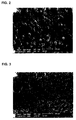
- the exposed ratio E in the present invention is defined by the above formula (1) and represents the ratio of the number e of the inorganic filaments with their cross-sections exposed, to the total number N of the inorganic filaments arranged in the pellet, on at least one end surface in the direction of the filaments of the long fiber-reinforced thermoplastic resin molding material in the form of pellets.
- the state of the inorganic filaments with their cross-sections exposed means the state where the cross-sections of the filaments are completely exposed without being covered by the resin, or the state where the resin is attached to only a part of the cross-sections of the filaments, and the peripheral portions of the filaments are exposed without being covered. Further, the state of the filaments at an end surface of the pellet, can be observed by means of a scanning electron microscope (SEM).
- SEM scanning electron microscope
- the cross-sections of the filaments are observed to have a circular or cylindrical shape in a state where the cross-sections of the filaments are completely exposed without being covered by the resin or in a state where the resin is attached to only a part of the cross-sections of the filaments, and the peripheral portions of the filaments are exposed without being covered.
- the cross-sections of the inorganic filaments are covered by the thermoplastic resin and are not exposed, no cross-sections of inorganic filaments are observed by observation by SEM.
- Figure 2 shows a scanning electron microscopic photograph with 200 magnifications showing an end surface of the long fiber-reinforced thermoplastic resin molding material of the present invention
- Figure 3 is a scanning electron microscopic photograph with 200 magnifications showing an end surface of the conventional long fiber-reinforced thermoplastic resin molding material.
- the inorganic filaments are covered with the resin so that the exposed ratio E of the cross-sections of the inorganic filaments is at most 60% on at least one end surface, whereby fine cracks are also covered to reduce cracks, and cracking of the molding material along the fibers, starting from the portions where the fibers are exposed at the end surface, scarcely takes place, and peeling of the fibers therefrom, is little. Accordingly, even at the time of transportation by a means such as an air stream, the inorganic filaments will not fall, and formation of fuzz scarcely takes place.
- the resin is adequately impregnated among the filaments constituting the bundle of inorganic filaments, so that void spaces are little, whereby the inorganic filaments will be uniformly dispersed in the thermoplastic resin as the matrix at the time of producing a long fiber-reinforced thermoplastic resin molded product by a method such as injection molding, and the mechanical properties of the molded product will be improved, and the appearance will be good.
- the above-mentioned exposed ratio E is preferably at most 30%.
- the above inorganic filaments are glass filaments, and the content of the filaments is from 50 to 90 wt%.
- the above-mentioned pellets are ones obtained by having a molten thermoplastic resin coated on or impregnated in a bundle of continuous inorganic filaments, then cutting the bundle in a predetermined length to obtain cut products, heating the cut products in a dispersed state at a temperature of at least the melting point of the thermoplastic resin, to melt the thermoplastic resin coated on or impregnated in the cut products, followed by cooling.
- an inorganic fiber bundle having a predetermined number of inorganic filaments bundled together.
- This inorganic fiber bundle may be one commonly used for a long fiber-reinforced thermoplastic resin molding material.
- the inorganic filaments constituting the inorganic fiber bundle those having a filament diameter of from 4 to 30 ⁇ m are preferably employed, and the number of filaments to be bundled is preferably from 100 to 20,000, so that a thermoplastic resin may easily be coated or impregnated to the fiber bundle. Further, a plurality of inorganic fiber bundles each having a relatively small number of bundled filaments, may be used by putting them together.
- binders are usually applied in order to improve the handling efficiency by suppressing formation of fuzz or static electricity during use, or in order to improve the adhesion of glass fibers to a thermoplastic resin as matrix.
- the type of such a binder may be suitably selected depending upon the type of the thermoplastic resin as matrix.
- the amount of the binder to be applied to the glass fibers is preferably from 0.1 to 3.0 wt%, to the glass fibers. If the amount is less than 0.1 wt%, it tends to be difficult to sufficiently improve the above-mentioned handling efficiency or adhesion. On the other hand, if it exceeds 3.0 wt%, the binder tends to hinder impregnation of the thermoplastic resin into filaments.
- Such a binder may usually comprise a coupling agent represented by a silane coupling agent such as aminosilane, epoxysilane or acrylsilane, and a polymer such as a vinyl acetate resin, a urethane resin, an acrylic resin, a polyester resin, a polyether resin, a phenoxy resin, a polyamide resin, an epoxy resin or a polyolefin resin, or its modified product, or an oligomer such as a wax represented by a polyolefin wax.
- a coupling agent represented by a silane coupling agent such as aminosilane, epoxysilane or acrylsilane
- a polymer such as a vinyl acetate resin, a urethane resin, an acrylic resin, a polyester resin, a polyether resin, a phenoxy resin, a polyamide resin, an epoxy resin or a polyolefin resin, or its modified product, or an oligomer such as a wax represented by a polyolefin
- the above polymer or oligomer is used usually in the form of an aqueous dispersion obtained by dispersing it in water by a surfactant, or in the form of an aqueous solution obtained by water-solubilization in water by neutralization or hydration of carboxyl groups or amide groups present in the polymer or oligomer structure.
- the above binder may contain, in addition to the above components, an antistatic agent represented by an inorganic salt such as lithium chloride or potassium iodide, or a quaternary ammonium salt of e.g. an ammonium chloride type or an ammonium ethylsulfate type, or a lubricant represented by a surfactant of an aliphatic ester type, an aliphatic ether type, an aromatic ester type or an aromatic ether type.
- an antistatic agent represented by an inorganic salt such as lithium chloride or potassium iodide, or a quaternary ammonium salt of e.g. an ammonium chloride type or an ammonium ethylsulfate type, or a lubricant represented by a surfactant of an aliphatic ester type, an aliphatic ether type, an aromatic ester type or an aromatic ether type.
- thermoplastic resin used as matrix in the present invention is not particularly limited, and it is possible to employ, for example, polyethylene, polypropylene, polyamide, polyethylene terephthalate, polybutylene terephthalate, polystyrene, a styrene-acrylonitrile copolymer, an acrylonitrile-butadiene-styrene copolymer, polyacetal, polyetherimide or polycarbonate.
- such resins may be used alone or in combination as a mixture of two or more of them, or a copolymer obtained by preliminarily copolymerizing two or more of them, may be employed.
- thermoplastic resin known additives such as a colorant, a modifier, and a filler other than inorganic fibers, may suitably be incorporated depending upon the particular application or molding conditions, and such additives may be used by mixing them with the resin in accordance with a conventional method.
- additives such as a colorant, a modifier, and a filler other than inorganic fibers
- the long fiber-reinforced thermoplastic resin molding material of the present invention is in the form of pellets having inorganic filaments arranged substantially in the same length and in parallel in the same direction in a matrix of the thermoplastic resin.
- "arranged substantially in the same length and in parallel in the same direction” means that the majority of inorganic filaments are arranged substantially in parallel with one another in the same direction, but a part of filaments may partially be curved or entangled with one another.
- the inorganic filaments are arranged with their cut cross-sections substantially uniformly disposed at the end surfaces in the direction of the filaments of each pellet.
- the exposed ratio E as defined above is at most 60%, whereby filaments with their cross-sections exposed are relatively small in number, whereby it is less likely that the molding material cracks along the fibers starting from the portions where the fibers are exposed, and the filaments are less susceptible to peeling.
- the exposed ratio E is preferably adjusted to be at most 30% in order to minimize formation of fuzz during e.g. transportation and to improve dispersion of inorganic filaments at the time of molding to obtain a molded product.
- thermoplastic resin is impregnated among filaments in pellets, whereby high dispersibility of fibers can be attained during molding, and excellent mechanical properties of a molded product can be obtained.
- the fiber content i.e. the content of inorganic filaments
- the fiber content is not particularly limited.
- the fiber content is preferably adjusted to be at least 50 wt%. Namely, when the fiber content is at least 50 wt%, problems such as a decrease in impregnation of the thermoplastic resin into the inorganic fiber bundle and formation of fuzz during e.g. transportation, are usually likely to occur By the present invention, however, even when the fiber content is at least 50 wt%, it is possible to improve the impregnation of the thermoplastic resin into the organic fiber bundle and to reduce formation of fuzz during e.g. transportation.
- the fiber content is preferably at most 90 wt%. If the fiber content exceeds 90 wt%, the thermoplastic resin component tends to be small relative to the inorganic fibers, whereby it tends to be difficult to make the exposed ratio E to be at most 60%.
- the length of the long fiber-reinforced thermoplastic resin molding material is not particularly limited, but it is preferably from 3 to 30 mm. If the length is less than 3 mm, fuzz is likely to form during preparation of pellets of the long fiber-reinforced thermoplastic resin molding material. If the length exceeds 30 mm, dispersion of fibers tends to be poor when molding is carried out by a method such as an injection molding method.
- the long fiber-reinforced thermoplastic resin molding material of the present invention can be produced, for example, by the process as shown in Figure 1.
- a molten thermoplastic resin 2 is supplied from an extruder 3, and the thermoplastic resin is impregnated to the inorganic fiber bundle 1.
- the inorganic fiber bundle 1 impregnated with the thermoplastic resin is withdrawn through a die 5, whereby an excess thermoplastic resin 2 is removed to obtain a prescribed fiber content, and at the same time, the bundle is shaped into a prescribed shape to obtain a long fiber-reinforced thermoplastic resin 6.
- the long fiber-reinforced thermoplastic resin 6 thus obtained is cooled in a cooling tank 7, withdrawn by a withdrawing machine 8 and cut into pellets by a pelletizer 9 to obtain cut products 10a.
- the process up to here is a process so-called a melt impregnation method which is the same as a conventional common process for producing a long fiber-reinforced thermoplastic resin molding material, and the cut products 10a correspond to a common conventional long fiber-reinforced thermoplastic resin molding material.
- the cut products 10a correspond to a common conventional long fiber-reinforced thermoplastic resin molding material.
- the end surfaces of the cut products 10a most of the cross-sections of inorganic filaments formed by cutting by means of the pelletizer 9, are exposed, and fine cracks are formed along fibers in the vicinity of the end surfaces by the impact at the time of cutting.
- the cut products 10a obtained as described above are then sent to a belt conveyor 11 installed in continuation from the pelletizer 9, and the belt conveyor 11 is vibrated by a vibrator not shown, so that the cut products 10a will be in a dispersed state substantially not to contact one another on the belt conveyor 11. Then, they are passed through a heating chamber 13 equipped with heaters 12 and heated to a temperature of at least the melting point of the thermoplastic resin 2.
- thermoplastic resin 2 impregnated in the cut products 10a is melted and oozes out at the end surfaces and the periphery of the cut products 10a to cover at least a part of the exposed inorganic fibers, and at the same time, penetrate among filaments constituting the inorganic fiber bundles in the cut products 10a.
- the cut products 10a are cooled by a cooler 14 and scraped from a belt conveyor 11 by a scraper 15 to obtain a long fiber-reinforced thermoplastic resin molding material 10b.
- This long fiber-reinforced thermoplastic resin molding material 10b has at least a part of the end surfaces covered with the thermoplastic resin 2, whereby the exposed ratio E of the cross-sections of inorganic filaments is at most 60%, and fine cracks formed during the cutting have almost disappeared.
- a sieve or other apparatus may be provided between the pelletizer 9 and the belt conveyor 11, or on the rear side of the belt conveyor 11, for removing defective products formed during the cutting, fallen filaments or powder dust.
- the state in which the cut products 10a are dispersed substantially not to contact one another on the belt conveyor 11, is meant for a state wherein the majority of the cut products can maintain the individually separated state without sticking to one another, when the thermoplastic resin coated on or impregnated in the cut products, is melted and then cooled.
- a method for transporting the cut products 10a to the heating chamber 13 may be a method other than the method by means of the belt conveyor 11.
- it may be a method of transporting them with a stream such as an air stream, or a method of permitting them to fall freely.
- it is preferred to preliminarily treat the surface of the belt conveyor 11 with e.g. a silicone resin or a fluorine resin, whereby scraping of the cut products from the belt conveyor 11 will be facilitated, when the thermoplastic resin 2 of the cut products 10a is heated and melted and then cooled to obtain a long fiber-reinforced thermoplastic resin molding material 10b.
- the heaters 12 for the heating chamber 13 are not particularly limited, but a hot air generator or an infrared heater may preferably be employed.
- the heating temperature and the heating time are the temperature and the time sufficient for the thermoplastic resin 2 impregnated in the cut products 10a to melt and cover the end surfaces and the periphery of the cut products 10a and penetrate among internal filaments, and preferably the temperature and the time at a level not to deteriorate the thermoplastic resin 2.
- the interior of the heating chamber 13 may be an atmosphere of air, but to prevent deterioration of the thermoplastic resin 2, it may be made to be an inert gas atmosphere such as nitrogen gas.
- the cooling method by a cooler 14 may be a method whereby the long fiber-reinforced thermoplastic resin molding material 10b can be cooled to at least a temperature at which the molding material does not fuse when recovered.
- a method of using cool air or cool water may be employed.
- cool air when cooling by a water tank as the cooling tank 7, is employed, it is preferred to use cool air for the cooler 14 in order to let the heating chamber 13 perform a step of removing (drying) water, since it is thereby unnecessary to provide a redrying step.
- a method of natural cooling at room temperature may be employed instead of the forcible cooling at the cooler 14.
- a melt impregnation method wherein a molten thermoplastic resin 2 is impregnated to the inorganic fiber bundle 1, was employed as a method for coating or impregnating a thermoplastic resin to a continuous inorganic fiber bundle 1.
- other methods may be employed. For example, it is possible to employ a method wherein an emulsion of a thermoplastic resin, a suspension having a thermoplastic resin powder dispersed in water or other liquid, or a resin solution having a thermoplastic resin dissolved in a solvent, is coated or impregnated to the inorganic fiber bundle, and then the dispersing medium or the solvent is removed.
- a method for coating or impregnating a method of using a roll coater or a curtain coater may be employed instead of the method of using an impregnation die.
- a method wherein a thermoplastic resin powder is applied to the inorganic fiber bundle, and then, if necessary, heated and melted, followed by cooling.
- it is preferred to employ the melt impregnation method since a drying or solvent-removal step is not required, and the cost is low.
- impregnation of the resin to the inorganic fiber bundle can be facilitated by the heating step of the cut products 10a, even without spreading the inorganic fiber bundle by exerting a tension by contacting the bundle with a protrusion or roller in the impregnation die to impregnate the resin, as required by the conventional technique.
- the inorganic fiber bundle may be cut into a prescribed length to obtain chopped strands, then, an emulsion or suspension of a thermoplastic resin may be coated on the chopped strands by a method such as spraying, followed by drying to obtain pellets, or a composite fiber bundle having inorganic fiber bundles and thermoplastic resin fiber bundles commingled, may be cut into chopped strands, and such pellets or chopped strands may be employed instead of the above-described cut products 10a.
- thermoplastic resin As a method for covering the end surfaces of the cut products 10a or the pellets with a thermoplastic resin to bring the exposed ratio E of the cross-sections of inorganic filaments to a level of at most 60%, it is possible to employ a method wherein an emulsion or suspension of a thermoplastic resin is applied to the cut products 10a or the pellets by a method such as spraying, followed by drying, a method wherein the cut products 10a or the pellets are dipped in an emulsion or suspension of a thermoplastic resin, followed by drying, or a method wherein a powder of a thermoplastic resin is applied to the cut products 10a or the pellets, followed by heating to fuse the powder.
- a method for covering the end surfaces of the cut products 10a or the pellets with a thermoplastic resin to bring the exposed ratio E of the cross-sections of inorganic filaments to a level of at most 60% it is possible to employ a method wherein an emulsion or suspension of a thermoplastic resin is applied to
- thermoplastic resin constituting the matrix of the cut products 10a or the pellets i.e. the thermoplastic resin impregnated to the inorganic fiber bundle, and the thermoplastic resin to be applied later to cover the end surfaces, may be the same resin, or different types of resins.
- thermoplastic resin molding material was prepared in accordance with the process described above along the production steps illustrated in Figure 1.
- the thermoplastic resin 2 a polypropylene resin was used, and as the impregnation die 4, the cooling tank 7, the withdrawing machine 8 and the pelletizer 9, conventional ones were used.
- the opening diameter of the die 5 at the outlet of the impregnation die 4 was 2.2 mm, and the withdrawing speed was 30 m/min.
- the cut products 10a were obtained with the cutting length of 6 mm at the pelletizer 9.
- the obtained cut products 10a were placed on the belt conveyor 11 having the surface treated with a fluorine resin, and the belt conveyor 11 was vibrated to disperse the cut products 10a so that they did not substantially contact one another.
- the cut products 10a were introduced into a heating chamber 13 at an atmosphere temperature of 200°C provided with heaters 12 which were infrared ray heaters and retained for 1 minute for heating. Then, they were cooled to about 40°C by blowing a cool air from the cooler 14 to which compressed air was supplied from an air compressor and then scraped from the belt conveyor 11 by a scraper 15, to obtain the long fiber-reinforced thermoplastic resin molding material 10b.
- This long fiber-reinforced thermoplastic resin molding material 10b had a glass fiber content of 51 wt%.
- thermoplastic resin molding material having a glass fiber content of 60 wt% was obtained by the same apparatus and conditions as in Example 1 except that in Example 1, as the continuous inorganic fiber bundle 1, one having put together 10 glass fiber bundles obtained by bundling 800 E glass filaments having a filament diameter of 13 ⁇ m and having the same binder applied, was used.
- thermoplastic resin molding material having a glass fiber content of 73 wt% was obtained by the same apparatus and conditions as in Example 1 except that in Example 1, as the continuous inorganic fiber bundle 1, one having put together 13 glass fiber bundles obtained by bundling 800 E glass filaments having a filament diameter of 13 ⁇ m and having the same binder applied, was used.
- thermoplastic resin molding material having a glass fiber content of 51 wt% was obtained by the same fiber bundle, thermoplastic resin, apparatus and conditions as in Example 1 except that in Example 1, the process up to obtaining the cut products 10a was carried out in the same manner, and the subsequent process including a step of heating the cut products 10a, was omitted.
- thermoplastic resin molding material having a glass fiber content of 60 wt% was obtained by the same fiber bundle, thermoplastic resin, apparatus and conditions as in Example 2 except that in Example 2, the process up to obtaining the cut products 10a was carried out in the same manner, and the subsequent process including the step of heating the cut products 10a, was omitted.
- thermoplastic resin molding material having a glass fiber content of 73 wt% was obtained by the same fiber bundle, thermoplastic resin, apparatus and conditions as in Example 3 except that in Example 3, the process up to obtaining the cut products 10a was carried out in the same manner, and the subsequent process including a step of heating the cut products 10a, was omitted.
- thermoplastic resin molding materials obtained in Examples 1 to 3 and Comparative Examples 1 to 3 were, respectively, mixed with the prescribed amounts of polypropylene, followed by injection molding to obtain test specimens.
- the state of dispersion of the glass fibers was visually observed, whereby a glass fiber bundle observed in a bundled state is regarded as a non-dispersed portion i.e. a portion where dispersion was poor, and the number of such bundles was counted and converted to a number per 100 cm 2 from the size of the test specimens. Further, as the mechanical properties of the respective test specimens, the tensile strength and the bending strength were measured in accordance with ASTM D638 and ASTM D790.
- thermoplastic resin molding materials obtained in Examples 1 to 3 and Comparative Examples 1 to 3 10 kg of each was transported for a distance of 3 m in a polyvinyl chloride tube with an inner diameter of 50 mm by a hopper loader ("BS-700", tradename, manufactured by Kato Riki K.K.), and fuzz formed during the transportation was collected by a metal net of 100 mesh provided at a suction inlet of the hopper loader, and the weight was measured.
- BS-700 tradename, manufactured by Kato Riki K.K.
- pellets optionally selected from each of the long fiber-reinforced thermoplastic resin molding materials obtained in Examples 1 to 3 and Comparative Examples 1 to 3 one end surface and the periphery of each was covered with a thermosetting unsaturated polyester resin to prevent falling of filaments or deformation of the pellet by washing, and the resin was cured. Then, the pellets were cleaned for 30 minutes by a ultrasonic cleaning machine to remove chips and foreign matters from the end surface which was not covered with the unsaturated polyester resin, and then dried to obtain samples for evaluation by inspection of the end surface of the molding material.
- the end surface which was not covered with the unsaturated polyester resin was observed by a scanning electron microscope (SEM), whereby the number (e) of glass filaments with their cross-sections exposed without being covered with a thermoplastic resin, was counted and its ratio i.e. the exposed ratio E, to the total number (N) of glass filaments contained in the molding material, was calculated. Then, an average value of the exposed ratios E of 10 pellets, was obtained.
- SEM scanning electron microscope
- the exposed ratio E of the inorganic filaments is adjusted to be at most 60% on at least one end surface in the direction of the filaments in each pellet, whereby it is possible to suppress falling of filaments from the material during e.g. transportation, to reduce formation of fuzz, to provide good dispersion of fibers in a molded product and to obtain excellent mechanical properties for the molded product.
Landscapes
- Engineering & Computer Science (AREA)
- Mechanical Engineering (AREA)
- Reinforced Plastic Materials (AREA)
- Processing And Handling Of Plastics And Other Materials For Molding In General (AREA)
- Processes Of Treating Macromolecular Substances (AREA)
Applications Claiming Priority (3)
| Application Number | Priority Date | Filing Date | Title |
|---|---|---|---|
| JP09259300A JP3100567B2 (ja) | 1997-09-08 | 1997-09-08 | 長繊維強化熱可塑性樹脂成形材料 |
| JP25930097 | 1997-09-08 | ||
| JP259300/97 | 1997-09-08 |
Publications (3)
| Publication Number | Publication Date |
|---|---|
| EP0900638A2 true EP0900638A2 (de) | 1999-03-10 |
| EP0900638A3 EP0900638A3 (de) | 1999-07-28 |
| EP0900638B1 EP0900638B1 (de) | 2001-12-05 |
Family
ID=17332170
Family Applications (1)
| Application Number | Title | Priority Date | Filing Date |
|---|---|---|---|
| EP98116662A Expired - Lifetime EP0900638B1 (de) | 1997-09-08 | 1998-09-03 | Langfaserverstärkte, thermoplastische Formmasse |
Country Status (4)
| Country | Link |
|---|---|
| US (1) | US6045912A (de) |
| EP (1) | EP0900638B1 (de) |
| JP (1) | JP3100567B2 (de) |
| DE (1) | DE69802759T2 (de) |
Cited By (5)
| Publication number | Priority date | Publication date | Assignee | Title |
|---|---|---|---|---|
| EP1375103A1 (de) * | 2002-06-21 | 2004-01-02 | Asahi Fiber Glass Company, Limited | Glasfaserverstärkte thermoplastische Harzpellets und Verfahren zu deren Herstellung |
| EP1932644A1 (de) * | 2006-12-13 | 2008-06-18 | Amandus Kahl GmbH & Co. KG | Verfahren und Vorrichtung zum Herstellen von Granulaten |
| WO2014118144A1 (en) * | 2013-02-01 | 2014-08-07 | Saudi Basic Industries Corporation | Methods for treatment and manufacture of pellets |
| WO2016062569A1 (en) * | 2014-10-23 | 2016-04-28 | Sabic Global Technologies B.V. | Method for transporting pellets, method for manufacturing pellets, and method for the manufacture of a modulded product from pellets |
| WO2016091686A1 (en) * | 2014-12-08 | 2016-06-16 | Sabic Global Technologies B.V. | Process for the manufacture of glass fibre reinforced pellets |
Families Citing this family (12)
| Publication number | Priority date | Publication date | Assignee | Title |
|---|---|---|---|---|
| US6066395A (en) * | 1997-05-23 | 2000-05-23 | Toray Industries, Inc. | Chopped carbon fibers and a production process there of |
| DE19929301A1 (de) * | 1999-06-25 | 2000-12-28 | Basf Ag | Aus mit Epoxypolymeren vorbehandelten glasfaserverstärkten Formteilen geschweißte Verbunde |
| JP2003049002A (ja) * | 2001-08-02 | 2003-02-21 | Ube Nitto Kasei Co Ltd | 長繊維強化熱可塑性樹脂ペレット並びにその製造方法及び製造装置 |
| US7000932B2 (en) | 2001-11-02 | 2006-02-21 | Ventra Group Inc. | Automotive vehicle polymeric running board |
| US7060155B2 (en) | 2002-12-24 | 2006-06-13 | Owens Corning Fiberglas Technology, Inc. | Method and apparatus for soft skin encapsulation |
| DE102004026493A1 (de) * | 2004-05-27 | 2006-04-13 | Pavlinec, Jan O. P. | Verfahren zur Herstellung von faserhaltigen Kunststoffgranulaten |
| JP2008544885A (ja) * | 2005-07-07 | 2008-12-11 | ダウ グローバル テクノロジーズ インコーポレイティド | 長繊維強化熱可塑性コンセントレート及びその製造方法 |
| US20080118728A1 (en) | 2006-10-20 | 2008-05-22 | Dow Global Technologies Inc. | Aqueous dispersions disposed on glass-based fibers and glass-containing substrates |
| ES2376076T3 (es) * | 2007-12-21 | 2012-03-08 | Saudi Basic Industries Corporation | Procedimiento para producir composiciones termopl�?sticas reforzadas con fibra de vidrio larga. |
| FR3027546B1 (fr) * | 2014-10-24 | 2017-07-21 | Porcher Ind | Meches poudrees par procede electrostatique |
| KR101952621B1 (ko) * | 2015-01-07 | 2019-02-28 | (주)엘지하우시스 | 섬유 강화 복합재 및 이의 제조방법 |
| EP4611972A1 (de) * | 2022-10-31 | 2025-09-10 | SABIC Global Technologies B.V. | Faserverstärkte thermoplastische polymerzusammensetzung |
Family Cites Families (7)
| Publication number | Priority date | Publication date | Assignee | Title |
|---|---|---|---|---|
| JPS5210140A (en) * | 1975-07-14 | 1977-01-26 | Canon Inc | Electrophotographic toner |
| US4067942A (en) * | 1976-02-23 | 1978-01-10 | Phillips Petroleum Company | Heat treatment of resinous block copolymer to improve clarity |
| US4439387A (en) * | 1979-09-13 | 1984-03-27 | Polymer Composites, Inc. | Method of manufacturing a composite reinforcing structure |
| FR2613661B1 (fr) * | 1987-04-09 | 1989-10-06 | Atochem | Procede de fabrication de profiles de resine thermoplastique renforces de fibres continues, appareillage pour leur obtention |
| JPH06254856A (ja) * | 1993-03-02 | 1994-09-13 | Kobe Steel Ltd | 長繊維強化合成樹脂ストランドの製造方法 |
| JP3437651B2 (ja) * | 1994-08-03 | 2003-08-18 | 住友化学工業株式会社 | ペレット状長繊維強化樹脂構造物の製造方法 |
| JP3584065B2 (ja) * | 1994-09-12 | 2004-11-04 | 住友化学工業株式会社 | 長繊維強化樹脂構造物の製造装置及び製造方法 |
-
1997
- 1997-09-08 JP JP09259300A patent/JP3100567B2/ja not_active Expired - Fee Related
-
1998
- 1998-09-02 US US09/145,614 patent/US6045912A/en not_active Expired - Fee Related
- 1998-09-03 EP EP98116662A patent/EP0900638B1/de not_active Expired - Lifetime
- 1998-09-03 DE DE69802759T patent/DE69802759T2/de not_active Expired - Fee Related
Cited By (10)
| Publication number | Priority date | Publication date | Assignee | Title |
|---|---|---|---|---|
| EP1375103A1 (de) * | 2002-06-21 | 2004-01-02 | Asahi Fiber Glass Company, Limited | Glasfaserverstärkte thermoplastische Harzpellets und Verfahren zu deren Herstellung |
| US6911259B2 (en) | 2002-06-21 | 2005-06-28 | Asahi Fiber Glass Company, Limited | Glass fiber-reinforced thermoplastic resin pellets and their production process |
| EP1932644A1 (de) * | 2006-12-13 | 2008-06-18 | Amandus Kahl GmbH & Co. KG | Verfahren und Vorrichtung zum Herstellen von Granulaten |
| WO2014118144A1 (en) * | 2013-02-01 | 2014-08-07 | Saudi Basic Industries Corporation | Methods for treatment and manufacture of pellets |
| CN105189074A (zh) * | 2013-02-01 | 2015-12-23 | 沙特基础工业公司 | 用于处理和制备丸粒的方法 |
| CN105189074B (zh) * | 2013-02-01 | 2019-02-15 | 沙特基础工业公司 | 用于处理和制备丸粒的方法 |
| US10828802B2 (en) | 2013-02-01 | 2020-11-10 | Sabic Global Technologies B.V. | Methods for treatment and manufacture of pellets |
| WO2016062569A1 (en) * | 2014-10-23 | 2016-04-28 | Sabic Global Technologies B.V. | Method for transporting pellets, method for manufacturing pellets, and method for the manufacture of a modulded product from pellets |
| WO2016091686A1 (en) * | 2014-12-08 | 2016-06-16 | Sabic Global Technologies B.V. | Process for the manufacture of glass fibre reinforced pellets |
| US10486335B2 (en) | 2014-12-08 | 2019-11-26 | Sabic Global Technologies B.V. | Process for the manufacture of glass fibre reinforced pellets |
Also Published As
| Publication number | Publication date |
|---|---|
| JPH1177676A (ja) | 1999-03-23 |
| EP0900638A3 (de) | 1999-07-28 |
| JP3100567B2 (ja) | 2000-10-16 |
| DE69802759D1 (de) | 2002-01-17 |
| US6045912A (en) | 2000-04-04 |
| DE69802759T2 (de) | 2002-08-08 |
| EP0900638B1 (de) | 2001-12-05 |
Similar Documents
| Publication | Publication Date | Title |
|---|---|---|
| EP0900638B1 (de) | Langfaserverstärkte, thermoplastische Formmasse | |
| EP0994978B1 (de) | Nichtwässrige schlichte für glasfasern und spritzgussfähige polymere | |
| KR101578236B1 (ko) | 긴 유리섬유 강화된 열가소성 조성물의 생산방법 | |
| JP3934682B2 (ja) | ガラス繊維ペレットを製造するための装置 | |
| KR100628017B1 (ko) | 폴리머로 피막된 유리섬유 입상체의 제조장치 | |
| US5868982A (en) | System for preparing glass fiber pellets | |
| JPS5836950A (ja) | ガラス繊維処理用水性組成物およびそれで処理されたガラス繊維 | |
| US6399198B1 (en) | Nonaqueous sizing system for glass fibers and injection moldable polymers | |
| JP2001129827A (ja) | 長繊維ペレットおよびその製造方法ならびにその製造装置 | |
| JP3899263B2 (ja) | ガラス長繊維強化熱可塑性樹脂成形材料の製造方法 | |
| JP2985788B2 (ja) | 長繊維強化熱可塑性樹脂成形材料の製造法 | |
| JP3639236B2 (ja) | 形態の優れた炭素繊維チョップ | |
| JP2008540306A (ja) | 高ガラス含有率を有するガラスストランド顆粒のためのサイジング組成物 | |
| KR100508223B1 (ko) | 유리섬유펠릿을제조하기위한장치 | |
| JP2003191236A (ja) | 長繊維強化熱可塑性樹脂成形材料用ガラス繊維および該ガラス繊維を用いた長繊維強化熱可塑性樹脂成形材料 | |
| JPH05261730A (ja) | 形態の優れた炭素繊維チョップ及びその製造方法 | |
| JPH05261698A (ja) | ロービングカッター | |
| JP2020090611A (ja) | 樹脂含有繊維束およびその製造方法における品質管理方法 | |
| MXPA00000271A (en) | Nonaqueous sizing system for glass fibers and injection moldable polymers | |
| JPH10101813A (ja) | ガラス繊維チョップドストランドマット | |
| JPH01306680A (ja) | 集束された補強用繊維及び短繊維チップの製造法 |
Legal Events
| Date | Code | Title | Description |
|---|---|---|---|
| PUAI | Public reference made under article 153(3) epc to a published international application that has entered the european phase |
Free format text: ORIGINAL CODE: 0009012 |
|
| AK | Designated contracting states |
Kind code of ref document: A2 Designated state(s): DE FR GB |
|
| AX | Request for extension of the european patent |
Free format text: AL;LT;LV;MK;RO;SI |
|
| PUAL | Search report despatched |
Free format text: ORIGINAL CODE: 0009013 |
|
| AK | Designated contracting states |
Kind code of ref document: A3 Designated state(s): AT BE CH CY DE DK ES FI FR GB GR IE IT LI LU MC NL PT SE |
|
| AX | Request for extension of the european patent |
Free format text: AL;LT;LV;MK;RO;SI |
|
| 17P | Request for examination filed |
Effective date: 19990923 |
|
| AKX | Designation fees paid |
Free format text: DE FR GB |
|
| 17Q | First examination report despatched |
Effective date: 20000405 |
|
| GRAG | Despatch of communication of intention to grant |
Free format text: ORIGINAL CODE: EPIDOS AGRA |
|
| GRAG | Despatch of communication of intention to grant |
Free format text: ORIGINAL CODE: EPIDOS AGRA |
|
| GRAH | Despatch of communication of intention to grant a patent |
Free format text: ORIGINAL CODE: EPIDOS IGRA |
|
| GRAH | Despatch of communication of intention to grant a patent |
Free format text: ORIGINAL CODE: EPIDOS IGRA |
|
| GRAA | (expected) grant |
Free format text: ORIGINAL CODE: 0009210 |
|
| AK | Designated contracting states |
Kind code of ref document: B1 Designated state(s): DE FR GB |
|
| REG | Reference to a national code |
Ref country code: GB Ref legal event code: IF02 |
|
| REF | Corresponds to: |
Ref document number: 69802759 Country of ref document: DE Date of ref document: 20020117 |
|
| PLBE | No opposition filed within time limit |
Free format text: ORIGINAL CODE: 0009261 |
|
| STAA | Information on the status of an ep patent application or granted ep patent |
Free format text: STATUS: NO OPPOSITION FILED WITHIN TIME LIMIT |
|
| 26N | No opposition filed | ||
| REG | Reference to a national code |
Ref country code: GB Ref legal event code: 732E |
|
| REG | Reference to a national code |
Ref country code: FR Ref legal event code: TP |
|
| PGFP | Annual fee paid to national office [announced via postgrant information from national office to epo] |
Ref country code: FR Payment date: 20080915 Year of fee payment: 11 |
|
| PGFP | Annual fee paid to national office [announced via postgrant information from national office to epo] |
Ref country code: GB Payment date: 20080903 Year of fee payment: 11 |
|
| PGFP | Annual fee paid to national office [announced via postgrant information from national office to epo] |
Ref country code: DE Payment date: 20080919 Year of fee payment: 11 |
|
| GBPC | Gb: european patent ceased through non-payment of renewal fee |
Effective date: 20090903 |
|
| REG | Reference to a national code |
Ref country code: FR Ref legal event code: ST Effective date: 20100531 |
|
| PG25 | Lapsed in a contracting state [announced via postgrant information from national office to epo] |
Ref country code: FR Free format text: LAPSE BECAUSE OF NON-PAYMENT OF DUE FEES Effective date: 20090930 Ref country code: DE Free format text: LAPSE BECAUSE OF NON-PAYMENT OF DUE FEES Effective date: 20100401 |
|
| PG25 | Lapsed in a contracting state [announced via postgrant information from national office to epo] |
Ref country code: GB Free format text: LAPSE BECAUSE OF NON-PAYMENT OF DUE FEES Effective date: 20090903 |