EP0900672B1 - Verfahren zum Lackieren von verschiedenen Gegenständen unter Verwendung von Pulverlacken, durch das Verfahren hergestellte lackierte Produkte und zugehörige Vorrichtung - Google Patents
Verfahren zum Lackieren von verschiedenen Gegenständen unter Verwendung von Pulverlacken, durch das Verfahren hergestellte lackierte Produkte und zugehörige Vorrichtung Download PDFInfo
- Publication number
- EP0900672B1 EP0900672B1 EP98114770A EP98114770A EP0900672B1 EP 0900672 B1 EP0900672 B1 EP 0900672B1 EP 98114770 A EP98114770 A EP 98114770A EP 98114770 A EP98114770 A EP 98114770A EP 0900672 B1 EP0900672 B1 EP 0900672B1
- Authority
- EP
- European Patent Office
- Prior art keywords
- powder
- paint
- peening
- process according
- beads
- Prior art date
- Legal status (The legal status is an assumption and is not a legal conclusion. Google has not performed a legal analysis and makes no representation as to the accuracy of the status listed.)
- Expired - Lifetime
Links
- 239000000843 powder Substances 0.000 title claims abstract description 116
- 239000003973 paint Substances 0.000 title claims abstract description 85
- 238000000034 method Methods 0.000 title claims abstract description 51
- 230000008569 process Effects 0.000 title claims abstract description 51
- 238000010422 painting Methods 0.000 title claims abstract description 26
- 239000000463 material Substances 0.000 claims abstract description 43
- 238000010304 firing Methods 0.000 claims abstract description 15
- 238000002360 preparation method Methods 0.000 claims abstract description 5
- 238000005238 degreasing Methods 0.000 claims abstract description 3
- 239000011324 bead Substances 0.000 claims description 27
- 238000000576 coating method Methods 0.000 claims description 26
- 239000002245 particle Substances 0.000 claims description 25
- 239000000203 mixture Substances 0.000 claims description 15
- 238000011084 recovery Methods 0.000 claims description 10
- 229920001169 thermoplastic Polymers 0.000 claims description 10
- 239000004416 thermosoftening plastic Substances 0.000 claims description 10
- 229920001187 thermosetting polymer Polymers 0.000 claims description 8
- 239000011521 glass Substances 0.000 claims description 7
- 238000012216 screening Methods 0.000 claims description 4
- 239000004411 aluminium Substances 0.000 claims description 3
- 229910052782 aluminium Inorganic materials 0.000 claims description 3
- XAGFODPZIPBFFR-UHFFFAOYSA-N aluminium Chemical compound [Al] XAGFODPZIPBFFR-UHFFFAOYSA-N 0.000 claims description 3
- 230000001680 brushing effect Effects 0.000 claims description 3
- 238000002203 pretreatment Methods 0.000 claims description 3
- 238000005488 sandblasting Methods 0.000 claims description 3
- 229910000838 Al alloy Inorganic materials 0.000 claims description 2
- 229910000851 Alloy steel Inorganic materials 0.000 claims description 2
- 229910000906 Bronze Inorganic materials 0.000 claims description 2
- 229910000831 Steel Inorganic materials 0.000 claims description 2
- 239000010974 bronze Substances 0.000 claims description 2
- 238000006243 chemical reaction Methods 0.000 claims description 2
- KUNSUQLRTQLHQQ-UHFFFAOYSA-N copper tin Chemical compound [Cu].[Sn] KUNSUQLRTQLHQQ-UHFFFAOYSA-N 0.000 claims description 2
- 238000004519 manufacturing process Methods 0.000 claims description 2
- 230000003647 oxidation Effects 0.000 claims description 2
- 238000007254 oxidation reaction Methods 0.000 claims description 2
- 239000002904 solvent Substances 0.000 claims description 2
- 239000010959 steel Substances 0.000 claims description 2
- 239000000126 substance Substances 0.000 claims description 2
- 238000009423 ventilation Methods 0.000 claims description 2
- 230000000379 polymerizing effect Effects 0.000 claims 1
- 238000010438 heat treatment Methods 0.000 abstract description 4
- 238000005406 washing Methods 0.000 abstract 1
- 239000011248 coating agent Substances 0.000 description 12
- 239000000919 ceramic Substances 0.000 description 5
- 238000002844 melting Methods 0.000 description 4
- 230000008018 melting Effects 0.000 description 4
- 239000002184 metal Substances 0.000 description 4
- 229910052751 metal Inorganic materials 0.000 description 4
- PNEYBMLMFCGWSK-UHFFFAOYSA-N Alumina Chemical compound [O-2].[O-2].[O-2].[Al+3].[Al+3] PNEYBMLMFCGWSK-UHFFFAOYSA-N 0.000 description 3
- 230000000694 effects Effects 0.000 description 3
- 239000012530 fluid Substances 0.000 description 3
- 239000004033 plastic Substances 0.000 description 3
- 238000010433 powder painting Methods 0.000 description 3
- 229920005989 resin Polymers 0.000 description 3
- 239000011347 resin Substances 0.000 description 3
- XEEYBQQBJWHFJM-UHFFFAOYSA-N Iron Chemical compound [Fe] XEEYBQQBJWHFJM-UHFFFAOYSA-N 0.000 description 2
- 239000004809 Teflon Substances 0.000 description 2
- 229920006362 Teflon® Polymers 0.000 description 2
- 238000004132 cross linking Methods 0.000 description 2
- 238000000151 deposition Methods 0.000 description 2
- 235000012438 extruded product Nutrition 0.000 description 2
- 239000000049 pigment Substances 0.000 description 2
- 239000004848 polyfunctional curative Substances 0.000 description 2
- 239000000758 substrate Substances 0.000 description 2
- 229910001369 Brass Inorganic materials 0.000 description 1
- 229910001018 Cast iron Inorganic materials 0.000 description 1
- 239000004593 Epoxy Substances 0.000 description 1
- 239000002033 PVDF binder Substances 0.000 description 1
- 239000003082 abrasive agent Substances 0.000 description 1
- 239000000654 additive Substances 0.000 description 1
- 230000004888 barrier function Effects 0.000 description 1
- 239000010951 brass Substances 0.000 description 1
- 239000004568 cement Substances 0.000 description 1
- 239000004020 conductor Substances 0.000 description 1
- 238000001816 cooling Methods 0.000 description 1
- 230000007797 corrosion Effects 0.000 description 1
- 238000005260 corrosion Methods 0.000 description 1
- 230000008021 deposition Effects 0.000 description 1
- 230000005684 electric field Effects 0.000 description 1
- 238000004924 electrostatic deposition Methods 0.000 description 1
- 238000005516 engineering process Methods 0.000 description 1
- 238000001125 extrusion Methods 0.000 description 1
- 239000000945 filler Substances 0.000 description 1
- 238000001914 filtration Methods 0.000 description 1
- 230000005484 gravity Effects 0.000 description 1
- 239000004519 grease Substances 0.000 description 1
- 230000006698 induction Effects 0.000 description 1
- 229910052742 iron Inorganic materials 0.000 description 1
- 238000003475 lamination Methods 0.000 description 1
- 238000011068 loading method Methods 0.000 description 1
- 238000002156 mixing Methods 0.000 description 1
- 230000004048 modification Effects 0.000 description 1
- 238000012986 modification Methods 0.000 description 1
- 239000003960 organic solvent Substances 0.000 description 1
- 229920000728 polyester Polymers 0.000 description 1
- 229920002981 polyvinylidene fluoride Polymers 0.000 description 1
- 238000000926 separation method Methods 0.000 description 1
- 238000003892 spreading Methods 0.000 description 1
- 230000007480 spreading Effects 0.000 description 1
- 230000003068 static effect Effects 0.000 description 1
- 238000003860 storage Methods 0.000 description 1
- 239000000725 suspension Substances 0.000 description 1
- 229920005992 thermoplastic resin Polymers 0.000 description 1
Images

Classifications
-
- B—PERFORMING OPERATIONS; TRANSPORTING
- B05—SPRAYING OR ATOMISING IN GENERAL; APPLYING FLUENT MATERIALS TO SURFACES, IN GENERAL
- B05D—PROCESSES FOR APPLYING FLUENT MATERIALS TO SURFACES, IN GENERAL
- B05D1/00—Processes for applying liquids or other fluent materials
- B05D1/02—Processes for applying liquids or other fluent materials performed by spraying
- B05D1/12—Applying particulate materials
-
- B—PERFORMING OPERATIONS; TRANSPORTING
- B05—SPRAYING OR ATOMISING IN GENERAL; APPLYING FLUENT MATERIALS TO SURFACES, IN GENERAL
- B05D—PROCESSES FOR APPLYING FLUENT MATERIALS TO SURFACES, IN GENERAL
- B05D5/00—Processes for applying liquids or other fluent materials to surfaces to obtain special surface effects, finishes or structures
- B05D5/06—Processes for applying liquids or other fluent materials to surfaces to obtain special surface effects, finishes or structures to obtain multicolour or other optical effects
- B05D5/061—Special surface effect
-
- B—PERFORMING OPERATIONS; TRANSPORTING
- B44—DECORATIVE ARTS
- B44D—PAINTING OR ARTISTIC DRAWING, NOT OTHERWISE PROVIDED FOR; PRESERVING PAINTINGS; SURFACE TREATMENT TO OBTAIN SPECIAL ARTISTIC SURFACE EFFECTS OR FINISHES
- B44D2/00—Special techniques in artistic painting or drawing, e.g. oil painting, water painting, pastel painting, relief painting
-
- B—PERFORMING OPERATIONS; TRANSPORTING
- B44—DECORATIVE ARTS
- B44D—PAINTING OR ARTISTIC DRAWING, NOT OTHERWISE PROVIDED FOR; PRESERVING PAINTINGS; SURFACE TREATMENT TO OBTAIN SPECIAL ARTISTIC SURFACE EFFECTS OR FINISHES
- B44D3/00—Accessories or implements for use in connection with painting or artistic drawing, not otherwise provided for; Methods or devices for colour determination, selection, or synthesis, e.g. use of colour tables
Definitions
- the present invention relates to a process for painting with powder paints various objects and artefacts, made of materials either conductive or non conductive, such as metal, glass, ceramic and like materials.
- the invention also relates to the so obtained painted products and the apparatus for carrying out said process.
- powder paints are produced by mixing the semi-fluid state resins in a one or double-screw extruder together with hardeners, pigments and the most suitable additives.
- the scales are ground by a mechanical system (for instance, a pin type mill) until a powder is obtained having a controlled particle size.
- a mechanical system for instance, a pin type mill
- the average particle size of the powders obtained by the aforesaid process is usually comprised between 10 and 100 ⁇ (preferably, between 40 and 80 ⁇ ), as greater or smaller size powder particles may create severe application problems that cause the application process to be not economical.
- thermoplastic or thermosetting powder paints takes place by an electrostatic process or by pre-heating the object.
- Electrostatic painting takes place by electrically charging the powder particles by means of the electric field generated by an electrode and a high-voltage generator, or by triboelectricity due to the rubbing of the powder particles on surfaces of suitable materials.
- the object to be painted must be a good earthen conductor; in this case, the electrostatically charged powder particles adhere to the object to be painted, coating it uniformly until the deposited layer prevents a further deposition by electrically insulating the object.
- Another commonly used system is heat-painting which takes place by pre-heating the object to be painted to a temperature sufficiently high to allow the start of the melting of the powder paint.
- powder paints having an average particle size of about 40-80 ⁇ , and controllable paint thicknesses of about 50-60 ⁇ in the case of electrostatic system or higher than 100 ⁇ , up to some hundred microns in the case of heat-painting.
- a final firing is usually provided, for instance with hot air for fixed times (180-200°C for 20 min), to stabilise the finishing following the resin cross-linking with hardeners in the case of thermosetting powders.
- thermoplastic powders instead, for thermoplastic powders, a firing temperature proportional to the melting point of the thermoplastic resin used is necessary.
- GB-A-2 194 178 which consists in bombarding with an air gun, on smooth plastic materials or ceramics, a mixture of dry powder paint and of fine abrasive material, such as aluminium oxide powder.
- Another object of the invention is to provide a powder painting process allowing to obtain paint layers of any desired thickness, from thicknesses lower than 10 ⁇ to some hundred microns, homogeneous and with a perfectly controlled final thickness, and allowing also to realise multilayer coatings and/or mixed coatings.
- a further object of the invention is to provide objects or artefacts powder painted to low paint thicknesses, even lower than 10 ⁇ , but coating completely and without solution of continuity the surface to be painted.
- Another object is to provide an apparatus allowing to carry out such process.
- said paint powder is intimately pre-mixed with said peening powder material and the so obtained mixture is projected against the surface to be painted by compressed air, centrifugal rotors or the like.
- the compressed air used is dry, separated from oil, and at a pressure comprised between 1 and 50 atm, preferably between 6 and 10 atm.
- said peening material has substantially the shape of beads having a diameter comprised between 10 ⁇ and 500 ⁇ , preferably between 100 ⁇ and 200 ⁇ , and a specific weight greater than the specific weight of the particles of the paint powder to be applied to the surface to be painted.
- Said peening powder material is constituted by beads preferably from glass, steel, bronze or other materials known and utilisable to carry out peening, according to the type of powder paint used and/or the material which the artefact to be painted is made from.
- the powder paint to be applied has a specific weight lower than 2,45 and a particle size comprised between 1 and 300 ⁇ , preferably between 10 ⁇ and 100 ⁇ ;
- the peening particles are substantially spherical, made from glass, and have a specific weight higher than 2,45 and a harness of at least 5,5 Mohs and a diameter comprised between 10 ⁇ and 500 ⁇ , preferably between 100 ⁇ and 200 ⁇ .
- the particles may be also from metal or other materials, provided they have a specific weight higher than that of the powder to be applied, for instance alloy steel with a specific weight higher than 5,585 and a diameter comprised between 10 ⁇ and 500 ⁇ , preferably between 100 ⁇ and 200 ⁇ .
- the weight ratio between said paint powder and said peening material in said mixture is comprised between 1:100 and 50:100, preferably between 5:100 and 30:100.
- the powder overspray and said peening material are suitably collected, separated from one another by screening, ventilation or the like, and re-used in said application step.
- a further surface pre-treatment step consisting in a chemical conversion according to known means or anodic oxidation may be advantageously introduced between said surface preparation step and said powder paint layer application step.
- the powder particles are adhered to the support by mechanically supplied energy.
- the powder particles are squashed on the surface to be coated while being at the same time partly melt by the heat generated by the impact.
- any type of powder paint may be used by the process according to the invention to produce coatings ready for firing, with thicknesses ranging from a few microns to hundreds microns.
- the powder yield may reach 90-95%, while treatment times may range from a few seconds to some minutes.
- a particular characteristic of the process is the possibility of realising multilayer coatings or homogeneous coatings starting from powder mixtures.
- thermosetting and thermoplastic powders may be sequentially used for multilayer coatings or in admixture for mixed coatings.
- the co-deposition coatings are acquiring an always increasing acceptance as they may be easily adapted to the most different problems of protection against corrosion, modification of surface properties or also only to ensure a better adhesion to a finishing coat.
- the process according to the invention can be adapted to the continuous treatment of either long objects such as tubes or extruded products or flat surfaces such as sheets and coils.
- the process may be used for metal parts from iron, cast iron, brass or aluminium, in the form of cast, extruded or laminated objects.
- oil-, grease or oxide-dirt parts are cleaned before the pre-treatment with organic solvents, alkaline degreasers, mechanical brushing or sandblasting.
- the shape and composition of the peening material affects both the effectiveness of the process and the quality of the coating and its cost.
- the particles of said material are generally spherical, as they ensure in this manner a better spreading effect of the paint powder on the surfaces to be painted, have a better resistance to impact and therefore a longer average life.
- the sizes of holes, cavities and internal radiuses of the parts to be treated determine the shape and size of the peening material. Generally, one or two different mixtures are sufficient to treat the majority of objects.
- the mixture transported by compressed air is projected or sprayed through a suitable dispenser on the surfaces to be coated and therefore all what does not reach the target is collected on the bottom of the painting cabin.
- the mixture recovered from the bottom of the cabin in conveyed to a sieve which separates the two fractions, sending them to the respective storage tanks.
- a conventional fluid bed tank or a vibrating or mechanically stirred tank is used to mix the recovered powder and the fresh powder to be conveyed to the application dispenser, while for the peening material a feed-valve pressure tank is preferably used.
- the percent peening powder included in the mixture to be sprayed depends on the surface to be coated, the process time and the final thickness desired. Amount of powder necessary to obtain a known coating thickness on a pre-defined area type of powder specific weight and powder weight in g/ ⁇ /m 2 epoxy with pigments and fillers 1.7 transparent polyester 1.3 Teflon 2.2
- One of the main advantages of the process according to the invention lies in that the thickness of the coating may be rendered partly independent on the treatment time by suitably controlling the percent peening powder added to the mixture.
- a mixture containing 10% painting powder and 90% peening powder by volume, projected by a 6 bar compressed air gun, at a distance of 20 cm from the object to be treated, can cover 1 dm 2 of surface with 10 ⁇ of paint in less than 2 minutes.
- multilayer coatings may be obtained wherein the different powders spread into each other, so as to ensure after the firing the best possible adhesion.
- This characteristic is particularly important when Teflon or PVDF powders are used which usually wet the substrate only slightly and have therefore a poor adhesion.
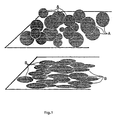
- the coating morphology or structure obtained by the process according to the invention seem generally rather different relatively to those known for powder paints.
- the coating appears to be constituted by discrete powder particles, which however are molten one on top of the other and smashed on the surface of the object to be painted, by effect of the impact of the peening powder, until a continuous structure is obtained.
- This flat particle structure is particularly interesting as it allows to obtain very thin continuous layers also starting from painting powders having a markedly higher average diameter.
- the coating may show different properties according to the firing type chosen.
- the parameters chosen for the firing are such as to ensure a good cross-linking of the thermosetting component of the coating - without however reaching the melting temperature of the thermoplastic component - uniformity cannot be as good as it is in the case of a firing temperature higher than the melting temperature of the thermoplastic component.
- An apparatus for carrying out the process according to the present invention comprises:
- the operating parameter of the process are bound to the characteristics of the painting product and the peening material used.
- Compressed air is used within a range of between 2 and 10 bar, and a gun can deliver 40 to 50 kg product per hour (about 8-10 kg product per hour).
- the dispenser may be fixed, oscillating or mounted on pump bobs.
- the overspray problem is not as important as in conventional painting systems with powder paints, as the dispensers are much nearer to the objects to be treated and the cloud size is much more reduced.
- an overspray recovery system with final filtration is necessary to reduce any type of pollution of air exiting the application cabin.
- the dosage of the flow of said two powders is made independently from one another and therefore their mutual rate may be suitably adjusted according to need.
- the storing tanks for the paint powder and the peening material may be fed either fresh products or recovery products coming from the overspray collected in the application cabin, said collected overspray being conveyed to a mechanical screening using a screen having suitably sized meshes, so as to separate the recovery powder paint from the peening beads,
- the object to be painted is kept in a painting cabin at a distance from the dispenser comprised between 10 and 1000 mm, preferably between 100 and 200 mm.
- both fresh powder and overspray recovery powder coming from the painting cabin are stored. Paint is conveyed to dispenser 3 by means of the pneumatic transport system 2. Bead peening powder is stored in the pressurised container/tank 4, which is provided with feed and exhaust valve. Through the pneumatic transport system 5, the peening material is conveyed to the spray-type dispenser 3, which combines the flow of both materials in a uniform cloud 9 transported at the pre-fixed speed by means of compressed air and projected against surface 10 of the object to be painted, contained within the painting cabin 7.
- a recovery device consisting of a vibrating sieve 8 that provides to separating the powder paint that has not been utilised from beads; the non utilised paint and the beads are conveyed by gravity to the respective storing tanks.
- a rotary valve 11 As bead tank is pressurised, feeding is through a rotary valve 11.
- a control board with a mechanical or electronic programmer (not shown in the figure) is also provided which allows to pre-fix work and time conditions.
- the working cycle comprises the following steps:
Landscapes
- Application Of Or Painting With Fluid Materials (AREA)
- Paints Or Removers (AREA)
Claims (19)
- Verfahren zum Lackieren von verschiedenen Gegenständen unter Verwendung von Pulverlacken, umfassend die folgenden Schritte:dadurch gekennzeichnet, dass es den weiteren Schritt einer Brennbehandlung und/oder Polymerisierens der auf diese Weise aufgetragenen Pulverlackschicht bei einer geeigneten Temperatur mittels Hitze, Strahlung oder dergleichen umfasst.Vorbereitung der Oberfläche des Gegenstandes für die Lackierung durch Entfetten mit geeigneten Lösungsmitteln, Bürsten, Sandstrahlen oder dergleichen gemäß bekannten Verfahren und als Funktion der letztendlich geforderten Gebrauchseigenschaften;Auftragen von zumindest einer Schicht Pulverlack auf die zu lackierende Oberfläche, das durch druckbeaufschlagtes Aufsprühen des genannten Pulverlackes in Verbindung mit einem Pulvermaterial erfolgt, welches im wesentlichen ein Aufprallmaterial ist;
- Verfahren nach Anspruch 1, dadurch gekennzeichnet, dass das genannte Lackpulver innig mit dem genannten Aufprallmaterialpulver vorgemischt wird und dass die auf diese Weise entstandene Mischung auf die zu lackierende Oberfläche mittels Druckluft, Zentrifugenrotoren und dergleichen gespritzt wird.
- Verfahren nach Anspruch 1, dadurch gekennzeichnet, dass die genannte Druckluft trocken und/oder entölt ist und dass deren Druck zwischen 1 und 50 atm liegt.
- Verfahren nach Anspruch 1, dadurch gekennzeichnet, dass das genannte Aufprallmaterial im wesentlichen in Form von Kügelchen mit einem Durchmesser zwischen 10 µm und 500µm vorliegt und ein spezifisches Gewicht aufweist, das größer ist als das spezifische Gewicht des aufzutragenden Lackpulvers.
- Verfahren nach Anspruch 1, dadurch gekennzeichnet, dass das genannte Aufprallmaterial aus Kügelchen besteht, die vorzugsweise aus Glas, Stahl, Bronze oder anderen bekannten Werkstoffen sind und die in Abhängigkeit von der Art des verwendeten Lackpulvers und/oder des Werkstoffs, aus dem der zu lackierende Gegenstand besteht, für den Einsatz als Aufprallmaterial geeignet sind.
- Verfahren nach Anspruch 1, dadurch gekennzeichnet, dass der aufzutragende Pulverlack ein spezifisches Gewicht von unter 2,45 hat und eine Partikelgröße aufweist, die im Bereich zwischen 1 und 300 µm liegt.
- Verfahren nach Anspruch 1, dadurch gekennzeichnet, dass die Partikel, aus denen das Aufprallmaterial besteht, im wesentlichen kugelförmig und aus Glas sind, ein spezifisches Gewicht von mehr als 2,45 und eine Härte von mindestens 5,5 Mohs aufweisen sowie einen Durchmesser haben, der zwischen 10 und 500 µm liegt.
- Verfahren nach Anspruch 1, dadurch gekennzeichnet, dass die Partikel oder Kügelchen, aus denen das genannte Aufprallmaterial besteht, ein größeres spezifisches Gewicht als das spezifische Gewicht der Lackpulverpartikel haben und aus Legierungsstahl bestehen, der ein spezifisches Gewicht von mehr als 5,58 hat und einen Durchmesser aufweist, der zwischen 10 und 500 µm liegt.
- Verfahren nach den Ansprüchen 1 und 2, dadurch gekennzeichnet, dass während des Schrittes des Auftragens das Gewichtsverhältnis zwischen dem genannten Lackpulver und dem genannten Aufprallmaterial in der genannten Mischung in einem Bereich zwischen 1 : 100 und 50 : 100 liegt.
- Verfahren nach Anspruch 1, dadurch gekennzeichnet, dass, nachdem das Auftragen erfolgt ist, das Overspray-Lackpulver und das genannte Aufprallmaterial in geeigneter Weise aufgefangen, durch Siebung, Luftzirkulation oder dergleichen von einander getrennt und in dem genannten Auftragungsschritt erneut verwendet werden.
- Verfahren nach Anspruch 1, dadurch gekennzeichnet, dass in dem Fall, wo der genannte Gegenstand aus Aluminium oder Aluminiumlegierung besteht, ein weiterer Oberflächen-Vorbehandlungsschritt, bestehend aus einer chemischen Oxidation mit Hilfe von bekannten Mitteln oder einer anodischen Oxidation, in vorteilhafter Weise zwischen dem genannten Schritt der Oberflächenvorbereitung und dem genannten Schritt des Auftragens der Pulverlackschicht zwischengeschaltet werden kann.
- Verfahren nach Anspruch 1, dadurch gekennzeichnet, dass zwei oder mehr übereinanderliegende Lackpulverschichten nacheinander aufgetragen werden, um mehrschichtige Lackierungen herzustellen.
- Verfahren nach Anspruch 1, dadurch gekennzeichnet, dass das genannte Lackpulver aus einer Mischung aus wärmehärtbaren und thermoplastischen Pulverlacken besteht, um homogen gemischte Lackschichten zu erhalten.
- Verfahren nach den Ansprüchen 1, 2 und 9, dadurch gekennzeichnet, dass durch geeignete Regulierung der Mengen von Pulverlack und/oder Aufprallmaterialpulver und/oder der Luftstromvolumina die Dosierung der Ströme der genannten zwei Pulver unabhängig voneinander vorgenommen wird und deshalb ihr Verhältnis zueinander in Übereinstimmung mit den jeweiligen Erfordernissen eingestellt werden kann.
- Vorrichtung zur Durchführung des Verfahrens nach Anspruch 1, dadurch gekennzeichnet, dass sie folgendes umfasst:einen Behälter/Tank (1) für Pulverlacke, in denen sowohl frische als auch Overspray-Lacke gelagert werden,ein pneumatisches Fördersystem (2) für Pulverlacke von dem genannten Behälter zu einer Auftragsvorrichtung (3),einen Behälter/Tank (4) für das aus Kügelchen bestehende Aufprallmaterial, der unter Druck gehalten wird und mit einem Ein- und Ausströmventil versehen ist.ein pneumatisches Fördersystem (5) für die genannten Aufprallkügelchen vom Behälter (4) zur Auftragsvorrichtung (3),eine Sprüh-Auftragsvorrichtung (3), die den Pulverlackstrom mit den genannten Aufprallkügelchen zu einem gleichförmigen Nebel vermischt, der bei einer gewünschten Geschwindigkeit mittels Druckluft transportiert wird,ein Produktions-, Lager- und Meßsystem für trockene und entölte Druckluft, welches das Transportmedium für den genannten Pulverlack und die genannten Kügelchen von den jeweiligen Behältern (1, 4) zu der Auftragsvorrichtung (3) bildet,ein Rückgewinnungssystem, das am Boden der Lackierkabine (7) mit einem Vibrationssieb (8) versehen ist, das für die Trennung des nicht verwendeten Pulverlackes von den Kügelchen sorgt, die beide zu ihren jeweiligen Lagerbehältern zurückgeführt werden, wobei der genannte unter Druck stehende Lagerbehälter für die genannten Kügelchen mit einem rotierenden Zuführventil versehen ist,eine Steuertafel mit einem mechanischen oder elektronischen Programmiergerät, das eine Voreinstellung der Betriebszeiten und -bedingungen ermöglicht.
- Vorrichtung nach Anspruch 15, dadurch gekennzeichnet, dass die Lagerbehälter für den Pulverlack und für das Aufprallmaterial sowohl mit neuen Materialien als auch mit zurückgewonnenem Material, das aus dem Overspray in der Auftragskabine aufgefangen wird, befüllt werden, wobei das genannte aufgefangene Overspray einer mechanischen Siebung zugeführt wird, bei dem ein Sieb mit geeignet großen Maschen verwendet wird, um den zurückgewonnenen Pulverlack von den Aufprallkügelchen zu trennen.
- Vorrichtung nach Anspruch 15, dadurch gekennzeichnet, dass der zu lakkierende Gegenstand in einer Lackierkabine in einem Abstand zwischen 10 und 1000 mm von der Auftragsvorrichtung gehalten wird.
- Gegenstände, die gemäß dem Verfahren nach Anspruch 1 hergestellt sind, dadurch gekennzeichnet, dass sie mit einer Lackschicht mit einer Dicke von weniger als 10 µm versehen sind.
- Gegenstände, die gemäß Anspruch 1 hergestellt sind, dadurch gekennzeichnet, dass sie mit mehreren übereinanderliegenden Lackschichten versehen sind, die auch aus thermoplastischen und wärmehärtbaren Lacken bestehen.
Applications Claiming Priority (2)
| Application Number | Priority Date | Filing Date | Title |
|---|---|---|---|
| IT97MI001999A IT1294375B1 (it) | 1997-09-03 | 1997-09-03 | Procedimento di verniciatura di oggetti e manufatti vari con vernici in polvere, prodotti verniciati cosi' ottenuti e relativa |
| ITMI971999 | 1997-09-03 |
Publications (3)
| Publication Number | Publication Date |
|---|---|
| EP0900672A2 EP0900672A2 (de) | 1999-03-10 |
| EP0900672A3 EP0900672A3 (de) | 2001-06-06 |
| EP0900672B1 true EP0900672B1 (de) | 2004-05-12 |
Family
ID=11377814
Family Applications (1)
| Application Number | Title | Priority Date | Filing Date |
|---|---|---|---|
| EP98114770A Expired - Lifetime EP0900672B1 (de) | 1997-09-03 | 1998-08-06 | Verfahren zum Lackieren von verschiedenen Gegenständen unter Verwendung von Pulverlacken, durch das Verfahren hergestellte lackierte Produkte und zugehörige Vorrichtung |
Country Status (5)
| Country | Link |
|---|---|
| EP (1) | EP0900672B1 (de) |
| AT (1) | ATE266530T1 (de) |
| DE (1) | DE69823757T2 (de) |
| ES (1) | ES2221101T3 (de) |
| IT (1) | IT1294375B1 (de) |
Families Citing this family (1)
| Publication number | Priority date | Publication date | Assignee | Title |
|---|---|---|---|---|
| DE102006057898B4 (de) * | 2006-12-08 | 2011-06-01 | Eisenmann Anlagenbau Gmbh & Co. Kg | Vorrichtung zum Fördern fluidisierbarer Medien |
Family Cites Families (2)
| Publication number | Priority date | Publication date | Assignee | Title |
|---|---|---|---|---|
| GB2194178A (en) * | 1986-04-25 | 1988-03-02 | Smith Meters Ltd | Coating surfaces |
| JPH01228580A (ja) * | 1988-03-08 | 1989-09-12 | Furukawa Electric Co Ltd:The | エポキシ被覆鋼材の製造方法 |
-
1997
- 1997-09-03 IT IT97MI001999A patent/IT1294375B1/it active IP Right Grant
-
1998
- 1998-08-06 AT AT98114770T patent/ATE266530T1/de not_active IP Right Cessation
- 1998-08-06 EP EP98114770A patent/EP0900672B1/de not_active Expired - Lifetime
- 1998-08-06 DE DE69823757T patent/DE69823757T2/de not_active Expired - Lifetime
- 1998-08-06 ES ES98114770T patent/ES2221101T3/es not_active Expired - Lifetime
Also Published As
| Publication number | Publication date |
|---|---|
| ITMI971999A1 (it) | 1999-03-03 |
| IT1294375B1 (it) | 1999-03-24 |
| DE69823757D1 (de) | 2004-06-17 |
| EP0900672A2 (de) | 1999-03-10 |
| ATE266530T1 (de) | 2004-05-15 |
| ES2221101T3 (es) | 2004-12-16 |
| EP0900672A3 (de) | 2001-06-06 |
| DE69823757T2 (de) | 2005-05-04 |
Similar Documents
| Publication | Publication Date | Title |
|---|---|---|
| US5711489A (en) | Electrostatic powder coating method and apparatus | |
| US3787230A (en) | Method of applying powder paint | |
| US6649116B2 (en) | Process and apparatus for forming a thin-walled elastomeric article | |
| US3770482A (en) | Electrostatic coating method of applying multilayer coating | |
| KR101518223B1 (ko) | 초음파 스프레이 증착을 사용하는 코팅 제조 방법 및 코팅 제조 장치 | |
| US5505990A (en) | Method for forming a coating using powders of different fusion points | |
| MXPA97002463A (en) | Apparatus for covering substrates with inductivame loaded powder resin particles | |
| WO1996011061A1 (en) | Apparatus for coating substrates with inductively charged resinous powder particles | |
| WO1997030796A1 (de) | Verfahren zur mehrlagigen beschichtung von substraten mit elektrotauchlack und pulverlack | |
| US3860557A (en) | Electrostatic method of applying multilayer coating and product produced thereby | |
| CZ200417A3 (cs) | Způsob výroby povlaků na vodivých substrátech a zařízení k jeho provádění | |
| KR20070086133A (ko) | 도포막 형성방법, 도포막 형성장치, 및 조색 도료 작성방법 | |
| CN116239925A (zh) | 用于电磁保护的覆盖交通工具紧固件的喷雾塑料涂层 | |
| EP3192586B1 (de) | System und verfahren zur beschichtung eines substrats | |
| EP0900672A2 (de) | Verfahren zum Lackieren von verschiedenen Gegenständen unter Verwendung von Pulverlacken, durch das Verfahren hergestellte lackierte Produkte und zugehörige Vorrichtung | |
| Fazlyyyakhmatov et al. | Corona discharge in the process of spraying protective powder coatings on piezoceramic materials | |
| US4027366A (en) | Multilayer coated substrate | |
| US4471109A (en) | Polyester powdered paint | |
| US20050069652A1 (en) | Method for coating an object with a film and equipment therefor | |
| JP3435549B2 (ja) | 粉体皮膜形成方法 | |
| JPH09141195A (ja) | メタリック塗装方法 | |
| KR102654588B1 (ko) | 두꺼운 금속 제품에 대한 분체 도장 방법 | |
| JP2003039011A (ja) | 搬送用部材の製造方法 | |
| Lader | Powder Coating Application Processes | |
| JPH0857361A (ja) | 静電粉体塗装方法及びその装置 |
Legal Events
| Date | Code | Title | Description |
|---|---|---|---|
| PUAI | Public reference made under article 153(3) epc to a published international application that has entered the european phase |
Free format text: ORIGINAL CODE: 0009012 |
|
| AK | Designated contracting states |
Kind code of ref document: A2 Designated state(s): AT BE CH CY DE DK ES FI FR GB GR IE IT LI LU MC NL PT SE |
|
| AX | Request for extension of the european patent |
Free format text: AL;LT;LV;MK;RO;SI |
|
| RAP1 | Party data changed (applicant data changed or rights of an application transferred) |
Owner name: ITALFINISH S.R.L. |
|
| PUAL | Search report despatched |
Free format text: ORIGINAL CODE: 0009013 |
|
| RIC1 | Information provided on ipc code assigned before grant |
Free format text: 7B 44D 2/00 A, 7B 44D 3/00 B, 7B 05C 5/02 B, 7B 05D 5/06 B, 7B 05D 1/12 B |
|
| AK | Designated contracting states |
Kind code of ref document: A3 Designated state(s): AT BE CH CY DE DK ES FI FR GB GR IE IT LI LU MC NL PT SE |
|
| AX | Request for extension of the european patent |
Free format text: AL;LT;LV;MK;RO;SI |
|
| 17P | Request for examination filed |
Effective date: 20011005 |
|
| AKX | Designation fees paid |
Free format text: AT BE CH CY DE DK ES FI FR GB GR IE IT LI LU MC NL PT SE |
|
| GRAP | Despatch of communication of intention to grant a patent |
Free format text: ORIGINAL CODE: EPIDOSNIGR1 |
|
| GRAS | Grant fee paid |
Free format text: ORIGINAL CODE: EPIDOSNIGR3 |
|
| GRAA | (expected) grant |
Free format text: ORIGINAL CODE: 0009210 |
|
| AK | Designated contracting states |
Kind code of ref document: B1 Designated state(s): AT BE CH CY DE DK ES FI FR GB GR IE IT LI LU MC NL PT SE |
|
| PG25 | Lapsed in a contracting state [announced via postgrant information from national office to epo] |
Ref country code: NL Free format text: LAPSE BECAUSE OF FAILURE TO SUBMIT A TRANSLATION OF THE DESCRIPTION OR TO PAY THE FEE WITHIN THE PRESCRIBED TIME-LIMIT Effective date: 20040512 Ref country code: IT Free format text: LAPSE BECAUSE OF FAILURE TO SUBMIT A TRANSLATION OF THE DESCRIPTION OR TO PAY THE FEE WITHIN THE PRESCRIBED TIME-LIMIT;WARNING: LAPSES OF ITALIAN PATENTS WITH EFFECTIVE DATE BEFORE 2007 MAY HAVE OCCURRED AT ANY TIME BEFORE 2007. THE CORRECT EFFECTIVE DATE MAY BE DIFFERENT FROM THE ONE RECORDED. Effective date: 20040512 Ref country code: FI Free format text: LAPSE BECAUSE OF FAILURE TO SUBMIT A TRANSLATION OF THE DESCRIPTION OR TO PAY THE FEE WITHIN THE PRESCRIBED TIME-LIMIT Effective date: 20040512 Ref country code: CY Free format text: LAPSE BECAUSE OF FAILURE TO SUBMIT A TRANSLATION OF THE DESCRIPTION OR TO PAY THE FEE WITHIN THE PRESCRIBED TIME-LIMIT Effective date: 20040512 Ref country code: BE Free format text: LAPSE BECAUSE OF FAILURE TO SUBMIT A TRANSLATION OF THE DESCRIPTION OR TO PAY THE FEE WITHIN THE PRESCRIBED TIME-LIMIT Effective date: 20040512 |
|
| REG | Reference to a national code |
Ref country code: GB Ref legal event code: FG4D |
|
| REG | Reference to a national code |
Ref country code: CH Ref legal event code: EP |
|
| REG | Reference to a national code |
Ref country code: IE Ref legal event code: FG4D |
|
| REF | Corresponds to: |
Ref document number: 69823757 Country of ref document: DE Date of ref document: 20040617 Kind code of ref document: P |
|
| REG | Reference to a national code |
Ref country code: CH Ref legal event code: NV Representative=s name: WILLIAM BLANC & CIE CONSEILS EN PROPRIETE INDUSTRI |
|
| PG25 | Lapsed in a contracting state [announced via postgrant information from national office to epo] |
Ref country code: LU Free format text: LAPSE BECAUSE OF NON-PAYMENT OF DUE FEES Effective date: 20040806 Ref country code: IE Free format text: LAPSE BECAUSE OF NON-PAYMENT OF DUE FEES Effective date: 20040806 |
|
| PG25 | Lapsed in a contracting state [announced via postgrant information from national office to epo] |
Ref country code: SE Free format text: LAPSE BECAUSE OF FAILURE TO SUBMIT A TRANSLATION OF THE DESCRIPTION OR TO PAY THE FEE WITHIN THE PRESCRIBED TIME-LIMIT Effective date: 20040812 Ref country code: GR Free format text: LAPSE BECAUSE OF FAILURE TO SUBMIT A TRANSLATION OF THE DESCRIPTION OR TO PAY THE FEE WITHIN THE PRESCRIBED TIME-LIMIT Effective date: 20040812 Ref country code: DK Free format text: LAPSE BECAUSE OF FAILURE TO SUBMIT A TRANSLATION OF THE DESCRIPTION OR TO PAY THE FEE WITHIN THE PRESCRIBED TIME-LIMIT Effective date: 20040812 |
|
| PG25 | Lapsed in a contracting state [announced via postgrant information from national office to epo] |
Ref country code: MC Free format text: LAPSE BECAUSE OF NON-PAYMENT OF DUE FEES Effective date: 20040831 |
|
| NLV1 | Nl: lapsed or annulled due to failure to fulfill the requirements of art. 29p and 29m of the patents act | ||
| REG | Reference to a national code |
Ref country code: ES Ref legal event code: FG2A Ref document number: 2221101 Country of ref document: ES Kind code of ref document: T3 |
|
| ET | Fr: translation filed | ||
| PLBE | No opposition filed within time limit |
Free format text: ORIGINAL CODE: 0009261 |
|
| STAA | Information on the status of an ep patent application or granted ep patent |
Free format text: STATUS: NO OPPOSITION FILED WITHIN TIME LIMIT |
|
| 26N | No opposition filed |
Effective date: 20050215 |
|
| REG | Reference to a national code |
Ref country code: IE Ref legal event code: MM4A |
|
| PG25 | Lapsed in a contracting state [announced via postgrant information from national office to epo] |
Ref country code: PT Free format text: LAPSE BECAUSE OF NON-PAYMENT OF DUE FEES Effective date: 20041012 |
|
| PGFP | Annual fee paid to national office [announced via postgrant information from national office to epo] |
Ref country code: FR Payment date: 20090730 Year of fee payment: 12 Ref country code: ES Payment date: 20090824 Year of fee payment: 12 |
|
| PGFP | Annual fee paid to national office [announced via postgrant information from national office to epo] |
Ref country code: GB Payment date: 20090819 Year of fee payment: 12 Ref country code: DE Payment date: 20090804 Year of fee payment: 12 Ref country code: CH Payment date: 20090728 Year of fee payment: 12 Ref country code: AT Payment date: 20090722 Year of fee payment: 12 |
|
| REG | Reference to a national code |
Ref country code: CH Ref legal event code: PFA Owner name: ITALFINISH S.R.L. Free format text: ITALFINISH S.R.L.#VIA LUNGO SERIO, 1#24050 GRASSOBBIO BG (IT) -TRANSFER TO- ITALFINISH S.R.L.#VIA LUNGO SERIO, 1#24050 GRASSOBBIO BG (IT) |
|
| REG | Reference to a national code |
Ref country code: CH Ref legal event code: PL |
|
| GBPC | Gb: european patent ceased through non-payment of renewal fee |
Effective date: 20100806 |
|
| PG25 | Lapsed in a contracting state [announced via postgrant information from national office to epo] |
Ref country code: CH Free format text: LAPSE BECAUSE OF NON-PAYMENT OF DUE FEES Effective date: 20100831 Ref country code: LI Free format text: LAPSE BECAUSE OF NON-PAYMENT OF DUE FEES Effective date: 20100831 |
|
| REG | Reference to a national code |
Ref country code: FR Ref legal event code: ST Effective date: 20110502 |
|
| PG25 | Lapsed in a contracting state [announced via postgrant information from national office to epo] |
Ref country code: AT Free format text: LAPSE BECAUSE OF NON-PAYMENT OF DUE FEES Effective date: 20100806 |
|
| REG | Reference to a national code |
Ref country code: DE Ref legal event code: R119 Ref document number: 69823757 Country of ref document: DE Effective date: 20110301 |
|
| PG25 | Lapsed in a contracting state [announced via postgrant information from national office to epo] |
Ref country code: FR Free format text: LAPSE BECAUSE OF NON-PAYMENT OF DUE FEES Effective date: 20100831 Ref country code: DE Free format text: LAPSE BECAUSE OF NON-PAYMENT OF DUE FEES Effective date: 20110301 |
|
| PG25 | Lapsed in a contracting state [announced via postgrant information from national office to epo] |
Ref country code: GB Free format text: LAPSE BECAUSE OF NON-PAYMENT OF DUE FEES Effective date: 20100806 |
|
| REG | Reference to a national code |
Ref country code: ES Ref legal event code: FD2A Effective date: 20111019 |
|
| PG25 | Lapsed in a contracting state [announced via postgrant information from national office to epo] |
Ref country code: ES Free format text: LAPSE BECAUSE OF NON-PAYMENT OF DUE FEES Effective date: 20100807 |