EP0900871A2 - Méthodes et dispostifs pour évaluer l'aiguilletage hydrodynamique appliqué aux tissus - Google Patents
Méthodes et dispostifs pour évaluer l'aiguilletage hydrodynamique appliqué aux tissus Download PDFInfo
- Publication number
- EP0900871A2 EP0900871A2 EP98307072A EP98307072A EP0900871A2 EP 0900871 A2 EP0900871 A2 EP 0900871A2 EP 98307072 A EP98307072 A EP 98307072A EP 98307072 A EP98307072 A EP 98307072A EP 0900871 A2 EP0900871 A2 EP 0900871A2
- Authority
- EP
- European Patent Office
- Prior art keywords
- fabric
- hydroenhancement
- vacuum
- permeability
- woven fabric
- Prior art date
- Legal status (The legal status is an assumption and is not a legal conclusion. Google has not performed a legal analysis and makes no representation as to the accuracy of the status listed.)
- Withdrawn
Links
- 239000004744 fabric Substances 0.000 title claims abstract description 76
- 238000000034 method Methods 0.000 title claims abstract description 76
- 230000035699 permeability Effects 0.000 claims abstract description 72
- 230000008569 process Effects 0.000 claims abstract description 51
- 238000005259 measurement Methods 0.000 claims abstract description 25
- 239000002759 woven fabric Substances 0.000 claims abstract description 25
- XLYOFNOQVPJJNP-UHFFFAOYSA-N water Substances O XLYOFNOQVPJJNP-UHFFFAOYSA-N 0.000 claims description 15
- 238000000605 extraction Methods 0.000 claims description 5
- 238000004364 calculation method Methods 0.000 claims description 4
- 238000004519 manufacturing process Methods 0.000 claims description 2
- 239000002352 surface water Substances 0.000 claims description 2
- 238000004886 process control Methods 0.000 claims 8
- 238000012550 audit Methods 0.000 abstract description 2
- 238000012360 testing method Methods 0.000 description 8
- 238000011156 evaluation Methods 0.000 description 5
- 239000000835 fiber Substances 0.000 description 5
- 238000000691 measurement method Methods 0.000 description 4
- 239000000758 substrate Substances 0.000 description 4
- 230000003247 decreasing effect Effects 0.000 description 3
- 238000001035 drying Methods 0.000 description 3
- 239000012530 fluid Substances 0.000 description 3
- 230000008859 change Effects 0.000 description 2
- 238000003070 Statistical process control Methods 0.000 description 1
- 230000009471 action Effects 0.000 description 1
- 230000008901 benefit Effects 0.000 description 1
- 238000012986 modification Methods 0.000 description 1
- 230000004048 modification Effects 0.000 description 1
- 238000012545 processing Methods 0.000 description 1
- 238000003908 quality control method Methods 0.000 description 1
- 230000009467 reduction Effects 0.000 description 1
- 230000004044 response Effects 0.000 description 1
- 230000003068 static effect Effects 0.000 description 1
- 239000004753 textile Substances 0.000 description 1
Images


Classifications
-
- G—PHYSICS
- G01—MEASURING; TESTING
- G01N—INVESTIGATING OR ANALYSING MATERIALS BY DETERMINING THEIR CHEMICAL OR PHYSICAL PROPERTIES
- G01N33/00—Investigating or analysing materials by specific methods not covered by groups G01N1/00 - G01N31/00
- G01N33/36—Textiles
-
- D—TEXTILES; PAPER
- D04—BRAIDING; LACE-MAKING; KNITTING; TRIMMINGS; NON-WOVEN FABRICS
- D04H—MAKING TEXTILE FABRICS, e.g. FROM FIBRES OR FILAMENTARY MATERIAL; FABRICS MADE BY SUCH PROCESSES OR APPARATUS, e.g. FELTS, NON-WOVEN FABRICS; COTTON-WOOL; WADDING ; NON-WOVEN FABRICS FROM STAPLE FIBRES, FILAMENTS OR YARNS, BONDED WITH AT LEAST ONE WEB-LIKE MATERIAL DURING THEIR CONSOLIDATION
- D04H18/00—Needling machines
- D04H18/04—Needling machines with water jets
-
- D—TEXTILES; PAPER
- D06—TREATMENT OF TEXTILES OR THE LIKE; LAUNDERING; FLEXIBLE MATERIALS NOT OTHERWISE PROVIDED FOR
- D06C—FINISHING, DRESSING, TENTERING OR STRETCHING TEXTILE FABRICS
- D06C29/00—Finishing or dressing, of textile fabrics, not provided for in the preceding groups
Definitions
- the present invention relates to an on-line hydroenhancement evaluation technique and, more particularly, to a technique for measuring the permeability of a woven fabric (i.e., textile) being subjected to a hydroenhancement process.
- webs of nonwoven fibers are treated with high pressure fluids while supported on an "entangling" substrate wire.
- the substrate wire is provided on a drum or continuous planar conveyor which traverses a series of pressurized fluid jets to entangle the web into cohesive ordered fiber groups and configurations corresponding to open areas in the screen. Entanglement is effected by action of the fluid jets which cause fibers in the web to migrate to open areas in the screen, tangle and intertwine.
- Hydroenhancement is a term used to describe the hydroentanglement process when used specifically on a woven fabric.
- the properties of a woven fabric are modified (or "enhanced") by exposing the fabric to a sequence of high pressure water jets to act on the woven, spun thread fibers that make up the fabric.
- fibers from the same or adjacent threads become entangled, decreasing the open spaces among the weft and warp threads.
- permeability is defined as the air that will flow through a unit area of a fabric at a known, controlled pressure drop.
- the capability of measuring the permeability of a fabric during the hydroenhancement process (“wet” permeability) would be a useful control tool in order to provide an indication of the degree of enhancement for a given fabric, allowing the process to be altered to increase or decrease the degree of hydroenhancement, as required.
- the capability of measuring the permeability of a fabric at the end of the drying process (“dry” permeability) would be useful as a means of auditing the quality of the finished product, in terms of both the product itself and the efficiency of the machinery used to produced the fabric.
- the present invention relates to an on-line hydroenhancement evaluation technique and, more particularly, to a technique for measuring the permeability of a fabric being subjected to a hydroenhancement process.
- a fabric is first subjected to any type of suitable hydroenhancement process. Subsequent to the hydroenhancement, the fabric is monitored using the inventive permeability test to evaluate the degree of hydroenhancement that has been achieved. In particular, the fabric passes over a vacuum region using a vacuum roll, a moving wire system, or an uncovered, smooth polished vacuum slot, for example. A vacuum controller is used to maintain a constant vacuum in the measurement zone (under the woven fabric). A flow measuring device measures the air flow through the fabric and then calculates the air flow per unit area (i.e., "permeability"). The resultant permeability measurement can then be used as a feedback signal to the hydroenhancement process.
- permeability air flow per unit area
- an additional extraction slot may be included in the test apparatus and located prior to the vacuum slot.
- the extraction slot is used to ensure that all surface water remaining on the fabric after the hydroenhancement process is removed prior to measuring the permeability of the fabric.
- the control system can be designed to calculate the permeability by maintaining a constant air flow and measuring the vacuum pressure drop attributed the degree of hydroenhancement imparted to the processed fabric.
- the vacuum controller may comprise a vacuum roll, vacuum source, control valve and flow meter.
- the vacuum roll contains a "permeability" slot and the vacuum at the permeability slot is maintained at a constant value by using the valve.
- the permeability is calculated by measuring the air flow through the slot (or alternatively, measuring the vacuum drop during a constant air flow).
- the measured signal is used as a measure of hydroenhancement of the finished product.
- the permeability measurement signal When used as part of a "wet” permeability test, the permeability measurement signal may be used in a dynamic mode as a feedback signal to control (either automatically or by manual operator adjustment) the hydroenhancement jet energy imparted to the fabric under process, the line speed of the hydroenhancement process, or both.
- the "wet" permeability test result can also be used as a "static” measure of the hydroenhancement process.
- permeability may be defined as either the air flow through a unit area of fabric at a constant pressure, or the vacuum drop through a unit area of fabric subjected to a constant air flow.
- the various embodiments of the present invention may be easily configured to either maintain constant air flow and measure the pressure drop, or maintain a constant vacuum and measure the air flow.
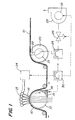
- a woven fabric 10 first passes through an exemplary hydroenhancement process utilizing a vacuum roll 12 for supporting fabric 10, with a plurality of pressurized jets 14 positioned above fabric 10 as it passes over roll 12.
- the plurality of pressurized water streams 16 exiting jets 14 pass through fabric 10, as indicated, entangling adjacent threads and thereby decreasing the open spaces between the chute and warp threads, where this decrease is defined as "hydroenhancement".
- hydroenhancement As is well known, there are various factors that relate to the degree of hydroenhancement achieved.
- the line speed is controlled by a drive motor 18 attached to a drive belt 19, where drive belt 19 is disposed to surround the drum portion of vacuum roll 12.
- Drive motor 18 is configured to rotate vacuum roll 12 in a clockwise manner, as indicated by the arrow in Figure 1, where the speed of drive motor 18 (and hence the speed of drive belt 19) controls the line speed of the hydroenhancement process.
- various ones of these factors may be controlled so as to achieve any desired degree of hydroenhancement.
- FIG. 1 The arrangement of Figure 1 is particularly suited for measuring the "wet" permeability of fabric 10. That is, the permeability is measured in a continuous fashion, immediately after the completion of the hydroenhancement process.
- fabric 10 passes over a second vacuum roll 20, including a vacuum slot 22.
- Vacuum roll 20 may also include an extraction slot 21, disposed prior to vacuum slot 22, where extraction slot 21 functions to remove any standing water remaining on the surface of fabric 10, thus ensuring a repeatable permeability reading.
- Coupled to vacuum slot 22 is a flow meter 24, a vacuum control valve 26 and a vacuum source 28.
- a vacuum controller device 30 is shown as coupled to flow meter 24.
- Controller 30 functions to maintain a constant vacuum in slot 22 by, for example, throttling valve 26, as indicated by the dotted line connection between controller 30 and valve 26.
- controller 30 may utilize a variable speed motor 32 associated with vacuum source 28 to control the vacuum at slot 22 (again indicated by the dotted line in Figure 1).
- Flow meter 24 functions to measure the air flow through fabric 10 at vacuum slot 22 and provide the measured air flow value as an input signal to controller 30.
- Controller 30 subsequently uses this air flow measurement, in conjunction with known parameters (e.g., size of vacuum slot opening) to calculate the air flow per unit area of fabric 10.
- the "air flow per unit area of fabric", under constant vacuum is defined as the "permeability" of the fabric.
- the arrangement of Figure 1 may be reconfigured to maintain a constant air flow through slot 22 and measure the vacuum drop at slot 22 to calculate the permeability.
- the "permeability output" from controller 30 can be used in at least two ways.
- the output can be used by an operator overseeing the process line as a means of quality control. Indeed, if an operator determines that the permeability calculation is either too high or too low, the operator may modify the hydroenhancement process to change one of the processing variables (e.g., line speed, number of jets, water pressure from jets, etc.) until a proper permeability output is generated by controller 30.
- the output from controller 30 may be used as a feedback signal to automatically control the hydroenhancement process.
- the output from controller 30 may be coupled to either drive motor 18 controlling the hydroenhancement line or jet controller 34, or both.
- Jet controller 34 may function in a variety of modes, including but not limited to, turning “off” and “on” jets in sequence in response to the feedback signal, increasing or decreasing the water pressure associated with the jets, or, indeed, simultaneously controlling both the number of active jets and the water pressure (that is, controlling in any acceptable manner the energy imparted to the fabric).
- the control of the jet process may be used either alone or in combination with the line speed to achieve the desired permeability reading.
- FIG. 2 An alternative embodiment of a "wet" permeability measurement arrangement of the present invention is illustrated in Figure 2.
- hydroenhancement is achieved using a moving wire process.
- Fabric 10 passes in a straight line along a conveyor belt 40.
- a plurality of pressurized jets 42 are positioned above belt 40 and used to impart the desired hydroenhanced quality to fabric 10.
- fabric 10 After exiting the hydroenhancement process, fabric 10 enters the on-line hydroenhancement measurement arrangement of the present invention and, in particular, passes over a vacuum slot 44 located under a wire support substrate 40.
- An alternative vacuum slot arrangement is illustrated in an enlarged view in Figure 4.
- the arrangement illustrated in Figure 4 utilizes a vacuum slot 45, similar to slot 44, but without the need for the overlying wire support structure for fabric 10.
- a covered or an uncovered, smooth and polished vacuum slot 45 may be used interchangeably with slot 44 in the permeability testing apparatus as illustrated in detail in Figure 2.
- a vacuum slot may be covered with a screen, a set of perforations, or, as mentioned above, left uncovered.
- vacuum slot 44 (or, alternatively slot 45 as depicted in Figure 4) is directly coupled to a series arrangement of a flow meter 46, a vacuum control valve 48 and a vacuum source 50. Also directly coupled to flow meter 46 is a vacuum control device 52. As with the arrangement described above, controller 52 is used to maintain a constant vacuum at slot 44, either by controlling valve 48 or vacuum source 50 (where a variable speed motor 54 is used to drive vacuum source 50 and is responsive to control signals from controller 52). Similar to the arrangement described above in associated with Figure 1, flow meter 46 measures the air flow through fabric 10 at vacuum slot 44 and provides this measurement as an input signal to controller 52. The permeability of fabric 10 may then be calculated by controller 52, where permeability is defined as the air flow per unit area.
- the calculated permeability can then either be used by a process operator to manually control the line (or merely recorded), or used as a feedback signal to control the hydroenhancement process, as discussed above.
- Illustrated in Figure 2 are exemplary feedback signal lines between controller 52 and line speed controller 56 and jet controller 58.
- the permeability measurement signal may be used to change the line speed, jet pressure, or number of active jets so as to achieve the desired permeability measurement.
- the on-line hydroenhancement measurement technique of the present invention may also be utilized to perform a "dry" permeability measurement at the end of the drying process.
- the measurement of the permeability after the fabric has been dried, in conjunction with the line speed and various process algorithms may be used to audit the product quality, machine efficiency, as well as used in calculating the actual product rate and various other performance measurements.
- fabric 10 is subjected to an exemplary hydroenhancement process, in this case, the process as discussed above in association with Figure 1. Fabric 10 is then "dried", as indicated by element 60 in Figure 3.
- the various processes utilized to dry fabric 10 are of no concern.
- a "dry" permeability measurement is performed at the end of the drying process.
- a vacuum roll is used to perform this measurement.
- any suitable vacuum slot arrangement may also be utilized (for example, the moving wire configuration as illustrated in Figure 2, or the uncovered vacuum slot as shown in detail in Figure 4).
- fabric 10 passes over a vacuum roll 62 which includes a vacuum slot 64.
- a flow meter 66, vacuum control valve 68 and vacuum source 70 are coupled in series with vacuum slot 64.
- a vacuum controller 72 is also coupled to vacuum slot 64. As with the embodiments described above, controller 72 functions to maintain a constant vacuum in slot 64 by controlling either valve 68 or vacuum source 70 (using a variable speed motor 74, for example, to control vacuum source 70).
- Flow meter 66 is used to measure the actual air flow through fabric 10 as it passes over vacuum slot 64 and provides the air flow measurement as an input signal to controller 72. As discussed above, controller 72 then uses this measured value to calculate the air flow per unit area of fabric, thus providing a measurement of the "dry" permeability of fabric 10.
- the dry permeability reading may be used as part of an overall quality process as indicating an acceptable measure of hydroenhancement in the finished product.
- the "dry" permeability measurement and resulting hydroenhancement assessment may be used to modify any of the various parameters associated with the hydroenhancement process.
- the above-described method of assessing the hydroenhancement of a woven fabric may include various modifications not discussed above and fall within the spirit and scope of the present invention.
- various hydroenhancement processes have been discussed, they are exemplary only, and the permeability testing as described above and defined by the claims recited hereinbelow may be used in conjunction with any suitable hydroenhancement process.
- the permeability measurement may be performed either by measuring the air flow through a unit area of fabric under constant pressure or, by measuring the vacuum drop associated with a constant air flow through a unit area of fabric. Either measurement technique will result in providing a permeability calculation that defines the degree of hydroenhancement imparted to the fabric being processed.
Landscapes
- Engineering & Computer Science (AREA)
- Textile Engineering (AREA)
- Health & Medical Sciences (AREA)
- Life Sciences & Earth Sciences (AREA)
- Chemical & Material Sciences (AREA)
- Food Science & Technology (AREA)
- Medicinal Chemistry (AREA)
- Physics & Mathematics (AREA)
- Analytical Chemistry (AREA)
- Biochemistry (AREA)
- General Health & Medical Sciences (AREA)
- General Physics & Mathematics (AREA)
- Immunology (AREA)
- Pathology (AREA)
- Treatment Of Fiber Materials (AREA)
- Paper (AREA)
- Woven Fabrics (AREA)
Applications Claiming Priority (2)
| Application Number | Priority Date | Filing Date | Title |
|---|---|---|---|
| US08/922,412 US5862575A (en) | 1997-09-03 | 1997-09-03 | On-line hydroenhancement evaluation technique |
| US922412 | 1997-09-03 |
Publications (2)
| Publication Number | Publication Date |
|---|---|
| EP0900871A2 true EP0900871A2 (fr) | 1999-03-10 |
| EP0900871A3 EP0900871A3 (fr) | 2000-12-06 |
Family
ID=25447000
Family Applications (1)
| Application Number | Title | Priority Date | Filing Date |
|---|---|---|---|
| EP19980307072 Withdrawn EP0900871A3 (fr) | 1997-09-03 | 1998-09-03 | Méthodes et dispostifs pour évaluer l'aiguilletage hydrodynamique appliqué aux tissus |
Country Status (7)
| Country | Link |
|---|---|
| US (1) | US5862575A (fr) |
| EP (1) | EP0900871A3 (fr) |
| JP (1) | JP4311778B2 (fr) |
| KR (1) | KR100577600B1 (fr) |
| CN (1) | CN1108520C (fr) |
| CA (1) | CA2246237C (fr) |
| TW (1) | TW426773B (fr) |
Cited By (1)
| Publication number | Priority date | Publication date | Assignee | Title |
|---|---|---|---|---|
| WO2002048441A3 (fr) * | 2000-12-13 | 2002-11-14 | Fleissner Maschf Gmbh Co | Procede d'application hydrodynamique de jets d'eau sur une bande de materiau et faisceau de buses conçu pour produire des jets de liquide |
Families Citing this family (6)
| Publication number | Priority date | Publication date | Assignee | Title |
|---|---|---|---|---|
| EP1694893A4 (fr) * | 2003-12-15 | 2007-11-28 | Univ North Carolina State | Amelioration des caracteristiques physiques et mecaniques de tissus par hydroliage |
| US7500292B2 (en) * | 2006-08-28 | 2009-03-10 | Hbi Branded Apparel Enterprises, Llc | Hydrodynamic treatment of tubular knitted fabrics |
| FI20075472L (fi) * | 2007-06-20 | 2008-12-21 | Metso Paper Inc | Menetelmä paperikoneen tai vastaavan puristinhuovan kunnon/tilan arvioinnissa |
| EP3000923A1 (fr) * | 2014-03-13 | 2016-03-30 | Oskar Dilo Maschinenfabrik KG | Planche a aiguilles |
| CN104132879B (zh) * | 2014-07-22 | 2017-11-21 | 嘉兴市梦迪织造有限公司 | 一种抗紫外线大麻针织面料透气性检测机 |
| DE102019116197A1 (de) * | 2019-06-14 | 2020-12-17 | Voith Patent Gmbh | Verschmutzungsmessung Saugwalze |
Family Cites Families (22)
| Publication number | Priority date | Publication date | Assignee | Title |
|---|---|---|---|---|
| US3056281A (en) * | 1959-01-28 | 1962-10-02 | Thomas C Smyth | Porosity testing of papermaker's felt |
| US3371518A (en) * | 1965-02-12 | 1968-03-05 | Beloit Corp | Device for continuously measuring porosity |
| US4130689A (en) * | 1976-06-11 | 1978-12-19 | International Paper Company | Production of high strength hollow rayon fibers |
| US4166877A (en) * | 1976-07-26 | 1979-09-04 | International Paper Company | Non-woven fabric lightly fiber-entangled |
| US4132592A (en) * | 1977-02-22 | 1979-01-02 | International Paper Company | Entangled non-woven web-forming apparatus |
| US4174237A (en) * | 1978-07-03 | 1979-11-13 | International Paper Company | Process and apparatus for controlling the speed of web forming equipment |
| US4311037A (en) * | 1980-03-19 | 1982-01-19 | Scott Paper Company | Web permeability tester |
| JPS58182539A (ja) * | 1982-04-20 | 1983-10-25 | Kuriin Filter:Kk | 濾過集塵装置用濾布の通気度試験方法 |
| US4499691A (en) * | 1982-08-25 | 1985-02-19 | General Electric Company | Jet pump beam bolt retainer cutter |
| US4495796A (en) * | 1982-10-25 | 1985-01-29 | R. J. Reynolds Tobacco Company | Apparatus and method for measuring permeability of a moving web |
| US4960630A (en) * | 1988-04-14 | 1990-10-02 | International Paper Company | Apparatus for producing symmetrical fluid entangled non-woven fabrics and related method |
| DE3537896A1 (de) * | 1985-10-24 | 1987-04-30 | Gessner & Co Gmbh | Verfahren und vorrichtung zur kontinuierlichen messung der porositaet |
| US5136761A (en) * | 1987-04-23 | 1992-08-11 | International Paper Company | Apparatus and method for hydroenhancing fabric |
| JPS63282633A (ja) * | 1987-05-15 | 1988-11-18 | Tomoegawa Paper Co Ltd | 多孔性シ−トの透気度測定装置及び該測定装置を用いた多孔性シ−トの製造装置における透気度制御装置 |
| FI77119C (fi) * | 1987-09-23 | 1989-01-10 | Valmet Paper Machinery Inc | Foerfarande och anordning foer maetning av luftgenomslaeppningsfoermaogan hos luftgenomslaeppliga vaevnader i synnerhet en vira eller en filt i en pappersmaskin. |
| US5142752A (en) * | 1990-03-16 | 1992-09-01 | International Paper Company | Method for producing textured nonwoven fabric |
| US5311389A (en) * | 1990-04-16 | 1994-05-10 | International Paper Company | Hydroentangled fabric diskette liner |
| FI903349A7 (fi) * | 1990-07-03 | 1992-01-04 | Tamfelt Oy Ab | Mittauslaite huovan kunnon mittaamiseksi |
| FI94178C (fi) * | 1992-04-07 | 1995-07-25 | Tamfelt Oy Ab | Mittauslaite paperikoneen huovan kunnon mittaamiseksi |
| EP0610555A3 (en) * | 1993-02-09 | 1995-09-20 | Textest Ag | Device for determining the air permeability of a web. |
| US5566434A (en) * | 1994-06-15 | 1996-10-22 | Jps Automotive Products Corporation | Air bag for use in a motor vehicle and method of producing same |
| US5657520A (en) * | 1995-01-26 | 1997-08-19 | International Paper Company | Method for tentering hydroenhanced fabric |
-
1997
- 1997-09-03 US US08/922,412 patent/US5862575A/en not_active Expired - Lifetime
-
1998
- 1998-08-27 CA CA002246237A patent/CA2246237C/fr not_active Expired - Fee Related
- 1998-09-01 TW TW87114515A patent/TW426773B/zh not_active IP Right Cessation
- 1998-09-02 JP JP24816798A patent/JP4311778B2/ja not_active Expired - Fee Related
- 1998-09-03 CN CN98117902A patent/CN1108520C/zh not_active Expired - Fee Related
- 1998-09-03 KR KR1019980036216A patent/KR100577600B1/ko not_active Expired - Fee Related
- 1998-09-03 EP EP19980307072 patent/EP0900871A3/fr not_active Withdrawn
Cited By (1)
| Publication number | Priority date | Publication date | Assignee | Title |
|---|---|---|---|---|
| WO2002048441A3 (fr) * | 2000-12-13 | 2002-11-14 | Fleissner Maschf Gmbh Co | Procede d'application hydrodynamique de jets d'eau sur une bande de materiau et faisceau de buses conçu pour produire des jets de liquide |
Also Published As
| Publication number | Publication date |
|---|---|
| US5862575A (en) | 1999-01-26 |
| CA2246237C (fr) | 2009-08-11 |
| CN1108520C (zh) | 2003-05-14 |
| CN1211732A (zh) | 1999-03-24 |
| KR19990029480A (ko) | 1999-04-26 |
| JP4311778B2 (ja) | 2009-08-12 |
| TW426773B (en) | 2001-03-21 |
| JPH11166927A (ja) | 1999-06-22 |
| EP0900871A3 (fr) | 2000-12-06 |
| KR100577600B1 (ko) | 2006-07-25 |
| CA2246237A1 (fr) | 1999-03-03 |
Similar Documents
| Publication | Publication Date | Title |
|---|---|---|
| US4058962A (en) | Method and apparatus for detecting periodic yarn irregularities in a yarn between a yarn forming stage and a yarn winding stage | |
| US7581294B2 (en) | Method of manufacturing a nonwoven | |
| US5725737A (en) | Apparatus for the detection of holes and plugged spots | |
| US5853543A (en) | Method for monitoring and controlling water content in paper stock in a paper making machine | |
| US5862575A (en) | On-line hydroenhancement evaluation technique | |
| JPH06186174A (ja) | 抄紙機におけるフェルトの状態測定装置 | |
| US11125501B2 (en) | Dryer for a textile material web having a device for determining the residual moisture of a material web and method, module, and system therefor | |
| CA2244529C (fr) | Systeme d'impermeabilisation a mouvement alternatif | |
| GB2230620A (en) | Controlling paper making machines | |
| US5135615A (en) | Device for measuring the condition of a felt and for reconditioning it | |
| CN1954109A (zh) | 加宽非织造布及其制造方法和用于其生产的机器 | |
| KR100892536B1 (ko) | 기재로의 액상 중합체의 도포방법 | |
| US4157595A (en) | Process for the uniform dyeing of textile material webs with the aid of a uniform application of liquor | |
| US5420802A (en) | System and method for testing yarn altering devices | |
| JP2012122167A (ja) | 繊維束の監視装置 | |
| EP1637646A1 (fr) | Habillage de machine pour fabriquer une bande de matière fibreuse | |
| KR102900742B1 (ko) | 텐터 가공 관리 시스템 | |
| Ahmed et al. | Process control in knitting | |
| Seyam et al. | Carding Dynamics Part II: Development of a Device for On-Line Measurement of Two-Dimensional Fiber Loading on Card Elements | |
| GB2061341A (en) | Maintaining the permeability of paper machine felts | |
| JPH0792466B2 (ja) | ループ状の移動するフェルトの循環速度と回転位置を測定する装置 | |
| JPS59204970A (ja) | 織物の染色性監視法および装置 | |
| SU1142536A1 (ru) | Способ контрол процесса переработки волокнистой массы | |
| DE10116666A1 (de) | Spritzdüsen | |
| CN116843320A (zh) | 基于物联网的纺织设备异常感测方法 |
Legal Events
| Date | Code | Title | Description |
|---|---|---|---|
| PUAI | Public reference made under article 153(3) epc to a published international application that has entered the european phase |
Free format text: ORIGINAL CODE: 0009012 |
|
| AK | Designated contracting states |
Kind code of ref document: A2 Designated state(s): AT BE CH CY DE DK ES FI FR GB GR IE IT LI LU MC NL PT SE |
|
| AX | Request for extension of the european patent |
Free format text: AL;LT;LV;MK;RO;SI |
|
| PUAL | Search report despatched |
Free format text: ORIGINAL CODE: 0009013 |
|
| AK | Designated contracting states |
Kind code of ref document: A3 Designated state(s): AT BE CH CY DE DK ES FI FR GB GR IE IT LI LU MC NL PT SE |
|
| AX | Request for extension of the european patent |
Free format text: AL;LT;LV;MK;RO;SI |
|
| RIC1 | Information provided on ipc code assigned before grant |
Free format text: 7D 04H 1/46 A, 7D 04H 18/00 B, 7G 01N 15/08 B, 7G 01N 33/36 B, 7D 06B 1/02 B, 7D 06C 29/00 B |
|
| AKX | Designation fees paid | ||
| REG | Reference to a national code |
Ref country code: DE Ref legal event code: 8566 |
|
| RBV | Designated contracting states (corrected) |
Designated state(s): AT BE CH CY DE DK ES FI FR GB GR IE IT LI LU MC NL PT SE |
|
| 17P | Request for examination filed |
Effective date: 20010831 |
|
| STAA | Information on the status of an ep patent application or granted ep patent |
Free format text: STATUS: THE APPLICATION IS DEEMED TO BE WITHDRAWN |
|
| 18D | Application deemed to be withdrawn |
Effective date: 20020403 |