EP0900976A2 - Zone d' inspection et luminaire pour cette zone - Google Patents
Zone d' inspection et luminaire pour cette zone Download PDFInfo
- Publication number
- EP0900976A2 EP0900976A2 EP98306976A EP98306976A EP0900976A2 EP 0900976 A2 EP0900976 A2 EP 0900976A2 EP 98306976 A EP98306976 A EP 98306976A EP 98306976 A EP98306976 A EP 98306976A EP 0900976 A2 EP0900976 A2 EP 0900976A2
- Authority
- EP
- European Patent Office
- Prior art keywords
- luminaire
- fluorescent lamp
- housing
- pair
- luminaires
- Prior art date
- Legal status (The legal status is an assumption and is not a legal conclusion. Google has not performed a legal analysis and makes no representation as to the accuracy of the status listed.)
- Withdrawn
Links
- 238000007689 inspection Methods 0.000 title claims description 41
- 230000007547 defect Effects 0.000 claims abstract description 22
- 230000000712 assembly Effects 0.000 claims description 13
- 238000000429 assembly Methods 0.000 claims description 13
- 238000000034 method Methods 0.000 claims description 3
- 230000002093 peripheral effect Effects 0.000 description 6
- 230000004313 glare Effects 0.000 description 4
- 238000001514 detection method Methods 0.000 description 3
- 230000003252 repetitive effect Effects 0.000 description 3
- 238000011179 visual inspection Methods 0.000 description 3
- 229910052782 aluminium Inorganic materials 0.000 description 2
- XAGFODPZIPBFFR-UHFFFAOYSA-N aluminium Chemical compound [Al] XAGFODPZIPBFFR-UHFFFAOYSA-N 0.000 description 2
- 230000007423 decrease Effects 0.000 description 2
- 210000003298 dental enamel Anatomy 0.000 description 2
- 238000005286 illumination Methods 0.000 description 2
- 239000000463 material Substances 0.000 description 2
- 238000007789 sealing Methods 0.000 description 2
- 239000000725 suspension Substances 0.000 description 2
- 241000251468 Actinopterygii Species 0.000 description 1
- 208000008035 Back Pain Diseases 0.000 description 1
- 229910001335 Galvanized steel Inorganic materials 0.000 description 1
- 206010019233 Headaches Diseases 0.000 description 1
- 208000019695 Migraine disease Diseases 0.000 description 1
- 229910000831 Steel Inorganic materials 0.000 description 1
- 239000000853 adhesive Substances 0.000 description 1
- 230000001070 adhesive effect Effects 0.000 description 1
- 208000003464 asthenopia Diseases 0.000 description 1
- 238000011109 contamination Methods 0.000 description 1
- 230000003247 decreasing effect Effects 0.000 description 1
- 239000008397 galvanized steel Substances 0.000 description 1
- 239000011521 glass Substances 0.000 description 1
- 231100000869 headache Toxicity 0.000 description 1
- 230000017525 heat dissipation Effects 0.000 description 1
- 238000004519 manufacturing process Methods 0.000 description 1
- 229910052751 metal Inorganic materials 0.000 description 1
- 239000002184 metal Substances 0.000 description 1
- 238000012986 modification Methods 0.000 description 1
- 230000004048 modification Effects 0.000 description 1
- 238000002310 reflectometry Methods 0.000 description 1
- 238000009877 rendering Methods 0.000 description 1
- 230000000717 retained effect Effects 0.000 description 1
- 239000010959 steel Substances 0.000 description 1
- 239000005341 toughened glass Substances 0.000 description 1
- 230000000007 visual effect Effects 0.000 description 1
- 238000009941 weaving Methods 0.000 description 1
Images




Classifications
-
- G—PHYSICS
- G01—MEASURING; TESTING
- G01N—INVESTIGATING OR ANALYSING MATERIALS BY DETERMINING THEIR CHEMICAL OR PHYSICAL PROPERTIES
- G01N21/00—Investigating or analysing materials by the use of optical means, i.e. using sub-millimetre waves, infrared, visible or ultraviolet light
- G01N21/84—Systems specially adapted for particular applications
- G01N21/88—Investigating the presence of flaws or contamination
- G01N21/8806—Specially adapted optical and illumination features
-
- F—MECHANICAL ENGINEERING; LIGHTING; HEATING; WEAPONS; BLASTING
- F21—LIGHTING
- F21V—FUNCTIONAL FEATURES OR DETAILS OF LIGHTING DEVICES OR SYSTEMS THEREOF; STRUCTURAL COMBINATIONS OF LIGHTING DEVICES WITH OTHER ARTICLES, NOT OTHERWISE PROVIDED FOR
- F21V7/00—Reflectors for light sources
- F21V7/005—Reflectors for light sources with an elongated shape to cooperate with linear light sources
-
- F—MECHANICAL ENGINEERING; LIGHTING; HEATING; WEAPONS; BLASTING
- F21—LIGHTING
- F21Y—INDEXING SCHEME ASSOCIATED WITH SUBCLASSES F21K, F21L, F21S and F21V, RELATING TO THE FORM OR THE KIND OF THE LIGHT SOURCES OR OF THE COLOUR OF THE LIGHT EMITTED
- F21Y2103/00—Elongate light sources, e.g. fluorescent tubes
Definitions
- the present invention relates to article inspection and in particular to an inspection area and a luminaire for the same to facilitate the visual inspection of coated articles for surface defects.
- inspection areas are located along the assembly line so that assembled automobiles can be inspected for surface defects such as for example dirt, sags, dents, dings, fisheyes, scratches, mottle, orange peel etc.
- the inspection areas include rows of fluorescent luminaires installed above and/or on opposite sides of the assembly line.
- the luminaires are equipped with various types of fluorescent lamps including high output (HO) or very high output (VHO) fluorescent lamps.
- HO high output
- VHO very high output
- the recommended illumination is at least 200 foot-candles (fd). In many instances the illumination is well above this level.
- Inspection personnel detect defects by viewing the specular surfaces from various angles depending on the relative position of the reflected images and the position of inspection personnel. Arranging conventional luminaires to achieve the desired illuminance creates many problems. In particular, the illuminance level results in discomfort and disability glare causing inspection personnel to suffer eye fatigue, headaches and/or migraines. Also, inspection personnel must constantly bob and weave to see visual defects in the distorted luminaire lens images reflected by the specular surfaces thereby increasing the risk of back pain.
- baked enamel high reflectance reflectors with prismatic lenses have been used in the luminaires.
- the images reflected by these luminaires onto the specular surfaces of the automobiles being inspected include images of the reflectors and lenses with images of the fluorescent lamps superimposed thereon.
- the resulting reflected images are distorted and unclear making it more difficult for inspection personnel to detect surface defects.
- Specular lenses have also been used in luminaires with clear lenses and without lenses in the luminaire. Although the reflected images are apparent they are not sharp due to contamination which rapidly decreases reflectivity resulting in blurred images. As well, the highly specular reflective material tends to bend and flex easily resulting in distortion of the reflected images and creating secondary vague images.
- a luminaire to illuminate an article to be visually inspected comprising:
- the luminaire includes at least a pair of laterally spaced elongate fluorescent lamp assemblies and a pair of linear reflectors associated with each of the fluorescent lamp assemblies.
- the linear reflectors of each pair are located on opposite sides of the associated fluorescent lamp assembly.
- the linear reflectors of each pair are mounted on a rigid support to reflect the straight edges of the fluorescent lamps with minimal distortion.
- the support includes a pair of diverging, forwardly extending panels on opposed sides of the associated fluorescent lamp bridged by an intermediate panel directly behind the fluorescent lamp.
- the diverging panels form angles with the intermediate panels equal to about 130 degrees.
- a luminaire to illuminate an article to be visually inspected comprising:
- an inspection area for an assembly line including a plurality of luminaires, said luminaires being positioned relative to said assembly line to illuminate specular surfaces of articles traveling along said assembly line, at least one of said luminaires comprising:
- the present invention provides advantages in that the luminaire projects light onto the article being inspected such that repetitive, laterally spaced elongate light source images are reflected by specular surfaces of the article being inspected. Defects in the specular surfaces of the articles distort the reflected elongate light source images as the articles move relative to the luminaires. Since the reflected elongate light source images are repetitive, distinct and clear, distortions in the reflected elongate light source images are easily noticed thereby facilitating surface defect detection. Also, the present invention provides advantages in that glare, veiling and power consumption are reduced while maintaining illuminance at recommended levels.
- a luminaire for use in an inspection area is shown and is generally indicated to by reference numeral 20.
- the luminaire 20 projects light onto specular surfaces of articles being inspected resulting in a plurality of laterally spaced, elongate fluorescent lamp images being reflected by the specular surfaces.
- inspection personnel examine the reflected fluorescent lamp images to detect and locate surface defects such as for example, dirt, sags, dents, dings, fish eyes, scratches, mottle, orange peel, etc. Surface defects are detected when the defects pass through sharp edges of the reflected fluorescent lamp images which results in distortion of the reflected fluorescent lamp images.
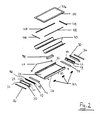
- luminaire 20 includes a generally rectangular housing 22 having abase 24, a pair of opposed side walls 26 and a pair of opposed end walls 28.
- the side walls 26 are integrally formed with the base 24.
- Flanges 29 extend inwardly from the upper peripheral edges of the side walls 26.
- the end walls 28 are defined by end plates 30 secured to the base 24 by fasteners (not shown) so that the end walls 28 remain flush with the side walls 26 and base 24.
- Each end plate 30 has an outwardly directed flange 32 formed along its bottom peripheral edge and an inwardly directed flange 34 formed along its upper peripheral edge.
- Secured to the flanges 32 by way of fasteners (not shown) are support mounting brackets 36 to accommodate suspension wires or fasteners to allow the luminaire 20 either to be hung from or fastened to a support surface.
- Each socket bracket 40 includes a main panel 42 having a pair of spaced apertures 44 therein. Flanges 46 and 48 extend outwardly in opposite directions from the upper and lower peripheral edges of the panel 42. The upper flange 46 overlies the inwardly directed flange 34 on the end plate 30 and is secured to it by fasteners (not shown).
- Each fluorescent lamp assembly 60 includes a pair of terminals 62 adjacent opposite ends of the housing and an energy efficient, low wattage fluorescent lamp 64 such as for example a T8 or T12 fluorescent lamp extending between the terminals 62.
- the fluorescent lamps 64 provide illuminance equal to about 200 F.C. and use daylight phosphors in the range of about 5000 to 6500 Kelvin (K) at 72 to 85 Colour Rendering Index (CRI).
- K Kelvin
- CRI Colour Rendering Index
- the terminals 62 are positioned in the spaces between the socket brackets 40 and the end plates 30 and are in-line with the apertures 44 in the socket brackets.
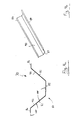
- Each linear specular reflector assembly 70 includes a rigid sheet steel support 80 including a pair of diverging forwardly extending panels 82 bridged by an intermediate panel 84. Each diverging panel 82 forms an angle with the intermediate panel 84 equal to approximately 130 degrees. Flanges 86 extend from the peripheral edges of the diverging panels 82 and are parallel with the plane of the intermediate panel 84.
- Linear reflectors 90 formed of thin, highly specular aluminum are provided on the diverging panels 82.
- the linear reflectors 90 in the present example are 0.016" thick and have a reflectance equal to approximately 93%.
- the linear reflectors 90 are secured to the diverging panels 82 via sheet adhesive in a manner so that the linear reflectors remain flat to reflect the straight edges of the fluorescent lamps with minimum distortion.
- the intermediate panels 84 are finished in a black matte enamel to inhibit ghost reflections from the fluorescent lamps 64 and thereby reduce distortion.
- Opposed ends of the supports 80 are secured to mounting brackets 94 by way of fasteners (not shown) passing through holes in the intermediate panels 84.
- the mounting brackets 94 are fastened to the lower flanges 48 of the socket brackets 40 by way of fasteners (not shown).
- a ballast (not shown) is also provided in the housing 22 and is electrically connected to the pairs of terminals 62.
- the ballast may be either of the magnetic or electronic type. Better energy savings are achieved when using an electronic ballast with T8 fluorescent lamps.
- a power cable or power cord set (not shown) extends into the housing 22 and is connected the baliast.
- the ballast is mounted on a bracket 98 secured to the base 24 and positioned between the linear reflector assemblies 70.
- a door 100 covers the open forward face of the housing 22 and is pivotally connected to the housing 22 by way of a plurality of hinges 102.
- the door 100 is retained in a closed position by releasable fasteners (not shown) located at spaced locations along one side of the housing 22 to seal the housing and inhibit dirt from contacting the linear reflectors which will decrease the efficiency of the linear reflectors 90 resulting in blurred fluorescent lamp images and a loss of illuminance.
- the door 100 is pivotable to an open position to permit access to the interior of the housing 22.
- the door 100 includes a rectangular frame 104 surrounding and supporting a tempered glass lens 106.
- the glass lens 106 is sealed to the frame 104 by way of a sealing gasket (not shown) and galvanized steel retainers 108.
- Metal bridges 110 are riveted in place at each end of the base 24 so as to close the space at each corner where the door 100 and end plate 30 come in contact, thereby providing a continuous surface for contacting the sealing gasket.
- the orientation of the diverging panels 82 relative to the intermediate panels 84 helps to reduce glare and veiling. Also, the spacing of the fluorescent lamps 64 and the volume of the housing 22 results in heat being distributed generally evenly throughout the housing maintaining a relatively constant internal temperature therein. By maintaining a relatively constant temperature in the housing, the efficiency and lifetime of the fluorescent lamps 64 are increased.
- each linear reflector 90 projects an image of a fluorescent lamp 64 so that the luminaire 20 projects six (6) laterally spaced images of the fluorescent lamps.
- the angles of the linear reflectors 90 relative to the intermediate panels 84 ensure that fluorescent lamp images projected by the linear reflectors 90 are spaced sufficiently to avoid fluorescent lamp image overlap when reflected by the specular surfaces.
- the linear reflectors 90 are described as forming angles with the intermediate panels 84 equal to about 130 degrees, other angles can be selected to suit inspection personnel preference while avoiding fluorescent lamp image overlap.
- FIGS 5 and 6 illustrate another embodiment of a luminaire 120.
- like reference numerals are used to indicate like components of the previous embodiment with a "100" added for clarity.
- the luminaire 22 is basically the same as the luminaire 20 except that its dimensions are larger.
- the luminaires 20 and 120 are particularly useful for facilitating surface defect detection in specular surfaces of automobiles.
- the luminaires 20 and 120 illuminate all of the specular surfaces of the automobile visible to inspection personnel so that inspection personnel can visually inspect the specular surfaces.
- Each luminaire projects light onto the specular surface resulting in six (6) laterally spaced images of fluorescent lamps being reflected by the specular surfaces.
- the reflected repetitive fluorescent lamp images have sharp peripheral edges and are clearly visible to the inspection personnel.
- Surface defects in the specular surfaces cause distortions in the sharp edges of the reflected fluorescent lamp images which are easily noticed by inspection personnel.
- the inspection personnel can follow the distortions through the sharp edges of reflected fluorescent lamp images allowing the inspection personnel to locate and correct the surface defects.
- FIG. 8a to 8d embodiments of automobile assembly line inspection areas including luminaires of the types shown in Figures 1 and 5 are illustrated.
- a pair of luminaires 220 are suspended from a ceiling surface 202 by way of suspension wires 204 and are angled with respect to the ceiling surface.
- the assembly line 206 is close to ground level.
- large upright luminaires 320 are provided on opposite sides of the assembly line 306.
- Smaller luminaires 420 are suspended from the ceiling surface 302 and form a 20 degree angle with respect to the ceiling surface.
- the assembly line 306 is generally at waist level with respect to inspection personnel.
- the assembly line 506 is at eye level with respect to inspection personnel. In this case, only upright luminaires 520 are provided in the inspection area 500 on opposite sides of the assembly line.
- the assembly line 606 is generally at waist level with respect to inspection personnel.
- the inspection area 600 includes small luminaires 820 mounted on supports 608 on opposite sides of the assembly line 606. The supports provide an inclined mounting surface 610 and are positioned slightly below the assembly line.
- the luminaires are positioned and oriented to limit the amount of bobbing and weaving inspection personnel must do to inspect visually the specular surfaces of the entire automobile while illuminating all specular surfaces visible to the inspection personnel.
- the present inventions facilitates surface defect detection while maintaining illuminance at recommended levels.
- the linear reflectors have been described as being formed of aluminum, it should be appreciated by those of skill in the art that other highly reflective material can be used.
- each luminaire is shown to include a pair of fluorescent lamp assemblies, the number of fluorescent lamp assemblies is arbitrary and can be increased or decreased as desired.
- luminaires have been shown in an automobile assembly line, it will be appreciated by those of skill in the art that the luminaires may be used in virtually any environment where coated surfaces are to be inspected for defects.
Landscapes
- Physics & Mathematics (AREA)
- Health & Medical Sciences (AREA)
- Life Sciences & Earth Sciences (AREA)
- Chemical & Material Sciences (AREA)
- Analytical Chemistry (AREA)
- Biochemistry (AREA)
- General Health & Medical Sciences (AREA)
- General Physics & Mathematics (AREA)
- Immunology (AREA)
- Pathology (AREA)
- Engineering & Computer Science (AREA)
- General Engineering & Computer Science (AREA)
- Investigating Materials By The Use Of Optical Means Adapted For Particular Applications (AREA)
Applications Claiming Priority (2)
| Application Number | Priority Date | Filing Date | Title |
|---|---|---|---|
| US08/922,059 US6012825A (en) | 1997-09-02 | 1997-09-02 | Defect highlighting luminaire and inspection area |
| US922059 | 1997-09-02 |
Publications (2)
| Publication Number | Publication Date |
|---|---|
| EP0900976A2 true EP0900976A2 (fr) | 1999-03-10 |
| EP0900976A3 EP0900976A3 (fr) | 2000-05-17 |
Family
ID=25446441
Family Applications (1)
| Application Number | Title | Priority Date | Filing Date |
|---|---|---|---|
| EP98306976A Withdrawn EP0900976A3 (fr) | 1997-09-02 | 1998-09-01 | Zone d' inspection et luminaire pour cette zone |
Country Status (3)
| Country | Link |
|---|---|
| US (1) | US6012825A (fr) |
| EP (1) | EP0900976A3 (fr) |
| CA (1) | CA2245748A1 (fr) |
Cited By (1)
| Publication number | Priority date | Publication date | Assignee | Title |
|---|---|---|---|---|
| WO2004020897A1 (fr) * | 2002-08-28 | 2004-03-11 | Full Vision Productions Limited | Luminaire |
Families Citing this family (15)
| Publication number | Priority date | Publication date | Assignee | Title |
|---|---|---|---|---|
| US6737811B2 (en) * | 2001-06-16 | 2004-05-18 | A L Lightech, Inc. | High intensity light source arrangement |
| USD706481S1 (en) * | 2013-01-14 | 2014-06-03 | Lighting Science Group Corporation | High bay light fixture |
| US9412203B1 (en) | 2013-01-22 | 2016-08-09 | Carvana, LLC | Systems and methods for generating virtual item displays |
| EP4350431A3 (fr) | 2016-12-07 | 2024-07-03 | Scheich, Davo | Chambre photographique pour véhicule |
| US11560730B2 (en) * | 2017-01-04 | 2023-01-24 | Thomas Williams | System and method for finding dents on an automobile using a booth |
| EP3633353A4 (fr) | 2017-05-29 | 2020-06-10 | Konica Minolta, Inc. | Dispositif et procédé d'inspection de défauts de surface |
| US11412135B2 (en) | 2018-12-05 | 2022-08-09 | Ovad Custom Stages, Llc | Bowl-shaped photographic stage |
| US11720005B2 (en) | 2019-02-19 | 2023-08-08 | Carvana, LLC | Camera mount for vehicle photographic chambers |
| WO2020210790A1 (fr) | 2019-04-11 | 2020-10-15 | Ovad Custom Stages, Llc | Cabine photographique ovoïde pour véhicule |
| WO2020215060A1 (fr) | 2019-04-19 | 2020-10-22 | Ovad Custom Stages, Llc | Palette photographique et procédé d'utilisation de celle-ci |
| WO2020223301A1 (fr) | 2019-04-29 | 2020-11-05 | Ovad Custom Stages, Llc | Cabine de photographie et d'inspection de véhicule |
| US12061411B2 (en) | 2019-06-06 | 2024-08-13 | Carvana, LLC | Vehicle photographic system for identification of surface imperfections |
| EP3792619B1 (fr) * | 2019-09-11 | 2023-11-01 | Proov Station | Ensemble de détection de défauts sur une carrosserie d'un véhicule automobile |
| CN112924464A (zh) * | 2021-01-29 | 2021-06-08 | 中国重型机械研究院股份公司 | 一种板带表面卧式检查装置 |
| US12126774B2 (en) | 2021-03-19 | 2024-10-22 | Carvana, LLC | Mobile photobooth |
Family Cites Families (7)
| Publication number | Priority date | Publication date | Assignee | Title |
|---|---|---|---|---|
| US2845854A (en) * | 1955-03-02 | 1958-08-05 | Pyle National Co | Combination light fixture and ventilating apparatus |
| CH594849A5 (fr) * | 1975-04-16 | 1978-01-31 | Wunderlin Willy | |
| DE3418317C1 (de) * | 1984-05-17 | 1985-01-31 | Daimler-Benz Ag, 7000 Stuttgart | Prüfraum zur Überprüfung der Oberfläche von Fahrzeugkarosserien |
| DE3613137C1 (en) * | 1986-04-18 | 1987-11-05 | Daimler Benz Ag | Test room for checking the glossy (lustrous) surface of vehicle bodies for defects |
| DE9319537U1 (de) * | 1993-12-18 | 1994-09-22 | VH Lichttechnische Spezialgeräte GmbH, 67433 Neustadt | Beleuchtungsvorrichtung |
| DE4417884A1 (de) * | 1994-05-21 | 1995-01-05 | Braun Uwe Peter Dipl Ing | Lackkontrolleuchte |
| US5436726A (en) * | 1994-05-23 | 1995-07-25 | It's Dents Or Us | Flaw highlighting light panel and booth for automobile body repair |
-
1997
- 1997-09-02 US US08/922,059 patent/US6012825A/en not_active Expired - Fee Related
-
1998
- 1998-08-25 CA CA002245748A patent/CA2245748A1/fr not_active Abandoned
- 1998-09-01 EP EP98306976A patent/EP0900976A3/fr not_active Withdrawn
Non-Patent Citations (1)
| Title |
|---|
| None |
Cited By (1)
| Publication number | Priority date | Publication date | Assignee | Title |
|---|---|---|---|---|
| WO2004020897A1 (fr) * | 2002-08-28 | 2004-03-11 | Full Vision Productions Limited | Luminaire |
Also Published As
| Publication number | Publication date |
|---|---|
| CA2245748A1 (fr) | 1999-03-02 |
| EP0900976A3 (fr) | 2000-05-17 |
| US6012825A (en) | 2000-01-11 |
Similar Documents
| Publication | Publication Date | Title |
|---|---|---|
| US6012825A (en) | Defect highlighting luminaire and inspection area | |
| US6234643B1 (en) | Lay-in/recessed lighting fixture having direct/indirect reflectors | |
| US5075827A (en) | Indirect light fixture amplification reflector system | |
| US4729075A (en) | Constant zone reflector for luminaires and method | |
| US4054793A (en) | Lighting system | |
| CA1288085C (fr) | Appareil d'eclairage a diffuseur anti-eblouissement amovible | |
| AU2008200869B2 (en) | Showcase | |
| US5412551A (en) | Luminaire fixture | |
| US6773135B1 (en) | Luminaires having shaped reflective structures for illuminating vertical surfaces such as billboards and the like | |
| JP4001387B2 (ja) | 寸法の大きいマッチング面の表面性状を目視検査するための装置 | |
| US5134553A (en) | Illuminating device | |
| MXPA04005408A (es) | Luminarias mejoradas para la iluminacion de paneles exteriores. | |
| WO1999026018A1 (fr) | Appareil d'eclairage | |
| BE1017369A3 (nl) | Verlichtingstoestel. | |
| US4751626A (en) | Reflector system for a luminaire | |
| JPH0247683B2 (ja) | Hanshakyotsukitenkenshomeisochi | |
| CN115013756B (zh) | 一种发光装置及灯具 | |
| US4833575A (en) | Brightness equalizing light filter system | |
| US7252413B2 (en) | Light fixture, reflector housing, and facility that includes a plurality of light fixtures | |
| US5414604A (en) | Light reflector with edge illumination | |
| JPH0618423A (ja) | 検査用照明器具 | |
| WO2000017571A1 (fr) | Luminaire | |
| JPH0581912A (ja) | 照明装置 | |
| CN214840358U (zh) | 一种45°转角线光源 | |
| CN209042131U (zh) | 侧边折射聚光涂装灯 |
Legal Events
| Date | Code | Title | Description |
|---|---|---|---|
| PUAI | Public reference made under article 153(3) epc to a published international application that has entered the european phase |
Free format text: ORIGINAL CODE: 0009012 |
|
| AK | Designated contracting states |
Kind code of ref document: A2 Designated state(s): AT BE CH CY DE DK ES FI FR GB GR IE IT LI LU MC NL PT SE |
|
| AX | Request for extension of the european patent |
Free format text: AL;LT;LV;MK;RO;SI |
|
| PUAL | Search report despatched |
Free format text: ORIGINAL CODE: 0009013 |
|
| AK | Designated contracting states |
Kind code of ref document: A3 Designated state(s): AT BE CH CY DE DK ES FI FR GB GR IE IT LI LU MC NL PT SE |
|
| AX | Request for extension of the european patent |
Free format text: AL;LT;LV;MK;RO;SI |
|
| RIC1 | Information provided on ipc code assigned before grant |
Free format text: 7F 21S 3/02 A, 7F 21V 7/12 B |
|
| AKX | Designation fees paid | ||
| REG | Reference to a national code |
Ref country code: DE Ref legal event code: 8566 |
|
| STAA | Information on the status of an ep patent application or granted ep patent |
Free format text: STATUS: THE APPLICATION IS DEEMED TO BE WITHDRAWN |
|
| 18D | Application deemed to be withdrawn |
Effective date: 20001118 |