EP0901067A2 - Verfahren und System zur Ausführung von Operationen auf denormalisierten Zahlen - Google Patents
Verfahren und System zur Ausführung von Operationen auf denormalisierten Zahlen Download PDFInfo
- Publication number
- EP0901067A2 EP0901067A2 EP98306442A EP98306442A EP0901067A2 EP 0901067 A2 EP0901067 A2 EP 0901067A2 EP 98306442 A EP98306442 A EP 98306442A EP 98306442 A EP98306442 A EP 98306442A EP 0901067 A2 EP0901067 A2 EP 0901067A2
- Authority
- EP
- European Patent Office
- Prior art keywords
- unit
- pipeline
- floating point
- instructions
- instruction
- Prior art date
- Legal status (The legal status is an assumption and is not a legal conclusion. Google has not performed a legal analysis and makes no representation as to the accuracy of the status listed.)
- Withdrawn
Links
Images

Classifications
-
- G—PHYSICS
- G06—COMPUTING OR CALCULATING; COUNTING
- G06F—ELECTRIC DIGITAL DATA PROCESSING
- G06F5/00—Methods or arrangements for data conversion without changing the order or content of the data handled
- G06F5/01—Methods or arrangements for data conversion without changing the order or content of the data handled for shifting, e.g. justifying, scaling, normalising
- G06F5/012—Methods or arrangements for data conversion without changing the order or content of the data handled for shifting, e.g. justifying, scaling, normalising in floating-point computations
-
- G—PHYSICS
- G06—COMPUTING OR CALCULATING; COUNTING
- G06F—ELECTRIC DIGITAL DATA PROCESSING
- G06F9/00—Arrangements for program control, e.g. control units
- G06F9/06—Arrangements for program control, e.g. control units using stored programs, i.e. using an internal store of processing equipment to receive or retain programs
- G06F9/30—Arrangements for executing machine instructions, e.g. instruction decode
- G06F9/38—Concurrent instruction execution, e.g. pipeline or look ahead
- G06F9/3861—Recovery, e.g. branch miss-prediction, exception handling
-
- G—PHYSICS
- G06—COMPUTING OR CALCULATING; COUNTING
- G06F—ELECTRIC DIGITAL DATA PROCESSING
- G06F9/00—Arrangements for program control, e.g. control units
- G06F9/06—Arrangements for program control, e.g. control units using stored programs, i.e. using an internal store of processing equipment to receive or retain programs
- G06F9/30—Arrangements for executing machine instructions, e.g. instruction decode
- G06F9/38—Concurrent instruction execution, e.g. pipeline or look ahead
- G06F9/3867—Concurrent instruction execution, e.g. pipeline or look ahead using instruction pipelines
- G06F9/3875—Pipelining a single stage, e.g. superpipelining
-
- G—PHYSICS
- G06—COMPUTING OR CALCULATING; COUNTING
- G06F—ELECTRIC DIGITAL DATA PROCESSING
- G06F2207/00—Indexing scheme relating to methods or arrangements for processing data by operating upon the order or content of the data handled
- G06F2207/38—Indexing scheme relating to groups G06F7/38 - G06F7/575
- G06F2207/3804—Details
- G06F2207/386—Special constructional features
- G06F2207/3884—Pipelining
Definitions
- This invention relates to computer systems that execute floating point instructions, and particularly to a method and system for processing instructions in a floating point unit for executing denormalized numbers in floating point pipeline via serializing.
- IEEE standard for floating point execution is IEEE standard 754 adopted in the mid 1980s and used since that time.
- floating point units which may be part of a chip or a separate chip or other functional module of the computer system
- pipeline execution of the IEEE 754's standard denormalized numbers there has been a problem all this time.
- the present invention provides a method of processing instructions in a floating point unit and floating point unit for a computer system having an instruction unit having a control unit and a pipelined data flow unit, a shifter and a rounding unit, and having an external feedback path for data from said rounding unit to an input of the pipelined data flow unit to reuse the pipeline for denormalization.
- intermediate results are passed in the pipeline which have a denormalized condition computed after the exponent calculation of the shifting circuit directly from the rounding unit to the top of the dataflow in the pipeline via an external feedback path.
- the pipelined has two paths which are selected based on the presence of other instructions in the floating point pipeline, and wherein if there are no other instructions in the pipeline a first path is taken which uses the external feedback path from the rounding unit back into the top of the dataflow.
- a shifter unit indicates possible underflow, and prepares to hold the exponent and any fraction in a floating point data flow register; and upon detection of exponent underflow in the control unit and detection of any other instructions in the pipeline; then the control unit forces an interrupt for serialization, and cancels execution of this instruction and other instructions in pipeline.
- the IEEE 754 standard specifies a floating point data format which is commonly implemented in computer hardware.
- the format consists of a sign, a characteristic, and a mantissa.
- the sign bit is one bit and is represented by an "S”
- the characteristic is 8 bits for single format and 11 bits for double format and is represented by a "C”
- the mantissa is 24 bits for single format and 53 bits for double format in which the most significant bit is implied and lesser significant bits are fractional bits and are represented by an "F” in equation [1] and [2] below.
- the bias of the exponent is equal to 127 for short and 1023 for long. If the characteristic is not equal to zero or the maximum value of all bits equal to one, then the value of the number is given by the following equation: (-1)**S * (1).F * 2**(C - bias)
- Denormalized numbers are particularly difficult to implement in a floating point unit without the assistance of software. Denormalized numbers are not normalized and have a fixed exponent value equal to (1 - bias). If it is determined that a normalized intermediate result needs to be represented in a denormalized format, then the mantissa must be right shifted. Detection of denormalized result is not until late in a floating point unit's pipeline. The right shifting for denormalization should be performed prior to rounding in order to apply the rounding to the correct precision.
- a floating point unit typically consists of several pipeline stages such as multiple pipeline stages for arithmetic computation (addition or multiplication), a normalization stage, and a rounding stage.
- Each pipeline stage may contain a separate instruction and the stages are connected in an ordered manner. If an instruction requires the use of an early stage in the pipeline that it already has executed in, this may not be allowable due to a resource conflict with a latter instruction. These paths are called internal feedback paths and they degrade the performance of the pipeline of floating point instructions. Additionally a protocol is required for controlling the resource conflicts of feedback paths. Denormalized results cause a problem due to the late detection that denormalization is required, and then there may be a feedback to an early pipeline stage which causes resource conflicts.
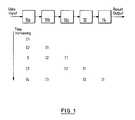
- FIGURE 1 illustrates the pipelining of execution of instructions. It illustrates the flow of instruction through different stages 10a-14. This illustration illustrates how to finish off a binary result, where stage 10a represents the first of three parts of the arithmetic computation of an intermediate result which is completed by steps 10b and 10c and then step 12 represents taking the intermediate result computed by step 10c and normalizing it. That result is passed to stage 14 which rounds the intermediate result into a machine representation of the final result.
- FIGURE 2 illustrating the floating point unit's dataflow
- instructions are received into control unit 16.
- Data is received into the first of a set of pipeline stages 10, and data is outputted from the rounding unit 14 (the same as the final result of stage 14).
- the control unit accepts instructions by handshaking with a instruction unit sending instructions to the control unit 14.
- the instruction unit for instance will issue instructions when the control unit's busy handshake signal is inactive, and the interrupt signal is inactive.
- the instruction unit also keeps track of which instructions are in the execution phase and when an instruction has completed execution the floating point control unit sends an end of instruction signal to the instruction unit.
- an interrupt is issued all instructions that have not ended are cancelled and refetched by the instruction unit.
- a serialization interrupt the instruction unit will issue the next instruction in a slow mode. The slow mode is when one instruction is issued and the next instruction is delayed until the first one's end of instruction.
- pipeline stage 10a which can consist of many pipeline stages or just one, to produce the intermediate result such as addition or multiplication which is the result of the arithmetic computations illustrated by 10a-10c of Figure 1.
- this intermediate result is normalized by the shifter 12 before passing to the rounding unit 14.
- the exponent calculation in the shifter unit is fed back to the control unit to detect if there is a denormalized result needed. This calculation is done in the rounding unit's pipeline stage.
- control path 14 There are two control paths illustrated, one to the shifter unit 12 and one to the rounding unit 14.
- the control unit can cause the shifter to either normalize an operand or to shift it by a specific amount which could result in denormalization depending upon the shift.
- the control signal to the rounding unit allows the selection of either rounding an operand or forcing truncation of the operand.
- the present invention has two paths which are selected based on the presence of other instructions in the floating point unit pipeline. If there are no other instructions in the floating point unit pipeline then Path 1 is taken, else Path 2 is taken. Path 1 uses the external feedback path from the last stage of the floating point pipeline back into the shifter stage. The shifter stage is used to right shift the fraction until the exponent is equal to the fixed exponent of the denormalized format. Thus the steps employed in the process used in path 1 when there are no instructions in the pipeline are:
- Path 2 consists of a causing a "serialization interrupt".
- Hardware causes an interrupt which clears the floating point unit pipeline of outstanding instructions including the instruction which requires denormalization.
- the interrupt is invoked after all instructions prior to the one requiring denormalization are executed.
- the "serialization" interrupt type causes the first reissued instruction to be executed in a slow mode which holds off the issuing of subsequent instructions until the first one has completed. This guarantees that when the instruction is reissued it will be able to execute in Path 1.
- Another processor could alter the instruction or data which caused the intermediate result to require denormalization. Since both the instruction and data are refetched from memory, this presents no problem to cache coherency.
- the other processor will have been assumed to execute first. It is acceptable to cancel and refetch an instruction as long as no machine state is altered on the first execution. If the intermediate result were stored away this could present a problem in a multiprocessor environment.
- the following steps occur:
- the proposed method uses the external feedback path to reuse the shifter unit to perform the denormalization of the intermediate result. This eliminates the need for an extra shifter. Also, the detection of the need to denormalize an intermediate result is accomplished by post detection of the exponent after normalization. This eliminates the need to perform leading zero anticipation which can require a large amount of area, so that the shift amount can be predicted in parallel with the normalization.
- a simple protocol is specified. The protocol only allows the feedback path to be used if there are no other instructions in the floating point pipeline currently executing other than the one that needs to be denormalized. The protocol forces the instruction to be reissued if there are other instructions in the floating point unit pipeline.
- a mechanism for forcing the instruction to be reissued without any overlapping execution with any other instruction is used to eliminate any resource conflicts. No knowledge of the prior intermediate results need to be maintained and are not maintained to avoid any cache coherency problems.
- a determination is made to see if there is any other instructions in the floating point unit pipeline. If there are no other instructions in the pipeline a busy handshake signal is sent to the Instruction Unit to prevent any new instructions from being accepted, then the data is wrapped back through the pipeline and a forced right shift of the data is accomplished in the shifter unit. Then the data is rounded and the result is written to the register file.
- a serialization interrupt is taken.
- the control unit 14 signals the serialization interrupt to the instruction unit. All the outstanding instructions are cancelled.
- the instruction unit reissues the instruction requiring denormalization and waits for its end of instruction prior to issuing a subsequent sequential instruction. Thus, both the instruction which needed to denormalize the result and any other subsequent instructions in the FPU pipeline are cancelled.
- the instructions are re-fetched and the first instruction is executed in a serialization mode which causes the second instruction to not be issued until an end of execution signal is received for the first instruction. After the second instruction is issued the serialization mode ends and a pipeline of instructions is reestablished.
Landscapes
- Engineering & Computer Science (AREA)
- Theoretical Computer Science (AREA)
- Software Systems (AREA)
- Physics & Mathematics (AREA)
- General Engineering & Computer Science (AREA)
- General Physics & Mathematics (AREA)
- Computing Systems (AREA)
- Advance Control (AREA)
Applications Claiming Priority (2)
| Application Number | Priority Date | Filing Date | Title |
|---|---|---|---|
| US08/922,191 US5903479A (en) | 1997-09-02 | 1997-09-02 | Method and system for executing denormalized numbers |
| US922191 | 1997-09-02 |
Publications (2)
| Publication Number | Publication Date |
|---|---|
| EP0901067A2 true EP0901067A2 (de) | 1999-03-10 |
| EP0901067A3 EP0901067A3 (de) | 2000-02-02 |
Family
ID=25446669
Family Applications (1)
| Application Number | Title | Priority Date | Filing Date |
|---|---|---|---|
| EP98306442A Withdrawn EP0901067A3 (de) | 1997-09-02 | 1998-08-12 | Verfahren und System zur Ausführung von Operationen auf denormalisierten Zahlen |
Country Status (2)
| Country | Link |
|---|---|
| US (1) | US5903479A (de) |
| EP (1) | EP0901067A3 (de) |
Cited By (1)
| Publication number | Priority date | Publication date | Assignee | Title |
|---|---|---|---|---|
| WO2007133914A1 (en) * | 2006-05-10 | 2007-11-22 | Qualcomm Incorporated | Mode-based multiply-add processor for denormal operands |
Families Citing this family (14)
| Publication number | Priority date | Publication date | Assignee | Title |
|---|---|---|---|---|
| US6219684B1 (en) * | 1998-09-30 | 2001-04-17 | Intel Corporation | Optimized rounding in underflow handlers |
| US6408379B1 (en) | 1999-06-10 | 2002-06-18 | Advanced Micro Devices, Inc. | Apparatus and method for executing floating-point store instructions in a microprocessor |
| US6442677B1 (en) | 1999-06-10 | 2002-08-27 | Advanced Micro Devices, Inc. | Apparatus and method for superforwarding load operands in a microprocessor |
| US6490606B1 (en) | 1999-08-19 | 2002-12-03 | National Semicondcutor Corporation | Rounding denormalized numbers in a pipelined floating point unit without pipeline stalls |
| US6487653B1 (en) * | 1999-08-25 | 2002-11-26 | Advanced Micro Devices, Inc. | Method and apparatus for denormal load handling |
| US6714957B1 (en) * | 2000-01-04 | 2004-03-30 | National Semiconductor Corporation | System and method for efficient processing of denormal results as hardware exceptions |
| US7890566B1 (en) * | 2000-02-18 | 2011-02-15 | Texas Instruments Incorporated | Microprocessor with rounding dot product instruction |
| US7139801B2 (en) * | 2002-06-14 | 2006-11-21 | Mindshare Design, Inc. | Systems and methods for monitoring events associated with transmitted electronic mail messages |
| US7062635B2 (en) * | 2002-08-20 | 2006-06-13 | Texas Instruments Incorporated | Processor system and method providing data to selected sub-units in a processor functional unit |
| US7395314B2 (en) * | 2003-10-28 | 2008-07-01 | Mindshare Design, Inc. | Systems and methods for governing the performance of high volume electronic mail delivery |
| US7478428B1 (en) * | 2004-10-12 | 2009-01-13 | Microsoft Corporation | Adapting input to find integer overflows |
| US7698353B2 (en) * | 2005-09-14 | 2010-04-13 | Freescale Semiconductor, Inc. | Floating point normalization and denormalization |
| US20070074008A1 (en) * | 2005-09-28 | 2007-03-29 | Donofrio David D | Mixed mode floating-point pipeline with extended functions |
| US9286031B2 (en) * | 2013-11-26 | 2016-03-15 | International Business Machines Corporation | Fast normalization in a mixed precision floating-point unit |
Family Cites Families (3)
| Publication number | Priority date | Publication date | Assignee | Title |
|---|---|---|---|---|
| US5058048A (en) * | 1990-04-02 | 1991-10-15 | Advanced Micro Devices, Inc. | Normalizing pipelined floating point processing unit |
| US5646875A (en) * | 1995-02-27 | 1997-07-08 | International Business Machines Corporation | Denormalization system and method of operation |
| US5602769A (en) * | 1995-07-05 | 1997-02-11 | Sun Microsystems, Inc. | Method and apparatus for partially supporting subnormal operands in floating point multiplication |
-
1997
- 1997-09-02 US US08/922,191 patent/US5903479A/en not_active Expired - Fee Related
-
1998
- 1998-08-12 EP EP98306442A patent/EP0901067A3/de not_active Withdrawn
Cited By (3)
| Publication number | Priority date | Publication date | Assignee | Title |
|---|---|---|---|---|
| WO2007133914A1 (en) * | 2006-05-10 | 2007-11-22 | Qualcomm Incorporated | Mode-based multiply-add processor for denormal operands |
| US7912887B2 (en) | 2006-05-10 | 2011-03-22 | Qualcomm Incorporated | Mode-based multiply-add recoding for denormal operands |
| US8447800B2 (en) | 2006-05-10 | 2013-05-21 | Qualcomm Incorporated | Mode-based multiply-add recoding for denormal operands |
Also Published As
| Publication number | Publication date |
|---|---|
| US5903479A (en) | 1999-05-11 |
| EP0901067A3 (de) | 2000-02-02 |
Similar Documents
| Publication | Publication Date | Title |
|---|---|---|
| US5373461A (en) | Data processor a method and apparatus for performing postnormalization in a floating-point execution unit | |
| US4639886A (en) | Arithmetic system having pipeline structure arithmetic means | |
| US5940311A (en) | Immediate floating-point operand reformatting in a microprocessor | |
| EP0789297B1 (de) | Datenprozessor zum gleichzeitigen Dataladen und Durchführung einer multiplizier-addier Operation | |
| US6151669A (en) | Methods and apparatus for efficient control of floating-point status register | |
| US4879676A (en) | Method and apparatus for precise floating point exceptions | |
| US5923871A (en) | Multifunctional execution unit having independently operable adder and multiplier | |
| US5357237A (en) | In a data processor a method and apparatus for performing a floating-point comparison operation | |
| US5903479A (en) | Method and system for executing denormalized numbers | |
| US5646875A (en) | Denormalization system and method of operation | |
| US6148395A (en) | Shared floating-point unit in a single chip multiprocessor | |
| GB2507656A (en) | Reducing power consumption in a fused multiply-add unit responsive to input data values | |
| US5884062A (en) | Microprocessor with pipeline status integrity logic for handling multiple stage writeback exceptions | |
| EP0450802A2 (de) | Arithmetische Einheit | |
| JPH11511579A (ja) | 浮動小数点処理装置のためのリザベーションステーション | |
| JPH09507941A (ja) | multiply−add浮動小数点シーケンスにおけるウエイト・サイクルなしのブロック正規化 | |
| JPH1049370A (ja) | 遅延命令を有するマイクロプロセッサ | |
| US20030005261A1 (en) | Method and apparatus for attaching accelerator hardware containing internal state to a processing core | |
| US5991863A (en) | Single carry/borrow propagate adder/decrementer for generating register stack addresses in a microprocessor | |
| US6370639B1 (en) | Processor architecture having two or more floating-point status fields | |
| US6148314A (en) | Round increment in an adder circuit | |
| JP3578883B2 (ja) | データ処理装置 | |
| US6078940A (en) | Microprocessor with an instruction for multiply and left shift with saturate | |
| US5649174A (en) | Microprocessor with instruction-cycle versus clock-frequency mode selection | |
| US4878191A (en) | Multiplication circuit capable of operating at a high speed with a small amount of hardware |
Legal Events
| Date | Code | Title | Description |
|---|---|---|---|
| PUAI | Public reference made under article 153(3) epc to a published international application that has entered the european phase |
Free format text: ORIGINAL CODE: 0009012 |
|
| AK | Designated contracting states |
Kind code of ref document: A2 Designated state(s): DE FR GB |
|
| AX | Request for extension of the european patent |
Free format text: AL;LT;LV;MK;RO;SI |
|
| PUAL | Search report despatched |
Free format text: ORIGINAL CODE: 0009013 |
|
| AK | Designated contracting states |
Kind code of ref document: A3 Designated state(s): AT BE CH CY DE DK ES FI FR GB GR IE IT LI LU MC NL PT SE |
|
| AX | Request for extension of the european patent |
Free format text: AL;LT;LV;MK;RO;SI |
|
| 17P | Request for examination filed |
Effective date: 20000531 |
|
| AKX | Designation fees paid |
Free format text: DE FR GB |
|
| 17Q | First examination report despatched |
Effective date: 20020417 |
|
| STAA | Information on the status of an ep patent application or granted ep patent |
Free format text: STATUS: THE APPLICATION IS DEEMED TO BE WITHDRAWN |
|
| 18D | Application deemed to be withdrawn |
Effective date: 20020828 |