EP0901085A2 - Appareil et méthode d'identification des mots allant ensemble - Google Patents
Appareil et méthode d'identification des mots allant ensemble Download PDFInfo
- Publication number
- EP0901085A2 EP0901085A2 EP98307120A EP98307120A EP0901085A2 EP 0901085 A2 EP0901085 A2 EP 0901085A2 EP 98307120 A EP98307120 A EP 98307120A EP 98307120 A EP98307120 A EP 98307120A EP 0901085 A2 EP0901085 A2 EP 0901085A2
- Authority
- EP
- European Patent Office
- Prior art keywords
- phrase
- collocate
- word
- collocates
- collocation
- Prior art date
- Legal status (The legal status is an assumption and is not a legal conclusion. Google has not performed a legal analysis and makes no representation as to the accuracy of the status listed.)
- Withdrawn
Links
Images
Classifications
-
- G—PHYSICS
- G06—COMPUTING OR CALCULATING; COUNTING
- G06F—ELECTRIC DIGITAL DATA PROCESSING
- G06F40/00—Handling natural language data
- G06F40/20—Natural language analysis
- G06F40/279—Recognition of textual entities
- G06F40/284—Lexical analysis, e.g. tokenisation or collocates
-
- G—PHYSICS
- G06—COMPUTING OR CALCULATING; COUNTING
- G06F—ELECTRIC DIGITAL DATA PROCESSING
- G06F40/00—Handling natural language data
- G06F40/20—Natural language analysis
- G06F40/253—Grammatical analysis; Style critique
-
- G—PHYSICS
- G06—COMPUTING OR CALCULATING; COUNTING
- G06F—ELECTRIC DIGITAL DATA PROCESSING
- G06F40/00—Handling natural language data
- G06F40/40—Processing or translation of natural language
- G06F40/55—Rule-based translation
Definitions
- a collocation is a group of words in a sentence or phrase which are closely related (the words belonging to a collocation are known as collocates). It is frequently desirable to identify a collocation in a section of text to be processed since, for example, a group of words forming a collocation might be translated as a single word in another language. Alternatively, a collocation might be equivalent to a single word in the same language.
- a collocation can be either sequential - in which case the words forming the collocation are consecutive in the sentence - or non-sequential.
- JP-A-6 325 081 discloses a method of displaying a sentence in a source language together with a translation of the sentence into a target language.
- the words in the target language are aligned with the source language words from which they are translated - this is achieved by inserting spaces between words in the sentence in one, or both, of the source language and the target language.
- EP-A-0 189 665 discloses a machine translation system which displays an input sentence in a source language and the equivalent output sentence in a target language. A word or phrase in the input sentence that has two or more possible translations is displayed in different text from the remainder of the sentence.
- EP-A-0 199 464 discloses a machine translation system which outputs a sentence in a target language. A word in the output sentence that has two or more possible translations is displayed in different text from the remainder of the sentence. This system does not, however, identify collocates in the input sentence.
- a first aspect of the present invention provides an apparatus for identifying collocates in a phrase to be processed, the apparatus comprising:
- a second aspect of the present invention provides an apparatus for identifying collocates in a phrase to be processed, the apparatus comprising:
- Such an apparatus allows for the "dynamic" identification of collocates.
- a user can investigate the structure of a phrase by finding out whether a particular word in the phrase is a collocate and, if so, which other words in the phrase belong to the same collocation.
- a third aspect of the present invention provides an apparatus for identifying collocates in a phrase to be processed, the apparatus comprising:
- the marker may be "n”.
- the output means may comprise means for displaying the output phrase.
- a fourth aspect of the present invention provides a method of identifying collocates in a phrase to be processed, the method comprising the steps of:
- a fifth aspect of the present invention provides a method of identifying collocates in a phrase to be processed, the method comprising the steps of:
- a sixth aspect of the present invention provides a method of identifying collocates in a phrase to be processed, the method comprising the steps of:
- the marker may be "n”.
- the first step is to analyse an input sentence, and identify each collocate contained in the sentence. This can be done using any known method, for example such as the method disclosed in co-pending UK patent application No: 9612474.8/2 314 183 and European patent application No. 97304196.5/0 813 160, the contents of which are hereby incorporated by reference.
- the results of this step can be thought of as a table having 2 rows. In the first row, there is a representation of the input sentence. In the second row, there are collocate number or markings associated with each word. For example: Sentence John made good use of his salary Collocate number 0 1 0 1 1 0 0
- collocate number of 0 indicates that the item is not collocated with any others. Any other numbers indicate the number of the collocation that this word forms part of. So, in the example above, "made, “use” and “of” are both part of collocation 1. In the following example there is more than one collocate:
- the next step is to display the sentence in such a way that the collocate information is clearly represented. This enables users easily to identify non-sequential collocations.
- the collocate number of a word having a non-zero collocate number is displayed adjacent to the word, for example as a superscript:-
- More than one of the methods of identifying a collocate in a displayed sentence described above can be used together.
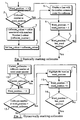
- Figure 1 illustrates one embodiment of a method of the present invention.
- a collocate is identified in a displayed sentence in two ways. Firstly, a collocate is underlined, with the colour of the underlining being different from one collocation to another. Secondly, the collocate number is displayed under a collocate, in the middle of the underlining.
- the collocate number of the first word of the phrase is compared with zero, at step 2. If the collocate number of the first word is zero - that is, if the first word is not a collocate - the word is not underlined in the displayed phrase, and the collocate number of the first word is not displayed. If the first word is a collocate, however, a colour is assigned to the collocate number of the first word at step 3, and the colour of the underlining of the first word in the displayed image is set to that colour at step 4. This process is then repeated for subsequent words in the phrase, until the determination at step 7 indicates that the process has been performed for all words in the phrase.
- the method of assigning a colour to a collocate number is not significant, provided that colours assigned to different collocate numbers are sufficiently different to allow a user to distinguish easily between collocations.
- One method would be to construct a collocate number to colour array having a size greater than the largest likely collocate number, and assign selected colours to collocate numbers at random in the array.
- An alternative method of assigning a colour to a collocate number would be to keep a record of selected collocate number/colour pairs. When a new colour is required, a colour which is significantly different from previously used colours would be chosen. (This is analogous to pseudo-random number generation, where the first selected colour acts as a seed.)
- the present invention is not limited to displaying a sentence having just two collocations, but it can be applied to a sentence having three or more collocations.
- Another embodiment of the present invention provides a 'dynamic' display method, in which the collocate information displayed depends on the user's choice.
- collocate information is determined as outlined above, but the information is initially not displayed with the input sentence - that is, all words of the sentence are displayed in the same manner.
- the next step is for a user to select a word of the input sentence. If the sentence is displayed on a VDU the user can select a word by clicking the mouse on the word, for example. If the selected word is a collocate, the selected word and the other words in the collocation would be highlighted. Thus, for the sentence:-
- Figure 2 illustrates a method of 'dynamic' identification of collocates. It assumes that the step of determining the collocate number of each word in the input phrase has already been carried out.
- step 10 the collocate number of the word in the input phrase selected by the user is 'looked up', and at step 11 this collocate number is compared with zero. If it is zero - that is, if the selected word is not a collocate - no words in the displayed phrase are highlighted.
- the selected word is a collocate - i.e. it has a non-zero collocate number - the collocate number of the first word in the input phrase is compared with the collocate number of the selected word at step 13.
- the first word is highlighted in the output phrase at step 14 if, and only if, it has the same collocate number as the selected word. It can be highlighted in any one of the ways described above.
- the comparison of the collocate number with the collocate number of the selected word is then repeated for the second and subsequent words in the input phrase, until the result of the determination at step 16 shows that the comparison has been carried out for all words in the input phrase. All words in the input phrase having the same collocate number as the selected word will have been highlighted in the output phrase, following 'yes' determinations at step 13 for each word in the collocation.
- One advantageous feature of this invention is that when it displays a sentence having a non-sequential collocation only the words making up the collocation are "highlighted", as shown in example (2). In contrast, in the prior art a non-sequential collocation is not displayed correctly, as shown in Example (1).
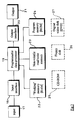
- Figure 3 is a schematic illustration of an apparatus suitable for carrying out the present invention. It has an input terminal 17 for inputting a section of text to be processed. Alternatively, other means capable of inputting a section of text, for example a voice recognition system, or an Optical Character Reader could be used.
- the input terminal 17 is connected to a programmable data processor 19 by means of an input interface 18.
- the processor is capable of analysing the input section of text in the manner described in UK Patent Application No. 9612474.8 and European Patent Application No. 97304196.5.
- the data processor 19 is connected to a random access memory (RAM) 22, a nonvolatile read/write memory 23 and a program memory 24.
- the program memory is a read only memory (ROM).
- the RAM 22 acts as a "working" memory, and contains a database.
- the data processor 19 may also be connectable to an external database such as, for example, a CD-ROM 25, a "floppy” disc 26, or a digital video disc (DVD) 27.
- the apparatus further comprises an output device 21, which is connected to the processor 19 by an output interface 20.
- This output device could be, for example, a display device or a printer.
- the processor 19 is able to analyse an input section of text in the manner described in UK Patent Application No. 9612474.8 and European Patent Application No. 97304196.5.
- the apparatus of the present invention is further adapted to identify collocates in the output text, for example in one of the ways described hereinabove.
- the processor 19 is adapted to determine which words in the input text are collocates and deliver the results to the output interface 20 for outputting by the output device 21.
Landscapes
- Engineering & Computer Science (AREA)
- Theoretical Computer Science (AREA)
- Health & Medical Sciences (AREA)
- Artificial Intelligence (AREA)
- Audiology, Speech & Language Pathology (AREA)
- Computational Linguistics (AREA)
- General Health & Medical Sciences (AREA)
- Physics & Mathematics (AREA)
- General Engineering & Computer Science (AREA)
- General Physics & Mathematics (AREA)
- Machine Translation (AREA)
Applications Claiming Priority (2)
| Application Number | Priority Date | Filing Date | Title |
|---|---|---|---|
| GB9718906 | 1997-09-05 | ||
| GB9718906A GB2329047A (en) | 1997-09-05 | 1997-09-05 | A method of identifying collocates |
Publications (2)
| Publication Number | Publication Date |
|---|---|
| EP0901085A2 true EP0901085A2 (fr) | 1999-03-10 |
| EP0901085A3 EP0901085A3 (fr) | 2000-07-05 |
Family
ID=10818636
Family Applications (1)
| Application Number | Title | Priority Date | Filing Date |
|---|---|---|---|
| EP98307120A Withdrawn EP0901085A3 (fr) | 1997-09-05 | 1998-09-04 | Appareil et méthode d'identification des mots allant ensemble |
Country Status (4)
| Country | Link |
|---|---|
| US (1) | US20020007266A1 (fr) |
| EP (1) | EP0901085A3 (fr) |
| JP (1) | JPH11175524A (fr) |
| GB (1) | GB2329047A (fr) |
Families Citing this family (4)
| Publication number | Priority date | Publication date | Assignee | Title |
|---|---|---|---|---|
| US7574348B2 (en) * | 2005-07-08 | 2009-08-11 | Microsoft Corporation | Processing collocation mistakes in documents |
| US9916295B1 (en) * | 2013-03-15 | 2018-03-13 | Richard Henry Dana Crawford | Synchronous context alignments |
| US10769375B2 (en) | 2017-08-17 | 2020-09-08 | International Business Machines Corporation | Domain-specific lexical analysis |
| US10445423B2 (en) | 2017-08-17 | 2019-10-15 | International Business Machines Corporation | Domain-specific lexically-driven pre-parser |
Family Cites Families (5)
| Publication number | Priority date | Publication date | Assignee | Title |
|---|---|---|---|---|
| JPH0664585B2 (ja) * | 1984-12-25 | 1994-08-22 | 株式会社東芝 | 翻訳編集装置 |
| JPS61217871A (ja) * | 1985-03-25 | 1986-09-27 | Toshiba Corp | 翻訳処理装置 |
| US4868750A (en) * | 1987-10-07 | 1989-09-19 | Houghton Mifflin Company | Collocational grammar system |
| US5383120A (en) * | 1992-03-02 | 1995-01-17 | General Electric Company | Method for tagging collocations in text |
| US5617488A (en) * | 1995-02-01 | 1997-04-01 | The Research Foundation Of State University Of New York | Relaxation word recognizer |
-
1997
- 1997-09-05 GB GB9718906A patent/GB2329047A/en not_active Withdrawn
-
1998
- 1998-09-03 US US09/146,180 patent/US20020007266A1/en not_active Abandoned
- 1998-09-03 JP JP10250053A patent/JPH11175524A/ja active Pending
- 1998-09-04 EP EP98307120A patent/EP0901085A3/fr not_active Withdrawn
Also Published As
| Publication number | Publication date |
|---|---|
| GB2329047A (en) | 1999-03-10 |
| EP0901085A3 (fr) | 2000-07-05 |
| GB9718906D0 (en) | 1997-11-12 |
| JPH11175524A (ja) | 1999-07-02 |
| US20020007266A1 (en) | 2002-01-17 |
Similar Documents
| Publication | Publication Date | Title |
|---|---|---|
| US5442546A (en) | System and method for automatically generating translation templates from a pair of bilingual sentences | |
| US8489388B2 (en) | Data detection | |
| US7213205B1 (en) | Document categorizing method, document categorizing apparatus, and storage medium on which a document categorization program is stored | |
| US5926565A (en) | Computer method for processing records with images and multiple fonts | |
| Hutchins | The development and use of machine translation systems and computer-based translation tools | |
| EP0180047A2 (fr) | Editeur de texte pour l'entrée de la parole | |
| GB2062916A (en) | Method and apparatus for producing ideographic text | |
| EP0435803A2 (fr) | Méthode pour la recherche de caractéristiques dans un système de traitement de données pour support de langues vivantes | |
| IL121457A (en) | Computerized dictionary and thesaurus applications | |
| EP0775963B1 (fr) | Indexation d'une base de données par un automate fini | |
| GB2227110A (en) | Keyboard coding of Chinese | |
| US7937657B2 (en) | User specific error analysis | |
| US6640219B2 (en) | Analyzing data files | |
| EP1492036B1 (fr) | Systeme d'interrogation de base de données | |
| EP0901085A2 (fr) | Appareil et méthode d'identification des mots allant ensemble | |
| EP0398513A2 (fr) | Méthode et appareil de traduction d'une phrase comportant un mot composé formé par hyphénation | |
| US5835625A (en) | Method and apparatus for optical character recognition utilizing proportional nonpredominant color analysis | |
| Barreiro et al. | Lexical differences between european and brazilian portuguese | |
| JPS60108959A (ja) | 文章変換装置 | |
| JPS6118074A (ja) | プレ・エデイツト方式 | |
| EP0864989A2 (fr) | Procédé et dispositif pour chercher des fichiers et utiliser les fichiers trouvés | |
| KR100248387B1 (ko) | 자국어작성에 의한 한일간 온라인 작문 서비스지원방법 | |
| JPH0748217B2 (ja) | 文書要約装置 | |
| JP3447127B2 (ja) | 機械翻訳装置 | |
| Viet et al. | Unified Tai Script for Unicode |
Legal Events
| Date | Code | Title | Description |
|---|---|---|---|
| PUAI | Public reference made under article 153(3) epc to a published international application that has entered the european phase |
Free format text: ORIGINAL CODE: 0009012 |
|
| AK | Designated contracting states |
Kind code of ref document: A2 Designated state(s): DE ES FR GB |
|
| AX | Request for extension of the european patent |
Free format text: AL;LT;LV;MK;RO;SI |
|
| PUAL | Search report despatched |
Free format text: ORIGINAL CODE: 0009013 |
|
| AK | Designated contracting states |
Kind code of ref document: A3 Designated state(s): AT BE CH CY DE DK ES FI FR GB GR IE IT LI LU MC NL PT SE |
|
| AX | Request for extension of the european patent |
Free format text: AL;LT;LV;MK;RO;SI |
|
| 17P | Request for examination filed |
Effective date: 20001214 |
|
| AKX | Designation fees paid |
Free format text: DE ES FR GB |
|
| 17Q | First examination report despatched |
Effective date: 20040914 |
|
| STAA | Information on the status of an ep patent application or granted ep patent |
Free format text: STATUS: THE APPLICATION IS DEEMED TO BE WITHDRAWN |
|
| 18D | Application deemed to be withdrawn |
Effective date: 20050325 |