EP0901118A2 - Procédé et dispositif de calcul de distances dans des espaces vectoriels de dimensions élevées - Google Patents
Procédé et dispositif de calcul de distances dans des espaces vectoriels de dimensions élevées Download PDFInfo
- Publication number
- EP0901118A2 EP0901118A2 EP98202843A EP98202843A EP0901118A2 EP 0901118 A2 EP0901118 A2 EP 0901118A2 EP 98202843 A EP98202843 A EP 98202843A EP 98202843 A EP98202843 A EP 98202843A EP 0901118 A2 EP0901118 A2 EP 0901118A2
- Authority
- EP
- European Patent Office
- Prior art keywords
- vectors
- values
- vector
- value
- partial
- Prior art date
- Legal status (The legal status is an assumption and is not a legal conclusion. Google has not performed a legal analysis and makes no representation as to the accuracy of the status listed.)
- Withdrawn
Links
Images


Classifications
-
- G—PHYSICS
- G10—MUSICAL INSTRUMENTS; ACOUSTICS
- G10L—SPEECH ANALYSIS TECHNIQUES OR SPEECH SYNTHESIS; SPEECH RECOGNITION; SPEECH OR VOICE PROCESSING TECHNIQUES; SPEECH OR AUDIO CODING OR DECODING
- G10L15/00—Speech recognition
- G10L15/08—Speech classification or search
- G10L15/10—Speech classification or search using distance or distortion measures between unknown speech and reference templates
-
- G—PHYSICS
- G10—MUSICAL INSTRUMENTS; ACOUSTICS
- G10L—SPEECH ANALYSIS TECHNIQUES OR SPEECH SYNTHESIS; SPEECH RECOGNITION; SPEECH OR VOICE PROCESSING TECHNIQUES; SPEECH OR AUDIO CODING OR DECODING
- G10L15/00—Speech recognition
- G10L15/06—Creation of reference templates; Training of speech recognition systems, e.g. adaptation to the characteristics of the speaker's voice
- G10L15/063—Training
- G10L2015/0631—Creating reference templates; Clustering
-
- G—PHYSICS
- G10—MUSICAL INSTRUMENTS; ACOUSTICS
- G10L—SPEECH ANALYSIS TECHNIQUES OR SPEECH SYNTHESIS; SPEECH RECOGNITION; SPEECH OR VOICE PROCESSING TECHNIQUES; SPEECH OR AUDIO CODING OR DECODING
- G10L19/00—Speech or audio signals analysis-synthesis techniques for redundancy reduction, e.g. in vocoders; Coding or decoding of speech or audio signals, using source filter models or psychoacoustic analysis
- G10L2019/0001—Codebooks
- G10L2019/0013—Codebook search algorithms
- G10L2019/0014—Selection criteria for distances
Definitions
- the invention relates to a method for reducing the computing steps in Calculate distances between feature vectors in the pattern and Voice recognition.
- the distance calculation poses a central problem in the pattern and Speech recognition. It requires the most computing time, so that a reduction in Computing time significantly improves performance.
- EP 0 285 211 A2 (DE3710507 A1) describes a system in which, inter alia, Speech values are compared with comparison values and distance sums are formed become. These comparison and language values consist of several components that Properties of these signal parts include. A continuous speech signal is converted into a temporal sequence of speech values is divided, and each component of the speech value is with corresponding components of at least some predefined stored ones Comparative values compared, each comparison result representing a distance to a minimum distance sum is added.
- DE 42 40 978 A1 describes a method for improving the recognition quality described speaker-dependent speech recognition. From a spoken word Characteristic sequences are formed which are subjected to a vector quantization method. In doing so, speaker-typical feature vectors previously created for this speaker are which are stored in a code book, compared with the current feature vectors. For this purpose, distance values of the feature vectors are formed. It will be different Distance calculation methods applied, the results of which may be weighted and averaged become. The resulting distance value is compared to a threshold value. This leads to a positive or negative result in speaker verification.
- DE 44 17 557 A1 describes a method for recognizing voice signals and Arrangement for performing this method described.
- a first Training phase become the first feature vectors from pending reference speech signals obtained, which are then subjected to vector quantization.
- This Feature vectors are stored with cluster vectors stored in a code book compared and a first cluster vector is determined which is related to a predetermined Distance dimension has the greatest agreement with the respective feature vector.
- the address of the first cluster vector determined is stored in the address memory.
- the speech signals to be recognized become in again Characteristic vectors divided and subjected to a classification and with the Compared cluster vectors.
- the object of the invention is therefore to provide a method with which the Computational effort for distance calculation optimized and thereby reduced can be. This object is achieved by the method according to claim 1.
- An advantage of this invention over the prior art is that it is unique Calculate all necessary partial distances by forming value vectors.
- the resolution of the component values is limited to a certain number of bits component values occur with an increasing number of different reference vectors several times.
- each value vector only all the different components of the in the Values occurring reference vector stored.
- the number of to be formed Value vectors result from the number of components of the reference vectors that are for all reference vectors are the same, with the individual value vectors having different numbers May contain component values.
- a repetition of values within one Value vector is not possible, but can also be in different value vectors same values occur because the value vectors different components of the Represent reference vectors and these components different properties of a Describe the reference vector.
- the component values in the value vectors are over Pointer linked to the values of the components of the reference vectors.
- Each Component value of the reference vectors is assigned a pointer that points to a value in shows the corresponding value vector.
- Pointers assigned to the values of the components of the reference vectors and which point to the corresponding values in the value vectors consist appropriately two parts, the first part pointing to an address of the corresponding value vector and the second part represents an offset that within the value vector select the appropriate value.
- Another possibility of reducing the calculation steps results from a Clustering the values of the components.
- closely adjacent values of the Components combined into a cluster.
- the values within this cluster must meet a specified condition.
- From these values within the cluster a mean value is calculated, and the different mean values of the Component values are stored in associated value vectors.
- the condition according to which the values are assigned to the individual clusters can be the Accuracy. In the case of a rough condition, many values fall into one Cluster, only a few in a tight condition.
- the width of the clusters can also vary A histogram can be set differently so that a weighting of Areas is possible.
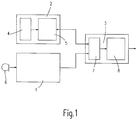
- Input unit 1 shows an input unit 1, a storage unit 2 and an output unit 3
- Input unit 1 becomes the input signals from a microphone 6 in this example fed.
- the digitized signal is divided into several successive ones Sections and values that represent typical properties of these sections, are assigned to the corresponding components of feature vectors.
- Of the Memory 2 consists of two areas. In one memory area 4 are Contain reference vectors, each consisting of several components, each Component is assigned a value. In the other memory area 5, the Value vectors, which are only different values of the components of the reference vectors contained in the first memory area 4, stored.
- the output unit 3 contains the Evaluation unit 8 and a distance calculation 7, in which each value of the components of each newly created feature vector with each different component value compared within the corresponding value vector, a partial distance is formed and this is assigned to the associated value in the value vector.
- the components of the Reference vectors in memory area 4 are assigned pointers that point to the different component values in the value vectors in memory area 5 with the show calculated partial distances.
- the distance calculation shows 7 for everyone Components of the feature vector for at least some of the reference vectors, one each Combination of the individual partial distances of the component values of a reference vector formed according to certain calculation rules. This combination represents the distance between the feature vector and the relevant reference vector Evaluation unit 8 for forming or continuing, for example, word hypotheses fed.
- FIG. 2a shows the reference vectors R 1 -R n with their components K a -K m .
- the reference vectors all consist of the same number of components.
- the stored values of these components contain properties of the signal parts.
- the value vectors AM are shown in FIG. 2b.
- the number of value vectors corresponds to the number of components K a -K m of the reference vectors, the value vectors now only containing the different values of the components of the reference vectors. For example, only four values are shown in value vector A, ie only four different values occur in component K a in reference vectors R 1 -R n .
- value vector B consists of only two values
- value vector C here consists of ten values. These values are stored in the memory locations in the value vectors which are denoted by W. For each value in these value vectors, a storage location P is additionally kept, at which the corresponding partial distance is stored.
- FIG. 2c shows the relationship between reference vectors and value vectors using the example of value vector A.
- Pointers Z w are assigned to the values of component K a of reference vectors R 1 -R n , which point to the corresponding values in the value vector.
- the values of the component K a of the reference vectors R 1 and R 2 point to the same value.
- a feature vector has as many components as a reference vector.
- the value of the component K a of the feature vector is compared with all the values of the corresponding value vector A and the differences between the values in the fields P i provided for this purpose are assigned to the respective values as partial distances.
- a partial distance is calculated four times, since there are only four different values in component K a of the reference vectors.
- a partial distance calculation is only necessary twice for component K b , since there are only two values here.
- the number of reference vectors is 60000 as in the example above, it is not necessary to calculate a distance 60000 times for each component of a feature vector, but in this example for component K a only four times or twice for component K b . These examples exaggerate the problem somewhat, but clearly show the goal.
- This partial distance calculation to all existing value vectors is carried out for each new feature vector.
- a combination distance is then formed for each reference vector by the assignment via the pointers Z W , as shown in FIG. 2c, since each partial distance is assigned to the corresponding value in the value vectors and the pointers Z W thus do not only point to the value of their component , but also on the partial distance.
- This distance formed in the distance calculation 7 for at least some of the reference vectors is fed within the output unit 3 to the evaluation unit 8 for the formation and continuation of, for example, word hypotheses.
- Different calculation methods in particular according to Gauss, Laplace or Supremums norm, can be used to form this distance.
- FIG. 3 shows several reference vectors R 1 -R n , the same sequences F 1 and F 2 of values x, y, z and q, r, s, t in the components K c , K d , K e and K g , K h , K i , K j .
- partial vectors PV 1 and PV 2 are set up in order to calculate the same sequences F 1 and F 2 in several reference vectors R 1 , R 2 , R 3 and R 3 , R 4 in the distance calculation between feature vectors and reference vectors not to combine the individual partial distances every time.
- the values of the components of the individual reference vectors do not change, so that, for example, R 1 , R 2 and R 3 always have the same sequence F 1 with the values x, y, z for the components K c , K d , K, regardless of the feature vector under consideration e have.
- the partial vector PV 1 is addressed once, in each case by one pointer Z F per sequence in the reference vector, the pointers Z W (shown in FIG. 2c) of the components K c , K d , K e of the sequence F 1 in the R 1 , R 2 and R 3 are replaced at their values in the value vectors C, D, E and assigned to the partial vector PV 1 .
- the partial vectors thus provide auxiliary partial distances for the reference vectors, so that the number of partial distances for the calculation of the distance is reduced.
- R 1 only ten calculations instead of twelve previously are required for R 1 in order to calculate the distance to the feature vector.
- R 3 since there are two sequences, only 6 calculations are required. This procedure only makes sense if the same sequences of values of the same components also occur in several reference vectors, since the computing effort is only reduced for each next reference vector, since the auxiliary partial distance is then already calculated.
- the component values of the reference vectors these values to groups or clusters summarize.
- a corresponding condition is set up for this. Content of this The condition is the definition of the boundaries of the clusters. Depending on the required accuracy you can choose the limits wide or narrow. All values of this cluster then become an average value with selectable accuracy is formed.
- the mean values thus formed are entered in the value vectors.
- the mean value of the respective cluster is used. This will achieved that even with a high resolution with a corresponding number of possible values the method of forming value vectors can be applied. It stays weigh up to what extent you accept compromises in the accuracy of the values without recognizing the overall result, recognizing the pattern or word, falsify sustainably.
Landscapes
- Engineering & Computer Science (AREA)
- Computational Linguistics (AREA)
- Health & Medical Sciences (AREA)
- Audiology, Speech & Language Pathology (AREA)
- Human Computer Interaction (AREA)
- Physics & Mathematics (AREA)
- Acoustics & Sound (AREA)
- Multimedia (AREA)
- Image Analysis (AREA)
- Compression, Expansion, Code Conversion, And Decoders (AREA)
- Character Discrimination (AREA)
Applications Claiming Priority (2)
| Application Number | Priority Date | Filing Date | Title |
|---|---|---|---|
| DE19738846 | 1997-09-05 | ||
| DE19738846A DE19738846C1 (de) | 1997-09-05 | 1997-09-05 | Verfahren und Anordnung zur Berechnung von Abständen in hochdimensionalen Vektorräumen |
Publications (2)
| Publication Number | Publication Date |
|---|---|
| EP0901118A2 true EP0901118A2 (fr) | 1999-03-10 |
| EP0901118A3 EP0901118A3 (fr) | 1999-10-20 |
Family
ID=7841302
Family Applications (1)
| Application Number | Title | Priority Date | Filing Date |
|---|---|---|---|
| EP98202843A Withdrawn EP0901118A3 (fr) | 1997-09-05 | 1998-08-27 | Procédé et dispositif de calcul de distances dans des espaces vectoriels de dimensions élevées |
Country Status (3)
| Country | Link |
|---|---|
| EP (1) | EP0901118A3 (fr) |
| JP (1) | JPH11161291A (fr) |
| DE (1) | DE19738846C1 (fr) |
Families Citing this family (3)
| Publication number | Priority date | Publication date | Assignee | Title |
|---|---|---|---|---|
| DE19939705A1 (de) * | 1999-08-18 | 2001-03-08 | Deutsche Telekom Ag | Vorrichtung zur Spracherkennung |
| DE19939101A1 (de) * | 1999-08-18 | 2001-03-01 | Siemens Ag | Verfahren, Anordnung und Computerprogrammerzeugnis zur Berechnung von Abständen zwischen einem Merkmalsvektor und mehreren Vergleichsvektoren |
| DE10305821A1 (de) * | 2003-02-12 | 2004-09-02 | Infineon Technologies Ag | Verfahren und Vorrichtung zum Vergleichen einer Vielzahl von Eingangsvektoren mit m Referenzvektoren, Computerprogramm-Element und Computerlesbares Speichermedium |
Family Cites Families (3)
| Publication number | Priority date | Publication date | Assignee | Title |
|---|---|---|---|---|
| DE3710507A1 (de) * | 1987-03-30 | 1988-10-20 | Philips Patentverwaltung | Verfahren zum erkennen kontinuierlich gesprochener woerter |
| DE4240978A1 (de) * | 1992-12-05 | 1994-06-09 | Telefonbau & Normalzeit Gmbh | Verfahren zur Verbesserung der Erkennungsqualität bei sprecherabhängiger Spracherkennung, insbesondere Sprecherverifikation |
| DE4417557A1 (de) * | 1994-05-19 | 1995-11-23 | Daimler Benz Aerospace Ag | Verfahren zur Erkennung von Sprachsignalen und Anordnung zum Durchführen des Verfahrens |
-
1997
- 1997-09-05 DE DE19738846A patent/DE19738846C1/de not_active Expired - Fee Related
-
1998
- 1998-08-27 EP EP98202843A patent/EP0901118A3/fr not_active Withdrawn
- 1998-09-07 JP JP10252725A patent/JPH11161291A/ja active Pending
Also Published As
| Publication number | Publication date |
|---|---|
| EP0901118A3 (fr) | 1999-10-20 |
| JPH11161291A (ja) | 1999-06-18 |
| DE19738846C1 (de) | 1998-10-22 |
Similar Documents
| Publication | Publication Date | Title |
|---|---|---|
| DE69127961T2 (de) | Verfahren zur Spracherkennung | |
| DE68928154T2 (de) | Fingerabdruckverarbeitungssystem, geeignet für das Ermitteln des Kernes eines Fingerabdruckbildes durch Krümmungsparameter | |
| DE3819178C2 (fr) | ||
| DE102008017993B4 (de) | Sprachsuchvorrichtung | |
| DE69423692T2 (de) | Sprachkodiergerät und Verfahren unter Verwendung von Klassifikationsregeln | |
| EP0533261A2 (fr) | Procédé et dispositif pour la reconnaissance de mots prononcés dans un signal de parole | |
| DE3043516C2 (de) | Verfahren und Vorrichtung zur Spracherkennung | |
| EP0285222B1 (fr) | Procédé pour la reconnaissance de la parole continue | |
| DE69130270T2 (de) | Signalverarbeitung und -erkennung | |
| DE3733391A1 (de) | Verfahren zur spracherkennung | |
| DE4002336A1 (de) | Bezugsmuster-erneuerungsverfahren | |
| DE3026055C2 (de) | Schaltungsanordnung zur maschinellen Zeichererkennung | |
| DE19738846C1 (de) | Verfahren und Anordnung zur Berechnung von Abständen in hochdimensionalen Vektorräumen | |
| DE2813157C2 (de) | Gerät zur selbsttätigen, lageunabhängigen Mustererkennung | |
| DE69518291T2 (de) | System und Verfahren zur Spracherkennung mit verringerter Antwortzeit | |
| DE69915817T2 (de) | Vorrichtung und verfahren zur spracherkennung | |
| DE19956625C2 (de) | Echtzeit-Datensortierung und -reduktion | |
| EP0956531A1 (fr) | Procede pour la transformation d'une logique floue servant a la simulation d'un processus technique en un reseau neuronal | |
| EP0834859B1 (fr) | Procédé de détermination d'un modèle acoustique pour un mot | |
| DE4433366A1 (de) | Verfahren und Einrichtung zur Bestimmung eines Maßes der Übereinstimmung zwischen zwei Mustern sowie Spracherkennungseinrichtung damit und Programm-Modul dafür | |
| DE69325612T2 (de) | Lernende Wellenformerkennungseinrichtung | |
| DE3238300A1 (de) | Verfahren und vorrichtung zur muster- oder zeichenerkennung | |
| EP0815515B1 (fr) | Methode et appareil permettant de concevoir un reseau neuronal | |
| DE69621674T2 (de) | Trainingssystem für Referenzmuster und dieses Trainingssystem benutzendes Spracherkennungssystem | |
| DE69700987T2 (de) | Anordnungen zur signalverarbeitung |
Legal Events
| Date | Code | Title | Description |
|---|---|---|---|
| PUAI | Public reference made under article 153(3) epc to a published international application that has entered the european phase |
Free format text: ORIGINAL CODE: 0009012 |
|
| AK | Designated contracting states |
Kind code of ref document: A2 Designated state(s): DE FR GB |
|
| AX | Request for extension of the european patent |
Free format text: AL;LT;LV;MK;RO;SI |
|
| PUAL | Search report despatched |
Free format text: ORIGINAL CODE: 0009013 |
|
| AK | Designated contracting states |
Kind code of ref document: A3 Designated state(s): AT BE CH CY DE DK ES FI FR GB GR IE IT LI LU MC NL PT SE |
|
| AX | Request for extension of the european patent |
Free format text: AL;LT;LV;MK;RO;SI |
|
| RIC1 | Information provided on ipc code assigned before grant |
Free format text: 6G 10L 5/06 A, 6G 06K 9/64 B |
|
| RAP3 | Party data changed (applicant data changed or rights of an application transferred) |
Owner name: KONINKLIJKE PHILIPS ELECTRONICS N.V. Owner name: PHILIPS CORPORATE INTELLECTUAL PROPERTY GMBH |
|
| 17P | Request for examination filed |
Effective date: 20000420 |
|
| AKX | Designation fees paid |
Free format text: DE FR GB |
|
| STAA | Information on the status of an ep patent application or granted ep patent |
Free format text: STATUS: THE APPLICATION HAS BEEN WITHDRAWN |
|
| 18W | Application withdrawn |
Withdrawal date: 20010903 |
|
| R18W | Application withdrawn (corrected) |
Effective date: 20010831 |