EP0901253A2 - Procédé de commande de transmission - Google Patents
Procédé de commande de transmission Download PDFInfo
- Publication number
- EP0901253A2 EP0901253A2 EP98116502A EP98116502A EP0901253A2 EP 0901253 A2 EP0901253 A2 EP 0901253A2 EP 98116502 A EP98116502 A EP 98116502A EP 98116502 A EP98116502 A EP 98116502A EP 0901253 A2 EP0901253 A2 EP 0901253A2
- Authority
- EP
- European Patent Office
- Prior art keywords
- base station
- radio base
- forward link
- terminal
- link message
- Prior art date
- Legal status (The legal status is an assumption and is not a legal conclusion. Google has not performed a legal analysis and makes no representation as to the accuracy of the status listed.)
- Granted
Links
- 230000005540 biological transmission Effects 0.000 title claims abstract description 82
- 238000000034 method Methods 0.000 title claims abstract description 36
- 230000004044 response Effects 0.000 claims abstract description 48
- 230000002459 sustained effect Effects 0.000 claims abstract description 5
- 238000004891 communication Methods 0.000 claims description 44
- 230000002441 reversible effect Effects 0.000 claims description 11
- 238000012790 confirmation Methods 0.000 claims description 8
- 101001062854 Rattus norvegicus Fatty acid-binding protein 5 Proteins 0.000 abstract description 4
- 238000010586 diagram Methods 0.000 description 7
- 238000005266 casting Methods 0.000 description 4
- 230000000694 effects Effects 0.000 description 3
- 239000000284 extract Substances 0.000 description 3
- 238000001514 detection method Methods 0.000 description 2
- 230000004083 survival effect Effects 0.000 description 2
- 101150042515 DA26 gene Proteins 0.000 description 1
- 230000015556 catabolic process Effects 0.000 description 1
- 230000008859 change Effects 0.000 description 1
- 230000003247 decreasing effect Effects 0.000 description 1
- 238000006731 degradation reaction Methods 0.000 description 1
- 238000010295 mobile communication Methods 0.000 description 1
- 230000008569 process Effects 0.000 description 1
- 230000002269 spontaneous effect Effects 0.000 description 1
Images


Classifications
-
- H—ELECTRICITY
- H04—ELECTRIC COMMUNICATION TECHNIQUE
- H04W—WIRELESS COMMUNICATION NETWORKS
- H04W74/00—Wireless channel access
- H04W74/02—Hybrid access
-
- H—ELECTRICITY
- H04—ELECTRIC COMMUNICATION TECHNIQUE
- H04W—WIRELESS COMMUNICATION NETWORKS
- H04W74/00—Wireless channel access
- H04W74/04—Scheduled access
- H04W74/06—Scheduled access using polling
-
- H—ELECTRICITY
- H04—ELECTRIC COMMUNICATION TECHNIQUE
- H04W—WIRELESS COMMUNICATION NETWORKS
- H04W74/00—Wireless channel access
- H04W74/08—Non-scheduled access, e.g. ALOHA
- H04W74/0833—Random access procedures, e.g. with 4-step access
- H04W74/0841—Random access procedures, e.g. with 4-step access with collision treatment
- H04W74/085—Random access procedures, e.g. with 4-step access with collision treatment collision avoidance
Definitions
- the present invention relates to a transmission control method in a radio communication system.
- the represent invention relates to a transmission control method in a communication system that establishes packet communications where a radio communication medium is shared between plural terminals and a base station and that uses a multiple access system in which possible collision occurs.
- the shared communication medium provides a point-to-multipoint transmission line.
- the forward link which transmits signals from a radio base station to terminals is used for broadcasting so that all terminals become a receivable state.
- the reverse link which transmits signals from a terminal to the radio station is generally used as a multi-access in which plural terminals use a common communication medium.
- To provide an effective multi-access mode to the reverse link means to increase the transmission capacity per shared communication medium. As a result, this allows the subscriber capacity of the system to be greatly increased.
- the basic system which can provide the simplest control is the ALOHA system (refer to Telecommunication Networks (ISBNO-201-16423), pp. 407-408).
- ALOHA Telecommunication Networks
- packet signals are transmitted immediately when they are newly generated. This allows a very small delay to be achieved although collision may occur.
- This access system in which possible collision occurs is hereinafter called a collision-based access system.
- CSMA Carrier Sense Multiple Access
- ISBNO-201-16423 Telecommunication Networks (ISBNO-201-16423), pp. 437) which detects whether or not other terminal currently is in a transmission mode by means of a receiving section and then transmits packet signals immediately when the idle period detection.
- This system allows collision of transmitted packets to be relieved because packet signals are not transmitted while other terminal is in a transmission mode.
- the terminal cannot completely sense the carrier.
- the ICMA system Idle-signal Casting Multiple Access
- the ICMA system is used to reduce collision of a packet signal at a multi-access time, thus improving the throughput.
- ICMA-PE Idle-signal Casting Multiple Access With Partial Echo
- Fig. 4 is a sequence diagram showing the ICMA-PE system.
- the radio base station 40 when the radio base station 40 receives an reverse link message Dlu(0) from the terminal 41, it sets up a busy flag as access control information and adds a portion of the received data Dlu(0) as a partial echo PE1(0). This operation can determine whether or not which terminal has transmitted a survival signal due to packet signal collision by a capture effect, thus enabling a relief process.
- ICMA-CD Idle-signal Casting Multiple Access With Collision Detection
- the multiple access system is hereinafter called the non-collision-based access system.
- This access system is generally realized by circulating the transmission right of a terminal.
- polling system as one of non-collision-based access systems.
- JP-A-274788/1996 discloses a multiple access method that uses adaptively and selectively the collision-based access system and the non-collision-based access system. That is, according to the communication traffic between a terminal and a radio base station, the connection delay is decreased by using the collision multiple access system at the time of low traffic and using the non-collision multiple access system at the time of high traffic. Moreover, high throughput can be realized even at a high traffic time.
- the collision-based access system employs such a methodology in which the terminal that judges that a packet signal transmitted from itself to avoid re-collision after the occurrence of collision has collided is transferred to a back-off state and then re-transmits the packet signal after a period of a random time or transmits the next signal.
- the non-collision-based access system since a terminal can perform transmission only by the polling from a radio base station, collision does not occur, so that the terminal does not change to a back-off state.
- the terminal when the mode changes from the collision-based access system to the non-collision-based access system due to collision of a signal transmitted from a certain terminal, the terminal is changed to a back-off state. In this case, the problem arises that the terminal cannot perform transmission operation because of its back-off state even if polling is performed from the radio base station to the terminal.
- the objective of the present invention is to solve the above-mentioned tasks.
- the objective of the present invention is achieved by the transmission control method suitable in a radio communication system which performs packet communications by sharing a radio communication medium between plural terminals and a radio station and employs a multiple access system in which collision may occur, the method comprising the steps of making a terminal in a transmission mode during use of a collision-based access system when receiving a polling from said radio base station, said terminal being changed to a back-off state, thus being in a wait state, because of collision of a signal transmitted from said terminal.
- each of the terminals judges that a packet signal transmitted from its terminal has collided when its terminal receives access control information from the radio base station after transmitting the packet signal to the radio base station, the access control information representing no reception, and changes to a back-off state in which a different random time transmission is suspended.
- the radio base station transmits a common polling signal to all the terminals when a packet signal from each of the terminals is not received, and sequentially transmits polling signals to other terminals after a packet is completely received from a specific terminal.
- the method comprises the steps of detecting collision by means of the radio station; changing the radio communication system to a back-off state by transmitting the collision signal when the multiple access system in which collision may occur is changed to the multiple access system in which collision does not occur; and making the terminal in a transmission mode at a polling receive time when the terminal in a wait state has received polling from the base station.
- each of the terminals judges that a packet signal transmitted from itself has collided when receiving the access control information from the radio base station, the access control information representing that the packet signal is not received, after transmission of the packet signal to the radio station, and changes to a back-off state in which a different random time transmission is sustained.
- the transmission control method suitable in a radio communication system which performs packet communications by sharing a radio communication medium between plural terminals and a radio base station and employs a multiple access system in which collision may occur in a reverse link from the plural terminals to the radio base station and which realizes transmission confirmation regarding a forward link packet signal to be transmitted on a forward link in response to a response signal from a terminal being a destination of the forward link packet signal
- the method comprises the steps of transmitting a collision signal after the radio base station detects collision; and transmitting a response signal for transmission confirmation at a polling receiving time when a terminal changed to a back-off state and in a wait state receives polling from the radio station.
- each of the terminals judges that a packet signal transmitted from itself has collided when receiving the access control information from the radio base station, the access control information representing that the packet signal is not received, after transmission of the packet signal to the radio station, and changes to a back-off state in which a different random time transmission is sustained.
- a terminal in a back-off state or wait state can be quickly changed to a transmission mode in response to a polling signal from a radio base station.
- the throughput is improved and the radio line can be effectively used.
- a response signal to be transmitted from a terminal for transmission confirmation can be quickly invited to a signal to be transmitted from a base station to a terminal.
- the transmission control method comprises the steps of transmitting a first forward link message from a radio base station to terminals; transmitting packet signals from the terminals in response to the first forward link message; transmitting a second forward link message from the radio base station when the radio base station does not receive the packet signals due to collision of the packet signals; changing the terminals to a back-off state in response to the second forward link message to avoid re-collision; retrasnmitting a packet signal from a terminal first recovered from the back-off state in response to a third forward link message from the radio base station; transmitting a fourth forward link message containing access control information from the radio base station when the radio base station correctly receives the packet signal from the first recovered terminal; and judging that the packet signal from the first recovered terminal has been correctly received by the radio base station when the first recovered terminal receives the fourth forward link message.
- the transmission control method comprises the steps of transmitting a first forward link message from a radio base station to terminals; transmitting packet signals from the terminals in response to the first forward link message when the radio base station is in a collision-system access mode; changing the radio base station from a collision-system access mode to a non-collision-system access mode when the radio base station does not receive the packet signals due to collision of the packet signals, and then transmitting a second forward link message from the radio base station; changing the terminals to a back-off state in response to the second forward link message to avoid re-collision; retransmitting a packet signal from a terminal first recovered from the back-off state according to transmission invitation in response to a third forward link message from the radio base station; transmitting a fourth forward link message containing polling information from the radio base station to the first recovered terminal when the radio base station correctly receives the packet signal from the first recovered terminal; and sequentially transmitting a fifth forward link message from the radio base station when a packet signal
- the transmission control method comprises the steps of transmitting packet signals from terminals in response to a first forward link message from a radio base station; transmitting a second forward link message from the radio base station when the radio base station does not receive the packet signals due to collision of the packet signals; changing the terminals to a back-off state in response to the second forward link message to avoid re-collision; extracting forward link message for a terminal in a back-off state from a third forward link message transmitted from the radio base station retransmitting a packet signal from a terminal first recovered from the back-off state in response to the third forward link message from the radio base station; transmitting a fourth forward link message containing access control information and forward link message for first-recovered terminal from the radio base station when the radio base station correctly receives the packet signal from the first recovered terminal; extracting forward link message from the fourth forward link message; transmitting a fifth forward link message containing access control information and forward link message from the radio base station to confirm transmission of forward link message; and transmitting a response packet
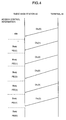
- Fig. 1 is a sequence diagram illustrating communications between a base terminal and terminals according to an embodiment of the present invention.
- the embodiment relates to a radio packet communication system in which the reverse link message has a time slot structure and the forward link message has a time slot structure.
- the ICMA-PE system is employed for the reverse link multiple access.
- the radio base station 10 communicates with the terminals 11 and 12.
- Numeral 11 represents the identifier of the terminal 11 while 12 represents the identifier of the terminal 12.
- the radio base station 10 transmits down signals (DA11 to DA17) containing access control information formed of a Busy/Idle/Polling flag and a polling address to each of terminals.
- the terminal 11 transmits the packet signal D11(0) in response to the forward link message DA11 containing Idle information from the radio base station 10 while the terminal 12 transmits the packet signal D12(0) in response to the forward link message DA11 containing Idle information from the radio base station 10.
- the radio base station 10 transmits the forward link message DA12 containing access control information formed of an Idle flag and a polling address "0".
- the forward link message DA12 In response to the forward link message DA12, each of the terminals 11 and 12 judges that collision of the packet signal transmitted by itself has occurred and then changes to a back-off state in which random time transmission is held, to avoid re-collision.
- the terminal 12 When first recovering from the back-off state and receiving the forward link message DA13 containing Idle information from the radio base station 10, the terminal 12 re-transmits the packet signal D12(0). When correctly receiving the packet signal, the radio base station 10 transmits the forward link message DA14 containing access control information formed of an Idle flag and a polling address "12" as the identifier of the terminal 12. In response to the forward link message DA14, the terminal 12 judges that the packet signal transmitted by itself has been correctly received by the radio base station 10.
- the radio base station 10 transmits the forward link message DA15 containing access control information formed of a Polling flag and a polling address "11" as the identifier 11 of the terminal 11 and then invites the terminal 11 to send packet signals.
- the terminal 11 which has received the forward link message DA15 is in a back-off state and does not originally transmit packet signals. However, according to the invitation from the radio base station, the terminal 11 in a back-off state re-transmits the packet signal D11(0).
- the radio base station 10 transmits the forward link message DA15 containing access control information formed of an Idle flag and a polling access "11" as the identifier 11 of the terminal 11. In response to the forward link message DA15, the terminal 11 judges that the radio base station 10 has correctly received the packet signal transmitted by itself.
- Fig. 2 is a sequence diagram illustrating communication sequences between a radio base station and a terminal according to the second embodiment of the present invention.
- This embodiment relates a radio packet communicant system in which each of the reverse link message and the forward link message has a time slot structure.
- the reverse link multiple access employs the ICMA-CD system.
- the radio base station 20 communicates with the terminals 21 and 22 by adaptively using the collision-based access system and the non-collision-based access system.
- Numeral 21 represents the identifier of the terminal 21 while 22 represents the identifier of the terminal 22.
- the radio base station 20 transmits the down signals (DA21 to DA27) containing access control information formed of a Busy/Idle flag and a polling address to the terminals.
- the terminal 21 transmits the packet signal D21(0) in response to DA21 containing Idle information from the radio base station 20 while the terminal 22 transmits the packet signal D22(0) in response to DA21 containing Idle information from the radio base station 20.
- the terminal 21 When the terminal 21 first recovers from the back-off state, it receives the forward link message DA23 containing polling information for itself formed of a Busy flag and a polling address. Then, the terminal 21 retransmits the packet signal D21(0) (being the collided packet signal) according to invitation from the radio base station 20. When correctly receiving the packet signal, the radio base station 20 again transmits the forward link message DA24 containing the polling information for the terminal 21. However, since the terminal 21 does not transmits the packet signal, the radio base station sequentially transmits forward link message DA25 containing polling information formed of a Busy flag and a polling address "22" as the identifier 22 of the terminal 22.
- the terminal 25 which receives the forward link message DA25 is in a back-off state and does not originally send the packet signal. However, since there is invitation from the radio base station, the terminal 22 in a back-off state re-transmits the D21(0) being the collided packet signal.
- the radio base station 20 correctly receives the packet signal, it re-transmits the forward link message DA26 containing the polling information for the terminal 22.
- the radio base station 20 sequentially transmits the forward link message DA27 containing polling information for the next terminal to be invited for transmission.
- Fig. 3 is a sequence chart illustrating a communication sequence between a radio base station and a terminal according to the third embodiment of the present invention.
- This embodiment relates to a radio packet communication system in which each of the reverse link message and the forward link message has a time slot structure.
- the reverse link multiple access employs the ICMA-CD system.
- the down packet signal transmitted from the radio base station 30 to the terminals 31 and 32 is confirmed using a protocol corresponding to LAPB (Balanced Link Access Procedure).
- Numeral 31 represents the identifier of the terminal 31 while 32 represents the identifier of the terminal 32.
- the radio base station 30 sequentially transmits down signals (DA31 to DA37) formed of a Busy/Idle/Polling flag and a destination address to each terminal.
- the terminal 31 transmits the packet signal D31(0) in response to the forward link message DA31 containing Idle information from the radio base station 30.
- the terminal 32 transmits the packet signal D32(0) in response to the forward link message DA31 containing Idle information from the radio base station 30.
- the radio base station 30 Since the packet signals D31(0) and D32(0) collide, the radio base station 30 cannot receive them. Hence, the radio base station 30 transmits the forward link message DA32 containing access control information in which destination address is 0. In response to the forward link message DA32, the terminal 31 judges that collision of the packet signal transmitted by itself has collided and then turns in a back-off state in which a random time transmission is held to avoid repeated collision.
- the terminal 32 which has first recovered from the back-off state receives the forward link message DA33 containing Idle information from the radio base station 30, it re-transmits the packet signal D32(0) being the collided packet signal.
- the radio base station 30 which has correctly received the packet signal, transmits the forward link message DA34 formed of access control information containing an Idle flag and a destination address "31" as the identifier of the terminal 31 as well as the down-steam data for the terminal 31.
- the terminal 31 receives the forward link message DA34 and then extracts the forward link message for itself from it.
- the radio base station 30 confirms that the forward link message for the successive terminal 31 as well as the forward link message transmitted until now have been transmitted and then transmits the forward link message DA35 formed of access control information and forward link message for the terminal 31.
- the access control information includes a Busy/Idle/polling flag as polling (transmission confirmation request) and a destination address "31" as the identifier of the terminal 31.
- the terminal 31 extracts the forward link message for itself from it.
- the terminal 31 transmits a packet signal D31(RR) to send an acknowledgment to an inquiry of confirmation from the radio base station 30.
- the radio base station 30 When the radio base station 30 correctly receives the packet signal for the response, it transmits the forward link message DA36 formed of access control information and the forward link message for the successive terminal 31.
- the access control information includes an Idle flag and a destination address "31" as the identifier of the terminal 31.
- the terminal 31 receives the forward link message DA36 and then extracts the forward link message for itself from it. Since the terminal 31 is relieved from the back-off state until this time, it re-transmits the packet signal D31(0) being the collided packet signal, in response the forward link message DA36 containing the Idle information.
- the radio base station transmits a polling signal to a terminal which is in a back-off state due to an occurrence of collision and holds its spontaneous transmission, and then urges the terminal to transmit signals without delaying based on a request thereof. Hence, effectively packet transmission can be realized.
- a terminal can transmit packet signals when a polling signal from the radio communication station is received in transmission invitation sent immediately when the mode has changed from the collision-system access mode to the non-collision-system access mode. As a result, more effective packet transmission can be realized.
Landscapes
- Engineering & Computer Science (AREA)
- Computer Networks & Wireless Communication (AREA)
- Signal Processing (AREA)
- Mobile Radio Communication Systems (AREA)
- Small-Scale Networks (AREA)
Priority Applications (1)
| Application Number | Priority Date | Filing Date | Title |
|---|---|---|---|
| EP20090179417 EP2173070B1 (fr) | 1997-09-04 | 1998-09-01 | Commande de transmission dans un terminal de communication mobile et dans un réseau de communication mobile. |
Applications Claiming Priority (3)
| Application Number | Priority Date | Filing Date | Title |
|---|---|---|---|
| JP25412097A JP3061122B2 (ja) | 1997-09-04 | 1997-09-04 | 伝送制御方式 |
| JP254120/97 | 1997-09-04 | ||
| JP25412097 | 1997-09-04 |
Related Child Applications (1)
| Application Number | Title | Priority Date | Filing Date |
|---|---|---|---|
| EP20090179417 Division-Into EP2173070B1 (fr) | 1997-09-04 | 1998-09-01 | Commande de transmission dans un terminal de communication mobile et dans un réseau de communication mobile. |
Publications (3)
| Publication Number | Publication Date |
|---|---|
| EP0901253A2 true EP0901253A2 (fr) | 1999-03-10 |
| EP0901253A3 EP0901253A3 (fr) | 2004-03-24 |
| EP0901253B1 EP0901253B1 (fr) | 2010-02-10 |
Family
ID=17260510
Family Applications (2)
| Application Number | Title | Priority Date | Filing Date |
|---|---|---|---|
| EP20090179417 Expired - Lifetime EP2173070B1 (fr) | 1997-09-04 | 1998-09-01 | Commande de transmission dans un terminal de communication mobile et dans un réseau de communication mobile. |
| EP19980116502 Expired - Lifetime EP0901253B1 (fr) | 1997-09-04 | 1998-09-01 | Procédé de commande de transmission |
Family Applications Before (1)
| Application Number | Title | Priority Date | Filing Date |
|---|---|---|---|
| EP20090179417 Expired - Lifetime EP2173070B1 (fr) | 1997-09-04 | 1998-09-01 | Commande de transmission dans un terminal de communication mobile et dans un réseau de communication mobile. |
Country Status (6)
| Country | Link |
|---|---|
| US (1) | US6621826B1 (fr) |
| EP (2) | EP2173070B1 (fr) |
| JP (1) | JP3061122B2 (fr) |
| CN (1) | CN1201605C (fr) |
| CA (1) | CA2246506C (fr) |
| DE (1) | DE69841493D1 (fr) |
Cited By (11)
| Publication number | Priority date | Publication date | Assignee | Title |
|---|---|---|---|---|
| US6218896B1 (en) | 1999-08-27 | 2001-04-17 | Tachyon, Inc. | Vectored demodulation and frequency estimation apparatus and method |
| US6256483B1 (en) | 1998-10-28 | 2001-07-03 | Tachyon, Inc. | Method and apparatus for calibration of a wireless transmitter |
| US6532220B1 (en) | 1999-08-27 | 2003-03-11 | Tachyon, Inc. | System and method for efficient channel assignment |
| WO2003043265A1 (fr) * | 2001-11-13 | 2003-05-22 | Koninklijke Philips Electronics N.V. | Appareil et procede de definition de regles de reprise et de degagement d'un coordinateur hybride ieee 802.11e |
| US6650636B1 (en) | 1999-08-27 | 2003-11-18 | Tachyon, Inc. | Transmission and reception of TCP/IP data over a wireless communication channel |
| US6665292B1 (en) | 1999-08-27 | 2003-12-16 | Tachyon, Inc. | Transmission and reception of TCP/IP data over a wireless communication channel |
| US6674731B1 (en) | 1999-08-27 | 2004-01-06 | Tachyon, Inc. | Transmission and reception of TCP/IP data over a wireless communication channel |
| US6674730B1 (en) | 1998-08-04 | 2004-01-06 | Tachyon, Inc. | Method of and apparatus for time synchronization in a communication system |
| US6735188B1 (en) | 1999-08-27 | 2004-05-11 | Tachyon, Inc. | Channel encoding and decoding method and apparatus |
| US6847626B1 (en) | 1998-07-21 | 2005-01-25 | Tachyon, Inc. | Method and apparatus for multiple access in a communication system |
| US6982969B1 (en) | 1999-09-28 | 2006-01-03 | Tachyon, Inc. | Method and system for frequency spectrum resource allocation |
Families Citing this family (12)
| Publication number | Priority date | Publication date | Assignee | Title |
|---|---|---|---|---|
| DE19959545A1 (de) * | 1999-12-09 | 2001-06-21 | Iar Systems Ag | Funkstrecke und Verfahren zu deren Betrieb |
| JP2004297400A (ja) * | 2003-03-26 | 2004-10-21 | Matsushita Electric Ind Co Ltd | 無線情報通信システム |
| AU2003904169A0 (en) * | 2003-08-08 | 2003-08-21 | Clipsal Intergrated Systems Pty Ltd | Collision detection in a non-dominant bit radio network communication system |
| US8699508B2 (en) * | 2003-12-18 | 2014-04-15 | Intel Corporation | Response scheduling for multiple receivers |
| BRPI0508484A (pt) * | 2004-03-05 | 2007-07-31 | Nextnet Wireless Inc | método e aparelho para transmissão de datagramas isócronos através de link de dados baseado em disputa |
| DE602005025470D1 (de) * | 2005-07-07 | 2011-02-03 | Ericsson Telefon Ab L M | Sendeleistungsregelung in einem wahlfreien Zugriffsverfahren |
| JP4550013B2 (ja) * | 2006-06-08 | 2010-09-22 | 日本電信電話株式会社 | 無線通信方法、動的帯域割当方法、無線通信システム及び基地局 |
| JP5631843B2 (ja) * | 2011-10-31 | 2014-11-26 | 日本電信電話株式会社 | 無線lanアクセス制御方法および無線lanシステム |
| JP5631845B2 (ja) * | 2011-11-01 | 2014-11-26 | 日本電信電話株式会社 | 無線lanアクセス制御方法および無線lanシステム |
| CN106157588B (zh) * | 2016-08-15 | 2022-04-29 | 扬州恒隆软件有限公司 | 快速高精度光电直读式智能水表系统 |
| CN109560857A (zh) * | 2018-11-26 | 2019-04-02 | 四川安迪科技实业有限公司 | 基于卫星通信的分组轮询方法 |
| CN116847309A (zh) * | 2023-06-05 | 2023-10-03 | 华能伊敏煤电有限责任公司 | 一种用于无人驾驶矿车的数据通信方法 |
Family Cites Families (10)
| Publication number | Priority date | Publication date | Assignee | Title |
|---|---|---|---|---|
| US4409592A (en) * | 1981-04-20 | 1983-10-11 | Hunt V Bruce | Multipoint packet data communication system using random access and collision detection techniques |
| WO1991016775A1 (fr) * | 1990-04-25 | 1991-10-31 | Telxon Corporation | Systeme de communication a commande adaptative d'acces aux supports |
| US5353287A (en) * | 1992-03-25 | 1994-10-04 | Alcatel Network Systems, Inc. | Local area network with message priority |
| US5896561A (en) * | 1992-04-06 | 1999-04-20 | Intermec Ip Corp. | Communication network having a dormant polling protocol |
| US6088590A (en) * | 1993-11-01 | 2000-07-11 | Omnipoint Corporation | Method and system for mobile controlled handoff and link maintenance in spread spectrum communication |
| JP2746183B2 (ja) | 1995-04-04 | 1998-04-28 | 日本電気株式会社 | 多重アクセス方法 |
| US5717889A (en) * | 1995-06-30 | 1998-02-10 | Intel Corporation | Collison reduction algorithm for an ethernet backoff protocol |
| US5737330A (en) * | 1996-01-11 | 1998-04-07 | Meteor Communications Corporation | System and method for the efficient control of a radio communications network |
| US5940399A (en) * | 1996-06-20 | 1999-08-17 | Mrv Communications, Inc. | Methods of collision control in CSMA local area network |
| US5946118A (en) * | 1997-02-04 | 1999-08-31 | Digital Equipment Corporation | Communication collision detection |
-
1997
- 1997-09-04 JP JP25412097A patent/JP3061122B2/ja not_active Expired - Lifetime
-
1998
- 1998-09-01 DE DE69841493T patent/DE69841493D1/de not_active Expired - Lifetime
- 1998-09-01 EP EP20090179417 patent/EP2173070B1/fr not_active Expired - Lifetime
- 1998-09-01 EP EP19980116502 patent/EP0901253B1/fr not_active Expired - Lifetime
- 1998-09-03 CA CA 2246506 patent/CA2246506C/fr not_active Expired - Lifetime
- 1998-09-03 US US09/146,240 patent/US6621826B1/en not_active Expired - Lifetime
- 1998-09-04 CN CNB981203442A patent/CN1201605C/zh not_active Expired - Lifetime
Cited By (12)
| Publication number | Priority date | Publication date | Assignee | Title |
|---|---|---|---|---|
| US6847626B1 (en) | 1998-07-21 | 2005-01-25 | Tachyon, Inc. | Method and apparatus for multiple access in a communication system |
| US7203204B2 (en) | 1998-07-21 | 2007-04-10 | Tachyon Networks Incorporated | Method and apparatus for multiple access in a communication system |
| US6674730B1 (en) | 1998-08-04 | 2004-01-06 | Tachyon, Inc. | Method of and apparatus for time synchronization in a communication system |
| US6256483B1 (en) | 1998-10-28 | 2001-07-03 | Tachyon, Inc. | Method and apparatus for calibration of a wireless transmitter |
| US6218896B1 (en) | 1999-08-27 | 2001-04-17 | Tachyon, Inc. | Vectored demodulation and frequency estimation apparatus and method |
| US6532220B1 (en) | 1999-08-27 | 2003-03-11 | Tachyon, Inc. | System and method for efficient channel assignment |
| US6650636B1 (en) | 1999-08-27 | 2003-11-18 | Tachyon, Inc. | Transmission and reception of TCP/IP data over a wireless communication channel |
| US6665292B1 (en) | 1999-08-27 | 2003-12-16 | Tachyon, Inc. | Transmission and reception of TCP/IP data over a wireless communication channel |
| US6674731B1 (en) | 1999-08-27 | 2004-01-06 | Tachyon, Inc. | Transmission and reception of TCP/IP data over a wireless communication channel |
| US6735188B1 (en) | 1999-08-27 | 2004-05-11 | Tachyon, Inc. | Channel encoding and decoding method and apparatus |
| US6982969B1 (en) | 1999-09-28 | 2006-01-03 | Tachyon, Inc. | Method and system for frequency spectrum resource allocation |
| WO2003043265A1 (fr) * | 2001-11-13 | 2003-05-22 | Koninklijke Philips Electronics N.V. | Appareil et procede de definition de regles de reprise et de degagement d'un coordinateur hybride ieee 802.11e |
Also Published As
| Publication number | Publication date |
|---|---|
| EP2173070A3 (fr) | 2011-07-27 |
| EP2173070A2 (fr) | 2010-04-07 |
| JP3061122B2 (ja) | 2000-07-10 |
| EP2173070B1 (fr) | 2013-12-25 |
| EP0901253A3 (fr) | 2004-03-24 |
| US6621826B1 (en) | 2003-09-16 |
| CA2246506A1 (fr) | 1999-03-04 |
| CN1220555A (zh) | 1999-06-23 |
| EP0901253B1 (fr) | 2010-02-10 |
| JPH1188366A (ja) | 1999-03-30 |
| CN1201605C (zh) | 2005-05-11 |
| DE69841493D1 (de) | 2010-03-25 |
| CA2246506C (fr) | 2006-02-21 |
Similar Documents
| Publication | Publication Date | Title |
|---|---|---|
| EP0901253B1 (fr) | Procédé de commande de transmission | |
| US5621732A (en) | Access method and a relay station and terminals thereof | |
| US6996088B1 (en) | Distributed trunking mechanism for VHF networking | |
| US9826492B2 (en) | Wireless communication apparatus | |
| US7373135B2 (en) | Communication system, communication apparatus, communication method, and program | |
| JPH10303930A (ja) | 無線ローカルエリアネットワーク(wlan)用コントローラ、wlanの動作パラメータを動的に調整する方法および無線通信局用コントローラ | |
| JP2001160813A (ja) | 無線ネットワーク | |
| EP1114542B1 (fr) | Mecanisme de liaison reparti pour un reseau vhf | |
| CN102958185A (zh) | 一种竞争窗口的更新方法和一种接入点 | |
| CN1087538C (zh) | 能快速确认收到下行分组信号的分组通信系统 | |
| US6359899B1 (en) | Priority access for real-time traffic in contention-based networks | |
| JP2000115051A (ja) | 無線マルチキャストデータ転送方法及び該方法を用いた無線通信システム | |
| US20040233927A1 (en) | Method of controlling communications | |
| JP2002064503A (ja) | 無線パケット中継方法 | |
| JP2001525155A (ja) | 2進フィードバックを用いたランダムアクセス通信法 | |
| JP4042901B2 (ja) | 無線端末およびその無線アクセス制御方法 | |
| CN101631337B (zh) | 一种数据传输的方法及装置 | |
| Foh et al. | Improving the Efficiency of CSMA using Reservations by Interruptions. | |
| GB2419496A (en) | Priority in contention based communications network channel access | |
| JPH01264332A (ja) | データ伝送装置 |
Legal Events
| Date | Code | Title | Description |
|---|---|---|---|
| PUAI | Public reference made under article 153(3) epc to a published international application that has entered the european phase |
Free format text: ORIGINAL CODE: 0009012 |
|
| AK | Designated contracting states |
Kind code of ref document: A2 Designated state(s): AT BE CH CY DE DK ES FI FR GB GR IE IT LI LU MC NL PT SE |
|
| AX | Request for extension of the european patent |
Free format text: AL;LT;LV;MK;RO;SI |
|
| PUAL | Search report despatched |
Free format text: ORIGINAL CODE: 0009013 |
|
| AK | Designated contracting states |
Kind code of ref document: A3 Designated state(s): AT BE CH CY DE DK ES FI FR GB GR IE IT LI LU MC NL PT SE |
|
| AX | Request for extension of the european patent |
Extension state: AL LT LV MK RO SI |
|
| RIC1 | Information provided on ipc code assigned before grant |
Ipc: 7H 04L 12/403 B Ipc: 7H 04L 12/413 B Ipc: 7H 04L 12/56 A |
|
| 17P | Request for examination filed |
Effective date: 20040217 |
|
| 17Q | First examination report despatched |
Effective date: 20040512 |
|
| AKX | Designation fees paid |
Designated state(s): DE FI FR GB IT SE |
|
| GRAP | Despatch of communication of intention to grant a patent |
Free format text: ORIGINAL CODE: EPIDOSNIGR1 |
|
| RIC1 | Information provided on ipc code assigned before grant |
Ipc: H04W 74/02 20090101ALI20090728BHEP Ipc: H04L 12/403 20060101ALI20090728BHEP Ipc: H04L 12/413 20060101ALI20090728BHEP Ipc: H04L 12/56 20060101AFI20090728BHEP |
|
| GRAS | Grant fee paid |
Free format text: ORIGINAL CODE: EPIDOSNIGR3 |
|
| GRAA | (expected) grant |
Free format text: ORIGINAL CODE: 0009210 |
|
| RIN1 | Information on inventor provided before grant (corrected) |
Inventor name: TAKETSUGU, MASANORI |
|
| AK | Designated contracting states |
Kind code of ref document: B1 Designated state(s): DE FI FR GB IT SE |
|
| REG | Reference to a national code |
Ref country code: GB Ref legal event code: FG4D |
|
| REF | Corresponds to: |
Ref document number: 69841493 Country of ref document: DE Date of ref document: 20100325 Kind code of ref document: P |
|
| PG25 | Lapsed in a contracting state [announced via postgrant information from national office to epo] |
Ref country code: FI Free format text: LAPSE BECAUSE OF FAILURE TO SUBMIT A TRANSLATION OF THE DESCRIPTION OR TO PAY THE FEE WITHIN THE PRESCRIBED TIME-LIMIT Effective date: 20100210 |
|
| PG25 | Lapsed in a contracting state [announced via postgrant information from national office to epo] |
Ref country code: SE Free format text: LAPSE BECAUSE OF FAILURE TO SUBMIT A TRANSLATION OF THE DESCRIPTION OR TO PAY THE FEE WITHIN THE PRESCRIBED TIME-LIMIT Effective date: 20100210 |
|
| PLBE | No opposition filed within time limit |
Free format text: ORIGINAL CODE: 0009261 |
|
| STAA | Information on the status of an ep patent application or granted ep patent |
Free format text: STATUS: NO OPPOSITION FILED WITHIN TIME LIMIT |
|
| 26N | No opposition filed |
Effective date: 20101111 |
|
| PG25 | Lapsed in a contracting state [announced via postgrant information from national office to epo] |
Ref country code: IT Free format text: LAPSE BECAUSE OF FAILURE TO SUBMIT A TRANSLATION OF THE DESCRIPTION OR TO PAY THE FEE WITHIN THE PRESCRIBED TIME-LIMIT Effective date: 20100210 |
|
| REG | Reference to a national code |
Ref country code: FR Ref legal event code: PLFP Year of fee payment: 19 |
|
| REG | Reference to a national code |
Ref country code: FR Ref legal event code: PLFP Year of fee payment: 20 |
|
| PGFP | Annual fee paid to national office [announced via postgrant information from national office to epo] |
Ref country code: GB Payment date: 20170830 Year of fee payment: 20 Ref country code: DE Payment date: 20170830 Year of fee payment: 20 Ref country code: FR Payment date: 20170810 Year of fee payment: 20 |
|
| REG | Reference to a national code |
Ref country code: DE Ref legal event code: R071 Ref document number: 69841493 Country of ref document: DE |
|
| REG | Reference to a national code |
Ref country code: GB Ref legal event code: PE20 Expiry date: 20180831 |
|
| PG25 | Lapsed in a contracting state [announced via postgrant information from national office to epo] |
Ref country code: GB Free format text: LAPSE BECAUSE OF EXPIRATION OF PROTECTION Effective date: 20180831 |