EP0902009B1 - Esterquats based on cinnamic acid - Google Patents
Esterquats based on cinnamic acid Download PDFInfo
- Publication number
- EP0902009B1 EP0902009B1 EP98116083A EP98116083A EP0902009B1 EP 0902009 B1 EP0902009 B1 EP 0902009B1 EP 98116083 A EP98116083 A EP 98116083A EP 98116083 A EP98116083 A EP 98116083A EP 0902009 B1 EP0902009 B1 EP 0902009B1
- Authority
- EP
- European Patent Office
- Prior art keywords
- acid
- alkyl
- carbon atoms
- cinnamic
- cinnamic acid
- Prior art date
- Legal status (The legal status is an assumption and is not a legal conclusion. Google has not performed a legal analysis and makes no representation as to the accuracy of the status listed.)
- Expired - Lifetime
Links
Classifications
-
- A—HUMAN NECESSITIES
- A61—MEDICAL OR VETERINARY SCIENCE; HYGIENE
- A61K—PREPARATIONS FOR MEDICAL, DENTAL OR TOILETRY PURPOSES
- A61K8/00—Cosmetics or similar toiletry preparations
- A61K8/18—Cosmetics or similar toiletry preparations characterised by the composition
- A61K8/30—Cosmetics or similar toiletry preparations characterised by the composition containing organic compounds
- A61K8/40—Cosmetics or similar toiletry preparations characterised by the composition containing organic compounds containing nitrogen
- A61K8/45—Derivatives containing from 2 to 10 oxyalkylene groups
-
- A—HUMAN NECESSITIES
- A61—MEDICAL OR VETERINARY SCIENCE; HYGIENE
- A61K—PREPARATIONS FOR MEDICAL, DENTAL OR TOILETRY PURPOSES
- A61K8/00—Cosmetics or similar toiletry preparations
- A61K8/18—Cosmetics or similar toiletry preparations characterised by the composition
- A61K8/30—Cosmetics or similar toiletry preparations characterised by the composition containing organic compounds
- A61K8/40—Cosmetics or similar toiletry preparations characterised by the composition containing organic compounds containing nitrogen
- A61K8/41—Amines
- A61K8/416—Quaternary ammonium compounds
-
- A—HUMAN NECESSITIES
- A61—MEDICAL OR VETERINARY SCIENCE; HYGIENE
- A61Q—SPECIFIC USE OF COSMETICS OR SIMILAR TOILETRY PREPARATIONS
- A61Q19/00—Preparations for care of the skin
-
- C—CHEMISTRY; METALLURGY
- C07—ORGANIC CHEMISTRY
- C07C—ACYCLIC OR CARBOCYCLIC COMPOUNDS
- C07C219/00—Compounds containing amino and esterified hydroxy groups bound to the same carbon skeleton
- C07C219/02—Compounds containing amino and esterified hydroxy groups bound to the same carbon skeleton having esterified hydroxy groups and amino groups bound to acyclic carbon atoms of the same carbon skeleton
- C07C219/04—Compounds containing amino and esterified hydroxy groups bound to the same carbon skeleton having esterified hydroxy groups and amino groups bound to acyclic carbon atoms of the same carbon skeleton the carbon skeleton being acyclic and saturated
- C07C219/10—Compounds containing amino and esterified hydroxy groups bound to the same carbon skeleton having esterified hydroxy groups and amino groups bound to acyclic carbon atoms of the same carbon skeleton the carbon skeleton being acyclic and saturated having at least one of the hydroxy groups esterified by a carboxylic acid having the esterifying carboxyl group bound to an acyclic carbon atom of a carbon skeleton containing rings
-
- A—HUMAN NECESSITIES
- A61—MEDICAL OR VETERINARY SCIENCE; HYGIENE
- A61Q—SPECIFIC USE OF COSMETICS OR SIMILAR TOILETRY PREPARATIONS
- A61Q17/00—Barrier preparations; Preparations brought into direct contact with the skin for affording protection against external influences, e.g. sunlight, X-rays or other harmful rays, corrosive materials, bacteria or insect stings
- A61Q17/04—Topical preparations for affording protection against sunlight or other radiation; Topical sun tanning preparations
-
- A—HUMAN NECESSITIES
- A61—MEDICAL OR VETERINARY SCIENCE; HYGIENE
- A61Q—SPECIFIC USE OF COSMETICS OR SIMILAR TOILETRY PREPARATIONS
- A61Q5/00—Preparations for care of the hair
-
- A—HUMAN NECESSITIES
- A61—MEDICAL OR VETERINARY SCIENCE; HYGIENE
- A61Q—SPECIFIC USE OF COSMETICS OR SIMILAR TOILETRY PREPARATIONS
- A61Q5/00—Preparations for care of the hair
- A61Q5/02—Preparations for cleaning the hair
Definitions
- the invention relates to new ester quats based on cinnamic acid and their use as light protection filters in cosmetics and textile technology.
- Cosmetic products are used to protect against the harmful effects of UV rays often added light protection filters which are able to absorb ultraviolet rays and which absorbed energy in the form of longer-wave radiation, e.g. To give off heat again.
- typical examples are aminobenzoic acid esters, methoxycinnamic acid, benzophenones, dibenzoylmethanes, salicylic acid esters and the like, but also finely dispersed metal oxides, e.g. Titanium dioxide or zinc stearate. These substances, especially in synergistic combinations, meet the requirements for light protection satisfactory, but the problem is to stably disperse them in large amounts.
- the complex object of the invention was to provide new light protection filters for both To provide cosmetics as well as for textile technology that have surface-active properties have a slight sensory impression on the skin, both natural as well as synthetic fibers, i.e. hair and textiles, give them a pleasant soft feel and reduce the electrostatic charge between the fibers and at the same time via UV absorbers Properties.
- the invention relates to esterquats, the acid component of which is wholly or partly Cinnamic acid.
- the substances mentioned not only have excellent surface-active, finishing and antistatic properties, they also have excellent absorbency for UV rays and are therefore suitable, for example, as UV filters for cosmetic products such as Sunscreens, skin and hair care products and for finishing textiles against fading.
- Another advantage of the substances is their good solubility, which enables the new ester quats permanently incorporated into formulations in large quantities. Because the substances in turn emulsify In this way, the amount of emulsifier can even have additional properties funds are reduced, which is of course always desirable from an economic perspective.
- ester quats is generally understood to mean quaternized triethanolamine ester salts . These are known substances which can be obtained by the relevant methods of preparative organic chemistry. In this connection, reference is made to the international patent application WO 91/01295 (Henkel), after which triethanolamine is partially esterified with carboxylic acids in the presence of hypophosphorous acid, air is passed through and then quaternized with dimethyl sulfate or ethylene oxide. Reviews on this topic are, for example, by R. Puchta et al. in Tens.Surf.Det. 30 , 186 (1993) , M.Brock in Tens.Surf.Det. 30 , 394 (1993), R. Lagerman et al. In J.Am.Oil.Chem.Soc. 71 , 97 (1994) and I.Shapiro in Cosm.Toil. 109 , 77 (1994) appeared.
- the quaternized cinnamic acid triethanolamine ester salts follow the formula (I) in which R 1 CO for a radical of cinnamic acid, R 2 and R 3 independently of one another for hydrogen or R 1 CO, R 4 for an alkyl radical with 1 to 4 carbon atoms or a (CH 2 CH 2 O) q H group, m , n and p in total stand for 0 or numbers from 1 to 12, q stands for numbers from 1 to 12 and X stands for halide, alkyl sulfate or alkyl phosphate.
- R 1 CO for a radical of cinnamic acid
- R 2 and R 3 independently of one another for hydrogen or R 1 CO
- R 4 for an alkyl radical with 1 to 4 carbon atoms or a (CH 2 CH 2 O) q H group
- m , n and p in total stand for 0 or numbers from 1 to 12
- q stands for numbers from 1 to 12
- X stands for halide
- the esterquats according to the invention can be derived entirely from cinnamic acids. It is also possible that the cinnamic acid accounts for only 10 to 90 mol% of the total sum of the acid component. Accordingly, mixtures of cinnamic acid, for example with fatty acids having 6 to 22, preferably 12 to 18, carbon atoms in a molar ratio of 10:90 to 90:10, preferably 25:75 to 75:25 and in particular 40:60 to 60:40 can also be used.
- cinnamic acid, fatty acid and dicarboxylic acid, in particular cinnamic acid, hardened palm fatty acid and adipic acid in a molar ratio of 1: (0.5 to 1.5): (0.5: 2.0) are also possible.
- cinnamic acids with technical C 12/18 coconut fatty acids and in particular partially hardened C 16/18 tallow or palm fatty acids as well as C 16/18 fatty acid cuts rich in elaidic acid are preferably used.
- the cinnamic acids or the acid mixtures and the triethanolamine can be used in a molar ratio of 1.1: 1 to 3: 1.
- an application ratio of 1.2: 1 to 2.2: 1, preferably 1.5: 1 to 1.9: 1 has proven to be particularly advantageous.
- the preferred ester quats are technical mixtures of mono-, di- and triesters with an average degree of esterification of 1.5 to 1.9.
- quaternized cinnamic acid triethanolamine ester salts of the formula (I) have proven to be particularly advantageous in which R 1 CO for a cinnamic acid residue, R 2 for R 1 CO, R 3 for hydrogen, R 4 for a methyl group, m, n and p for 0 and X for methyl sulfate.
- quaternized ester salts of cinnamic acids with diethanolalkylamines of the formula (II) are also suitable as esterquats.
- R 1 CO for a residue of cinnamic acid
- R 2 for hydrogen or R 1 CO
- R 4 and R 5 independently of one another for alkyl residues with 1 to 4 carbon atoms
- m and n in total for 0 or numbers from 1 to 12
- X stands for halide, alkyl sulfate or alkyl phosphate.
- ester quats in which R 1 CO for a radical of cinnamic acid, R 2 for hydrogen or R 1 CO, R 4 , R 6 and R 7 independently of one another for alkyl radicals with 1 to 4 carbon atoms, m and n in total for 0 or numbers from 1 to 12 and X represents halide, alkyl sulfate or alkyl phosphate.
- esterquats of formulas (II) and (III) also apply to Esterquats of formulas (II) and (III).
- the ester quats usually come in the form of 50 to 90% by weight alcoholic solutions on the market, which can be easily diluted with water if required can.
- Another object of the invention relates to a process for the preparation of said ester quats, in which cinnamic acid esters with alkanolamines selected from the group formed by triethanolamine, diethanolalkylamines and 1,2-dihydroxypropyldialkylamines and mixtures thereof, in the presence of organic solvents with dialkyl sulfates , preferably dimethyl sulfate, quaternized.
- the acid component - as already explained at the beginning - can be derived entirely or only partially from cinnamic acid, ie the process also includes those embodiments in which esters of mixtures of (a) cinnamic acid and (b) fatty acids with 6 up to 22 carbon atoms and / or dicarboxylic acids with 2 to 12 carbon atoms in a molar ratio of 10:90 to 90:10 are quaternized with alkanolamines.
- Preferred alkanolamines are triethanolamine and methyldiethanolamine and their mixtures in a molar ratio of 10:90 to 90:10 and preferably 40:60 to 60:40.
- isopropyl alcohol other lower alcohols and polyols, such as, for example, ethanol, ethylene glycol, propylene glycol or glycerol, are also suitable as solvents.
- solvents for the production of solid, scalable products, it is advisable to carry out the quaternization in the presence of an excipient which is liquid under the reaction conditions but is cosmetically acceptable at room temperature.
- Fatty alcohols such as cetylstearyl alcohol or anhydrous surfactants such as alkyl oligoglucosides are particularly suitable for this purpose.
- Liquid mixed products are obtained if partial glycerides or cosmetic oils, such as liquid triglycerides, dialkyl ethers and the like, are used as cosmetically acceptable solvents in the quaternization.
- the esterification and quaternization can be carried out in a manner known per se , as is described in detail, for example, in the publications DE 4308794 C1 and DE 4335782 C1 (Henkel).
- the new esterquats have surface-active, anti-static and anti-static properties also a high absorption capacity for UV rays.
- Two other objects of the invention therefore relate to their use as UV light protection filters for the production of cosmetic and / or pharmaceutical preparations, especially sunscreens, and for finishing colored ones textile fabrics, such as threads, games, fabrics and textiles, especially blue denim fabrics (Jeans) against fading.
- the new esterquats based on cinnamic acid are suitable for the production of cosmetic and / or pharmaceutical preparations, such as hair shampoos, hair lotions, skin care products and especially sunscreens in the form of creams and lotions, and can also be used as others Auxiliaries and additives mild surfactants, oil bodies, emulsifiers, superfatting agents, pearlescent waxes, Stabilizers, consistency enhancers, thickeners, cation polymers, silicone compounds, biogenic Active ingredients, antidandruff agents, film formers, preservatives, hydrotropes, solubilizers, others UV light protection filters, insect repellents, self-tanners, perfume oils, dyes and the like contain.
- cosmetic and / or pharmaceutical preparations such as hair shampoos, hair lotions, skin care products and especially sunscreens in the form of creams and lotions, and can also be used as others Auxiliaries and additives mild surfactants, oil bodies, emulsifiers, superfatting agents, pearl
- Suitable mild, ie particularly skin-compatible surfactants are fatty alcohol polyglycol ether sulfates, monoglyceride sulfates, mono- and / or dialkyl sulfosuccinates, fatty acid taurides, fatty acid glutamates, ether carboxylic acids, alkyl oligoglucosides, fatty acid glucamides, alkylamidobetaines and / or protein fatty acid condensates, the latter preferably based on wheat proteins.
- Guerbet alcohols based on fatty alcohols having 6 to 18, preferably 8 to 10 carbon atoms, esters of linear C 6 -C 22 fatty acids with linear C 6 -C 22 fatty alcohols, esters of branched C 6 -C 13 carboxylic acids are, for example, oil bodies with linear C 6 -C 22 fatty alcohols, esters of linear C 6 -C 22 fatty acids with branched alcohols, in particular 2-ethylhexanol, esters of linear and / or branched fatty acids with polyhydric alcohols (such as propylene glycol, dimer diol or trimer triol) and / or Guerbet alcohols, triglycerides based on C 6 -C 10 fatty acids, liquid mono- / di- / triglyceride mixtures based on C 6 -C 18 fatty acids, esters of C 6 -C 22 fatty alcohols and / or Guerbet alcohols with aromatic carboxylic acids , in
- Finsolv® TN linear or branched, symmetrical or unsymmetrical dialkyl ethers with 6 to 22 carbon atoms per alkyl group, ring opening products of epoxidized fatty acid esters with polyols, silicone oils and / or aliphatic or naphthenic hydrocarbons.
- the adducts of ethylene oxide and / or of propylene oxide with fatty alcohols, fatty acids, alkylphenols, glycerol mono- and diesters as well as sorbitan mono- and diesters of fatty acids or with castor oil are known, commercially available products. These are mixtures of homologs, the middle of which Degree of alkoxylation corresponds to the ratio of the amounts of ethylene oxide and / or propylene oxide and substrate with which the addition reaction is carried out.
- C 12/18 fatty acid monoesters and diesters of adducts of ethylene oxide with glycerol are known from DE 2024051 PS as refatting agents for cosmetic preparations.
- C 8/18 alkyl mono- and oligoglycosides their preparation and their use are known from the prior art. They are produced in particular by reacting glucose or oligosaccharides with primary alcohols with 8 to 18 carbon atoms.
- glycoside residue both monoglycosides in which a cyclic sugar residue is glycosidically bonded to the fatty alcohol and oligomeric glycosides with a degree of oligomerization of up to preferably about 8 are suitable.
- the degree of oligomerization is a statistical mean value which is based on a homolog distribution customary for such technical products.
- Zwitterionic surfactants can also be used as emulsifiers.
- Zwitterionic surfactants are surface-active compounds that contain at least one quaternary ammonium group and at least one carboxylate and one sulfonate group in the molecule.
- Particularly suitable zwitterionic surfactants are the so-called betaines such as the N-alkyl-N, N-dimethylammonium glycinate, for example the coconut alkyldimethylammonium glycinate, N-acylaminopropyl-N, N-dimethylammonium glycinate, for example the coconut acylaminopropyldimethylammonium glycinate, and 2-alkyl-3-carboxyimide-3-carboxylimide each with 8 to 18 carbon atoms in the alkyl or acyl group and the cocoacylaminoethylhydroxyethylcarboxymethylglycinate.
- betaines such as the N-alkyl-N, N-dimethylammonium glycinate, for example the coconut alkyldimethylammonium glycinate, N-acylaminopropyl-N, N-dimethylammonium glycinate, for example the
- fatty acid amide derivative known under the CTFA name Cocamidopropyl Betaine is particularly preferred.
- Suitable emulsifiers are ampholytic surfactants.
- Ampholytic surfactants are surface-active compounds which, in addition to a C 8/18 alkyl or acyl group, contain at least one free amino group and at least one -COOH or -SO 3 H group in the molecule and are capable of forming internal salts.
- ampholytic surfactants are N-alkylglycines, N-alkylpropionic acids, N-alkylaminobutyric acids, N-alkyliminodipropionic acids, N-hydroxyethyl-N-alkylamidopropylglycines, N-alkyltaurines, N-alkylsarcosines, 2-alkylaminopropionic acids and alkylaminoacetic acids each with about 8 to 18 C. Atoms in the alkyl group.
- Particularly preferred ampholytic surfactants are N-cocoalkylaminopropionate, cocoacylaminoethylaminopropionate and C 12/18 acylsarcosine.
- quaternary emulsifiers are also suitable, those of the esterquat type, preferably methylquaternized difatty acid triethanolamine ester salts, being particularly preferred.
- Substances such as, for example, lanolin and lecithin and polyethoxylated or acylated lanolin and lecithin derivatives, polyol fatty acid esters, monoglycerides and fatty acid alkanolamides can be used as superfatting agents, the latter simultaneously serving as foam stabilizers.
- Pearlescent waxes that can be used are, for example: alkylene glycol esters, especially ethylene glycol distearate; Fatty acid alkanolamides, especially coconut fatty acid diethanolamide; Partial glycerides, especially stearic acid monoglyceride; Esters of polyvalent, optionally hydroxy-substituted carboxylic acids with fatty alcohols having 6 to 22 carbon atoms, especially long-chain esters of tartaric acid; Fatty substances, such as, for example, fatty alcohols, fatty ketones, fatty aldehydes, fatty ethers and fatty carbonates, which have a total of at least 24 carbon atoms, especially lauron and distearyl ether; Fatty acids such as stearic acid, hydroxystearic acid or behenic acid, ring opening products of olefin epoxides with 12 to 22 carbon atoms with fatty alcohols with 12 to 22 carbon atoms and / or polyols with 2 to 15
- Suitable consistency agents are primarily fatty alcohols or hydroxyfatty alcohols with 12 to 22 and preferably 16 to 18 carbon atoms and also partial glycerides, fatty acids or hydroxyfatty acids. A combination of these substances with alkyl oligoglucosides and / or fatty acid N-methylglucamides of the same chain length and / or polyglycerol poly-12-hydroxystearates is preferred.
- Suitable thickeners are, for example, polysaccharides, in particular xanthan gum, guar guar, agar agar, alginates and tyloses, carboxymethyl cellulose and hydroxyethyl cellulose, and also higher molecular weight polyethylene glycol mono- and diesters of fatty acids, polyacrylates, (for example Carbopole® from Goodrich or Synthalene® from Sigma), polyacrylamides, polyvinyl alcohol and polyvinyl pyrrolidone, surfactants such as, for example, ethoxylated fatty acid glycerides, esters of fatty acids with polyols such as, for example, pentaerythritol or trimethylolpropane, fatty alcohol ethoxylates with a narrow homolog distribution or alkyl oligoglucosides, and electrolytes such as sodium chloride and ammonium chloride.
- polysaccharides in particular xanthan gum, guar gu
- Suitable cationic polymers are, for example, cationic cellulose derivatives, such as, for example, a quaternized hydroxyethyl cellulose, which is available from Amerchol under the name Polymer JR 400®, cationic starch, copolymers of diallylammonium salts and acrylamides, quaternized vinylpyrrolidone / vinylimidazole polymers, such as, for example, Luviquat® ( BASF), condensation products of polyglycols and amines, quaternized collagen polypeptides, such as, for example, lauryldimonium hydroxypropyl hydrolyzed collagen (Lamequat®L / Grünau), quaternized wheat polypeptides, polyethyleneimine, cationic silicone polymers, such as amidomethicones, copolymers of adipic acid and cartiethydroxyaminodiaminodiaminodiaminodiaminodiaminodiamino), Copolymers of acrylic acid with dimethyldiallylam
- Anionic, zwitterionic, amphoteric and nonionic polymers include, for example, vinyl acetate / crotonic acid copolymers, vinylpyrrolidone / vinyl acrylate copolymers, vinyl acetate / butyl maleate / isobomylacrylate copolymers, methyl vinyl ether / maleic anhydride copolymers and their esters, non-decomposed acrylamide and with polyesters, unemethylated acrylate and with polyesters, unmemethylated acrylate and with polyesters, unmemethylated acrylate and with polyesters, unmemethylated acrylate and with polyesters Copolymers, octylacrylamide / methyl methacrylate / tert-butylaminoethyl methacrylate / 2-hydroxypropyl methacrylate copolymers, polyvinylpyrrolidone, vinylpyrrolidone / vinyl acetate copolymers, vinylpyrrolidone
- Suitable silicone compounds are, for example, dimethylpolysiloxanes, methylphenylpolysiloxanes, cyclic silicones and amino, fatty acid, alcohol, polyether, epoxy, fluorine, glycoside and / or alkyl-modified silicone compounds, which can be both liquid and resinous at room temperature.
- Typical examples of fats are glycerides; beeswax, camamauba wax, candelilla wax, montan wax, paraffin wax or microwaxes may be used as waxes , if appropriate in combination with hydrophilic waxes, for example cetylstearyl alcohol or partial glycerides.
- Biogenic active substances are, for example, tocopherol, tocopherol acetate, tocopherol palmitate, ascorbic acid, deoxyribonucleic acid, retinol, bisabolol, allantoin, phytantriol, panthenol, AHA acids, amino acids, ceramides, pseudoceramides, essential oils, plant extracts and vitamin complexes to understand complexes.
- anti-dandruff agents Climbazol, Octopirox® and zinc pyrithione.
- Common film formers are, for example, chitosan, microcrystalline chitosan, quaternized chitosan, polyvinylpyrrolidone, vinylpyrrolidone-vinyl acetate copolymers, polymers of the acrylic acid series, quaternary cellulose derivatives, collagen, hyaluronic acid or its salts and similar compounds.
- Montmorillonites, clay minerals, pemulene and alkyl-modified carbopol types can serve as swelling agents for aqueous phases.
- UV light protection filters are understood to mean organic substances which are able to absorb ultraviolet rays and the absorbed energy in the form of longer-wave radiation, for example
- UV-A filters such as, for example, 1- (4'-tert-butylphenyl) -3- (4'-methoxyphenyl) propane-1,3-dione or 1-phenyl-3- (4'-isopropylphenyl) -propane-1,3-dione.
- the UV-A and UV-B filters can of course also be used in mixtures.
- insoluble pigments namely finely dispersed metal oxides or salts, such as, for example, titanium dioxide, zinc oxide, iron oxide, aluminum oxide, cerium oxide, zirconium oxide, silicates (talc), barium sulfate and zinc stearate are also suitable for this purpose.
- the particles should have an average diameter of less than 100 nm, preferably between 5 and 50 nm and in particular between 15 and 30 nm. They can have a spherical shape, but it is also possible to use particles which have an ellipsoidal shape or a shape which differs in some other way from the spherical shape.
- UV light stabilizers of the antioxidant type which interrupt the photochemical reaction chain which is triggered when UV radiation penetrates the skin.
- Typical examples are superoxide dismutase, tocopherols (vitamin E) and ascorbic acid (vitamin C).
- Further suitable UV light protection filters can be found in the overview by P.Finkel in S ⁇ FW-Journal 122, 543 (1996) .
- Suitable preservatives are, for example, phenoxyethanol, formaldehyde solution, parabens, pentanediol or sorbic acid and the other classes of substances listed in Appendix 6, Parts A and B of the Cosmetics Regulation.
- N, N-diethyl-m-touluamide, 1,2-pentanediol or Insect repellent 3535 are suitable as insect repellents
- dihydroxyacetone is suitable as a self-tanner .
- Perfume oils include mixtures of natural and synthetic fragrances. Natural fragrances are extracts of flowers (lily, lavender, rose, jasmine, neroli, ylang-ylang), stems and leaves (geranium, patchouli, petitgrain), fruits (anise, coriander, caraway, juniper), fruit peel (bergamot, lemon, Oranges), roots (mace, angelica, celery, cardamom, costus, iris, calmus), wood (pine, sandal, guaiac, cedar, rosewood), herbs and grasses (tarragon, lemongrass, sage, thyme), Needles and twigs (spruce, fir, pine, mountain pine), resins and balms (galbanum, elemi, benzoin, myrrh, olibanum, opoponax).
- Typical synthetic fragrance compounds are products of the ester, ether, aldehyde, ketone, alcohol and hydrocarbon type. Fragrance compounds of the ester type are, for example, benzyl acetate, phenoxyethyl isobutyrate, p-tert-butylcyclohexyl acetate, linalyl acetate, dimethylbenzylcarbinylacetate, phenylethyl acetate, linalyl benzoate, benzyl formate, ethyl methyl phenylglycinate, allyl cyclohexyl benzylatepylpropylate, stylate propionate, stylate propionate.
- the ethers include, for example, benzyl ethyl ether, the aldehydes, for example, the linear alkanals with 8 to 18 carbon atoms, citral, citronellal, citronellyloxyacetaldehyde, cyclamenaldehyde, hydroxycitronellal, lilial and bourgeonal, the ketones, for example, the jonones, ⁇ -isomethylionone and methyl cedryl ketone the alcohols anethole, citronellol, eugenol, isoeugenol, geraniol, linalool, phenylethyl alcohol and terpineol, the hydrocarbons mainly include the terpenes and balsams.
- fragrance oils which are mostly used as aroma components, are also suitable as perfume oils, e.g. sage oil, chamomile oil, clove oil, lemon balm oil, mint oil, cinnamon leaf oil, linden blossom oil, juniper berry oil, vetiver oil, oliban oil, galbanum oil, labolanum oil and lavandin oil.
- bergamot oil dihydromyrcenol, lilial, lyral, citronellol, phenylethyl alcohol, ⁇ -hexylcinnamaldehyde, geraniol, benzyl acetone, cyclamen aldehyde, linalool, Boisambrene Forte, Ambroxan, indole, hedione, Sandelice, lemon oil, mandarin oil, orange oil, allyl amyl glycolate, Cyclovertal, lavandin oil, muscatel Sage oil, ⁇ -damascone, geranium oil bourbon, cyclohexyl salicylate, Vertofix Coeur, Iso-E-Super, Fixolide NP, Evernyl, Iraldein gamma, phenylacetic acid, geranyl acetate, benzyl acetate, rose oxide, romilllate, iroty
- the dyes used can be those substances which are suitable and approved for cosmetic purposes, as compiled, for example, in the publication "Cosmetic Dyes " by the Dye Commission of the German Research Foundation, Verlag Chemie, Weinheim, 1984, pp . 81-106 . These dyes are usually used in concentrations of 0.001 to 0.1% by weight, based on the mixture as a whole.
- the total proportion of auxiliaries and additives can be 1 to 50, preferably 5 to 40% by weight on the middle - amount.
- the agents can be produced by customary cold or hot processes respectively; the phase inversion temperature method is preferably used.
- Example 1 559 g (3.8 mol) of cinnamic acid and 1.2 g of hypophosphoric acid (50% by weight) were placed in a 1.5 l three-necked flask equipped with a stirrer, dropping funnel and distillation head and heated to 70.degree. At a reduced pressure of 30 mbar, 279 g (1.9 mol) of triethanolamine were added dropwise and the temperature was increased to 160.degree. After the addition had ended, the reaction mixture was stirred for a further 2 h at 2 mbar until no further water of reaction had been separated off and the acid number had reached a value below 5 mg KOH / g.
- Example 2 Example 2 was repeated using 865 g (3.2 moles) of partially hydrogenated tallow fatty acid, 53 g (0.36 moles) of cinnamic acid, 1.5 g of hypophosphoric acid and 279 g (1.87 moles) of triethanolamine. 1092 g (1.82 mol) of the resulting mixed ester were then dissolved in 146 g of isopropyl alcohol and quaternized with 218 g (1.73 mol) of dimethyl sulfate. A yellowish-colored paste with a solids content of 90% by weight and an active substance content of 1.086 meq / g was obtained.
- Example 4 Example 2 was repeated using 270 g (1 mole) of partially hydrogenated tallow fatty acid, 148 g (1 mole) of cinnamic acid, 0.6 g of hypophosphoric acid and 157 g (1.05 mole) of triethanolamine. 531 g (1.05 mol) of the resulting mixed ester were then dissolved in 75 g of ethanol and quaternized with 125 g (0.99 mol) of dimethyl sulfate. A yellowish-colored solution with a solids content of 90% by weight and an active substance content of 1.1151 meq / g was obtained.
- Example 5 Example 5 was repeated using 270 g (1 mole) of partially hydrogenated tallow fatty acid, 148 g (1 mole) of cinnamic acid, 0.6 g of hypophosphoric acid and 157 g (1.05 mole) of triethanolamine. 420 g (1.05 mol) of the resulting mixed ester were then dissolved in 75 g of cetylstearyl alcohol and quaternized with 125 g (0.99 mol) of dimethyl sulfate. A yellowish-colored wax-like product with a solids content of 90% by weight and an active substance content of 1.1151 meq / g was obtained, which was easily flaked.
- Example 6 Analogously to Example 1, 133 g (0.49 mol) of partially hydrogenated palm fatty acid, 73 g (0.49 mol) of cinnamic acid and 103 g (0.71 mol) of adipic acid were reacted at 80 ° C. in the presence of 1 g of hypophosphorous acid brought. At a reduced pressure of 35 mm Hg, 210 g (1.41 mol) of triethanolamine were added in portions, the temperature was raised to 170 ° C. and the pressure was reduced to 2 mm Hg. After the acid number had dropped below 2, the vacuum was broken with nitrogen. 445 g (1.32) of the ester obtained in this way were dissolved in 106 g of isopropyl alcohol at 60 ° C.
- Example 7 Analogously to example 6, 209 g (1.4 mol) of triethanolamine, 145 g (0.98 mol) of cinnamic acid and 102 g (0.7 mol) of adipic acid were reacted. 370 g (1.24 mol) of the resulting ester, 91 g of isopropyl alcohol were dissolved and quaternized with 148 g (1.17 mol) of dimethyl sulfate. The result was a slightly yellowish, clear liquid with a solids content of 87.5% by weight and an active content of 0.9 meq / g.
- ester quats used in Examples 8 to 11 according to the invention correspond to the cinnamic acid derivatives according to Examples 1 to 4; a commercial ester quat based on pure partially hydrogenated tallow fatty acid was used for comparative example V1 (Dehyquart® AU 56, Pulcra SA / Barcelona). Soft touch and bleaching example 8th 9 11 V1 softness 1.7 1.4 1.5 1.4 bleaching 1.1 1.5 1.3 3.5
- Hair conditioner Hexadecyl Polyglucose (and) Hexadecyl Alcohol 4.0 Hydrolyzed keratin 2.3 Coco Glucosides 2.0 Cinnamic acid ester quat according to example 1 1.0 Polyglyceryl-3 isostearate 1.0 Decyl Oleate 1.0 Glyceryl stearate 0.5 Hair conditioner (II) Cetearyl alcohol 2.5 Cinnamic ester quat according to Example 2 1.0 Dicaprylyl ether 1.0 Ceteareth-20 0.8 Glyceryl stearate 0.5 Hair conditioner (IV) Cetearyl alcohol 2.5 Hydrolyzed collagen 2.0 Cinnamic acid ester quat according to Example 5 1.0 Polyglyceryl-3 diisostearate 1.0 Decyl Oleate 1.0 Ceteareth-20 0.8 Glyceryl stearate 0.5 Leave-on hair rinse Polyacrylate (and) Laureth-2 (and) paraffin oil 3.0 Hydrolyzed collagen 2.0 Cinnamic acid ester quat according to Example 1
Landscapes
- Health & Medical Sciences (AREA)
- Life Sciences & Earth Sciences (AREA)
- Veterinary Medicine (AREA)
- Organic Chemistry (AREA)
- Animal Behavior & Ethology (AREA)
- General Health & Medical Sciences (AREA)
- Public Health (AREA)
- Chemical & Material Sciences (AREA)
- Birds (AREA)
- Epidemiology (AREA)
- Dermatology (AREA)
- Cosmetics (AREA)
- Detergent Compositions (AREA)
- Organic Low-Molecular-Weight Compounds And Preparation Thereof (AREA)
Description
Die Erfindung betrifft neue Esterquats auf Zimtsäurebasis sowie deren Verwendung als Lichtschutzfilter in der Kosmetik und Textiltechnik.The invention relates to new ester quats based on cinnamic acid and their use as light protection filters in cosmetics and textile technology.
Zum Schutz gegen die schädlichen Auswirkungen von UV-Strahlen werden kosmetischen Produkten vielfach Lichtschutzfilter zugegeben, die in der Lage sind, ultraviolette Strahlen zu absorbieren und die aufgenommene Energie in Form längerwelliger Strahlung, z.B. Wärme wieder abzugeben. Typische Beispiele sind Aminobenzoesäureester, Methoxyzimtsäure, Benzophenone, Dibenzoylmethane, Salicylsäureester und dergleichen, aber auch feindisperse Metalloxide, wie z.B. Titandioxid oder Zinkstearat. Diese Stoffe, zumal in synergistischen Kombinationen, erfüllen die Anforderungen an den Lichtschutz zufriedenstellend, das Problem besteht jedoch darin, sie in größeren Mengen stabil zu dispergieren. Ganz konkret besteht im Markt der Wunsch nach Lichtschutzfiltern, die eine hohe UV-Absorption besitzen und gut löslich in polaren Medien sind. Nach Möglichkeit sollten diese Stoffe noch weitere vorteilhafte Eigenschaften besitzen, insbesondere Haut und Haaren einen angenehmen Weichgriff verleihen und die elektrostatische Aufladung herabsetzen. Für derartige Stoffe besteht auch im Bereich der Textiltechnik zur Ausrüstung von Stoffen gegen Ausbleichung ein großer Markt.Cosmetic products are used to protect against the harmful effects of UV rays often added light protection filters which are able to absorb ultraviolet rays and which absorbed energy in the form of longer-wave radiation, e.g. To give off heat again. typical Examples are aminobenzoic acid esters, methoxycinnamic acid, benzophenones, dibenzoylmethanes, salicylic acid esters and the like, but also finely dispersed metal oxides, e.g. Titanium dioxide or zinc stearate. These substances, especially in synergistic combinations, meet the requirements for light protection satisfactory, but the problem is to stably disperse them in large amounts. Concretely, there is a desire in the market for light protection filters that have a high UV absorption own and are readily soluble in polar media. If possible, these substances should be more possess advantageous properties, in particular give skin and hair a pleasant soft feel and reduce the electrostatic charge. For such fabrics there is also in the area a large market in textile technology for finishing fabrics against fading.
Die komplexe Aufgabe der Erfindung hat darin bestanden, neue Lichtschutzfilter sowohl für die Kosmetik als auch für die Textiltechnik zur Verfügung zu stellen, die über oberflächenaktive Eigenschaften verfügen, auf der Haut einen leichten sensorischen Eindruck hinterlassen, sowohl natürlichen wie auch synthetischen Fasern, also Haaren und Textilien, einen angenehmen Weichgriff verleihen und die elektrostatische Aufladung zwischen den Fasern herabsetzen und dabei gleichzeitig noch über UVabsorbierende Eigenschaften verfügen. The complex object of the invention was to provide new light protection filters for both To provide cosmetics as well as for textile technology that have surface-active properties have a slight sensory impression on the skin, both natural as well as synthetic fibers, i.e. hair and textiles, give them a pleasant soft feel and reduce the electrostatic charge between the fibers and at the same time via UV absorbers Properties.
Gegenstand der Erfindung sind Esterquats, deren Säurekomponente sich ganz oder teilweise von Zimtsäure, ableitet.The invention relates to esterquats, the acid component of which is wholly or partly Cinnamic acid.
Überraschenderweise weisen die genannten Stoffe nicht nur ausgezeichnete oberflächenaktive, avivierende und antistatische Eigenschaften auf, sie besitzen auch ein ausgezeichnetes Absorptionsvermögen für UV-Strahlen und eignen sich daher beispielsweise als UV-Filter für kosmetische Produkte wie Sonnenschutzmittel, Haut- und Haarpflegemittel sowie zur Ausrüstung von Textilien gegen Ausbleichen. Ein weiterer Vorteil der Stoffe liegt in ihrer guten Löslichkeit, was es ermöglicht, die neuen Esterquats in größeren Mengen dauerhaft in Formulierungen einzuarbeiten. Da die Stoffe ihrerseits emulgierende Eigenschaften besitzen, kann auf diese Weise sogar zusätzlich noch die Menge an Emulgator in den Mitteln verringert werden, was aus ökonomischer Sicht natürlich stets gewünscht wird.Surprisingly, the substances mentioned not only have excellent surface-active, finishing and antistatic properties, they also have excellent absorbency for UV rays and are therefore suitable, for example, as UV filters for cosmetic products such as Sunscreens, skin and hair care products and for finishing textiles against fading. Another advantage of the substances is their good solubility, which enables the new ester quats permanently incorporated into formulations in large quantities. Because the substances in turn emulsify In this way, the amount of emulsifier can even have additional properties funds are reduced, which is of course always desirable from an economic perspective.
Unter der Bezeichnung Esterquats" werden im allgemeinen quaternierte Triethanolaminestersalze verstanden. Es handelt sich dabei um bekannte Stoffe, die man nach den einschlägigen Methoden der präparativen organischen Chemie erhalten kann. In diesem Zusammenhang sei auf die Internationale Patentanmeldung WO 91/01295 (Henkel) verwiesen, nach der man Triethanolamin in Gegenwart von unterphosphoriger Säure mit Carbonsäuren partiell verestert, Luft durchleitet und anschließend mit Dimethylsulfat oder Ethylenoxid quaterniert. Übersichten zu diesem Thema sind beispielsweise von R.Puchta et al. in Tens.Surf.Det. 30, 186 (1993), M.Brock in Tens.Surf.Det. 30, 394 (1993), R.Lagerman et al. in J.Am.Oil.Chem.Soc. 71, 97 (1994) sowie I.Shapiro in Cosm.Toil. 109, 77 (1994) erschienen.The term ester quats "is generally understood to mean quaternized triethanolamine ester salts . These are known substances which can be obtained by the relevant methods of preparative organic chemistry. In this connection, reference is made to the international patent application WO 91/01295 (Henkel), after which triethanolamine is partially esterified with carboxylic acids in the presence of hypophosphorous acid, air is passed through and then quaternized with dimethyl sulfate or ethylene oxide. Reviews on this topic are, for example, by R. Puchta et al. in Tens.Surf.Det. 30 , 186 (1993) , M.Brock in Tens.Surf.Det. 30 , 394 (1993), R. Lagerman et al. In J.Am.Oil.Chem.Soc. 71 , 97 (1994) and I.Shapiro in Cosm.Toil. 109 , 77 (1994) appeared.
Die quaternierten Zimtsäuretriethanolaminestersalze folgen der Formel (I),

Die erfindungsgemäßen Esterquats können sich vollständig von Zimtsäuren ableiten. Es ist ferner ebenfalls möglich, daß die Zimtsäure nur einen Anteil von 10 bis 90 Mol-% an der Gesamtsumme der Säurekomponente ausmacht. Demzufolge können auch Mischungen von Zimtsäure beispielsweise mit Fettsäuren mit 6 bis 22, vorzugsweise 12 bis 18 Kohlenstoffatomen im Molverhältnis 10 : 90 bis 90 : 10, vorzugsweise 25 : 75 bis 75 : 25 und insbesondere 40 : 60 bis 60 : 40 eingesetzt werden. Weiterhin ist es möglich, Mischungen von Zimtsäure mit Dicarbonsäuren mit 2 bis 12, vorzugsweise 4 bis 6 Kohlenstoffatomen, wie beispielsweise Bernsteinsäure oder Adipinsäure einzusetzen, wobei die molaren Einsatzverhältnisse wiederum 10 : 90 bis 90 : 10, vorzugsweise 25 : 75 bis 75 : 25 und insbesondere 40 : 60 bis 60 : 40 betragen können. Auch ternäre Mischungen von Zimtsäure, Fettsäure und Dicarbonsäure, insbesondere Zimtsäure, gehärteter Palmfettsäure und Adipinsäure im molaren Verhältnis 1 : (0,5 bis 1,5) : (0,5 : 2,0) sind möglich. Vorzugsweise werden Mischungen von Zimtsäuren mit technischen C12/18-Kokosfettsäuren und insbesondere teilgehärteter C16/18-Talg- bzw. Palmfettsäuren sowie elaidinsäurereichen C16/18-Fettsäurenschnitten eingesetzt. Zur Herstellung der quaternierten Ester können die Zimtsäuren bzw. die Säuregemische und das Triethanolamin im molaren Verhältnis von 1,1 : 1 bis 3 : 1 eingesetzt werden. Im Hinblick auf die anwendungstechnischen Ei-genschaften der Esterquats hat sich ein Einsatzverhältnis von 1,2 : 1 bis 2,2 : 1, vorzugsweise 1,5 : 1 bis 1,9 : 1 als besonders vorteilhaft erwiesen. Die bevorzugten Esterquats stellen technische Mi-schungen von Mono-, Di- und Triestern mit einem durchschnittlichen Veresterungsgrad von 1,5 bis 1,9 dar. Aus anwendungstechnischer Sicht haben sich quaternierte Zimtsäuretriethanolaminestersalze der Formel (I) als besonders vorteilhaft erwiesen, in der R1CO für einen Zimtsäurerest, R2 für R1CO, R3 für Wasserstoff, R4 für eine Methylgruppe, m, n und p für 0 und X für Methylsulfat steht.The esterquats according to the invention can be derived entirely from cinnamic acids. It is also possible that the cinnamic acid accounts for only 10 to 90 mol% of the total sum of the acid component. Accordingly, mixtures of cinnamic acid, for example with fatty acids having 6 to 22, preferably 12 to 18, carbon atoms in a molar ratio of 10:90 to 90:10, preferably 25:75 to 75:25 and in particular 40:60 to 60:40 can also be used. It is also possible to use mixtures of cinnamic acid with dicarboxylic acids having 2 to 12, preferably 4 to 6, carbon atoms, such as, for example, succinic acid or adipic acid, the molar ratios again being 10:90 to 90:10, preferably 25:75 to 75:25 and in particular can be 40:60 to 60:40. Ternary mixtures of cinnamic acid, fatty acid and dicarboxylic acid, in particular cinnamic acid, hardened palm fatty acid and adipic acid in a molar ratio of 1: (0.5 to 1.5): (0.5: 2.0) are also possible. Mixtures of cinnamic acids with technical C 12/18 coconut fatty acids and in particular partially hardened C 16/18 tallow or palm fatty acids as well as C 16/18 fatty acid cuts rich in elaidic acid are preferably used. To prepare the quaternized esters, the cinnamic acids or the acid mixtures and the triethanolamine can be used in a molar ratio of 1.1: 1 to 3: 1. With regard to the application properties of the esterquats, an application ratio of 1.2: 1 to 2.2: 1, preferably 1.5: 1 to 1.9: 1, has proven to be particularly advantageous. The preferred ester quats are technical mixtures of mono-, di- and triesters with an average degree of esterification of 1.5 to 1.9. From an application point of view, quaternized cinnamic acid triethanolamine ester salts of the formula (I) have proven to be particularly advantageous in which R 1 CO for a cinnamic acid residue, R 2 for R 1 CO, R 3 for hydrogen, R 4 for a methyl group, m, n and p for 0 and X for methyl sulfate.
Neben den quaternierten Zimtsäuretriethanolaminestersalzen kommen als Esterquats ferner auch quatemierte
Estersalze von Zimtsäuren mit Diethanolalkylaminen der Formel (II) in Betracht,

Als weitere Gruppe geeigneter Esterquats sind schließlich die quaternierten Estersalze von Zimtsäuren
mit 1,2-Dihydroxypropyldialkylaminen der Formel (III) zu nennen,

Finally, the quaternized ester salts of cinnamic acids with 1,2-dihydroxypropyl dialkylamines of the formula (III) should be mentioned as a further group of suitable ester quats,
Hinsichtlich des optimalen Veresterungsgrades gelten die für (I) genannten Beispiele auch für die Esterquats der Formeln (II) und (III). Üblicherweise gelangen die Esterquats in Form 50 bis 90 Gew.-%iger alkoholischer Lösungen in den Handel, die bei Bedarf problemlos mit Wasser verdünnt werden können.With regard to the optimal degree of esterification, the examples given for (I) also apply to Esterquats of formulas (II) and (III). The ester quats usually come in the form of 50 to 90% by weight alcoholic solutions on the market, which can be easily diluted with water if required can.
Ein weiterer Gegenstand der Erfindung betrifft ein Verfahren zur Herstellung der genannten Esterquats, bei dem man Zimtsäureester mit Alkanolaminen, ausgewählt aus der Gruppe, die gebildet wird von Triethanolamin, Diethanolalkylaminen und 1,2-Dihydroxypropyldialkylaminen sowie deren Gemischen, in Gegenwart von organischen Lösemitteln mit Dialkylsulfaten, vorzugsweise Dimethylsulfat, quaterniert. Bei den eingesetzten Estem kann sich die Säurekomponente - wie schon eingangs erläutert - ganz oder aber auch nur teilweise von der Zimtsäure ableiten, d.h. das Verfahren umschließt auch solche Ausführungsformen, in denen Ester von Gemischen aus (a) Zimtsäure und (b) Fettsäuren mit 6 bis 22 Kohlenstoffatomen und/oder Dicarbonsäuren mit 2 bis 12 Kohlenstoffatomen im Molverhältnis 10 : 90 bis 90 : 10 mit Alkanolaminen quaterniert werden. Als bevorzugte Alkanolamine sind Triethanolamin und Methyldiethanolamin sowie deren Gemische im Molverhältnis 10 : 90 bis 90 : 10 und vorzugsweise 40 : 60 bis 60 : 40 zu nennen. Als Lösemittel kommen neben dem bekannten Isopropylalkohol auch andere niedere Alkohole und Polyole, wie beispielsweise Ethanol, Ethylenglycol, Propylenglycol oder Glycerin in Frage. Zur Herstellung fester, schuppbarer Produkte empfiehlt es sich, die Quaternierung in Gegenwart eines unter Reaktionsbedingungen flüssigen, bei Raumtemperatur aber festen kosmetisch akzeptablen Hilfsstoffes durchzuführen. Hierzu eignen sich insbesondere Fettalkohole wie Cetylstearylalkohol oder wasserfreie Tenside wie Alkyloligoglucoside. Flüssige Mischprodukte werden erhalten, wenn man als kosmetisch akzeptable Lösemittel in der Quaternierung Partialglyceride oder kosmetische Öle, wie beispielsweise flüssige Triglyceride, Dialkylether und dergleichen verwendet. Die Veresterung und Quaternierung kann dabei in an sich bekannter Weise durchgeführt werden, wie dies beispielsweise ausführlich in den Druckschriften DE 4308794 C1 und DE 4335782 C1 (Henkel) beschrieben wird.Another object of the invention relates to a process for the preparation of said ester quats, in which cinnamic acid esters with alkanolamines selected from the group formed by triethanolamine, diethanolalkylamines and 1,2-dihydroxypropyldialkylamines and mixtures thereof, in the presence of organic solvents with dialkyl sulfates , preferably dimethyl sulfate, quaternized. In the esters used, the acid component - as already explained at the beginning - can be derived entirely or only partially from cinnamic acid, ie the process also includes those embodiments in which esters of mixtures of (a) cinnamic acid and (b) fatty acids with 6 up to 22 carbon atoms and / or dicarboxylic acids with 2 to 12 carbon atoms in a molar ratio of 10:90 to 90:10 are quaternized with alkanolamines. Preferred alkanolamines are triethanolamine and methyldiethanolamine and their mixtures in a molar ratio of 10:90 to 90:10 and preferably 40:60 to 60:40. In addition to the known isopropyl alcohol, other lower alcohols and polyols, such as, for example, ethanol, ethylene glycol, propylene glycol or glycerol, are also suitable as solvents. For the production of solid, scalable products, it is advisable to carry out the quaternization in the presence of an excipient which is liquid under the reaction conditions but is cosmetically acceptable at room temperature. Fatty alcohols such as cetylstearyl alcohol or anhydrous surfactants such as alkyl oligoglucosides are particularly suitable for this purpose. Liquid mixed products are obtained if partial glycerides or cosmetic oils, such as liquid triglycerides, dialkyl ethers and the like, are used as cosmetically acceptable solvents in the quaternization. The esterification and quaternization can be carried out in a manner known per se , as is described in detail, for example, in the publications DE 4308794 C1 and DE 4335782 C1 (Henkel).
Die neuen Esterquats besitzen oberflächenaktive, avivierende und antistatische Eigenschaften und zudem ein hohes Absorptionsvermögen für UV-Strahlen. Zwei weitere Gegenstände der Erfindung betreffen daher ihre Verwendung als UV-Lichtschutzfilter zur Herstellung von kosmetischen und/oder pharmazeutischen Zubereitungen, speziell Sonnenschutzmitteln, sowie zur Ausrüstung von gefärbten textilen Flächengebilden, wie beispielsweise Fäden, Gamen, Geweben und Textilien, speziell Blue-Denimstoffen (Jeans) gegen Ausbleichen.The new esterquats have surface-active, anti-static and anti-static properties also a high absorption capacity for UV rays. Two other objects of the invention therefore relate to their use as UV light protection filters for the production of cosmetic and / or pharmaceutical preparations, especially sunscreens, and for finishing colored ones textile fabrics, such as threads, games, fabrics and textiles, especially blue denim fabrics (Jeans) against fading.
Die neuen Esterquats auf Basis Zimtsäure eignen sich zur Herstellung von kosmetischen und/oder pharmazeutischen Zubereitungen, wie beispielsweise Haarshampoos, Haarlotionen, Hautpflegemittel und speziell Sonnenschutzmittel in Form von Cremes und Lotionen, und können ferner als weitere Hilfs- und Zusatzstoffe milde Tenside, Ölkörper, Emulgatoren, Überfettungsmittel, Perlglanzwachse, Stabilisatoren, Konsistenzgeber, Verdickungsmittel, Kationpolymere, Siliconverbindungen, biogene Wirkstoffe, Antischuppenmittel, Filmbildner, Konservierungsmittel, Hydrotrope, Solubilisatoren, weitere UV-Lichtschutzfilter, Insektenrepellentien, Selbstbräuner, Parfümöle, Farbstoffe und dergleichen enthalten.The new esterquats based on cinnamic acid are suitable for the production of cosmetic and / or pharmaceutical preparations, such as hair shampoos, hair lotions, skin care products and especially sunscreens in the form of creams and lotions, and can also be used as others Auxiliaries and additives mild surfactants, oil bodies, emulsifiers, superfatting agents, pearlescent waxes, Stabilizers, consistency enhancers, thickeners, cation polymers, silicone compounds, biogenic Active ingredients, antidandruff agents, film formers, preservatives, hydrotropes, solubilizers, others UV light protection filters, insect repellents, self-tanners, perfume oils, dyes and the like contain.
Typische Beispiele für geeignete milde, d.h. besonders hautverträgliche Tenside sind Fettalkoholpolyglycolethersulfate, Monoglyceridsulfate, Mono- und/oder Dialkylsulfosuccinate, Fettsäureisethionate, Fettsäuresarcosinate, Fettsäuretauride, Fettsäureglutamate, Ethercarbonsäuren, Alkyloligoglucoside, Fettsäureglucamide, Alkylamidobetaine und/oder Proteinfettsäurekondensate, letztere vorzugsweise auf Basis von Weizenproteinen.Typical examples of suitable mild, ie particularly skin-compatible surfactants are fatty alcohol polyglycol ether sulfates, monoglyceride sulfates, mono- and / or dialkyl sulfosuccinates, fatty acid taurides, fatty acid glutamates, ether carboxylic acids, alkyl oligoglucosides, fatty acid glucamides, alkylamidobetaines and / or protein fatty acid condensates, the latter preferably based on wheat proteins.
Als Ölkörper kommen beispielsweise Guerbetalkohole auf Basis von Fettalkoholen mit 6 bis 18, vorzugsweise 8 bis 10 Kohlenstoffatomen, Ester von linearen C6-C22-Fettsäuren mit linearen C6-C22-Fettalkoholen, Ester von verzweigten C6-C13-Carbonsäuren mit linearen C6-C22-Fettalkoholen, Ester von linearen C6-C22-Fettsäuren mit verzweigten Alkoholen, insbesondere 2-Ethylhexanol, Ester von linearen und/oder verzweigten Fettsäuren mit mehrwertigen Alkoholen (wie z.B. Propylenglycol, Dimerdiol oder Trimertriol) und/oder Guerbetalkoholen, Triglyceride auf Basis C6-C10-Fettsäuren, flüssige Mono-/Di-/Triglyceridmischungen auf Basis von C6-C18-Fettsäuren, Ester von C6-C22-Fettalkoholen und/oder Guerbetalkoholen mit aromatischen Carbonsäuren, insbesondere Benzoesäure, Ester von C2-C12-Dicarbonsäuren mit linearen oder verzweigten Alkoholen mit 1 bis 22 Kohlenstoffatomen oder Polyolen mit 2 bis 10 Kohlenstoffatomen und 2 bis 6 Hydroxylgruppen, pflanzliche Öle, verzweigte primäre Alkohole, substituierte Cyclohexane, lineare und verzweigte C6-C22-Fettalkoholcarbonate, Guerbetcarbonate, Ester der Benzoesäure mit linearen und/oder verzweigten C6-C22-Alkoholen (z.B. Finsolv® TN), lineare oder verzweigte, symmetrische oder unsymmetrische Dialkylether mit 6 bis 22 Kohlenstoffatomen pro Alkylgruppe, Ringöffnungsprodukte von epoxidierten Fettsäureestern mit Polyolen, Siliconöle und/oder aliphatische bzw. naphthenische Kohlenwasserstoffe in Betracht.Guerbet alcohols based on fatty alcohols having 6 to 18, preferably 8 to 10 carbon atoms, esters of linear C 6 -C 22 fatty acids with linear C 6 -C 22 fatty alcohols, esters of branched C 6 -C 13 carboxylic acids are, for example, oil bodies with linear C 6 -C 22 fatty alcohols, esters of linear C 6 -C 22 fatty acids with branched alcohols, in particular 2-ethylhexanol, esters of linear and / or branched fatty acids with polyhydric alcohols (such as propylene glycol, dimer diol or trimer triol) and / or Guerbet alcohols, triglycerides based on C 6 -C 10 fatty acids, liquid mono- / di- / triglyceride mixtures based on C 6 -C 18 fatty acids, esters of C 6 -C 22 fatty alcohols and / or Guerbet alcohols with aromatic carboxylic acids , in particular benzoic acid, esters of C 2 -C 12 dicarboxylic acids with linear or branched alcohols with 1 to 22 carbon atoms or polyols with 2 to 10 carbon atoms and 2 to 6 hydroxyl groups, vegetable Oils, branched primary alcohols, substituted cyclohexanes, linear and branched C 6 -C 22 fatty alcohol carbonates, Guerbet carbonates, esters of benzoic acid with linear and / or branched C 6 -C 22 alcohols (e.g. Finsolv® TN), linear or branched, symmetrical or unsymmetrical dialkyl ethers with 6 to 22 carbon atoms per alkyl group, ring opening products of epoxidized fatty acid esters with polyols, silicone oils and / or aliphatic or naphthenic hydrocarbons.
Als Emulgatoren kommen beispielsweise nichtionogene Tenside aus mindestens einer der folgenden
Gruppen in Frage:
Die Anlagerungsprodukte von Ethylenoxid und/oder von Propylenoxid an Fettalkohole, Fettsäuren, Alkylphenole, Glycerinmono- und -diester sowie Sorbitanmono- und -diester von Fettsäuren oder an Ricinusöl stellen bekannte, im Handel erhältliche Produkte dar. Es handelt sich dabei um Homologengemische, deren mittlerer Alkoxylierungsgrad dem Verhältnis der Stoffmengen von Ethylenoxid und/oder Propylenoxid und Substrat, mit denen die Anlagerungsreaktion durchgeführt wird, entspricht. C12/18-Fettsäuremono- und -diester von Anlagerungsprodukten von Ethylenoxid an Glycerin sind aus DE 2024051 PS als Rückfettungsmittel für kosmetische Zubereitungen bekannt.The adducts of ethylene oxide and / or of propylene oxide with fatty alcohols, fatty acids, alkylphenols, glycerol mono- and diesters as well as sorbitan mono- and diesters of fatty acids or with castor oil are known, commercially available products. These are mixtures of homologs, the middle of which Degree of alkoxylation corresponds to the ratio of the amounts of ethylene oxide and / or propylene oxide and substrate with which the addition reaction is carried out. C 12/18 fatty acid monoesters and diesters of adducts of ethylene oxide with glycerol are known from DE 2024051 PS as refatting agents for cosmetic preparations.
C8/18-Alkylmono- und -oligoglycoside, ihre Herstellung und ihre Verwendung sind aus dem Stand der Technik bekannt. Ihre Herstellung erfolgt insbesondere durch Umsetzung von Glucose oder Oligosacchariden mit primären Alkoholen mit 8 bis 18 C-Atomen. Bezüglich des Glycosidrestes gilt, daß sowohl Monoglycoside, bei denen ein cyclischer Zuckerrest glycosidisch an den Fettalkohol gebunden ist, als auch oligomere Glycoside mit einem Oligomerisationsgrad bis vorzugsweise etwa 8 geeignet sind. Der Oligomerisierungsgrad ist dabei ein statistischer Mittelwert, dem eine für solche technischen Produkte übliche Homologenverteilung zugrunde liegt.C 8/18 alkyl mono- and oligoglycosides, their preparation and their use are known from the prior art. They are produced in particular by reacting glucose or oligosaccharides with primary alcohols with 8 to 18 carbon atoms. With regard to the glycoside residue, both monoglycosides in which a cyclic sugar residue is glycosidically bonded to the fatty alcohol and oligomeric glycosides with a degree of oligomerization of up to preferably about 8 are suitable. The degree of oligomerization is a statistical mean value which is based on a homolog distribution customary for such technical products.
Weiterhin können als Emulgatoren zwitterionische Tenside verwendet werden. Als zwitterionische Tenside werden solche oberflächenaktiven Verbindungen bezeichnet, die im Molekül mindestens eine quartäre Ammoniumgruppe und mindestens eine Carboxylat- und eine Sulfonatgruppe tragen. Besonders geeignete zwitterionische Tenside sind die sogenannten Betaine wie die N-Alkyl-N,N-dimethylammoniumglycinate, beispielsweise das Kokosalkyldimethylammoniumglycinat, N-Acylaminopropyl-N,N-dimethylammoniumglycinate, beispielsweise das Kokosacylaminopropyldimethylammoniumglycinat, und 2-Alkyl-3-carboxylmethyl-3-hydroxyethylimidazoline mit jeweils 8 bis 18 C-Atomen in der Alkyl- oder Acylgruppe sowie das Kokosacylaminoethylhydroxyethylcarboxymethylglycinat. Besonders bevorzugt ist das unter der CTFA-Bezeichnung Cocamidopropyl Betaine bekannte Fettsäureamid-Derivat. Ebenfalls geeignete Emulgatoren sind ampholytische Tenside. Unter ampholytischen Tensiden werden solche oberflächenaktiven Verbindungen verstanden, die außer einer C8/18-Alkyl- oder -Acylgruppe im Molekül mindestens eine freie Aminogruppe und mindestens eine -COOH- oder -SO3H-Gruppe enthalten und zur Ausbildung innerer Salze befähigt sind. Beispiele für geeignete ampholytische Tenside sind N-Alkylglycine, N-Alkylpropionsäuren, N-Alkylaminobuttersäuren, N-Alkyliminodipropionsäuren, N-Hydroxyethyl-N-alkylamidopropylglycine, N-Alkyltaurine, N-Alkylsarcosine, 2-Alkylaminopropionsäuren und Alkylaminoessigsäuren mit jeweils etwa 8 bis 18 C-Atomen in der Alkylgruppe. Besonders bevorzugte ampholytische Tenside sind das N-Kokosalkylaminopropionat, das Kokosacylaminoethylaminopropionat und das C12/18-Acylsarcosin. Neben den ampholytischen kommen auch quartäre Emulgatoren in Betracht, wobei solche vom Typ der Esterquats, vorzugsweise methylquaternierte Difettsäuretriethanolaminester-Salze, besonders bevorzugt sind.Zwitterionic surfactants can also be used as emulsifiers. Zwitterionic surfactants are surface-active compounds that contain at least one quaternary ammonium group and at least one carboxylate and one sulfonate group in the molecule. Particularly suitable zwitterionic surfactants are the so-called betaines such as the N-alkyl-N, N-dimethylammonium glycinate, for example the coconut alkyldimethylammonium glycinate, N-acylaminopropyl-N, N-dimethylammonium glycinate, for example the coconut acylaminopropyldimethylammonium glycinate, and 2-alkyl-3-carboxyimide-3-carboxylimide each with 8 to 18 carbon atoms in the alkyl or acyl group and the cocoacylaminoethylhydroxyethylcarboxymethylglycinate. The fatty acid amide derivative known under the CTFA name Cocamidopropyl Betaine is particularly preferred. Suitable emulsifiers are ampholytic surfactants. Ampholytic surfactants are surface-active compounds which, in addition to a C 8/18 alkyl or acyl group, contain at least one free amino group and at least one -COOH or -SO 3 H group in the molecule and are capable of forming internal salts. Examples of suitable ampholytic surfactants are N-alkylglycines, N-alkylpropionic acids, N-alkylaminobutyric acids, N-alkyliminodipropionic acids, N-hydroxyethyl-N-alkylamidopropylglycines, N-alkyltaurines, N-alkylsarcosines, 2-alkylaminopropionic acids and alkylaminoacetic acids each with about 8 to 18 C. Atoms in the alkyl group. Particularly preferred ampholytic surfactants are N-cocoalkylaminopropionate, cocoacylaminoethylaminopropionate and C 12/18 acylsarcosine. In addition to the ampholytic emulsifiers, quaternary emulsifiers are also suitable, those of the esterquat type, preferably methylquaternized difatty acid triethanolamine ester salts, being particularly preferred.
Als Überfettungsmittel können Substanzen wie beispielsweise Lanolin und Lecithin sowie polyethoxylierte oder acylierte Lanolin- und Lecithinderivate, Polyolfettsäureester, Monoglyceride und Fettsäurealkanolamide verwendet werden, wobei die letzteren gleichzeitig als Schaumstabilisatoren dienen.Substances such as, for example, lanolin and lecithin and polyethoxylated or acylated lanolin and lecithin derivatives, polyol fatty acid esters, monoglycerides and fatty acid alkanolamides can be used as superfatting agents, the latter simultaneously serving as foam stabilizers.
Als Perlglanzwachse kommen beispielsweise in Frage : Alkylenglycolester, speziell Ethylenglycoldistearat; Fettsäurealkanolamide, speziell Kokosfettsäurediethanolamid; Partialglyceride, speziell Stearinsäuremonoglycerid; Ester von mehrwertigen, gegebenenfalls hydroxysubstituierte Carbonsäuren mit Fettalkoholen mit 6 bis 22 Kohlenstoffatomen, speziell langkettige Ester der Weinsäure; Fettstoffe, wie beispielsweise Fettalkohole, Fettketone, Fettaldehyde, Fettether und Fettcarbonate, die in Summe mindestens 24 Kohlenstoffatome aufweisen, speziell Lauron und Distearylether; Fettsäuren wie Stearinsäure, Hydroxystearinsäure oder Behensäure, Ringöffnungsprodukte von Olefinepoxiden mit 12 bis 22 Kohlenstoffatomen mit Fettalkoholen mit 12 bis 22 Kohlenstoffatomen und/oder Polyolen mit 2 bis 15 Kohlenstoffatomen und 2 bis 10 Hydroxylgruppen sowie deren Mischungen. Pearlescent waxes that can be used are, for example: alkylene glycol esters, especially ethylene glycol distearate; Fatty acid alkanolamides, especially coconut fatty acid diethanolamide; Partial glycerides, especially stearic acid monoglyceride; Esters of polyvalent, optionally hydroxy-substituted carboxylic acids with fatty alcohols having 6 to 22 carbon atoms, especially long-chain esters of tartaric acid; Fatty substances, such as, for example, fatty alcohols, fatty ketones, fatty aldehydes, fatty ethers and fatty carbonates, which have a total of at least 24 carbon atoms, especially lauron and distearyl ether; Fatty acids such as stearic acid, hydroxystearic acid or behenic acid, ring opening products of olefin epoxides with 12 to 22 carbon atoms with fatty alcohols with 12 to 22 carbon atoms and / or polyols with 2 to 15 carbon atoms and 2 to 10 hydroxyl groups and mixtures thereof.
Als Konsistenzgeber kommen in erster Linie Fettalkohole oder Hydroxyfettalkohole mit 12 bis 22 und vorzugsweise 16 bis 18 Kohlenstoffatomen und daneben Partialglyceride, Fettsäuren oder Hydroxyfettsäuren in Betracht. Bevorzugt ist eine Kombination dieser Stoffe mit Alkyloligoglucosiden und/oder Fettsäure-N-methylglucamiden gleicher Kettenlänge und/oder Polyglycerinpoly-12-hydroxystearaten. Geeignete Verdickungsmittel sind beispielsweise Polysaccharide, insbesondere Xanthan-Gum, Guar-Guar, Agar-Agar, Alginate und Tylosen, Carboxymethyl-cellulose und Hydroxyethylcellulose, ferner höhermolekulare Polyethylenglycolmono- und -diester von Fettsäuren, Polyacrylate, (z.B. Carbopole® von Goodrich oder Synthalene® von Sigma), Polyacrylamide, Polyvinylalkohol und Polyvinylpyrrolidon, Tenside wie beispielsweise ethoxylierte Fettsäureglyceride, Ester von Fettsäuren mit Polyolen wie beispielsweise Pentaerythrit oder Trimethylolpropan, Fettalkoholethoxylate mit eingeengter Homologenverteilung oder Alkyloligoglucoside sowie Elektrolyte wie Kochsalz und Ammoniumchlorid.Suitable consistency agents are primarily fatty alcohols or hydroxyfatty alcohols with 12 to 22 and preferably 16 to 18 carbon atoms and also partial glycerides, fatty acids or hydroxyfatty acids. A combination of these substances with alkyl oligoglucosides and / or fatty acid N-methylglucamides of the same chain length and / or polyglycerol poly-12-hydroxystearates is preferred. Suitable thickeners are, for example, polysaccharides, in particular xanthan gum, guar guar, agar agar, alginates and tyloses, carboxymethyl cellulose and hydroxyethyl cellulose, and also higher molecular weight polyethylene glycol mono- and diesters of fatty acids, polyacrylates, (for example Carbopole® from Goodrich or Synthalene® from Sigma), polyacrylamides, polyvinyl alcohol and polyvinyl pyrrolidone, surfactants such as, for example, ethoxylated fatty acid glycerides, esters of fatty acids with polyols such as, for example, pentaerythritol or trimethylolpropane, fatty alcohol ethoxylates with a narrow homolog distribution or alkyl oligoglucosides, and electrolytes such as sodium chloride and ammonium chloride.
Geeignete kationische Polymere sind beispielsweise kationische Cellulosederivate, wie z.B. eine quaternierte Hydroxyethylcellulose, die unter der Bezeichnung Polymer JR 400® von Amerchol erhältlich ist, kationische Stärke, Copolymere von Diallylammoniumsalzen und Acrylamiden, quaternierte Vinylpyrrolidon/Vinyl-imidazol-Polymere, wie z.B. Luviquat® (BASF), Kondensationsprodukte von Polyglycolen und Aminen, quaternierte Kollagenpolypeptide, wie beispielsweise Lauryldimonium hydroxypropyl hydrolyzed collagen (Lamequat®L/Grünau), quaternierte Weizenpolypeptide, Polyethylenimin, kationische Siliconpolymere, wie z.B. Amidomethicone, Copolymere der Adipinsäure und Dimethylaminohydroxypropyldiethylentriamin (Cartaretine®/Sandoz), Copolymere der Acrylsäure mit Dimethyldiallylammoniumchlorid (Merquat® 550/Chemviron), Polyaminopolyamide, wie z.B. beschrieben in der FR 2252840 A sowie deren vernetzte wasserlöslichen Polymere, kationische Chitinderivate wie beispielsweise quaterniertes Chitosan, gegebenenfalls mikrokristallin verteilt, Kondensationsprodukte aus Dihalogenalkylen, wie z.B. Dibrombutan mit Bisdialkylaminen, wie z.B. Bis-Dimethylamino-1,3-propan, kationischer Guar-Gum, wie z.B. Jaguar® CBS, Jaguar® C-17, Jaguar® C-16 der Firma Celanese, quaternierte Ammoniumsalz-Polymere, wie z.B. Mirapol® A-15, Mirapol® AD-1, Mirapol® AZ-1 der Firma Miranol.Suitable cationic polymers are, for example, cationic cellulose derivatives, such as, for example, a quaternized hydroxyethyl cellulose, which is available from Amerchol under the name Polymer JR 400®, cationic starch, copolymers of diallylammonium salts and acrylamides, quaternized vinylpyrrolidone / vinylimidazole polymers, such as, for example, Luviquat® ( BASF), condensation products of polyglycols and amines, quaternized collagen polypeptides, such as, for example, lauryldimonium hydroxypropyl hydrolyzed collagen (Lamequat®L / Grünau), quaternized wheat polypeptides, polyethyleneimine, cationic silicone polymers, such as amidomethicones, copolymers of adipic acid and cartiethydroxyaminodiaminodiaminodiaminodiaminodiaminodiaminodiamino), Copolymers of acrylic acid with dimethyldiallylammonium chloride (Merquat® 550 / Chemviron), polyaminopolyamides, as described for example in FR 2252840 A, and their crosslinked water-soluble polymers, cationic chitin derivatives such as, for example, quaternized chitosan, optionally microcrystalline, condensation products from dihaloalkylene, such as dibromobutane with bisdialkylamines, such as bis-dimethylamino-1,3-propane, cationic guar gum, such as Jaguar® CBS, Jaguar® C-17, Jaguar® C-16 from the company Celanese, quaternized ammonium salt polymers, such as Mirapol® A-15, Mirapol® AD-1, Mirapol® AZ-1 from Miranol.
Als anionische, zwitterionische, amphotere und nichtionische Polymere kommen beispielsweise Vinylacetat/Crotonsäure-Copolymere, Vinylpyrrolidon/Vinylacrylat-Copolymere, Vinylacetat/Butylmaleat/Isobomylacrylat-Copolymere, Methylvinylether/Maleinsäureanhydrid-Copolymere und deren Ester, unvemetzte und mit Polyolen vemetzte Polyacrylsäuren, Acrylamidopropyltrimethylammoniumchlorid/Acrylat-Copolymere, Octylacrylamid/Methylmethacrylat/tert.Butylaminoethylmethacrylat/2-Hydroxypropylmethacrylat-Copolymere, Polyvinylpyrrolidon, Vinylpyrrolidon/Vinylacetat-Copolymere, Vinylpyrrolidon/Dimethylaminoethylmethacrylat/Vinylcaprolactam-Terpolymere sowie gegebenenfalls derivatisierte Celluloseether und Silicone in Frage. Anionic, zwitterionic, amphoteric and nonionic polymers include, for example, vinyl acetate / crotonic acid copolymers, vinylpyrrolidone / vinyl acrylate copolymers, vinyl acetate / butyl maleate / isobomylacrylate copolymers, methyl vinyl ether / maleic anhydride copolymers and their esters, non-decomposed acrylamide and with polyesters, unemethylated acrylate and with polyesters, unmemethylated acrylate and with polyesters, unmemethylated acrylate and with polyesters, unmemethylated acrylate and with polyesters Copolymers, octylacrylamide / methyl methacrylate / tert-butylaminoethyl methacrylate / 2-hydroxypropyl methacrylate copolymers, polyvinylpyrrolidone, vinylpyrrolidone / vinyl acetate copolymers, vinylpyrrolidone / dimethylaminoethyl methacrylate / vinylcaprolactam terpolymers and optionally derivatized cellulose ethers.
Geeignete Siliconverbindungen sind beispielsweise Dimethylpolysiloxane, Methylphenylpolysiloxane, cyclische Silicone sowie amino-, fettsäure-, alkohol-, polyether-, epoxy-, fluor-, glykosid- und/oder alkylmodifizierte Siliconverbindungen, die bei Raumtemperatur sowohl flüssig als auch harzförmig vorliegen können. Typische Beispiele für Fette sind Glyceride, als Wachse kommen u.a. Bienenwachs, Camaubawachs, Candelillawachs, Montanwachs, Paraffinwachs oder Mikrowachse gegebenenfalls in Kombination mit hydrophilen Wachsen, z.B. Cetylstearylalkohol oder Partialglyceriden in Frage. Als Stabilisatoren können Metallsalze von Fettsäuren, wie z.B. Magnesium-, Aluminium- und/oder Zinkstearat bzw. -ricinoleat eingesetzt werden. Unter biogenen Wirkstoffen sind beispielsweise Tocopherol, Tocopherolacetat, Tocopherolpalmitat, Ascorbinsäure, Desoxyribonucleinsäure, Retinol, Bisabolol, Allantoin, Phytantriol, Panthenol, AHA-Säuren, Aminosäuren, Ceramide, Pseudoceramide, essentielle Öle, Pflanzenextrakte und Vitaminkomplexe zu verstehen. Als Antischuppenmittel können Climbazol, Octopirox und Zinkpyrethion eingesetzt werden. Gebräuchliche Filmbildner sind beispielsweise Chitosan, mikrokristallines Chitosan, quaterniertes Chitosan, Polyvinylpyrrolidon, Vinylpyrrolidon-Vinylacetat-Copolymerisate, Polymere der Acrylsäurereihe, quaternäre Cellulose-Derivate, Kollagen, Hyaluronsäure bzw. deren Salze und ähnliche Verbindungen. Als Quellmittel für wäßrige Phasen können Montmorillonite, Clay Mineralstoffe, Pemulen sowie alkylmodifizierte Carbopoltypen (Goodrich) dienen.Suitable silicone compounds are, for example, dimethylpolysiloxanes, methylphenylpolysiloxanes, cyclic silicones and amino, fatty acid, alcohol, polyether, epoxy, fluorine, glycoside and / or alkyl-modified silicone compounds, which can be both liquid and resinous at room temperature. Typical examples of fats are glycerides; beeswax, camamauba wax, candelilla wax, montan wax, paraffin wax or microwaxes may be used as waxes , if appropriate in combination with hydrophilic waxes, for example cetylstearyl alcohol or partial glycerides. Metal salts of fatty acids such as magnesium, aluminum and / or zinc stearate or ricinoleate can be used as stabilizers . Biogenic active substances are, for example, tocopherol, tocopherol acetate, tocopherol palmitate, ascorbic acid, deoxyribonucleic acid, retinol, bisabolol, allantoin, phytantriol, panthenol, AHA acids, amino acids, ceramides, pseudoceramides, essential oils, plant extracts and vitamin complexes to understand complexes. As anti-dandruff agents Climbazol, Octopirox® and zinc pyrithione. Common film formers are, for example, chitosan, microcrystalline chitosan, quaternized chitosan, polyvinylpyrrolidone, vinylpyrrolidone-vinyl acetate copolymers, polymers of the acrylic acid series, quaternary cellulose derivatives, collagen, hyaluronic acid or its salts and similar compounds. Montmorillonites, clay minerals, pemulene and alkyl-modified carbopol types (Goodrich) can serve as swelling agents for aqueous phases.
Unter UV-Lichtschutzfiltern sind organische Substanzen zu verstehen, die in der Lage sind, ultraviolette Strahlen zu absorbieren und die aufgenommene Energie in Form längerwelliger Strahlung, z.B. UV light protection filters are understood to mean organic substances which are able to absorb ultraviolet rays and the absorbed energy in the form of longer-wave radiation, for example
Wärme wieder abzugeben. UVB-Filter können öllöslich oder wasserlöslich sein. Als öllösliche Substanzen sind z.B. zu nennen:
- 3-Benzylidencampher und dessen Derivate, z.B. 3-(4-Methylbenzyliden)campher;
- 4-Aminobenzoesäurederivate, vorzugsweise 4-(Dimethylamino)benzoesäure-2-ethylhexylester, 4-(Dimethylamino)benzoesäure-2-octylester und 4-(Dimethylamino)benzoesäureamylester;
- Ester der Zimtsäure, vorzugsweise 4-Methoxyzimtsäure-2-ethylhexylester, 4-Methoxyzimtsäureisopentylester, 2-Cyano-3-phenyl-zimtsäure-2-ethylhexylester (Octocrylene);
- Ester der Salicylsäure, vorzugsweise Salicylsäure-2-ethylhexylester, Salicylsäure-4-isopropylbenzylester, Salicylsäurehomomenthylester;
- Derivate des Benzophenons, vorzugsweise 2-Hydroxy-4-methoxybenzophenon, 2-Hydroxy-4-methoxy-4'-methylbenzophenon, 2,2'-Dihydroxy-4-methoxybenzophenon;
- Ester der Benzalmalonsäure, vorzugsweise 4-Methoxybenzmalonsäuredi-2-ethylhexylester;
- Triazinderivate, wie z.B. 2,4,6-Trianilino-(p-carbo-2'-ethyl-1'-hexyloxy)-1,3,5-triazin und Octyltriazon.
- Propan-1,3-dione, wie z.B. 1-(4-tert.Butylphenyl)-3-(4'methoxyphenyl)propan-1,3-dion;
- 3-benzylidene camphor and its derivatives, for example 3- (4-methylbenzylidene) camphor;
- 4-aminobenzoic acid derivatives, preferably 2-ethylhexyl 4- (dimethylamino) benzoate, 2-octyl 4- (dimethylamino) benzoate and amyl 4- (dimethylamino) benzoate;
- Esters of cinnamic acid, preferably 2-ethylhexyl 4-methoxycinnamate, isopentyl 4-methoxycinnamate, 2-ethylhexyl 2-cyano-3-phenylcinnamate (octocrylene);
- Esters of salicylic acid, preferably salicylic acid 2-ethylhexyl ester, salicylic acid 4-isopropylbenzyl ester, salicylic acid homomethyl ester;
- Derivatives of benzophenone, preferably 2-hydroxy-4-methoxybenzophenone, 2-hydroxy-4-methoxy-4'-methylbenzophenone, 2,2'-dihydroxy-4-methoxybenzophenone;
- Esters of benzalmalonic acid, preferably di-2-ethylhexyl 4-methoxybenzmalonate;
- Triazine derivatives such as 2,4,6-trianilino- (p-carbo-2'-ethyl-1'-hexyloxy) -1,3,5-triazine and octyltriazone.
- Propane-1,3-diones such as 1- (4-tert-butylphenyl) -3- (4'methoxyphenyl) propane-1,3-dione;
Als wasserlösliche Substanzen kommen in Frage:
- 2-Phenylbenzimidazol-5-sulfonsäure und deren Alkali-, Erdalkali-, Ammonium-, Alkylammonium-, Alkanolammonium- und Glucammoniumsalze;
- Sulfonsäurederivate von Benzophenonen, vorzugsweise 2-Hydroxy-4-methoxybenzophenon-5-sulfonsäure und ihre Salze;
- Sulfonsäurederivate des 3-Benzylidencamphers, wie z.B. 4-(2-Oxo-3-bornylidenmethyl)benzolsulfonsäure und 2-Methyl-5-(2-oxo-3-bornyliden)sulfonsäure und deren Salze.
- 2-phenylbenzimidazole-5-sulfonic acid and its alkali, alkaline earth, ammonium, alkylammonium, alkanolammonium and glucammonium salts;
- Sulfonic acid derivatives of benzophenones, preferably 2-hydroxy-4-methoxybenzophenone-5-sulfonic acid and its salts;
- Sulfonic acid derivatives of 3-benzylidene camphor, such as 4- (2-oxo-3-bornylidene methyl) benzenesulfonic acid and 2-methyl-5- (2-oxo-3-bornylidene) sulfonic acid and their salts.
Als typische UV-A-Filter kommen insbesondere Derivate des Benzoylmethans in Frage, wie beispielsweise 1-(4'-tert.Butylphenyl)-3-(4'-methoxyphenyl)propan-1,3-dion oder 1-Phenyl-3-(4'-isopropylphenyl)-propan-1,3-dion. Die UV-A und UV-B-Filter können selbstverständlich auch in Mischungen eingesetzt werden. Neben den genannten löslichen Stoffen kommen für diesen Zweck auch unlösliche Pigmente, nämlich feindisperse Metalloxide bzw. Salze in Frage, wie beispielsweise Titandioxid, Zinkoxid, Eisenoxid, Aluminiumoxid, Ceroxid, Zirkoniumoxid, Silicate (Talk), Bariumsulfat und Zinkstearat. Die Partikel sollten dabei einen mittleren Durchmesser von weniger als 100 nm, vorzugsweise zwischen 5 und 50 nm und insbesondere zwischen 15 und 30 nm aufweisen. Sie können eine sphärische Form aufweisen, es können jedoch auch solche Partikel zum Einsatz kommen, die eine ellipsoide oder in sonstiger Weise von der sphärischen Gestalt abweichende Form besitzen. Neben den beiden vorgenannten Gruppen primärer Lichtschutzstoffe können auch sekundäre Lichtschutzmittel vom Typ der Antioxidantien eingesetzt werden, die die photochemische Reaktionskette unterbrechen, welche ausgelöst wird, wenn UV-Strahlung in die Haut eindringt. Typische Beispiele hierfür sind Superoxid-Dismutase, Tocopherole (Vitamin E) und Ascorbinsäure (Vitamin C). Weitere geeignete UV-Lichtschutzfilter sind der Übersicht von P.Finkel in SÖFW-Journal 122, 543 (1996) zu entnehmen.Derivatives of benzoylmethane are particularly suitable as typical UV-A filters, such as, for example, 1- (4'-tert-butylphenyl) -3- (4'-methoxyphenyl) propane-1,3-dione or 1-phenyl-3- (4'-isopropylphenyl) -propane-1,3-dione. The UV-A and UV-B filters can of course also be used in mixtures. In addition to the soluble substances mentioned, insoluble pigments, namely finely dispersed metal oxides or salts, such as, for example, titanium dioxide, zinc oxide, iron oxide, aluminum oxide, cerium oxide, zirconium oxide, silicates (talc), barium sulfate and zinc stearate are also suitable for this purpose. The particles should have an average diameter of less than 100 nm, preferably between 5 and 50 nm and in particular between 15 and 30 nm. They can have a spherical shape, but it is also possible to use particles which have an ellipsoidal shape or a shape which differs in some other way from the spherical shape. In addition to the two aforementioned groups of primary light stabilizers, it is also possible to use secondary light stabilizers of the antioxidant type which interrupt the photochemical reaction chain which is triggered when UV radiation penetrates the skin. Typical examples are superoxide dismutase, tocopherols (vitamin E) and ascorbic acid (vitamin C). Further suitable UV light protection filters can be found in the overview by P.Finkel in SÖFW-Journal 122, 543 (1996) .
Zur Verbesserung des Fließverhaltens können ferner Hydrotrope, wie beispielsweise Ethanol, lsopropylalkohol, oder Polyole eingesetzt werden. Polyole, die hier in Betracht kommen, besitzen vorzugsweise 2 bis 15 Kohlenstoffatome und mindestens zwei Hydroxylgruppen. Typische Beispiele sind
- Glycerin;
- Alkylenglycole, wie beispielsweise Ethylenglycol, Diethylenglycol, Propylenglycol, Butylenglycol, Hexylenglycol sowie Polyethylenglycole mit einem durchschnittlichen Molekulargewicht von 100 bis 1.000 Dalton;
- technische Oligoglyceringemische mit einem Eigenkondensationsgrad von 1,5 bis 10 wie etwa technische Diglyceringemische mit einem Diglyceringehalt von 40 bis 50 Gew.-%;
- Methyolverbindungen, wie insbesondere Trimethylolethan, Trimethylolpropan, Trimethylolbutan, Pentaerythrit und Dipentaerythrit;
- Niedrigalkylglucoside, insbesondere solche mit 1 bis 8 Kohlenstoffen im Alkylrest, wie beispielsweise Methyl- und Butylglucosid;
- Zuckeralkohole mit 5 bis 12 Kohlenstoffatomen, wie beispielsweise Sorbit oder Mannit,
- Zucker mit 5 bis 12 Kohlenstoffatomen, wie beispielsweise Glucose oder Saccharose;
- Aminozucker, wie beispielsweise Glucamin.
- glycerol;
- Alkylene glycols, such as, for example, ethylene glycol, diethylene glycol, propylene glycol, butylene glycol, hexylene glycol and polyethylene glycols with an average molecular weight of 100 to 1,000 daltons;
- technical oligoglycerol mixtures with a degree of self-condensation of 1.5 to 10 such as technical diglycerol mixtures with a diglycerol content of 40 to 50% by weight;
- Methyl compounds, such as in particular trimethylolethane, trimethylolpropane, trimethylolbutane, pentaerythritol and dipentaerythritol;
- Lower alkyl glucosides, in particular those with 1 to 8 carbons in the alkyl radical, such as methyl and butyl glucoside;
- Sugar alcohols with 5 to 12 carbon atoms, such as sorbitol or mannitol,
- Sugars with 5 to 12 carbon atoms, such as glucose or sucrose;
- Aminosugars such as glucamine.
Als Konservierungsmittel eignen sich beispielsweise Phenoxyethanol, Formaldehydlösung, Parabene, Pentandiol oder Sorbinsäure sowie die in Anlage 6, Teil A und B der Kosmetikverordnung aufgeführten weiteren Stoffklassen. Als Insekten-Repellentien kommen N,N-Diethyl-m-touluamid, 1,2-Pentandiol oder Insect repellent 3535 in Frage, als Selbstbräuner eignet sich Dihydroxyaceton.Suitable preservatives are, for example, phenoxyethanol, formaldehyde solution, parabens, pentanediol or sorbic acid and the other classes of substances listed in Appendix 6, Parts A and B of the Cosmetics Regulation. N, N-diethyl-m-touluamide, 1,2-pentanediol or Insect repellent 3535 are suitable as insect repellents , and dihydroxyacetone is suitable as a self-tanner .
Als Parfümöle seien genannt Gemische aus natürlichen und synthetischen Riechstoffen. Natürliche Riechstoffe sind Extrakte von Blüten (Lilie, Lavendel, Rosen, Jasmin, Neroli, Ylang-Ylang), Stengeln und Blättern (Geranium, Patchouli, Petitgrain), Früchten (Anis, Koriander, Kümmel, Wacholder), Fruchtschalen (Bergamotte, Zitrone, Orangen), Wurzeln (Macis, Angelica, Sellerie, Kardamon, Costus, Iris, Calmus), Hölzern (Pinien-, Sandel-, Guajak-, Zedern-, Rosenholz), Kräutern und Gräsern (Estragon, Lemongras, Salbei, Thymian), Nadeln und Zweigen (Fichte, Tanne, Kiefer, Latschen), Harzen und Balsamen (Galbanum, Elemi, Benzoe, Myrrhe, Olibanum, Opoponax). Weiterhin kommen tierische Rohstoffe in Frage, wie beispielsweise Zibet und Castoreum. Typische synthetische Riechstoffverbindungen sind Produkte vom Typ der Ester, Ether, Aldehyde, Ketone, Alkohole und Kohlenwasserstoffe. Riechstoffverbindungen vom Typ der Ester sind z.B. Benzylacetat, Phenoxyethylisobutyrat, p-tert.-Butylcyclohexylacetat, Linalylacetat, Dimethylbenzylcarbinylacetat, Phenylethylacetat, Linalylbenzoat, Benzylformiat, Ethylmethyl-phenylglycinat, Allylcyclohexylpropionat, Styrallylpropionat und Benzylsalicylat. Zu den Ethern zählen beispielsweise Benzylethylether, zu den Aldehyden z.B. die linearen Alkanale mit 8 bis 18 Kohlenstoffatomen, Citral, Citronellal, Citronellyloxyacetaldehyd, Cyclamenaldehyd, Hydroxycitronellal, Lilial und Bourgeonal, zu den Ketonen z.B. die Jonone, ∝-Isomethylionon und Methyl-cedrylketon, zu den Alkoholen Anethol, Citronellol, Eugenol, Isoeugenol, Geraniol, Linalool, Phenylethylalkohol und Terpineol, zu den Kohlenwasserstoffen gehören hauptsächlich die Terpene und Balsame. Bevorzugt werden jedoch Mischungen verschiedener Riechstoffe verwendet, die gemeinsam eine ansprechende Duftnote erzeugen. Auch ätherische Öle geringerer Flüchtigkeit, die meist als Aromakomponenten verwendet werden, eignen sich als Parfümöle, z.B. Salbeiöl, Kamillenöl, Nelkenöl, Melissenöl, Minzenöl, Zimtblätteröl, Lindenblütenöl, Wacholderbeerenöl, Vetiveröl, Olibanöl, Galbanumöl, Labolanumöl und Lavandinöl. Vorzugsweise werden Bergamotteöl, Dihydromyrcenol, Lilial, Lyral, Citronellol, Phenylethylalkohol, α-Hexylzimtaldehyd, Geraniol, Benzylaceton, Cyclamenaldehyd, Linalool, Boisambrene Forte, Ambroxan, Indol, Hedione, Sandelice, Citronenöl, Mandarinenöl, Orangenöl, Allylamylglycolat, Cyclovertal, Lavandinöl, Muskateller Salbeiöl, β-Damascone, Geraniumöl Bourbon, Cyclohexylsalicylat, Vertofix Coeur, Iso-E-Super, Fixolide NP, Evernyl, Iraldein gamma, Phenylessigsäure, Geranylacetat, Benzylacetat, Rosenoxid, Romilllat, Irotyl und Floramat allein oder in Mischungen, eingesetzt. Perfume oils include mixtures of natural and synthetic fragrances. Natural fragrances are extracts of flowers (lily, lavender, rose, jasmine, neroli, ylang-ylang), stems and leaves (geranium, patchouli, petitgrain), fruits (anise, coriander, caraway, juniper), fruit peel (bergamot, lemon, Oranges), roots (mace, angelica, celery, cardamom, costus, iris, calmus), wood (pine, sandal, guaiac, cedar, rosewood), herbs and grasses (tarragon, lemongrass, sage, thyme), Needles and twigs (spruce, fir, pine, mountain pine), resins and balms (galbanum, elemi, benzoin, myrrh, olibanum, opoponax). Animal raw materials, such as civet and castoreum, are also suitable. Typical synthetic fragrance compounds are products of the ester, ether, aldehyde, ketone, alcohol and hydrocarbon type. Fragrance compounds of the ester type are, for example, benzyl acetate, phenoxyethyl isobutyrate, p-tert-butylcyclohexyl acetate, linalyl acetate, dimethylbenzylcarbinylacetate, phenylethyl acetate, linalyl benzoate, benzyl formate, ethyl methyl phenylglycinate, allyl cyclohexyl benzylatepylpropylate, stylate propionate, stylate propionate. The ethers include, for example, benzyl ethyl ether, the aldehydes, for example, the linear alkanals with 8 to 18 carbon atoms, citral, citronellal, citronellyloxyacetaldehyde, cyclamenaldehyde, hydroxycitronellal, lilial and bourgeonal, the ketones, for example, the jonones, ∝-isomethylionone and methyl cedryl ketone the alcohols anethole, citronellol, eugenol, isoeugenol, geraniol, linalool, phenylethyl alcohol and terpineol, the hydrocarbons mainly include the terpenes and balsams. However, preference is given to using mixtures of different fragrances which together produce an appealing fragrance. Essential oils of low volatility, which are mostly used as aroma components, are also suitable as perfume oils, e.g. sage oil, chamomile oil, clove oil, lemon balm oil, mint oil, cinnamon leaf oil, linden blossom oil, juniper berry oil, vetiver oil, oliban oil, galbanum oil, labolanum oil and lavandin oil. Preferably, bergamot oil, dihydromyrcenol, lilial, lyral, citronellol, phenylethyl alcohol, α-hexylcinnamaldehyde, geraniol, benzyl acetone, cyclamen aldehyde, linalool, Boisambrene Forte, Ambroxan, indole, hedione, Sandelice, lemon oil, mandarin oil, orange oil, allyl amyl glycolate, Cyclovertal, lavandin oil, muscatel Sage oil, β-damascone, geranium oil bourbon, cyclohexyl salicylate, Vertofix Coeur, Iso-E-Super, Fixolide NP, Evernyl, Iraldein gamma, phenylacetic acid, geranyl acetate, benzyl acetate, rose oxide, romilllate, irotyl and floramate, alone or in mixtures.
Als Farbstoffe können die für kosmetische Zwecke geeigneten und zugelassenen Substanzen verwendet werden, wie sie beispielsweise in der Publikation "Kosmetische Färbemittel" der Farbstoffkommission der Deutschen Forschungsgemeinschaft, Verlag Chemie, Weinheim, 1984, S.81-106 zusammengestellt sind. Diese Farbstoffe werden üblicherweise in Konzentrationen von 0,001 bis 0,1 Gew.-%, bezogen auf die gesamte Mischung, eingesetzt.The dyes used can be those substances which are suitable and approved for cosmetic purposes, as compiled, for example, in the publication "Cosmetic Dyes " by the Dye Commission of the German Research Foundation, Verlag Chemie, Weinheim, 1984, pp . 81-106 . These dyes are usually used in concentrations of 0.001 to 0.1% by weight, based on the mixture as a whole.
Der Gesamtanteil der Hilfs- und Zusatzstoffe kann 1 bis 50, vorzugsweise 5 bis 40 Gew.-% - bezogen auf die Mittel - betragen. Die Herstellung der Mittel kann durch übliche Kalt- oder Heißprozesse erfolgen; vorzugsweise arbeitet man nach der Phaseninversionsternperatur-Methode. The total proportion of auxiliaries and additives can be 1 to 50, preferably 5 to 40% by weight on the middle - amount. The agents can be produced by customary cold or hot processes respectively; the phase inversion temperature method is preferably used.
Beispiel 1. In einem 1,5-l-Dreihalskolben mit Rührer, Tropftrichter und Destillationsaufsatz wurden 559 g (3,8 Mol) Zimtsäure und 1,2 g Hypophosphorsäure (50 Gew.-%ig) vorgelegt und auf 70°C erhitzt. Bei einem verminderten Druck von 30 mbar wurden portionsweise 279 g (1,9 Mol) Triethanolamin zugetropft und dabei die Temperatur bis auf 160°C gesteigert. Nach dem Ende der Zugabe wurde die Reaktionsmischung noch weitere 2 h bei 2 mbar gerührt, bis kein weiteres Reaktionswasser abgeschieden wurde und die Säurezahl einen Wert unterhalb von 5 mg KOH/g erreicht hatte. Anschließend wurden 670 g (0,86 Mol) des hergestellten Esters in einen zweiten Dreihalskolben überführt und bei 60°C in 120 g Isopropylalkohol gelöst. Anschließend wurden portionsweise 104 g (0,83 Mol) Dimethylsulfat zugetropft und die Mischung 4 h bei 65°C gerührt. Es wurde eine gelblich gefärbte Paste mit einem Feststoffgehalt von 90 Gew.-% erhalten. Example 1. 559 g (3.8 mol) of cinnamic acid and 1.2 g of hypophosphoric acid (50% by weight) were placed in a 1.5 l three-necked flask equipped with a stirrer, dropping funnel and distillation head and heated to 70.degree. At a reduced pressure of 30 mbar, 279 g (1.9 mol) of triethanolamine were added dropwise and the temperature was increased to 160.degree. After the addition had ended, the reaction mixture was stirred for a further 2 h at 2 mbar until no further water of reaction had been separated off and the acid number had reached a value below 5 mg KOH / g. 670 g (0.86 mol) of the ester prepared were then transferred to a second three-necked flask and dissolved in 120 g of isopropyl alcohol at 60 ° C. 104 g (0.83 mol) of dimethyl sulfate were then added dropwise in portions and the mixture was stirred at 65 ° C. for 4 h. A yellowish-colored paste with a solids content of 90% by weight was obtained.
Beispiel 2. Beispiel 1 wurde unter Einsatz von 865 g (3,2 Mol) teilgehärteter Talgfettsäure, 53 g (0,36 Mol) Zimtsäure, 1,5 g Hypophosphorsäure und 279 g (1,87 Mol) Triethanolamin wiederholt. 1092 g (1,82 Mol) des resultierenden Mischesters wurden anschließend in 146 g Isopropylalkohol gelöst und mit 218 g (1,73 Mol) Dimethylsulfat quaterniert. Es wurde eine gelblich gefärbte Paste mit einem Feststoffgehalt von 90 Gew.-% und einem Aktivsubstanzgehalt von 1,086 meq/g erhalten. Example 2. Example 1 was repeated using 865 g (3.2 moles) of partially hydrogenated tallow fatty acid, 53 g (0.36 moles) of cinnamic acid, 1.5 g of hypophosphoric acid and 279 g (1.87 moles) of triethanolamine. 1092 g (1.82 mol) of the resulting mixed ester were then dissolved in 146 g of isopropyl alcohol and quaternized with 218 g (1.73 mol) of dimethyl sulfate. A yellowish-colored paste with a solids content of 90% by weight and an active substance content of 1.086 meq / g was obtained.
Beispiel 4. Beispiel 2 wurde unter Einsatz von 270 g (1 Mol) teilgehärteter Talgfettsäure, 148 g (1 Mol) Zimtsäure, 0,6 g Hypophosphorsäure und 157 g (1,05 Mol) Triethanolamin wiederholt. 531 g (1,05 Mol) des resultierenden Mischesters wurden anschließend in 75 g Ethanol gelöst und mit 125 g (0,99 Mol) Dimethylsulfat quaterniert. Es wurde eine gelblich gefärbte Lösung mit einem Feststoffgehalt von 90 Gew.-% und einem Aktivsubstanzgehalt von 1,1151 meq/g erhalten. Example 4. Example 2 was repeated using 270 g (1 mole) of partially hydrogenated tallow fatty acid, 148 g (1 mole) of cinnamic acid, 0.6 g of hypophosphoric acid and 157 g (1.05 mole) of triethanolamine. 531 g (1.05 mol) of the resulting mixed ester were then dissolved in 75 g of ethanol and quaternized with 125 g (0.99 mol) of dimethyl sulfate. A yellowish-colored solution with a solids content of 90% by weight and an active substance content of 1.1151 meq / g was obtained.
Beispiel 5. Beispiel 2 wurde unter Einsatz von 270 g (1 Mol) teilgehärteter Talgfettsäure, 148 g (1 Mol) Zimtsäure, 0,6 g Hypophosphorsäure und 157 g (1,05 Mol) Triethanolamin wiederholt. 420 g (1,05 Mol) des resultierenden Mischesters wurden anschließend in 75 g Cetylstearylalkohol gelöst und mit 125 g (0,99 Mol) Dimethylsulfat quaterniert. Es wurde ein gelblich gefärbtes wachsartiges Produkt mit einem Feststoffgehalt von 90 Gew.-% und einem Aktivsubstanzgehalt von 1,1151 meq/g erhalten, das sich leicht schuppen ließ. Example 5. Example 2 was repeated using 270 g (1 mole) of partially hydrogenated tallow fatty acid, 148 g (1 mole) of cinnamic acid, 0.6 g of hypophosphoric acid and 157 g (1.05 mole) of triethanolamine. 420 g (1.05 mol) of the resulting mixed ester were then dissolved in 75 g of cetylstearyl alcohol and quaternized with 125 g (0.99 mol) of dimethyl sulfate. A yellowish-colored wax-like product with a solids content of 90% by weight and an active substance content of 1.1151 meq / g was obtained, which was easily flaked.
Beispiel 6. Analog Beispiel 1 wurden bei 80°C 133 g (0,49 mol) teilgehärteter Palmfettsäure, 73 g (0,49 mol) Zimtsäure und 103 g (0,71 mol) Adipinsäure in Gegenwart von 1 g hypophosphoriger Säure zur Reaktion gebracht. Bei einem verminderten Druck von 35 mm Hg wurden portionsweise 210 g (1,41 mol) Triethanolamin zugegeben, die Temperatur auf 170°C gesteigert und der Druck auf 2 mm Hg abgesenkt. Nachdem die Säurezahl auf einen Wert unter 2 gefallen war, wurde das Vakuum mit Stickstoff gebrochen. 445 g (1,32) des auf diese Weise gewonnenen Esters wurden bei 60°C in 106 g Isopropylalkohol gelöst. Anschließend wurden portionsweise 158 g (1,25 mol) Dimethylsulfat hinzugegeben und die Mischung 3 h bei 65 bis 70°C gerührt. Es resultierte eine leicht gelblich gefärbte, klare Flüssigkeit mit einem Feststoffgehalt von 85 Gew.-% und einem Aktivanteil von 1,17 meq/g. Example 6. Analogously to Example 1, 133 g (0.49 mol) of partially hydrogenated palm fatty acid, 73 g (0.49 mol) of cinnamic acid and 103 g (0.71 mol) of adipic acid were reacted at 80 ° C. in the presence of 1 g of hypophosphorous acid brought. At a reduced pressure of 35 mm Hg, 210 g (1.41 mol) of triethanolamine were added in portions, the temperature was raised to 170 ° C. and the pressure was reduced to 2 mm Hg. After the acid number had dropped below 2, the vacuum was broken with nitrogen. 445 g (1.32) of the ester obtained in this way were dissolved in 106 g of isopropyl alcohol at 60 ° C. 158 g (1.25 mol) of dimethyl sulfate were then added in portions and the mixture was stirred at 65 to 70 ° C. for 3 h. The result was a slightly yellowish, clear liquid with a solids content of 85% by weight and an active fraction of 1.17 meq / g.
Beispiel 7. Analog Beispiel 6 wurden 209 g (1,4 mol) Triethanolamin, 145 g (0,98 mol) Zimtsäure und 102 g (0,7 mol) Adipinsäure umgesetzt. 370 g (1,24 mol) des resultierenden Esters wurden 91 g Isopropylalkohol gelöst und mit 148 g (1,17 mol) Dimethylsulfat quaterniert. Es resultierte eine leicht gelblich gefärbte, klare Flüssigkeit mit einem Feststoffgehalt von 87,5 Gew.-% und einem Aktivanteil von 0,9 meq/g. Example 7. Analogously to example 6, 209 g (1.4 mol) of triethanolamine, 145 g (0.98 mol) of cinnamic acid and 102 g (0.7 mol) of adipic acid were reacted. 370 g (1.24 mol) of the resulting ester, 91 g of isopropyl alcohol were dissolved and quaternized with 148 g (1.17 mol) of dimethyl sulfate. The result was a slightly yellowish, clear liquid with a solids content of 87.5% by weight and an active content of 0.9 meq / g.
Beispiele 8 bis 11, Vergleichsbeispiel V1. Blue Denim-Gewebe wurde im Foulard-Verfahren mit 5
Gew.-%igen Kationtensidlösungen behandelt und ausgerüstet. Nach der Zwangsapplikation wurden die
Gewebe von einem Panel bestehend 6 geschulten Personen hinsichtlich ihres Weichgriffs beurteilt.
Dabei bedeutet (1) = sehr weich und (4) = hart. Anschließend wurden die Testgewebe 4 Wochen mit
einer 1000-W-Lampe bestrahlt, deren spektrale Verteilung der des natürlichen Sonnenlichtes entsprach.
Danach wurden die Gewebe von der gleichen Testgruppe bezüglich ihrer Ausbleichung beurteilt.
Dabei bedeutet (1) = keine Ausbleichung und (4) = starke Ausbleichung. Alle Angaben in Tabelle 1
stellen Mittelwerte der Testgruppe basierend auf 5 Versuchen dar. Die in den erfindungsge-mäßen
Beispielen 8 bis 11 eingesetzten Esterquats entsprechen den Zimtsäurederivaten nach den Beispielen
1 bis 4; für das Vergleichsbeispiel V1 wurde ein handelsübliches Esterquat auf Basis reiner
teilgehärteter Talgfettsäure eingesetzt (Dehyquart® AU 56, Pulcra S.A./Barcelona).
Claims (9)
- Esterquats of which the acid component is completely or partly derived from cinnamic acids, characterized in that they correspond to formula (I):in which R1CO is a residue of cinnamic acid, R2 and R3 independently of one another represent hydrogen or have the same meaning as R1CO, R4 is an alkyl group containing 1 to 4 carbon atoms or a (CH2CH2O)qH group, m, n and p together stand for 0 or numbers of 1 to 12, q is a number of 1 to 12 and X is halide, alkyl sulfate or alkyl phosphate.
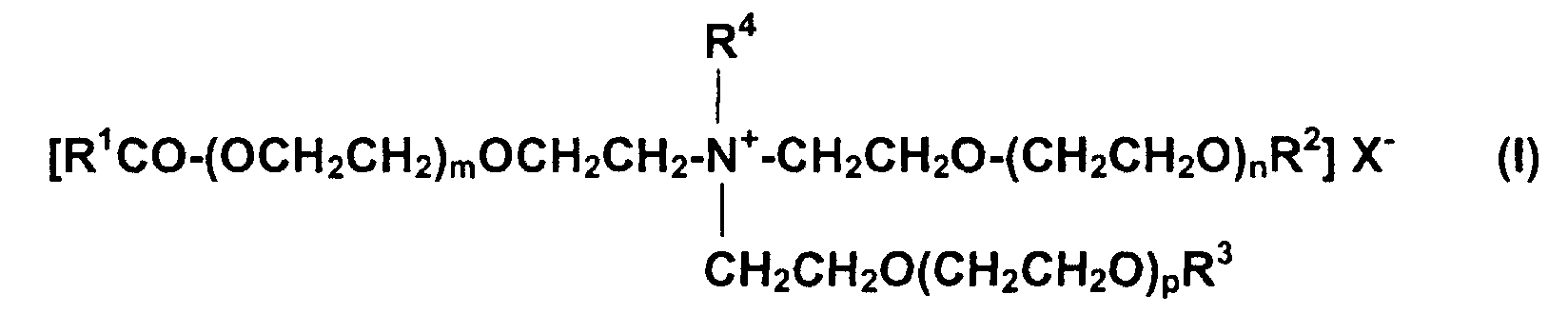
- Quaternized ester salts of which the acid component is completely or partly derived from cinnamic acids, characterized in that they correspond to formula (II):in which R1CO is a residue of cinnamic acid, R2 is hydrogen or has the same meaning as R1CO, R4 and R5 independently of one another are alkyl groups containing 1 to 4 carbon atoms, m and n together stand for 0 or numbers of 1 to 12 and X stands for halide, alkyl sulfate or alkyl phosphate.

- Quaternized ester salts of which the acid component is completely or partly derived from cinnamic acids, characterized in that they correspond to formula (III):in which R1CO is a residue of cinnamic acid, R2 is hydrogen or has the same meaning as R1CO, R4, R6 and R7 independently of one another are alkyl groups containing 1 to 4 carbon atoms, m and n together stand for 0 or numbers of 1 to 12 and X stands for halide, alkyl sulfate or alkyl phosphate.
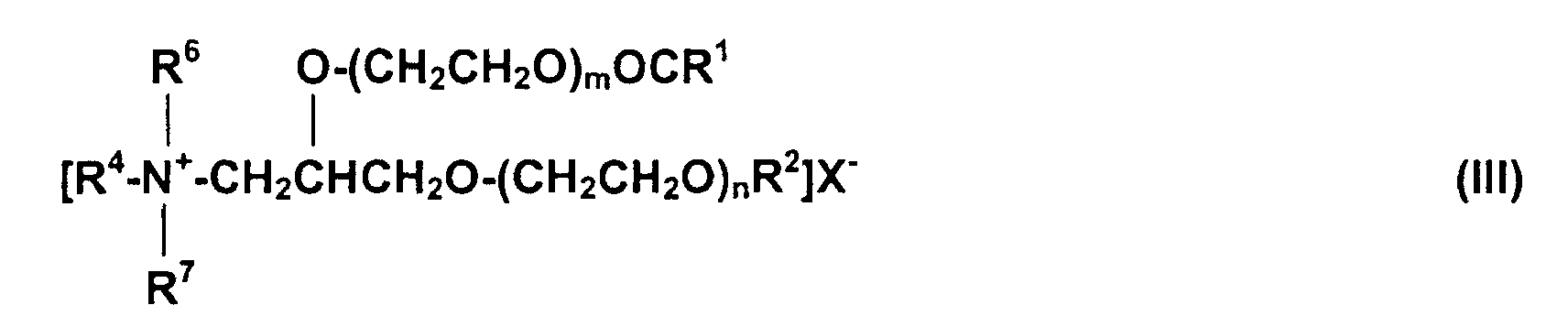
- A process for the production of esterquats and/or quaternized ester salts, in which esters of cinnamic acid with alkanolamines selected from the group consisting of triethanolamine, diethanol alkylamines and 1,2-dihydroxypropyl dialkylamines and mixtures thereof are quaternized with dialkyl sulfates in the presence of organic solvents.
- A process as claimed in claim 4, characterized in that esters of which the acid components are derived from mixtures of (a) cinnamic acid with (b) fatty acids containing 6 to 22 carbon atoms and/or dicarboxylic acids containing 2 to 12 carbon atoms in a molar ratio of 10:90 to 90:10.
- A process as claimed in claims 4 and 5, characterized in that the quaternization is carried out in the presence of ethanol, isopropyl alcohol, ethylene glycol, propylene glycol, gycerol or mixtures thereof.
- A process as claimed in claims 4 to 5, characterized in that the quaternization is carried out in the presence of fatty alcohols, alkyl oligoglucosides, partial glycerides and/or cosmetic oils.
- The use of the esterquats and/or quaternized ester salts claimed in claims 1 to 3 as UV filters for the production of cosmetic and/or pharmaceutical preparations.
- The use of the esterquats and/or quaternized ester salts claimed in claims 1 to 3 for treating dyed textile materials against fading.
Applications Claiming Priority (2)
| Application Number | Priority Date | Filing Date | Title |
|---|---|---|---|
| DE19738641A DE19738641C1 (en) | 1997-09-04 | 1997-09-04 | Cinnamic acid-based esterquats |
| DE19738641 | 1997-09-04 |
Publications (3)
| Publication Number | Publication Date |
|---|---|
| EP0902009A2 EP0902009A2 (en) | 1999-03-17 |
| EP0902009A3 EP0902009A3 (en) | 2000-10-04 |
| EP0902009B1 true EP0902009B1 (en) | 2004-10-27 |
Family
ID=7841160
Family Applications (1)
| Application Number | Title | Priority Date | Filing Date |
|---|---|---|---|
| EP98116083A Expired - Lifetime EP0902009B1 (en) | 1997-09-04 | 1998-08-26 | Esterquats based on cinnamic acid |
Country Status (3)
| Country | Link |
|---|---|
| EP (1) | EP0902009B1 (en) |
| DE (2) | DE19738641C1 (en) |
| ES (1) | ES2231927T3 (en) |
Families Citing this family (6)
| Publication number | Priority date | Publication date | Assignee | Title |
|---|---|---|---|---|
| DE19758272C5 (en) * | 1997-12-31 | 2004-10-07 | Kpss-Kao Professional Salon Services Gmbh | Use of a hair treatment product |
| DE19920555B4 (en) * | 1999-05-05 | 2004-08-26 | Cognis Deutschland Gmbh & Co. Kg | Use of nanoscale metal soaps |
| DE19922230A1 (en) * | 1999-05-14 | 2000-11-16 | Cognis Deutschland Gmbh | Stable, well tolerated cosmetic and/or dermatological preparation for care or cleaning of skin or hair, containing oligoglycoside, partial glyceride and fungicide |
| DE19922229A1 (en) * | 1999-05-14 | 2000-11-16 | Cognis Deutschland Gmbh | Cosmetic and / or pharmaceutical preparations |
| DE10148264B4 (en) * | 2001-09-28 | 2004-12-02 | Beiersdorf Ag | Cosmetic and / or dermatological preparations and their use |
| DE10246160A1 (en) * | 2002-10-02 | 2004-04-15 | Beiersdorf Ag | Wipes impregnated with wetting agents which contain zinc oxide with a particle size of 20 to 100 mm |
Family Cites Families (5)
| Publication number | Priority date | Publication date | Assignee | Title |
|---|---|---|---|---|
| DE957162C (en) * | 1955-02-11 | 1957-01-31 | Thomae Gmbh Dr K | Light protection preparation |
| FR2504530A1 (en) * | 1981-04-28 | 1982-10-29 | Fabre Sa Pierre | Substd. alkyl 4-methoxy-cinnamic acid ester derivs. - useful as sunscreening agents |
| EP0272576B1 (en) * | 1986-12-23 | 1991-02-27 | L. GIVAUDAN & CIE Société Anonyme | Quaternary ammonium halide salts of cinnamate esters as sunscreen agents and compositions containing same |
| ES2021900A6 (en) * | 1989-07-17 | 1991-11-16 | Pulcra Sa | Process for preparing quaternary ammonium compounds. |
| EP0834304B1 (en) * | 1996-09-17 | 2005-01-26 | Ciba SC Holding AG | Use of liposomogenic UV absorbers to protect hair |
-
1997
- 1997-09-04 DE DE19738641A patent/DE19738641C1/en not_active Expired - Fee Related
-
1998
- 1998-08-26 EP EP98116083A patent/EP0902009B1/en not_active Expired - Lifetime
- 1998-08-26 DE DE59812163T patent/DE59812163D1/en not_active Expired - Lifetime
- 1998-08-26 ES ES98116083T patent/ES2231927T3/en not_active Expired - Lifetime
Also Published As
| Publication number | Publication date |
|---|---|
| DE59812163D1 (en) | 2004-12-02 |
| DE19738641C1 (en) | 1999-07-01 |
| EP0902009A2 (en) | 1999-03-17 |
| ES2231927T3 (en) | 2005-05-16 |
| EP0902009A3 (en) | 2000-10-04 |
Similar Documents
| Publication | Publication Date | Title |
|---|---|---|
| DE19756454C1 (en) | Surface-active compositions, especially cosmetics, containing glycerol carbonate as emulsifier | |
| EP1052972B1 (en) | Hair-conditioning agents | |
| EP1077672B1 (en) | Sunscreens | |
| EP0893120A2 (en) | Self-emulsifying compositions | |
| EP1117377B1 (en) | Cosmetic preparations | |
| WO1999015610A1 (en) | Application of unsaturated betain tensides as thickening agents | |
| WO2000027343A2 (en) | Cosmetic and/or pharmaceutical preparations containing quaternary esters and partial glycerides | |
| EP0902009B1 (en) | Esterquats based on cinnamic acid | |
| EP1077924B1 (en) | Ethoxylated quaternary ester compounds | |
| EP1021163B1 (en) | Cosmetic products | |
| EP1037599B1 (en) | Utilization of detergent mixtures | |
| DE19738645C1 (en) | Water-miscible cationic surfactant concentrates | |
| EP0992488B1 (en) | Quaternary ammonium compounds | |
| EP0955037B1 (en) | Skin care compositions | |
| DE19744703C1 (en) | Phyto-sterol ester useful as emollient agent in skin and hair care formulation | |
| EP1131049B1 (en) | Utilization of cation-active mixtures | |
| EP1128808B1 (en) | Utilization of cation-active mixtures | |
| EP0950398A2 (en) | Use of esters as dispersants or solvents in sunscreens and solar protection pigments | |
| EP1131046A2 (en) | Utilization of cation-active mixtures | |
| EP0992489B1 (en) | Betaines | |
| WO1999009938A1 (en) | Cosmetic agents containing fatty acid polyglycol ester sulphates | |
| EP1004355A2 (en) | Use of esterquats as pigment dispersants | |
| WO1999006518A1 (en) | Thickened aqueous tenside solutions | |
| WO2000001875A1 (en) | Softening composition | |
| EP0945123A2 (en) | Use of fatty acids as brightening agents |
Legal Events
| Date | Code | Title | Description |
|---|---|---|---|
| PUAI | Public reference made under article 153(3) epc to a published international application that has entered the european phase |
Free format text: ORIGINAL CODE: 0009012 |
|
| 17P | Request for examination filed |
Effective date: 19980826 |
|
| AK | Designated contracting states |
Kind code of ref document: A2 Designated state(s): DE ES FR GB IT NL |
|
| AX | Request for extension of the european patent |
Free format text: AL;LT;LV;MK;RO;SI |
|
| PUAL | Search report despatched |
Free format text: ORIGINAL CODE: 0009013 |
|
| AK | Designated contracting states |
Kind code of ref document: A3 Designated state(s): AT BE CH CY DE DK ES FI FR GB GR IE IT LI LU MC NL PT SE |
|
| AX | Request for extension of the european patent |
Free format text: AL;LT;LV;MK;RO;SI |
|
| RIC1 | Information provided on ipc code assigned before grant |
Free format text: 7C 07C 219/10 A, 7C 07C 217/08 B, 7A 61K 7/42 B, 7A 61K 7/50 B |
|
| AKX | Designation fees paid |
Free format text: DE ES FR GB IT NL |
|
| 17Q | First examination report despatched |
Effective date: 20010518 |
|
| RAP1 | Party data changed (applicant data changed or rights of an application transferred) |
Owner name: COGNIS DEUTSCHLAND GMBH & CO. KG |
|
| GRAP | Despatch of communication of intention to grant a patent |
Free format text: ORIGINAL CODE: EPIDOSNIGR1 |
|
| GRAS | Grant fee paid |
Free format text: ORIGINAL CODE: EPIDOSNIGR3 |
|
| GRAA | (expected) grant |
Free format text: ORIGINAL CODE: 0009210 |
|
| AK | Designated contracting states |
Kind code of ref document: B1 Designated state(s): DE ES FR GB IT NL |
|
| PG25 | Lapsed in a contracting state [announced via postgrant information from national office to epo] |
Ref country code: NL Free format text: LAPSE BECAUSE OF FAILURE TO SUBMIT A TRANSLATION OF THE DESCRIPTION OR TO PAY THE FEE WITHIN THE PRESCRIBED TIME-LIMIT Effective date: 20041027 Ref country code: IT Free format text: LAPSE BECAUSE OF FAILURE TO SUBMIT A TRANSLATION OF THE DESCRIPTION OR TO PAY THE FEE WITHIN THE PRESCRIBED TIME-LIMIT;WARNING: LAPSES OF ITALIAN PATENTS WITH EFFECTIVE DATE BEFORE 2007 MAY HAVE OCCURRED AT ANY TIME BEFORE 2007. THE CORRECT EFFECTIVE DATE MAY BE DIFFERENT FROM THE ONE RECORDED. Effective date: 20041027 Ref country code: GB Free format text: LAPSE BECAUSE OF FAILURE TO SUBMIT A TRANSLATION OF THE DESCRIPTION OR TO PAY THE FEE WITHIN THE PRESCRIBED TIME-LIMIT Effective date: 20041027 |
|
| REG | Reference to a national code |
Ref country code: GB Ref legal event code: FG4D Free format text: NOT ENGLISH |
|
| REF | Corresponds to: |
Ref document number: 59812163 Country of ref document: DE Date of ref document: 20041202 Kind code of ref document: P |
|
| NLV1 | Nl: lapsed or annulled due to failure to fulfill the requirements of art. 29p and 29m of the patents act | ||
| REG | Reference to a national code |
Ref country code: ES Ref legal event code: FG2A Ref document number: 2231927 Country of ref document: ES Kind code of ref document: T3 |
|
| GBV | Gb: ep patent (uk) treated as always having been void in accordance with gb section 77(7)/1977 [no translation filed] |
Effective date: 20041027 |
|
| RAP2 | Party data changed (patent owner data changed or rights of a patent transferred) |
Owner name: COGNIS DEUTSCHLAND GMBH & CO. KG |
|
| RAP2 | Party data changed (patent owner data changed or rights of a patent transferred) |
Owner name: COGNIS IP MANAGEMENT GMBH |
|
| PLBE | No opposition filed within time limit |
Free format text: ORIGINAL CODE: 0009261 |
|
| STAA | Information on the status of an ep patent application or granted ep patent |
Free format text: STATUS: NO OPPOSITION FILED WITHIN TIME LIMIT |
|
| ET | Fr: translation filed | ||
| 26N | No opposition filed |
Effective date: 20050728 |
|
| PGFP | Annual fee paid to national office [announced via postgrant information from national office to epo] |
Ref country code: FR Payment date: 20120914 Year of fee payment: 15 |
|
| PGFP | Annual fee paid to national office [announced via postgrant information from national office to epo] |
Ref country code: DE Payment date: 20121031 Year of fee payment: 15 |
|
| PGFP | Annual fee paid to national office [announced via postgrant information from national office to epo] |
Ref country code: ES Payment date: 20120928 Year of fee payment: 15 |
|
| PG25 | Lapsed in a contracting state [announced via postgrant information from national office to epo] |
Ref country code: DE Free format text: LAPSE BECAUSE OF NON-PAYMENT OF DUE FEES Effective date: 20140301 |
|
| REG | Reference to a national code |
Ref country code: FR Ref legal event code: ST Effective date: 20140430 |
|
| REG | Reference to a national code |
Ref country code: DE Ref legal event code: R119 Ref document number: 59812163 Country of ref document: DE Effective date: 20140301 |
|
| PG25 | Lapsed in a contracting state [announced via postgrant information from national office to epo] |
Ref country code: FR Free format text: LAPSE BECAUSE OF NON-PAYMENT OF DUE FEES Effective date: 20130902 |
|
| REG | Reference to a national code |
Ref country code: ES Ref legal event code: FD2A Effective date: 20140909 |
|
| PG25 | Lapsed in a contracting state [announced via postgrant information from national office to epo] |
Ref country code: ES Free format text: LAPSE BECAUSE OF NON-PAYMENT OF DUE FEES Effective date: 20130827 |