EP0902043A2 - Polyselenophene, Verfahren zu deren Herstellung, und deren Verwendung - Google Patents
Polyselenophene, Verfahren zu deren Herstellung, und deren Verwendung Download PDFInfo
- Publication number
- EP0902043A2 EP0902043A2 EP98116886A EP98116886A EP0902043A2 EP 0902043 A2 EP0902043 A2 EP 0902043A2 EP 98116886 A EP98116886 A EP 98116886A EP 98116886 A EP98116886 A EP 98116886A EP 0902043 A2 EP0902043 A2 EP 0902043A2
- Authority
- EP
- European Patent Office
- Prior art keywords
- group
- linear
- branched chain
- selenophene
- pyrazine
- Prior art date
- Legal status (The legal status is an assumption and is not a legal conclusion. Google has not performed a legal analysis and makes no representation as to the accuracy of the status listed.)
- Withdrawn
Links
Classifications
-
- C—CHEMISTRY; METALLURGY
- C08—ORGANIC MACROMOLECULAR COMPOUNDS; THEIR PREPARATION OR CHEMICAL WORKING-UP; COMPOSITIONS BASED THEREON
- C08G—MACROMOLECULAR COMPOUNDS OBTAINED OTHERWISE THAN BY REACTIONS ONLY INVOLVING UNSATURATED CARBON-TO-CARBON BONDS
- C08G79/00—Macromolecular compounds obtained by reactions forming a linkage containing atoms other than silicon, sulfur, nitrogen, oxygen, and carbon with or without the latter elements in the main chain of the macromolecule
-
- C—CHEMISTRY; METALLURGY
- C07—ORGANIC CHEMISTRY
- C07D—HETEROCYCLIC COMPOUNDS
- C07D345/00—Heterocyclic compounds containing rings having selenium or tellurium atoms as the only ring hetero atoms
-
- C—CHEMISTRY; METALLURGY
- C08—ORGANIC MACROMOLECULAR COMPOUNDS; THEIR PREPARATION OR CHEMICAL WORKING-UP; COMPOSITIONS BASED THEREON
- C08G—MACROMOLECULAR COMPOUNDS OBTAINED OTHERWISE THAN BY REACTIONS ONLY INVOLVING UNSATURATED CARBON-TO-CARBON BONDS
- C08G2261/00—Macromolecular compounds obtained by reactions forming a carbon-to-carbon link in the main chain of the macromolecule
- C08G2261/10—Definition of the polymer structure
- C08G2261/14—Side-groups
- C08G2261/142—Side-chains containing oxygen
- C08G2261/1424—Side-chains containing oxygen containing ether groups, including alkoxy
-
- C—CHEMISTRY; METALLURGY
- C08—ORGANIC MACROMOLECULAR COMPOUNDS; THEIR PREPARATION OR CHEMICAL WORKING-UP; COMPOSITIONS BASED THEREON
- C08G—MACROMOLECULAR COMPOUNDS OBTAINED OTHERWISE THAN BY REACTIONS ONLY INVOLVING UNSATURATED CARBON-TO-CARBON BONDS
- C08G2261/00—Macromolecular compounds obtained by reactions forming a carbon-to-carbon link in the main chain of the macromolecule
- C08G2261/30—Monomer units or repeat units incorporating structural elements in the main chain
- C08G2261/32—Monomer units or repeat units incorporating structural elements in the main chain incorporating heteroaromatic structural elements in the main chain
- C08G2261/322—Monomer units or repeat units incorporating structural elements in the main chain incorporating heteroaromatic structural elements in the main chain non-condensed
- C08G2261/3225—Monomer units or repeat units incorporating structural elements in the main chain incorporating heteroaromatic structural elements in the main chain non-condensed containing one or more Se atoms as the only heteroatom
-
- C—CHEMISTRY; METALLURGY
- C08—ORGANIC MACROMOLECULAR COMPOUNDS; THEIR PREPARATION OR CHEMICAL WORKING-UP; COMPOSITIONS BASED THEREON
- C08G—MACROMOLECULAR COMPOUNDS OBTAINED OTHERWISE THAN BY REACTIONS ONLY INVOLVING UNSATURATED CARBON-TO-CARBON BONDS
- C08G2261/00—Macromolecular compounds obtained by reactions forming a carbon-to-carbon link in the main chain of the macromolecule
- C08G2261/30—Monomer units or repeat units incorporating structural elements in the main chain
- C08G2261/32—Monomer units or repeat units incorporating structural elements in the main chain incorporating heteroaromatic structural elements in the main chain
- C08G2261/324—Monomer units or repeat units incorporating structural elements in the main chain incorporating heteroaromatic structural elements in the main chain condensed
- C08G2261/3246—Monomer units or repeat units incorporating structural elements in the main chain incorporating heteroaromatic structural elements in the main chain condensed containing nitrogen and sulfur as heteroatoms
Definitions
- the present invention relates to new polyselenophenes. It also affects Processes and monomers for the preparation of polyselenophenes, their use in various technical fields, as well as an electrically conductive Material containing at least one polyselenophene according to the invention.
- conjugated polymers with high electrical conductivity and non-linear optical properties include Polythiophenes known. This can be used as materials for semiconductors (see below EP-B-0 332 704 and P.N. Prasad, D.J. Williams “Introduction to NLO effects in molecules and polymers ", John Wiley and Sons, Inc. (1991)) the polythiophenes electrochromic and antistatic properties (see N. Arsalani and K.E. Geckeler "Conducting isopolymers: peparation, properties, and applications ", J. Prakt. Chem. 337 (1995), pp. 1-11.
- the object of the present invention was therefore to provide new polyselenophenes, which are advantageously outlined as in different technical areas can be applied.
- polyselenophene as used in the context of the present application is used includes all poly and oligomers, one or contain several of the units of the general formulas (I) and / or (II). This includes the presence of one or more identical units (I) and / or (II) as well as the presence of several different ones Units (II), which in turn each at least once in the polyselenophen according to the invention may be present.
- the polyselenophenes according to the invention contain one or more units of the general formulas (I) and (II).
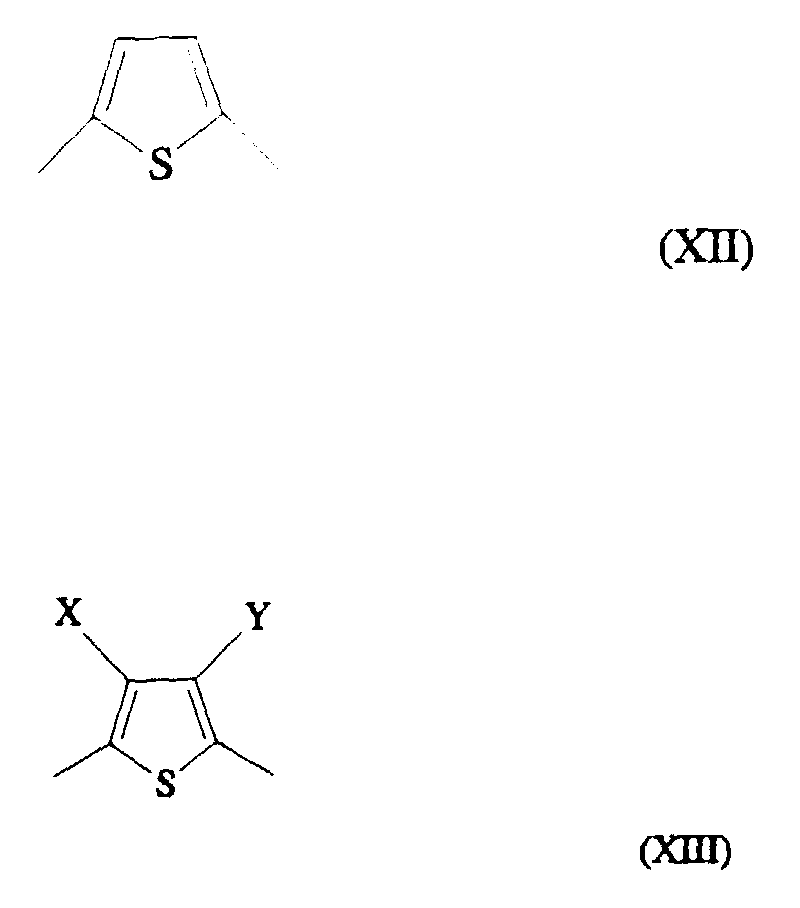
- all poly and Oligomers comprising one or more of the units of the general Formulas (I) and / or (II) together with one or more thiophene units of the general formulas (XII) and / or (XIII).
- the structural unit present in the polyselenophenes according to the invention (I) is derived from selenophene.
- X and Y In the structural unit (II) in which X and Y, provided that they do not form a ring system containing carbon together with the atoms to which they are attached, can each represent the groups mentioned at the outset, it is preferred that X and Y are identical are. If X and Y each represent the group NHR 1 , the two radicals R 1 are preferably also identical.
- the alkyl, alkoxy, alkyloxyalkyl, acyl and thioacyl groups with 1 to 22 carbon atoms listed above those with 1 to 20 carbon atoms are preferred, those with 6 to 20 carbon atoms are more preferred and those with 10 to 16 carbon atoms are particularly preferred.
- substituents X and Y are the acyl groups, thioacyl groups and NHR 1 defined above.
- thioacyl group denotes a group of the general formula ⁇ C (S) ⁇ R, where R is alkyl.
- heterocyclic group denotes alicyclic saturated, alicyclic unsaturated and aromatic heterocyclic Groups.
- X and Y together with the atoms to which they are attached are, form a carbon-containing ring system, in addition to carbon Nitrogen (N), oxygen (O), sulfur (S) or phosphorus (P) heteroatoms or mixtures of two or more of these heteroatoms.
- X and Y preferably form a divalent radical which is two to has eight atoms, more preferably three to six atoms, and, together with the two atoms to which it is bound, a ring system with four to ten or five to eight atoms.
- the number of in this ring system possibly existing heteroatoms defined above is preferably up to three, more preferably up to two.
- Under Nitrogen (N) is preferred to the heteroatoms defined above.
- the ring system described above is at least one one, more preferably two or more double bonds System.
- the double bonds of the above ring system in Conjugation with the double bonds of the selenophene fragment to which the Ring system is bound, and possibly the double bonds further to the Ring system of bound radicals of the formulas (III) to (VI) described above, as defined above.
- This ring system can in turn be attached to the carbon, nitrogen or Phosphorus atoms can each be substituted with a group Z, each Z independently a group as defined above for X and Y, means, and also here the substituents indicated as preferred for X and Y. are again to be regarded as preferred.
- Two adjacent groups Z can also together a residue form, which is selected from the radicals mentioned above general formulas (III) to (VI), the placeholders "A” being carbon (C), nitrogen (N), phosphorus (P) or mixtures of two or more of these atoms mean, where, if A is carbon, this is either a Bear hydrogen atom or again, as defined above for X and Y, can be substituted.
- residues form together with the atoms, to which they are bound, another ring, preferably with the remaining rings within the structural unit a conjugated, unsaturated System forms.
- the cyclobutene ring is to be mentioned as the preferred ring that is formed.
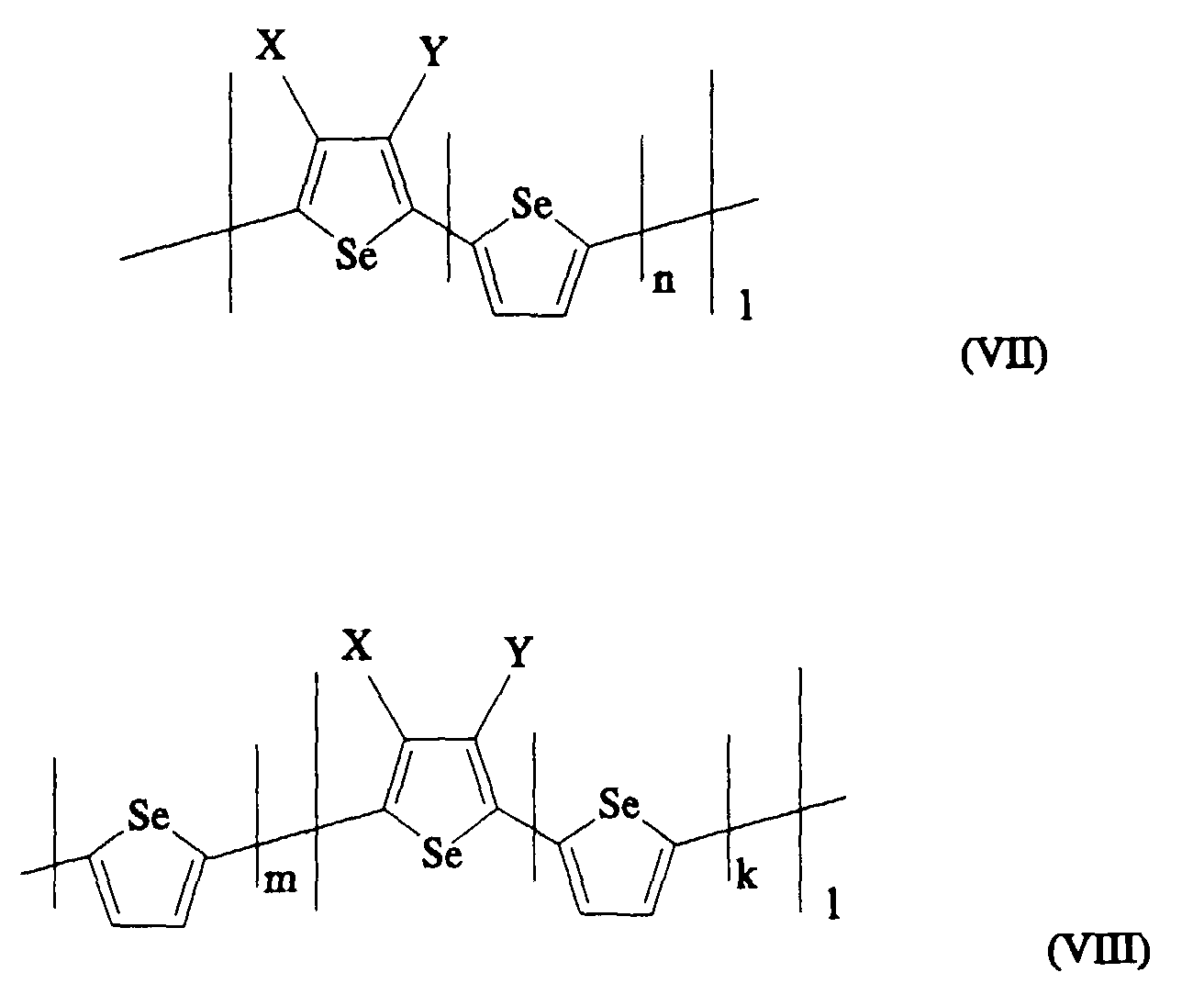
- a preferred group of the polyselenophenes according to the invention are those with structural units of the general formulas (VII) and / or (VIII) in which X and Y are as defined above and n, m and k independently of one another are an integer from 1 to 10, preferably an integer from 1 to 6, and 1 is an integer from 1 to 3,000, preferably 1 to 1,000 , in particular 1 to 100, means.
- the alternating sequence of a substituted selenophene unit and an unsubstituted selenophene unit is preferred.
- the proportions of the structural units (I) and (II) defined above in those according to the invention Polyselenophenes are from about 1 to about 99 mol% (I) and about 99 to about 1 mole% (II), preferably about 30 up to about 70 mol% (I) and about 70 to about 30 mol% (II), and in particular about 50 mol% (I) and about 50 mol% (II), the proportions of these two structural units being 100 mol% each add.
- the weight average molecular weight (M w ) of the polyselenophenes prepared according to the invention is generally from about 1,000 to about 500,000, preferably from about 10,000 to about 250,000, and in particular from about 30,000 to about 80,000.
- the non-uniformity of the molecular weight distribution, ie the quotient of the weight average molecular weight and the number average molecular weight (M w / M n ), is approximately 2 to approximately 4, preferably approximately 2 to approximately 3, and in particular approximately 2 to approximately 2.5.
- the polyselenophenes according to the invention can be used for polymerization polymerized reactions of pyrroles or thiophenes such as by means of chemical or electrochemical oxidation; some of the polyselenophenes, for example alkyl, alkoxy, acylamino or Alkyloxyalkyl substituents can also be catalytic Coupling of organometallic reagents (mostly Grignard reagents) be implemented. Regarding the details of this implementation, reference is made to the in PCT / EP97 / 01140 mentioned in the introduction and the literature referenced therein referred.
- the preferred methods of making the polyselenophenes of the invention implement the implementation after silence as well as the implementation Suzuki (see A. Suzuki et al. "Stereoselective synthesis of arylated (E) alkanes by the reaction of alk-1-enylboranes with aryl halides in the presence of palladium catalyst ", J.C.S. Chem. Comm., 1979, pp. 866-867), which in following should be explained in more detail.
- Selenophen-2,5-diboric acid is the preferred borane in this reaction and used "their" esters. Regarding further details of this implementation reference is made to the reference cited above.
- diboric acid (ester) derivatives can be used in the Suzuki reaction of the selenophene derivatives corresponding to the structural units (II) above with 2,5-dihalo- or 2,5-triflate-substituted selenophene, that corresponds to the structural unit (I).
- Halogen-substituted derivatives are preferably used among the "Sub" substituents mentioned in the above scheme. If bis (triflate) - ie (CF 3 SO 3 ) -substituted starting materials are used, LiCl, for example, can be added to improve the reactivity.
- Pd (II) or Pd (0) complexes are used as catalysts.
- tris (dibenzylidene acetone) dipalladium Pd 2 dba 3
- Pd (Ph 3 P) 2 Cl 2 where "Ph” stands for C 6 H 5
- Pd (Ph 3 P) 4th When using tris (dibenzylidene acetone) dipalladium, various ligands (L) can be added, the catalytically active catalyst PdL 4 being formed in situ by ligand exchange between the weakly coordinated Pd 2 dba 3 and the ligand or ligands.
- PPh 3 , AsPh 3 , [2- (CH 3 ) C 6 H 4 ] 3 P, P (OPh) 3 and (2-furyl) 3 P are used as ligands.
- the amount of the catalyst used is about 2 to about 10 mol%, preferably about 2 to about 5 mol%, based on the amount of the bis (trialkyltin) substituted starting material used.
- NMP and cyclic ethers such as e.g. THF and dioxane, are the most suitable solvents. Among these are DMF and THF are preferred.
- the reaction is generally carried out at temperatures between room temperature and the boiling point of the solvent, temperatures from about 50 ° C to about 100 ° C are preferred.
- the response time varies depending on the starting materials and / or catalysts used between 1 day and 1 month, preferably 1 day to 1 week.
- Suzuki implementation also has the advantages listed above the conventional methods, is within the scope of the present Invention particularly preferred the silence implementation because it - in contrast to the Suzuki implementation - no additional base required.
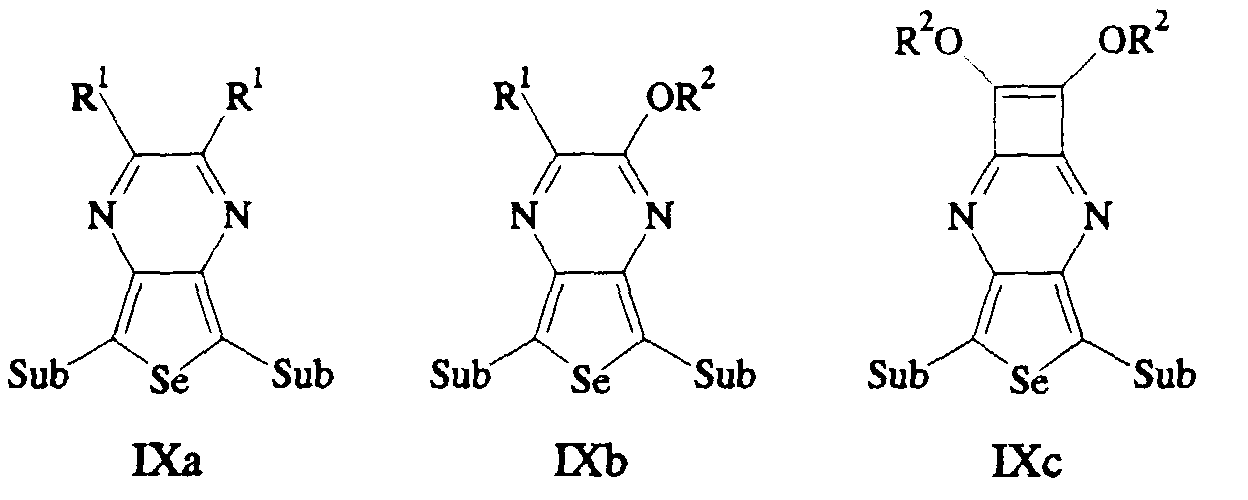
- the present invention furthermore provides compounds of the general formulas (IXa) to (IXc) in which "Sub” is hydrogen (H), bromine (Br), chlorine (Cl), iodine (I), triflate (CF 3 SO 3 ) or trialkyltin, and R 1 is as defined above, and R 2 CH 2 R 1 or CHR 1 2 is ready.
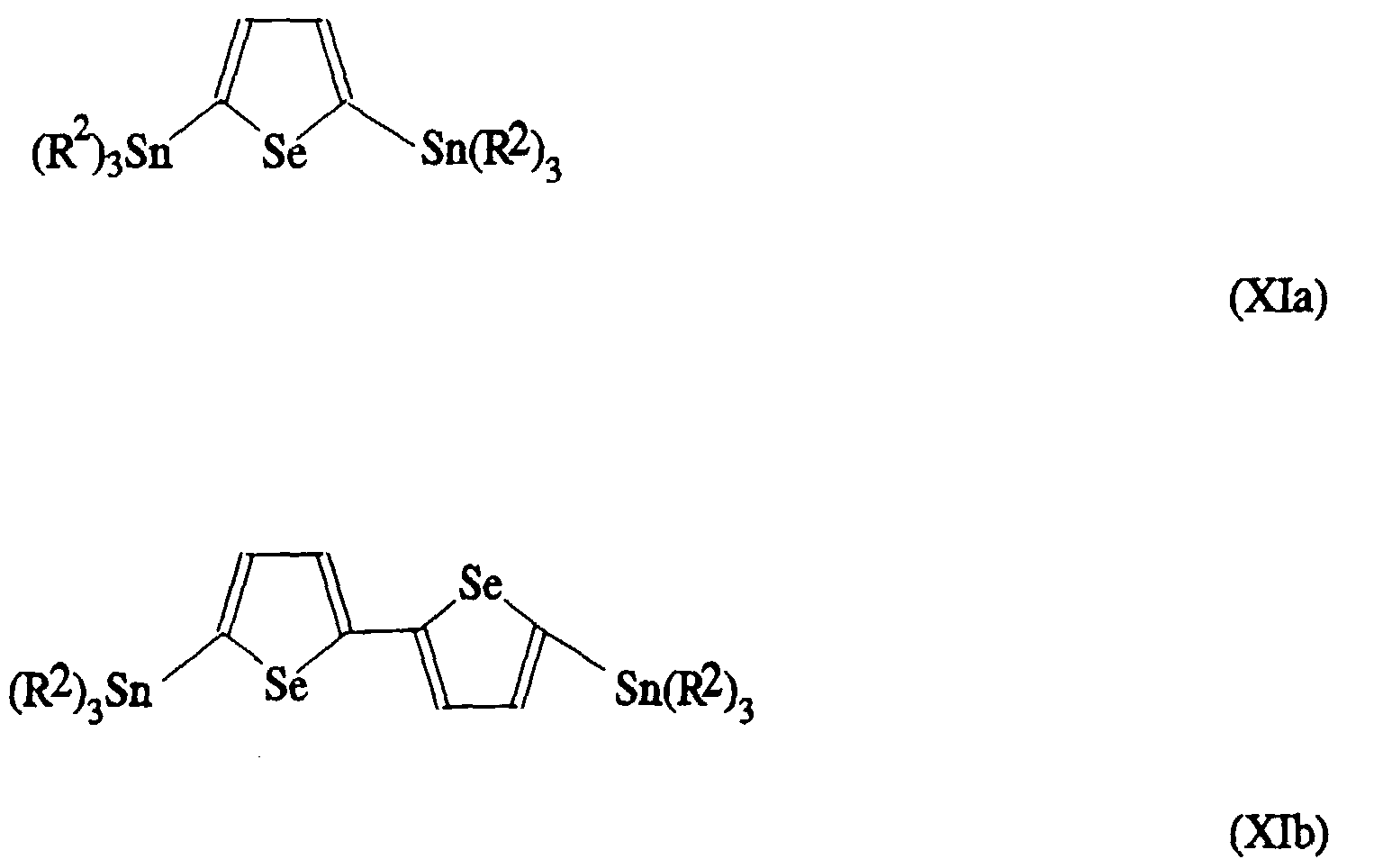
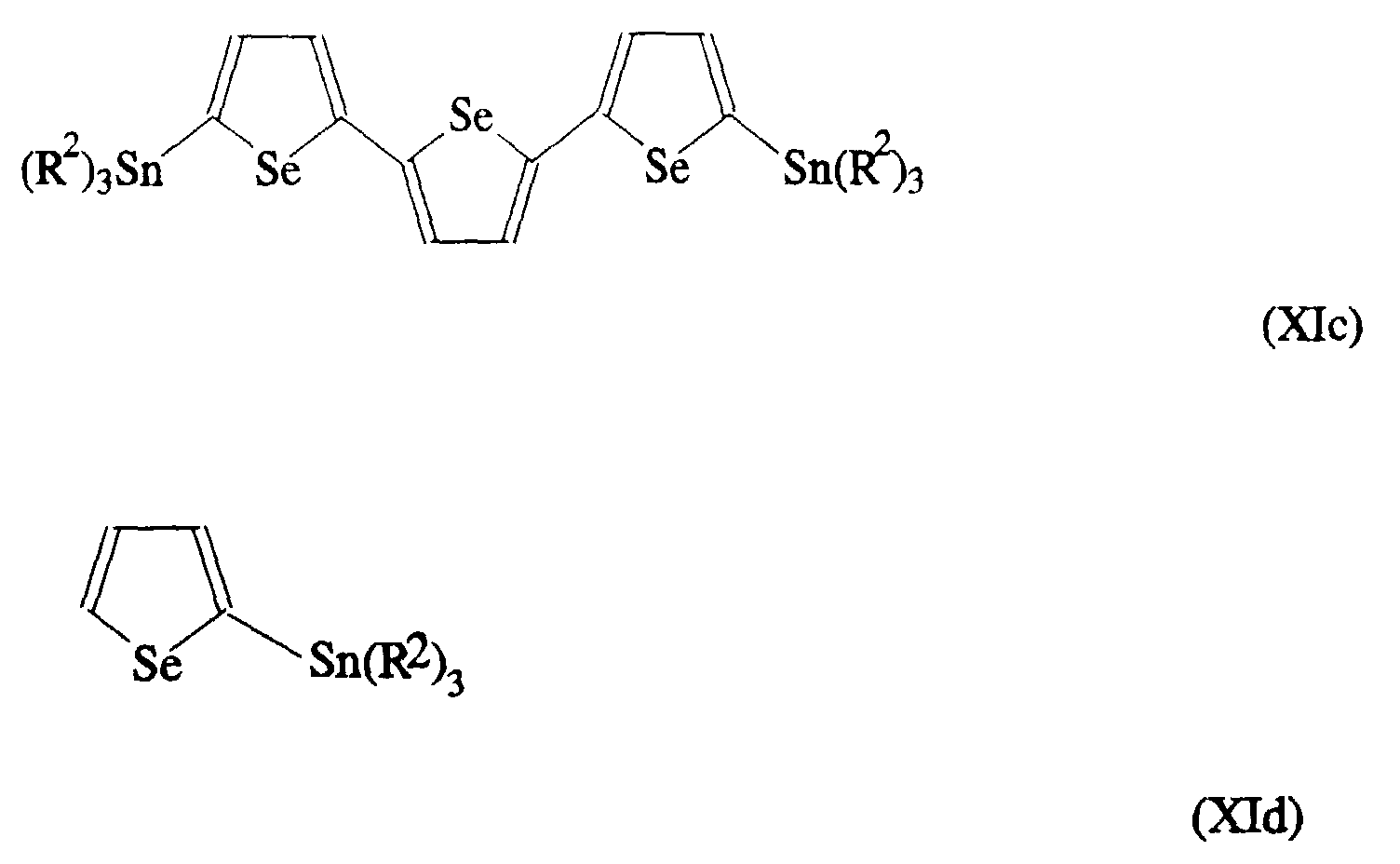
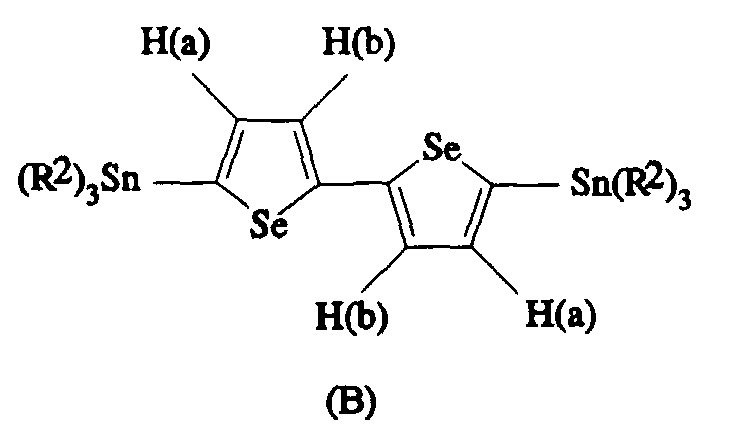
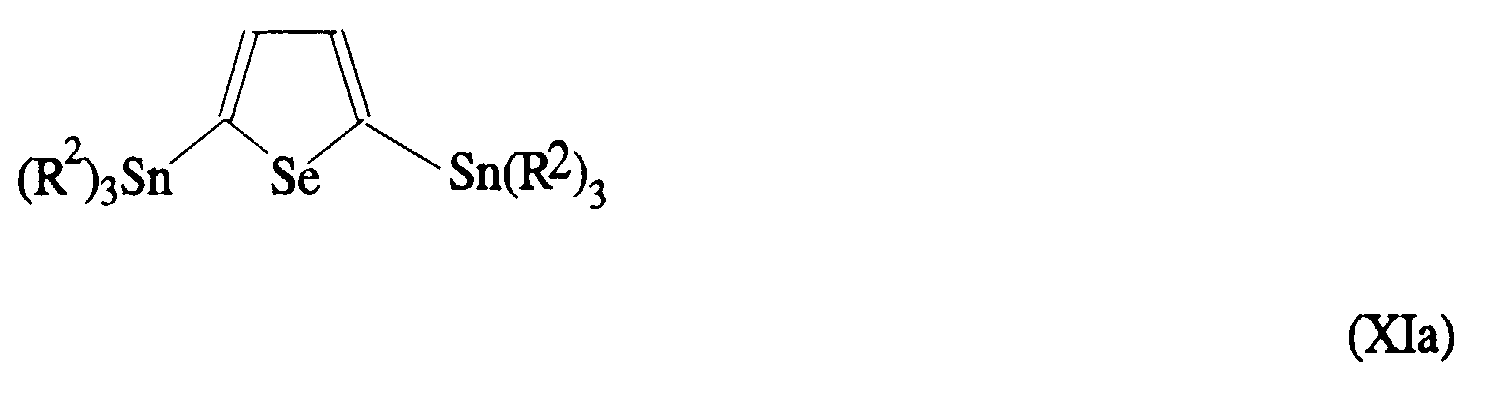
- Another aspect of the present invention provides 2,5-bis (trialkyltin) selenophene (formula XIa), 5,5'-bis (trialkyltin) -2,2'-diselenophene (formula XIb) and 5,5 ''-Bis (trialkyltin) -2,2': 5 ', 2''- Terselenophenen of the formula (XIc), and the 2- (Trialkylzinn) selenophene (Formula XId), which are also used for the synthesis of oligo- and polyselenophenes can represent wherein R 2 represents an alkyl group, preferably a methyl or butyl group. The preparation of these selenophenes is described in the examples.
- the di- and trimers of selenophene i.e. H. 2,2'-biselenophen and 2,2 ': 5', 2 '' terselenophens.
- Thin films of the polyselenophene according to the invention can be cast of carefully filtered or centrifuged solutions in chloroform or trichlorethylene can be produced on a glass substrate. Because of this Processes can make homogeneous films with a thickness of up to 300 nm be preserved. The optical quality of the films is high and has none noteworthy scattering of light.
- polyselenophenes described herein can either be undoped or not doped to the antistatic equipment by the electric current or only poorly conductive substances, as electrically conductive foils, as semiconductor foils, as an additive for active electrodes, for LEDs, as organic Transistors and capacitors are used. Doing this Copolymers processed in the usual way and possibly with known ones for additional and packaging substances required for the respective application mixed or processed according to known methods.
- the present invention also provides a method for antistatic equipment one or only the electric current poorly conductive substrate by applying a layer containing electrically conductive organic polymer on the surface of the substrates ready, which is characterized in that one on the surface of the Substrate by polymerizing a layer of at least one polyselenophene generates the structural units of the general formulas defined above (I) and / or (II) contains.
- This layer mentioned above can also be used exclusively consist of the conductive organic polymer defined above.
- the present invention provides an electrically conductive material which contains at least one polyselenophene according to the present invention.
- the present invention will now be further explained using a few selected examples.
- the 2,2'-biselenophen 6 became selenophene starting from 2-iodo-selenophene 3 and 2- (trimethyltin) 5 received.
- 2-iodo-selenophene was as in Yurjev et al, Russ. J. of General Chem., 26 (1956), p. 3154.
- 2- (trimethyltin) selenophene 5 was obtained by quenching 2-lithium selenophene obtained with trimethyltin chloride.
- the monolithium derivative became selective starting from selenophene by reacting one equivalent of butyllitium in hexane in the presence of TMEDA (N, N'N ', N'-tetramethylethylenediamine) receive.
Landscapes
- Chemical & Material Sciences (AREA)
- Organic Chemistry (AREA)
- Health & Medical Sciences (AREA)
- Chemical Kinetics & Catalysis (AREA)
- Medicinal Chemistry (AREA)
- Polymers & Plastics (AREA)
- Polyoxymethylene Polymers And Polymers With Carbon-To-Carbon Bonds (AREA)
- Laminated Bodies (AREA)
- Heterocyclic Carbon Compounds Containing A Hetero Ring Having Oxygen Or Sulfur (AREA)
Abstract
Description

wobei dieses Ringsystem wiederum an dem (den) Kohlenstoffatom(en), dem (den) Stickstoffatom(en) oder dem (den) Phosphoratom(en) jeweils mit einer Gruppe Z substituiert sein kann, in der jedes Z unabhängig voneinander eine Gruppe wie oben für X und Y definiert bedeutet, oder

wobei, sofern A Kohlenstoff ist, jedes dieser A entweder ein Wasserstoffatom trägt oder wiederum wie oben für X und Y definiert, substituiert sein kann.

3,4-Di(decyloxy)selenophen-, 3,4-Di(undecyloxy)selenophen-, 3,4-Di(dodecyloxy)selenophen-, 3,4-Di(tridecyloxy)selenophen-, 3-4-Di(tetradecyloxy)selenophen-, 3,4-Di(pentadecyloxy)selenophen-, 3,4-Di(hexadecyloxy)selenophen-, 3,4-Di(heptadecyloxy)selenophen- und 3,4-Di(octadecyloxy)selenophen-Struktureinheiten; weiterhin bevorzugt sind Struktureinheiten, in denen die oben definierten Etherreste durch die entsprechenden Thioetherreste ersetzt sind;
3,4-Di(decyloxyethyl)selenophen-, 3,4-Di(undecyloxyethyl)selenophen-, 3,4-Di(dodecyloxyethyl)selenophen-, 3,4-Di(tridecyloxyethyl)selenophen-, 3,4-Di(tetradecyloxyethyl)selenophen-, 3,4-Di(pentadecyloxyethyl)selenophen-, 3,4-Di(hexadecyloxyethyl)selenophen-, 3,4-Di(heptadecyloxyethyl)selenophen- und 3,4-Di(octadecyloxyethyl)selenophen-Struktureinheiten;
wobei ferner Struktureinheiten bevorzugt sind, in denen sich das (die) Sauerstoffatom(e) innerhalb der oben näher definierten Alkyloxyalkyl-Gruppen in z.B. der 3-, 3,6-, 3,6,9-, 3,6,9,12-Position(en), usw., je nach Gesamtlänge des Substituenten, befindet(en), wie z.B. 3,4-Di(ethyl-2-oxydecyl)selenophen; 3,4-Di(propyl-3-oxydecyl)selenophen; 3,4-Di(butyl-4-oxydecyl)selenophen; usw.; 3,4-Di(2-(2-(decyloxy)ethoxy)ethyl)selenophen; 3,4-Di(2-(2-(undecyloxy)ethoxy)- ethyl)selenophen; 3,4-Di(2-(2-(dodecyloxy)ethoxy)ethyl)selenophen; usw., wobei die Gesamtzahl der C-Atome 22 nicht übersteigt; weiterhin bevorzugt sind Struktureinheiten, in denen das Sauerstoffatom der oben definierten Alkyloxyalkyl-Substituenten durch Schwefel ersetzt wird;
3,4-Di(cyclopentyl)selenophen-, 3,4-Di(cyclopentenyl)selenophen-, 3,4-Di(cyclohexyl)selenophen-, 3,4-Di(cyclohexenyl)selenophen-, 3,4-Di(cyclohexadienyl)selenophen-, 3,4-Di(phenyl)selenophen- und 3,4-Di(benzyl)selenophen-Struktureinheiten, wobei die oben angegebenen Substituenten wiederum durch eine oder mehrere der für R1 definierten Gruppen substituiert sein können; 3,4-Di(decanoyl)selenophen-, 3,4-Di(undecanoyl)selenophen-, 3,4-Di(dodecanoyl)selenophen-, 3,4-Di(tridecanoyl)selenophen-, 3,4-Di(tetradecanoyl)selenophen-, 3,4-Di(pentadecanoyl)selenophen-, 3,4-Di(hexadecanoyl)selenophen-, 3,4-Di(heptadecanoyl)selenophen- und 3,4-Di(octadecanoyl)selenophen-Struktureinheiten; sowie die entsprechenden Alkanoyloxy-Struktureinheiten, wie z.B. 3,4-Di(decanoyloxy)selenophen, 3,4-Di(undecanoyloxy)selenophen, usw; weiterhin bevorzugt sind auch hier Substituenten, in denen die sich darin befindliche Carbonylgruppe durch eine Thiocarbonylgruppe ersetzt wird;
3,4-Di(decanoylamino)selenophen-, 3,4-Di(undecanoylamino)selenophen-, 3,4-Di(dodecanoylamino)selenophen-, 3,4-Di(tridecanoylamino)selenophen-, 3,4-Di(tetradecanoylamino)selenophen-, 3,4-Di(pentadecanoylamino)selenophen-, 3,4-Di(hexadecanoylamino)selenophen-, 3,4-Di(heptadecanoylamino)selenophen- und 3,4-Di(octadecanoylamino)selenophen-Struktureinheiten, wobei auch hier das Sauerstoffatom durch Schwefel ersetzt werden kann;
2-Methyl-3-decyloxyseleno[3,4-b]pyrazin-, 2-Methyl-3-undecyloxyseleno[3,4-b]pyrazin-, 2-Methyl-3-dodecyloxyseleno[3,4-b]pyrazin-, 2-Methyl-3-tridecyloxyseleno[3,4-b]pyrazin-, 2-Methyl-3-tetradecyloxyseleno[3,4-b]pyrazin-, 2-Methyl-3-pentadecyloxyseleno[3,4-b]pyrazin-, 2-Methyl-3-hexadecyloxyseleno[3,4-b]pyrazin-, 2-Methyl-3-octadecyloxyseleno[3,4-b]pyrazin-, 2-Methyl-3-eicosyloxyseleno[3,4-b]pyrazin-, 2-Methyl-3-docosyloxyseleno[3,4-b]pyrazin-, 2-Ethyl-3-decyloxyseleno[3,4-b]pyrazin-, 2-Ethyl-3-undecyloxyseleno[3,4-b]pyrazin-, 2-Ethyl-3-dodecyloxyseleno[3,4-b]pyrazin-, 2-Ethyl-3-tridecyloxyseleno[3,4-b]pyrazin-, 2-Ethyl-3-tetradecyloxyseleno[3,4-b]pyrazin-, 2-Ethyl-3-pentadecyloxyseleno[3,4-b]pyrazin-, 2-Ethyl-3-hexadecyloxyseleno[3,4-b]pyrazin-, 2-Ethyl-3-octadecyloxyseleno[3,4-b]pyrazin-, 2-Ethyl-3-eicosyloxyseleno[3,4-b]-pyrazin-, 2-Ethyl-3-docosyloxyseleno[3,4-b]pyrazin-Struktureirheiten, 2-Phenyl-3-decyloxyseleno[3,4-b]pyrazin-, 2-Phenyl-3-undecyloxyseleno[3,4-b]pyrazin-, 2-Phenyl-3-dodecyloxyseleno[3,4-b]pyrazin-, 2-Phenyl-3-tridecyloxyseleno[3,4-b]pyrazin-, 2-Phenyl-3-tetradecyloxyseleno[3,4-b]pyrazin-, 2-Phenyl-3-pentadecyloxyseleno[3,4-b]pyrazin-, 2-Phenyl-3-hexadecyloxyseleno[3,4-b]pyrazin-, 2-Phenyl-3-heptadecyloxyseleno[3,4-b]pyrazin-, 2-Phenyl-3-octadecyloxyseleno[3,4-b]pyrazin-, 2-Phenyl-3-eicosyloxyseleno[3,4-b]pyrazin- und 2-Phenyl-3-docosyloxyseleno[3,4-b]pyrazin-Struktureinheiten, wobei auch hier das Sauerstoffatom im Substituenten durch Schwefel ersetzt werden kann;
2,3-Di(decyloxy)seleno[3,4-b]pyrazin-, 2,3-Di(undecyloxy)seleno[3,4-b]pyrazin-, 2,3-Di(dodecyloxy)seleno[3,4-b]pyrazin-, 2,3-Di(tridecyloxy)seleno[3,4-b]pyrazin-, 2,3-Di(tetradecyloxy)seleno[3,4-b]pyrazin-, 2,3-Di(pentadecyloxy)seleno[3,4-b]pyrazin-, 2,3-Di(hexadecyloxy)seleno[3,4-b]pyrazin-, 2,3-Di(heptadecyloxy)seleno[3,4-b]pyrazin-, 2,3-Di(octadecyloxy)seleno[3,4-b]pyrazin-, 2,3-Di(eicosyloxy)seleno[3,4-b]pyrazin- und 2,3-Di(docosyloxy)seleno[3,4-b]pyrazin-Struktureinheiten; weiterhin bevorzugt sind Struktureinheiten, in denen die oben definierten Etherreste durch die entsprechenden Thioetherreste ersetzt sind;
2,3-Di(decyloxyethyl)seleno[3,4-b]pyrazin-, 2,3-Di(undecyloxyethyl)seleno[3,4-b]pyrazin-, 2,3-Di(dodecyloxyethyl)seleno[3,4-b]pyrazin-, 2,3-Di(tridecyloxyethyl)seleno[3,4-b]pyrazin-, 2,3-Di(tetradecyloxyethyl)seleno[3,4-b]pyrazin-, 2,3-Di(pentadecyloxyethyl)seleno[3,4-b]pyrazin-, 2,3-Di(hexadecyloxyethyl)seleno[3,4-b]pyrazin-, 2,3-Di(heptadecyloxyethyl)seleno[3,4-b]pyrazin- und 2,3-Di(octadecyloxyethyl)seleno[3,4-b]pyrazin-Struktureinheiten; wobei ferner Struktureinheiten bevorzugt sind, in denen sich das (die) Sauerstoffatom(e) innerhalb der oben näher definierten Alkyloxyalkyl-Gruppen z.B. in der 3-, 3,6-, 3,6,9-, 3,6,9,12-Position, usw., je nach Gesamtlänge des Substituenten, befindet; wie z.B. 2,3-Di(ethyl-2-oxydecyl)seleno[3,4-b]pyrazin; 2,3-Di(propyl-3-oxydecyl)seleno[3,4-b]pyrazin; 2,3-Di(butyl-4-oxydecyl)seleno[3,4-b]pyrazin; usw.; 2,3-Di(2-(2-(decyloxy)ethoxy)ethyl)seleno[3,4-b]pyrazin; 2,3-Di(2-(2-(undecyloxy)ethoxy)ethyl)seleno[3,4-b]pyrazin; 2,3-Di(2-(2-(dodecyloxy)ethoxy)ethyl)seleno[3,4-b]pyrazin; usw., wobei jeweils die Gesamtzahl der C-Atome 22 nicht übersteigt; weiterhin bevorzugt sind Struktureinheiten, in denen das Sauerstoffatom der oben definierten Alkyloxyalkyl-Substituenten durch Schwefel ersetzt wird;
2,3-Di(cyclopentyl)seleno[3,4-b]pyrazin-, 2,3-Di(cyclopentenyl)seleno[3,4-b]pyrazin-, 2,3-Di(cyclohexyl)seleno[3,4-b]pyrazin-, 2,3-Di(cyclohexenyl)seleno[3,4-b]pyrazin-, 2,3-Di(cyclohexadienyl)seleno[3,4-b]pyrazin-, 2,3-Di(phenyl)seleno[3,4-b]pyrazin- und 2,3-Di(benzyl)seleno[3,4-b]pyrazin-Struktureinheiten, wobei die oben angegebenen Substituenten wiederum durch eine oder mehrere der für R1 definierten Gruppen substituiert sein können;
5,6-Di(decyloxy)cyclobuta[b]seleno[3,4-e]pyrazin-, 5,6-Di(undecyloxy)cyclobuta[b]seleno[3,4-e]pyrazin-, 5,6-Di(dodecyloxy)cyclobuta[b]seleno[3,4-e]pyrazin-, 5,6-Di(tridecyloxy)cyclobuta[b]seleno[3,4-e]pyrazin-, 5,6-Di(tetradecyloxy)cyclobuta[b]seleno[3,4-e]pyrazin-, 5,6-Di(pentadecyloxy)cyclobuta[b]seleno[3,4-e]pyrazin-, 5,6-Di(hexadecyloxy)cyclobuta[b]seleno[3,4-e]pyrazin-, 5,6-Di(heptadecyloxy)cyclobuta[b]seleno[3,4-e]pyrazin- und 5,6-Di(octadecyloxy)cyclobuta[b]seleno[3,4-e]pyrazin-Struktureinheiten; weiterhin bevorzugt sind Struktureinheiten, in denen die oben definierten Etherreste durch die entsprechenden Thioetherreste ersetzt sind;
5,6-Di(cyclopentyloxy)cyclobuta[b]seleno[3,4-e]pyrazin-, 5,6-Di(cyclopentenyloxy)cyclobuta[b]seleno[3,4-e]pyrazin-, 5,6-Di(cyclohexyloxy)cyclobuta[b]seleno[3,4-e]pyrazin-, 5,6-Di(cyclohexenyloxy)cyclobuta[b]seleno[3,4-e]pyrazin-, 5,6-Di(cyclohexadienyloxy)cyclobuta[b]seleno[3,4-e]pyrazin-, 5,6-Di(phenyl)cyclobuta[b]seleno[3,4-e]pyrazin- und 5,6-Di(benzyl)cyclobuta[b]seleno[3,4-e]pyrazin-Struktureinheiten, wobei die oben angegebenen Substituenten wiederum durch eine oder mehrere der für R1 definierten Gruppen substituiert sein können;
2-Decyl-1H-seleno[3,4-d]imidazol-, 2-Undecyl-1H-seleno[3,4-d]imidazol-, 2-Dodecyl-1H-seleno[3,4-d]imidazol-, 2-Tridecyl-1H-seleno[3,4-d]imidazol-, 2-Tetradecyl-1H-seleno[3,4-d]imidazol-, 2-Pentadecyl-1H-seleno[3,4-d]imidazol-, 2-Hexadecyl-1H-seleno[3,4-d]imidazol-, 2-Heptadecyl-1H-seleno[3,4-d]imidazol- und 2-Octadecyl-1H-seleno[3,4-d]imidazol-Struktureinheiten;
2-Cyclopentyl-1H-seleno[3,4-d]imidazol-, 2-Cyclopentenyl-1H-seleno[3,4-d]imidazol-, 2-Cyclohexyl-1H-seleno[3,4-d]imidazol-, 2-Cyclohexenyl-1H-seleno[3,4-d)imidazol-, 2-Cyclohexadienyl-1H-seleno[3,4-d]imidazol-, 2-Phenyl-1H-seleno[3,4-d]imidazol- und 2-Benzyl-1H-seleno[3,4-d]imidazol-Struktureinheiten; 2-Burylthio-1H-seleno[3,4-d]imidazol-, 2-Pentylthio-1H-seleno[3,4-d]imidazol-, 2-Hexylthio-1H-seleno[3,4-d]imidazol-, 2-Heptylthio-1H-seleno[3,4-d]imidazol-, 2-Octylthio-1H-seleno[3,4-d]imidazol-, 2-Nonylthio-1H-seleno[3,4-d]-imidazol-, 2-Decylthio-1H-seleno[3,4-d]imidazol-, 2-Undecylthio-1H-seleno[3,4-d]imidazol-, 2-Dodecylthio-1H-seleno[3,4-d]imidazol-, 2-Tridecylthio-1H-seleno[3,4-d]imidazol-, 2-Tetradecylthio-1H-seleno[3,4-d]imidazol-, 2-Pentadecylthio-1H-seleno[3,4-d]imidazol-, 2-Hexadecylthio-1H-seleno[3,4-d]- imidazol-, 2-Heptadecylthio-1H-seleno[3,4-d]imidazol-, 2-Octadecylthio-1H-seleno[3,4-d]imidazol-Struktureinheiten, wobei die oben angegebenen Substituenten wiederum durch eine oder mehrere der für R1 definierten Gruppen substituiert sein können.
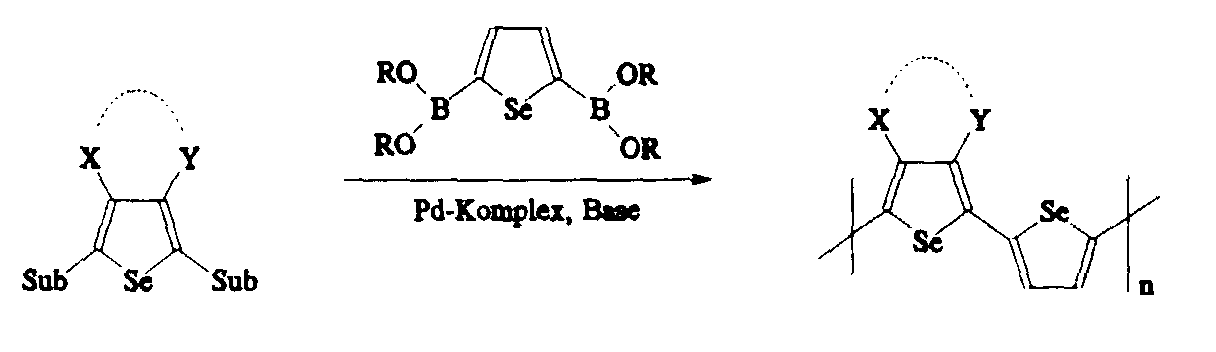
- Sub
- = Halogen oder Triflat
- X,Y
- = wie oben definiert
- R
- = H oder Alkyl
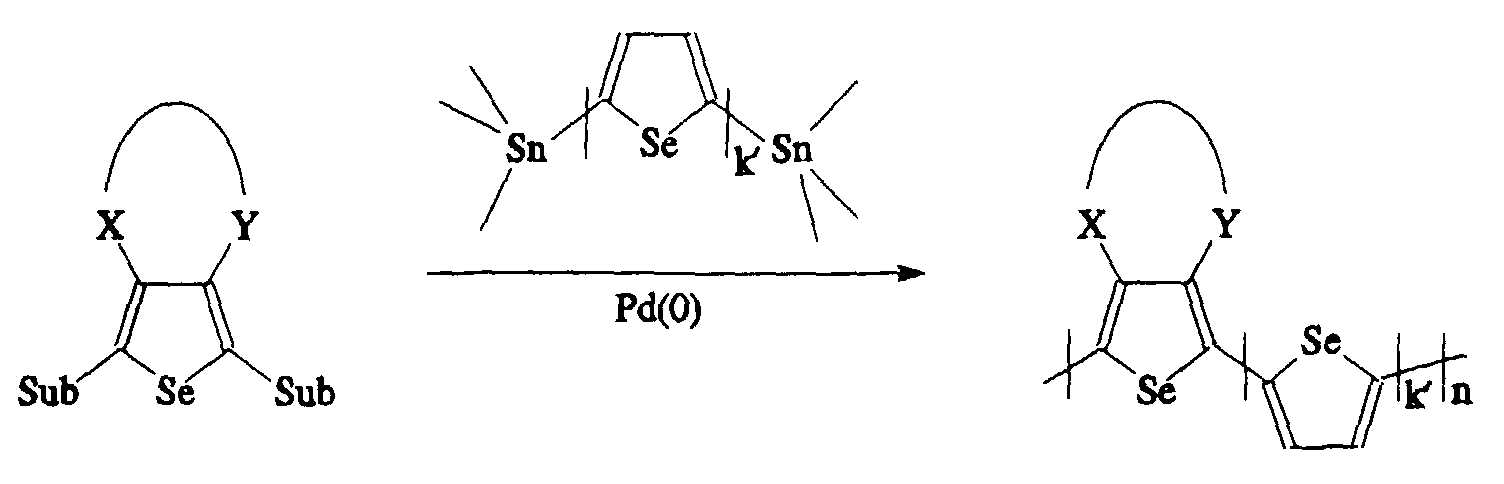
- Sub
- = Halogen oder Triflat
- k'
- = 1,2,3,...10
- Die erhaltenen Selenophene weisen lediglich geringe oder keine strukturellen Defekte, Dotierung oder Überoxidation auf;
- es ist möglich, eine große Vielzahl funktioneller Gruppen einschließlich Akzeptoren, Donatoren und π-Systemen mit mehreren Bindungen zwischen Kohlenstoff und einem Heteroatom einzusetzen; und
- es ist möglich, streng alternierende Copolyselenophene mit verschieden substituierten Ringen, beispielsweise die Umsetzung von in 3- und 4-Stellung substituierten Selenophenen mit unsubstituierten Selenophenen durchzuführen, was mit den bislang allgemein verwendeten Verfahren zur Polyselenophenherstellung nur äußerst schwierig möglich war.
Die vorliegende Erfindung soll nunmehr an einigen ausgewählten Beispielen weiter erläutert werden.

0,38 s (CH3), 0,38 d (CH3, J(117Sn-1H) = J(119Sn-1H) = 56,7 Hz), Gesamtintensität beider Signale: 9H), 7,70 s (Har); bedingt durch eine Spin-Spin-Kopplung (3J) mit 117Sn/119Sn und 77Se wurde ein symmetrisches Multiplet um 7,70 ppm mit einer Gesamtintensität, die 1H entsprach, beobachtet.
7,3 m (2 H, Hb + Hc), 7.94 d (1 H, H3, Jab 4,5 Hz); ferner wurde ein Dublett von Dubletts (dd) mit niedriger Intensität zentriert um 7,94 ppm beobachtet, 2J(77Se-H) = 47 Hz, Jab = 5,4 Hz, Integralintensität dieses dd: 6% der Intensität des Hauptsignals, das dem natürlichen Gehalt an 77Se (7,6) entspricht.
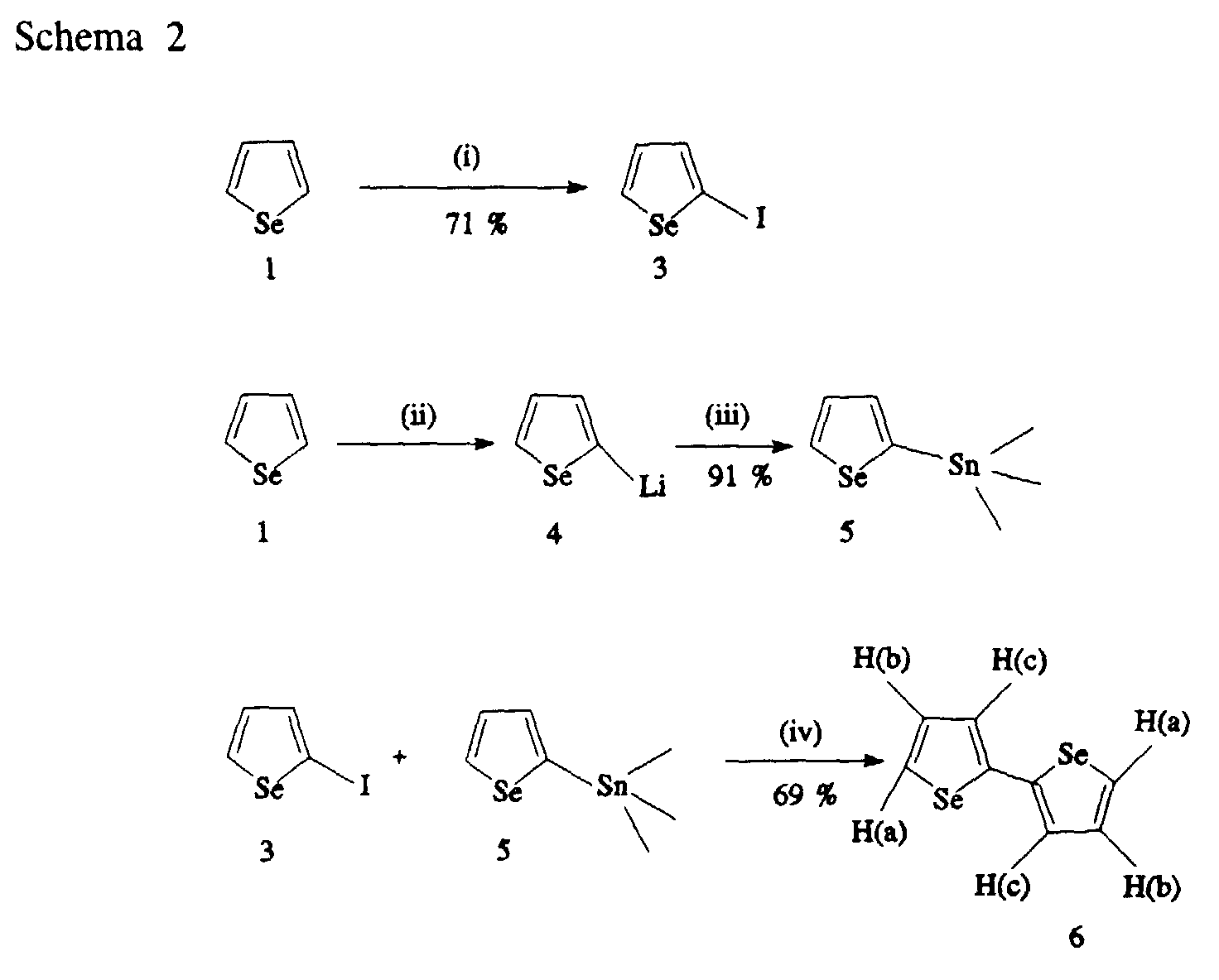
- i: I2/HgO, Benzol
- ii: BuLi/TMEDA, Hexan, 0°C - Raumtemperatur (RT)
- iii: (CH3)3SnCl, Hexan, 0°C - RT
- iv: 5 mol-% Pd(Ph3P)2Cl2, THF, Rückfluß
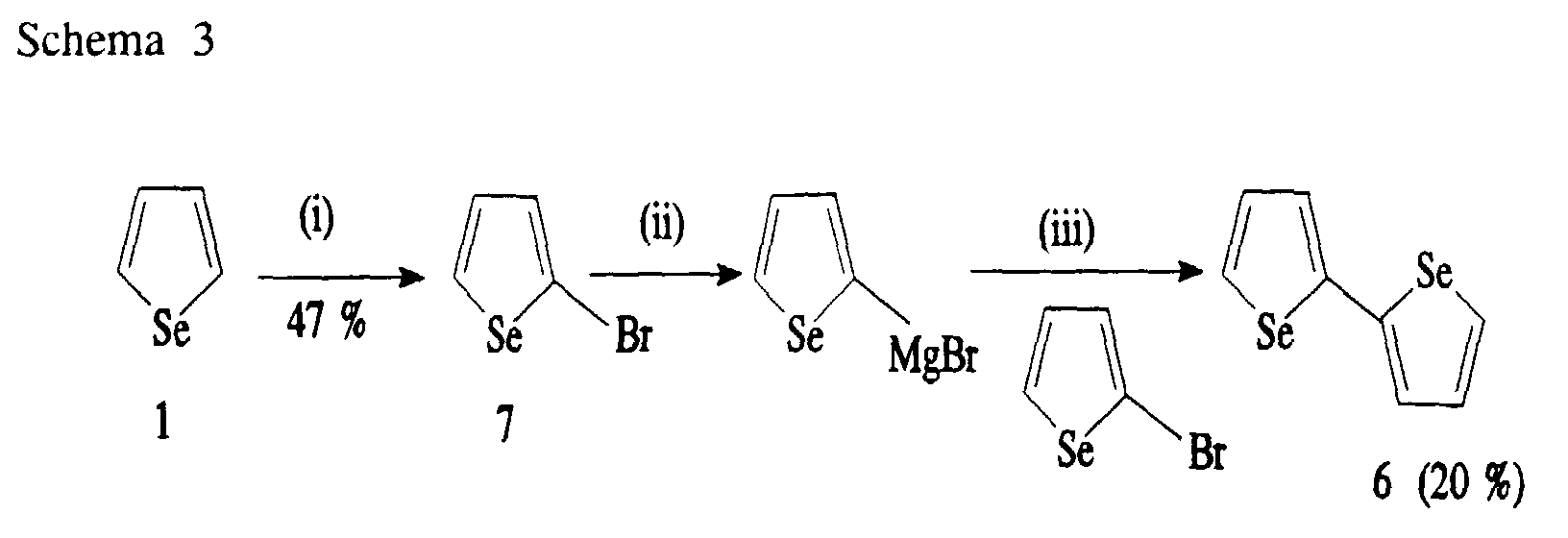

7,14 s (2 H, Hd), 7,24 m (4 H, Hb + Hc), 7,88 d (2 H, Ha, Jab 5 Hz); ferner wurde ein Dublett von Dubletts (dd) mit niedriger Intensität zentriert um 7,88 ppm beobachtet, 2J(77Se-H) = 47 Hz, Jab = 6,3 Hz.

- i: BuLi, TMEDA, THF, -10°C - RT
- ii: (CH3)3SnCl, THF
Claims (11)
- Polyselenophen, enthaltend eine oder mehrere Struktureinheiten der allgemeinen Formeln (I) oder (II) oder (I) und (II)wobei
 X und Y unabhängig voneinander gleich oder verschieden sein können und Wasserstoff, mit der Maßgabe, daß nicht sowohl X als auch Y Wasserstoff ist; eine lineare oder verzweigtkettige C1- bis C22-Alkylgruppe; eine lineare oder verzweigtkettige C1- bis C22-Alkoxygruppe; eine lineare oder verzweigtkettige C1- bis C22-Alkyloxyalkylgruppe; eine lineare oder verzweigtkettige C1- bis C22-Acylgruppe; eine lineare oder verzweigtkettige C1- bis C22-Thioacylgruppe; eine lineare oder verzweigtkettige C1- bis C22-Thioacyloxygruppe; eine lineare oder verzweigtkettige C1- bis C22-Acyloxygruppe; eine C5- bis C8-Cycloalkylgruppe, eine C6- bis C18-Arylgruppe oder eine C5- bis C8-heterocyclische Gruppe, die jeweils wiederum mit einer oder mehreren linearen oder verzweigtkettigen C1- bis C22-Alkylgruppe(n), einer oder mehreren linearen oder verzweigtkettigen C1- bis C22-Alkoxygruppe(n), einer oder mehreren linearen oder verzweigtkettigen C1- bis C22-Alkyloxyalkylgruppe(n), einer oder mehreren linearen oder verzweigtkettigen C1- bis C22-Acylgruppe(n) oder einer oder mehreren linearen oder verzweigtkettigen C1- bis C22-Thioacylgruppe(n) substituiert sein können; NO2; oder NHR1, wobei R1 gleich oder verschieden sein kann und jeweils Wasserstoff, eine lineare oder verzweigtkettige C1- bis C22-Alkylgruppe, eine lineare oder verzweigtkettige C1- bis C22-Alkoxygruppe, eine lineare oder verzweigtkettige C1- bis C22-Alkyloxyalkylgruppe, eine lineare oder verzweigtkettige C1- bis C22-Acylgruppe oder eine lineare oder verzweigtkettige C1- bis C22-Thioacylgruppe ist, bedeuten, oder X und Y zusammen mit den Atomen, an die sie gebunden sind, ein Kohlenstoff enthaltendes Ringsystem bilden, das neben Kohlenstoff Stickstoff (N)-, Sauerstoff (O)-, Schwefel (S)- oder Phosphor (P)-Heteroatome oder Mischungen zweier oder mehrerer dieser Heteroatome aufweist, wobei
dieses Ringsystem wiederum an dem (den) Kohlenstoffatom(en), dem (den) Stickstoffatom(en) oder dem (den) Phosphoratom(en) jeweils mit einer Gruppe Z substituiert sein kann, in der jedes Z unabhängig voneinander eine Gruppe wie oben für X und Y definiert bedeutet, oder zwei benachbarte Gruppen Z zusammen einen durch eine der folgenden allgemeinen Formeln (III) bis (VI) dargestellten Rest bildenin denen A Kohlenstoff (C), Stickstoff (N), Phosphor (P) oder Mischungen zweier oder mehrerer dieser Atome bedeutet,
wobei, sofern A Kohlenstoff ist, jedes dieser A entweder ein Wasserstoffatom trägt oder wiederum wie oben für X und Y definiert, substituiert sein kann. - Polyselenophen nach Anspruch 1, enthaltend Struktureinheiten der allgemeinen Formeln (VII) oder (VIII)
 in denen X und Y wie in Anspruch 1 definiert sind,n, m und k jeweils unabhängig voneinander eine ganze Zahl von 1 bis 10 bedeuten, und1 eine ganze Zahl von 1 bis 3000 bedeutet.
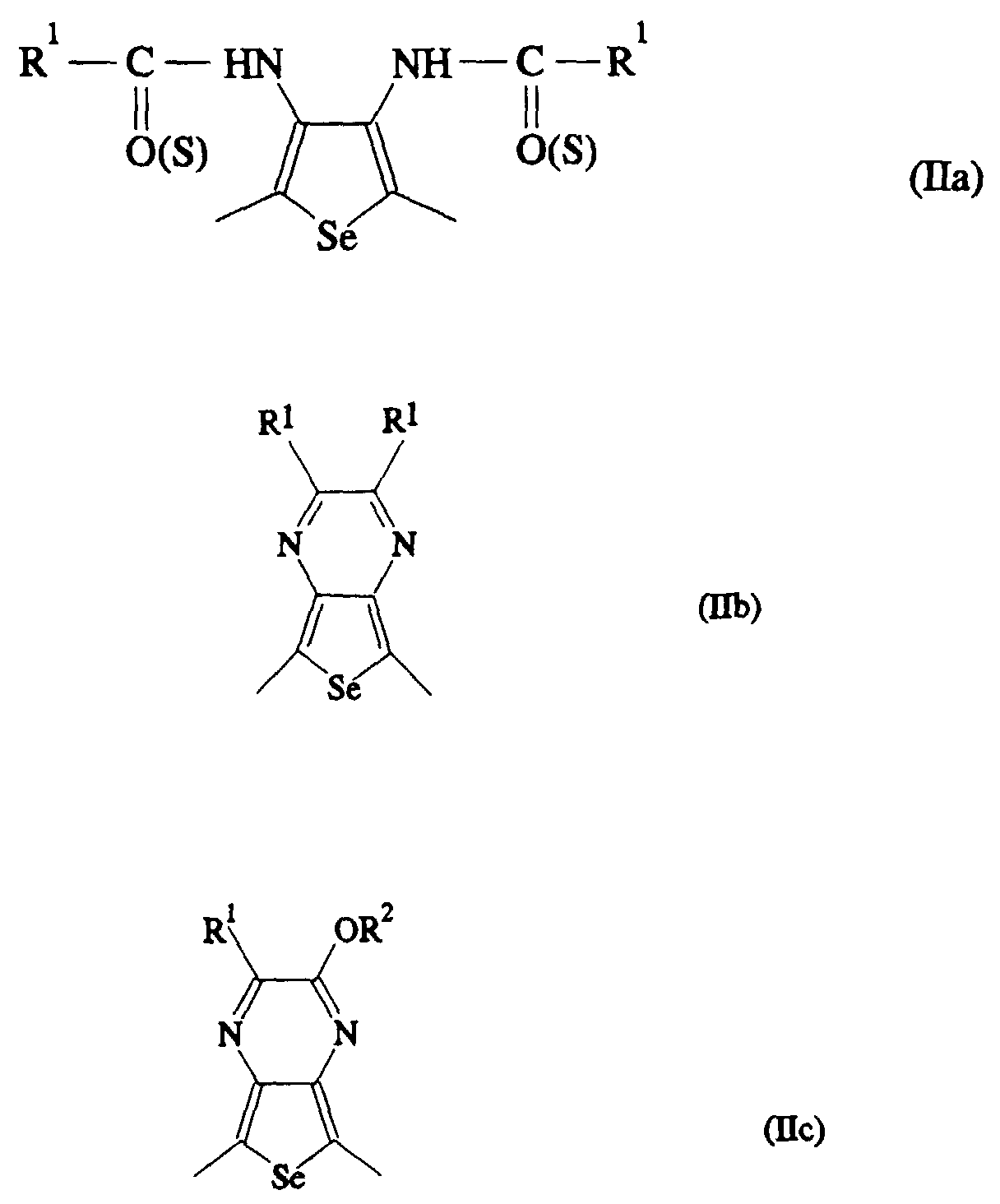
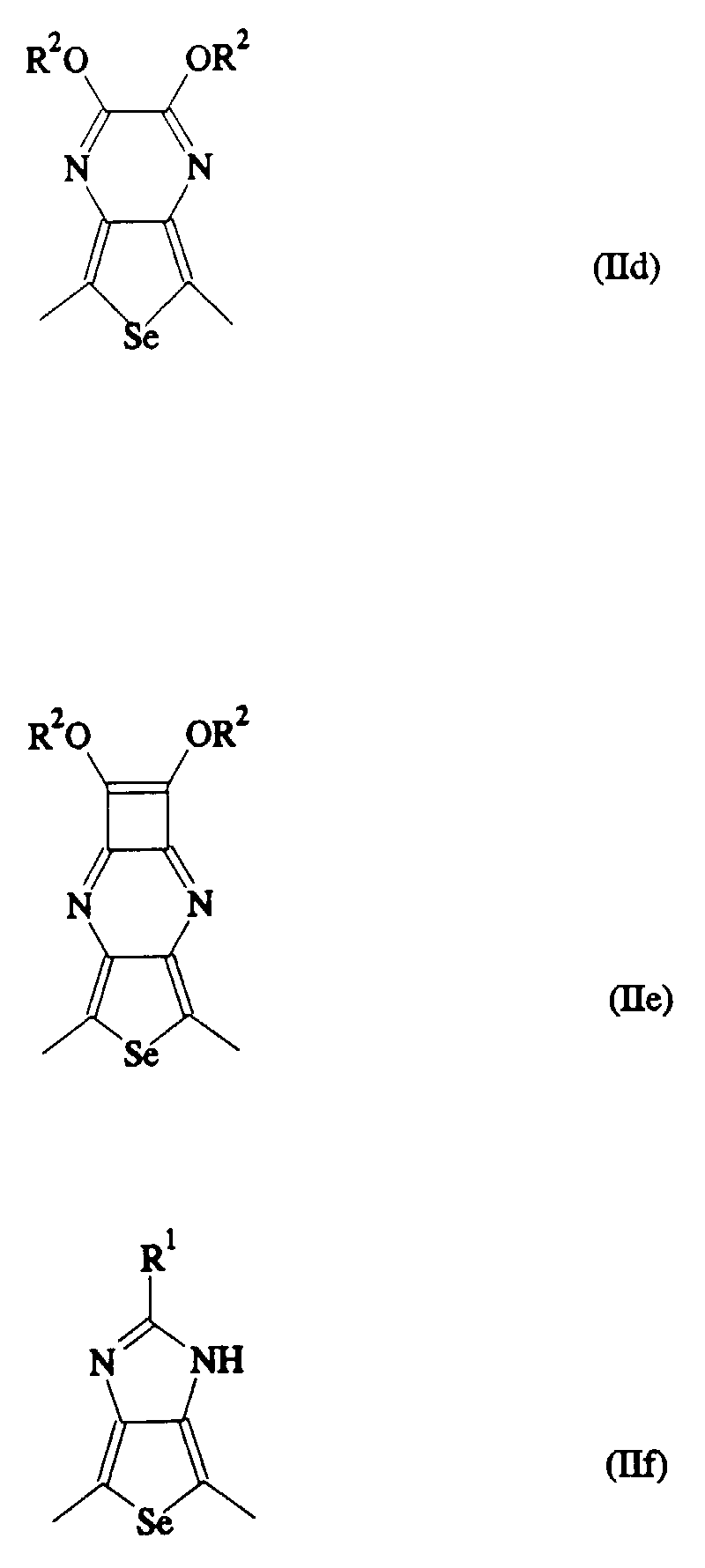
 - Polyselenophen nach Anspruch 1 oder 2, in dem die Struktureinheit (II) ausgewählt wird aus der Gruppe bestehend aus den Resten der folgenden allgemeinen Formeln (IIa) bis (IIg)
 und Mischungen dieser, in denen R1 wie in Anspruch 1 definiert ist und R2 CHR1 2 oder CH2R1 ist.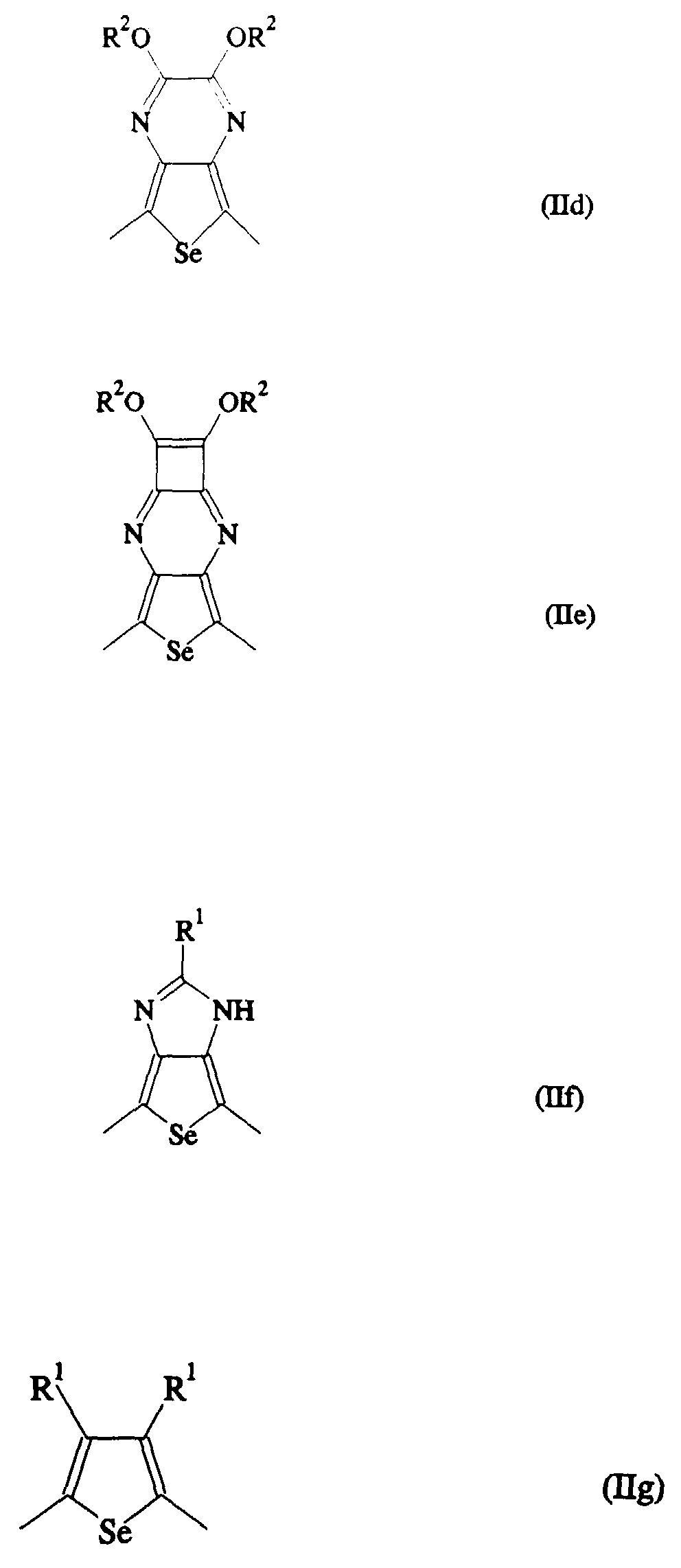
- Verbindungen der allgemeinen Formeln (IXa) bis (IXc)in der "Sub" Wasserstoff (H), Brom (Br), Chlor (Cl), Iod (I), Triflat (CF3SO3) oder Trialkylzinn ist, und R1 wie in Anspruch 1 definiert ist und R2 CHR1 2 oder CH2R1 ist.

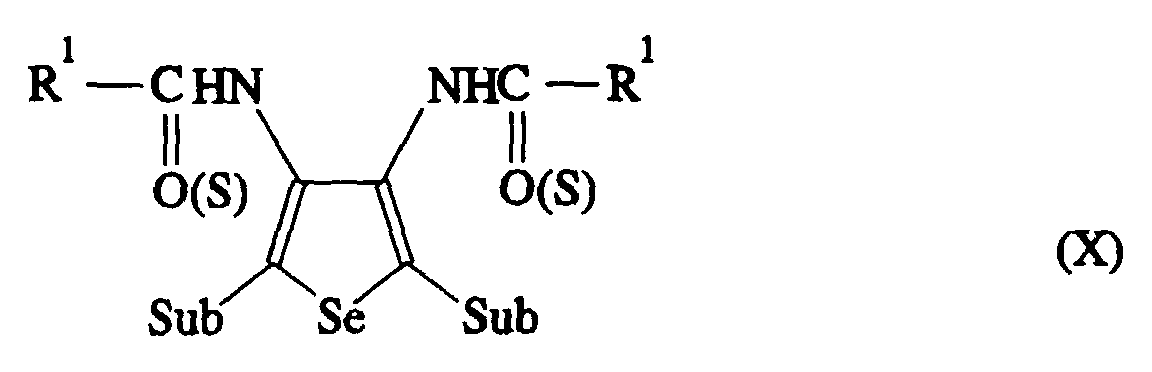
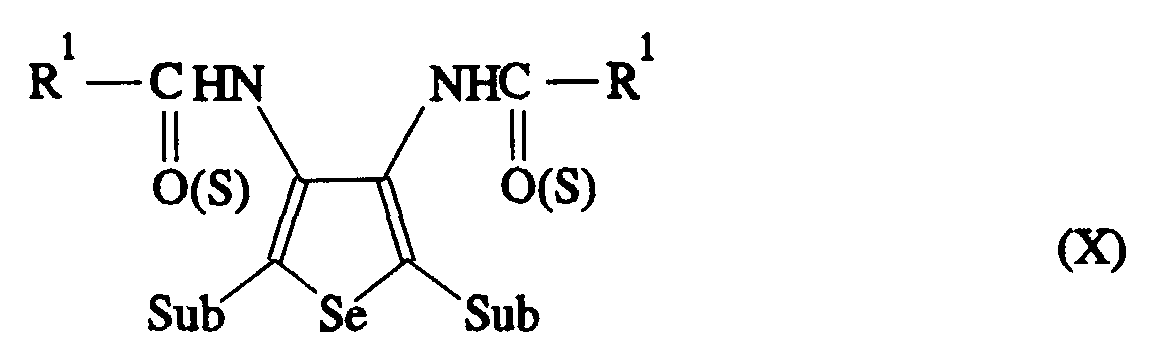
- N,N-substituiertes 3,4-Diamino-2,5-disubstuituiertes Selenophen der allgemeinen Formel (X)in der "Sub" wie in Anspruch 4 und R1 wie in Anspruch 1 definiert ist.
- 2,5-Bis(trialkylzinn)selenophen der allgemeinen Formel (XIa)2,5'-Bis(trialkylzinn)-5,2'-diselenophen der allgemeinen Formel (XIb)
 5,5''-Bis(trialkylzinn)-2,2':5',2''-Terselenophen der allgemeinen Formel (XIc)
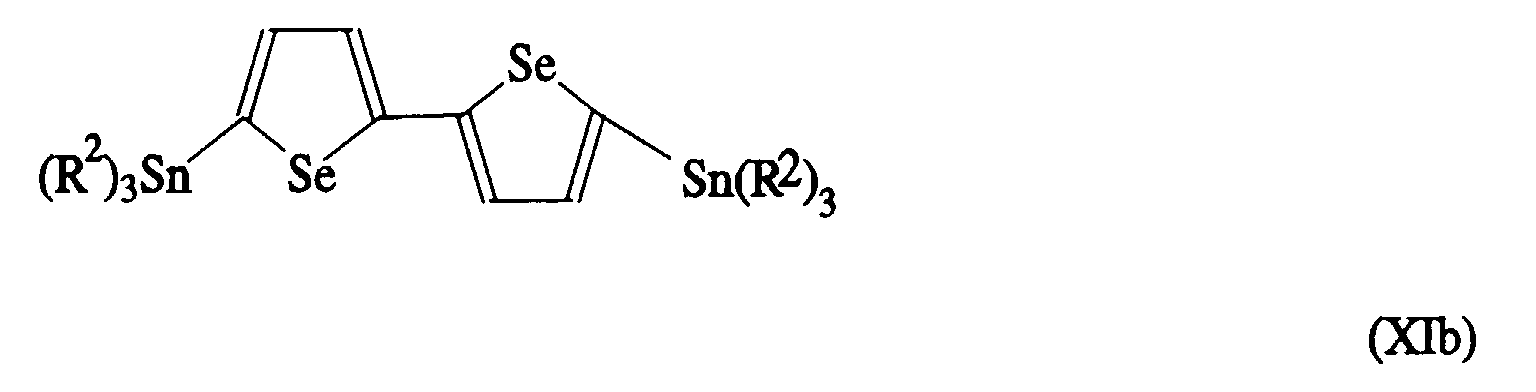 2-(Trialkylzinn)selenophen der allgemeinen Formel (XId)
 wobei R2 jeweils eine Alkylgruppe darstellt,;2,2'-Biselenophen, und 2,2':5',2''-Terselenophen.
 - Verfahren zur Herstellung eines Polyselenophens, wobei 2,5-Dihalogenselenophen oder 2,5-Ditriflatselenophen und an den dem Selen benachbarten Kohlenstoffatomen bis(Trialkylzinn)-substituierte Selenophenderivate, die der in Anspruch 1 definierten Struktureinheit (II) entsprechen, miteinander in geeigneten Lösungsmitteln in Anwesenheit von geeigneten Pd(0)- oder Pd(II)-Komplexen als Katalysator umgesetzt werden.
- Verfahren zur Herstellung eines Polyselenophens, dadurch gekennzeichnet, daß 2,5-Bis(trialkylzinn)selenophen und an den dem Selen benachbarten Kohlenstoffatomen bis(Halogen)- oder bis(Triflat)-substituierte Selenophenderivate, die der in Anspruch 1 definierten Struktureinheit (II) entsprechen, miteinander in geeigneten Lösungsmitteln in Anwesenheit von geeigneten Pd(0)- oder Pd(II)-Komplexen als Katalysator umgesetzt werden.
- Verwendung eines undotierten oder dotierten Polyselenophens gemäß einem der Ansprüche 1 bis 3 zur antistatischen Ausrüstung von den elektrischen Strom nicht oder nur schlecht leitenden Substanzen; als elektrisch leitfähige Folien; als Halbleiterfolien; als Zusatzstoff für aktive Elektroden; als LED's; als organische Transistoren; oder als Kondensatoren.
- Verfahren zur antistatischen Ausrüstung eines den elektrischen Strom nicht oder nur schlecht leitenden Substrats durch Aufbringen einer Schicht enthaltend ein elektrisch leitfähiges organisches Polymer auf die Oberfläche des Substrats, wobei man auf der Oberfläche des Substrats durch Polymerisation eine Schicht mindestens eines Polyselenophens erzeugt, das eine oder mehrere Struktureinheiten der allgemeinen Formeln (I) oder (II) oder (I) und (II), wie in Anspruch 1 definiert, enthält.
- Elektrisch leitfähiges Material, enthaltend mindestens ein Polyselenophen gemäß einem der Ansprüche 1 bis 3.
Applications Claiming Priority (2)
| Application Number | Priority Date | Filing Date | Title |
|---|---|---|---|
| DE19739775 | 1997-09-10 | ||
| DE19739775 | 1997-09-10 |
Publications (2)
| Publication Number | Publication Date |
|---|---|
| EP0902043A2 true EP0902043A2 (de) | 1999-03-17 |
| EP0902043A3 EP0902043A3 (de) | 1999-08-11 |
Family
ID=7841899
Family Applications (1)
| Application Number | Title | Priority Date | Filing Date |
|---|---|---|---|
| EP98116886A Withdrawn EP0902043A3 (de) | 1997-09-10 | 1998-09-07 | Polyselenophene, Verfahren zu deren Herstellung, und deren Verwendung |
Country Status (3)
| Country | Link |
|---|---|
| US (1) | US6197922B1 (de) |
| EP (1) | EP0902043A3 (de) |
| JP (1) | JPH11152323A (de) |
Cited By (1)
| Publication number | Priority date | Publication date | Assignee | Title |
|---|---|---|---|---|
| WO2007059849A1 (en) | 2005-11-24 | 2007-05-31 | Merck Patent Gmbh | Regioregular polyselenophenes |
Families Citing this family (11)
| Publication number | Priority date | Publication date | Assignee | Title |
|---|---|---|---|---|
| TWI290164B (en) * | 1999-08-26 | 2007-11-21 | Ciba Sc Holding Ag | DPP-containing conjugated polymers and electroluminescent devices |
| EP1313729B1 (de) * | 2000-08-17 | 2007-03-21 | Lumera Corporation | Design und synthese von nlo-materialien für electro-optische anwendungen, die von thiophen abgeleitet sind |
| US7909241B2 (en) * | 2004-03-09 | 2011-03-22 | Lowe's Companies, Inc. | Systems, methods and computer program products for implementing processes relating to retail sales |
| KR20070112791A (ko) * | 2005-03-11 | 2007-11-27 | 메르크 파텐트 게엠베하 | 티오펜 및 셀레노펜 함유 단량체, 올리고머 및 중합체 |
| ATE509055T1 (de) * | 2005-08-16 | 2011-05-15 | Merck Patent Gmbh | Verfahren zur polymerisation von thiophen- oder selenophenderivaten |
| US20070278458A1 (en) * | 2006-04-13 | 2007-12-06 | Martello Mark T | Electrically conductive polymer compositions |
| US20070278453A1 (en) * | 2006-06-02 | 2007-12-06 | Steffen Zahn | Electrically conductive polymers and method of making electrically conductive polymers |
| WO2008092490A1 (en) * | 2007-01-31 | 2008-08-07 | Merck Patent Gmbh | Process of preparing regioregular polymers |
| US7982055B2 (en) * | 2007-07-13 | 2011-07-19 | Konarka Technologies, Inc. | Heterocyclic fused selenophene monomers |
| JP5937382B2 (ja) * | 2012-03-06 | 2016-06-22 | 国立大学法人東京工業大学 | 有機半導体用有機ヘテロ高分子及びそれを用いた半導体デバイス |
| US12258441B1 (en) * | 2024-05-24 | 2025-03-25 | Imam Mohammad Ibn Saud Islamic University | Fabrication of a conjugated polymer |
Family Cites Families (5)
| Publication number | Priority date | Publication date | Assignee | Title |
|---|---|---|---|---|
| US3686141A (en) * | 1970-06-23 | 1972-08-22 | Cosden Oil & Chem Co | Heterocyclizing of polymer |
| DE3852540D1 (de) | 1987-07-30 | 1995-02-02 | Nippon Soda Co | Verfahren zur herstellung leitfähiger polymerfilme. |
| JPH064622B2 (ja) * | 1988-05-30 | 1994-01-19 | ダイソー株式会社 | ジヒドロポリセレノフェン及びこれを成分とする導電性電荷移動錯体 |
| JPH08245636A (ja) * | 1995-03-06 | 1996-09-24 | Fuji Electric Co Ltd | セレノロセレノフェンオリゴマおよびその製造方法 |
| US6242561B1 (en) * | 1996-03-06 | 2001-06-05 | Basf Aktiengesellschaft | Substituted polythiophenes, processes for their preparation their use |
-
1998
- 1998-09-07 EP EP98116886A patent/EP0902043A3/de not_active Withdrawn
- 1998-09-09 US US09/149,446 patent/US6197922B1/en not_active Expired - Fee Related
- 1998-09-09 JP JP10255795A patent/JPH11152323A/ja active Pending
Cited By (4)
| Publication number | Priority date | Publication date | Assignee | Title |
|---|---|---|---|---|
| WO2007059849A1 (en) | 2005-11-24 | 2007-05-31 | Merck Patent Gmbh | Regioregular polyselenophenes |
| GB2445514A (en) * | 2005-11-24 | 2008-07-09 | Merck Patent Gmbh | Regioregular polyselenophenes |
| GB2445514B (en) * | 2005-11-24 | 2010-01-13 | Merck Patent Gmbh | Regioregular polyselenophenes |
| US8431682B2 (en) | 2005-11-24 | 2013-04-30 | Merck Patent Gmbh | Regioregular polyselenophenes |
Also Published As
| Publication number | Publication date |
|---|---|
| US6197922B1 (en) | 2001-03-06 |
| EP0902043A3 (de) | 1999-08-11 |
| JPH11152323A (ja) | 1999-06-08 |
Similar Documents
| Publication | Publication Date | Title |
|---|---|---|
| EP0885251B1 (de) | Substituierte polythiophene, verfahren zu deren herstellung, und deren verwendung | |
| EP0579604B1 (de) | Leiterpolymere mit konjugierten doppelbindungen | |
| DE69524006T2 (de) | Thiophenderivate und Polymere davon | |
| DE10159946A1 (de) | Prozess zur Herstellung von Aryl-Aryl gekoppelten Verbindungen | |
| DE19614249A1 (de) | Polysilane, Herstellungsverfahren derselben und Ausgangsmaterialien hierfür | |
| EP0257573A1 (de) | Lösliche, elektrisch leitende Polymere, Verfahren zu ihrer Herstellung und ihre Verwendung | |
| DE112007000382T5 (de) | Leitfähige Polymere aus Precursorpolymeren; Verfahren zur Herstellung und ihre Verwendung | |
| EP0218093B1 (de) | Polymere mit konjugierten Doppelbindungen | |
| US6197922B1 (en) | Polyselenophenes, the preparation thereof and the use thereof | |
| DE3341377A1 (de) | Elektroaktives polymeres | |
| DE2739584C2 (de) | Schwefel- und/oder selenhaltige Heterofulvalene und Verfahren zu ihrer Herstellung | |
| DE69012755T2 (de) | Ladungsübertragunssalze und Anwendungen derselben. | |
| DE3701495A1 (de) | Polymer einer fuenfgliedrigen heterocyclischen verbindung und dessen herstellung | |
| DE3526234A1 (de) | Verfahren zur polymerisation von acetylen in gegenwart von polymeren und polyacetylenhaltige polymerprodukte | |
| EP0071082A1 (de) | Verfahren zur Herstellung luftstabiler, elektrisch leitfähiger, polymerer Polyensysteme und ihre Verwendung in der Elektrotechnik und zur antistatischen Ausrüstung von Kunststoffen | |
| EP0313998A2 (de) | Modifizierte elektrisch leitende Polymere | |
| EP2107065A1 (de) | Ruthenium-Komplexe mit (P-P)-koordinierten Di-Phosphor-Donorliganden sowie Verfahren zu ihrer Herstellung | |
| DE60010263T2 (de) | Verwendung von sulfon- und phosphonsäuren als dotierstoffe von polyanilinfilmen und aus polyanilin leitende verbundwerkstoffe | |
| DE1954255C3 (de) | Polymere mit einem System von konjugierten Doppelbindungen in der Hauptkette und Verfahren zu deren Herstellung | |
| DE19739774A1 (de) | Polyselenophene als Materialien mit nichtlinear optischen Eigenschaften | |
| DE60309096T2 (de) | Poly(5-aminoquinoxaline); deren Herstellung und Verwendung | |
| DE19549065A1 (de) | Lösliches leitendes Polymer, Herstellungsverfahren für das Polymer und Anzeigevorrichtung unter Verwendung dieses Polymers | |
| DE3804523A1 (de) | Elektrisch leitende polymere mit verbesserter loeslichkeit | |
| DE3305401A1 (de) | Verfahren zur herstellung von elektrisch leitfaehigen kunststoffen | |
| DE2638072A1 (de) | Katalytische asymmetrische hydrierverfahren |
Legal Events
| Date | Code | Title | Description |
|---|---|---|---|
| PUAI | Public reference made under article 153(3) epc to a published international application that has entered the european phase |
Free format text: ORIGINAL CODE: 0009012 |
|
| AK | Designated contracting states |
Kind code of ref document: A2 Designated state(s): DE GB IT |
|
| AX | Request for extension of the european patent |
Free format text: AL;LT;LV;MK;RO;SI |
|
| PUAL | Search report despatched |
Free format text: ORIGINAL CODE: 0009013 |
|
| AK | Designated contracting states |
Kind code of ref document: A3 Designated state(s): AT BE CH CY DE DK ES FI FR GB GR IE IT LI LU MC NL PT SE |
|
| AX | Request for extension of the european patent |
Free format text: AL;LT;LV;MK;RO;SI |
|
| RIC1 | Information provided on ipc code assigned before grant |
Free format text: 6C 08G 79/00 A, 6C 07D 345/00 B, 6C 07D 517/04 B, 6C 07D 517/04 J, 6C 07D 345:00 J, 6C 07D 241:00 J |
|
| 17P | Request for examination filed |
Effective date: 20000204 |
|
| AKX | Designation fees paid |
Free format text: DE GB IT |
|
| RAP1 | Party data changed (applicant data changed or rights of an application transferred) |
Owner name: H.C. STARCK GMBH & CO. KG |
|
| RAP1 | Party data changed (applicant data changed or rights of an application transferred) |
Owner name: H.C. STARCK GMBH |
|
| 17Q | First examination report despatched |
Effective date: 20040126 |
|
| STAA | Information on the status of an ep patent application or granted ep patent |
Free format text: STATUS: THE APPLICATION IS DEEMED TO BE WITHDRAWN |
|
| 18D | Application deemed to be withdrawn |
Effective date: 20040609 |