FIELD OF THE INVENTION AND RELATED ART
The present invention relates to
phthalocyanine compounds, more specifically
iodogallium phthalocyanine compound, bromogallium
phthalocyanine compound and zirconium phthalocyanine
compound, having novel crystal forms. The present
invention further relates to a process for producing
the phthalocyanine compounds and an electrophotographic
photosensitive member using the phthalocyanine
compounds.
Hitherto, phthalocyanine pigments have been
noted and studied not only as coloring agents but also
as electronic materials for constituting
electrophotographic photosensitive member, solar
batteries, photosensors, etc.
On the other hand, non-impact type printers
utilizing electrophotography have been widely used as
terminal printers in recent years, in place of
conventional impact type printers. These printers are
principally constituted as laser beam printers using a
laser as a light source. As the light source, a
semiconductor laser has been predominantly used in
view of its cost and apparatus size. A semiconductor
laser principally used at present has an emission
wavelength in a long wavelength region around 790 nm,
so that electrophotographic photoconductors having a
sufficient sensitivity to such a long-wavelength light
have been developed.
The sensitivity region of an
electrophotographic photoconductor principally varies
depending on a charge-generating material, and many
studies have been made on charge-generating materials
having a sensitivity to a long-wavelength light
including metallic phthalocyanines and non-metallic
phthalocyanines, such as aluminum
chlorophthalocyanine, chloroindium phthalocyanine,
oxyvanadium phthalocyanine, hydroxygallium
phthalocyanine, chlorogallium phthalocyanine,
magnesium phthalocyanine, and oxytitanium
phthalocyanine.
Many of these phthalocyanine compounds are
known to have various crystal forms. For example,
non-metallic phthalocyanine is known to have α-form,
β-form, γ-form, δ-form, ε-form, χ-form, τ-form, etc.,
and copper phthalocyanine is known to have α-form, β-form,
γ-form, ε-form, χ-form, etc. Specific examples
of these phthalocyanine compounds are disclosed in,
e.g., Japanese Laid-Open Patent Application (JP-A) 50-38543,
JP-A 51-108847, and JP-A 53-37423. Oxytitaniun
phthalocyanines are reported in JP-A 61-217050, JP-A
61-239248, JP-A 62-67094, JP-A 64-17066 and JP-A 3-128973.
Further, gallium phthalocyanines are
disclosed in JP-A 5-98181 and JP-A 5-263007 with
respect to chlorogallium phthalocyanine and
hydroxygallium phthalocyanine together with their
crystal forms. Further, iodogallium phthalocyanine is
disclosed in JP-A 60-59354, and bromogallium
phthalocyanine is disclosed in JP-A 57-148745 but with
no specific disclosure regarding their crystal forms.
However, many electrophotographic
photosensitive members using such known phthalocyanine
compounds can only show a low sensitivity and are
liable to cause fluctuation in dark-part potential and
light-part potential during repetitive use.
SUMMARY OF THE INVENTION
An object of the present invention is to
provide phthalocyanine compounds having a novel
crystal form, and a process producing the compounds.
Another object of the present invention is to
provide an electrophotographic photosensitive member
having a very high sensitivity to long-wavelength
light and having excellent potential stability.
According to the present invention, there is
provided iodogallium phthalocyanine having a crystal
form selected from those characterized by X-ray
diffraction patterns (a) - (e) shown below
respectively obtained by a CuKα characteristic X-ray
diffraction method:
Such iodo- (or bromo-)gallium phthalocyanine
may effectively be produced through a process
comprising: reacting chlorogallium phthalocyanine or
hydroxygallium phthalocyanine with hydroiodic (or
hydrobromic) acid under milling or stirring.
According to the present invention, there is
further provided zirconium phthalocyanine having a
crystal form represented by an X-ray diffraction
pattern having a strongest peak at a Bragg angle (2 ±
0.2 deg.) in a range of 7.0 - 9.0 deg. as measured by
a CuKα characteristic X-ray diffraction method.
Such zirconium phthalocyanine may effectively
be produced through a process comprising milling or
stirring zirconium phthalocyanine in an organic
solvent.
According to the present invention, there is
also provided an electrophotographic photosensitive
member, comprising a support, and a photosensitive
layer formed on the support and containing one of the
above-mentioned iodogallium phthalocyanine,
bromogallium phthalocyanine and zirconium
phthalocyanine.
These and other objects, features and
advantages of the present invention will become more
apparent upon a consideration of the following
description of the preferred embodiments of the
present invention taken in conjunction with the
accompanying drawings.
BRIEF DESCRIPTION OF THE DRAWINGS
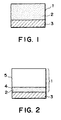
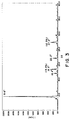
Figures 1 and 2 are sectional views each
showing an example of laminar structure of an
electrophotographic photosensitive member.
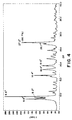
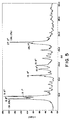
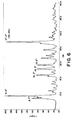
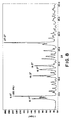
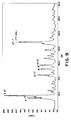
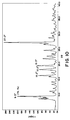
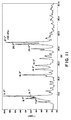
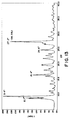
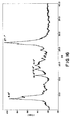
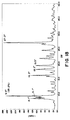
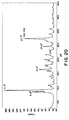
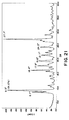
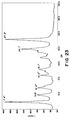
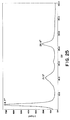
Figures 3 - 31 each show an X-ray diffraction
pattern of an iodogallium phthalocyanine crystal
according to the invention.
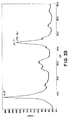
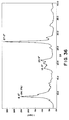
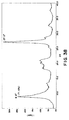
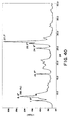
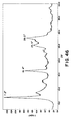
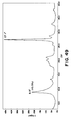
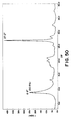
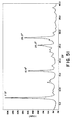
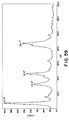
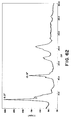
Figures 32 - 59 each show an X-ray
diffraction pattern of a bromogallium phthalocyanine
crystal according to the invention.
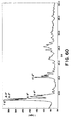
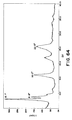
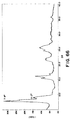
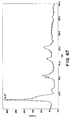
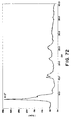
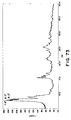
Figures 60 - 75 each show an X-ray
diffraction pattern of a zirconium phthalocyanine
according to the invention.
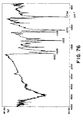
Figures 76 and 77 each show an infrared
absorption spectrum of zirconium phthalocyanine
according to the invention.
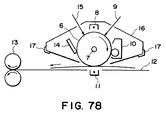
Figure 78 schematically illustrates an
electrophotographic apparatus in which a process
cartridge including an electrophotographic
photosensitive member according to the invention is
mounted.
DETAILED DESCRIPTION OF THE INVENTION
The iodogallium phthalocyanine according to
the present invention has a crystal form selected from
those characterized by X-ray diffraction patterns (a)
- (e) shown below respectively obtained by a CuKα
characteristic X-ray diffraction method:
It is preferred that the diffraction pattern
(g) further shows strong peaks at Bragg angles (2 ±
0.2 deg.) of 9.7 deg., 18.2 deg. and 21.0 deg.; the
diffraction pattern (h) further shows a strong peak at
a Bragg angle (2 ± 0.2 deg.) of 16.2 deg.; the
diffraction pattern (i) further shows strong peaks at
Bragg angles (2 ± 0.2 deg.) of 16.3 deg. and 24.9
deg.; and the diffraction pattern (j) further shows
strong peaks at Bragg angles (2 ± 0.2 deg.) of 13.2
deg. and 16.6 deg.
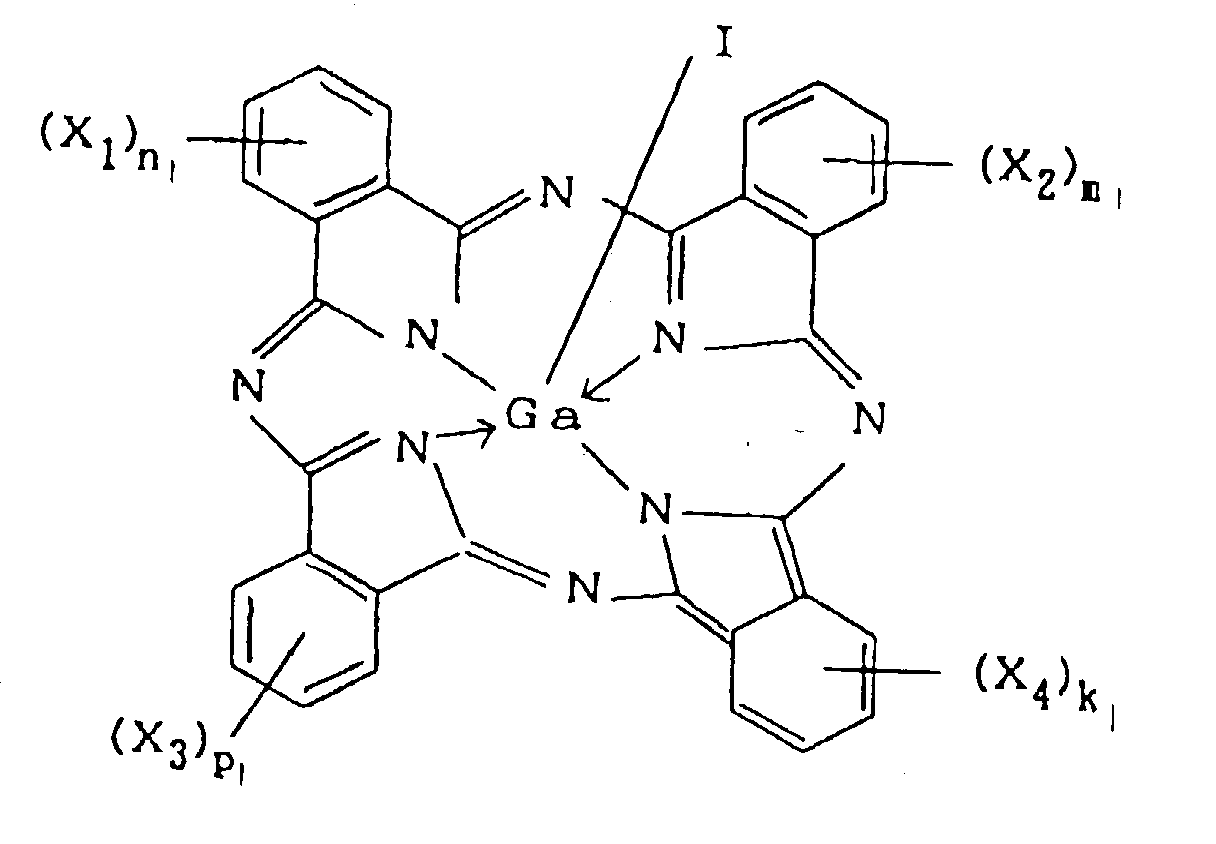
The bromogallium phthalocyanine according to
the present invention has a structure represented by
the following formula:
wherein X
5, X
6, X
7 and X
8 denote Cl or Br, n
2, m
2, p
2
and k
2 are respectively an integer of 0 - 4.
The above-mentioned bromogallium
phthalocyanine may for example be formed by reacting
phthalocyanine and gallium tribromide in α-chloronaphthalene
solvent at 150 - 230 °C. It has
been also discovered that bromogallium phthalocyanine
can be obtained by reacting chlorogallium
phthalocyanine obtained through various process, e.g.,
one disclosed in JP-A 5-194523 or hydroxygallium
phthalocyanine formed by hydrolyzing the chlorogallium
phthalocyanine with hydrobromic acid under application
of a shearing force, as by milling or stirring. This
process is commercially desirable because inexpensive
gallium chloride can be used instead of gallium
bromide.
More specifically, bromogallium
phthalocyanine having a crystal form represented by a
diffraction pattern (f) showing a strong peak at a
Bragg angle (2 ± 0.2 deg.) of 27.3 deg. (hereinafter,
sometimes referred as "bromogallium phthalocyanine
(f)") may be formed by reacting phthalonitrile and
gallium tribromide in a reaction solvent of α-chloronaphthalene
under stirring and heating at 150 -
230 °C. It is possible to further subject the product
bromogallium phthalocyanine to washing under heating
dispersion within an amide solvent, such as N,N-dimethylformamide,
or washing with an alcohol, such as
ethanol. The crystal form is not changed by such
washing.
Bromogallium phthalocyanine having a crystal
form represented by a diffraction pattern (g) having
strong peaks at Bragg angles (2 ± 0.2 deg.) of 9.0
deg. and 27.1 deg. (hereinafter sometimes referred to
as "bromogallium phthalocyanine (g)") may be obtained
by subjecting bromogallium phthalocyanine (f) to dry
milling by a mortar.
Bromogallium phthalocyanine (g) may also be
prepared by subjecting bromogallium phthalocyanine
(f), to dry milling, as by a sand mill or a paint
shaker together with glass beads to obtain a crystal,
and subjecting the crystal to milling in an
appropriate solvent, examples of which may include:
halogen-containing solvents, such as chloroform,
chlorobenzene and dichlorobenzene; ketone solvents,
such as cyclohexane, methyl ethyl ketone and acetone;
nitrile solvents, such as acetonitrile and
benzonitrile; ester solvents, such as ethyl acetate
and butyl acetate, alcohol solvents, such as methanol,
ethanol, propanol, ethylene glycol and polyethylene
glycol, and ether solvents, such as tetrahydrofuran,
1,4-dioxane, propyl ether, and butyl ether. By
milling or stirring bromogallium phthalocyanine in
such a solvent, it is possible to obtain bromogallium
phthalocyanine (g) in various crystallinities.
Bromogallium phthalocyanine having a crystal
form represented by a diffracting pattern (h) showing
strong peaks at Bragg angles (2 ± 0.2 deg) of 7.4 deg
and 27.9 deg. (hereinafter sometimes referred as
"bromogallium phthalocyanine (h)") may be obtained by
subjecting bromogallium phthalocyanine (f) to dry
milling, as by a sand mill or a paint shaker, together
with glass beads.
Bromogallium phthalocyanine (h) may also be
obtained by milling or stirring (i) a crystal formed
by subjecting bromogallium phthalocyanine (f) to dry
milling, as by a mortar, or (ii) bromogallium
phthalocyanine (g) obtained by treatment with
hydrobromic acid, in an amide solvent, such as N,N-dimethylformamide,
or N-methylpyrrolidone.
Bromogallium phthalocyanine having a crystal
form represented by a diffraction pattern (i) showing
strong peaks at Bragg angles (2 ± 0.2 deg.) of 7.5
deg. and 26.4 deg. (hereinafter sometimes referred to
as "bromogallium phthalocyanine (i)") may be obtained
by milling or stirring (i) a crystal formed by
subjecting bromogallium phthalocyanine (f) to dry
milling, as by a mortar, a sand mill, a ball mill, or
a paint shaker, or (ii) bromogallium phthalocyanine
(g) obtained by treatment with hydrobromic acid in an
amine solvent, such as N,N-dimethylaniline, N,N-diethylaniline
or quinoline.
Bromogallium phthalocyanine having a crystal
form represented by a diffraction pattern (j) showing
strong peaks at Bragg angles (2 ± 0.2 deg.) of 6.9
deg. and 26.7 deg. may be obtained by milling or
stirring bromogallium phthalocyanine (g) obtained by
treatment with hydrobromic acid in a weak alkaline
aqueous solution (pH of at most 11), followed by
washing with water.
Zirconium phthalocyanine according to the
present invention has a crystal form represented by an
X-ray diffraction pattern having a strongest peak at a
Bragg angle (2 ± 0.2 deg.) in a range of 7.0 - 9.0
deg. as measured by a CuKα characteristic X-ray
diffraction method.
It is preferred that the X-ray diffraction
pattern shows a strongest peak at a Bragg angle (2 ±
0.2 deg.) of 8.0 deg. It is further preferred that
the diffraction pattern further shows a strong peak at
a Bragg angle (2 ± 0.2 deg.) of 25.5 deg.
The zirconium phthalocyanine according to the
present invention has a structure represented by the
following formula:
wherein X
9, X
10, X
11 and X
12 denote Cl or Br, n
3, m
3,
p
3 and k
3 are respectively an integer of 0 - 4.
The zirconium phthalocyanine may for example
be prepared by reacting phthalonitrile and zirconium
tetrachloride in an appropriate solvent, such as
quinoline, under an inert gas atmosphere at 150 - 230
°C, and dispersing the reaction product in the
reaction solvent or a solvent such as N,N-dimethylformamide.
Various forms of zirconium
phthtalocyanine may be formed milling or stirring the
thus synthesized zirconium phthalocyanine in an
appropriate solvent, directly or after dry-milling, as
by a mortar, a sand mill, a ball mill or a paint
shaker.
Examples of appropriate solvent may include:
halogen-containing solvents, such as chloroform,
chlorobenzene and dichlorobenzene; ketone solvents,
such as cyclohexane, methyl ethyl ketone and acetone;
nitrile solvents, such as acetonitrile and
benzonitrile; ester solvents, such as ethyl acetate
and butyl acetate; alcohol solvents, such as methanol,
ethanol, propanol, ethylene glycol and polyethylene
glycol; ether solvents, such as tetrahydrofuran, 1,4-dioxane,
propyl ether, and butyl ether; amine
solvents, such as N,N-dimethylaniline and N,N-diethylaniline;
and amide solvents, such as N,N-dimethylformamide
and N-methylpyrrolidone.
The above-mentioned phthalocyanine compound
of the invention functions as an excellent
photoconductor and may be adapted for an electronic
material such as an electrophotosensitive member, a
solar cell, a sensor or a switching device.
Hereinafter, some examples of application of
the phthalocyanine compound of the invention to a
charge-generating material in an electrophotosensitive
member will be explained.
Representative embodiments of laminar
structure of the electrophotosensitive member of the
invention are shown in Figures 1 and 2. Figure 1
shows an embodiment, wherein a photosensitive layer 1
is composed of a single layer and comprises a charge-generating
material 2 and a charge-transporting
material (not shown) together. The photosensitive
layer 1 may be disposed on an electroconductive
support 3. Figure 2 shows an embodiment of laminated
structure wherein a photosensitive layer 1 comprises a
charge generation layer 4 comprising a charge-generating
material 2 and a charge transport layer 5
comprising a charge-transporting material (not shown)
disposed on the charge generation layer 4; and the
charge transport layer 5 may be disposed on an
electroconductive support 3. The charge generation
layer 4 and the charge transport layer 5 can be
disposed in reverse. The laminar structure of Figure
2 is preferred in the present invention.
The electroconductive support 3 may comprise
a material having an electroconductivity including: a
metal such as aluminum or stainless steel; and metal,
plastic or paper having an electroconductive layer.
The support 3 may have a shape of a cylinder or a
sheet.
Between the electroconductive support 3 and
the photosensitive layer 1, there can be formed a
primer or undercoat layer having a barrier function
and an adhesive function as an intermediate layer.
The primer layer may comprise a substance, such as
polyvinyl alcohol, polyethylene oxide, ethyl
cellulose, methyl cellulose, casein, polyamide, glue
or gelatin. The above substance may be dissolved in
an appropriate solvent and applied onto the
electroconductive support 3 to prepare the primer
layer. The thickness of the primer layer may be 0.2 -
3.0 µm.
The photosensitive layer which is composed of
a single layer as shown in Figure 2 may be formed by
dispersing or dissolving the charge-generating
material comprising the phthalocyanine compound of the
invention and the charge-transporting material with an
appropriate solution containing a binder resin,
applying the resultant coating liquid and then drying
the coating.
The charge generation layer of the
photosensitive layer having a laminated structure as
shown in Figure 2 may be formed by dispersing the
charge-generating material comprising the oxytitanium
phthalocyanine crystal of the invention in an
appropriate solution containing a binder resin,
applying the resultant coating liquid and then drying
the coating. Examples of the binder resin as
described above may include: polyester, acrylic
resins, polyvinylcarbazole, phenoxy resins,
polycarbonate, polyvinyl butyral, polystyrene, vinyl
acetate resins, polysulfone, polyarylate or vinylidene
chloride-acrylonitrile copolymers.
The charge transport layer may be formed by
dissolving a charge-transporting material and a binder
resin in an appropriate solvent, applying the
resultant coating liquid and then drying the coating.
Examples of the charge-transporting material used may
include: triaryl amine compounds, hydrazone compounds,
stilbene compounds, pyrazoline compounds, oxazole
compounds, thiazole compounds or triaryl methane
compounds. As the binder resin, the above-mentioned
resins can be used.
The method for applying the photosensitive
layer(s) may be: dipping, spray coating, spinner
coating, bead coating, blade coating or beam coating.
The thickness of the photosensitive layer
composed of a single layer may preferably be 5 - 40
µm, more preferably 10 - 30 µm. When the
photosensitive layer has a laminated structure, the
thickness of the charge generation layer may
preferably be 0.01 - 10 µm, more preferably 0.05 - 5
µm and the thickness of the charge transport layer may
preferably be 5 - 40 µm, more preferably 10 - 30 µm.
In order to protect the photosensitive layer
from external shock, a thin protective layer can be
further disposed on the photosensitive layer.
When the phthalocyanine compound of the
invention is used as the charge-generating material,
it is possible to mix the phthalocyanine compound with
another charge-generating material.
The electrophotographic photosensitive member
according to the present invention can be applied to
not only a laser beam printer, a light-emitting diode
(LED) printer and a cathode-ray tube (CRT) printer but
also an ordinary electrophotographic copying machine
and other fields of applied electrophotography.
Figure 78 shows an outline of an
electrophotographic apparatus including an
electrophotographic photosensitive member according to
the present invention as an essential part of a
process cartridge.
Referring to Figure 78, a drum-shaped
electrophotographic photosensitive member 6 according
to the present invention is driven in rotation at a
prescribed peripheral speed in an indicated arrow
direction about an axis 7. During the rotation, the
outer peripheral surface of the photosensitive member
6 is uniformly charged at a prescribed positive or
negative potential, and then exposed to image light 9
(as by slit exposure or laser beam scanning exposure)
by using an imagewise exposure means (not shown),
whereby an electrostatic latent image is successively
formed on the peripheral surface of the photosensitive
member 6.
The thus-formed electrostatic latent image is
then developed with a toner by developing means 10 to
form a toner image on the photosensitive member 6.
The toner image is transferred by a transfer means 11
onto a transfer(-receiving) material 12 which has been
supplied from a paper supply unit (not shown) to a
position between the photosensitive member 6 and the
transfer means 11 in synchronism with the rotation of
the photosensitive member 6.
The transfer material 12 carrying the
received toner image is then separated from the
photosensitive member 6 surface and guided to an image
fixing means 13 to fix the toner image. The resultant
print or copy comprising the fixed toner image is then
discharged out of the electrophotographic apparatus.
The surface of the photosensitive member
after the image transfer is subjected to removal of
residual toner by a cleaning means 14 to be cleaned
and then subjected to charge removal by exposure to
pre-exposure light from a pre-exposure means (not
shown) to be recycled for repetitive image formation.
Incidentally, in case where the primary charging means
8 is a contact charging means, such s a charging
roller, the pre-exposure is not necessarily required.
Plural members among the above-mentioned
electrophotographic photosensitive member 6, primary
charging means 8, developing means 10 and cleaning
means 14 may be integrally supported to form a process
cartridge so as to be detachably mountable to a main
assembly of an electrophotographic apparatus, such as
a copying machine or a laser beam printer. As shown
in Figure 78, for example, at least one of the primary
charging means 8, the developing means 10 and the
cleaning means 14 may be integrally supported
together with the photosensitive member 6 to form a
process cartridge 16, which is detachably mountable to
an apparatus main assembly with the aid of a guide
means, such as a rail 17 provided in the apparatus
main assembly.
In case where the electrophotographic
apparatus is used as a copying machine or a printer,
exposure image light 9 may be given as reflected light
from or transmitted light through an original, or as
illumination light formed by reading data of an
original by a sensor to provide a signal and driving a
laser beam scanner, an LED array or a liquid crystal
shutter array based on the signal.
Hereinbelow, the present invention will be
described more specifically based on Examples, wherein
"parts" used for describing compositions are by weight
unless otherwise noted specifically.
Incidentally, X-ray diffraction data
described herein as representing various crystal forms
of phthalocyanine compounds are based on data measured
by X-ray diffractometry using CuK
α characteristic X-rays
according to the following conditions:
Example 1
28 parts of phthalonitrile, 25 parts of
gallium triiodide and 150 parts of α-chloronaphthalene
were stirred for 4 hours under heating at 200 °C in a
nitrogen atmosphere, followed by cooling to 130 °C and
filtration. The recovered solid was washed with 200
parts of N,N-dimethylformamide at 130 °C under
stirring for 2 hours, and was washed with methanol on
a filter, followed by drying to 27 parts of a crystal,
which was found to comprise iodogallium phthalocyanine
(a) with an X-ray diffraction pattern shown in Figure
3. The crystal also exhibited the following
elementary analysis results (C
32H
16N
8GaI):
| | C (%) | H (%) | N (%) | I (%) |
| Calculated value | 54.20 | 2.27 | 15.80 | 17.90 |
| Measured value | 54.20 | 2.21 | 16.96 | 17.4 |
5 parts of the crystal obtained in Example 1
was treated for 3 hours in an automatic mortar ("ANM-150"
(trade name), available from Nitto Kagaku K.K.
and comprising a porcelain mortar and a porcelain
pestle rotating at fixed speeds of 6 rpm and 100 rpm,
respectively, in mutually reverse directions) to
provide a crystal, which was found to comprise
iodogallium phthalocyanine (b) with an X-ray
diffraction pattern shown in Figure 4.
Example 3
5 parts of the crystal obtained in Example 1
was treated for 9 hours in an automatic mortar
identical to the one used in Example 2 to provide a
crystal, which was found to comprise iodogallium
phthalocyanine (e) with an X-ray diffraction pattern
shown in Figure 5.
Example 4
0.3 part of the crystal obtained in Example
2, 10 parts of cyclohexanone and 10 parts of 1 mm-dia.
glass beads were dispersed for 24 hours in a paint
shaker, followed by filtration, washing with methanol
and drying to recover a crystal, which was found to
comprise iodogallium phthalocyanine (b) with an X-ray
diffraction pattern shown in Figure 6.
Example 5
0.3 part of the crystal obtained in Example
2, 10 parts of acetonitrile and 10 parts of 1 mm-dia.
glass beads were dispersed for 24 hours in a paint
shaker, followed by filtration, washing with methanol
and drying to recover a crystal, which was found to
comprise iodogallium phthalocyanine (b) with an X-ray
diffraction pattern shown in Figure 7.
Example 6
0.3 part of the crystal obtained in Example
2, 10 parts of butyl acetate and 10 parts of 1 mm-dia.
glass beads were dispersed for 24 hours in a paint
shaker, followed by filtration, washing with methanol
and drying to recover a crystal, which was found to
comprise iodogallium phthalocyanine (b) with an X-ray
diffraction pattern shown in Figure 8.
Example 7
0.3 part of the crystal obtained in Example
2, 10 parts of ethylene glycol and 10 parts of 1 mm-dia.
glass beads were dispersed for 24 hours in a
paint shaker, followed by filtration, washing with
methanol and drying to recover a crystal, which was
found to comprise iodogallium phthalocyanine (b) with
an X-ray diffraction pattern shown in Figure 9.
Example 8
0.3 part of the crystal obtained in Example
2, 10 parts of monochlorobenzene and 10 parts of 1 mm-dia.
glass beads were dispersed for 24 hours in a
paint shaker, followed by filtration, washing with
methanol and drying to recover a crystal, which was
found to comprise iodogallium phthalocyanine (b) with
an X-ray diffraction pattern shown in Figure 10.
Example 9
0.3 part of the crystal obtained in Example
2, 10 parts of tetrahydrofuran and 10 parts of 1 mm-dia.
glass beads were dispersed for 24 hours in a
paint shaker, followed by filtration, washing with
methanol and drying to recover a crystal, which was
found to comprise iodogallium phthalocyanine (b) with
an X-ray diffraction pattern shown in Figure 11.
Example 10
0.3 part of the crystal obtained in Example
2, 10 parts of methyl ethyl ketone and 10 parts of 1
mm-dia. glass beads were dispersed for 24 hours in a
paint shaker, followed by filtration, washing with
methanol and drying to recover a crystal, which was
found to comprise iodogallium phthalocyanine (b) with
an X-ray diffraction pattern shown in Figure 12.
Example 11
0.3 part of the crystal obtained in Example
2, 10 parts of methanol and 10 parts of 1 mm-dia.
glass beads were dispersed for 24 hours in a paint
shaker, followed by filtration, washing with methanol
and drying to recover a crystal, which was found to
comprise iodogallium phthalocyanine (b) with an X-ray
diffraction pattern shown in Figure 13.
Example 12
0.3 part of the crystal obtained in Example
2, 10 parts of N,N-dimethylformamide and 10 parts of 1
mm-dia. glass beads were dispersed for 24 hours in a
paint shaker, followed by filtration, washing with
methanol and drying to recover a crystal, which was
found to comprise iodogallium phthalocyanine (c) with
an X-ray diffraction pattern shown in Figure 14.
Example 13
0.3 part of the crystal obtained in Example
2, 10 parts of N,N-diethylaniline and 10 parts of 1
mm-dia. glass beads were dispersed for 24 hours in a
paint shaker, followed by filtration, washing with
methanol and drying to recover a crystal, which was
found to comprise iodogallium phthalocyanine (d) with
an X-ray diffraction pattern shown in Figure 15.
Example 14
3 parts of the crystal obtained in Example 1
and 120 parts of 1 mm-dia. glass beads were dispersed
for 24 hours in a paint shaker, followed by an
ultrasonic treatment in water, filtration and drying
to obtain a crystal, which was found to comprise
iodogallium phthalocyanine (e) with an X-ray
diffraction pattern of Figure 16.
Example 15
3 parts of the crystal obtained in Example 1
and 120 parts of 1 mm-dia. glass beads were dispersed
for 72 hours in a paint shaker, followed by an
ultrasonic treatment in water filtration and drying to
obtain a crystal, which was found to comprise
iodogallium phthalocyanine (e) with an X-ray
diffraction pattern of Figure 17.
Example 16
0.3 part of the crystal obtained in Example
14, 10 parts of tetrahydrofuran and 10 parts of 1 mm-dia.
glass beads were dispersed for 24 hours in a
paint shaker, followed by filtration, washing with
methanol and drying to recover a crystal, which was
found to comprise iodogallium phthalocyanine (b) with
an X-ray diffraction pattern shown in Figure 18.
The crystal also exhibited the following
elementary analysis results (C
32H
16N
8GaI):
| | C (%) | H (%) | N (%) |
| Calculated value | 54.20 | 2.27 | 15.80 |
| Measured value | 56.04 | 2.29 | 16.05 |
0.3 part of the crystal obtained in Example
14, 10 parts of chloroform and 10 parts of 1 mm-dia.
glass beads were dispersed for 24 hours in a paint
shaker, followed by filtration, washing with methanol
and drying to recover a crystal, which was found to
comprise iodogallium phthalocyanine (b) with an X-ray
diffraction pattern shown in Figure 19.
Example 18
0.3 part of the crystal obtained in Example
14, 10 parts of methanol and 10 parts of 1 mm-dia.
glass beads were dispersed for 24 hours in a paint
shaker, followed by filtration, washing with methanol
and drying to recover a crystal, which was found to
comprise iodogallium phthalocyanine (b) with an X-ray
diffraction pattern shown in Figure 20.
Example 19
0.3 part of the crystal obtained in Example
15, 10 parts of methanol and 10 parts of 1 mm-dia.
glass beads were dispersed for 24 hours in a paint
shaker, followed by filtration, washing with methanol
and drying to recover a crystal, which was found to
comprise iodogallium phthalocyanine (b) with an X-ray
diffraction pattern shown in Figure 21.
Example 20
0.3 part of the crystal obtained in Example
14, 10 parts of N,N-dimethylaniline and 10 parts of 1
mm-dia. glass beads were dispersed for 24 hours in a
paint shaker, followed by filtration, washing with
methanol and drying to recover a crystal, which was
found to comprise iodogallium phthalocyanine (d) with
an X-ray diffraction pattern shown in Figure 22.
Example 21
0.3 part of the crystal obtained in Example
14, 10 parts of N,N-dimethylformamide and 10 parts of
1 mm-dia. glass beads were dispersed for 24 hours in a
paint shaker, followed by filtration, washing with
methanol and drying to recover a crystal, which was
found to comprise iodogallium phthalocyanine (c) with
an X-ray diffraction pattern shown in Figure 23.
The crystal also exhibited the following
elementary analysis results (C
32H
16N
8GaI):
| | C (%) | H (%) | N (%) |
| Calculated value | 54.20 | 2.27 | 15.80 |
| Measured value | 54.34 | 2.63 | 15.01 |
0.3 part of the crystal obtained in Example
15, 10 parts of N,N-dimethylformamide and 10 parts of
1 mm-dia. glass beads were dispersed for 24 hours in a
paint shaker, followed by filtration, washing with
methanol and drying to recover a crystal, which was
found to comprise iodogallium phthalocyanine (c) with
an X-ray diffraction pattern shown in Figure 24.
Example 23
0.3 part of hydroxygallium phthalocyanine
(with an X-ray diffraction pattern of Figure 25), 10
parts of 1N-hydroiodic acid aqueous solution and 10
parts of 1 mm-dia. glass beads were dispersed for 24
hours in a paint shaker, followed by filtration,
washing with methanol and drying to recover a solid,
which was found to comprise amorphous iodogallium
phthalocyanine with an X-ray diffraction pattern shown
in Figure 26.
Example 24
0.3 part of hydroxygallium phthalocyanine
(with an X-ray diffraction pattern of Figure 25), 10
parts of 2N-hydroiodic acid aqueous solution and 10
parts of 1 mm-dia. glass beads were dispersed for 24
hours in a paint shaker, followed by filtration,
washing with methanol and drying to recover a solid,
which was found to comprise amorphous iodogallium
phthalocyanine with an X-ray diffraction pattern shown
in Figure 27.
Example 25
0.3 part of the crystal obtained in Example
23, 10 parts of tetrahydrofuran and 10 parts of 1 mm-dia.
glass beads were dispersed for 24 hours in a
paint shaker, followed by filtration, washing with
methanol and drying to recover a crystal, which was
found to comprise iodogallium phthalocyanine (b) with
an X-ray diffraction pattern shown in Figure 28.
The crystal also exhibited the following
elementary analysis results (C
32H
16N
8GaI):
| | C (%) | H (%) | N (%) |
| Calculated value | 54.20 | 2.27 | 15.80 |
| Measured value | 54.41 | 2.58 | 18.92 |
0.3 part of the crystal obtained in Example
24, 10 parts of tetrahydrofuran and 10 parts of 1 mm-dia.
glass beads were dispersed for 24 hours in a
paint shaker, followed by filtration, washing with
methanol and drying to recover a crystal, which was
found to comprise iodogallium phthalocyanine (b) with
an X-ray diffraction pattern shown in Figure 29.
Example 27
0.3 part of the crystal obtained in Example
23, 10 parts of N,N-dimethylformamide and 10 parts of
1 mm-dia. glass beads were dispersed for 24 hours in a
paint shaker, followed by filtration, washing with
methanol and drying to recover a crystal, which was
found to comprise iodogallium phthalocyanine (c) with
an X-ray diffraction pattern shown in Figure 30.
Example 28
3 parts of the crystal obtained in Example 23
was stirred in 100 parts of water, followed by
filtration, washing with methanol and drying to
recover a crystal, which was found to comprise
iodogallium phthalocyanine (e) with an X-ray
diffraction pattern shown in Figure 31.
Hereinbelow, some examples for preparation of
electrophotographic photosensitive members by using
iodogallium phthalocyanines prepared above will be
described.
Example 29
An aluminum substrate was coated with a
solution of 5 g of methoxymethylated nylon resin (Mw
(weight-average molecular weight) = 3.2x10⁴) and 10 g
of alcohol-soluble copolymer nylon (Mw = 2.9x10⁴) in
95 g of methanol by using a wire bar and dried to form
a 1 µm-thick undercoating layer.
Then, 3 parts of the iodogallium
phthalocyanine (a) prepared in Example 1 was added to
a solution of 2 parts of polyvinylbutyral in 60 parts
of cyclohexanone, and the mixture was dispersed
together with 100 parts of 1 mm-dia. glass beads for 3
hours in a sand mill. The resultant dispersion was
further diluted with 100 parts of ethyl acetate, and
applied by a wire bar over the undercoating layer,
followed by drying to form a 0.2 µm-thick charge
generation layer.
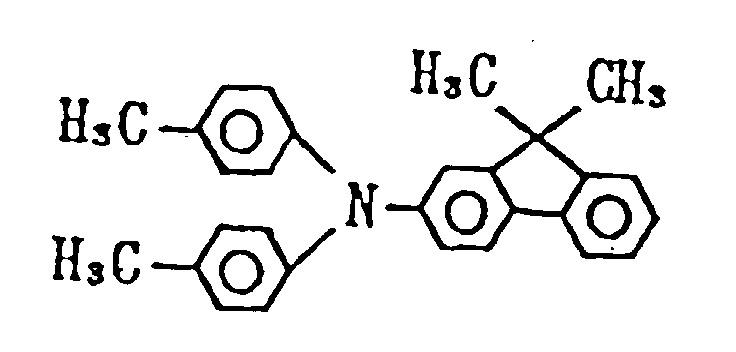
Then, a solution of 5 parts of a triarylamine
compound of the following formula:
and 5 parts of polycarbonate resin ("Z-200" (trade
name), mfd. by Mitsubishi Kagaku K.K.) in 35 parts of
chlorobenzene was applied by a wire bar onto the
charge generation layer and dried to form a 18 µm-thick
charge transport layer, thereby providing an
electrophotographic photosensitive member.
Electrophotographic photosensitive members
were prepared in the same manner as in Example 29
except for using iodogallium phthalocyanines prepared
in the respective Examples shown in Table 1 below as
charge generation materials instead of iodogallium
phthalocyanine (a) prepared in Example 1.
Comparative Example 1
An electrophotographic photosensitive member
was prepared in the same manner as in Example 29
except for using ε-form copper phthalocyanine as a
charge generation material instead of iodogallium
phthalocyanine (a) prepared in Example 1.
Comparative Example 2
An electrophotographic photosensitive member
was prepared in the same manner as in Example 29
except for using hydroxygallium phthalocyanine (with
an X-ray diffraction pattern of Figure 25) as a charge
generation material instead of iodogallium
phthalocyanine (a) prepared in Example 1.
Each of the above-prepared photosensitive
members was applied onto an aluminum cylinder to form
a photosensitive drum, which was incorporated in a
laser beam printer ("LBX-SX" (trade name), mfd. by
Canon K.K.) and subjected to a sensitivity measurement
wherein the photosensitive member was first charged to
a dark-part potential of -700 volts and illuminated
with laser light at a wavelength of 802 nm, thereby
measuring a light quantity required to lower the
potential of -700 volts down to a light-part potential
of -150 volts as a sensitivity.
The results are inclusively shown in Table 1
below.
| Example | No. of photosensitive member | Iodogallium phthalocyanine (Ex. No.) | Sensitivity (µJ/cm2) |
| Ex. 29 | 1 | (a) (Ex. 1) | 2.10 |
| Ex. 30 | 2 | (b) (Ex. 7) | 0.90 |
| Ex. 31 | 3 | (c) (Ex. 12) | 0.90 |
| Ex. 32 | 4 | (d) (Ex. 13) | 2.20 |
| Ex. 33 | 5 | (b) (Ex. 16) | 0.85 |
| Ex. 34 | 6 | (b) (Ex. 19) | 0.70 |
| Ex. 35 | 7 | (c) (Ex. 21) | 0.31 |
| Ex. 36 | 8 | (c) (Ex. 22) | 0.52 |
| Ex. 37 | 9 | (b) (Ex. 26) | 1.95 |
| Ex. 38 | 10 | (c) (Ex. 27) | 0.42 |
| Ex. 39 | 11 | (e) (Ex. 28) | 0.64 |
| Comp. Ex. 1 | 1 | ε-Cu | 2.25 |
| Comp. Ex. 2 | 13 | Hydroxygallium phthalocyanine | |
Table 1 shows that each photosensitive member
according to the present invention exhibited an
excellent sensitivity.
Example 40
The electrophotographic photosensitive member
prepared in Example 32 was subjected to 5000 cycles of
charging and exposure while setting initial dark-part
potential Vd and light-part potential Vl to ca. -700
volts and ca. -150 volts respectively, thereby
measuring a change in dark-part potential ΔVd and a
change in light-part potential ΔVl. The results are
shown in Table 2 below together with those of Examples
and Comparative Example described below. In Table 2,
+ (plus) and - (minus) signs preceding the values of
ΔVd and ΔVl represents an increase and a decrease,
respectively, in terms of absolute value of potential.
Examples 41 - 44
Photosensitive members (Nos. 6 - 7 and 10 -
11) prepared in Examples 34, 35, 38 and 39,
respectively were subjected to the charging-exposure
cycle test in the same manner as in Example 40. The
results are also shown in Table 2.
Comparative Example 3
A photosensitive member (No. 12) prepared in
Comparative Example 1 was subjected to the charging-exposure
cycle test in the same manner as in Example
40. The results are also shown in Table 2.
| Example | No. of photosensitive member | ΔVd (V) | ΔVl (V) |
| Ex. 40 | 4 | -5 | -15 |
| Ex. 41 | 6 | -10 | -10 |
| Ex. 42 | 7 | 0 | 0 |
| Ex. 43 | 10 | 0 | -5 |
| Ex. 44 | 11 | -5 | -10 |
| Comp. Ex. 3 | 12 | -110 | +105 |
The results in Table 2 above show that each
photosensitive member according to the present
invention exhibited little potential fluctuation in
repetition of electrophotographic cycles.
Example 45
An aluminum vapor-deposited polyethylene
terephthalate film was provided with a 0.5 µm-thick
undercoating layer of polyvinyl alcohol on its
aluminum-deposited surface and further a 0.2 µm-thick
charge generation layer of the same composition as in
Example 35.
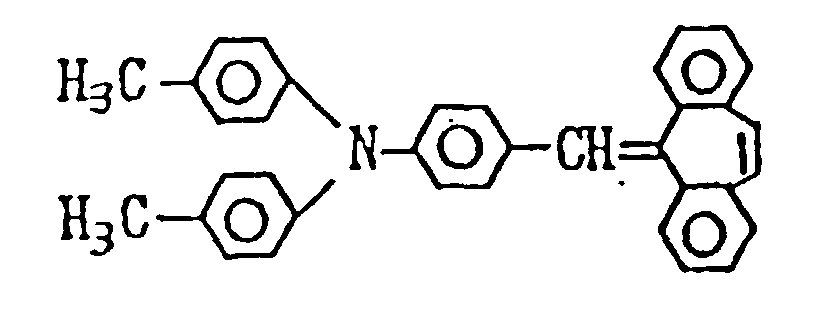
Then, a solution of 5 parts of styryl
compound of the following formula:
and 5 parts of polycarbonate resin ("Z-200" (trade
name), mfd. by Mitsubishi Kagaku K.K.) in 40 parts of
tetrahydrofuran was applied onto the charge generation
layer and dried to form a 16 µm-thick charge transport
layer, thereby providing an electrophotographic
photosensitive member.
The thus-prepared photosensitive member was
evaluated with respect to sensitivity and potential
stability in the same manner as in Examples 29 and 40,
whereby the following results were obtained.
Example 46
An aluminum vapor-deposited polyethylene
terephthalate film was provided with a 0.5 µm-thick
undercoating layer of polyvinyl alcohol on its
aluminum-deposited surface and further a 0.2 µm-thick
charge generation layer of the same composition as in
Example 38.
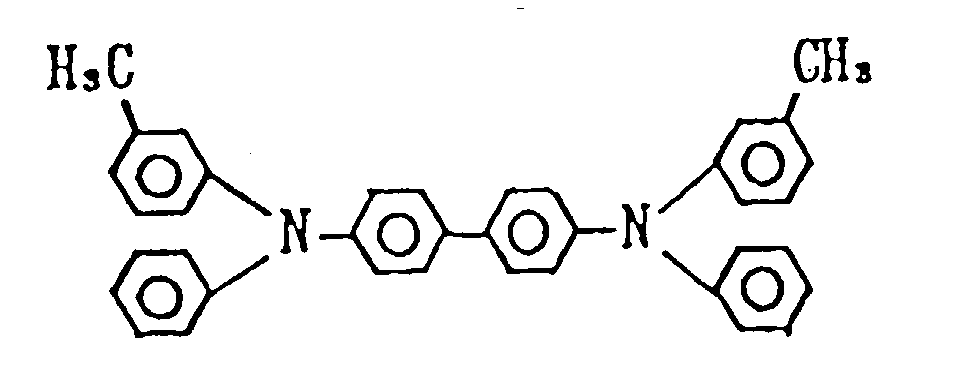
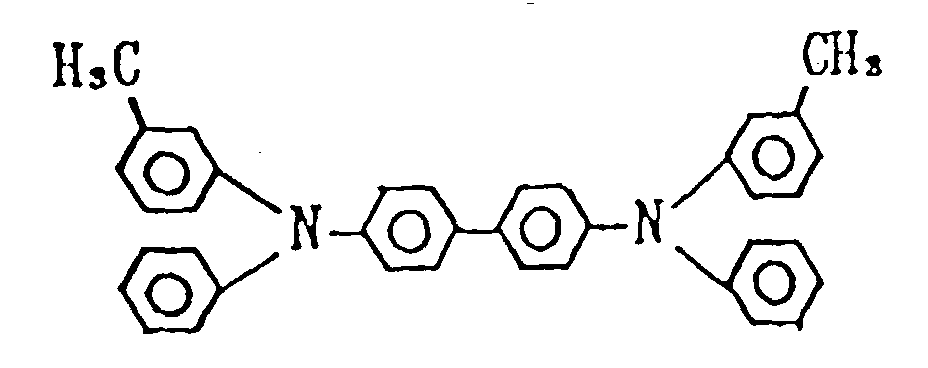
Then, a solution of 5 parts of benzidine
compound of the following formula:
and 5 parts of polycarbonate resin ("Z-200" (trade
name), mfd. by Mitsubishi Kagaku K.K.) in 40 parts of
tetrahydrofuran was applied onto the charge generation
layer and dried to form a 16 µm-thick charge transport
layer, thereby providing an electrophotographic
photosensitive member.
The thus-prepared photosensitive member was
evaluated with respect to sensitivity and potential
stability in the same manner as in Examples 29 and 40,
whereby the following results were obtained.
Example 47
41 parts of phthalonitrile, 25 parts of
gallium tribromide and 200 parts of α-chloronaphthalene
were stirred for 4 hours under
heating at 200 °C in a nitrogen atmosphere, followed
by cooling to 130 °C and filtration. The recovered
solid was washed with 200 parts of N,N-dimethylformamide
at 130 °C under stirring for 2
hours, and was washed with methanol on a filter,
followed by drying to recover 23 parts of a crystal,
which was found to comprise bromogallium
phthalocyanine (f) with an X-ray diffraction pattern
shown in Figure 32. The crystal also exhibited the
following elementary analysis results (C
32H
16N
8GaBr):
| | C (%) | H (%) | N (%) | Br (%) |
| Calculated value | 58.05 | 2.44 | 16.92 | 12.07 |
| Measured value | 57.92 | 2.35 | 16.86 | 11.9 |
5 parts of the crystal obtained in Example 47
was treated for 9 hours in an automatic mortar ("ANM-150"
(trade name), available from Nitto Kagaku K.K.
and comprising a porcelain mortar and a porcelain
pestle rotating at fixed speeds of 6 rpm and 100 rpm,
respectively, in mutually reverse directions)
to provide a crystal, which was found to comprise
bromogallium phthalocyanine (g) with an X-ray
diffraction pattern shown in Figure 33.
Example 49
0.3 part of the crystal obtained in Example
48, 10 parts of chloroform and 10 parts of 1 mm-dia.
glass beads were dispersed for 24 hours in a
paint shaker, followed by filtration, washing with
methanol and drying to recover a crystal, which was
found to comprise bromogallium phthalocyanine (g) with
an X-ray diffraction pattern shown in Figure 34.
Example 50
0.3 part of the crystal obtained in Example
48, 10 parts of cyclohexanone and 10 parts of 1 mm-dia.
glass beads were dispersed for 24 hours in a
paint shaker, followed by filtration, washing with
methanol and drying to recover a crystal, which was
found to comprise bromogallium phthalocyanine (g) with
an X-ray diffraction pattern shown in Figure 35.
Example 51
0.3 part of the crystal obtained in Example
48, 10 parts of acetonitrile and 10 parts of 1 mm-dia.
glass beads were dispersed for 24 hours in a paint
shaker, followed by filtration, washing with methanol
and drying to recover a crystal, which was found to
comprise bromogallium phthalocyanine (g) with an X-ray
diffraction pattern shown in Figure 36.
Example 52
0.3 part of the crystal obtained in Example
48, 10 parts of butyl acetate and 10 parts of 1 mm-dia.
glass beads were dispersed for 24 hours in a
paint shaker, followed by filtration, washing with
methanol and drying to recover a crystal, which was
found to comprise bromogallium phthalocyanine (g) with
an X-ray diffraction pattern shown in Figure 37.
Example 53
0.3 part of the crystal obtained in Example
48, 10 parts of ethylene glycol and 10 parts of 1 mm-dia.
glass beads were dispersed for 24 hours in a
paint shaker, followed by filtration, washing with
methanol and drying to recover a crystal, which was
found to comprise bromogallium phthalocyanine (g) with
an X-ray diffraction pattern shown in Figure 38.
Example 54
0.3 part of the crystal obtained in Example
48, 10 parts of mono-chlorobenzene and 10 parts of 1
mm-dia. glass beads were dispersed for 24 hours in a
paint shaker, followed by filtration, washing with
methanol and drying to recover a crystal, which was
found to comprise bromogallium phthalocyanine (g) with
an X-ray diffraction pattern shown in Figure 39.
Example 55
0.3 part of the crystal obtained in Example
48, 10 parts of tetrahydrofuran and 10 parts of 1 mm-dia.
glass beads were dispersed for 24 hours in a
paint shaker, followed by filtration, washing with
methanol and drying to recover a crystal, which was
found to comprise bromogallium phthalocyanine (g) with
an X-ray diffraction pattern shown in Figure 40.
Example 56
0.3 part of the crystal obtained in Example
48, 10 parts of methyl ethyl ketone and 10 parts of 1
mm-dia. glass beads were dispersed for 24 hours in a
paint shaker, followed by filtration, washing with
methanol and drying to recover a crystal, which was
found to comprise bromogallium phthalocyanine (g) with
an X-ray diffraction pattern shown in Figure 41.
Example 57
0.3 part of the crystal obtained in Example
48, 10 parts of methanol and 10 parts of 1 mm-dia.
glass beads were dispersed for 24 hours in a paint
shaker, followed by filtration, washing with methanol
and drying to recover a crystal, which was found to
comprise bromogallium phthalocyanine (g) with an X-ray
diffraction pattern shown in Figure 42.
Example 58
0.3 part of the crystal obtained in Example
48, 10 parts of N,N-dimethylformamide and 10 parts of
1 mm-dia. glass beads were dispersed for 24 hours in a
paint shaker, followed by filtration, washing with
methanol and drying to recover a crystal, which was
found to comprise bromogallium phthalocyanine (h) with
an X-ray diffraction pattern shown in Figure 43.
Example 59
0.3 part of the crystal obtained in Example
48, 10 parts of N,N-diethylaniline and 10 parts of 1
mm-dia. glass beads were dispersed for 24 hours in a
paint shaker, followed by filtration, washing with
methanol and drying to recover a crystal, which was
found to comprise bromogallium phthalocyanine (i) with
an X-ray diffraction pattern shown in Figure 44.
Example 60
3 parts of the crystal obtained in Example 47
and 120 parts of 1 mm-dia. glass beads were dispersed
for 24 hours in a paint shaker, followed by an
ultrasonic treatment in water, filtration and drying
to obtain a crystal, which was found to comprise
bromogallium phthalocyanine (h) with an X-ray
diffraction pattern of Figure 45.
Example 61
3 parts of the crystal obtained in Example 47
and 120 parts of 1 mm-dia. glass beads were dispersed
for 24 hours in a paint shaker, followed by an
ultrasonic treatment in water, filtration and drying
to obtain a crystal, which was found to comprise
bromogallium phthalocyanine (h) with an X-ray
diffraction pattern of Figure 46.
Example 62
0.3 part of the crystal obtained in Example
60, 10 parts of tetrahydrofuran and 10 parts of 1 mm-dia.
glass beads were dispersed for 24 hours in a
paint shaker, followed by filtration, washing with
methanol and drying to recover a crystal, which was
found to comprise bromogallium phthalocyanine (g) with
an X-ray diffraction pattern shown in Figure 47.
Example 63
0.3 part of the crystal obtained in Example
60, 10 parts of chloroform and 10 parts of 1 mm-dia.
glass beads were dispersed for 24 hours in a paint
shaker, followed by filtration, washing with methanol
and drying to recover a crystal, which was found to
comprise bromogallium phthalocyanine (g) with an X-ray
diffraction pattern shown in Figure 48.
The crystal also exhibited the following
elementary analysis results (C
32H
16N
8GaBr):
| | C (%) | H (%) | N (%) |
| Calculated value | 58.05 | 2.44 | 16.92 |
| Measured value | 58.16 | 2.39 | 16.86 |
0.3 part of the crystal obtained in Example
60, 10 parts of methanol and 10 parts of 1 mm-dia.
glass beads were dispersed for 24 hours in a paint
shaker, followed by filtration, washing with methanol
and drying to recover a crystal, which was found to
comprise bromogallium phthalocyanine (g) with an X-ray
diffraction pattern shown in Figure 49.
Example 65
0.3 part of the crystal obtained in Example
61, 10 parts of methanol and 10 parts of 1 mm-dia.
glass beads were dispersed for 24 hours in a paint
shaker, followed by filtration, washing with methanol
and drying to recover a crystal, which was found to
comprise bromogallium phthalocyanine (g) with an X-ray
diffraction pattern shown in Figure 50.
Example 66
0.3 part of the crystal obtained in Example
60, 10 parts of N,N-dimethylformamide and 10 parts of
1 mm-dia. glass beads were dispersed for 3 hours in a
paint shaker, followed by filtration, washing with
methanol and drying to recover a crystal, which was
found to comprise bromogallium phthalocyanine (h) with
an X-ray diffraction pattern shown in Figure 51.
Example 67
0.3 part of the crystal obtained in Example
60, 10 parts of N,N-dimethylformamide and 10 parts of
1 mm-dia. glass beads were dispersed for 24 hours in a
paint shaker, followed by filtration, washing with
methanol and drying to recover a crystal, which was
found to comprise bromogallium phthalocyanine (h) with
an X-ray diffraction pattern shown in Figure 52.
The crystal also exhibited the following
elementary analysis results (C
32H
16N
8GaBr):
| | C (%) | H (%) | N (%) |
| Calculated value | 58.05 | 2.44 | 16.92 |
| Measured value | 57.18 | 2.61 | 16.08 |
0.3 part of hydroxygallium phthalocyanine
(with an X-ray diffraction pattern of Figure 53), 10
parts of 1 N-hydrobromic acid aqueous solution and 10
parts of 1 mm-dia. glass beads were dispersed for 24
hours in a paint shaker, followed by filtration,
washing with methanol an drying to recover a crystal,
which was found to comprise bromogallium
phthalocyanine (g) with an X-ray diffraction pattern
shown in Figure 54.
The crystal also exhibited the following
elementary analysis results (C
32H
16N
8GaBr):
| | C (%) | H (%) | N (%) |
| Calculated value | 58.05 | 2.44 | 16.92 |
| Measured value | 56.98 | 2.36 | 16.30 |
0.3 part of hydroxygallium phthalocyanine
(with an X-ray diffraction pattern of Figure 53), 10
parts of 2 N-hydrobromic acid aqueous solution and 10
parts of 1 mm-dia. glass beads were dispersed for 24
hours in a paint shaker, followed by filtration,
washing with methanol an drying to recover a crystal,
which was found to comprise bromogallium
phthalocyanine (g) with an X-ray diffraction pattern
shown in Figure 55.
Example 70
0.3 part of hydroxygallium phthalocyanine
(with an X-ray diffraction pattern of Figure 56), 10
parts of 1 N-hydrobromic acid aqueous solution and 10
parts of 1 mm-dia. glass beads were dispersed for 24
hours in a paint shaker, followed by filtration,
washing with methanol an drying to recover a crystal,
which was found to comprise bromogallium
phthalocyanine (g) with an X-ray diffraction pattern
similar to the one shown in Figure 54.
Example 71
0.3 part of the crystal obtained in Example
68, 10 parts of tetrahydrofuran and 10 parts of 1 mm-dia.
glass beads were dispersed for 24 hours in a
paint shaker, followed by filtration, washing with
methanol and drying to recover a crystal, which was
found to comprise bromogallium phthalocyanine (g) with
an X-ray diffraction pattern shown in Figure 57.
The crystal also exhibited the following
elementary analysis results (C
32H
16N
8GaBr):
| | C (%) | H (%) | N (%) |
| Calculated value | 58.05 | 2.44 | 16.92 |
| Measured value | 57.56 | 2.29 | 16.34 |
0.3 part of the crystal obtained in Example
68, 10 parts of N,N-dimethylformamide and 10 parts of
1 mm-dia. glass beads were dispersed for 24 hours in a
paint shaker, followed by filtration, washing with
methanol and drying to recover a crystal, which was
found to comprise bromogallium phthalocyanine (h) with
an X-ray diffraction pattern shown in Figure 58.
The crystal also exhibited the following
elementary analysis results (C
32H
16N
8GaBr):
| | C (%) | H (%) | N (%) |
| Calculated value | 58.05 | 2.44 | 16.92 |
| Measured value | 57.65 | 2.73 | 16.08 |
3 parts of the crystal obtained in Example 68
was stirred in 100 parts of sodium bicarbonate aqueous
solution (pH 10), followed by sufficient washing with
distilled water, filtration, washing with methanol and
drying to recover a crystal, which was found to
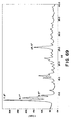
comprise bromogallium phthalocyanine (j) with an X-ray
diffraction pattern shown in Figure 59.
Hereinbelow, some examples for preparation of
electrophotographic photosensitive members by using
bromogallium phthalocyanines prepared above will be
described.
Example 74
An aluminum substrate was coated with a
solution of 5 g of methoxymethylated nylon resin (Mw
(weight-average molecular weight) = 3.2x10⁴) and 10 g
of alcohol-soluble copolymer nylon (Mw = 2.9x10⁴) in
95 g of methanol by using a wire bar and dried to form
a 1 µm-thick undercoating layer.
Then, 3 parts of the bromogallium
phthalocyanine (f) prepared in Example 1 was added to
a solution of 2 parts of polyvinylbutyral in 60 parts
of cyclohexanone, and the mixture was dispersed
together with 100 parts of 1 mm-dia. glass beads for 3
hours in a sand mill. The resultant dispersion was
further diluted with 100 parts of ethyl acetate, and
applied by a wire bar over the undercoating layer,
followed by drying to form a 0.2 µm-thick charge
generation layer.
Then, a solution of 5 parts of a triarylamine
compound of the following formula:
and 5 parts of polycarbonate resin ("Z-200" (trade
name), mfd. by Mitsubishi Kagaku K.K.) in 35 parts of
chlorobenzene was applied by a wire bar onto the
charge generation layer and dried to form a 18 µm-thick
charge transport layer, thereby providing an
electrophotographic photosensitive member.
Electrophotographic photosensitive members
were prepared in the same manner as in Example 74
except for using bromogallium phthalocyanines prepared
in the respective Examples shown in Table 3 below as
charge generation materials instead of bromogallium
phthalocyanine (f) prepared in Example 47.
Comparative Example 4
An electrophotographic photosensitive member
was prepared in the same manner as in Example 74
except for using ε-form copper phthalocyanine as a
charge generation material instead of bromogallium
phthalocyanine (f) prepared in Example 47.
Comparative Example 5
An electrophotographic photosensitive member
was prepared in the same manner as in Example 74
except for using hydroxygallium phthalocyanine (with
an X-ray diffraction pattern of Figure 53) as a charge
generation material instead of bromogallium
phthalocyanine (f) prepared in Example 47.
Each of the above-prepared photosensitive
members was applied onto an aluminum cylinder to form
a photosensitive drum, which was incorporated in a
laser beam printer ("LBX-SX" (trade name), mfd. by
Canon K.K.) and subjected to a sensitivity measurement
wherein the photosensitive member was first charged to
a dark-part potential of -700 volts and illuminated
with laser light at a wavelength of 802 nm, thereby
measuring a light quantity required to lower the
potential of -700 volts down to a light-part potential
of -150 volts as a sensitivity.
The results are inclusively shown in Table 3
below.
| Example | No. of photosensitive member | Bromogallium phthalocyanine (Ex. No.) | Sensitivity (µJ/cm2) |
| Ex. 74 | 13 | (f) (Ex. 47) | 0.90 |
| Ex. 75 | 14 | (g) (Ex. 48) | 1.02 |
| Ex. 76 | 15 | (g) (Ex. 50) | 0.75 |
| Ex. 77 | 16 | (h) (Ex. 58) | 2.24 |
| Ex. 78 | 17 | (i) (Ex. 59) | 0.54 |
| Ex. 79 | 18 | (h) (Ex. 60) | 1.04 |
| Ex. 80 | 19 | (g) (Ex. 63) | 0.96 |
| Ex. 81 | 20 | (h) (Ex. 67) | 0.46 |
| Ex. 82 | 21 | (g) (Ex. 68) | 0.42 |
| Ex. 83 | 22 | (g) (Ex. 71) | 1.00 |
| Ex. 84 | 23 | (j) (Ex. 73) | 2.12 |
| Comp. Ex. 4 | 24 | ε-Cu | 2.25 |
| Comp. Ex. 5 | 25 | Hydroxygallium phthalocyanine | |
Table 3 shows that each photosensitive member
according to the present invention exhibited an
excellent sensitivity.
Example 85
The electrophotographic photosensitive member
prepared in Example 75 was subjected to 5000 cycles of
charging and exposure while setting initial dark-part
potential Vd and light-part potential Vl to ca. -700
volts and ca. -150 volts respectively, thereby
measuring a change in dark-part potential ΔVd and a
change in light-part potential ΔVl. The results are
shown in Table 4 below together with those of Examples
and Comparative Example described below. In Table 4,
+ (plus) and - (minus) signs preceding the values of
ΔVd and ΔVl represents an increase and a decrease,
respectively, in terms of absolute value of potential.
Examples 86 - 89
Photosensitive members (Nos. 16, 18, 20 and
21) prepared in Examples 77, 79, 81 and 82,
respectively were subjected to the charging-exposure
cycle test in the same manner as in Example 85. The
results are also shown in Table 4.
Comparative Example 6
A photosensitive member (No. 24) prepared in
Comparative Example 4 was subjected to the charging-exposure
cycle test in the same manner as in Example
85. The results are also shown in Table 4.
| Example | No. of photosensitive member | ΔVd (V) | ΔVl (V) |
| Ex. 85 | 14 | 0 | +15 |
| Ex. 86 | 16 | -10 | +15 |
| Ex. 87 | 18 | -5 | -10 |
| Ex. 88 | 20 | 0 | +20 |
| Ex. 89 | 21 | -5 | +10 |
| Comp. Ex. 6 | 24 | -110 | +105 |
The results in Table 4 above show that each
photosensitive member according to the present
invention exhibited little potential fluctuation in
repetition of electrophotographic cycles.
Example 90
An aluminum vapor-deposited polyethylene
terephthalate film was provided with a 0.5 µm-thick
undercoating layer of polyvinyl alcohol on its
aluminum-deposited surface and further a 0.2 µm-thick
charge generation layer of the same composition as in
Example 82.
Then, a solution of 5 parts of styryl
compound of the following formula:
and 5 parts of polycarbonate resin ("Z-200" (trade
name), mfd. by Mitsubishi Kagaku K.K.) in 40 parts of
tetrahydrofuran was applied onto the charge generation
layer and dried to form a 16 µm-thick charge transport
layer, thereby providing an electrophotographic
photosensitive member.
The thus-prepared photosensitive member was
evaluated with respect to sensitivity and potential
stability in the same manner as in Examples 74 and 85,
whereby the following results were obtained.
Example 91
An aluminum vapor-deposited polyethylene
terephthalate film was provided with a 0.5 µm-thick
undercoating layer of polyvinyl alcohol on its
aluminum-deposited surface and further a 0.2 µm-thick
charge generation layer of the same composition as in
Example 67.
Then, a solution of 5 parts of benzidine
compound of the following formula:
and 5 parts of polycarbonate resin ("Z-200" (trade
name), mfd. by Mitsubishi Kagaku K.K.) in 40 parts of
tetrahydrofuran was applied onto the charge generation
layer and dried to form a 16 µm-thick charge transport
layer, thereby providing an electrophotographic
photosensitive member.
The thus-prepared photosensitive member was
evaluated with respect to sensitivity and potential
stability in the same manner as in Examples 74 and 85,
whereby the following results were obtained.
Example 92
22 parts of phthalonitrile, 10 parts of
zirconium tetrachloride and 100 parts of quinoline
were stirred for 4 hours under heating at 180 °C in a
nitrogen atmosphere, followed by cooling to 130 °C and
filtration. The recovered solid was subjected to 3
times of washing with 200 parts of N,N-dimethylformamide
at 130 °C for 2 hours under
stirring, followed by filtration, washing with
methanol on the filter and drying to obtain a crystal,
which was found to comprise zirconium phthalocyanine
with an X-ray diffraction pattern shown in Figure 60
showing strong peaks at Bragg angles (2) of 7.8 deg.,
8.0 deg. and 8.2 deg. The zirconium phthalocyanine
also exhibited an infrared-absorption spectrum shown
in Figure 76.
The compound also exhibited a mass spectrum
value (FAB-MS, matrix: NBA) of 619 (m/Z) and the
following elementary analysis results (C
32H
18N
8O
2Zr):
| | C (%) | H (%) | N (%) |
| Calculated value | 60.26 | 2.84 | 17.57 |
| Measured value | 58.33 | 3.02 | 16.82 |
22 parts of phthalonitrile, 40 parts of
zirconium tetrachloride and 440 parts of quinoline
were stirred for 4 hours under heating at 180 °C in a
nitrogen atmosphere, followed by cooling to 130 °C and
filtration. The recovered solid was subjected to 3
times of washing with 200 parts of N,N-dimethylformamide
at 130 °C for 2 hours under
stirring, followed by filtration, washing with
methanol on the filter and drying to obtain a crystal,
which was found to comprise zirconium phthalocyanine
with an X-ray diffraction pattern shown in Figure 61
showing strong peaks at Bragg angles (2) of 8.0 deg.
and 8.2 deg. The zirconium phthalocyanine also
exhibited an infrared-absorption spectrum shown in
Figure 77.
The compound also exhibited a mass spectrum
value (FAB-MS, matrix: NBA) of 619 (m/Z) and the
following elementary analysis results (C
32H
18N
8O
2Zr):
| | C (%) | H (%) | N (%) |
| Calculated value | 60.26 | 2.84 | 17.57 |
| Measured value | 59.56 | 2.78 | 17.35 |
0.3 part of the crystal obtained in Example
92, 10 parts of N,N-dimethylformamide and 10 parts of
1 mm-dia. glass beads were dispersed for 24 hours in a
paint shaker, followed by filtration, washing with
methanol and drying to recover a crystal, which was
found to comprise zirconium phthalocyanine with an X-ray
diffraction pattern shown in Figure 62 showing a
strong peak at a Bragg angle (2) of 8.0 deg.
Example 95
0.3 part of the crystal obtained in Example
92, 10 parts of tetrahydrofuran and 10 parts of 1 mm-dia.
glass beads were dispersed for 24 hours in a
paint shaker, followed by filtration, washing with
methanol and drying to recover a crystal, which was
found to comprise zirconium phthalocyanine with an X-ray
diffraction pattern shown in Figure 63 showing a
strong peak at a Bragg angle (2) of 8.1 deg.
Example 96
0.3 part of the crystal obtained in Example
92, 10 parts of methanol and 10 parts of 1 mm-dia.
glass beads were dispersed for 24 hours in a paint
shaker, followed by filtration, washing with methanol
and drying to recover a crystal, which was found to
comprise zirconium phthalocyanine with an X-ray
diffraction pattern shown in Figure 64 showing a
strong peak at a Bragg angle (2) of 8.1 deg.
Example 97
0.3 part of the crystal obtained in Example
92, 10 parts of monochlorobenzene and 10 parts of 1
mm-dia. glass beads were dispersed for 24 hours in a
paint shaker, followed by filtration, washing with
methanol and drying to recover a crystal, which was
found to comprise zirconium phthalocyanine with an X-ray
diffraction pattern shown in Figure 65 showing a
strong peak at a Bragg angle (2) of 8.0 deg.
Example 98
0.3 part of the crystal obtained in Example
93, 10 parts of N,N-dimethylformamide and 10 parts of
1 mm-dia. glass beads were dispersed for 24 hours in a
paint shaker, followed by filtration, washing with
methanol and drying to recover a crystal, which was
found to comprise zirconium phthalocyanine with an X-ray
diffraction pattern shown in Figure 66 showing a
strong peak at a Bragg angle (2) of 7.9 deg.
Example 99
0.3 part of the crystal obtained in Example
93, 10 parts of tetrahydrofuran and 10 parts of 1 mm-dia.
glass beads were dispersed for 24 hours in a
paint shaker, followed by filtration, washing with
methanol and drying to recover a crystal, which was
found to comprise zirconium phthalocyanine with an X-ray
diffraction pattern shown in Figure 67 showing a
strong peak at a Bragg angle (2) of 8.0 deg.
Example 100
0.3 part of the crystal obtained in Example
93, 10 parts of chloroform and 10 parts of 1 mm-dia.
glass beads were dispersed for 24 hours in a paint
shaker, followed by filtration, washing with methanol
and drying to recover a crystal, which was found to
comprise zirconium phthalocyanine with an X-ray
diffraction pattern shown in Figure 68 showing a
strong peak at a Bragg angle (2) of 8.1 deg.
Example 101
0.3 part of the crystal obtained in Example
93, 10 parts of monochlorobenzene and 10 parts of 1
mm-dia. glass beads were dispersed for 24 hours in a
paint shaker, followed by filtration, washing with
methanol and drying to recover a crystal, which was
found to comprise zirconium phthalocyanine with an X-ray
diffraction pattern shown in Figure 69 showing
strong peaks at Bragg angles (2) of 7.9 deg. and 8.7
deg.
Reference Example
3 parts of the crystal obtained in Example 93
and 120 parts of 1 mm-dia. glass beads were dispersed
for 24 hours in a paint shaker, followed by ultrasonic
treatment in water, filtration and drying to recover
zirconium phthalocyanine with an X-ray diffraction
pattern shown in Figure 70.
Example 102
0.3 part of rather amorphous zirconium
phthalocyanine obtained in Reference Example, 10 parts
of N,N-dimethylformamide and 10 parts of 1 mm-dia.
glass beads were dispersed for 24 hours in a paint
shaker, followed by filtration, washing with methanol
and drying to recover a crystal, which was found to
comprise zirconium phthalocyanine with an X-ray
diffraction pattern shown in Figure 71 showing strong
peaks at Bragg angle (2) of 7.7 deg. and 8.2 deg.
Example 103
0.3 part of the crystal obtained in Example
93, 10 parts of tetrahydrofuran and 10 parts of 1 mm-dia.
glass beads were dispersed for 24 hours in a
paint shaker, followed by filtration, washing with
methanol and drying to recover a crystal, which was
found to comprise zirconium phthalocyanine with an X-ray
diffraction pattern shown in Figure 72 showing a
strong peak at a Bragg angle (2) of 8.0 deg.
Example 104
5 parts of the crystal obtained in Example 93
was treated for 4 hours in an automatic mortar ("ANM-150"
(trade name), available from Nitto Kagaku K.K.
and comprising a porcelain mortar and a porcelain
pestle rotating at fixed speeds of 6 rpm and 100 rpm,
respectively, in mutually reverse directions)
to recover a crystal, which was found to comprise
zirconium phthalocyanine with an X-ray diffraction
pattern shown in Figure 73 showing strong peaks at 7.8
deg., 8.0 deg. and 8.2 deg.
Example 105
0.3 part of the crystal obtained in Example
104, 10 parts of tetrahydrofuran and 10 parts of 1 mm-dia.
glass beads were dispersed for 24 hours in a
paint shaker, followed by filtration, washing with
methanol and drying to recover a crystal, which was
found to comprise zirconium phthalocyanine with an X-ray
diffraction pattern shown in Figure 74 showing a
strong peak at a Bragg angle (2) of 8.0 deg.
Example 106
0.3 part of the crystal obtained in Example
104, 10 parts of monochlorobenzene and 10 parts of 1
mm-dia. glass beads were dispersed for 24 hours in a
paint shaker, followed by filtration, washing with
methanol and drying to recover a crystal, which was
found to comprise zirconium phthalocyanine with an X-ray
diffraction pattern shown in Figure 75 showing a
strong peak at a Bragg angle (2) of 8.0 deg.
Hereinbelow, some examples for preparation of
electrophotographic photosensitive members by using
zirconium phthalocyanines prepared above will be
described.
Example 107
An aluminum substrate was coated with a
solution of 5 g of methoxymethylated nylon resin (Mw
(weight-average molecular weight) = 3.2x10⁴) and 10 g
of alcohol-soluble copolymer nylon (Mw = 2.9x10⁴) in
95 g of methanol by using a wire bar and dried to form
a 1 µm-thick undercoating layer.
Then, 3 parts of the zirconium phthalocyanine
prepared in Example 94 was added to a solution of 2
parts of polyvinylbutyral in 60 parts of
cyclohexanone, and the mixture was dispersed together
with 100 parts of 1 mm-dia. glass beads for 3 hours in
a sand mill. The resultant dispersion was further
diluted with 100 parts of ethyl acetate, and applied
by a wire bar over the undercoating layer, followed by
drying to form a 0.2 µm-thick charge generation layer.
Then, a solution of 5 parts of a triarylamine
compound of the following formula:
and 5 parts of polycarbonate resin ("Z-200" (trade
name), mfd. by Mitsubishi Kagaku K.K.) in 35 parts of
chlorobenzene was applied by a wire bar onto the
charge generation layer and dried to form a 19 µm-thick
charge transport layer, thereby providing an
electrophotographic photosensitive member.
Electrophotographic photosensitive members
were prepared in the same manner as in Example 107
except for using zirconium phthalocyanine prepared in
the respective Examples shown in Table 5 below as
charge generation materials instead of zirconium
phthalocyanine prepared in Example 94.
Comparative Example 7
An electrophotographic photosensitive member
was prepared in the same manner as in Example 107
except for using ε-form copper phthalocyanine as a
charge generation material instead of the zirconium
phthalocyanine prepared in Example 94.
Each of the above-prepared photosensitive
members was applied onto an aluminum cylinder to form
a photosensitive drum, which was incorporated in a
laser beam printer ("LBX-SX" (trade name), mfd. by
Canon K.K.) and subjected to a sensitivity measurement
wherein the photosensitive member was first charged to
a dark-part potential of -700 volts and illuminated
with laser light at a wavelength of 802 nm, thereby
measuring a light quantity E1/2 required to lower the
potential of -700 volts down to a half (-350 volts) as
a sensitivity.
The results are inclusively shown in Table 5
below.
| Example | No. of photosensitive member | Zirconium phthalocyanine Ex. No. | E1/2 (µJ/cm2) |
| Ex. 107 | 26 | (Ex. 94) | 1.00 |
| Ex. 108 | 27 | (Ex. 95) | 0.75 |
| Ex. 109 | 28 | (Ex. 97) | 0.60 |
| Ex. 110 | 29 | (Ex. 98) | 1.40 |
| Ex. 111 | 30 | (Ex. 99) | 0.82 |
| Ex. 112 | 31 | (Ex. 100) | 0.75 |
| Ex. 113 | 32 | (Ex. 101) | 0.49 |
| Ex. 114 | 33 | (Ex. 102) | 1.50 |
| Ex. 115 | 34 | (Ex. 103) | 0.75 |
| Ex. 116 | 35 | (Ex. 104) | 0.58 |
| Ex. 117 | 36 | (Ex. 105) | 1.05 |
| Comp. Ex. 7 | 37 | ε-Cu | 1.42 |
Table 5 shows that each photosensitive member
according to the present invention exhibited an
excellent sensitivity.
Example 118
The electrophotographic photosensitive member
prepared in Example 108 was subjected to 5000 cycles
of charging and exposure while setting initial dark-part
potential Vd and light-part potential Vl to ca.
-700 volts and ca. -150 volts respectively, thereby
measuring a change in dark-part potential ΔVd and a
change in light-part potential ΔVl. The results are
shown in Table 2 below together with those of Examples
and Comparative Example described below. In Table 2,
+ (plus) and - (minus) signs preceding the values of
ΔVd and ΔVl represents an increase and a decrease,
respectively in terms of absolute value of potential.
Examples 119 - 122
Photosensitive members (Nos. 28, 32, 34 and
35) prepared in Examples 109, 113, 115 and 116,
respectively were subjected to the charging-exposure
cycle test in the same manner as in Example 118. The
results are also shown in Table 6.
Comparative Example 8
A photosensitive member (No. 37) prepared in
Comparative Example 7 was subjected to the charging-exposure
cycle test in the same manner as in Example
118. The results are also shown in Table 6.
| Example | No. of photosensitive member | ΔVd (V) | ΔVl (V) |
| Ex. 118 | 27 | -5 | +10 |
| Ex. 119 | 29 | -5 | +5 |
| Ex. 120 | 32 | 0 | +5 |
| Ex. 121 | 33 | +5 | +10 |
| Ex. 122 | 35 | -5 | +10 |
| Comp. Ex. 8 | 37 | -110 | +120 |
The results in Table 6 above show that each
photosensitive member according to the present
invention exhibited little potential fluctuation in
repetition of electrophotographic cycles.
Example 123
An aluminum vapor-deposited polyethylene
terephthalate film was provided with a 0.5 µm-thick
undercoating layer of polyvinyl alcohol on its
aluminum-deposited surface and further a 0.2 µm-thick
charge generation layer of the same composition as in
Example 116.
Then, a solution of 5 parts of styryl
compound of the following formula:
and 5 parts of polycarbonate resin ("Z-200" (trade
name), mfd. by Mitsubishi Kagaku K.K.) in 40 parts of
tetrahydrofuran was applied onto the charge generation
layer and dried to form a 16 µm-thick charge transport
layer, thereby providing an electrophotographic
photosensitive member.
The thus-prepared photosensitive member was
evaluated with respect to sensitivity and potential
stability in the same manner as in Examples 107 and
118, whereby the following results were obtained.
Example 124
An aluminum vapor-deposited polyethylene
terephthalate film was provided with a 0.5 µm-thick
undercoating layer of polyvinyl alcohol on its
aluminum-deposited surface and further a 0.2 µm-thick
charge generation layer of the same composition as in
Example 108.
Then, a solution of 5 parts of benzidine
compound of the following formula:
and 5 parts of polycarbonate resin ("Z-200" (trade
name), mfd. by Mitsubishi Kagaku K.K.) in 40 parts of
tetrahydrofuran was applied onto the charge generation
layer and dried to form a 25 µm-thick charge transport
layer, thereby providing an electrophotographic
photosensitive member.
The thus-prepared photosensitive member was
evaluated with respect to sensitivity and potential
stability in the same manner as in Examples 107 and
118, whereby the following results were obtained.
Iodogallium phthalocyanine and bromogallium
phthalocyanine having novel crystalline forms
characterized by X-ray diffraction patterns according
to CuKα characteristic X-ray diffraction method and
exhibiting excellent zirconium phthalocyanine can be
obtained through appropriate selection of a reaction
solvent, followed by milling or stirring in an
appropriate solvent. For example, α-chloronaphthalene
is a suitable solvent for reaction between
phthalonitrile and gallium triiodide or tribromide to
provide iodogallium phthalocyanine or bromogallium
phthalocyanine. Reaction of chlorogallium
phthalocyanine or hydroxygallium phthalocyanine with
hydroiodic (or hydrobromic) acid is also effective for
providing a novel crystal form of iodo- (or bromo-)gallium
phthalocyanine. Zirconium phthalocyanine
exhibiting good electrophotographic performances can
be obtained through a similar process.