EP0902421A2 - Dispositif et procédé de codage de la parole - Google Patents
Dispositif et procédé de codage de la parole Download PDFInfo
- Publication number
- EP0902421A2 EP0902421A2 EP98307345A EP98307345A EP0902421A2 EP 0902421 A2 EP0902421 A2 EP 0902421A2 EP 98307345 A EP98307345 A EP 98307345A EP 98307345 A EP98307345 A EP 98307345A EP 0902421 A2 EP0902421 A2 EP 0902421A2
- Authority
- EP
- European Patent Office
- Prior art keywords
- codebook
- subframe
- candidate
- gains
- sequence
- Prior art date
- Legal status (The legal status is an assumption and is not a legal conclusion. Google has not performed a legal analysis and makes no representation as to the accuracy of the status listed.)
- Granted
Links
Images

Classifications
-
- G—PHYSICS
- G10—MUSICAL INSTRUMENTS; ACOUSTICS
- G10L—SPEECH ANALYSIS TECHNIQUES OR SPEECH SYNTHESIS; SPEECH RECOGNITION; SPEECH OR VOICE PROCESSING TECHNIQUES; SPEECH OR AUDIO CODING OR DECODING
- G10L19/00—Speech or audio signals analysis-synthesis techniques for redundancy reduction, e.g. in vocoders; Coding or decoding of speech or audio signals, using source filter models or psychoacoustic analysis
- G10L19/04—Speech or audio signals analysis-synthesis techniques for redundancy reduction, e.g. in vocoders; Coding or decoding of speech or audio signals, using source filter models or psychoacoustic analysis using predictive techniques
- G10L19/08—Determination or coding of the excitation function; Determination or coding of the long-term prediction parameters
- G10L19/083—Determination or coding of the excitation function; Determination or coding of the long-term prediction parameters the excitation function being an excitation gain
-
- G—PHYSICS
- G10—MUSICAL INSTRUMENTS; ACOUSTICS
- G10L—SPEECH ANALYSIS TECHNIQUES OR SPEECH SYNTHESIS; SPEECH RECOGNITION; SPEECH OR VOICE PROCESSING TECHNIQUES; SPEECH OR AUDIO CODING OR DECODING
- G10L19/00—Speech or audio signals analysis-synthesis techniques for redundancy reduction, e.g. in vocoders; Coding or decoding of speech or audio signals, using source filter models or psychoacoustic analysis
- G10L2019/0001—Codebooks
- G10L2019/0013—Codebook search algorithms
Definitions
- the present invention relates to a voice coder and more particularly, to a new codebook search method and system for improving performance of a Code Excited Linear Predictive (CELP) voice coder.
- CELP Code Excited Linear Predictive
- a voice coder reduces the amount of data required to support a communication by transmitting a residual signal instead of a complete input voice signals, where the residual signal corresponds to a difference value between a predicted signal derived from previous information and an original input signal.
- LPC Linear Prediction Coefficient
- Pitch analysis is performed to obtain information about the pitch period corresponding to a long-term correlation of voice signal.
- pitch periods of voice are variable and are modelled using a codebook
- the corresponding pitch period can be found from the codebook by transmission of index for the code book.
- a pitch filter removes correlation based on pitch period of voiced sound from the residual signal filtered by the LPC filter.
- the original voice can be reconstructed using the final residual signal, the LPC coefficients and the pitch filter parameters.
- the LPC coefficients and the pitch filter parameters are determined to minimize the error signal using the input voice signal.
- the determined LPC coefficients, pitch parameters and residual signals must be quantized for digital transmission.
- Voice coders are differentiated based on the quantisation of the residual signals.
- a CELP voice coder uses a codebook to quantize a residual signal.
- the CELP voice coder selects the signal closest to the residual signal from among prepared codebook sequences and transmits the codebook index of the selected codebook sequence to a receiver.
- the receiver uses the same codebook, the receiver obtains the residual signal using the transmitted index.
- the CELP voice coder is arranged to produce a signal to optimise given fidelity requirement from among signals by passing excited input signals stored in a codebook through two time-varying linear recursive filters such as a pitch filter and a LPC filter.
- the CELP voice coder achieves high quality voice by using analysis-by-synthesis, where an input voice signal is analyzed and is compared with synthesized signals using determined parameters.
- the analysis-by-synthesis comprises calculating a synthesized voice signal over each of all possible codebook excitation sequences and finally selecting the synthesized voice signal closest to the original voice signal.
- an input voice signal is divided into subframes, each of which consists of 20 samples (one sample being produces every 0.125ms).
- One optimal codebook excitation sequence is selected per subframe.
- a quantised codebook gain required to reconstruct a signal is also selected from the codebook.
- a pitch signal is formed by multiplying codeword selected by using an index with quantised codebook gain also selected by using an index.
- the transfer function of each filter and the search strategy for codebook excitation sequences and codebook gains are important in a voice coder for coding a voice signal as described above.
- a codebook gain search which must be performed for each voice signal sample requires a large amount of computation.
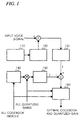
- Figure 1 is a diagram illustrating a codebook search method and system according to the prior art. It is assumed that the transfer or characteristic functions of an LPC filter, pitch filter and weighting filter are determined as 1/A(z), 1/P(z) and 1/W(z) respectively prior to selecting a codebook.
- the codebook search system which includes the means for outputting a Zero-Input Response from a pitch filter (S110); receiving the output from the pitch filter and predicting (S120) a voice signal sample using an LPC filter; receiving a value at weighting filter (130) which is produced by subtracting voice signal predictied by an LPC filter (120) from the input voice signal; receiving at an LPC filter (150) the product of all codebook sequences, determined from all codebook indices, and all quantised gains; selecting an optimal codebook sequence and quantised gain using a signal produced by subtracting the output of the LPC filter from an output target signal (1) output from the weighting filter (130) using a minimum mean signal error selector.
- the pitch filter at step S110 produces a zero-input response, which is used as an input to an LPC filter (120).
- a weighting filter After subtracting an output signal of the LPC filter (120) from input voice signal, a weighting filter produces (S130) a target signal (1) using the result of the subtraction.
- An LPC filter then produces (S150) an output signal (2) by filtering all possible codebook sequences and all quantized gains which have been selected using corresponding codebook indices.
- a codebook sequence and quantized gain are selected to minimize a mean square error between the target signal (1) and output signal (2).
- Such procedure is performed for each of the subframes and optimization of codebook sequence and codebook gain is performed based on the difference between the target signal (1) for a subframe and an output signal (2).
- a codebook sequence is determined independently for each subframe by means of optimisation within each subframe. Then, an input voice signal for a current subframe is provided and all previous information is provided as initial values of each filter without or prior to effecting a codebook search.
- a codebook search is performed without any information on the next input voice signal sample.
- a voice-varying region that is, a period over which a voice signal varies significantly (by a predeterminable margin)
- a transient region for example, a period over which a voice signal varies suddenly
- optimization within a short-term subframe doesn't guarantee selection of an optimal codebook sequence.
- a problem of independent optimization for each subframe is that characteristics of signal at the boundary between subframes are less accurately replicated or modelled. The shorter the subframe, the greater the boundary problem between subframes.
- a CELP standard voice coder according to the prior art used in a communication system provides poor quality synthesized voice for the above reasons and accordingly provides a poor quality service for the communication system.
- a first aspect of the present invention provides a method for a voice coder comprising the steps of: calculating a target signal for a window; the window comprising a first subframe and a second subframe; determining K candidate codebook sequences and candidate codebook gains for the first subframe from the target signal; calculating K target signals for the second subframe from the target signal and the candidate codebook sequence and candidate codebook gains for the first subframe; determining L candidate codebook sequences and candidate codebook gains for the second subframe from each of the Ktarget signals for the second subframe thereby producing K x L codebook sequence-codebook gain pairs; and selecting a codebook sequence and a codebook gain for the two subframes respectively from said target signal for the window from the K candidate codebook sequence-codebook gain pairs for the first subframe and from the K x L codebook sequence-codebook gain pairs for the second subframe.
- a second aspect of the present invention provides a vocoder comprising means for calculating a target signal for a window; the window comprising a first subframe and a second subframe; means for determining K candidate codebook sequences and candidate codebook gains for the first subframe from the target signal; means for calculating K target signals for the second subframe from the target signal and the candidate codebook sequence and candidate codebook gains for the first subframe; means for determining L candidate codebook sequences and candidate codebook gains for the second subframe from each of the Ktarget signals for the second subframe thereby producing K x L codebook sequence-codebook gain pairs; and means selecting a codebook sequence and a codebook gain for the two subframes respectively from said target signal for the window from the K candidate codebook sequence-codebook gain pairs for the first subframe and from the K x L codebook sequence-codebook gain pairs for the second subframe.
- An embodiment of the present invention provides a method for improving performance of voice coder comprises the steps of: calculating a target signal for a window; determining K candidate optimal codebooks and candidate optimal codebook gains for a first subframe from said target signal for a window, all codebook indices and all codebook optimal gains; calculating K target signals for a second subframe from said target signal for a window and said candidate optimal codebooks and candidate optimal codebook gains for a first subframe; determining L candidate optimal codebooks and candidate optimal codebook gains for a second subframe from said target signal for a second subframe and said candidate optimal codebooks and candidate optimal codebook gains for a first subframe; and selecting an optimal codebook and optimal codebook gain for said two subframes respectively from said target signal for a window, said candidate optimal gains and all possible quantized gains for said first subframe and said optimal codebook and candidate optimal codebook gains for said second subframe.
- the present invention provides a method for performing optimization within two successive subframes preferably simultaneously. More particularly, the method searches codebooks by utilizing information on a next input voice signal sample.
- a CELP voice coder according to a preferred embodiment of the present invention is compatible with a conventional CELP voice coder and improves voice quality by changing the software of the conventional CELP voice coder.
- a method of the present invention improves voice quality using a codebook search which uses information on the next input and a simultaneous optimization within two successive subframes. Such improvement of the synthesized voice quality is achieved by codebook search over wider band of voice.
- the present invention provides two methods for a simultaneous optimisation of two successive subframes: one is to reduce the computational burden and the other is to adjust variably the computational burden.
- Lc is a time interval of one subframe, and an index of a time axis which runs from 0 to 2Lc-1.
- a first subframe corresponds to 0, 1, ..., Lc-1 and a second subframe corresponds to Lc, Lc+1, ..., 2Lc-1.
- K candidate optimal codebook sequences for a first subframe are selected within each window, and L candidate optimal codebook sequences for a second subframe are selected for each of K determined candidate codebook sequences. As a result, K ⁇ L combinations are chosen.
- a search for all possible quantised codebook gains corresponding to the chosen K ⁇ L combination is performed for the window, and optimal codebook sequences combinations and the corresponding quantised gain are determined accordingly.
- Figures 3 and 4 illustrate a codebook search method according a preferred embodiment of the present invention. As described, the method comprises the steps of: calculating a target signal (11) for a window, the window comprising a first and second subframes at step S210;
- L pairs of codebook sequences and gains are calculated for each of the K target signals 31 for a second subframe, ie for each of the K codebook sequence-codebook gain pairs for the first subframe.
- a codebook search technique will be presently explained with reference to the drawings.
- a pitch filter produces a zero-input response, which is used as an input to a LPC filter and the LPC filter produces a LPC filtered output signal in the same manner as in the prior art system depicted in figure 1.
- a subtracter subtracts the output of LPC filter from a voice signal corresponding to two subframes, and the subtracted output is used by a weighting filter, to provide a target signal for a window.
- the target signal for a window is used for optimal codebooks search for a first subframe.
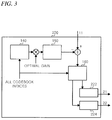
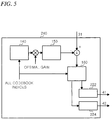
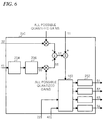
- Figures 5 and 6 illustrate a codebook search method for a first subframe according to a preferred embodiment of the present invention.
- an LPC filter receives, at step S140, all possible codebooks and codebook gains and produces, at step S150, corresponding filtered output signals.
- a subtractor calculates, at step S152, a difference value between a target signal (11) for a window and the corresponding filtered output signals and mean a square error selector selects, at steps S160, S222 and S224, a candidate codebook sequence (21) and a codebook gain (22) to minimize the mean square error. This completes the optimization process for the first subframe.
- the above process determines K candidate optimal codebook sequences and K candidate optimal codebook gains for the first subframe.
- a target signal corresponding to each second subframe is calculated.
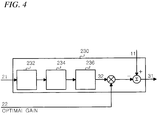
- Figures 7 and 8 illustrate a calculation method for a second subframe.
- the method comprises the step of producing, for each candidate codebook sequence, a signal comprising the candidate codebook sequence and a plurality of zeros such that the zeros are located at discrete time locations Lc, Lc+1, ..., 2 Lc -1 corresponding to a second subframe, at step S232, for each of the candidate codebooks sequences for a first subframe selected in step 220 and an output signal (32) is produced by passing, at step S236, the above signals through a pitch filter (232) and an LPC filter (234) at step S236. At this time, all the initial values of the pitch filter and LPC filter are set to "0", and filtered.
- a multiplier multiplies, at step S238, the output signal (32) by an candidate optimal codebook gain (22) for the first subframe.
- a subtractor subtracts, at step S239, the above result from the target signal (11) and produces a target signal (31) for a second subframe.
- Figures 9 and 10 illustrate an optimal codebook search method for a second subframe.
- An LPC filter receives, at step S150, all possible codebook sequences and codebook gains and produces corresponding filtered output signals.
- a subtractor calculates, at step S152, difference values between the corresponding filtered output signals and each of the K target signals for the second subframe and a minimum mean square error selector selects, at step S160, the subtracted signal having the minimum mean square error.
- a candidate codebook sequence (41) and a candidate codebook gain (42) are selected, at steps S222 and S224 for the second subframe according to the selected subtracted signal having a minimum use. candidate codebook sequence (41) and quantized candidate gains (42) to minimize mean square error.
- a time axis from 0 to Lc-1 corresponding to a first subframe at each of candidate codebooks (41) is set to "0".
- a search for optimal codebook sequence (51)(52) and optical codebook gains (53)(54) for the two subframes is performed by utilizing candidate codebook (41) for the second subframe, candidate codebook gains (42) and other information.
- Figures 11 and 12 illustrate an optimal codebook sequence and optical codebook gain search method according to a preferred embodiment of the present invention.
- Candidate codebook sequences (41) for a second subframe are filtered, at step S234, through a pitch filter and, at step S236, an LPC filter.
- a multiplier multiplies, at step S237, the filtered output signal (55) by all codebook gains Gq2 b for the second subframe and produces an output signal (56).
- a multiplier multiplies, at step S239, the output signal (32) of step S230 by all possible quantized gains Gq1a for the first subframe. The result is added, at step S241, to the signal (56) to produce an output signal (57).
- a subtractor calculates, at step S243, a difference value between a target signal for the window (11) and the output signal (57) and a mean square error selector selects, at steps S160 and S252, sequence codebooks (51)(53) and gains (52)(54) to minimize mean square error between the target signal and the output signal.
- the present invention simultaneously quantizes two gains per window consisting of two subframes, while a prior art quantization is performed per subframe basis. Consequently, in the procedure to minimize equation 2, all possible quantized gains are not searched, i.e., all values of a and b of k and j respectively are not searched, but only quantized gains having the same positive or negative sign as candidate optimal gains of each codebook (22) and (42) are searched. For example, when an optimal gain for a codebook of first subframe is positive, a search is performed in relation to only positive gains all Gq 2 a values.
- This method reduces search time to 1/4 of that of the prior art method which searches for all optimal gains.
- the method according to a preferred embodiment of the present invention firstly determines K and L codebooks respectively for a first subframe and second subframe within a window and later selects one optimal combination from K ⁇ L combinations. Since search time depends on K and L accordingly, the present invention adjusts search time per frame by varying K and L.
- CELP voice coder of the present invention is compatible with a previous standard coder and improves a voice quality without algorithmic delay.
Landscapes
- Engineering & Computer Science (AREA)
- Computational Linguistics (AREA)
- Signal Processing (AREA)
- Health & Medical Sciences (AREA)
- Audiology, Speech & Language Pathology (AREA)
- Human Computer Interaction (AREA)
- Physics & Mathematics (AREA)
- Acoustics & Sound (AREA)
- Multimedia (AREA)
- Compression, Expansion, Code Conversion, And Decoders (AREA)
Applications Claiming Priority (4)
| Application Number | Priority Date | Filing Date | Title |
|---|---|---|---|
| KP9746506 | 1997-09-10 | ||
| KR19970046506 | 1997-09-10 | ||
| KP9765487 | 1997-12-03 | ||
| KR1019970065487A KR100277096B1 (ko) | 1997-09-10 | 1997-12-03 | 음성압축을 위한 코드워드와 양자화된 이득 선택방법 |
Publications (3)
| Publication Number | Publication Date |
|---|---|
| EP0902421A2 true EP0902421A2 (fr) | 1999-03-17 |
| EP0902421A3 EP0902421A3 (fr) | 2002-04-03 |
| EP0902421B1 EP0902421B1 (fr) | 2004-01-14 |
Family
ID=26633073
Family Applications (1)
| Application Number | Title | Priority Date | Filing Date |
|---|---|---|---|
| EP98307345A Expired - Lifetime EP0902421B1 (fr) | 1997-09-10 | 1998-09-10 | Dispositif et procédé de codage de la parole |
Country Status (6)
| Country | Link |
|---|---|
| US (1) | US6108624A (fr) |
| EP (1) | EP0902421B1 (fr) |
| JP (1) | JP3335929B2 (fr) |
| CN (1) | CN1124590C (fr) |
| CA (1) | CA2246901C (fr) |
| DE (1) | DE69821068T2 (fr) |
Cited By (1)
| Publication number | Priority date | Publication date | Assignee | Title |
|---|---|---|---|---|
| US9076442B2 (en) | 2009-12-10 | 2015-07-07 | Lg Electronics Inc. | Method and apparatus for encoding a speech signal |
Families Citing this family (3)
| Publication number | Priority date | Publication date | Assignee | Title |
|---|---|---|---|---|
| US6581030B1 (en) * | 2000-04-13 | 2003-06-17 | Conexant Systems, Inc. | Target signal reference shifting employed in code-excited linear prediction speech coding |
| US7050969B2 (en) * | 2001-11-27 | 2006-05-23 | Mitsubishi Electric Research Laboratories, Inc. | Distributed speech recognition with codec parameters |
| US8560134B1 (en) | 2010-09-10 | 2013-10-15 | Kwangduk Douglas Lee | System and method for electric load recognition from centrally monitored power signal and its application to home energy management |
Family Cites Families (14)
| Publication number | Priority date | Publication date | Assignee | Title |
|---|---|---|---|---|
| US5060269A (en) * | 1989-05-18 | 1991-10-22 | General Electric Company | Hybrid switched multi-pulse/stochastic speech coding technique |
| US4980916A (en) * | 1989-10-26 | 1990-12-25 | General Electric Company | Method for improving speech quality in code excited linear predictive speech coding |
| US5138661A (en) * | 1990-11-13 | 1992-08-11 | General Electric Company | Linear predictive codeword excited speech synthesizer |
| JP3151874B2 (ja) * | 1991-02-26 | 2001-04-03 | 日本電気株式会社 | 音声パラメータ符号化方式および装置 |
| FI98104C (fi) * | 1991-05-20 | 1997-04-10 | Nokia Mobile Phones Ltd | Menetelmä herätevektorin generoimiseksi ja digitaalinen puhekooderi |
| US5307460A (en) * | 1992-02-14 | 1994-04-26 | Hughes Aircraft Company | Method and apparatus for determining the excitation signal in VSELP coders |
| US5495555A (en) * | 1992-06-01 | 1996-02-27 | Hughes Aircraft Company | High quality low bit rate celp-based speech codec |
| US5598504A (en) * | 1993-03-15 | 1997-01-28 | Nec Corporation | Speech coding system to reduce distortion through signal overlap |
| JP2624130B2 (ja) * | 1993-07-29 | 1997-06-25 | 日本電気株式会社 | 音声符号化方式 |
| JP2655046B2 (ja) * | 1993-09-13 | 1997-09-17 | 日本電気株式会社 | ベクトル量子化装置 |
| US5651090A (en) * | 1994-05-06 | 1997-07-22 | Nippon Telegraph And Telephone Corporation | Coding method and coder for coding input signals of plural channels using vector quantization, and decoding method and decoder therefor |
| US5602961A (en) * | 1994-05-31 | 1997-02-11 | Alaris, Inc. | Method and apparatus for speech compression using multi-mode code excited linear predictive coding |
| US5751903A (en) * | 1994-12-19 | 1998-05-12 | Hughes Electronics | Low rate multi-mode CELP codec that encodes line SPECTRAL frequencies utilizing an offset |
| US5701294A (en) * | 1995-10-02 | 1997-12-23 | Telefonaktiebolaget Lm Ericsson | System and method for flexible coding, modulation, and time slot allocation in a radio telecommunications network |
-
1998
- 1998-09-09 CN CN98119216A patent/CN1124590C/zh not_active Expired - Fee Related
- 1998-09-09 US US09/150,362 patent/US6108624A/en not_active Expired - Lifetime
- 1998-09-10 JP JP25626298A patent/JP3335929B2/ja not_active Expired - Fee Related
- 1998-09-10 CA CA002246901A patent/CA2246901C/fr not_active Expired - Fee Related
- 1998-09-10 EP EP98307345A patent/EP0902421B1/fr not_active Expired - Lifetime
- 1998-09-10 DE DE69821068T patent/DE69821068T2/de not_active Expired - Fee Related
Cited By (1)
| Publication number | Priority date | Publication date | Assignee | Title |
|---|---|---|---|---|
| US9076442B2 (en) | 2009-12-10 | 2015-07-07 | Lg Electronics Inc. | Method and apparatus for encoding a speech signal |
Also Published As
| Publication number | Publication date |
|---|---|
| CA2246901C (fr) | 2001-12-18 |
| JP3335929B2 (ja) | 2002-10-21 |
| US6108624A (en) | 2000-08-22 |
| EP0902421A3 (fr) | 2002-04-03 |
| DE69821068D1 (de) | 2004-02-19 |
| EP0902421B1 (fr) | 2004-01-14 |
| CN1235335A (zh) | 1999-11-17 |
| DE69821068T2 (de) | 2004-11-04 |
| CA2246901A1 (fr) | 1999-03-10 |
| JPH11167399A (ja) | 1999-06-22 |
| CN1124590C (zh) | 2003-10-15 |
Similar Documents
| Publication | Publication Date | Title |
|---|---|---|
| EP0696026B1 (fr) | Dispositif de codage de la parole | |
| US4811396A (en) | Speech coding system | |
| EP0504627B1 (fr) | Méthode et dispositif de codage de paramètres de voix | |
| US5602961A (en) | Method and apparatus for speech compression using multi-mode code excited linear predictive coding | |
| CA2202825C (fr) | Codeur vocal | |
| EP1019907B1 (fr) | Codage de signal vocal | |
| JP3254687B2 (ja) | 音声符号化方式 | |
| WO1994023426A1 (fr) | Quantification vectorielle: methode et appareil | |
| JPH08263099A (ja) | 符号化装置 | |
| EP0824750B1 (fr) | Procede de quantification du gain dans le codage lineaire predictif de la parole utilisant l'analyse par synthese | |
| EP1005022B1 (fr) | Méthode et système de codage de la parole | |
| EP0578436B1 (fr) | Application sélective de techniques de codage de parole | |
| US6330531B1 (en) | Comb codebook structure | |
| EP0902421B1 (fr) | Dispositif et procédé de codage de la parole | |
| CA2026823C (fr) | Methode et circuit de recherche de periodes fondamentales pour codeur-decodeur de paroles | |
| EP0694907A2 (fr) | Codeur de parole | |
| JP3192051B2 (ja) | 音声符号化装置 | |
| KR100277096B1 (ko) | 음성압축을 위한 코드워드와 양자화된 이득 선택방법 | |
| JP3229784B2 (ja) | 音声符号化復号化装置及び音声復号化装置 | |
| EP0910063B1 (fr) | Procédé de codage de parole | |
| JP3270146B2 (ja) | 音声符号化装置 | |
| JP2000020099A (ja) | 線形予測分析器,コード励振線形予測符号器及びコード励振線形予測復号器 | |
| KR100389898B1 (ko) | 음성부호화에 있어서 선스펙트럼쌍 계수의 양자화 방법 | |
| JPH05341800A (ja) | 音声符号化装置 | |
| JPH0675597A (ja) | 音声符号化装置 |
Legal Events
| Date | Code | Title | Description |
|---|---|---|---|
| PUAI | Public reference made under article 153(3) epc to a published international application that has entered the european phase |
Free format text: ORIGINAL CODE: 0009012 |
|
| 17P | Request for examination filed |
Effective date: 19980910 |
|
| AK | Designated contracting states |
Kind code of ref document: A2 Designated state(s): AT BE CH CY DE DK ES FI FR GB GR IE IT LI LU MC NL PT SE Kind code of ref document: A2 Designated state(s): DE FR GB |
|
| AX | Request for extension of the european patent |
Free format text: AL;LT;LV;MK;RO;SI |
|
| K1C3 | Correction of patent application (complete document) published |
Effective date: 19990317 |
|
| PUAL | Search report despatched |
Free format text: ORIGINAL CODE: 0009013 |
|
| AK | Designated contracting states |
Kind code of ref document: A3 Designated state(s): AT BE CH CY DE DK ES FI FR GB GR IE IT LI LU MC NL PT SE |
|
| AX | Request for extension of the european patent |
Free format text: AL;LT;LV;MK;RO;SI |
|
| 17Q | First examination report despatched |
Effective date: 20020903 |
|
| AKX | Designation fees paid |
Free format text: DE FR GB |
|
| GRAH | Despatch of communication of intention to grant a patent |
Free format text: ORIGINAL CODE: EPIDOS IGRA |
|
| RIC1 | Information provided on ipc code assigned before grant |
Ipc: 7G 10L 19/12 A |
|
| GRAS | Grant fee paid |
Free format text: ORIGINAL CODE: EPIDOSNIGR3 |
|
| GRAA | (expected) grant |
Free format text: ORIGINAL CODE: 0009210 |
|
| AK | Designated contracting states |
Kind code of ref document: B1 Designated state(s): DE FR GB |
|
| REG | Reference to a national code |
Ref country code: GB Ref legal event code: FG4D |
|
| REG | Reference to a national code |
Ref country code: IE Ref legal event code: FG4D |
|
| REF | Corresponds to: |
Ref document number: 69821068 Country of ref document: DE Date of ref document: 20040219 Kind code of ref document: P |
|
| ET | Fr: translation filed | ||
| PLBE | No opposition filed within time limit |
Free format text: ORIGINAL CODE: 0009261 |
|
| STAA | Information on the status of an ep patent application or granted ep patent |
Free format text: STATUS: NO OPPOSITION FILED WITHIN TIME LIMIT |
|
| 26N | No opposition filed |
Effective date: 20041015 |
|
| REG | Reference to a national code |
Ref country code: IE Ref legal event code: MM4A |
|
| PGFP | Annual fee paid to national office [announced via postgrant information from national office to epo] |
Ref country code: DE Payment date: 20070906 Year of fee payment: 10 |
|
| PGFP | Annual fee paid to national office [announced via postgrant information from national office to epo] |
Ref country code: GB Payment date: 20070905 Year of fee payment: 10 |
|
| PGFP | Annual fee paid to national office [announced via postgrant information from national office to epo] |
Ref country code: FR Payment date: 20070914 Year of fee payment: 10 |
|
| GBPC | Gb: european patent ceased through non-payment of renewal fee |
Effective date: 20080910 |
|
| REG | Reference to a national code |
Ref country code: FR Ref legal event code: ST Effective date: 20090529 |
|
| PG25 | Lapsed in a contracting state [announced via postgrant information from national office to epo] |
Ref country code: DE Free format text: LAPSE BECAUSE OF NON-PAYMENT OF DUE FEES Effective date: 20090401 |
|
| PG25 | Lapsed in a contracting state [announced via postgrant information from national office to epo] |
Ref country code: FR Free format text: LAPSE BECAUSE OF NON-PAYMENT OF DUE FEES Effective date: 20080930 |
|
| PG25 | Lapsed in a contracting state [announced via postgrant information from national office to epo] |
Ref country code: GB Free format text: LAPSE BECAUSE OF NON-PAYMENT OF DUE FEES Effective date: 20080910 |