EP0903237B1 - Imprimante ayant un mode de service pour un matériau de marquage non-identifié - Google Patents
Imprimante ayant un mode de service pour un matériau de marquage non-identifié Download PDFInfo
- Publication number
- EP0903237B1 EP0903237B1 EP98305298A EP98305298A EP0903237B1 EP 0903237 B1 EP0903237 B1 EP 0903237B1 EP 98305298 A EP98305298 A EP 98305298A EP 98305298 A EP98305298 A EP 98305298A EP 0903237 B1 EP0903237 B1 EP 0903237B1
- Authority
- EP
- European Patent Office
- Prior art keywords
- printer
- ink
- cartridge
- qualified
- printing
- Prior art date
- Legal status (The legal status is an assumption and is not a legal conclusion. Google has not performed a legal analysis and makes no representation as to the accuracy of the status listed.)
- Expired - Lifetime
Links
- 239000000463 material Substances 0.000 title claims description 40
- 238000007639 printing Methods 0.000 claims description 144
- 230000015654 memory Effects 0.000 claims description 42
- 238000012544 monitoring process Methods 0.000 claims description 23
- 238000000034 method Methods 0.000 claims description 19
- 238000004140 cleaning Methods 0.000 claims description 8
- 230000004044 response Effects 0.000 claims description 8
- 238000001035 drying Methods 0.000 claims description 7
- 230000000694 effects Effects 0.000 claims description 7
- 238000009434 installation Methods 0.000 claims description 6
- 239000007788 liquid Substances 0.000 claims description 5
- 230000037452 priming Effects 0.000 claims description 5
- 238000001514 detection method Methods 0.000 claims description 4
- 230000000977 initiatory effect Effects 0.000 claims description 3
- 238000004891 communication Methods 0.000 claims 1
- 239000012530 fluid Substances 0.000 claims 1
- 239000000976 ink Substances 0.000 description 177
- 238000012423 maintenance Methods 0.000 description 13
- 238000010438 heat treatment Methods 0.000 description 10
- 238000010304 firing Methods 0.000 description 9
- 206010011906 Death Diseases 0.000 description 8
- 239000006260 foam Substances 0.000 description 6
- 230000001627 detrimental effect Effects 0.000 description 4
- 230000006870 function Effects 0.000 description 3
- 230000009471 action Effects 0.000 description 2
- 230000001351 cycling effect Effects 0.000 description 2
- -1 for example Substances 0.000 description 2
- 230000008439 repair process Effects 0.000 description 2
- 239000000758 substrate Substances 0.000 description 2
- 238000012360 testing method Methods 0.000 description 2
- 239000004743 Polypropylene Substances 0.000 description 1
- 230000002411 adverse Effects 0.000 description 1
- 238000013475 authorization Methods 0.000 description 1
- 239000003086 colorant Substances 0.000 description 1
- 230000003247 decreasing effect Effects 0.000 description 1
- 230000001771 impaired effect Effects 0.000 description 1
- 238000007641 inkjet printing Methods 0.000 description 1
- 238000003780 insertion Methods 0.000 description 1
- 230000037431 insertion Effects 0.000 description 1
- 239000000203 mixture Substances 0.000 description 1
- 238000012806 monitoring device Methods 0.000 description 1
- 239000002245 particle Substances 0.000 description 1
- 230000000149 penetrating effect Effects 0.000 description 1
- 229920001155 polypropylene Polymers 0.000 description 1
- 230000008569 process Effects 0.000 description 1
- 239000012858 resilient material Substances 0.000 description 1
- 230000002441 reversible effect Effects 0.000 description 1
- 239000011800 void material Substances 0.000 description 1
- XLYOFNOQVPJJNP-UHFFFAOYSA-N water Substances O XLYOFNOQVPJJNP-UHFFFAOYSA-N 0.000 description 1
Images




Classifications
-
- B—PERFORMING OPERATIONS; TRANSPORTING
- B41—PRINTING; LINING MACHINES; TYPEWRITERS; STAMPS
- B41J—TYPEWRITERS; SELECTIVE PRINTING MECHANISMS, i.e. MECHANISMS PRINTING OTHERWISE THAN FROM A FORME; CORRECTION OF TYPOGRAPHICAL ERRORS
- B41J2/00—Typewriters or selective printing mechanisms characterised by the printing or marking process for which they are designed
- B41J2/005—Typewriters or selective printing mechanisms characterised by the printing or marking process for which they are designed characterised by bringing liquid or particles selectively into contact with a printing material
- B41J2/01—Ink jet
- B41J2/17—Ink jet characterised by ink handling
- B41J2/175—Ink supply systems ; Circuit parts therefor
- B41J2/17566—Ink level or ink residue control
-
- B—PERFORMING OPERATIONS; TRANSPORTING
- B41—PRINTING; LINING MACHINES; TYPEWRITERS; STAMPS
- B41J—TYPEWRITERS; SELECTIVE PRINTING MECHANISMS, i.e. MECHANISMS PRINTING OTHERWISE THAN FROM A FORME; CORRECTION OF TYPOGRAPHICAL ERRORS
- B41J2/00—Typewriters or selective printing mechanisms characterised by the printing or marking process for which they are designed
- B41J2/005—Typewriters or selective printing mechanisms characterised by the printing or marking process for which they are designed characterised by bringing liquid or particles selectively into contact with a printing material
- B41J2/01—Ink jet
- B41J2/17—Ink jet characterised by ink handling
- B41J2/175—Ink supply systems ; Circuit parts therefor
- B41J2/17503—Ink cartridges
- B41J2/17506—Refilling of the cartridge
- B41J2/17509—Whilst mounted in the printer
-
- B—PERFORMING OPERATIONS; TRANSPORTING
- B41—PRINTING; LINING MACHINES; TYPEWRITERS; STAMPS
- B41J—TYPEWRITERS; SELECTIVE PRINTING MECHANISMS, i.e. MECHANISMS PRINTING OTHERWISE THAN FROM A FORME; CORRECTION OF TYPOGRAPHICAL ERRORS
- B41J2/00—Typewriters or selective printing mechanisms characterised by the printing or marking process for which they are designed
- B41J2/005—Typewriters or selective printing mechanisms characterised by the printing or marking process for which they are designed characterised by bringing liquid or particles selectively into contact with a printing material
- B41J2/01—Ink jet
- B41J2/17—Ink jet characterised by ink handling
- B41J2/175—Ink supply systems ; Circuit parts therefor
- B41J2/17503—Ink cartridges
- B41J2/17513—Inner structure
-
- B—PERFORMING OPERATIONS; TRANSPORTING
- B41—PRINTING; LINING MACHINES; TYPEWRITERS; STAMPS
- B41J—TYPEWRITERS; SELECTIVE PRINTING MECHANISMS, i.e. MECHANISMS PRINTING OTHERWISE THAN FROM A FORME; CORRECTION OF TYPOGRAPHICAL ERRORS
- B41J2/00—Typewriters or selective printing mechanisms characterised by the printing or marking process for which they are designed
- B41J2/005—Typewriters or selective printing mechanisms characterised by the printing or marking process for which they are designed characterised by bringing liquid or particles selectively into contact with a printing material
- B41J2/01—Ink jet
- B41J2/17—Ink jet characterised by ink handling
- B41J2/175—Ink supply systems ; Circuit parts therefor
- B41J2/17503—Ink cartridges
- B41J2/1752—Mounting within the printer
-
- B—PERFORMING OPERATIONS; TRANSPORTING
- B41—PRINTING; LINING MACHINES; TYPEWRITERS; STAMPS
- B41J—TYPEWRITERS; SELECTIVE PRINTING MECHANISMS, i.e. MECHANISMS PRINTING OTHERWISE THAN FROM A FORME; CORRECTION OF TYPOGRAPHICAL ERRORS
- B41J2/00—Typewriters or selective printing mechanisms characterised by the printing or marking process for which they are designed
- B41J2/005—Typewriters or selective printing mechanisms characterised by the printing or marking process for which they are designed characterised by bringing liquid or particles selectively into contact with a printing material
- B41J2/01—Ink jet
- B41J2/17—Ink jet characterised by ink handling
- B41J2/175—Ink supply systems ; Circuit parts therefor
- B41J2/17503—Ink cartridges
- B41J2/1752—Mounting within the printer
- B41J2/17523—Ink connection
-
- B—PERFORMING OPERATIONS; TRANSPORTING
- B41—PRINTING; LINING MACHINES; TYPEWRITERS; STAMPS
- B41J—TYPEWRITERS; SELECTIVE PRINTING MECHANISMS, i.e. MECHANISMS PRINTING OTHERWISE THAN FROM A FORME; CORRECTION OF TYPOGRAPHICAL ERRORS
- B41J2/00—Typewriters or selective printing mechanisms characterised by the printing or marking process for which they are designed
- B41J2/005—Typewriters or selective printing mechanisms characterised by the printing or marking process for which they are designed characterised by bringing liquid or particles selectively into contact with a printing material
- B41J2/01—Ink jet
- B41J2/17—Ink jet characterised by ink handling
- B41J2/175—Ink supply systems ; Circuit parts therefor
- B41J2/17503—Ink cartridges
- B41J2/17526—Electrical contacts to the cartridge
- B41J2/1753—Details of contacts on the cartridge, e.g. protection of contacts
-
- B—PERFORMING OPERATIONS; TRANSPORTING
- B41—PRINTING; LINING MACHINES; TYPEWRITERS; STAMPS
- B41J—TYPEWRITERS; SELECTIVE PRINTING MECHANISMS, i.e. MECHANISMS PRINTING OTHERWISE THAN FROM A FORME; CORRECTION OF TYPOGRAPHICAL ERRORS
- B41J2/00—Typewriters or selective printing mechanisms characterised by the printing or marking process for which they are designed
- B41J2/005—Typewriters or selective printing mechanisms characterised by the printing or marking process for which they are designed characterised by bringing liquid or particles selectively into contact with a printing material
- B41J2/01—Ink jet
- B41J2/17—Ink jet characterised by ink handling
- B41J2/175—Ink supply systems ; Circuit parts therefor
- B41J2/17503—Ink cartridges
- B41J2/17543—Cartridge presence detection or type identification
- B41J2/17546—Cartridge presence detection or type identification electronically
-
- B—PERFORMING OPERATIONS; TRANSPORTING
- B41—PRINTING; LINING MACHINES; TYPEWRITERS; STAMPS
- B41J—TYPEWRITERS; SELECTIVE PRINTING MECHANISMS, i.e. MECHANISMS PRINTING OTHERWISE THAN FROM A FORME; CORRECTION OF TYPOGRAPHICAL ERRORS
- B41J2/00—Typewriters or selective printing mechanisms characterised by the printing or marking process for which they are designed
- B41J2/005—Typewriters or selective printing mechanisms characterised by the printing or marking process for which they are designed characterised by bringing liquid or particles selectively into contact with a printing material
- B41J2/01—Ink jet
- B41J2/17—Ink jet characterised by ink handling
- B41J2/175—Ink supply systems ; Circuit parts therefor
- B41J2/17503—Ink cartridges
- B41J2/17553—Outer structure
-
- B—PERFORMING OPERATIONS; TRANSPORTING
- B41—PRINTING; LINING MACHINES; TYPEWRITERS; STAMPS
- B41J—TYPEWRITERS; SELECTIVE PRINTING MECHANISMS, i.e. MECHANISMS PRINTING OTHERWISE THAN FROM A FORME; CORRECTION OF TYPOGRAPHICAL ERRORS
- B41J2/00—Typewriters or selective printing mechanisms characterised by the printing or marking process for which they are designed
- B41J2/005—Typewriters or selective printing mechanisms characterised by the printing or marking process for which they are designed characterised by bringing liquid or particles selectively into contact with a printing material
- B41J2/01—Ink jet
- B41J2/17—Ink jet characterised by ink handling
- B41J2/175—Ink supply systems ; Circuit parts therefor
- B41J2/17566—Ink level or ink residue control
- B41J2002/17589—Ink level or ink residue control using ink level as input for printer mode selection or for prediction of remaining printing capacity
Definitions
- the invention relates to printing devices and more particularly to ink jet printers using customer replaceable ink supply cartridges having electronic monitoring devices to detect whether competitor supplied cartridges or competitor refilled cartridges containing non-qualified ink have been installed and, if detected, to adjust the printing mode of the printer in order to minimize the effect of non-qualified inks on the printer.
- customer replaceable marking material supply containers typically referred to as cartridges
- the marking material may be xerographic toner or liquid ink, depending upon the type of printer.
- the customer replaceable cartridge contains an integral printhead as well as the ink and the combined cartridge and printhead may be discarded when the ink is depleted.
- the printhead is separately provided.
- the cartridges are readily installed on or removed from the printer carriage by the customer.
- the printhead is fixedly mounted in the printer and extends for the width of a recording medium to accommodate printing across the complete width of the recording medium as it is moved past the printhead.
- the ink cartridges for full width array printers contain only ink and usually contain larger supplies of ink than the carriage type printer cartridges.
- printers are designed for specially formulated marking material.
- Thermal ink jet printing devices are designed for specifically formulated inks, termed 'qualified' inks, and for specific printing modes to control ejected droplet sizes, droplet velocity, material compatibility, particular cleaning and priming techniques, droplet ejection rates, and other functions.
- Many problems may arise with the printers when specifically qualified inks are replaced with a non-qualified ink by the customers. For example, heating elements may be damaged and fail early, print quality may be lower, and the printheads and/or maintenance stations may be corroded by the non-qualified inks.
- the printers and printheads are usually provided with a warranty for a particular lifetime, rate of ink consumption, and print quality.
- non-qualified inks Since the use of a non-qualified ink in thermal inkjet printers is highly likely to affect the printer's performance and lifetime in the printer's normal printing mode, printer manufacturers generally discourage use of non-qualified inks and void warranties when they are used.
- the price of non-qualified inks are usually lower in price than the qualified inks, so customers are tempted to use them at least some of the time, especially when ink-depleted cartridges by the same manufacturer are refilled with the non-qualified ink.
- US-A-4,961,088 discloses a system for monitoring customer replaceable cartridges in printers or copiers.
- Each replaceable cartridge includes an electrically erasable programmable read only memory (EEPROM) which is programmed with a cartridge identification number that when matched a cartridge identification number in the printer or copier enables the printer or copier to operate, provides a cartridge replacement warning count, and provides a termination count at which the cartridge is disabled from further use.
- the EEPROM is programmed to store updated counts of the remaining number of images or prints available by the cartridge after each print or copy is made by the printer or copier.
- US-A-5,021,828 discloses a replaceable unit for use in a copier or printer in which initial use and near-end-of-life is recorded by electrical means, including a portion itself removable from the removable, comprising two fuses. A first fuse is blown when a few copies have been made with the replaceable unit, and the second fuse is used to prevent further use of the replaceable unit when a certain number of copies or prints have been made with the replaceable unit.
- a method for adjusting the print mode of a printer using a customer replaceable marking material supply cartridge from a normal print mode to a non-normal print mode in response to a detection of a non-qualified ink in the cartridge by an electronic monitoring system comprising the steps of:
- the method of adjusting the print mode of the printer further comprises the steps of: (g) determining a marking material level in said cartridge by an electronic monitoring system and displaying an available usage remaining for the customer replaceable cartridge on the display panel when the printer is actuated for printing and a warranty condition is displayed; (h) causing a normal printing mode for the printhead, if the available usage displayed is greater than zero, and preventing the printer from initiating printing under warranty conditions, if the available usage displayed is zero; (i) converting the warranty condition displayed to an out-of-warranty condition displayed, if the available usage displayed is zero, and changing the identification number on the customer replaceable cartridge to prevent further matches with the stored identification numbers; (j) providing an option of printing with a cartridge which has been at least partially refilled with a non-qualified marking material; (k) enabling the non-normal printing mode for the printer, when the printhead is actuated for printing and an out-of-warranty condition is displayed; and (1) automatically logging a use of a non-normal
- a printer utilizing customer replaceable marking material supply cartridges and being adjustable between a normal printing mode and a non-normal printing mode in response to the detection of non-qualified marking material in said cartridges, comprising:
- the present invention is applicable for any multifunction printer or marking engine, such as a copier, facsimile machine, or inkjet printer, which uses liquid or dry marking material in a customer replaceable cartridge.
- a copier facsimile machine
- inkjet printer which uses liquid or dry marking material in a customer replaceable cartridge.
- the invention will be described in the environment of an ink jet printer.
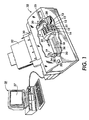
- Fig. 1 illustrates an isometric view of a carriage type, multicolor thermal ink jet printer 10, including personal computer 39 connected thereto, having a normal printing mode for qualified ink and a non-normal printing mode for non-qualified ink.
- the printer incorporates an electronic monitoring system for customer replaceable ink supply cartridges, sometimes referred to as a Customer Replaceable Unit Monitoring System or CRUM system, described later.
- the printer includes four replaceable ink supply tanks or cartridges12 mounted in a removable ink jet printhead assembly 14.
- the ink supply tanks or cartridges may each have a different color of ink, and in the preferred embodiment, the tanks have yellow, magenta, cyan, and black ink.
- the printhead assembly is installed on a translatable carriage 16 which is supported by carriage guide rails 18 fixedly mounted in frame 20 of the printer.
- the carriage is translated back and forth along the guide rails by any suitable means (not shown), such as timing belt driven by an electrical motor, as is well known in the printer industry.
- the carriage is under the control of the printer controller 21, shown in Fig. 5.
- the printhead assembly 14 comprises a housing 15 having an integral multicolor ink jet printhead 22 and ink pipe connectors 24 which protrude from a floor 17 of the printhead assembly for insertion into the ink supply cartridges 12 when the ink supply cartridges are installed in the printhead assembly housing.
- the protruding ink pipe connectors are usually covered by a wire mesh filter 48 to prevent particles or debris from the cartridge from being carried by the ink into the printhead.
- Ink flow paths, represented by dashed lines 26, in the housing interconnects each of the ink pipe connectors with the separate inlets of the printhead.
- the printhead assembly on which the replaceable ink supply tanks or cartridges are mounted includes an interfacing printed circuit board 23 that is connected to the printer controller by ribbon cable 28 through which electric signals are selectively applied to the printhead to selectively eject ink droplets from the printhead nozzles (not shown).
- the multicolor printhead 22 contains a plurality of ink channels with heating elements therein (neither shown) which carry ink from each of the cartridges to respective groups of ink ejecting nozzles of the printhead.
- Identification and memory chips 25 with contact pads 27, shown in dashed line, are bonded to the bottom wall 46 of the cartridges 12, so that when the cartridges are installed in the printhead assembly 14, the chip contact pads 27 mate with and couple to the contact pads 29 of the printed circuit board 23 to complete the electrical connection with the printer controller.
- the chips 25 in the preferred embodiment are electrically erasable programmable read only memories or EEPROMs which when electrically integrated with the printer controller form the CRUM system of the present invention, described below.
- the carriage 16 When printing, the carriage 16 reciprocates back and forth along the guide rails 18 in the direction of arrow 31. As the printhead 22 reciprocates back and forth across a recording medium 30, such as single cut sheets of paper fed from an input stack 32 of sheets, droplets of ink are expelled from selected ones of the printhead nozzles towards the recording medium 30.
- the nozzles are typically arranged in a linear array perpendicular to the reciprocating direction of arrow 31.
- the recording medium 30 is held in a stationary position. At the end of each pass, the recording medium is stepped in the direction of arrow 19 for a distance equal to the height of a printed swath.
- a single sheet of recording medium 30 is fed from the input stack 32 through the printer along a path defined by a curved platen 34 and a guide member 36.
- the sheet is driven along the path by a transport roller 38 as is understood by those skilled in the art or, for instance, as illustrated in US-A-5,534,902.
- the sheet 30 is caused to reverse bow such that the sheet is supported by the platen 34 at a flat portion thereof for printing by the printhead 22.
- ink from each of the ink cartridges 12 is drawn by capillary action through the outlet port 40 in the ink cartridges, the ink pipe connectors 24, and ink flow paths 26 in the printhead assembly housing to the printhead 22.
- the ink pipe connectors and flow paths of the housing supplies ink to the printhead ink channels, replenishing the ink after each ink droplet ejection from the nozzle associated with the printhead ink channel.
- ink at the nozzles be maintained at a slightly negative pressure, so that the ink is prevented from dripping onto the recording medium 30, and ensuring that ink droplets are placed on the recording medium only when a droplet is ejected by an electrical signal applied to the heating element in the ink channel for the selected nozzle.
- a negative pressure also ensures that the size of the ink droplets ejected from the nozzles remain substantially constant as ink is depleted from the ink supply cartridges.
- the negative pressure is usually in the range of -0.5 to -2.0 inches of water.
- One known method of supplying ink at a negative pressure is to place within the ink supply cartridges an open cell foam or needled felt in which ink is absorbed and suspended by capillary action. Ink tanks which contain ink holding foam are disclosed, for example, in US-A-5,185,614; US-A-4,771,295; and US-A-5,486,855.
- inks are specifically formulated to provide satisfactory performance in a particular ink jet printer.
- the ink compositions are fine tuned to meet particular refill rates of the printhead, drying time on the recording medium, droplet ejection rate or firing frequency, materials compatibility, etc.
- Such an ink is termed 'qualified' by the manufacturer and will satisfactorily perform in the printer, and it is with qualified inks that the printer performance and print quality is warranted by the manufacturer.
- each ink cartridge has a chip 25 attached thereto that includes an electrically erasable programmable read only memory (EEPROM).
- EEPROM electrically erasable programmable read only memory
- contact pads 27 are provided on the chip and a printed circuit board 23 with corresponding contact pads 29 are mounted on the printhead assembly in a manner similar to that described in US-A-5,283,613.
- the ink supply cartridge 12 for a carriage type ink jet printer 10 comprises a housing 52 of any suitable material, such as, for example, polypropylene, having first and second compartments 62,64 which are separated by a common wall 63.
- a qualified ink is stored in the first compartment 62.
- the ink is introduced into the first compartment through ink inlet 61 which is subsequently covered.
- the second compartment 64 has an open cell foam member (not shown) inserted therein. Ink from the first compartment moves through aperture 65 in the common wall 63 to saturate the foam member with ink.
- the foam member is inserted into the second compartment through the open bottom thereof, and then the open bottom is covered by a bottom wall 46 of the same material as the housing 52.
- the bottom wall 46 has the open outlet port 40 and is heat staked to weld it to the housing 52 after the foam member is inserted.
- the chip 25 is positioned and bonded to the bottom wall.
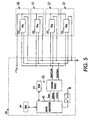
- a multicolor ink jet printer 10 with four cartridges 12 containing different ink colors are represented by dashed line enclosures.
- a suitable printer controller 21 is depicted which includes one or more microprocessors 42 and a suitable memory, such as a Read Only Memory (ROM) 43 and Random Access Memory (RAM) 44, for holding the printer operating system software, programming data, etc.
- the printer controller 21 operates the various component parts of the printer in an integrated fashion to produce high quality images on the recording medium 30.
- the chip 25 for each cartridge 12 has an identification number and provides addressable memory for storing or logging a count of the number of sheets of recording medium still available for printing by each cartridge, the count of the remaining number of sheets of recording medium that can be printed with average ink coverage is stored on the various memories by the printer controller at the end of each print job.
- Each chip (EEPROM) is pre-programmed with a maximum count reflecting the maximum number of recording sheets that can be printed by the cartridge, as estimated by the average number of ink droplets printed on an average sheet.
- the counting system is a decrementing type system with the maximum count in the chips being decremented after the total print job is completed. The total droplets used to produce the images are counted as they are printed on each sheet to provide a current effective sheet count.
- the cartridge When the current estimated number of recording medium sheets is zero, the cartridge is rendered unusable for normal printing, so that it must be discarded or refilled. Because it is detrimental to the heating elements in the printhead to be fired or energized without ink being in the printhead channels, a small amount of unusable ink is left in the cartridge. Once the cartridge has used up the pre-programmed maximum count, this information is displayed on the display panel 35 of the printer or monitor 37 of an associated personal computer 39 and any attempt to further use it is not permitted unless it is first removed and then replaced thereby permitting refilling if desired by the customer.
- a refilled cartridge is always identified as containing non-qualified ink, but may be used to print by the customer in a non-normal print mode, automatically provided by the operating software as described later with respect to Figs. 6-9, by pushing the printer's start button 33.
- the non-normal printing mode is provided with the caveat that such use is out side of the warranty. However, the non-normal printing mode has been designed to minimize the potential detrimental effects of the non-qualified ink.
- the non-normal mode entails a slower firing frequency and slower printing speed to prevent the printhead ink channels from being starved of ink which would damage the heating elements and to enable the non-qualified ink more time to dry on the recording medium.
- the non-normal printing mode causes the cleaning step to be repeated to assure a clean nozzle face (not shown) on the printhead and the priming step is changed to cause 50 % more ink to be suctioned than is removed during a normal print mode priming operation to assure that no bubbles remain in the printhead which will effect print quality or damage to the printhead.
- a warning count number reflecting the predetermined number of remaining sheets of recording medium that may be printed by the cartridge is also provided in the memories of the chip.
- a message is displayed on the display panel 35 of the printer or on the monitor 37 of the associated personal computer 39 connected thereto, so that the customer is warned that a particular one of the cartridges currently in use is nearing end of life and should soon be replaced.
- the warning count number provides at least a few hundred sheets of recording medium to be printed with an average number of ink droplets per sheet. Accordingly, the actual number of pages left is based upon the area coverage of each of the remaining sheets printed.
- the maximum count number and warning count number are typically pre-programmed by the manufacturer at the factory. Additionally, in order to assure that only authorized chips and cartridges are used, an identification number is also pre-programmed and stored in the chip memories of each cartridge. In a well known manner, such as disclosed in US-A-5,283,613, the identification numbers of the cartridges are read and compared with the corresponding recognition numbers stored in the memory of the printer controller upon each installation thereof. Where the identification number of any cartridge does not match any of the recognition numbers for that cartridge, an out-of-warranty condition is displayed on the printer panel or associated monitor and initiating printing by actuation of the print start button 33 will cause the printer to print in the non-normal print mode.
- All printing events in the non-normal printing mode is logged in the printer controller memory and can be access by a technical representative during either repair or routine maintenance, so that a complaint under warranty can be verified. Repairs for any damage or impaired print quality caused by out-of-warranty or non-qualified ink may be refused by the supplier or manufacturer, though the non-normal printing mode should adequately protect the printer from serious harm.
- the identification number for the cartridge may be changed by software program, so that reinstallation will cause an out-of-warranty display, thereby causing any such refilled cartridge to be used for printing only in the non-normal printing mode.
- a printing operation may be initiated by the customer with on 'out-of-warranty' notice being displayed by pushing the start button 33 on the printer which will automatically convert the printer to the non-normal printing mode, thereby enabling the customer to use the non-qualified ink with reduced, if not eliminated, likelihood of damaging the printer.
- a competitor's cartridge is installed which has no identification number or has an identification number which is not recognized, a 'wrong cartridge' signal is displayed and the customer may, nevertheless, print with it, but in the non-normal printing mode.
- Each non-normal printing mode operation is logged in the memory of the printer controller for access by the service provider or technical representative through, for example, a printout by the printer onto a sheet of recording medium or message printed on the display panel or monitor.
- the printer enters a standby state ready to make prints, with the number of equivalent printed sheets which can still be printed by the cartridge displayed for the convenience of the customer.
- the printer cycles up by performing a set sequence of events to assure that the first printed sheet of recording medium will have the warranted print quality for the normal printing mode printing, such as, for example, firing a few test droplets at the maintenance station to clear the nozzles and clean the nozzle face with a blade as the printhead is traversed from the maintenance station to the printing location.
- the printer also enters a standby state to make prints in the non-normal printing mode, but on a print request, the startup sequence is revised according to the software program in the printer controller for the non-normal printing mode, which entails, for example, more test droplets and additional cleaning steps, generally doubling the number of times that the nozzle face is cleaned during a normal printing mode.
- the firing or droplet ejection rate is reduced to provide appropriate refill time and the speed of printing is reduced to enable more drying time for the printed sheets.
- the printer controller counts each time a droplet is ejected from nozzles connected to its respective ink supplying cartridge, so that for each allotted quantity of ejected droplets representing a printed sheet of recording medium, the chip memory will be decremented by one when the printing job is completed, so that an accurate number of remaining sheets available to be printed by the cartridge is maintained in the chip for the respective cartridge.
- the total number of equivalent average sheets is temporarily stored in the printer controller and then this total number of equivalent average printed sheets is decreased from that existing in the chip memory by means well known in the industry.
- a photosensor 50 may be optionally provided to sense the absence of ink in any one of the cartridges and terminate the operation of the printer to prevent life threatening damage to the printhead assembly 14.
- the customer must repush the start print button when the printer display panel 35 or personal computer monitor 37 displays 'is ink in cartridge?' to signify or confirm that the cartridges each contain ink and permit continued printing in the non-normal printing mode.
- the ink cartridges are transparent or otherwise provide means for visually determining that ink is present in the cartridge.
- the updated remaining count in the chip memory is compared to the warning count number stored in the chips of each cartridge. Where the new current count of sheets available to be printed is equal to or less than the warning count, usually about one hundred sheets, a message is displayed for the particular cartridge in the printer panel or associated monitor to 'Order New Cartridge'. This alerts the customer of the fact that the identified cartridge is about to be depleted of usable ink and that a replacement should be available.
- the updated remaining count in the chip memory is also compared with the termination count of zero.
- the cartridge chip causes a display of 'empty cartridge' on the printer panel or associated monitor, changes the identification number thereof, and prevents further use of this cartridge by the printer, except in the non-normal printing mode.
- the cartridge which has once been depleted of ink will permit only non-normal printing modes and a display of 'out-of-warranty' during subsequent printing, each of which event is also stored in the printer controller memory for access by a service provider.
- the memory in each chip mounted on the cartridges is of the type which can only be decremented and cannot be revised by a customer to add count of available sheets which can be printed by the cartridge.
- a memory which cannot be revised upwardly is disclosed in US-A-5,283,613.
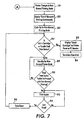
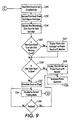
- Figs. 6-9 are flow charts showing the operation of a control system for a printer having a normal printing mode and a non-normal printing mode.
- the non-normal printing mode enables a customer to have the option of using a cartridge with non-qualified ink and, though such printing is conducted in an out-of-warranty operation, it minimizes, if not eliminating, the potential detrimental effects thereof on the printer.
- an initialization routine is entered in which the controller checks to see if all cartridges have been installed at step 72. If not, the missing cartridges are installed by the customer at step 73.
- the identification number of each cartridge is read at step 74 and checked for authorization at step 76 by comparing the numbers with the numbers stored in the printer controller memory for matches. If there are no identification numbers on the cartridges or there are no matches, the printer display panel 35 or personal computer monitor 37 displays "Wrong Cartridge" at step 77. If a competitor supplied cartridge is installed without an authorized identification number or a refilled cartridge with revised identification number is installed by the customer, then such cartridge is determined to contain non-qualified ink and may still be used but only in a non-normal printing mode as described before. To use a cartridge with non-qualified ink, the print start button 33 is pushed at step 78.
- the printer controller automatically changes the printing mode from the normal printing mode to the non-normal printing mode at step 79 and, at step 80, the printer display panel or personal computer monitor displays "Out-of-Warranty Printing" which remains displayed while printing in the non-normal printing mode.
- the printer controller cycles up the printer for non-normal printing, which includes ejecting a number of ink droplets at the maintenance station, usually twice the number for the normal printing mode, cleans the printhead nozzle face at least twice the number for normal printing, reduces the frequency of the droplet ejection (firing rate), and slows down the printing speed to provide more drying time for the printed sheets.
- the printer controller checks at step 84 if there is ink in the cartridge containing non-qualified ink, so that a cartridge depleted of ink will not cause the heating elements to fire when there is no ink in the printhead channels. Firing or energizing a heating element without the presence of ink could ruin the heating element.
- the customer must double push print start button to confirm that ink is present in the cartridges or, optionally, a photosensor 50 (Fig. 2) checks for ink.
- a photosensor 50 Fig. 2 checks for ink.
- the customer replaceable ink cartridges are transparent or otherwise provide means for visually observing ink level therein.
- the printer panel or monitor will display "Empty Cartridge" at step 85 and the operation of the printer will be terminated at step 86. If the presence of ink is established, the printer enters a standby of non-normal printing at step 88, awaiting the entry of the number of prints to be made and the pushing of the print start button at step 90. When the print start button is pushed, the printer starts making the prints at step 92 and queries for the last print at step 94. When the print job is completed, the printer is cycled down by moving the printhead assembly to a maintenance station and rechecks to see if ink is still available in the cartridges at step 96 before returning to the standby for the non-normal printing mode.
- the printer controller If the cartridge identification number is matched by the printer controller, the remaining number of sheets available to be printed by the cartridge is read at step 100 and compared to zero at step 102. If the remaining number of sheets available to be printed is zero, meaning no usable ink is left in the cartridge, the printer display panel or monitor displays "End-of-Life" at step 104 and revises the cartridge identification number at step 106, so that the cartridge can no longer be used, except in the non-normal printing mode. Next, the printer operation is terminated until a new or different cartridge is installed at step 108.
- the chip count is compared with a predetermined warning number at step 103 representing a small number of sheets left which can still be printed and indicating only a small amount of ink is left in the cartridge.
- the warning number is usually about 100 equivalent sheets of average ink coverage.
- the printer display panel or monitor displays "Order New Cartridge" at step 105, and then causes the printer to perform a routine, generally referred to as cycling up, at step 107, which prepares the printhead assembly for the normal printing mode. If the chip number is larger than the warning number, the printer controller causes the printer to proceed directly with step 107.
- the cycling up process includes firing a few ink droplets at the maintenance station to clear out the printhead nozzles and clean the nozzle face by a cleaning blade as it leaves the maintenance station and proceeds to the printing location.
- the number of prints to be made is entered into the printer at step 109 by the customer and this number of prints is compared with the chip number at step 110. If the desired number of prints is greater than the number of prints available by the cartridge, the desired number of prints must be lessened or the cartridge replaced at step 111.
- the printer controller checks for the last sheet being printed at step 116 and stops printing and performs a cycle down routine at step 118 when the last sheet is identified.
- the cycle down basically involves moving the printhead assembly to the maintenance station where it is capped to prevent the ink at the nozzles from drying out, a few droplets are ejected to clear little used nozzles, and the nozzle face is cleaned as the printhead assembly enters the maintenance station.
- the total print count is established in the printer controller memory at step 120, and the chip count number is retrieved from the chip at step 122.
- a new remaining count number is calculated for a new remaining number of equivalent sheets that can be printed by the cartridges at step 124.
- This new chip count number is compared first with the warning number at step 126 and if it is equal to or less than the warning number, but greater than zero, the printer display panel or monitor displays "Order New Cartridge" at step 127.
- the chip count number is checked to see if it is equal to zero at step 128 and if it is the printer display panel or monitor displays "End-of Life" and the printer operation is terminated at step 130.
- the new chip count number is written on the chip at step 132 and the printer placed in standby for further printing in normal printing mode at step 134, where it is queried to see if the customer is at least temporarily finished with printing jobs and if new entries are not made for the next print job in a predetermined time period, the printer operation is terminated at step 130 or left in the standby condition if the customer is not through with the printer.
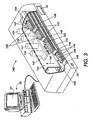
- the above described invention is equally applicable for full width array ink jet printers 140, such as shown in Figs. 3 and 4.
- the full width array printer has four identical stationary printbars 142, similar to those described in US-A-5,198.054, the relevant portions of which are hereby incorporated by reference.
- the printbars each have a different color of ink and are stacked one over the other with the side nozzles (not shown) of each printbar confronting the recording medium 144 which moves therepast at a constant velocity in the direction of arrow 145.
- the nozzles of each printbar are in alignment with each other for color registration.
- Each printbar is comprised of abutted printhead subunits 146 on a support substrate 148.
- Each subunit has an ink inlet 150 and a common ink manifold 152 is mounted thereon with outlet ports 154 which are aligned and sealed with respective subunit ink inlets 150.
- the support substrate of each printbar above the lowest printbar 142' resides on or close to the ink manifold of the printbar immediately below it.
- Relatively large ink containing cartridges 156, 157, 158, and 159, each with a different color of ink, are shown in dashed line mounted on a fixed shelf 160 in the printer and each connected to a respective one of the ink manifolds by a separate flexible tube 162.
- the full width array printer 140 has a person computer 39 with monitor 37, an optional display panel 35, and print start button 33.
- FIG. 4 a schematic, partially sectioned, elevation view of the four customer replaceable ink cartridges 156, 157, 158, 159 are shown separated from the fixed shelf 160.
- the shelf contains receptacles 164 to hold releasably the cartridges and each receptacle has an opening 165 through which the cartridge neck 166 extends when the cartridges are installed in the directions of arrows 167.
- the fixed shelf has photosensors 50 to detect the presence or absence of non-qualified ink in the cartridges 156-159, a feature not necessary for cartridges containing qualified ink.
- the cartridges with qualified ink uses the chips 25 to monitor the status of the ink level, but competitor supplied cartridges or competitor refilled cartridges do not have authorized CRUM systems, so to protect the printheads from firing with empty cartridges and damaging the heating elements, the customer must manually confirm the presence of ink in all cartridges or photosensors must be used.
- the photosensors may be of any suitable type which are well known in the industry. For example, a photosensor may sense the light which passes through the light transmitting cartridge and detect more light when the cartridge is empty than when it contains ink.
- the cartridges are depicted with cylindrical shapes, but could have any desired shape.
- the cartridge neck 166 extends centrally from a relatively flat end surface 168 of the cartridge, and has an opening 167 which is sealingly covered by a cap 170 having a resilient material and a flat thin portion 172 over the neck opening 167.
- Aligned with each receptacle opening 165 is a fixed needle 174 mounted on a support member 176 and perpendicularly extending therefrom for penetrating the flat thin portion 172 of the cap 170 when the cartridge is installed in the shelf receptacle 164.
- the end of the needle opposite the one which penetrates the cap is sealingly connected to the tubes 162 for supplying ink to a respective ink manifold 152.
- Each cartridge has a chip 25 on the cartridge end surface 168, the contact pad thereof couples to a printed circuit board portion 178 which resides on the fixed shelf in each receptacle 164 when the cartridges 156-159 are installed.
- the full width array printer 140 has a normal print mode and a non-normal print mode and the printer controller thereof (not shown) and chips on the customer replaceable cartridges function is a similar manner as described above for a carriage type printer to determine automatically whether the printer functions in the normal or non-normal printing mode to accommodate a customer in using non-qualified ink in replacement cartridges.
- the main differences are that the maintenance stations (not shown) for the full width array printer 140 are moved to cap the printhead nozzles of the fixed printheads, and the cleaning blades must traverse the printhead nozzles, In contrast, the maintenance station of the carriage type printer 10 is fixed and the printhead assembly 14 is moved to the maintenance station.
- the customer replaceable unit monitoring system of the present invention adjusts the printing mode of the printer automatically from a normal print mode to a non-normal print mode when non-qualified marking material is detected in the customer replaceable cartridge, and would work equally well on any printer, whether it uses liquid or dry marking material or whether the printer is a xerographic copier, facsimile machine, thermal ink jet printer, piezoelectric ink jet printer, or an acoustic ink jet printer.
Landscapes
- Ink Jet (AREA)
Claims (14)
- Procédé destiné à ajuster le mode d'impression d'une imprimante utilisant une cartouche d'alimentation en matériau de marquage pouvant être remplacée par un client (12) d'un mode d'impression normal à un mode d'impression anormal en réponse à une détection d'une encre non appropriée dans la cartouche par un système de surveillance électronique (21), comprenant les étapes consistant à :(a) lire (74) un numéro d'identification sur une cartouche d'alimentation en matériau de marquage pouvant être remplacée par un client après l'installation de celle-ci dans l'imprimante,(b) comparer (76) le numéro d'identification qui a été lu à des numéros d'identification mémorisés dans une mémoire du contrôleur (43) de l'imprimante, et(c) identifier (76) des correspondances et des non-correspondances entre ledit numéro d'identification de la cartouche pouvant être remplacée par un client et lesdits numéros d'identification mémorisés,
caractérisé en ce que le procédé comprend les étapes supplémentaires consistant à :(d) afficher (80) soit une condition de garantie, soit une condition hors garantie sur un panneau d'affichage pour l'imprimante, la condition affichée dépendant du fait que des correspondances ou des non-correspondances sont respectivement identifiées,(e) provoquer un mode d'impression anormal (79) pour l'imprimante lorsque l'imprimante est actionnée en vue d'imprimer et qu'une condition hors garantie est affichée sur le panneau d'affichage, et permettre (78) l'utilisation d'une cartouche ayant des numéros d'identification non correspondants par ladite imprimante, le mode d'impression anormal présentant des paramètres d'impression ajustés pour minimiser l'effet du matériau de marquage non approprié sur l'imprimante, et(f) enregistrer automatiquement une utilisation d'un mode d'impression anormal dans la mémoire du contrôleur de l'imprimante, en permettant ainsi l'utilisation optionnelle d'une cartouche contenant un matériau de marquage non approprié. - Procédé d'ajustement du mode d'impression selon la revendication 1, dans lequel le procédé comprend en outre les étapes consistant à :(g) déterminer un niveau de matériau de marquage dans la cartouche grâce au système de surveillance électronique (21) et afficher une utilisation disponible restante pour la cartouche d'alimentation en matériau de marquage pouvant être remplacée par un client sur le panneau d'affichage lorsque l'imprimante est actionnée en vue d'une impression et qu'une condition de garantie est affichée,(h) provoquer un mode d'impression normal pour la tête d'impression lorsque l'utilisation disponible affichée est supérieure à zéro, et empêcher l'imprimante de débuter une impression sous les conditions de garantie, lorsque l'utilisation disponible affichée est zéro,(i) convertir la condition de garantie affichée en une condition hors garantie affichée lorsque l'utilisation disponible affichée est zéro et modifier le numéro d'identification sur la cartouche pouvant être remplacée par un client afin d'empêcher des correspondances ultérieures du numéro de cartouche avec les numéros d'identification mémorisés dans la mémoire du contrôleur,(j) fournir une option d'impression avec une cartouche comportant un numéro d'identification ne correspondant pas qui a été au moins partiellement remplie avec un matériau de marquage non approprié,(k) permettre le mode d'impression anormal pour l'imprimante lorsque l'imprimante est actionnée en vue d'une impression et qu'une condition hors garantie est affichée, et(1) enregistrer automatiquement une utilisation d'un mode d'impression anormal dans la mémoire du contrôleur de l'imprimante.
- Procédé d'ajustement du mode d'impression selon la revendication 2, dans lequel l'imprimante est une imprimante à jet d'encre (10) comportant un ensemble de tête d'impression (14) avec un groupe de buses d'éjection de gouttelettes qui sont en communication de fluide avec la cartouche pouvant être remplacée par un client (12), et dans lequel le matériau de marquage est de l'encre liquide.
- Procédé d'ajustement du mode d'impression selon la revendication 3, dans lequel l'ensemble de tête d'impression (14) comprend une tête d'impression et des passages de circulation d'encre (24) reliant mutuellement la tête d'impression (14) et la cartouche pouvant être remplacée par un client (12), la tête d'impression (14) comportant une pluralité de canaux à encre et lesdites buses, les canaux étant chacun reliés à l'une des buses respectives et présentant une vitesse de remplissage différente pour une encre appropriée et une encre non appropriée, la vitesse de remplissage pour l'encre non appropriée étant inférieure à la vitesse de remplissage pour l'encre appropriée.
- Procédé d'ajustement du mode d'impression selon la revendication 4, dans lequel le mode d'impression normal est destiné à une impression avec une encre appropriée et comprend une première vitesse d'éjection de gouttelettes, un premier cycle de nettoyage, un premier cycle d'amorçage pour le retrait d'une première quantité d'encre depuis la tête d'impression, et un premier temps de séchage pour chaque feuille imprimée, et dans lequel le mode d'impression anormal est destiné à une impression avec de l'encre non appropriée et comprend une seconde vitesse d'éjection de gouttelettes inférieure à ladite première vitesse d'éjection de gouttelettes afin de garantir qu'une quantité adéquate d'encre est fournie aux buses, un second cycle de nettoyage qui comprend le premier cycle de nettoyage et une répétition de celui-ci, un second cycle d'amorçage pour le retrait d'une seconde quantité d'encre qui est supérieure à la première quantité, et un second temps de séchage supérieur au premier temps de séchage dudit mode d'impression normal.
- Procédé d'ajustement du mode d'impression selon la revendication 5, dans lequel le procédé comprend en outre les étapes consistant à :(m) détecter photoélectriquement (84) le niveau d'encre dans la cartouche contenant de l'encre non appropriée afin de confirmer au contrôleur de l'imprimante la présence d'encre dans celle-ci, et(n) permettre l'impression dans le mode d'impression anormal par l'imprimante uniquement après que la présence d'encre dans la cartouche a été confirmée, du fait que de telles cartouches contenant de l'encre non appropriée ne peuvent pas être vérifiées en ce qui concerne la disponibilité d'encre par l'utilisation du système de surveillance électronique fourni avec les cartouches contenant de l'encre appropriée.
- Procédé d'ajustement du mode d'impression selon la revendication 5, dans lequel le procédé comprend en outre les étapes consistant à :(o) observer visuellement (84) la présence d'encre dans une cartouche contenant de l'encre non appropriée,(p) appuyer manuellement sur le bouton de départ d'impression de l'imprimante (90) afin de confirmer au contrôleur de l'imprimante la présence d'encre non appropriée dans la cartouche pouvant être remplacée par un client qui a été installée dans l'imprimante et après qu'un signal hors garantie a été affiché sur le panneau d'affichage de l'imprimante, et(q) permettre l'impression (92) dans le mode d'impression anormal par l'imprimante uniquement après confirmation que l'encre est présente dans la cartouche, du fait que les cartouches contenant de l'encre non appropriée ne peuvent pas être vérifiées en ce qui concerne la disponibilité d'encre par l'utilisation du système de surveillance électronique fourni avec les cartouches contenant de l'encre appropriée.
- Procédé d'ajustement du mode d'impression selon la revendication 5, dans lequel le système de surveillance électronique comprend une puce (25) fixée à la cartouche pouvant être remplacée par un client (12) qui comprend une mémoire reprogrammable effaçable électriquement (EEPROM).
- Procédé d'ajustement du mode d'impression selon l'une quelconque des revendications 2 à 8, dans lequel l'étape de détermination du niveau d'encre dans la cartouche pouvant être remplacée par un client à l'étape (g) est accomplie en comptant les gouttelettes éjectées de la tête d'impression et lorsque le nombre attribué représentant une page imprimée est obtenu, la page est comptée et mémorisée dans la mémoire du contrôleur de l'imprimante jusqu'à ce que l'impression soit terminée, après quoi le nombre total de pages est totalisé et décrémenté du nombre mémorisé précédemment de pages indiqué sur la puce de la cartouche pouvant être remplacée par un client, de sorte que le nombre de pages encore disponibles à partir de ladite cartouche après la dernière tâche d'impression est affiché sur le panneau d'affichage de l'imprimante par commodité pour le client.
- Imprimante (10) utilisant des cartouches d'alimentation en matériau de marquage pouvant être remplacées par un client (12) et étant réglable entre un mode d'impression normal et un mode d'impression anormal en réponse à la détection de matériau de marquage non approprié dans lesdites cartouches, comprenant :caractérisée par :un système de surveillance électronique destiné à lire un numéro d'identification sur chaque cartouche d'alimentation en matériau de marquage pouvant être remplacée par un client (12) après l'installation de celle-ci dans l'imprimante (10) et à comparer le numéro d'identification de la cartouche avec chacun d'une pluralité de numéros d'identification mémorisés dans une mémoire de contrôleur (44) de l'imprimante, le système de surveillance électronique identifiant les correspondances et les non-correspondances entre les numéros d'identification de cartouches et les numéros d'identification mémorisés dans la mémoire du contrôleur et comportant un moyen pour afficher une indication du nombre de feuilles de support d'enregistrement qui peuvent être imprimées par la cartouche pouvant être remplacée par un client lorsque des correspondances de numéro d'identification sont identifiées et destiné à décrémenter le nombre indiqué précédemment de feuilles restantes qui peuvent être imprimées par ladite cartouche après chaque tâche d'impression qui est menée dans le mode d'impression normal, le système de surveillance électronique affichant un signal de cartouche vide et arrêtant simultanément le fonctionnement de l'imprimante lorsque le nombre de feuilles disponibles pour l'impression par ladite cartouche est zéro,un panneau d'affichage (35) destiné à afficher une condition d'impression sous garantie en réponse aux correspondances qui sont identifiées par le système de surveillance électronique et destiné à afficher une condition d'impression hors garantie en réponse aux non-correspondances qui sont détectées,un moyen destiné à ajuster l'imprimante soit pour le mode d'impression normal lorsqu'une condition d'impression sous garantie est affichée, soit pour le mode d'impression anormal lorsqu'une condition d'impression hors garantie est affichée,un moyen destiné à permettre à l'imprimante d'imprimer dans le mode d'impression anormal lorsque la présence de matériau de marquage non approprié est confirmée par le système de surveillance électronique, le mode d'impression anormal ayant les paramètres d'impression de l'imprimante ajustés pour minimiser l'effet d'utilisation de matériau de marquage non approprié sur l'imprimante, etun moyen destiné à enregistrer chaque utilisation d'un mode d'impression anormal dans la mémoire du contrôleur de l'imprimante (44).
- Imprimante selon la revendication 10, dans laquelle l'imprimante est une imprimante à jet d'encre, et dans laquelle le matériau de marquage est de l'encre liquide.
- Imprimante selon la revendication 11, dans laquelle le moyen destiné à permettre à l'imprimante (10) d'imprimer dans le mode d'impression anormal comprend un photodétecteur (50) qui détecte la présence ou l'absence d'encre, l'imprimante étant capable d'imprimer lorsque de l'encre est présente et d'empêcher d'imprimer lorsque l'encre est absente.
- Imprimante selon la revendication 11, dans laquelle le moyen destiné à permettre à l'imprimante d'imprimer dans le mode d'impression anormal comprend le double appui d'un bouton de départ d'impression de l'imprimante par un client après que la cartouche pouvant être remplacée par un client (12) a été installée dans l'imprimante, indiquant que le client a déterminé visuellement la présence d'encre dans la cartouche pouvant être remplacée par le client et qu'il confirme la présence d'encre dans celle-ci au contrôleur de l'imprimante.
- Imprimante selon la revendication 11, dans laquelle le système de surveillance électronique est constitué d'une puce (25) fixée aux cartouches pouvant être remplacées par le client (12) contenant de l'encre appropriée, la puce comprenant une mémoire reprogrammable effaçable électriquement (EEPROM).
Applications Claiming Priority (2)
| Application Number | Priority Date | Filing Date | Title |
|---|---|---|---|
| US934547 | 1997-09-19 | ||
| US08/934,547 US6158837A (en) | 1997-09-19 | 1997-09-19 | Printer having print mode for non-qualified marking material |
Publications (3)
| Publication Number | Publication Date |
|---|---|
| EP0903237A2 EP0903237A2 (fr) | 1999-03-24 |
| EP0903237A3 EP0903237A3 (fr) | 2000-09-13 |
| EP0903237B1 true EP0903237B1 (fr) | 2002-10-30 |
Family
ID=25465714
Family Applications (1)
| Application Number | Title | Priority Date | Filing Date |
|---|---|---|---|
| EP98305298A Expired - Lifetime EP0903237B1 (fr) | 1997-09-19 | 1998-07-03 | Imprimante ayant un mode de service pour un matériau de marquage non-identifié |
Country Status (4)
| Country | Link |
|---|---|
| US (1) | US6158837A (fr) |
| EP (1) | EP0903237B1 (fr) |
| JP (1) | JP4077953B2 (fr) |
| DE (1) | DE69809007T2 (fr) |
Families Citing this family (96)
| Publication number | Priority date | Publication date | Assignee | Title |
|---|---|---|---|---|
| US6431703B2 (en) * | 1997-10-31 | 2002-08-13 | Xerox Corporation | Apparatus and method for improved life sensing in a replaceable intermediate transfer surface application assembly |
| JP3664218B2 (ja) * | 1998-05-25 | 2005-06-22 | セイコーエプソン株式会社 | インクジェット記録装置、及びインクカートリッジ |
| JP4314702B2 (ja) * | 1998-11-26 | 2009-08-19 | セイコーエプソン株式会社 | 印刷装置、書込方法およびプリンタ |
| US20020105668A1 (en) * | 1999-01-20 | 2002-08-08 | Lilland Kevin R. | Print consumables monitoring |
| DE60032842T2 (de) * | 1999-02-15 | 2007-10-18 | Seiko Epson Corp. | Tintenstrahldrucker |
| IL131753A0 (en) * | 1999-09-06 | 2001-03-19 | Curie Authentication Technolog | Genuine printing refill and method |
| US6629134B2 (en) | 1999-09-16 | 2003-09-30 | Xerox Corporation | Context sensitive web-based user support |
| US6985877B1 (en) | 1999-09-16 | 2006-01-10 | Xerox Corporation | Method for supply ordering |
| CA2318023A1 (fr) | 1999-09-16 | 2001-03-16 | Xerox Corporation | Commande de fournitures en contexte sur internet |
| US6658219B1 (en) * | 1999-09-30 | 2003-12-02 | Fuji Photo Film Co., Ltd. | Method, device, system and recording medium for detecting improper cartridge, and cartridge |
| CA2343853A1 (fr) * | 2000-04-14 | 2001-10-14 | Muga Mochizuki | Dispositif a semiconducteurs, reservoir d'encre dote de ce dispositif a semiconducteurs, cartouche a jet d'encre, appareil d'enregistrement a jet d'encre, methode de fabrication de ce dispositif a semiconducteurs, systeme de communication, methode de commande de pression, element de memoire, systeme de securite pour appareil d'enregistrement a jet d'encre |
| DE10036345B4 (de) * | 2000-07-26 | 2005-07-07 | Francotyp-Postalia Ag & Co. Kg | Anordnung und Verfahren zur Datennachführung für Aufwärmzyklen von Tintenstrahldruckköpfen |
| JP4690532B2 (ja) | 2000-09-26 | 2011-06-01 | 株式会社日立製作所 | 画像形成装置 |
| JP2002169431A (ja) * | 2000-11-30 | 2002-06-14 | Ricoh Co Ltd | 画像形成装置、画像形成装置に用いる交換部品及びicチップ |
| US6975422B2 (en) * | 2000-12-19 | 2005-12-13 | Xerox Corporation | Method for providing information for a customer replaceable unit |
| US6584290B2 (en) | 2000-12-19 | 2003-06-24 | Xerox Corporation | System for providing information for a customer replaceable unit |
| JP2002307786A (ja) * | 2001-04-13 | 2002-10-23 | Minolta Co Ltd | 情報機器、情報機器のコスト管理方法およびコスト管理システム |
| US6454381B1 (en) * | 2001-04-27 | 2002-09-24 | Hewlett-Packard Company | Method and apparatus for providing ink container extraction characteristics to a printing system |
| GB0113095D0 (en) * | 2001-05-30 | 2001-07-18 | 3M Innovative Properties Co | Liquid usage monitoring |
| US7102647B2 (en) | 2001-06-26 | 2006-09-05 | Microsoft Corporation | Interactive horizon mapping |
| CN100374303C (zh) * | 2001-11-08 | 2008-03-12 | 精工爱普生株式会社 | 墨盒及记录装置 |
| JP3768864B2 (ja) * | 2001-11-26 | 2006-04-19 | シチズン電子株式会社 | 表面実装型発光ダイオード及びその製造方法 |
| JP3815308B2 (ja) * | 2001-11-26 | 2006-08-30 | セイコーエプソン株式会社 | インクジェット記録装置およびインクカートリッジ |
| US6963351B2 (en) * | 2001-12-21 | 2005-11-08 | Datacard Corporation | Radio frequency identification tags on consumable items used in printers and related equipment |
| JPWO2003078165A1 (ja) * | 2002-03-18 | 2005-07-14 | セイコーエプソン株式会社 | 印刷装置および印刷システム |
| KR100470614B1 (ko) * | 2002-07-05 | 2005-03-08 | 삼성전자주식회사 | 잉크젯프린터 및 그 제어방법 |
| US8694327B2 (en) * | 2002-08-29 | 2014-04-08 | Hewlett-Packard Development Company, L.P. | Electronic warranty system and method |
| GB0230200D0 (en) * | 2002-12-24 | 2003-02-05 | Esselte Nv | Validation of consumables |
| EP1580003B1 (fr) * | 2003-02-05 | 2007-03-28 | International United Technology Co., Ltd. | Circuit d'identification pour tête d'impression à jet d'encre et méthode |
| US7422310B2 (en) * | 2003-04-25 | 2008-09-09 | Hewlett-Packard Development Company, L.P. | Methods and apparatus for selecting image enhancement techniques |
| US20050018005A1 (en) * | 2003-07-23 | 2005-01-27 | Roylance Eugene A. | Methods and apparatus for selecting image enhancement techniques |
| US7296873B2 (en) * | 2003-10-08 | 2007-11-20 | Konica Minolta Business Technologies, Inc. | Printing device, printing method, printing program and computer-readable recording medium on which the program is recorded |
| JP2005186418A (ja) * | 2003-12-25 | 2005-07-14 | Dainippon Screen Mfg Co Ltd | 画像記録システム、画像記録装置、および印刷データ処理装置 |
| US20050157000A1 (en) * | 2004-01-21 | 2005-07-21 | Silverbrook Research Pty Ltd | Inkjet printer cradle with end data and power contacts |
| US7448734B2 (en) | 2004-01-21 | 2008-11-11 | Silverbrook Research Pty Ltd | Inkjet printer cartridge with pagewidth printhead |
| US20050157112A1 (en) | 2004-01-21 | 2005-07-21 | Silverbrook Research Pty Ltd | Inkjet printer cradle with shaped recess for receiving a printer cartridge |
| JP2005288878A (ja) * | 2004-03-31 | 2005-10-20 | Fuji Photo Film Co Ltd | 消耗材管理システム |
| US7904728B2 (en) * | 2004-04-22 | 2011-03-08 | Hewlett-Packard Development Company, L.P. | Consumable resource access control |
| US7139494B2 (en) * | 2004-04-30 | 2006-11-21 | Fuji Xerox Co., Ltd. | Image forming apparatus, part detachable device and image forming apparatus main body that switches operation mode based part used |
| US7192108B2 (en) * | 2004-05-05 | 2007-03-20 | Eastman Kodak Company | Ink compatibility assurance program |
| US7401052B2 (en) * | 2004-05-05 | 2008-07-15 | Eastman Kodak Company | Method for validating warranty compliance and ink compatibility assurance |
| US7263298B2 (en) * | 2004-05-17 | 2007-08-28 | Fuji Xerox Co., Ltd. | Image forming apparatus mounted with replaceable unit, image forming system, and method of controlling image forming apparatus |
| JP4650780B2 (ja) * | 2004-05-17 | 2011-03-16 | 富士ゼロックス株式会社 | 交換ユニットが装着された画像形成装置、画像形成システム及び画像形成装置の制御方法 |
| JP2005326739A (ja) * | 2004-05-17 | 2005-11-24 | Fuji Xerox Co Ltd | 交換ユニットが装着された画像形成装置 |
| JP2005331626A (ja) * | 2004-05-19 | 2005-12-02 | Fuji Xerox Co Ltd | 画像形成装置、画像形成装置の制御方法及び制御プログラム |
| JP2005338456A (ja) * | 2004-05-27 | 2005-12-08 | Seiko Epson Corp | 印刷装置及び印刷管理方法 |
| US7706019B2 (en) * | 2004-06-25 | 2010-04-27 | Hewlett-Packard Development Company, L.P. | Consumable resource option control |
| US7755782B2 (en) * | 2004-06-25 | 2010-07-13 | Hewlett-Packard Development Company, L.P. | Consumable resource option control |
| US9296214B2 (en) | 2004-07-02 | 2016-03-29 | Zih Corp. | Thermal print head usage monitor and method for using the monitor |
| MX2007006388A (es) | 2004-11-30 | 2007-06-20 | Panduit Corp | Sistema y metodo de etiquetado basado en el mercado. |
| US7280772B2 (en) * | 2004-12-29 | 2007-10-09 | Lexmark International, Inc. | Method for detecting whether a cartridge installed in an imaging apparatus is potentially counterfeit |
| US20060146100A1 (en) * | 2005-01-04 | 2006-07-06 | Dull Daniel J | Ink jet supply component including a secure memory serial device |
| DE602005005470T2 (de) | 2005-07-22 | 2009-04-30 | Eastman Kodak Co. | Verfahren zum bestätigen der einhaltung von garantiebedingungen und zur sicherung des einsatzes kompatibler tinten |
| US7980686B2 (en) * | 2005-09-07 | 2011-07-19 | Retail Inkjet Solutions, Inc. | Fluid reservoir connector |
| US8721203B2 (en) | 2005-10-06 | 2014-05-13 | Zih Corp. | Memory system and method for consumables of a printer |
| US20070092268A1 (en) * | 2005-10-24 | 2007-04-26 | Shigeyuki Takahashi | Image forming device, control method thereof, and computer readable medium recording a control program |
| US8517524B1 (en) | 2006-01-30 | 2013-08-27 | Shahar Turgeman | Ink jet printer cartridge refilling method and apparatus |
| US9718268B1 (en) | 2006-01-30 | 2017-08-01 | Shahar Turgeman | Ink printing system comprising groups of inks, each group having a unique ink base composition |
| US10144222B1 (en) | 2006-01-30 | 2018-12-04 | Shahar Turgeman | Ink printing system |
| US20070176981A1 (en) | 2006-01-30 | 2007-08-02 | Shahar Turgeman | Ink jet printer cartridge refilling method and apparatus |
| US8403466B1 (en) | 2010-04-02 | 2013-03-26 | Shahar Turgeman | Wide format printer cartridge refilling method and apparatus |
| US8960868B1 (en) | 2006-01-30 | 2015-02-24 | Shahar Turgeman | Ink predispense processing and cartridge fill method and apparatus |
| JP2007253396A (ja) * | 2006-03-22 | 2007-10-04 | Seiko Epson Corp | 印刷装置、印刷報知方法及びそのプログラム |
| JP4162022B2 (ja) * | 2006-08-21 | 2008-10-08 | セイコーエプソン株式会社 | 搬送量補正装置、搬送量補正方法、及び、プログラム |
| US7401877B2 (en) * | 2006-09-22 | 2008-07-22 | Xerox Corporation | Printing mode for a printer |
| JP4946751B2 (ja) * | 2006-11-06 | 2012-06-06 | セイコーエプソン株式会社 | 容器ホルダ、液体消費装置及び液体収容容器 |
| US7794036B2 (en) * | 2006-12-22 | 2010-09-14 | Pitney Bowes Inc. | Ensuring print quality for postage meter systems |
| JP4186126B2 (ja) * | 2006-12-26 | 2008-11-26 | ブラザー工業株式会社 | 画像形成装置 |
| JP2008170635A (ja) * | 2007-01-10 | 2008-07-24 | Kyocera Mita Corp | 画像形成システム及びその画像形成装置並びにトナーコンテナ |
| CN101616805B (zh) * | 2007-02-21 | 2012-07-18 | 武藏工业株式会社 | 喷墨涂布装置的清洗方法 |
| JP5233188B2 (ja) * | 2007-07-11 | 2013-07-10 | 株式会社リコー | 画像形成装置 |
| US8027048B2 (en) * | 2007-09-27 | 2011-09-27 | Hewlett-Packard Development Company, L.P. | Method and article for determining use of consumable items in an image-forming device |
| KR101329744B1 (ko) * | 2008-04-23 | 2013-11-14 | 삼성전자주식회사 | 화상형성장치에 제공되는 콘텐츠를 인증하는 방법 및 이를실행하는 화상형성장치 |
| JP2010023486A (ja) * | 2008-06-17 | 2010-02-04 | Canon Inc | 液体吐出ヘッド及びそれを用いた記録装置 |
| JP5274120B2 (ja) * | 2008-06-20 | 2013-08-28 | キヤノン株式会社 | インクタンク、記録装置、インク残量検知システムおよびインク残量検知方法 |
| US20100085606A1 (en) * | 2008-10-02 | 2010-04-08 | Brenda Daos | System and method for document rendering device resource conservation |
| DE202008013962U1 (de) * | 2008-10-18 | 2009-01-08 | Lico-Tec Gmbh | Steuerelement zur Konvertierung von Tintenpatronen |
| US20100217428A1 (en) * | 2009-02-23 | 2010-08-26 | Provo Craft And Novelty, Inc. | System for Controlling an Electronic Cutting Machine |
| US9372425B2 (en) * | 2010-08-16 | 2016-06-21 | Xerox Corporation | Curable sublimation toner and sublimation transfer process using same |
| CN102009530B (zh) * | 2010-10-15 | 2014-08-13 | 珠海天威技术开发有限公司 | 成像装置、其改装方法及耗材容器 |
| US9569631B2 (en) * | 2011-01-21 | 2017-02-14 | Lexmark International, Inc. | Method and apparatus for configuring an electronics device |
| US8836988B2 (en) * | 2011-01-31 | 2014-09-16 | Static Control Components, Inc. | System and method for updating memories used to store information in a printing system |
| US20120327451A1 (en) * | 2011-06-23 | 2012-12-27 | Steven Miller | Method of Transforming an Imaging Machine |
| JP5978863B2 (ja) * | 2012-08-31 | 2016-08-24 | セイコーエプソン株式会社 | 制御部 |
| CA2928848C (fr) * | 2013-03-15 | 2021-12-14 | Ologn Technologies Ag | Systemes, methodes et appareils pour utilisation autorisee et recharge d'une cartouche d'imprimante |
| US9914306B2 (en) * | 2013-07-31 | 2018-03-13 | Hewlett-Packard Development Company, L.P. | Communicating a classification of a consumable product |
| CN103640339B (zh) * | 2013-09-23 | 2015-06-17 | 珠海艾派克微电子有限公司 | 存储芯片、成像盒、更换序列号的方法及使用该存储芯片的方法 |
| MY190287A (en) | 2014-08-19 | 2022-04-12 | Hewlett Packard Development Co | Transform map at printer cartridge |
| JP6663667B2 (ja) * | 2015-09-09 | 2020-03-13 | 株式会社日立産機システム | インクジェット記録装置及びインクジェット記録装置のインク情報表示方法 |
| EP3371688A4 (fr) | 2015-11-05 | 2019-06-19 | Hewlett-Packard Development Company, L.P. | Déterminations d'installations précédentes de cartouches d'agents de marquage dans des parcs d'imprimantes |
| CN105346256B (zh) * | 2015-11-09 | 2017-03-22 | 杭州旗捷科技有限公司 | 一种打印机芯片、墨盒、和打印机芯片存储分配方法 |
| AU2018350131B2 (en) * | 2017-10-13 | 2022-01-27 | Canon Kabushiki Kaisha | Member including pad electrode, ink cartridge, recording apparatus |
| CN112368150B (zh) * | 2018-10-08 | 2023-03-17 | 惠普发展公司有限责任合伙企业 | 打印材料可视指示符 |
| US11919313B2 (en) | 2018-12-04 | 2024-03-05 | Hewlett-Packard Development Company, L.P. | Print device functionalities |
| CN113165405B (zh) * | 2018-12-04 | 2022-11-11 | 惠普发展公司,有限责任合伙企业 | 成像设备、用于激活墨盒的方法以及计算机可读介质 |
| WO2020117217A1 (fr) | 2018-12-04 | 2020-06-11 | Hewlett-Packard Development Company, L.P. | Fonctionnalités de dispositif d'impression |
Family Cites Families (22)
| Publication number | Priority date | Publication date | Assignee | Title |
|---|---|---|---|---|
| US32572A (en) * | 1861-06-18 | Safety-guard for steam-boilers | ||
| US4571599A (en) * | 1984-12-03 | 1986-02-18 | Xerox Corporation | Ink cartridge for an ink jet printer |
| USRE32572E (en) | 1985-04-03 | 1988-01-05 | Xerox Corporation | Thermal ink jet printhead and process therefor |
| US4771295B1 (en) * | 1986-07-01 | 1995-08-01 | Hewlett Packard Co | Thermal ink jet pen body construction having improved ink storage and feed capability |
| JPH01263662A (ja) * | 1988-04-15 | 1989-10-20 | Fuji Xerox Co Ltd | 記録装置およびその消耗部品 |
| DE3880694D1 (de) * | 1988-07-25 | 1993-06-03 | Siemens Ag | Anordnung fuer druckeinrichtungen zur ueberwachung von druckmedium enthaltenden vorratsbehaeltern. |
| US5049210A (en) * | 1989-02-18 | 1991-09-17 | Nippon Steel Corporation | Oil Country Tubular Goods or a line pipe formed of a high-strength martensitic stainless steel |
| US4961088A (en) * | 1989-04-20 | 1990-10-02 | Xerox Corporation | Monitor/warranty system for electrostatographic reproducing machines using replaceable cartridges |
| JP2985205B2 (ja) * | 1990-01-25 | 1999-11-29 | ミノルタ株式会社 | 画像形成装置 |
| JP2584879B2 (ja) * | 1990-02-23 | 1997-02-26 | キヤノン株式会社 | ファクシミリ装置 |
| US5233369A (en) * | 1990-12-27 | 1993-08-03 | Xerox Corporation | Method and apparatus for supplying ink to an ink jet printer |
| JP2915583B2 (ja) * | 1991-01-14 | 1999-07-05 | キヤノン株式会社 | 画像記録装置 |
| US5185614A (en) * | 1991-04-17 | 1993-02-09 | Hewlett-Packard Company | Priming apparatus and process for multi-color ink-jet pens |
| US5160945A (en) * | 1991-05-10 | 1992-11-03 | Xerox Corporation | Pagewidth thermal ink jet printhead |
| US5198054A (en) * | 1991-08-12 | 1993-03-30 | Xerox Corporation | Method of making compensated collinear reading or writing bar arrays assembled from subunits |
| US5272503A (en) * | 1992-09-02 | 1993-12-21 | Xerox Corporation | Replaceable sub-assemblies for electrostatographic reproducing machines |
| US5289242A (en) * | 1992-11-17 | 1994-02-22 | Hewlett-Packard | Method and system for identifying the type of toner print cartridges loaded into electrophotographic printers |
| US5283613A (en) * | 1993-02-19 | 1994-02-01 | Xerox Corporation | Monitoring system with dual memory for electrophotographic printing machines using replaceable cartridges |
| US5519425A (en) * | 1993-11-15 | 1996-05-21 | Xerox Corporation | Ink supply cartridge for an ink jet printer |
| US5534902A (en) * | 1994-04-01 | 1996-07-09 | Xerox Corporation | Holddown structures for recording medium having curl |
| US5673106A (en) * | 1994-06-17 | 1997-09-30 | Texas Instruments Incorporated | Printing system with self-monitoring and adjustment |
| EP0858012B1 (fr) * | 1994-08-30 | 2002-02-13 | Canon Kabushiki Kaisha | Appareil de formation d'images comprenant une unité de traitement |
-
1997
- 1997-09-19 US US08/934,547 patent/US6158837A/en not_active Expired - Lifetime
-
1998
- 1998-07-03 DE DE69809007T patent/DE69809007T2/de not_active Expired - Lifetime
- 1998-07-03 EP EP98305298A patent/EP0903237B1/fr not_active Expired - Lifetime
- 1998-09-16 JP JP26176998A patent/JP4077953B2/ja not_active Expired - Fee Related
Also Published As
| Publication number | Publication date |
|---|---|
| EP0903237A3 (fr) | 2000-09-13 |
| EP0903237A2 (fr) | 1999-03-24 |
| DE69809007T2 (de) | 2003-03-20 |
| US6158837A (en) | 2000-12-12 |
| JP4077953B2 (ja) | 2008-04-23 |
| JPH11157059A (ja) | 1999-06-15 |
| DE69809007D1 (de) | 2002-12-05 |
Similar Documents
| Publication | Publication Date | Title |
|---|---|---|
| EP0903237B1 (fr) | Imprimante ayant un mode de service pour un matériau de marquage non-identifié | |
| US6312083B1 (en) | Printhead assembly with ink monitoring system | |
| CN101293423B (zh) | 打印设备和墨剩余量检测方法 | |
| EP0968090B1 (fr) | Receptacle d'encre pourvus de dispositifs electroniques et mecaniques assurant une totale compatibilite entre des alimentations en encre de tailles differentes | |
| US6106088A (en) | Printhead assembly with integral lifetime monitoring system | |
| EP2100738B1 (fr) | Appareil de formation d'images, procédé de formation d'images et programme de stockage de support d'enregistrement entraînant l'exécution du procédé par l'appareil | |
| JP4245411B2 (ja) | 画像形成装置 | |
| JP7052349B2 (ja) | 液体消費システム及び配送システム | |
| CN112440564A (zh) | 印刷装置和印刷系统 | |
| EP2017679B1 (fr) | Dispositif, appareil de support de maintenance et système de support | |
| US6789883B2 (en) | Method and apparatus for compensating for ink container extraction characteristics | |
| CN101005954B (zh) | 成像设备 | |
| KR20000062112A (ko) | 잉크제트식 프린터를 구비한 인화장치 | |
| CN113650417B (zh) | 液体喷出装置以及液体喷出头的配送系统 | |
| US6945623B2 (en) | Inkjet printing apparatus | |
| US6130682A (en) | Ink jet recording apparatus with detection of discharge malfunction | |
| JPH0445953A (ja) | インクジェット記録装置 | |
| US6672703B2 (en) | Inkjet printing apparatus and printing system | |
| JP2001096760A (ja) | インクジェット記録装置及びインクカートリッジ | |
| JP6969370B2 (ja) | 液体消費装置及び液体消費システム | |
| JP2005081596A (ja) | 画像形成装置、プログラムおよび記録媒体 | |
| JP4190319B2 (ja) | 画像形成装置 | |
| JP2019177498A (ja) | 液体消費システム | |
| JP2026009603A (ja) | 消費装置、およびプログラム | |
| JP2004358733A (ja) | 画像形成装置、プログラムおよび記録媒体 |
Legal Events
| Date | Code | Title | Description |
|---|---|---|---|
| PUAI | Public reference made under article 153(3) epc to a published international application that has entered the european phase |
Free format text: ORIGINAL CODE: 0009012 |
|
| AK | Designated contracting states |
Kind code of ref document: A2 Designated state(s): DE FR GB |
|
| AX | Request for extension of the european patent |
Free format text: AL;LT;LV;MK;RO;SI |
|
| PUAL | Search report despatched |
Free format text: ORIGINAL CODE: 0009013 |
|
| AK | Designated contracting states |
Kind code of ref document: A3 Designated state(s): AT BE CH CY DE DK ES FI FR GB GR IE IT LI LU MC NL PT SE |
|
| AX | Request for extension of the european patent |
Free format text: AL;LT;LV;MK;RO;SI |
|
| RIC1 | Information provided on ipc code assigned before grant |
Free format text: 7B 41J 2/175 A, 7G 03G 21/18 B, 7G 03G 15/00 B |
|
| 17P | Request for examination filed |
Effective date: 20010313 |
|
| AKX | Designation fees paid |
Free format text: DE FR GB |
|
| 17Q | First examination report despatched |
Effective date: 20010704 |
|
| GRAG | Despatch of communication of intention to grant |
Free format text: ORIGINAL CODE: EPIDOS AGRA |
|
| GRAG | Despatch of communication of intention to grant |
Free format text: ORIGINAL CODE: EPIDOS AGRA |
|
| GRAH | Despatch of communication of intention to grant a patent |
Free format text: ORIGINAL CODE: EPIDOS IGRA |
|
| GRAH | Despatch of communication of intention to grant a patent |
Free format text: ORIGINAL CODE: EPIDOS IGRA |
|
| GRAA | (expected) grant |
Free format text: ORIGINAL CODE: 0009210 |
|
| AK | Designated contracting states |
Kind code of ref document: B1 Designated state(s): DE FR GB |
|
| REG | Reference to a national code |
Ref country code: GB Ref legal event code: FG4D |
|
| REF | Corresponds to: |
Ref document number: 69809007 Country of ref document: DE Date of ref document: 20021205 |
|
| ET | Fr: translation filed | ||
| PLBE | No opposition filed within time limit |
Free format text: ORIGINAL CODE: 0009261 |
|
| STAA | Information on the status of an ep patent application or granted ep patent |
Free format text: STATUS: NO OPPOSITION FILED WITHIN TIME LIMIT |
|
| 26N | No opposition filed |
Effective date: 20030731 |
|
| REG | Reference to a national code |
Ref country code: FR Ref legal event code: PLFP Year of fee payment: 18 |
|
| PGFP | Annual fee paid to national office [announced via postgrant information from national office to epo] |
Ref country code: GB Payment date: 20150626 Year of fee payment: 18 |
|
| PGFP | Annual fee paid to national office [announced via postgrant information from national office to epo] |
Ref country code: FR Payment date: 20150625 Year of fee payment: 18 |
|
| PGFP | Annual fee paid to national office [announced via postgrant information from national office to epo] |
Ref country code: DE Payment date: 20150623 Year of fee payment: 18 |
|
| REG | Reference to a national code |
Ref country code: DE Ref legal event code: R119 Ref document number: 69809007 Country of ref document: DE |
|
| GBPC | Gb: european patent ceased through non-payment of renewal fee |
Effective date: 20160703 |
|
| PG25 | Lapsed in a contracting state [announced via postgrant information from national office to epo] |
Ref country code: FR Free format text: LAPSE BECAUSE OF NON-PAYMENT OF DUE FEES Effective date: 20160801 Ref country code: DE Free format text: LAPSE BECAUSE OF NON-PAYMENT OF DUE FEES Effective date: 20170201 |
|
| REG | Reference to a national code |
Ref country code: FR Ref legal event code: ST Effective date: 20170331 |
|
| PG25 | Lapsed in a contracting state [announced via postgrant information from national office to epo] |
Ref country code: GB Free format text: LAPSE BECAUSE OF NON-PAYMENT OF DUE FEES Effective date: 20160703 |