EP0903238A2 - Système d'alimentation en encre pour imprimante par jet d'encre - Google Patents
Système d'alimentation en encre pour imprimante par jet d'encre Download PDFInfo
- Publication number
- EP0903238A2 EP0903238A2 EP98306329A EP98306329A EP0903238A2 EP 0903238 A2 EP0903238 A2 EP 0903238A2 EP 98306329 A EP98306329 A EP 98306329A EP 98306329 A EP98306329 A EP 98306329A EP 0903238 A2 EP0903238 A2 EP 0903238A2
- Authority
- EP
- European Patent Office
- Prior art keywords
- tubing
- carriage
- ink
- further characterized
- scanning
- Prior art date
- Legal status (The legal status is an assumption and is not a legal conclusion. Google has not performed a legal analysis and makes no representation as to the accuracy of the status listed.)
- Withdrawn
Links
Images







Classifications
-
- B—PERFORMING OPERATIONS; TRANSPORTING
- B41—PRINTING; LINING MACHINES; TYPEWRITERS; STAMPS
- B41J—TYPEWRITERS; SELECTIVE PRINTING MECHANISMS, i.e. MECHANISMS PRINTING OTHERWISE THAN FROM A FORME; CORRECTION OF TYPOGRAPHICAL ERRORS
- B41J2/00—Typewriters or selective printing mechanisms characterised by the printing or marking process for which they are designed
- B41J2/005—Typewriters or selective printing mechanisms characterised by the printing or marking process for which they are designed characterised by bringing liquid or particles selectively into contact with a printing material
- B41J2/01—Ink jet
- B41J2/17—Ink jet characterised by ink handling
- B41J2/175—Ink supply systems ; Circuit parts therefor
- B41J2/17503—Ink cartridges
- B41J2/17556—Means for regulating the pressure in the cartridge
-
- B—PERFORMING OPERATIONS; TRANSPORTING
- B41—PRINTING; LINING MACHINES; TYPEWRITERS; STAMPS
- B41J—TYPEWRITERS; SELECTIVE PRINTING MECHANISMS, i.e. MECHANISMS PRINTING OTHERWISE THAN FROM A FORME; CORRECTION OF TYPOGRAPHICAL ERRORS
- B41J2/00—Typewriters or selective printing mechanisms characterised by the printing or marking process for which they are designed
- B41J2/005—Typewriters or selective printing mechanisms characterised by the printing or marking process for which they are designed characterised by bringing liquid or particles selectively into contact with a printing material
- B41J2/01—Ink jet
- B41J2/17—Ink jet characterised by ink handling
- B41J2/175—Ink supply systems ; Circuit parts therefor
- B41J2/17503—Ink cartridges
- B41J2/17506—Refilling of the cartridge
- B41J2/17509—Whilst mounted in the printer
-
- B—PERFORMING OPERATIONS; TRANSPORTING
- B41—PRINTING; LINING MACHINES; TYPEWRITERS; STAMPS
- B41J—TYPEWRITERS; SELECTIVE PRINTING MECHANISMS, i.e. MECHANISMS PRINTING OTHERWISE THAN FROM A FORME; CORRECTION OF TYPOGRAPHICAL ERRORS
- B41J2/00—Typewriters or selective printing mechanisms characterised by the printing or marking process for which they are designed
- B41J2/005—Typewriters or selective printing mechanisms characterised by the printing or marking process for which they are designed characterised by bringing liquid or particles selectively into contact with a printing material
- B41J2/01—Ink jet
- B41J2/17—Ink jet characterised by ink handling
- B41J2/175—Ink supply systems ; Circuit parts therefor
- B41J2/17503—Ink cartridges
- B41J2/1752—Mounting within the printer
- B41J2/17523—Ink connection
Definitions
- This application is related to commonly assigned applications entitled COMPLIANT INK INTERCONNECT BETWEEN PRINT CARTRIDGE AND CARRIAGE, serial number , attorney docket 10960733-1, and FLUIDIC DELIVERY SYSTEM WITH TUBING AND MANIFOLDING FOR AN OFF-AXIS PRINTING SYSTEM, serial number , attorney docket number 10960736-1, the entire contents of which applications are incorporated herein by this reference.
- This invention relates to ink-jet printers, and more particularly to a printing system employing off-axis ink supplies connected to a carriage mounted pen via tubing and manifolding.
- Ink-jet printers are well known in the art, and many utilize a carriage which carries one or more ink-jet cartridges or pens in a traversing or scanning movement transverse to the printer paper path. It is also known to provide an external stationary ink reservoir connected to the scanning cartridge via a tube. The external reservoir is typically known as an "off-axis" ink reservoir. While providing increased ink capacity, these off-axis systems present a number of problems, however. The space requirements for the off-axis reservoirs and tubing impact the size of the printer, with consequent cost increase. Moreover, pressure drops through the tubing can reduce printer throughput and affect printing quality. Another problem is that of vapor losses from the tubing and air diffusion into the tubing system.
- tubing such as LDPE (low density polyethylene) has been used, since it is a low modulus material which is easy to bend.
- This low modulus material suffers from relatively high vapor losses and air diffusion into the tube.
- the ink can change properties, degrading print quality and eventually causing tube or printhead clogging.
- the printhead can fill with air.
- the air can expand, causing printhead drool.
- the air can cause printhead starvation.
- Further problems include the force exerted on the carriage by the tubing, and the stresses on the tubing that tends to cause buckling or fatigue failures. These problems are exacerbated with a low end off-axis printing system with its relatively small form factor.
- the tubing material has a tensile modulus characteristic value which is less than 300,000 pounds per square inch (psi), and a water vapor transmission rate of less than one g•mil/100in 2 •day), at 10% RH, 100°F.
- Particular tubing materials suitable for the purpose include polyvinylidene chloride copolymer, polychlorotrifluoroethylene copolymer, and ethylenechlorotrifluoroethylene.
- An exemplary application for this invention is in an off-axis ink delivery system for a low end printing system.
- a scanning carriage moves a print head that fires ink drops in a dot matrix pattern onto a paper or other print medium.
- the print head is in fluid communication with a replaceable ink supply which is releasably mounted in a fixed ink supply station.
- Objectives of this system include the following:
- the tubing used in the ink delivery system should meet several objectives. It should have a very low vapor transmission rate (VTR) and very low air diffusion.
- VTR vapor transmission rate
- the tubing modulus should be minimized to the extent possible while meeting the other objectives to minimize the force exerted on the carriage.
- the tubing should operate for many cycles of the carriage scanning back and forth, e.g. for millions of cycles for some applications, without failure. Finally, the tubing should be very low cost.
- Air diffusion into the tubing is a more difficult problem to eliminate than that of volatiles escaping from the tubing and the ink partially concentrating and even partially drying in the tubing.
- Air ingestion is the growth of bubbles that are pre-existing in the tubing that is in fluid communication with a flaccid bag.
- the vapor air in the tube is fully saturated; however, the pressure of vapor outside may vary.
- the vapor pressure may be very low.
- Florida it would typically be very high.
- the diffusion rate of air can be very high.
- the tubes can fill with air in a few days. The air in the tubing will be drawn into the print cartridge, causing starvation of the printhead or dysfunction of the regulator.
- a tubing has been employed in the printing system embodying the invention which meets the above objectives.
- One presently preferred tubing material suitable for the purpose is Polyvinylidene Chloride copolymer (PVDC).
- PVDC Polyvinylidene Chloride copolymer
- the tubing is manufactured using known extrusion processes for making tubing.
- PVDC copolymer materials suitable for the purpose are commercially available.
- Dow Chemical markets materials under the trademark "Saran.” Versions of "Saran” that appear to be suitable for the purpose include “Saran 2032,” “Saran 32056,” and “Saran
- PCTFE copolymer and ECTFE (ethylenechlorotrifluoroethylene). These materials have exemplary characteristic values given in Table I below, with a water vapor transmission rate (WVTR) (gram-mil/100 inches 2 -Day) at 10% relative humidity (RH), 100°F; O 2 permeability (cc•mil/(100 in 2 •day•atm), 23°C, 0% RH); tensile modulus (psi), where psi represents pounds per square inch.
- WVTR water vapor transmission rate
- the tubing is formed as an extrusion consisting of the selected low diffusion material
- the tubing can alternatively be formed as a multilayered tube, wherein the tubing is fabricated of a layer of very flexible polymer material, and another layer of PVDC copolymer or other low diffusion material.
- FIG. 3 a perspective view is shown of an exemplary embodiment of an ink-jet printer embodying the invention, with its cover removed.
- the printer 10 includes a tray 12A for holding an input supply of paper or other print media.
- a sheet of paper is fed into the printer using a sheet feeder, and then brought around in a U direction to travel in the opposite direction toward output tray 12B.
- the sheet is stopped in a print zone 14, and a scanning carriage 16, containing one or more print cartridges 18, is then scanned across the sheet for printing a swath of ink thereon. After a single scan or multiple scans, the sheet is then incrementally shifted using a stepper motor and feed rollers (not shown in FIG.
- Alternate embodiments of the printer include those with an output tray located at the back of the printer 10, where the sheet of paper is fed through the print zone 14 without being fed back in a U direction.
- the carriage 16 scanning mechanism may be conventional, and generally includes a slide rod 22, along which carriage 16 slides, and a coded strip 24 which is optically detected by a photodetector in carriage 16 for precisely positioning carriage 16.
- a stepper motor (not shown), connected to carriage 16 using a conventional drive belt and pulley arrangement, is used for transporting carriage 16 across print zone 14.
- Novel features of the ink-jet printer 10 relate to the ink delivery system for delivering ink to the print cartridges 18 from an off-axis ink supply station 30 containing replaceable ink supply cartridges 31, 32, 33 and 34.
- an off-axis ink supply station 30 containing replaceable ink supply cartridges 31, 32, 33 and 34.
- a tubing set 36 of four tubes 38, 40, 42 and 44 carry ink from the four off-axis ink supply cartridges 31-34 to the four print cartridges 18.
- the tubes 38-44 are formed of a PVDC copolymer.
- Other materials are also suitable for the purpose, including ECTFE, such as Halar TM , and PCTFE copolymer, such as Aclon 3000 TM .
- Such tubing materials provide the necessary barrier to air diffusion, and meet the other criteria discussed above for the tubing.
- FIG. 4 is a top view of the printer 10 of FIG. 3. This shows the tube routing of the tubing set 36 according to a further aspect of the invention.
- the tube routing is designed to accommodate the tubing set while minimizing the space needed for the tubing set 36 to follow the carriage 16 along its scanning path.
- the tubes 38-44 are secured together in a flat ribbon intermediate the tube ends.
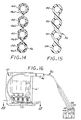
- a flexible tubing carrier 46 fabricated of a flexible plastic material with tube-receiving channels 46A-46D formed therein, sized so that the individual tubes snap fit into the channels, as shown in FIG. 14.
- An exemplary material for fabrication of the tube carrier is polyurethane.
- the four tubes 38-44 can be fabricated of an integral extrusion 36', wherein the tubes are joined together by portions of the extrusion. This alternate embodiment is shown in FIG. 15.
- the tubing set 36 runs from the individual off-axis cartridges 31-34 to the carriage mounted cartridges 18 in a run length of approximately 25 to 30 inches for a small printer, with about 26-28 inches in the exemplary embodiment.
- the inner tube diameter is in the range of 0.030 to 0.150 inches, depending on the required ink flow rates, with 0.054 to 0.094 inches the preferred range, and about 0.064 inches an exemplary preferred diameter of the tubing for the printer 10.
- the tubing outer wall thickness is preferably in the range of 0.010 inch to 0.020 inch, with a preferred value of 0.015 inches. The tubing bend stress versus air diffusion requirements tends to define this value.
- the tubing set 36 runs in a C-shaped channel guide 48 which is open along a side facing the print zone 14.
- a clamp (not shown) located at the off-axis supply end of the channel guide secures the position of the tubing set 36 relative to this end of the guide.
- the channel guide 48 constrains the tubing set 36 such that it cannot move further away from the print zone 14 than the upright wall 48A of the member 48, yet permits the tubing set 36 to move out of the channel guide as needed to follow the movement of the carriage 16.
- the tubing set 36 is clamped upright to the carriage 16 by a stress relief clamp 50, and so the tubing set 36 includes an off-carriage portion 36B and an on-carriage portion 36C, divided by the clamp 50.
- the tube carrier 46 terminates at the stress relief clamp.
- the tubing set 36 is bent upwardly in this exemplary embodiment from the level of the carriage 16 to the level of the channel member 48. This upward curve is accomplished by bending the tubes 38-44 to make the transition from a horizontal plane at carriage level to an upper horizontal plane at the channel guide 48. Downstream of the clamp 50, the ends of the tubes 38-44 are respectfully connected to input ports of a plastic manifold 60, which routes the ink through corresponding channels to manifold output ports, including port 62A shown in FIG. 9.
- the manifold output ports are in turn then fluidically coupled to the corresponding print cartridges 18 via ink couplers 66 and needle/septum arrangements, as shown in FIG. 5, and more particularly described in the co-pending application, "COMPLIANT INK INTERCONNECT BETWEEN PRINT CARTRIDGE AND CARRIAGE," serial number .
- An important tube routing feature embodied in the printer 10 is that the tube set 36 is routed between the off-axis ink supply and the print cartridges on the carriage 16 such that a loop is formed in the tubing set, and wherein a projection of the loop substantially overlaps a corresponding projection of the carriage.
- the tubing 208 provides a fluid path from the off-axis ink supply station 202 and the carriage 204, with a loop 210 formed in the tubing. It is noted that the tubing does not cross the vertical plane 212 between the off-axis ink supply and the carriage, and the dynamic loop 210 formed by the tubing lies mostly outside of the vertical projection of the carriage scan swept volume. Thus, the tubing takes up additional product volume beyond the carriage swept volume.
- the printer has a depth indicated at D 1 .
- a low performance tubing material is generally used, such as LDPE tubing, which has a relatively low modulus and thus permits loops with very small bend radii, say on the order of 20 mm.
- the low performance tubing can permit high air ingestion rates, leading to printing difficulties.
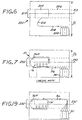
- FIG. 7 shows a highly simplified top view of the printer 10, illustrating the carriage 16, the vertical plane indicated as numeral 230 passing through the nozzle arrays of the printheads carried on the carriage, the off-axis ink supply station 30 and tubing set 36.
- a loop 36A is formed in the tubing set.
- the loop 36A is larger than the loop 210 formed in the tubing 208 of FIG. 6.
- the net increase in printer space due to the larger loop is negligible.
- the vertical projection of the loop 36A along the media path direction is substantially contained with the vertical projection of the carriage scan swept volume, indicated as 232.
- the tubing 36 crosses the axis 230 twice in this exemplary embodiment.
- plane 230 can also represent such a plane through the center of mass.
- the vertical projection of the dynamic loop 36A formed in the tubing set 36 will lie substantially within the vertical projection of the swept volume of the carriage as it passes between its right and left limits of travel. (It is the vertical projection of the loop because the loop must stay out of the way of the carriage.)
- the depth D 2 of the printer 10 can be reduced in comparison to the depth D 1 of the printer shown in FIG. 6.
- the tube routing configuration of FIG. 7 is space saving because the loop does not add to the depth (measured along the media advance axis) of the printer, even though the loop has a fairly large radius.
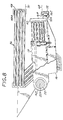
- the position of the front side of the carriage is determined by an idler wheel 16B which rotates freely on a shaft 16C. Gravity urges the wheel 16C against a lower surface 72A of a guide 72 fixedly attached to the printer housing structure. It is possible for the carriage to rotate to a small degree about the rod 22, against the force of gravity. This can happen if the carriage is subjected to forces urging the front side of the carriage upwardly. Such rotation of the carriage would adversely affect the print quality, since the alignment of the printhead relative to the print media would be affected. It is an object of this invention to minimize the forces applied to the carriage by the tubing set which could tend to lift the wheel off the surface 72A, while at the same time minimizing the size of the printer. This is accomplished by the routing of the tubing set, the selection of the tubing material and diameter and thickness of the tubes.
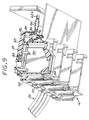
- FIG. 9 is an isometric view looking up at the carriage 16, showing a print cartridge 18 and septum 80 in cross-section. Not shown in this cross-section is a regulator valve within the print cartridge which regulates the pressure by opening and closing hole 82. An opening in the bottom of the carriage 16 exposes the printhead location 84 of each print cartridge 18. Carriage electrodes (not shown) oppose contact pads on the print cartridge 18. When the regulator valve is opened, a hollow needle 86 is in fluid communication with an ink chamber 90 internal to the cartridge 18. The needle 86 extends through a self-sealing slit formed in through the center of the septum 80. The slit is automatically sealed by the resiliency of the rubber septum 80 when the needle is removed.
- a plastic conduit 92 leads from the needle 86 to chamber 90 via hole 82.
- the conduit may also be integral to the print cartridge body.
- the conduit may be glued, heat-staked, ultrasonically welded or otherwise secured to the print cartridge body.
- a septum elbow 94 routes ink from the manifold 60 to the septum 80, and supports the septum.
- the septum is affixed to the elbow using a crimp cap.
- the coupler 66 in this exemplary embodiment is a flexible bellows for allowing a degree of x, y and z movement of the septum 80 when the needle 86 is inserted into the septum to minimize the load on the needle and ensure a fluid-tight and air-tight seal around the needle.
- the bellows may be formed of butyl rubber, high acn nitrile or other flexible material having low vapor and air transmission properties. Alternatively, the bellows can be replaced with a U-shaped or circular flexible tube.
- a spring 96 urges the septum 80 upwardly, allowing the septum to take up z tolerances, minimizes the load on the needle and ensures a tight seal around the needle 60.
- Slots 98 formed on each of the stalls 95 in the carriage 16 align with tabs on each print cartridge 18 to restrict movement of the print cartridge 18 within the stall.
- FIG. 10 is a simplified, partial top view of the printer of FIG. 3, showing the position of the tubing set 36 at various carriage positions in its scanning range of motion.
- the tubing set 36 At a first carriage position disposed at a first end of the scanning range of motion located away from the off-axis ink supply station 30, the tubing set 36 has the position illustrated as 36-1 in FIG. 10.
- the tubing set assumes a continuum of positions including the exemplary discrete positions 36-2 through 36-12 shown in FIG. 8.
- the outer (i.e. away from the area scanned by carriage 16) travel limit of the tubing set 36 is bounded by the channel guide 46 on one longitudinal side of the area scanned by the carriage 16.
- the outer travel of the tubing set 36 on the opposite longitudinal side of the scanned area is constrained by the stress relief clamp 50 which, at tubing position 36-1, results in the vertical projection of the tubing set 36 substantially containing the carriage 16, yet without the tubing extending past the side of the carriage over the slider rod 20.
- additional length of the tubing set 36 becomes available to form a somewhat larger loop which does slightly protrude over the side of the carriage over the rod 20, as shown at carriage position 36-12, for example.
- the printer volume required to accommodate the tubing set is minimized due to the efficient tube routing scheme shown in FIG. 10.
- FIG. 11 is an exploded view of the carriage manifold 60 of the system of FIG. 3.
- the manifold is shown to comprise two matching plastic manifold parts 60A and 60B with corresponding channel-defining structures, which when joined together define four leak-resistant fluid channels between an input port connected to a corresponding tube, and an output port connected to a fluid coupler for connection to the corresponding printing cartridge mounted in the carriage.
- One input port is shown as a short connector tube 60A-5.
- One output port is shown as short connector tube 60B-8.
- the two parts of the manifold are joined together with ultrasonic welding, adhesive or other sealing techniques to ensure a lead-resistant joinder between the two parts. Ultrasonic welding is a preferred method of assembly of the manifold, using tongue and groove joints as illustrated.
- An exemplary material from which the manifold can be constructed is DOW Isoplast 302, a polyurethane.
- FIGS. 12 and 13 illustrate an exemplary technique for achieving a fluidic connection between an exemplary off-axis ink cartridge 34 and its corresponding tube 42.
- a hollow needle 112 extends from an off-axis manifold 110 at a stall in the off-axis supply station 30, and is connected to input port 114 of the manifold via a 90 degree conduit 116 defined in the manifold.
- the ink within the off-axis cartridges 31-34 is at atmospheric pressure in this exemplary embodiment, and ink is drawn into each of the print cartridges 18 by a negative pressure within each cartridge 18 determined by a regulator internal to each print cartridge.
- the hollow needle 112 extends in an upward direction from the ink supply support provided by the manifold 110, and is inserted through a rubber septum 120 on the ink supply cartridge 34 to create a fluid communication path between the ink reservoir 122 within the cartridge 34 and the ink conduit 116.
- the ink reservoir 122 comprises a collapsible ink bag.
- the off-axis manifold 110 includes input ports, upwardly extending hollow needles and internal 90 degree fluid conduits for each of the other supply cartridges 31-33 at the supply station 30, as generally indicated in FIG. 13.
- a fluid conduit is established between the printer cartridges on the carriage and the off-axis ink supply reservoirs.
- the fluid conduit can include the fluid outlet from the off-axis reservoir, the manifolds at the carriage and off-axis ink supply, the tubing, the fluid coupler between the carriage manifold and the cartridge reservoir.
- the fluid conduit includes the entire fluid path between the off-axis reservoir and the carriage mounted cartridge.
- FIG. 16 is a top view of an alternate printing system embodiment 10', wherein the channel guide 46' is mounted on the opposite side of the print zone from the location of the guide 46 of the printer embodiment of FIG. 4. Thus, the channel guide 46' is mounted adjacent to and above the slider rod 22.
- the carriage end of the tubing set 36 is connected to the carriage manifold 150, located on the carriage side opposite the channel guide 46'.
- a stress relief clamp 50' is mounted to the carriage 16' to fix a section of the tubing set 36 to the carriage, as shown in FIG. 16.
- a disadvantage of the embodiment 10' is that the stress relief clamp 50' is not located adjacent the slider rod 22.
- any forces exerted by the tubing set 36 as the carriage is scanned will more readily be transferred into forces tending to pull the idler wheel 16B off the guide surface of guide 72, thus adversely affecting alignment of the printing cartridges relative to a print medium.
- the tube routing of the tubing set 36 is quite efficient, thus minimizing printing system size.
- FIGS 17 and 18 show the alternate form of manifold 150 in further detail.
- the manifold 150 includes a 90 degree elbow turn on each of the inlet ports 152, so that the tubing set 36 essentially runs parallel to the face of the manifold, instead of meeting the manifold transversely relative to the face of the manifold, as in the embodiment of FIG. 3.
- the distance of each inlet port from the face 154 of the manifold is staggered, thereby facilitating the turning and changing of elevation of the tubing set 36 as it is routed from the carriage to the off-axis ink supply station.
- the fitment stagger of the manifold defines a 15 degree angle, with 4.5 mm spacing between fitments (manifold output ports).
- manifold output ports 156 which are coupled to the print cartridges on the carriage via fluid couplers (not shown).
- the manifold 150 has four internal fluid conduits providing a fluid path from each inlet port to a corresponding output port.
- the manifold 150 provides essentially three 90 degree changes of direction of the ink path.
- the manifold 150 can be fabricated of two elements which are fixed together, in a similar fashion as the construction of manifold 60.
- FIG. 19 is a simplified top view of the printer 10' of FIG. 16, and is corresponds to FIG. 7.
- the vertical projection of the dynamic loop 36A' will be substantially contained within the vertical projection of the carriage swept volume 232', and crosses the vertical plane 230'.
- FIGS. 20-22 illustrate an alternate embodiment of a fluid coupler for coupling between the ink supply station and the printing cartridges.
- This embodiment employs heat forming to form ends of the tubing set into shapes facilitating direct connection to the septum elbow 94, eliminating the need for a separate fluid coupler 66 and a manifold 60 as in the embodiment of FIG. 3.
- a further advantage is the elimination of the fluid connections for each tube, i.e. the tube-to-manifold connection and the manifold-to-coupler connection, thereby reducing ink leak risks.
- FIGS. 21 and 22 further illustrate the formed tube ends and the structure 160.
- the structure 160 is a plastic member having a plurality of channels 162-168 formed therein of a size to receive a corresponding tube 38'-44' therein in a press fit. The channels thus hold portions of the tubes in place for stress relief, with end portions of the tubes protruding therefrom for connection to the corresponding septum elbow.
- the protruding tube portion has a loop formed therein to provide compliance to facilitate the connection to the septum elbow. For example, as shown in FIG. 21, tube 38' has a loop 170 formed therein.
- FIGS. 23 and 24 illustrate yet another embodiment of the tube routing aspect of the invention.
- the carriage 16'' is intended for use in a tube routing configuration similar to that shown in FIGS. 3-4.
- the carriage 16'' further includes a tube routing member 270 which guides the tubing set 36''' to transition planes from the stress reliever 50 located on the top surface of the carriage down to the level of the septum elbows to which the ends of the tubes are directly connected.
- the tubes comprising the tubing set 36"' can be heat formed to assume the curvature shown in FIGS. 23 and 24.
- the embodiment of FIGS. 23 and 24 also do not require a separate ink manifold, and therefore eliminate two fluid connections per tube.
- the heat forming of the tubes can be obtained by preshaping the tubing, holding the tubing in the preshaped position, and then heating the tubing. Hot air, radiant heating, or a hot forming tool can be used to heat the tubing. One way to obtain the proper shape is to place the tubing into the tube routing member of FIG. 23. The tubes can then be heated, e.g. by directing a hot air blast at the tubing to relieve stress.
Landscapes
- Ink Jet (AREA)
Applications Claiming Priority (2)
| Application Number | Priority Date | Filing Date | Title |
|---|---|---|---|
| US914832 | 1992-07-16 | ||
| US91483297A | 1997-08-18 | 1997-08-18 |
Publications (2)
| Publication Number | Publication Date |
|---|---|
| EP0903238A2 true EP0903238A2 (fr) | 1999-03-24 |
| EP0903238A3 EP0903238A3 (fr) | 2000-11-08 |
Family
ID=25434831
Family Applications (1)
| Application Number | Title | Priority Date | Filing Date |
|---|---|---|---|
| EP98306329A Withdrawn EP0903238A3 (fr) | 1997-08-18 | 1998-08-07 | Système d'alimentation en encre pour imprimante par jet d'encre |
Country Status (1)
| Country | Link |
|---|---|
| EP (1) | EP0903238A3 (fr) |
Cited By (5)
| Publication number | Priority date | Publication date | Assignee | Title |
|---|---|---|---|---|
| WO2000068018A1 (fr) | 1999-05-05 | 2000-11-16 | Inca Digital Printers Limited | Regulateur de pression d'encre commande par pression fluidique |
| WO2000068017A1 (fr) | 1999-05-05 | 2000-11-16 | Cambridge Consultants Limited | Systeme de regulation de pression pour imprimante a jet d'encre |
| WO2006076852A1 (fr) * | 2005-01-22 | 2006-07-27 | Print-Rite Unicorn Image Products Co., Ltd Of Zhuhai | Support pour tubes d’alimentation en encre d’imprimante |
| WO2006081465A1 (fr) * | 2005-01-26 | 2006-08-03 | Hewlett-Packard Development Company, L.P. | Mecanisme de distribution de fluide pour dispositif d'ejection de fluide |
| WO2018200930A1 (fr) * | 2017-04-28 | 2018-11-01 | Goss International Americas, Inc. | Collecteur d'encre interne |
Family Cites Families (5)
| Publication number | Priority date | Publication date | Assignee | Title |
|---|---|---|---|---|
| JPS552054A (en) * | 1978-06-20 | 1980-01-09 | Canon Inc | Recording device |
| JPH02111555A (ja) * | 1988-10-19 | 1990-04-24 | Fujitsu Ltd | インクジェット記録装置 |
| JPH0517712A (ja) * | 1991-07-08 | 1993-01-26 | Seiko Epson Corp | インクジエツト記録用インクの脱気方法 |
| US5751300A (en) * | 1994-02-04 | 1998-05-12 | Hewlett-Packard Company | Ink delivery system for a printer |
| US5659346A (en) * | 1994-03-21 | 1997-08-19 | Spectra, Inc. | Simplified ink jet head |
-
1998
- 1998-08-07 EP EP98306329A patent/EP0903238A3/fr not_active Withdrawn
Cited By (7)
| Publication number | Priority date | Publication date | Assignee | Title |
|---|---|---|---|---|
| WO2000068018A1 (fr) | 1999-05-05 | 2000-11-16 | Inca Digital Printers Limited | Regulateur de pression d'encre commande par pression fluidique |
| WO2000068017A1 (fr) | 1999-05-05 | 2000-11-16 | Cambridge Consultants Limited | Systeme de regulation de pression pour imprimante a jet d'encre |
| US6698869B2 (en) | 1999-05-05 | 2004-03-02 | Inca Digital Printers Limited | Fluid-pressure controlled ink pressure regulator |
| WO2006076852A1 (fr) * | 2005-01-22 | 2006-07-27 | Print-Rite Unicorn Image Products Co., Ltd Of Zhuhai | Support pour tubes d’alimentation en encre d’imprimante |
| WO2006081465A1 (fr) * | 2005-01-26 | 2006-08-03 | Hewlett-Packard Development Company, L.P. | Mecanisme de distribution de fluide pour dispositif d'ejection de fluide |
| US7461928B2 (en) | 2005-01-26 | 2008-12-09 | Hewlett-Packard Development Company, L.P. | Fluid-delivery mechanism for fluid-ejection device |
| WO2018200930A1 (fr) * | 2017-04-28 | 2018-11-01 | Goss International Americas, Inc. | Collecteur d'encre interne |
Also Published As
| Publication number | Publication date |
|---|---|
| EP0903238A3 (fr) | 2000-11-08 |
Similar Documents
| Publication | Publication Date | Title |
|---|---|---|
| EP0826504B1 (fr) | Système d'administration de fluide avec tubage pour système d'impression | |
| US5988801A (en) | High performance tubing for inkjet printing systems with off-board ink supply | |
| US6341853B1 (en) | Continuous refill of spring bag reservoir in an ink-jet swath printer/plotter | |
| US6273560B1 (en) | Print cartridge coupling and reservoir assembly for use in an inkjet printing system with an off-axis ink supply | |
| US7303271B2 (en) | Ink jet printer | |
| EP0839659B1 (fr) | Système d'alimentation en encre pour système d'impression à jet d'encre avec régulateur de pression | |
| CN100404264C (zh) | 一种墨盒以及具有该墨盒的供墨系统 | |
| JP4122077B2 (ja) | プリントカートリッジとキャリッジとの間におけるインクの自動接続装置 | |
| US6799840B2 (en) | Ink supply mechanism and inkjet recording apparatus including the ink supply mechanism | |
| US8454137B2 (en) | Biased wall ink tank with capillary breather | |
| US6457821B1 (en) | Filter carrier for protecting a filter from being blocked by air bubbles in an inkjet printhead | |
| US6120139A (en) | Ink flow design to provide increased heat removal from an inkjet printhead and to provide for air accumulation | |
| JP2000043286A (ja) | インク配給システム | |
| US20170057233A1 (en) | Damper device, liquid supply system including the same, and inkjet recording device | |
| EP0903238A2 (fr) | Système d'alimentation en encre pour imprimante par jet d'encre | |
| JP3687517B2 (ja) | インクカートリッジの接続構造およびこれを用いたインクジェット式記録装置 | |
| WO2006068313A1 (fr) | Reservoir d’encre et imprimante a jet d’encre | |
| US6234622B1 (en) | Ink delivery system that utilizes a separate insertable filter carrier | |
| JP3019842B1 (ja) | インクカートリッジ | |
| EP0968830A2 (fr) | Dispositif d'alimentation en encre | |
| US11117375B2 (en) | Liquid ejecting head and liquid ejecting apparatus | |
| US6199974B1 (en) | Ink supply system | |
| US8038272B2 (en) | Liquid-droplet jetting apparatus | |
| JP2766827B2 (ja) | インク検出装置 | |
| CN112895714A (zh) | 液体喷出装置 |
Legal Events
| Date | Code | Title | Description |
|---|---|---|---|
| PUAI | Public reference made under article 153(3) epc to a published international application that has entered the european phase |
Free format text: ORIGINAL CODE: 0009012 |
|
| AK | Designated contracting states |
Kind code of ref document: A2 Designated state(s): DE FR GB |
|
| AX | Request for extension of the european patent |
Free format text: AL;LT;LV;MK;RO;SI |
|
| PUAL | Search report despatched |
Free format text: ORIGINAL CODE: 0009013 |
|
| AK | Designated contracting states |
Kind code of ref document: A3 Designated state(s): AT BE CH CY DE DK ES FI FR GB GR IE IT LI LU MC NL PT SE |
|
| AX | Request for extension of the european patent |
Free format text: AL;LT;LV;MK;RO;SI |
|
| 17P | Request for examination filed |
Effective date: 20001212 |
|
| RAP1 | Party data changed (applicant data changed or rights of an application transferred) |
Owner name: HEWLETT-PACKARD COMPANY, A DELAWARE CORPORATION |
|
| AKX | Designation fees paid |
Free format text: DE FR GB |
|
| STAA | Information on the status of an ep patent application or granted ep patent |
Free format text: STATUS: THE APPLICATION HAS BEEN WITHDRAWN |
|
| 18W | Application withdrawn |
Withdrawal date: 20020531 |