EP0903602A2 - Anordnung zum Verbinden einer Lichtleitfaser aus Kunstoff an einen Photodetektor - Google Patents
Anordnung zum Verbinden einer Lichtleitfaser aus Kunstoff an einen Photodetektor Download PDFInfo
- Publication number
- EP0903602A2 EP0903602A2 EP98402208A EP98402208A EP0903602A2 EP 0903602 A2 EP0903602 A2 EP 0903602A2 EP 98402208 A EP98402208 A EP 98402208A EP 98402208 A EP98402208 A EP 98402208A EP 0903602 A2 EP0903602 A2 EP 0903602A2
- Authority
- EP
- European Patent Office
- Prior art keywords
- light
- face
- fiber
- optical fiber
- plastic optical
- Prior art date
- Legal status (The legal status is an assumption and is not a legal conclusion. Google has not performed a legal analysis and makes no representation as to the accuracy of the status listed.)
- Withdrawn
Links
Images

Classifications
-
- G—PHYSICS
- G02—OPTICS
- G02B—OPTICAL ELEMENTS, SYSTEMS OR APPARATUS
- G02B6/00—Light guides; Structural details of arrangements comprising light guides and other optical elements, e.g. couplings
- G02B6/24—Coupling light guides
- G02B6/42—Coupling light guides with opto-electronic elements
- G02B6/4201—Packages, e.g. shape, construction, internal or external details
- G02B6/4204—Packages, e.g. shape, construction, internal or external details the coupling comprising intermediate optical elements, e.g. lenses, holograms
- G02B6/4206—Optical features
-
- G—PHYSICS
- G02—OPTICS
- G02B—OPTICAL ELEMENTS, SYSTEMS OR APPARATUS
- G02B6/00—Light guides; Structural details of arrangements comprising light guides and other optical elements, e.g. couplings
- G02B6/24—Coupling light guides
- G02B6/42—Coupling light guides with opto-electronic elements
- G02B6/4201—Packages, e.g. shape, construction, internal or external details
- G02B6/4204—Packages, e.g. shape, construction, internal or external details the coupling comprising intermediate optical elements, e.g. lenses, holograms
-
- G—PHYSICS
- G02—OPTICS
- G02B—OPTICAL ELEMENTS, SYSTEMS OR APPARATUS
- G02B6/00—Light guides; Structural details of arrangements comprising light guides and other optical elements, e.g. couplings
- G02B6/24—Coupling light guides
- G02B6/42—Coupling light guides with opto-electronic elements
- G02B6/4292—Coupling light guides with opto-electronic elements the light guide being disconnectable from the opto-electronic element, e.g. mutually self aligning arrangements
Definitions
- the invention relates to the field of high-speed optical communications and a plastic optical fiber used therefor.
- the invention concerns in particular a connecting structure between the plastic optical fiber and a light-receiving element (photodetector).
- a plastic optical fiber in general has a wider core diameter than the other quartz-type optical fibers. It is therefore easy to connect them to one another or to another optical element. Also, the components thereof are not required to have a precise dimension.
- the plastic optical fiber is therefore useful for a cost-effective optical communications device, the optical alignment of which can easily be performed.
- the device was generally configured such that an end face of the plastic optical fiber is disposed face-to-face against the light-receiving face of an optical element such as photo-diode.
- the response speed of a photo-diode is determined by the time span, during which the electrons, that are excited by the light entering its light-receiving portion through the light-receiving face, reach its inside electrode.
- the light-receiving portion of the photo-diode has to be scaled down, so that the above-mentioned time span is shortened.
- An object of the invention is therefore to provide a connecting structure between the plastic optical fiber and the light-receiving element, which minimizes the connection loss caused therebetween.
- a structure for connecting a plastic optical fiber to a light-receiving element the fiber having an end face that emits light, whilst the light-receiving element comprising a light-receiving face having a smaller surface than that of the end face of the fiber and receiving the light emitted therefrom.
- the structure has a frusto-conical outer surface, and a fiber-side and an element-side face, the diameter of which decreases gradually from the fiber-side face towards the element-side face and is adapted for interconnecting the end face of the fiber and the light-receiving face.
- the plastic optical fiber may have a core and a cladding portion and the fiber-side face of the structure may have a size substantially the same as that of the end face of the core portion of the plastic optical fiber, whilst the element-side face of the structure has a size substantially the same as that of the light-receiving face of the light-receiving element.
- the structure is formed of a material having the same refractive index as that of the core portion of the plastic optical fiber.
- the structure may be covered with a coating having a lower refractive index than that of the cladding portion of the plastic optical fiber.
- an optical connector comprising the structure according to claim 1, the plastic optical fiber and the light-receiving element.
- the optical connector 1 comprises a fiber-side (rear side in Fig. 1) housing 10 which holds a plastic optical fiber A and a module-side (front side in Fig. 1) housing 30 which contains a photo-diode PD.
- the light-receiving face of the photo-diode is smaller than the end face of the plastic optical fiber.
- the fiber-side housing 10 comprises a frame 11 and a ferrule 21 engaged thereinto.
- the optical fiber A is first stripped of the coating from its end portion.
- the ferrule 21 having a cylindrical portion 22 is then fitted onto the region covering this end portion.
- the cylindrical portion 22 is provided with an outwardly projecting circular guard 24 about halfway on its axial direction.
- the frame 11 has a tubular container 12 that contains the ferrule 21.
- the inner diameter of the tubular container 12 is somewhat greater than the outer diameter of the guard 24 of the ferrule 21.
- the tubular container 12 of the frame 11 is provided, at its inner circular surface, with an inwardly projecting neck 13 which slides on the cylindrical portion 22 of the ferrule 21. The neck 13 serves to position the ferrule 21.
- the ferrule 21 is wrapped with a coil spring 14 from the position behind the guard 24 towards the rear side (see Fig. 1).
- the tubular container 12 of the frame 11 is fitted with a cap 15 which pushes the coil spring 14 from the rear side onwards.
- the coil spring 14 thus pushes the guard 24 of the ferrule 21 towards the front side (see Fig. 1).
- the guard 24 abuts against the neck 13 of the tubular container 12, whilst the ferrule 21 is prevented from the backward movement.
- the cap 15 is provided with a hole 15a, into which the optical fiber A is rubbed through. By this movement, the position of the fiber A at the rear side of the tubular container 12 is determined.
- the top side of the fiber-side housing 10 (rear side in Fig. 1) is provided with an elongate stopper 16 extending from the rear side to about halfway the housing 10.
- This stopper 16 comprises a bracket 17 at its end portion.
- the module-side housing 30 (front side in Fig. 1) has a knob 33a. When the bracket 17 and the knob 33a are clipped, the module-side housing 30 and the fiber-side housing 10 fit firmly.
- the elongate stopper 16 is equipped with a handle 18. When the handle 18 is pushed down, the knob 33a is released from the bracket 17 and the both housings 10, 30 are separated.
- the module-side housing 30 comprises a frame 31 and an inner housing 32.
- the frame 31 of the module-side housing 30 forms the shape of a box which is opened up in the axial direction of the fiber A.
- the frame also comprises a top plate 33 and a bottom plate 34. Part of the top plate 33 is cut into the knob 33a that engages with the bracket 17 and holds the fiber-side housing 10.
- the front side of the inner housing 32 is fixed to the inner surface of the bottom plate 34 in the housing 31.
- This inner housing comprises a cylindrical guide 39 which is located at the rear side and receives the terminal portion of the ferrule 21 installed in the fiber-side housing 10.
- the inner housing 32 also comprises a container 41 for photo-diode PD at its front side and an intermediate container 40 between this and the cylindrical guide 39.
- the intermediate container holds a relaying element 50 which will be described later.
- the cylindrical guide 39 is arranged in a position corresponding to the ferrule 21 of the fiber-side housing 10.
- the ferrule 21 is led through the guide 39, it arrives at a predetermined position in the module-side housing 30 and is held at this position.
- the PD container 41 together with a base plate 42, forms an inside space corresponding to the outer shape of the photo-diode PD.
- the photo-diode PD When the photo-diode PD is put into the PD container 41, it rests on the base plate 42.
- the front side of the frame 31 of the module-side housing 30 is then capped with a lid 43 having spacers 44. Through these spacers 44, the photo-diode PD is pushed towards the guide 39 and immobilized in this state.
- a pair of lead cords L extends from the bottom of the photo-diode PD. They pass through the base plate 42 and the space between the base plate 42 and the lid 43, respectively, and are led away from the module-side housing 30.
- the photo-diode PD has a light-receiving portion R.
- the light-receiving portion R is placed on the central axis of the ferrule 21, fixedly positioned at a predetermined site by the guide 39.
- the intermediate container 40 located between the guide 39 and the PD container 41 has an inner diameter slightly greater than that of the guide 39, so that the relaying element 50 can be contained therein.
- the relaying element 50 thus comprises a relay ferrule 54, inside which a connecting structure such as light-relay element 52 is contained.
- the light-relay element 52 is made of a material having the same level of refractive index as that of the core portion of the plastic optical fiber A. Its rear end face has a size comparable to the end face of the plastic optical fiber, whilst its front end face has a size comparable to the light-receiving face of the light-receiving portion R in the photo-diode PD. In addition, its diameter decreases gradually from the rear side to the front side. Further, the surrounding surface of the relay element 52 is protected with a coating having a refractive index smaller than that of the cladding of the plastic optical fiber A.
- the above-mentioned light-relay element 52 can be manufactured, for instance, by heating a plastic optical fiber, drawing the hot fiber through its both ends, solidifying the fiber under cooling and cutting out a tapered portion therefrom.
- the element 52 further can be protected by painting a low refractive-index resin therearound.
- the relay ferrule 54 is provided with that space corresponding to the outer shape of the light-relay element 52 which fixedly contains the element 52.
- the light-relay element 52 is thus contained in the intermediate container 40 via the relay ferrule 54.
- the element 52 is positioned therein such that its large surface faces the end face of the guide 39, whilst its small surface is opposed to the light-receiving face of the photo-diode PD, either in contact or in close distance.
- the plastic optical fiber A is positioned in the guide 39 via the ferrule 21 and its end face faces the rear side of the light-relay element 52.
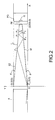
- Fig. 2 illustrates a light path, according to which the light emitted from the end face of a plastic optical fiber A passes through the light-relay element 52 and enters the photo-diode PD.
- the core diameter of the plastic optical fiber A, its numerical aperture and the diameter of light-receiving face (Rf) of photo-diode PD measure respectively 500 ⁇ m, 0. 3 and 100 ⁇ m.
- the end face diameter of the light-relay element 52 at the side of the optical fiber A, its end face diameter at the side of the photo-diode PD and its length measure 500 ⁇ m, 100 ⁇ m and 5,000 ⁇ m, respectively.
- Fig. 2 also shows abscissa X and ordinate Y, drawn, as the origin, from the lowermost point Po of the end face of the light-relay element 52 at the side of the optical fiber A.
- the cross-section along the optical axis of the light-relay element 52 defines the upper and lower straight line L, M formed by the circular surface.
- the plastic optical fiber A has a numerical aperture of 0. 3
- the light advancing therein forms an inclination angle of about 7. 7° in respect to its center axis, ie abscissa X.
- the light forms a second reflection point P 1 on the circular surface of the light-relay element 52.
- the light reflected at point P 1 follows the path line P 1 P 2 .
- the light is repeatedly reflected inside the light-relay element 52, gradually led into the smaller diameter region thereof and then emitted from the small end face of the element 52.
- the emitted light enters the light-receiving face Rf of the photo-diode PD.
- the end face of the light-relay element 52 and the light-receiving face Rf are shown in separate position for the purpose of better illustration. However, in normal state, they are placed very closely or in contact.
- the light emitted from the end face of the plastic optical fiber A is passed through the light-relay element 52 and led into the smaller diameter region, so that the light is converged.
- the converged light is emitted from the small end face of the light-relay element 52 and enters the light-receiving face Rf of the photo-diode PD.
- a plastic fiber A having a large core diameter and a photo-diode PD having a small-diameter light-receiving face Rf are thus snugly connected and the optical loss due to connection can be minimized.
- the plastic fiber side of the light-relay element 52 is scaled so as to approximately correspond to the core size of the plastic fiber A.
- the light exiting from the end face of the fiber A is efficiently led into the light-relay element 52.
- the photo-diode side end face of the light-relay element 52 is scaled into about the same size as the light-receiving face Rf. Consequently, the light exiting from the light-relay element 52 can be efficiently recovered by the light-receiving face Rf.
- optical fibers currently used have a different level of numerical aperture. Therefore, when the converging capacity of the hemi-spherical lens and the optical fiber are not matched, a considerable amount of optical loss was to be expected.
- the connecting structure according to the invention allows to choose easily an appropriate light-relay element 52 which matches the numerical aperture of the plastic optical fiber.
- the connecting structure thus has a wider use.
- a polycarbonate-type multifunctional resin (epoxy resin) is commonly used.
- This type of resin has a refractive index of 1. 56 to 1. 59 after hardening, which is relatively high. Accordingly, when the light emitted from the light-relay element 52 enters the resin, the light is refracted so as to form an angle nearer to a perpendicular direction to the light-receiving face Rf. Due to this phenomenon, the connecting loss is minimized.
- the outer circular surface of the light-relay element 52 is surrounded with a protection coating layer having a lower refractive index than that of the cladding portion of the plastic optical fiber A. The farther the light propagates In the light-relay element 52, the greater becomes the angle of the light against the axial center. By virtue of the above-mentioned coating layer, such a light can be efficiently reflected.
- a structure connecting a plastic optical fiber and a light-receiving element was manufactured and the connection loss of the structure was measured as mentioned hereinafter.
- an optical connector 1 having the same constitution as the one described for the above-mentioned embodiment is used.
- the light-relay element 52 was prepared from a product SI-POF (Step Index-Plastic Optical Fiber) manufactured by Asahi Kasei Kogyo Kabushiki Kaisha, which has an outer diameter of 750 ⁇ m, a refractive index difference of 0. 02 and a transmission loss of 230 dB/km.
- SI-POF Step Index-Plastic Optical Fiber
- the end portion of the product SI-POF was hung with a poise of 100 g via a kite string. Then, part of the product covering a length of 10 mm was drawn under the heat at 150 °C and hardened, so as to obtain a heat-deformed, tapered portion. This portion was cut out.
- the heating time from 5 to 10 seconds, the taper angle of the outer circular face of the light-relay element 52 was varied. In this way, several kinds of tapered portion were obtained.
- the intermediate ferrule 54 was prepared by cutting a brass material and forming a hollow therein capable to contain the light-relay element 52.
- LED module of GL link product name
- Sumitomo Wiring Systems was used as the light source for measure. This module was continuously driven through a finely stabilized electrical source, so that a light having a central wavelength of 700 nm in LED module was emitted at an output of 3 dBm.
- the light belonging to this LED module is led to the photo-diode PD through a plastic optical fiber.
- This fiber was obtained by cutting a 2 m-length out of fiber SI-POF manufactured by Asahi Kasei Kogyo Kabushiki Kaisha.
- connection loss was measured by an Optical Power Meter (Product Number 3292) manufactured by Yokogawa, in which its wavelength-sensitivity center is set up to 700 nm.
- the sensor unit of this apparatus was arranged in container 41 in the module-side housing 30 instead of photo-diode PD.
- the column headlined ' Surface proportion' indicates the surface ratio of the light-receiving face of photo-diode PD with respect to the small end face of light-relay element 52.
- the light loss occurring when the light enters from the light-relay element 52 into the photo-diode PD must also be taken into consideration.
- the connection loss is the lowest.
- the light-relay element is interposed between an end face of the plastic optical fiber and the light-receiving face of a light-receiving element. Further, this element has a diameter gradually decreasing from the fiber side towards the light-receiving face. Then, the light emitted from the end face of the plastic optical fiber is converged through the light-relay element and enters the light-receiving face of the light-receiving element. Accordingly, a greater part of the light coming from the fiber end face enters the light-receiving face, with the result that the connection loss therebetween can be minimized.
- the plastic fiber side of the light-relay element is scaled so as to correspond approximately to the core size of the plastic fiber, whilst its light-receiving element side end face is scaled into about the same size as the light-receiving face of the light-receiving element.
- the diameter of the light-relay element is formed so as to decrease gradually from its fiber-side end face towards the light-receiving element. As the light advances inside it, the angle with which the light is directed towards the cylindrical surface of the light-relay element becomes greater gradually. Therefore, when the outer cylindrical surface of the light-relay element is protected by a coating having a refractive index lower than that of the fiber's cladding portion, the light can be efficiently transmitted.
Landscapes
- Physics & Mathematics (AREA)
- General Physics & Mathematics (AREA)
- Optics & Photonics (AREA)
- Optical Couplings Of Light Guides (AREA)
- Optical Fibers, Optical Fiber Cores, And Optical Fiber Bundles (AREA)
- Light Receiving Elements (AREA)
Applications Claiming Priority (3)
| Application Number | Priority Date | Filing Date | Title |
|---|---|---|---|
| JP246790/97 | 1997-09-11 | ||
| JP9246790A JPH1184182A (ja) | 1997-09-11 | 1997-09-11 | プラスチック光ファイバと受光素子との接続構造 |
| JP24679097 | 1997-09-11 |
Publications (2)
| Publication Number | Publication Date |
|---|---|
| EP0903602A2 true EP0903602A2 (de) | 1999-03-24 |
| EP0903602A3 EP0903602A3 (de) | 1999-11-24 |
Family
ID=17153718
Family Applications (1)
| Application Number | Title | Priority Date | Filing Date |
|---|---|---|---|
| EP98402208A Withdrawn EP0903602A3 (de) | 1997-09-11 | 1998-09-08 | Anordnung zum Verbinden einer Lichtleitfaser aus Kunstoff an einen Photodetektor |
Country Status (4)
| Country | Link |
|---|---|
| US (1) | US6062742A (de) |
| EP (1) | EP0903602A3 (de) |
| JP (1) | JPH1184182A (de) |
| CN (1) | CN1109908C (de) |
Cited By (7)
| Publication number | Priority date | Publication date | Assignee | Title |
|---|---|---|---|---|
| EP1182479A1 (de) * | 2000-08-11 | 2002-02-27 | Alcatel | Modenfeldumwandler für eine höchsteffiziente Kopplung in optischen Modulen |
| DE10054551A1 (de) * | 2000-11-01 | 2002-05-16 | Infineon Technologies Ag | Lichtempfangsvorrichtung |
| GB2350440B (en) * | 1999-04-23 | 2003-02-26 | Yazaki Corp | Optical fibre connector with tapered light guide |
| EP1170611A3 (de) * | 2000-07-04 | 2004-10-20 | Yazaki Corporation | Hülse und deren Herstellungsverfahrung |
| WO2004097486A1 (en) * | 2003-04-29 | 2004-11-11 | Pirelli & C. S.P.A. | Coupling structure for optical fibres and process for making it |
| EP1722258A1 (de) * | 2005-05-13 | 2006-11-15 | STMicroelectronics S.r.l. | Kopplungsmodul für optische Strahlung |
| DE10009845B4 (de) * | 2000-03-01 | 2011-06-01 | Escha Bauelemente Gmbh | Steckverbinder für einen Lichtwellenleiter |
Families Citing this family (13)
| Publication number | Priority date | Publication date | Assignee | Title |
|---|---|---|---|---|
| JP2000193849A (ja) * | 1998-12-28 | 2000-07-14 | Yazaki Corp | 光コネクタ、スリ―ブ、及び、スリ―ブの製造方法 |
| JP2001074987A (ja) * | 1999-09-08 | 2001-03-23 | Yazaki Corp | レセプタクルの製造方法、レセプタクル、及び光コネクタ |
| DE10122685B4 (de) * | 2001-05-10 | 2005-12-08 | Siemens Ag | Anordnung mit mindestens zwei überkreuzten Lichtwellenleitern |
| DE10126659B4 (de) * | 2001-06-01 | 2010-06-10 | Escha Bauelemente Gmbh | Steckverbinder für Lichtwellenleiter |
| US6809823B2 (en) * | 2001-09-28 | 2004-10-26 | Agilent Technologies, Inc. | Method for the calibration and alignment of multiple multi-axis motion stages for optical alignment to a planar waveguide device and system |
| JP3960073B2 (ja) * | 2002-02-21 | 2007-08-15 | ソニー株式会社 | 光リンク装置 |
| US20040101251A1 (en) * | 2002-11-27 | 2004-05-27 | Fci Americas Technology, Inc. | Plastic optical connector |
| JP5470784B2 (ja) * | 2008-09-12 | 2014-04-16 | オムロン株式会社 | 受光装置およびセンサ装置 |
| JP5952326B2 (ja) | 2013-06-28 | 2016-07-13 | Toto株式会社 | 光レセプタクル |
| US10564357B2 (en) * | 2013-07-30 | 2020-02-18 | The Boeing Company | Plastic optical fiber bus network using tapered mixing rods |
| US11300730B2 (en) * | 2013-07-30 | 2022-04-12 | The Boeing Company | Plastic and glass optical fiber bus network having plural line replaceable units transmitting to a mixing rod |
| US9778419B1 (en) | 2016-06-23 | 2017-10-03 | The Boeing Company | Fiber optical system with fiber end face area relationships |
| JP2022179073A (ja) * | 2021-05-21 | 2022-12-02 | 株式会社エンプラス | 光レセプタクルおよび光モジュール |
Family Cites Families (9)
| Publication number | Priority date | Publication date | Assignee | Title |
|---|---|---|---|---|
| FR2560395B1 (fr) * | 1984-02-24 | 1986-11-21 | Thomson Csf | Coupleur optoelectronique pour fibres optiques a prelevement reglable et systeme de transmissions bidirectionnelles d'informations mettant en oeuvre un tel coupleur |
| JPS6169008A (ja) * | 1985-08-23 | 1986-04-09 | Toshiba Corp | 光結合装置の製造方法 |
| JPS6323106A (ja) * | 1987-02-04 | 1988-01-30 | Toshiba Corp | 光結合装置 |
| JPH01100502A (ja) * | 1987-10-13 | 1989-04-18 | Sumitomo Electric Ind Ltd | 集束形ロッドレンズ |
| EP0562211A1 (de) * | 1992-03-25 | 1993-09-29 | International Business Machines Corporation | Selbstausrichtende Faserkoppler |
| US5438873A (en) * | 1993-07-01 | 1995-08-08 | Fiberoptic Sensor Technologies, Inc. | Fiberoptic sensor using tapered and bundled fibers |
| JP3248331B2 (ja) * | 1994-01-24 | 2002-01-21 | 住友電装株式会社 | フェルール端末 |
| JPH09127374A (ja) * | 1995-10-31 | 1997-05-16 | Omron Corp | 光ファイバ投受光装置、光ファイバ式光電センサおよび光ファイバ式光電センサと光ファイバを接続するためのコネクタ |
| JPH10239559A (ja) * | 1997-02-26 | 1998-09-11 | Sumitomo Wiring Syst Ltd | 光伝送装置 |
-
1997
- 1997-09-11 JP JP9246790A patent/JPH1184182A/ja active Pending
-
1998
- 1998-09-03 US US09/146,315 patent/US6062742A/en not_active Expired - Fee Related
- 1998-09-04 CN CN98117483A patent/CN1109908C/zh not_active Expired - Fee Related
- 1998-09-08 EP EP98402208A patent/EP0903602A3/de not_active Withdrawn
Cited By (10)
| Publication number | Priority date | Publication date | Assignee | Title |
|---|---|---|---|---|
| GB2350440B (en) * | 1999-04-23 | 2003-02-26 | Yazaki Corp | Optical fibre connector with tapered light guide |
| DE10009845B4 (de) * | 2000-03-01 | 2011-06-01 | Escha Bauelemente Gmbh | Steckverbinder für einen Lichtwellenleiter |
| EP1170611A3 (de) * | 2000-07-04 | 2004-10-20 | Yazaki Corporation | Hülse und deren Herstellungsverfahrung |
| EP1182479A1 (de) * | 2000-08-11 | 2002-02-27 | Alcatel | Modenfeldumwandler für eine höchsteffiziente Kopplung in optischen Modulen |
| US6633705B2 (en) | 2000-08-11 | 2003-10-14 | Alcatel | Modal field converter for a highly efficient coupling in optical modules |
| DE10054551A1 (de) * | 2000-11-01 | 2002-05-16 | Infineon Technologies Ag | Lichtempfangsvorrichtung |
| DE10054551C2 (de) * | 2000-11-01 | 2002-10-24 | Infineon Technologies Ag | Lichtempfangsvorrichtung |
| WO2004097486A1 (en) * | 2003-04-29 | 2004-11-11 | Pirelli & C. S.P.A. | Coupling structure for optical fibres and process for making it |
| US7645076B2 (en) | 2003-04-29 | 2010-01-12 | Pirelli & C. S.P.A. | Coupling structure for optical fibres and process for making it |
| EP1722258A1 (de) * | 2005-05-13 | 2006-11-15 | STMicroelectronics S.r.l. | Kopplungsmodul für optische Strahlung |
Also Published As
| Publication number | Publication date |
|---|---|
| CN1109908C (zh) | 2003-05-28 |
| US6062742A (en) | 2000-05-16 |
| JPH1184182A (ja) | 1999-03-26 |
| EP0903602A3 (de) | 1999-11-24 |
| CN1210987A (zh) | 1999-03-17 |
Similar Documents
| Publication | Publication Date | Title |
|---|---|---|
| EP0903602A2 (de) | Anordnung zum Verbinden einer Lichtleitfaser aus Kunstoff an einen Photodetektor | |
| US6094517A (en) | Optical transmission device | |
| EP0892293B1 (de) | Modul für optische Nachrichtentechnik | |
| US5778127A (en) | Optical transceiver and filler composition | |
| US5631987A (en) | Low cost, mode-field matched, high performance laser transmitter optical subassembly | |
| US5692084A (en) | Package for an optoelectronic device | |
| US7048449B2 (en) | Optical sub-assembly | |
| EP0874258A1 (de) | Verbindung von einem optoelektronischen Element oder einem Wellenleiter zu einem Steckerstift mit einer optischen Faser | |
| CA1260163A (en) | Wave-division multiplex component for an optical network comprising monomode transmission fibers | |
| US20010033719A1 (en) | Bidirectional optical semiconductor apparatus | |
| EP0774680B1 (de) | Optischer Verbinder | |
| US20110075132A1 (en) | Angle-cleaved optical fibers and methods of making and using same | |
| EP0736190B1 (de) | Eine optische vorrichtung und ihr herstellungsverfahren | |
| US7729569B2 (en) | Optical transmitter and/or receiver assembly comprising a planar optical circuit | |
| EP1454173B1 (de) | Fokussierende faser-optik | |
| US5040862A (en) | Method of trimming optical power | |
| EP0774679A1 (de) | Optisches Filter mit Wellenleiterstruktur | |
| US20020176662A1 (en) | Electro-optical module for transmitting and/or receiving optical signals on at least two optical data channels | |
| GB2307564A (en) | Back-scattered light free optical fibre device | |
| US7387450B2 (en) | Optical receptacle having stub capable of enhancing optical coupling efficiency and optical module installing the same | |
| US6798949B2 (en) | Optical assembly with integrated lens protrusion | |
| US6438289B1 (en) | Light emitting and receiving device | |
| US6301411B1 (en) | Link structure for connecting a plastic optical fiber to a light receptor | |
| CA2354718A1 (en) | Molded optical fiber ferrule and method of making the same | |
| WO2004005992A1 (en) | Improved mode conditioning launch lead |
Legal Events
| Date | Code | Title | Description |
|---|---|---|---|
| PUAI | Public reference made under article 153(3) epc to a published international application that has entered the european phase |
Free format text: ORIGINAL CODE: 0009012 |
|
| 17P | Request for examination filed |
Effective date: 19980922 |
|
| AK | Designated contracting states |
Kind code of ref document: A2 Designated state(s): DE FR GB |
|
| AX | Request for extension of the european patent |
Free format text: AL;LT;LV;MK;RO;SI |
|
| PUAL | Search report despatched |
Free format text: ORIGINAL CODE: 0009013 |
|
| AK | Designated contracting states |
Kind code of ref document: A3 Designated state(s): AT BE CH CY DE DK ES FI FR GB GR IE IT LI LU MC NL PT SE |
|
| AX | Request for extension of the european patent |
Free format text: AL;LT;LV;MK;RO;SI |
|
| AKX | Designation fees paid |
Free format text: DE FR GB |
|
| 17Q | First examination report despatched |
Effective date: 20000915 |
|
| STAA | Information on the status of an ep patent application or granted ep patent |
Free format text: STATUS: THE APPLICATION HAS BEEN WITHDRAWN |
|
| 18W | Application withdrawn |
Effective date: 20030611 |