EP0904643B1 - Method and apparatus for providing anonymous data transfer in a communication system - Google Patents
Method and apparatus for providing anonymous data transfer in a communication system Download PDFInfo
- Publication number
- EP0904643B1 EP0904643B1 EP97927558A EP97927558A EP0904643B1 EP 0904643 B1 EP0904643 B1 EP 0904643B1 EP 97927558 A EP97927558 A EP 97927558A EP 97927558 A EP97927558 A EP 97927558A EP 0904643 B1 EP0904643 B1 EP 0904643B1
- Authority
- EP
- European Patent Office
- Prior art keywords
- communication
- network
- station
- coded signal
- group
- Prior art date
- Legal status (The legal status is an assumption and is not a legal conclusion. Google has not performed a legal analysis and makes no representation as to the accuracy of the status listed.)
- Expired - Lifetime
Links
Images

Classifications
-
- G—PHYSICS
- G06—COMPUTING OR CALCULATING; COUNTING
- G06Q—INFORMATION AND COMMUNICATION TECHNOLOGY [ICT] SPECIALLY ADAPTED FOR ADMINISTRATIVE, COMMERCIAL, FINANCIAL, MANAGERIAL OR SUPERVISORY PURPOSES; SYSTEMS OR METHODS SPECIALLY ADAPTED FOR ADMINISTRATIVE, COMMERCIAL, FINANCIAL, MANAGERIAL OR SUPERVISORY PURPOSES, NOT OTHERWISE PROVIDED FOR
- G06Q20/00—Payment architectures, schemes or protocols
- G06Q20/38—Payment protocols; Details thereof
- G06Q20/383—Anonymous user system
-
- H—ELECTRICITY
- H04—ELECTRIC COMMUNICATION TECHNIQUE
- H04L—TRANSMISSION OF DIGITAL INFORMATION, e.g. TELEGRAPHIC COMMUNICATION
- H04L63/00—Network architectures or network communication protocols for network security
- H04L63/04—Network architectures or network communication protocols for network security for providing a confidential data exchange among entities communicating through data packet networks
- H04L63/0407—Network architectures or network communication protocols for network security for providing a confidential data exchange among entities communicating through data packet networks wherein the identity of one or more communicating identities is hidden
- H04L63/0414—Network architectures or network communication protocols for network security for providing a confidential data exchange among entities communicating through data packet networks wherein the identity of one or more communicating identities is hidden during transmission, i.e. party's identity is protected against eavesdropping, e.g. by using temporary identifiers, but is known to the other party or parties involved in the communication
-
- H—ELECTRICITY
- H04—ELECTRIC COMMUNICATION TECHNIQUE
- H04L—TRANSMISSION OF DIGITAL INFORMATION, e.g. TELEGRAPHIC COMMUNICATION
- H04L63/00—Network architectures or network communication protocols for network security
- H04L63/06—Network architectures or network communication protocols for network security for supporting key management in a packet data network
- H04L63/065—Network architectures or network communication protocols for network security for supporting key management in a packet data network for group communications
-
- H—ELECTRICITY
- H04—ELECTRIC COMMUNICATION TECHNIQUE
- H04L—TRANSMISSION OF DIGITAL INFORMATION, e.g. TELEGRAPHIC COMMUNICATION
- H04L63/00—Network architectures or network communication protocols for network security
- H04L63/08—Network architectures or network communication protocols for network security for authentication of entities
- H04L63/0869—Network architectures or network communication protocols for network security for authentication of entities for achieving mutual authentication
-
- H—ELECTRICITY
- H04—ELECTRIC COMMUNICATION TECHNIQUE
- H04L—TRANSMISSION OF DIGITAL INFORMATION, e.g. TELEGRAPHIC COMMUNICATION
- H04L9/00—Cryptographic mechanisms or cryptographic arrangements for secret or secure communications; Network security protocols
- H04L9/32—Cryptographic mechanisms or cryptographic arrangements for secret or secure communications; Network security protocols including means for verifying the identity or authority of a user of the system or for message authentication, e.g. authorization, entity authentication, data integrity or data verification, non-repudiation, key authentication or verification of credentials
- H04L9/3271—Cryptographic mechanisms or cryptographic arrangements for secret or secure communications; Network security protocols including means for verifying the identity or authority of a user of the system or for message authentication, e.g. authorization, entity authentication, data integrity or data verification, non-repudiation, key authentication or verification of credentials using challenge-response
-
- H—ELECTRICITY
- H04—ELECTRIC COMMUNICATION TECHNIQUE
- H04W—WIRELESS COMMUNICATION NETWORKS
- H04W12/00—Security arrangements; Authentication; Protecting privacy or anonymity
- H04W12/06—Authentication
- H04W12/069—Authentication using certificates or pre-shared keys
-
- H—ELECTRICITY
- H04—ELECTRIC COMMUNICATION TECHNIQUE
- H04L—TRANSMISSION OF DIGITAL INFORMATION, e.g. TELEGRAPHIC COMMUNICATION
- H04L2209/00—Additional information or applications relating to cryptographic mechanisms or cryptographic arrangements for secret or secure communication H04L9/00
- H04L2209/42—Anonymization, e.g. involving pseudonyms
-
- H—ELECTRICITY
- H04—ELECTRIC COMMUNICATION TECHNIQUE
- H04L—TRANSMISSION OF DIGITAL INFORMATION, e.g. TELEGRAPHIC COMMUNICATION
- H04L2209/00—Additional information or applications relating to cryptographic mechanisms or cryptographic arrangements for secret or secure communication H04L9/00
- H04L2209/80—Wireless
-
- H—ELECTRICITY
- H04—ELECTRIC COMMUNICATION TECHNIQUE
- H04W—WIRELESS COMMUNICATION NETWORKS
- H04W4/00—Services specially adapted for wireless communication networks; Facilities therefor
- H04W4/06—Selective distribution of broadcast services, e.g. multimedia broadcast multicast service [MBMS]; Services to user groups; One-way selective calling services
- H04W4/08—User group management
-
- H—ELECTRICITY
- H04—ELECTRIC COMMUNICATION TECHNIQUE
- H04W—WIRELESS COMMUNICATION NETWORKS
- H04W8/00—Network data management
- H04W8/26—Network addressing or numbering for mobility support
-
- Y—GENERAL TAGGING OF NEW TECHNOLOGICAL DEVELOPMENTS; GENERAL TAGGING OF CROSS-SECTIONAL TECHNOLOGIES SPANNING OVER SEVERAL SECTIONS OF THE IPC; TECHNICAL SUBJECTS COVERED BY FORMER USPC CROSS-REFERENCE ART COLLECTIONS [XRACs] AND DIGESTS
- Y04—INFORMATION OR COMMUNICATION TECHNOLOGIES HAVING AN IMPACT ON OTHER TECHNOLOGY AREAS
- Y04S—SYSTEMS INTEGRATING TECHNOLOGIES RELATED TO POWER NETWORK OPERATION, COMMUNICATION OR INFORMATION TECHNOLOGIES FOR IMPROVING THE ELECTRICAL POWER GENERATION, TRANSMISSION, DISTRIBUTION, MANAGEMENT OR USAGE, i.e. SMART GRIDS
- Y04S40/00—Systems for electrical power generation, transmission, distribution or end-user application management characterised by the use of communication or information technologies, or communication or information technology specific aspects supporting them
- Y04S40/20—Information technology specific aspects, e.g. CAD, simulation, modelling, system security
Definitions
- the present invention relates generally to the transmission of data, such as packet data transmitted in a communication system providing packet radio services or circuit-switched data transmitted in a communication system providing circuit-switched communications. More particularly, the present invention relates to a method, and associated apparatus for implementing the method, for providing a communication station with anonymous access to a communication network which forms a portion of the communication system. While anonymous access to the network is provided, such access is permitted only after authenticating that the communication station is authorized to communicate with the network. Once the anonymous access is provided, communication of data between the communication station and a correspondent entity is permitted, without identifying the communication station to the communication network by a permanent, unique identifier.
- the communication station is provided anonymous access to the network, communication of data to or from the communication station is effectuated without necessitating that the communication station be uniquely identified with a permanent identifier unique to the communication station.
- the particular communication station and the user thereof remains anonymous.
- the present invention can be used, for example, to provide a mobile station with anonymous access to packet radio services, such as the General Packet Radio Service (GPRS) proposed to be standardized in the Global System for Mobile communication (GSM) telecommunications system standard. Authentication is performed to ensure that the mobile station is authorized to communicate with the network.
- GPRS General Packet Radio Service
- GSM Global System for Mobile communication
- the field of cellular telephony is exemplary of a communication system that has been made possible due to such advancements.
- Communication pursuant to a cellular telephone, or other radio telecommunication system is advantageous as a fixed, wireline connection is not required between a sending station and a receiving station to permit communications to be effectuated therebetween.
- a cellular telephone, or other radio telecommunication system is therefore particularly advantageous to effectuate communications when the use of fixed or hardwired connections to effectuate communications would be inconvenient or impractical.
- Some conventional communications pursuant to a cellular communication system are sometimes referred to as circuit-switched communications as data is transmitted upon channels and circuit paths dedicated during the communication to a particular sending and receiving station pair.
- GPRS General Packet Radio Service
- Information which is to be transmitted between a sending and receiving station is formed into discrete packets of data. Individual ones of the packets can be sent on a communication channel from the sending station to the receiving station. As the information is communicated by way of discrete packets, the sending station utilizes the channel only during the time periods required to send the discrete packets.
- the channel is typically, therefore, a shared channel, used by a plurality of sending stations.
- a packet of data to be transmitted by a sending station might have to be queued until the shared channel becomes available.
- the shared channel is shared, the costs of transmitting data on a shared channel can be shared amongst many users as a dedicated communication channel need not be allocated to the sending station to effectuate communication of the packet.
- Communications effectuated via the Internet and communications pursuant to paging networks are also exemplary of communication systems which make use of data transmission of packet data.
- GSM digital cellular communication network is exemplary of a cellular communication system for which the introduction of GPRS has been proposed and proposed standards therefor have been promulgated.
- GSM mobile stations constructed corresponding to such standards are able to communicate packet data via the GSM network.
- Authentication procedures are performed prior to providing a GSM mobile station with access to the GSM network to communicate therein.
- Standard authentication procedures are promulgated in the GSM standards.
- An exemplary authentication procedure is described, for instance, in U.S. Patent No. 5,282,250, assigned to the assignee of the present invention.
- Authentication procedures are performed to ensure that the mobile station is authorized to communicate in the system.
- Other cellular telephone, and other radio telecommunication systems utilize analogous authentication procedures for similar reasons.
- an International Mobile Subscriber Identity which permanently and uniquely identifies the mobile station, or at least the party to whom communications provided pursuant to the network are to be billed, is provided to the network. Responsive to such provided identity, the authentication procedure authenticates that the mobile station is authorized to communicate via the network. By providing the IMSI to the network, the identity of the user necessarily is provided to the network.
- An exemplary application which has been proposed is a traffic telematic application in which vehicular-mounted, mobile stations send positional, directional, and speed information to a traffic control center. Responsive to such information conveyed to the traffic control center by a plurality of vehicular-mounted mobile stations, traffic control operations can be implemented to alleviate traffic congestion, when necessary.
- Another exemplary application which has been proposed is an automatic tolling application in which passage of automotive vehicles through an automotive toll gate, or tolling point, are provided to a tolling control center.
- Vehicular-mounted mobile stations transmit signals to a tolling control center when passing through the automotive toll gate.
- EP A 0 715 476 A2 relates to a method for anonymous use of a communication system based on a group identity.
- a group identity allocated to a group of users is stored in a storage element at the user side and is sent via the user's mobile phone to the mobile telecommunication system.
- the sending of the group identity effects a barring of the transfer of the access code data identifying the user.
- What is needed, therefore, is a manner by which to provide a mobile station with anonymous access to a communication network of a communication system, thereby to permit the mobile station to communicate data in a communication system while also providing a manner by which to authenticate the mobile station prior to providing the mobile station with such anonymous access to the system.
- the present invention advantageously provides a method, and associated apparatus for implementing the method, of providing a communication station with anonymous access to a communication network of a communication system to communicate data in the communication system. Access is provided to the communication station only after authenticating that the communication station is authorized to communicate in the network, but access is provided without individually identifying the communication station to the network with a permanent identifier unique to the communication station.
- the communication station comprises a mobile station operable in a communication system which provides packet radio service, such as GPRS, permitting transfer of packet data between the mobile station and a correspondent entity.
- the mobile station is provided with anonymous access to the communication network.
- the mobile station is authenticated as being a member of a group of mobile stations permitted to utilize the communication network prior to granting the mobile station access to the network. Thereby, the mobile station is authenticated without requiring that a permanent, unique identifier of the mobile station be used to authenticate the mobile station.
- the teachings of the present invention can be advantageously utilized to provide anonymous access to generalized packet radio services proposed as part of the GSM digital cellular communication system.
- Access of the mobile station to the GSM network thereby to provide the mobile station with generalized packet radio services, is provided without requiring that the mobile station provide the network with the mobile station's International Mobile Subscriber Identity (IMSI). Instead, the mobile station provides the GSM network with an International Mobile Group Identity (IMGI).
- IMSI International Mobile Subscriber Identity
- IMGI International Mobile Group Identity
- the mobile station can thereby be authenticated as being a member of a group of anonymous mobile stations authorized to be provided with packet radio services. Services are provided, thereby, to the mobile station without requiring that the IMSI of the mobile station be provided to the network.
- the mobile station is provided anonymous access to the communication network to permit the transfer of circuit-switched data therethrough.
- the mobile station permits packet radio services only to be provided.
- the mobile station forms a portion of a mobile station which permits circuit-switched telecommunications, such as those provided in a conventional cellular communication system.
- the mobile station permits both circuit-switched communications and packet data communications.
- the present invention is utilized to initiate packet data transmission in a traffic telematic application, for example, to provide a traffic control center with vehicular traffic information.
- a traffic telematic application for example, to provide a traffic control center with vehicular traffic information.
- anonymity of communications is required for privacy reasons.
- Mobile stations are positioned upon vehicles and send packet data representative of, e.g., positional, directional, and speed information related to the position of the vehicles upon which the mobile stations are positioned. Responsive to such information, traffic control operations can be implemented, such as traffic light control operations to alleviate traffic congestion. Because of the anonymous access granted to the mobile station, the privacy of the user or owner of the vehicle in which the mobile station is positioned is maintained.
- the present invention is utilized in an automatic tolling application.
- Vehicular-mounted mobile stations transmit signals when passing through an automotive toll gate. Indications of such signals are forwarded on to a tolling control center, such as by way of a GSM communication network. This permits toll fees to be paid electronically, e.g., based upon coding of a smart card.
- the mobile station is granted anonymous access to the network such that, to the network, the identity of the mobile station is anonymous.
- Indications of the mobile station's permanent identity may, optionally, depending upon the payment method, be provided to the tolling control center, but in a manner which is transparent to the communication network. Viz., the permanent identity of the mobile station remains unknown to the communication network.
- traffic telematic applications can similarly embody the teachings of the present invention to provide a communication station anonymous access to a communication network while also authenticating the communication station to ensure that the communication station is authorized to communicate with the communication system.
- teachings of the present invention can also be advantageously utilized in a communication system to provide anonymous access to permit the communication of the circuit-switched data.
- a communication network effectuates communication between at least a first communication station and a correspondent entity.
- the first communication station is a group-identified communication station of a group of group-identified communication stations.
- Each group-identified communication station of the group is identified by a group identifier.
- the data transmission is initiated without individually identifying the first communication station with a permanent identifier unique to the first communication station.
- a group identifier signal is provided to the communication network.
- the group identifier signal is of a value representative of at least the group identifier.
- At least a first network coded signal and a second network-coded signal are formed responsive, at least in part, to the group identifier signal provided to the communication network.
- the second network-coded signal is then sent to the first communication station.
- a first station-coded signal is formed at the first communication station responsive to reception of the second network-coded signal.
- the first network-coded signal is then compared with the first station-coded signal. Then, authorization of initiation of transmission of the data between the first communication station and the communication network is authorized responsive to such comparisons.
- an exemplary communication system shown generally at 10, provides anonymous access of a mobile station 12 to a communication network 14.
- the communication system 10 here forms a GSM communication system
- the mobile station 12 forms a GSM mobile station
- the communication network includes a GSM infrastructure network.
- the anonymous access provided to the mobile station 12 during operation of an embodiment of the present invention permits the mobile station 12 to communicate by way of the communication network 14 with a remotely-positioned device, here a correspondent entity 16, without identifying the mobile station 12 with a permanent identifier which uniquely identifies the mobile station. While, for purposes of illustration, a single mobile station 12 is illustrated, a plurality of mobile stations are able to communicate by way of the communication network 14.
- the mobile station 12 is one of a group of mobile stations, each mobile station of the group commonly-identified with a group identifier.
- the mobile station 12 permits the communication of packet data. In another embodiment of the present invention, the mobile station 12 permits the communication of circuit-switched data. And in another embodiment of the present invention, the mobile station 12 permits the communication of at least both packet data and circuit-switched data. In the exemplary embodiment illustrated in the Figure, the mobile station 12 is operable to communicate packet data by way of the communication network 14, here forming a GPRS communication network.
- the mobile station 12 includes, inter alia, both transmitter circuitry 18 and receiver circuitry 22. Operation of the transmitter and receiver circuitry 18 and 22 is controlled by processing circuitry, here identified as a controller 24.
- the controller 24 is coupled to the transmitter and receiver circuitry 18 and 22 by way of lines 26 and 28, respectively.
- the controller is further coupled to a memory device 32 by way of lines 34.
- the transmitter and receiver circuitry are respectively operable to transmit and to receive TDMA, GMSK-modulated signals.
- the circuitry of the mobile station 12 is operable to generate and to receive other types of communication signals, modulated in other manners and in other communication schemes.
- SIM Subscriber Identity Module
- the SIM card 36 is coupled to the circuitry of the mobile station 12 in conventional manner, here indicated by the lines 42 connecting the SIM card 36 with the controller 24.
- the memory element 38 includes storage locations for storing an International Mobile Group Identity (IMGI) 44, an authentication key (K i ) 46, and, optionally, one or more destination address.
- IMGI International Mobile Group Identity
- K i authentication key
- IP Internet protocol address
- the memory element 38 of the SIM card 36 may further include additional storage locations for storing other information, such as an International Mobile Subscriber Identity (IMSI), and an associated authentication key, K j , conventionally utilized e.g., in an authentication procedure pursuant to conventional telecommunication by way of the mobile station 12.
- IMSI International Mobile Subscriber Identity
- K j Uplink signals generated during operation of the mobile station 12 are formed by the transmitter circuitry 18 and transduced by an antenna 52. Signals transmitted to the mobile station 12 are detected by the antenna 52, transduced thereat and applied to the receiver circuitry 22, all in conventional manner.
- the communication network 14 receives uplink signals 54 generated by the mobile station 12 and transmits downlink signals 56 to the mobile station 12.
- the communication network 14 includes, inter alia, a base station (BTS) 62, operable in conventional manner to transceive the uplink and downlink signals 54 and 56 by way of an antenna transducer 64.
- the base station transceiver 62 is coupled to a base station controller (BSC) 66 by way of lines 68 in conventional manner and, the base station controller 66 is coupled, in turn, to a mobile services switching center (MSC) 72 by way of lines 74.
- a visitor location register (VLR) is positioned at the mobile services switching center, together referenced as an MSC/VLR.
- the mobile switching center 72 and the VLR located thereat, is coupled, in conventional fashion, here indicated by lines 76 to a home location register (HLR) 78.
- HLR home location register
- the HLR 78 is coupled to a general packet radio service (GPRS) register 82 and to an authentication center (AUC) 84 by way of lines of 86 and 88, respectively.
- GPRS general packet radio service
- AUC authentication center
- the GPRS register 82 and the AUC 84 are located together with the HLR 78; such an embodiment is indicated by the block 92, shown in dash.
- a storage location 93 coupled to the GPRS register 82 stores a value of an IP address analogous to the IP address 48.
- the authentication center 84 includes storage locations for storing group identities, including the International Mobile Group Identity (IMGI) 94 and authentication key (K i ) 96, corresponding to the IMGI and K 1 44 and 46 stored at the SIM card 36 at the mobile station 12.
- Processing circuitry of the AUC 84 generate a random number, RAND 98.
- the value of the RAND 98 is stored at a storage location of the communication network. In a GPRS context, the RAND 98 is stored in a GPRS register, or elsewhere, as appropriate.
- Processing circuitry of the AUC 84 is operable to execute an algorithm responsive to values of the RAND 98 and K i 96 to form a signed response (SRES) value, indicated by SRES 100.
- a ciphering key (K c ) 102 is also calculated by an algorithm, responsive to values of the RAND 98 and the K i 96.
- the communication network is further shown to include a Gateway GPRS Support Node (GGSN) 104 and Serving GPRS Support Node (SGSN) 106.
- the GGSN 104 and SGSN 106 are logical entities.
- the GGSN 104 provides an interface towards external data networks, here an external data network 108.
- the GGSN 104 is operable, for example, to translate data formats, signaling protocols and address information in order to permit communication between different networks.
- the GGSN 104 is further operable for purposes of routing to SGSNs, such as the SGSN 106, to perform protocol conversions, and interrogations of data from the GPRS register 82.
- the SGSN 106 provides, for example, for packet routing of packet data to and from a service area of the node 106, signaling exchanges with the MSC/VLR 72, and GPRS register 82, and control, monitoring, and parameter storage functions related to packet data mobile stations, such as the mobile station 12.
- the service nodes 104 and 106 are coupled together by way of a backbone network 108, such coupling indicated by lines 112 and 114 extending to the backbone network 108.
- Additional support nodes such as a GGSN 116 and a SGSN 118 are further illustrated to be coupled to the backbone network 108, such couplings indicated by the lines 122 and 124, respectively.
- Additional service nodes can additionally be represented and analogously coupled together, also to form portions of the communication network 14.
- Exemplary operation of an embodiment of the present invention shall be described with respect primarily to the anonymous transfer of packet data, such as that described with respect to the GPRS Stage 1 Service Description, GSM 02.60, b1.3.0, Section 5.4.4.
- Such description defines a requirement for an anonymous access (AA) service, permitting anonymous mobile-originated (MO) packet transfer to a predetermined destination address.
- AA anonymous access
- MO mobile-originated
- the mobile station 12 Although access of the mobile station 12 to permit the communication of data anonymously and transparently between the mobile station 12 and a correspondent entity 16, the mobile station 12 must be authenticated to ensure that the mobile station 12 should be permitted such access to communicate by way of the communication network 14. Operation of the present invention, while permitting anonymous access of the mobile station to communicate by way of the communication network 14, ensures that the mobile station is authorized to communicate therein. In an embodiment of the present invention, two-way communication between the mobile station 12 and the correspondent entity 16 is further permitted, all while preserving the anonymity of the mobile station in the communication network 14.
- IP Internet protocol
- CLNP CLNP
- X.25 X.25
- an attach/activation procedure i.e., a log-on procedure
- the mobile station 12 must identify itself to the communication network 14. To do so, the mobile station 12 transmits a group identifier signal to the network.
- the group identifier signal is of a value representative of the IMGI 44. In one embodiment, the group identifier signal further includes the destination address 48.
- a random identifier here a random temporary logical link identity (TLLI) also forms a portion of the group identifier signal.
- the random TLLI is, for instance, stored in a storage location of the memory element 32 or is generated in some manner by the controller 24. Transmission of the random TLLI permits, for a particular communication, the mobile station 12 to be individually identified until the mobile station is assigned a TLLI by SGSN, but the random TLLI does not provide the communication network 14 with the permanent identity of the mobile station 12.
- a random TLLI is not necessary if the attach/activation procedure uses a conventional, dedicated GSM signaling channel.
- the collision resolution rules suggested in Tdoc 132/96 may be used. These rules are based on aborting and restarting a signaling message sequence with a new random TLLI if a received message does not correspond with the expected message at a given point in a message sequence or in a given context.
- the means for context-based collision resolution is more limited as no IMSI-related information, unique for each mobile station, can be used.
- an International Mobile Station Equipment Identity (IMEI) is provided by the mobile station in ciphered form (in a later stage of the attach procedure when a ciphering key has been established) as a means for context-based collision resolution.
- IMEI International Mobile Station Equipment Identity
- the following complementary method is employed.
- the SGSN monitors the random TLLIs received and currently in use at the SGSN (during the short initial part of anonymous attach procedures currently in progress). If a random TLLI is received which is already currently in use, the SGSN responds with an abort message to the cell from which the random TLLI was received. This causes the mobile stations receiving the abort message to make a new attempt with a new random TLLI.
- Indications of the group identifier signal received at the base station 62 are forwarded, in conventional manner, to the SGSN 106 (or appropriate MSC/VLR 72).
- a triplet is fetched by the SGSN 106 (or appropriate MSC/VLR 72).
- the triplets are values of the RAND 98, the ciphering key K c 102, and the SRES 100.
- the value of the RAND 98 is allocated in a manner to be unique within the group of mobile stations identified by the IMGI 94.
- the SRES 100 is, as mentioned previously, calculated responsive to values of the RAND 98 and the K i 96.
- the SGSN 106 causes the retrieved value of the RAND 98 to be transmitted to the mobile station 12 by way of the base station 62 as part of a network-coded signal.
- the network-coded signal is generated through operation of the various elements of the network 14.
- the controller 24 also calculates the value of the SRES and also a value of an encryption key, K c , with algorithms in the same manner as the manners by which the SRES 100 and K c 102 are calculated.
- the values calculated at the mobile station 12 are calculated responsive to the value of the RAND 98 transmitted to the mobile station and to the value of K i 46 stored at the memory element 38.
- a mobile station-coded signal indicative of the SRES is generated and transmitted back to the communication network 14. Indications of such signal are provided to the SGSN 106, and a comparison is made with the SRES 100, previously calculated at the AUC 84 and stored and fetched as part of the triplet, described above.
- the mobile station 12 is authenticated and is provided access to the communication network 14. Thereafter, additional communications between the mobile station and the communication network are ciphered, as required, using the ciphering keys calculated at the mobile station 12 and the fetched value of the ciphering key 102 fetched from the authentication center.
- the SGSN allocates to the MS (from dynamic pools) an individual TLLI and an individual temporary IP address, or more generally, a temporary network layer identity.
- a temporary IMSI may be allocated in order to facilitate similar handling in the network as for an individual IMSI subscriber.
- the SGSN and GGSN contexts are established and maintained for mobile stations, including the mobile station 12, in manners similar to those conventionally established and maintained in a GPRS system for an individual IMSI-based subscriber.
- the SGSN context includes, inter alia, subscriber data, including the IMGI, optional predefined IP addresses of destinations, a temporary IP address, a TLLI, a K c , a mobile station state and cell/routing area location.
- the SGSN and GGSN contexts permit the mobile station 12 to be positioned at any location within the area encompassed by the communication network 14 to communicate data therethrough.
- communication of data between the mobile station 12 and a correspondent entity 16 by way of the communication network 14 can be performed.
- packet data to be transmitted pursuant to GPRS provided by the communication network 14 is generated at the mobile station 12
- transmission by way of the communication network 14 to the correspondent entity 16 is permitted, pursuant to a selected packet data protocol in conventional fashion.
- the allocation of a temporary network layer identity and the establishment and maintaining of SGSN and GGSN routing contexts permit two-way communication between the mobile station 12 and the correspondent entity 16.
- this includes reliable transmission control protocol (TCP) communication. Reliable two-way communication should be especially useful for road toll and other applications involving electronic payments.
- TCP transmission control protocol
- the IMGI group subscription includes one or more predefined destination address (IP address 48 and 93 in Figure 1)
- IP address 48 and 93 in Figure 1 data transfers initiated by the mobile station 12 are screened with respect to the predefined destination address, either in the mobile station (IP address 48) or in the network (IP address 93).
- the access provided to the mobile station 12 does not require identification of the mobile station with a permanent identifier unique to the mobile station. Instead, anonymous access is provided to the mobile station 12 responsive to the IMGI 44 which merely identifies the mobile station 12 as a member of a group of mobile stations. To the communication network, the actual, or permanent, identity of the mobile station 12 is not known. Depending upon the particular application, data provided by the mobile station 12 to the correspondent entity 16 may uniquely identify the mobile station 12 to the correspondent entity 16. Such an identification is, however, pursuant to an end-to-end application layer which is transparent to the communication network. Ciphering of data between the mobile station and the correspondent entity can also be performed on such an end-to-end application layer for security purposes.
- Movement of the mobile station 12 anywhere throughout an area encompassed by the communication network 14 is permitted in manners analogous to those otherwise permitted in a GPRS communication network and the components of the communication network 14 are operable in similar such analogous manners responsive to such movement.
- intra- and inter-SGSN cell/routing area updating procedures are analogous to corresponding procedures utilized for updating of a conventional IMSI-based GPRS, point-to-point service subscriber.
- the mobile station 12 Before subsequently initiating a new packet exchange sequence, the mobile station 12 must first perform a routing area update. In the event of an inter-SGSN routing area update, normal procedures for reestablishment of SGSN and GGSN contexts are then performed. Such a simplified mobility management process can either be an inherent part of an anonymous access service, or, instead, be a subscription option.
- Such a procedure provides the same level of protection utilized in a conventional GPRS communication system against a third party lacking a knowledge of the value of the authentication key, K i .
- Additional secured protection between, for example, individual members of the same IMGI group of mobile stations can be provided by providing additional end-to-end ciphering between the mobile station 12 and the correspondent entity 16 on an application level.
- the present invention can alternatively employ other ciphering methods such as the one used in the Cellular Digital Packet Data system, described in the CDPD System Specification, Release 1.1.
- SRES is received by the network, i.e., after authentication, instead of using a ciphering key K c based on RAND and K i , one or more ciphering keys are exchanged between the network and the mobile station.
- ciphering keys are exchanged between the network and the mobile station as a first part of an anonymous attach procedure. Again, once the ciphering keys have been exchanged, subsequent exchanges between the mobile station and the network are in ciphered form, ciphered, as required, by the ciphering keys. In the latter embodiment, this means that the authentication procedure, including transmission of IMGI and RAND, can then be performed in ciphered mode.
- These two alternative ciphering embodiments may provide enhanced security between different mobile stations belonging to the same IMGI group.
- FIG. 2 illustrates a traffic telematic system, shown generally at 152.
- An embodiment of the present invention is utilized to communicate data generated at vehicular-mounted mobile stations 12 mounted in vehicles 156 to a traffic control center 158 by way of a communication network 14.
- the data provided by the mobile stations 12 includes, for example, positional, directional, and speed information related to the vehicles 156 at which the mobile stations are positioned. Responsive to such information, the traffic control center implements traffic control operations. For instance, the traffic control center 158 can be caused to selectively alter the sequencing and functioning of traffic lights along a roadway, thereby to alleviate traffic congestion. Because of the anonymous access granted to the mobile stations 12, and, hence, the users or owners of the vehicles in which the mobile stations are positioned, the privacy of the users or owners of the vehicles is assured.
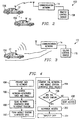
- FIG 3 illustrates another traffic telematics application, here shown generally at 172.
- vehicular-mounted mobile stations 12 are mounted in vehicles 156 (one such vehicular-mounted mobile station 12 and one such vehicle 156 is illustrated in the Figure).
- signals generated by the mobile station 12 are detected by the communication network 14. Indications of such reception are provided to a tolling control center 176.
- the informational content of the signals generated by the mobile station 12 permits toll fees to be paid electronically, e.g., based upon coding of a smart card.
- Indications of the mobile station's permanent identity may, optionally, depending upon the payment method, be provided to the tolling control center on an end-to-end application layer transparent to the communication network.
- the anonymity of the mobile station to the communication network is thereby preserved while, utilizing the previously described process, the mobile station 12 is authenticated by way of a group identifier, such as the aforementioned IMGI.
- Figure 4 illustrates a method, shown generally at 182, of an embodiment of the present invention.
- the method initiates data transmission in a communication system having a communication network for effectuating communication between at least a first communication station, such as the mobile station 12, and a correspondent entity, such as the correspondent entity 16 (shown in Figure 1).
- the first communication station is a group-identified communication station of a group of communication stations. Each group-identified communication station of the group is identified by a group identifier.
- the following method steps shall be described with respect to the exemplary embodiment shown in Figure 1. Analogous embodiments may similarly be described and illustrated.
- the IMGI 44 is provided to the communication network 14. Then, as indicated by the block 186, network-generated SRES 100 and RAND 98 values are accessed. Such values are formed, in the embodiment of Figure 1, responsive to values of the IMGI 94 and the K, 102 and can be pre-calculated prestored in one embodiment of the present invention.
- the network-generated RAND is sent to the mobile station 12. Responsive to reception of the RAND 98 at the mobile station, a mobile station-generated SRES value is formed.
- the network- and mobile station-generated SRES values are compared, as indicated by the block 194. Then, as indicated by the decision block 196, a determination is made as to whether the values are substantially similar. If not, access to the communication network is denied, as indicated by the block 198. If the values are substantially similar, the yes branch is taken from the decision block 196 to the block 202 and access of mobile station to communicate by way of the communication network 14 is provided. Thereafter, and as indicated by the block 204, data is transferred, as appropriate.
- anonymous access to conventional circuit-switched GSM (or similar cellular system) data services are provided, analogously with the above outlined principles for anonymous access to GPRS.
- the service provided is an anonymous mobile originated (MO) data call service.
- a group identified mobile station would be allocated a Temporary Mobile Station Identity (TMSI) in a conventional manner, instead of a TLLI in the GPRS case.
- TMSI Temporary Mobile Station Identity
- Authentication at call set-up would be based on the group subscriber authentication key.
- the mobility management procedures may be simplified compared to those conventionally used for IMSI-based mobile stations.
- a mobile station only needs to perform location updating periodically and, as required, before initiating a data call.
- Operation of an embodiment of the present invention provides a communication station, such as the mobile station 12, with anonymous access to a communication network, such as the communication network 14, to communicate data therein. Access is provided to a communication station only after authenticating that the communication is authorized to communicate in the network, but access is provided without individually identifying the communication station to the network with a permanent identifier unique to the communication station.
Landscapes
- Engineering & Computer Science (AREA)
- Computer Security & Cryptography (AREA)
- Computer Networks & Wireless Communication (AREA)
- Signal Processing (AREA)
- Computer Hardware Design (AREA)
- Computing Systems (AREA)
- General Engineering & Computer Science (AREA)
- Business, Economics & Management (AREA)
- Accounting & Taxation (AREA)
- Finance (AREA)
- Strategic Management (AREA)
- Physics & Mathematics (AREA)
- General Business, Economics & Management (AREA)
- General Physics & Mathematics (AREA)
- Theoretical Computer Science (AREA)
- Mobile Radio Communication Systems (AREA)
- Data Exchanges In Wide-Area Networks (AREA)
- Computer And Data Communications (AREA)
Applications Claiming Priority (3)
| Application Number | Priority Date | Filing Date | Title |
|---|---|---|---|
| US08/664,571 US5729537A (en) | 1996-06-14 | 1996-06-14 | Method and apparatus for providing anonymous data transfer in a communication system |
| US664571 | 1996-06-14 | ||
| PCT/SE1997/001000 WO1997048208A1 (en) | 1996-06-14 | 1997-06-06 | Method and apparatus for providing anonymous data transfer in a communication system |
Publications (2)
| Publication Number | Publication Date |
|---|---|
| EP0904643A1 EP0904643A1 (en) | 1999-03-31 |
| EP0904643B1 true EP0904643B1 (en) | 2005-02-23 |
Family
ID=24666524
Family Applications (1)
| Application Number | Title | Priority Date | Filing Date |
|---|---|---|---|
| EP97927558A Expired - Lifetime EP0904643B1 (en) | 1996-06-14 | 1997-06-06 | Method and apparatus for providing anonymous data transfer in a communication system |
Country Status (12)
| Country | Link |
|---|---|
| US (1) | US5729537A (id) |
| EP (1) | EP0904643B1 (id) |
| JP (1) | JP2000512455A (id) |
| CN (1) | CN1132376C (id) |
| AR (1) | AR007586A1 (id) |
| AU (1) | AU730615B2 (id) |
| BR (1) | BR9709576A (id) |
| CO (1) | CO4650109A1 (id) |
| DE (1) | DE69732567T2 (id) |
| ID (1) | ID20431A (id) |
| NZ (1) | NZ333220A (id) |
| WO (1) | WO1997048208A1 (id) |
Families Citing this family (167)
| Publication number | Priority date | Publication date | Assignee | Title |
|---|---|---|---|---|
| FI103313B1 (fi) * | 1994-05-13 | 1999-05-31 | Sonera Oy | Menetelmä matkaviestinjärjestelmän päätelaitteella, kuten korttiohjatulla matkaviestimellä soittamiseksi |
| JP3555345B2 (ja) * | 1996-08-09 | 2004-08-18 | 株式会社日立製作所 | 自動料金収受システムの車載機 |
| JPH1065801A (ja) * | 1996-08-26 | 1998-03-06 | Nec Corp | 移動機識別方式 |
| JP3097581B2 (ja) * | 1996-12-27 | 2000-10-10 | 日本電気株式会社 | アドホックローカルエリアネットワークの構成方法、通信方法及び端末 |
| FI103083B (fi) | 1997-01-20 | 1999-04-15 | Nokia Telecommunications Oy | Pakettiradioverkko ja menetelmä reititysalueen päivittämiseksi |
| US5961593A (en) * | 1997-01-22 | 1999-10-05 | Lucent Technologies, Inc. | System and method for providing anonymous personalized browsing by a proxy system in a network |
| US6748082B1 (en) * | 1997-02-03 | 2004-06-08 | Atx Europe Gmbh | Method and device for introducing a service key into a terminal |
| US7290288B2 (en) | 1997-06-11 | 2007-10-30 | Prism Technologies, L.L.C. | Method and system for controlling access, by an authentication server, to protected computer resources provided via an internet protocol network |
| US6104929A (en) * | 1997-06-20 | 2000-08-15 | Telefonaktiebolaget Lm Ericsson | Data packet radio service with enhanced mobility management |
| US6937566B1 (en) | 1997-07-25 | 2005-08-30 | Telefonaktiebolaget Lm Ericsson (Publ) | Dynamic quality of service reservation in a mobile communications network |
| US6891819B1 (en) * | 1997-09-05 | 2005-05-10 | Kabushiki Kaisha Toshiba | Mobile IP communications scheme incorporating individual user authentication |
| US6023510A (en) * | 1997-12-24 | 2000-02-08 | Philips Electronics North America Corporation | Method of secure anonymous query by electronic messages transported via a public network and method of response |
| FI106831B (fi) | 1998-01-14 | 2001-04-12 | Nokia Networks Oy | Pääsyn kontrollointimenetelmä matkaviestinjärjestelmää varten |
| EP1062765B1 (de) * | 1998-03-16 | 2004-08-18 | Rohde & Schwarz SIT GmbH | Authentifizierung von schlüsselgeräten |
| US6665529B1 (en) * | 1998-03-26 | 2003-12-16 | Ericsson Inc. | System and method for authenticating a cellular subscriber at registration |
| DE19820422A1 (de) * | 1998-05-07 | 1999-11-11 | Giesecke & Devrient Gmbh | Verfahren zur Authentisierung einer Chipkarte innerhalb eines Nachrichtenübertragungs-Netzwerks |
| GB2383237B (en) * | 1998-06-03 | 2003-10-22 | Orange Personal Comm Serv Ltd | Mobile communications |
| US6195705B1 (en) | 1998-06-30 | 2001-02-27 | Cisco Technology, Inc. | Mobile IP mobility agent standby protocol |
| US7277717B1 (en) * | 1998-07-06 | 2007-10-02 | At&T Bls Intellectual Property, Inc. | Dispatch application utilizing short message service |
| AU4858999A (en) * | 1998-07-06 | 2000-01-24 | Bellsouth Intellectual Property Corporation | Dispatch application utilizing short message service |
| FI105966B (fi) * | 1998-07-07 | 2000-10-31 | Nokia Networks Oy | Autentikointi tietoliikenneverkossa |
| FI105965B (fi) * | 1998-07-07 | 2000-10-31 | Nokia Networks Oy | Autentikointi tietoliikenneverkosssa |
| US9112579B2 (en) | 1998-11-03 | 2015-08-18 | Gilat Satellite Networks Ltd. | Switching VSAT transmitter with smart stand-by mode |
| ES2318876T3 (es) * | 1998-11-06 | 2009-05-01 | Nokia Siemens Networks Oy | Metodo y sistema para restablecer un contexto de abonado. |
| FI107685B (fi) * | 1998-11-19 | 2001-09-14 | Nokia Networks Oy | Palvelun toimittaminen |
| US6052600A (en) * | 1998-11-23 | 2000-04-18 | Motorola, Inc. | Software programmable radio and method for configuring |
| FI105964B (fi) | 1998-12-16 | 2000-10-31 | Nokia Networks Oy | Menetelmä matkaviestinyhteyksien hallintaan |
| US6636498B1 (en) | 1999-01-08 | 2003-10-21 | Cisco Technology, Inc. | Mobile IP mobile router |
| WO2000049821A1 (en) * | 1999-02-11 | 2000-08-24 | Hong Jo Park | System and terminal for exchanging concise and detailed information among users |
| US6425004B1 (en) * | 1999-02-24 | 2002-07-23 | Nortel Networks Limited | Detecting and locating a misbehaving device in a network domain |
| US6748227B1 (en) | 1999-03-03 | 2004-06-08 | Lucent Technologies Inc. | Method for transferring data using permanent identifier including routing information |
| US6603974B1 (en) | 1999-03-03 | 2003-08-05 | Lucent Technologies Inc. | Method for transferring data |
| US6615045B1 (en) | 1999-03-03 | 2003-09-02 | Lucent Technologies Inc. | Method for transferring data upon request using permanent identifier |
| US6810261B1 (en) | 1999-03-03 | 2004-10-26 | Lucent Technologies Inc. | Method for transferring data using expanded permanent identifier |
| FI107487B (fi) * | 1999-03-08 | 2001-08-15 | Nokia Mobile Phones Ltd | Datalähetyksen salausmenetelmä radiojärjestelmässä |
| FI114077B (fi) * | 1999-03-10 | 2004-07-30 | Nokia Corp | Tunnuksen varausmenetelmä |
| GB9908315D0 (en) * | 1999-04-12 | 1999-06-02 | Nokia Telecommunications Oy | A mobile communications network |
| US7313381B1 (en) * | 1999-05-03 | 2007-12-25 | Nokia Corporation | Sim based authentication as payment method in public ISP access networks |
| US6822971B1 (en) * | 1999-05-28 | 2004-11-23 | Nokia Corporation | Apparatus, and association method, for identifying data with an address |
| US6751191B1 (en) | 1999-06-29 | 2004-06-15 | Cisco Technology, Inc. | Load sharing and redundancy scheme |
| CN1315333C (zh) * | 1999-08-23 | 2007-05-09 | 摩托罗拉公司 | 域选择系统和方法 |
| FI19991918A7 (fi) * | 1999-09-09 | 2001-03-10 | Nokia Corp | Menetelmä ja järjestely liittymän hallitsemiseksi matkaviestinjärjestelmässä |
| FI19992593A7 (fi) * | 1999-12-02 | 2001-06-03 | Nokia Networks Oy | Puheluiden reititys tietoliikennejärjestelmässä |
| SE515456C2 (sv) * | 1999-12-16 | 2001-08-06 | Ericsson Telefon Ab L M | Förfarande vid ett kommunikationsnät |
| JP2001186121A (ja) * | 1999-12-27 | 2001-07-06 | Nec Corp | 通信装置、通信装置セット、認証方法および端末間ワイヤレス接続方法 |
| WO2001050353A1 (en) * | 2000-01-04 | 2001-07-12 | Ma'at | System and method for anonymous observation and use of premium content |
| US6839829B1 (en) | 2000-01-18 | 2005-01-04 | Cisco Technology, Inc. | Routing protocol based redundancy design for shared-access networks |
| US7058007B1 (en) | 2000-01-18 | 2006-06-06 | Cisco Technology, Inc. | Method for a cable modem to rapidly switch to a backup CMTS |
| FI109950B (fi) | 2000-01-20 | 2002-10-31 | Nokia Corp | Osoitteen saanti |
| US6662014B1 (en) * | 2000-02-04 | 2003-12-09 | Sbc Properties, L.P. | Location privacy manager for a wireless communication device and method therefor |
| US6603977B1 (en) * | 2000-02-04 | 2003-08-05 | Sbc Properties, Lp | Location information system for a wireless communication device and method therefor |
| DE60111022T2 (de) * | 2000-02-16 | 2005-11-03 | Nokia Corp. | Verfahren und system für datenkommunikation zwischen einer mobilen und einer packetvermittelten kommunikationsarchitektur |
| GB0004178D0 (en) * | 2000-02-22 | 2000-04-12 | Nokia Networks Oy | Integrity check in a communication system |
| US7203315B1 (en) | 2000-02-22 | 2007-04-10 | Paul Owen Livesay | Methods and apparatus for providing user anonymity in online transactions |
| US6915272B1 (en) | 2000-02-23 | 2005-07-05 | Nokia Corporation | System and method of secure payment and delivery of goods and services |
| US6650901B1 (en) * | 2000-02-29 | 2003-11-18 | 3Com Corporation | System and method for providing user-configured telephone service in a data network telephony system |
| US7130629B1 (en) | 2000-03-08 | 2006-10-31 | Cisco Technology, Inc. | Enabling services for multiple sessions using a single mobile node |
| US20030046332A1 (en) * | 2000-03-22 | 2003-03-06 | Maximilian Riegel | Method and communication system for providing geographic data during the retrieval of information from the www/wap |
| US9514459B1 (en) * | 2000-03-24 | 2016-12-06 | Emc Corporation | Identity broker tools and techniques for use with forward proxy computers |
| FI20000760A0 (fi) * | 2000-03-31 | 2000-03-31 | Nokia Corp | Autentikointi pakettidataverkossa |
| US6556582B1 (en) * | 2000-05-15 | 2003-04-29 | Bbnt Solutions Llc | Systems and methods for collision avoidance in mobile multi-hop packet radio networks |
| US7421583B1 (en) * | 2000-06-19 | 2008-09-02 | Xerox Corp | System, method and article of manufacture for determining a price of cryptograph IC services based on a computational burden thereof |
| US6765892B1 (en) | 2000-06-26 | 2004-07-20 | Cisco Technology, Inc. | Optimizing IP multicast data transmission in a mobile IP environment |
| US6982967B1 (en) | 2000-06-29 | 2006-01-03 | Cisco Technology, Inc. | Methods and apparatus for implementing a proxy mobile node in a wireless local area network |
| US6963918B1 (en) | 2000-06-29 | 2005-11-08 | Cisco Technology, Inc. | Voice over IP optimization for mobile IP |
| US8041817B2 (en) | 2000-06-30 | 2011-10-18 | At&T Intellectual Property I, Lp | Anonymous location service for wireless networks |
| KR20010007743A (ko) * | 2000-07-27 | 2001-02-05 | 이승열 | 가이드코드를 이용한 무선인터넷 접속방법 |
| US7042876B1 (en) * | 2000-09-12 | 2006-05-09 | Cisco Technology, Inc. | Stateful network address translation protocol implemented over a data network |
| JP4447761B2 (ja) * | 2000-10-18 | 2010-04-07 | キヤノン株式会社 | 周辺装置の集中管理システム、方法及び記憶媒体 |
| US20040203592A1 (en) * | 2000-11-15 | 2004-10-14 | Motorola, Inc. | Introduction device, smart appliance and method of creating a federation thereof |
| TWI257058B (en) * | 2000-11-21 | 2006-06-21 | Ibm | Anonymous access to a service |
| US7023995B2 (en) * | 2000-12-08 | 2006-04-04 | Telefonaktiebolaget L M Ericsson (Publ) | Secure location-based services system and method |
| EP1213882A3 (en) * | 2000-12-08 | 2002-09-18 | Telefonaktiebolaget L M Ericsson (Publ) | Method, system and device for granting access to a service |
| US7110749B2 (en) | 2000-12-19 | 2006-09-19 | Bellsouth Intellectual Property Corporation | Identity blocking service from a wireless service provider |
| US7085555B2 (en) | 2000-12-19 | 2006-08-01 | Bellsouth Intellectual Property Corporation | Location blocking service from a web advertiser |
| US7116977B1 (en) | 2000-12-19 | 2006-10-03 | Bellsouth Intellectual Property Corporation | System and method for using location information to execute an action |
| US7130630B1 (en) | 2000-12-19 | 2006-10-31 | Bellsouth Intellectual Property Corporation | Location query service for wireless networks |
| US7224978B2 (en) | 2000-12-19 | 2007-05-29 | Bellsouth Intellectual Property Corporation | Location blocking service from a wireless service provider |
| US7181225B1 (en) | 2000-12-19 | 2007-02-20 | Bellsouth Intellectual Property Corporation | System and method for surveying wireless device users by location |
| US7245925B2 (en) | 2000-12-19 | 2007-07-17 | At&T Intellectual Property, Inc. | System and method for using location information to execute an action |
| US7428411B2 (en) | 2000-12-19 | 2008-09-23 | At&T Delaware Intellectual Property, Inc. | Location-based security rules |
| US6959341B1 (en) | 2000-12-20 | 2005-10-25 | Cisco Technology, Inc. | Dynamic network allocation for mobile router |
| US6885667B1 (en) | 2000-12-26 | 2005-04-26 | Cisco Technology, Inc. | Redirection to a virtual router |
| US7295551B1 (en) * | 2000-12-28 | 2007-11-13 | Cisco Technology, Inc. | Support mobile device in asymmetric link environment |
| US7152238B1 (en) | 2000-12-29 | 2006-12-19 | Cisco Technology, Inc. | Enabling mobility for point to point protocol (PPP) users using a node that does not support mobility |
| US7076538B2 (en) | 2001-01-12 | 2006-07-11 | Lenovo (Singapore) Pte. Ltd. | Method and system for disguising a computer system's identity on a network |
| US7472269B2 (en) * | 2001-02-23 | 2008-12-30 | Nokia Siemens Networks Oy | System and method for strong authentication achieved in a single round trip |
| US20020142805A1 (en) * | 2001-04-02 | 2002-10-03 | Pecen Mark E. | Method and apparatus for anonymous network access in the absence of a mobile subscriber identity module |
| US7881208B1 (en) | 2001-06-18 | 2011-02-01 | Cisco Technology, Inc. | Gateway load balancing protocol |
| US20030048806A1 (en) * | 2001-09-13 | 2003-03-13 | Jacobus Haartsen | Method for address allocation in ad-hoc networks |
| US7036143B1 (en) | 2001-09-19 | 2006-04-25 | Cisco Technology, Inc. | Methods and apparatus for virtual private network based mobility |
| US7756507B2 (en) * | 2001-10-24 | 2010-07-13 | Siemens Aktiengesellschaft | Method and device for authenticated access of a station to local data networks in particular radio data networks |
| US6908030B2 (en) * | 2001-10-31 | 2005-06-21 | Arcot Systems, Inc. | One-time credit card number generator and single round-trip authentication |
| US7227863B1 (en) | 2001-11-09 | 2007-06-05 | Cisco Technology, Inc. | Methods and apparatus for implementing home agent redundancy |
| US7227838B1 (en) | 2001-12-14 | 2007-06-05 | Cisco Technology, Inc. | Enhanced internal router redundancy |
| US20030177259A1 (en) * | 2002-02-04 | 2003-09-18 | Wookey Michael J. | Remote services systems data delivery mechanism |
| US20030163544A1 (en) * | 2002-02-04 | 2003-08-28 | Wookey Michael J. | Remote service systems management interface |
| US20030149889A1 (en) * | 2002-02-04 | 2003-08-07 | Wookey Michael J. | Automatic communication and security reconfiguration for remote services |
| US20030149870A1 (en) * | 2002-02-04 | 2003-08-07 | Wookey Michael J. | Remote services wide area network connection anti-spoofing control |
| US7167448B2 (en) * | 2002-02-04 | 2007-01-23 | Sun Microsystems, Inc. | Prioritization of remote services messages within a low bandwidth environment |
| US20030149740A1 (en) * | 2002-02-04 | 2003-08-07 | Wookey Michael J. | Remote services delivery architecture |
| US20030149771A1 (en) * | 2002-02-04 | 2003-08-07 | Wookey Michael J. | Remote services system back-channel multicasting |
| US7471661B1 (en) | 2002-02-20 | 2008-12-30 | Cisco Technology, Inc. | Methods and apparatus for supporting proxy mobile IP registration in a wireless local area network |
| US7346053B1 (en) | 2002-05-07 | 2008-03-18 | Cisco Technology, Inc. | Methods and apparatus for supporting IP multicast for a mobile router |
| US20030212738A1 (en) * | 2002-05-10 | 2003-11-13 | Wookey Michael J. | Remote services system message system to support redundancy of data flow |
| KR20080080219A (ko) | 2002-05-22 | 2008-09-02 | 인터디지탈 테크날러지 코포레이션 | 인터넷 프로토콜 기능을 갖는 모바일 장치 |
| US7240109B2 (en) * | 2002-06-27 | 2007-07-03 | Sun Microsystems, Inc. | Remote services system service module interface |
| US8266239B2 (en) * | 2002-06-27 | 2012-09-11 | Oracle International Corporation | Remote services system relocatable mid level manager |
| US7181455B2 (en) * | 2002-06-27 | 2007-02-20 | Sun Microsystems, Inc. | Bandwidth management for remote services system |
| US7260623B2 (en) * | 2002-06-27 | 2007-08-21 | Sun Microsystems, Inc. | Remote services system communication module |
| US20040002878A1 (en) * | 2002-06-28 | 2004-01-01 | International Business Machines Corporation | Method and system for user-determined authentication in a federated environment |
| US7174376B1 (en) | 2002-06-28 | 2007-02-06 | Cisco Technology, Inc. | IP subnet sharing technique implemented without using bridging or routing protocols |
| US7280557B1 (en) | 2002-06-28 | 2007-10-09 | Cisco Technology, Inc. | Mechanisms for providing stateful NAT support in redundant and asymetric routing environments |
| CN1203695C (zh) * | 2002-08-13 | 2005-05-25 | 北京三星通信技术研究有限公司 | 临时移动组标识的产生与分配方法 |
| JP4377328B2 (ja) * | 2002-08-13 | 2009-12-02 | トムソン ライセンシング | ホーム・ロケーション・レジスタの改良による移動端末の個人情報保護 |
| US7379433B1 (en) | 2002-09-25 | 2008-05-27 | Cisco Technology, Inc. | Methods and apparatus for broadcast optimization in mobile IP |
| US7110377B2 (en) * | 2002-10-10 | 2006-09-19 | Qualcomm Incorporated | Dormant handoff in a packet data network |
| US7457289B2 (en) * | 2002-12-16 | 2008-11-25 | Cisco Technology, Inc. | Inter-proxy communication protocol for mobile IP |
| JP3801559B2 (ja) * | 2002-12-26 | 2006-07-26 | ソニー株式会社 | 通信装置および方法、記録媒体、並びにプログラム |
| WO2004061668A1 (en) * | 2002-12-31 | 2004-07-22 | International Business Machines Corporation | Authorized anonymous authentication |
| US7362742B1 (en) | 2003-01-28 | 2008-04-22 | Cisco Technology, Inc. | Methods and apparatus for synchronizing subnet mapping tables |
| US7308260B2 (en) * | 2003-04-02 | 2007-12-11 | Qualcomm Incorporated | Method and apparatus for supporting access network (AN) authentication |
| US7505432B2 (en) | 2003-04-28 | 2009-03-17 | Cisco Technology, Inc. | Methods and apparatus for securing proxy Mobile IP |
| CN1327648C (zh) * | 2003-05-16 | 2007-07-18 | 华为技术有限公司 | 一种实现高速率分组数据业务认证的方法 |
| CN1549482B (zh) * | 2003-05-16 | 2010-04-07 | 华为技术有限公司 | 一种实现高速率分组数据业务认证的方法 |
| US7593346B2 (en) * | 2003-07-31 | 2009-09-22 | Cisco Technology, Inc. | Distributing and balancing traffic flow in a virtual gateway |
| US7327746B1 (en) | 2003-08-08 | 2008-02-05 | Cisco Technology, Inc. | System and method for detecting and directing traffic in a network environment |
| CN1601958B (zh) * | 2003-09-26 | 2010-05-12 | 北京三星通信技术研究有限公司 | 基于cave算法的hrpd网络接入认证方法 |
| US7417961B2 (en) * | 2003-12-09 | 2008-08-26 | Cisco Technology, Inc. | Methods and apparatus for implementing a speed sensitive mobile router |
| US8051472B2 (en) * | 2003-12-17 | 2011-11-01 | Oracle International Corporation | Method and apparatus for personalization and identity management |
| CN100370724C (zh) * | 2004-03-22 | 2008-02-20 | 西安电子科技大学 | 宽带无线ip网络匿名连接方法 |
| US7840988B1 (en) | 2004-05-07 | 2010-11-23 | Cisco Technology, Inc. | Front-end structure for access network line card |
| US7447188B1 (en) | 2004-06-22 | 2008-11-04 | Cisco Technology, Inc. | Methods and apparatus for supporting mobile IP proxy registration in a system implementing mulitple VLANs |
| US8059661B2 (en) * | 2004-12-29 | 2011-11-15 | Cisco Technology, Inc. | Methods and apparatus for using DHCP for home address management of nodes attached to an edge device and for performing mobility and address management as a proxy home agent |
| WO2006128481A2 (en) * | 2005-05-31 | 2006-12-07 | Telecom Italia S.P.A. | Method for auto-configuration of a network terminal address |
| ES2331141T3 (es) * | 2005-09-27 | 2009-12-22 | Telefonaktiebolaget Lm Ericsson (Publ) | Una arquitectura de red y un metodo relacionado con el acceso de estaciones de usuario. |
| CN1941699B (zh) * | 2005-09-29 | 2012-05-23 | 国际商业机器公司 | 密码方法、主机系统、可信平台模块和计算机安排 |
| US20070123208A1 (en) * | 2005-11-28 | 2007-05-31 | Puneet Batta | System and method for prioritizing emergency communications in a wireless network |
| US7831237B2 (en) | 2006-02-03 | 2010-11-09 | Broadcom Corporation | Authenticating mobile network provider equipment |
| US7903585B2 (en) | 2006-02-15 | 2011-03-08 | Cisco Technology, Inc. | Topology discovery of a private network |
| US7633917B2 (en) * | 2006-03-10 | 2009-12-15 | Cisco Technology, Inc. | Mobile network device multi-link optimizations |
| US7623875B2 (en) * | 2006-04-24 | 2009-11-24 | Gm Global Technology Operations, Inc. | System and method for preventing unauthorized wireless communications which attempt to provide input to or elicit output from a mobile device |
| US8085790B2 (en) * | 2006-07-14 | 2011-12-27 | Cisco Technology, Inc. | Ethernet layer 2 protocol packet switching |
| JP4622951B2 (ja) * | 2006-07-26 | 2011-02-02 | ソニー株式会社 | 通信システムおよび通信方法、情報処理装置および方法、デバイス、プログラム、並びに記録媒体 |
| US8274978B2 (en) | 2007-01-17 | 2012-09-25 | Panasonic Corporation | Systems and methods for reducing multicast traffic over a network |
| US9392434B2 (en) | 2007-01-22 | 2016-07-12 | Qualcomm Incorporated | Message ordering for network based mobility management systems |
| FR2915337B1 (fr) * | 2007-04-19 | 2009-06-05 | Bouygues Telecom Sa | Procede et systeme de securisation d'acces interne de telephone mobile, telephone mobile et terminal correspondants. |
| US9052924B2 (en) * | 2008-04-15 | 2015-06-09 | Microsoft Technology Licensing, Llc | Light-weight managed composite control hosting |
| US8532618B2 (en) * | 2009-07-03 | 2013-09-10 | Futurewei Technologies, Inc. | System and method for communications device and network component operation |
| US9729351B2 (en) | 2009-08-10 | 2017-08-08 | Qualcomm Incorporated | Identifying a domain for delivery of message service information |
| US10104512B2 (en) | 2009-08-10 | 2018-10-16 | Qualcomm Incorporated | Domain selection for mobile-originated message service |
| US20110137684A1 (en) * | 2009-12-08 | 2011-06-09 | Peak David F | System and method for generating telematics-based customer classifications |
| US20110227757A1 (en) * | 2010-03-16 | 2011-09-22 | Telcordia Technologies, Inc. | Methods for context driven disruption tolerant vehicular networking in dynamic roadway environments |
| CN102215474B (zh) * | 2010-04-12 | 2014-11-05 | 华为技术有限公司 | 对通信设备进行认证的方法和装置 |
| CN102291218B (zh) * | 2010-06-21 | 2016-06-15 | 夏普株式会社 | 信道状态信息反馈资源分配方法和信道状态信息反馈方法 |
| GB2484921B (en) | 2010-10-25 | 2014-10-08 | Sca Ipla Holdings Inc | Communications device and method |
| GB2484922B (en) | 2010-10-25 | 2014-10-08 | Sca Ipla Holdings Inc | Infrastructure equipment and method |
| GB2484920B (en) * | 2010-10-25 | 2014-10-08 | Sca Ipla Holdings Inc | Communications systems and method |
| US9253178B2 (en) * | 2011-01-17 | 2016-02-02 | Telefonaktiebolaget L M Ericsson | Method and apparatus for authenticating a communication device |
| AT13270U3 (de) * | 2013-03-26 | 2014-02-15 | Amv Networks Gmbh | System zum Erfassen, Verarbeiten und Senden von Telemetriedaten (AMV-System) |
| DE102013206661A1 (de) * | 2013-04-15 | 2014-10-16 | Robert Bosch Gmbh | Kommunikationsverfahren zum Übertragen von Nutzdaten sowie entsprechendes Kommunikationssystem |
| US9578099B2 (en) * | 2014-01-22 | 2017-02-21 | Alcatel Lucent | Devices and methods for content distribution in a communications network |
| DE102014206545A1 (de) * | 2014-04-04 | 2015-10-08 | Continental Teves Ag & Co. Ohg | Verfahren, Kommunikationssystem und Daten-Zugangsknoten zur Übermittlung von Daten |
| CN104618599B (zh) * | 2015-02-02 | 2017-03-15 | 联想(北京)有限公司 | 信息处理方法及电子设备 |
| US10931644B2 (en) * | 2015-06-23 | 2021-02-23 | Telefonaktiebolaget Lm Ericsson (Publ) | Methods, network nodes, mobile entity, computer programs and computer program products for protecting privacy of a mobile entity |
| BR112019006280A8 (pt) * | 2016-09-30 | 2023-02-14 | Richard Olivier Laurence | Plataforma de rede de ponte distribuída de desidentificação |
| CN108632817A (zh) * | 2018-07-27 | 2018-10-09 | 中国电子科技集团公司第三十研究所 | 一种5g高安全终端内部imsi隐私保护的方法 |
Family Cites Families (10)
| Publication number | Priority date | Publication date | Assignee | Title |
|---|---|---|---|---|
| FI90181C (fi) * | 1992-02-24 | 1993-12-27 | Nokia Telecommunications Oy | Telekommunikationssystem och ett abonnentautenticeringsfoerfarande |
| SE515362C2 (sv) * | 1992-10-16 | 2001-07-23 | Eritel Ab | Styrning av datakommunikation i nät med slutna användargrupper |
| JPH06188831A (ja) * | 1992-12-16 | 1994-07-08 | Fujitsu Ltd | パーソナル通信方式 |
| US5457680A (en) * | 1993-05-18 | 1995-10-10 | International Business Machines Corporation | Data gateway for mobile data radio terminals in a data communication network |
| US5455863A (en) * | 1993-06-29 | 1995-10-03 | Motorola, Inc. | Method and apparatus for efficient real-time authentication and encryption in a communication system |
| US5420910B1 (en) * | 1993-06-29 | 1998-02-17 | Airtouch Communications Inc | Method and apparatus for fraud control in cellular telephone systems utilizing rf signature comparison |
| EP0656708A1 (en) * | 1993-12-03 | 1995-06-07 | International Business Machines Corporation | System and method for the transmission and validation of an updated encryption key between two users |
| DE69330065T2 (de) * | 1993-12-08 | 2001-08-09 | International Business Machines Corp., Armonk | Verfahren und System zur Schlüsselverteilung und Authentifizierung in einem Datenübertragungssystem |
| DE69534012T2 (de) * | 1994-03-17 | 2006-05-04 | Kokusai Denshin Denwa Co., Ltd. | Authentifizierungsverfahren für mobile Kommunikation |
| EP0715476A3 (de) * | 1994-11-28 | 1999-06-02 | MANNESMANN Aktiengesellschaft | Verfahren zur anonymen Benutzung eines Funkkommunikationssystems |
-
1996
- 1996-06-14 US US08/664,571 patent/US5729537A/en not_active Expired - Lifetime
-
1997
- 1997-06-06 DE DE69732567T patent/DE69732567T2/de not_active Expired - Lifetime
- 1997-06-06 NZ NZ333220A patent/NZ333220A/xx not_active IP Right Cessation
- 1997-06-06 JP JP10501512A patent/JP2000512455A/ja active Pending
- 1997-06-06 CN CN97197207A patent/CN1132376C/zh not_active Expired - Fee Related
- 1997-06-06 AU AU31996/97A patent/AU730615B2/en not_active Ceased
- 1997-06-06 EP EP97927558A patent/EP0904643B1/en not_active Expired - Lifetime
- 1997-06-06 WO PCT/SE1997/001000 patent/WO1997048208A1/en not_active Ceased
- 1997-06-06 BR BR9709576A patent/BR9709576A/pt not_active IP Right Cessation
- 1997-06-13 CO CO97032867A patent/CO4650109A1/es unknown
- 1997-06-13 AR ARP970102601A patent/AR007586A1/es unknown
- 1997-06-16 ID IDP972062A patent/ID20431A/id unknown
Also Published As
| Publication number | Publication date |
|---|---|
| CN1132376C (zh) | 2003-12-24 |
| WO1997048208A1 (en) | 1997-12-18 |
| AU3199697A (en) | 1998-01-07 |
| CN1227688A (zh) | 1999-09-01 |
| BR9709576A (pt) | 1999-08-10 |
| AU730615B2 (en) | 2001-03-08 |
| DE69732567D1 (de) | 2005-03-31 |
| ID20431A (id) | 1998-12-17 |
| CO4650109A1 (es) | 1998-09-03 |
| DE69732567T2 (de) | 2006-03-23 |
| JP2000512455A (ja) | 2000-09-19 |
| EP0904643A1 (en) | 1999-03-31 |
| AR007586A1 (es) | 1999-11-10 |
| NZ333220A (en) | 2000-07-28 |
| US5729537A (en) | 1998-03-17 |
Similar Documents
| Publication | Publication Date | Title |
|---|---|---|
| EP0904643B1 (en) | Method and apparatus for providing anonymous data transfer in a communication system | |
| US6920326B2 (en) | Method and apparatus for restricting call terminations when a mobile unit is roaming | |
| US20040162998A1 (en) | Service authentication in a communication system | |
| AU731100B2 (en) | Finding copied SIM cards | |
| US7206576B2 (en) | Using shared secret data (SSD) to authenticate between a CDMA network and a GSM network | |
| EP0976278B1 (en) | Preventing misuse of a copied subscriber identity in a mobile communication system | |
| EP2403283B1 (en) | Improved subscriber authentication for unlicensed mobile access signaling | |
| KR100363300B1 (ko) | 통신 핸들링에서 보안 관련 기능을 제어하는 방법, 이동국및 무선 통신 시스템 | |
| EP1178445A1 (en) | Method for performing short-range wireless transactions between an hybrid wireless terminal and a service terminal | |
| EP0584725A1 (en) | Method of authentication with improved security for secrecy of authentication key | |
| CA2650029C (en) | Method and apparatus for steering of roaming | |
| EP1305967B1 (en) | Control of unciphered user traffic | |
| US7110747B2 (en) | Ciphering between a CDMA network and a GSM network | |
| JPH1098774A (ja) | 加入者を認証するための及び/又は情報をコード化するための方法及び装置 | |
| WO2004015968A1 (en) | Mobile terminal identity protection through home location register modification | |
| EP1315394A2 (en) | Short-distance wireless connections in a telecommunication network | |
| CN1244330A (zh) | 移动通信网和/或无线本地网中用于执行与安全管理有关的校检功能的过程 | |
| CA2258036C (en) | Method and apparatus for providing anonymous data transfer in a communication system | |
| Peng | GSM and GPRS security | |
| KR100915043B1 (ko) | 이동 무선 네트워크, 상기 네트워크에서 단말기 장치를동작시키기 위한 방법, 및 상기 단말기 장치를 식별하는파라미터들을 저장하기 위해 통합된 전자 회로 설비들을구비하는 단말기 장치 | |
| WO1999037113A1 (en) | Method for authentication of a mobile subscriber in a telecommunication network | |
| JPH1032635A (ja) | ユーザ情報転送方法 |
Legal Events
| Date | Code | Title | Description |
|---|---|---|---|
| PUAI | Public reference made under article 153(3) epc to a published international application that has entered the european phase |
Free format text: ORIGINAL CODE: 0009012 |
|
| 17P | Request for examination filed |
Effective date: 19981120 |
|
| AK | Designated contracting states |
Kind code of ref document: A1 Designated state(s): DE FI FR GB IT NL |
|
| 17Q | First examination report despatched |
Effective date: 20040212 |
|
| RAP1 | Party data changed (applicant data changed or rights of an application transferred) |
Owner name: TELEFONAKTIEBOLAGET LM ERICSSON (PUBL) |
|
| GRAP | Despatch of communication of intention to grant a patent |
Free format text: ORIGINAL CODE: EPIDOSNIGR1 |
|
| GRAS | Grant fee paid |
Free format text: ORIGINAL CODE: EPIDOSNIGR3 |
|
| GRAA | (expected) grant |
Free format text: ORIGINAL CODE: 0009210 |
|
| AK | Designated contracting states |
Kind code of ref document: B1 Designated state(s): DE FI FR GB IT NL |
|
| PG25 | Lapsed in a contracting state [announced via postgrant information from national office to epo] |
Ref country code: FI Free format text: LAPSE BECAUSE OF FAILURE TO SUBMIT A TRANSLATION OF THE DESCRIPTION OR TO PAY THE FEE WITHIN THE PRESCRIBED TIME-LIMIT Effective date: 20050223 |
|
| REG | Reference to a national code |
Ref country code: GB Ref legal event code: FG4D |
|
| REF | Corresponds to: |
Ref document number: 69732567 Country of ref document: DE Date of ref document: 20050331 Kind code of ref document: P |
|
| PLBE | No opposition filed within time limit |
Free format text: ORIGINAL CODE: 0009261 |
|
| STAA | Information on the status of an ep patent application or granted ep patent |
Free format text: STATUS: NO OPPOSITION FILED WITHIN TIME LIMIT |
|
| ET | Fr: translation filed | ||
| 26N | No opposition filed |
Effective date: 20051124 |
|
| REG | Reference to a national code |
Ref country code: FR Ref legal event code: PLFP Year of fee payment: 19 |
|
| PGFP | Annual fee paid to national office [announced via postgrant information from national office to epo] |
Ref country code: GB Payment date: 20150629 Year of fee payment: 19 Ref country code: DE Payment date: 20150629 Year of fee payment: 19 |
|
| PGFP | Annual fee paid to national office [announced via postgrant information from national office to epo] |
Ref country code: FR Payment date: 20150617 Year of fee payment: 19 |
|
| PGFP | Annual fee paid to national office [announced via postgrant information from national office to epo] |
Ref country code: IT Payment date: 20150625 Year of fee payment: 19 |
|
| PGFP | Annual fee paid to national office [announced via postgrant information from national office to epo] |
Ref country code: NL Payment date: 20160626 Year of fee payment: 20 |
|
| REG | Reference to a national code |
Ref country code: DE Ref legal event code: R119 Ref document number: 69732567 Country of ref document: DE |
|
| GBPC | Gb: european patent ceased through non-payment of renewal fee |
Effective date: 20160606 |
|
| REG | Reference to a national code |
Ref country code: FR Ref legal event code: ST Effective date: 20170228 |
|
| PG25 | Lapsed in a contracting state [announced via postgrant information from national office to epo] |
Ref country code: DE Free format text: LAPSE BECAUSE OF NON-PAYMENT OF DUE FEES Effective date: 20170103 Ref country code: FR Free format text: LAPSE BECAUSE OF NON-PAYMENT OF DUE FEES Effective date: 20160630 |
|
| PG25 | Lapsed in a contracting state [announced via postgrant information from national office to epo] |
Ref country code: GB Free format text: LAPSE BECAUSE OF NON-PAYMENT OF DUE FEES Effective date: 20160606 |
|
| REG | Reference to a national code |
Ref country code: NL Ref legal event code: MK Effective date: 20170605 |
|
| PG25 | Lapsed in a contracting state [announced via postgrant information from national office to epo] |
Ref country code: IT Free format text: LAPSE BECAUSE OF NON-PAYMENT OF DUE FEES Effective date: 20160606 |