EP0904647B1 - Gestion de reseau en mode de transfert asynchrone - Google Patents
Gestion de reseau en mode de transfert asynchrone Download PDFInfo
- Publication number
- EP0904647B1 EP0904647B1 EP97926107A EP97926107A EP0904647B1 EP 0904647 B1 EP0904647 B1 EP 0904647B1 EP 97926107 A EP97926107 A EP 97926107A EP 97926107 A EP97926107 A EP 97926107A EP 0904647 B1 EP0904647 B1 EP 0904647B1
- Authority
- EP
- European Patent Office
- Prior art keywords
- link
- agents
- agent
- bandwidth
- network
- Prior art date
- Legal status (The legal status is an assumption and is not a legal conclusion. Google has not performed a legal analysis and makes no representation as to the accuracy of the status listed.)
- Expired - Lifetime
Links
Images








Classifications
-
- H—ELECTRICITY
- H04—ELECTRIC COMMUNICATION TECHNIQUE
- H04L—TRANSMISSION OF DIGITAL INFORMATION, e.g. TELEGRAPHIC COMMUNICATION
- H04L12/00—Data switching networks
- H04L12/54—Store-and-forward switching systems
- H04L12/56—Packet switching systems
- H04L12/5601—Transfer mode dependent, e.g. ATM
- H04L12/5602—Bandwidth control in ATM Networks, e.g. leaky bucket
-
- H—ELECTRICITY
- H04—ELECTRIC COMMUNICATION TECHNIQUE
- H04Q—SELECTING
- H04Q11/00—Selecting arrangements for multiplex systems
- H04Q11/04—Selecting arrangements for multiplex systems for time-division multiplexing
- H04Q11/0428—Integrated services digital network, i.e. systems for transmission of different types of digitised signals, e.g. speech, data, telecentral, television signals
- H04Q11/0478—Provisions for broadband connections
-
- H—ELECTRICITY
- H04—ELECTRIC COMMUNICATION TECHNIQUE
- H04L—TRANSMISSION OF DIGITAL INFORMATION, e.g. TELEGRAPHIC COMMUNICATION
- H04L12/00—Data switching networks
- H04L12/54—Store-and-forward switching systems
- H04L12/56—Packet switching systems
- H04L12/5601—Transfer mode dependent, e.g. ATM
- H04L2012/5619—Network Node Interface, e.g. tandem connections, transit switching
-
- H—ELECTRICITY
- H04—ELECTRIC COMMUNICATION TECHNIQUE
- H04L—TRANSMISSION OF DIGITAL INFORMATION, e.g. TELEGRAPHIC COMMUNICATION
- H04L12/00—Data switching networks
- H04L12/54—Store-and-forward switching systems
- H04L12/56—Packet switching systems
- H04L12/5601—Transfer mode dependent, e.g. ATM
- H04L2012/5625—Operations, administration and maintenance [OAM]
- H04L2012/5626—Network management, e.g. Intelligent nets
-
- H—ELECTRICITY
- H04—ELECTRIC COMMUNICATION TECHNIQUE
- H04L—TRANSMISSION OF DIGITAL INFORMATION, e.g. TELEGRAPHIC COMMUNICATION
- H04L12/00—Data switching networks
- H04L12/54—Store-and-forward switching systems
- H04L12/56—Packet switching systems
- H04L12/5601—Transfer mode dependent, e.g. ATM
- H04L2012/5629—Admission control
- H04L2012/5631—Resource management and allocation
- H04L2012/5632—Bandwidth allocation
Definitions
- the present invention concerns the performance management and traffic control of what are known as asynchronous transfer mode (ATM) networks.
- ATM asynchronous transfer mode
- connection types such as video and data at variable bit rates.
- users now require the ability to select from a number of connection types in accordance with their needs.
- ATM networks have been developed to meet this demand.
- a user can choose between three potential connection types, namely the already mentioned two megabit voice links, a variable bandwidth link peaking at 10 megabits and with a mean of 5 megabits, and a third variable bandwidth link peaking at 20 megabits and having a mean of 8 megabits.
- the second of these connection types can be used for high speed data transfer and the third for the transmission of video images. It will however be appreciated that the present invention is not limited to any particular set of connection types.
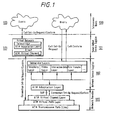
- FIG. 1 of the accompanying drawings is a functional representation of user and service interaction in a typical ATM network environment.
- Layer 100 represents the users and layer 101 represents suppliers who provided value added services to users.
- Layer 102 gives some examples of value added network services such as additional telephoning features, provision of video data, transfer of data files and the like, and layer 103 shows the various functional layers of the actual ATM network.
- the basic unit of an ATM network is the ATM switch. Such a switch will be described in greater detail hereinafter but each switch supports several hundred users and provides the requisite links between the users and other ATM switches in the network.
- VP networks differ in two ways from the traditional telephone network. In a traditional telephone network when a user wishes to access another user a fixed channel is established via the various nodes and switches and this channel either has the ability to carry the data or not.
- a VP network each user is allocated a bandwidth appropriate to his assumed needs in the various connection types and the ATM network management provides bandwidth by selecting a route from all of the available paths in the network.
- a link is an ATM transmission path which provides bandwidth between transmission end points. Normally such a link will be a fibre optic one.
- a number of transmission paths and transmission end points form the transmission capability of the network which is provided to the virtual path (VP) level.
- the transmission end points are ATM switches which route traffic over VP links.
- VP connections A concatenation of VP links is terminated by VP connection end points to form VP connections which are simply called VPs in the remainder of this specification.
- VPs enable the ATM transport network to provide either teleservices to end users via the network service supplier layer 103 or raw bandwidth to value added service suppliers at layer 102.
- a set of VPs are provided to the VC level such that at this level, VPs are interconnected by VC links.
- the resulting concatenation of VC links form a VC connection which are used to transport these teleservices.
- Nodes, links and VP's can all be considered as network resources and in a typical network each is represented by a distributed object. Thus information concerning the network can be obtained by calling function acting on these distributed objects. The importance of this arrangement to the present invention will become apparent hereinafter.
- More than one connection is usually used to provide an end-to-end service association or call to a user/customer of the network.
- Each of the connections in a call have certain characteristics such as bandwidth utilisation profile and performance targets that it shares with other connections of the same type.
- NRM Network Resource Management
- TCM Traffic Control Management
- NRM deals with VP bandwidth management, VP routing, virtual channel (VC) routing strategies, VP and link load balancing, VP Topology Management and quality of service (QoS) verification.
- QoS quality of service
- the performance management in ATM networks is an extremely complex problem due to many factors. Amongst these are the fact that each user has the potential of a plurality of connection types and because of the VP model of the network the combination of the number of different connection types with the number of potential virtual paths between the ATM switches in the network rapidly becomes extremely large. Adding to the problem is the variability of the traffic characteristics and controls at many levels together with the necessity to plan ahead for substantially larger networks.
- VPBM Virtual Path Bandwidth Management
- Telecommunications Management Network Telecommunications Management Network
- virtual path bandwidth management as applied to ATM networks is a network management function which aims to ensure that virtual paths have the right size, allocation and route.
- the difficulties of carrying out this function include:
- TTN telecommunication management network
- the present invention is concerned with providing a solution to the above problems.
- one concern of the present invention is to provide a system for managing bandwidth in an ATM network.
- the present invention is concerned with providing a generic approach to a range of problems in ATM management.
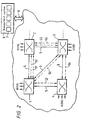
- FIG. 2 of the accompanying drawings shows an ATM network consisting of four ATM switches 1, 2, 3 and 4.
- high bandwidth links are provided between the switches by optical fibres indicated at 5.
- switch 1 is connected directly to switches 2 and 4 and also to switch 3, whilst switches 2 and 4 are respectively connected to 1 and 3.
- each switch will support several hundreds of users and each user in this embodiment has the potentiality of three different connection types with each connection type having a different bandwidth allocated by the VP bandwidth naturally.
- each of the links 5 is capable of carrying the three different connection types which have already been discussed.
- the number and range of connection types can, of course, be varied.
- numerals 50 to 56 represent VPs carried over the links 5.
- VP56 can be considered as providing a direct path between switches 2 and 4. In a physical sense VP56 passes through switch 3 but cannot terminate at switch 3. Thus in effect it does provide a direct path between switch 2 and switch 4.
- the provision of VPCs of this type is a decision of the management function and will depend on, for example, expected traffic volumes.
- a management system is indicated at 6.
- This system comprises a plurality of programmable computers 7 and communicates with the network via an interface indicated at 8.
- This interface can comprise one or more VPs or virtual circuits.
- the function of the programmable computers will be described in greater detail hereinafter. It is conceivable that a single computer can be used in the management system. The number and range of connection types can be varied.
- FIG. 3 shows switch 1 linked to switch 2 of Figure 2.
- a first user is indicated at 10, this user being physically linked to switch 1, and a second user is shown at 11, the second user being physically linked to switch 2.
- the physical links between user 10 and switch 1 are terminated by a port 12, the physical link between switch 1 and switch 2 is terminated by respective ports 13 and 14 and the physical link between user 11 and switch 2 is terminated by a port 15.
- Ports perform the function of line termination so that ATM cells arriving at a port are delivered to the switch and likewise the cells leaving the switch are delivered to the port for transmission.
- the VP/VC switching function is indicated at 20 and the routing tables are indicated at 21.
- the call handling functions of the switch comprise signalling and routing strategies for VC routings and these are shown at 22 and 23.
- the connection acceptance control function (CAC) is shown at 24 and is responsible for accepting or rejecting a new connection onto the network depending on the available capacity left in the network.
- the source policing (SP) function shown at 25 ensures that users do not go above their contracted traffic volumes.
- VPM virtual path management
- the switch is connected via a path indicated at 28 to the management system 6.
- the Synchronous Digital Hierarchy (SDH) will be used as the transport layer of the ATM network being described.
- SDH Synchronous Digital Hierarchy
- the ATM cells generated at the ATM layer will be loaded into appropriate SDH frames before being transmitted over SDH networks to the destination switch.
- SDH termination points upon receiving SDH frames by SDH termination points they are unloaded into ATM cells and delivered to the ATM switching functions.
- the termination points 26 and 27 of the two switches are shown as being divided into ATM termination points and SDH termination points to indicate this shared functionality.
- a user sets up a connection or a call to another user.
- the network switch to which the user is connected in this case switch 1, using the call handling functions, VPM and CAC and by talking to other switches on the path to the destination, allocates a virtual circuit by giving it a VP and VC address and updating the routing tables in the switches.
- the dotted lines VP1 and VP2 show a virtual circuit set up between the two end points as represented by the users. As these are virtual paths it will be appreciated that the actual physical links along which the data will pass from one user to another need not be the direct one between switch 1 and switch 2.
- the present embodiment utilises a distributed set of autonomous objects, which will hereafter be referred to as agents, in the programmable computers 7 located in the management system 6. Additionally in the present embodiment the agents have been kept very simple by having no state and no learning capability.
- agents autonomous objects
- the agents have been kept very simple by having no state and no learning capability.
- One of the benefits of this simplicity is that the quantity and complexity of code required in the running of the system will be small. The complexity of behaviour required to manage a large network emerges from the interaction between the agents.
- a set of agents which dynamically tune the VP network based on network performance measurements fall into three categories or sets. These three categories are diagrammatically represented in Figure 4.
- the first category of agent is shown at 30 and will be referred to as VPC bundle agents which are responsible for a set of VPCs and their supporting VP links.
- the second type of agent is shown at 31 and is referred to as a link agent which is responsible for a physical link and the third type of agent is shown at 32 and is referred to as a coordinator agent which is responsible for coordinating actions taken in response to a network condition to prevent the other agents from performing conflicting actions.
- the first of the agents to be described is the VPC bundle agent 30.
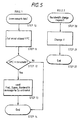
- the behaviour of this agent is described by the two rules shown in Figure 5 of the accompanying drawings.
- the first rule shown in Figure 5 is rule 1 and this rule fires at step 10 when new data arrives from the network. Essentially this rule detects if a problem is present and if this is the case requests the assistance of a coordinator agent 32.
- the rule acts to find the VPC which is the most heavily utilised.
- the rule checks if the utilisation level of the most heavily utilised VPC is over a predetermined threshold or not. If the answer is "Yes" a problem does exist and a request is sent at step 13 to the coordinator agent to find spare bandwidth. If the answer is "No" there is no problem and the rule ends with step 14.
- Rule 2 of Figure 5 fires if the VPC bundle agent 30 receives a request to change the bandwidth of a VPC. Such a request is received at Step 20, carried out at Step 21 and the rule ends with Step 22.
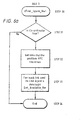
- the behaviour of the coordinator agent 32 is described by the three rules 3, 4 and 5 shown in Figure 6 of the accompanying drawings.
- the first rule in Figure 6 is Rule 3 which fires at step 30 when new data is received from the network via a VPC bundle agent 30 in response to that agent having received a positive answer at step 12 of Rule 1 and having sent a request for spare bandwidth in accordance with step 13 of that rule.
- the coordinator agent determines at Step 31 whether or not it is free to assist. If it is free the coordinator agent obtains at Step 32 the links that the problem VPC traverses. Once the links have been obtained by Step 32 the coordinator agent queries the corresponding link agents to report to it any available bandwidth. This is done in Step 33.
- Rule 3 ends either with the decision at Step 31 that the coordinator is not free or with the request to the link agents in Step 33.
- the termination of the rule is shown at Step 34.
- the second rule associated with each coordinator agent is Rule 4 of Figure 6 and this rule fires when the coordinator agent receives an event stating how much bandwidth is available on a particular link.
- Step 41 of Rule 4 is a decision as to whether or not all of the link agents have reported their available bandwidth. If all the agents do not report then the rule ends at Step 45. However, if all agents have reported the next step, Step 42, involves a decision by the coordinator agent as to whether or not the bandwidth reported by the links is sufficient to solve the problem. If the answer to Step 42 is "Yes" the coordinator agent asks the link agents for instructions as to how the bandwidth can be recovered.
- Step 44 If the answer at Step 42 is "No", Step 43 sends a failure message to the VPC bundle agent of the problem VPC. In either case the rules end at Step 45.
- the third rule associated with the coordinator agent 32 is Rule 5 and this rule fires at Step 50 when the coordinator agent receives an event describing how to cover bandwidth on a link. Such an event is generated by the link agent in response to the message generated at Step 44 of Rule 4.
- Step 51 proceeds with the coordinator agent sending instructions to the links to perform the actions which had been reported at Step 51. This is shown at Steps 53 and 54.
- the last of the three agents is the link agent 31.
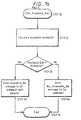
- the behaviour of this agent is described by the two rules 6 and 7 shown in Figure 7.
- Rule 6 fires at Step 60 when the link agent receives a request for available bandwidth sent by a coordinator agent in accordance with Step 33 of Rule 3.
- the link agent calculates the available bandwidth at Step 62 it compares the available bandwidth with a preset threshold. If the answer is that more bandwidth is available, the link agent sends at Step 63 a message to this effect to the coordinator. This corresponds to the link agent fulfilling the requirement for Step 51 of Rule 5. If no more bandwidth is available the rule sends that message at Step 64 to the coordinator. The rule ends at Step 65.
- the second rule covering the behaviour of a link agent 31 is Rule 7.
- This rule fires at Step 70 when the link agent receives a request to free up an amount of bandwidth, this request corresponding to Steps 53 and 54 of Rule 5.
- the link agent calculates the bandwidth to be released and at Step 72 sends to the appropriate coordinator agent 32 an instruction concerning the amount of bandwidth to be released.
- Rule 7 ends at Step 73.
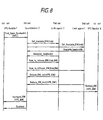
- Figure 8 of the accompanying drawings is a diagram showing the temporal sequence and paths between the agents of messages sent during the tuning of bandwidths for a VPC.
- the VP Topology Problem Management System employs distributed agents. Also the physical connection and switches of the system are similar to those described with reference to Figures 2 and 3 so that the VP Topology Problem Management System resides in the plurality of programmable computers 7 shown in Figure 2.
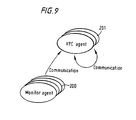
- the VP Topology Problem Management System utilises a distributed set of autonomous agents in the programmable computers 7. As in the previous embodiment the agents have been kept very simple by having no state and no learning capacity. In the present embodiment it utilises two agent types 200, 201 illustrated in Figure 9 of the accompanying drawings.
- the agent type indicated at 200 will hereinafter be referred to as a monitor agent and the agent type 201 will hereinafter be referred to as a VP agent.
- the number of monitor agents will be in this embodiment the same as the number of links in the network and each monitor agent 200 is responsible for identifying a VP Topology problem and then notifying appropriate VP agents 201 to deal with the identified problem.
- each monitor agent monitors its link and the VPs that use the link for the conditions that indicate a problem.
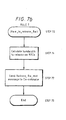
- the rule governing the behaviour of a monitor agent 200 will be referred to as Rule 8 and fires at Step S100 when new data arrives from the link being monitored by the agent.
- the rule acts to calculate the utilisation levels of the link. This is done by calculating the sum of the bandwidth allocated to the VPs using the link. If this sum is equal to, or exceeds a predetermined threshold, then a VP Topology problem is identified. This is shown at Step S102.
- the actual process carried out by the monitor agent 201 at step S101 is as follows.
- Call Acceptance Control as shown at 24 in Figure 3 is responsible for accepting or rejecting a new connections onto the network depending on the capacity left in the network.
- Each connection type has an associated 'effective bandwidth' which is the amount of bandwidth the CAC allows for an actual connection of that type.
- CAC subtracts the sum of the effective bandwidth's for active calls on the VP from the bandwidth that has been reserved for it on the links it traverses.
- Each VPC has a 'load factor' which says that the CAC should only accept calls up to a certain utilisation. If there is enough spare effective bandwidth, after taking any load factor into account, the connection is accepted.
- each VP may carry a number of different connection types, with different effective bandwidths.
- the monitor agent threshold is set by calculating the effective bandwidth for each VP carried by a link above which the next connection request may be rejected. These bandwidths are summed to find the maximum effective bandwidth that could be allocated. A management policy will then decide a point below this to set as the threshold to trigger a Topology problem.
- each of the VP agents 201 which are associated with a VP which uses the problem link and the other VP agents concerned with the problem.
- each network resource is represented by a distributed object.
- Each object representing a link has a reference to the objects representing the VP's that it carries.
- each of these objects has a reference to the VP agents that have an interest in them.
- Each VP agent 201 represents a VP for a particular Quality of Service (QoS).
- QoS Quality of Service
- each VP agent 201 The behaviour of each VP agent 201 is described by the rules illustrated in Figures 11 and 12.
- Figure 11 illustrates a Rule 9 which is triggered when a VP agent 201 receives a VP Topology problem message in response to a signal from a monitor agent 200 sent in response to a "YES" output at Step 203 in previously described Rule 8.
- Rule 8 is triggered at Step S110 when the VP agent 201 receives a notification that a VP Topology problem is present.
- Rule 8 carries out a series of functions which can be categorised as "preparing a bid". The agent prepares the bid by searching for a new route through the network that avoids the problem link and has appropriate spare capacity in all the links it will traverse.
- the bid is a numerical score based on the bandwidth that will be moved and the amount of spare capacity along the new route. If no route can be found a score guaranteed never to win will be produced.
- the VP agent sends its bid to all the other VP agents which were notified by the monitor agent 200 that a VP Topology problem existed.
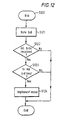
- Figure 12 illustrates Rule 10. This rule is triggered at Step S120 when a bid is received from another agent.
- the bid is recorded along with any other bid which has been generated by any other VP agent involved in the problem and which had been notified by the monitor agent 200 of the problem.
- the VP agent can determine if its bid is best. This is illustrated at Step S122. If all the bids have been received the rule proceeds to Step S123 where the agent determines if its bid is the best. If its bid is not the best it again takes no further action. If the VP agents own bid is the best it then implements a set of actions to create a bypass for the link which caused the initial problem.
- Step S124 This is done at Step S124 and comprises the steps of:
- Figures 13A and 13B The results of these operations are illustrated in Figures 13A and 13B in which Figure 13A shows a network configuration when a VP Topology problem has arisen and Figure 13B shows the results of the activity of the already described Monitor and VP agents.
- the network shown in Figures 13A and 13B is similar to that shown in Figure 2. It will be seen that the links which had been generally indicated at 5 in Figure 2 are now individually numbered 5(1), 5(2), 5(3), 5(4) and 5(5).
- link 5(1) consists of 2 VPCs, VPC1 and VPC2.
- the Bandwidth management system tries to increase the bandwidth of VPC2 but fails because there is no spare capacity.
- the Topology management system identifies the problem and replaces VPC1 with VPC1' that uses LINK 3 and LINK 2 as has been already described with regard to Figures 13a, 13b and 14.
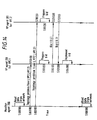
- Figure 14 shows the temporal sequence of messages between the monitor agent (200) which monitors link 5(1) of Figure 13A and the two VP agents (201) responsible for VPC1 and VPC2 respectively.
- the first action in Figure 14 is the monitor agent reading data from the link 5(1) in accordance with Step S100 of Rule 8.
- Step S101 of Rule 8 the existence of a VP Topology problem is notified to the respective VP agents representing VPC1 and VPC2 respectively. In practice these two notifications would be virtually simultaneous.
- the two VP agents carry out the steps of Rule 9 and in particular send out respective bids at S112(9) to each other.
- the bid of the VP agent for VPC1 wins and as a result the winning bid is implemented at S124(10).
- VPC1 has been deleted and replaced by VPC1' the physical path of which passes via ATM switch 3 but as was explained with regard to VPC 56 of Figure 2 cannot terminate at switch 3.
- VPC1' Once the new VPC (VPC1') has been created (as shown in 13B) data about it will start to arrive from the network. Similarly when the old VPC (VPC1) has been deleted data about it will no longer arrive from the network.
- the Topology Management System just described is capable of operating independently of the bandwidth management system described with respect to Figures 1 to 8 and that the converse is also applicable. However it is preferred for the two systems to operate in parallel.
- the agents described will all reside in the general purpose computers 7 of Figure 2. It is thus essential that the agents shown in Figure 4 are capable of taking the changes caused by the Topology Management System into account.
- Topology Management system makes the system more robust since the failure of a VP agent will only means that it is not involved in problem solution.
- VP agent failure is detected by having a time period in which all bids must be received. If VP agent's bid is not received in this time period then it is excluded from the problem but the problem can still be solved by the other VP agents. If there were a controller agents that received these bids to make the decision and this controller agent failed then the problem could not be solved.
- Topology Management system could incorporate central controller but the more distributed control mechanism just described provides greater security in generation for the reasons just given.
- Figure 15 of the accompanying drawings is an illustration of the parallel working of the bandwidth of Topology Management Systems and is effectively a combination of Figure 8 and of Figure 14 with the bandwidth management system slightly simplified in that only a single link agent 31 is shown.
- the bandwidth management system reads the network data at T 0 and the Topology Management System reads the network data at T 1 .
- Bandwidth management fails at T 2 ;
- Topology Management alters the network at T 3 by replacing VPC1 by VPC1';
- Bandwidth management reads the new network data at T 4 with successful tuning indicated at T 5 . Further readings by both management sub-systems at T 6 and T 7 indicate no further problems.
- the two management systems can operate over different timescales and that there is no need for there to be a specific integration of these timescales.
- the two systems can operate entirely independently provided that changes in the network configuration are recognised by the two systems.
Landscapes
- Engineering & Computer Science (AREA)
- Computer Networks & Wireless Communication (AREA)
- Signal Processing (AREA)
- Data Exchanges In Wide-Area Networks (AREA)
Abstract
Claims (27)
- Système de gestion destiné à un réseau à voies virtuelles en mode de transfert asynchrone ATM, dans lequel les connexions physiques sont fournies par des liaisons à large bande (5, liaison 1, liaison 2, liaison 3, liaison 4, liaison 5) entre des commutateurs en mode ATM (1, 2, 3, 4), et comprenant un moyen électronique de traitement de données (7) pouvant être connecté à des commutateurs en mode ATM individuels (1, 2, 3, 4) dans un réseau à voies virtuelles en mode ATM, et pouvant être mis en oeuvre, lorsqu'il est utilisé, pour mesurer une charge actuelle du réseau dans des liaisons individuelles (5) et des voies virtuelles (50-56, VPC1, VPC2) du réseau, caractérisé en ce que le moyen électronique de traitement de données (7) comprend en outre des ensembles d'agents logiciels répartis d'intercommunication (30, 31, 32, 200, 201) destinés à exécuter une gestion du réseau en réponse à la charge mesurée et aux exigences de gestion, et en ce qu'au moins certains des agents (30, 201) sont chacun associés à une voie respective, ou bien un sous-ensemble, des voies virtuelles (50-56, VPC1, VPC2), du réseau.
- Système selon la revendication 1, dans lequel une fois que les paramètres initiaux ont été établis, le système fonctionne entièrement en réponse à une charge mesurée et aux exigences de gestion.
- Système selon la revendication 1 ou 2, dans lequel les agents répartis (30, 31, 32, 200, 201) ne possèdent pas d'état, ni de capacité d'apprentissage.
- Système selon l'une quelconque des revendications précédentes, dans lequel les agents (30, 31, 32, 200, 201) comprennent trois ensembles d'agents répartis (30, 31, 32) destinés à exécuter une gestion de la bande passante du système, le premier ensemble comprenant des agents (30), dont chacun est associé à une voie respective, ou à un sous-ensemble, des voies virtuelles (50-56) du réseau, un deuxième ensemble d'agents (31) chargé des liaisons physiques (5) et un troisième ensemble d'agents (32) destiné à gérer des événements de performances.
- Système de gestion selon la revendication 4, dans lequel chaque agent (30) dudit premier ensemble est associé à une pluralité de voies virtuelles (50-56) et est conçu pour répondre à un manque de bande passante dans l'une de ses voies virtuelles associées (50-56) pour engendrer une demande vers un agent (32) dudit troisième ensemble afin d'obtenir de la bande passante.
- Système de gestion selon la revendication 5, dans lequel chacun des agents (32) du troisième ensemble d'agents est conçu, en réponse à une demande provenant d'un agent (30) du premier ensemble d'agents, pour demander des informations concernant la disponibilité de bande passante sur une ou plusieurs liaisons physiques (5) auprès de un ou plusieurs des agents (31) du deuxième ensemble d'agents, l'agent ou chaque agent (31) du deuxième ensemble d'agents répondant à une demande provenant d'un agent (32) du troisième ensemble d'agents en envoyant à l'agent demandeur (32) des informations spécifiant la bande passante disponible sur sa liaison associée (5).
- Système de gestion selon la revendication 6, dans lequel, en réponse à des informations de bande passante reçues de l'agent ou de chaque agent (31) dudit deuxième ensemble d'agents, l'agent ou chaque agent (32) du troisième ensemble d'agents est conçu pour donner des instructions à l'agent ou à chaque agent approprié (31) du deuxième ensemble d'agents sur la manière dont la bande passante doit être libérée.
- Système de gestion selon la revendication 7, dans lequel l'agent ou chaque agent (31) dudit deuxième ensemble d'agents recevant ainsi des instructions d'un agent (32) dudit troisième ensemble d'agents est conçu pour calculer la bande passante à libérer en réponse à la demande et pour envoyer à l'agent du troisième ensemble (32) une instruction concernant la quantité de bande passante à libérer et l'identité ou les identités de la voie ou des voies virtuelles (50-56) à partir desquelles la bande passante doit être libérée.
- Système de gestion selon la revendication 8, dans lequel, en réponse aux instructions reçues de l'agent ou de chaque agent du deuxième ensemble (31), l'agent du troisième ensemble (32) est conçu pour donner des instructions à l'agent du premier ensemble (30) qui a effectué la demande centralisée pour augmenter la bande passante afin de satisfaire ses exigences, et pour donner des instructions à l'agent ou à chaque agent du premier ensemble (30), identifié par l'agent ou chaque agent du deuxième ensemble (31) qui a exécuté les calculs de bande passante, pour réduire sa bande passante afin de satisfaire les exigences de l'agent du premier ensemble effectuant une demande centralisée.
- Système de gestion selon l'une quelconque des revendications précédentes, comprenant.en outre un moyen de surveillance (200) destiné à déterminer si un problème de bande passante existe sur une liaison ou des liaisons (liaison 1, liaison 2, liaison 3, liaison 4, liaison 5) du réseau et destiné à notifier à un ou plusieurs agents d'une pluralité d'agents de voies virtuelles (201) dont chacun est associé à une voie respective, ou à un sous-ensemble, des voies virtuelles (VPC1, VPC2) du réseau, dans lequel les agents de voies virtuelles (201) sont en outre conçus pour identifier un nouvel itinéraire (VPC1') au travers du réseau qui, à la fois, évite la liaison à problème (liaison 1) et possède une capacité en réserve, et dans lequel le système comprend en outre un moyen (201) destiné à sélectionner l'itinéraire identifié (VPC1') et à créer une nouvelle connexion de voie virtuelle (VPC1') sur une liaison ou un certain nombre de liaisons (liaison 2, liaison 3) du réseau.
- Système selon la revendication 10, dans lequel ledit moyen de surveillance (200) est conçu pour calculer la somme des bandes passantes allouées à des connexions de voies virtuelles (VPC1, VPC2) qui utilisent la liaison (liaison 1), pour comparer la somme à un seuil prédéterminé, et pour notifier à l'agent ou à chaque agent de voie virtuelle (201) associé aux voies virtuelles (VPC1, VPC2) de la liaison (liaison 1) qu'il existe un problème.
- Système selon la revendication 11, dans lequel ledit moyen de surveillance (200) comprend une pluralité d'agents de surveillance répartis (200), un agent de surveillance (200) existant pour chaque liaison (liaison 1, liaison 2, liaison 3, liaison 4, liaison 5).
- Système selon l'une quelconque des revendications 10 à 12, dans lequel chaque agent de voie virtuelle (201) est conçu pour engendrer, à la réception d'une notification d'un problème par ledit moyen de surveillance (200), une tentative de prise fondée sur les bandes passantes à déplacer et la quantité de capacité en réserve le long du nouvel itinéraire (VPC1') après que l'agent de voie virtuelle (201) a identifié un itinéraire, grâce à quoi l'un des agents de voies virtuelles (201) peut sélectionner un nouvel itinéraire (VPC1') en réponse à la meilleure tentative de prise engendrée.
- Système selon la revendication 13, dans lequel chaque agent de voie virtuelle (201) est conçu pour envoyer une tentative de prise à chaque agent de voie virtuelle (201) ayant reçu une notification dudit moyen de surveillance (200), pour déterminer si sa propre tentative de prise engendrée est la meilleure tentative de prise parmi toutes celles engendrées par tous les agents de voies virtuelles ayant reçus une notification dudit moyen de surveillance (200), et, si la détermination est positive, pour mettre en oeuvre un ensemble d'actions pour créer un contournement de la liaison (liaison 1) qui a provoqué le problème initial.
- Procédé de gestion d'un réseau à voies virtuelles en mode de transfert asynchrone, ATM, dans lequel les connexions physiques sont fournies par des liaisons à large bande (5, liaison 1, liaison 2, liaison 3, liaison 4, liaison 5) entre des commutateurs en mode ATM (1, 2, 3, 4), et comprenant un moyen électronique de traitement de données (7) pouvant être connecté à des commutateurs en mode ATM individuels (1, 2, 3, 4) dans un réseau à voies virtuelles en mode ATM, le procédé comprenant l'utilisation d'un moyen de traitement de données électronique pour mesurer une charge actuelle du réseau dans des liaisons individuelles (5) et des voies virtuelles (50-56, VPC1, VPC2) du réseau, caractérisé par l'utilisation d'ensembles d'agents logiciels répartis d'intercommunication (30, 31, 32, 200, 201) s'exécutant sur le moyen électronique de traitement de données (7) pour exécuter la gestion du réseau en réponse à la charge mesurée et aux exigences de gestion, et en ce qu'au moins certains des agents (30, 201) sont chacun associés à une voie respective, ou un sous-ensemble, des voies virtuelles (50-56, VPC1, VPC2) du réseau.
- Procédé selon la revendication 15, dans lequel, une fois que les paramètres initiaux ont été initialisés, la gestion du réseau fonctionne entièrement en réponse à une charge mesurée et aux exigences de gestion.
- Procédé selon la revendication 15 ou la revendication 16, dans lequel les agents répartis n'ont pas d'état, ni de capacité d'apprentissage.
- Procédé selon l'une quelconque des revendications 15 à 17, dans lequel les agents (30, 31, 32, 200, 201) comprennent trois ensembles d'agents répartis (30, 31, 32) destinés à exécuter une gestion de la bande passante du système, le premier ensemble comprenant des agents (30), dont chacun est associé à une voie respective, ou à un sous-ensemble, des voies virtuelles (50-56) du réseau, un deuxième ensemble d'agents (31) chargé des liaisons physiques (5), et un troisième ensemble d'agents (32) destiné à gérer des événements de performances.
- Procédé selon la revendication 18, dans lequel chaque agent (30) dudit premier ensemble est associé à une pluralité de voies virtuelles (50-56) et répond à un manque de bande passante dans l'une de ses voies virtuelles associées (50-56) en engendrant une demande vers un agent (32) dudit troisième ensemble afin d'obtenir de la bande passante.
- Procédé selon la revendication 19, dans lequel chacun des agents (32) du troisième ensemble d'agents, en réponse à une demande provenant d'un agent (30) du premier ensemble d'agents, demande des informations concernant la disponibilité de bande passante sur une ou plusieurs liaisons physiques (5) auprès de un ou plusieurs des agents (31) du deuxième ensemble d'agents, et dans lequel l'agent ou chaque agent (31) du deuxième ensemble d'agents répond à une demande provenant d'un agent (32) du troisième ensemble d'agents en envoyant à l'agent demandeur (32) des informations spécifiant la bande passante disponible sur sa liaison associée (5).
- Procédé selon la revendication 20, dans lequel, en réponse à des informations de bande passante reçues de l'agent ou de chaque agent (31) dudit deuxième ensemble d'agents, l'agent ou chaque agent (32) du troisième ensemble d'agents donne des instructions à l'agent ou à chaque agent approprié (31) du deuxième ensemble d'agents sur la manière dont la bande passante doit être libérée.
- Procédé selon la revendication 21, dans lequel l'agent ou chaque agent (31) dudit deuxième ensemble d'agents ayant ainsi reçu des instructions d'un agent (32) dudit troisième ensemble d'agents, calcule la bande passante à libérer en réponse à la demande et envoie à l'agent du troisième ensemble (32) une instruction concernant la quantité de bande passante à libérer et l'identité ou les identités de la voie ou des voies virtuelles (50-56) à partir desquelles la bande passante devrait être libérée.
- Procédé selon la revendication 22, dans lequel, en réponse aux instructions reçus de l'agent ou de chaque agent du deuxième ensemble (31), l'agent du troisième ensemble (32) donne des instructions à l'agent du premier ensemble (30) qui a effectué la demande centralisée pour augmenter la bande passante afin de satisfaire ces exigences, et donne des instructions à l'agent ou à chaque agent du premier ensemble (30), identifié par l'agent ou chaque agent du deuxième ensemble (31) qui a exécuté les calculs de bande passante, pour réduire sa bande passante afin de satisfaire les exigences de l'agent du premier ensemble (30) effectuant une demande centralisée.
- Procédé selon l'une quelconque des revendications 15 à 23, comprenant en outre une détermination pour savoir si un problème de bande passante existe sur une liaison ou des liaisons (liaison 1, liaison 2, liaison 3, liaison 4, liaison 5) du réseau et une notification à un ou plusieurs agents d'une pluralité d'agents de voies virtuelles (201), dont chacun est associé à une voie respective, ou à un sous-ensemble, des voies virtuelles (VPC1, VPC2) du réseau, et dans lequel chaque agent de voie virtuelle ayant ainsi reçu une notification (201) tente d'identifier un nouvel itinéraire (VPC1') au travers du réseau qui, à la fois, évite la liaison à problème (liaison 1) et présente une capacité de réserve, et dans lequel le procédé comprend en outre la sélection de l'itinéraire identifié (VPC1') et la création d'une nouvelle connexion de voie virtuelle (VPC1') sur une liaison ou un certain nombre de liaisons (liaison 2, liaison 3) du réseau.
- Procédé selon la revendication 24, dans lequel ladite surveillance est exécutée par une pluralité d'agents de surveillance répartis (200), dont chacun est associé à une liaison respective ou un sous-ensemble des liaisons (liaison 1, liaison 2, liaison 3, liaison 4, liaison 5), lesquels agents de surveillance (201) calculent la somme de la bande passante allouée aux voies virtuelles effectives (VPC1, VPC2) qui constituent la liaison ou chaque liaison (liaison 1), comparent la somme à un seuil prédéterminé, et, si la comparaison indique qu'il existe un problème, notifient aux agents de voies virtuelles respectives (201) qu'il existe un problème.
- Procédé selon la revendication 24 ou la revendication 25, dans lequel chaque agent de voie virtuelle (201), à la réception d'une notification d'un problème par un agent de surveillance (200), génère une tentative de prise d'après la bande passante à déplacer et la valeur de capacité de réserve en suivant le nouvel itinéraire (VPC1'), après que l'agent de voie virtuelle a identifié un itinéraire, grâce à quoi l'un des agents de voies virtuelles (201) peut sélectionner un nouvel itinéraire (VPC1') en réponse à la meilleure tentative de prise engendrée.
- Procédé selon la revendication 26, dans lequel chaque agent de voie virtuelle (201), envoie une tentative de prise à chaque agent de voie virtuelle (201) ayant reçu une notification par ledit moyen de surveillance (200), détermine si sa propre tentative de prise engendrée est la meilleure tentative de prise parmi toutes celles engendrées par tous les agents de voies virtuelles (201) ayant reçu une notification par ledit moyen de surveillance (200) et, si la détermination est positive, met en oeuvre un ensemble d'actions pour créer un contournement de la liaison (liaison 1) qui a provoqué le problème initial.
Applications Claiming Priority (3)
| Application Number | Priority Date | Filing Date | Title |
|---|---|---|---|
| GB9612363A GB9612363D0 (en) | 1996-06-13 | 1996-06-13 | ATM network management |
| GB9612363 | 1996-06-13 | ||
| PCT/GB1997/001591 WO1997048214A2 (fr) | 1996-06-13 | 1997-06-12 | Gestion de reseau en mode de transfert asynchrone |
Publications (2)
| Publication Number | Publication Date |
|---|---|
| EP0904647A2 EP0904647A2 (fr) | 1999-03-31 |
| EP0904647B1 true EP0904647B1 (fr) | 2005-12-14 |
Family
ID=10795231
Family Applications (1)
| Application Number | Title | Priority Date | Filing Date |
|---|---|---|---|
| EP97926107A Expired - Lifetime EP0904647B1 (fr) | 1996-06-13 | 1997-06-12 | Gestion de reseau en mode de transfert asynchrone |
Country Status (6)
| Country | Link |
|---|---|
| EP (1) | EP0904647B1 (fr) |
| JP (1) | JP2000512453A (fr) |
| AU (1) | AU3099497A (fr) |
| DE (1) | DE69734878T2 (fr) |
| GB (1) | GB9612363D0 (fr) |
| WO (1) | WO1997048214A2 (fr) |
Families Citing this family (11)
| Publication number | Priority date | Publication date | Assignee | Title |
|---|---|---|---|---|
| JPH10190733A (ja) | 1996-12-25 | 1998-07-21 | Hitachi Ltd | Ipスイッチ、該ipスイッチに用いるインターフェース回路及びatmスイッチ、及びipスイッチネットワークシステム |
| JP3634942B2 (ja) * | 1997-06-10 | 2005-03-30 | 株式会社日立コミュニケーションテクノロジー | パケットスイッチングネットワーク及びパケットスイッチ装置 |
| US6108304A (en) | 1996-03-08 | 2000-08-22 | Abe; Hajime | Packet switching network, packet switching equipment, and network management equipment |
| US6046999A (en) | 1996-09-03 | 2000-04-04 | Hitachi, Ltd. | Router apparatus using ATM switch |
| IL125310A (en) * | 1998-07-12 | 2002-02-10 | Eci Telecom Ltd | Method and system for managing varying traffic load in telecommunication network |
| FI107098B (fi) | 1999-06-08 | 2001-05-31 | Nokia Networks Oy | Virtuaaliväylän tai -kanavan valinta tietoliikenneverkossa |
| US6671724B1 (en) * | 2000-03-21 | 2003-12-30 | Centrisoft Corporation | Software, systems and methods for managing a distributed network |
| US7260635B2 (en) | 2000-03-21 | 2007-08-21 | Centrisoft Corporation | Software, systems and methods for managing a distributed network |
| WO2002037724A1 (fr) * | 2000-10-31 | 2002-05-10 | Dynarc Ab | Procede de reglage d'une capacite de bande passante de voie dynamique |
| JP4711795B2 (ja) * | 2005-09-28 | 2011-06-29 | 富士通株式会社 | リング型ネットワーク帯域増減速方法およびノード装置 |
| JP4711794B2 (ja) * | 2005-09-28 | 2011-06-29 | 富士通株式会社 | リング型ネットワーク帯域変更方法およびノード装置 |
Family Cites Families (1)
| Publication number | Priority date | Publication date | Assignee | Title |
|---|---|---|---|---|
| US5347511A (en) * | 1993-06-07 | 1994-09-13 | International Business Machines Corp. | Traffic management in packet communications networks |
-
1996
- 1996-06-13 GB GB9612363A patent/GB9612363D0/en active Pending
-
1997
- 1997-06-12 DE DE69734878T patent/DE69734878T2/de not_active Expired - Lifetime
- 1997-06-12 AU AU30994/97A patent/AU3099497A/en not_active Abandoned
- 1997-06-12 JP JP10501366A patent/JP2000512453A/ja active Pending
- 1997-06-12 WO PCT/GB1997/001591 patent/WO1997048214A2/fr not_active Ceased
- 1997-06-12 EP EP97926107A patent/EP0904647B1/fr not_active Expired - Lifetime
Also Published As
| Publication number | Publication date |
|---|---|
| DE69734878D1 (de) | 2006-01-19 |
| DE69734878T2 (de) | 2006-08-10 |
| AU3099497A (en) | 1998-01-07 |
| GB9612363D0 (en) | 1996-08-14 |
| WO1997048214A2 (fr) | 1997-12-18 |
| EP0904647A2 (fr) | 1999-03-31 |
| JP2000512453A (ja) | 2000-09-19 |
| WO1997048214A3 (fr) | 1998-02-19 |
Similar Documents
| Publication | Publication Date | Title |
|---|---|---|
| US6400687B1 (en) | ATM network management | |
| US6400681B1 (en) | Method and system for minimizing the connection set up time in high speed packet switching networks | |
| US6934249B1 (en) | Method and system for minimizing the connection set up time in high speed packet switching networks | |
| US6842463B1 (en) | Automated and adaptive management of bandwidth capacity in telecommunications networks | |
| US6400685B1 (en) | Heterogenous traffic connection admission control system for ATM networks and a method thereof | |
| US6665264B1 (en) | Connection admission control for connection orientated networks | |
| CA2069195C (fr) | Systeme de commutation pour les communications | |
| US5467348A (en) | Bandwidth allocation system of virtual path in asynchronous transfer mode | |
| US6104699A (en) | Method and device for partitioning physical network resources | |
| JP4368981B2 (ja) | Atmネットワーク中のロード平衡したubrルーティング | |
| US20040042402A1 (en) | Method and system for a local and fast non-disruptive path switching in high speed packet switching networks | |
| JPH09186701A (ja) | 最適帯域幅割当て方法及び装置 | |
| JP2000151652A (ja) | 連続ビット・レ―ト仮想パス接続の帯域幅を動的に調節するための方法、システム及びネットワ―ク | |
| EP0904647B1 (fr) | Gestion de reseau en mode de transfert asynchrone | |
| EP0814583A2 (fr) | Méthode et système pour minimiser le temps d'établissement de connexion dans des réseaux de commutation de paquets à haute vitesse | |
| JPH09506749A (ja) | 通信網を制御するための方法及び装置 | |
| EP0838970B1 (fr) | Méthode de gestion de mémoire partagée dans des noeuds de réseaux | |
| US6842780B1 (en) | Method of management in a circuit-switched communication network and device which can be used as a node in a circuit-switched communication network | |
| US6542509B1 (en) | Virtual path level fairness | |
| Bartal et al. | Fast, fair and frugal bandwidth allocation in atm networks | |
| EP1008274B1 (fr) | Procede de gestion d'un reseau de communication a circuit commute et dispositif utile en tant que noeud dans un tel reseau | |
| JP3053356B2 (ja) | 帯域可変通信装置 | |
| Bahk et al. | Preventive congestion control based routing in ATM networks | |
| Wong et al. | Bandwidth allocation for virtual paths in ATM networks with dynamic routing | |
| JP2794740B2 (ja) | 網内リソース管理方法 |
Legal Events
| Date | Code | Title | Description |
|---|---|---|---|
| PUAI | Public reference made under article 153(3) epc to a published international application that has entered the european phase |
Free format text: ORIGINAL CODE: 0009012 |
|
| 17P | Request for examination filed |
Effective date: 19981201 |
|
| AK | Designated contracting states |
Kind code of ref document: A2 Designated state(s): DE FR GB IT |
|
| 17Q | First examination report despatched |
Effective date: 20031009 |
|
| GRAP | Despatch of communication of intention to grant a patent |
Free format text: ORIGINAL CODE: EPIDOSNIGR1 |
|
| GRAS | Grant fee paid |
Free format text: ORIGINAL CODE: EPIDOSNIGR3 |
|
| GRAA | (expected) grant |
Free format text: ORIGINAL CODE: 0009210 |
|
| AK | Designated contracting states |
Kind code of ref document: B1 Designated state(s): DE FR GB IT |
|
| PG25 | Lapsed in a contracting state [announced via postgrant information from national office to epo] |
Ref country code: IT Free format text: LAPSE BECAUSE OF FAILURE TO SUBMIT A TRANSLATION OF THE DESCRIPTION OR TO PAY THE FEE WITHIN THE PRESCRIBED TIME-LIMIT;WARNING: LAPSES OF ITALIAN PATENTS WITH EFFECTIVE DATE BEFORE 2007 MAY HAVE OCCURRED AT ANY TIME BEFORE 2007. THE CORRECT EFFECTIVE DATE MAY BE DIFFERENT FROM THE ONE RECORDED. Effective date: 20051214 |
|
| REG | Reference to a national code |
Ref country code: GB Ref legal event code: FG4D |
|
| REF | Corresponds to: |
Ref document number: 69734878 Country of ref document: DE Date of ref document: 20060119 Kind code of ref document: P |
|
| ET | Fr: translation filed | ||
| PLBE | No opposition filed within time limit |
Free format text: ORIGINAL CODE: 0009261 |
|
| STAA | Information on the status of an ep patent application or granted ep patent |
Free format text: STATUS: NO OPPOSITION FILED WITHIN TIME LIMIT |
|
| 26N | No opposition filed |
Effective date: 20060915 |
|
| PGFP | Annual fee paid to national office [announced via postgrant information from national office to epo] |
Ref country code: FR Payment date: 20110630 Year of fee payment: 15 |
|
| PGFP | Annual fee paid to national office [announced via postgrant information from national office to epo] |
Ref country code: GB Payment date: 20110620 Year of fee payment: 15 |
|
| PGFP | Annual fee paid to national office [announced via postgrant information from national office to epo] |
Ref country code: DE Payment date: 20110622 Year of fee payment: 15 |
|
| GBPC | Gb: european patent ceased through non-payment of renewal fee |
Effective date: 20120612 |
|
| REG | Reference to a national code |
Ref country code: FR Ref legal event code: ST Effective date: 20130228 |
|
| REG | Reference to a national code |
Ref country code: DE Ref legal event code: R119 Ref document number: 69734878 Country of ref document: DE Effective date: 20130101 |
|
| PG25 | Lapsed in a contracting state [announced via postgrant information from national office to epo] |
Ref country code: DE Free format text: LAPSE BECAUSE OF NON-PAYMENT OF DUE FEES Effective date: 20130101 Ref country code: FR Free format text: LAPSE BECAUSE OF NON-PAYMENT OF DUE FEES Effective date: 20120702 Ref country code: GB Free format text: LAPSE BECAUSE OF NON-PAYMENT OF DUE FEES Effective date: 20120612 |