EP0904709A2 - Faltverschluss für Armbänder - Google Patents
Faltverschluss für Armbänder Download PDFInfo
- Publication number
- EP0904709A2 EP0904709A2 EP98307289A EP98307289A EP0904709A2 EP 0904709 A2 EP0904709 A2 EP 0904709A2 EP 98307289 A EP98307289 A EP 98307289A EP 98307289 A EP98307289 A EP 98307289A EP 0904709 A2 EP0904709 A2 EP 0904709A2
- Authority
- EP
- European Patent Office
- Prior art keywords
- clasp
- base member
- arm
- locking
- locking members
- Prior art date
- Legal status (The legal status is an assumption and is not a legal conclusion. Google has not performed a legal analysis and makes no representation as to the accuracy of the status listed.)
- Withdrawn
Links
Images


Classifications
-
- A—HUMAN NECESSITIES
- A44—HABERDASHERY; JEWELLERY
- A44C—PERSONAL ADORNMENTS, e.g. JEWELLERY; COINS
- A44C5/00—Bracelets; Wrist-watch straps; Fastenings for bracelets or wrist-watch straps
- A44C5/18—Fasteners for straps, chains or the like
- A44C5/22—Fasteners for straps, chains or the like for closed straps
- A44C5/24—Fasteners for straps, chains or the like for closed straps with folding devices
Definitions
- Bracelet type watch bands generally comprise a first band portion connected to one side of a watch and a second band portion connected to the other side of the watch.
- the first and second band portions are joined by an extensible clasp or fastener.
- the clasp is opened and extended so that the loop formed by the watch, watch band and clasp is of a length allowing it to pass over the wearer's hand.
- the clasp is closed to reduce the length of the loop so that the watch band fits closely around the wearer's wrist. In the closed condition, the clasp is held in position by an interference or snap-fit engagement acting to prevent movement of the clasp normal to the plane of the clasp.
- the band portions are joined by two arms which are pivotally interconnected.
- the overall length of the clasp increases to increase the overall length of the loop allowing this to pass over the wearer's hand.
- the arms By pivoting the arms so they overlie each other, the loop is shortened to closely fit around the wearer's wrist where it is unable to pass over the wearer's hand.
- the snap-fit engagement between the two arms is in the direction of the final closing or initial opening of the arms. The snap-fit is therefore in a direction generally normal to the plane of the clasp.
- the arms In the closed position, the arms are in a generally stable state, and require a force having a component normal to the plane of the clasp to move them from the stable state into a state where the clasp can be extended.
- This force component must be greater than the frictional force of the snap-fit. Nevertheless, this frictional force is small, and therefore if the clasp is caught on clothing or otherwise knocked, this may overcome the frictional force and open the clasp. The watch band will then be able to pass over the wearer's hand and this may result in the loss of or damage to the watch.
- a clasp for a bracelet comprises a base member, an arm, one end of which is hinged to the base member for pivotal movement with respect to the base member between an extended position in which the arm is away from the base member, and a closed position in which the arm overlies the base member, and a lock having a first locking member attached to the free end of the arm, and a second locking member provided on the base member, in which a portion of the first or second locking member is moveable with respect to the other in a plane substantially orthogonal to the direction of the initial opening movement of the clasp from its closed position to engage the two locking members together.
- the clasp according to the present invention allows for an additional movement in a direction other than the direction of initial opening of the clasp, the additional movement therefore being generally in a plane parallel to the base member. Accordingly, to open the clasp there must be an initial unlocking movement in a direction substantially orthogonal to the initial opening movement of the clasp, followed by movement in the direction of opening. Accordingly it is difficult for the clasp to be opened accidentally since two distinct movements in two different directions are required, and it is unlikely that such movement will occur during accidental contact.
- the first locking member is pivotally mounted on the arm. This is advantageous as it allows a larger tolerance for the closing of the clasp. Furthermore, when the clasp is formed as part of a bracelet, or part of a bracelet for a watch band, and where one part of this bracelet is attached directly to the first locking means, this provides pivotal movement between the watch band and arm and base member of the clasp. This is advantageous since, if the locking member were mounted rigidly to the arm, upon opening the clasp, the band would dig into the wearer's wrist. Where the first locking member is mounted to the arm pivotally, it is preferred that the hinge axis between the arm and the locking member is parallel to the hinge axis between the arm and the base member.
- the second locking member may be mounted on an end of a second arm, the other end of which is connected pivotally to the base member.
- This is advantageous as the second arm can also be moved between an extended position in which it is pivoted away from the base member and closed position in which it overlies the base member thereby allowing further lengthening of the clasp to assist in passing the bracelet over the wearer's hand.
- the band portion is connected directly to the second locking member, for the second locking member be mounted pivotally on the second arm and in this case, as with the first member and first arm, for the hinge axis of this pivotal connection to be generally parallel to the hinge axis of the pivotal connection between the second arm and the base member.
- the relative movement of the part of the first and second locking members is in a direction generally transverse to the watch band and clasp.
- the movement is transverse both to the direction of initial opening of the clasp and to the tensile force applied to the bracelet when it is around the wearers wrist.
- one of the locking members includes a slidable portion for achieving the relative movement.
- the slidable portion is advantageously mounted on at least two elongate pins. The use of two pins is advantageous as this helps prevent undesirable skewing during the transverse movement.
- One of the locking members may include one or more projections which engage a corresponding number of recesses in the other of the locking members as a result of their relative movement.
- the projection may be a pin which is received in a hole in the other locking member.
- one of the locking members may include a projection which, upon relative movement of the locking members, lies below a portion of the other locking member thereby preventing lifting of the locking members in the initial opening direction of the clasp.
- the projection may be formed by a "C" or "U” shaped channel section on the edge of one locking member, one of the arms of which slides below the other locking member during the relative movement of the locking members.
- the projection has the form of a headed pin which is received in a recess and a key hole shaped plate overlies the recess and, as a result of the transverse relative movement of the locking members traps the headed pin beneath portions of the plate and in the recess.
- the clasp includes biasing means for biasing the locking members to a first or second relative position in the plane of movement substantially orthogonal to the initial opening movement of the clasp.
- this biasing means is in the form of a leaf spring which is engagable with one of two notches to hold the members in the first or second relative positions.
- the locking members snap-fit to each other or to the base member.
- the clasp if first closed and held in place by the snap-fitting, so holding the clasp in the closed position whilst allowing the wearer to move the locking members relative to each other to lock the clasp into its closed position.
- a watch band comprises a first band portion and a second band portion linked together with a clasp according to the first aspect of the present invention.
- the clasp comprises a base member 1 which is curved to correspond generally to the underside of a wearer's wrist. The size and curvature of the base member will vary depending on whether the clasp is for a man's or a woman's bracelet.
- a first arm 2 and a second arm 3 are mounted pivotally to opposite ends of the base member 1 by pivot pins 8, 9 respectively.
- the arms 2, 3 are pivotally moveable away from the base member 1 from a closed position as shown in Figure 1 to an open as shown in Figure 3. In the closed position, the clasp has a much shorter length than in the open position.
- Upstands 12, 13 are provided on the base member 1. Each upstand 12, 13 has a slightly convex surface.
- the first and second arms 2, 3 each include a pin 10, 11 respectively against which the convex surfaces of the upstands 12, 13 respectively press when the first and second arms 2, 3 are pivoted to overlie the base member 1. This snap fits the arms 2, 3 into place overlying the base member 1.
- a first locking member 4 is pivotally connected to the end of the first arm 2 remote from the base member 1 by a pivot pin 6 parallel to the pivot pin 8.
- a second locking member 5 is connected pivotally to the end of the second arm 3 remote from the base member 1 by a pivot pin 7 parallel to the pivot pin 9.
- the second locking member 5 in the first example includes a hole 14 extending transversely into it.
- the first locking member includes a main portion having two holes 15, 16 extending transversely through the portion. Across the width of the main body portion, there are two notches 17, 18 each having inclined sides. A sliding member 19 is mounted on the first locking member by two pins 20, 21 extending through the holes 15, 16 respectively. This permits the slider 19 to slide transversely with respect to the main body portion of the first locking member 4.
- a leaf spring 22 is provided on the underside of the slider 19. This leaf spring engages one of the grooves 17, 18 of the main body portion of the first locking member 4. As the slider 19 is moved transversely with respect to the main body portion of the first locking member, the leaf spring 22 is compressed against the underside of the slider 19 until it is able to return to its non deformed position in the adjacent grooves 17, 18. This gives a bias to urge the slider 19 into either its first or second position.
- the slider 19 includes a pin 23.
- this pin is aligned with the hole 14 on the second locking member 5.
- the pin 23 is received in the hole 14 thereby locking the first and second locking members 4, 5 together by relative transverse movement.
- two portions of a bracelet type watch band are connected respectively to the first and second locking members 4, 5.
- the clasp, watch band portions and watch form a closed loop.
- the loop has a long length allowing it to pass over the wearers hand and onto or away from the wearers wrist.
- the second arm 3 is pivoted about pivot pin 9 and snap fits onto the base member 1 by the frictional engagement between the upstand 13 and pin 11.
- the first arm 1 is pivoted about pivot pin 8 to overlie the base member 1 and is snap fitted with the pin 10 engaging the upstand 12. This tightens the watch band around the wearers wrist.
- This is a stable position in which the clasp can only be opened by a force applied in a direction normal to the clasp.
- the slider 19 can be slid relative to the second locking means 5 to engage the pin 23 with the hole 14 to lock the clasp shut.
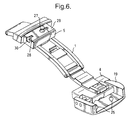
- FIG. 6 A second example is shown in Figure 6. It is identical to the first except that the pin 23 and recess 14 are replaced by two headed pins 25 projecting from the underside of the slider 19 and a key-hole shaped slot 27 and tapering mouth slot 28 in the second locking member 5.
- the slots 27 and 28 are formed in a top plate 29 below which is a channel 30 in the second locking member 5.
- the clasp is closed one pin 25 enters the round portion of the key-hole shaped slot 27 and the other is adjacent the tapering mouth of the slot 28.
- the slider 19 is moved transversely the pins 25 move along the slots 27 and 28 so that their heads are held captive beneath the plate 29 to lock the two parts of the clasp together.
Landscapes
- Buckles (AREA)
Applications Claiming Priority (2)
| Application Number | Priority Date | Filing Date | Title |
|---|---|---|---|
| GBGB9720459.8A GB9720459D0 (en) | 1997-09-25 | 1997-09-25 | Clasp |
| GB9720459 | 1997-09-25 |
Publications (2)
| Publication Number | Publication Date |
|---|---|
| EP0904709A2 true EP0904709A2 (de) | 1999-03-31 |
| EP0904709A3 EP0904709A3 (de) | 1999-08-18 |
Family
ID=10819662
Family Applications (1)
| Application Number | Title | Priority Date | Filing Date |
|---|---|---|---|
| EP98307289A Withdrawn EP0904709A3 (de) | 1997-09-25 | 1998-09-09 | Faltverschluss für Armbänder |
Country Status (3)
| Country | Link |
|---|---|
| EP (1) | EP0904709A3 (de) |
| CN (1) | CN1214222A (de) |
| GB (1) | GB9720459D0 (de) |
Cited By (3)
| Publication number | Priority date | Publication date | Assignee | Title |
|---|---|---|---|---|
| WO2003022090A1 (fr) * | 2001-09-08 | 2003-03-20 | Tag-Heuer Sa | Bracelet muni d'un fermoir |
| WO2018078128A1 (fr) * | 2016-10-31 | 2018-05-03 | Buonomo Sebastien | Boucle securisee |
| CN111329185A (zh) * | 2020-04-20 | 2020-06-26 | 广东小天才科技有限公司 | 一种滑动搭扣及可穿戴设备 |
Family Cites Families (3)
| Publication number | Priority date | Publication date | Assignee | Title |
|---|---|---|---|---|
| FR1541115A (fr) * | 1967-08-24 | 1968-10-04 | Fermoir pour bracelet, collier et articles analogues | |
| FR2723824A1 (fr) * | 1994-08-31 | 1996-03-01 | Alain Bonnet | Fermoir de bracelet verrouillable |
| CH690894A5 (fr) * | 1996-07-01 | 2001-02-28 | Vacheron & Constantin S A | Fermoir dépliant, notamment à bouton. |
-
1997
- 1997-09-25 GB GBGB9720459.8A patent/GB9720459D0/en not_active Ceased
-
1998
- 1998-09-09 EP EP98307289A patent/EP0904709A3/de not_active Withdrawn
- 1998-09-25 CN CN 98119586 patent/CN1214222A/zh active Pending
Cited By (10)
| Publication number | Priority date | Publication date | Assignee | Title |
|---|---|---|---|---|
| WO2003022090A1 (fr) * | 2001-09-08 | 2003-03-20 | Tag-Heuer Sa | Bracelet muni d'un fermoir |
| US7412755B2 (en) | 2001-09-08 | 2008-08-19 | Tag-Heuer Sa | Bracelet provided with a clasp |
| CH697522B1 (fr) * | 2001-09-08 | 2008-11-28 | Tag Heuer Sa | Bracelet muni d'un fermoir. |
| CN100553515C (zh) * | 2001-09-08 | 2009-10-28 | 豪雅公司 | 带有一钩扣的腕带 |
| WO2018078128A1 (fr) * | 2016-10-31 | 2018-05-03 | Buonomo Sebastien | Boucle securisee |
| FR3058030A1 (fr) * | 2016-10-31 | 2018-05-04 | Watchlock | Boucle securisee |
| AU2017351784B2 (en) * | 2016-10-31 | 2020-08-27 | Watchlock | Secure buckle |
| RU2732169C1 (ru) * | 2016-10-31 | 2020-09-14 | Уотчлок | Надежно защищенная застежка |
| US10842235B2 (en) | 2016-10-31 | 2020-11-24 | Watchlock | Secure buckle |
| CN111329185A (zh) * | 2020-04-20 | 2020-06-26 | 广东小天才科技有限公司 | 一种滑动搭扣及可穿戴设备 |
Also Published As
| Publication number | Publication date |
|---|---|
| EP0904709A3 (de) | 1999-08-18 |
| GB9720459D0 (en) | 1997-11-26 |
| CN1214222A (zh) | 1999-04-21 |
Similar Documents
| Publication | Publication Date | Title |
|---|---|---|
| US6023816A (en) | Locking device of a buckle of belt-shaped ornament | |
| JP3920391B2 (ja) | 腕輪の伸長可能な留め金 | |
| HK98597A (en) | Extensible, fine adjustable wrist-strap fastener | |
| JP4445129B2 (ja) | 帯状装身具の中留 | |
| JPH06327508A (ja) | 時計バンドの中留構造 | |
| US5870803A (en) | Double-locking clasp for watch band | |
| CA2003175A1 (en) | Openable ring with safety snap lock element | |
| CN101677658A (zh) | 具有长度调节装置的表链的搭扣 | |
| USRE37365E1 (en) | Clasp mechanism | |
| US6457215B1 (en) | Bracelet clasp | |
| CN111513436A (zh) | 金属表带 | |
| US5642558A (en) | Jewelry clasp | |
| US4314389A (en) | Double fold over jewelry clasp | |
| US7412755B2 (en) | Bracelet provided with a clasp | |
| JP2001286310A (ja) | ブレスレット用クロージャ | |
| US3999251A (en) | Buckle and clip apparatus | |
| CN100479694C (zh) | 用于带子或类似物的带扣 | |
| HK1016846A (en) | Foldable fastener for a bracelet | |
| US6457216B1 (en) | Buckle for a wristwatch | |
| US4545094A (en) | Extensible clasp for use with flexible wristlet | |
| KR102705108B1 (ko) | 길이 조정을 갖는 팔찌 클래스프 | |
| EP0904709A3 (de) | Faltverschluss für Armbänder | |
| EP0375565B1 (de) | Ring mit einem Sicherheitsschnappverschlusselement, der geöffnet werden kann | |
| JP3205470B2 (ja) | 時計バンド用バックル | |
| US4270249A (en) | Clasp for a bracelet or the like |
Legal Events
| Date | Code | Title | Description |
|---|---|---|---|
| PUAI | Public reference made under article 153(3) epc to a published international application that has entered the european phase |
Free format text: ORIGINAL CODE: 0009012 |
|
| AK | Designated contracting states |
Kind code of ref document: A2 Designated state(s): AT BE CH CY DE DK ES FI FR GB GR IE IT LI LU MC NL PT SE |
|
| AX | Request for extension of the european patent |
Free format text: AL;LT;LV;MK;RO;SI |
|
| PUAL | Search report despatched |
Free format text: ORIGINAL CODE: 0009013 |
|
| AK | Designated contracting states |
Kind code of ref document: A3 Designated state(s): AT BE CH CY DE DK ES FI FR GB GR IE IT LI LU MC NL PT SE |
|
| AX | Request for extension of the european patent |
Free format text: AL;LT;LV;MK;RO;SI |
|
| RIC1 | Information provided on ipc code assigned before grant |
Free format text: 6A 44C 5/24 A, 6A 44C 5/20 B |
|
| RIN1 | Information on inventor provided before grant (corrected) |
Inventor name: LI,SHU CHUNG |
|
| AKX | Designation fees paid | ||
| REG | Reference to a national code |
Ref country code: DE Ref legal event code: 8566 |
|
| STAA | Information on the status of an ep patent application or granted ep patent |
Free format text: STATUS: THE APPLICATION IS DEEMED TO BE WITHDRAWN |
|
| 18D | Application deemed to be withdrawn |
Effective date: 20000419 |
|
| REG | Reference to a national code |
Ref country code: HK Ref legal event code: WD Ref document number: 1016846 Country of ref document: HK |