EP0905003B1 - Rechnergestütztes Konfliktlösungsverfahren für Eisenbahnnetz - Google Patents
Rechnergestütztes Konfliktlösungsverfahren für Eisenbahnnetz Download PDFInfo
- Publication number
- EP0905003B1 EP0905003B1 EP98402082A EP98402082A EP0905003B1 EP 0905003 B1 EP0905003 B1 EP 0905003B1 EP 98402082 A EP98402082 A EP 98402082A EP 98402082 A EP98402082 A EP 98402082A EP 0905003 B1 EP0905003 B1 EP 0905003B1
- Authority
- EP
- European Patent Office
- Prior art keywords
- mission
- resolution
- conflict
- determining
- conflicts
- Prior art date
- Legal status (The legal status is an assumption and is not a legal conclusion. Google has not performed a legal analysis and makes no representation as to the accuracy of the status listed.)
- Revoked
Links
- 238000000034 method Methods 0.000 title claims abstract description 68
- 230000008569 process Effects 0.000 title description 3
- 230000004044 response Effects 0.000 claims abstract description 9
- 238000012800 visualization Methods 0.000 description 9
- 230000004048 modification Effects 0.000 description 6
- 238000012986 modification Methods 0.000 description 6
- 238000012545 processing Methods 0.000 description 4
- 238000010586 diagram Methods 0.000 description 2
- 235000021183 entrée Nutrition 0.000 description 2
- 238000007726 management method Methods 0.000 description 2
- 238000012360 testing method Methods 0.000 description 2
- 241001080024 Telles Species 0.000 description 1
- 238000013473 artificial intelligence Methods 0.000 description 1
- 230000008859 change Effects 0.000 description 1
- 239000003086 colorant Substances 0.000 description 1
Images


Classifications
-
- B—PERFORMING OPERATIONS; TRANSPORTING
- B61—RAILWAYS
- B61L—GUIDING RAILWAY TRAFFIC; ENSURING THE SAFETY OF RAILWAY TRAFFIC
- B61L27/00—Central railway traffic control systems; Trackside control; Communication systems specially adapted therefor
- B61L27/10—Operations, e.g. scheduling or time tables
- B61L27/16—Trackside optimisation of vehicle or train operation
Definitions
- the present invention relates to a method enabling a regulator network (or traffic) to modify, using a computer means, scheduling of missions on a network type transport network railway, following a conflict.
- Document US 4,122,523 A describes a control system for applying said method.
- mission The journey made by a convoy (or train) on the rail network is called mission, this journey comprising departure, arrival and stop times at different stations.
- TDG visualization for Time Distance Graph
- Figure 1 gives an example of TDG visualization.
- the abscissa shows time, expressed here in hours (h).
- the ordinates show the stations or stations likely to be served (S 1 , S 2 , S 3 , S 4 ).
- References 1 and 2 represent two missions.
- the slope corresponding to the representation of a convoy is proportional to the speed of the latter.
- mission 2 is faster than mission 1.
- a stop at a station appears as a horizontal segment more or less long depending the time during which the convoy corresponding to the mission remains at the station.
- the task of the network regulator is to assign the mission parameters: arrival and departure times at each station, speed between two stations, etc.
- Different events can disrupt mission planning: temporary closure of a track section, addition of an additional mission, etc.
- These events can lead to conflicts.
- a restriction is the temporary prohibition to enter a section of a railway network, for example following an accident (derailment, collapse of a bridge ...) or work on the network.
- a restriction can be defined by a restriction zone (that is to say the section of the network which is concerned), a start date and an end date.
- the conflicts of occupation are due to a limitation of the number of missions which can be present at the same time in certain zones of the network (zones of limitation). For example, only one mission can be present, at a given time, on a bridge, under a tunnel, etc.
- Catch-up conflicts occur when a mission collides with another mission, the two missions having the same direction of movement.
- Face to face conflicts occur when a mission collides with another mission, the two missions having opposite directions of progression.
- Scarfing conflicts occur when a mission collides with another mission, the two missions coming from two different directions and meeting at a switch.
- the known state of the art allowing the regulator to modify the scheduling of one or more missions following a conflict using computer means can be divided into two groups: manual methods and automatic methods.
- the manual methods consist in editing the assignments, one by one or in a more global manner, and in modifying, for each of them, their scheduling parameters (departure time, station parking times, speeds between two stations. ..).
- the modifications can be made by editing a table, or graphically. This kind of method is not satisfactory.
- it is very difficult to manually find the best solution to a conflict whether it is the one generating the least significant modifications, or the solution which generates the least modifications.
- not being able to find this solution can be critical if the flow of missions is significant in the vicinity of the conflict being dealt with. Indeed, in such situations, modifying a mission to resolve a conflict may result in a new conflict (for example, resolving a restriction conflict may result in an occupation conflict).
- the second family of methods is based on advanced computer techniques.
- methods based on expert systems These methods are however cumbersome to implement and maintain, and oversized for the resolution of simple conflicts. They also generate very long execution times.
- Another example of an automatic conflict resolution method is based on the constraint programming technique. Here again, these methods generate long execution times.
- the parameters (heuristics, etc.) of the process depend on the rail network. They must therefore be determined again if the network changes or if the characteristics of the network or of the traffic change.
- the aim of the present invention is to propose a resolution method of conflicts in a computerized representation of a rail network, does not not having the drawbacks of the methods according to the state of the art.
- the step of determining an answer (e) can be broken down into a or more sub-steps depending on the nature of the selected object, that is to say whether it is a conflict, a mission, a restriction or a couple formed of a conflict and a mission.
- Figure 1 already described, shows an example of a scheduling of several missions on a rail network according to the TDG formalism.
- Figure 2 shows an example of a TDG graph with different types of conflicts.
- Figure 3 shows a flowchart illustrating the method according to the invention.
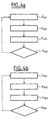
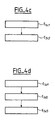
- Figures 4a, 4b, 4c and 4d detail in the form of flowcharts, a step of the method according to the invention in the various cases that may arise.
- Stage E 1 consists in determining the various conflicts existing on the rail network as a function of the parameters of the missions, and of events such as the restrictions.
- Step E 2 consists of viewing, for example on a computer screen in the form of a TDG (Time Distance Graph) graph , the missions, the conflicts and the restrictions.
- Figure 2 shows an example of such a visualization.
- the restrictions are represented by rectangles (R 1 , R 2 ) whose dimensions are determined on the one hand by the geographical area (that is to say, the section of the rail network), and on the other hand by a start date and end date.
- the restriction R 1 is geographically delimited by the stations Si and S 2 , and it lasts from 9:30 to 13 hours.
- the missions, conflicts and restrictions which are thus viewed can be selected by the network regulator, in the step referenced E 3 in FIG. 3.
- the selection can be made using a mouse by clicking on the desired mission, conflict or restriction. It may be possible to make multiple selections.
- the network regulator can select a conflict and a mission.
- the selection made by the regulator is called an object.
- An object can therefore be made up of an element singleton (a conflict, a mission or a restriction) or of a pair of two elements (a conflict and a mission).
- Step E 4 consists in selecting a resolution method from a predetermined set of resolution methods.
- a method of resolution is a general guideline on how to resolve the conflict. Examples of resolution methods can be "advance”, "delay” ... which indicates whether the conflict should be resolved by advancing the mission or missions that generate it, or rather by delaying it.
- the predetermined set of resolution methods may depend on the type of object that the controller has selected. However, one of the advantages of the method according to the invention is that the resolution methods are general and therefore capable of being applied in all situations and for any type of network. It is the computer system that interprets the resolution method in terms of resolution commands depending on the situation.
- Step E 5 consists in constructing the response, that is to say a set, possibly reduced to a single element, of resolution commands which are applied to missions which generate conflicts in order to resolve them, and to actually apply these resolution commands to missions.
- the way of constructing this set of resolution commands may depend on the object selected during step E 3 .
- FIG. 4a shows a flowchart illustrating the processing implemented by step E 5 , when the selected object is a mission.
- Substep E 5a1 consists in determining a conflict generated by the selected mission. Indeed, the same mission can generate a plurality of conflicts. This step can simply be summed up by taking the first conflict encountered following the direction of the mission.
- Step E 5a2 consists in determining one or more resolution commands depending on the type of conflict and the resolution method.
- Step E 5a3 consists in applying these resolution commands to the selected mission.
- Step E 5a4 consists in testing whether the selected mission still generates a conflict. If yes, we return to step E 5a1 . It should be noted that step E 5a3 can generate new conflicts. For example, by delaying a mission in order to avoid a restriction, this can lead to an occupation conflict with another mission.
- FIG. 4b shows a flow diagram illustrating the processing implemented by step E 5 , when the selected object is a restriction.
- Sub-step E 5b1 consists in determining a mission which conflicts with the selected restriction. This step can simply be summed up as taking the first mission encountered following a direction of restriction (that is, going up or down the time axis).
- Step E 5b2 consists in determining one or more resolution commands according to the mission and the resolution method.
- Step E 5b3 consists in applying these resolution commands to the chosen mission.
- Step E 5b4 consists in testing whether there are still missions which enter the selected restriction. If yes, we return to step E 5b1 .
- FIG. 4c shows a flowchart illustrating the processing implemented by step E 5 , when the selected object is a couple formed by a conflict and a mission.
- the sub-step E 5c1 consists in determining one or more resolution commands as a function of the selected resolution method, and of the mission / conflict pair.
- Sub-step E 5c2 consists, like sub-steps E 5a3 and E 5b3, of updating the mission by executing said resolution commands.
- Sub-step E 5d2 consists in determining one or more resolution commands as a function of the selected resolution method, of the mission determined in the previous sub-step
- Sub-step E 5d3 consists, like sub-steps E 5a3, E 5b3, and E 5c2, of updating the mission by executing said resolution commands.
- the sub-steps E 5a2 , E 5b2 , E 5c1 and E 5d2 consisting in determining all of the execution commands, can be implemented using a table with two inputs. One entry is the type of conflict, the other entry is the chosen resolution method. The table then gives one or more resolution commands. When several resolution commands exist for a single conflict type / resolution method pair, the choice can be made randomly or by a parameter of the resolution method, said parameter being able to be by default or else selected by the regulator of the network.
Landscapes
- Engineering & Computer Science (AREA)
- Mechanical Engineering (AREA)
- Train Traffic Observation, Control, And Security (AREA)
- Small-Scale Networks (AREA)
- Electric Propulsion And Braking For Vehicles (AREA)
Claims (8)
- Verfahren zur Auflösung von Konflikten in einer automatisierten Darstellung eines Transportnetzes, insbesondere eines Schienentransportnetzes, wobei die Darstellung eine Menge von Aufgaben und von Einschränkungen umfasst, dadurch gekennzeichnet, dass es die folgenden geordneten Schritte umfasst:a) Feststellen der Existenz von Konflikten in Abhängigkeit vom Netz, den Aufgaben und den Einschränkungen,b) Visualisierung der Aufgaben, der Konflikte und der Einschränkungen auf einem Schirm,c) Auswählen eines Objekts ausgehend von der Visualisierung,d) Auswählen eines Auflösungsverfahrens aus einer Menge von Auflösungsverfahren, wobei die Menge vorgegeben ist,e) Bestimmen einer Antwort in Abhängigkeit von dem Auflösungsverfahren und dem Objekt.
- Verfahren nach dem vorhergehenden Anspruch, dadurch gekennzeichnet, dass wenn das Objekt eine Aufgabe ist, der Schritt des Bestimmens einer Antwort in die nachfolgenden geordneten Unterschritte unterteilt ist:wobei die Unterschritte so oft wiederholt werden, wie ein von der Aufgabe hervorgerufener Konflikt besteht.a) Bestimmen eines von der Aufgabe hervorgerufenen Konflikts,b) Bestimmen eines oder mehrerer Auflösungsbefehle in Abhängigkeit von dem Auflösungsverfahren und dem Konflikt,c) Ändern der Darstellung in Abhängigkeit von dem oder den Auflösungsbefehlen,
- Verfahren nach einem der vorhergehenden Ansprüche, dadurch gekennzeichnet, dass wenn das Objekt eine Einschränkung ist, der Schritt des Bestimmens einer Antwort in die folgenden geordneten Unterschritte unterteilt ist:wobei die Unterschritte so oft wiederholt werden, wie eine einen Konflikt mit der Einschränkung hervorrufende Aufgabe existiert.a) Bestimmen einer Aufgabe, die einen Konflikt mit der Einschränkung hervorruft,b) Bestimmen eines oder mehrerer Auflösungsbefehle in Abhängigkeit von dem Auflösungsverfahren, der Aufgabe und dem Konflikt,c) Verändern der Darstellung in Abhängigkeit von dem oder den Auflösungsbefehlen,
- Verfahren nach einem der vorhergehenden Ansprüche, dadurch gekennzeichnet, dass wenn das Objekt ein Paar, bestehend aus einem Konflikt und einer Aufgabe ist, der Schritt des Bestimmens einer Antwort darin beruht, einen oder mehrere Auflösungsbefehle in Abhängigkeit von dem Auflösungsverfahren, der Aufgabe und dem Konflikt zu bestimmen.
- Verfahren nach einem der vorhergehenden Ansprüche, dadurch gekennzeichnet, dass wenn das Objekt ein Konflikt ist, der Schritt des Bestimmens einer Antwort in die folgenden geordneten Unterschritte unterteilt ist:a) Bestimmen einer Aufgabe aus der Menge der Aufgaben, die den Konflikt hervorruft,b) Bestimmen eines oder mehrerer Auflösungsbefehle in Abhängigkeit von dem Auflösungsverfahren, der Aufgabe und dem Konflikt.
- Verfahren nach einem der vorhergehenden Ansprüche, dadurch gekennzeichnet, dass die Menge von Auflösungsverfahren vom Objekt abhängig ist.
- Verfahren nach einem der vorhergehenden Ansprüche, dadurch gekennzeichnet, dass die Auflösungsverfahren Parameter aufweisen.
- Verfahren nach einem der Ansprüche 2 bis 7, dadurch gekennzeichnet, dass der Schritt des Bestimmens eines oder mehrerer Auflösungsbefehle eine Tabelle mit zwei Eingaben verwendet, von denen die eine der Typ des Konflikts und die andere das Auflösungsverfahren ist.
Applications Claiming Priority (2)
| Application Number | Priority Date | Filing Date | Title |
|---|---|---|---|
| FR9710844 | 1997-09-01 | ||
| FR9710844A FR2767770B1 (fr) | 1997-09-01 | 1997-09-01 | Procede de resolution de conflits dans un reseau ferroviaire a l'aide d'un moyen informatique |
Publications (2)
| Publication Number | Publication Date |
|---|---|
| EP0905003A1 EP0905003A1 (de) | 1999-03-31 |
| EP0905003B1 true EP0905003B1 (de) | 2003-05-07 |
Family
ID=9510636
Family Applications (1)
| Application Number | Title | Priority Date | Filing Date |
|---|---|---|---|
| EP98402082A Revoked EP0905003B1 (de) | 1997-09-01 | 1998-08-20 | Rechnergestütztes Konfliktlösungsverfahren für Eisenbahnnetz |
Country Status (4)
| Country | Link |
|---|---|
| EP (1) | EP0905003B1 (de) |
| AT (1) | ATE239635T1 (de) |
| DE (1) | DE69814276T2 (de) |
| FR (1) | FR2767770B1 (de) |
Families Citing this family (27)
| Publication number | Priority date | Publication date | Assignee | Title |
|---|---|---|---|---|
| US6304801B1 (en) | 1999-12-30 | 2001-10-16 | Ge-Harris Railway Electronics, L.L.C. | Train corridor scheduling process including a balanced feasible schedule cost function |
| US6546371B1 (en) * | 1999-12-30 | 2003-04-08 | Ge-Harris Railway Electronics, L.L.C. | Train corridor scheduling process including various cost functions associated with railway operations |
| US10308265B2 (en) | 2006-03-20 | 2019-06-04 | Ge Global Sourcing Llc | Vehicle control system and method |
| US10569792B2 (en) | 2006-03-20 | 2020-02-25 | General Electric Company | Vehicle control system and method |
| US9233696B2 (en) | 2006-03-20 | 2016-01-12 | General Electric Company | Trip optimizer method, system and computer software code for operating a railroad train to minimize wheel and track wear |
| US9733625B2 (en) | 2006-03-20 | 2017-08-15 | General Electric Company | Trip optimization system and method for a train |
| US8924049B2 (en) | 2003-01-06 | 2014-12-30 | General Electric Company | System and method for controlling movement of vehicles |
| US9156477B2 (en) | 2006-03-20 | 2015-10-13 | General Electric Company | Control system and method for remotely isolating powered units in a vehicle system |
| US8290645B2 (en) | 2006-03-20 | 2012-10-16 | General Electric Company | Method and computer software code for determining a mission plan for a powered system when a desired mission parameter appears unobtainable |
| US9201409B2 (en) | 2006-03-20 | 2015-12-01 | General Electric Company | Fuel management system and method |
| US8473127B2 (en) | 2006-03-20 | 2013-06-25 | General Electric Company | System, method and computer software code for optimizing train operations considering rail car parameters |
| US8768543B2 (en) | 2006-03-20 | 2014-07-01 | General Electric Company | Method, system and computer software code for trip optimization with train/track database augmentation |
| US8401720B2 (en) | 2006-03-20 | 2013-03-19 | General Electric Company | System, method, and computer software code for detecting a physical defect along a mission route |
| US8370006B2 (en) | 2006-03-20 | 2013-02-05 | General Electric Company | Method and apparatus for optimizing a train trip using signal information |
| US9266542B2 (en) | 2006-03-20 | 2016-02-23 | General Electric Company | System and method for optimized fuel efficiency and emission output of a diesel powered system |
| US8788135B2 (en) | 2006-03-20 | 2014-07-22 | General Electric Company | System, method, and computer software code for providing real time optimization of a mission plan for a powered system |
| US8126601B2 (en) | 2006-03-20 | 2012-02-28 | General Electric Company | System and method for predicting a vehicle route using a route network database |
| US9527518B2 (en) | 2006-03-20 | 2016-12-27 | General Electric Company | System, method and computer software code for controlling a powered system and operational information used in a mission by the powered system |
| US8370007B2 (en) | 2006-03-20 | 2013-02-05 | General Electric Company | Method and computer software code for determining when to permit a speed control system to control a powered system |
| US8249763B2 (en) | 2006-03-20 | 2012-08-21 | General Electric Company | Method and computer software code for uncoupling power control of a distributed powered system from coupled power settings |
| US8155811B2 (en) | 2008-12-29 | 2012-04-10 | General Electric Company | System and method for optimizing a path for a marine vessel through a waterway |
| US9834237B2 (en) | 2012-11-21 | 2017-12-05 | General Electric Company | Route examining system and method |
| US8234023B2 (en) | 2009-06-12 | 2012-07-31 | General Electric Company | System and method for regulating speed, power or position of a powered vehicle |
| DE102011081995A1 (de) * | 2011-09-01 | 2012-10-25 | Siemens Ag | Fahrtoptimierungsmodul |
| DE102011081993A1 (de) * | 2011-09-01 | 2013-03-07 | Siemens Aktiengesellschaft | Haltezeitberechnungsmodul |
| US9669851B2 (en) | 2012-11-21 | 2017-06-06 | General Electric Company | Route examination system and method |
| FR3063554B1 (fr) * | 2017-03-03 | 2021-04-02 | Mbda France | Procede et dispositif de prediction de solutions d'attaque et de defense optimales dans un scenario de conflit militaire |
Family Cites Families (2)
| Publication number | Priority date | Publication date | Assignee | Title |
|---|---|---|---|---|
| US4122523A (en) * | 1976-12-17 | 1978-10-24 | General Signal Corporation | Route conflict analysis system for control of railroads |
| US5177684A (en) * | 1990-12-18 | 1993-01-05 | The Trustees Of The University Of Pennsylvania | Method for analyzing and generating optimal transportation schedules for vehicles such as trains and controlling the movement of vehicles in response thereto |
-
1997
- 1997-09-01 FR FR9710844A patent/FR2767770B1/fr not_active Expired - Lifetime
-
1998
- 1998-08-20 AT AT98402082T patent/ATE239635T1/de not_active IP Right Cessation
- 1998-08-20 EP EP98402082A patent/EP0905003B1/de not_active Revoked
- 1998-08-20 DE DE69814276T patent/DE69814276T2/de not_active Revoked
Also Published As
| Publication number | Publication date |
|---|---|
| DE69814276D1 (de) | 2003-06-12 |
| EP0905003A1 (de) | 1999-03-31 |
| FR2767770B1 (fr) | 1999-10-15 |
| ATE239635T1 (de) | 2003-05-15 |
| DE69814276T2 (de) | 2004-02-19 |
| FR2767770A1 (fr) | 1999-03-05 |
Similar Documents
| Publication | Publication Date | Title |
|---|---|---|
| EP0905003A1 (de) | Rechnergestütztes Konfliktlösungsverfahren für Eisenbahnnetz | |
| CN110795818B (zh) | 一种确定虚拟测试场景方法、装置、电子设备和存储介质 | |
| EP0866393B1 (de) | Methode und Vorrichtung zur Bestimmung der optimalen Flugbahn eines Flugzeuges | |
| CN112400192A (zh) | 多模态深度交通信号控制的方法和系统 | |
| DE112017008231T5 (de) | Koordiniertes autonomes fahren | |
| FR3006050A1 (fr) | Procede et systeme d'aide a la navigation d'un aeronef. | |
| Schwarz et al. | Towards autonomous vehicles | |
| FR3071092A1 (fr) | Procede et systeme d'aide a la navigation d'un avion sur un aeroport | |
| CN114111827A (zh) | 一种基于区块链的导航处理方法、装置以及设备 | |
| EP4058959A1 (de) | Gemeinschaftlicher raum zur verwaltung von flugplänen | |
| CN115362422A (zh) | 基于行驶场景的行驶路线自动优化 | |
| WO2008142271A2 (fr) | Dispositif d'aide à la navigation d'un aéronef | |
| Fothergill et al. | Conflict-resolution heuristics for en route air traffic management | |
| CN109445576A (zh) | 控制方法和控制系统 | |
| Broggi et al. | Moving from analog to digital driving | |
| WO2020065148A1 (fr) | Procédé de régulation d'un réseau de transport multimodal | |
| EP0933280A2 (de) | Lösungsverfahren für Fahrplankonflikte in Transportnetzen und Datenverarbeitungseinrichtung dafür | |
| Derrick | THE MERGING OF RUSSIA'S REGIONS AS APPLIED NATIONALITY POLICY: A SUGGESTED RATIONALE. | |
| Giahi et al. | A holding strategy to optimize the bus transit service | |
| EP0617349B1 (de) | Verfahren und Vorrichtung zur Rekonfiguration in Echtzeit einer Fahrzeugstrajektorie | |
| Maia et al. | Understanding the effects of autonomous vehicles on urban form | |
| FR3121540A1 (fr) | Système électronique et procédé de gestion du vol d’un aéronef, avec insertion de tronçon(s) avec contrainte(s) dans un plan de vol, programme d’ordinateur associé | |
| Naz et al. | Exploring the impact of service quality and customer satisfaction on reliability: A structural equation modeling approach | |
| FR2844615A1 (fr) | Systeme de gestion des plans de vol en tour de controle d'aeroport | |
| US20170344916A1 (en) | Supporting analysis based on workflow |
Legal Events
| Date | Code | Title | Description |
|---|---|---|---|
| PUAI | Public reference made under article 153(3) epc to a published international application that has entered the european phase |
Free format text: ORIGINAL CODE: 0009012 |
|
| AK | Designated contracting states |
Kind code of ref document: A1 Designated state(s): AT DE GB |
|
| AX | Request for extension of the european patent |
Free format text: AL;LT;LV;MK;RO;SI |
|
| 17P | Request for examination filed |
Effective date: 19990930 |
|
| AKX | Designation fees paid |
Free format text: AT DE GB |
|
| GRAH | Despatch of communication of intention to grant a patent |
Free format text: ORIGINAL CODE: EPIDOS IGRA |
|
| GRAH | Despatch of communication of intention to grant a patent |
Free format text: ORIGINAL CODE: EPIDOS IGRA |
|
| GRAA | (expected) grant |
Free format text: ORIGINAL CODE: 0009210 |
|
| RAP1 | Party data changed (applicant data changed or rights of an application transferred) |
Owner name: ALCATEL |
|
| AK | Designated contracting states |
Designated state(s): AT DE GB |
|
| REG | Reference to a national code |
Ref country code: GB Ref legal event code: FG4D Free format text: NOT ENGLISH |
|
| GBT | Gb: translation of ep patent filed (gb section 77(6)(a)/1977) |
Effective date: 20030507 |
|
| REF | Corresponds to: |
Ref document number: 69814276 Country of ref document: DE Date of ref document: 20030612 Kind code of ref document: P |
|
| PLBI | Opposition filed |
Free format text: ORIGINAL CODE: 0009260 |
|
| PLAX | Notice of opposition and request to file observation + time limit sent |
Free format text: ORIGINAL CODE: EPIDOSNOBS2 |
|
| 26 | Opposition filed |
Opponent name: SIEMENS SCHWEIZ AG Effective date: 20040121 |
|
| PGFP | Annual fee paid to national office [announced via postgrant information from national office to epo] |
Ref country code: GB Payment date: 20040730 Year of fee payment: 7 |
|
| PGFP | Annual fee paid to national office [announced via postgrant information from national office to epo] |
Ref country code: DE Payment date: 20040805 Year of fee payment: 7 |
|
| PGFP | Annual fee paid to national office [announced via postgrant information from national office to epo] |
Ref country code: AT Payment date: 20040810 Year of fee payment: 7 |
|
| RDAF | Communication despatched that patent is revoked |
Free format text: ORIGINAL CODE: EPIDOSNREV1 |
|
| RDAG | Patent revoked |
Free format text: ORIGINAL CODE: 0009271 |
|
| STAA | Information on the status of an ep patent application or granted ep patent |
Free format text: STATUS: PATENT REVOKED |
|
| 27W | Patent revoked |
Effective date: 20041105 |
|
| GBPR | Gb: patent revoked under art. 102 of the ep convention designating the uk as contracting state |
Free format text: 20041105 |