EP0905165B1 - Substituierte Biphenylpolyoxyalkyleneether und diese enthaltende Kraftstoffzusammensetzungen - Google Patents
Substituierte Biphenylpolyoxyalkyleneether und diese enthaltende Kraftstoffzusammensetzungen Download PDFInfo
- Publication number
- EP0905165B1 EP0905165B1 EP98307595A EP98307595A EP0905165B1 EP 0905165 B1 EP0905165 B1 EP 0905165B1 EP 98307595 A EP98307595 A EP 98307595A EP 98307595 A EP98307595 A EP 98307595A EP 0905165 B1 EP0905165 B1 EP 0905165B1
- Authority
- EP
- European Patent Office
- Prior art keywords
- carbon atoms
- hydrogen
- oxyalkylene
- alkyl
- compound according
- Prior art date
- Legal status (The legal status is an assumption and is not a legal conclusion. Google has not performed a legal analysis and makes no representation as to the accuracy of the status listed.)
- Expired - Lifetime
Links
- 0 C**(C)(*)c1ccc(*)cc1 Chemical compound C**(C)(*)c1ccc(*)cc1 0.000 description 3
Classifications
-
- C—CHEMISTRY; METALLURGY
- C10—PETROLEUM, GAS OR COKE INDUSTRIES; TECHNICAL GASES CONTAINING CARBON MONOXIDE; FUELS; LUBRICANTS; PEAT
- C10L—FUELS NOT OTHERWISE PROVIDED FOR; NATURAL GAS; SYNTHETIC NATURAL GAS OBTAINED BY PROCESSES NOT COVERED BY SUBCLASSES C10G OR C10K; LIQUIFIED PETROLEUM GAS; USE OF ADDITIVES TO FUELS OR FIRES; FIRE-LIGHTERS
- C10L1/00—Liquid carbonaceous fuels
- C10L1/10—Liquid carbonaceous fuels containing additives
- C10L1/14—Organic compounds
- C10L1/18—Organic compounds containing oxygen
- C10L1/192—Macromolecular compounds
- C10L1/198—Macromolecular compounds obtained otherwise than by reactions involving only carbon-to-carbon unsaturated bonds homo- or copolymers of compounds having one or more unsaturated aliphatic radicals, each having only one carbon to carbon double bond, and at least one being terminated by an acyloxy radical of a saturated carboxylic acid, of carbonic acid
- C10L1/1985—Macromolecular compounds obtained otherwise than by reactions involving only carbon-to-carbon unsaturated bonds homo- or copolymers of compounds having one or more unsaturated aliphatic radicals, each having only one carbon to carbon double bond, and at least one being terminated by an acyloxy radical of a saturated carboxylic acid, of carbonic acid polyethers, e.g. di- polygylcols and derivatives; ethers - esters
-
- C—CHEMISTRY; METALLURGY
- C10—PETROLEUM, GAS OR COKE INDUSTRIES; TECHNICAL GASES CONTAINING CARBON MONOXIDE; FUELS; LUBRICANTS; PEAT
- C10L—FUELS NOT OTHERWISE PROVIDED FOR; NATURAL GAS; SYNTHETIC NATURAL GAS OBTAINED BY PROCESSES NOT COVERED BY SUBCLASSES C10G OR C10K; LIQUIFIED PETROLEUM GAS; USE OF ADDITIVES TO FUELS OR FIRES; FIRE-LIGHTERS
- C10L1/00—Liquid carbonaceous fuels
- C10L1/10—Liquid carbonaceous fuels containing additives
- C10L1/14—Organic compounds
- C10L1/22—Organic compounds containing nitrogen
- C10L1/234—Macromolecular compounds
- C10L1/238—Macromolecular compounds obtained otherwise than by reactions involving only carbon-to-carbon unsaturated bonds
-
- C—CHEMISTRY; METALLURGY
- C10—PETROLEUM, GAS OR COKE INDUSTRIES; TECHNICAL GASES CONTAINING CARBON MONOXIDE; FUELS; LUBRICANTS; PEAT
- C10L—FUELS NOT OTHERWISE PROVIDED FOR; NATURAL GAS; SYNTHETIC NATURAL GAS OBTAINED BY PROCESSES NOT COVERED BY SUBCLASSES C10G OR C10K; LIQUIFIED PETROLEUM GAS; USE OF ADDITIVES TO FUELS OR FIRES; FIRE-LIGHTERS
- C10L1/00—Liquid carbonaceous fuels
- C10L1/10—Liquid carbonaceous fuels containing additives
- C10L1/14—Organic compounds
- C10L1/22—Organic compounds containing nitrogen
- C10L1/234—Macromolecular compounds
- C10L1/238—Macromolecular compounds obtained otherwise than by reactions involving only carbon-to-carbon unsaturated bonds
- C10L1/2383—Polyamines or polyimines, or derivatives thereof (poly)amines and imines; derivatives thereof (substituted by a macromolecular group containing 30C)
- C10L1/2387—Polyoxyalkyleneamines (poly)oxyalkylene amines and derivatives thereof (substituted by a macromolecular group containing 30C)
-
- C—CHEMISTRY; METALLURGY
- C10—PETROLEUM, GAS OR COKE INDUSTRIES; TECHNICAL GASES CONTAINING CARBON MONOXIDE; FUELS; LUBRICANTS; PEAT
- C10L—FUELS NOT OTHERWISE PROVIDED FOR; NATURAL GAS; SYNTHETIC NATURAL GAS OBTAINED BY PROCESSES NOT COVERED BY SUBCLASSES C10G OR C10K; LIQUIFIED PETROLEUM GAS; USE OF ADDITIVES TO FUELS OR FIRES; FIRE-LIGHTERS
- C10L10/00—Use of additives to fuels or fires for particular purposes
- C10L10/04—Use of additives to fuels or fires for particular purposes for minimising corrosion or incrustation
Definitions
- This invention relates to substituted biphenyl poly(oxyalkylene) ethers and to fuel compositions containing substituted biphenyl poly(oxyalkylene) ethers to prevent and control engine deposits.
- polyether amine fuel additives are well known in the art for the prevention and control of engine deposits. These polyether additives have a polyoxyalkylene "backbone", i.e., the polyether portion of the molecule consists of repeating oxyalkylene units.
- U.S. Patent No. 4,191,537, issued March 4, 1980 to Lewis et al. disclose a fuel composition comprising a major portion of hydrocarbons boiling in the gasoline range and from 30 to 2,000 ppm of a hydrocarbyl polyoxyalkylene aminocarbamate having a molecular weight from about 600 to 10,000, and at least one basic nitrogen atom.
- the hydrocarbyl polyoxyalkylene moiety is composed of oxyalkylene units having from 2 to 5 carbon atoms in each oxyalkylene unit.
- Aromatic compounds containing a poly(oxyalkylene) moiety are also known in the art.
- U.S. Patent No. 4,191,537 discloses alkylphenyl poly(oxyalkylene) polymers which are useful as intermediates in the preparation of alkylphenyl poly(oxyalkylene) aminocarbamates.
- U.S. Patent No. 4,881,945 issued November 21, 1989 to Buckley, discloses a fuel composition comprising a hydrocarbon boiling in the gasoline or diesel range and from about 30 to about 5,000 parts per million of a fuel soluble alkylphenyl polyoxyalkylene aminocarbamate having at least one basic nitrogen and an average molecular weight of about 800 to 6,000 and wherein the alkyl group contains at least 40 carbon atoms.
- U.S. Patent No. 5,090,914, issued February 25, 1992 to Reardan et al. disclose poly(oxyalkylene) aromatic compounds having an amino or hydrazinocarbonyl substituent on the aromatic moiety and an ester, amide, carbamate, urea or ether linking group between the aromatic moiety and the poly(oxyalkylene) moiety. These compounds are taught to be useful for modifying macromolecular species such as proteins and enzymes.
- U.S. Patent Nos. 5,081,295; 5,103,039; and 5,157,099; all issued to Reardan et al. disclose similar poly(oxyalkylene) aromatic compounds.
- U.S. Patent No. 5,409,507 issued April 25, 1995 to Cherpeck discloses that poly(oxyalkylene) aromatic ethers having a nitro, amino, N-alkylamino, or N,N-dialkylamino substituent on the aromatic moiety are surprisingly useful for reducing engine deposits, especially intake valve deposits, when employed as fuel additives in fuel compositions.
- the present invention provides novel substituted biphenyl poly(oxyalkylene) ether fuel additives which are useful for the prevention and control of engine deposits, particularly intake valve deposits.
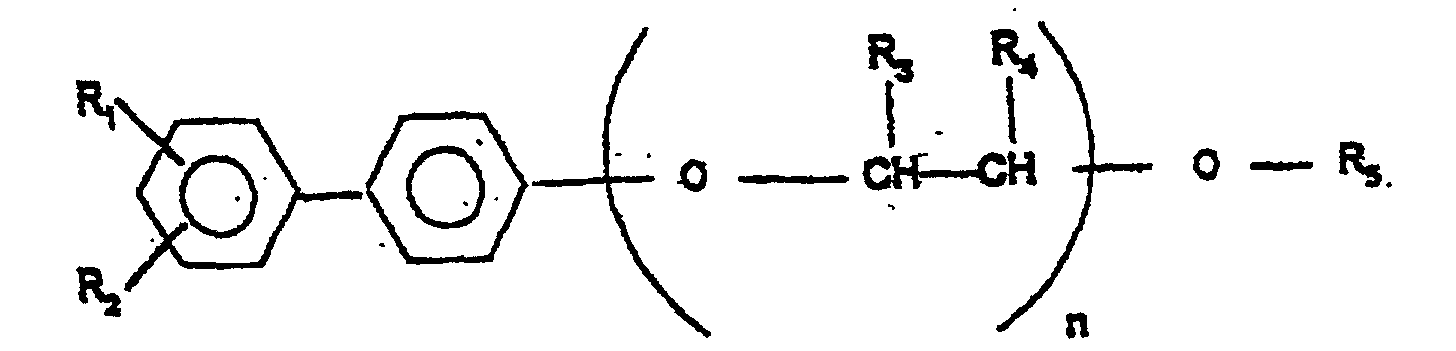
- the substituted biphenyl poly(oxyalkylene) ethers of the present invention have the formula: wherein R 1 is hydrogen or hydroxyl; R 2 is hydroxyl, cyano, nitro, amino, aminomethyl, N -alkylamino or N -alkylaminomethyl wherein the alkyl group contains 1 to 6 carbon atoms, N , N -dialkylamino or N,N -dialkylaminomethyl wherein each alkyl group independently contains 1 to 6 carbon atoms, with the proviso that R 1 and R 2 are ortho relative to each other and meta or para relative to the adjoining phenyl substitutent; R 3 and R 4 are independently hydrogen or lower alkyl having 1 to 6 carbon atoms and each R 3 and R 4 is independently selected in each -OCHR 3 - CHR 4 - unit; R 5 is hydrogen, alkyl having 1 to 100 carbon atoms, phenyl, aralkyl having about 7 to 100 carbon atoms, alkaryl having about 7 to
- the present invention further provides a fuel composition comprising a major amount of hydrocarbons boiling in the gasoline or diesel range and an effective deposit-controlling amount of a substituted biphenyl poly(oxyalkylene) ether of formula 1 above.
- the present invention additionally provides a fuel concentrate comprising an inert stable oleophilic organic solvent boiling in the range of from about 150°F (65°C) to about 400°F (205°C) and from 10 to 70 weight percent of a substituted biphenyl poly(oxyalkylene) ether of formula I above.
- the present invention also provides a method for reducing engine deposits in an internal combustion engine comprising operating the engine with a fuel composition containing an effective deposit-controlling amount of a substituted biphenyl poly(oxyalkylene) ether of formula I above.
- the present invention is based on the surprising discovery that certain substituted biphenyl poly(oxyalkylene) ethers provide excellent control of engine deposits, especially on intake valves, when employed as fuel additives in fuel compositions.
- the substituted biphenyl poly(oxyalkylene) ethers of the present invention have the general formula: wherein R 1 , R 2 , R 3 , R 4 , R 5 , and n are as defined above.
- R 1 is preferably hydrogen.
- R 2 is hydroxyl, amino, or aminomethyl. More preferably, R 2 is amino or aminomethyl. Most preferably, R 2 is an amino group.
- one of R 3 and R 4 is lower alkyl having 1 to 3 carbon atoms and the other is hydrogen. More preferably, one of R 3 and R 4 is methyl or ethyl and the other is hydrogen. Most preferably, one of R 3 and R 4 is ethyl and the other is hydrogen.
- R 5 is preferably hydrogen, alkyl having 1 to 30 carbon atoms, or alkylphenyl having an alkyl group containing 1 to 30 carbon atoms. More preferably, R 5 is hydrogen, alkyl having 2 to 24 carbon atoms, or alkylphenyl having an alkyl group containing about 2 to 24 carbon atoms. Still more preferably, R 5 is hydrogen, alkyl having 4 to 12 carbon atoms or alkylphenyl having an alkyl group containing 4 to 12 carbon atoms. Most preferably, R 5 is alkylphenyl having an alkyl group containing 4 to 12 carbon atoms.
- n is an integer from 5 to 100.
- n is an integer from about 8 to 50. More preferably, n is an integer from 10 to 30.
- R 2 is an N -alkylamino or N -alkylaminomethyl group
- the alkyl group of the N -alkylamino or N -alkylaminomethyl moiety preferably contains 1 to 4 carbon atoms. More preferably, the alkyl group is methyl or ethyl.
- particularly preferred groups are N -methylamino, N -ethylamino, N -methylaminomethyl. and N -ethylaminomethyl.
- each alkyl group of the N,N -dialkylamino or N,N -dialkylaminomethyl moiety preferably contains 1 to 4 carbon atoms. More preferably, each alkyl group is either methyl or ethyl.
- particularly preferred groups are N,N -dimethylamino, N -ethyl- N -methylamino, N,N -diethylamino, N,N -dimethylaminomethyl, N -ethyl- N -methylaminomethyl, and N,N -diethylaminomethyl.
- R 1 and R 2 are ortho relative to each other and meta or para relative to the adjoining phenyl substitutent.
- a preferred group of substituted biphenyl poly(oxyalkylene) ethers of this invention are compounds of formula I wherein R 1 is hydrogen or hydroxy; R 2 is hydroxy, amino, or aminomethyl; one of R 3 and R 4 is hydrogen and the other is methyl or ethyl; R 5 is hydrogen, alkyl having 1 to 30 carbon atoms or alkylphenyl having an alkyl group containing 1 to 30 carbon atoms; and n is 8 to 50.
- a more preferred group of substituted biphenyl poly(oxyalkylene) ethers are those of formula I wherein R 1 is hydrogen; R 2 is amino or aminomethyl; one of R 3 and R 4 is hydrogen and the other is methyl or ethyl; R 5 is hydrogen, alkyl having 2 to 24 carbon atoms or alkylphenyl having an alkyl group containing 2 to 24 carbon atoms; and n is 10 to 30.
- a particularly preferred group of substituted biphenyl poly(oxyalkylene) ethers are those of formula I wherein R 1 is hydrogen; R 2 is amino; one of R 3 and R 4 is hydrogen and the other is methyl or ethyl; R 5 is hydrogen, alkyl having 1 to 12 carbon atoms or alkylphenyl having an alkyl group containing 1 to 12 carbon atoms; and n is 10 to 30.
- the hydroxyl, amino, aminomethyl, N -alkylamino, N -alkylaminomethyl, N,N -dialkylamino, or N,N -dialkylaminomethyl substituent, R 2 present in the aromatic moiety of the substituted biphenyl poly(oxyalkylene) ethers of this invention be situated in a meta or para position relative to the adjoining phenyl substituent.
- the aromatic moiety also contains a hydroxyl group as the R 1 substituent
- this hydroxyl group be in a meta or para position relative to the phenyl substituent and in an ortho position relative to the R 2 hydroxyl, amino, aminomethyl, N -alkylamino, N -alkylaminomethyl, N,N -dialkylamino, or N,N -dialkylaminomethyl substituent.
- the substituted biphenyl poly(oxyalkylene) ethers of the present invention will generally have a sufficient molecular weight so as to be non-volatile at normal engine intake valve operating temperatures (200°C to 250°C).
- the molecular weight of the substituted biphenyl poly(oxyalkylene) ethers will range from 600 to 10,000, preferably from 1,000 to 3,000.
- the substituted biphenyl poly(oxyalkylene) ethers of this invention will contain an average of 5 to 100 oxyalkylene units; preferably, 8 to 50 oxyalkylene units; more preferably, 10 to 30 oxyalkylene units.
- Fuel-soluble salts of the substituted biphenyl poly(oxyalkylene) ethers of the present invention can be readily prepared for those compounds containing an amino, aminomethyl, N -alkylamino, N -alkylaminomethyl, N,N -dialkylamino, or N,N -dialkylaminomethyl group and such salts are contemplated to be useful for preventing or controlling engine deposits.
- Suitable salts include, for example, those obtained by protonating the amino moiety with a strong organic acid, such as an alkyl- or arylsulfonic acid.
- Preferred salts are derived from toluenesulfonic acid and methanesulfonic acid.
- Fuel-soluble salts of the substituted biphenyl poly(oxyalkylene) ethers of the present invention can also be readily prepared for those compounds containing a hydroxyl group.
- Such salts include alkali metal, alkaline earth metal, ammonium, substituted ammonium, and sulfonium salts.
- Perferred metal salts are the alkaline metal salts, particularly, the sodium and potassium salts, and the substituted ammonium salts, particularly, tetraalkyl-substituted ammonium salts, such as the tetrabutylammonium salts.
- amino refers to the group: -NH 2 .
- aminomethyl refers to the group: -CH 2 NH 2 .
- cyano refers to the group: -CN.
- nitro refers to the group: -NO 2 .
- N -alkylamino refers to the group: -NHR a wherein R a is an alkyl group.
- N,N -dialkylamino refers to the group: -NR b R c wherein R b and R c are alkyl groups.
- N -alkylaminomethyl refers to the group: -CH 2 NHR d wherein R d is an alkyl group.
- N,N -dialkylaminomethyl refers to the group: -CH 2 NR e R f wherein R e and R f are alkyl groups.
- alkyl refers to both straight- and branched-chain alkyl groups.
- lower alkyl refers to alkyl groups having 1 to 6 carbon atoms and includes primary, secondary, and tertiary alkyl groups.
- Typical lower alkyl groups include, for example, methyl, ethyl, n-propyl, isopropyl, n-butyl, sec-butyl, t-butyl, n-pentyl, n-hexyl, and the like.
- polyalkyl refers to an alkyl group which is generally derived from polyolefins which are polymers or copolymers of mono-olefins, particularly 1-mono-olefins, such as ethylene, propylene, butylene, and the like.
- the mono-olefin employed will have 2 to about 24 carbon atoms, and more preferably, about 3 to 12 carbon atoms. More preferred mono-olefins include propylene, butylene, particularly isobutylene, 1-octene and 1-decene.
- Polyolefins prepared from such mono-olefins include polypropylene, polybutene, especially polyisobutene, and the polyalphaolefins produced from 1-octene and 1-decene.
- lower alkoxy refers to the group -OR g wherein R g is lower alkyl. Typical lower alkoxy groups include methoxy, ethoxy, and the like.
- alkaryl refers to the group: wherein R h and R i are each independently hydrogen or an alkyl group, with the proviso that both R h and R i are not hydrogen.
- Typical alkaryl groups include, for example, tolyl, xylyl, cumenyl, ethylphenyl, butylphenyl, dibutylphenyl, hexylphenyl, octylphenyl, dioctylphenyl, nonylphenyl, decylphenyl, didecylphenyl, dodecylphenyl, hexadecylphenyl, octadecylphenyl, icosylphenyl, tricontylphenyl, and the like.
- alkylphenyl refers to an alkaryl group of the above formula in which R h is alkyl and R i is hydrogen.
- aralkyl refers to the group: wherein R j and R k are each independently hydrogen or an alkyl group; and R l is an alkylene group.
- Typical alkaryl groups include, for example, benzyl, methylbenzyl, dimethylbenzyl, phenethyl, and the like.
- oxyalkylene unit refers to an ether moiety having the general formula: wherein R m and R n are each independently hydrogen or lower alkyl groups.
- poly(oxyalkylene) refers to a polymer or oligomer having the general formula: wherein R m and R n are as defined above, and z is an integer greater than 1.
- fuel or "hydrocarbon fuel” refers to normally liquid hydrocarbons having boiling points in the range of gasoline and diesel fuels.
- the substituted biphenyl poly(oxyalkylene) ethers of this invention can be prepared by the following general methods and procedures. Those skilled in the art will recognize that where typical or preferred process conditions (e.g., reaction temperatures, times, mole ratios of reactants, solvents, pressures, etc.) are given, other process conditions may also be used unless otherwise stated. Optimum reaction conditions may vary with the particular reactants or solvents used, but one skilled in the art will be able to determine such conditions by routine optimization procedures.
- process conditions e.g., reaction temperatures, times, mole ratios of reactants, solvents, pressures, etc.
- the protecting group will serve to protect the functional group from undesired reactions or to block its undesired reaction with other functional groups or with the reagents used to carry out the desired chemical transformations.
- the proper choice of a protecting group for a particular functional group will be readily apparent to one skilled in the art.
- Various protecting groups and their introduction and removal are described, for example, in T.W. Greene and P.G.M. Wuts, Protective Groups in Organic Synthesis , Second Edition, Wiley, New York, 1991, and references cited therein.
- a hydroxyl group will preferably be protected, when necessary, as the benzyl or tert -butyldimethylsilyl ether.
- Introduction and removal of these protecting groups is well described in the art.
- Amino groups may also require protection and this may be accomplished by employing a standard amino protecting group, such as a benzyloxycarbonyl or a trifluoroacetyl group.
- the substituted biphenyl poly(oxyalkylene) ethers of this invention having an amino group on the aromatic moiety will generally be prepared from the corresponding nitro derivative. Accordingly, in many of the following procedures, a nitro group will serve as a protecting group for the amino moiety.
- the compounds of this invention having a -CH 2 NH 2 group on the aromatic moiety will generally be prepared from the corresponding cyano derivative, -CN.
- a cyano group will serve as a protecting group for the -CH 2 NH 2 moiety.
- the substituted biphenyl poly(oxyalkylene) ethers of the present invention may be prepared from a biphenyl compound having the formula: wherein R 1 and R 2 are as defined above. R 2 may also be hydrogen in the starting material of formula II.
- Aromatic compounds of formula II are either known compounds or can be prepared from known compounds by conventional procedures.
- Aromatic compounds suitable for use as starting materials in this invention include, for example, 4-hydroxy-4'nitrobiphenyl, available from Frinton Labs, and 4,4'-biphenol and 4-hydroxybiphenyl, both available from Aldrich Chemical Company.
- an aromatic compound of formula II is deprotonated with a suitable base to provide a metal salt having the formula: wherein R 1 and R 2 are as defined above; and M is a metal cation, such as lithium, sodium, or potassium.
- this deprotonation reaction will be effected by contacting III with a base, such as potassium hydroxide, in a solvent, such as ethanol, at a temperature in the range from -10°C to 50°C for 5 minutes to 3 hours.
- a base such as potassium hydroxide
- a solvent such as ethanol
- the metal salt may also be prepared by the hydrolysis of an ester of the substituted hydroxybiphenyl.
- the hydrolysis of a benzoate ester of a hydroxybiphenyl is described in EP 231,770.
- Metal salt III is reacted with a poly(oxyalkylene) derivative having the formula: wherein R 3 , R 4 , R 5 , and n are as defined above and W is a suitable leaving group, such as a sulfonate or a halide, to provide a substituted biphenyl poly(oxyalkylene) ether of the formula: wherein R 1 , R 2 , R 3 , R 4 , R 5 , and n are as defined above.
- this reaction will be conducted by contacting IV with 0.8 to 5 molar equivalents of III in an inert solvent, such as toluene, dimethyformamide, tetrahydrofuran, and the like, under substantially anhydrous conditions at a temperature in the range of 25°C to 150°C for 1 to 100 hours.
- an inert solvent such as toluene, dimethyformamide, tetrahydrofuran, and the like
- the poly(oxyalkylene) derivative IV may be derived from a poly(oxyalkylene) alcohol having the formula: wherein R 3 , R 4 , R 5 , and n are as defined above.
- the hydroxyl group of the poly(oxyalkylene) moiety of V may be converted into a suitable leaving group by contacting V with a sulfonyl chloride to form a sulfonate ester, such as a methanesulfonate (mesylate) or a toluenesulfonate (tosylate).
- a sulfonate ester such as a methanesulfonate (mesylate) or a toluenesulfonate (tosylate).
- this reaction is conducted in the presence of a suitable amine, such as triethylamine or pyridine, in an inert solvent, such as dichloromethane, at a temperature in the range of -10°C to 30°C.
- the hydroxyl group of the poly(oxyalkylene) moiety of V can be exchanged for a halide, such as chloride or bromide, by contacting V with a halogenating agent, such as thionyl chloride, oxalyl chloride, or phosphorus tribromide.
- a halogenating agent such as thionyl chloride, oxalyl chloride, or phosphorus tribromide.
- poly(oxyalkylene) alcohols of formula V are known compounds that can be prepared using conventional procedures. For example, suitable procedures for preparing such compounds are taught in U.S. Patent Nos. 2,782,240 and 2,841,479.
- the poly(oxyalkylene) alcohols of formula V are prepared by contacting an alkoxide or phenoxide metal salt having the formula: R 5 ⁇ O ⁇ M wherein R 5 is as defined above and M is a metal cation, such as lithium, sodium, potassium, and the like, with 5 to 100 molar equivalents of an alkylene oxide (an epoxide) having the formula: wherein R 3 and R 4 are as defined above.
- metal salt VI is prepared by contacting the corresponding hydroxy compound R 5 OH with a strong base, such as sodium hydride, potassium hydride, sodium amide, and the like, in an inert solvent, such as toluene, xylene, and the like, under substantially anhydrous conditions at a temperature in the range from -10°C to 120°C for 0.25 to 3 hours.
- a strong base such as sodium hydride, potassium hydride, sodium amide, and the like
- an inert solvent such as toluene, xylene, and the like
- Metal salt VI is generally not isolated, but is reacted in situ with alkylene oxide VII to provide, after neutralization, the poly(oxyalkylene) alcohol V.
- This polymerization reaction is typically conducted in a substantially anhydrous inert solvent at a temperature of 30°C to 150°C for 2 to 120 hours. Suitable solvents for this reaction, include toluene, xylene, and the like. Typically, the reaction is conducted at a pressure sufficient to contain the reactants and the solvent, preferably at atmospheric or ambient pressure.
- alkylene oxide VII The amount of alkylene oxide employed in this reaction will generally depend on the number of oxyalkylene units desired in the product Typically, the molar ratio of alkylene oxide VII to metal salt VI will range from 5:1 to 100:1; preferably, from 8:1 to 50:1, more preferably from 10:1 to 30:1.
- Alkylene oxides suitable for use in this polymerization reaction include, for example, ethylene oxide; propylene oxide; butylene oxides, such as 1,2-butylene oxide (1,2-epoxybutane) and 2,3-butylene oxide (2,3-epoxybutane); pentylene oxides; hexylene oxides; octylene oxides, and the like.
- Preferred alkylene oxides are propylene oxide and 1,2-butylene oxide.
- a single type of alkylene oxide may be employed, e.g., propylene oxide, in which case the product is a homopolymer, e.g., a poly(oxypropylene) polymer.
- Copolymers are equally satisfactory and random copolymers can be prepared by contacting metal salt VI with a mixture of alkylene oxides, such as a mixture of propylene oxide and 1,2-butylene oxide, under polymerization conditions.
- Copolymers containing blocks of oxyalkylene units are also suitable for use in this invention.
- Block copolymers can be prepared by contacting metal salt VI with first one alkylene oxide, then others in any order, or repetitively, under polymerization conditions.
- Poly(oxyalkylene) copolymers prepared by terminating or capping the poly(oxyalkylene) moiety with 1 to 10 oxyethylene units, preferably 2 to 5 oxyethylene units, are particularly useful in the present invention, since these copolymers have been found to be more readily converted into an aromatic ether than those having an alkyl branch in the terminal oxyalkylene unit
- These copolymers may be prepared by contacting metal salt VI with an alkylene oxide of formula VII, such as 1,2-butylene oxide or propylene oxide, under polymerization conditions and then capping or terminating the resulting block of oxyalkylene units with oxyethylene units by adding ethylene oxide.
- the poly(oxyalkylene) alcohol V may also be prepared by living or immortal polymerization as described by S. Inoue and T. Aida in Encyclopedia of Polymer Science and Engineering , Second Edition, Supplemental Volume, J. Wiley and Sons, New York, pages 412-420 (1989). These procedures are especially useful for preparing poly(oxyalkylene) alcohols of formula V in which R 3 and R 4 are both alkyl groups.
- the alkoxide or phenoxide metal salt VI used in the above procedures is generally derived from the corresponding hydroxy compound, R 5 OH.
- Suitable hydroxy compounds include straight- or branched-chain aliphatic alcohols having 1 to 100 carbon atoms and phenols having the formula: wherein R 7 is an alkyl group having 1 to 100 carbon atoms and R 8 is hydrogen; or R 7 and R 8 are both alkyl groups, each independently containing 1 to 50 carbon atoms.
- straight- or branched-chain aliphatic alcohols suitable for use in this invention include, but are not limited to, n-butanol; isobutanol; sec-butanol; t-butanol; n-pentanol; n-hexanol; n-heptanol; n-octanol; isooctanol; n-nonanol; n-decanol; n-dodecanol; n-hexadecanol (cetyl alcohol); n-octadecanol (stearyl alcohol); alcohols derived from linear C 10 to C 30 alpha olefins and mixtures thereof; and alcohols derived from polymers of C 2 to C 6 olefins, such as alcohols derived from polypropylene and polybutene, including polypropylene alcohols having 9 to 100 carbon atoms and polybutylene alcohols having 12 to 100
- Preferred straight- or branched-chain aliphatic alcohols will contain 1 to 30 carbon atoms, more preferably 2 to 24 carbon atoms, and most preferably 4 to 12 carbon atoms. Particularly, preferred aliphatic alcohols are butanols.
- the phenols of formula VIII may be monoalkyl-substituted phenols or dialkyl-substituted phenols. Monoalkyl-substituted phenols are preferred, especially monoalkylphenols having an alkyl substituent in the para position.
- the alkyl group of the alkylphenol will contain 1 to 30 carbon atoms, more preferably 2 to 24 carbon atoms, and most preferably 4 to 12 carbon atoms.
- phenols suitable for use in this invention include, but are not limited to, phenol, methylphenol, dimethylphenol, ethylphenol, butylphenol, octylphenol, decylphenol, dodecylphenol, tetradecylphenol, hexadecylphenol, octadecylphenol, eicosylphenol, tetracosylphenol, hexacosylphenol, triacontylphenol, and the like.
- mixtures of alkylphenols may be employed, such as a mixture of C 14 to C 28 alkylphenols, a mixture of C 18 to C 24 alkylphenols, a mixture of C 20 to C 24 alkylphenols, or a mixture of C 16 to C 26 alkylphenols.
- preferred alkylphenols are prepared by alkylating phenol with polymers or oligomers of C 3 to C 6 olefins, such as polypropylene or polybutene. These polymers typically contain 8 to 100 carbon atoms, preferably 10 to 30 carbon atoms.
- An especially preferred alkylphenol is prepared by alkylating phenol with a propylene polymer having an average of 4 units. This polymer has the common name of propylene tetramer and is commercially available.
- the substituted biphenyl poly(oxyalkylene) ethers of formula I wherein R 5 is hydrogen i.e., compounds having the formula: wherein R 1 , R 2 , R 3 , R 4 , and n are as defined above, may be prepared from compounds. of formula V wherein R 5 is a labile hydrocarbyl group, such as a benzyl or t-butyl group, by removing the hydrocarbyl group under appropriate conditions to provide a hydroxyl group.
- R 5 represents a benzyl group
- compounds of formula V where R 5 represents a benzyl group may be prepared by employing a metal salt VI derived from benzyl alcohol in the above-described synthetic procedures.
- Cleavage of the benzyl ether using conventional hydrogenolysis procedures then provides a compound of formula IX.
- Other labile hydrocarbyl groups such as a t-butyl group, may be similarly employed for those compounds having functional groups that are not compatible with hydrogenolysis conditions, such as nitro groups.
- t-Butyl ethers may be cleaved under acidic conditions using, for example, trifluoroacetic acid.
- the substituted biphenyl poly(oxyalkylene) ethers of formula IX may be prepared by reacting metal salt VI with an alkylene oxide of formula VII. The conditions for this reaction are essentially the same as those described above for the preparation of poly(oxyalkylene) alcohol V.
- the hydroxyl group of IX may be alkylated using well known procedures to provide a poly(oxyalkylene) aromatic ether of formula I wherein R 5 is an alkyl or aralkyl group.
- the hydroxyl group of IX may be converted into a leaving group using essentially the same procedures as those described above for the preparation of V, and this leaving group may be displaced with the metal salt of phenol VIII using conventional procedures to provide a substituted biphenyl poly(oxyalkylene) ether of formula I wherein R 5 is an alkaryl group.
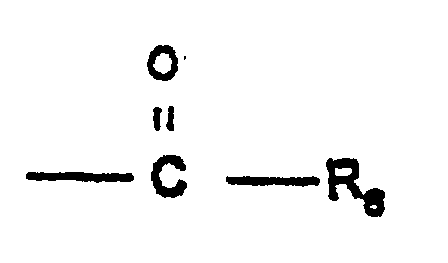
- substituted biphenyl poly(oxyalkylene) ethers of the present invention containing an acyl moiety i.e., those having the formula: wherein R 1 , R 2 , R 3 , R 4 , and n are as defined above; R 6 is alkyl having 1 to 30 carbon atoms, phenyl, or aralkyl or alkaryl having 7 to 36 carbon atoms; may be prepared from IX by acylating the hydroxyl group of the poly(oxyalkylene) moiety of IX to form an ester.
- this acylation reaction will be conducted by contacting IX with 0.95 to 1.2 molar equivalents of a suitable acylating agent
- suitable acylating agents for use in this reaction include acyl halides, such as acyl chlorides and bromides; and carboxylic acid anhydrides.
- Preferred acylating agents are those having the formula: R 6 C(O)-X, wherein R 6 is as defined above and X is chloro or bromo. More preferably, R 6 is alkyl having 4 to 12 carbon atoms.
- acylating agents include, but are not limited to, acetyl chloride, acetic anhydride, propionyl chloride, butanoyl chloride, pivaloyl chloride, octanoyl chloride, decanoyl chloride 4-t-butylbenzoyl chloride, and the like.
- this reaction is conducted in an inert solvent, such as toluene, dichloromethane, diethyl ether, and the like, at a temperature in the range of 25°C to 150°C, and is generally complete in 0.5 to 48 hours.
- an acyl halide is employed as the acylating agent, this reaction is preferably conducted in the presence of a sufficient amount of an amine capable of neutralizing the acid generated during the reaction, such as triethylamine, di(isopropyl)ethylamine, pyridine, or 4-dimethylaminopyridine.
- the substituted biphenyl alcohol of formula II contains a hydroxyl group
- protection of the substituted biphenyl hydroxyl group may be accomplished using well-known procedures.
- the choice of a suitable protecting group for a particular hydroxy substituted biphenyl alcohol will be apparent to those skilled in the art.
- Various protecting groups, and their introduction and removal, are described, for example, in T. W. Greene and P. G. M. Wuts, Protective Groups in Organic Synthesis , Second Edition, Wiley, New York, 1991, and references cited therein.
- Deprotection of the aromatic hydroxyl group(s) can also be accomplished using conventional procedures. Appropriate conditions for this deprotection step will depend upon the protecting group(s) utilized in the synthesis and will be readily apparent to those skilled in the art For example, benzyl protecting groups may be removed by hydrogenolysis under 1 to 4 atmospheres of hydrogen in the presence of a catalyst, such as palladium on carbon. Typically, this deprotection reaction is conducted in an inert solvent, preferably a mixture of ethyl acetate and acetic acid, at a temperature of from 0°C to 40°C for 1 to 24 hours.
- an inert solvent preferably a mixture of ethyl acetate and acetic acid
- Aromatic nitro or cyano groups may be reduced to amino or aminomethyl groups, respectively, using a number of procedures that are well known in the art See, or example, the article entitled, “ Amination by Reduction” in Kirk-Othmer “ Encyclopedia of Chemical Technology “, second Edition, Vol. 2, pp 76-99.
- reductions can be carried out with, for example, hydrogen, carbon monoxide, or hydrazine, (or mixtures of the same) in the presence of metallic catalysts such as palladium, platinum, and its oxides, nickel, copper chromite, etc.
- Co-catalysts such as alkali or alkaline earth metal hydroxides or amines (including amino phenols) can be used in these catalyzed reductions.
- Reductions can also be accomplished through the use of reducing metals in the presence of acids, such as hydrochloric add.
- Typical reducing metals are zinc, iron, and tin; salts of these metals can also be used.
- the amino or aminomethyl substituted biphenyl poly(oxyalkylene) ethers of the present invention are obtained by reduction of the corresponding nitro or cyano compound with hydrogen in the presence of a metallic catalyst such as palladium.
- This reduction is generally carried out at temperatures of 20°C to 100°C, preferably, 20°C to 40°C, and hydrogen pressures of atmospheric to 1 ⁇ 37 ⁇ 10 3 KPa (200 psig), typically, 1 ⁇ 37 ⁇ 10 2 - 5 ⁇ 51 ⁇ 10 2 KPa (20-80 psig).
- the reaction time for reduction usually varies between 5 minutes to 24 hours.
- inert liquid diluents and solvents such as ethanol, cyclohexane, ethyl acetate, toluene, etc, can be used to facilitate the reaction.
- solvents such as ethanol, cyclohexane, ethyl acetate, toluene, etc.
- the substituted biphenyl poly(oxyalkylene) ethers of the present invention can then be obtained by well-known techniques.
- the substituted biphenyl poly(oxyalkylene) ethers of the present invention are useful as additives in hydrocarbon fuels to prevent and control engine deposits, particularly intake valve deposits.
- the desired deposit control is achieved by operating an intemal combustion engine with a fuel composition containing a substituted biphenyl poly(oxyalkylene) ethers of the present invention.
- the proper concentration of additive necessary to achieve the desired level of deposit control varies depending upon the type of fuel employed, the type of engine, and the presence of other fuel additives.
- the concentration of the substituted biphenyl poly(oxyalkylene) ethers of this invention in hydrocarbon fuel will range from 50 to 2,500 parts per million (ppm) by weight, preferably from 75 to 1,000 ppm. When other deposit control additives are present, a lesser amount of the present additive may be used.
- the substituted biphenyl poly(oxyalkylene) ethers of the present invention may also be formulated as a concentrate using an inert stable oleophilic (i.e., dissolves in gasoline) organic solvent boiling in the range of 150°F to 400°F (65°C to 205°C).
- an aliphatic or an aromatic hydrocarbon solvent is used, such as benzene, toluene, xylene, or higher-boiling aromatics or aromatic thinners.
- Aliphatic alcohols containing 3 to 8 carbon atoms, such as isopropanol, isobutylcarbinol, n-butanol, and the like, in combination with hydrocarbon solvents are also suitable for use with the present additives.
- the amount of the additive will generally range from 10 to 70 weight percent, preferably 10 to 50 weight percent, more preferably from 20 to 40 weight percent.
- additives of the present invention including, for example, oxygenates, such as t-butyl methyl ether, antiknock agents, such as methylcyclopentadienyl manganese tricarbonyl, and other dispersants/detergents, such as hydrocarbyl amines, hydrocarbyl poly(oxyalkylene) amines, or succinimides. Additionally, antioxidants, metal deactivators, and demulsifiers may be present.
- oxygenates such as t-butyl methyl ether
- antiknock agents such as methylcyclopentadienyl manganese tricarbonyl
- dispersants/detergents such as hydrocarbyl amines, hydrocarbyl poly(oxyalkylene) amines, or succinimides.
- antioxidants, metal deactivators, and demulsifiers may be present.
- diesel fuels other well-known additives can be employed, such as pour point depressants, flow improvers, cetane improvers, and the like.
- a fuel-soluble, nonvolatile carrier fluid or oil may also be used with the substituted biphenyl poly(oxyalkylene) ethers of this invention.
- the carrier fluid is a chemically inert hydrocarbon-soluble liquid vehicle which substantially increases the nonvolatile residue (NVR), or solvent-free liquid fraction of the fuel additive composition while not overwhelmingly contributing to octane requirement increase.
- the carrier fluid may be a natural or synthetic oil, such as mineral oil, refined petroleum oils, synthetic polyalkanes and alkenes, including hydrogenated and unhydrogenated polyalphaolefins, synthetic polyoxyalkylene-derived oils, such as those described, for example, in U.S. Patent No.
- polyesters such as those described, for example, in U.S. Patent Nos. 3,756,793 and 5,004,478 to Robinson and Vogel et al., respectively, and in European Patent Application Nos. 356,726 and 382,159, published March 7, 1990 and August 16, 1990, respectively.
- carrier fluids are believed to act as a carrier for the fuel additives of the present invention and to assist in removing and retarding deposits.
- the carrier fluid may also exhibit synergistic deposit control properties when used in combination with a substituted biphenyl poly(oxyalkylene) ethers of this invention.
- the carrier fluids are typically employed in amounts ranging from 100 to 5,000 ppm by weight of the hydrocarbon fuel, preferably from 400 to 3,000 ppm by weight of the fuel.
- the ratio of carrier fluid to deposit control additive will range from 0.5:1 to 10:1, more preferably from 1:1 to 4.1, most preferably 2:1.
- carrier fluids When employed in a fuel concentrate, carrier fluids will generally be present in amounts ranging from 20 to 60 weight percent, preferably from 30 to 50 weight percent.
- Example 3 The product from Example 3 (3.0 grams) and the product from Example 4 (25.0 grams) were combined with anhydrous dimethylformamide (300mL). The reaction was heated at 120°C for sixteen hours, cooled to room temperature and diluted with diethyl ether (1500 mL). The diethyl ether solution was washed four times with water and once with brine. The organic layer was dried over anhydrous magnesium sulfate, filtered and the solvents removed in vacuo to yield 24.1 grams as a yellow oil. The oil was chromatographed on silica gel eluting with hexane/diethyl ether (60:40) to afford 19.1 grams of the desired product as a yellow oil.
- test compounds were blended in gasoline and their deposit reducing capacity determined in an ASTM/CFR single-cylinder engine test.
- a Waukesha CFR single-cylinder engine was used. Each run was carried out for 15 hours, at the end of which time the intake valve was removed, washed with hexane and weighed. The previously determined weight of the clean valve was subtracted from the weight of the value at the end of the run. The differences between the two weights is the weight of the deposit. A lesser amount of deposit indicates a superior additive.
- the operating conditions of the test were as follows: water jacket temperature 93°C (200°F); vacuum of 4.1 ⁇ 10 4 Pa (12 in Hg), air-fuel ratio of 12, ignition spark timing of 400 BTC; engine speed is 1800 rpm; the crankcase oil is a commercial 30W oil.
- the base fuel employed in the above single-cylinder engine tests was a regular octane unleaded gasoline containing no fuel detergent.
- the test compounds were admixed with the base fuel to give the concentrations indicated in the table.
- Table I illustrates the significant reduction in intake valve deposits provided by the substituted biphenyl poly(oxyalkylene) ethers of the present invention (Example 6) compared to the base fuel.
Landscapes
- Chemical & Material Sciences (AREA)
- Oil, Petroleum & Natural Gas (AREA)
- Organic Chemistry (AREA)
- Engineering & Computer Science (AREA)
- General Chemical & Material Sciences (AREA)
- Chemical Kinetics & Catalysis (AREA)
- Combustion & Propulsion (AREA)
- Health & Medical Sciences (AREA)
- Emergency Medicine (AREA)
- Organic Low-Molecular-Weight Compounds And Preparation Thereof (AREA)
- Liquid Carbonaceous Fuels (AREA)
- Compositions Of Macromolecular Compounds (AREA)
- Polyethers (AREA)
Claims (13)
- Verbindung der Formel:worin ist:
- R1
- Wasserstoff oder Hydroxyl;
- R2
- Hydroxyl, Cyano, Nitro, Amino, Aminomethyl,
N-Alkylamino oder N-Alkylaminomethyl, worin die
Alkylgruppe 1 bis 6 Kohlenstoffatome enthält,
N,N-Dialkylamino oder N,N-Dialkylaminomethyl,
worin jede Alkylgruppe unabhängig 1 bis 6
Kohlenstoffatome enthält,
vorausgesetzt, R1 und R2 stehen ortho zueinander und meta oder para zum benachbarten Phenyl-Substituenten, ist R1 Wasserstoff,
R2 steht meta oder para zum benachbarten Phenyl-Substituenten, ist R1 Wasserstoff; - R3 und R4
- unabhängig Wasserstoff oder Niederalkyl mit 1 bis 6 Kohlenstoffatomen und R3 und R4 jeweils unabhängig ausgewählt in jeder -OCHR3-CHR4-Einheit;
- R5
- Wasserstoff, Alkyl mit 1 bis 100 Kohlenstoffatomen,
Phenyl, Aralkyl mit 7 bis 100
Kohlenstoffatomen, Alkaryl mit 7 bis 100
Kohlenstoffatomen oder eine Acylgruppe der
Formel:
worin R6 Alkyl mit 1 bis 30 Kohlenstoffatomen, Phenyl, Aralkyl oder Alkaryl mit 7 bis 36 Kohlenstoffatomen ist und n eine ganze Zahl von 5 bis etwa 100.
- Verbindung nach Anspruch 1, wobei R1 Wasserstoff und R2 Amino oder Aminomethyl ist.
- Verbindung nach Anspruch 2, wobei R2 Amino ist.
- Verbindung nach Anspruch 1, wobei R3 und R4 Niederalkyl mit 1 bis 3 Kohlenstoffatomen ist und der jeweils andere Rest Wasserstoff.
- Verbindung nach Anspruch 4, wobei R3 und R4 Methyl oder Ethyl ist und der jeweils andere Rest Wasserstoff.
- Verbindung nach Anspruch 1, wobei R5 Wasserstoff ist, Alkyl mit 1 bis 30 Kohlenstoffatomen oder Alkylphenyl mit einer Alkylgruppe, die 1 bis 30 Kohlenstoffatome enthält.
- Verbindung nach Anspruch 6, wobei R5 Wasserstoff ist, Alkyl mit 2 bis 24 Kohlenstoffatomen oder Alkylphenyl mit einer Alkylgruppe, die 2 bis 24 Kohlenstoffatome enthält.
- Verbindung nach Anspruch 1, wobei n eine ganze Zahl von 8 bis 50 ist.
- Verbindung nach Anspruch 8, wobei n eine ganze Zahl von 10 bis 30 ist.
- Kraftstoffzusammensetzung, beinhaltend eine größere Menge Kohlenwasserstoffe, die im Benzin- oder Dieselbereich sieden, sowie eine Ablagerungen wirksam bekämpfende Menge einer Verbindung nach irgendeinem vorhergehenden Anspruch.
- Verfahren zur Verminderung von Motorablagerungen in einer Verbrennungskraftmaschine, umfassend den Betrieb einer Verbrennungskraftmaschine mit einer Kraftstoffzusammensetzung nach Anspruch 10.
- Kraftstoffkonzentrat, umfassend ein inertes, stabiles, oleophiles, organisches Lösungsmittel, das im Bereich von 150° F (65,6° C) bis 400° F (104° C) siedet und 10 bis 70 Gew.% einer Verbindung nach irgendeinem der Ansprüche 1 bis 9 enthält.
- Kraftstoffkonzentrat nach Anspruch 12, wobei das Kraftstoffkonzentrat zudem 20 bis 60 Gew.% einer kraftstofflöslichen, nicht-flüchtigen Trägerflüssigkeit enthält.
Applications Claiming Priority (2)
| Application Number | Priority Date | Filing Date | Title |
|---|---|---|---|
| US08/941,621 US5849048A (en) | 1997-09-30 | 1997-09-30 | Substituted biphenyl poly (oxyalkylene) ethers and fuel compositions containing the same |
| US941621 | 1997-09-30 |
Publications (2)
| Publication Number | Publication Date |
|---|---|
| EP0905165A1 EP0905165A1 (de) | 1999-03-31 |
| EP0905165B1 true EP0905165B1 (de) | 2001-11-21 |
Family
ID=25476794
Family Applications (1)
| Application Number | Title | Priority Date | Filing Date |
|---|---|---|---|
| EP98307595A Expired - Lifetime EP0905165B1 (de) | 1997-09-30 | 1998-09-18 | Substituierte Biphenylpolyoxyalkyleneether und diese enthaltende Kraftstoffzusammensetzungen |
Country Status (5)
| Country | Link |
|---|---|
| US (1) | US5849048A (de) |
| EP (1) | EP0905165B1 (de) |
| JP (1) | JPH11171988A (de) |
| CA (1) | CA2246090A1 (de) |
| DE (1) | DE69803153T2 (de) |
Families Citing this family (3)
| Publication number | Priority date | Publication date | Assignee | Title |
|---|---|---|---|---|
| US6776897B2 (en) * | 2001-10-19 | 2004-08-17 | Chevron U.S.A. | Thermally stable blends of highly paraffinic distillate fuel component and conventional distillate fuel component |
| US6846402B2 (en) | 2001-10-19 | 2005-01-25 | Chevron U.S.A. Inc. | Thermally stable jet prepared from highly paraffinic distillate fuel component and conventional distillate fuel component |
| EP1884556A3 (de) * | 2006-08-04 | 2011-09-14 | Infineum International Limited | Dieselkraftstoffzusammensetzungen enthaltend metallische Spezies und Detergensadditive |
Family Cites Families (16)
| Publication number | Priority date | Publication date | Assignee | Title |
|---|---|---|---|---|
| US4191537A (en) * | 1976-06-21 | 1980-03-04 | Chevron Research Company | Fuel compositions of poly(oxyalkylene) aminocarbamate |
| CA1325640C (en) * | 1986-07-21 | 1993-12-28 | Polaroid Corporation | Liquid crystal compounds having ether tail moiety |
| US4881945A (en) * | 1987-10-23 | 1989-11-21 | Chevron Research Company | Fuel compositions containing very long chain alkylphenyl poly(oxyalkylene) aminocarbonates |
| US5081295A (en) * | 1988-03-04 | 1992-01-14 | Xoma Corporation | Activated polyers and conjugates thereof |
| US5090914A (en) * | 1988-03-04 | 1992-02-25 | Xoma Corporation | Activated polymers and conjugates thereof |
| US4960950A (en) * | 1988-03-28 | 1990-10-02 | The Dow Chemical Company | Formation of nitrophenyl ethers from polyols and nitroanisoles |
| DE3834749A1 (de) * | 1988-10-12 | 1990-04-19 | Bayer Ag | Aromatische polyhydroxypolyamine, ein verfahren zu ihrer herstellung und ihre verwendung zur herstellung von polyurethan-kunststoffen |
| US5103039A (en) * | 1990-08-24 | 1992-04-07 | Xoma Corporation | Activated polymers and conjugates thereof |
| US5157099A (en) * | 1991-06-19 | 1992-10-20 | Xoma Corporation | Activated polymers and conjugates thereof |
| US5569310A (en) * | 1992-12-18 | 1996-10-29 | Chevron Chemical Company | Poly(oxyalkylene) hydroxyaromatic ethers and fuel compositions containing the same |
| US5296003A (en) * | 1993-03-08 | 1994-03-22 | Chevron Research And Technology Company | Polyesters of poly(oxyalkylene) hydroxyaromatic ethers |
| US5409507A (en) * | 1993-10-28 | 1995-04-25 | Chevron Chemical Company | Fuel compositions containing poly(oxyalkylene) aromatic ethers |
| US5618320A (en) * | 1996-05-14 | 1997-04-08 | Chevron Chemical Company | Aromatic esters of polyalkylphenoxyalkanols and fuel compositions containing the same |
| US5709720A (en) * | 1996-11-07 | 1998-01-20 | Chevron Chemical Company | Aromatic ethers of polyalkylphenoxyalkanols and fuel compositions containing the same |
| US5709719A (en) * | 1996-12-30 | 1998-01-20 | Chevron Chemical Company | Poly(oxyalkylene) esters of substituted polyphenylethers and fuel compositions containing the same |
| US5728182A (en) * | 1996-12-30 | 1998-03-17 | Chevron Chemical Company | Polyalkyl esters of substituted polyphenyl ethers and fuel compositions containing the same |
-
1997
- 1997-09-30 US US08/941,621 patent/US5849048A/en not_active Expired - Fee Related
-
1998
- 1998-08-28 CA CA002246090A patent/CA2246090A1/en not_active Abandoned
- 1998-09-18 DE DE69803153T patent/DE69803153T2/de not_active Expired - Fee Related
- 1998-09-18 EP EP98307595A patent/EP0905165B1/de not_active Expired - Lifetime
- 1998-09-29 JP JP10275587A patent/JPH11171988A/ja active Pending
Also Published As
| Publication number | Publication date |
|---|---|
| JPH11171988A (ja) | 1999-06-29 |
| DE69803153D1 (de) | 2002-02-21 |
| DE69803153T2 (de) | 2002-11-07 |
| CA2246090A1 (en) | 1999-03-30 |
| US5849048A (en) | 1998-12-15 |
| EP0905165A1 (de) | 1999-03-31 |
Similar Documents
| Publication | Publication Date | Title |
|---|---|---|
| EP0675939B1 (de) | Poly(oxyalkylen)aromatische äther enthaltende brennstoffzusammensetzungen | |
| EP0662999B1 (de) | Poly(oxyalkylen) aromatische ester enthaltende brennstoffzusammensetzungen | |
| EP0719762B1 (de) | Polyoxyalkylen-substituierte aromatische Amide und diese enthaltende Kraftstoffzusammensetzungen | |
| EP0686181B1 (de) | Poly(oxyalkylen) aromatische aether enthaltende brennstoffzusammensetzungen | |
| EP0706554B1 (de) | Poly(oxyalkylen)-hydroxy- und -amino-aromatische carbamate und diese enthaltende treibstoffzusammensetzungen | |
| EP0905165B1 (de) | Substituierte Biphenylpolyoxyalkyleneether und diese enthaltende Kraftstoffzusammensetzungen | |
| EP0686183B1 (de) | Polyalkyl-und poly(oxyalkylen)aromatische ester enthaltende brennstoffzusammensetzungen | |
| EP0850917B1 (de) | Polyoxyalkylen substituierte Benzylaminether und diese enthaltende Kraftstoffzusammensetzungen | |
| EP0850918B1 (de) | Polyoxyalkylester von substituierten Polyphenylethern und diese enthaltende Kraftstoffzusammensetzungen | |
| EP0905150B1 (de) | Substituierte Biphenylpolyalkylether und diese enthaltene Kraftstoffzusammensetzungen |
Legal Events
| Date | Code | Title | Description |
|---|---|---|---|
| PUAI | Public reference made under article 153(3) epc to a published international application that has entered the european phase |
Free format text: ORIGINAL CODE: 0009012 |
|
| AK | Designated contracting states |
Kind code of ref document: A1 Designated state(s): DE FR GB NL |
|
| AX | Request for extension of the european patent |
Free format text: AL;LT;LV;MK;RO;SI |
|
| 17P | Request for examination filed |
Effective date: 19990922 |
|
| AKX | Designation fees paid |
Free format text: DE FR GB NL |
|
| 17Q | First examination report despatched |
Effective date: 20000522 |
|
| RAP1 | Party data changed (applicant data changed or rights of an application transferred) |
Owner name: CHEVRON CHEMICAL COMPANY LLC |
|
| GRAG | Despatch of communication of intention to grant |
Free format text: ORIGINAL CODE: EPIDOS AGRA |
|
| GRAG | Despatch of communication of intention to grant |
Free format text: ORIGINAL CODE: EPIDOS AGRA |
|
| GRAH | Despatch of communication of intention to grant a patent |
Free format text: ORIGINAL CODE: EPIDOS IGRA |
|
| GRAH | Despatch of communication of intention to grant a patent |
Free format text: ORIGINAL CODE: EPIDOS IGRA |
|
| GRAA | (expected) grant |
Free format text: ORIGINAL CODE: 0009210 |
|
| AK | Designated contracting states |
Kind code of ref document: B1 Designated state(s): DE FR GB NL |
|
| REG | Reference to a national code |
Ref country code: GB Ref legal event code: IF02 |
|
| RAP2 | Party data changed (patent owner data changed or rights of a patent transferred) |
Owner name: CHEVRON ORONITE COMPANY LLC |
|
| REF | Corresponds to: |
Ref document number: 69803153 Country of ref document: DE Date of ref document: 20020221 |
|
| NLT2 | Nl: modifications (of names), taken from the european patent patent bulletin |
Owner name: CHEVRON ORONITE COMPANY LLC |
|
| ET | Fr: translation filed | ||
| PGFP | Annual fee paid to national office [announced via postgrant information from national office to epo] |
Ref country code: NL Payment date: 20020618 Year of fee payment: 5 |
|
| PGFP | Annual fee paid to national office [announced via postgrant information from national office to epo] |
Ref country code: GB Payment date: 20020808 Year of fee payment: 5 |
|
| PGFP | Annual fee paid to national office [announced via postgrant information from national office to epo] |
Ref country code: FR Payment date: 20020903 Year of fee payment: 5 |
|
| REG | Reference to a national code |
Ref country code: GB Ref legal event code: 732E |
|
| PLBE | No opposition filed within time limit |
Free format text: ORIGINAL CODE: 0009261 |
|
| STAA | Information on the status of an ep patent application or granted ep patent |
Free format text: STATUS: NO OPPOSITION FILED WITHIN TIME LIMIT |
|
| PGFP | Annual fee paid to national office [announced via postgrant information from national office to epo] |
Ref country code: DE Payment date: 20020930 Year of fee payment: 5 |
|
| 26N | No opposition filed | ||
| PG25 | Lapsed in a contracting state [announced via postgrant information from national office to epo] |
Ref country code: GB Free format text: LAPSE BECAUSE OF NON-PAYMENT OF DUE FEES Effective date: 20030918 |
|
| PG25 | Lapsed in a contracting state [announced via postgrant information from national office to epo] |
Ref country code: NL Free format text: LAPSE BECAUSE OF NON-PAYMENT OF DUE FEES Effective date: 20040401 Ref country code: DE Free format text: LAPSE BECAUSE OF NON-PAYMENT OF DUE FEES Effective date: 20040401 |
|
| GBPC | Gb: european patent ceased through non-payment of renewal fee |
Effective date: 20030918 |
|
| PG25 | Lapsed in a contracting state [announced via postgrant information from national office to epo] |
Ref country code: FR Free format text: LAPSE BECAUSE OF NON-PAYMENT OF DUE FEES Effective date: 20040528 |
|
| NLV4 | Nl: lapsed or anulled due to non-payment of the annual fee |
Effective date: 20040401 |
|
| REG | Reference to a national code |
Ref country code: FR Ref legal event code: ST |