EP0905618A2 - Mikrokontroller, Datenverarbeitungssystem und Taskschaltungssteuerungsverfahren - Google Patents
Mikrokontroller, Datenverarbeitungssystem und Taskschaltungssteuerungsverfahren Download PDFInfo
- Publication number
- EP0905618A2 EP0905618A2 EP98116477A EP98116477A EP0905618A2 EP 0905618 A2 EP0905618 A2 EP 0905618A2 EP 98116477 A EP98116477 A EP 98116477A EP 98116477 A EP98116477 A EP 98116477A EP 0905618 A2 EP0905618 A2 EP 0905618A2
- Authority
- EP
- European Patent Office
- Prior art keywords
- task
- state
- execution
- representative
- tasks
- Prior art date
- Legal status (The legal status is an assumption and is not a legal conclusion. Google has not performed a legal analysis and makes no representation as to the accuracy of the status listed.)
- Granted
Links
Images



Classifications
-
- G—PHYSICS
- G06—COMPUTING OR CALCULATING; COUNTING
- G06F—ELECTRIC DIGITAL DATA PROCESSING
- G06F9/00—Arrangements for program control, e.g. control units
- G06F9/06—Arrangements for program control, e.g. control units using stored programs, i.e. using an internal store of processing equipment to receive or retain programs
- G06F9/46—Multiprogramming arrangements
- G06F9/48—Program initiating; Program switching, e.g. by interrupt
- G06F9/4806—Task transfer initiation or dispatching
- G06F9/4843—Task transfer initiation or dispatching by program, e.g. task dispatcher, supervisor, operating system
- G06F9/4881—Scheduling strategies for dispatcher, e.g. round robin, multi-level priority queues
-
- G—PHYSICS
- G06—COMPUTING OR CALCULATING; COUNTING
- G06F—ELECTRIC DIGITAL DATA PROCESSING
- G06F9/00—Arrangements for program control, e.g. control units
- G06F9/06—Arrangements for program control, e.g. control units using stored programs, i.e. using an internal store of processing equipment to receive or retain programs
- G06F9/46—Multiprogramming arrangements
- G06F9/48—Program initiating; Program switching, e.g. by interrupt
- G06F9/4806—Task transfer initiation or dispatching
- G06F9/4843—Task transfer initiation or dispatching by program, e.g. task dispatcher, supervisor, operating system
- G06F9/4881—Scheduling strategies for dispatcher, e.g. round robin, multi-level priority queues
- G06F9/4887—Scheduling strategies for dispatcher, e.g. round robin, multi-level priority queues involving deadlines, e.g. rate based, periodic
-
- G—PHYSICS
- G06—COMPUTING OR CALCULATING; COUNTING
- G06F—ELECTRIC DIGITAL DATA PROCESSING
- G06F9/00—Arrangements for program control, e.g. control units
- G06F9/06—Arrangements for program control, e.g. control units using stored programs, i.e. using an internal store of processing equipment to receive or retain programs
- G06F9/30—Arrangements for executing machine instructions, e.g. instruction decode
- G06F9/30003—Arrangements for executing specific machine instructions
- G06F9/30076—Arrangements for executing specific machine instructions to perform miscellaneous control operations, e.g. NOP
- G06F9/3009—Thread control instructions
-
- G—PHYSICS
- G06—COMPUTING OR CALCULATING; COUNTING
- G06F—ELECTRIC DIGITAL DATA PROCESSING
- G06F9/00—Arrangements for program control, e.g. control units
- G06F9/06—Arrangements for program control, e.g. control units using stored programs, i.e. using an internal store of processing equipment to receive or retain programs
- G06F9/30—Arrangements for executing machine instructions, e.g. instruction decode
- G06F9/38—Concurrent instruction execution, e.g. pipeline or look ahead
- G06F9/3836—Instruction issuing, e.g. dynamic instruction scheduling or out of order instruction execution
- G06F9/3851—Instruction issuing, e.g. dynamic instruction scheduling or out of order instruction execution from multiple instruction streams, e.g. multistreaming
-
- G—PHYSICS
- G06—COMPUTING OR CALCULATING; COUNTING
- G06F—ELECTRIC DIGITAL DATA PROCESSING
- G06F9/00—Arrangements for program control, e.g. control units
- G06F9/06—Arrangements for program control, e.g. control units using stored programs, i.e. using an internal store of processing equipment to receive or retain programs
- G06F9/46—Multiprogramming arrangements
- G06F9/461—Saving or restoring of program or task context
- G06F9/463—Program control block organisation
Definitions
- This invention relates to a multitasking microcontroller and to a data processing system employing such a multitasking microcontroller operable to control a plurality of hardware engines and it further relates to a method of controlling task switching.
- Multitasking microcontrollers have been known in the art.
- a built-in processor sequentially executes a plurality of tasks and a task timer therefore makes periodic issues of timer interruptions which request task switching to be made. Every time the processor accepts such a timer interruption, an interruption handling routine in the operating system (OS) is activated.
- OS operating system
- the interruption handling routine performs the scheduling of tasks and the saving and restoring of resources.
- an object of the present invention is to provide a microcontroller capable of switching between tasks at a high speed.
- Another object of the present invention is to provide a data processing system employing a microcontroller (which controls a plurality of hardware engines) for the realization of high-speed task switching in the microcontroller.
- Yet another object of the present invention is to provide a method of controlling task switching for the realization of high-speed task switching.
- the microcontroller of the present invention controls the task switching not by means of an interruption handling routine, but by means of a hardware scheduler.
- a plurality of tasks are allocated to respective hardware engines.
- a task switching operation is controlled by the hardware scheduler on the basis of information representative of the allocation of the tasks to the hardware engines.
- Some of the hardware engines execute time critical processes and the other hardware engines do not.
- a relationship among the hardware engines is reflected in the execution priority of the tasks, which makes it possible to select a task to be run next in a short time without redeterming which of the hardware engines executes a time critical process at the time of task switching. In other words, there is created less overhead when task switching occurs. High-speed task switching is realized.
- the microcontroller of the present invention adopts an event-driven method capable of performing task switching in fast response to the occurrence of an event (i.e., an event of hardware engine execution termination).
- Each task can be in one of at least three states: a first state (the state of READY) representative of an execution wait status, a second state (the state of ACTIVE) representative of a running status, and a third state (the state of SLEEP) representative of an allocated hardware engine execution termination status.
- a task is in the state of ACTIVE when it uses the microcontroller and in the state of ACTIVE a hardware engine allocated to the task is controlled.
- a task is in the state of READY when it is not selected therefore waiting to be selected although it is ready to use the microcontroller.
- a task is in the state of SLEEP when it waits for a hardware engine allocated thereto to be execution-terminated (in other words, it is not ready to use the microcontroller).
- a task that has finished activating its allocated hardware engine makes a state transition from ACTIVE to SLEEP in response to a given instruction (the task_sleep instruction).
- a task allocated to that hardware engine makes a state transition from SLEEP to READY and a task under execution makes a state transition from ACTIVE to READY. Thereafter, a task having the highest execution priority in all tasks assuming the state of READY is selected as a task to be run next. The task thus selected makes a state transition from READY to ACTIVE.
- a register file for storing a setting parameter common to a plurality of hardware engines can be prepared in the microcontroller.
- FIGURE 1 shows an MPEG (Moving Picture Experts Group) image encoder which is one of the data processing systems in accordance with the present invention.
- the MPEG image encoder has a single microcontroller 101 , five different hardware engines (hereinafter called the cores) 111 - 115 together forming a macroblock pipeline, and three buffer memories 116-118 .
- the core 111 is a motion detector (MD).
- the core 112 is a motion compensator (MC).
- the core 113 is a discrete cosine transformer (DCT).
- the core 114 is a quantizer (Q).
- the core 115 is a variable length coder (VLC). All the cores 111-115 are controlled by the microcontroller 101 .
- the microcontroller 101 sends an activation signal 123 to each core 111-115 and receives a termination signal 124 from each core 111-115 .
- the microcontroller 101 is allowed to individually communicate with each core 111-115 through signal lines 131-135 . Additionally, the microcontroller 101 provides a parameter common to the five cores 111-115 through a signal line 136 .
- FIGURE 2 shows in detail the structure of the microcontroller 101 .
- the microcontroller 101 has a task controller 201 for the realization of multitasking, five core register files 211-215 for use by the five cores 111-115 as mutually independent working areas, a single common register file 216 for storing a setting parameter common to at least two of the five cores 111-115 , a single general-purpose register file 217 for use by the task controller 201 as a working area, a multiplier 221 , a shifter 222 , an arithmetic and logic unit (ALU) 223 , and a data memory 224 .
- 241 is an A bus.
- 242 is a B bus.
- 243 is a C bus.
- each of the register files 211-216 is connected between the C bus 243 and a corresponding one of the signal lines 131-136 . Additionally, each of the register files 211-216 has two outputs that are connected to the A bus 241 and to the B bus 242 respectively.
- the general-purpose register file 217 and the data memory 224 each have a single input that is connected to the C bus 243 and two outputs that are connected to the A bus 241 and to the B bus 242 respectively.
- the multiplier 221 , the shifter 222 , and the ALU 223 each have two inputs that are connected to the A bus 241 and to the B bus 242 respectively and a single output that is connected to the C bus 243 .
- a variation to the above can be made in which the placement of the five core register files 211-215 and the common register file 216 is omitted and the signal lines 131-136 extend directly form the C bus 243 .
- image data processes proceed in units of macroblocks each containing 16 ⁇ 16 pixels.
- the MD core 111 finds candidate motion vectors about the input image data 121 .
- image differential data are found using the candidate motion vectors to select an optimal motion vector.
- Differential data with respect to the selected motion vector is discrete cosine transformed in the DCT core 113 , quantized in the Q core 114 , variable length coded in the VLC core 115 together with side information such as the motion vectors found, and finally provided as the encoded data 122 .
- the task controller 201 first sets an operating parameter to the MD core register file 211 through the signal line 231 , the ALU 223 , and the C bus 243 and provides the activation signal 123 to make the MD core 111 active.
- the MD core 111 reads in the operating parameter from the MD core register file 211 through the signal line 131 and inputs the image data 121 .
- candidate motion vectors found in the MD core 111 are written into the MD core register file 211 through the signal line 131 , and the MD core 111 provides the termination signal 124 .
- the task controller 201 In response to the termination signal 124 , the task controller 201 reads out the candidate motion vectors from the MD core register file 211 . Based on the candidate motion vectors, the task controller 201 computes an operating parameter for the MC core 112 by the use of the multiplier 221 , the shifter 222 , the ALU 223 , and the general-purpose register file 217 . The operating parameter is set to the MC core register file 212 and the MC core 112 is made active by the activation signal 123 . The MC core 112 reads in the operating parameter from the MC core register file 212 through the signal line 132 . Thereafter, the MC core 112 finds image differential data.
- a sum of the image differential data is written into the MC core register file 212 by way of the signal line 132 , the image differential data are written into the buffer memory 116 , and the MC core 112 provides the termination signal 124 .
- the task controller 201 reads out the image differential data sum from the MC core register file 212 . Based on the image differential data sum, the task controller 201 selects an optimum motion vector from among the aforesaid candidate motion vectors through the use of the multiplier 221 , the shifter 222 , the ALU 223 , and the general-purpose register file 217 .
- An address indicative of the location of differential data corresponding to the optimum motion vector is set in the DCT core register file 213 and the DCT core 113 is made active by the activation signal 123 .
- the DCT core 113 reads out the differential data from the buffer memory 116 for DCT.
- a result of the DCT operation is written into the buffer memory 117 and the DCT core 113 provides the termination signal 124 .
- the Q core 114 performs quantization and a result of the quantization operation is written into the buffer memory 118 .
- the VLC core 115 performs VLC and a result of the VLC operation is provided as the encoded data 122 .
- the common register file 216 is used in cases such as when a common parameter for switching between MPEG1 and MPEG2 is pre-supplied to the five cores 111 and when a common parameter for designating a motion estimation mode is pre-supplied to the cores 111 and 112 .
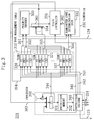
- the task controller 201 has a processor 300 , a task management table 310 , and a scheduler 330 .
- the processor 300 is a RISC (reduced instruction set computer) processor capable of sequential execution of eight tasks at most.
- the processor 300 has a program counter (PC) 301 for generating instruction addresses, an instruction memory 302 for storing a program of a series of instructions, and an instruction decoder 303 for decoding instructions.
- the instruction decoder 303 sends the activation signal 123 to each core.
- the instruction decoder 303 is connected to resources for the execution of instructions, such as the multiplier 221 , the shifter 222 and the ALU 223 , through the signal line 231 .
- the task management table 310 is a circuit block for storing task management information.
- the task management table 310 has eight task management register files 320-327 that are associated with eight tasks from TASK0 to TASK7, respectively.
- the task management information includes state information (ST INFO) representative of the execution status of each task, priority information (PRI INFO) representative of the execution priority of each task, and core identification information (CID INFO) representative of the allocation of the tasks to the five cores 111-115 .
- the task management table 310 has PC regions for the tasks for saving the processor's 300 resources (i.e., the contents of the PC 301 ). Such a region is also used to save a flag concerning a result of the arithmetic operation of the ALU 223 (see FIGURE 2 ).
- the scheduler 330 is a circuit block operable to allows the processor 300 to switch between tasks on the basis of the task management information stored in the task management table 310 .
- the scheduler 330 has a state controller 331 , a terminated core determination unit (TCDU) 332 , a priority encoder 333 , and a selector 334 .
- TCDU terminated core determination unit
- the TCDU 322 In response to the termination signal 124 sent from any one of the five cores 111-115 (i.e., a core the execution of which is terminated), the TCDU 322 identifies a task allocated to that execution-terminated core. Such identification is carried out with reference to the task management table 310 and a task number 362 representative of a result of the identification operation is communicated to the state controller 331 .
- the priority encoder 333 is a circuit block for selecting a task to be run next. Referring to the task management table 310 , the priority encoder 333 performs such a selection operation and a task number 361 representative of a result of the selection operation is communicated to the state controller 331 as well as to the selector 334 .
- the state controller 331 is a circuit block for updating the ST INFO stored in the task management table 310 .
- the selector 334 controls the restoration of resources to the processor 300 .
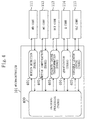
- FIGURE 4 illustrates an association between the cores and the tasks in the MPEG image encoder of FIGURE 1 .
- the microcontroller 101 executes six tasks 400-405 .
- the task 400 controls the five tasks 401-405 lower in hierarchy than the task 400 and is a main task (TASK0) for managing the entire encoding processing.
- the main task 400 is assigned no core.
- the task 401 is a motion detection task (TASK1) for controlling the allocated MD core 111 .
- the task 402 is a motion compensation task (TASK2) for controlling the allocated MC core 112 .
- the task 403 is a DCT task (TASK3) for controlling the allocated DCT core 113 .
- the task 404 is a Q task (TASK4) for controlling the allocated Q core 114 .
- the task 405 is a VLC task (TASK5) for controlling the allocated VLC core 115 .
- the task management table 310 of FIGURE 3 stores task management information concerning at least six tasks (the six tasks 400-405 ).
- the PRI INFO is set according to a priority setting signal 342 .
- the CID INFO is set according to a core setting signal 343 .
- the priority setting signal 342 is sent to the task management table 310 from the instruction decoder 303 if the instruction decoder 303 decodes a priority setting instruction.
- the core setting signal 343 is sent to the task management table 310 from the instruction decoder 303 if the instruction decoder 303 decodes a core setting instruction.
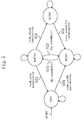
- FIGURE 5 is a conceptual diagram showing the state transition of each task.
- Each task can be in one of four states, namely, the state of STOP representative of a suspended status, the state of READY representative of an execution wait status, the state of ACTIVE representative of a running status, and the state of SLEEP representative of an allocated hardware engine execution termination wait status.
- SLEEP cannot exist for TASK0. If the task controller 201 is reset, it will assume the state of STOP for all tasks.
- a task in the state of STOP is changed to READY by a task_ready instruction (in other words, a transition 501 is made).
- ACTIVE in other words, a transition 511 is made
- a task which has been placed in the state of ACTIVE up to the moment is changed to READY by the scheduler 330 (in other words, a transition 522 is made).
- a task in the state of ACTIVE is executed by the processor 300 .
- a task in the state of ACTIVE can be changed to SLEEP by a task - sleep instruction (in other words, a transition 521 is made), alternatively it can be changed to STOP by a task_stop instruction (in other words, a transition 523 is made).
- a task in the state of SLEEP is changed to READY (in other words, a transition 531 is made) if the execution of a core allocated to that task is terminated.
- Task switching occurs if the instruction decoder 303 decodes the task_ready instruction, the task_sleep instruction, or the task_stop instruction. For example, when a certain task is run to finish setting an operating parameter for a core allocated to the task and activating the core, the state of the task is changed from ACTIVE to SLEEP by the task_sleep instruction. Additionally, task switching occurs upon termination of the execution of any one of the five cores 111-115 .
- the operating sequence of the task controller 201 at task switching time includes (1) activating the scheduler (SCHEDULER ACTIVATION), (2) saving the resources of a task under execution (RESOURCE SAVING), (3) selecting a task to be run next (TASK SELECTION), and (4) restoring the saved resources (RESOURCE RESTORATION).
- the instruction decoder 303 If the task_ready instruction, the task - sleep instruction, or the task_stop instruction is decoded, the instruction decoder 303 provides a state change signal 341 .
- the state change signal 341 is sent to the state controller 331 .
- the scheduler 330 is made active.
- the state change signal 341 is also sent to the task management table 310 and the ST INFO is updated. At the same time, the value of the PC 301 of a task which has been executed up to the moment is saved in the task management table 310 through a signal line 344 .
- the priority encoder 333 receives from the task management table 310 the ST INFO and the PRI INFO through a signal line 351 and through a signal line 352 respectively, to select a task having the highest priority of execution in all tasks that are in the state of READY as a task to be run next.
- the task number 361 indicative of a result of the task selection operation is communicated to the state controller 331 and to the selector 334 .
- the state controller 331 sends to the task management table 310 a state change signal 364 according to the task number 361 .
- the ST INFO of the task selected by the priority encoder 333 is updated from READY to ACTIVE.
- the selector 334 reads out the PC of the task designated by the task number 361 from the task management table 310 through a signal line 353 , for forwarding onto a signal line 363 .
- the value of the PC of the task to be run next is set in the processor 300 and the execution of the task starts.
- the termination signal 124 is sent to the TCDU 332 .
- the TCDU 332 determines which of the cores is execution-terminated on the basis of the termination signal 124 . Further, the TCDU 332 reads out the CID INFO stored in the task management table 310 through a signal line 354 and determines which of the tasks is allocated to the execution-terminated core.
- the task number 362 indicative of a result of the determination operation by the TCDU 332 is communicated to the state controller 331 if the task in question is confirmed to be in the state of SLEEP from the ST INFO, in consequence of which the scheduler 330 is activated.
- the state controller 331 sends to the task management table 310 the state change signal 364 according to the task number 362 , as a result of which the ST INFO of the execution-terminated task is updated from SLEEP to READY.
- the scheduler 330 will not be activated if there exists no task allocated to the execution-terminated core.
- the state controller 331 sends the state change signal 364 to the task management table 310 so that the ST INFO of a task that has been under execution up to the moment is updated from ACTIVE to READY. At the same time, the value of the PC 301 of the task is saved in the task management table 310 .
- the priority encoder 333 receives the ST INFO and the PRI INFO from the task management table 310 thereby selecting a task having the highest priority of execution in all tasks in the state of READY as a task to be run next.
- the task number 361 indicative of a result of the task selection operation is communicated to the state controller 331 as well as to the selector 334 .
- the state controller 331 sends to the task management table 310 the state change signal 364 according to the task number 361 .
- the ST INFO of the task selected by the priority encoder 333 is updated from READY to ACTIVE.
- the selector 334 reads out the PC of the task designated by the task number 361 from the task management table 310 , for forwarding to the processor 300 . As a result, the value of the PC of the task to be run next is set in the processor 300 and the execution of the task in question starts.
- FIGURE 6 therein shown is macroblock pipeline processing by the five cores 111-115 of FIGURE 1 .
- the pipeline pitch is set at a maximum value of the time taken to process one macro block in each core, which means that there is a characteristic that in the individual pipeline pitches, there exists a core the execution of which is terminated earlier than the other cores. This therefore produces idle time and there is a characteristic that the length of such idle time varies depending on the image data.
- an MPEG image encoder adaptive to the foregoing characteristics is implemented by means of task switching adopting an event driven method. The number of times a core is activated in an individual pipeline pitch period varies depending on the contents and data of processing carried out in the core.
- the DCT core 113 is activated once per pipeline pitch period.
- the MC core 112 is activated a plurality of times per pipeline pitch period depending on the data, since in the MC core 112 data of one macroblock is divided into luminance and chrominance components and processing is subdivided for the components and carried out.
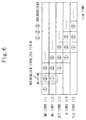
- FIGURE 7 shows the state transition of each of three tasks in a part period specified by broken line of FIGURE 6 .
- TASK0 is a main task for managing an entire encoding process
- TASK1 is a task allocated to the MD core 111
- TASK2 is a task allocated to the MC core 112 (see FIGURE 4 ).
- TASK1 has the highest execution priority.
- TASK2 has the second highest execution priority.
- TASK0 has the lowest execution priority.
- TASK1 is in the state of ACTIVE and TASK0 and TASK2 are in the state of READY.
- FIGURE 7 shows that task switching occurs at each time t1-t7.
- ⁇ t represents the overhead of one task switching operation.
- TASK1 makes the MD core 111 active prior to time t1.
- the state of TASK1 is changed from ACTIVE to SLEEP by the task_sleep instruction.
- TASK0 and TASK2 are in the state of READY, it is TASK2 that is allowed to make a transition from READY to ACTIVE, since TASK2 has priority of execution over that of TASK0.
- TASK2 makes the MC core 112 active.
- the state of TASK2 is changed from ACTIVE to SLEEP by the task_sleep instruction.
- TASK0 assumes the state of READY.
- TASK0 therefore makes a state transition from READY to ACTIVE.
- the state of TASK2 is changed from SLEEP to READY by the execution termination of the MC core 112 and the state of TASK0 (which has been in the state of ACTIVE up to the moment) moves to READY.
- TASK0 and TASK2 are in the state of READY, it is TASK2 that is allowed to make a state transition from READY to ACTIVE, since TASK2 has priority of execution over that of TASK0.
- TASK2 again activates the MC core 112 .
- the state of TASK2 is changed from ACTIVE to SLEEP by the task - sleep instruction, at which point in time only TASK0 is in the state of READY.
- TASK0 therefore makes a state transition from READY to ACTIVE.
- the state of TASK1 is changed from SLEEP to READY by the execution termination of the MD core 111 and the state of TASK0 (which has been in the state of ACTIVE up to the moment) moves to READY.
- TASK0 and TASK1 are in the state of READY, it is TASK1 that is allowed to make a state transition from READY to ACTIVE, since TASK1 has priority of execution over that of TASK0.
- the state of TASK2 is changed from SLEEP to READY by the execution termination of the MC core 112 and the state of TASK1 (which has been in the state of ACTIVE up to the moment) moves to READY.
- TASK0, TASK1, and TASK2 are all in the state of READY, it is TASK1 that is allowed to return to ACTIVE from READY, since TASK1 has the highest execution priority in all the tasks.
- TASK1 again makes the MD core 111 active.
- the state of TASK1 is changed from ACTIVE to SLEEP by the task_sleep instruction.
- TASK0 and TASK2 are in the state of READY, it is TASK2 that is allowed to make a state transition from READY to ACTIVE, since TASK2 has priority of execution over that of TASK0.
- the overhead of one task switching operation amounts to ten-odd machine cycles.
- the overhead, ⁇ t, of FIGURE 7 is only several machine cycles. Taking into account the fact that task switching occurs twenty-odd times at most in an individual macropipeline pitch period, the difference in overhead between the foregoing methods further increases. Reduction in the overhead achieved by the present invention makes it possible to achieve also a reduction in the pipeline pitch. In other words, it is possible to achieve high-speed encoding of image data.
- each hardware engine is assigned one task. There may be a core that is assigned no task. Additionally, there may be a core that is assigned a plurality of tasks. The same task is never simultaneously allocated to a plurality of cores.
Landscapes
- Engineering & Computer Science (AREA)
- Software Systems (AREA)
- Theoretical Computer Science (AREA)
- Physics & Mathematics (AREA)
- General Engineering & Computer Science (AREA)
- General Physics & Mathematics (AREA)
- Multimedia (AREA)
- Compression Or Coding Systems Of Tv Signals (AREA)
- Multi Processors (AREA)
Applications Claiming Priority (3)
| Application Number | Priority Date | Filing Date | Title |
|---|---|---|---|
| JP235625/97 | 1997-09-01 | ||
| JP23562597 | 1997-09-01 | ||
| JP23562597 | 1997-09-01 |
Publications (3)
| Publication Number | Publication Date |
|---|---|
| EP0905618A2 true EP0905618A2 (de) | 1999-03-31 |
| EP0905618A3 EP0905618A3 (de) | 2003-01-08 |
| EP0905618B1 EP0905618B1 (de) | 2009-02-18 |
Family
ID=16988791
Family Applications (1)
| Application Number | Title | Priority Date | Filing Date |
|---|---|---|---|
| EP98116477A Expired - Lifetime EP0905618B1 (de) | 1997-09-01 | 1998-09-01 | Mikrokontroller, Datenverarbeitungssystem und Taskschaltungssteuerungsverfahren |
Country Status (5)
| Country | Link |
|---|---|
| US (1) | US6243735B1 (de) |
| EP (1) | EP0905618B1 (de) |
| KR (1) | KR100526213B1 (de) |
| CN (1) | CN1096024C (de) |
| DE (1) | DE69840558D1 (de) |
Cited By (12)
| Publication number | Priority date | Publication date | Assignee | Title |
|---|---|---|---|---|
| WO2003052597A3 (en) * | 2001-12-14 | 2004-05-13 | Koninkl Philips Electronics Nv | Data processing system having multiple processors and task scheduler and corresponding method therefore |
| WO2004061663A3 (en) * | 2002-12-31 | 2005-01-27 | Globespan Virata Inc | System and method for providing hardware-assisted task scheduling |
| EP1143341A4 (de) * | 1999-10-29 | 2005-08-24 | Sony Corp | Speichermedium und verfahren und gerät für informationsverarbeitung |
| EP1242869A4 (de) * | 1999-09-01 | 2006-10-25 | Intel Corp | Instruktion für multithreaded parallelprozessor |
| EP1531390A3 (de) * | 2003-11-13 | 2006-11-08 | Infineon Technologies AG | Verfahren und Vorrichtung zur Steuerung der Ausführung von mehreren Fäden in einem Parallelprozessor |
| WO2006108169A3 (en) * | 2005-04-05 | 2007-04-12 | Intel Corp | Sequencer address management |
| US7340740B2 (en) | 2003-04-22 | 2008-03-04 | International Business Machines Corporation | Cooperatively multitasking in an interrupt free computing environment |
| EP1810146B1 (de) * | 2004-10-25 | 2009-03-18 | Robert Bosch Gmbh | Verfahren und vorrichtung zur trennung der abarbeitung von programmcode bei einem rechnersystem mit wenigstens zwei ausführungseinheiten |
| EP1939726A4 (de) * | 2005-09-26 | 2009-06-24 | Netac Technology Co Ltd | Verfahren zur multitask-realisierung in einer media-wiedergabeeinrichtung |
| FR2960989A1 (fr) * | 2010-06-08 | 2011-12-09 | Thales Sa | Processeur sur puce electronique comportanr un moniteur temps reel materiel |
| EP2857968A4 (de) * | 2012-05-24 | 2016-03-09 | Renesas Electronics Corp | Aufgabenprozessor |
| GB2563589A (en) * | 2017-06-16 | 2018-12-26 | Imagination Tech Ltd | Scheduling tasks |
Families Citing this family (54)
| Publication number | Priority date | Publication date | Assignee | Title |
|---|---|---|---|---|
| KR100617228B1 (ko) * | 1999-03-19 | 2006-08-31 | 엘지전자 주식회사 | 실시간 운영체계 커널의 이벤트 전달 체계 구현방법 |
| JP3601677B2 (ja) * | 1999-06-09 | 2004-12-15 | 日本電気株式会社 | タスク処理システム |
| WO2001016702A1 (en) | 1999-09-01 | 2001-03-08 | Intel Corporation | Register set used in multithreaded parallel processor architecture |
| US7099855B1 (en) | 2000-01-13 | 2006-08-29 | International Business Machines Corporation | System and method for electronic communication management |
| US6408277B1 (en) | 2000-06-21 | 2002-06-18 | Banter Limited | System and method for automatic task prioritization |
| US8290768B1 (en) | 2000-06-21 | 2012-10-16 | International Business Machines Corporation | System and method for determining a set of attributes based on content of communications |
| US9699129B1 (en) | 2000-06-21 | 2017-07-04 | International Business Machines Corporation | System and method for increasing email productivity |
| US7644057B2 (en) | 2001-01-03 | 2010-01-05 | International Business Machines Corporation | System and method for electronic communication management |
| US6918115B2 (en) * | 2001-02-16 | 2005-07-12 | Microsoft Corporation | Method and apparatus for synchronization of periodic processes |
| JP4058752B2 (ja) * | 2001-12-11 | 2008-03-12 | 日本電気株式会社 | 携帯情報端末装置 |
| US7305675B1 (en) * | 2002-01-11 | 2007-12-04 | Advanced Micro Devices, Inc. | Processing tasks with failure recovery |
| US20030163507A1 (en) * | 2002-02-26 | 2003-08-28 | Zarlink Semiconductor V.N. Inc. | Task-based hardware architecture for maximization of intellectual property reuse |
| US6971103B2 (en) * | 2002-10-15 | 2005-11-29 | Sandbridge Technologies, Inc. | Inter-thread communications using shared interrupt register |
| CN100349149C (zh) * | 2003-01-24 | 2007-11-14 | 中兴通讯股份有限公司 | 嵌入式实时操作系统的进程调度方法 |
| KR20050113194A (ko) * | 2003-02-27 | 2005-12-01 | 코닌클리즈케 필립스 일렉트로닉스 엔.브이. | 데이터 처리 시스템 및 그 제어 방법 |
| US7389230B1 (en) | 2003-04-22 | 2008-06-17 | International Business Machines Corporation | System and method for classification of voice signals |
| US20050187913A1 (en) | 2003-05-06 | 2005-08-25 | Yoram Nelken | Web-based customer service interface |
| US8495002B2 (en) | 2003-05-06 | 2013-07-23 | International Business Machines Corporation | Software tool for training and testing a knowledge base |
| US7542026B2 (en) * | 2003-11-03 | 2009-06-02 | International Business Machines Corporation | Apparatus method and system for improved feedback of pointing device event processing |
| KR101160640B1 (ko) * | 2003-12-30 | 2012-06-28 | 삼성전자주식회사 | 데이터 처리 시스템 및 데이터 처리 방법 |
| US7882504B2 (en) * | 2004-01-29 | 2011-02-01 | Klingman Edwin E | Intelligent memory device with wakeup feature |
| US8108870B2 (en) * | 2004-01-29 | 2012-01-31 | Klingman Edwin E | Intelligent memory device having ASCII-named task registers mapped to addresses of a task |
| US7823161B2 (en) * | 2004-01-29 | 2010-10-26 | Klingman Edwin E | Intelligent memory device with variable size task architecture |
| US7908603B2 (en) * | 2004-01-29 | 2011-03-15 | Klingman Edwin E | Intelligent memory with multitask controller and memory partitions storing task state information for processing tasks interfaced from host processor |
| US7594232B2 (en) * | 2004-01-29 | 2009-09-22 | Klingman Edwin E | Intelligent memory device for processing tasks stored in memory or for storing data in said memory |
| US7856632B2 (en) * | 2004-01-29 | 2010-12-21 | Klingman Edwin E | iMEM ASCII architecture for executing system operators and processing data operators |
| US7823159B2 (en) * | 2004-01-29 | 2010-10-26 | Klingman Edwin E | Intelligent memory device clock distribution architecture |
| US7984442B2 (en) * | 2004-01-29 | 2011-07-19 | Klingman Edwin E | Intelligent memory device multilevel ASCII interpreter |
| US8028292B2 (en) * | 2004-02-20 | 2011-09-27 | Sony Computer Entertainment Inc. | Processor task migration over a network in a multi-processor system |
| US7614053B2 (en) * | 2004-02-20 | 2009-11-03 | Sony Computer Entertainment Inc. | Methods and apparatus for task management in a multi-processor system |
| US7873817B1 (en) * | 2004-10-19 | 2011-01-18 | Broadcom Corporation | High speed multi-threaded reduced instruction set computer (RISC) processor with hardware-implemented thread scheduler |
| JP2008522277A (ja) * | 2004-11-30 | 2008-06-26 | コーニンクレッカ フィリップス エレクトロニクス エヌ ヴィ | 優先度の付けられたタスク間の効率的な切り換え |
| US7631125B2 (en) * | 2005-09-30 | 2009-12-08 | Intel Corporation | Dynamically migrating channels |
| KR100748715B1 (ko) * | 2005-12-27 | 2007-08-13 | 주식회사 텔레칩스 | 하드웨어 작업관리 장치 |
| JP4944518B2 (ja) * | 2006-05-26 | 2012-06-06 | 富士通セミコンダクター株式会社 | タスク遷移図表示方法及び表示装置 |
| CN101106734B (zh) * | 2007-08-09 | 2010-12-08 | 中兴通讯股份有限公司 | 智能网系统任务调度系统及方法 |
| TWI357257B (en) * | 2007-10-19 | 2012-01-21 | Mstar Semiconductor Inc | Information processing system and related method t |
| CN101426073B (zh) * | 2007-11-02 | 2011-04-13 | 晨星半导体股份有限公司 | 信息处理系统及其相关方法 |
| CN101290668B (zh) * | 2008-06-16 | 2011-08-17 | 中国移动通信集团湖北有限公司 | 一种分时作业动态调度方法和装置 |
| CN101655828B (zh) * | 2008-08-18 | 2011-09-07 | 中国人民解放军信息工程大学 | 基于任务数据流驱动的高效能超级计算系统的设计方法 |
| CN101446906B (zh) * | 2008-12-31 | 2011-05-04 | 中国建设银行股份有限公司 | 一种调度多批处理任务的方法及系统 |
| US20130246736A1 (en) * | 2010-11-25 | 2013-09-19 | Toyota Jidosha Kabushiki Kaisha | Processor, electronic control unit and generating program |
| US8868828B2 (en) * | 2011-05-24 | 2014-10-21 | International Business Machines Corporation | Implementing storage adapter performance optimization with cache data/directory mirroring |
| US8886881B2 (en) | 2011-05-24 | 2014-11-11 | International Business Machines Corporation | Implementing storage adapter performance optimization with parity update footprint mirroring |
| US8793462B2 (en) | 2011-05-24 | 2014-07-29 | International Business Machines Corporation | Implementing storage adapter performance optimization with enhanced resource pool allocation |
| US8909836B2 (en) * | 2012-10-08 | 2014-12-09 | Andes Technology Corporation | Interrupt controller, apparatus including interrupt controller, and corresponding methods for processing interrupt request event(s) in system including processor(s) |
| CN105303508B (zh) * | 2014-07-04 | 2019-06-14 | 腾讯科技(深圳)有限公司 | 图片处理方法及装置 |
| JP6471758B2 (ja) * | 2015-01-07 | 2019-02-20 | 富士通株式会社 | タスク切替支援方法、タスク切替支援プログラム、及び情報処理装置 |
| CN106155806B (zh) * | 2015-04-14 | 2020-08-11 | 腾讯科技(深圳)有限公司 | 一种多任务调度方法及服务器 |
| CN105955101A (zh) * | 2016-04-27 | 2016-09-21 | 李灵超 | 一种控制方法、调度处理器和控制器 |
| US10496409B2 (en) | 2016-11-22 | 2019-12-03 | The Arizona Board Of Regents | Method and system for managing control of instruction and process execution in a programmable computing system |
| CN107357646A (zh) * | 2017-09-01 | 2017-11-17 | 长沙小卡机器人科技有限公司 | 多任务序列并行运行的设备 |
| US10871992B2 (en) * | 2018-05-30 | 2020-12-22 | Texas Instruments Incorporated | Level two first-in-first-out transmission |
| CN110392106A (zh) * | 2019-07-19 | 2019-10-29 | 深圳前海微众银行股份有限公司 | 一种作业状态的推送方法及装置 |
Family Cites Families (16)
| Publication number | Priority date | Publication date | Assignee | Title |
|---|---|---|---|---|
| FR2258113A5 (de) * | 1973-11-30 | 1975-08-08 | Honeywell Bull Soc Ind | |
| US4807142A (en) * | 1984-10-09 | 1989-02-21 | Wang Laboratories, Inc. | Screen manager multiple viewport for a multi-tasking data processing system |
| US4914570A (en) * | 1986-09-15 | 1990-04-03 | Counterpoint Computers, Inc. | Process distribution and sharing system for multiple processor computer system |
| US4979118A (en) * | 1989-03-10 | 1990-12-18 | Gte Laboratories Incorporated | Predictive access-control and routing system for integrated services telecommunication networks |
| US5237686A (en) * | 1989-05-10 | 1993-08-17 | Mitsubishi Denki Kabushiki Kaisha | Multiprocessor type time varying image encoding system and image processor with memory bus control table for arbitration priority |
| US5425086A (en) * | 1991-09-18 | 1995-06-13 | Fujitsu Limited | Load control system for controlling a plurality of processes and exchange system having load control system |
| DE69227664T2 (de) * | 1991-10-15 | 1999-04-22 | Hewlett Packard Co | Hardwarekonfiguriertes Betriebssystemkern für einen Multitaskprozessor |
| JPH05120039A (ja) | 1991-10-24 | 1993-05-18 | Hitachi Ltd | タスクスケジユーリング方式 |
| US5640563A (en) * | 1992-01-31 | 1997-06-17 | International Business Machines Corporation | Multi-media computer operating system and method |
| US5353331A (en) * | 1992-03-05 | 1994-10-04 | Bell Atlantic Network Services, Inc. | Personal communications service using wireline/wireless integration |
| JPH0628323A (ja) | 1992-07-06 | 1994-02-04 | Nippon Telegr & Teleph Corp <Ntt> | プロセス実行制御方法 |
| JPH06230985A (ja) * | 1993-02-02 | 1994-08-19 | Hitachi Ltd | タスク制御回路、及びマイクロプロセッサ |
| CA2137488C (en) * | 1994-02-18 | 1998-09-29 | Richard I. Baum | Coexecuting method and means for performing parallel processing in conventional types of data processing systems |
| KR100272092B1 (ko) * | 1995-06-29 | 2000-12-01 | 윤종용 | 시간정보에 의한 우선순위 스케줄링 방법 및 그에 적합한 태스크 생성방법 |
| US5940612A (en) * | 1995-09-27 | 1999-08-17 | International Business Machines Corporation | System and method for queuing of tasks in a multiprocessing system |
| JPH09146780A (ja) * | 1995-11-20 | 1997-06-06 | Fujitsu Ltd | ハードウェアパッケージに対するタスク実行順序制御方法 |
-
1998
- 1998-08-31 US US09/144,474 patent/US6243735B1/en not_active Expired - Lifetime
- 1998-09-01 KR KR10-1998-0035839A patent/KR100526213B1/ko not_active Expired - Fee Related
- 1998-09-01 DE DE69840558T patent/DE69840558D1/de not_active Expired - Lifetime
- 1998-09-01 CN CN98117663A patent/CN1096024C/zh not_active Expired - Fee Related
- 1998-09-01 EP EP98116477A patent/EP0905618B1/de not_active Expired - Lifetime
Cited By (24)
| Publication number | Priority date | Publication date | Assignee | Title |
|---|---|---|---|---|
| EP1242869A4 (de) * | 1999-09-01 | 2006-10-25 | Intel Corp | Instruktion für multithreaded parallelprozessor |
| EP1143341A4 (de) * | 1999-10-29 | 2005-08-24 | Sony Corp | Speichermedium und verfahren und gerät für informationsverarbeitung |
| WO2003052597A3 (en) * | 2001-12-14 | 2004-05-13 | Koninkl Philips Electronics Nv | Data processing system having multiple processors and task scheduler and corresponding method therefore |
| WO2004061663A3 (en) * | 2002-12-31 | 2005-01-27 | Globespan Virata Inc | System and method for providing hardware-assisted task scheduling |
| US8056078B2 (en) | 2003-04-22 | 2011-11-08 | International Business Machines Corporation | Cooperatively multitasking in an interrupt free computing environment |
| US7340740B2 (en) | 2003-04-22 | 2008-03-04 | International Business Machines Corporation | Cooperatively multitasking in an interrupt free computing environment |
| EP1531390A3 (de) * | 2003-11-13 | 2006-11-08 | Infineon Technologies AG | Verfahren und Vorrichtung zur Steuerung der Ausführung von mehreren Fäden in einem Parallelprozessor |
| EP1810146B1 (de) * | 2004-10-25 | 2009-03-18 | Robert Bosch Gmbh | Verfahren und vorrichtung zur trennung der abarbeitung von programmcode bei einem rechnersystem mit wenigstens zwei ausführungseinheiten |
| DE112006000807B4 (de) * | 2005-04-05 | 2014-01-30 | Intel Corporation | Verwaltung von Sequenzer-Adressen |
| CN101189575B (zh) * | 2005-04-05 | 2010-05-19 | 英特尔公司 | 定序器地址管理 |
| US7743233B2 (en) | 2005-04-05 | 2010-06-22 | Intel Corporation | Sequencer address management |
| WO2006108169A3 (en) * | 2005-04-05 | 2007-04-12 | Intel Corp | Sequencer address management |
| EP1939726A4 (de) * | 2005-09-26 | 2009-06-24 | Netac Technology Co Ltd | Verfahren zur multitask-realisierung in einer media-wiedergabeeinrichtung |
| RU2412465C2 (ru) * | 2005-09-26 | 2011-02-20 | Нетак Текнолоджи Ко., Лтд. | Способы одновременного выполнения нескольких задач в медиаплеерах |
| FR2960989A1 (fr) * | 2010-06-08 | 2011-12-09 | Thales Sa | Processeur sur puce electronique comportanr un moniteur temps reel materiel |
| EP2431875A1 (de) * | 2010-06-08 | 2012-03-21 | Thales | Prozessor auf einem elektronischen Chip, der mit einem materiellen Echtzeit-Monitor ausgestattet ist |
| EP2857968A4 (de) * | 2012-05-24 | 2016-03-09 | Renesas Electronics Corp | Aufgabenprozessor |
| US9753779B2 (en) | 2012-05-24 | 2017-09-05 | Renesas Electronics Corporation | Task processing device implementing task switching using multiple state registers storing processor id and task state |
| CN108920267A (zh) * | 2012-05-24 | 2018-11-30 | 瑞萨电子株式会社 | 任务处理装置 |
| GB2563589A (en) * | 2017-06-16 | 2018-12-26 | Imagination Tech Ltd | Scheduling tasks |
| GB2563589B (en) * | 2017-06-16 | 2019-06-12 | Imagination Tech Ltd | Scheduling tasks |
| US10884743B2 (en) | 2017-06-16 | 2021-01-05 | Imagination Technologies Limited | Scheduling tasks using swap flags |
| US11531545B2 (en) | 2017-06-16 | 2022-12-20 | Imagination Technologies Limited | Scheduling tasks using swap flags |
| US12367046B2 (en) | 2017-06-16 | 2025-07-22 | Imagination Technologies Limited | Scheduling tasks using swap flags |
Also Published As
| Publication number | Publication date |
|---|---|
| CN1210306A (zh) | 1999-03-10 |
| US6243735B1 (en) | 2001-06-05 |
| EP0905618A3 (de) | 2003-01-08 |
| EP0905618B1 (de) | 2009-02-18 |
| CN1096024C (zh) | 2002-12-11 |
| KR19990029410A (ko) | 1999-04-26 |
| KR100526213B1 (ko) | 2005-12-21 |
| DE69840558D1 (de) | 2009-04-02 |
Similar Documents
| Publication | Publication Date | Title |
|---|---|---|
| US6243735B1 (en) | Microcontroller, data processing system and task switching control method | |
| CN112463709B (zh) | 可配置的异构人工智能处理器 | |
| KR100649107B1 (ko) | 실시간 동작 수행방법 및 시스템 | |
| US9164807B2 (en) | Statically allocating set of tasks to particular cluster and dynamically allocating each task to different processing units within cluster | |
| US6389446B1 (en) | Multi-processor system executing a plurality of threads simultaneously and an execution method therefor | |
| US6360243B1 (en) | Method, device and article of manufacture for implementing a real-time task scheduling accelerator | |
| US7464379B2 (en) | Method and system for performing real-time operation | |
| US6430593B1 (en) | Method, device and article of manufacture for efficient task scheduling in a multi-tasking preemptive priority-based real-time operating system | |
| US6128672A (en) | Data transfer using software interrupt service routine between host processor and external device with queue of host processor and hardware queue pointers on external device | |
| JP2561801B2 (ja) | プロセス・スケジューリングの管理方法およびシステム | |
| US7418705B2 (en) | Method and system for performing real-time operation | |
| KR100450228B1 (ko) | 비동기로실행할태스크가다수있어도비동기이벤트태스크를효율적으로실행할수있는프로세서 | |
| KR20050000487A (ko) | 스케줄링 방법 및 실시간 처리시스템 | |
| JP3007612B2 (ja) | マイクロコントローラ、データ処理システム及びタスクスイッチの制御方法 | |
| EP2282265A1 (de) | Hardware-Ablaufsteuerung | |
| EP1131704B1 (de) | Verarbeitungssystem-aufstellung | |
| CN111506397B (zh) | 一种基于linux实时操作系统的单调速率优先级调度方法 | |
| CN115576683A (zh) | 一种协程池调度管理方法、系统、装置及存储介质 | |
| Lam et al. | Performance guarantee for online deadline scheduling in the presence of overload | |
| Kravetz et al. | Enhancing Linux scheduler scalability | |
| JPH05151064A (ja) | 密結合マルチプロセツサシステム | |
| JPH05108380A (ja) | データ処理システム | |
| Yamasaki | Responsive multithreaded processor for distributed real-time processing | |
| CN120929217A (zh) | 一种基于OpenHarmony的协程任务调度优化方法 | |
| Salaheddine | Aperiodic scheduling in a dynamic real-time manufacturing system |
Legal Events
| Date | Code | Title | Description |
|---|---|---|---|
| PUAI | Public reference made under article 153(3) epc to a published international application that has entered the european phase |
Free format text: ORIGINAL CODE: 0009012 |
|
| AK | Designated contracting states |
Kind code of ref document: A2 Designated state(s): AT BE CH CY DE DK ES FI FR GB GR IE IT LI LU MC NL PT SE |
|
| AX | Request for extension of the european patent |
Free format text: AL;LT;LV;MK;RO;SI |
|
| PUAL | Search report despatched |
Free format text: ORIGINAL CODE: 0009013 |
|
| AK | Designated contracting states |
Kind code of ref document: A3 Designated state(s): AT BE CH CY DE DK ES FI FR GB GR IE IT LI LU MC NL PT SE |
|
| AX | Request for extension of the european patent |
Free format text: AL;LT;LV;MK;RO;SI |
|
| 17P | Request for examination filed |
Effective date: 20030207 |
|
| 17Q | First examination report despatched |
Effective date: 20030321 |
|
| AKX | Designation fees paid |
Designated state(s): DE FR GB NL |
|
| APBN | Date of receipt of notice of appeal recorded |
Free format text: ORIGINAL CODE: EPIDOSNNOA2E |
|
| APBR | Date of receipt of statement of grounds of appeal recorded |
Free format text: ORIGINAL CODE: EPIDOSNNOA3E |
|
| APAF | Appeal reference modified |
Free format text: ORIGINAL CODE: EPIDOSCREFNE |
|
| APAF | Appeal reference modified |
Free format text: ORIGINAL CODE: EPIDOSCREFNE |
|
| APBT | Appeal procedure closed |
Free format text: ORIGINAL CODE: EPIDOSNNOA9E |
|
| APBV | Interlocutory revision of appeal recorded |
Free format text: ORIGINAL CODE: EPIDOSNIRAPE |
|
| GRAP | Despatch of communication of intention to grant a patent |
Free format text: ORIGINAL CODE: EPIDOSNIGR1 |
|
| RAP1 | Party data changed (applicant data changed or rights of an application transferred) |
Owner name: PANASONIC CORPORATION |
|
| GRAS | Grant fee paid |
Free format text: ORIGINAL CODE: EPIDOSNIGR3 |
|
| GRAA | (expected) grant |
Free format text: ORIGINAL CODE: 0009210 |
|
| AK | Designated contracting states |
Kind code of ref document: B1 Designated state(s): DE FR GB NL |
|
| REG | Reference to a national code |
Ref country code: GB Ref legal event code: FG4D |
|
| REF | Corresponds to: |
Ref document number: 69840558 Country of ref document: DE Date of ref document: 20090402 Kind code of ref document: P |
|
| PGFP | Annual fee paid to national office [announced via postgrant information from national office to epo] |
Ref country code: NL Payment date: 20090915 Year of fee payment: 12 |
|
| PLBE | No opposition filed within time limit |
Free format text: ORIGINAL CODE: 0009261 |
|
| STAA | Information on the status of an ep patent application or granted ep patent |
Free format text: STATUS: NO OPPOSITION FILED WITHIN TIME LIMIT |
|
| 26N | No opposition filed |
Effective date: 20091119 |
|
| REG | Reference to a national code |
Ref country code: NL Ref legal event code: V1 Effective date: 20110401 |
|
| PG25 | Lapsed in a contracting state [announced via postgrant information from national office to epo] |
Ref country code: NL Free format text: LAPSE BECAUSE OF NON-PAYMENT OF DUE FEES Effective date: 20110401 |
|
| PGFP | Annual fee paid to national office [announced via postgrant information from national office to epo] |
Ref country code: DE Payment date: 20110824 Year of fee payment: 14 Ref country code: FR Payment date: 20110922 Year of fee payment: 14 Ref country code: GB Payment date: 20110831 Year of fee payment: 14 |
|
| GBPC | Gb: european patent ceased through non-payment of renewal fee |
Effective date: 20120901 |
|
| REG | Reference to a national code |
Ref country code: FR Ref legal event code: ST Effective date: 20130531 |
|
| PG25 | Lapsed in a contracting state [announced via postgrant information from national office to epo] |
Ref country code: GB Free format text: LAPSE BECAUSE OF NON-PAYMENT OF DUE FEES Effective date: 20120901 Ref country code: DE Free format text: LAPSE BECAUSE OF NON-PAYMENT OF DUE FEES Effective date: 20130403 |
|
| PG25 | Lapsed in a contracting state [announced via postgrant information from national office to epo] |
Ref country code: FR Free format text: LAPSE BECAUSE OF NON-PAYMENT OF DUE FEES Effective date: 20121001 |
|
| REG | Reference to a national code |
Ref country code: DE Ref legal event code: R119 Ref document number: 69840558 Country of ref document: DE Effective date: 20130403 |