EP0906648B1 - Elektrische schaltzelle mit einer metallischem kasten - Google Patents
Elektrische schaltzelle mit einer metallischem kasten Download PDFInfo
- Publication number
- EP0906648B1 EP0906648B1 EP98917242A EP98917242A EP0906648B1 EP 0906648 B1 EP0906648 B1 EP 0906648B1 EP 98917242 A EP98917242 A EP 98917242A EP 98917242 A EP98917242 A EP 98917242A EP 0906648 B1 EP0906648 B1 EP 0906648B1
- Authority
- EP
- European Patent Office
- Prior art keywords
- tank
- disconnector
- bushings
- box
- conductive
- Prior art date
- Legal status (The legal status is an assumption and is not a legal conclusion. Google has not performed a legal analysis and makes no representation as to the accuracy of the status listed.)
- Expired - Lifetime
Links
- 239000002184 metal Substances 0.000 title claims description 10
- 239000004020 conductor Substances 0.000 claims description 42
- 230000000149 penetrating effect Effects 0.000 claims description 3
- 229920001971 elastomer Polymers 0.000 claims 2
- 239000000806 elastomer Substances 0.000 claims 2
- 230000001681 protective effect Effects 0.000 claims 1
- 230000003014 reinforcing effect Effects 0.000 claims 1
- 230000008878 coupling Effects 0.000 description 19
- 238000010168 coupling process Methods 0.000 description 19
- 238000005859 coupling reaction Methods 0.000 description 19
- 238000010586 diagram Methods 0.000 description 15
- 230000002787 reinforcement Effects 0.000 description 3
- 238000009413 insulation Methods 0.000 description 2
- 239000012212 insulator Substances 0.000 description 2
- 238000004519 manufacturing process Methods 0.000 description 2
- 101100008046 Caenorhabditis elegans cut-2 gene Proteins 0.000 description 1
- 230000005540 biological transmission Effects 0.000 description 1
- 239000000969 carrier Substances 0.000 description 1
- 238000006073 displacement reaction Methods 0.000 description 1
- 230000000694 effects Effects 0.000 description 1
- 239000013536 elastomeric material Substances 0.000 description 1
- 230000005684 electric field Effects 0.000 description 1
- 238000009434 installation Methods 0.000 description 1
- 231100000647 material safety data sheet Toxicity 0.000 description 1
- 238000005259 measurement Methods 0.000 description 1
- 238000011144 upstream manufacturing Methods 0.000 description 1
Images




Classifications
-
- H—ELECTRICITY
- H02—GENERATION; CONVERSION OR DISTRIBUTION OF ELECTRIC POWER
- H02B—BOARDS, SUBSTATIONS OR SWITCHING ARRANGEMENTS FOR THE SUPPLY OR DISTRIBUTION OF ELECTRIC POWER
- H02B1/00—Frameworks, boards, panels, desks, casings; Details of substations or switching arrangements
- H02B1/20—Bus-bar or other wiring layouts, e.g. in cubicles, in switchyards
- H02B1/22—Layouts for duplicate bus-bar selection
-
- H—ELECTRICITY
- H02—GENERATION; CONVERSION OR DISTRIBUTION OF ELECTRIC POWER
- H02B—BOARDS, SUBSTATIONS OR SWITCHING ARRANGEMENTS FOR THE SUPPLY OR DISTRIBUTION OF ELECTRIC POWER
- H02B13/00—Arrangement of switchgear in which switches are enclosed in, or structurally associated with, a casing, e.g. cubicle
- H02B13/02—Arrangement of switchgear in which switches are enclosed in, or structurally associated with, a casing, e.g. cubicle with metal casing
- H02B13/035—Gas-insulated switchgear
Definitions
- the invention relates to electrical power distribution cells, medium voltage, having a metal box in which the apparatus electrical system is installed, this equipment including at least one circuit breaker and often a disconnector, the box being designed waterproof and commonly filled of a dielectric shielding gas and the electrical connections between the external connecting conductors and the equipment housed in the box carried out by watertight current crossings.
- a medium voltage cell with a sealed metal box filled of a shielding gas is provided in particular by the German utility model G94201935.
- This cell has a box in and around which various electrical equipment elements are placed. The arrangement of the elements is produced in such a way as to obtain a great compactness and to allow to perform all operating operations on the cubicle front face.
- this cell has a welded waterproof box, the manufacture of which is delicate, because this box has a lower recess provided for allow cables to be connected.
- the connecting conductors between the circuit breaker elements and the disconnecting elements have shapes complicated and relatively long because of the differences of position existing between the circuit breaker elements provided for the different electrical distribution phases, which are arranged in width in the box, and the disconnecting elements which are arranged in depth.
- German patent application 29501081.9 presents a variant with longitudinal coupling comprising a set of busbars and a variant with coupling transverse with two busbars.
- the side by side positioning of the elements of the two disconnectors with an axis main perpendicular to the front face of the cell involves setting work of a waterproof box different from that provided for the first variant.
- the various connecting conductors also have shapes complicated and relatively large lengths that cause a unnecessary dissipation of energy by Joule effect.
- the invention therefore proposes a medium-voltage cell with a metal box simpler watertight in shape which accommodates the fitting elements electric necessary for the realization of different variants and in particular of cells with longitudinal or transverse coupling in minimum volume and with minimum lengths of conductive connections between elements.
- the electrical cell according to the invention comprises a sealed metal box containing at least one three-phase circuit breaker and disconnector so as to ensure interconnection of external busbars and / or cables external electrics individually connected inside the box to the through watertight current bushings, the circuit breaker having chambers cut-out arranged horizontally and perpendicular to a front face of the box through which this circuit breaker is controlled, the disconnector has at least two positions is also controlled through said face front and has movable knives each articulated on one piece carrier, conductive and fixed, carried by at least one insulating support of a breaking chamber with a movable contact to which this part is connected.
- the parallelepiped box rectangle and optimally cubic includes a disconnector whose knives mobile are oriented at least about vertically in one position, called service, for which these knives are in contact with studs conductors which are aligned horizontally in parallel to the front panel and which are located above the disconnector in relation to the circuit breaker at circuit breaker in the box and which are connected to the first bushings of waterproof current carried by an upper face of the box
- the cell comprises first current bushings arranged on the upper face of the box so such that a first central current crossing is directly above of the central disconnector block and movable knife and that the other two first current crossings to be diagonally aligned with respect to this first central current crossing and are respectively connected each to a different pad by a first individual busbar, these bars, parallel and arranged orthogonally to the face front, being positioned symmetrically vis-à-vis the first central bushing in the box
- the box contains a additional disconnector with movable knives each articulated on one piece fixed conductor carried by insulating supports of a switch-off chamber a contact to which this conductive part is connected, these knives mobile being oriented vertically in a service position for which they are in contact with conductive pads, aligned horizontally in parallel to the front face, located above this additional disconnector by report to the circuit breaker in the box and connected to seconds crossing of watertight current carried by the upper face of the box, said disconnector additional being located behind the other disconnector relative to the face front of the housing.
- the so-called movable knives in a position of grounding, are each in contact with a contact stud earth carried by a horizontal reinforcement crosspiece arranged centrally between side walls of the box above the switching chambers of the breaker.
- the box comprises a disconnector of which, in the sectioning position, the movable knives are electrically isolated from the studs connected to the first current crossings and the putting studs to the ground where these knives are tilted halfway between the two positions service and grounding.
- the box comprises second current crossings arranged so that one second current crossing, called central, either directly above the stud and the central movable knife of the additional disconnector; than the other two seconds current crossings are diagonally aligned with respect to this second central current crossing and are respectively connected each to a different pad by a second individual busbar, these two second bars being positioned symmetrically with respect to at the central crossing corresponding to the central block of the disconnector extra in the box.
- the disconnector and the additional disconnector have their corresponding elements arranged at alignment and at the same horizontal level in the box as well as the first and second bars of the same phase.
- the box is provided with external single-pole hanger tubes which each connect to the box at the level of orifices provided in the rear part of the flat bottom wall of this box, which each ensure the passage of a different conductive element, the latter penetrating into the box to connect to a conductive part fixed carried by at least one insulating support of a switching chamber at fixed contact of which this part is electrically connected and which allow each the connection of at least one unipolar electrical cable by through a sealed current crossing housed at a end of the tube which contains it and oriented horizontally and towards the front of the box under which the tubes are positioned.
- the box is provided with straight, external unipolar tubes, which each connect to the box at the level of orifices provided in the rear part of the flat bottom wall of this box, behind those provided for possible unipolar tubes curved, which each ensure the passage of a different conductive element entering the box to connect to a fixed conductive part carried by at least one insulating support of a contact interrupting chamber fixed from which this part is electrically connected and which allow in particular each the connection of a phase of a voltage transformer external.
- the box comprises second watertight current crossings carried by the upper face of this box behind the first current crossings in a layout identical to that of these compared to this the front panel, these seconds crossings being respectively connected each to one of the first crossings by a common busbar which is housed inside of the box parallel to the upper face of the box, these bars being parallel to each other.
- the cell comprises a box in which the additional disconnector and disconnector are symmetrically arranged with respect to a plane passing through the setting studs the earth, the additional disconnector having movable knives mounted each on a conductive carrier piece fixed on at least one support insulator of a breaking chamber, the movable knives of the disconnector additional being electrically connected each to a fixed contact of one of the interrupting chambers with movable contact from which is electrically connected a movable knife of the disconnector housed in the same box
- the box comprises a additional disconnector having movable knives which are respectively positioned each with the mobile knife of the same phase of the disconnector with which it is housed in the same box, on parts carriers, fixed and conductive, which are fixed on at least one support fixed isolating chamber and which are electrically connected between them by a connection which extends into the space existing between the cut to which the insulating support is assigned and the crosspiece that the caisson.
- the cell comprises a symmetrically arranged disconnector box and additional disconnector relative to a plane passing through the earthing studs, the disconnector additional having movable knives each mounted on a workpiece fixed conductive carrier electrically connected to a fixed contact of one of the interrupting chambers via a fixed conductive part, which carries at least one insulating support for this breaking chamber, and two conductive elements connected to watertight bushings and connected together at the exterior of the box through an insulated and bent conductor and connectors for mounting current and voltage transformers outside the box, the conductive part, a first of the elements conductor, the insulated conductor, a second of the conductive elements and the fixed conductive piece relating to a knife being electrically in series in this order.
- the cell comprises a box in which the additional disconnector has movable knives which are respectively positioned each with the movable knife likewise phase of the disconnector with which it is housed in the same box, on load-bearing, conductive parts which are fixed on at least one fixed support and isolating chamber and which are electrically connected to each other by a connection which extends in the space existing between the breaking chamber to which the insulating support is assigned and the crosspiece that comprises the box.
- the box comprises current bushings carried by the upper face of this box, provided to be connected to overhead distribution lines via of unipolar connecting conductors connected to the external parts respective current crossings, each conductor being provided with a insulating elastomeric sleeve which covers it at the end and which can be fitted on the external part of the current bushing to which this driver.
- the box comprises current bushings intended to be connected to overhead lines distribution via unipolar connecting conductors which are fitted with insulating elastomeric sleeves and around which are mounted current transformers. toroidal type
- the box is filled a dielectric shielding gas.
- Figure 1 shows a diagram of a cell called arrival-departure according to the invention seen from the side and in section.
- Figure 2 shows a partial block diagram of a cell variant of arrival-departure supposed seen from above and fictitiously across the face top of the cell of this cell.
- Figure 3 shows a side section diagram of the cell variant presented in figure 2.
- FIG. 4 presents an electrical diagram of a so-called coupling cell according to Figure 3.
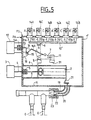
- FIG. 5 presents a diagram of an arrival-departure cell shifted by bars according to the invention, seen laterally and in section
- Figure 6 shows a block diagram showing the connections of the set bars between two arrival-departure cells via a cell longitudinal coupling.
- FIG. 7 shows a diagram of a variant coupling cell longitudinal with external measuring transformers, then accessible that the bars are energized.
- Figure 8 shows an electrical diagram of the variant of coupling according to FIG. 7.
- FIG. 9 shows a diagram of a variant cell with a double set of bars.
- Figure 10 shows an electrical diagram of the double cell variant busbar according to figure 9.
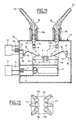
- Figure 11 shows a diagram of an alternative cell arrangement for outdoor use with current crossings connectable to overhead lines.
- FIG. 12 shows a top view of a cell according to FIG. 11.
- FIG. 1 The example of a three-phase arrival-departure cell presented in Figure 1 comprises a box 1 of rectangular parallelepiped shape, optimally cubic, made in a manner known to those skilled in the art to be waterproof.
- This box here assumed in sheet metal, is designed to contain various electrical equipment elements including in particular elements of at least one circuit breaker having three poles whose respective axes are oriented perpendicular to one of the walls of the box intended to constitute the face before the cell, this wall being here referenced FA.
- the poles are arranged side by side in a horizontal plane, they are here supposed to be aligned behind the one symbolized by one of its three rooms 2.
- These chambers are for example of the breaking chamber type. vacuum or chamber filled with a dielectric shielding gas, such as SF6.
- An operating mechanism 3 of the circuit breaker is positioned in front of the box It comprises at least one operating rod 4 which passes through of the front face FA by a sealed crossing device 5 and which controls the breaking chambers 2.
- the latter are carried by supports insulators 6 which are fixed inside the box 1 on the wall constituting the front panel FA
- the box 1 is also provided to be able to contain the elements of at least one disconnector here assumed to have three positions which takes place above the poles of the circuit breaker.
- This switch has three pairs of contact knives mobiles 7 which are directly articulated each on a load-bearing part 8, conductive and fixed, mounted on the insulating supports 6 of a break 2 at the movable contact of which this part 8 is electrically connected. Only one of the knives is shown here
- the three mobile knives 7 are in contact with three conductive pads 9 carried by conductive bars 10 arranged under the wall constituting the upper face FS of the cell.
- These bars 10 are here rectilinear and extend perpendicular to the front face FA of the caisson. They are positioned above the disconnector relative to to the circuit breaker in this box.
- the knives are for example oriented vertically, as shown in dotted lines.
- the movable knives 7 are away from the pads 9 so that sufficient sectioning distances between knives and studs 9 are respected.
- the knives are for example tilted halfway between the position mentioned above and the one described below.
- the movable knives 7 are in contact with three conductive pads 11 which are connected to an earth collector of the box, only one of these studs being shown.
- Each movable knife is for example oriented at least roughly horizontally, as shown in solid lines.
- the mobile knives 7 are actuated by a mechanism control 12 outside the box 1.
- An operating rod 13 of the mechanism control unit passes through the front panel FA by a device sealed crossing 5A identical or similar to the sealed crossing device 5 evokes above.
- This rod acts on a mechanism comprising a shaft 15, levers 16 and insulating rods 16A.
- the operating rod 13 acts on a lever which partially rotates the shaft 15. The latter drives three levers which individually control the passage of movable knives 7 from one position to another via the insulating rods.
- the shaft 15 is carried by bearings 18 fixed on the wall of the front face FA inside the box 1. Only one of the bearings 18 is shown here
- the earthing studs 11 are carried by the same support which is for example a metal cross member 31 positioned in the central part of the box, between the two side walls of this last, this cross member also serving as reinforcement and making it possible to improve the pressure resistance or possibly depression of the cell
- the conductive bars 10 are intended to be connected to conductors three-phase external A, B, C located outside the box through current crossings 17A, 17B, 17C carried by the wall constituting the face upper FS of this box.
- Each current crossing carries a 10 bar that it is here supposes to connect to an external conductor, for example by a connector 14A, 14B or 14C.
- This external conductor is for example one of the busbars of a three-phase busbar set outside and above of the box.
- the three current crossings 17A, 17B, 17C carried by the box 1 are arranged diagonally, with respect to the front face FA on the upper face MSDS of rectangular and preferably square shape of this box, so that the current crossing of the central phase referenced 17C is directly above the corresponding stud 9 as well as the movable knife 7 correspondent, when the latter is in the service position, as well as the shows Figure 1.
- the other two current crossings 17A, 17B, diagonally aligned on either side of the phase current crossing central 17C, are then connected to the pads 9 which correspond to them.
- the corresponding connections are provided by the busbars 10 which are identical and symmetrically positioned with respect to the crossing central phase 17C and the corresponding pad 9 in the box 1
- the assembly formed by the elements functional contained in box 1 between disconnector and crossings of current, as described so far, is housed in the upper front of the box, this part corresponding approximately to a quarter of this box
- single-pole bent tubes 19, only one of which is shown in FIG. 1, are connected each by a first end at the level of orifices provided in the part rear of the flat bottom wall FI of the box 1.
- These tubes allow each the passage of a curved conductive element 20, different, penetrating into the box to connect to a fixed conductive part 21 carried by the insulating supports 6 of a breaking chamber 2 in fixed contact with which this piece 21 is electrically connected.
- the second end of the unipolar tubes 19 is connected to a bushing of watertight current 22 here assumed to have a horizontal axis
- Each watertight crossing 22 is here designed to allow front connection of one or more single-pole electric cables 0 per phase, this connection being made to the by means of connectors known per se
- the second ends of the unipolar tubes 19 possibly include a portion here provided horizontal for receiving transformers current 23, external and toroidal type.
- external unipolar tubes 24 are capable of being connected each by a first end at the level of orifices provided in the wall lower plane FI of the box 1 behind those provided for the tubes external single-pole 19 if these are provided
- These tubes 24 which are here supposed rights each allow the passage of a conductive element 25 different that enters the box to connect to a room fixed conductor 21 of one of the interrupting chambers 2
- the second end of each of the unipolar tubes 24 is provided with a sealed current crossing 26 here shown vertical.
- Each sealed passage 26 is here assumed to be provided to allow connection of at least one connection element 27 in T provided for the connection of an external voltage transformer 28.
- FIG. 3 An example of a coupling cell developed from such a cell that mentioned above and comprising an additional disconnector is shown in Figure 3, it allows for example to make an arrangement according to a electrical diagram presented on figure 4.
- Such an arrangement allows a longitudinal coupling between a set of three-phase external conductors A, B, C connected to the current bushings 17A, 17B, 17C and a set of three-phase external conductors A ', B', C ' connected to current crossings 17'A, 17'B and 17'C arranged behind of the previous ones on the upper face of the box 1 '.
- the coupling takes place here by means of a succession of elements comprising a disconnector movable knives 7 and a circuit breaker with breaking chambers 2, both similar to those provided in Figure 1, as well as a disconnector additional 7 'mobile knife.
- this disconnector additional to its mobile knives 7 ' respectively positioned each between a fixed contact of one of the breaking chambers 2 and one of the bars conductive 10 'as shown in Figure 3.
- the additional disconnector which is included in the 1 'box of a cubicle analogous to that previously detailed is also a three-way disconnector positions which is identical to the movable knife disconnector 7
- These two disconnectors are symmetrically arranged with respect to a vertical plane, not shown and assumed to pass through the grounding studs 11, this plane being parallel to the front face FA of the box.
- the movable knives 7 'of the additional disconnector are articulated each on a support piece 8 ', fixed and conductive, itself carried by the insulating supports 6 of one of the interrupting chambers 2 in fixed contact with which this support piece 8 'is electrically connected in the box.
- the three mobile knives 7 ' are in contact with three conductive pads 9 'carried by conductive bars 10' located above additional disconnector in the box These knives are for example oriented vertically, as shown in dotted lines.
- the movable knives 7 ' are in contact each with a stud connected to the earth collector of the box
- the disconnectors are symmetrically installed with respect to a vertical median plane of the box which is assumed to be parallel to the wall constituting the front face FA, the pads connected to the ground are the studs 11 which can simultaneously receive the knives 7 and 7 'from the two disconnectors.
- Each movable knife is for example oriented at least roughly horizontally, as shown in solid lines.
- the movable knives 7 ′ are for example rocked halfway between the two positions mentioned above
- the additional disconnector has its own control mechanism which is outside the box 1 'as well as the control mechanism 12 to side of which it is located in front of said box.
- This mechanism includes a operating rod 13 ', partially shown, which passes through the front panel FA by a sealed crossing device identical or similar to the sealed passage device 5 mentioned above, so as to run alongside one of the side walls of the box and to be articulated on one of the levers 16 'of a movement transmission mechanism by 16 'levers and insulating rods 16'A analogous to the mechanism with levers 16 and connecting rods 16A.
- the 16 'levers are carried by a 15 'rotating shaft and three of them are connected to the 9' knives by means of three insulating rods 16'A, to ensure the displacements of the movable knives 7 between the positions mentioned above.
- the shaft 15 ' is carried by bearings 18' fixed on the wall which is opposite to the front face FA in the box.
- the conductive bars 10 ′ are intended to be connected to conductors, located outside the box, via the current bushings 17'A, 17'B, 17C 'carried by the wall constituting the upper face FS of this caisson.
- Each current crossing 17'A, 17'B, 17'C makes it possible to connect a busbar 10 'located inside the box with a connecting conductor different external A ', B' or C 'located outside and above said box.
- connectors 14'A, 14'B and 14'C are planned to ensure these connections and to allow their possible disconnection.
- the three current crossings 17'A, 17'B, 17'C are provided arranged diagonally on the upper face FS of this box, as well as the crossings 17A, 17B, 17C.
- the 17'C current crossing the central phase is positioned directly above the stud 9 ' corresponding as well as the corresponding movable knife 7 ′, when this the latter is in the service position.
- the other two current crossings diagonally aligned on either side of the phase current crossing central are then connected to the pads 9 'which correspond to them
- the connections corresponding are provided by the 10 'bars positioned so symmetrical with respect to the vertical plane which passes through the phase crossings central 17C and 17'C and the studs 9 and 9 'and which is perpendicular to the plane that defines the front face FA.
- the assembly formed by the elements functional in box 1 between additional disconnector and current bushings 17'A, 17'B, 17'C, as described so far, is housed in the upper rear part of the box, this part corresponding at least also approximately a quarter of this box. It should be noted that in this exemplary embodiment the electrical connections between conductive bars external via disconnectors and circuit breaker are likely to be particularly short.
- FIG. 5 A variant of an arrival-departure cell with a 1 "box is shown in Figure 5 it is developed from a box 1 arrival-departure cell presented in figure 1. However, it differs from it insofar as it has three additional current crossings in addition to the three current bushings 17A, 17B, 17C arranged diagonally to the front face FA of the box. The three additional current crossings 17'A, 17'B and 17'C are arranged behind the previous ones opposite top of the 1 "box, like those of a 1 'box cell such as shown in figure 3
- connection between two current crossings relating to the same phase, such 17A and 17A ', is provided by a straight conductive bar, called offset, 10 "fixed to the two current bushings inside the box 1", the three 10 “shift bars being identical and parallel to each other at proximity to the upper face FS
- external unipolar bent tubes 19 are connected at the level of orifices provided in the rear part of the flat bottom wall FI of the box 1 in a manner analogous to that provided at the level of the cell presented in FIG. 1.
- Figure 6 shows an example of connection between two arrival-departure cells with 1 and 1 "boxes through a box coupling cell the alignment between them.
- the arrival-departure cell with box 1 is assumed to be identical to that presented in figure 1.
- the box coupling cell 1 ′ is assumed to be identical to that presented in figure 3
- the arrival-departure boxes 1 and 1 "receive each a different set of three-phase external conductors referenced A, B, C for one and A ', B', C 'for the other.
- the conductors of the two sets are parallel to each other and to the front face of boxes in each game and aligned two by two from one game to another. They're from more respectively connected to the current bushings 17A, 17B, 17C located at near the front of the box where they end up.
- the boxes 1, 1 "of the arrival-departure cells are respectively connected to the casing 1 ′ of the coupling cell by intermediate conductive bars which are preferably identical, these isolated and external bars being referenced AI, BI, CI between boxes 1 and 1 'and AI', BI, CI 'between boxes 1' and 1 ".
- Connectors provide connection of the intermediate bars to current bushings which they unite, such as the referenced connectors 14A1, 14B1, 14C1 at the level of the box 1 'for the intermediate bars AI, BI, CI connecting this box to box 1.
- the coupling function of a set of three-phase external conductors is thus produced using a single coupling cell composed of elements standardized, such as circuit breaker, disconnectors and busbars
- the 1 "caisson arrival-departure cell performs the same function as a outgoing feeder cell 1, that is to say it allows feeding a feeder by cables from a set of external conductors via a circuit breaker and a disconnector. It also makes it possible to compensate simply using 10 "bars the offset between current crossings of the same phase that the casing of the coupling cell 1 'introduces.
- FIG 7 Another example of the L'D coupling cell box is shown in the figure 7, it allows an arrangement to be made according to an electrical diagram such as shown in Figure 8.
- This cell is developed from a cell of box coupling 1 'as mentioned above, it has a connection external conductor for connecting the fixed contacts of the cut 2 to the conductive supporting parts 8 "of the movable knives 7 'of the additional disconnector.
- This external link is here equipped with current 23 and voltage 28 transformers, external to the box.
- transformers are likely to be affected and in particular dismantled, if necessary, when the busbars are energized.
- the coupling is carried out via a knife disconnector mobile 7, a circuit breaker with breaking chambers 2 and a disconnector with 7 'mobile knives
- the movable knives 7 'of the additional disconnector are hinged here each on an 8 "conductive support piece, called auxiliary, slightly different from the supporting parts 8, 8 '.
- This 8 "auxiliary load-bearing part is here fixed on additional 6 "insulating supports carried by a workpiece fixed conductor 21, identical to that provided in the cell presented in figure 1.
- the part 21 is fixed on the insulating supports 6 of the fixed contact of a chamber of cut-off 2 identically.
- Each 8 "auxiliary load-bearing part is connected to a conductive element 25.
- External unipolar bent tubes 19 similar to that shown in the Figure 1, are connected each by a first end at the level openings in the rear part of the flat bottom wall of the box 1'D
- These tubes each contain a conductor hanger 20, which enters the box to connect at one end to a fixed conductive part 21 connected to the fixed contact of a switching chamber 2, like before.
- each single-pole bent tube 24 is provided with a sealed bushing 22 which receives a T-connector 29, of known type
- Each bar conductive 30 is here connected to two current crossings 20 and 26 relating to the same phase by two connectors 27 and 29, for example at the level of the median taps of these.
- the connectors 27 are positioned vertically with their respective median sockets facing forward and the connectors 29 are positioned horizontally with their sockets respective downward medians and bus bars 30, which are angled, are each mounted between the respective median sockets of two connectors 27, 29 relating to the same phase.
- Current transformers 23 and voltage transformers 28 are associated with the different conductive elements 20 and 25, in the same way than in the case of the box cell 1 presented in FIG. 1. They allow respectively a measurement of the current passing through the busbars 30 and the voltage at these bars.
- This diagram shows an example of a 1 "cell enclosure intended to allow the supply of a cable feeder from two sets of conductors three-phase external A, B, C and A ', B', C ', here two busbars, this box comprising a circuit breaker and two disconnectors 7 and 7 'like the boxes 1' and 1'D
- the arrangement of the box 1 "'shown in Figure 9 differs from the previous ones in that as the movable knife disconnector 7 and the movable knife disconnector 7 'have their knives of the same phase articulated on load-bearing parts 8 and 8 "' which are fixed on the insulating supports 6 and which are electrically interconnected two by two, as shown in figure 9 for the two parts 8 and 8 "'visible in this figure.
- the connection established between two parts 8 and 8 "'connected to the movable contact of one of the breaking chambers 2 of circuit breaker here has an elongated part which here extends parallel to this room between the space existing between it and the cross reinforcement 31 that includes the box.
- the above-mentioned double busbar cubicle has the important advantage to use components already used with cells 1 and 1 ".
- the cell arrangement presented in Figure 11 is more specifically adapted in case the cell, of the "dead tank” type, according to the invention is intended to be operated outdoors in connection with overhead lines to which connect at least some of the cell's current crossings.
- the cell itself is analogous to that presented in FIG. 3 except for the fact that the current bushings of the 1 "" box it contains are there possibly aligned parallel to the front face FA in one or here two rows of three crossings as seen in Figure 12 for crossings respectively referenced 17A to 17C and 17A 'to 17C'.
- the studs conductors 9 and optionally 9 ′ that comprise the disconnector (s) y are therefore located directly each under a crossing to which this stud is electrically connected by a corresponding part of limited dimensions functionally at one of the 10 or 10 'bars of the previously produced described
- a sleeve of insulating elastomeric material 32 covers a single-pole connecting conductor 33 for connection to one of the phase wires an overhead connection which is connected to the 1 "" box at a current bushings, such as 17C, carried by the upper face FS of the caisson.
- This sleeve is fitted on the external part of this crossing of current, it is dimensioned in a manner known per se so as to allow to obtain the necessary dielectric distances between phase conductors and between phase and earth conductors. It has fins so as to increase the line of flight.
- the insulating sleeves 32 comprise each a cylindrical part covered with a conductive layer put at the earth allowing everyone to come to oversee and protect one or more current transformer (s) 34, of toroidal type, surrounding the conductor single pole 33 which passes through the sleeve in question, this or these transformer (s) being positioned at the external part of the current bushing concerned, for example on a cylindrical part of the sleeve fitted on this external crossing part and under a second part of the sleeve.
- a box such as 1 "" makes it possible to produce medium voltage cells, gas insulated for outdoor use and connection overhead distribution lines, which include a circuit breaker, one or disconnectors and part of the electrical connecting elements essential housed in a relatively small container by compared to known cell arrangements and this with elements standardized components, at least some of which are common to various variants of cells according to the invention.
- the disconnectors electrically located on either side of the circuit breaker are provided of the type three positions as indicated above, it is possible to earth or and in short-circuit one and / or the other of the upstream and downstream overhead lines connected to either of these disconnectors.
- Earthing is carried out for example with a disconnector whose knives are in the commissioning position and therefore connected to the bushings of current, such as 17A, 17B, 17C, serving the line to be short-circuited by putting the blades of the second disconnector in the earthing position and by closing the circuit breaker by taking advantage of the closing power on short circuit specific to the latter.
- the operation can of course be carried out in an equivalent way by reversing the positionings of the disconnectors in the case where the line is served by current crossings 17'A, 17'B, 17'c.
- the watertight current bushings 17 are fixed to one of the ends of inclined metal tubes fixed by another end to the box at the orifices provided in the upper face FS for these current crossings.
- the difference in orientation between tubes is then chosen so that the necessary dielectric distance between the ends of the sleeves insulation with which the bushings are fitted respectively is respected.
Landscapes
- Engineering & Computer Science (AREA)
- Power Engineering (AREA)
- Gas-Insulated Switchgears (AREA)
- Patch Boards (AREA)
Claims (16)
- Elektrische Schaltzelle mit dichtem metallischen Gehäuse, umfassend zumindest einen Schalter und einen Dreiphasenschalter, zur Verbindung von externen leitenden Streben und/oder externen elektrischen Kabeln, die individuell im Inneren des Gehäuses über dichte Stromdurchgänge verbunden sind, wobei der Schalter über Unterbrechungskammern (2) verfügt, die horizontal und senkrecht zu einer Frontfläche (FA) des Gehäuses angeordnet sind, mittels welcher der Schalter wie auch der Dreiphasenschalter gesteuert wird, wobei letzterer bewegliche Klingen (7) umfasst, die beweglich sind zwischen zumindest einer ersten sogenannten Betriebsposition und einer sogenannten Unterbrechungsposition und die jeweils angelenkt sind an einem leitenden und feststehenden Trägerteil (8), abgestützt an zumindest einer isolierenden Stütze (6) für eine Unterbrechungskammer mit einem beweglichen Kontakt, an dem dieses Teil befestigt ist, dadurch gekennzeichnet, dass das parallelepipedische, rechteckige Gehäuse, welches im Idealfall kubisch ist, einen Dreiphasenschalter umfasst, dessen bewegliche Klingen zumindest annähernd vertikal in der Betriebsposition ausgerichtet sind, in welcher Position die Klingen in Kontakt mit leitenden Kontaktstellen (9) stehen, die horizontal und parallel zu der Frontfläche ausgerichtet sind, die sich oberhalb des Dreiphasenschalters mit Bezug auf den Schalter in dem Gehäuse befinden, und die mit ersten, dichten Stromdurchgängen (17A, 17B, 17C) verbunden sind, welche von einer oberen Fläche (FS) des Gehäuses gestützt werden.
- Schaltzelle nach Anspruch 1 dadurch gekennzeichnet, dass sie erste Stromdurchgänge umfasst, die an der oberen Fläche des Gehäuses in solch einer Weise angeordnet sind, dass ein erster mittlerer Stromdurchgang oder -durchtritt (17C) sich unmittelbar oberhalb der Kontaktstelle der mittleren beweglichen Klinge des Dreiphasenschalters befindet, und dass die zwei weiteren ersten Stromdurchgänge diagonal ausgerichtet sind mit Bezug auf den ersten mittleren Stromdurchgang und jeweils verbunden sind mit einer unterschiedlichen Kontaktstelle, über eine erste individuelle leitende Strebe (10), wobei diese Streben parallel verlaufend und auch diagonal angeordnet mit Bezug auf die Frontfläche in einer symmetrischen Art und Weise angeordnet sind, gegenüberstehend im ersten mittleren Durchgang in dem Gehäuse.
- Schaltzelle nach einem der Ansprüche 1, 2 dadurch gekennzeichnet, dass sie ein Gehäuse umfasst, welches einen zusätzlichen Dreiphasenschalter enthält, umfassend bewegliche Klingen (7'), die ebenfalls jeweils an einem feststehenden leitenden Teil (8', 8'' oder 8''') angelenkt sind, gestützt an isolierenden Stützen (6, 6') einer Unterbrechungskammer (2), wobei ein Kontakt davon mit dem leitenden Teil verbunden ist, wobei die beweglichen Klingen ebenfalls vertikal ausgerichtet sind in einer Betriebsposition, in welcher sie in Kontakt stehen mit leitenden Kontaktstellen (9'), die horizontal und parallel zur Frontfläche angeordnet sind, oberhalb des zusätzlichen Dreiphasenschalters, mit Bezug auf den Schalter in dem Gehäuse und verbunden mit zweiten dichten Stromdurchgängen (17'A, 17'B, 17'C), die an der oberen Fläche des Gehäuses gestützt sind, wobei der zusätzliche Dreiphasenschalter sich hinter dem anderen Dreiphasenschalter mit Bezug auf die Frontfläche des Gehäuses befindet.
- Schaltzelle nach einem der Ansprüche 1 bis 3, dadurch gekennzeichnet, dass in einer Erdungsposition die genannten beweglichen Klingen in einer annähernd horizontal ausgerichteten Position jeweils in Kontakt stehen mit einer Erdungskontaktstelle (11), die von einer horizontalen Verstärkungsstrebe (31) gestützt sind, mittig angeordnet zwischen Lateralwandungen des Gehäuses oberhalb der Unterbrechungskammern des Schalters.
- Schaltzelle nach einem der Ansprüche 1 bis 4, dadurch gekennzeichnet, dass sie einen Dreiphasenschalter umfasst, dessen bewegliche Klingen in der Betriebsposition elektrisch isoliert bezüglich der Kontaktstellen (9) vorliegen, die mit den ersten Stromdurchgängen verbunden sind, sowie von den Erdungskontaktstellen (11), die in dem Gehäuse enthalten sind, wobei die Klingen halb verschwenkt sind zwischen den zwei Positionen entsprechend der Betriebsposition und der Erdungsposition.
- Schaltzelle nach einem der Ansprüche 3 bis 5, dadurch gekennzeichnet, dass sie zweite Stromdurchgänge umfasst, in solch einer Weise angeordnet, dass einer der zweiten Stromdurchgänge, mittlerer Stromdurchgang (17'C) genannt, sich unmittelbar oberhalb der mittleren Kontaktstelle und der mittleren beweglichen Klinge des zusätzlichen Dreiphasenschalters befindet, wobei die zwei anderen Stromdurchgänge (17'A, 17'B) diagonal ausgerichtet sind mit Bezug auf den zweiten mittleren Stromdurchgang und jeweils verbunden sind mit einer unterschiedlichen Kontaktstelle durch eine zweite individuelle leitende Strebe (10'), wobei die zweiten Streben in symmetrischer Weise angeordnet sind mit Bezug auf den mittleren Durchgang, entsprechend der mittleren Kontaktstelle des zusätzlichen Dreiphasenschalters in dem Gehäuse.
- Schaltzelle nach einem der Ansprüche 3 bis 6, dadurch gekennzeichnet, dass der Dreiphasenschalter und der zusätzliche Dreiphasenschalter entsprechende Elemente (7, 7' und 9, 9') in Ausrichtung angeordnet und auf entsprechendem horizontalem Niveau in dem Gehäuse aufweisen, wobei entsprechendes gilt bezüglich der ersten und zweiten Streben (10, 10') von entsprechenden Phasens.
- Schaltzelle nach einem der Ansprüche 1 bis 7, dadurch gekennzeichnet, dass sie ein Gehäuse umfasst, welches mit externen, gebogenen, unipolaren Rohren (19) versehen ist, die sich jeweils an das Gehäuse auf der Höhe oder dem Niveau von Öffnungen anschließen, die in dem hinteren Abschnitt der unteren ebenen Wandung (FI) des Gehäuses ausgebildet sind, die jeweils den Durchtritt eines unterschiedlichen leitenden Elementes gewährleisten, wobei letzteres in das Gehäuse tritt, um an einem feststehenden leitenden Teil (21) angeschlossen zu werden, welches von zumindest einer isolierenden Stütze (6) einer Unterbrechungskammer (2) gestützt ist, mit deren feststehendem Kontakt dieses Teil elektrisch verbunden ist und die jeweils den Anschluss von zumindest einem unipolaren elektrischem Kabel (0) unter Zwischenschaltung eines dichten Stromdurchgangs (22) ermöglichen, angeordnet auf der Höhe eines Endes des Rohres, welches es enthält und horizontal und nach vorne bezüglich des Gehäuses unter dem die Rohre angeordnet sind ausgerichtet.
- Schaltzelle nach einem der Ansprüche 1 bis 8, dadurch gekennzeichnet, dass sie ein Gehäuse umfasst, welches mit geraden unipolaren Rohren (24) versehen ist, die extern vorliegen und die sich jeweils an dem Gehäuse auf der Höhe oder dem Niveau von Öffnungen anschließen, die in dem hinteren Abschnitt der unteren ebenen Wandung des Gehäuses ausgebildet sind, und zwar hinter jenen, die ausgebildet sind für eventuelle unipolare gebogene Rohre, die jeweils den Durchtritt eines unterschiedlichen leitenden Elementes (25) in das Gehäuse zum Anschluss an ein feststehendes leitendes Teil (21) ichertellen, welches von zumindest einer isolierenden Stütze (6) einer Unterbrechungskammer (2) gestützt wird, deren feststehender Kontakt mit diesem Teil elektrisch verbunden ist und die insbesondere jeweils den Anschluss einer Phase eines externen Spannungswandlers (28) ermöglichen.
- Schaltzelle nach einem der Ansprüche 3 bis 5, dadurch gekennzeichnet, dass sie zweite dichte Stromdurchgänge (17'A, 17'B, 17'C) umfasst, gestützt an der oberen Fläche (FS) des Gehäuses hinter ersten Stromdurchgängen (17A, 17B, 17C) in einer bezüglich dieser identischen Anordnung mit Bezug auf die Frontfläche (FA) des Gehäuses, wobei die zweiten Durchgänge jeweils mit einer der ersten Durchgänge über eine leitende Strebe (10'') verbunden sind, die diesbezüglich gemeinsam vorliegt und im Inneren des Gehäuses aufgenommen ist, und zwar parallel zu der oberen Fläche des Gehäuses, wobei die Streben untereinander parallel verlaufen.
- Schaltzelle nach einem der Ansprüche 3 bis 7, dadurch gekennzeichnet, dass sie ein Gehäuse umfasst, in welchem der Dreiphasenschalter (7, 9, 10) und der zusätzliche Dreiphasenschalter (7', 9', 10') symmetrisch angeordnet sind mit Bezug auf eine Ebene, die durch die Erdungskontakstellen (11) tritt, wobei der zusätzliche Dreiphasenschalter über bewegliche Klingen (7') verfügt, die jeweils an einem leitenden Trägerteil (8') montiert sind, befestigt an zumindest einer isolierenden Stütze (6) einer Unterbrechungskammer, wobei die beweglichen Klingen des zusätzlichen Dreiphasenschalters elektrisch jeweils verbunden sind mit einem feststehenden Kontakt einer der Unterbrechungskammern (2) mit deren beweglichen Kontakt elektrisch eine bewegliche Klinge (7) des Dreiphasenschalters verbunden ist, der in demselben Gehäuse aufgenommen ist.
- Schaltzelle nach Anspruch 9, dadurch gekennzeichnet, dass sie ein Gehäuse mit einem Dreiphasenschalter (7, 9, 10) und einem zusätzlichen Dreiphasenschalter (7', 9', 10') umfasst, die symmetrisch angeordnet sind mit Bezug auf eine Ebene, die durch die Erdungskontaktstellen (11) tritt, wobei der zusätzliche Dreiphasenschalter bewegliche Klingen umfasst, die jeweils an einer feststehenden leitenden Trägerstelle (8'') montiert sind, elektrisch verbunden mit einem feststehenden Kontakt einer der Unterbrechnungskammern (2) unter Zwischenschaltung eines feststehenden leitenden Teiles (21), das zumindest eine isolierende Stütze (6) der Unterbrechungskammer trägt, sowie von zwei leitenden Elementen (25, 20), die mit dichten Durchtritten (26, 22) verbunden und untereinander äußerlich des Gehäuses unter Zwischenschaltung eines isolierten und gebogenen Leiters (30) und Leitern (27, 29) geschaltet sind, die die Montage von Stromwandlern und von Spannungswandlern außerhalb des Gehäuses ermöglichen, wobei das leitende Teil (8''), ein erstes der leitenden Elemente (25), der isolierte Leiter (30), ein zweites der leitenden Elemente (20) und das feststehende leitende Teil (21) mit Bezug auf eine Klinge elektrisch in Serie geschaltet in dieser Reihenfolge vorliegen.
- Schaltzelle nach einem der Ansprüche 3 bis 9, dadurch gekennzeichnet, dass sie ein Gehäuse umfasst, in welchem der zusätzliche Dreiphasenschalter über bewegliche Klingen (7') verfügt, die jeweils einzeln angeordnet sind mit der beweglichen Klinge (7) der entsprechenden Phase des Dreiphasenschalters mit welchem dieser in demselben Gehäuse aufgenommen ist an leitenden Trägerteilen (8'''), die an zumindest einer feststehenden und isolierenden Stütze (6) einer Unterbrechungskammer befestigt sind, und die elektrisch untereinander verbunden sind über eine Verbindung, die sich in dem Raum erstreckt, der zwischen der Unterbrechungskammer, mit der die isolierende Stütze wechselwirkt, und Strebe (31), die das Gehäuse umfasst, besteht.
- Schaltzelle nach einem der Ansprüche 1, 3, 4, 5, 7, 8, 9, 11 dadurch gekennzeichnet, dass sie Stromdurchtritte umfasst, gestützt von einer oberen Fläche (FS) des Gehäuses 1'''') vorgesehen, um angeschlossen zu werden an Überlandleitungen unter Zwischenschaltung von unipolaren Verbindungs- oder Anschlussleitern (33), die mit jeweiligen externen Abschnitten von Stromdurchgängen verbunden oder geschaltet sind, wobei jeder Leiter mit einer isolierenden elastomeren Manschette (32) versehen ist, die ein Ende bedeckt, und die an dem oberen Abschnitt des Stromdurchtrittes eingreift, mit dem der Leiter verbunden oder geschaltet ist.
- Schaltzelle nach Anspruch 14, dadurch gekennzeichnet, dass sie Stromdurchgänge umfasst, vorgesehen um angeschlossen zu werden an Überlandleitungen unter Zwischenschaltung von unipolaren Verbindungs- oder Anschlussleitern (33), die mit isolierenden elastomeren Manschetten versehen sind und um welche torusartige Spannungswandler (34) montiert sind.
- Schaltzelle nach einem der Ansprüche 1 bis 15, dadurch gekennzeichnet, dass sie mit einem dielektrischen Schutzgas gefüllt ist.
Applications Claiming Priority (3)
| Application Number | Priority Date | Filing Date | Title |
|---|---|---|---|
| FR9704260 | 1997-04-08 | ||
| FR9704260A FR2761825B1 (fr) | 1997-04-08 | 1997-04-08 | Cellule electrique a caisson metallique etanche |
| PCT/FR1998/000614 WO1998045913A1 (fr) | 1997-04-08 | 1998-03-26 | Cellule electrique a caisson metallique etanche |
Publications (2)
| Publication Number | Publication Date |
|---|---|
| EP0906648A1 EP0906648A1 (de) | 1999-04-07 |
| EP0906648B1 true EP0906648B1 (de) | 2002-07-03 |
Family
ID=9505628
Family Applications (1)
| Application Number | Title | Priority Date | Filing Date |
|---|---|---|---|
| EP98917242A Expired - Lifetime EP0906648B1 (de) | 1997-04-08 | 1998-03-26 | Elektrische schaltzelle mit einer metallischem kasten |
Country Status (6)
| Country | Link |
|---|---|
| EP (1) | EP0906648B1 (de) |
| JP (1) | JP2000511760A (de) |
| DE (1) | DE69806319T2 (de) |
| ES (1) | ES2178202T3 (de) |
| FR (1) | FR2761825B1 (de) |
| WO (1) | WO1998045913A1 (de) |
Families Citing this family (5)
| Publication number | Priority date | Publication date | Assignee | Title |
|---|---|---|---|---|
| JP3667150B2 (ja) * | 1999-05-21 | 2005-07-06 | 三菱電機株式会社 | ガス封入開閉装置 |
| DE102010018326A1 (de) * | 2010-04-27 | 2011-10-27 | Areva Energietechnik Gmbh | Elektrische Schaltanlage, insbesondere Mittelspannungsschaltanlage |
| FR2968119B1 (fr) * | 2010-11-29 | 2012-12-28 | Areva T&D Sas | Module de traversee et de derivation de cuve d'un appareillage electrique moyenne tension, procede de realisation et connexion electrique associes |
| CN102306586A (zh) * | 2011-08-27 | 2012-01-04 | 魏献通 | 组合电器三工位隔离接地开关操动机构 |
| CN104143460B (zh) * | 2014-07-08 | 2017-09-19 | 厦门市恒源新电力设备有限公司 | 一种封闭式闸刀接地开关 |
Family Cites Families (5)
| Publication number | Priority date | Publication date | Assignee | Title |
|---|---|---|---|---|
| DE3436173A1 (de) * | 1984-08-22 | 1986-03-06 | BBC Aktiengesellschaft Brown, Boveri & Cie., Baden, Aargau | Schaltanlage |
| DE4103101C3 (de) * | 1990-03-22 | 1996-08-14 | Mitsubishi Electric Corp | Trennschalter, sowie Druckgas-isoliertes Schaltgetriebe mit solchem |
| DE19511736A1 (de) * | 1994-04-18 | 1995-10-19 | Abb Patent Gmbh | Schaltfeld mit einem innerhalb eines Schaltschrankes angeordneten dreipoligen Leistungsschalter |
| DE29501081U1 (de) * | 1995-01-13 | 1995-03-23 | Siemens AG, 80333 München | Anordnung von Kupplungsfeldern in gekapselten Mittelspannungs-Schaltanlagen |
| DE19518126A1 (de) * | 1995-05-17 | 1996-11-21 | Josef F Perle | Leistungsschalter-Anlage |
-
1997
- 1997-04-08 FR FR9704260A patent/FR2761825B1/fr not_active Expired - Fee Related
-
1998
- 1998-03-26 EP EP98917242A patent/EP0906648B1/de not_active Expired - Lifetime
- 1998-03-26 WO PCT/FR1998/000614 patent/WO1998045913A1/fr not_active Ceased
- 1998-03-26 ES ES98917242T patent/ES2178202T3/es not_active Expired - Lifetime
- 1998-03-26 DE DE69806319T patent/DE69806319T2/de not_active Expired - Fee Related
- 1998-03-26 JP JP10542437A patent/JP2000511760A/ja active Pending
Also Published As
| Publication number | Publication date |
|---|---|
| DE69806319T2 (de) | 2003-02-20 |
| FR2761825A1 (fr) | 1998-10-09 |
| DE69806319D1 (de) | 2002-08-08 |
| EP0906648A1 (de) | 1999-04-07 |
| JP2000511760A (ja) | 2000-09-05 |
| FR2761825B1 (fr) | 1999-05-14 |
| ES2178202T3 (es) | 2002-12-16 |
| WO1998045913A1 (fr) | 1998-10-15 |
| HK1020459A1 (en) | 2000-04-20 |
Similar Documents
| Publication | Publication Date | Title |
|---|---|---|
| EP0543682B1 (de) | SFG-Lasttrennschalter und Verwendung in Zellen und Posten und vorfabrizierten Unterstationen | |
| EP0771057B1 (de) | Mittelspannungsschaltanlage | |
| EP0543683A1 (de) | Mittelspannungs-Lasttrennschalter und Verwendung in einer Mittelspannungszelle und Mittelspannungspost | |
| FR2812772A1 (fr) | Appareil de commutation a isolant gazeux pour sous-station electrique | |
| EP1329008B1 (de) | Hybrid-hochspannungsstation mit gegenüberliegenden abgängen, und gekapselten schalt- und-trennmodulen dafür | |
| FR2656473A1 (fr) | Installation de commutation isolee par un gaz. | |
| EP0165184B1 (de) | Metallverkapselte gasisolierte dreiphasige Schaltanlage | |
| EP0068951B2 (de) | Gasisolierte gekapselte Zelle für elektrische Mittelspannungsanlage | |
| EP0871268A1 (de) | Verteilerstation für elektrische Energie | |
| WO1998045913A1 (fr) | Cellule electrique a caisson metallique etanche | |
| EP1226641B1 (de) | Geschottete metallgekapselte schaltanlage zum einsetzen von trennschaltern | |
| CA1127285A (fr) | Poste electrique a tres haute tension | |
| JP4572145B2 (ja) | ガス絶縁スイッチギヤ | |
| BE897589A (fr) | Cellule de distribution a haute tension pour poste de transormation | |
| FR2789798A1 (fr) | Module de disjoncteur auto-sectionneur, moyenne tension et poste de distribution d'energie correspondant | |
| EP0559552B1 (de) | Lasttrennschalter für hohe Nominal-Intensität und Verwendung für Zelle und für Mittel-Spannungsanlage | |
| FR2782418A1 (fr) | Poste de transformation electrique compact | |
| EP3001521A1 (de) | Mittelspannungsschutzgerät mit stromzählung | |
| EP0311472A1 (de) | Mittelspannungsfertigschalttafel mit Drehschalter | |
| FR2558013A1 (fr) | Armoire de raccordement en derivation d'un poste electrique moyenne tension | |
| FR2823002A1 (fr) | Interrupteur/sectionneur multifonctionnel pour poste de distribution electrique | |
| EP0002398A1 (de) | Verbesserungen an Stromverteilungszellen | |
| EP1540788B1 (de) | Sammelschienenschaltung in einer metallgekapselten schaltanlage | |
| FR2471064A1 (fr) | Cellule electrique a disjoncteur sectionnable | |
| FR2648405A1 (fr) | Dispositif de sectionnement pour catenaire sous tunnel |
Legal Events
| Date | Code | Title | Description |
|---|---|---|---|
| PUAI | Public reference made under article 153(3) epc to a published international application that has entered the european phase |
Free format text: ORIGINAL CODE: 0009012 |
|
| AK | Designated contracting states |
Kind code of ref document: A1 Designated state(s): BE CH DE ES GB IT LI NL SE |
|
| 17P | Request for examination filed |
Effective date: 19990305 |
|
| GRAG | Despatch of communication of intention to grant |
Free format text: ORIGINAL CODE: EPIDOS AGRA |
|
| 17Q | First examination report despatched |
Effective date: 20010625 |
|
| GRAG | Despatch of communication of intention to grant |
Free format text: ORIGINAL CODE: EPIDOS AGRA |
|
| GRAH | Despatch of communication of intention to grant a patent |
Free format text: ORIGINAL CODE: EPIDOS IGRA |
|
| GRAH | Despatch of communication of intention to grant a patent |
Free format text: ORIGINAL CODE: EPIDOS IGRA |
|
| GRAA | (expected) grant |
Free format text: ORIGINAL CODE: 0009210 |
|
| AK | Designated contracting states |
Kind code of ref document: B1 Designated state(s): BE CH DE ES GB IT LI NL SE |
|
| PG25 | Lapsed in a contracting state [announced via postgrant information from national office to epo] |
Ref country code: NL Free format text: LAPSE BECAUSE OF FAILURE TO SUBMIT A TRANSLATION OF THE DESCRIPTION OR TO PAY THE FEE WITHIN THE PRESCRIBED TIME-LIMIT Effective date: 20020703 |
|
| REG | Reference to a national code |
Ref country code: CH Ref legal event code: EP |
|
| GBT | Gb: translation of ep patent filed (gb section 77(6)(a)/1977) |
Effective date: 20020703 |
|
| REG | Reference to a national code |
Ref country code: CH Ref legal event code: NV Representative=s name: CABINET ROLAND NITHARDT CONSEILS EN PROPRIETE INDU |
|
| REF | Corresponds to: |
Ref document number: 69806319 Country of ref document: DE Date of ref document: 20020808 |
|
| NLV1 | Nl: lapsed or annulled due to failure to fulfill the requirements of art. 29p and 29m of the patents act | ||
| REG | Reference to a national code |
Ref country code: ES Ref legal event code: FG2A Ref document number: 2178202 Country of ref document: ES Kind code of ref document: T3 |
|
| PG25 | Lapsed in a contracting state [announced via postgrant information from national office to epo] |
Ref country code: BE Free format text: LAPSE BECAUSE OF NON-PAYMENT OF DUE FEES Effective date: 20030331 |
|
| PLBE | No opposition filed within time limit |
Free format text: ORIGINAL CODE: 0009261 |
|
| STAA | Information on the status of an ep patent application or granted ep patent |
Free format text: STATUS: NO OPPOSITION FILED WITHIN TIME LIMIT |
|
| 26N | No opposition filed |
Effective date: 20030404 |
|
| BERE | Be: lapsed |
Owner name: S.A. *GEC ALSTHOM T & D Effective date: 20030331 |
|
| PGFP | Annual fee paid to national office [announced via postgrant information from national office to epo] |
Ref country code: DE Payment date: 20040220 Year of fee payment: 7 |
|
| PGFP | Annual fee paid to national office [announced via postgrant information from national office to epo] |
Ref country code: SE Payment date: 20040224 Year of fee payment: 7 Ref country code: CH Payment date: 20040224 Year of fee payment: 7 |
|
| PGFP | Annual fee paid to national office [announced via postgrant information from national office to epo] |
Ref country code: GB Payment date: 20040226 Year of fee payment: 7 |
|
| PGFP | Annual fee paid to national office [announced via postgrant information from national office to epo] |
Ref country code: ES Payment date: 20040322 Year of fee payment: 7 |
|
| PG25 | Lapsed in a contracting state [announced via postgrant information from national office to epo] |
Ref country code: IT Free format text: LAPSE BECAUSE OF NON-PAYMENT OF DUE FEES Effective date: 20050326 Ref country code: GB Free format text: LAPSE BECAUSE OF NON-PAYMENT OF DUE FEES Effective date: 20050326 |
|
| PG25 | Lapsed in a contracting state [announced via postgrant information from national office to epo] |
Ref country code: SE Free format text: LAPSE BECAUSE OF NON-PAYMENT OF DUE FEES Effective date: 20050327 |
|
| PG25 | Lapsed in a contracting state [announced via postgrant information from national office to epo] |
Ref country code: ES Free format text: LAPSE BECAUSE OF NON-PAYMENT OF DUE FEES Effective date: 20050328 |
|
| PG25 | Lapsed in a contracting state [announced via postgrant information from national office to epo] |
Ref country code: LI Free format text: LAPSE BECAUSE OF NON-PAYMENT OF DUE FEES Effective date: 20050331 Ref country code: CH Free format text: LAPSE BECAUSE OF NON-PAYMENT OF DUE FEES Effective date: 20050331 |
|
| PG25 | Lapsed in a contracting state [announced via postgrant information from national office to epo] |
Ref country code: DE Free format text: LAPSE BECAUSE OF NON-PAYMENT OF DUE FEES Effective date: 20051001 |
|
| EUG | Se: european patent has lapsed | ||
| REG | Reference to a national code |
Ref country code: CH Ref legal event code: PL |
|
| GBPC | Gb: european patent ceased through non-payment of renewal fee |
Effective date: 20050326 |
|
| REG | Reference to a national code |
Ref country code: ES Ref legal event code: FD2A Effective date: 20050328 |