EP0906821A1 - Schneckenmaschine - Google Patents
Schneckenmaschine Download PDFInfo
- Publication number
- EP0906821A1 EP0906821A1 EP98115392A EP98115392A EP0906821A1 EP 0906821 A1 EP0906821 A1 EP 0906821A1 EP 98115392 A EP98115392 A EP 98115392A EP 98115392 A EP98115392 A EP 98115392A EP 0906821 A1 EP0906821 A1 EP 0906821A1
- Authority
- EP
- European Patent Office
- Prior art keywords
- housing
- screw machine
- machine according
- tie rods
- plate spring
- Prior art date
- Legal status (The legal status is an assumption and is not a legal conclusion. Google has not performed a legal analysis and makes no representation as to the accuracy of the status listed.)
- Granted
Links
Images


Classifications
-
- B—PERFORMING OPERATIONS; TRANSPORTING
- B29—WORKING OF PLASTICS; WORKING OF SUBSTANCES IN A PLASTIC STATE IN GENERAL
- B29C—SHAPING OR JOINING OF PLASTICS; SHAPING OF MATERIAL IN A PLASTIC STATE, NOT OTHERWISE PROVIDED FOR; AFTER-TREATMENT OF THE SHAPED PRODUCTS, e.g. REPAIRING
- B29C48/00—Extrusion moulding, i.e. expressing the moulding material through a die or nozzle which imparts the desired form; Apparatus therefor
- B29C48/25—Component parts, details or accessories; Auxiliary operations
- B29C48/36—Means for plasticising or homogenising the moulding material or forcing it through the nozzle or die
- B29C48/50—Details of extruders
- B29C48/503—Extruder machines or parts thereof characterised by the material or by their manufacturing process
-
- B—PERFORMING OPERATIONS; TRANSPORTING
- B29—WORKING OF PLASTICS; WORKING OF SUBSTANCES IN A PLASTIC STATE IN GENERAL
- B29C—SHAPING OR JOINING OF PLASTICS; SHAPING OF MATERIAL IN A PLASTIC STATE, NOT OTHERWISE PROVIDED FOR; AFTER-TREATMENT OF THE SHAPED PRODUCTS, e.g. REPAIRING
- B29C48/00—Extrusion moulding, i.e. expressing the moulding material through a die or nozzle which imparts the desired form; Apparatus therefor
- B29C48/25—Component parts, details or accessories; Auxiliary operations
- B29C48/36—Means for plasticising or homogenising the moulding material or forcing it through the nozzle or die
- B29C48/50—Details of extruders
- B29C48/68—Barrels or cylinders
- B29C48/682—Barrels or cylinders for twin screws
-
- B—PERFORMING OPERATIONS; TRANSPORTING
- B29—WORKING OF PLASTICS; WORKING OF SUBSTANCES IN A PLASTIC STATE IN GENERAL
- B29C—SHAPING OR JOINING OF PLASTICS; SHAPING OF MATERIAL IN A PLASTIC STATE, NOT OTHERWISE PROVIDED FOR; AFTER-TREATMENT OF THE SHAPED PRODUCTS, e.g. REPAIRING
- B29C48/00—Extrusion moulding, i.e. expressing the moulding material through a die or nozzle which imparts the desired form; Apparatus therefor
- B29C48/25—Component parts, details or accessories; Auxiliary operations
- B29C48/256—Exchangeable extruder parts
- B29C48/2562—Mounting or handling of the die
-
- B—PERFORMING OPERATIONS; TRANSPORTING
- B29—WORKING OF PLASTICS; WORKING OF SUBSTANCES IN A PLASTIC STATE IN GENERAL
- B29C—SHAPING OR JOINING OF PLASTICS; SHAPING OF MATERIAL IN A PLASTIC STATE, NOT OTHERWISE PROVIDED FOR; AFTER-TREATMENT OF THE SHAPED PRODUCTS, e.g. REPAIRING
- B29C48/00—Extrusion moulding, i.e. expressing the moulding material through a die or nozzle which imparts the desired form; Apparatus therefor
- B29C48/25—Component parts, details or accessories; Auxiliary operations
- B29C48/36—Means for plasticising or homogenising the moulding material or forcing it through the nozzle or die
- B29C48/50—Details of extruders
- B29C48/68—Barrels or cylinders
- B29C48/6801—Barrels or cylinders characterised by the material or their manufacturing process
-
- B—PERFORMING OPERATIONS; TRANSPORTING
- B29—WORKING OF PLASTICS; WORKING OF SUBSTANCES IN A PLASTIC STATE IN GENERAL
- B29C—SHAPING OR JOINING OF PLASTICS; SHAPING OF MATERIAL IN A PLASTIC STATE, NOT OTHERWISE PROVIDED FOR; AFTER-TREATMENT OF THE SHAPED PRODUCTS, e.g. REPAIRING
- B29C48/00—Extrusion moulding, i.e. expressing the moulding material through a die or nozzle which imparts the desired form; Apparatus therefor
- B29C48/03—Extrusion moulding, i.e. expressing the moulding material through a die or nozzle which imparts the desired form; Apparatus therefor characterised by the shape of the extruded material at extrusion
Definitions
- the invention is directed to a screw machine according to the preamble of claim 1.
- a generic screw machine is out DE 39 36 085 A1 known.
- DE 29 52 348 A1 describes a connection of housing sections, in particular for twin screw extruders, described, the housing sections by means of prestressed, in two to the cylinder double bores axially parallel and diametrically opposed planes Threaded bolts are connected to each other. To achieve the The threaded bolts are heated so that they cool down sets the desired preload due to the shortening of the length.
- Screw machines are, for example, four parallel to each other Tie rods are arranged in closed bores in the housing sections.
- the housing sections are mounted on the tie rods threaded on.
- the object of the invention is also based on Such larger machines under the currency of the basic advantages such a tie rod construction has a high level of tightness at all operating temperatures, So also during the heating process and in heated State to achieve.
- the provision of a spring arrangement according to the invention is similar to that which occurs uneven expansion due to a non-uniform temperature distribution in an optimal manner and ensures a high level of tightness for sure.
- the plate spring packages provided according to claim 2 enable realizing a very favorable displacement-force characteristic of the spring arrangement, in particular to design the spring arrangement so that on the one hand Utilization of approx. 50% of the maximum spring travel sufficient sealing force is applied and on the other hand about 25% of the remaining travel is sufficient, the differences in length due to the different thermal expansion to record. The remaining 25% of the maximum possible Travel can remain as a reserve.
- Claim 3 enters optimal ratio of the expansion of the tie rod and disc spring package again.
- control pin provided according to claims 8 and 9 enables one optical control of the preload such that the correct preload is reached when the edge of a placed on the disc spring package Thrust washer reached the tip of the control pin.
- a screw machine 1 shown in the drawing comprises a Screw housing 2, of which housing sections 3 and 4, an end plate 5 and a front part 6 are shown.
- the housing sections 3, 4 and the end plate 5 and the front part 6 are connected via tie rods 7, the outside in recesses 8 of the housing 2 are arranged parallel to its central longitudinal axis 9. How 2 can be removed, the recesses 8 of the housing 2 are open laterally, so that the tie rods 7 are transverse to their own longitudinal direction, i.e. across can be inserted into the recesses 8 to the axis 9.
- the tie rods 7 have a first end on the right in FIG. 1 illustrated thread 10, which also in a laterally open recess 11 of the end plate 5 opens, in this area a nut 12th is screwed, which is supported on the bottom 13 of the recess 11.
- a thread 14 is provided on which a nut 15 is screwed.
- the nut 15 is supported against a thrust washer 16 which on one Snap ring 17 is present.
- a disc spring assembly is connected to the thrust washer 16 18, with a shim 19 between this disc spring assembly 18 and an inner end wall 20 of the end part 6 are provided is.
- the nut 15 with the thrust washer 16 forms a first abutment on Tie rod 7 and the shim 19 with the end wall 20 a second Abutment on the housing 2 each for the plate spring package 18.
- the Snap ring 17 prevents the pressure plate 16 and the from falling out Disc spring pack 18 when the tie rod 7 is removed.
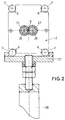
- the front part 6 is of a bore 21 in the direction perpendicular to Longitudinal axis 9 of the housing 2 passes through, in which a control pin 22nd is used, which extends into the area of the pressure plate 16 and one Control of proper assembly allows.
- the housing 2 two penetrating has in cross section circular longitudinal recesses 23, 24, in which Screws 25, 26 are arranged.
- the screw machine 1 shown overall in FIG. 3 is concerned an extruder. It has one supported on a foundation 29 Underframe 30 on which a reduction and distribution gear 31 is supported. On the input side of the transmission 31 is a drive motor 32 flanged with a clutch; on the output side of the gearbox 31 is the front part 6, a so-called lantern, attached to which the process part forming housing 2 is attached.
- This housing 2 consists of the housing sections 3 and 4 and further housing sections.
- the working direction 33 corresponds to the longitudinal direction of the housing 2.
- On the first housing section 3 in the working direction 33 is a Inlet 34 is provided for material to be treated.
- the one in the working direction 33 last housing section is provided with a nozzle head 35 through the treated material emerges.
- the nozzle head 35 lies on the end plate 5 on.
- the process part forming the housing 2 is by means of a support trained receptacle 28 supported on the base 30.
- the lower Tie rods 7 lie on the crossbar or beam Table 27 on.
- the ratio of the elongation defined in mm / N from tie rod 7 to disc spring package 18 is in the range of 1: 1.5 to 1: 5.
- the elongation of the plate spring assembly 18 in each case 1.5 to 5 times greater than the elongation of the tie rods 7, so that changes in length of the tie rods 7, in particular due to thermally induced different expansions of housing 2 and tie rods 7, without much change in the preload the tie rod 7 can be collected.
Landscapes
- Engineering & Computer Science (AREA)
- Mechanical Engineering (AREA)
- Manufacturing & Machinery (AREA)
- Extrusion Moulding Of Plastics Or The Like (AREA)
- Formation And Processing Of Food Products (AREA)
- Structure Of Belt Conveyors (AREA)
- Control Of Conveyors (AREA)
- Investigating Strength Of Materials By Application Of Mechanical Stress (AREA)
- Extrusion Of Metal (AREA)
- Heat-Exchange Devices With Radiators And Conduit Assemblies (AREA)
- Screw Conveyors (AREA)
Abstract
Description
- Fig. 1
- eine Seitenansicht, teilweise geschnitten, eines Teils einer erfindungsgemäßen Schneckenmaschine,
- Fig. 2
- einen Querschnitt durch die Schneckenmaschine und
- Fig. 3
- eine Seitenansicht einer Schneckenmaschine in schematischer Darstellung.
Claims (9)
- Schneckenmaschine mit einem in Längsrichtung aneinandergesetzte Gehäuse-Abschnitte (3, 4) aufweisenden, zusammengesetzten Gehäuse (2), wobei die Gehäuse-Abschnitte (3, 4) durch eine Mehrzahl von Zugankern (7), welche an der Gehäuseaußenseite parallel zueinander in Längsrichtung des Gehäuses (2) verlaufen, dicht gegeneinander verspannt sind, dadurch gekennzeichnet, daß die Zuganker (7) in Längsrichtung jeweils durch eine vorgespannte Federanordnung belastet sind.
- Schneckenmaschine nach Anspruch 1, dadurch gekennzeichnet, daß die Federanordnung durch ein auf den jeweiligen Zuganker (7) aufgesetztes Tellerfedernpaket (18) gebildet ist.
- Schneckenmaschine nach Anspruch 2, dadurch gekennzeichnet, daß das Verhältnis der Dehnung des Zugankers (7) zur Dehnung des Tellerfedernpaketes (18) im Bereich von 1:1,5 bis 1:5 liegt.
- Schneckenmaschine nach Anspruch 2, dadurch gekennzeichnet, daß das Tellerfedernpaket (18) sich einerseits an einer dem Gehäuse (2) zugeordneten Stirnwand (20) und andererseits wenigstens mittelbar an einer auf ein Gewinde (14) am Ende jedes Zugankers (7) aufgeschraubten Mutter (15) abstützt.
- Schneckenmaschine nach Anspruch 2, dadurch gekennzeichnet, daß das Tellerfedernpaket (18) über eine Abgleichscheibe (19) abgestutzt ist.
- Schneckenmaschine nach Anspruch 1, dadurch gekennzeichnet, daß die Zuganker (7) in nach außen offenen Aussparungen (8) des Gehäuses (2) angeordnet sind, und daß untere Zuganker (7) auf einer Aufnahme (28) abgestützt sind.
- Schneckenmaschine nach Anspruch 2, dadurch gekennzeichnet, daß eine optische Kontrolleinrichtung zur Überprüfung der Vorspannung eines Tellerfedernpaketes (18) vorgesehen ist.
- Schneckenmaschine nach Anspruch 7, dadurch gekennzeichnet, daß ein Kontrollstift (22) zur Überprüfung der Vorspannung eines Tellerfedernpaketes (18) vorgesehen ist, der sich mit einem Ende bis in den Bereich des freien äußeren Endes des Tellerfedernpakets (18) erstreckt.
- Schneckenmaschine nach Anspruch 8, dadurch gekennzeichnet, daß der Kontrollstift (22) eine Bohrung (21) des Gehäuses (2) durchsetzt, die im wesentlichen senkrecht zur Längsrichtung des Gehäuses (2) verläuft.
Applications Claiming Priority (2)
| Application Number | Priority Date | Filing Date | Title |
|---|---|---|---|
| DE19740836 | 1997-09-17 | ||
| DE19740836 | 1997-09-17 |
Publications (2)
| Publication Number | Publication Date |
|---|---|
| EP0906821A1 true EP0906821A1 (de) | 1999-04-07 |
| EP0906821B1 EP0906821B1 (de) | 2001-11-21 |
Family
ID=7842604
Family Applications (1)
| Application Number | Title | Priority Date | Filing Date |
|---|---|---|---|
| EP98115392A Expired - Lifetime EP0906821B1 (de) | 1997-09-17 | 1998-08-17 | Schneckenmaschine |
Country Status (7)
| Country | Link |
|---|---|
| EP (1) | EP0906821B1 (de) |
| KR (1) | KR19990029887A (de) |
| AT (1) | ATE209093T1 (de) |
| BR (1) | BR9803468A (de) |
| DE (2) | DE59802693D1 (de) |
| ES (1) | ES2168711T3 (de) |
| TR (1) | TR199801768A2 (de) |
Cited By (1)
| Publication number | Priority date | Publication date | Assignee | Title |
|---|---|---|---|---|
| DE102010027664A1 (de) * | 2010-07-19 | 2012-01-19 | Thermo Electron (Karlsruhe) Gmbh | Extruder |
Families Citing this family (1)
| Publication number | Priority date | Publication date | Assignee | Title |
|---|---|---|---|---|
| DE202004019291U1 (de) * | 2004-12-14 | 2005-02-24 | Thread Guard Technology Ltd. | Vorrichtung zur Abstützung von Rohren |
Citations (5)
| Publication number | Priority date | Publication date | Assignee | Title |
|---|---|---|---|---|
| DE2952348A1 (de) * | 1979-02-05 | 1980-08-14 | Textima Veb K | Zylinderstueckverbindung, insbesondere fuer doppelschneckenextruder |
| EP0334163A2 (de) * | 1988-03-25 | 1989-09-27 | Bayer Ag | Schneckenmaschine mit keramischem Verfahrensteil |
| FR2632892A1 (fr) * | 1988-06-21 | 1989-12-22 | Clextral | Fourreau pour machine de traitement de matieres en particulier pour une ex-trudeuse a vis |
| DE3936085A1 (de) * | 1989-10-30 | 1991-05-02 | Blach Josef A | Schneckenwellenmaschine mit zusammengesetztem gehaeuse |
| JPH07266405A (ja) * | 1995-03-31 | 1995-10-17 | Kobe Steel Ltd | 押出機のバレル接続装置 |
-
1998
- 1998-08-17 EP EP98115392A patent/EP0906821B1/de not_active Expired - Lifetime
- 1998-08-17 DE DE59802693T patent/DE59802693D1/de not_active Expired - Lifetime
- 1998-08-17 ES ES98115392T patent/ES2168711T3/es not_active Expired - Lifetime
- 1998-08-17 AT AT98115392T patent/ATE209093T1/de not_active IP Right Cessation
- 1998-08-17 DE DE19837171A patent/DE19837171A1/de not_active Withdrawn
- 1998-09-07 TR TR1998/01768A patent/TR199801768A2/xx unknown
- 1998-09-16 BR BR9803468-5A patent/BR9803468A/pt not_active Application Discontinuation
- 1998-09-17 KR KR1019980038400A patent/KR19990029887A/ko not_active Withdrawn
Patent Citations (5)
| Publication number | Priority date | Publication date | Assignee | Title |
|---|---|---|---|---|
| DE2952348A1 (de) * | 1979-02-05 | 1980-08-14 | Textima Veb K | Zylinderstueckverbindung, insbesondere fuer doppelschneckenextruder |
| EP0334163A2 (de) * | 1988-03-25 | 1989-09-27 | Bayer Ag | Schneckenmaschine mit keramischem Verfahrensteil |
| FR2632892A1 (fr) * | 1988-06-21 | 1989-12-22 | Clextral | Fourreau pour machine de traitement de matieres en particulier pour une ex-trudeuse a vis |
| DE3936085A1 (de) * | 1989-10-30 | 1991-05-02 | Blach Josef A | Schneckenwellenmaschine mit zusammengesetztem gehaeuse |
| JPH07266405A (ja) * | 1995-03-31 | 1995-10-17 | Kobe Steel Ltd | 押出機のバレル接続装置 |
Non-Patent Citations (1)
| Title |
|---|
| PATENT ABSTRACTS OF JAPAN vol. 096, no. 002 29 February 1996 (1996-02-29) * |
Cited By (1)
| Publication number | Priority date | Publication date | Assignee | Title |
|---|---|---|---|---|
| DE102010027664A1 (de) * | 2010-07-19 | 2012-01-19 | Thermo Electron (Karlsruhe) Gmbh | Extruder |
Also Published As
| Publication number | Publication date |
|---|---|
| BR9803468A (pt) | 1999-11-23 |
| TR199801768A2 (xx) | 1999-04-21 |
| KR19990029887A (ko) | 1999-04-26 |
| DE19837171A1 (de) | 1999-03-18 |
| EP0906821B1 (de) | 2001-11-21 |
| ATE209093T1 (de) | 2001-12-15 |
| DE59802693D1 (de) | 2002-02-21 |
| ES2168711T3 (es) | 2002-06-16 |
Similar Documents
| Publication | Publication Date | Title |
|---|---|---|
| DE102007037760B4 (de) | Kolben/Zylinder-Einheit mit einem Zylindergehäuse, einem Kolben und einer Kolbenstange | |
| DE3824074C2 (de) | ||
| EP1585912B1 (de) | Baueinheit mit einer hülse für kettentriebe | |
| DE4302007C1 (de) | Einrichtung zum Verbinden eines Motorblocks mit einem Getriebeblock | |
| EP0147736A2 (de) | Gehäuseabschnitt für eine Doppelschneckenwellenmaschine | |
| DE10315690B4 (de) | Befestigungsvorrichtung für eine Anhängevorrichtung an einem Längsträger eines Kraftfahrzeuges | |
| DE4316913C2 (de) | Breitschlitzdüse | |
| EP0767315A2 (de) | Kurbelwellenlagerung für eine Brennkraftmaschine | |
| EP0052310A1 (de) | Gleiskettenspanneinrichtung, insbesondere bei einem Raupenschlepper | |
| DE4300344A1 (de) | ||
| DE102021102230A1 (de) | Werkzeugsicherung gegen Schraubenbruch | |
| EP0906821B1 (de) | Schneckenmaschine | |
| DE2936630C2 (de) | Kolben für eine Brennkraftmaschine | |
| EP3587002A1 (de) | Schiebeverschluss für ein metallurgisches gefäss, vorzugsweise ein verteilergefäss für eine stranggiessanlage | |
| EP0429918B1 (de) | Kurbelschleifenrahmen für einen Kurbelschleifentrieb einer Brennkraftmaschine | |
| EP1707759A2 (de) | Gehäuse einer Turbomaschine | |
| EP1002634B1 (de) | Mehrwellige Schneckenmaschine | |
| DE4018094C2 (de) | ||
| DE2715076C3 (de) | Rohrweite für Schiffs-Wellenleitung | |
| DE10007454C2 (de) | Toleranzausgleich-Element | |
| EP0773376A1 (de) | Kurbelwellenlager | |
| CH687710A5 (de) | Halterung fuer Spinn- oder Zwirnspindeln. | |
| DE4407270C1 (de) | Schneidplatten-Einstellvorrichtung | |
| DE2952348A1 (de) | Zylinderstueckverbindung, insbesondere fuer doppelschneckenextruder | |
| DE102008031732B4 (de) | Vorrichtung zur Halterung einer Abgasanlage |
Legal Events
| Date | Code | Title | Description |
|---|---|---|---|
| PUAI | Public reference made under article 153(3) epc to a published international application that has entered the european phase |
Free format text: ORIGINAL CODE: 0009012 |
|
| AK | Designated contracting states |
Kind code of ref document: A1 Designated state(s): AT BE CH DE ES FI FR GB IT LI NL SE |
|
| AX | Request for extension of the european patent |
Free format text: AL;LT;LV;MK;RO;SI |
|
| 17P | Request for examination filed |
Effective date: 19990216 |
|
| AKX | Designation fees paid |
Free format text: AT BE CH DE ES FI FR GB IT LI NL SE |
|
| 17Q | First examination report despatched |
Effective date: 20000804 |
|
| GRAG | Despatch of communication of intention to grant |
Free format text: ORIGINAL CODE: EPIDOS AGRA |
|
| RAP1 | Party data changed (applicant data changed or rights of an application transferred) |
Owner name: COPERION WERNER & PFLEIDERER GMBH & CO. KG |
|
| GRAG | Despatch of communication of intention to grant |
Free format text: ORIGINAL CODE: EPIDOS AGRA |
|
| GRAH | Despatch of communication of intention to grant a patent |
Free format text: ORIGINAL CODE: EPIDOS IGRA |
|
| GRAA | (expected) grant |
Free format text: ORIGINAL CODE: 0009210 |
|
| AK | Designated contracting states |
Kind code of ref document: B1 Designated state(s): AT BE CH DE ES FI FR GB IT LI NL SE |
|
| PG25 | Lapsed in a contracting state [announced via postgrant information from national office to epo] |
Ref country code: FI Free format text: LAPSE BECAUSE OF FAILURE TO SUBMIT A TRANSLATION OF THE DESCRIPTION OR TO PAY THE FEE WITHIN THE PRESCRIBED TIME-LIMIT Effective date: 20011121 |
|
| REF | Corresponds to: |
Ref document number: 209093 Country of ref document: AT Date of ref document: 20011215 Kind code of ref document: T |
|
| REG | Reference to a national code |
Ref country code: CH Ref legal event code: EP |
|
| REG | Reference to a national code |
Ref country code: GB Ref legal event code: IF02 |
|
| GBT | Gb: translation of ep patent filed (gb section 77(6)(a)/1977) |
Effective date: 20020121 |
|
| PG25 | Lapsed in a contracting state [announced via postgrant information from national office to epo] |
Ref country code: SE Free format text: LAPSE BECAUSE OF FAILURE TO SUBMIT A TRANSLATION OF THE DESCRIPTION OR TO PAY THE FEE WITHIN THE PRESCRIBED TIME-LIMIT Effective date: 20020221 |
|
| REF | Corresponds to: |
Ref document number: 59802693 Country of ref document: DE Date of ref document: 20020221 |
|
| REG | Reference to a national code |
Ref country code: ES Ref legal event code: FG2A Ref document number: 2168711 Country of ref document: ES Kind code of ref document: T3 |
|
| PGFP | Annual fee paid to national office [announced via postgrant information from national office to epo] |
Ref country code: CH Payment date: 20020708 Year of fee payment: 5 |
|
| PLBQ | Unpublished change to opponent data |
Free format text: ORIGINAL CODE: EPIDOS OPPO |
|
| PLBI | Opposition filed |
Free format text: ORIGINAL CODE: 0009260 |
|
| PG25 | Lapsed in a contracting state [announced via postgrant information from national office to epo] |
Ref country code: AT Free format text: LAPSE BECAUSE OF NON-PAYMENT OF DUE FEES Effective date: 20020817 |
|
| PGFP | Annual fee paid to national office [announced via postgrant information from national office to epo] |
Ref country code: ES Payment date: 20020826 Year of fee payment: 5 |
|
| PLBF | Reply of patent proprietor to notice(s) of opposition |
Free format text: ORIGINAL CODE: EPIDOS OBSO |
|
| 26 | Opposition filed |
Opponent name: LEISTRITZ AKTIENGESELLSCHAFT Effective date: 20020806 |
|
| NLR1 | Nl: opposition has been filed with the epo |
Opponent name: LEISTRITZ AKTIENGESELLSCHAFT |
|
| PLBF | Reply of patent proprietor to notice(s) of opposition |
Free format text: ORIGINAL CODE: EPIDOS OBSO |
|
| PLBF | Reply of patent proprietor to notice(s) of opposition |
Free format text: ORIGINAL CODE: EPIDOS OBSO |
|
| PG25 | Lapsed in a contracting state [announced via postgrant information from national office to epo] |
Ref country code: ES Free format text: LAPSE BECAUSE OF NON-PAYMENT OF DUE FEES Effective date: 20030818 |
|
| PGFP | Annual fee paid to national office [announced via postgrant information from national office to epo] |
Ref country code: NL Payment date: 20030818 Year of fee payment: 6 |
|
| PGFP | Annual fee paid to national office [announced via postgrant information from national office to epo] |
Ref country code: BE Payment date: 20030827 Year of fee payment: 6 |
|
| PG25 | Lapsed in a contracting state [announced via postgrant information from national office to epo] |
Ref country code: LI Free format text: LAPSE BECAUSE OF NON-PAYMENT OF DUE FEES Effective date: 20030831 Ref country code: CH Free format text: LAPSE BECAUSE OF NON-PAYMENT OF DUE FEES Effective date: 20030831 |
|
| PLBD | Termination of opposition procedure: decision despatched |
Free format text: ORIGINAL CODE: EPIDOSNOPC1 |
|
| REG | Reference to a national code |
Ref country code: CH Ref legal event code: PL |
|
| PLBM | Termination of opposition procedure: date of legal effect published |
Free format text: ORIGINAL CODE: 0009276 |
|
| STAA | Information on the status of an ep patent application or granted ep patent |
Free format text: STATUS: OPPOSITION PROCEDURE CLOSED |
|
| 27C | Opposition proceedings terminated |
Effective date: 20040222 |
|
| PG25 | Lapsed in a contracting state [announced via postgrant information from national office to epo] |
Ref country code: BE Free format text: LAPSE BECAUSE OF NON-PAYMENT OF DUE FEES Effective date: 20040831 |
|
| NLR2 | Nl: decision of opposition |
Effective date: 20040222 |
|
| REG | Reference to a national code |
Ref country code: ES Ref legal event code: FD2A Effective date: 20030818 |
|
| BERE | Be: lapsed |
Owner name: *COPERION WERNER & PFLEIDERER G.M.B.H. & CO. K.G. Effective date: 20040831 |
|
| PG25 | Lapsed in a contracting state [announced via postgrant information from national office to epo] |
Ref country code: NL Free format text: LAPSE BECAUSE OF NON-PAYMENT OF DUE FEES Effective date: 20050301 |
|
| NLV4 | Nl: lapsed or anulled due to non-payment of the annual fee |
Effective date: 20050301 |
|
| BERE | Be: lapsed |
Owner name: *COPERION WERNER & PFLEIDERER G.M.B.H. & CO. K.G. Effective date: 20040831 |
|
| REG | Reference to a national code |
Ref country code: FR Ref legal event code: PLFP Year of fee payment: 18 |
|
| REG | Reference to a national code |
Ref country code: FR Ref legal event code: PLFP Year of fee payment: 19 |
|
| REG | Reference to a national code |
Ref country code: FR Ref legal event code: PLFP Year of fee payment: 20 |
|
| PGFP | Annual fee paid to national office [announced via postgrant information from national office to epo] |
Ref country code: FR Payment date: 20170823 Year of fee payment: 20 Ref country code: IT Payment date: 20170824 Year of fee payment: 20 Ref country code: GB Payment date: 20170824 Year of fee payment: 20 |
|
| PGFP | Annual fee paid to national office [announced via postgrant information from national office to epo] |
Ref country code: DE Payment date: 20171019 Year of fee payment: 20 |
|
| REG | Reference to a national code |
Ref country code: DE Ref legal event code: R071 Ref document number: 59802693 Country of ref document: DE |
|
| REG | Reference to a national code |
Ref country code: GB Ref legal event code: PE20 Expiry date: 20180816 |
|
| PG25 | Lapsed in a contracting state [announced via postgrant information from national office to epo] |
Ref country code: GB Free format text: LAPSE BECAUSE OF EXPIRATION OF PROTECTION Effective date: 20180816 |