EP0907662B1 - Galactosylierte hydroxyalkylpolysaccharide und ihre derivate - Google Patents
Galactosylierte hydroxyalkylpolysaccharide und ihre derivate Download PDFInfo
- Publication number
- EP0907662B1 EP0907662B1 EP98920063A EP98920063A EP0907662B1 EP 0907662 B1 EP0907662 B1 EP 0907662B1 EP 98920063 A EP98920063 A EP 98920063A EP 98920063 A EP98920063 A EP 98920063A EP 0907662 B1 EP0907662 B1 EP 0907662B1
- Authority
- EP
- European Patent Office
- Prior art keywords
- hydroxyalkyl
- polysaccharide
- cellulose
- guar
- hydroxyethyl
- Prior art date
- Legal status (The legal status is an assumption and is not a legal conclusion. Google has not performed a legal analysis and makes no representation as to the accuracy of the status listed.)
- Expired - Lifetime
Links
Images


Classifications
-
- C—CHEMISTRY; METALLURGY
- C08—ORGANIC MACROMOLECULAR COMPOUNDS; THEIR PREPARATION OR CHEMICAL WORKING-UP; COMPOSITIONS BASED THEREON
- C08B—POLYSACCHARIDES; DERIVATIVES THEREOF
- C08B31/00—Preparation of derivatives of starch
-
- C—CHEMISTRY; METALLURGY
- C08—ORGANIC MACROMOLECULAR COMPOUNDS; THEIR PREPARATION OR CHEMICAL WORKING-UP; COMPOSITIONS BASED THEREON
- C08B—POLYSACCHARIDES; DERIVATIVES THEREOF
- C08B11/00—Preparation of cellulose ethers
- C08B11/20—Post-etherification treatments of chemical or physical type, e.g. mixed etherification in two steps, including purification
-
- C—CHEMISTRY; METALLURGY
- C08—ORGANIC MACROMOLECULAR COMPOUNDS; THEIR PREPARATION OR CHEMICAL WORKING-UP; COMPOSITIONS BASED THEREON
- C08B—POLYSACCHARIDES; DERIVATIVES THEREOF
- C08B15/00—Preparation of other cellulose derivatives or modified cellulose, e.g. complexes
-
- C—CHEMISTRY; METALLURGY
- C08—ORGANIC MACROMOLECULAR COMPOUNDS; THEIR PREPARATION OR CHEMICAL WORKING-UP; COMPOSITIONS BASED THEREON
- C08B—POLYSACCHARIDES; DERIVATIVES THEREOF
- C08B37/00—Preparation of polysaccharides not provided for in groups C08B1/00 - C08B35/00; Derivatives thereof
- C08B37/006—Heteroglycans, i.e. polysaccharides having more than one sugar residue in the main chain in either alternating or less regular sequence; Gellans; Succinoglycans; Arabinogalactans; Tragacanth or gum tragacanth or traganth from Astragalus; Gum Karaya from Sterculia urens; Gum Ghatti from Anogeissus latifolia; Derivatives thereof
- C08B37/0063—Glycosaminoglycans or mucopolysaccharides, e.g. keratan sulfate; Derivatives thereof, e.g. fucoidan
- C08B37/0072—Hyaluronic acid, i.e. HA or hyaluronan; Derivatives thereof, e.g. crosslinked hyaluronic acid (hylan) or hyaluronates
-
- C—CHEMISTRY; METALLURGY
- C12—BIOCHEMISTRY; BEER; SPIRITS; WINE; VINEGAR; MICROBIOLOGY; ENZYMOLOGY; MUTATION OR GENETIC ENGINEERING
- C12P—FERMENTATION OR ENZYME-USING PROCESSES TO SYNTHESISE A DESIRED CHEMICAL COMPOUND OR COMPOSITION OR TO SEPARATE OPTICAL ISOMERS FROM A RACEMIC MIXTURE
- C12P19/00—Preparation of compounds containing saccharide radicals
- C12P19/14—Preparation of compounds containing saccharide radicals produced by the action of a carbohydrase (EC 3.2.x), e.g. by alpha-amylase, e.g. by cellulase, hemicellulase
Definitions
- This invention relates to galactosylated hydroxyalkyl polysaccharides and methods for preparation thereof.
- U.S. Patent No. 5,149,640 discloses a galactose transfer product prepared by a process of allowing a microorganism capable of producing a galactose transfer product to act on a combination of lactose or a galactose donor and a galactose receptor; and collecting the galactose transfer product produced.
- U.S. Patent No. 5,180,674 teaches a method and an apparatus for preparing saccharide compositions.
- the method is reiterative and comprises the following three steps: 1) a glycosyl transferase capable of transferring a preselected saccharide unit to an acceptor moiety is isolated by contacting the acceptor moiety with a mixture suspected of containing the glycosyl transferase under conditions effective to bind the acceptor moiety and glycosyl transferase and thereby isolate the glycosyl transferase.
- the acceptor moiety is a protein, a glycoprotein, a lipid, a glycolipid or a carbohydrate; 2) the isolated glycosyl transferase is then used to catalyze the bond between the acceptor moiety and the preselected saccharide unit; 3) steps (1) and (2) are repeated a plurality of times with the intermediate product obtained in the first iteration of the method being used as the acceptor moiety of the second iteration.
- U.S. Patent No. 4,957,860 discloses a method for producing oligosaccharides by the reaction between lactose and ⁇ -galactosidase.
- EP-A-0 281 655 discloses starch ether derivatives of monosaccharides.
- Hydroxyalkyl polysaccharides particularly hydroxyalkyl cellulose or cellulose derivatives and hydroxyalkyl guar or guar derivatives, are widely used as rheology modifiers, thickening agents and a variety of other applications. Methods to modify these materials by galactosylation, i.e., conversion of hydroxyl groups to galactosides, have been sought in order to modify the properties of the hydroxyalkyl polysaccharides and improve their performance.
- a composition comprises galactosylated hydroxyalkyl polysaccharide and galactosidase enzyme wherein the hydroxyalkyl polysaccharide has a degree of substitution by galactose moieties bound to hydroxyl groups of the hydroxyalkyi polysaccharide by galactosidic bonds.
- a process for preparing galactosylated hydroxyalkyl polysaccharide comprises:
- compositions of this invention comprise galactosylated hydroxyalkyl polysaccharides and galactosidase enzyme.
- hydroxyalkyl polysaccharides are available commercially. They are readily prepared by methods well known in the art by reaction of polysaccharides, generally under alkaline conditions, with ethylene oxide or C 1 -C 12 substituted ethylene oxide.
- the hydroxyalkyl polysaccharides for use in this invention include any water-soluble hydroxyalkyl polysaccharide.
- they are chosen from the group: hydroxyalkyl cellulose, hydroxyalkyl cellulose ethers, hydroxyalkyl guar, hydroxyalkyl guar derivatives, hydroxyalkyl starch and hydroxyalkyl starch derivatives.
- the hydroxyalkyl groups are hydroxyethyl or hydroxypropyl groups. More preferably the hydroxyalkyl groups are hydroxyethyl groups.
- hydroxyalkyl celluloses include hydroxyethyl cellulose (HEC) and hydroxypropyl cellulose (HPC).
- Hydroxyalkyl cellulose ethers include water soluble ethylhydroxyethyl cellulose (EHEC), carboxymethylhydroxyethyl cellulose (CMHEC), hydroxypropylhydroxyethyl cellulose (HPHEC), methylhydrooypropyl cellulose (MHPC), methylhydroxyethyl cellulose (MHEC), hydrophobically modified hydroxyethyl cellulose (HMHEC), hydrophobically modified hydroxypropyl cellulose (HMHPC), hydrophobically modified ethylhydroxyethyl cellulose (HMEHEC), hydrophobically modified carboxymethylhydroxyethyl cellulose (HMCMHEC), hydrophobically modified hydroxypropylhydroxyethyl cellulose (HMHPHEC), hydrophobically modified methylhydroxypropyl cellulose (HMMHPC), hydrophobically modified methylhydroxy
- hydroxyalkyl guars include hydroxyethyl guar (HE guar) and hydroxypropyl guar (HP guar).
- Hydroxyalkyl guar derivatives include carboxymethylhydroxypropyl guar (CMHP guar), hydrophobically modified hydroxyethyl guar (HMHE guar), hydrophobically modified hydroxypropyl guar (HMHP guar), cationic hydrophobically modified hydroxypropyl guar (cationic HMHP guar), and hydrophobically modified carboxymethylhydroxypropyl guar (HMCMHP guar).
- Preferred hydroxyalkyl starch derivatives for use in the invention include hydroxyethyl starch, hydroxypropyl starch, hydroxyethyl oxidized starch, hydroxypropyl oxidized starch, hydroxyethyl cationic starch, hydroxypropyl cationic starch, hydroxyethyl starch acetate, hydroxypropyl starch acetate, hydroxyethyl starch phosphate, hydroxypropyl starch phosphate, hydroxyethyl depolymerized starch and hydroxypropyl depolymerized starch.
- More preferred hydroxyalkyl polysaccharides for use in the invention are hydroxyethyl cellulose (HEC), ethylhydroxyethyl cellulose (EHEC), carboxymethylhydroxyethyl cellulose, methylhydroxyethyl cellulose (MHEC), hydrophobically modified hydroxyethyl cellulose (HMHEC), hydrophobically modified ethylhydroxyethyl cellulose (HMEHEC), hydrophobically modified carboxymethylhydroxyethyl cellulose (HMCMHEC), hydrophobically modified methylhydroxyethyl cellulose (HMMHEC), cationic hydroxyethyl cellulose (cationic HEC) and cationic hydrophobically modified hydroxyethyl cellulose (cationic HMHEC).
- HEC hydroxyethyl cellulose
- EHEC ethylhydroxyethyl cellulose
- MHEC hydrophobically modified hydroxyethyl cellulose
- HMEHEC hydrophobically modified carboxymethyl
- hydroxyalkyl polysaccharide is hydroxyethyl cellulose (HEC).
- the galactosylation reaction is carried out in the presence of a galactose donor and galactosidase enzyme.
- Suitable galactose donors include galactose itself and any di- oligo- or polysaccharide which can yield galactose on hydrolysis.
- the galactose donor is one of the group lactose, galactose, galactomannans, and nitrophenyl, dinitrophenyl, and trinitrophenyl glycosides thereof.
- Preferred galactomannans include guar and locust bean gum.
- Preferred donors include lactose and galactose. The most preferred donor is lactose.
- the galactosidase enzymes for use in galactosylation reaction are preferably ⁇ -galactosidases.
- the galactosylation reaction may be carried out in the presence of any microorganism that produces ⁇ -galactosidase. Specific examples of such microorganisms are Bacillus circulans, Aspergillus oryzae and E. coli.
- any nutrient source is usable so long as it can be assimilated by the microorganism.
- the culture is supplemented with the appropriate hydroxyalkyl polysaccharide and galactose donor at the initial stage of culturing or during the culturing.
- the galactosylated product may be produced using resting cultures.
- a method using resting cultures simply employs a culture solution as is.
- Another method comprises isolating cells by centrifugation, or an equivalent technique, resuspending the cells in phosphate buffer or equivalent, further adding galactose donor and hydroxyalkyi polysaccharide to the suspension, and then allowing these ingredients to react
- the microorganisms may be viable cells, or the cells may have been subjected to treatment with acetone or may have been subjected to freeze drying.
- the microorganism may also have been immobilized on a carrier or may have been used in a bioreactor utilizing an ultrafiltration membrane.
- a preferred method for carrying out the reaction is under cell-free condition, i.e., utilizing enzyme isolated from the appropriate microorganism, together with hydroxyalkyi polysaccharide and galactose donor.
- the preferred enzymes are those ⁇ -galactosidases isolated from the organisms Bacillus circulans, Aspergillus oryzae and E. coli.
- the reaction is carried out in aqueous solution.
- Water-miscible organic cosolvents may be utilized in levels that do not destroy the activity of the enzyme.
- the optimum pH of the reaction medium depends on the source of the enzyme utilized, but is preferably in the range. of from 4 to 9.5, more preferably from 4.5 to 7.
- the pH can be maintained by inclusion of appropriate buffering materials, e.g., sodium acetate.
- the level of hydroxyalkyl polysaccharide in the reaction medium is not critical, the process being operable at any level of dissolved hydroxyalkyl polysaccharide.
- the level will be in the range of from 0.1 weight percent to 50 weight percent, more preferably from 0.5 to 15 weight percent, and most preferably from 1 to 10 weight percent.
- the ratio of galactose donor to hydroxyalkyl polysaccharide on a weight basis can vary over a wide range. Generally it is found that the higher the ratio, the higher the level of galactosylation that can be achieved.
- the maximum ratio of galactose donor to hydroxyalkyl polysaccharide is limited only by the solubility of the donor in the reaction medium. In the work disclosed here, ratios of from 1:1 to 100:1 have been found satisfactory. However, ratios beyond those limits are within the bounds of the invention as well.
- the amount of galactosidase used is not critical. Even very small amounts will allow the reaction to proceed, albeit at a low rate.
- the amount of galactosidase is from 0.5 to 1,000 units per gram of hydroxyalkyl polysaccharide. More preferably, the amount is from 5 to 500 units, and most preferably from 10 to 150 units per gram of hydroxyalkyl polysaccharide.
- a "unit" of galactosidase enzyme is defined as the amount that will hydrolyze 1 micromole per minute of p-nitrophenyl- ⁇ -D-galactoside to p-nitrophenol and galactose at pH 6.5 and 25°C.
- the temperature for reaction is preferably from room temperature, i.e., 20°-25°C, up to a temperature where the enzyme becomes inactivated, 85°C. Temperatures lower than room temperature may be utilized, but with a concomitant increase in reaction time.
- the reaction time for optimum galactosylation depends on a variety of factors, e.g., temperature, concentrations of the reactants, and the structures of the hydroxyalkylated polysaccharide and galactose donor that are chosen for reaction. Furthermore, there can be a competing reaction of enzymatic hydrolysis, which results in loss of bound galactose groups. For this reason, some experimentation may be necessary to determine the optimum time for a specific set of reaction conditions. Those skilled in the art of enzyme reactions are able to determine the optimum time without undue experimentation.
- the course of the reaction may be conveniently followed by enzymatic assay utilizing galactose oxidase as shown in Figure 1, where R represents the hydroxyalkylated polysaccharide residue.
- the oxidation reaction with galactose oxidase is highly specific for galactose and galactosides.
- the oxidation reaction catalyzed by galactose oxidase can be followed by determination of the simultaneously produced hydrogen peroxide by a peroxidase-chromogen test in a UV spectrophotometer at 420 nm, or by visual observation of color.
- the hydrogen peroxide is determined by measuring its reaction with peroxidase in the presence of a suitable chromogenic oxygen acceptor such as o-toluidine or o-dianisidine.
- the product Prior to the analysis the product must be treated to remove unreacted galactose and/or galactose donor.
- One convenient treatment method is dialysis, with a molecular weight cutoff of about 8,000, which allows separation of the lower molecular weight galactose and/or galactose donor from galactosylated hydroxyalkyl polysaccharide, unreacted hydroxyalkyl polysaccharide and enzyme.
- the same effect i.e., rough separation of small molecules from macromolecules, can be accomplished by gel filtration by Sepharose® CL-4B gels, which can fractionate polymers with a molecular weight range of from 10,000 to 4x10 7
- the level of galactosylation in the galactosylated hydroxyalkyl polysaccharides is expressed as "degree of substitution.”
- Polysaccharides generally contain 3 reactive hydroxyl groups per monomer unit. Hydroxyalkylation of the polysaccharide does not change the number of these hydroxyl groups. Instead, it replaces original hydroxyl groups with hydroxyl groups that are at the end of hydroxyalkyl chains.
- the average number of hydroxyl groups per monomer unit substituted by galactose moieties is the degree of substitution. Theoretically then, the maximum degree of substitution is 3. In the present invention the degree of substitution is from 0.01 to 3. Preferably it is from 0.01 to 1, and more preferably from 0.01 to 0.5.
- Polysaccharides generally contain hydroxyl groups in great numbers along the polymer backbone. As indicated above, hydroxyalkylation of the polysaccharide does not change the number of these hydroxyl groups. Instead, it replaces original hydroxyl groups with hydroxyl groups that are at the end of the hydroxyalkyl chains. It is believed that the galactosylation process of this invention favors reaction at these hydroxyalkyl hydroxyls.
- the hydroxyalkyl polysaccharide is a hydroxyethyl polysaccharide
- the hydroxyalkyl hydroxyls are primary and are expected to be greatly favored for reaction over the large number of secondary hydroxyl groups present on the backbone of a typical polysaccharide.
- the galactosylated hydroxyalkyi polysaccharides of this invention have utility in a variety of areas including thickening agents, rheology modifiers, and protective colloids.
- Hydroxyethyl cellulose Natrosol®250LR, from Hercules Incorporated, Wilmington, Delaware.
- Hydroxypropyl cellulose Klucel® Type MF, from Hercules Incorporated, Wilmington, Delaware.
- Galactosidases ⁇ -Galactosidases from Aspergillus oryzae (EC 3.2.1.23; Grade XI) and from E. coli. (EC 3.2.1.23; Grade VI) were purchased from Sigma Inc., St. Louis, Missouri.
- ⁇ -Galactosidase from Bacillus circulans was obtained from Daiwai Kasei Co. Ltd., Osaka, Japan.
- CLONEZYME Thermostable Glycosidases library was obtained from Recombinant Biocatalysis, Inc., Philadelphia, Pennsylvania.
- the oxidase-chromogen reagent was prepared by mixing 0.5 ml of galactose oxidase (70 units), 0.5 ml of horseradish peroxidase (100 mg/l), 0.5 ml of o-toluidine (200 mg/l) and 0.5 ml of the substrate solution (the reaction concentration was less than 1.39 x 10 -4 M, i.e., 278 mmoles in 2 ml of solution), and then placing the mixture in an incubator at 30°C for 1 hour. Maximum chromogenesis took place within 60 minutes. The color that developed was read at 420 nm. To calibrate the test, a plot of absorbance at 420 nm versus known amounts of lactose was prepared. Comparison of the test results with the calibration plot gave values for the amount of bound galactose in the test materials.
- This example illustrates the effect of reaction time on the extent of galactosylation of hydroxyethyl cellulose under a standard set of reaction conditions.
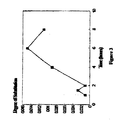
- Lactose (2 g), hydroxyethyl cellulose (0.219 g) and Aspergillus oryzae source ⁇ -galactosidase (0.025 g, 110 units) were dissolved in 2.5 ml of sodium acetate buffer at pH 4.5. The reaction was allowed to proceed at room temperature and monitored to determine the extent of galactosylation at time intervals using the standard test method. The results are presented below in Figure 3.
- This example demonstrates the weak glucosidase activity of Aspergillus oryzae ⁇ -galactosidase.
- This example demonstrates the effects of varying ratios and concentration of galactose donor and hydroxyethyl cellulose acceptor, and the effect on the reaction of the presence of organic solvent.
- This example describes a method for increasing the level of galactosylation by recycling product through several reaction stages.
- This example illustrates the galactosylation of hydroxypropyl cellulose in the presence of ⁇ -galactosidase.
Landscapes
- Chemical & Material Sciences (AREA)
- Life Sciences & Earth Sciences (AREA)
- Organic Chemistry (AREA)
- Engineering & Computer Science (AREA)
- Health & Medical Sciences (AREA)
- Biochemistry (AREA)
- Chemical Kinetics & Catalysis (AREA)
- Materials Engineering (AREA)
- Medicinal Chemistry (AREA)
- Polymers & Plastics (AREA)
- General Health & Medical Sciences (AREA)
- Wood Science & Technology (AREA)
- Zoology (AREA)
- Molecular Biology (AREA)
- Biotechnology (AREA)
- General Chemical & Material Sciences (AREA)
- Microbiology (AREA)
- Bioinformatics & Cheminformatics (AREA)
- General Engineering & Computer Science (AREA)
- Genetics & Genomics (AREA)
- Preparation Of Compounds By Using Micro-Organisms (AREA)
Claims (30)
- Zusammensetzung, die galactosyliertes Hydroxyalkylpolysaccharid und Galactosidaseenzym umfasst, worin das Hydroxyalkylpolysaccharid mit Galactose-Einheiten substituiert ist, die an Hydroxylgruppen des Hydroxyalkylpolysaccharids durch glactosidische Bindungen gebunden sind.
- Zusammensetzung gemäss Anspruch 1, worin wenigstens ein Teil der Galactose-Einheiten an Hydroxylgruppen am Ende der Hydroxyalkylketten des Hydroxyalkylpolysaccharids gebunden sind.
- Zusammensetzung gemäss Anspruch 1, worin das Hydroxyalkylpolysaccharid aus der Gruppe ausgewählt ist, die aus Hydroxyethylpolysacchariden und Hydroxypropylpolysacchariden besteht.
- Zusammensetzung gemäss Anspruch 3, worin das Hydroxyalkylpolysaccharid Hydroxyethylpolysaccharid umfasst.
- Zusammensetzung gemäss Anspruch 3, worin das Hydroxyalkylpolysaccharid Hydroxypropylpolysaccharid umfasst.
- Zusammensetzung gemäss Anspruch 1, worin das Hydroxyalkylpolysaccharid aus der Gruppe ausgewählt ist, die aus Hydroxyalkylcellulose, Hydroxyalkylcelluloseethern, Hydroxyalkylguar, Hydroxyalkylguarderivaten, Hydroxyalkylstärke und Hydroxyalkylstärkederivaten besteht.
- Zusammensetzung gemäss Anspruch 6, worin das Hydroxyalkylpolysaccharid aus der Gruppe ausgewählt ist, die aus Hydroxyethylcellulose (HEC), Hydroxypropylcellulose (HPC), wasserlöslicher Ethylhydroxyethylcellulose (EHEC), Carboxymethylhydroxyethylcellulose (CMHEC), Hydroxypropylhydroxyethylcellulose (HPHEC), Methylhydroxypropylcellulose (MHPC), Methylhydroxyethylcellulose (MHEC), hydrophob modifizierter Hydroxyethylcellulose (HMHEC), hydrophob modifizierter Hydroxypropylcellulose (HMHPC), hydrophob modifizierter Ethylhydroxyethylcellulose (HMEHEC), hydrophob modifizierter Carboxymethylhydroxyethylcellulose (HMCMHEC), hydrophob modifizierter Hydroxypropylhydroxyethylcellulose (HMHPHEC), hydrophob modifizierter Methylhydroxypropylcellulose (HMMHPC), hydrophob modifizierter Methylhydroxyethylcellulose (HMMHEC), kationischer Hydroxyethylcellulose (kationischer HEC) und kationischer, hydrophob modifizierter Hydroxyethylcellulose (kationischer HMHEC) besteht.
- Zusammensetzung gemäss Anspruch 6, worin das Hydroxyalkylpolysaccharid aus der Gruppe ausgewählt ist, die aus Hydroxyethylguar (HE-Guar), Hydroxypropylguar (HP-Guar), Carboxymethylhydroxypropylguar (CMHP-Guar), hydrophob modifiziertem Hydroxyethylguar (HMHE-Guar), hydrophob modifiziertem Hydroxypropylguar (HMHP-Guar), kationischem, hydrophob modifiziertem Hydroxypropylguar (kationischem HMHP-Guar) und hydrophob modifiziertem Carboxymethylhydroxypropylguar (HMCMHP-Guar) besteht.
- Zusammensetzung gemäss Anspruch 6, worin das Hydroxyalkylpolysaccharid aus der Gruppe ausgewählt ist, die aus Hydroxyethylstärke, Hydroxypropylstärke, oxidierter Hydroxyethylstärke, oxidierter Hydroxypropylstärke, kationischer Hydroxyethylstärke, kationischer Hydroxypropylstärke, Hydroxyethylstärkeacetat, Hydroxypropylstärkeacetat, Hydroxyethylstärkephosphat, Hydroxypropylstärkephosphat, depolymerisierter Hydroxyethylstärke und depolymerisierter Hydroxypropylstärke besteht.
- Zusammensetzung gemäss Anspruch 1, worin das Hydroxyalkylpolysaccharid Hydroxyethylcellulose ist.
- Zusammensetzung gemäss Anspruch 1, worin der Substitutionsgrad des Hydroxyalkylpolysaccharids mit Galactoseeinheiten 0,01 bis 3 beträgt.
- Zusammensetzung gemäss Anspruch 11, worin der Substitutionsgrad mit Galactoseeinheiten 0,01 bis 1 beträgt.
- Zusammensetzung gemäss Anspruch 12, worin der Substitutionsgrad mit Galactoseeinheiten 0,01 bis 0,5 beträgt.
- Zusammensetzung gemäss Anspruch 1, worin das Hydroxyalkylpolysaccharid ein Hydroxyethylpolysaccharid ist und der Substitutionsgrad mit Galactoseeinheiten 0,01 bis 3 beträgt.
- Zusammensetzung gemäss einem der vorhergehenden Ansprüche, worin das Galactosidaseenzym eine β-Galactosidase ist, ausgewählt aus einem Mikroorganismus, der aus der Gruppe isoliert ist, die aus Bacillus circulans, Aspergillus oryzae und E. coli besteht.
- Zusammensetzung gemäss einem der vorhergehenden Ansprüche, worin das Galactosidaseenzym eine β-Galactosidase ist, die aus Aspergillus oryzae isoliert ist.
- Verfahren zur Herstellung von galactosyliertem Hydroxyalkylpolysaccharid wie in einem der Ansprüche 1 bis 14 definiert, umfassend:(a) Bereitstellen wenigstens eines Hydroxyalkylpolysaccharids; und(b) Behandeln des Hydroxyalkylpolysaccharids mit einem Galactosedonor in Gegenwart von Galactosidaseenzym für eine ausreichende Zeit, um einen Substitutionsgrad mit Galactoseeinheiten an den Hydroxylgruppen des Hydroxyalkylpolysaccharids zu verursachen.
- Verfahren gemäss Anspruch 17, worin das Hydroxyalkylpolysaccharid Hydroxypropylcellulose ist.
- Verfahren gemäss Anspruch 17, worin der Galactosedonor aus der Gruppe ausgewählt ist, die aus Lactose, Galactose, Galactomannanen und Nitrophenyl-, Dinitrophenyl- und Trinitrophenylglycosiden davon besteht.
- Verfahren gemäss Anspruch 19, worin das Galactomannan aus der Gruppe ausgewählt ist, die aus Guargummi und Johannisbrotkernmehl besteht.
- Verfahren gemäss Anspruch 17, worin das Galactosidaseenzym eine β-Galactosidase ist, die aus einem Mikroorganismus isoliert ist, der aus der Gruppe ausgewählt ist, die aus Bacillus circulans, Aspergillus oryzae und E. coli besteht.
- Verfahren gemäss Anspruch 21, worin das Galactosidaseenzym eine β-Galactosidase ist, isoliert aus Aspergillus oryzae.
- Verfahren gemäss Anspruch 17, die in einem wässrigen Medium stattfindet.
- Verfahren gemäss Anspruch 23, worin das wässrige Medium wassermischbares organisches Lösungsmittel enthält.
- Verfahren gemäss Anspruch 17, worin das Gewichtsverhältnis von Galactosedonor zu Hydroxyalkylpolysaccharid 1:1 bis 100:1 beträgt.
- Verfahren gemäss Anspruch 17, worin das Galactosidaseenzym in einem Mass von 0,5 bis 1.000 Einheiten pro Gramm Hydroxyalkylpolysaccharid verwendet wird.
- Verfahren gemäss Anspruch 26, worin das Galactosidaseenzym in einem Mass von 5 bis 500 Einheiten pro Gramm Hydroxyalkylpolysaccharid verwendet wird.
- Verfahren gemäss Anspruch 27, worin das Galactosidaseenzym in einem Mass von 10 bis 150 Einheiten pro Gramm Hydroxyalkylpolysaccharid verwendet wird.
- Verfahren gemäss Anspruch 17, worin das Hydroxyalkylpolysaccharid aus der Gruppe ausgewählt wird, die aus Hydroxyethylpolysaccharid und Hydroxypropylpolysacchariden besteht, der Galactosedonor aus der Gruppe ausgewählt wird, die aus Lactose, Galactose, Galactomannanen und Nitrophenyl-, Dinitrophenyl- und Trinitrophenylglycosiden davon besteht, und das Galactosidaseenzym eine β-Galactosidase ist, die aus einem Mikroorganismus isoliert wird, der aus der Gruppe ausgewählt wird, die aus Bacillus circulans, Aspergillus oryzae und E. coli besteht.
- Verfahren gemäss Anspruch 29, worin das Verhältnis von Galactosedonor zu Hydroxyalkylpolysaccharid 1:1 bis 100:1 beträgt und das Galactosidaseenzym in einem Mass von 0,5 bis 1.000 Einheiten pro Gramm Hydroxyalkylpolysaccharid verwendet wird.
Applications Claiming Priority (3)
| Application Number | Priority Date | Filing Date | Title |
|---|---|---|---|
| US841036 | 1997-04-29 | ||
| US08/841,036 US6433161B1 (en) | 1997-04-29 | 1997-04-29 | Galactosylated hydroxyalkyl polysaccharides |
| PCT/US1998/008767 WO1998049201A1 (en) | 1997-04-29 | 1998-04-27 | Galactosylated hydroxyalkyl polysaccharides and their derivatives |
Publications (2)
| Publication Number | Publication Date |
|---|---|
| EP0907662A1 EP0907662A1 (de) | 1999-04-14 |
| EP0907662B1 true EP0907662B1 (de) | 2003-06-04 |
Family
ID=25283854
Family Applications (1)
| Application Number | Title | Priority Date | Filing Date |
|---|---|---|---|
| EP98920063A Expired - Lifetime EP0907662B1 (de) | 1997-04-29 | 1998-04-27 | Galactosylierte hydroxyalkylpolysaccharide und ihre derivate |
Country Status (6)
| Country | Link |
|---|---|
| US (1) | US6433161B1 (de) |
| EP (1) | EP0907662B1 (de) |
| AU (1) | AU738188B2 (de) |
| CA (1) | CA2261603A1 (de) |
| DE (1) | DE69815244T2 (de) |
| WO (1) | WO1998049201A1 (de) |
Families Citing this family (3)
| Publication number | Priority date | Publication date | Assignee | Title |
|---|---|---|---|---|
| US7851416B2 (en) * | 2006-05-19 | 2010-12-14 | Hercules Incorporated | Oxidized guar for oilfield servicing fluids |
| ES2386972T3 (es) * | 2006-05-31 | 2012-09-10 | Genzyme Corporation | Uso de polisacáridos para la estimulación de la actividad enzimática |
| US7832857B2 (en) * | 2008-08-18 | 2010-11-16 | Levinson Dennis J | Microbial cellulose contact lens |
Family Cites Families (9)
| Publication number | Priority date | Publication date | Assignee | Title |
|---|---|---|---|---|
| US4942128A (en) | 1987-03-06 | 1990-07-17 | Board Of Regents, The University Of Texas System | Microbial cellulose modified during synthesis |
| US4435389A (en) | 1980-07-07 | 1984-03-06 | Kabushiki Kaisha Yakult Honsha | Composition for promoting growth of bifidobacteria |
| US4663448A (en) * | 1985-10-23 | 1987-05-05 | National Starch And Chemical Corporation | Aldehyde-containing heterpolysaccharides, a process for their preparation, and the use thereof |
| JPS63109789A (ja) | 1986-10-27 | 1988-05-14 | Yakult Honsha Co Ltd | オリゴ糖の製造法 |
| DE3765418D1 (de) | 1987-03-11 | 1990-11-08 | Nat Starch Chem Invest | Aldehyde enthaltende heteropolysaccharide, verfahren zu deren herstellung und ihre verwendung. |
| JPS63297019A (ja) | 1987-05-29 | 1988-12-05 | Pura Giken:Kk | 押出成形機の金型 |
| US5149640A (en) | 1988-12-22 | 1992-09-22 | Ajinomoto Co., Inc. | Method for producing galactose transfer products |
| WO1991016449A1 (en) | 1990-04-16 | 1991-10-31 | The Trustees Of The University Of Pennsylvania | Saccharide compositions, methods and apparatus for their synthesis |
| JP3064031B2 (ja) | 1991-03-06 | 2000-07-12 | 塩水港精糖株式会社 | 新規オリゴ糖およびその製造法 |
-
1997
- 1997-04-29 US US08/841,036 patent/US6433161B1/en not_active Expired - Fee Related
-
1998
- 1998-04-27 CA CA002261603A patent/CA2261603A1/en not_active Abandoned
- 1998-04-27 EP EP98920063A patent/EP0907662B1/de not_active Expired - Lifetime
- 1998-04-27 AU AU72713/98A patent/AU738188B2/en not_active Ceased
- 1998-04-27 DE DE69815244T patent/DE69815244T2/de not_active Expired - Fee Related
- 1998-04-27 WO PCT/US1998/008767 patent/WO1998049201A1/en not_active Ceased
Also Published As
| Publication number | Publication date |
|---|---|
| US6433161B1 (en) | 2002-08-13 |
| AU738188B2 (en) | 2001-09-13 |
| CA2261603A1 (en) | 1998-11-05 |
| AU7271398A (en) | 1998-11-24 |
| DE69815244D1 (de) | 2003-07-10 |
| EP0907662A1 (de) | 1999-04-14 |
| DE69815244T2 (de) | 2004-04-22 |
| WO1998049201A1 (en) | 1998-11-05 |
Similar Documents
| Publication | Publication Date | Title |
|---|---|---|
| EP0710674B1 (de) | Verfahren zur Herstellung eines Glukans mit cyclischer Struktur | |
| JP2589941B2 (ja) | グルコアミラーゼ酵素分画 | |
| Govindasamy et al. | Characterization of changes of sago starch components during hydrolysis by a thermostable alpha-amylase | |
| Wang et al. | Sago starch as a biomass source: raw sago starch hydrolysis by commercial enzymes | |
| US3827937A (en) | Method of producing pullulan | |
| US6803459B2 (en) | Branched starches and branched starch hydrolyzates | |
| US6248566B1 (en) | Glucan having cyclic structure and method for producing the same | |
| Kusano et al. | Immobilization of Bacillus acidopullulyticus pullulanase and properties of the immobilized pullulanases | |
| US4970158A (en) | Beta amylase enzyme product, preparation and use thereof | |
| EP0338057B1 (de) | Wärmestabiles cyclodextrin glycosyl-transferase, deren herstellung und verwendung | |
| EP0727485B1 (de) | Verfahren zur Umwandlung von stärkeartigem Material und dafür geeignete enzymatische Zusammensetzung | |
| US5501968A (en) | Thermostable cyclodextrin glycosyl transferase and processes using it | |
| EP0405283A2 (de) | Thermo- und säurestabiles Pullulanase-Enzym und Verfahren zu seiner Herstellung | |
| EP0907662B1 (de) | Galactosylierte hydroxyalkylpolysaccharide und ihre derivate | |
| US5686132A (en) | Glucans having a cycle structure, and processes for preparing the same | |
| Chakrabarti et al. | Co-immobilization of amyloglucosidase and pullulanase for enhanced starch hydrolysis | |
| US4121974A (en) | Preparation of retrogradation-resistant starches with immobilized amylases | |
| US5827697A (en) | Process for preparing glucans having a cyclic structure | |
| US3806419A (en) | Preparing pullulanase enzyme | |
| EP0506790A1 (de) | Verfahren zur enzymatischen umwandlung von stärke in cyclodextrine. | |
| Kim et al. | Modification of Acetobacter xylinum bacterial cellulose using dextransucrase and alternansucrase | |
| JPH09289A (ja) | 環状構造を有するグルカンの製造方法 | |
| Yamamoto et al. | Effective dextran production from starch by dextrin dextranase with debranching enzyme | |
| Ohnishi et al. | Kinetic Properties of the Rhizopus Glucoamylase and Bacillus α‐Amylase, which are Immobilized on Cellulofine | |
| JPS5937957B2 (ja) | アミラ−ゼg3によるマルトトリオ−スの製造法 |
Legal Events
| Date | Code | Title | Description |
|---|---|---|---|
| PUAI | Public reference made under article 153(3) epc to a published international application that has entered the european phase |
Free format text: ORIGINAL CODE: 0009012 |
|
| 17P | Request for examination filed |
Effective date: 19990128 |
|
| AK | Designated contracting states |
Kind code of ref document: A1 Designated state(s): DE DK FR GB IE IT NL SE |
|
| 17Q | First examination report despatched |
Effective date: 20010309 |
|
| GRAH | Despatch of communication of intention to grant a patent |
Free format text: ORIGINAL CODE: EPIDOS IGRA |
|
| GRAH | Despatch of communication of intention to grant a patent |
Free format text: ORIGINAL CODE: EPIDOS IGRA |
|
| GRAA | (expected) grant |
Free format text: ORIGINAL CODE: 0009210 |
|
| AK | Designated contracting states |
Designated state(s): DE DK FR GB IE IT NL SE |
|
| PG25 | Lapsed in a contracting state [announced via postgrant information from national office to epo] |
Ref country code: IT Free format text: LAPSE BECAUSE OF FAILURE TO SUBMIT A TRANSLATION OF THE DESCRIPTION OR TO PAY THE FEE WITHIN THE PRESCRIBED TIME-LIMIT;WARNING: LAPSES OF ITALIAN PATENTS WITH EFFECTIVE DATE BEFORE 2007 MAY HAVE OCCURRED AT ANY TIME BEFORE 2007. THE CORRECT EFFECTIVE DATE MAY BE DIFFERENT FROM THE ONE RECORDED. Effective date: 20030604 |
|
| REG | Reference to a national code |
Ref country code: GB Ref legal event code: FG4D |
|
| REG | Reference to a national code |
Ref country code: IE Ref legal event code: FG4D |
|
| REF | Corresponds to: |
Ref document number: 69815244 Country of ref document: DE Date of ref document: 20030710 Kind code of ref document: P |
|
| PG25 | Lapsed in a contracting state [announced via postgrant information from national office to epo] |
Ref country code: SE Free format text: LAPSE BECAUSE OF FAILURE TO SUBMIT A TRANSLATION OF THE DESCRIPTION OR TO PAY THE FEE WITHIN THE PRESCRIBED TIME-LIMIT Effective date: 20030904 Ref country code: DK Free format text: LAPSE BECAUSE OF FAILURE TO SUBMIT A TRANSLATION OF THE DESCRIPTION OR TO PAY THE FEE WITHIN THE PRESCRIBED TIME-LIMIT Effective date: 20030904 |
|
| PGFP | Annual fee paid to national office [announced via postgrant information from national office to epo] |
Ref country code: GB Payment date: 20040312 Year of fee payment: 7 |
|
| PGFP | Annual fee paid to national office [announced via postgrant information from national office to epo] |
Ref country code: FR Payment date: 20040402 Year of fee payment: 7 |
|
| PGFP | Annual fee paid to national office [announced via postgrant information from national office to epo] |
Ref country code: IE Payment date: 20040406 Year of fee payment: 7 |
|
| ET | Fr: translation filed | ||
| PLBE | No opposition filed within time limit |
Free format text: ORIGINAL CODE: 0009261 |
|
| STAA | Information on the status of an ep patent application or granted ep patent |
Free format text: STATUS: NO OPPOSITION FILED WITHIN TIME LIMIT |
|
| PGFP | Annual fee paid to national office [announced via postgrant information from national office to epo] |
Ref country code: DE Payment date: 20040430 Year of fee payment: 7 |
|
| PGFP | Annual fee paid to national office [announced via postgrant information from national office to epo] |
Ref country code: NL Payment date: 20040510 Year of fee payment: 7 |
|
| 26N | No opposition filed |
Effective date: 20040305 |
|
| PG25 | Lapsed in a contracting state [announced via postgrant information from national office to epo] |
Ref country code: IE Free format text: LAPSE BECAUSE OF NON-PAYMENT OF DUE FEES Effective date: 20050427 Ref country code: GB Free format text: LAPSE BECAUSE OF NON-PAYMENT OF DUE FEES Effective date: 20050427 |
|
| PG25 | Lapsed in a contracting state [announced via postgrant information from national office to epo] |
Ref country code: NL Free format text: LAPSE BECAUSE OF NON-PAYMENT OF DUE FEES Effective date: 20051101 Ref country code: DE Free format text: LAPSE BECAUSE OF NON-PAYMENT OF DUE FEES Effective date: 20051101 |
|
| GBPC | Gb: european patent ceased through non-payment of renewal fee |
Effective date: 20050427 |
|
| PG25 | Lapsed in a contracting state [announced via postgrant information from national office to epo] |
Ref country code: FR Free format text: LAPSE BECAUSE OF NON-PAYMENT OF DUE FEES Effective date: 20051230 |
|
| NLV4 | Nl: lapsed or anulled due to non-payment of the annual fee |
Effective date: 20051101 |
|
| REG | Reference to a national code |
Ref country code: FR Ref legal event code: ST Effective date: 20051230 |