EP0908068B1 - Systeme universel de radiocommunication, protocole d'emission, station de communication radio, et station de base radio - Google Patents
Systeme universel de radiocommunication, protocole d'emission, station de communication radio, et station de base radio Download PDFInfo
- Publication number
- EP0908068B1 EP0908068B1 EP98901457A EP98901457A EP0908068B1 EP 0908068 B1 EP0908068 B1 EP 0908068B1 EP 98901457 A EP98901457 A EP 98901457A EP 98901457 A EP98901457 A EP 98901457A EP 0908068 B1 EP0908068 B1 EP 0908068B1
- Authority
- EP
- European Patent Office
- Prior art keywords
- wireless communication
- wireless
- subsystem
- radio base
- station
- Prior art date
- Legal status (The legal status is an assumption and is not a legal conclusion. Google has not performed a legal analysis and makes no representation as to the accuracy of the status listed.)
- Expired - Lifetime
Links
- 238000004891 communication Methods 0.000 title claims description 119
- 230000005540 biological transmission Effects 0.000 title claims description 31
- 230000003595 spectral effect Effects 0.000 claims description 22
- 238000001228 spectrum Methods 0.000 claims description 21
- 230000002452 interceptive effect Effects 0.000 claims description 10
- 238000005259 measurement Methods 0.000 claims description 8
- 238000012545 processing Methods 0.000 claims description 7
- 238000012549 training Methods 0.000 claims description 5
- 238000000034 method Methods 0.000 claims description 4
- 239000000969 carrier Substances 0.000 description 5
- 230000001413 cellular effect Effects 0.000 description 4
- 238000010586 diagram Methods 0.000 description 4
- 238000000411 transmission spectrum Methods 0.000 description 4
- 230000008878 coupling Effects 0.000 description 3
- 238000010168 coupling process Methods 0.000 description 3
- 238000005859 coupling reaction Methods 0.000 description 3
- 230000007246 mechanism Effects 0.000 description 2
- 238000007792 addition Methods 0.000 description 1
- 230000015572 biosynthetic process Effects 0.000 description 1
- 238000005516 engineering process Methods 0.000 description 1
- 230000007613 environmental effect Effects 0.000 description 1
- 238000012986 modification Methods 0.000 description 1
- 230000004048 modification Effects 0.000 description 1
- 238000007493 shaping process Methods 0.000 description 1
- 238000003786 synthesis reaction Methods 0.000 description 1
Images


Classifications
-
- H—ELECTRICITY
- H04—ELECTRIC COMMUNICATION TECHNIQUE
- H04W—WIRELESS COMMUNICATION NETWORKS
- H04W52/00—Power management, e.g. Transmission Power Control [TPC] or power classes
- H04W52/04—Transmission power control [TPC]
- H04W52/18—TPC being performed according to specific parameters
- H04W52/24—TPC being performed according to specific parameters using SIR [Signal to Interference Ratio] or other wireless path parameters
Definitions
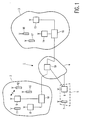
- the present invention relates to a universal wireless communication system in which an available radio frequency spectrum is divided among at least a first and a second wireless subsystem, the first wireless subsystem comprising at least a first radio base station and a first plurality of wireless communication stations, and the second wireless subsystem comprising at least a second radio base station and a second plurality of wireless communication stations, in at least one wireless subsystem one radio base station comprising means for identifying a wireless communication station of another wireless subsystem.
- a universal wireless communication system can comprise a plurality of wireless subsystems such as a terrestrial cellular or cordless radio system, a wireless local area network, a satellite system, or any other suitable wireless communication subsystem. The subsystems are able to operate independent of each other.
- the present invention further relates to a transmission method, to a wireless communication station, and to a radio base station for use in such a system.
- a universal wireless communication system of the above kind is generally known from many publications about universal wireless communication systems, e.g., from the article "Third Generation Mobile - UMTS and FPLMTS", D. MacFarlane, 7th World Telecommunication Forum, Technology Summit, Vol. 2, pp. 185-188, ITU, Geneva, 3-11 October 1995.
- a number of operators of either a private or a public wireless subsystem share an available frequency band radio resources are becoming scarce so that there is a need to make an efficient use of such radio resources.
- US 5,430,889 discloses an automatic power control system for a mobile radio system.
- a plurality of base stations, each serving a cell is linked to facilitate mutual communication between mobile units.
- the mobile units are arranged for transmitting an identification code, and a common sequence at a nominally different time within a transmission burst.
- Each base station has a correlator operative to discriminate, based on the sequences, between signals from mobile units within its own cell and interfering signals from mobile units in adjacent cells. Based on received signal strength mobile units are instructed to change their transmission power.
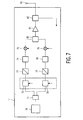
- the system according to the present invention is characterised in that, for operating the wireless communication system up to the limits of spectral band while at the same time allowing wireless communication stations to operate such that minimal power consumption is obtained under acceptable transmission conditions, the one radio base station comprises means for measuring whether the wireless communication station of the other wireless subsystem is causing adjacent channel interference in a channel of the one wireless subsystem, and means for issuing a command to the wireless communication station of the other wireless subsystem for adapting a spectral transmission characteristic of the wireless communication station in accordance with said adjacent channel interference measurements, and in that in at least one other wireless subsystem at least one wireless communication station comprises means for processing the command as issued from said radio base station and for adjusting the spectral transmission characteristic of the wireless communication station from a first to a second characteristic in accordance with the command.
- the present invention is based upon the insight that individual control of the spectral transmission spectrum of an interfering wireless communication station in one subsystem by a system resource of another subsystem achieves a better overall interference control in the system and achieves better overall power saving in the wireless communication stations in the system than with an uncoordinated transmission spectrum shaping. Furthermore, such an interference bandwidth/energy adjustment does not affect the information bandwidth or other RF characteristic. In the event of a cellular and cordless radio system as subsystems such subsystems can use adjacent frequency bands while applying wide band CDMA or wide band TDMA carriers without any further mutual coordination between such subsystems beyond the issuing of the command when an interferer is recognized from a wireless communication station being operated in a neighbouring frequency band. Power consumption in a wireless communication system can typically be reduced when the wireless communication station is operated in a non-congested system. With the transmission protocol according to the present invention RF carriers can be packed densely so that the spectrum efficiency is improved.
- the wireless communication station comprises means for transmitting a code at regular intervals, in particular a training sequence or like signal replacing a known training sequence at regular intervals, and in the radio base station the means for identifying the wireless communication station are arranged for identifying the wireless communication station from the code.
- interfering wireless communication stations can be identified easily after having been powered-up and can be commanded to adjust their transmission spectrum immediately according to the interference conditions in the system.
- the means for measuring are arranged for interference measurements on the basis of energy to bit error measurements, and the command being an instruction for narrowing the identified interfering transmit spectrum if the interference is not acceptable and being an instruction for allowing to broaden the transmit spectrum if the interference is acceptable.
- the command being an instruction for narrowing the identified interfering transmit spectrum if the interference is not acceptable and being an instruction for allowing to broaden the transmit spectrum if the interference is acceptable.
- the means for adjusting the spectral transmission characteristic are arranged for adjusting the spectral transmission characteristic of the wireless communication station by adjusting a modulation type and/or by modifying the linearity of a power amplifier and/or by adjusting transmit signal processing characteristics, and/or adjusting transmit power filter characteristics.
- the spectral transmission characteristic is adjusted by adjusting the transmit filter characteristic, because of the fact that a lot of power is saved when operating the wireless communication station while using a less complex filter which results in a broad transmit spectrum, preferably a digital filter, under non-interference conditions, as compared to a more complex filter which narrows the spectrum under interference conditions, broadening or narrowing of the spectrum can also be done by other means, whether or not in combination with using an adjustable filter means.
- the means for issuing a command are arranged for issuing the command via a common control channel of the system.
- a control channel can control all subsystems within the system, or a subset of subsystems within the systems, or the like, and can be a prioritized control channel.
- Such a control channel is thus used as an inter-subsystem control channel.
- the interfering wireless communication station is recognised by the identifying code it is transmitting with the mechanisms described earlier.
- the means for issuing a command are arranged for issuing the command via a network comprised in the system to which the first and the second wireless subsystem are coupled.
- a network comprised in the system to which the first and the second wireless subsystem are coupled.
Landscapes
- Engineering & Computer Science (AREA)
- Computer Networks & Wireless Communication (AREA)
- Signal Processing (AREA)
- Mobile Radio Communication Systems (AREA)
Claims (10)
- Système de communication sans fil universel dans lequel un spectre de fréquences radio disponible est divisé entre au moins un premier et un second sous-système sans fil, le premier sous-système sans fil comprenant au moins une première station de base radio et une première pluralité de stations de communication sans fil, et le second sous-système sans fil comprenant au moins une seconde station de base radio et une seconde pluralité de stations de communication sans fil, une station de base radio comprenant, dans au moins un sous-système sans fil :caractérisé en ce que, pour exploiter le système de communication sans fil jusqu'aux limites de la bande de spectre tout en permettant en même temps aux stations de communication sans fil de fonctionner d'une manière telle qu'une consommation d'énergie minimale soit obtenue dans des conditions de transmission acceptables, la station de base radio comprenddes moyens (45) pour identifier une station de communication sans fil d'un autre sous-système sans fil,des moyens (42, 43, 44) pour mesurer si la station de communication sans fil de l'autre sous-système sans fil provoque de l'interférence dans un canal adjacent du sous-système sans fil, etdes moyens (46) pour envoyer une commande à la station de communication sans fil de l'autre sous-système sans fil pour adapter une caractéristique d'émission spectrale de la station de communication sans fil conformément auxdites mesures d'interférence due au canal adjacent, et en ce que dans au moins un autre sous-système sans fil, au moins une station de communication sans fil comprenddes moyens (70, 71, 72, 74, 75, 76, 78, 79) pour traiter la commande telle qu'envoyée à partir de ladite station de base radio et pour régler la caractéristique d'émission spectrale de la station de communication sans fil à partir d'une première vers une seconde caractéristique conformément à la commande.
- Système de communication sans fil universel selon la revendication 1, dans lequel la station de communication sans fil comprend des moyens pour transmettre un code à intervalles réguliers, en particulier une séquence d'apprentissage ou un signal du même genre qui remplace une séquence apprentissage connue à intervalles réguliers, et dans la station de base radio, les moyens pour identifier la station de communication sans fil sont agencés pour identifier la station de communication sans fil à partir du code.
- Système de communication sans fil universel selon la revendication 1 ou 2, dans lequel les moyens de mesure sont agencés pour déterminer si de l'interférence est présente dans le canal du sous-système sans fil, et les moyens d'identification sont agencés pour, si l'on a déterminé de l'interférence, déterminer l'identité de la station de communication sans fil responsable de l'interférence.
- Système de communication sans fil universel selon la revendication 3, dans lequel les moyens de mesure sont agencés pour réaliser des mesures d'interférence sur la base de mesures d'énergie en fonction des erreurs sur les bits, et la commande est un ordre pour rétrécir le spectre d'émission provoquant de l'interférence identifié si l'interférence n'est pas acceptable, et est un ordre pour permettre l'élargissement du spectre d'émission si l'interférence est acceptable.
- Système de communication sans fil universel selon la revendication 1, 2, 3 ou 4, dans lequel les moyens pour régler la caractéristique d'émission spectrale sont agencés pour régler la caractéristique d'émission spectrale de la station de communication sans fil en réglant un type de modulation et/ou en modifiant la linéarité d'un amplificateur de puissance, et/ou en réglant les caractéristiques de traitement du signal d'émission, et/ou en réglant les caractéristiques du filtre de puissance d'émission.
- Système de communication sans fil universel selon l'une quelconque des revendications précédentes, dans lequel les moyens pour envoyer une commande sont agencés pour envoyer la commande par le biais d'un canal de contrôle commun du système.
- Système de communication sans fil universel selon l'une quelconque des revendications 1 à 6, dans lequel les moyens pour envoyer une commande sont agencés pour envoyer la commande par le biais d'un réseau compris dans le système, auquel le premier et le second sous-systèmes sans fil sont connectés.
- Procédé de transmission pour un système de communication sans fil universel dans lequel un spectre de fréquences radio disponible est divisé entre au moins un premier et un second sous-système sans fil, le premier sous-système sans fil comprenant au moins une première station de base radio et une première pluralité de stations de communication sans fil, et le second sous-système sans fil comprenant au moins une seconde station de base radio et une seconde pluralité de stations de communication sans fil, le procédé de transmission comprenant l'étape, dans une station de base radio de l'un des sous-systèmes sans fil, d'identifier une station de communication sans fil d'un autre sous-système sans fil, caractérisé en ce que, pour exploiter le système de communication sans fil jusqu'aux limites de la bande de spectre tout en permettant en même temps aux stations de communication sans fil de fonctionner d'une manière telle qu'une consommation d'énergie minimale soit obtenue dans des conditions de transmission acceptables, le procédé de transmission comprend les étapes suivantes :a) mesurer, dans la station de base radio, si la station de communication sans fil de l'autre sous-système sans fil provoque de l'interférence dans un canal adjacent du sous-système sans fil,b) dans la station de base radio du sous-système sans fil, envoyer une commande à la station de communication sans fil de l'autre sous-système sans fil pour adapter la caractéristique d'émission spectrale de la station de communication sans fil conformément à la situation d'interférence déterminée, etc) dans la station de communication sans fil identifiée, régler la caractéristique d'émission spectrale de la station de communication sans fil à partir d'une première vers une seconde caractéristique conformément à la commande.
- Station de communication sans fil dans un sous-système sans fil d'un système selon l'une quelconque des revendications 1 à 8, caractérisée en ce que la station de communication sans fil comprend des moyens (70, 71, 72, 74, 75, 76, 78, 79) pour traiter une commande destinée à adapter une caractéristique d'émission spectrale conformément à des mesures d'interférence due au canal adjacent entre deux sous-systèmes sans fil telle qu'envoyée à partir de ladite station de base radio d'un autre sous-système sans fil, et des moyens pour adapter la caractéristique d'émission spectrale de la station de communication sans fil à partir d'une première vers une seconde caractéristique conformément à la commande.
- Station de base radio destinée à être utilisée dans un sous-système sans fil d'un système de communication sans fil universel selon l'une quelconque des revendications 1 à 8, la station de base radio comprenant des moyens (45) pour identifier une station de communication sans fil d'un autre sous-système sans fil,
caractérisée en ce que la station de base radio comprenddes moyens (42, 43, 44) pour mesurer si la station de communication sans fil de l'autre sous-système sans fil provoque de l'interférence dans un canal adjacent du sous-système sans fil, etdes moyens (46) pour envoyer une commande à la station de communication sans fil de l'autre sous-système sans fil pour adapter la caractéristique d'émission spectrale de la station de communication sans fil conformément auxdites mesures d'interférence due au canal adjacent.
Priority Applications (1)
| Application Number | Priority Date | Filing Date | Title |
|---|---|---|---|
| EP98901457A EP0908068B1 (fr) | 1997-02-28 | 1998-02-16 | Systeme universel de radiocommunication, protocole d'emission, station de communication radio, et station de base radio |
Applications Claiming Priority (4)
| Application Number | Priority Date | Filing Date | Title |
|---|---|---|---|
| EP97400477 | 1997-02-28 | ||
| EP97400477 | 1997-02-28 | ||
| PCT/IB1998/000193 WO1998038821A1 (fr) | 1997-02-28 | 1998-02-16 | Systeme universel de radiocommunication, protocole d'emission, station de communication radio, et station de base radio |
| EP98901457A EP0908068B1 (fr) | 1997-02-28 | 1998-02-16 | Systeme universel de radiocommunication, protocole d'emission, station de communication radio, et station de base radio |
Publications (2)
| Publication Number | Publication Date |
|---|---|
| EP0908068A1 EP0908068A1 (fr) | 1999-04-14 |
| EP0908068B1 true EP0908068B1 (fr) | 2005-10-05 |
Family
ID=26147783
Family Applications (1)
| Application Number | Title | Priority Date | Filing Date |
|---|---|---|---|
| EP98901457A Expired - Lifetime EP0908068B1 (fr) | 1997-02-28 | 1998-02-16 | Systeme universel de radiocommunication, protocole d'emission, station de communication radio, et station de base radio |
Country Status (5)
| Country | Link |
|---|---|
| EP (1) | EP0908068B1 (fr) |
| JP (1) | JP2000511024A (fr) |
| KR (1) | KR100489567B1 (fr) |
| CN (1) | CN1224562A (fr) |
| DE (1) | DE69831778T2 (fr) |
Families Citing this family (8)
| Publication number | Priority date | Publication date | Assignee | Title |
|---|---|---|---|---|
| EP1198076A1 (fr) * | 2000-10-10 | 2002-04-17 | Siemens Aktiengesellschaft | Procédé et appareil pour initiation de communication |
| EP1734665B1 (fr) * | 2005-06-17 | 2011-08-10 | Fujitsu Limited | Système de communication à bonds multiples |
| US7653357B2 (en) * | 2005-08-22 | 2010-01-26 | Toshiba America Research, Inc. | Access point interference control and selection methods |
| JP5464314B2 (ja) * | 2007-10-01 | 2014-04-09 | 山栄化学株式会社 | 無機フィラー及び有機フィラー含有硬化性樹脂組成物、並びにレジスト膜被覆プリント配線板及びその製造方法 |
| US8689026B2 (en) * | 2008-05-20 | 2014-04-01 | Intel Corporation | Enhancing power efficiency in a wireless internet card |
| JP5605509B2 (ja) * | 2011-06-30 | 2014-10-15 | 富士通株式会社 | 無線通信システム、移動局、基地局および無線通信方法 |
| EP2845405B1 (fr) * | 2012-05-04 | 2017-10-11 | Nokia Solutions and Networks Oy | Configuration d'une bande de fréquences partagée entre des systèmes de communication sans fil |
| WO2021134650A1 (fr) * | 2019-12-31 | 2021-07-08 | 深圳迈瑞生物医疗电子股份有限公司 | Dispositif de communication sans fil |
-
1998
- 1998-02-16 KR KR10-1998-0708603A patent/KR100489567B1/ko not_active Expired - Fee Related
- 1998-02-16 EP EP98901457A patent/EP0908068B1/fr not_active Expired - Lifetime
- 1998-02-16 DE DE69831778T patent/DE69831778T2/de not_active Expired - Fee Related
- 1998-02-16 CN CN199898800517A patent/CN1224562A/zh active Pending
- 1998-02-16 JP JP10529253A patent/JP2000511024A/ja not_active Withdrawn
Also Published As
| Publication number | Publication date |
|---|---|
| KR20000065054A (ko) | 2000-11-06 |
| KR100489567B1 (ko) | 2005-09-02 |
| JP2000511024A (ja) | 2000-08-22 |
| DE69831778T2 (de) | 2006-06-14 |
| CN1224562A (zh) | 1999-07-28 |
| DE69831778D1 (de) | 2005-11-10 |
| EP0908068A1 (fr) | 1999-04-14 |
Similar Documents
| Publication | Publication Date | Title |
|---|---|---|
| US6167237A (en) | Universal wireless communication system, a transmission protocol, a wireless communication station, and a radio base station | |
| EP1496632B1 (fr) | Émetteur radio, récepteur radio et procédé correspondant | |
| US5809422A (en) | Distributed microcellular communications system | |
| US5412658A (en) | Beacon detection method and apparatus for sharing spectrum between wireless communications systems and fixed microwave systems | |
| JP3966369B2 (ja) | Cdma無線加入者網システムの順方向トラヒックチャンネル電力制御方法及びその装置 | |
| US8619804B2 (en) | System and method for the delivery of high speed data services over dedicated and non-dedicated private land mobile radio (PLMR) channels using cognitive radio technology | |
| US6952563B2 (en) | Method and apparatus for adaptively setting frequency channels in a multi-point wireless networking system | |
| US6577617B1 (en) | Communication terminal apparatus, base station communication apparatus and radio communication method | |
| US5361258A (en) | Beacon detection system for sharing spectrum between wireless communications systems and fixed microwave systems | |
| EP1004177B1 (fr) | Procede de reglage de la frequence pour un recepteur de radio cellulaire | |
| US6788729B1 (en) | Frequency hopping method and base station | |
| WO1995013685A2 (fr) | Poste de base de donnees mobile cellulaire numerique a paquets de donnees | |
| EP1216511A1 (fr) | Methode et installations de systemes radio mobiles avec possibilite de commutation de schemas de codage canal | |
| US6980838B2 (en) | Control channel to enable a low power mode in a wideband wireless communication system | |
| US6442146B1 (en) | Time-division multiple-access communication system | |
| CA2294535C (fr) | Interface radio pour une petite installation sans fil dans la bande ism 2,4 ghz | |
| EP0908068B1 (fr) | Systeme universel de radiocommunication, protocole d'emission, station de communication radio, et station de base radio | |
| AU7046498A (en) | Channel selection method in gsm/dcs-based cellular radio network | |
| WO1998038821A1 (fr) | Systeme universel de radiocommunication, protocole d'emission, station de communication radio, et station de base radio | |
| EP0976277B1 (fr) | Procede pour faciliter la mesure des niveaux de transmission, et station de base | |
| KR101023283B1 (ko) | 기지국 장치, 기지국 장치의 제어 방법 및 기록 매체 | |
| JPH10507882A (ja) | デジタルセルラ移動通信網のための基地局システム | |
| JP3534060B2 (ja) | 移動通信システム及びその通信制御方法並びにそれに用いる基地局 | |
| Kubota et al. | High capacity automobile telephone system | |
| CN117614540A (zh) | 一种多频段多子带数字光纤分布式天线系统 |
Legal Events
| Date | Code | Title | Description |
|---|---|---|---|
| PUAI | Public reference made under article 153(3) epc to a published international application that has entered the european phase |
Free format text: ORIGINAL CODE: 0009012 |
|
| AK | Designated contracting states |
Kind code of ref document: A1 Designated state(s): CH DE FR GB IT LI |
|
| 17P | Request for examination filed |
Effective date: 19990303 |
|
| 17Q | First examination report despatched |
Effective date: 20031104 |
|
| GRAP | Despatch of communication of intention to grant a patent |
Free format text: ORIGINAL CODE: EPIDOSNIGR1 |
|
| GRAS | Grant fee paid |
Free format text: ORIGINAL CODE: EPIDOSNIGR3 |
|
| GRAA | (expected) grant |
Free format text: ORIGINAL CODE: 0009210 |
|
| AK | Designated contracting states |
Kind code of ref document: B1 Designated state(s): CH DE FR GB IT LI |
|
| PG25 | Lapsed in a contracting state [announced via postgrant information from national office to epo] |
Ref country code: LI Free format text: LAPSE BECAUSE OF FAILURE TO SUBMIT A TRANSLATION OF THE DESCRIPTION OR TO PAY THE FEE WITHIN THE PRESCRIBED TIME-LIMIT Effective date: 20051005 Ref country code: CH Free format text: LAPSE BECAUSE OF FAILURE TO SUBMIT A TRANSLATION OF THE DESCRIPTION OR TO PAY THE FEE WITHIN THE PRESCRIBED TIME-LIMIT Effective date: 20051005 |
|
| REG | Reference to a national code |
Ref country code: GB Ref legal event code: FG4D |
|
| REG | Reference to a national code |
Ref country code: CH Ref legal event code: EP |
|
| REF | Corresponds to: |
Ref document number: 69831778 Country of ref document: DE Date of ref document: 20051110 Kind code of ref document: P |
|
| PGFP | Annual fee paid to national office [announced via postgrant information from national office to epo] |
Ref country code: IT Payment date: 20060228 Year of fee payment: 9 |
|
| REG | Reference to a national code |
Ref country code: CH Ref legal event code: PL |
|
| ET | Fr: translation filed | ||
| PLBE | No opposition filed within time limit |
Free format text: ORIGINAL CODE: 0009261 |
|
| STAA | Information on the status of an ep patent application or granted ep patent |
Free format text: STATUS: NO OPPOSITION FILED WITHIN TIME LIMIT |
|
| 26N | No opposition filed |
Effective date: 20060706 |
|
| REG | Reference to a national code |
Ref country code: GB Ref legal event code: 732E Free format text: REGISTERED BETWEEN 20090305 AND 20090311 |
|
| PGFP | Annual fee paid to national office [announced via postgrant information from national office to epo] |
Ref country code: DE Payment date: 20090219 Year of fee payment: 12 |
|
| PGFP | Annual fee paid to national office [announced via postgrant information from national office to epo] |
Ref country code: GB Payment date: 20090219 Year of fee payment: 12 |
|
| PG25 | Lapsed in a contracting state [announced via postgrant information from national office to epo] |
Ref country code: IT Free format text: LAPSE BECAUSE OF NON-PAYMENT OF DUE FEES Effective date: 20070216 |
|
| PGFP | Annual fee paid to national office [announced via postgrant information from national office to epo] |
Ref country code: FR Payment date: 20090213 Year of fee payment: 12 |
|
| GBPC | Gb: european patent ceased through non-payment of renewal fee |
Effective date: 20100216 |
|
| REG | Reference to a national code |
Ref country code: FR Ref legal event code: ST Effective date: 20101029 |
|
| PG25 | Lapsed in a contracting state [announced via postgrant information from national office to epo] |
Ref country code: FR Free format text: LAPSE BECAUSE OF NON-PAYMENT OF DUE FEES Effective date: 20100301 |
|
| PG25 | Lapsed in a contracting state [announced via postgrant information from national office to epo] |
Ref country code: DE Free format text: LAPSE BECAUSE OF NON-PAYMENT OF DUE FEES Effective date: 20100901 |
|
| PG25 | Lapsed in a contracting state [announced via postgrant information from national office to epo] |
Ref country code: GB Free format text: LAPSE BECAUSE OF NON-PAYMENT OF DUE FEES Effective date: 20100216 |