EP0908158B1 - Satz aus Prothesen unterschiedlicher Grösse - Google Patents
Satz aus Prothesen unterschiedlicher Grösse Download PDFInfo
- Publication number
- EP0908158B1 EP0908158B1 EP98116719A EP98116719A EP0908158B1 EP 0908158 B1 EP0908158 B1 EP 0908158B1 EP 98116719 A EP98116719 A EP 98116719A EP 98116719 A EP98116719 A EP 98116719A EP 0908158 B1 EP0908158 B1 EP 0908158B1
- Authority
- EP
- European Patent Office
- Prior art keywords
- prosthesis
- anchoring
- section
- external contour
- sections
- Prior art date
- Legal status (The legal status is an assumption and is not a legal conclusion. Google has not performed a legal analysis and makes no representation as to the accuracy of the status listed.)
- Expired - Lifetime
Links
- 238000004873 anchoring Methods 0.000 claims description 42
- 210000000988 bone and bone Anatomy 0.000 claims description 18
- 210000000689 upper leg Anatomy 0.000 claims description 6
- 238000005452 bending Methods 0.000 claims description 2
- 230000007423 decrease Effects 0.000 claims 1
- 210000000527 greater trochanter Anatomy 0.000 claims 1
- 238000004080 punching Methods 0.000 claims 1
- 239000007787 solid Substances 0.000 claims 1
- 239000004568 cement Substances 0.000 description 13
- 239000007943 implant Substances 0.000 description 4
- 238000002271 resection Methods 0.000 description 3
- 238000011161 development Methods 0.000 description 2
- 230000018109 developmental process Effects 0.000 description 2
- 230000035876 healing Effects 0.000 description 2
- 210000004394 hip joint Anatomy 0.000 description 2
- 238000002513 implantation Methods 0.000 description 2
- 238000002360 preparation method Methods 0.000 description 2
- 239000000956 alloy Substances 0.000 description 1
- 229910045601 alloy Inorganic materials 0.000 description 1
- 239000011324 bead Substances 0.000 description 1
- 238000010009 beating Methods 0.000 description 1
- 238000005266 casting Methods 0.000 description 1
- 238000005520 cutting process Methods 0.000 description 1
- 238000005242 forging Methods 0.000 description 1
- 229910052588 hydroxylapatite Inorganic materials 0.000 description 1
- 238000003780 insertion Methods 0.000 description 1
- 230000037431 insertion Effects 0.000 description 1
- 238000009434 installation Methods 0.000 description 1
- 238000004519 manufacturing process Methods 0.000 description 1
- 239000000463 material Substances 0.000 description 1
- 239000002184 metal Substances 0.000 description 1
- 238000012986 modification Methods 0.000 description 1
- 230000004048 modification Effects 0.000 description 1
- XYJRXVWERLGGKC-UHFFFAOYSA-D pentacalcium;hydroxide;triphosphate Chemical compound [OH-].[Ca+2].[Ca+2].[Ca+2].[Ca+2].[Ca+2].[O-]P([O-])([O-])=O.[O-]P([O-])([O-])=O.[O-]P([O-])([O-])=O XYJRXVWERLGGKC-UHFFFAOYSA-D 0.000 description 1
- 238000012805 post-processing Methods 0.000 description 1
- 235000019592 roughness Nutrition 0.000 description 1
- 238000007493 shaping process Methods 0.000 description 1
- 238000001356 surgical procedure Methods 0.000 description 1
Images


Classifications
-
- A—HUMAN NECESSITIES
- A61—MEDICAL OR VETERINARY SCIENCE; HYGIENE
- A61B—DIAGNOSIS; SURGERY; IDENTIFICATION
- A61B17/00—Surgical instruments, devices or methods
- A61B17/16—Instruments for performing osteoclasis; Drills or chisels for bones; Trepans
- A61B17/1659—Surgical rasps, files, planes, or scrapers
-
- A—HUMAN NECESSITIES
- A61—MEDICAL OR VETERINARY SCIENCE; HYGIENE
- A61F—FILTERS IMPLANTABLE INTO BLOOD VESSELS; PROSTHESES; DEVICES PROVIDING PATENCY TO, OR PREVENTING COLLAPSING OF, TUBULAR STRUCTURES OF THE BODY, e.g. STENTS; ORTHOPAEDIC, NURSING OR CONTRACEPTIVE DEVICES; FOMENTATION; TREATMENT OR PROTECTION OF EYES OR EARS; BANDAGES, DRESSINGS OR ABSORBENT PADS; FIRST-AID KITS
- A61F2/00—Filters implantable into blood vessels; Prostheses, i.e. artificial substitutes or replacements for parts of the body; Appliances for connecting them with the body; Devices providing patency to, or preventing collapsing of, tubular structures of the body, e.g. stents
- A61F2/02—Prostheses implantable into the body
- A61F2/30—Joints
- A61F2/32—Joints for the hip
- A61F2/36—Femoral heads ; Femoral endoprostheses
-
- A—HUMAN NECESSITIES
- A61—MEDICAL OR VETERINARY SCIENCE; HYGIENE
- A61F—FILTERS IMPLANTABLE INTO BLOOD VESSELS; PROSTHESES; DEVICES PROVIDING PATENCY TO, OR PREVENTING COLLAPSING OF, TUBULAR STRUCTURES OF THE BODY, e.g. STENTS; ORTHOPAEDIC, NURSING OR CONTRACEPTIVE DEVICES; FOMENTATION; TREATMENT OR PROTECTION OF EYES OR EARS; BANDAGES, DRESSINGS OR ABSORBENT PADS; FIRST-AID KITS
- A61F2/00—Filters implantable into blood vessels; Prostheses, i.e. artificial substitutes or replacements for parts of the body; Appliances for connecting them with the body; Devices providing patency to, or preventing collapsing of, tubular structures of the body, e.g. stents
- A61F2/02—Prostheses implantable into the body
- A61F2/30—Joints
- A61F2/30721—Accessories
- A61F2/30739—Devices connected to the proximal part of an endoprosthetic femoral shaft for reinforcing or replacing the trochanters, e.g. the greater trochanter
-
- A—HUMAN NECESSITIES
- A61—MEDICAL OR VETERINARY SCIENCE; HYGIENE
- A61F—FILTERS IMPLANTABLE INTO BLOOD VESSELS; PROSTHESES; DEVICES PROVIDING PATENCY TO, OR PREVENTING COLLAPSING OF, TUBULAR STRUCTURES OF THE BODY, e.g. STENTS; ORTHOPAEDIC, NURSING OR CONTRACEPTIVE DEVICES; FOMENTATION; TREATMENT OR PROTECTION OF EYES OR EARS; BANDAGES, DRESSINGS OR ABSORBENT PADS; FIRST-AID KITS
- A61F2/00—Filters implantable into blood vessels; Prostheses, i.e. artificial substitutes or replacements for parts of the body; Appliances for connecting them with the body; Devices providing patency to, or preventing collapsing of, tubular structures of the body, e.g. stents
- A61F2/02—Prostheses implantable into the body
- A61F2/30—Joints
- A61F2/32—Joints for the hip
- A61F2/36—Femoral heads ; Femoral endoprostheses
- A61F2/3662—Femoral shafts
-
- A—HUMAN NECESSITIES
- A61—MEDICAL OR VETERINARY SCIENCE; HYGIENE
- A61F—FILTERS IMPLANTABLE INTO BLOOD VESSELS; PROSTHESES; DEVICES PROVIDING PATENCY TO, OR PREVENTING COLLAPSING OF, TUBULAR STRUCTURES OF THE BODY, e.g. STENTS; ORTHOPAEDIC, NURSING OR CONTRACEPTIVE DEVICES; FOMENTATION; TREATMENT OR PROTECTION OF EYES OR EARS; BANDAGES, DRESSINGS OR ABSORBENT PADS; FIRST-AID KITS
- A61F2/00—Filters implantable into blood vessels; Prostheses, i.e. artificial substitutes or replacements for parts of the body; Appliances for connecting them with the body; Devices providing patency to, or preventing collapsing of, tubular structures of the body, e.g. stents
- A61F2/02—Prostheses implantable into the body
- A61F2/30—Joints
- A61F2/32—Joints for the hip
- A61F2/36—Femoral heads ; Femoral endoprostheses
- A61F2/3662—Femoral shafts
- A61F2/367—Proximal or metaphyseal parts of shafts
-
- A—HUMAN NECESSITIES
- A61—MEDICAL OR VETERINARY SCIENCE; HYGIENE
- A61F—FILTERS IMPLANTABLE INTO BLOOD VESSELS; PROSTHESES; DEVICES PROVIDING PATENCY TO, OR PREVENTING COLLAPSING OF, TUBULAR STRUCTURES OF THE BODY, e.g. STENTS; ORTHOPAEDIC, NURSING OR CONTRACEPTIVE DEVICES; FOMENTATION; TREATMENT OR PROTECTION OF EYES OR EARS; BANDAGES, DRESSINGS OR ABSORBENT PADS; FIRST-AID KITS
- A61F2/00—Filters implantable into blood vessels; Prostheses, i.e. artificial substitutes or replacements for parts of the body; Appliances for connecting them with the body; Devices providing patency to, or preventing collapsing of, tubular structures of the body, e.g. stents
- A61F2/02—Prostheses implantable into the body
- A61F2/30—Joints
- A61F2/32—Joints for the hip
- A61F2/36—Femoral heads ; Femoral endoprostheses
- A61F2/3662—Femoral shafts
- A61F2/3676—Distal or diaphyseal parts of shafts
-
- A—HUMAN NECESSITIES
- A61—MEDICAL OR VETERINARY SCIENCE; HYGIENE
- A61F—FILTERS IMPLANTABLE INTO BLOOD VESSELS; PROSTHESES; DEVICES PROVIDING PATENCY TO, OR PREVENTING COLLAPSING OF, TUBULAR STRUCTURES OF THE BODY, e.g. STENTS; ORTHOPAEDIC, NURSING OR CONTRACEPTIVE DEVICES; FOMENTATION; TREATMENT OR PROTECTION OF EYES OR EARS; BANDAGES, DRESSINGS OR ABSORBENT PADS; FIRST-AID KITS
- A61F2/00—Filters implantable into blood vessels; Prostheses, i.e. artificial substitutes or replacements for parts of the body; Appliances for connecting them with the body; Devices providing patency to, or preventing collapsing of, tubular structures of the body, e.g. stents
- A61F2/02—Prostheses implantable into the body
- A61F2/30—Joints
- A61F2/46—Special tools for implanting artificial joints
- A61F2/4603—Special tools for implanting artificial joints for insertion or extraction of endoprosthetic joints or of accessories thereof
-
- A—HUMAN NECESSITIES
- A61—MEDICAL OR VETERINARY SCIENCE; HYGIENE
- A61F—FILTERS IMPLANTABLE INTO BLOOD VESSELS; PROSTHESES; DEVICES PROVIDING PATENCY TO, OR PREVENTING COLLAPSING OF, TUBULAR STRUCTURES OF THE BODY, e.g. STENTS; ORTHOPAEDIC, NURSING OR CONTRACEPTIVE DEVICES; FOMENTATION; TREATMENT OR PROTECTION OF EYES OR EARS; BANDAGES, DRESSINGS OR ABSORBENT PADS; FIRST-AID KITS
- A61F2/00—Filters implantable into blood vessels; Prostheses, i.e. artificial substitutes or replacements for parts of the body; Appliances for connecting them with the body; Devices providing patency to, or preventing collapsing of, tubular structures of the body, e.g. stents
- A61F2/02—Prostheses implantable into the body
- A61F2/30—Joints
- A61F2002/30001—Additional features of subject-matter classified in A61F2/28, A61F2/30 and subgroups thereof
- A61F2002/30108—Shapes
- A61F2002/3011—Cross-sections or two-dimensional shapes
- A61F2002/30112—Rounded shapes, e.g. with rounded corners
-
- A—HUMAN NECESSITIES
- A61—MEDICAL OR VETERINARY SCIENCE; HYGIENE
- A61F—FILTERS IMPLANTABLE INTO BLOOD VESSELS; PROSTHESES; DEVICES PROVIDING PATENCY TO, OR PREVENTING COLLAPSING OF, TUBULAR STRUCTURES OF THE BODY, e.g. STENTS; ORTHOPAEDIC, NURSING OR CONTRACEPTIVE DEVICES; FOMENTATION; TREATMENT OR PROTECTION OF EYES OR EARS; BANDAGES, DRESSINGS OR ABSORBENT PADS; FIRST-AID KITS
- A61F2/00—Filters implantable into blood vessels; Prostheses, i.e. artificial substitutes or replacements for parts of the body; Appliances for connecting them with the body; Devices providing patency to, or preventing collapsing of, tubular structures of the body, e.g. stents
- A61F2/02—Prostheses implantable into the body
- A61F2/30—Joints
- A61F2002/30001—Additional features of subject-matter classified in A61F2/28, A61F2/30 and subgroups thereof
- A61F2002/30108—Shapes
- A61F2002/3011—Cross-sections or two-dimensional shapes
- A61F2002/30138—Convex polygonal shapes
- A61F2002/30153—Convex polygonal shapes rectangular
-
- A—HUMAN NECESSITIES
- A61—MEDICAL OR VETERINARY SCIENCE; HYGIENE
- A61F—FILTERS IMPLANTABLE INTO BLOOD VESSELS; PROSTHESES; DEVICES PROVIDING PATENCY TO, OR PREVENTING COLLAPSING OF, TUBULAR STRUCTURES OF THE BODY, e.g. STENTS; ORTHOPAEDIC, NURSING OR CONTRACEPTIVE DEVICES; FOMENTATION; TREATMENT OR PROTECTION OF EYES OR EARS; BANDAGES, DRESSINGS OR ABSORBENT PADS; FIRST-AID KITS
- A61F2/00—Filters implantable into blood vessels; Prostheses, i.e. artificial substitutes or replacements for parts of the body; Appliances for connecting them with the body; Devices providing patency to, or preventing collapsing of, tubular structures of the body, e.g. stents
- A61F2/02—Prostheses implantable into the body
- A61F2/30—Joints
- A61F2002/30001—Additional features of subject-matter classified in A61F2/28, A61F2/30 and subgroups thereof
- A61F2002/30108—Shapes
- A61F2002/30199—Three-dimensional shapes
- A61F2002/30273—Three-dimensional shapes pyramidal
- A61F2002/30276—Three-dimensional shapes pyramidal frustopyramidal
-
- A—HUMAN NECESSITIES
- A61—MEDICAL OR VETERINARY SCIENCE; HYGIENE
- A61F—FILTERS IMPLANTABLE INTO BLOOD VESSELS; PROSTHESES; DEVICES PROVIDING PATENCY TO, OR PREVENTING COLLAPSING OF, TUBULAR STRUCTURES OF THE BODY, e.g. STENTS; ORTHOPAEDIC, NURSING OR CONTRACEPTIVE DEVICES; FOMENTATION; TREATMENT OR PROTECTION OF EYES OR EARS; BANDAGES, DRESSINGS OR ABSORBENT PADS; FIRST-AID KITS
- A61F2/00—Filters implantable into blood vessels; Prostheses, i.e. artificial substitutes or replacements for parts of the body; Appliances for connecting them with the body; Devices providing patency to, or preventing collapsing of, tubular structures of the body, e.g. stents
- A61F2/02—Prostheses implantable into the body
- A61F2/30—Joints
- A61F2002/30001—Additional features of subject-matter classified in A61F2/28, A61F2/30 and subgroups thereof
- A61F2002/30316—The prosthesis having different structural features at different locations within the same prosthesis; Connections between prosthetic parts; Special structural features of bone or joint prostheses not otherwise provided for
- A61F2002/30317—The prosthesis having different structural features at different locations within the same prosthesis
- A61F2002/30327—The prosthesis having different structural features at different locations within the same prosthesis differing in diameter
-
- A—HUMAN NECESSITIES
- A61—MEDICAL OR VETERINARY SCIENCE; HYGIENE
- A61F—FILTERS IMPLANTABLE INTO BLOOD VESSELS; PROSTHESES; DEVICES PROVIDING PATENCY TO, OR PREVENTING COLLAPSING OF, TUBULAR STRUCTURES OF THE BODY, e.g. STENTS; ORTHOPAEDIC, NURSING OR CONTRACEPTIVE DEVICES; FOMENTATION; TREATMENT OR PROTECTION OF EYES OR EARS; BANDAGES, DRESSINGS OR ABSORBENT PADS; FIRST-AID KITS
- A61F2/00—Filters implantable into blood vessels; Prostheses, i.e. artificial substitutes or replacements for parts of the body; Appliances for connecting them with the body; Devices providing patency to, or preventing collapsing of, tubular structures of the body, e.g. stents
- A61F2/02—Prostheses implantable into the body
- A61F2/30—Joints
- A61F2002/30001—Additional features of subject-matter classified in A61F2/28, A61F2/30 and subgroups thereof
- A61F2002/30316—The prosthesis having different structural features at different locations within the same prosthesis; Connections between prosthetic parts; Special structural features of bone or joint prostheses not otherwise provided for
- A61F2002/30329—Connections or couplings between prosthetic parts, e.g. between modular parts; Connecting elements
-
- A—HUMAN NECESSITIES
- A61—MEDICAL OR VETERINARY SCIENCE; HYGIENE
- A61F—FILTERS IMPLANTABLE INTO BLOOD VESSELS; PROSTHESES; DEVICES PROVIDING PATENCY TO, OR PREVENTING COLLAPSING OF, TUBULAR STRUCTURES OF THE BODY, e.g. STENTS; ORTHOPAEDIC, NURSING OR CONTRACEPTIVE DEVICES; FOMENTATION; TREATMENT OR PROTECTION OF EYES OR EARS; BANDAGES, DRESSINGS OR ABSORBENT PADS; FIRST-AID KITS
- A61F2/00—Filters implantable into blood vessels; Prostheses, i.e. artificial substitutes or replacements for parts of the body; Appliances for connecting them with the body; Devices providing patency to, or preventing collapsing of, tubular structures of the body, e.g. stents
- A61F2/02—Prostheses implantable into the body
- A61F2/30—Joints
- A61F2002/30001—Additional features of subject-matter classified in A61F2/28, A61F2/30 and subgroups thereof
- A61F2002/30316—The prosthesis having different structural features at different locations within the same prosthesis; Connections between prosthetic parts; Special structural features of bone or joint prostheses not otherwise provided for
- A61F2002/30535—Special structural features of bone or joint prostheses not otherwise provided for
- A61F2002/30593—Special structural features of bone or joint prostheses not otherwise provided for hollow
-
- A—HUMAN NECESSITIES
- A61—MEDICAL OR VETERINARY SCIENCE; HYGIENE
- A61F—FILTERS IMPLANTABLE INTO BLOOD VESSELS; PROSTHESES; DEVICES PROVIDING PATENCY TO, OR PREVENTING COLLAPSING OF, TUBULAR STRUCTURES OF THE BODY, e.g. STENTS; ORTHOPAEDIC, NURSING OR CONTRACEPTIVE DEVICES; FOMENTATION; TREATMENT OR PROTECTION OF EYES OR EARS; BANDAGES, DRESSINGS OR ABSORBENT PADS; FIRST-AID KITS
- A61F2/00—Filters implantable into blood vessels; Prostheses, i.e. artificial substitutes or replacements for parts of the body; Appliances for connecting them with the body; Devices providing patency to, or preventing collapsing of, tubular structures of the body, e.g. stents
- A61F2/02—Prostheses implantable into the body
- A61F2/30—Joints
- A61F2002/30001—Additional features of subject-matter classified in A61F2/28, A61F2/30 and subgroups thereof
- A61F2002/30316—The prosthesis having different structural features at different locations within the same prosthesis; Connections between prosthetic parts; Special structural features of bone or joint prostheses not otherwise provided for
- A61F2002/30535—Special structural features of bone or joint prostheses not otherwise provided for
- A61F2002/30602—Shaft made of a bundle of anchoring rods or bristles, e.g. fasciculate shaft
-
- A—HUMAN NECESSITIES
- A61—MEDICAL OR VETERINARY SCIENCE; HYGIENE
- A61F—FILTERS IMPLANTABLE INTO BLOOD VESSELS; PROSTHESES; DEVICES PROVIDING PATENCY TO, OR PREVENTING COLLAPSING OF, TUBULAR STRUCTURES OF THE BODY, e.g. STENTS; ORTHOPAEDIC, NURSING OR CONTRACEPTIVE DEVICES; FOMENTATION; TREATMENT OR PROTECTION OF EYES OR EARS; BANDAGES, DRESSINGS OR ABSORBENT PADS; FIRST-AID KITS
- A61F2/00—Filters implantable into blood vessels; Prostheses, i.e. artificial substitutes or replacements for parts of the body; Appliances for connecting them with the body; Devices providing patency to, or preventing collapsing of, tubular structures of the body, e.g. stents
- A61F2/02—Prostheses implantable into the body
- A61F2/30—Joints
- A61F2002/30001—Additional features of subject-matter classified in A61F2/28, A61F2/30 and subgroups thereof
- A61F2002/30316—The prosthesis having different structural features at different locations within the same prosthesis; Connections between prosthetic parts; Special structural features of bone or joint prostheses not otherwise provided for
- A61F2002/30535—Special structural features of bone or joint prostheses not otherwise provided for
- A61F2002/30604—Special structural features of bone or joint prostheses not otherwise provided for modular
- A61F2002/30606—Sets comprising both cemented and non-cemented endoprostheses
-
- A—HUMAN NECESSITIES
- A61—MEDICAL OR VETERINARY SCIENCE; HYGIENE
- A61F—FILTERS IMPLANTABLE INTO BLOOD VESSELS; PROSTHESES; DEVICES PROVIDING PATENCY TO, OR PREVENTING COLLAPSING OF, TUBULAR STRUCTURES OF THE BODY, e.g. STENTS; ORTHOPAEDIC, NURSING OR CONTRACEPTIVE DEVICES; FOMENTATION; TREATMENT OR PROTECTION OF EYES OR EARS; BANDAGES, DRESSINGS OR ABSORBENT PADS; FIRST-AID KITS
- A61F2/00—Filters implantable into blood vessels; Prostheses, i.e. artificial substitutes or replacements for parts of the body; Appliances for connecting them with the body; Devices providing patency to, or preventing collapsing of, tubular structures of the body, e.g. stents
- A61F2/02—Prostheses implantable into the body
- A61F2/30—Joints
- A61F2002/30001—Additional features of subject-matter classified in A61F2/28, A61F2/30 and subgroups thereof
- A61F2002/30316—The prosthesis having different structural features at different locations within the same prosthesis; Connections between prosthetic parts; Special structural features of bone or joint prostheses not otherwise provided for
- A61F2002/30535—Special structural features of bone or joint prostheses not otherwise provided for
- A61F2002/30604—Special structural features of bone or joint prostheses not otherwise provided for modular
- A61F2002/30616—Sets comprising a plurality of prosthetic parts of different sizes or orientations
-
- A—HUMAN NECESSITIES
- A61—MEDICAL OR VETERINARY SCIENCE; HYGIENE
- A61F—FILTERS IMPLANTABLE INTO BLOOD VESSELS; PROSTHESES; DEVICES PROVIDING PATENCY TO, OR PREVENTING COLLAPSING OF, TUBULAR STRUCTURES OF THE BODY, e.g. STENTS; ORTHOPAEDIC, NURSING OR CONTRACEPTIVE DEVICES; FOMENTATION; TREATMENT OR PROTECTION OF EYES OR EARS; BANDAGES, DRESSINGS OR ABSORBENT PADS; FIRST-AID KITS
- A61F2/00—Filters implantable into blood vessels; Prostheses, i.e. artificial substitutes or replacements for parts of the body; Appliances for connecting them with the body; Devices providing patency to, or preventing collapsing of, tubular structures of the body, e.g. stents
- A61F2/02—Prostheses implantable into the body
- A61F2/30—Joints
- A61F2/30767—Special external or bone-contacting surface, e.g. coating for improving bone ingrowth
- A61F2/30771—Special external or bone-contacting surface, e.g. coating for improving bone ingrowth applied in original prostheses, e.g. holes or grooves
- A61F2002/30878—Special external or bone-contacting surface, e.g. coating for improving bone ingrowth applied in original prostheses, e.g. holes or grooves with non-sharp protrusions, for instance contacting the bone for anchoring, e.g. keels, pegs, pins, posts, shanks, stems, struts
- A61F2002/30879—Ribs
-
- A—HUMAN NECESSITIES
- A61—MEDICAL OR VETERINARY SCIENCE; HYGIENE
- A61F—FILTERS IMPLANTABLE INTO BLOOD VESSELS; PROSTHESES; DEVICES PROVIDING PATENCY TO, OR PREVENTING COLLAPSING OF, TUBULAR STRUCTURES OF THE BODY, e.g. STENTS; ORTHOPAEDIC, NURSING OR CONTRACEPTIVE DEVICES; FOMENTATION; TREATMENT OR PROTECTION OF EYES OR EARS; BANDAGES, DRESSINGS OR ABSORBENT PADS; FIRST-AID KITS
- A61F2/00—Filters implantable into blood vessels; Prostheses, i.e. artificial substitutes or replacements for parts of the body; Appliances for connecting them with the body; Devices providing patency to, or preventing collapsing of, tubular structures of the body, e.g. stents
- A61F2/02—Prostheses implantable into the body
- A61F2/30—Joints
- A61F2/30767—Special external or bone-contacting surface, e.g. coating for improving bone ingrowth
- A61F2/30771—Special external or bone-contacting surface, e.g. coating for improving bone ingrowth applied in original prostheses, e.g. holes or grooves
- A61F2002/30878—Special external or bone-contacting surface, e.g. coating for improving bone ingrowth applied in original prostheses, e.g. holes or grooves with non-sharp protrusions, for instance contacting the bone for anchoring, e.g. keels, pegs, pins, posts, shanks, stems, struts
- A61F2002/30884—Fins or wings, e.g. longitudinal wings for preventing rotation within the bone cavity
-
- A—HUMAN NECESSITIES
- A61—MEDICAL OR VETERINARY SCIENCE; HYGIENE
- A61F—FILTERS IMPLANTABLE INTO BLOOD VESSELS; PROSTHESES; DEVICES PROVIDING PATENCY TO, OR PREVENTING COLLAPSING OF, TUBULAR STRUCTURES OF THE BODY, e.g. STENTS; ORTHOPAEDIC, NURSING OR CONTRACEPTIVE DEVICES; FOMENTATION; TREATMENT OR PROTECTION OF EYES OR EARS; BANDAGES, DRESSINGS OR ABSORBENT PADS; FIRST-AID KITS
- A61F2/00—Filters implantable into blood vessels; Prostheses, i.e. artificial substitutes or replacements for parts of the body; Appliances for connecting them with the body; Devices providing patency to, or preventing collapsing of, tubular structures of the body, e.g. stents
- A61F2/02—Prostheses implantable into the body
- A61F2/30—Joints
- A61F2/3094—Designing or manufacturing processes
- A61F2/30942—Designing or manufacturing processes for designing or making customized prostheses, e.g. using templates, CT or NMR scans, finite-element analysis or CAD-CAM techniques
- A61F2002/30952—Designing or manufacturing processes for designing or making customized prostheses, e.g. using templates, CT or NMR scans, finite-element analysis or CAD-CAM techniques using CAD-CAM techniques or NC-techniques
-
- A—HUMAN NECESSITIES
- A61—MEDICAL OR VETERINARY SCIENCE; HYGIENE
- A61F—FILTERS IMPLANTABLE INTO BLOOD VESSELS; PROSTHESES; DEVICES PROVIDING PATENCY TO, OR PREVENTING COLLAPSING OF, TUBULAR STRUCTURES OF THE BODY, e.g. STENTS; ORTHOPAEDIC, NURSING OR CONTRACEPTIVE DEVICES; FOMENTATION; TREATMENT OR PROTECTION OF EYES OR EARS; BANDAGES, DRESSINGS OR ABSORBENT PADS; FIRST-AID KITS
- A61F2/00—Filters implantable into blood vessels; Prostheses, i.e. artificial substitutes or replacements for parts of the body; Appliances for connecting them with the body; Devices providing patency to, or preventing collapsing of, tubular structures of the body, e.g. stents
- A61F2/02—Prostheses implantable into the body
- A61F2/30—Joints
- A61F2/32—Joints for the hip
- A61F2/36—Femoral heads ; Femoral endoprostheses
- A61F2/3609—Femoral heads or necks; Connections of endoprosthetic heads or necks to endoprosthetic femoral shafts
- A61F2002/3611—Heads or epiphyseal parts of femur
-
- A—HUMAN NECESSITIES
- A61—MEDICAL OR VETERINARY SCIENCE; HYGIENE
- A61F—FILTERS IMPLANTABLE INTO BLOOD VESSELS; PROSTHESES; DEVICES PROVIDING PATENCY TO, OR PREVENTING COLLAPSING OF, TUBULAR STRUCTURES OF THE BODY, e.g. STENTS; ORTHOPAEDIC, NURSING OR CONTRACEPTIVE DEVICES; FOMENTATION; TREATMENT OR PROTECTION OF EYES OR EARS; BANDAGES, DRESSINGS OR ABSORBENT PADS; FIRST-AID KITS
- A61F2/00—Filters implantable into blood vessels; Prostheses, i.e. artificial substitutes or replacements for parts of the body; Appliances for connecting them with the body; Devices providing patency to, or preventing collapsing of, tubular structures of the body, e.g. stents
- A61F2/02—Prostheses implantable into the body
- A61F2/30—Joints
- A61F2/32—Joints for the hip
- A61F2/36—Femoral heads ; Femoral endoprostheses
- A61F2/3609—Femoral heads or necks; Connections of endoprosthetic heads or necks to endoprosthetic femoral shafts
- A61F2002/3625—Necks
-
- A—HUMAN NECESSITIES
- A61—MEDICAL OR VETERINARY SCIENCE; HYGIENE
- A61F—FILTERS IMPLANTABLE INTO BLOOD VESSELS; PROSTHESES; DEVICES PROVIDING PATENCY TO, OR PREVENTING COLLAPSING OF, TUBULAR STRUCTURES OF THE BODY, e.g. STENTS; ORTHOPAEDIC, NURSING OR CONTRACEPTIVE DEVICES; FOMENTATION; TREATMENT OR PROTECTION OF EYES OR EARS; BANDAGES, DRESSINGS OR ABSORBENT PADS; FIRST-AID KITS
- A61F2/00—Filters implantable into blood vessels; Prostheses, i.e. artificial substitutes or replacements for parts of the body; Appliances for connecting them with the body; Devices providing patency to, or preventing collapsing of, tubular structures of the body, e.g. stents
- A61F2/02—Prostheses implantable into the body
- A61F2/30—Joints
- A61F2/32—Joints for the hip
- A61F2/36—Femoral heads ; Femoral endoprostheses
- A61F2/3609—Femoral heads or necks; Connections of endoprosthetic heads or necks to endoprosthetic femoral shafts
- A61F2002/3625—Necks
- A61F2002/3631—Necks with an integral complete or partial peripheral collar or bearing shoulder at its base
-
- A—HUMAN NECESSITIES
- A61—MEDICAL OR VETERINARY SCIENCE; HYGIENE
- A61F—FILTERS IMPLANTABLE INTO BLOOD VESSELS; PROSTHESES; DEVICES PROVIDING PATENCY TO, OR PREVENTING COLLAPSING OF, TUBULAR STRUCTURES OF THE BODY, e.g. STENTS; ORTHOPAEDIC, NURSING OR CONTRACEPTIVE DEVICES; FOMENTATION; TREATMENT OR PROTECTION OF EYES OR EARS; BANDAGES, DRESSINGS OR ABSORBENT PADS; FIRST-AID KITS
- A61F2/00—Filters implantable into blood vessels; Prostheses, i.e. artificial substitutes or replacements for parts of the body; Appliances for connecting them with the body; Devices providing patency to, or preventing collapsing of, tubular structures of the body, e.g. stents
- A61F2/02—Prostheses implantable into the body
- A61F2/30—Joints
- A61F2/32—Joints for the hip
- A61F2/36—Femoral heads ; Femoral endoprostheses
- A61F2/3609—Femoral heads or necks; Connections of endoprosthetic heads or necks to endoprosthetic femoral shafts
- A61F2002/365—Connections of heads to necks
-
- A—HUMAN NECESSITIES
- A61—MEDICAL OR VETERINARY SCIENCE; HYGIENE
- A61F—FILTERS IMPLANTABLE INTO BLOOD VESSELS; PROSTHESES; DEVICES PROVIDING PATENCY TO, OR PREVENTING COLLAPSING OF, TUBULAR STRUCTURES OF THE BODY, e.g. STENTS; ORTHOPAEDIC, NURSING OR CONTRACEPTIVE DEVICES; FOMENTATION; TREATMENT OR PROTECTION OF EYES OR EARS; BANDAGES, DRESSINGS OR ABSORBENT PADS; FIRST-AID KITS
- A61F2/00—Filters implantable into blood vessels; Prostheses, i.e. artificial substitutes or replacements for parts of the body; Appliances for connecting them with the body; Devices providing patency to, or preventing collapsing of, tubular structures of the body, e.g. stents
- A61F2/02—Prostheses implantable into the body
- A61F2/30—Joints
- A61F2/32—Joints for the hip
- A61F2/36—Femoral heads ; Femoral endoprostheses
- A61F2/3662—Femoral shafts
- A61F2002/3678—Geometrical features
- A61F2002/3686—Geometrical features bent
-
- A—HUMAN NECESSITIES
- A61—MEDICAL OR VETERINARY SCIENCE; HYGIENE
- A61F—FILTERS IMPLANTABLE INTO BLOOD VESSELS; PROSTHESES; DEVICES PROVIDING PATENCY TO, OR PREVENTING COLLAPSING OF, TUBULAR STRUCTURES OF THE BODY, e.g. STENTS; ORTHOPAEDIC, NURSING OR CONTRACEPTIVE DEVICES; FOMENTATION; TREATMENT OR PROTECTION OF EYES OR EARS; BANDAGES, DRESSINGS OR ABSORBENT PADS; FIRST-AID KITS
- A61F2/00—Filters implantable into blood vessels; Prostheses, i.e. artificial substitutes or replacements for parts of the body; Appliances for connecting them with the body; Devices providing patency to, or preventing collapsing of, tubular structures of the body, e.g. stents
- A61F2/02—Prostheses implantable into the body
- A61F2/30—Joints
- A61F2/32—Joints for the hip
- A61F2/36—Femoral heads ; Femoral endoprostheses
- A61F2/3662—Femoral shafts
- A61F2002/3678—Geometrical features
- A61F2002/3698—Geometrical features twisted about the longitudinal axis of the shaft
-
- A—HUMAN NECESSITIES
- A61—MEDICAL OR VETERINARY SCIENCE; HYGIENE
- A61F—FILTERS IMPLANTABLE INTO BLOOD VESSELS; PROSTHESES; DEVICES PROVIDING PATENCY TO, OR PREVENTING COLLAPSING OF, TUBULAR STRUCTURES OF THE BODY, e.g. STENTS; ORTHOPAEDIC, NURSING OR CONTRACEPTIVE DEVICES; FOMENTATION; TREATMENT OR PROTECTION OF EYES OR EARS; BANDAGES, DRESSINGS OR ABSORBENT PADS; FIRST-AID KITS
- A61F2/00—Filters implantable into blood vessels; Prostheses, i.e. artificial substitutes or replacements for parts of the body; Appliances for connecting them with the body; Devices providing patency to, or preventing collapsing of, tubular structures of the body, e.g. stents
- A61F2/02—Prostheses implantable into the body
- A61F2/30—Joints
- A61F2/46—Special tools for implanting artificial joints
- A61F2002/4631—Special tools for implanting artificial joints the prosthesis being specially adapted for being cemented
-
- A—HUMAN NECESSITIES
- A61—MEDICAL OR VETERINARY SCIENCE; HYGIENE
- A61F—FILTERS IMPLANTABLE INTO BLOOD VESSELS; PROSTHESES; DEVICES PROVIDING PATENCY TO, OR PREVENTING COLLAPSING OF, TUBULAR STRUCTURES OF THE BODY, e.g. STENTS; ORTHOPAEDIC, NURSING OR CONTRACEPTIVE DEVICES; FOMENTATION; TREATMENT OR PROTECTION OF EYES OR EARS; BANDAGES, DRESSINGS OR ABSORBENT PADS; FIRST-AID KITS
- A61F2220/00—Fixations or connections for prostheses classified in groups A61F2/00 - A61F2/26 or A61F2/82 or A61F9/00 or A61F11/00 or subgroups thereof
- A61F2220/0025—Connections or couplings between prosthetic parts, e.g. between modular parts; Connecting elements
-
- A—HUMAN NECESSITIES
- A61—MEDICAL OR VETERINARY SCIENCE; HYGIENE
- A61F—FILTERS IMPLANTABLE INTO BLOOD VESSELS; PROSTHESES; DEVICES PROVIDING PATENCY TO, OR PREVENTING COLLAPSING OF, TUBULAR STRUCTURES OF THE BODY, e.g. STENTS; ORTHOPAEDIC, NURSING OR CONTRACEPTIVE DEVICES; FOMENTATION; TREATMENT OR PROTECTION OF EYES OR EARS; BANDAGES, DRESSINGS OR ABSORBENT PADS; FIRST-AID KITS
- A61F2230/00—Geometry of prostheses classified in groups A61F2/00 - A61F2/26 or A61F2/82 or A61F9/00 or A61F11/00 or subgroups thereof
- A61F2230/0002—Two-dimensional shapes, e.g. cross-sections
- A61F2230/0004—Rounded shapes, e.g. with rounded corners
-
- A—HUMAN NECESSITIES
- A61—MEDICAL OR VETERINARY SCIENCE; HYGIENE
- A61F—FILTERS IMPLANTABLE INTO BLOOD VESSELS; PROSTHESES; DEVICES PROVIDING PATENCY TO, OR PREVENTING COLLAPSING OF, TUBULAR STRUCTURES OF THE BODY, e.g. STENTS; ORTHOPAEDIC, NURSING OR CONTRACEPTIVE DEVICES; FOMENTATION; TREATMENT OR PROTECTION OF EYES OR EARS; BANDAGES, DRESSINGS OR ABSORBENT PADS; FIRST-AID KITS
- A61F2230/00—Geometry of prostheses classified in groups A61F2/00 - A61F2/26 or A61F2/82 or A61F9/00 or A61F11/00 or subgroups thereof
- A61F2230/0002—Two-dimensional shapes, e.g. cross-sections
- A61F2230/0017—Angular shapes
- A61F2230/0019—Angular shapes rectangular
-
- A—HUMAN NECESSITIES
- A61—MEDICAL OR VETERINARY SCIENCE; HYGIENE
- A61F—FILTERS IMPLANTABLE INTO BLOOD VESSELS; PROSTHESES; DEVICES PROVIDING PATENCY TO, OR PREVENTING COLLAPSING OF, TUBULAR STRUCTURES OF THE BODY, e.g. STENTS; ORTHOPAEDIC, NURSING OR CONTRACEPTIVE DEVICES; FOMENTATION; TREATMENT OR PROTECTION OF EYES OR EARS; BANDAGES, DRESSINGS OR ABSORBENT PADS; FIRST-AID KITS
- A61F2230/00—Geometry of prostheses classified in groups A61F2/00 - A61F2/26 or A61F2/82 or A61F9/00 or A61F11/00 or subgroups thereof
- A61F2230/0063—Three-dimensional shapes
- A61F2230/0086—Pyramidal, tetrahedral, or wedge-shaped
-
- A—HUMAN NECESSITIES
- A61—MEDICAL OR VETERINARY SCIENCE; HYGIENE
- A61F—FILTERS IMPLANTABLE INTO BLOOD VESSELS; PROSTHESES; DEVICES PROVIDING PATENCY TO, OR PREVENTING COLLAPSING OF, TUBULAR STRUCTURES OF THE BODY, e.g. STENTS; ORTHOPAEDIC, NURSING OR CONTRACEPTIVE DEVICES; FOMENTATION; TREATMENT OR PROTECTION OF EYES OR EARS; BANDAGES, DRESSINGS OR ABSORBENT PADS; FIRST-AID KITS
- A61F2250/00—Special features of prostheses classified in groups A61F2/00 - A61F2/26 or A61F2/82 or A61F9/00 or A61F11/00 or subgroups thereof
- A61F2250/0014—Special features of prostheses classified in groups A61F2/00 - A61F2/26 or A61F2/82 or A61F9/00 or A61F11/00 or subgroups thereof having different values of a given property or geometrical feature, e.g. mechanical property or material property, at different locations within the same prosthesis
- A61F2250/0039—Special features of prostheses classified in groups A61F2/00 - A61F2/26 or A61F2/82 or A61F9/00 or A61F11/00 or subgroups thereof having different values of a given property or geometrical feature, e.g. mechanical property or material property, at different locations within the same prosthesis differing in diameter
-
- A—HUMAN NECESSITIES
- A61—MEDICAL OR VETERINARY SCIENCE; HYGIENE
- A61F—FILTERS IMPLANTABLE INTO BLOOD VESSELS; PROSTHESES; DEVICES PROVIDING PATENCY TO, OR PREVENTING COLLAPSING OF, TUBULAR STRUCTURES OF THE BODY, e.g. STENTS; ORTHOPAEDIC, NURSING OR CONTRACEPTIVE DEVICES; FOMENTATION; TREATMENT OR PROTECTION OF EYES OR EARS; BANDAGES, DRESSINGS OR ABSORBENT PADS; FIRST-AID KITS
- A61F2310/00—Prostheses classified in A61F2/28 or A61F2/30 - A61F2/44 being constructed from or coated with a particular material
- A61F2310/00005—The prosthesis being constructed from a particular material
- A61F2310/00011—Metals or alloys
Definitions
- the invention relates to a set of prostheses of different sizes according to the preamble of claim 1.
- Prosthesis manufacturers provide sets of different size prostheses to accommodate the varying sizes of bones found in different patients. The surgeon selects from the set made available to him the most appropriate prosthesis in the individual case.
- cemented prosthesis For some operations, it may be desirable to make the decision between the cemented prosthesis and the cementless implanted prosthesis during the operation, depending on the conditions encountered.
- FR-A-2 662 932 discloses a set of two prostheses according to the preamble of claim 1, one of which is cementless, the other under Use of cement is implanted.
- the cemented prosthesis has a long, on the outer surface substantially smooth shaft.
- the cementless prosthesis to be implanted has the same geometry, but roughnesses are still provided on the surface which form anchoring possibilities for cancellous bone growing against the prosthesis.
- FR-A-2 728 160 is a pair of prostheses, one of which is cementless and the other implanted using cement. Again, both prostheses have substantially the same outer contour, but the smooth surface of the cement to be implanted prosthesis is offset in their major surfaces relative to the main surfaces of the cementless prosthesis to be implanted inside.
- the cement-free prosthesis to be implanted carries on its outer side ribs, which cut into the bone tissue during implantation.
- FR-A-2 629 707 discloses a set of prostheses which differ in their geometry and dimensions.
- This set of prostheses includes smooth-stem prostheses, such as those used for implantation using cement.
- EP-A-0 672 396 discloses a cemented prosthesis in which an upper proximal portion is tilted relative to a lower distal portion.
- FR-A-2 641 452 discloses a prosthesis implantable with or without cement, wherein the cementless implantable prosthesis is provided in its upper portion with a hydroxyapatite layer, otherwise corresponds to the cemented prosthesis.
- US-A-4 938 771 discloses a prosthesis which is designed as a framework in its upper portion. In this way it should be achieved that the prosthesis stem has a similar elastic behavior as the natural bone.
- EP-A-0 634 145, EP-A-0 733 343 and US-A-5 089 004 disclose shaping rasps which serve to create a recess in the femur into which a femoral prosthesis can be inserted ,
- the present invention is also intended to provide a set of prostheses that can be used to optionally cement-free implant and implant using cement.
- a pair of alternatively usable prostheses is thus available to the surgeon for each standard size, one of which corresponds to the cemented type and the other to the cementless type.
- These two prostheses have the same basic geometry, but with the clear outer contour of the anchoring portion of the cementless Prosthesis over the clear outer contour of the cemented prosthesis is located;
- the distance between these two contours corresponds approximately to the desired thickness of the cement layer between the inner surface of the bone cavity and the outer surface of the prosthesis socket when cementing the cemented prosthesis.
- the cementless prosthesis will be preferable, since after healing, it will most closely reflect the natural structure of a healthy bone. If a surgeon has now made the appropriate preparation of the bone end, then he can then, if he finds that for the operation just performed the cementless prosthesis is less well suited than the cemented prosthesis, easily cements a cemented instead of the per se provided cementless prosthesis Insert denture.
- FIGS. 3 to 6 relate to geometries of the anchoring sections which particularly well adapts to the corticalis of a femur in such a way that there is a constant spacing between the clear outer contour of the anchoring section of the prosthesis and the inner surface of the cavity delimited by the corticalis.
- the claims 9 and 10 indicate tools that ensure a contour-accurate finishing of the cavity, on the other hand are very easy to produce.
- a total of 10 designates a prosthesis, which is incorporated into the thigh of a patient to form an artificial hip joint.
- the prosthesis 10 has a prosthesis body generally designated 12 with an angled support plate 14.
- the top carries a medially tilted support pin 16 on which a joint ball 18 is mounted.
- the distal boundary surface of the support plate 14 is seated on a generally designated 20 anchoring portion which is constructed in the manner of a cage.
- This essentially comprises the corners of a pyramid of distally tapered and rectangular cross-section forming main anchoring posts 22 which are connected by Mauverank ceremoniesspfeiler 24, which may extend in practice zigzag between adjacent main anchoring piers 22.
- Main anchoring posts 22 and secondary anchoring posts 24 each carry axially spaced anchoring collars 26 which in practice protrude 1 to 2 mm above the pillar core.
- the axial dimension of the anchoring collars 26 may be about 1 to 2 mm, their axial distance about 3 to 6 mm.
- the prosthesis body is a casting made of a biocompatible alloy or a forging, which is post-machined on an NC machine.
- the space lying between the main anchoring posts 22 is filled in such a way that the main anchoring posts 22 only appear as beads 22 * on a smooth-surfaced core.
- the lateral surfaces of the former main anchoring pier 22 by connect the latter tangential lateral boundary surfaces, so that the main anchoring posts 22 appear only in the form of rounding of the substantially rectangular, tapering to the distal end of the anchoring portion 20 * transverse tranverse cross section of the anchoring portion 20 *.
- the axis of the trunnion 18 is tilted in the plane defined by the proximal direction and the lateral direction (drawing plane of FIG. 1) by an angle a against the axis of the lower end portion of the anchoring portion 20 and the shank 20 *, respectively.
- the angle a in the illustrated embodiment is about 35 °.
- the prosthesis types shown there have partly identical (upper prosthesis part), partly geometrically very similar (anchoring part) clear outer contour.
- the two prosthesis types have the same geometry, that is, their support plates 14, their support pins 16 and also carried by the latter joint balls 18 are equal.
- Implant preparation for both types of prosthesis is identical:
- the femur, in the upper end of which the prosthesis is to be inserted, is resected so that the trochander minor with the worn joint ball is completely removed, while part of the trochander major stops.
- the resection line corresponds to the contour of the support plate 14.
- This raw machined cavity is machined with a finishing tool 30, the clear outer contour is indicated in phantom in Figure 5 and 6. Thereafter, the clear outer contour of the finishing tool in the considered embodiment is consistently about in the middle between the two anchoring portions 20 of cement-free prosthesis to be implanted and cemented prosthesis.
- the distance between the clear outer contour of the finishing tool 30 from the clear outer contour of the cemented prosthesis generally corresponds to the thickness of the desired later cement layer (preferably about 1.5 mm), the distance of the clear outer contour of the finishing tool 30 from the clear outer contour of the cementless implant prosthesis of the strength of the press fit of the anchoring portion 20 in the corticalis of the femur and is preferably about 0.5 mm.
- a handle of the finishing tool 30 is shown at 32, and at 34 is shown a conforming plate which is conformal to the support plate 14 and serves to position the finishing tool on the femoral resection line.
- the finishing tool 30 can be produced from a blank whose outside contour corresponds to the clear outer contour of the cemented prosthesis and out of which individual rasping teeth 36 have been produced by beating, the tips of which predetermine the clear outer contour of the finishing tool 30.
- the finishing tool 30 may also be made of a hollow blank (which in turn is made by deep drawing of sheet metal), from which then planing blades 38 were pressed out in parallel by generating incisions and bending the material areas adjacent to the incisions whose cutting the light Specify outer contour of the finishing tool 30.
Landscapes
- Health & Medical Sciences (AREA)
- Orthopedic Medicine & Surgery (AREA)
- Life Sciences & Earth Sciences (AREA)
- Veterinary Medicine (AREA)
- Animal Behavior & Ethology (AREA)
- Surgery (AREA)
- Oral & Maxillofacial Surgery (AREA)
- Engineering & Computer Science (AREA)
- Biomedical Technology (AREA)
- Heart & Thoracic Surgery (AREA)
- Public Health (AREA)
- General Health & Medical Sciences (AREA)
- Nuclear Medicine, Radiotherapy & Molecular Imaging (AREA)
- Molecular Biology (AREA)
- Medical Informatics (AREA)
- Dentistry (AREA)
- Cardiology (AREA)
- Transplantation (AREA)
- Vascular Medicine (AREA)
- Prostheses (AREA)
Description
- Die Erfindung betrifft einen Satz aus Prothesen unterschiedlicher Größe gemäß dem Oberbegriff des Anspruches 1.
- Von Prothesenherstellern werden Sätze von Prothesen unterschiedlicher Größe bereitgehalten, um der unterschiedlichen Größe von Knochen, die bei unterschiedlichen Patienten angetroffen werden, Rechnung zu tragen. Der Operateur wählt jeweils aus dem ihm zur Verfügung gestellten Satz die im Einzelfall passendste Prothese aus.
- Auf dem Markt gibt es ferner zwei grundsätzlich unterschiedliche Klassen von Prothesen, nämlich sogenannte Schaftprothesen, die unter Verwendung eines Zementes mit der Wand einer im Knochen erzeugten Kavität verbunden werden, und sogenannte zementfreie Prothesen, bei welchen der in das Knochenende eingeführte Verankerungsabschnitt Hohlräume oder Öffnungen aufweist, in welche Spongiosa im Heilungsprozeß einwachsen kann. Welchen dieser beiden Grundtypen der Operateur im Einzelfalle verwendet, muß vor der Operation festgelegt werden.
- Für manche Operationen ist es wünschenswert, wenn man noch im Verlaufe der Operation je nach den angefundenen Verhältnissen die Entscheidung zwischen zementierter Prothese und zementfrei implantierter Prothese treffen könnte.
- Die FR-A-2 662 932 offenbart einen Satz von zwei Prothesen gemäß dem Oberbegriff des Anspruchs 1, von denen die eine zementfrei, die andere unter Verwendung von Zement implantiert wird. Die zementrierte Prothese hat einen langen, auf der Außenfläche im wesentlichen glatten Schaft. Die zementfrei zu implantierende Prothese hat die gleiche Geometrie, wobei jedoch auf der Oberfläche noch Rauhigkeiten vorgesehen sind, die Verankerungsmöglichkeiten für gegen die Prothese wachsende Spongiosa bilden.
- In der FR-A- 2 728 160 ist ebenfalls ein Paar von Prothesen offenbart, von denen die eine zementfrei, die andere unter Verwendung von Zement implantiert wird. Auch hier haben beide Prothesen im wesentlichen dieselbe Außenkontur, wobei jedoch die glatte Oberfläche der mit Zement zu implantierenden Prothese bei ihren Hauptflächen gegenüber den Hauptflächen der zementfrei zu implantierenden Prothese nach innen versetzt ist. Die zementfrei zu implantierende Prothese trägt auf ihrer Außenseite Rippen, welche sich in das Knochengewebe beim Implantieren hineinschneiden. Durch die Beabstandung der Hauptflächen der zementierten Prothese wird erreicht, daß dann, wenn man die Ausnehmung im Semur unter Verwendung einer einzigen Standard-Raspel herstellt, zwischen den Hauptflächen der zementierten Prothese und der mit der Raspel erzeugten Knochenausnehmung ein Zwischenraum verbleibt, der mit einer Zementschicht gefüllt wird.
- Die FR-A-2 629 707 offenbart einen Satz von Prothesen, welche sich in ihrer Geometrie und ihren Abmessungen unterscheiden. Zu diesem Satz von Prothesen gehören Prothesen mit glattem Schaft, wie sie für das Implantieren unter Verwendung von Zement verwendet werden.
- Die EP-A-0 672 396 offenbart eine zementierte Prothese, bei welcher ein oberer proximaler Abschnitt gegenüber einem unteren distalen Abschnitt verkippt ist.
- Die FR-A-2 641 452 offenbart eine Prothese, die mit oder ohne Zement implantierbar ist, wobei die zementfrei zu implantierbare Prothese in ihrem oberen Abschnitt mit einer Hydroxylapatitschicht versehen wird, ansonsten der zementierten Prothese entspricht.
- Die US-A-4 938 771 offenbart eine Prothese, welche in ihrem oberen Abschnitt als Fachwerk ausgeführt ist. Auf diese Weise soll erreicht werden, daß der Prothesenschaft ein ähnliches elastisches Verhalten aufweist wie der natürliche Knochen.
- In der EP-A-0 634 145, der EP-A-0 733 343 und der US-A-5 089 004 sind Formraspeln beschrieben, die dazu dienen, im Femur eine Ausnehmung zu erzeugen, in welche eine Femur-Prothese einsetzbar ist.
- Durch die vorliegende Erfindung soll ebenfalls ein Satz von Prothesen angegeben werden, mit dem wahlweise ein ein zementfreies Implantieren und ein Implantieren unter Verwendung von Zement möglich ist.
- Zur Lösung dieser Aufgabe wird durch die Erfindung ein Satz aus Prothesen unterschiedlicher Größe vorgeschlagen, der die im Anspruch 1 angegebenen Merkmale aufweist.
- Erfindungsgemäß steht dem Operateur somit für jede Standardgröße ein Paar alternativ verwendbarer Prothesen zur Verfügung, von denen die eine dem zementierten Typ, die andere dem zementfreien Typ entspricht. Diese beiden Prothesen haben gleiche Grundgeometrie, wobei aber die lichte Außenkontur des Verankerungsabschnittes der zementfreien Prothese über der lichten Außenkontur der zementierten Prothese liegt; der Abstand zwischen diesen beiden Konturen entspricht in der Praxis etwa der beim Einzementieren der zementierten Prothese gewünschten Dicke der Zementschicht zwischen Innenfläche der Knochenkavität und Außenfläche des Prothesenschaftes.
- Für beide Prothesen sind somit die gleiche Resektion der Corticalis des mit der Prothese zu verbindenden Endabschnittes des Knochens vorzunehmen, und auch das Herstellen der Kavität erfolgt im wesentlichen (abgesehen von einer etwaigen feinen Nachbearbeitung) gleich.
- In der Regel wird für eine Erstversorgung eines Knochens mit einer Prothese die zementfreie Prothese zu bevorzugen sein, da sie nach dem Einheilen die natürliche Struktur eines gesunden Knochens am nächsten abbildet. Hat ein Operateuer nun die entsprechende Präparation des Knochenendes vorgenommen, so kann er dann, wenn er hierbei feststellt, daß für die gerade durchgeführte Operation die zementfreie Prothese doch weniger gut geeignet ist als die zementierte Prothese, problemlos anstelle der an sich vorgesehenen zementfreien Prothese eine zementierte Prothese einsetzen.
- Vorteilhafte Weiterbildung der Erfindung sind in Unteransprüchen angegeben.
- Die im Anspruch 2 angegebenen Abstände zwischen den lichten Außenkonturen der zementfreien Prothese und der zementierten Prothese ergeben besonders vorteilhafte Einbaubedingungen und besonders vorteilhafte Dicken von Zementschichten.
- Die Weiterbildungen der Erfindung gemäß dem Ansprüchen 3 bis 6 haben Geometrien der Verankerungsabschnitte zum Gegenstand, welche sich besonders gut der Corticalis eines Oberschenkelknochens derart anpaßt, daß zwischen der lichten Außenkontur des Verankerungsabschnittes der Prothese und der Innenfläche der durch die Corticalis begrenzten Kavität ein im wesentlichen über die Kavität hinweg konstanter Abstand besteht.
- Verwendet man zur Endbearbeitung der Innenfläche der den Verankerungsabschnitt der einzugliedernden Prothese aufnehmenden Kavität ein Werkzeug, wie es im Anspruch 7 angegeben ist, so ist einerseits gewährleistet, daß bei Verwendung einer zementfreien Prothese eine optimale Dicke der zum Einzementieren verwendeten Zementschicht erhalten wird, andererseits bei Eingliederung einer zementfreien Prothese diese in sattem Reibschluß in der Kavität sitzt.
- Die vorgenannte Vorteile werden in der Praxis bevorzugt mit Verhältnissen zwischen den lichten Außenkonturen der beiden Prothese und des Werkzeuges erhalten, wie sie im Anspruch 8 angegeben sind.
- Die Ansprüche 9 und 10 geben Werkzeuge an, die eine konturgenaue Endbearbeitung der Kavität gewährleisten, andererseits sehr einfach herstellbar sind.
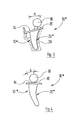
- Nachstehend wird die Erfindung anhand von Ausführungsbeispielen unter Bezugnahme auf die Zeichnung näher erläutert , wobei nur die Figuren 1 und 3 die erfindungsgemäßen Merkmale der in den Trochander major ragenden Abschnitt zeigen. Es zeigen:
- Figur 1:
- eine seitliche Ansicht einer zementfrei zu implantierenden Hüftgelenksprothese gesehen in Richtung von ventral nach dorsal;
- Figur 2:
- eine seitliche Ansicht der Prothese nach Figur 1 in Richtung von lateral nach medial (in Figur 1 von rechts nach links);
- Figur 3 und 4:
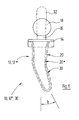
- Ansichten die denjenigen nach den Figuren 1 und 2 entsprechen, wobei jedoch eine einzuzementierende Prothese wiedergegeben ist;
- Figuren 5
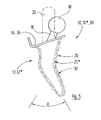
- und 6: den Figuren 1 und 2 bzw. 3 und 4 entsprechende Ansichten, in welche die lichten Außenkonturen der zementfrei zu implantierenden Prothese und der einzuzementierenden Prothese übereinander gelegt sind und ferner eine dazwischen liegende lichte Außenkontur eines Werkzeuges gezeigt ist, welches zur Endbearbeitung der die Prothese aufnehmenden Knochenkavität dient;
- Figur 6:
- eine Aufsicht auf einen Teil der Oberfläche eines Endbearbeitungswerkzeuges vom Raspeltyp; und
- Figur 7:
- eine ähnliche Ansicht wie Figur 6, in welcher jedoch ein Endbearbeitungswerkzeug vom Hobeltyp wiedergegeben ist.
- In Figur 1 ist mit 10 insgesamt eine Prothese bezeichnet, die in den Oberschenkel eines Patienten zur Bildung eines künstlichen Hüftgelenkes eingegliedert wird. Die Prothese 10 hat einen insgesamt mit 12 bezeichneten Prothesenkörper mit einer abgewinkelten Tragplatte 14. Deren Oberseite trägt einen nach medial gekippten Tragzapfen 16, auf welchem eine Gelenkkugel 18 angebracht ist.
- Die distale Begrenzungsfläche der Tragplatte 14 sitzt auf einem insgesamt mit 20 bezeichneten Verankerungsabschnitt, der nach Art eines Käfigs aufgebaut ist. Dieser umfaßt im wesentlichen die Ecken einer sich nach distal verjüngenden und rechteckigen Querschnitt aufweisenden Pyramide bildende Hauptverankerungspfeiler 22, die durch Nebenverankerungspfeiler 24 verbunden sind, welche in der Praxis zickzackförmig zwischen benachbarten Hauptverankerungspfeilern 22 verlaufen können.
- Die Hauptverankerungspfeiler 22 und die Nebenverankerungspfeiler 24 tragen jeweils axial beabstandete Verankerungsbunde 26, die in der Praxis 1 bis 2 mm über den Pfeilerkern überstehen. Die axiale Abmessung der Verankerungsbunde 26 kann etwa 1 bis 2 mm betragen, ihr axialer Abstand etwa 3 bis 6 mm.
- Der Prothesenkörper ist ein Gußteil aus einer biokompatiblen Legierung oder ein Schmiedeteil, welches auf einer NC-Maschine spanend nachbearbeitet ist.
- Bei der in den Figuren 3 und 4 gezeigten einzuzementierenden Prothese sind Prothesenteile, die in funktionsgleicher Form schon obenstehend unter Bezugnahme auf die Figuren 1 und 2 erläutert wurden, wieder mit analogen Bezugszeichen versehen, denen jedoch, soweit Unterschiede bestehen, zur Unterscheidung ein "*" angehängt ist. Diese Prothesenteile werden nachstehend nicht mehr im einzelnen beschrieben.
- Bei dem Prothesenkörper nach den Figuren 3 und 4 ist der zwischen den Hauptverankerungspfeilern 22 liegende Raum ausgefüllt, derart, daß die Hauptverankerungspfeiler 22 nur noch als Wulste 22* auf einem glattflächigen Kern erscheinen. In Abwandlung kann man die Mantelflächen der ehemaligen Hauptverankerungspfeiler 22 auch durch zu den letzteren tangentiale seitliche Begrenzungsflächen verbinden, so daß die Hauptverankerungspfeiler 22 nur noch in Form von Abrundungen des im wesentlichen rechteckigen, sich zum distalen Ende des Verankerungsabschnittes 20* hin verjüngenden tranversalen Querschnittes des Verankerungsabschnittes 20* erscheinen.
- Wie die Zeichnungen zeigen, ist die Achse des Tragzapfens 18 in der durch die Proximalrichtung und die Lateralrichtung aufgespannten Ebene (Zeichenebene von Figur 1) um einen Winkel a gegen die Achse des unteren Endabschnittes des Verankerungsabschnittes 20 bzw. des Schaftes 20* verkippt. Der Winkel a beträgt beim dargestellten Ausführungsbeispiel etwa 35°. Sie ist ferner in der durch die Proximalrichtung und die Dorsalrichtung vorgegebenen Ebene (Zeichenebene von Figur 2) gegen den unteren Endabschnitt von Verankerungsabschnitt 20 bzw. Schaft 20* um einen Winkel b verkippt. Dieser beträgt beim dargestellten Ausführungsbeispiel etwa 15 °.
- Wie schon aus dem Vergleich der Figuren 1 bis 4 ersichtlich, haben die dort gezeigten Prothesentypen teilweise identische (oberer Prothesenteil), teilweise geometrisch sehr ähnliche (Verankerungsabschnitt) lichte Außenkontur.
- Wie in den Figuren 5 und 6 näher dargestellt, verlaufen die Außenkonturen der Verankerungsabschnitte 20, 20* von zementfrei zu im plantierenden Prothese 10 und zementierter Prothese 10* unter einem kleinen im wesentlichen konstanten Abstand d parallel zueinander. In der Praxis beträgt dieser Abstand etwa 1 bis 2 mm, vorzugsweise etwa 1,5 mm. Im übrigen haben die beiden Prothesentypen gleich Geometrie, das heißt, ihre Tragplatten 14, ihre Tragzapfen 16 und auch die von den letzteren getragenen Gelenkkugeln 18 sind gleich.
- Die Implantierungsvorbereitungen für beide Prothesentypen sind identisch: Der Femur, in dessen oberes Ende die Prothese eingesetzt werden soll, wird so reseziert, daß der Trochander minor mit der verschlissenen Gelenkkugel vollständig entfernt wird, ein Teil des Trochander major dagegen stehenbleibt. Die Resektionslinie entspricht der Kontur der Tragplatte 14.
- Aus dem so resezierten Knochenende wird die Spongiosa mit einem Löffel oder dergleichen ausgeräumt, daß sie grob der Geometrie eines Verankerungsabschnittes 20 entspricht, jedoch Untermaß aufweist.
- Diese roh bearbeitete Kavität wird mit einem Endbearbeitungswerkzeug 30 spanend bearbeitet, dessen lichte Außenkontur in Figur 5 und 6 strichpunktiert angedeutet ist. Danach liegt die lichte Außenkontur des Endbearbeitungswerkzeuges beim betrachteten Ausführungsbeispiel durchweg etwa in der Mitte zwischen den beiden Verankerungsabschnitten 20 von zementfrei zu implantierender Prothese und einzuzementierender Prothese. Der Abstand zwischen der lichten Außenkontur des Endbearbeitungswerkzeuges 30 von der lichten Außenkontur der zementiertem Prothese entspricht allgemein der Dicke der später gewünschten Zementschicht (vorzugsweise etwa 1,5 mm), der Abstand der lichten Außenkontur des Endbearbeitungswerkzeuges 30 von der lichten Außenkontur der zementfrei zu implantierenden Prothese der Stärke des Preßsitzes des Verankerungsabschnittes 20 in der Corticalis des Femurs und beträgt vorzugsweise etwa 0,5 mm.
- In Figur 5 und 6 ist bei 32 ein Griff des Endbearbeitungswerkzeuges 30 dargestellt, und bei 34 ist eine Formschlußplatte gezeigt, die zur Tragplatte 14 formgleich ist und dazu dient, das Endbearbeitungswerkzeug an der Resektionslinie des Femurs zu positionieren.
- Das Endbearbeitungswerkzeug 30 kann gemäß Figur 7 aus einem Rohling hergestellt sein, dessen Außenkontur der lichten Außenkontur der zementierten Prothese entspricht und aus dem durch Hiebe einzelne Raspelzähne 36 nach außen ragend erzeugt wurden, deren Spitzen die lichte Außenkontur des Endbearbeitungswerkzeuges 30 vorgeben.
- Gemäß Figur 7 kann das Endbearbeitungswerkzeug 30 auch aus einem hohlen Rohling hergestellt sein (der seinerseits z.B. durch Tiefziehen von Blech hergestellt ist), aus dem dann durch Erzeugen von Einschnitten und Biegen der den Einschnitten benachbarten Materialbereiche Hobelklingen 38 parallel herausgedrückt wurden, deren Schneiden die lichte Außenkontur des Endbearbeitungswerkzeuges 30 vorgeben.
Claims (10)
- Satz aus Prothesen (10) unterschiedlicher Größe,
die jeweils aufweisen: eine Tragplatte (14), an welcher ein Gelenkelement (18) angebracht ist, und einen verankerungsabschnitt (20), der in eine Kavität eines Knochens (28) einführbar ist, wobei der Prothesensatz mindestens ein Paar von Prothesen (10, 10*) aufweist, von denen eine erste Prothese (10) einen zementfrei implantierbaren Verankerungsabschnitt (20) aufweist, und von denen eine zweite, mittels Knochenzement implantierbare Prothese (10*) einen als massiver Schaft ausgebildeten Verankerungsabschnitt (20*) aufweist, wobei die lichte Außenkontur des Verankerungsabschnitts (20) der ersten Prothese (10) unter im wesentlichen konstanten Abstand parallel verlaufend über der lichten Außenkontur des verankerungsabschnitts (20*) der zweiten Prothese (10*) liegt,
dadurch gekennzeichnet, daß
der Verankerungsabschnitt (20) der ersten Prothese (10) als Käfig ausgebildet ist,
die Geometrien der Verankerungsabschnitte (20, 20*) der Corticalis eines Oberschenkelknochens gut derart angepaßt sind, daß zwischen ihrer lichten Außenkontur und der Innenfläche der durch die Corticalis begrenzten Kavität ein im wesentlichen über die Kavität hinweg konstanter Abstand besteht und
die Verankerungsabschnitte (20, 20*) beider Prothesenteile (20, 20*) einen in den Trochanter major ragenden Abschnitt aufweisen. - Prothesensatz nach Anspruch 1, dadurch gekennzeichnet,
daß der Abstand zwischen den beiden lichten Außenkonturen der Verankerungsabschnitte (20, 20*) von erster Prothese (10) und zweiter Prothese (10*) 1 bis 3 mm, vorzugsweise etwa 1,5 bis 2 mm beträgt. - Prothesensatz nach Anspruch 1 oder 2, dadurch gekennzeichnet, daß der transversale Querschnitt der lichten Außenkonturen der Verankerungsabschnitte (20, 20*) im wesentlichen rechteckigen Querschnitt hat, wobei die Ecken des Rechteckes vorzugsweise abgerundet sind.
- Prothesensatz nach einem der Ansprüche 1 bis 3,
dadurch gekennzeichnet, daß der Querschnitt der verankerungsabschnitte (20, 20*) zum distalen Ende der Verankerungsabschnitte hin abnimmt. - Prothesensatz nach einem der Ansprüche 1 bis 4,
dadurch gekennzeichnet, daß die Verankerungeabschnitte (20, 20*) jeweils mindestens einen um ihre Längsachse tordierten Unterabschnitt aufweisen. - Prothesensatz nach einem der Ansprüche 1 bis 5,
bei welchem die verankerungsabschnitte (20, 20*) jeweils eine Hauptfläche aufweisen, die im wesentlichen durch die Proximalrichtung und die Lateralrichtung aufgespannt ist, dadurch gekennzeichnet, daß die Verankerungsabschnitte (20, 20*) jeweils einen proximalen Unterabschnitt und einen distalen Unterabschnitt aufweisen, die senkrecht zur Hauptfläche gesehen gegeneinander verkippt sind. - Prothesensatz nach einem der Ansprüche 1 bis 6, dadurch gekennzeichnet, daß er ferner ein Werkzeug (30) zum spanenden Endbearbeiten der Innenfläche einer in einem Knochenende erzeugten Kavität umfaßt, in welche ein Verankerungsabschnitt einer Prothese eingeführt werden soll, wobei die lichte Außenkontur des Endbearbeitungswerkzeuges (30) unter im wesentlichen konstantem Abstand über der lichten Außenkontur der zweiten Prothese (10*) und unterhalb der lichten Außenkontur der ersten Prothese (10) liegt.
- Prothesensatz nach Anspruch 7, dadurch gekennzeichnet, daß die lichte Außenkontur des Endbearbeitungswerkzeugs (30) in der Mitte zwischen den lichten Außenkonturen von erster Prothese (10) und zweiter Prothese (10*) liegt.
- Prothesensatz nach Anspruch 7 oder 8, dadurch gekennzeichnet, daß das Endbearbeitungswerkzeug (30) als Raspel ausgebildet ist, die durch Einbringen von Hieben in einen Werkzeugrohling hergestellt wurde, wobei letzterer eine der lichten Außenkontur des Verankerungsabschnittes (20*) einer zweiten Prothese (10*) entsprechende Außenfläche aufweist.
- Prothesensatz nach Anspruch 7 oder 8, dadurch gekennzeichnet, daß das Endbearbeitungswerkzeug (30) hohl ist und durch Ausstanzen und Ausbiegen von Klingenabschnitten (38) aus einem hohlen Rohling hergestellt wurde, dessen Außenkontur der eines Verankerungsabschnittes (20*) einer zweiten Prothese (10*) entspricht.
Applications Claiming Priority (2)
| Application Number | Priority Date | Filing Date | Title |
|---|---|---|---|
| DE19740755 | 1997-09-16 | ||
| DE19740755A DE19740755A1 (de) | 1997-09-16 | 1997-09-16 | Satz aus Prothesen unterschiedlicher Größe |
Publications (3)
| Publication Number | Publication Date |
|---|---|
| EP0908158A2 EP0908158A2 (de) | 1999-04-14 |
| EP0908158A3 EP0908158A3 (de) | 1999-12-08 |
| EP0908158B1 true EP0908158B1 (de) | 2006-11-29 |
Family
ID=7842552
Family Applications (1)
| Application Number | Title | Priority Date | Filing Date |
|---|---|---|---|
| EP98116719A Expired - Lifetime EP0908158B1 (de) | 1997-09-16 | 1998-09-03 | Satz aus Prothesen unterschiedlicher Grösse |
Country Status (4)
| Country | Link |
|---|---|
| US (1) | US6221110B1 (de) |
| EP (1) | EP0908158B1 (de) |
| DE (2) | DE19740755A1 (de) |
| ES (1) | ES2277373T3 (de) |
Families Citing this family (18)
| Publication number | Priority date | Publication date | Assignee | Title |
|---|---|---|---|---|
| FR2793675B1 (fr) * | 1999-05-19 | 2001-08-17 | Ile Octophoron Soc Civ | Jeu de tiges femorales |
| FR2815536B1 (fr) * | 2000-10-25 | 2003-07-04 | Marc Anzalone | Tige femorale anatomique cimentee |
| US7497874B1 (en) | 2001-02-23 | 2009-03-03 | Biomet Manufacturing Corp. | Knee joint prosthesis |
| US20020120340A1 (en) | 2001-02-23 | 2002-08-29 | Metzger Robert G. | Knee joint prosthesis |
| FR2831052B1 (fr) * | 2001-10-24 | 2004-07-30 | Alain Durand | Gamme de tiges femorales fixees par un liquide injecte par leur centre |
| US20040158329A1 (en) * | 2003-02-10 | 2004-08-12 | Waldemar Link (Gmbh & Co.) | Hip joint prosthesis with shaft inserted into femur |
| US7547328B2 (en) * | 2004-05-26 | 2009-06-16 | Sidebotham Christopher G | Canine femoral stem system |
| EP1623685A1 (de) | 2004-08-06 | 2006-02-08 | WALDEMAR LINK GmbH & Co. KG | Hüftgelenkprothese mit einem in den Oberschenkelknochen einzusetzenden Schaft |
| AU2006201835B2 (en) | 2005-05-09 | 2012-08-30 | Smith & Nephew, Inc. | Orthopaedic implants and methods for making the same |
| FR2901468B1 (fr) * | 2006-05-23 | 2008-12-19 | Fournitures Hospitalieres Ind | Gamme de tiges femorales prothetiques |
| US20080092796A1 (en) * | 2006-10-23 | 2008-04-24 | Laivins Kenneth T | Disposable flag |
| US8163028B2 (en) | 2007-01-10 | 2012-04-24 | Biomet Manufacturing Corp. | Knee joint prosthesis system and method for implantation |
| US8328873B2 (en) | 2007-01-10 | 2012-12-11 | Biomet Manufacturing Corp. | Knee joint prosthesis system and method for implantation |
| US8187280B2 (en) | 2007-10-10 | 2012-05-29 | Biomet Manufacturing Corp. | Knee joint prosthesis system and method for implantation |
| US8562616B2 (en) | 2007-10-10 | 2013-10-22 | Biomet Manufacturing, Llc | Knee joint prosthesis system and method for implantation |
| US8157869B2 (en) | 2007-01-10 | 2012-04-17 | Biomet Manufacturing Corp. | Knee joint prosthesis system and method for implantation |
| US7637729B2 (en) * | 2007-12-13 | 2009-12-29 | Biomet Manufacturing Corp. | Modular articulating cement spacer mold |
| DE102009017532A1 (de) * | 2009-04-17 | 2010-10-21 | Copf sen., Franz, Prof. Dr. med. | Prothesenkörper für eine Oberschenkelprothese |
Family Cites Families (23)
| Publication number | Priority date | Publication date | Assignee | Title |
|---|---|---|---|---|
| US3938198A (en) * | 1970-08-04 | 1976-02-17 | Cutter Laboratories, Inc. | Hip joint prosthesis |
| US4064567A (en) * | 1976-09-15 | 1977-12-27 | The Sampson Corporation | Prosthesis-to-bone interface system |
| US4068324A (en) * | 1977-01-19 | 1978-01-17 | Bio-Dynamics Inc. | Platform supported hip prosthesis |
| DE3015690A1 (de) * | 1980-04-24 | 1981-10-29 | Waldemar Link (Gmbh & Co), 2000 Hamburg | Hueftgelenkprothese mit einem in den markkanal des oberschenkelknochens einzusetzenden schaft |
| US4570271A (en) * | 1981-07-27 | 1986-02-18 | Battelle Development Corporation | Porous coatings from wire mesh for bone implants |
| DE8600970U1 (de) * | 1986-01-16 | 1986-02-20 | Waldemar Link GmbH & Co, 22339 Hamburg | Knochenimplantat |
| US4728335A (en) * | 1986-12-15 | 1988-03-01 | Jurgutis John A | Hip prosthesis |
| DE8712578U1 (de) * | 1987-09-17 | 1987-12-17 | Howmedica GmbH, 2314 Schönkirchen | Oberschenkelteil einer Hüftgelenkendoprothese |
| US5089004A (en) * | 1988-01-19 | 1992-02-18 | Osteonics Corp. | Prosthetic implant procedure and femoral broach therefor |
| FR2629707A1 (fr) * | 1988-04-07 | 1989-10-13 | Roux Jean Pierre | Piece femorale et equipement pour la realisation d'une prothese de la hanche |
| CH674928A5 (de) * | 1988-07-05 | 1990-08-15 | Experimentelle Chirurgie Lab | |
| SU1627171A1 (ru) * | 1988-11-24 | 1991-02-15 | Б. Г. Зимлицкий и Е. Д. Соломко | Клиновой эндопротез вертлужной впадины тазобедренного сустава |
| IT1228220B (it) * | 1989-01-11 | 1991-06-05 | Cremascoli Spa G | Protesi d'anca a sezione variabile e profilo ad andamento costante. |
| FR2662932B1 (fr) * | 1990-06-07 | 1997-09-05 | Denis Godeau | Prothese femorale. |
| DE4133877C1 (de) * | 1991-10-12 | 1993-05-19 | S + G Implants Gmbh, 2400 Luebeck, De | |
| US5807407A (en) * | 1992-05-04 | 1998-09-15 | Biomet, Inc. | Medical implant device and method for making same |
| US5387243A (en) * | 1992-11-23 | 1995-02-07 | Zimmer, Inc. | Method for converting a cementable implant to a press fit implant |
| DE4323873C2 (de) * | 1993-07-16 | 1996-07-18 | Eska Medical Gmbh & Co | Hohlschaftraspel |
| DE4406388A1 (de) * | 1994-02-26 | 1995-09-14 | Aesculap Ag | Schaftendoprothese |
| US5507814A (en) * | 1994-03-30 | 1996-04-16 | Northwestern University | Orthopedic implant with self-reinforced mantle |
| FR2728160B1 (fr) * | 1994-12-14 | 1997-08-14 | Cedior | Systeme de prothese de hanche a tiges cimentees et sans ciment utilisant une rape universelle |
| DE19510735C2 (de) * | 1995-03-24 | 1998-07-02 | Zeim Ingrid | Formraspel für medizinische Zwecke |
| US5766261A (en) * | 1996-02-01 | 1998-06-16 | Osteonics Corp. | Femoral revision broach with modular trial components and method |
-
1997
- 1997-09-16 DE DE19740755A patent/DE19740755A1/de not_active Withdrawn
-
1998
- 1998-09-03 DE DE59813827T patent/DE59813827D1/de not_active Expired - Fee Related
- 1998-09-03 ES ES98116719T patent/ES2277373T3/es not_active Expired - Lifetime
- 1998-09-03 EP EP98116719A patent/EP0908158B1/de not_active Expired - Lifetime
- 1998-09-16 US US09/154,547 patent/US6221110B1/en not_active Expired - Fee Related
Also Published As
| Publication number | Publication date |
|---|---|
| EP0908158A2 (de) | 1999-04-14 |
| EP0908158A3 (de) | 1999-12-08 |
| DE19740755A1 (de) | 1999-03-18 |
| US6221110B1 (en) | 2001-04-24 |
| ES2277373T3 (es) | 2007-07-01 |
| DE59813827D1 (de) | 2007-01-11 |
Similar Documents
| Publication | Publication Date | Title |
|---|---|---|
| DE69233509T2 (de) | Fräser für längliche Hüftgelenkpfanne | |
| EP0135755B1 (de) | Schaft für eine Hüftgelenkprothese | |
| DE60113177T2 (de) | Oberschenkelteil einer Hüftgelenksprothese | |
| EP0971651B1 (de) | Hüftgelenkendoprothese | |
| EP0182176B1 (de) | Verfahren zum Herstellen von Endoprothesen | |
| DE69331586T2 (de) | Verbessertes femorales manschettenimplantat | |
| DE69621087T2 (de) | Prothetisches Implantat mit Rippen | |
| DE69935399T2 (de) | Proximale femorale Hülse für eine Revisionshüftprothese | |
| DE69732677T2 (de) | Asymmetrischer Hüftschaft | |
| DE69727767T2 (de) | Bearbeitungsanordnung zur Vorbereitung des Knochenkanals eines Femurs für künstliche Bildung des Hüftgelenks | |
| EP1924208B1 (de) | Femur Implantat | |
| DE69917545T2 (de) | Implantierbare Prothese mit Knochenverbindungsrippen | |
| EP0159462B1 (de) | Femurale Totalendoprothese für ein Hüftgelenk | |
| EP0908158A2 (de) | Satz aus Prothesen unterschiedlicher Grösse | |
| EP0359097B1 (de) | Hüftkopf-Schaft-Prothese | |
| DE69425015T2 (de) | Femurkomponente für eine Hüftprothese | |
| DE8814565U1 (de) | Hüftgelenk-Prothesevorrichtung | |
| EP0311749A1 (de) | Oberschenkelteil einer Hüftgelenkendoprothese | |
| EP0069252A1 (de) | Gelenkendoprothese | |
| DE69515455T2 (de) | Femurschaft mit verwringtem Profil für Hüftprothese | |
| WO2002100302A1 (de) | Hüft-endoprothese | |
| DE3311326C2 (de) | Endoprothese | |
| EP1106143B1 (de) | Prothesensystem | |
| EP1357864B1 (de) | Schenkelhalsendoprothese für ein künstliches hüftgelenk | |
| EP0908159B1 (de) | Oberschenkelprothese |
Legal Events
| Date | Code | Title | Description |
|---|---|---|---|
| PUAI | Public reference made under article 153(3) epc to a published international application that has entered the european phase |
Free format text: ORIGINAL CODE: 0009012 |
|
| AK | Designated contracting states |
Kind code of ref document: A2 Designated state(s): DE ES FR GB IT |
|
| AX | Request for extension of the european patent |
Free format text: AL;LT;LV;MK;RO;SI |
|
| PUAL | Search report despatched |
Free format text: ORIGINAL CODE: 0009013 |
|
| AK | Designated contracting states |
Kind code of ref document: A3 Designated state(s): AT BE CH CY DE DK ES FI FR GB GR IE IT LI LU MC NL PT SE |
|
| AX | Request for extension of the european patent |
Free format text: AL;LT;LV;MK;RO;SI |
|
| 17P | Request for examination filed |
Effective date: 20000520 |
|
| AKX | Designation fees paid |
Free format text: DE ES FR GB IT |
|
| 17Q | First examination report despatched |
Effective date: 20030516 |
|
| GRAP | Despatch of communication of intention to grant a patent |
Free format text: ORIGINAL CODE: EPIDOSNIGR1 |
|
| RAP1 | Party data changed (applicant data changed or rights of an application transferred) |
Owner name: UNIOR BIONIC D.O.O. |
|
| RIN1 | Information on inventor provided before grant (corrected) |
Inventor name: UNIOR BIONIC D.O.O. |
|
| GRAS | Grant fee paid |
Free format text: ORIGINAL CODE: EPIDOSNIGR3 |
|
| GRAA | (expected) grant |
Free format text: ORIGINAL CODE: 0009210 |
|
| RIN1 | Information on inventor provided before grant (corrected) |
Inventor name: COPF, FRANZ |
|
| AK | Designated contracting states |
Kind code of ref document: B1 Designated state(s): DE ES FR GB IT |
|
| PG25 | Lapsed in a contracting state [announced via postgrant information from national office to epo] |
Ref country code: IT Free format text: LAPSE BECAUSE OF FAILURE TO SUBMIT A TRANSLATION OF THE DESCRIPTION OR TO PAY THE FEE WITHIN THE PRESCRIBED TIME-LIMIT;WARNING: LAPSES OF ITALIAN PATENTS WITH EFFECTIVE DATE BEFORE 2007 MAY HAVE OCCURRED AT ANY TIME BEFORE 2007. THE CORRECT EFFECTIVE DATE MAY BE DIFFERENT FROM THE ONE RECORDED. Effective date: 20061129 |
|
| REG | Reference to a national code |
Ref country code: GB Ref legal event code: FG4D Free format text: NOT ENGLISH |
|
| REF | Corresponds to: |
Ref document number: 59813827 Country of ref document: DE Date of ref document: 20070111 Kind code of ref document: P |
|
| GBT | Gb: translation of ep patent filed (gb section 77(6)(a)/1977) |
Effective date: 20070216 |
|
| ET | Fr: translation filed | ||
| REG | Reference to a national code |
Ref country code: ES Ref legal event code: FG2A Ref document number: 2277373 Country of ref document: ES Kind code of ref document: T3 |
|
| PLBE | No opposition filed within time limit |
Free format text: ORIGINAL CODE: 0009261 |
|
| STAA | Information on the status of an ep patent application or granted ep patent |
Free format text: STATUS: NO OPPOSITION FILED WITHIN TIME LIMIT |
|
| 26N | No opposition filed |
Effective date: 20070830 |
|
| PGFP | Annual fee paid to national office [announced via postgrant information from national office to epo] |
Ref country code: ES Payment date: 20080917 Year of fee payment: 11 |
|
| PGFP | Annual fee paid to national office [announced via postgrant information from national office to epo] |
Ref country code: FR Payment date: 20080918 Year of fee payment: 11 |
|
| PGFP | Annual fee paid to national office [announced via postgrant information from national office to epo] |
Ref country code: GB Payment date: 20080917 Year of fee payment: 11 |
|
| PGFP | Annual fee paid to national office [announced via postgrant information from national office to epo] |
Ref country code: DE Payment date: 20081128 Year of fee payment: 11 |
|
| GBPC | Gb: european patent ceased through non-payment of renewal fee |
Effective date: 20090903 |
|
| REG | Reference to a national code |
Ref country code: FR Ref legal event code: ST Effective date: 20100531 |
|
| PG25 | Lapsed in a contracting state [announced via postgrant information from national office to epo] |
Ref country code: FR Free format text: LAPSE BECAUSE OF NON-PAYMENT OF DUE FEES Effective date: 20090930 Ref country code: DE Free format text: LAPSE BECAUSE OF NON-PAYMENT OF DUE FEES Effective date: 20100401 |
|
| PG25 | Lapsed in a contracting state [announced via postgrant information from national office to epo] |
Ref country code: GB Free format text: LAPSE BECAUSE OF NON-PAYMENT OF DUE FEES Effective date: 20090903 |
|
| REG | Reference to a national code |
Ref country code: ES Ref legal event code: FD2A Effective date: 20110715 |
|
| PG25 | Lapsed in a contracting state [announced via postgrant information from national office to epo] |
Ref country code: ES Free format text: LAPSE BECAUSE OF NON-PAYMENT OF DUE FEES Effective date: 20110705 |
|
| PG25 | Lapsed in a contracting state [announced via postgrant information from national office to epo] |
Ref country code: ES Free format text: LAPSE BECAUSE OF NON-PAYMENT OF DUE FEES Effective date: 20090904 |