EP0908219A1 - Procédé à plusieurs étapes de séparation/récuperation de gaz - Google Patents
Procédé à plusieurs étapes de séparation/récuperation de gaz Download PDFInfo
- Publication number
- EP0908219A1 EP0908219A1 EP98110012A EP98110012A EP0908219A1 EP 0908219 A1 EP0908219 A1 EP 0908219A1 EP 98110012 A EP98110012 A EP 98110012A EP 98110012 A EP98110012 A EP 98110012A EP 0908219 A1 EP0908219 A1 EP 0908219A1
- Authority
- EP
- European Patent Office
- Prior art keywords
- gas
- membrane
- pressure
- process according
- membrane unit
- Prior art date
- Legal status (The legal status is an assumption and is not a legal conclusion. Google has not performed a legal analysis and makes no representation as to the accuracy of the status listed.)
- Granted
Links
Images


Classifications
-
- B—PERFORMING OPERATIONS; TRANSPORTING
- B01—PHYSICAL OR CHEMICAL PROCESSES OR APPARATUS IN GENERAL
- B01D—SEPARATION
- B01D53/00—Separation of gases or vapours; Recovering vapours of volatile solvents from gases; Chemical or biological purification of waste gases, e.g. engine exhaust gases, smoke, fumes, flue gases, aerosols
- B01D53/22—Separation of gases or vapours; Recovering vapours of volatile solvents from gases; Chemical or biological purification of waste gases, e.g. engine exhaust gases, smoke, fumes, flue gases, aerosols by diffusion
- B01D53/229—Integrated processes (Diffusion and at least one other process, e.g. adsorption, absorption)
-
- B—PERFORMING OPERATIONS; TRANSPORTING
- B01—PHYSICAL OR CHEMICAL PROCESSES OR APPARATUS IN GENERAL
- B01D—SEPARATION
- B01D53/00—Separation of gases or vapours; Recovering vapours of volatile solvents from gases; Chemical or biological purification of waste gases, e.g. engine exhaust gases, smoke, fumes, flue gases, aerosols
- B01D53/22—Separation of gases or vapours; Recovering vapours of volatile solvents from gases; Chemical or biological purification of waste gases, e.g. engine exhaust gases, smoke, fumes, flue gases, aerosols by diffusion
- B01D53/225—Multiple stage diffusion
- B01D53/226—Multiple stage diffusion in serial connexion
-
- B—PERFORMING OPERATIONS; TRANSPORTING
- B01—PHYSICAL OR CHEMICAL PROCESSES OR APPARATUS IN GENERAL
- B01D—SEPARATION
- B01D53/00—Separation of gases or vapours; Recovering vapours of volatile solvents from gases; Chemical or biological purification of waste gases, e.g. engine exhaust gases, smoke, fumes, flue gases, aerosols
- B01D53/22—Separation of gases or vapours; Recovering vapours of volatile solvents from gases; Chemical or biological purification of waste gases, e.g. engine exhaust gases, smoke, fumes, flue gases, aerosols by diffusion
- B01D53/228—Separation of gases or vapours; Recovering vapours of volatile solvents from gases; Chemical or biological purification of waste gases, e.g. engine exhaust gases, smoke, fumes, flue gases, aerosols by diffusion characterised by specific membranes
-
- B—PERFORMING OPERATIONS; TRANSPORTING
- B01—PHYSICAL OR CHEMICAL PROCESSES OR APPARATUS IN GENERAL
- B01D—SEPARATION
- B01D2256/00—Main component in the product gas stream after treatment
- B01D2256/16—Hydrogen
-
- B—PERFORMING OPERATIONS; TRANSPORTING
- B01—PHYSICAL OR CHEMICAL PROCESSES OR APPARATUS IN GENERAL
- B01D—SEPARATION
- B01D2256/00—Main component in the product gas stream after treatment
- B01D2256/18—Noble gases
-
- B—PERFORMING OPERATIONS; TRANSPORTING
- B01—PHYSICAL OR CHEMICAL PROCESSES OR APPARATUS IN GENERAL
- B01D—SEPARATION
- B01D2257/00—Components to be removed
- B01D2257/70—Organic compounds not provided for in groups B01D2257/00 - B01D2257/602
- B01D2257/702—Hydrocarbons
-
- B—PERFORMING OPERATIONS; TRANSPORTING
- B01—PHYSICAL OR CHEMICAL PROCESSES OR APPARATUS IN GENERAL
- B01D—SEPARATION
- B01D2259/00—Type of treatment
- B01D2259/40—Further details for adsorption processes and devices
- B01D2259/40001—Methods relating to additional, e.g. intermediate, treatment of process gas
-
- B—PERFORMING OPERATIONS; TRANSPORTING
- B01—PHYSICAL OR CHEMICAL PROCESSES OR APPARATUS IN GENERAL
- B01D—SEPARATION
- B01D2259/00—Type of treatment
- B01D2259/40—Further details for adsorption processes and devices
- B01D2259/416—Further details for adsorption processes and devices involving cryogenic temperature treatment
-
- B—PERFORMING OPERATIONS; TRANSPORTING
- B01—PHYSICAL OR CHEMICAL PROCESSES OR APPARATUS IN GENERAL
- B01D—SEPARATION
- B01D53/00—Separation of gases or vapours; Recovering vapours of volatile solvents from gases; Chemical or biological purification of waste gases, e.g. engine exhaust gases, smoke, fumes, flue gases, aerosols
- B01D53/02—Separation of gases or vapours; Recovering vapours of volatile solvents from gases; Chemical or biological purification of waste gases, e.g. engine exhaust gases, smoke, fumes, flue gases, aerosols by adsorption, e.g. preparative gas chromatography
- B01D53/04—Separation of gases or vapours; Recovering vapours of volatile solvents from gases; Chemical or biological purification of waste gases, e.g. engine exhaust gases, smoke, fumes, flue gases, aerosols by adsorption, e.g. preparative gas chromatography with stationary adsorbents
- B01D53/047—Pressure swing adsorption
Definitions
- the invention relates to a process for the separation and/or recovery of gases from gas and/or gas vapour mixtures by means of a membrane separating device to which the gas and/or gas vapour mixture is supplied, the latter being separated in the membrane separating device into permeates enriched with gas/vapours and retentates which are depleted of gas/vapours.
- the membrane separating device may comprise the use of different membrane types. Typically one said membrane type used is made of glassy polymers and is highly permeable to gases of small kinetic diameter, such as H 2 or He, whilst another said membrane type used is made of rubbery polymers and is highly permeable to condensable gases/organic vapours, such as C2 and higher hydrocarbons. If further purification of the desired component(s) is sought, a PSA or cryogenic system may be incorporated to the membrane separating device.
- the combination of membrane separating devices and pressure swing adsorption devices can only be economically operated where the initial content of desired gases to be separated from the gas/vapour mixture , for example H 2 , is above 40 mole % and where a high feed pressure is available. Because the glassy polymer membranes previously employed for this purpose in the membrane separating device must, as a precondition, exhibit selectivity which is as high as possible despite low fluxes, it is necessary to set the highest possible pressure to the inlet of the separating device, for example between 40 and 130 bar, in order to be able to utilise the selectivity of the membranes.
- the downstream pressure swing adsorption device was likewise operated in the known arrangements at a relatively high adsorption pressure, preferably 40 bar and higher.
- the compression costs are very high so that the total separating process can only be operated economically when the mixture to be separated is already available at high pressure.
- an object of the present invention to create a process by means of which, at low energy requirements, simultaneous separation or recovery of high purity gases having a small kinetic diameter and of condensable gases/ vapours in highly concentrated form can be achieved by applying moderate pressure only, it being possible for the gas and/or gas vapour mixture which has to be separated to have a low concentration of the components to be enriched.
- the object is achieved, according to the invention, by at least one membrane separating unit having an organophilic membrane which is selective for C2 and higher hydrocarbons combined with at least one membrane separating unit having a glassy membrane which is selective for gases of small kinetic diameter to which is supplied at the inlet end the retentate from the organophilic membrane separating unit.
- the advantage of the process according to the invention lies essentially in the fact that, as desired, simultaneous economical separation and/or recovery of gases with a small kinetic diameter such as hydrogen or helium and condensable gases/vapours, such as C2 and higher hydrocarbons from gas and/or gas vapour mixtures is possible.
- gases with a small kinetic diameter such as hydrogen or helium and condensable gases/vapours, such as C2 and higher hydrocarbons from gas and/or gas vapour mixtures is possible.
- the process according to the invention is advantageously characterised by substantially reduced energy requirements as compared with known processes because the process can be operated at relatively moderate pressures.
- the process is also advantageously applicable where the gases/vapours to be separated are only available in small or even in only very small molar concentrations in the mixture.
- the organophilic membrane(s) used in the organophilic membrane unit(s) are made from elastomer or rubbery polymers which are for example manufactured from silicone rubber, the silicone rubber advantageously consisting of POMS or PDMS.
- These membranes of the first membrane separating device (b) are therefore organophilic membranes through which gases or vapours, for example C2 and higher hydrocarbons, permeate selectively.
- the membranes of the glassy membrane unit(s) consist of a so-called glass-type membrane which is for example manufactured either from polyamide-imide or from aromatic polyimides. These membranes are selective with respect to gases of small kinetic diameter, for example hydrogen or helium.
- the primary gas and/or gas vapour mixture to be separated has a pressure between 1 and 30 bar, advantageously between 2 and 15 bar at inlet to the organophilic membrane unit(s).
- the primary gas and/or gas vapour mixture to be separated preferably has its temperature moderated before inlet to the organophilic membrane unit(s) in order to optimize the separation result, the temperature being then advantageously in the range between 0 and 25 C.
- the moderation of the temperature of the gas and/or gas vapour mixture to be separated can take place in any given suitable manner and will essentially depend on whether its temperature is located higher or lower within the range of the temperature which is optimum for the separation procedure of the gas and/or gas vapour mixture.
- the moderation in the temperature then takes place by means of a heat exchanger/cooler upstream of the organophilic membrane unit(s), through which heat exchanger/cooler is fed the gas and/or gas vapour mixture to be separated before inlet to the organophilic membrane unit(s).
- a reduction in pressure is preferably effected on the permeate side of the organophilic membrane unit(s), the pressure on the permeate side being advantageously in the region of 1 - 2 bar.
- the permeate leaving the organophilic membrane unit(s) can be further purification, whereby a cooling device such as cryogenic distillation can be provided, for example, for the further purification.
- a cooling device such as cryogenic distillation
- Other repurification stages which operate in accordance with other physical/chemical principles, are also conceivable however.
- the retentate leaving the organophilic membrane unit(s), which exhibits a pressure approximating to that found in the gas and/or gas vapour mixture to be separated before inlet to the membrane unit(s), for example between 2 and 15 bar, advantageously has its pressure increased before inlet to the glassy membrane unit(s) so that sufficient pressure energy is available for the separating procedure of the retentate of the organophilic membrane unit(s) when it is supplied to the glassy membrane unit(s); it is also advantageous in this case to moderate the temperature of the retentate before inlet to the glassy membrane unit(s), and in the range between 40 and 120 C, preferably 70 and 80 C, in order to optimise the separating procedure.
- the increase in pressure of the retentate before inlet to the glassy membrane unit(s) preferably takes place to the range between 30 and 40 bar.
- the moderation of the temperature of the retentate before inlet to the glassy membrane unit(s) advantageously takes place by means of an upstream heat exchanger/heater.
- the permeate leaving the glassy membrane unit(s) is advantageously guided via an adsorption device, with the permeate which is greatly enriched with gases of small kinetic diameter having its pressure reduced to the range between 1 and 2 bar, in contrast to the retentate which exhibits a pressure of some 25 to 40 bar or even higher.
- the adsorption device which purifies the permeate once again in order to supply a high-purity second product at outlet from the adsorption device, is preferably operated in accordance with the pressure swing adsorption principle.
- the pressure energy of the retentate of the glassy membrane unit(s) which corresponds approximately to the pressure of the increased pressure retentate of the organophilic membrane unit(s) present at inlet to the glassy membrane unit(s), for example in the range between 25 and 40 bar or even higher.
- This pressure energy is advantageously used to operate a turbo-expander which is driven by means of the retentate, which is at high pressure, of the glassy membrane unit(s).
- the permeate advantageously has its temperature suitably moderated or lowered before inlet to the adsorption device.
- the retentate of the glassy membrane unit(s), which now leaves the turbo-expander with its pressure lowered, can now be connected directly back into the process circuit at the inlet end (with its pressure correspondingly increased) or it can, however, be advantageously supplied to a third membrane separating device whose retentate, as previously, is in turn connected into the inlet of the process circuit.
- the permeate, as the third product may possibly be extracted at outlet from the adsorption device at a degree of purity which is not as high as that of the second product from the process circuit.
- the desorption or purge gas flow leaving the adsorption device is also advantageously recycled for connection into the process circuit, with the description or purge gas flow having its pressure increased and/or temperature moderated as specified before connection into the process circuit, depending on the point of connection into the process circuit.
- the permeate of the organophilic membrane unit(s) is fed through a repurification stage and is there further purified so that it leaves the process as the first product.
- the retentate of the glassy membrane unit(s) is preferably repurified in the same device in which the permeate of the organophilic membrane unit(s) is also repurified.
- This repurification can take place in a cooling stage or, advantageously, in an absorption/condensation unit.
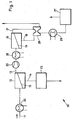
- a gas and/or gas vapour mixture which has to be separated such as is found in the petroleum industry and petrochemicals, has its pressure increased to an outlet pressure of between 8 and 15 bar by means of pumps or compressors (not shown here) and is supplied to the appliance 10 as a gas and/or gas vapour mixture which has to be separated or as a feed 11.
- the gas and/or gas vapour mixture 11 is first supplied to a heat exchanger 20 and there has its temperature moderated to a suitable temperature in the range between 10 and 20 C.
- a pre-treatment filter device 21 can be provided between the heat exchanger/cooler 20 and the downstream organophilic membrane unit(s) 12, see Fig. 2.
- the organophilic membrane unit(s) 12 is equipped with a membrane 15 of a first membrane type.
- This membrane 15 is an elastomer or rubber-type membrane which is manufactured from silicone rubber, for example; the silicone rubber can be POMS or PDMS.
- This organophilic membrane is selective for higher hydrocarbons in the gas and/or gas vapour mixture 11 to be separated (C2 and higher hydrocarbons). These C2 and higher hydrocarbons are separated in the organophilic membrane unit(s) 12 in the form of the permeate 14 and delivered to a repurification stage 23. They are then delivered as the first highly enriched product for further use.
- the retentate 13 leaving the organophilic membrane unit(s) 12 at approximately the same pressure as the gas and/or gas vapour mixture 11 supplied to the membrane unit(s) 12 represents the gas flow which is depleted of condensable gases or vapours.
- This gas flow is first fed through a pump compressor 25, where its pressure is increased and, in fact, preferably to the range between 25 and 40 bar.
- the pressurised retentate 13 from the organophilic membrane unit(s) 12 is fed through a heat exchanger/heater 26 and there brought to a temperature of between 50 and 80 C.
- the condensable components in the gas and/or gas vapour mixture are depleted in the organophilic membrane unit(s) in such a way that in the downstream glassy membrane unit(s) 16 (which follows the increase in pressure by the pump 25) i.e. in the process section through the glassy membrane unit(s) 16, no condensation takes place on the actual glassy membrane 19 in the glassy membrane unit(s) 16 despite possible cooling due to the Joule-Thomson effect.
- the glassy membrane 19 in the glassy membrane unit(s) 16 is a so-called glass-type membrane which is manufactured either from polyamide-imide or from aromatic polyimide.
- This glassy membrane 19 in the glassy membrane unit(s) 16 is selective for gases with small molecular diameters, for example for hydrogen or helium.
- the retentate 13 (which has had its temperature and its pressure increased) from the organophilic membrane unit(s) 12 is separated into a retentate 17 and a permeate 18.
- the permeate 18 has had its pressure greatly reduced, for example to within the range of between 1 and 2 bar, and is greatly enriched with the previously mentioned light gases of small kinetic diameter.
- the permeate 18 is fed through a turbo-expander 28 and is subsequently present at a higher pressure, for example in the range between 18 and 20 bar, and is supplied to an adsorption device 27 for further purification, possibly after being fed through a heat exchanger cooler 29.
- the adsorption device 27 operates, for example, in accordance with the pressure swing adsorption (PSA) principle.
- PSA pressure swing adsorption
- the operation of the turbo-expander 28 is effected by the high pressure energy of the retentate 17 from the glassy membrane unit(s) 16, which is present at approximately the supply pressure of between 25 and 40 bar of the retentate 13 of the organophilic membrane unit(s) 12 at inlet to the glassy membrane unit(s) 16.
- the retentate 17 is either supplied to some other application or is again connected into the process circuit.
- connection possibilities are available depending on the degree of enrichment in desired component(s).
- a second product, gases of small kinetic diameter, is then extracted from the adsorption device 27 in highly purified form, for example in the form of 99.9% hydrogen or helium.
- the desorption or purge gas flow 31 of the adsorption device 27 can be connected afresh into the process at various locations of the embodiment 10 in order to increase the total yield of the process.
- the desorption or purge gas flow 31 can be recycled, after having its pressure increased in a compressor 32 , to the retentate 13 of the organophilic membrane unit 12 or it can be fed through a temperature moderating device such as cooler 33 and from there can be fed afresh to the inlet of embodiment 10, through which inlet the primary gas and/or gas vapour mixture 11 to be separated is supplied to the process circuit.
- the heat exchanger 33 is then preferably a cooler in order to match the desorption or purge gas flow 31 to the temperature of the gas and/or gas vapour mixture 11 supplied to the organophilic membrane unit 12.
- the reduction in temperature can take place in the heat exchanger 20 after the desorption or purge gas flow 31 has been mixed (not shown) with the gas and/or gas vapour mixture 11 to be separated before the mixed flow formed in this way is supplied to the organophilic membrane unit 12.
- the retentate 17 of the glassy membrane unit 16 is, as already indicated above, supplied for another use or to the repurification unit 23.
- This repurification unit 23 is advantageously a cryogenic distillation. Depending on the composition of the permeate 14, the latter can be mixed into the desorption or purge gas flow 31 and/or the permeate 34 leaving organophilic membrane unit 30, after temperature reduction (not shown), before the latter is supplied to the cryogenic distillation unit 23 for further purification. Further purification in a cooling device or a cryogenic distillation unit 23 is of great advantage if, for example, C2 is a desired condensable gas simultaneously recovered by means of the multi-stage membrane separation device.
- the pressure ratio between inlet end and permeate side of the organophilic membrane unit 12 is set by a vacuum pump 22. It is then similarly possible to improve the efficiency by providing a vacuum pump (not shown) also for the permeate 18 in the case of the glassy membrane unit, for example unit 16, see Fig. 2. This permits a markedly better pressure ratio to be set.
- the permeate 18 is supplied to a further glassy membrane unit (not shown) after the pressure is increased preferably in the turbo-expander 28 providing sufficient pressure ratio across the membrane unit to recover a desired gas of small kinetic diameter, for example, hydrogen, with a degree of purity of between 96 and 99 mole%.
- the retentate of this further glassy membrane unit (not shown) can likewise be recirculated, and it can be connected anew into the process circuit at selected locations (not shown).
- turbo-expander(s) Whenever the pressure energy available in the system is not sufficient to meet the requirement of turbo-expander(s), such equipment(s) can be steam driven.
- Alternativelly electrically-driven compressors can be used instead of turbo-expanders. Wherever compressors are shown in the process circuit they may be replaced by turbo-expander(s) as long as sufficient pressure energy is available.
- Fig. 3 shows an alternative embodiment or appliance 10 for carrying out the process according to the invention.
- a gas and/or gas vapour mixture which has to be separated typically found in the petroleum and gas industry, which might be available at elevated pressure in natural gas flows containing Helium in small concentration, i.e. 0,5 - 5 mole%, for example in the range between 30 - 100 bar, or if the pressure in the feed 11 is rather lower, has its pressure increased by means of pump/compressor 25 preferably to a range between 30 and 40 bar or higher.
- the pressurised gas and/or gas vapour mixture is fed through a heat exchanger/heater 26 in order to raise its temperature to a range between 40 and 120 C preferably between 70 and 80 C.
- the feed flow Before passing the pressure increased gas vapour mixture 11 to the inlet of the glassy membrane unit(s) 16 the feed flow is fed through a pretreatment/filter or knockout device 21 to ensure, as said before, that no condensation takes place on the actual glassy membrane 19 in the glassy membrane unit(s) 16.
- the feed flow 11 (which has had its temperature and its pressure increased) is separated into a retentate 17 enriched for example with C2 and higher hydrocarbon and a permeate which is greatly enriched with gases of small kinetic diameter and has its pressure greatly reduced.
- the permeate 18 is fed through a turbo-expander 28 and subsequently fed at higher pressure, for example in the range between 18 and 20 bar to the adsorption device 27 possibly after being fed through a heat exchanger/cooler 29.
- Alternative options of processing the permeate 18 and/or the desorption of purge gas flow 31 and or retentate 17 may be considered as outlined before, see Fig. 1 and 2.
Landscapes
- Chemical & Material Sciences (AREA)
- Engineering & Computer Science (AREA)
- Analytical Chemistry (AREA)
- General Chemical & Material Sciences (AREA)
- Oil, Petroleum & Natural Gas (AREA)
- Chemical Kinetics & Catalysis (AREA)
- Separation Using Semi-Permeable Membranes (AREA)
- Separation Of Gases By Adsorption (AREA)
Priority Applications (7)
| Application Number | Priority Date | Filing Date | Title |
|---|---|---|---|
| EP98110012A EP0908219B1 (fr) | 1997-10-09 | 1998-06-02 | Procédé à plusieurs étapes de séparation/récuperation de gaz |
| CA002247496A CA2247496A1 (fr) | 1997-10-09 | 1998-09-21 | Procede en plusieurs etapes pour la separation/recuperation de gaz |
| ARP980104967 AR016143A1 (es) | 1998-06-02 | 1998-10-05 | Procedimiento para separacion/recuperacion de gases. |
| BR9803913A BR9803913A (pt) | 1998-06-02 | 1998-10-06 | Processo em estágios múltiplos para a separação/recuperação de gases |
| CO98058730A CO5040093A1 (es) | 1997-10-09 | 1998-10-08 | Proceso multietapas para la separacion/recuperacion de gases |
| US09/168,899 US6221131B1 (en) | 1997-10-09 | 1998-10-09 | Multi-stage process for the separation/recovery of gases |
| CN98121308A CN1220182A (zh) | 1997-10-09 | 1998-10-09 | 多级分离和回收气体的方法 |
Applications Claiming Priority (3)
| Application Number | Priority Date | Filing Date | Title |
|---|---|---|---|
| EP97117455A EP0945163A1 (fr) | 1997-10-09 | 1997-10-09 | Un procédé de séparation/récupération des gazes |
| EP97117455 | 1997-10-09 | ||
| EP98110012A EP0908219B1 (fr) | 1997-10-09 | 1998-06-02 | Procédé à plusieurs étapes de séparation/récuperation de gaz |
Publications (2)
| Publication Number | Publication Date |
|---|---|
| EP0908219A1 true EP0908219A1 (fr) | 1999-04-14 |
| EP0908219B1 EP0908219B1 (fr) | 1999-12-08 |
Family
ID=26145824
Family Applications (1)
| Application Number | Title | Priority Date | Filing Date |
|---|---|---|---|
| EP98110012A Revoked EP0908219B1 (fr) | 1997-10-09 | 1998-06-02 | Procédé à plusieurs étapes de séparation/récuperation de gaz |
Country Status (5)
| Country | Link |
|---|---|
| US (1) | US6221131B1 (fr) |
| EP (1) | EP0908219B1 (fr) |
| CN (1) | CN1220182A (fr) |
| CA (1) | CA2247496A1 (fr) |
| CO (1) | CO5040093A1 (fr) |
Cited By (4)
| Publication number | Priority date | Publication date | Assignee | Title |
|---|---|---|---|---|
| EP1190759A3 (fr) * | 2000-09-22 | 2002-12-04 | Nippon Sanso Corporation | Procédè et dispositif de recueil de gaz rare |
| US7811359B2 (en) | 2007-01-18 | 2010-10-12 | General Electric Company | Composite membrane for separation of carbon dioxide |
| US10428287B2 (en) | 2014-12-29 | 2019-10-01 | Aker Solutions As | Subsea fluid processing system |
| CN114340762A (zh) * | 2019-09-04 | 2022-04-12 | 环球油品有限责任公司 | 用于与变压吸附方法一起使用的膜渗透物再循环方法 |
Families Citing this family (33)
| Publication number | Priority date | Publication date | Assignee | Title |
|---|---|---|---|---|
| JP2001062240A (ja) * | 1999-08-27 | 2001-03-13 | Air Liquide Japan Ltd | 混合ガスの濃度調整方法および濃度調整装置 |
| AU2001264627A1 (en) * | 2000-05-17 | 2001-11-26 | Bechtel Bwxt Idaho, Llc | Method and apparatus for removing non-condensible gas from working fluid in a binary power system |
| MY128178A (en) * | 2001-09-07 | 2007-01-31 | Exxonmobil Upstream Res Co | High-pressure separation of a multi-components gas |
| MY129091A (en) * | 2001-09-07 | 2007-03-30 | Exxonmobil Upstream Res Co | Acid gas disposal method |
| FR2829403B1 (fr) * | 2001-09-11 | 2003-12-12 | Air Liquide | Procede de production par permeation, a partir d'un melange gazeux, d'au moins deux flux gazeux et installation de mise en oeuvre d'un tel procede |
| US20040091447A1 (en) * | 2002-09-06 | 2004-05-13 | Societe L'oreal. S.A. | Charging/separating cosmetic makeup compositions for keratin fibers |
| US6630011B1 (en) * | 2002-09-17 | 2003-10-07 | Membrane Technology And Research, Inc. | Nitrogen removal from natural gas using two types of membranes |
| US7025803B2 (en) * | 2002-12-02 | 2006-04-11 | L'Air Liquide Societe Anonyme A Directoire et Counsel de Surveillance Pour L'Etude et L'Exploration des Procedes Georges Claude | Methane recovery process |
| US6887300B2 (en) * | 2003-01-24 | 2005-05-03 | Cms Technology Holdings, Inc. | Cyclic membrane separation process |
| DE112004000175T5 (de) * | 2003-01-24 | 2006-01-26 | Cms Technology Holdings Inc., Newport | Zyklisches Membrantrennverfahren |
| US6719824B1 (en) * | 2003-01-24 | 2004-04-13 | Cms Technology Holdings, Inc. | Cyclic membrane separation process |
| US20040194513A1 (en) * | 2003-04-04 | 2004-10-07 | Giacobbe Frederick W | Fiber coolant system including improved gas seals |
| US6955704B1 (en) * | 2003-10-28 | 2005-10-18 | Strahan Ronald L | Mobile gas separator system and method for treating dirty gas at the well site of a stimulated well |
| JP4369359B2 (ja) * | 2004-12-28 | 2009-11-18 | 富士通マイクロエレクトロニクス株式会社 | 半導体装置 |
| WO2011111403A1 (fr) * | 2010-03-12 | 2011-09-15 | Jx日鉱日石エネルギー株式会社 | Système de traitement d'un gaz d'échappement |
| WO2014052423A1 (fr) * | 2012-09-26 | 2014-04-03 | Dow Corning Corporation | Procédé et appareil de séparation d'un ou plusieurs composants d'une composition |
| US9557104B1 (en) | 2013-02-12 | 2017-01-31 | Breakthrough Engenuity, Llc | Condensation collection system |
| US9676628B2 (en) * | 2015-02-10 | 2017-06-13 | Praxair Technology, Inc. | Integrated process and apparatus for recovery of helium rich streams |
| CN104906922A (zh) * | 2015-05-27 | 2015-09-16 | 中国石油化工股份有限公司 | 两级膜法油气回收装置及其回收方法 |
| DE102015213252A1 (de) * | 2015-07-15 | 2017-01-19 | Wacker Chemie Ag | Kontinuierliches Verfahren zur Reinigung von bei der Produktion von Siliconen anfallender Prozessabluft |
| AU2015410455B2 (en) * | 2015-10-01 | 2022-03-03 | Jgc Corporation | Nonhydrocarbon gas separation device and nonhydrocarbon gas separation method |
| WO2017056134A1 (fr) * | 2015-10-01 | 2017-04-06 | 日揮株式会社 | Dispositif de séparation de gaz sans hydrocarbure et procédé de séparation de gaz sans hydrocarbure |
| US10143961B2 (en) | 2015-12-03 | 2018-12-04 | Air Liquide Advanced Technologies U.S. Llc | Method and system for purification of natural gas using membranes |
| CN105771563B (zh) * | 2016-04-22 | 2018-05-25 | 南京工业大学 | 一种双膜法挥发性有机物回收处理方法及系统 |
| WO2017206069A1 (fr) * | 2016-05-31 | 2017-12-07 | Evonik Specialty Chemicals (Shanghai) Co., Ltd. | Procédé et appareil de séparation de gaz |
| CN105854519A (zh) * | 2016-06-10 | 2016-08-17 | 成都中科能源环保有限公司 | 混合气体分离方法和系统 |
| US10569218B2 (en) * | 2016-11-17 | 2020-02-25 | Uop Llc | Multiple membrane separation process using glassy polymeric membrane and rubbery polymeric membrane |
| CN107684983B (zh) * | 2017-07-04 | 2020-08-04 | 上海交通大学 | 一种旋叶式多级微气泡筛分装置 |
| JP6940206B2 (ja) * | 2018-06-18 | 2021-09-22 | 独立行政法人石油天然ガス・金属鉱物資源機構 | 酸性ガス分離装置 |
| EP3695897A1 (fr) | 2019-02-12 | 2020-08-19 | Haffmans B.V. | Système et procédé de séparation d'un mélange gazeux |
| US11155760B2 (en) * | 2019-04-30 | 2021-10-26 | Honeywell International Inc. | Process for natural gas production |
| US11994063B2 (en) * | 2019-10-16 | 2024-05-28 | Richard Alan Callahan | Turbine powered electricity generation |
| EP4074409A1 (fr) * | 2021-04-13 | 2022-10-19 | Linde GmbH | Procédé de réduction de la teneur en dioxyde de carbone d'un mélange gazeux et agencement de séparation de membrane |
Citations (3)
| Publication number | Priority date | Publication date | Assignee | Title |
|---|---|---|---|---|
| EP0329962A2 (fr) * | 1988-02-26 | 1989-08-30 | Gkss-Forschungszentrum Geesthacht Gmbh | Procédé pour la séparation de composés organiques des mélanges air/gaz permanent |
| EP0684066A2 (fr) * | 1994-05-26 | 1995-11-29 | The Boc Group, Inc. | Procédé pour récupérer un élément léger d'une alimentation diluée |
| EP0754487A1 (fr) * | 1995-07-17 | 1997-01-22 | L'air Liquide, Societe Anonyme Pour L'etude Et L'exploitation Des Procedes Georges Claude | Procédé et dispositif pour séparer et récupérer des composés perfluoriques gazeux |
Family Cites Families (19)
| Publication number | Priority date | Publication date | Assignee | Title |
|---|---|---|---|---|
| US4180388A (en) * | 1978-03-20 | 1979-12-25 | Monsanto Company | Processes |
| US4398926A (en) | 1982-04-23 | 1983-08-16 | Union Carbide Corporation | Enhanced hydrogen recovery from low purity gas streams |
| US4781907A (en) * | 1985-12-04 | 1988-11-01 | Mcneill John M | Production of membrane-derived nitrogen from combustion gases |
| US4690695A (en) | 1986-04-10 | 1987-09-01 | Union Carbide Corporation | Enhanced gas separation process |
| US4701187A (en) * | 1986-11-03 | 1987-10-20 | Air Products And Chemicals, Inc. | Process for separating components of a gas stream |
| US5032148A (en) * | 1989-11-07 | 1991-07-16 | Membrane Technology & Research, Inc. | Membrane fractionation process |
| US5354547A (en) * | 1989-11-14 | 1994-10-11 | Air Products And Chemicals, Inc. | Hydrogen recovery by adsorbent membranes |
| US5169412A (en) * | 1991-11-20 | 1992-12-08 | Praxair Technology Inc. | Membrane air drying and separation operations |
| US5233837A (en) * | 1992-09-03 | 1993-08-10 | Enerfex, Inc. | Process and apparatus for producing liquid carbon dioxide |
| US5378263A (en) * | 1992-12-21 | 1995-01-03 | Praxair Technology, Inc. | High purity membrane nitrogen |
| US5281253A (en) * | 1993-01-06 | 1994-01-25 | Praxair Technology, Inc. | Multistage membrane control system and process |
| US5282969A (en) * | 1993-04-29 | 1994-02-01 | Permea, Inc. | High pressure feed membrane separation process |
| US5332424A (en) * | 1993-07-28 | 1994-07-26 | Air Products And Chemicals, Inc. | Hydrocarbon fractionation by adsorbent membranes |
| US5482539A (en) * | 1993-09-22 | 1996-01-09 | Enerfex, Inc. | Multiple stage semi-permeable membrane process and apparatus for gas separation |
| US5383956A (en) * | 1993-10-12 | 1995-01-24 | Praxair Technology, Inc. | Start-up and shut down processes for membrane systems and membrane systems useful for the same |
| US5425801A (en) * | 1993-12-21 | 1995-06-20 | Praxair Technology, Inc. | Membrane nitrogen with temperature tracking |
| FR2724327B1 (fr) * | 1994-09-12 | 1996-10-25 | Air Liquide | Procede de separation membranaire par cascade de membranes de selectivites differentes |
| AU690723B2 (en) * | 1994-09-14 | 1998-04-30 | Bend Research, Inc. | Organic and inorganic vapor permeation by countercurrent condensable sweep |
| US5709732A (en) * | 1996-04-02 | 1998-01-20 | Praxair Technology, Inc. | Advanced membrane system for separating gaseous mixtures |
-
1998
- 1998-06-02 EP EP98110012A patent/EP0908219B1/fr not_active Revoked
- 1998-09-21 CA CA002247496A patent/CA2247496A1/fr not_active Abandoned
- 1998-10-08 CO CO98058730A patent/CO5040093A1/es unknown
- 1998-10-09 CN CN98121308A patent/CN1220182A/zh active Pending
- 1998-10-09 US US09/168,899 patent/US6221131B1/en not_active Expired - Lifetime
Patent Citations (3)
| Publication number | Priority date | Publication date | Assignee | Title |
|---|---|---|---|---|
| EP0329962A2 (fr) * | 1988-02-26 | 1989-08-30 | Gkss-Forschungszentrum Geesthacht Gmbh | Procédé pour la séparation de composés organiques des mélanges air/gaz permanent |
| EP0684066A2 (fr) * | 1994-05-26 | 1995-11-29 | The Boc Group, Inc. | Procédé pour récupérer un élément léger d'une alimentation diluée |
| EP0754487A1 (fr) * | 1995-07-17 | 1997-01-22 | L'air Liquide, Societe Anonyme Pour L'etude Et L'exploitation Des Procedes Georges Claude | Procédé et dispositif pour séparer et récupérer des composés perfluoriques gazeux |
Non-Patent Citations (1)
| Title |
|---|
| STERN S.A. ET AL.: "Recycle and multimembrane permeators for gas separations", JOURNAL OF MEMBRANE SCIENCE, vol. 20, no. 1, July 1984 (1984-07-01), XP002087834 * |
Cited By (5)
| Publication number | Priority date | Publication date | Assignee | Title |
|---|---|---|---|---|
| EP1190759A3 (fr) * | 2000-09-22 | 2002-12-04 | Nippon Sanso Corporation | Procédè et dispositif de recueil de gaz rare |
| US6605134B2 (en) | 2000-09-22 | 2003-08-12 | Nippon Sanso Corporation | Method and apparatus for collecting rare gas |
| US7811359B2 (en) | 2007-01-18 | 2010-10-12 | General Electric Company | Composite membrane for separation of carbon dioxide |
| US10428287B2 (en) | 2014-12-29 | 2019-10-01 | Aker Solutions As | Subsea fluid processing system |
| CN114340762A (zh) * | 2019-09-04 | 2022-04-12 | 环球油品有限责任公司 | 用于与变压吸附方法一起使用的膜渗透物再循环方法 |
Also Published As
| Publication number | Publication date |
|---|---|
| CO5040093A1 (es) | 2001-05-29 |
| US6221131B1 (en) | 2001-04-24 |
| CN1220182A (zh) | 1999-06-23 |
| CA2247496A1 (fr) | 1999-04-09 |
| EP0908219B1 (fr) | 1999-12-08 |
Similar Documents
| Publication | Publication Date | Title |
|---|---|---|
| EP0908219B1 (fr) | Procédé à plusieurs étapes de séparation/récuperation de gaz | |
| RU2730344C1 (ru) | Извлечение гелия из природного газа | |
| KR101985551B1 (ko) | 가스의 분리 방법 | |
| US10569217B2 (en) | Production of biomethane using a high recovery module | |
| US5632803A (en) | Enhanced helium recovery | |
| US6648944B1 (en) | Carbon dioxide removal process | |
| US4701187A (en) | Process for separating components of a gas stream | |
| TWI840733B (zh) | 利用與變壓吸附單元及/或低溫分離系統整合的氣體分離膜之增強氫氣回收技術 | |
| EP1952874B2 (fr) | Purification de dioxyde de carbone | |
| EP0213525B1 (fr) | Procédé hybride de purification par membrane et cryogénique d'hydrogène | |
| Dortmundt et al. | Recent developments in CO2 removal membrane technology | |
| US8454724B2 (en) | Flexible system to remove carbon dioxide from a feed natural gas | |
| US7604681B2 (en) | Three-stage membrane gas separation process | |
| US20050217479A1 (en) | Helium recovery from gas streams | |
| JPH08198606A (ja) | ガスのメンブレン分離のための方法および装置 | |
| JPH07748A (ja) | 高純度膜窒素 | |
| WO2000016879A1 (fr) | Procede de separation de dioxyde de carbone du gaz naturel | |
| JPH0838846A (ja) | 高圧の供給物流れから水素またはヘリウムを含んだ軽質成分を回収する方法 | |
| CN104884148A (zh) | 使用喷射器驱动气体再循环的基于膜的气体分离方法 | |
| JP2010529905A (ja) | 透過により混合気体を処理するための装置およびシステム | |
| CN111348630A (zh) | 从天然气中回收氦气 | |
| EP3067315B1 (fr) | Procédé de séparation de gaz léger et système | |
| JP4012146B2 (ja) | 精製メタンを分離するための装置及び方法 | |
| US11952270B2 (en) | Method and system for purification of helium using cryogenic, membrane, and adsorption techniques | |
| EP0695574B1 (fr) | Séparation de gaz avec purge fractionnée pour la pré- ou post-purification |
Legal Events
| Date | Code | Title | Description |
|---|---|---|---|
| PUAI | Public reference made under article 153(3) epc to a published international application that has entered the european phase |
Free format text: ORIGINAL CODE: 0009012 |
|
| 17P | Request for examination filed |
Effective date: 19980627 |
|
| AK | Designated contracting states |
Kind code of ref document: A1 Designated state(s): AT BE CH CY DE DK ES FI FR GB GR IE IT LI LU MC NL PT SE |
|
| AX | Request for extension of the european patent |
Free format text: AL;LT;LV;MK;RO;SI |
|
| GRAG | Despatch of communication of intention to grant |
Free format text: ORIGINAL CODE: EPIDOS AGRA |
|
| GRAG | Despatch of communication of intention to grant |
Free format text: ORIGINAL CODE: EPIDOS AGRA |
|
| GRAH | Despatch of communication of intention to grant a patent |
Free format text: ORIGINAL CODE: EPIDOS IGRA |
|
| 17Q | First examination report despatched |
Effective date: 19990423 |
|
| GRAH | Despatch of communication of intention to grant a patent |
Free format text: ORIGINAL CODE: EPIDOS IGRA |
|
| GRAA | (expected) grant |
Free format text: ORIGINAL CODE: 0009210 |
|
| AK | Designated contracting states |
Kind code of ref document: B1 Designated state(s): AT BE CH CY DE DK ES FI FR GB GR IE IT LI LU MC NL PT SE |
|
| AX | Request for extension of the european patent |
Free format text: AL;LT;LV;MK;RO;SI |
|
| PG25 | Lapsed in a contracting state [announced via postgrant information from national office to epo] |
Ref country code: LI Free format text: LAPSE BECAUSE OF FAILURE TO SUBMIT A TRANSLATION OF THE DESCRIPTION OR TO PAY THE FEE WITHIN THE PRESCRIBED TIME-LIMIT Effective date: 19991208 Ref country code: GR Free format text: LAPSE BECAUSE OF NON-PAYMENT OF DUE FEES Effective date: 19991208 Ref country code: CY Free format text: LAPSE BECAUSE OF NON-PAYMENT OF DUE FEES Effective date: 19991208 Ref country code: CH Free format text: LAPSE BECAUSE OF FAILURE TO SUBMIT A TRANSLATION OF THE DESCRIPTION OR TO PAY THE FEE WITHIN THE PRESCRIBED TIME-LIMIT Effective date: 19991208 |
|
| REF | Corresponds to: |
Ref document number: 187353 Country of ref document: AT Date of ref document: 19991215 Kind code of ref document: T |
|
| REG | Reference to a national code |
Ref country code: CH Ref legal event code: EP |
|
| AKX | Designation fees paid |
Free format text: AT BE CH CY DE DK ES FI FR GB GR IE IT LI LU MC NL PT SE |
|
| REF | Corresponds to: |
Ref document number: 69800049 Country of ref document: DE Date of ref document: 20000113 |
|
| REG | Reference to a national code |
Ref country code: IE Ref legal event code: FG4D |
|
| ITF | It: translation for a ep patent filed | ||
| PG25 | Lapsed in a contracting state [announced via postgrant information from national office to epo] |
Ref country code: DK Free format text: LAPSE BECAUSE OF FAILURE TO SUBMIT A TRANSLATION OF THE DESCRIPTION OR TO PAY THE FEE WITHIN THE PRESCRIBED TIME-LIMIT Effective date: 20000308 |
|
| PG25 | Lapsed in a contracting state [announced via postgrant information from national office to epo] |
Ref country code: PT Free format text: LAPSE BECAUSE OF FAILURE TO SUBMIT A TRANSLATION OF THE DESCRIPTION OR TO PAY THE FEE WITHIN THE PRESCRIBED TIME-LIMIT Effective date: 20000309 |
|
| REG | Reference to a national code |
Ref country code: ES Ref legal event code: FG2A Ref document number: 2141628 Country of ref document: ES Kind code of ref document: T3 |
|
| ET | Fr: translation filed | ||
| PG25 | Lapsed in a contracting state [announced via postgrant information from national office to epo] |
Ref country code: LU Free format text: LAPSE BECAUSE OF NON-PAYMENT OF DUE FEES Effective date: 20000602 Ref country code: IE Free format text: LAPSE BECAUSE OF NON-PAYMENT OF DUE FEES Effective date: 20000602 |
|
| REG | Reference to a national code |
Ref country code: CH Ref legal event code: PL |
|
| PG25 | Lapsed in a contracting state [announced via postgrant information from national office to epo] |
Ref country code: MC Free format text: THE PATENT HAS BEEN ANNULLED BY A DECISION OF A NATIONAL AUTHORITY Effective date: 20000630 |
|
| PLBQ | Unpublished change to opponent data |
Free format text: ORIGINAL CODE: EPIDOS OPPO |
|
| PLBI | Opposition filed |
Free format text: ORIGINAL CODE: 0009260 |
|
| PLBF | Reply of patent proprietor to notice(s) of opposition |
Free format text: ORIGINAL CODE: EPIDOS OBSO |
|
| 26 | Opposition filed |
Opponent name: MEMBRANE TECHNOLOGY AND RESEARCH, INC. Effective date: 20000906 |
|
| NLR1 | Nl: opposition has been filed with the epo |
Opponent name: MEMBRANE TECHNOLOGY AND RESEARCH, INC. |
|
| PLBF | Reply of patent proprietor to notice(s) of opposition |
Free format text: ORIGINAL CODE: EPIDOS OBSO |
|
| REG | Reference to a national code |
Ref country code: IE Ref legal event code: MM4A |
|
| PLBF | Reply of patent proprietor to notice(s) of opposition |
Free format text: ORIGINAL CODE: EPIDOS OBSO |
|
| PLBF | Reply of patent proprietor to notice(s) of opposition |
Free format text: ORIGINAL CODE: EPIDOS OBSO |
|
| REG | Reference to a national code |
Ref country code: GB Ref legal event code: IF02 |
|
| RDAH | Patent revoked |
Free format text: ORIGINAL CODE: EPIDOS REVO |
|
| APAC | Appeal dossier modified |
Free format text: ORIGINAL CODE: EPIDOS NOAPO |
|
| APAC | Appeal dossier modified |
Free format text: ORIGINAL CODE: EPIDOS NOAPO |
|
| PGFP | Annual fee paid to national office [announced via postgrant information from national office to epo] |
Ref country code: ES Payment date: 20030521 Year of fee payment: 6 |
|
| PGFP | Annual fee paid to national office [announced via postgrant information from national office to epo] |
Ref country code: SE Payment date: 20030526 Year of fee payment: 6 |
|
| PGFP | Annual fee paid to national office [announced via postgrant information from national office to epo] |
Ref country code: BE Payment date: 20030606 Year of fee payment: 6 |
|
| PGFP | Annual fee paid to national office [announced via postgrant information from national office to epo] |
Ref country code: FI Payment date: 20030618 Year of fee payment: 6 |
|
| PG25 | Lapsed in a contracting state [announced via postgrant information from national office to epo] |
Ref country code: FI Free format text: LAPSE BECAUSE OF NON-PAYMENT OF DUE FEES Effective date: 20040602 |
|
| PG25 | Lapsed in a contracting state [announced via postgrant information from national office to epo] |
Ref country code: SE Free format text: LAPSE BECAUSE OF NON-PAYMENT OF DUE FEES Effective date: 20040603 Ref country code: ES Free format text: LAPSE BECAUSE OF NON-PAYMENT OF DUE FEES Effective date: 20040603 |
|
| PG25 | Lapsed in a contracting state [announced via postgrant information from national office to epo] |
Ref country code: BE Free format text: LAPSE BECAUSE OF NON-PAYMENT OF DUE FEES Effective date: 20040630 |
|
| BERE | Be: lapsed |
Owner name: S.A. PETROLEOBRASILEIRO - *PETROBRAS Effective date: 20040630 Owner name: *GKSS-FORSCHUNGSZENTRUM GEESTHACHT G.M.B.H. Effective date: 20040630 |
|
| APAA | Appeal reference recorded |
Free format text: ORIGINAL CODE: EPIDOS REFN |
|
| EUG | Se: european patent has lapsed | ||
| EUG | Se: european patent has lapsed | ||
| PLAQ | Examination of admissibility of opposition: information related to despatch of communication + time limit deleted |
Free format text: ORIGINAL CODE: EPIDOSDOPE2 |
|
| PLAR | Examination of admissibility of opposition: information related to receipt of reply deleted |
Free format text: ORIGINAL CODE: EPIDOSDOPE4 |
|
| PLBQ | Unpublished change to opponent data |
Free format text: ORIGINAL CODE: EPIDOS OPPO |
|
| PLAB | Opposition data, opponent's data or that of the opponent's representative modified |
Free format text: ORIGINAL CODE: 0009299OPPO |
|
| APBU | Appeal procedure closed |
Free format text: ORIGINAL CODE: EPIDOSNNOA9O |
|
| R26 | Opposition filed (corrected) |
Opponent name: MEMBRANE TECHNOLOGY AND RESEARCH, INC. Effective date: 20000906 |
|
| NLR1 | Nl: opposition has been filed with the epo |
Opponent name: MEMBRANE TECHNOLOGY AND RESEARCH, INC. |
|
| REG | Reference to a national code |
Ref country code: ES Ref legal event code: FD2A Effective date: 20040603 |
|
| APAH | Appeal reference modified |
Free format text: ORIGINAL CODE: EPIDOSCREFNO |
|
| PLAY | Examination report in opposition despatched + time limit |
Free format text: ORIGINAL CODE: EPIDOSNORE2 |
|
| PLAH | Information related to despatch of examination report in opposition + time limit modified |
Free format text: ORIGINAL CODE: EPIDOSCORE2 |
|
| PLBC | Reply to examination report in opposition received |
Free format text: ORIGINAL CODE: EPIDOSNORE3 |
|
| PGFP | Annual fee paid to national office [announced via postgrant information from national office to epo] |
Ref country code: DE Payment date: 20070531 Year of fee payment: 10 |
|
| PGFP | Annual fee paid to national office [announced via postgrant information from national office to epo] |
Ref country code: AT Payment date: 20070626 Year of fee payment: 10 |
|
| PGFP | Annual fee paid to national office [announced via postgrant information from national office to epo] |
Ref country code: NL Payment date: 20070629 Year of fee payment: 10 |
|
| PGFP | Annual fee paid to national office [announced via postgrant information from national office to epo] |
Ref country code: GB Payment date: 20070606 Year of fee payment: 10 |
|
| RDAD | Information modified related to despatch of communication that patent is revoked |
Free format text: ORIGINAL CODE: EPIDOSCREV1 |
|
| PGFP | Annual fee paid to national office [announced via postgrant information from national office to epo] |
Ref country code: IT Payment date: 20070604 Year of fee payment: 10 |
|
| PGFP | Annual fee paid to national office [announced via postgrant information from national office to epo] |
Ref country code: FR Payment date: 20070627 Year of fee payment: 10 |
|
| RDAG | Patent revoked |
Free format text: ORIGINAL CODE: 0009271 |
|
| STAA | Information on the status of an ep patent application or granted ep patent |
Free format text: STATUS: PATENT REVOKED |
|
| 27W | Patent revoked |
Effective date: 20071203 |
|
| GBPR | Gb: patent revoked under art. 102 of the ep convention designating the uk as contracting state |
Effective date: 20071203 |
|
| NLR2 | Nl: decision of opposition |
Effective date: 20071203 |