EP0908287A1 - Materiau composite de type plaque et procede de fabrication - Google Patents
Materiau composite de type plaque et procede de fabrication Download PDFInfo
- Publication number
- EP0908287A1 EP0908287A1 EP97914625A EP97914625A EP0908287A1 EP 0908287 A1 EP0908287 A1 EP 0908287A1 EP 97914625 A EP97914625 A EP 97914625A EP 97914625 A EP97914625 A EP 97914625A EP 0908287 A1 EP0908287 A1 EP 0908287A1
- Authority
- EP
- European Patent Office
- Prior art keywords
- glass
- resinous material
- layer
- composite sheet
- sheet material
- Prior art date
- Legal status (The legal status is an assumption and is not a legal conclusion. Google has not performed a legal analysis and makes no representation as to the accuracy of the status listed.)
- Withdrawn
Links
- 239000002131 composite material Substances 0.000 title claims abstract description 104
- 238000000034 method Methods 0.000 title claims abstract description 18
- 239000012260 resinous material Substances 0.000 claims abstract description 149
- 229920005989 resin Polymers 0.000 claims abstract description 129
- 239000011347 resin Substances 0.000 claims abstract description 129
- 239000000463 material Substances 0.000 claims abstract description 119
- 239000011521 glass Substances 0.000 claims abstract description 91
- 239000005357 flat glass Substances 0.000 claims abstract description 84
- 238000003892 spreading Methods 0.000 claims abstract description 11
- 230000007480 spreading Effects 0.000 claims abstract description 11
- 239000004433 Thermoplastic polyurethane Substances 0.000 claims description 29
- 229920002803 thermoplastic polyurethane Polymers 0.000 claims description 29
- 229920001200 poly(ethylene-vinyl acetate) Polymers 0.000 claims description 28
- 229920002037 poly(vinyl butyral) polymer Polymers 0.000 claims description 28
- 229920000098 polyolefin Polymers 0.000 claims description 28
- 229920003048 styrene butadiene rubber Polymers 0.000 claims description 28
- 238000000465 moulding Methods 0.000 claims description 24
- 238000000748 compression moulding Methods 0.000 claims description 22
- 238000005304 joining Methods 0.000 claims description 17
- 239000002987 primer (paints) Substances 0.000 claims description 16
- 239000004417 polycarbonate Substances 0.000 claims description 15
- 229920000515 polycarbonate Polymers 0.000 claims description 15
- KUDUQBURMYMBIJ-UHFFFAOYSA-N 2-prop-2-enoyloxyethyl prop-2-enoate Chemical compound C=CC(=O)OCCOC(=O)C=C KUDUQBURMYMBIJ-UHFFFAOYSA-N 0.000 claims description 14
- 239000004925 Acrylic resin Substances 0.000 claims description 14
- 229920000178 Acrylic resin Polymers 0.000 claims description 14
- 239000004793 Polystyrene Substances 0.000 claims description 14
- 239000002174 Styrene-butadiene Substances 0.000 claims description 14
- MTAZNLWOLGHBHU-UHFFFAOYSA-N butadiene-styrene rubber Chemical class C=CC=C.C=CC1=CC=CC=C1 MTAZNLWOLGHBHU-UHFFFAOYSA-N 0.000 claims description 14
- 229920001971 elastomer Polymers 0.000 claims description 14
- 239000000806 elastomer Substances 0.000 claims description 14
- 239000005038 ethylene vinyl acetate Substances 0.000 claims description 14
- 150000004678 hydrides Chemical class 0.000 claims description 14
- -1 polyethylene terephthalate Polymers 0.000 claims description 14
- 229920000139 polyethylene terephthalate Polymers 0.000 claims description 14
- 239000005020 polyethylene terephthalate Substances 0.000 claims description 14
- 229920002223 polystyrene Polymers 0.000 claims description 14
- 229920006027 ternary co-polymer Polymers 0.000 claims description 14
- 229920001169 thermoplastic Polymers 0.000 claims description 8
- 239000004416 thermosoftening plastic Substances 0.000 claims description 8
- ZKSPHENWXBWOPM-UHFFFAOYSA-N 2-methylprop-2-enoic acid oxochromium Chemical compound CC(=C)C(=O)O.O=[Cr] ZKSPHENWXBWOPM-UHFFFAOYSA-N 0.000 claims description 7
- 239000006087 Silane Coupling Agent Substances 0.000 claims description 7
- 239000000853 adhesive Substances 0.000 claims description 7
- 230000001070 adhesive effect Effects 0.000 claims description 7
- 230000008602 contraction Effects 0.000 claims description 7
- 230000015572 biosynthetic process Effects 0.000 claims description 5
- 238000004519 manufacturing process Methods 0.000 claims description 5
- 230000007547 defect Effects 0.000 abstract description 4
- 238000006748 scratching Methods 0.000 abstract description 4
- 230000002393 scratching effect Effects 0.000 abstract description 4
- 238000002347 injection Methods 0.000 description 16
- 239000007924 injection Substances 0.000 description 16
- 230000006835 compression Effects 0.000 description 5
- 238000007906 compression Methods 0.000 description 5
- 230000008569 process Effects 0.000 description 4
- 238000002844 melting Methods 0.000 description 3
- 230000008018 melting Effects 0.000 description 3
- 238000001816 cooling Methods 0.000 description 2
- 230000007246 mechanism Effects 0.000 description 2
- 238000012986 modification Methods 0.000 description 2
- 230000004048 modification Effects 0.000 description 2
- 230000000452 restraining effect Effects 0.000 description 2
- 244000025254 Cannabis sativa Species 0.000 description 1
- 229910000831 Steel Inorganic materials 0.000 description 1
- 238000007599 discharging Methods 0.000 description 1
- 230000000694 effects Effects 0.000 description 1
- 230000004927 fusion Effects 0.000 description 1
- 238000009863 impact test Methods 0.000 description 1
- AMGQUBHHOARCQH-UHFFFAOYSA-N indium;oxotin Chemical compound [In].[Sn]=O AMGQUBHHOARCQH-UHFFFAOYSA-N 0.000 description 1
- 238000001746 injection moulding Methods 0.000 description 1
- 238000005259 measurement Methods 0.000 description 1
- 238000002156 mixing Methods 0.000 description 1
- 239000012768 molten material Substances 0.000 description 1
- 239000008188 pellet Substances 0.000 description 1
- 229920003023 plastic Polymers 0.000 description 1
- 239000004033 plastic Substances 0.000 description 1
- 239000000843 powder Substances 0.000 description 1
- 238000003825 pressing Methods 0.000 description 1
- 239000010959 steel Substances 0.000 description 1
- 229920003002 synthetic resin Polymers 0.000 description 1
- 239000000057 synthetic resin Substances 0.000 description 1
- 238000005303 weighing Methods 0.000 description 1
Images


Classifications
-
- B—PERFORMING OPERATIONS; TRANSPORTING
- B29—WORKING OF PLASTICS; WORKING OF SUBSTANCES IN A PLASTIC STATE IN GENERAL
- B29C—SHAPING OR JOINING OF PLASTICS; SHAPING OF MATERIAL IN A PLASTIC STATE, NOT OTHERWISE PROVIDED FOR; AFTER-TREATMENT OF THE SHAPED PRODUCTS, e.g. REPAIRING
- B29C45/00—Injection moulding, i.e. forcing the required volume of moulding material through a nozzle into a closed mould; Apparatus therefor
- B29C45/14—Injection moulding, i.e. forcing the required volume of moulding material through a nozzle into a closed mould; Apparatus therefor incorporating preformed parts or layers, e.g. injection moulding around inserts or for coating articles
- B29C45/14778—Injection moulding, i.e. forcing the required volume of moulding material through a nozzle into a closed mould; Apparatus therefor incorporating preformed parts or layers, e.g. injection moulding around inserts or for coating articles the article consisting of a material with particular properties, e.g. porous, brittle
-
- B—PERFORMING OPERATIONS; TRANSPORTING
- B29—WORKING OF PLASTICS; WORKING OF SUBSTANCES IN A PLASTIC STATE IN GENERAL
- B29C—SHAPING OR JOINING OF PLASTICS; SHAPING OF MATERIAL IN A PLASTIC STATE, NOT OTHERWISE PROVIDED FOR; AFTER-TREATMENT OF THE SHAPED PRODUCTS, e.g. REPAIRING
- B29C45/00—Injection moulding, i.e. forcing the required volume of moulding material through a nozzle into a closed mould; Apparatus therefor
- B29C45/14—Injection moulding, i.e. forcing the required volume of moulding material through a nozzle into a closed mould; Apparatus therefor incorporating preformed parts or layers, e.g. injection moulding around inserts or for coating articles
- B29C45/14311—Injection moulding, i.e. forcing the required volume of moulding material through a nozzle into a closed mould; Apparatus therefor incorporating preformed parts or layers, e.g. injection moulding around inserts or for coating articles using means for bonding the coating to the articles
-
- B—PERFORMING OPERATIONS; TRANSPORTING
- B29—WORKING OF PLASTICS; WORKING OF SUBSTANCES IN A PLASTIC STATE IN GENERAL
- B29C—SHAPING OR JOINING OF PLASTICS; SHAPING OF MATERIAL IN A PLASTIC STATE, NOT OTHERWISE PROVIDED FOR; AFTER-TREATMENT OF THE SHAPED PRODUCTS, e.g. REPAIRING
- B29C45/00—Injection moulding, i.e. forcing the required volume of moulding material through a nozzle into a closed mould; Apparatus therefor
- B29C45/14—Injection moulding, i.e. forcing the required volume of moulding material through a nozzle into a closed mould; Apparatus therefor incorporating preformed parts or layers, e.g. injection moulding around inserts or for coating articles
- B29C45/14467—Joining articles or parts of a single article
-
- B—PERFORMING OPERATIONS; TRANSPORTING
- B29—WORKING OF PLASTICS; WORKING OF SUBSTANCES IN A PLASTIC STATE IN GENERAL
- B29C—SHAPING OR JOINING OF PLASTICS; SHAPING OF MATERIAL IN A PLASTIC STATE, NOT OTHERWISE PROVIDED FOR; AFTER-TREATMENT OF THE SHAPED PRODUCTS, e.g. REPAIRING
- B29C45/00—Injection moulding, i.e. forcing the required volume of moulding material through a nozzle into a closed mould; Apparatus therefor
- B29C45/17—Component parts, details or accessories; Auxiliary operations
- B29C45/46—Means for plasticising or homogenising the moulding material or forcing it into the mould
- B29C45/56—Means for plasticising or homogenising the moulding material or forcing it into the mould using mould parts movable during or after injection, e.g. injection-compression moulding
- B29C45/561—Injection-compression moulding
-
- B—PERFORMING OPERATIONS; TRANSPORTING
- B32—LAYERED PRODUCTS
- B32B—LAYERED PRODUCTS, i.e. PRODUCTS BUILT-UP OF STRATA OF FLAT OR NON-FLAT, e.g. CELLULAR OR HONEYCOMB, FORM
- B32B17/00—Layered products essentially comprising sheet glass, or glass, slag, or like fibres
- B32B17/06—Layered products essentially comprising sheet glass, or glass, slag, or like fibres comprising glass as the main or only constituent of a layer, next to another layer of a specific material
- B32B17/10—Layered products essentially comprising sheet glass, or glass, slag, or like fibres comprising glass as the main or only constituent of a layer, next to another layer of a specific material of synthetic resin
- B32B17/10005—Layered products essentially comprising sheet glass, or glass, slag, or like fibres comprising glass as the main or only constituent of a layer, next to another layer of a specific material of synthetic resin laminated safety glass or glazing
- B32B17/10009—Layered products essentially comprising sheet glass, or glass, slag, or like fibres comprising glass as the main or only constituent of a layer, next to another layer of a specific material of synthetic resin laminated safety glass or glazing characterized by the number, the constitution or treatment of glass sheets
- B32B17/10018—Layered products essentially comprising sheet glass, or glass, slag, or like fibres comprising glass as the main or only constituent of a layer, next to another layer of a specific material of synthetic resin laminated safety glass or glazing characterized by the number, the constitution or treatment of glass sheets comprising only one glass sheet
-
- B—PERFORMING OPERATIONS; TRANSPORTING
- B32—LAYERED PRODUCTS
- B32B—LAYERED PRODUCTS, i.e. PRODUCTS BUILT-UP OF STRATA OF FLAT OR NON-FLAT, e.g. CELLULAR OR HONEYCOMB, FORM
- B32B17/00—Layered products essentially comprising sheet glass, or glass, slag, or like fibres
- B32B17/06—Layered products essentially comprising sheet glass, or glass, slag, or like fibres comprising glass as the main or only constituent of a layer, next to another layer of a specific material
- B32B17/10—Layered products essentially comprising sheet glass, or glass, slag, or like fibres comprising glass as the main or only constituent of a layer, next to another layer of a specific material of synthetic resin
- B32B17/10005—Layered products essentially comprising sheet glass, or glass, slag, or like fibres comprising glass as the main or only constituent of a layer, next to another layer of a specific material of synthetic resin laminated safety glass or glazing
- B32B17/10009—Layered products essentially comprising sheet glass, or glass, slag, or like fibres comprising glass as the main or only constituent of a layer, next to another layer of a specific material of synthetic resin laminated safety glass or glazing characterized by the number, the constitution or treatment of glass sheets
- B32B17/10036—Layered products essentially comprising sheet glass, or glass, slag, or like fibres comprising glass as the main or only constituent of a layer, next to another layer of a specific material of synthetic resin laminated safety glass or glazing characterized by the number, the constitution or treatment of glass sheets comprising two outer glass sheets
-
- B—PERFORMING OPERATIONS; TRANSPORTING
- B32—LAYERED PRODUCTS
- B32B—LAYERED PRODUCTS, i.e. PRODUCTS BUILT-UP OF STRATA OF FLAT OR NON-FLAT, e.g. CELLULAR OR HONEYCOMB, FORM
- B32B17/00—Layered products essentially comprising sheet glass, or glass, slag, or like fibres
- B32B17/06—Layered products essentially comprising sheet glass, or glass, slag, or like fibres comprising glass as the main or only constituent of a layer, next to another layer of a specific material
- B32B17/10—Layered products essentially comprising sheet glass, or glass, slag, or like fibres comprising glass as the main or only constituent of a layer, next to another layer of a specific material of synthetic resin
- B32B17/10005—Layered products essentially comprising sheet glass, or glass, slag, or like fibres comprising glass as the main or only constituent of a layer, next to another layer of a specific material of synthetic resin laminated safety glass or glazing
- B32B17/10807—Making laminated safety glass or glazing; Apparatus therefor
- B32B17/10816—Making laminated safety glass or glazing; Apparatus therefor by pressing
-
- B—PERFORMING OPERATIONS; TRANSPORTING
- B32—LAYERED PRODUCTS
- B32B—LAYERED PRODUCTS, i.e. PRODUCTS BUILT-UP OF STRATA OF FLAT OR NON-FLAT, e.g. CELLULAR OR HONEYCOMB, FORM
- B32B17/00—Layered products essentially comprising sheet glass, or glass, slag, or like fibres
- B32B17/06—Layered products essentially comprising sheet glass, or glass, slag, or like fibres comprising glass as the main or only constituent of a layer, next to another layer of a specific material
- B32B17/10—Layered products essentially comprising sheet glass, or glass, slag, or like fibres comprising glass as the main or only constituent of a layer, next to another layer of a specific material of synthetic resin
- B32B17/10005—Layered products essentially comprising sheet glass, or glass, slag, or like fibres comprising glass as the main or only constituent of a layer, next to another layer of a specific material of synthetic resin laminated safety glass or glazing
- B32B17/10807—Making laminated safety glass or glazing; Apparatus therefor
- B32B17/10899—Making laminated safety glass or glazing; Apparatus therefor by introducing interlayers of synthetic resin
- B32B17/10908—Making laminated safety glass or glazing; Apparatus therefor by introducing interlayers of synthetic resin in liquid form
- B32B17/10917—Making laminated safety glass or glazing; Apparatus therefor by introducing interlayers of synthetic resin in liquid form between two pre-positioned glass layers
-
- B—PERFORMING OPERATIONS; TRANSPORTING
- B29—WORKING OF PLASTICS; WORKING OF SUBSTANCES IN A PLASTIC STATE IN GENERAL
- B29C—SHAPING OR JOINING OF PLASTICS; SHAPING OF MATERIAL IN A PLASTIC STATE, NOT OTHERWISE PROVIDED FOR; AFTER-TREATMENT OF THE SHAPED PRODUCTS, e.g. REPAIRING
- B29C43/00—Compression moulding, i.e. applying external pressure to flow the moulding material; Apparatus therefor
- B29C43/32—Component parts, details or accessories; Auxiliary operations
- B29C43/58—Measuring, controlling or regulating
- B29C2043/5833—Measuring, controlling or regulating movement of moulds or mould parts, e.g. opening or closing, actuating
-
- B—PERFORMING OPERATIONS; TRANSPORTING
- B29—WORKING OF PLASTICS; WORKING OF SUBSTANCES IN A PLASTIC STATE IN GENERAL
- B29C—SHAPING OR JOINING OF PLASTICS; SHAPING OF MATERIAL IN A PLASTIC STATE, NOT OTHERWISE PROVIDED FOR; AFTER-TREATMENT OF THE SHAPED PRODUCTS, e.g. REPAIRING
- B29C45/00—Injection moulding, i.e. forcing the required volume of moulding material through a nozzle into a closed mould; Apparatus therefor
- B29C45/14—Injection moulding, i.e. forcing the required volume of moulding material through a nozzle into a closed mould; Apparatus therefor incorporating preformed parts or layers, e.g. injection moulding around inserts or for coating articles
- B29C45/14467—Joining articles or parts of a single article
- B29C2045/14532—Joining articles or parts of a single article injecting between two sheets
-
- B—PERFORMING OPERATIONS; TRANSPORTING
- B29—WORKING OF PLASTICS; WORKING OF SUBSTANCES IN A PLASTIC STATE IN GENERAL
- B29C—SHAPING OR JOINING OF PLASTICS; SHAPING OF MATERIAL IN A PLASTIC STATE, NOT OTHERWISE PROVIDED FOR; AFTER-TREATMENT OF THE SHAPED PRODUCTS, e.g. REPAIRING
- B29C45/00—Injection moulding, i.e. forcing the required volume of moulding material through a nozzle into a closed mould; Apparatus therefor
- B29C45/17—Component parts, details or accessories; Auxiliary operations
- B29C45/46—Means for plasticising or homogenising the moulding material or forcing it into the mould
- B29C45/56—Means for plasticising or homogenising the moulding material or forcing it into the mould using mould parts movable during or after injection, e.g. injection-compression moulding
- B29C45/561—Injection-compression moulding
- B29C2045/5615—Compression stroke, e.g. length thereof
- B29C2045/562—Velocity profiles of the compression stroke
-
- B—PERFORMING OPERATIONS; TRANSPORTING
- B29—WORKING OF PLASTICS; WORKING OF SUBSTANCES IN A PLASTIC STATE IN GENERAL
- B29K—INDEXING SCHEME ASSOCIATED WITH SUBCLASSES B29B, B29C OR B29D, RELATING TO MOULDING MATERIALS OR TO MATERIALS FOR MOULDS, REINFORCEMENTS, FILLERS OR PREFORMED PARTS, e.g. INSERTS
- B29K2709/00—Use of inorganic materials not provided for in groups B29K2703/00 - B29K2707/00, for preformed parts, e.g. for inserts
- B29K2709/08—Glass
Definitions
- the present invention relates to a composite sheet material, in particular, suitable for the manufacture of windshields mounted in automobile vehicles and a method of making the same.
- the composite sheet material comprises a glass layer constituting one of the opposed surfaces of the material and a resin layer constituting the other surface, these layers being provided in a laminated fashion.
- Composite sheet materials often include a glass layer at at least either surface to achieve light weight and surface protection from scratching.
- One known type of such composite sheet materials is a laminate having a glass layer formed by bonding sheet glass to the front surface of a pre-molded resin sheet.
- Another type is a laminate having glass layers which are formed by bonding sheet glass to the front and rear surfaces of a pre-molded resin sheet respectively such that the resin sheet is sandwiched between the glass layers.
- the invention is directed to overcoming this problem and one of the objects of the invention is therefore to provide a composite sheet material and its producing method, the material having at least a glass layer constituting either one of its opposed surfaces for the purpose of surface protection from scratching.
- This composite sheet material can be easily produced without causing bonding defects and is free from stress-strain.
- a composite sheet material comprising:
- a composite sheet material comprising:
- the composite sheet material of the invention has a resin layer which is molded by applying a uniform pressure to an entire molten resinous material which has been introduced onto a glass layer made of sheet glass, such that the molten resinous material is elongated, spreading over the glass layer. Therefore, the composite sheet material has at least one glass layer which constitutes either surface of the material and is hardly damaged by scratching, while being free from bonding defects likely to occur between the glass layer and the resin layer. Additionally, since a uniform pressure is applied to an entire molten resinous material, thereby elongating the molten material to form the resin layer, no stress-strain is generated.
- the pressure uniformly applied to the entire molten resinous material may be high enough to restrain the gas contained in the molten resinous material from growing to be bubbles. This prevents creation of bubbles which make the resin layer turbid.
- a silane coupling agent or volan is applied in pretreatment to the joint surface of the sheet glass of the glass layer which is to be joined to the resin layer.
- the intermediate layer may be made from, for example, a thermoplastic resinous material which is adhesive to the sheet glass and to the molten resinous material to be molded and which moderates the contraction difference and thermal expansion difference between the sheet glass and the molten resinous material during molding of the molten resinous material into the resin layer.
- the intermediate layer may be formed by primer coating in which the above resinous material is applied to the joint surface of the sheet glass to be joined to the resin layer or alternatively formed by affixing a resin film formed from the above resinous material to the joint surface.
- the sheet glass is transparent while the molten resinous material is selected from the group consisting of polycarbonate, acrylic resin, polystyrene, amorphous polyolefine, polyethylene terephthalate, ethylene-vinyl acetate copolymers (EVA), thermoplastic polyurethane (TPU), ethylene - acrylate - maleic anhydride ternary copolymers, hydrogenated styrene butadiene rubber (SBR hydride), polyvinyl butyral (PVB) and polyolefine elastomers, and the uniform pressure applied to the entire molten resinous material is not less than 15kg/cm 2 which is high enough to restrain the gas contained in the molten resinous material from growing to be bubbles. With this arrangement, the resultant composite sheet material is not turbid but transparent and free from stress-strain.
- the thermoplastic resinous material from which the intermediate layer is formed can keep its transparency after the formation of the resin layer and may be selected from the group consisting of polycarbonate, acrylic resin, polystyrene, amorphous polyolefine, polyethylene terephthalate, ethylene-vinyl acetate copolymers (EVA), thermoplastic polyurethane (TPU), ethylene - acrylate - maleic anhydride ternary copolymers, hydrogenated styrene butadiene rubber (SBR hydride), polyvinyl butyral (PVB) and polyolefine elastomers.
- polycarbonate acrylic resin
- polystyrene polystyrene
- amorphous polyolefine polyethylene terephthalate
- EVA ethylene-vinyl acetate copolymers
- TPU thermoplastic polyurethane
- SBR hydride hydrogenated styrene butadiene rubber
- PVB polyvinyl butyral
- this transparent resin sheet is preferably formed from a resinous material which is harder and has a higher melting point than the molten resinous material used in molding and selected from the group consisting of polycarbonate, acrylic resin, polystyrene, amorphous polyolefine, polyethylene terephthalate, ethylene-vinyl acetate copolymers (EVA), thermoplastic polyurethane (TPU), ethylene - acrylate - maleic anhydride ternary copolymers, hydrogenated styrene butadiene rubber (SBR hydride), polyvinyl butyral (PVB) and polyolefine elastomers.
- a resinous material which is harder and has a higher melting point than the molten resinous material used in molding and selected from the group consisting of polycarbonate, acrylic resin, polystyrene, amorphous polyolefine, polyethylene terephthalate, ethylene-vinyl acetate copolymers (EVA), thermoplastic polyurethan
- the above object can be accomplished by a method according to the invention for producing a composite sheet material having a glass layer and a resin layer which are laminated together, the method comprising the steps of:
- the joint surface of the sheet glass to be joined to the resin layer molded from the molten resinous material is preliminarily coated, in primer coating, with a resinous material which is adhesive to the sheet glass and to the molten resinous material and which moderates the contraction difference and thermal expansion difference between the sheet glass and the molten resinous material during molding of the molten resinous material into the resin layer.
- a resin film formed from the above resinous material may be preliminarily affixed to the joint surface of the sheet glass.
- the resultant, composite sheet material can be made to be free from turbidty and stress-strain by using the transparent sheet glass and the molten resinous material selected from the group consisting of polycarbonate, acrylic resin, polystyrene, amorphous polyolefine, polyethylene terephthalate, ethylene-vinyl acetate copolymers (EVA), thermoplastic polyurethane (TPU), ethylene - acrylate - maleic anhydride ternary copolymers, hydrogenated styrene butadiene rubber (SBR hydride), polyvinyl butyral (PVB) and polyolefine elastomers.
- the molten resinous material selected from the group consisting of polycarbonate, acrylic resin, polystyrene, amorphous polyolefine, polyethylene terephthalate, ethylene-vinyl acetate copolymers (EVA), thermoplastic polyurethane (TPU), ethylene - acrylate - maleic anhydr
- the uniform pressure applied to the entire molten resinous material should be no less than 15kg/cm 2 which is high enough to restrain the gas contained in the molten resinous material from growing to be bubbles.
- the resinous material used in the primer coating and the resinous material of the resin film to be affixed are selected from thermoplastic resinous materials, which can keep their transparency after molding, such as polycarbonate, acrylic resin, polystyrene, amorphous polyolefine, polyethylene terephthalate, ethylene-vinyl acetate copolymers (EVA), thermoplastic polyurethane (TPU), ethylene - acrylate - maleic anhydride ternary copolymers, hydrogenated styrene butadiene rubber (SBR hydride), polyvinyl butyral (PVB) and polyolefine elastomers.
- thermoplastic resinous materials which can keep their transparency after molding
- EVA ethylene-vinyl acetate copolymers
- TPU thermoplastic polyurethane
- SBR hydride hydrogenated styrene butadiene rubber
- PVB polyvinyl butyral
- the composite sheet material which has been molded by elongating through the application of uniform pressure onto the entire molten resinous material, may be subjected to compression molding again wherein the composite sheet material is interposed between a first plate having a heater and a second plate parallel to the first plate and having a heater and then, the molten resinous material of the composite sheet material is again fluidized and elongated by applying a uniform pressure to the entire material.
- the desirable molding temperature necessary for re-fluidizing and elongating the molten resinous material which has been once solidified is 200 °C or less and the desirable pressure necessary for re-fluidizing and elongating is 20kg/cm 2 or less.
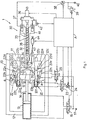
- the injection compression molding machine 1 is made up of a compression molding unit 10, an injection unit 30 and a controller A for controlling the compression molding unit 10 and the injection unit 30.
- the compression molding unit 10 includes a die opening/closing cylinder 13 located on the left side of a frame 12 that is fixed to a table 11 so as to extend to the left.
- a movable die plate 15 disposed within the frame 12 is engaged with a piston rod 14 provided for the die opening/closing cylinder 13.
- This movable die plate 15 is operated to move to the left or right by controlling pressure oil that is supplied from a pressure oil source 17 to the die opening/closing cylinder 13 or discharged reversely, the pressure oil control being performed through the energization and deenergization control of a solenoid selector valve 16 by the controller A.
- Attached to the right side of the movable die plate 15 is a movable die 18.
- a fixed die 19 is attached to the left side of the table 11.
- the fixed die 19 is provided with an inlet 20 piercing therethrough, through which a molten resinous material is fed into a mold cavity 21 formed between the dies 18 and 19.
- the compression molding unit 10 includes a die clamping apparatus 22 which locks the movable die plate 15 when the movable die 18 attached to the movable die plate 15 is placed in a position separated from the fixed die 19 by a predetermined spacing value l 1 , after the movable die plate 15 has been driven to the right by the die opening/closing cylinder 13 and which allows the locked movable die plate 15 to further move to the right thereby clamping both of the dies 18 and 19.
- the die clamping apparatus 22 is composed of a pair of following mechanisms which are respectively disposed above and below the movable die plate 15.
- Each mechanism in the die clamping apparatus 22 comprises (1) a height adjuster 22a secured to the table 11, (2) a cylinder frame 22c which is adjustable so as to move to the left or right, according to the thickness of the dies 18, 19 and to the predetermined spacing value l 1 , by means of the height adjuster 22a through a rod 22b, and (3) a link 22g and a lock cylinder 22h which are supported to the cylinder frame 22c with pins 22d, 22e respectively so as to freely pivot in the direction of arrow a, the link 22g having a die clamping cylinder 22f at the leading end thereof while the lock cylinder 22h allows the link 22g to pivot in the direction of arrow a so as to be away from or come close to the movable die plate 15.
- the die clamping cylinder 22f and the lock cylinder 22h are operated by controlling pressure oil, which is supplied from the pressure oil source 17 to the cylinders 22f, 22h or discharged reversely, through the energization and deenergization control of solenoid selector valves 23, 25 and the flow rate control of a flow control valve 24 performed by the controller A, so that the movable die plate 15 moves rightward together with the movable die 18 and the link 22g moves in the direction of arrow a.
- the injection unit 30 has a nozzle section 31 joined to the inlet 20 of the fixed die 19 in the compression molding unit 10 and a screw 35 housed in a cylinder 32.
- a resinous material such as a plastic synthetic resin
- a material hopper 33 in the form of pellet or powder is weighed, while being melted and mixed, and then injected into the mold cavity 21 via a passage 34 piercing through the nozzle section 31 and via the inlet 20 of the fixed die 19 by means of the screw 35.
- the rotation of the screw 35 for melting and mixing of the resinous material is carried out by a screw rotating motor 36.
- the screw 35 and the screw rotating motor 36 are mounted to a base plate 37.
- the base plate 37 is operated to move to the left or right by controlling pressure oil which is supplied from a pressure oil source 40 to a hydraulic piston 41 or discharged reversely, the pressure oil control being carried out through the flow rate control of a flow control valve 38 and the pressure value setting control of a solenoid relief valve 39 performed by the controller A.
- the controller A is provided with a screw positional value that is obtained by measurement with a screw position detector 42 engaged with the base plate 37. Based on the comparison between this measured screw positional value and a preset stroke value, the controller A performs control in conjunction with the forward and backward movement of the screw 35 according to a specified program so that the solenoid selector valves 16, 23, 25, the flow control valves 24, 38, and the solenoid relief valve 39 are operated and so that the rotation and stop of the screw rotating motor 36 and the switching of an opening/closing valve 43 incorporated in the passage 34 of the nozzle section 31 are controlled through a servo motor 44.
- sheet glass 50 having a thickness of 0.1mm and a specified shape is set so as to be in close contact with the inner side of the movable die 18.
- a resin film 51 made from a resinous material (described later) is affixed beforehand to the surface of the sheet glass 50, which surface is opposite to the surface contacting the movable die 18.
- the energization and deenergization control of the solenoid selector valve 16 is performed so that the movable die plate 15 is moved to the right by the die opening/closing cylinder 13 thereby, moving the movable die 18 forward.
- the energization and deenergization control of the solenoid selector valve 25 is performed to allow the lock cylinder 22h to pivot the link 22g toward the movable die plate 15. Then, the energization and deenergization control of the solenoid selector valve 23 and the flow rate control of the flow control valve 24 are performed to drive the die clamping cylinder 22f such that the right end of the die clamping cylinder 22f comes in contact with the left surface of the movable die plate 15, whereby the movable die plate 15 and therefore the movable die 18 are locked.
- the movable die plate 15 is moved to the right by the die clamping cylinder 22f, thereby moving the movable die 18 forward until the movable die 18 reaches a position that is away from the fixed die 19 by a value equal to a compression width l 2 .
- the servo motor 44 is driven to open the opening/closing valve 43 in the nozzle section 31 of the injection unit 30.
- the flow rate control of the flow control valve 38 and the pressure value setting control of the solenoid relief valve 39 are performed, thereby moving the screw 35 forward with the help of the hydraulic piston 41 to inject a molten resinous material 52 into the mold cavity 21 via the passage 34 and the inlet 20.
- the movable die 18 While the molten resinous material 52 being injected into the mold cavity 21 at a pressure of 150kg/cm 2 , the movable die 18 is moved forward to the fixed die 19 by a distance equal to the compression width l 2 by means of the die clamping cylinder 22f so that the volume of the mold cavity 21 is reduced. In this forward movement, the dies 18, 19 are kept in a parallel relationship.
- a pressure of 100kg/cm 2 which is more than the pressure required for restraining the gas contained in the molten resinous material 52 from growing to be bubbles, is uniformly applied to the entire resinous material 52 being injected so that the molten resinous material is elongated, spreading over the sheet glass 50 to form a layer of 3mm in thickness.
- the servo motor 44 is driven to close the opening/closing valve 43. At that time, the closing of the opening/closing valve 43 prevents the resinous material 52 from reversely flowing into the injection unit 30 due to the pressure of the press. The same effect can be achieved even if the opening/closing valve 43 is disposed within the resinous material passage of the die.
- the elongated, molten resinous material 52 is continuously held and compressed under a holding pressure of 15kg/cm 2 or more generated by the die clamping cylinder 22f until the molten resinous material 52 is cooled and bonded to the sheet glass 50 by virtue of the fusion of the resin film 51.
- the energization and deenergization control of the solenoid selector valve 23 is performed thereby operating the die clamping cylinder 22f to release the movable die 18 and therefore the movable die plate 15 from the locked condition. Further, the energization and deenergization control of the solenoid selector valve 25 is performed thereby operating the lock cylinder 22h to allow the link 22g to pivot, departing from the movable die plate 15. Sequentially, the energization and deenergization control of the solenoid selector valve 16 is performed thereby operating the die opening/closing cylinder 13 to move the movable die plate 15 to the left for the backward movement of the movable die 18.
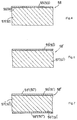
- a composite sheet material 58 in which a glass layer 55 formed from the sheet glass 50, an intermediate layer 56 formed from the resin film 51 and a resin layer 57 molded from the molten resinous material 52 are laminated in order as shown in Figure 4, is removed out of the dies 18, 19.
- the sheet glass 50 has a thickness of 0.1mm in this embodiment, the preferable thickness of the sheet glass 50 may be within the range of from 0.1 to 3mm.
- the resin layer 57 has a thickness of 3mm in this embodiment, the preferable thickness of the resin layer 57 ranges from 3mm to 6mm.
- the thickness of the sheet glass 50 and the thickness of the resin layer 57 do not necessarily fall in the above ranges but may be out of the ranges depending on applications.
- the suitable resinous material of the resin film 51 is adhesive to the sheet glass 50 and to the molding, molten resinous material 52 and can moderate the contraction difference and thermal expansion difference between the sheet glass 50 and the molding, molten resinous material 52 during molding of the molten resinous material 52 into the resin layer 57.
- a suitable resinous material for the resin film 51 By use of such a suitable resinous material for the resin film 51, the bonding strength between the glass layer 55 and the resin layer 57 can be enhanced.
- the resinous material of the resin film 51 should be transparent.
- the suitable resinous material of the resin film 51 is selected from the same thermoplastic resinous materials that can be used as the molten resinous material 52 having transparency, which are polycarbonate, acrylic resin, polystyrene, amorphous polyolefine, polyethylene terephthalate, ethylene-vinyl acetate copolymers (EVA), thermoplastic polyurethane (TPU), ethylene - acrylate - maleic anhydride ternary copolymers, hydrogenated styrene butadiene rubber (SBR hydride), polyvinyl butyral (PVB) and polyolefine elastomers.
- thermoplastic resinous materials that can be used as the molten resinous material 52 having transparency
- thermoplastic resinous materials that can be used as the molten resinous material 52 having transparency, which are polycarbonate, acrylic resin, polystyrene, amorphous polyolefine, polyethylene terephthalate, ethylene-vinyl acetate copolymers (EVA
- the pressure applied to the molten resinous material 52 to elongate it over the sheet glass 50 during molding should be no less than 15kg/cm 2 which is high enough to restrain the gas contained in the molten resinous material 52 from growing to be bubbles and this pressure should be uniformly applied to the entire molten resinous material 52.
- the intermediate layer 56 is formed by affixing the resin film 51 made from one of the materials listed above in this embodiment, the intermediate layer 56 may be formed by primer coating in which such a resinous material is applied to the joint surface of the sheet glass 50.
- the composite sheet material does not necessarily include the intermediate layer 56.
- a composite sheet material 58' as shown in Figure 5 does not include the intermediate layer but a silane coupling agent or volan is applied in pretreatment to the joint surface of sheet glass 50' that constitutes a glass layer 55' in order to enhance bonding strength.
- the composite sheet material includes the above intermediate layer 56
- mirror finishing may be applied to the joint surface of the sheet glass 50 joining to the intermediate layer 56, or a transparent conductive film such as an indium-tin oxide film may be formed on the joint surface by spattering.
- a composite sheet material 58'' includes the glass layer 55 constituting one surface thereof
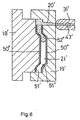
- a composite sheet material 58'' according to another embodiment has glass layers 55'', 55''' on both surfaces as shown in Figure 7.
- This composite sheet material 58'' can be produced by the arrangement shown in Figure 6 in which an inlet 20' through which a molten resinous material 52'' is injected into a mold cavity 21' is disposed aside and thin sheet glass 50'', 50''' of a specified shape is overlaid on the respective inner sides of a movable die 18' and a fixed die 19' in a close contact manner.
- Reference numerals 56' and 56'' respectively designate an intermediate layer.
- these intermediate layers 56' and 56'' may be omitted and a silane coupling agent or volan may be applied in pretreatment instead of provision of the intermediate layers 56', 56''.
- the sheet glass 50''' constituting the glass layer 55''' may be replaced by a transparent resin sheet made from one of the previously listed resinous materials such as polycarbonate, acrylic resin, polystyrene, amorphous polyolefine, polyethylene terephthalate, ethylene-vinyl acetate copolymers (EVA), thermoplastic polyurethane (TPU), ethylene - acrylate - maleic anhydride ternary copolymers, hydrogenated styrene butadiene rubber (SBR hydride), polyvinyl butyral (PVB) and polyolefine elastomers.
- resinous materials such as polycarbonate, acrylic resin, polystyrene, amorphous polyolefine, polyethylene terephthalate, ethylene-vinyl acetate cop
- the preferable resinous material of the resin sheet is harder and has a higher melting point than the resinous material of the resin layer 57.
- the intermediate layer formed by affixing a resin film or by primer coating may be provided between the resin sheet and the resin layer 57'', and printing treatment may be applied to the joint surface of the sheet glass to which the resin film is affixed or primer coating has been applied. Further, mirror finishing or a transparent conductive film may be applied to the joint surface of the resin sheet joining to the intermediate layer. Needless to say, the intermediate layer may be omitted.
- the composite sheet material may be modified to include a plurality of resin layers molded from molten resinous materials.
- a composite sheet material comprising a glass layer formed from sheet glass, a resin layer molded from a molten resinous material, a resin layer formed from a resin sheet, a resin layer molded from a molten resinous material and a resin layer formed from a resin sheet, these layers being laminated in order.
- a composite sheet material according to another example comprises a glass layer formed from sheet glass, a resin layer molded from a molten resinous material, a resin layer formed from a resin sheet, a resin layer molded from a molten resinous material, and a glass layer formed from sheet glass, these layers being laminated in order.
- the compression molding unit such as disclosed in Japanese Patent Laid-Open Publications Nos. 5-220749 (1993) and 5-285955 (1993) may be used in place of the compression molding unit 10 of the forgoing embodiment.
- a composite sheet material is injected by the hot press process such as disclosed in Japanese Patent Laid-Open Publications Nos. 4-361034 (1992) and 4-339646 (1992).
- the composite sheet material is then cooled to room temperature for subsequently carrying out easy thinning in a short time.
- the composite sheet material is pressurized for 10 seconds at a plate temperature of 150° and a pressure of 5kg/cm 2 , using the hot press disclosed in Japanese Patent Laid-Open Publication No. 8-19896 (1996) so that the solidified resin layer 57 is heated, softened and compressed to a thickness of 0.6mm to 1mm.
Landscapes
- Engineering & Computer Science (AREA)
- Manufacturing & Machinery (AREA)
- Mechanical Engineering (AREA)
- Laminated Bodies (AREA)
- Casting Or Compression Moulding Of Plastics Or The Like (AREA)
- Injection Moulding Of Plastics Or The Like (AREA)
Applications Claiming Priority (3)
| Application Number | Priority Date | Filing Date | Title |
|---|---|---|---|
| JP8100569A JPH09286039A (ja) | 1996-04-22 | 1996-04-22 | 板状複合体およびその製造法 |
| JP100569/96 | 1996-04-22 | ||
| PCT/JP1997/001190 WO1997039869A1 (fr) | 1996-04-22 | 1997-04-07 | Materiau composite de type plaque et procede de fabrication |
Publications (2)
| Publication Number | Publication Date |
|---|---|
| EP0908287A1 true EP0908287A1 (fr) | 1999-04-14 |
| EP0908287A4 EP0908287A4 (fr) | 1999-08-11 |
Family
ID=14277549
Family Applications (1)
| Application Number | Title | Priority Date | Filing Date |
|---|---|---|---|
| EP97914625A Withdrawn EP0908287A4 (fr) | 1996-04-22 | 1997-04-07 | Materiau composite de type plaque et procede de fabrication |
Country Status (4)
| Country | Link |
|---|---|
| US (1) | US6296799B1 (fr) |
| EP (1) | EP0908287A4 (fr) |
| JP (1) | JPH09286039A (fr) |
| WO (1) | WO1997039869A1 (fr) |
Cited By (3)
| Publication number | Priority date | Publication date | Assignee | Title |
|---|---|---|---|---|
| EP1445084A1 (fr) * | 2003-02-07 | 2004-08-11 | Creative Plastics International Limited | Procédé de fabrication d'un laminé décoratif verre-résine et laminé fabriqué selon ce procédé |
| WO2008024805A1 (fr) * | 2006-08-23 | 2008-02-28 | Solutia Incorporated | Vitrages multicouches moulés par injection |
| AU2012201329B2 (en) * | 2006-08-23 | 2013-08-15 | Solutia Inc. | Injection molded multiple layer glazings |
Families Citing this family (21)
| Publication number | Priority date | Publication date | Assignee | Title |
|---|---|---|---|---|
| JPH11138668A (ja) | 1997-11-12 | 1999-05-25 | Komatsu Ltd | 板状構造体とその製造方法 |
| US6777482B2 (en) | 2002-04-04 | 2004-08-17 | Owens Corning Fiberglas Technology, Inc. | Alternative polyolefin composite veil/compatibilizing mat material |
| US20040046274A1 (en) * | 2002-09-06 | 2004-03-11 | Chi-Kung Wu | Method for producing a wear-resisting outsole |
| US7981342B2 (en) * | 2003-12-31 | 2011-07-19 | International Automotive Components Group North America, Inc. | In-mold lamination of decorative products |
| JP2006310154A (ja) * | 2005-04-28 | 2006-11-09 | Bussan Nanotech Research Institute Inc | 透明導電膜および透明導電膜用コーティング組成物 |
| JP5295533B2 (ja) * | 2006-10-31 | 2013-09-18 | 日東電工株式会社 | 表面保護フィルムおよび表面保護フィルム付き光学フィルム |
| WO2008088841A2 (fr) * | 2007-01-17 | 2008-07-24 | Collins & Aikman Products Co. | Produits décoratifs ayant une profondeur d'image |
| DE102009021938A1 (de) * | 2009-05-19 | 2010-11-25 | Nyssen, Siegfried, Dr. | Verbundglasscheibe und Verfahren zu ihrer Herstellung |
| US9333690B2 (en) * | 2010-03-26 | 2016-05-10 | Mitsubishi Heavy Industries Plastic Technology | Method for manufacturing a fiber-reinforced composite material |
| US8437000B2 (en) | 2010-06-29 | 2013-05-07 | Honeywell International Inc. | Multiple wavelength cavity ring down gas sensor |
| US8269972B2 (en) | 2010-06-29 | 2012-09-18 | Honeywell International Inc. | Beam intensity detection in a cavity ring down sensor |
| US8322191B2 (en) | 2010-06-30 | 2012-12-04 | Honeywell International Inc. | Enhanced cavity for a photoacoustic gas sensor |
| CN105829051B (zh) | 2013-12-16 | 2018-08-07 | 旭硝子株式会社 | 玻璃树脂层叠体及其制造方法 |
| DE102015218142A1 (de) | 2015-09-22 | 2017-03-23 | Volkswagen Aktiengesellschaft | Verfahren zur Herstellung eines Verbundbauteils |
| CN108025474A (zh) * | 2015-09-25 | 2018-05-11 | 沙特基础工业全球技术有限公司 | 使用模具插入件进行模塑的方法及用于其的装置 |
| KR102203067B1 (ko) * | 2018-10-16 | 2021-01-14 | 주식회사 서연이화 | 차량용 폴리카보네이트 글레이징 및 제조방법 |
| CN110587910A (zh) * | 2019-09-12 | 2019-12-20 | 中国航发北京航空材料研究院 | 一种复合结构透明件的注射成型方法 |
| KR102363856B1 (ko) * | 2019-09-24 | 2022-02-17 | 주식회사 서연이화 | 차량용 폴리카보네이트 글레이징 제조방법 |
| CN112874073B (zh) * | 2021-01-20 | 2022-07-26 | 浙江水墨江南新材料科技有限公司 | 树脂装饰板及制造方法 |
| CN113443841B (zh) * | 2021-08-02 | 2022-04-19 | 南京宣汉玻璃有限公司 | 一种抵御太阳和电磁辐射的玻璃新材料的粘合装置及该玻璃新材料的生产方法 |
| IT202100021047A1 (it) * | 2021-08-04 | 2023-02-04 | B Max S R L | Metodo per la produzione di un materiale composito resistente e prodotti cosi' ottenuti |
Family Cites Families (30)
| Publication number | Priority date | Publication date | Assignee | Title |
|---|---|---|---|---|
| US2084113A (en) * | 1935-03-23 | 1937-06-15 | Duplate Corp | Process and apparatus for making safety glass |
| US3382137A (en) * | 1964-09-18 | 1968-05-07 | Corning Glass Works | Laminated structures and method for preparing such structures |
| DE1629350A1 (de) * | 1966-02-16 | 1971-05-19 | Deutsche Spiegelglas Ag | Mit UEberzug versehene,kratzfeste,chemisch und mechanisch widerstandsfaehige Kunststoffscheibe |
| US3666614A (en) * | 1969-06-24 | 1972-05-30 | Union Carbide Corp | Glass-polycarbonate resin laminates |
| US3620905A (en) * | 1969-10-21 | 1971-11-16 | Du Pont | Optically clear thermoplastic polyurethanes |
| JPS5936800B2 (ja) | 1976-08-30 | 1984-09-05 | 沖エンジニアリング株式会社 | 車輌分離識別装置 |
| CA1114115A (fr) * | 1977-11-04 | 1981-12-15 | Corning Glass Works | Methode de coulee directe pour la production de composites verre et plastique a faible reaction aux contraintes |
| ZA824094B (en) | 1981-06-19 | 1983-07-27 | Ici Plc | A process for the manufacture of cephalosporin derivative |
| US4724023A (en) * | 1985-04-09 | 1988-02-09 | E M Partners Ag | Method of making laminated glass |
| JPS63262241A (ja) * | 1987-04-21 | 1988-10-28 | 旭化成株式会社 | 積層体 |
| JPH07166B2 (ja) | 1987-09-24 | 1995-01-11 | 三菱重工業株式会社 | Co吸着分離方法 |
| JPH0520523Y2 (fr) * | 1987-11-18 | 1993-05-27 | ||
| FR2634753B1 (fr) * | 1988-07-27 | 1992-08-21 | Saint Gobain Vitrage | Vitrage a couche electro-conductrice obtenue par pyrolyse de composes en poudre, utilisable en tant que pare-brise pour automobile |
| GB9009066D0 (en) | 1990-04-23 | 1990-06-20 | Hickman James A A | Method of laminating glass |
| EP0490580B1 (fr) * | 1990-12-11 | 1999-05-06 | Pilkington United Kingdom Limited | Procédé pour laminer des vitrages et article ainsi obtenu |
| US5264160A (en) * | 1991-04-30 | 1993-11-23 | Canon Kabushiki Kaisha | Method of molding optical elements |
| JP2970062B2 (ja) * | 1991-06-12 | 1999-11-02 | 住友化学工業株式会社 | 多層成形品の成形方法 |
| JPH05514A (ja) | 1991-06-24 | 1993-01-08 | Ricoh Co Ltd | インク吐出用ノズルの目詰まり防止機能をもつ保存装置 |
| JP3036916B2 (ja) * | 1991-09-27 | 2000-04-24 | 積水化学工業株式会社 | 積層安全ガラス |
| JP3039070B2 (ja) | 1991-10-09 | 2000-05-08 | 住友電気工業株式会社 | 弗素樹脂被覆物 |
| JPH05208467A (ja) * | 1991-10-23 | 1993-08-20 | Sumitomo Chem Co Ltd | 多層成形体及びその製造方法 |
| DE4212944A1 (de) * | 1992-04-18 | 1993-10-21 | Docter Optic Wetzlar Gmbh | Verfahren zur Herstellung einer Glasfläche |
| FR2691112B1 (fr) * | 1992-05-14 | 1995-07-21 | Saint Gobain Vitrage Int | Procede d'encapsulation d'un vitrage et vitrage ainsi obtenu. |
| GB9313830D0 (en) * | 1993-07-01 | 1993-08-18 | Aho Michael S | Improvements in and relating to strengthened glass products |
| JPH07205374A (ja) | 1993-07-28 | 1995-08-08 | Asahi Glass Co Ltd | 積層ガラスおよび積層ガラスの製造方法 |
| DE4406097A1 (de) * | 1994-02-25 | 1995-08-31 | Dornier Gmbh | Verglasung |
| US5545277A (en) | 1994-10-03 | 1996-08-13 | Ford Motor Company | Plate glass edge strength |
| US6368537B1 (en) | 1994-10-20 | 2002-04-09 | Komatsu Ltd. | Laminated plate and method for making the same |
| US5593786A (en) | 1994-11-09 | 1997-01-14 | Libbey-Owens-Ford Company | Self-adhering polyvinyl chloride safety glass interlayer |
| FR2743802B1 (fr) * | 1996-01-19 | 1998-03-20 | Saint Gobain Vitrage | Vitrage feuillete et primaire utilise pour sa realisation |
-
1996
- 1996-04-22 JP JP8100569A patent/JPH09286039A/ja active Pending
-
1997
- 1997-04-07 EP EP97914625A patent/EP0908287A4/fr not_active Withdrawn
- 1997-04-07 WO PCT/JP1997/001190 patent/WO1997039869A1/fr not_active Ceased
- 1997-04-07 US US09/171,093 patent/US6296799B1/en not_active Expired - Fee Related
Cited By (4)
| Publication number | Priority date | Publication date | Assignee | Title |
|---|---|---|---|---|
| EP1445084A1 (fr) * | 2003-02-07 | 2004-08-11 | Creative Plastics International Limited | Procédé de fabrication d'un laminé décoratif verre-résine et laminé fabriqué selon ce procédé |
| WO2008024805A1 (fr) * | 2006-08-23 | 2008-02-28 | Solutia Incorporated | Vitrages multicouches moulés par injection |
| AU2012201329B2 (en) * | 2006-08-23 | 2013-08-15 | Solutia Inc. | Injection molded multiple layer glazings |
| US9242401B2 (en) | 2006-08-23 | 2016-01-26 | Solutia Inc. | Injection molded multiple layer glazings |
Also Published As
| Publication number | Publication date |
|---|---|
| WO1997039869A1 (fr) | 1997-10-30 |
| US6296799B1 (en) | 2001-10-02 |
| JPH09286039A (ja) | 1997-11-04 |
| EP0908287A4 (fr) | 1999-08-11 |
Similar Documents
| Publication | Publication Date | Title |
|---|---|---|
| US6296799B1 (en) | Plate-like composite material and method of producing the same | |
| EP0787568B1 (fr) | Procede de fabrication d'une plaque de verre laminee | |
| EP1023150B1 (fr) | Procede et appareil de preparation d'un article moule | |
| EP1054762B1 (fr) | Moulage par extrusion-compression d'articles optiques | |
| EP1785253B1 (fr) | Processus pour produire des objets moulés et appareil correspondant | |
| CN103009549B (zh) | 复合成形品的成形方法 | |
| WO1994025244A1 (fr) | Procede et appareil pour fabriquer des produits moules stratifies | |
| JP2012179773A (ja) | 多層成形装置及び多層成形方法 | |
| CN115195023B (zh) | 一种热塑性有机纤维板一体成型设备 | |
| EP0768159A2 (fr) | Procédé pour le moulage par compression de matières plastiques | |
| JP2521620B2 (ja) | 成形材料を射出するための方法及び装置 | |
| JP4224048B2 (ja) | 成形体の製造装置および製造方法 | |
| JP2007136842A (ja) | 成形体の製造装置および製造方法 | |
| JP2785352B2 (ja) | 複合材の成形装置 | |
| US6001287A (en) | Method of press-molding thermoplastic resin | |
| CN120921718A (zh) | 一种热塑碳板的生产工艺 | |
| MXPA00001413A (en) | Process and apparatus for preparing a molded article | |
| JPH0583057B2 (fr) |
Legal Events
| Date | Code | Title | Description |
|---|---|---|---|
| PUAI | Public reference made under article 153(3) epc to a published international application that has entered the european phase |
Free format text: ORIGINAL CODE: 0009012 |
|
| 17P | Request for examination filed |
Effective date: 19981120 |
|
| AK | Designated contracting states |
Kind code of ref document: A1 Designated state(s): DE |
|
| A4 | Supplementary search report drawn up and despatched |
Effective date: 19990629 |
|
| AK | Designated contracting states |
Kind code of ref document: A4 Designated state(s): DE |
|
| 17Q | First examination report despatched |
Effective date: 20010326 |
|
| STAA | Information on the status of an ep patent application or granted ep patent |
Free format text: STATUS: THE APPLICATION IS DEEMED TO BE WITHDRAWN |
|
| 18D | Application deemed to be withdrawn |
Effective date: 20020410 |