EP0908445A1 - Composition de teinture d'oxydation des fibres kératiniques comprenant un dérivé d'aminoacide en tant que base d'oxydation et nouveaux dérivés d'aminoacides - Google Patents
Composition de teinture d'oxydation des fibres kératiniques comprenant un dérivé d'aminoacide en tant que base d'oxydation et nouveaux dérivés d'aminoacides Download PDFInfo
- Publication number
- EP0908445A1 EP0908445A1 EP98402479A EP98402479A EP0908445A1 EP 0908445 A1 EP0908445 A1 EP 0908445A1 EP 98402479 A EP98402479 A EP 98402479A EP 98402479 A EP98402479 A EP 98402479A EP 0908445 A1 EP0908445 A1 EP 0908445A1
- Authority
- EP
- European Patent Office
- Prior art keywords
- amino
- radical
- aminophenyl
- acid
- group
- Prior art date
- Legal status (The legal status is an assumption and is not a legal conclusion. Google has not performed a legal analysis and makes no representation as to the accuracy of the status listed.)
- Granted
Links
Classifications
-
- A—HUMAN NECESSITIES
- A61—MEDICAL OR VETERINARY SCIENCE; HYGIENE
- A61K—PREPARATIONS FOR MEDICAL, DENTAL OR TOILETRY PURPOSES
- A61K8/00—Cosmetics or similar toiletry preparations
- A61K8/18—Cosmetics or similar toiletry preparations characterised by the composition
- A61K8/30—Cosmetics or similar toiletry preparations characterised by the composition containing organic compounds
- A61K8/49—Cosmetics or similar toiletry preparations characterised by the composition containing organic compounds containing heterocyclic compounds
- A61K8/4906—Cosmetics or similar toiletry preparations characterised by the composition containing organic compounds containing heterocyclic compounds with one nitrogen as the only hetero atom
- A61K8/4926—Cosmetics or similar toiletry preparations characterised by the composition containing organic compounds containing heterocyclic compounds with one nitrogen as the only hetero atom having six membered rings
-
- A—HUMAN NECESSITIES
- A61—MEDICAL OR VETERINARY SCIENCE; HYGIENE
- A61K—PREPARATIONS FOR MEDICAL, DENTAL OR TOILETRY PURPOSES
- A61K8/00—Cosmetics or similar toiletry preparations
- A61K8/18—Cosmetics or similar toiletry preparations characterised by the composition
- A61K8/30—Cosmetics or similar toiletry preparations characterised by the composition containing organic compounds
- A61K8/40—Cosmetics or similar toiletry preparations characterised by the composition containing organic compounds containing nitrogen
- A61K8/44—Aminocarboxylic acids or derivatives thereof, e.g. aminocarboxylic acids containing sulfur; Salts; Esters or N-acylated derivatives thereof
-
- A—HUMAN NECESSITIES
- A61—MEDICAL OR VETERINARY SCIENCE; HYGIENE
- A61K—PREPARATIONS FOR MEDICAL, DENTAL OR TOILETRY PURPOSES
- A61K8/00—Cosmetics or similar toiletry preparations
- A61K8/18—Cosmetics or similar toiletry preparations characterised by the composition
- A61K8/30—Cosmetics or similar toiletry preparations characterised by the composition containing organic compounds
- A61K8/49—Cosmetics or similar toiletry preparations characterised by the composition containing organic compounds containing heterocyclic compounds
- A61K8/4906—Cosmetics or similar toiletry preparations characterised by the composition containing organic compounds containing heterocyclic compounds with one nitrogen as the only hetero atom
- A61K8/4913—Cosmetics or similar toiletry preparations characterised by the composition containing organic compounds containing heterocyclic compounds with one nitrogen as the only hetero atom having five membered rings, e.g. pyrrolidone carboxylic acid
- A61K8/492—Cosmetics or similar toiletry preparations characterised by the composition containing organic compounds containing heterocyclic compounds with one nitrogen as the only hetero atom having five membered rings, e.g. pyrrolidone carboxylic acid having condensed rings, e.g. indol
-
- A—HUMAN NECESSITIES
- A61—MEDICAL OR VETERINARY SCIENCE; HYGIENE
- A61Q—SPECIFIC USE OF COSMETICS OR SIMILAR TOILETRY PREPARATIONS
- A61Q5/00—Preparations for care of the hair
- A61Q5/10—Preparations for permanently dyeing the hair
-
- C—CHEMISTRY; METALLURGY
- C07—ORGANIC CHEMISTRY
- C07C—ACYCLIC OR CARBOCYCLIC COMPOUNDS
- C07C229/00—Compounds containing amino and carboxyl groups bound to the same carbon skeleton
- C07C229/02—Compounds containing amino and carboxyl groups bound to the same carbon skeleton having amino and carboxyl groups bound to acyclic carbon atoms of the same carbon skeleton
- C07C229/04—Compounds containing amino and carboxyl groups bound to the same carbon skeleton having amino and carboxyl groups bound to acyclic carbon atoms of the same carbon skeleton the carbon skeleton being acyclic and saturated
- C07C229/06—Compounds containing amino and carboxyl groups bound to the same carbon skeleton having amino and carboxyl groups bound to acyclic carbon atoms of the same carbon skeleton the carbon skeleton being acyclic and saturated having only one amino and one carboxyl group bound to the carbon skeleton
- C07C229/18—Compounds containing amino and carboxyl groups bound to the same carbon skeleton having amino and carboxyl groups bound to acyclic carbon atoms of the same carbon skeleton the carbon skeleton being acyclic and saturated having only one amino and one carboxyl group bound to the carbon skeleton the nitrogen atom of the amino group being further bound to carbon atoms of six-membered aromatic rings
-
- C—CHEMISTRY; METALLURGY
- C07—ORGANIC CHEMISTRY
- C07C—ACYCLIC OR CARBOCYCLIC COMPOUNDS
- C07C229/00—Compounds containing amino and carboxyl groups bound to the same carbon skeleton
- C07C229/02—Compounds containing amino and carboxyl groups bound to the same carbon skeleton having amino and carboxyl groups bound to acyclic carbon atoms of the same carbon skeleton
- C07C229/04—Compounds containing amino and carboxyl groups bound to the same carbon skeleton having amino and carboxyl groups bound to acyclic carbon atoms of the same carbon skeleton the carbon skeleton being acyclic and saturated
- C07C229/26—Compounds containing amino and carboxyl groups bound to the same carbon skeleton having amino and carboxyl groups bound to acyclic carbon atoms of the same carbon skeleton the carbon skeleton being acyclic and saturated having more than one amino group bound to the carbon skeleton, e.g. lysine
-
- C—CHEMISTRY; METALLURGY
- C07—ORGANIC CHEMISTRY
- C07D—HETEROCYCLIC COMPOUNDS
- C07D213/00—Heterocyclic compounds containing six-membered rings, not condensed with other rings, with one nitrogen atom as the only ring hetero atom and three or more double bonds between ring members or between ring members and non-ring members
- C07D213/02—Heterocyclic compounds containing six-membered rings, not condensed with other rings, with one nitrogen atom as the only ring hetero atom and three or more double bonds between ring members or between ring members and non-ring members having three double bonds between ring members or between ring members and non-ring members
- C07D213/04—Heterocyclic compounds containing six-membered rings, not condensed with other rings, with one nitrogen atom as the only ring hetero atom and three or more double bonds between ring members or between ring members and non-ring members having three double bonds between ring members or between ring members and non-ring members having no bond between the ring nitrogen atom and a non-ring member or having only hydrogen or carbon atoms directly attached to the ring nitrogen atom
- C07D213/60—Heterocyclic compounds containing six-membered rings, not condensed with other rings, with one nitrogen atom as the only ring hetero atom and three or more double bonds between ring members or between ring members and non-ring members having three double bonds between ring members or between ring members and non-ring members having no bond between the ring nitrogen atom and a non-ring member or having only hydrogen or carbon atoms directly attached to the ring nitrogen atom with hetero atoms or with carbon atoms having three bonds to hetero atoms with at the most one bond to halogen, e.g. ester or nitrile radicals, directly attached to ring carbon atoms
- C07D213/72—Nitrogen atoms
- C07D213/74—Amino or imino radicals substituted by hydrocarbon or substituted hydrocarbon radicals
Definitions
- the present invention relates to a composition of dyeing of keratin fibers, and in particular fibers human keratin, comprising, as an oxidation base, minus an amino acid derivative substituted on an amino group by a aromatic ring group, to a dyeing process using such a composition and using revelation by an oxidizing agent and new amino acid derivatives of which an amino group is substituted by a group with an aromatic nucleus.
- oxidation dye precursors comprising "oxidation bases", in particular ortho- or paraphenylenediamines and ortho- or para-aminophenols, as well as couplers also called color modifiers, plus particularly aromatic meta-phenylenediamines, meta-aminophenols and meta-diphenols, which allow to modify and enrich the background colors obtained by the products with reflections of condensation of oxidation bases.
- oxidation bases in particular ortho- or paraphenylenediamines and ortho- or para-aminophenols
- couplers also called color modifiers
- aromatic meta-phenylenediamines, meta-aminophenols and meta-diphenols which allow to modify and enrich the background colors obtained by the products with reflections of condensation of oxidation bases.
- oxidation dye precursors having high dye power to allow the formulator to create a wide palette of shades.
- the oxidation dye precursors have a power high dye at neutral pH around 7 rather than basic pH (pH ⁇ 9) in order to respect the entirety of the keratin fiber and produce less irritation of the scalp.
- Compounds (I) can be isomers optically active agents or mixtures of such isomers.
- the new dyes thus obtained make it possible to obtain natural color supported at neutral pH around 7 and non toxic.
- Another object of the invention is the dye composition ready to use, containing at least one amino acid derivative such as defined above as an oxidation base and an oxidizing agent.
- the invention also relates to a process for dyeing fibers keratin, and in particular human keratin fibers such that the hair, consisting in applying to these fibers at least one composition (A) containing, in a medium suitable for dyeing, as oxidation base, at least one amino acid derivative of formula (I) as defined above and to reveal the color in the middle alkaline, neutral or acid using an oxidizing agent which is added just at the time of use in composition (A) or which is present in a composition (B) applied simultaneously or sequentially with separately.
- composition (A) containing, in a medium suitable for dyeing, as oxidation base, at least one amino acid derivative of formula (I) as defined above and to reveal the color in the middle alkaline, neutral or acid using an oxidizing agent which is added just at the time of use in composition (A) or which is present in a composition (B) applied simultaneously or sequentially with separately.
- a subject of the invention is also dyeing devices. or “kits” with several compartments, including the first compartment contains a composition (A) comprising at least one derivative amino acid as defined above as an oxidation base, and the second compartment contains a composition (B) comprising a oxidizing agent in a medium suitable for dyeing.
- Amino acid derivatives having an amino group substituted by an aromatic ring of formula (I) above have never used as oxidation bases in hair dye.
- a glycine derivative namely N- (4-aminophenyl) glycine, is known in thermography as a transfer reagent in a duplication process described in French patent FR-A-1,506,081 and in photography according to patent GB-A-1,227,395 or the request for Patent JP-A-02068546.
- These new amino acid derivatives (I ′) can be optically active isomers or mixtures of such isomers.
- X preferably represents a phenyl or pyridyl ring substituted with an amino group -NH 2 .
- the addition salts with an acid are chosen from hydrochlorides, sulfates, hydrobromides and tartrates.
- the preferred compounds (I) for use in dyeing oxidation according to the invention are: N ⁇ - (4-aminophenyl) -L-lysine, N ⁇ - (4-amino-2-pyridyl) -L-lysine; N- (4-aminophenyl) -glycine, N ⁇ - (4-aminophenyl) -L-lysine, N ⁇ , N ⁇ -di- (4-aminophenyl) -L-lysine, N- (4-aminophenyl) -L-serine, 6-N- (4-aminophenyl) amino-caproic acid and ⁇ -N- (4-aminophenyl) amino - ⁇ -caprolactam, as well as their addition salts with an acid.
- the compounds of formula (I) or (I ') are prepared according to the following procedures depending on whether they are lysine derivatives, glycine or other derivatives such as ⁇ -amino acids and derivatives lactams.
- a solution containing 1 equivalent of 4-fluoro-nitrobenzene or 2-chloro-5-nitropyridine in 40 ml of ethanol is prepared then poured drop by drop drop on the homogeneous mixture. After 6 hours of heating at reflux, the reaction medium is cooled and then filtered. The yellow-green precipitate corresponding to the final product in the form of copper complex, is washed with water and acetone, then dried in a vacuum oven. For remove copper, x moles of complex are treated with 2 eq of thioacetamide at reflux of water. After removing the sulfide from copper by filtration on paper, the filtrate is cooled to obtain crystallization of the expected final product.
- the aqueous phase is acidified to pH ⁇ 3 and again extracted with ethyl acetate.
- the organic phases are combined, washed with water and dried over sodium sulfate. After evaporation, an orange-yellow oil is obtained which is purified by flash chromatography (eluent: CH 2 Cl 2 95 / CH 3 OH 5) to give 1.6 g of a yellow crystalline product, ie a final yield of 22 %.
- the oxidation dye compositions according to the invention generally contain about 0.01 to 10% by weight, and preferably about 0.05 to 5% by weight, of at least one base oxidation of formula (I) above defined.
- the oxidizing agent is preferably chosen from peroxide hydrogen, urea peroxide, alkali metal bromates, persalts such as perborates and persulfates, and enzymes such than peroxidases and oxidoreductases with two electrons.
- peroxide hydrogen urea peroxide
- alkali metal bromates persalts such as perborates and persulfates
- enzymes such than peroxidases and oxidoreductases with two electrons.
- the use of hydrogen peroxide is particularly preferred.
- Composition (A), which contains the oxidation base of formula (I) as described above, can have a pH between 3 and 12, and preferably between 5 and 11, which can be adjusted to the value chosen by means of either basifying agents usually used in dyeing keratin fibers, such as ammonia, alkali carbonates, alkanolamines, for example mono-, di- and triethanolamines as well as their derivatives, sodium hydroxides or of potassium, the compounds of formula: in which R is a propylene residue optionally substituted by a hydroxyl group or a C 1 -C 4 alkyl radical; R 3, R 4, R 5 and R 6 simultaneously or independently of one another represent a hydrogen atom, an alkyl radical in C 1 -C 4 hydroxyalkyl or C 1 -C 4 alkyl, either by means of conventional acidifying agents, such as mineral or organic acids such as, for example, hydrochloric, tartaric, citric and phosphoric acids.
- basifying agents usually used in dyeing keratin fibers
- the pH of the composition (B) containing the oxidizing agent such as defined above is such that after mixing with the composition (A), the pH of the composition applied to the keratin fibers human varies between 3 and 12 and preferably between 5 and 11. It is adjusted to the desired value using acidifying agents or possibly alkalizing agents well known in the art, such than those described above.
- the oxidizing composition (B) preferably consists of a solution of hydrogen peroxide.
- the composition of dye (A) described above with an oxidizing solution in one enough to develop a color is then applied to human keratin fibers and left apply for 5 to 40 minutes, preferably 15 to 30 minutes, after which is rinsed, washed with shampoo, rinsed again and dried.
- the dye compositions according to the invention can contain, in addition to the oxidation dye precursors of formula (I) defined above, other precursors of oxidation dyes chosen from paraphenylenediamines, bis-phenylalkylenediamines, para-aminophenols, ortho-aminophenols, heterocyclic bases, benzene couplers and heterocyclic couplers.
- para-phenylenediamines everything is preferred. particularly paraphenylenediamine, paratoluylenediamine, 2-isopropyl paraphenylenediamine, 2- ⁇ -hydroxyethyl paraphenylenediamine, 2- ⁇ -hydroxyethyloxy paraphenylenediamine, 2,6-dimethyl paraphenylenediamine, 2,6-diethyl paraphenylenediamine, 2,3-dimethyl paraphenylenediamine, N, N-bis- ( ⁇ -hydroxyethyl) paraphenylenediamine, 2-chloro paraphenylenediamine, and their addition salts with an acid.
- N, N'-bis ( ⁇ -hydroxyethyl) is preferred N, N'-bis (4'-aminophenyl) 1,3-diaminopropanol or one of its addition salts with an acid.
- para-aminophenol 4-amino 3-methyl phenol, 4-amino 3-fluoro phenol, 4-amino 3-hydroxymethyl phenol, 4-amino 2-methyl phenol, 4-amino 2-hydroxymethyl phenol, 4-amino 2-methoxymethyl phenol, 4-amino 2-aminomethyl phenol, 4-amino 2- ( ⁇ -hydroxyethyl aminomethyl) phenol, 4-amino 2-fluoro phenol, and their addition salts with an acid.
- ortho-aminophenols one can more particularly quote 2-amino phenol, 2-amino 5-methyl phenol, 2-amino 6-methyl phenol, 5-acetamido 2-amino phenol, and their addition salts with an acid.
- heterocyclic bases one can more particularly mention pyridine derivatives, derivatives pyrimidinics, pyrazole derivatives, pyrazolo-pyrimidine derivatives, and their addition salts with an acid.
- benzene couplers one can more particularly mention meta-aminophenol, 2-methyl 5-aminophenol, 2-methyl-5-N- ( ⁇ -hydroxyethylamino) phenol, 2-methoxy-5-aminophenol, 2- ( ⁇ -hydroxyethyloxy) -5-amino phenol, 5-N- ( ⁇ -hydroxyethylamino) 4-methoxy 2-methyl phenol, 5-amino 4-methoxy 2-methyl phenol, 5-amino 4-chloro 2-methyl phenol, 5-amino 2,4-dimethoxy phenol, 5-N- ( ⁇ -hydroxypropylamino) 2-methyl phenol, 3,5-diamino 1-ethyl 2-methoxy benzene, 3,5-diamino 2-methoxy 1-methyl benzene, 2,4-diamino 1-ethoxy benzene, 1,3bis (2,4-diaminophenoxy) propane, bis- (2,4-diaminophenoxy) methane, 2,
- the dye compositions according to the invention can also contain direct dyes chosen from azo dyes, anthraquinones and nitro derivatives of the benzene series and / or melanin precursors, in particular for modifying the nuances or enrich them with reflections.
- the dye compositions may also contain antioxidants. These can be chosen in particular from sodium sulfite, thioglycolic acid, thiolactic acid, sodium bisulfite, dehydroascorbic acid, hydroquinone, 2-methyl hydroquinone, tert.butyl hydroquinone, 3-methyl 1-phenyl 5-pyrazolone and homogentisic acid and are then generally present in proportions of between approximately 0.05 and 1.5% by weight relative to the total weight of the composition.
- antioxidants can be chosen in particular from sodium sulfite, thioglycolic acid, thiolactic acid, sodium bisulfite, dehydroascorbic acid, hydroquinone, 2-methyl hydroquinone, tert.butyl hydroquinone, 3-methyl 1-phenyl 5-pyrazolone and homogentisic acid and are then generally present in proportions of between approximately 0.05 and 1.5% by weight relative to the total weight of the composition.
- the dye compositions also contain, in their preferred embodiment, well-known surfactants of the technique, in proportions of between about 0.5 and 55% by weight, and preferably between 2 and 50% by weight relative to the total weight of the composition, organic solvents, in proportions of between about 1 and 40% by weight, and particular between 5 and 30% by weight relative to the total weight of the composition, or any other cosmetically acceptable adjuvant and known from the prior art in hair oxidation dyeing.
- well-known surfactants of the technique in proportions of between about 0.5 and 55% by weight, and preferably between 2 and 50% by weight relative to the total weight of the composition
- organic solvents in proportions of between about 1 and 40% by weight, and particular between 5 and 30% by weight relative to the total weight of the composition, or any other cosmetically acceptable adjuvant and known from the prior art in hair oxidation dyeing.
- composition applied to the hair can be presented in various forms, such as liquid, cream, gel, or in any other form suitable for dyeing keratin fibers, and in particular human hair.
- it can be packaged under pressure in an aerosol can in the presence of a propellant and form a foam.
- the dyes are used in equal molar amount, namely 3 ⁇ 10 -3 mol%.
- the mixture obtained is applied to locks of hair natural gray with 90% white at a rate of 30 g for 3 g of hair during 30 minutes.
- the locks are then rinsed, washed with a standard shampoo, rinsed again and then dried.
- Hair color is assessed visually and then measured with the MINOLTA CM 2002 colorimeter.
- the dyes are used in equal molar amount, namely 3 x 10 -3 mole%.
- Hair color is evaluated in the same way.
- examples 1 to 5 carried out in a neutral environment in examples 11 to 15 carried out in basic medium with the same base oxidation, namely N ⁇ - (4-aminophenyl) -L-lysine we see that the latter is more powerful in neutral medium than in medium basic, because the pitch heights obtained in basic medium are more 0.5 to 2 tones high, i.e. lighter than those obtained in neutral medium with the same dye precursors.
Landscapes
- Organic Chemistry (AREA)
- Chemical & Material Sciences (AREA)
- Life Sciences & Earth Sciences (AREA)
- Health & Medical Sciences (AREA)
- Public Health (AREA)
- General Health & Medical Sciences (AREA)
- Animal Behavior & Ethology (AREA)
- Veterinary Medicine (AREA)
- Epidemiology (AREA)
- Birds (AREA)
- Cosmetics (AREA)
- Organic Low-Molecular-Weight Compounds And Preparation Thereof (AREA)
- Coloring (AREA)
- Pyridine Compounds (AREA)
- Indole Compounds (AREA)
Abstract
Description

- n est un nombre entier compris entre 0 et 11 inclusivement ;
- R représente un atome d'hydrogène, un radical amino, alkyle
en C1-C6 linéaire ou ramifié, saturé ou insaturé, ou un radical choisi
parmi les groupements suivants :

- R' représente un radical alkyle en C1-C6, linéaire ou ramifié, saturé ou insaturé ;
- n' est un nombre entier compris entre 1 et 6 inclusivement ;
- X représente un groupe aromatique à un ou deux cycles, le ou les cycles pouvant contenir un ou plusieurs hétéroatomes choisis parmi S, N ou O ; le ou les cycles étant substitués par au moins un groupement -NHR" ou par un radical -OH se trouvant en position para ou ortho sur le groupe aromatique X par rapport au groupement -NH, R" désignant un atome d'hydrogène, un radical alkyle en C1-C6, linéaire ou ramifié, saturé ou insaturé, éventuellement hydroxyle, à l'exclusion du composé dans lequel n=0, R=H et X est un radical 4-hydroxyphényle,

- n est un nombre entier compris entre 0 et 11 inclusivement ;
- R représente un atome d'hydrogène, un radical amino,
alkyle en C1-C6 linéaire ou ramifié, saturé ou insaturé, ou un radical
choisi parmi les groupements suivants :
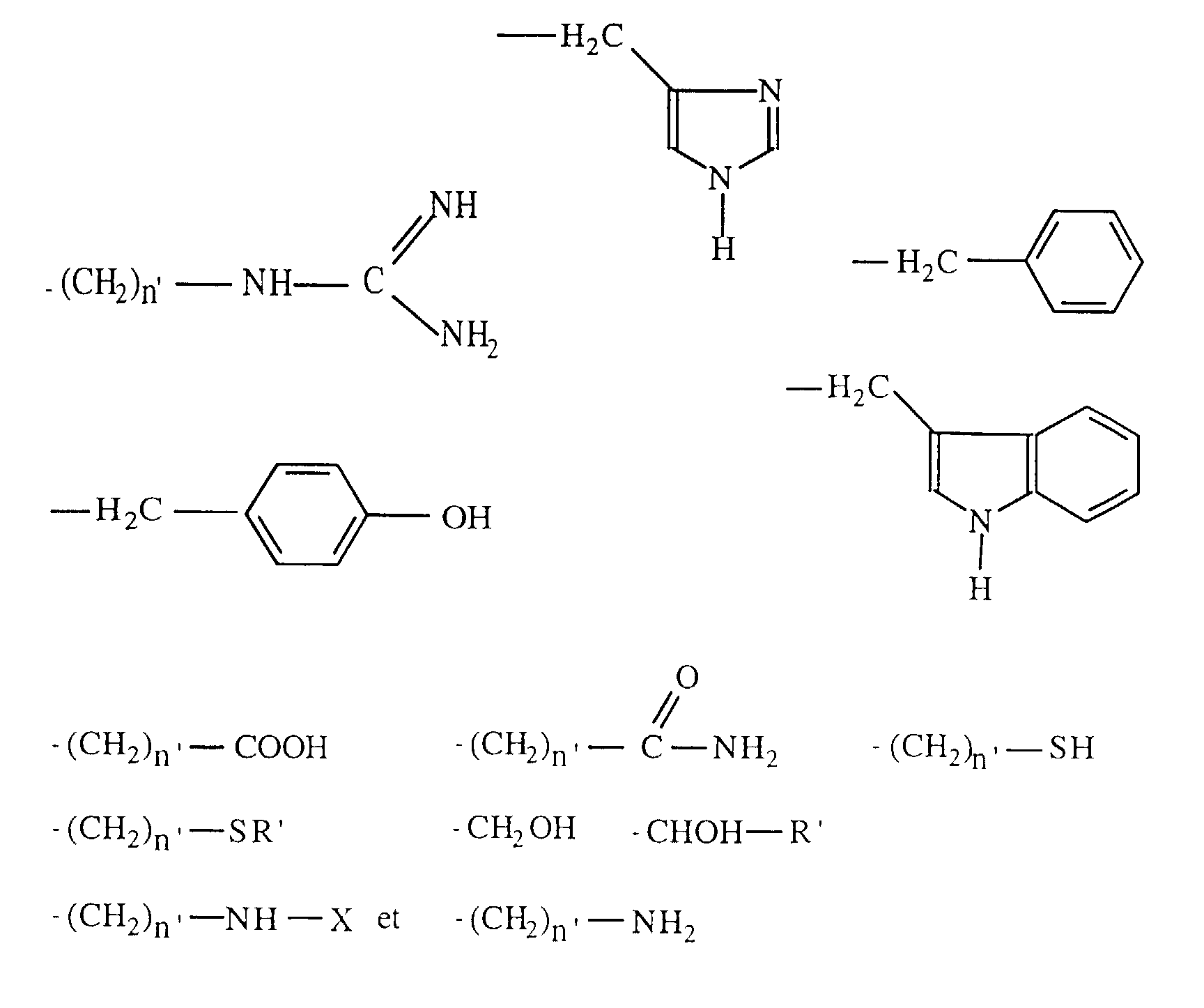
- R' représente un radical alkyle en C1-C6, linéaire ou ramifié, saturé ou insaturé ;
- n' est un nombre entier compris entre 1 et 6 inclusivement ;
- X représente un groupe aromatique à un ou deux cycles, le ou les cycles pouvant contenir un ou plusieurs hétéroatomes choisis parmi S, N ou O ; le ou les cycles étant substitués par au moins un groupement -NHR" ou par un radical -OH se trouvant en position para ou ortho sur le groupe aromatique X par rapport au groupement -NH, R" désignant un atome d'hydrogène, un radical alkyle en C1-C6, linéaire ou ramifié, saturé ou insaturé, éventuellement hydroxylé, sans comporter de groupements nitro,
ou l'un de leurs sels d'addition avec un acide.
- la Nε-(4-aminophényl)-L-lysine ;
- la Nε-(4-amino-2-pyridyl)-L-lysine ;
- la Nα-(4-aminophényl)-L-lysine ;
- la Nα,Nε-di-(4-aminophényl)-L-lysine ;
- la N-(4-aminophényl)-L-sérine et
- l'acide 6-N-(4-aminophényl)amino-caproïque et
- l'α-N-(4-aminophényl)amino -ε-caprolactame.
- F: 254°-258° C (banc Kofler)
- Analyse élémentaire (C12H17N3O4, PM= 267,287)
| C | H | N | O | |
| % calc. | 53,92 | 6,41 | 15,72 | 23,94 |
| % trouv. | 53,64 | 6,36 | 15,85 | 24,16 |
- F: > 260° C (banc Kofler)
- Analyse élémentaire (C11H16N4O4, PM= 268,275)
| C | H | N | O | |
| % calc. | 49,25 | 6,01 | 20,88 | 23,86 |
| % trouv. | 48,96 | 6,09 | 20,95 | 24,10 |
- F: 146-150° C (banc Kofler)
- Analyse élémentaire (C12H19N3O2,3HCl; PM= 346,687)
| C | H | N | O | Cl | |
| % calc. | 41,57 | 6,40 | 12,12 | 9,23 | 30,68 |
| % trouv. | 41,04 | 6,55 | 11,78 | 10,57 | 30,28 |
- F: 180-185° C (banc Kofler)
- Analyse élémentaire (C11H18N4O2,3HCl; PM= 347,675)
| C | H | N | O | Cl | |
| % calc. | 38,00 | 6,09 | 16,11 | 9,2 | 30,59 |
| % trouv. | 38,03 | 6,05 | 15,97 | 9,55 | 30,43 |
- F: 136°-140° C (banc Kofler)
- HPCCM (silice MERCK): éluant acétate d'éthyle 80/méthanol 20
Rf = 0,30 (révélation UV) - Les spectres RMN sont enregistrés sur un BRUKER AMX 500 MHz et sont conformes à la structure attendue.
- Analyse élémentaire (C12H19N3O2,3HCl, 2H2O; PM= 382,7)
| C | H | N | O | Cl | |
| % calc. | 37,62 | 6,27 | 10,97 | 16,72 | 27,82 |
| % trouv. | 37,00 | 6,63 | 10,35 | 15,28 | 27,44 |
- F : 72°-76° C (banc Kofler)
| C | H | N | O | |
| % calc. | 55,67 | 5,19 | 14,43 | 24,72 |
| % trouv. | 55,90 | 5,13 | 14,79 | 24,96 |
- HPCCM (silice MERCK): éluant NH4OH 6/ CH3OH 47/
CH2Cl2 47
Rf = 0,75 (révélation UV et ninhydrine) - Les spectres RMN sont enregistrés sur un BRUKER AMX 400 MHz et sont conformes à la structure attendue.
- HPCCM (silice MERCK) : éluant NH4OH 1/ CH3OH 4/ CH2Cl2 15
- Analyse élémentaire (C8H10N2O2, 2HCl, PM= 239,103 )
| C | H | N | O | Cl | |
| % calc. | 40,19 | 5,06 | 11,72 | 13,38 | 29,66 |
| % trouv. | 39,85 | 5,52 | 11,19 | 14,97 | 28,71 |
- F: 160° - 162° C (banc Kofler)
- Analyse élémentaire (C12H16N2O4, PM= 252,272)
| C | H | N | O | |
| % calc. | 57,13 | 6,39 | 11,1 | 25,37 |
| % trouv. | 56,86 | 6,38 | 10,99 | 25,51 |
- Analyse élémentaire (C12H18N2O2, 2HCl; PM= 295,211)
| C | H | N | O | Cl | |
| % calc. | 48,82 | 6,83 | 9,49 | 10,84 | 24,02 |
| % trouv. | 48,43 | 6,79 | 9,43 | 11,55 | 23,17 |
- F: 216°-218°C (banc Kofler)
| C | H | N | O | |
| % calc. | 52,82 | 6,07 | 16,86 | 19,26 |
| % trouv. | 56,97 | 6,15 | 16,54 | 19,07 |
- Analyse élémentaire (C12H17N3O, 2HCl,H2O;PM=310,2)
| C | H | N | O | Cl | |
| % calc. | 46,42 | 6,77 | 13,54 | 10,31 | 22,88 |
| % trouv. | 47,25 | 6,82 | 13,75 | 10,96 | 22,35 |

soit au moyen d'agents acidifiants classiques, tels que les acides minéraux ou organiques comme par exemple les acides chlorhydrique, tartriquc, citrique et phosphorique.
| EXEMPLE | 1 | 2 | 3 | 4 | 5 | 6 | 7 | 8 | 9 | 10 |
| Trichlorhydrate de Nε-(4-aminophényl)-L-lysine (Base d'oxydation conforme à l'invention) | 1,038 | 1,038 | 1,038 | 1,038 | 1,038 | - | - | - | - | - |
| Dichlorhydrate de N-(4-aminophényl)- glycine (Base d'oxydation conforme à l'invention) | - | - | - | - | - | 0,717 | 0,717 | 0,717 | 0,717 | 0,717 |
| Para-aminophénol (Base d'oxydation additionnelle) | - | - | 0,327 | - | - | - | - | 0,327 | - | - |
| 2-méthyl 5-N-(β-hydroxyéthyl)amino phénol (Coupleur) | - | 0,543 | - | - | - | - | 0,543 | - | - | - |
| Résorcine (Coupleur) | - | - | - | 0,33 | - | - | - | - | 0,33 | - |
| Méta-aminophénol (Coupleur) | - | - | - | - | 0,327 | - | - | - | - | 0,327 |
| Support de teinture commun | (*) | (*) | (*) | (*) | (*) | (*) | (*) | (*) | (*) | (*) |
| Eau déminéralisée q.s.p. | 100 g | 100 g | 100 g | 100 g | 100 g | 100 g | 100 g | 100 g | 100 g | 100 g |
- Ethanol à 96° 18 g
- Sel pentasodique de l'acide diéthylène triamine pentacétique vendu sous la dénomination MASQUOL DTPA par la société PROTEX 1,1 g
- Métabisulfite de sodium en solution aqueuse à 35 % de M.A. 0,68 g M.A.
- K2 HPO4/KH2 PO4 (1,5 M/1 M) 10 g
| EXEMPLE | Ton | Nuance sur cheveux naturels |
| 1 | 6 | Blond foncé cendré mat |
| 2 | 6 | Blond foncé violine cendré |
| 3 | 6 | Blond foncé naturel doré |
| 4 | 6 | Blond foncé gris |
| 5 | 6 | Blond foncé vert |
| 6 | 6 | Blond foncé gris légèrement violacé |
| 7 | 6 | Blond foncé violine irisé |
| 8 | 5 | Châtain clair naturel cendré |
| 9 | 7,5 | Blond clair beige doré |
| 10 | 5 | Châtain clair vert gris |
| EXEMPLE | 11 | 12 | 13 | 14 | 15 | 16 | 17 | 18 | 19 | 20 |
| Trichlorhydrate de Nε-(4-aminophényl)-L-lysine (Base d'oxydation conforme à l'invention) | 1,038 | 1,038 | 1,038 | 1,038 | 1,038 | - | - | - | - | - |
| Dichlorhydrate de N-(4-aminophényl)-glycine (Base d'oxydation conforme à l'invention) | - | - | - | - | - | 0,717 | 0,717 | 0,717 | 0,717 | 0,717 |
| Para-aminophénol (Base d'oxydation additionnelle) | - | - | 0,327 | - | - | - | - | 0,327 | - | - |
| 2-méthyl 5-N-(β-hydroxyéthyl)amino phénol (Coupleur) | - | 0,543 | - | - | - | - | 0,543 | - | - | - |
| Résorcine (Coupleur) | - | - | - | 0,33 | - | - | - | - | 0,33 | - |
| Méta-aminophénol (Coupleur) | - | - | - | - | 0,327 | - | - | - | - | 0,327 |
| Support de teinture commun | (*) | (*) | (*) | (*) | (*) | (*) | (*) | (*) | (*) | (*) |
| Eau déminéralisée q.s.p. | 100 g | 100 g | 100 g | 100 g | 100 g | 100 g | 100 g | 100 g | 100 g | 100 g |
- Ethanol à 96° 18 g
- Sel pentasodique de l'acide diéthylène triamine pentacétique vendu sous la dénomination MASQUOL DTPA par la société PROTEX 1,1 g
- Métabisulfite de sodium en solution aqueuse à 35 % de M.A. 0,68 g M.A.
- Ammoniaque à 20% 10 g
| EXEMPLE | Ton | Nuance sur cheveux naturels |
| 11 | 8 | Blond clair vert gris |
| 12 | 7 | Blond violine |
| 13 | 7,5 | Blond doré mat |
| 14 | 7,5 | Blond clair gris beige |
| 15 | 6,5 | Blond gris bleuté |
| 16 | 8,5 | Blond clair à reflet vert jaune |
| 17 | 8 | Blond clair violine |
| 18 | 6,5 | Blond doré mat |
| 19 | 8,5 | Blond clair à reflet vert jaune |
| 20 | 7,5 | Blond à reflet gris |

Claims (14)
- Dérivés d'aminoacides substitués sur un groupe amino par un groupe à noyau aromatique de formule :dans laquelle :
 à l'exclusion des composés dans lesquels n=0, R=H et X est un radical 4-aminophényle, 4-hydroxyphényle, 3-hydroxy-2-pyridyle ou 4-hydroxy-3-pyridyle, du composé dans lequel n=0, R=-CH3 et X est un radical 3-hydroxy-2-pyridyle et du composé dans lequel n=0, R = -CH2OH et X est un radical 3,4-dihydroxy-6-méthylphényle,n est un nombre entier compris entre 0 et 11 inclusivement ;R représente un atome d'hydrogène, un radical amino, alkyle en C1-C6 linéaire ou ramifié, saturé ou insaturé, ou un radical choisi parmi les groupements suivants :
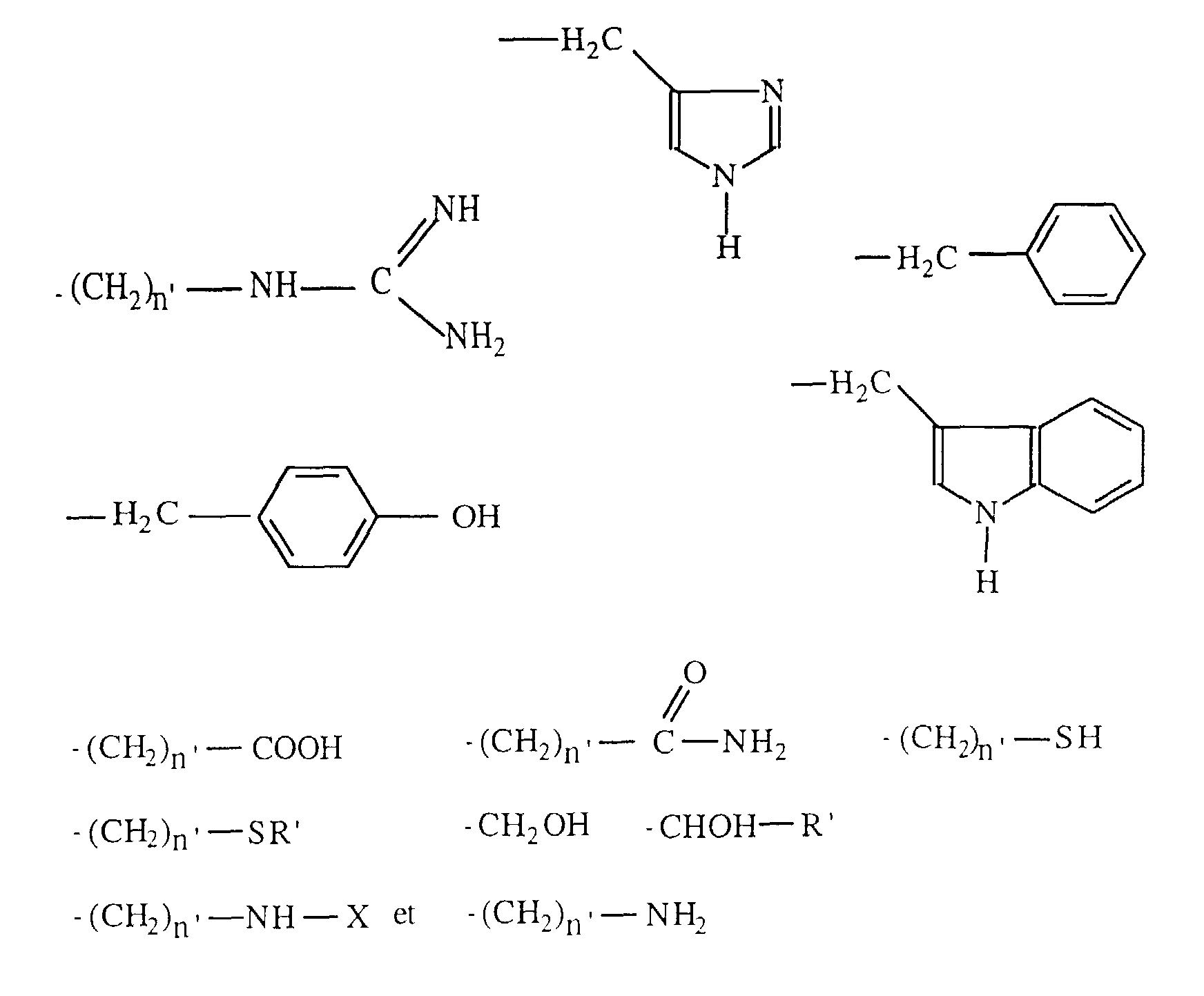 R' représente un radical alkyle en C1-C6, linéaire ou ramifié, saturé ou insaturé ;n' est un nombre entier compris entre 1 et 6 inclusivement ;X représente un groupe aromatique à un ou deux cycles, le ou les cycles pouvant contenir un ou plusieurs hétéroatomes choisis parmi S, N ou O ; le ou les cycles étant substitués par au moins un groupement -NHR" ou par un radical -OH se trouvant en position para ou ortho sur le groupe aromatique X par rapport au groupement -NH, R" désignant un atome d'hydrogène, un radical alkyle en C1-C6, linéaire ou ramifié, saturé ou insaturé, éventuellement hydroxylé, sans comporter de groupements nitro,
ou l'un de leurs sels d'addition avec un acide. - Composé selon la revendication 1, caractérisé par le fait que X représente un cycle phényle ou pyridyle substitué par un groupement amino -NH2.
- Composé selon la revendication 1 ou 2, caractérisé par le fait qu'il est choisi parmi : la Nε-(4-aminophényl)-L-lysine; la Nε-(4-amino-2-pyridyl)-L-lysine; la Nα-(4-aminophényl)-L-lysine ; la Nα,Nε-di-(4-aminophényl)-L-lysine; la N-(4-aminophényl)-L-sérine, l'acide 6-N-(4-aminophényl)amino-caproïque et l'α-N-(4-aminophényl)amino -ε-caprolactame, ainsi que leurs sels d'addition avec un acide.
- Composé selon l'une quelconque des revendications 1 à 3 caractérisé par le fait que les sels d'addition avec un acide sont choisis parmi les chlorhydrates, les sulfates, les bromhydrates et les tartrates.
- Composition de teinture d'oxydation pour fibres kératiniques, en particulier pour fibres kératiniques humaines telles que les cheveux, caractérisée par le fait qu'elle comprend, dans un milieu approprié pour la teinture, à titre de base d'oxydation, au moins un dérivé d'aminoacide substitué sur un groupe amino par un groupe à noyau aromatique de formule :dans laquelle :
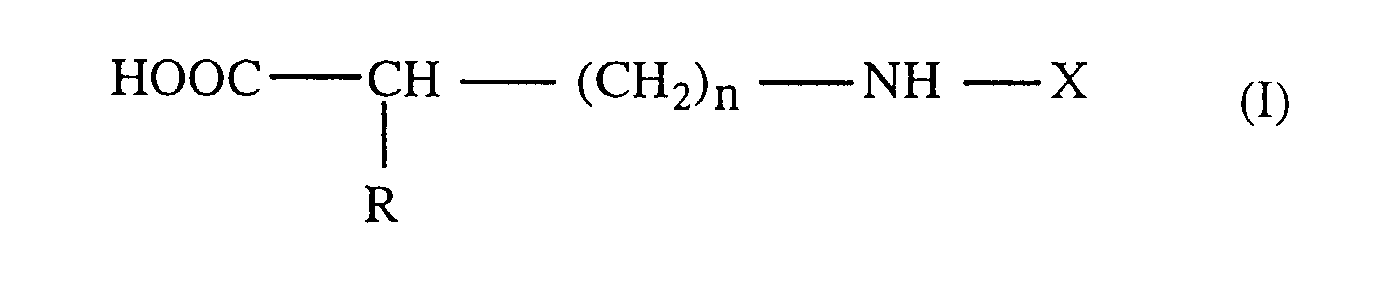 ou l'un de ses sels d'addition avec un acide.n est un nombre entier compris entre 0 et 11 inclusivement ;R représente un atome d'hydrogène, un radical amino, alkyle en C1-C6 linéaire ou ramifié, saturé ou insaturé, ou un radical choisi parmi les groupements suivants :
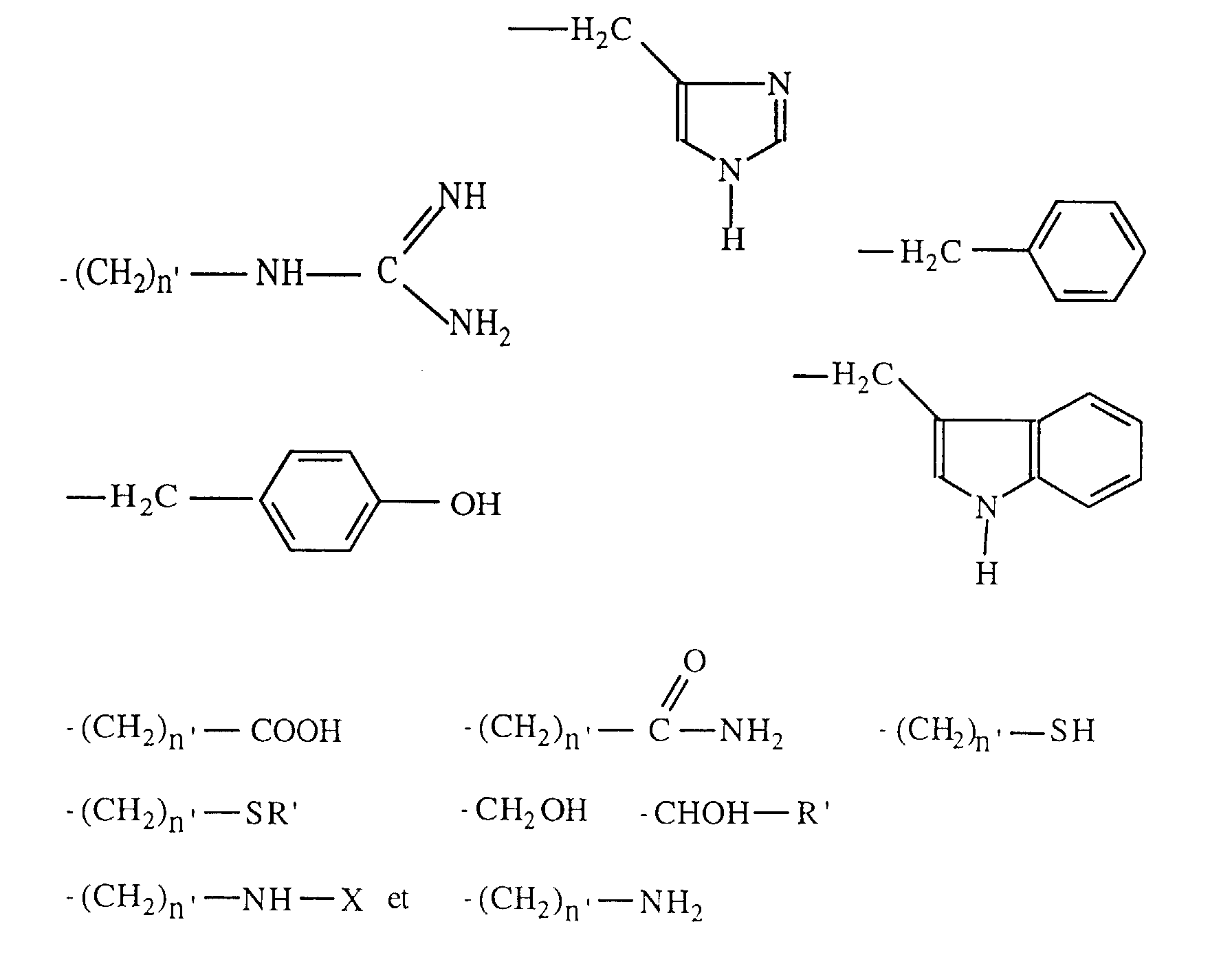 R' représente un radical alkyle en C1-C6, linéaire ou ramifié, saturé ou insaturé ;n' est un nombre entier compris entre 1 et 6 inclusivement ;X représente un groupe aromatique à un ou deux cycles, le ou les cycles pouvant contenir un ou plusieurs hétéroatomes choisis parmi S, N ou O ; le ou les cycles étant substitués par au moins un groupement -NHR" ou par un radical -OH se trouvant en position para ou ortho sur le groupe aromatique X par rapport au groupement -NH, R" désignant un atome d'hydrogène, un radical alkyle en C1-C6, linéaire ou ramifié, saturé ou insaturé, éventuellement hydroxylé, à l'exclusion du composé dans lequel n=0, R=H et X est un radical 4-hydroxyphényle,
 - Composition tinctoriale selon la revendication 5, caractérisée par le fait qu'elle contient au moins un dérivé d'aminoacide substitué sur un groupe amino par un groupe à noyau aromatique de formule (I), dans laquelle X est un radical phényle ou pyridyle substitué par un groupe amino -NH2.
- Composition tinctoriale selon la revendication 5 ou 6 caractérisée par le fait qu'elle contient au moins un dérivé d'aminoacide choisi parmi la Nε-(4-aminophényl)-L-lysine, la Nε-(4-amino-2-pyridyl)-L-lysine, la N-(4-aminophényl)-glycine, la Nα-(4-aminophényl)-L-lysine, la Nα,Nε-di(4-aminophényl)-L-lysine, la N-(4-aminophényl)-L-sérine, l'acide 6-N-(4-aminophényl)amino-caproïque et l'α-N-(4-aminophényl)amino -ε-caprolactame ainsi que leurs sels d'addition avec un acide.
- Composition tinctoriale selon l'une quelconque des revendications 5 à 7, caractérisée par le fait que les sels d'addition avec un acide sont choisis parmi les chlorhydrates, les sulfates, les bromhydrates et les tartrates.
- Composition tinctoriale selon l'une quelconque des revendications 5 à 8, caractérisée par le fait qu'elle contient 0,01 à 10% en poids, et de préférence 0,05 à 5% en poids d'au moins une base d'oxydation de formule (I).
- Composition tinctoriale selon l'une quelconque des revendications 5 à 9, prête à l'emploi, caractérisée en ce qu'elle contient en outre un agent oxydant et qu'elle possède un pH compris entre 3 et 12, et de préférence entre 5 et 11.
- Composition tinctoriale selon l'une quelconque des revendications 5 à 10, caractérisée par le fait qu'elle contient d'autres précurseurs de colorants d'oxydation choisis parmi les paraphénylènediamines, les bis-phénylalkylènediamines, les para-aminophénols, les ortho-aminophénols, les bases hétérocycliques, les coupleurs benzéniques et les coupleurs hétérocycliques.
- Composition tinctoriale selon l'une quelconque des revendications 5 à 11, caractérisée par le fait qu'elle contient en outre des colorants directs choisis parmi les colorants azoïques, anthraquinoniques et les dérivés nitrés de la série benzénique ou des précurseurs de mélanine.
- Procédé de teinture des fibres kératiniques et en particulier des fibres kératiniques humaines telles que les cheveux, caractérisé par le fait qu'il consiste à appliquer sur les fibres une composition tinctoriale (A) selon l'une quelconque des revendications 5 à 12, et à révéler la couleur en milieu acide, neutre ou alcalin à l'aide d'un agent oxydant ajouté juste au moment de l'emploi à cette composition (A) ou présent dans une composition (B), appliquée simultanément ou séquentiellement de façon séparée.
- Dispositif à plusieurs compartiments ou "kit" pour la teinture des fibres kératiniques et en particulier des fibres kératiniques humaines telles que les cheveux, caractérisé par le fait qu'il comporte au moins deux compartiments, dont l'un d'entre eux renferme une composition (A) telle que définie dans l'une quelconque des revendications 5 à 12, et un autre renferme une composition (B) comprenant un agent oxydant dans un milieu approprié pour la teinture.
Applications Claiming Priority (2)
| Application Number | Priority Date | Filing Date | Title |
|---|---|---|---|
| FR9712555 | 1997-10-08 | ||
| FR9712555A FR2769309B1 (fr) | 1997-10-08 | 1997-10-08 | Composition de teinture d'oxydation des fibres keratiniques comprenant un derive d'aminoacide en tant que base d'oxydation et nouveaux derives d'aminoacides |
Publications (2)
| Publication Number | Publication Date |
|---|---|
| EP0908445A1 true EP0908445A1 (fr) | 1999-04-14 |
| EP0908445B1 EP0908445B1 (fr) | 2001-12-12 |
Family
ID=9511972
Family Applications (1)
| Application Number | Title | Priority Date | Filing Date |
|---|---|---|---|
| EP98402479A Expired - Lifetime EP0908445B1 (fr) | 1997-10-08 | 1998-10-06 | Composition de teinture d'oxydation des fibres kératiniques comprenant un dérivé d'aminoacide en tant que base d'oxydation et nouveaux dérivés d'aminoacides |
Country Status (6)
| Country | Link |
|---|---|
| US (1) | US6630004B1 (fr) |
| EP (1) | EP0908445B1 (fr) |
| JP (2) | JP3202198B2 (fr) |
| DE (1) | DE69802884T2 (fr) |
| ES (1) | ES2169898T3 (fr) |
| FR (1) | FR2769309B1 (fr) |
Cited By (5)
| Publication number | Priority date | Publication date | Assignee | Title |
|---|---|---|---|---|
| FR2866878A1 (fr) * | 2004-02-27 | 2005-09-02 | Oreal | Para-phenylenediamines secondaires portant un groupement carboxy, composition tinctoriale les comprenant, procedes et utilisations |
| EP1739076A1 (fr) * | 2005-06-29 | 2007-01-03 | L'oreal | Nouvelles para-phénylènediamines doubles reliées par un bras de liaison substitué par un ou plusieurs radicaux carboxyliques et/ou dérivés et utilisation en coloration |
| US7384432B2 (en) | 2004-02-27 | 2008-06-10 | L'oreal S.A. | Secondary para-phenylenediamines having a carboxyl group, dye compositions comprising the same, and dyeing processes using the compositions |
| US7413580B2 (en) | 2005-06-29 | 2008-08-19 | L'oreal S.A. | Double para-phenylenediamines joined by a linker arm substituted with one or more carboxylic radicals and/or derivatives and use in dyeing |
| US7422609B2 (en) | 2005-06-29 | 2008-09-09 | Oreal | Double para-phenylenediamines joined by an aromatic group for dyeing keratin fibers |
Families Citing this family (6)
| Publication number | Priority date | Publication date | Assignee | Title |
|---|---|---|---|---|
| DE10227238A1 (de) * | 2002-06-19 | 2004-01-15 | Wella Ag | Hochaffine kosmetische Mittel |
| US7435268B2 (en) * | 2004-02-27 | 2008-10-14 | L'oreal S.A. | N-alkylhydroxylated secondary para-phenylenediamine compounds, composition for dyeing keratin fibers comprising the same, and dyeing processes using the composition |
| US20070011828A1 (en) * | 2005-06-29 | 2007-01-18 | Stephane Sabelle | Novel double para-phenylenediamines joined by a branched aliphatic group and method of dyeing keratin fibers |
| US8859048B2 (en) * | 2006-01-03 | 2014-10-14 | International Business Machines Corporation | Selective placement of carbon nanotubes through functionalization |
| EP1820487A1 (fr) * | 2006-02-13 | 2007-08-22 | Wella Aktiengesellschaft | Pastilles contenant un colorant et leur utilisation |
| US8124743B2 (en) * | 2006-06-01 | 2012-02-28 | President And Fellows Of Harvard College | Purification of a bivalently active antibody using a non-chromatographic method |
Citations (2)
| Publication number | Priority date | Publication date | Assignee | Title |
|---|---|---|---|---|
| US3532743A (en) * | 1965-04-23 | 1970-10-06 | Oreal | Novel carboxymethylamino benzenes used in hair dyes |
| US3931912A (en) * | 1971-08-12 | 1976-01-13 | The Gillette Company | Two-part hair dye or hair bleach package |
Family Cites Families (14)
| Publication number | Priority date | Publication date | Assignee | Title |
|---|---|---|---|---|
| US3464823A (en) | 1965-12-28 | 1969-09-02 | Ibm | Diazotype materials |
| GB1227395A (fr) | 1968-04-26 | 1971-04-07 | ||
| FR2220257A1 (en) | 1973-03-09 | 1974-10-04 | Lipha | 5,6-Dihydro-(4H)-s-triazolo-(4,3-a) (1,5)benzodiazepines - as antiinflam-matory and analgesic agents without tranquillising effects |
| IE38931B1 (en) | 1973-03-09 | 1978-07-05 | Lipha | Triazolobenzodiazepines |
| US4150230A (en) * | 1975-07-02 | 1979-04-17 | Sandoz Ltd. | 1,4-Diaminoanthraquinone derivatives containing a haloquinoxaline-6-carbonyl group |
| JPS53127597A (en) | 1977-02-25 | 1978-11-07 | Nhk Spring Co Ltd | Urea compcund having carboxylate group and its manufacture |
| DE2852252A1 (de) * | 1978-12-02 | 1980-09-04 | Henkel Kgaa | Haarfaerbemittel |
| GB8333431D0 (en) * | 1983-12-15 | 1984-01-25 | Unilever Plc | Hair treatment composition |
| JPS6211850A (ja) | 1985-07-10 | 1987-01-20 | Konishiroku Photo Ind Co Ltd | ハロゲン化銀写真感光材料 |
| US4871372A (en) * | 1987-07-17 | 1989-10-03 | Kao Corporation | Dye composition for keratinous fiber |
| JPH0268546A (ja) | 1988-09-02 | 1990-03-08 | Konica Corp | ハロゲン化銀カラー写真材料の画像形成方法 |
| PT101004B (pt) | 1991-10-26 | 1999-10-29 | Schering Ag | Derivados da quinoxalina, processo para a sua preparacao e composicoes farmaceuticas que os contem |
| JPH0632769A (ja) * | 1992-07-15 | 1994-02-08 | Kao Corp | 2−アルキル−4−メトキシ−5−アミノフェノール誘導体又はその塩、及びこれを含有する角質繊維染色剤組成物 |
| DE4340045A1 (de) | 1993-11-24 | 1995-06-01 | Basf Ag | Neue Chinoxaline und Arzneimittel daraus |
-
1997
- 1997-10-08 FR FR9712555A patent/FR2769309B1/fr not_active Expired - Fee Related
-
1998
- 1998-10-06 DE DE69802884T patent/DE69802884T2/de not_active Expired - Lifetime
- 1998-10-06 ES ES98402479T patent/ES2169898T3/es not_active Expired - Lifetime
- 1998-10-06 EP EP98402479A patent/EP0908445B1/fr not_active Expired - Lifetime
- 1998-10-08 JP JP28641798A patent/JP3202198B2/ja not_active Expired - Fee Related
- 1998-10-08 US US09/167,556 patent/US6630004B1/en not_active Expired - Fee Related
-
2000
- 2000-03-06 JP JP2000060037A patent/JP2000281633A/ja active Pending
Patent Citations (2)
| Publication number | Priority date | Publication date | Assignee | Title |
|---|---|---|---|---|
| US3532743A (en) * | 1965-04-23 | 1970-10-06 | Oreal | Novel carboxymethylamino benzenes used in hair dyes |
| US3931912A (en) * | 1971-08-12 | 1976-01-13 | The Gillette Company | Two-part hair dye or hair bleach package |
Cited By (7)
| Publication number | Priority date | Publication date | Assignee | Title |
|---|---|---|---|---|
| FR2866878A1 (fr) * | 2004-02-27 | 2005-09-02 | Oreal | Para-phenylenediamines secondaires portant un groupement carboxy, composition tinctoriale les comprenant, procedes et utilisations |
| EP1580186A1 (fr) * | 2004-02-27 | 2005-09-28 | L'oreal | Para-phénylènediamines secondaires portant un groupement carboxy, composition tinctoriale les comprenant, procédés et utilisations |
| US7384432B2 (en) | 2004-02-27 | 2008-06-10 | L'oreal S.A. | Secondary para-phenylenediamines having a carboxyl group, dye compositions comprising the same, and dyeing processes using the compositions |
| EP1739076A1 (fr) * | 2005-06-29 | 2007-01-03 | L'oreal | Nouvelles para-phénylènediamines doubles reliées par un bras de liaison substitué par un ou plusieurs radicaux carboxyliques et/ou dérivés et utilisation en coloration |
| FR2887876A1 (fr) * | 2005-06-29 | 2007-01-05 | Oreal | Nouvelles para-phenylenediamines doubles reliees par un bras de liaison substitue par un ou plusieurs radicaux carboxyliques et/ou derives et utilisation en coloration |
| US7413580B2 (en) | 2005-06-29 | 2008-08-19 | L'oreal S.A. | Double para-phenylenediamines joined by a linker arm substituted with one or more carboxylic radicals and/or derivatives and use in dyeing |
| US7422609B2 (en) | 2005-06-29 | 2008-09-09 | Oreal | Double para-phenylenediamines joined by an aromatic group for dyeing keratin fibers |
Also Published As
| Publication number | Publication date |
|---|---|
| EP0908445B1 (fr) | 2001-12-12 |
| ES2169898T3 (es) | 2002-07-16 |
| DE69802884D1 (de) | 2002-01-24 |
| JPH11255721A (ja) | 1999-09-21 |
| FR2769309A1 (fr) | 1999-04-09 |
| US6630004B1 (en) | 2003-10-07 |
| DE69802884T2 (de) | 2002-08-01 |
| JP3202198B2 (ja) | 2001-08-27 |
| FR2769309B1 (fr) | 2001-06-15 |
| JP2000281633A (ja) | 2000-10-10 |
Similar Documents
| Publication | Publication Date | Title |
|---|---|---|
| EP0928289B1 (fr) | Nouvelles bases d'oxydation cationiques, leur utilisation pour la teinture d'oxydation des fibres keratiniques, compositions tinctoriales et procedes de teinture | |
| EP0932602B1 (fr) | Bases d'oxydation cationiques, leur utilisation pour la teinture d'oxydation des fibres keratiniques, compositions tinctoriales et procedes | |
| EP0968171B1 (fr) | Bases d'oxydation cationiques, leur utilisation pour la teinture d'oxydation des fibres keratiniques, compositions tinctoriales et procedes de teinture | |
| EP0740931B1 (fr) | Compositions pour la teinture des fibres kératiniques contenant des diamino pyrazoles, procédé de teinture, nouveaux diamino pyrazoles et leur procédé de préparation | |
| CA2253678C (fr) | Compositions de teinture des fibres keratiniques contenant des 3-amino pyrazolo-[1,5-a]-pyrimidines, procede de teinture, nouvelles 3-amino pyrazolo-[1,5-a]-pyrimidines et leur procede de preparation | |
| EP0984007A1 (fr) | Nouvelles orthophénylènediamines cationiques, leur utilisation pour la teinture d'oxydation des fibres kératiniques, compositions tinctoriales et procédés de teinture | |
| EP0983996A1 (fr) | Nouvelles orthophénylènediamines cationiques, leur utilisation pour la teinture d'oxydation des fibres kératiniques, compositions tinctoriales et procédés de teinture | |
| EP0580713B1 (fr) | PROCEDE DE TEINTURE DES FIBRES KERATINIQUES AVEC DES AMINOINDOLES, A pH BASIQUE, COMPOSITIONS MISES EN OEUVRE | |
| EP0989128A1 (fr) | 4-Hydroxyindoles cationiques et leur utilisation pour la teinture d'oxydation des fibres kératiniques | |
| WO1997042173A1 (fr) | Nouveaux diamino pyrazoles, leur synthese, compositions de teinture des fibres keratiniques les contenant, procedes de teinture des fibres keratiniques | |
| EP0908445B1 (fr) | Composition de teinture d'oxydation des fibres kératiniques comprenant un dérivé d'aminoacide en tant que base d'oxydation et nouveaux dérivés d'aminoacides | |
| EP0656202B1 (fr) | Composition tinctoriale contenant des p-phénylènediamines soufrées, p-phénylènediamines soufrées et leur procédé de préparation | |
| EP1064267B1 (fr) | Nouveaux coupleurs cationiques, leur utilisation pour la teinture d'oxydation des fibres keratiniques, compositions tinctoriales et procedes de teinture | |
| EP0370880A1 (fr) | Nouvelles métaphénylènediamines trialcoxy-substituées, leur procédé de préparation, et leur utilisation en tant que coupleurs pour la teinture d'oxydation des fibres kératiniques et en particulier des cheveux humains | |
| EP0578735B1 (fr) | PROCEDE DE TEINTURE DES FIBRES KERATINIQUES AVEC DES AMINOINDOLES, A pH ACIDE ET COMPOSITIONS MISES EN OEUVRE ET NOUVEAUX COMPOSES AMINOINDOLES | |
| CA2322992A1 (fr) | Nouveaux composes cationiques, leur utilisation comme coupleurs pour la teinture d'oxydation des fibres keratiniques, compositions tinctoriales et procedes de teinture | |
| CA2250334A1 (fr) | Procede de synthese de 2-hydroxyalkyl paraphenylenediamines, nouvelles 2-hydroxyalkyl paraphenylenediamines, leur utilisation pour la teinture d'oxydation, compositions tinctoriales et procedes de teinture | |
| EP0586648B1 (fr) | Composition tinctoriale pour fibres keratiniques contenant des metaphenylenediamines soufrees, procede de teinture et nouvelles metaphenylenediamines soufrees et leur procede de preparation | |
| EP1120405B1 (fr) | Nouvelles bases d'oxydation à chaíne guanidine, leur procédé de préparation, leur utilisation pour la teinture d'oxydation des fibres kératiniques, compositions tinctoriales et procédés de teinture | |
| EP1568683A2 (fr) | Para-phenylenediamine secondaire n-alkylaminée, composition de teinture des fibres kératiniques contenant une tell paraphenylenediamine, procédé mettant en oeuvre cette composition et utilisations | |
| EP1580186A1 (fr) | Para-phénylènediamines secondaires portant un groupement carboxy, composition tinctoriale les comprenant, procédés et utilisations | |
| FR2887876A1 (fr) | Nouvelles para-phenylenediamines doubles reliees par un bras de liaison substitue par un ou plusieurs radicaux carboxyliques et/ou derives et utilisation en coloration | |
| WO2001041724A2 (fr) | Compositions pour la teinture des fibres keratiniques contenant des derives de paraphenylenediamine a groupement azetidinyle | |
| FR2887875A1 (fr) | Nouvelles para-phenylenediamines doubles reliees par un bras de liaison substitue par un ou plusieurs groupes hydroxy, alcoxy et/ou amino et utilisation en coloration |
Legal Events
| Date | Code | Title | Description |
|---|---|---|---|
| PUAI | Public reference made under article 153(3) epc to a published international application that has entered the european phase |
Free format text: ORIGINAL CODE: 0009012 |
|
| AK | Designated contracting states |
Kind code of ref document: A1 Designated state(s): DE ES FR GB IT |
|
| AX | Request for extension of the european patent |
Free format text: AL;LT;LV;MK;RO;SI |
|
| 17P | Request for examination filed |
Effective date: 19990310 |
|
| 17Q | First examination report despatched |
Effective date: 19990712 |
|
| AKX | Designation fees paid |
Free format text: DE ES FR GB IT |
|
| GRAG | Despatch of communication of intention to grant |
Free format text: ORIGINAL CODE: EPIDOS AGRA |
|
| GRAG | Despatch of communication of intention to grant |
Free format text: ORIGINAL CODE: EPIDOS AGRA |
|
| GRAG | Despatch of communication of intention to grant |
Free format text: ORIGINAL CODE: EPIDOS AGRA |
|
| GRAH | Despatch of communication of intention to grant a patent |
Free format text: ORIGINAL CODE: EPIDOS IGRA |
|
| GRAH | Despatch of communication of intention to grant a patent |
Free format text: ORIGINAL CODE: EPIDOS IGRA |
|
| GRAA | (expected) grant |
Free format text: ORIGINAL CODE: 0009210 |
|
| AK | Designated contracting states |
Kind code of ref document: B1 Designated state(s): DE ES FR GB IT |
|
| REG | Reference to a national code |
Ref country code: GB Ref legal event code: IF02 |
|
| GBT | Gb: translation of ep patent filed (gb section 77(6)(a)/1977) |
Effective date: 20011212 |
|
| REF | Corresponds to: |
Ref document number: 69802884 Country of ref document: DE Date of ref document: 20020124 |
|
| REG | Reference to a national code |
Ref country code: ES Ref legal event code: FG2A Ref document number: 2169898 Country of ref document: ES Kind code of ref document: T3 |
|
| PLBE | No opposition filed within time limit |
Free format text: ORIGINAL CODE: 0009261 |
|
| STAA | Information on the status of an ep patent application or granted ep patent |
Free format text: STATUS: NO OPPOSITION FILED WITHIN TIME LIMIT |
|
| PGFP | Annual fee paid to national office [announced via postgrant information from national office to epo] |
Ref country code: ES Payment date: 20021031 Year of fee payment: 5 |
|
| 26N | No opposition filed | ||
| PG25 | Lapsed in a contracting state [announced via postgrant information from national office to epo] |
Ref country code: ES Free format text: LAPSE BECAUSE OF NON-PAYMENT OF DUE FEES Effective date: 20031007 |
|
| PGFP | Annual fee paid to national office [announced via postgrant information from national office to epo] |
Ref country code: GB Payment date: 20041006 Year of fee payment: 7 |
|
| REG | Reference to a national code |
Ref country code: ES Ref legal event code: FD2A Effective date: 20031007 |
|
| PG25 | Lapsed in a contracting state [announced via postgrant information from national office to epo] |
Ref country code: IT Free format text: LAPSE BECAUSE OF NON-PAYMENT OF DUE FEES Effective date: 20051006 Ref country code: GB Free format text: LAPSE BECAUSE OF NON-PAYMENT OF DUE FEES Effective date: 20051006 |
|
| GBPC | Gb: european patent ceased through non-payment of renewal fee |
Effective date: 20051006 |
|
| PGFP | Annual fee paid to national office [announced via postgrant information from national office to epo] |
Ref country code: DE Payment date: 20091001 Year of fee payment: 12 |
|
| PGFP | Annual fee paid to national office [announced via postgrant information from national office to epo] |
Ref country code: FR Payment date: 20091029 Year of fee payment: 12 |
|
| PG25 | Lapsed in a contracting state [announced via postgrant information from national office to epo] |
Ref country code: FR Free format text: LAPSE BECAUSE OF NON-PAYMENT OF DUE FEES Effective date: 20101102 |
|
| REG | Reference to a national code |
Ref country code: FR Ref legal event code: ST Effective date: 20110630 |
|
| REG | Reference to a national code |
Ref country code: DE Ref legal event code: R119 Ref document number: 69802884 Country of ref document: DE Effective date: 20110502 |
|
| PG25 | Lapsed in a contracting state [announced via postgrant information from national office to epo] |
Ref country code: DE Free format text: LAPSE BECAUSE OF NON-PAYMENT OF DUE FEES Effective date: 20110502 |