EP0908848A2 - Méthode et machine d'inférence floue, et méthode et système de production d'image - Google Patents
Méthode et machine d'inférence floue, et méthode et système de production d'image Download PDFInfo
- Publication number
- EP0908848A2 EP0908848A2 EP98119223A EP98119223A EP0908848A2 EP 0908848 A2 EP0908848 A2 EP 0908848A2 EP 98119223 A EP98119223 A EP 98119223A EP 98119223 A EP98119223 A EP 98119223A EP 0908848 A2 EP0908848 A2 EP 0908848A2
- Authority
- EP
- European Patent Office
- Prior art keywords
- image
- layout pattern
- illustration
- manuscript
- descriptive region
- Prior art date
- Legal status (The legal status is an assumption and is not a legal conclusion. Google has not performed a legal analysis and makes no representation as to the accuracy of the status listed.)
- Granted
Links
Images

















Classifications
-
- G—PHYSICS
- G06—COMPUTING OR CALCULATING; COUNTING
- G06V—IMAGE OR VIDEO RECOGNITION OR UNDERSTANDING
- G06V30/00—Character recognition; Recognising digital ink; Document-oriented image-based pattern recognition
- G06V30/40—Document-oriented image-based pattern recognition
- G06V30/41—Analysis of document content
- G06V30/413—Classification of content, e.g. text, photographs or tables
Definitions
- the present invention relates generally to a document production system and the like for providing easy production of a document with an illustration or vignette.
- FIG.38 An image production system offering such a technique has been proposed in Japanese Unexamined Patent Publication No.6(1994)-54165.
- This system includes, as shown in Fig.38, an image data input section 201 for optically reading an image of a manuscript, a paint menu setting section 202 for setting a type and the like of an image to be superimposed, a paint address setting section 203 for specifying a position of the image to be superimposed, a data synthesizing section 204 for combining the manuscript image and the image to be superimposed, and an image output section 205 for outputting a composite image.
- the image production system permits a user to select a suitable image, such as an illustration, and to specify a position of the image to be combined with the manuscript image read by a scanner or the like, so as to superimpose the illustration and the manuscript image on the specified places for outputting the resultant composite image.
- a suitable image such as an illustration
- a fuzzy inference method for inference based on fuzzy rules stated in the if-then form, of the presnet invention comprises the steps of :
- a fuzzy inference machine of the present invention comprises:
- An image production method of the present invention comprises the steps of:
- An image production method of the present invention comprises the steps of:
- An image production system of the present invention comprises:
- An image production method of the present invention comprises the steps of:
- An image production system of the present invention comprises:
- An image production method of the present invention comprises the steps of:
- An image production system of the present invention comprises:
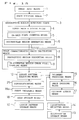
- Fig.1 is a block diagram showing an arrangement of an image production method and system according to a first embodiment of the invention.
- the system includes image input means 1 for inputting an image; image decoding means 2 for expanding the image data inputted by the image input means into a bitmap image; descriptive region detecting means 3 for detecting only an image of a descriptive region exclusive of a background portion of the bitmap image generated by the image decoding means 2; input-image dividing means 4 for dividing the input image in a grid form; in-grid pixel counting means 5 for counting a number of pixels included in one grid portion and forming an image of a different color from the background image; rectangular region generating means 6 for detecting, as the descriptive region image, a rectangular region including all grid portions in which a count of pixels exceeds a threshold value; image characteristic value calculating means 7 for calculating, as image characteristic values, a horizontal length, a vertical length, a mean pixel luminance and a luminance distribution of the descriptive region image detected by the descriptive region detecting means;
- the input-image dividing means 4, in-grid pixel counting means 5 and rectangular region generating means 6 constitute the descriptive region detecting means 3.
- the descriptive region segmenting means 8 and in-segmental-descriptive-region-image pixel counting means 9 constitute the image characteristic value calculating means 7.
- Fig.2 diagrammatically illustrates a hardware construction for carrying out the system of the above arrangement.
- Fig.2 The construction of Fig.2 is essentially the same with that of the general-purpose computer system. In addition, this construction includes identical components to those of the system arrangement of Fig.1. Therefore, such components are represented by like reference numerals and the description thereof is omitted.
- the construction includes the image input means 1, the document output means 17, a VRAM 101 for storing data to be displayed/outputted, a main storage 102 composed of a volatile memory for storing a program, an auxiliary storage 103 composed of a nonvolatile memory for storing a program and data, a CPU 104 for executing the program stored in the main storage 102, a scanner 105 for optically reading the manuscript, and a printer 106 for printing the outputted document.
- the hardware is essentially constructed the same way as the computer system wherein the program stored in the auxiliary storage 103 is loaded into the main storage 102 and then executed by the CPU 104.
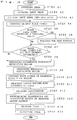
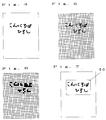
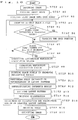
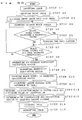
- the manuscript image read by the scanner 105 is inputted in the image input means 1. It is hereinafter assumed that the input image has a white background and a size of A4. As shown in Fig.4, a text and the like are written on the A4 sheet.
- the image decoding means 2 serves to decode the image inputted at STEP A1 into a bitmap image.
- the bitmap image has a horizontal length of 864 dots and a vertical length of 1080 dots. It is assumed hereinafter that the image is of a white/black binary image in which a white pixel is represented by 0 and a black pixel is represented by 1.
- the input image dividing means 4 divides the image decoded at STEP A2 into a grid form as shown in Fig.5. If a grid portion is in a size of 32(horizontal) ⁇ 30(vertical) dots, the 864 ⁇ 1080 dot image is divided into a 27 (horizontal) ⁇ 36 (vertical) grid array.
- the in-grid pixel counting means 5 counts a number of pixels included in one grid portion and representing a different color from the background. In this example, a number of black pixels is counted because the background color is white. Then, if the number of black pixels in a grid portion exceeds a predetermined threshold value, the grid portion is flagged. This operation is performed on all of the grid portions. Fig.6 shows the flagged grid portions in the form of solid black squares.
- the rectangular region generating means 6 defines a minimum size of rectangular region that includes all the grid portions flagged through the operations of STEPs A4 to A7, as an image of a descriptive region 50 of the input manuscript image.
- the operation of STEP A5 prevents the defined descriptive region image 50 from including black pixels resulting from fine noises. It is to be noted that such a rectangular region is not limited to one but may exist in plural numbers.
- Fig.7 shows the image of the descriptive region thus defined.
- the descriptive region segmenting means 8 segments the descriptive region image detected by the descriptive region detecting means 3 into four segments, as shown in Fig.8.
- this step there is counted a number of pixels included in each of the segmental descriptive region images defined at STEP A9 and representing a different color from the background. That is, a number of black pixels is counted here. Subsequently, the pixel count for each segmental descriptive region image is normalized based on a total number of pixels of the segmental descriptive region image.
- a descriptive region image detected at STEP A8 has a size of 300(horizontal) ⁇ 300 (vertical) dots
- the descriptive region image is divided into four segmental descriptive regions at STEP A9, one of which segmental descriptive regions has a size of 150(horizontal) ⁇ 150(vertical) dots.
- a certain segmental descriptive region image presents a black pixel count of 10000
- Each of the segmental regions is subject to this operation thereby to give a luminance distribution of the descriptive region image. Additionally, a mean pixel luminance is found from a ratio of the black pixel count versus the white pixel count.
- the layout pattern selecting means 12 selects a layout pattern by referring, to the table stored in the table storage means 11, the horizontal and vertical lengths of the manuscript descriptive region image detected at STEP A8 and the normalized black pixel count and the mean luminance obtained at STEP A11.
- the horizontal and vertical lengths, black pixel count and luminance which are continuous values, are classified into three categories of great", medium” and small” based on value range.
- the horizontal length of the descriptive region image a horizontal length of 600 or more dots is regarded as great", that of less than 600 dots and not less than 300 dots is regarded as medium", and that of less than 300 dots is regarded as small”.
- the black pixel count a count of not less than 0.7 is regarded as great", that of less than 0.7 and not less than 0.4 is regarded as medium", and that of less than 0.4 is regarded as small”.
- a seventh layout pattern is selected from Table 1.
- a relation of the parameters of the descriptive region image, such as great, medium and small, versus the layout pattern to be selected is previously determined by statistical processing of questionnaire answers from designers. The statistical processing is directed to the overall balance of the document layout and the reduced transmission amount.
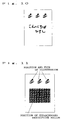
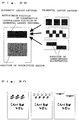
- the layout pattern is stored in the layout pattern storage means 10 in the form of description on a number of illustrations and positions of illustrations and the descriptive region image, as shown in Fig.9.
- Fig.9a depicts an imaginary layout pattern thus specified. In actual practice, however, the same content as that of Fig.9a is expressed by a list of numbers of illustrations and coordinate information pieces, as shown in Fig.9b.
- the illustration selecting means 14 selects from the illustrations stored in the illustration storage means 13 an illustration to be inserted in a superimposition area of the layout pattern selected at STEP A11.
- the illustration is selected based on, for example, random numbers.
- the descriptive region image is superimposed on the layout pattern of Fig.9 at the position of the descriptive region.
- the layout pattern selected from the table at STEP A11 includes the descriptive region superimposition area, which has a size equal to or greater than the read descriptive region image. Accordingly, the descriptive region image is laid at the center of the descriptive region superimposition area when the descriptive region image is combined with the layout pattern. In order to permit this, there may be prepared such a layout pattern as to accommodate a rectangular region of a maximum size.
- the text image of the descriptive region of the input manuscript is superimposed on the layout pattern to produce a composite image, which is encoded into a form for output.
- the encoded image is applied to the image output means 17 so as to be printed by the printer 106.
- Fig.10 shows an exemplary output of a document thus produced.
- the aforementioned sequence of document production operations automatically detect the descriptive region of the manuscript and add the illustration thereto based on only limited necessary items entered to the manuscript by the user. Furthermore, the operations determine the positions of the respective images of the illustration and the manuscript descriptive region according to a state of the descriptive region image, thereby accomplishing the layout in which the images of the illustration and descriptive region are laid in balance.
- the layout pattern may include a predetermined illustration.
- the layout pattern includes both the content(e.g., sparrow) and the position of the specific illustration, as shown in Fig.11.
- the illustration selecting means 14 may be omitted.
- the first embodiment hereof uses the horizontal and vertical lengths, black pixel count and mean luminance of the descriptive region image of the manuscript for deciding the document layout, it is to be understood that the invention should not be limited to the above. A similar effect may be attained by using any other image characteristic values obtained from the descriptive region image.
- the manuscript image is read by the scanner 105.
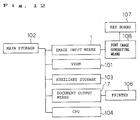
- a key board 107 and a font image generating means 108 may be provided, as shown in Fig.12, such that a text entered by the user through the key board 107 is converted into an image by the font image generating means 108 and the converted image is inputted in the image input means 1.
- This arrangement also permits the production of the document wherein the illustration is automatically added to the text entered by the user.
- the manuscript image is read by the scanner 105.
- a data modem 109 may be connected to a facsimile 110 via a telephone line, as shown in Fig.13, for inputting the manuscript image through the facsimile 110.
- This arrangement also permits the production of the document with the illustration automatically added thereto.
- the printer 106 is employed for printing the produced document image.
- the data modem 109 is connected to the facsimile 110 via the telephone line, as shown in Fig.14, such that the outputted document is transmitted to the facsimile 110 via the data modem 109.
- This arrangement also permits the printing of the document with the illustration added thereto.
- the illustration selecting means 14 serves to select a specific illustration based on random number.
- the user himself may select a specific illustration and superimpose the selected illustration on an illustration insertion area.
- optional illustrations are displayed by means of illustration display means (not shown) for allowing the user to select a desired illustration through input means such as the key board.
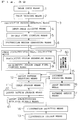
- Fig.15 is a block diagram showing an arrangement of an image production method and system according to a second embodiment of the invention.
- Fig.15 includes identical components to those of the system arrangement according to the first embodiment hereof. Therefore, such components are represented by like reference numerals and the detailed description thereof is omitted.
- the system of the second embodiment hereof includes the image input means 1, the image decoding means 2, the descriptive region detecting means 3, the input-image dividing means 4, the in-grid pixel counting means 5, the rectangular region generating means 6, the image characteristic value calculating means 7, the descriptive region segmenting means 8, the in-segmental-descriptive-region-image pixel counting means 9, the layout pattern storage means 10, rule storage means 18 for storing fuzzy rules used for the layout decision, fuzzy inference means 19a for performing inference based on the fuzzy rules stored in the rule storage means thereby deciding the layout pattern, defuzzificating means 25 for finding a real value from a fuzzy inference result, the layout pattern selecting means 12, the illustration storage means 13, the illustration selecting means 14, the document producing means 15, the image encoding means 16 and the document output means 17.
- FIG.2 A hardware construction for carrying out the system of the above arrangement is essentially the same with the general-purpose computer system and is shown in Fig.2. Since this arrangement is the same as the construction of the first embodiment hereof, the description thereof is omitted.
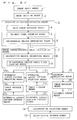
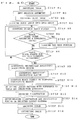
- a layout pattern is selected by applying a horizontal and a vertical length of a manuscript descriptive region image detected at STEP A8 and a normalized black pixel count and a mean luminance determined at STEP B10 to the rules.
- each layout pattern is described according to the fuzzy rules, indicating a degree of favorableness of the layout pattern.
- the description is made on each layout pattern, indicating a degree of favorableness thereof.
- fuzzy rules are stored in the rule storage means 18.
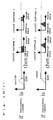
- the fuzzy inference means 19a ignites rules for the great'' and medium'' descriptive region images 50 for truncating a membership function of the favorableness of each layout pattern, as the consequent part, based on a membership function of the antecedent part.
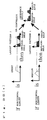
- Fig.18a illustrates the process of this operation.
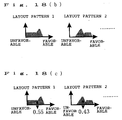
- Fig.18b shows the inference result indicating a degree of favorableness of each layout pattern.
- the defuzzificating means 25 defuzzificates the inference results by determining respective centroids thereof.
- Fig.18c illustrates a process of obtaining real values through the defuzzification procedure.
- the procedure gives the degree of favorableness of each layout pattern in terms of real value.
- the layout pattern selecting means 12 selects one from the layout patterns that has the greatest real value of favorableness determined at STEP B12.
- the fuzzy inference actually includes similar fuzzy rules for the other attribute values in addition to that for the horizontal length of the descriptive region image. Therefore, inference results based on the other rules are OR-synthesized to give a synthetic fuzzy inference result.
- the fuzzy rules used herein are formulated based on statistical data obtained from a questionnaire to designers and the like.
- the aforementioned sequence of document production operations automatically detect the descriptive region of the manuscript and add the illustration thereto based on only limited necessary items entered to the manuscript by the user. Furthermore, the operations determine the positions of the respective images of the illustration and the manuscript descriptive region according to the state of the descriptive region image, thereby accomplishing the layout in which the images of the illustration and descriptive region are laid in balance.
- the layout pattern may include a predetermined illustration.
- the consequent parts are OR-synthesized but may be synthesized by any other method. Further, the inference results are defuzzificated by determining the centroids thereof but may be defuzzificated by any other method.
- this embodiment hereof uses the fuzzy inference operation for deciding the layout pattern, an inference operation based on the typical if-then rules rather than on the fuzzy logic, or any other inference operation may be used.
- the rule storage means 18 shown in Fig.15 contains general statements of the production rules, neural net, clustering procedure and the like, instead of the fuzzy rules.
- the fuzzy inference means 19a and the defuzzificating means 25 are replaced by inference means 19.
- a system in this case is arranged the same way as shown in Fig.19.
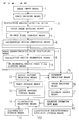
- Fig.20 is a block diagram showing an arrangement of an image production method and system according to a third embodiment of the invention.
- Fig.20 includes identical components to those of the system arrangement according to the second embodiment hereof. Therefore, such components are represented by like reference numerals and the detailed description thereof is omitted.
- the system of the third embodiment hereof includes the image input means 1, the image decoding means 2, the descriptive region detecting means 3, the input-image dividing means 4, the in-grid pixel counting means 5, the rectangular region generating means 6, the image characteristic value calculating means 7, the descriptive region segmenting means 8, the in-segmental-descriptive-region-image pixel counting means 9, the layout pattern storage means 10, the rule storage means 18, the fuzzy inference means 19a, the defuzzificating means 25, clustering means 26 for clustering the fuzzy inference results, the layout pattern selecting means 12, the illustration storage means 13, the illustration selecting means 14, the document producing means 15, the image encoding means 16 and the document output means 17.
- a hardware construction for carrying out the system of the above arrangement is essentially the same as the general-purpose computer system and is shown in Fig.2. Since this arrangement is the same with the construction of the first embodiment hereof, the description thereof is omitted.
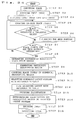
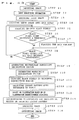
- a layout pattern is selected by applying a horizontal and a vertical length of the manuscript descriptive region image detected at STEP C8 and a normalized black pixel count and a mean luminance determined at STEP C10 to the rules.
- the fuzzy inference is performed on the horizontal length of the descriptive region image 50. This inference operation takes the same procedure as in STEP B11 according to the second embodiment hereof.
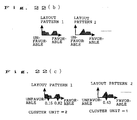
- Fig.22a show the process of this inference operation.
- Fig.22b shows favorablenesses of the respective layout patterns thus obtained as the inference results.
- the inference result includes two regions indicative of the favorableness of the layout pattern 1. This is ascribable to the consequent part of a rule shown in Fig.22a which includes two membership function peaks indicating the favorableness of the great'' horizontal length.
- the fuzzy rule with such a characteristic may be obtained when the fuzzy rules are formulated based on the questionnaire. More specifically, such a rule may be formulated when some answers are favorable'' while the others are unfavorable'' as to the great'' horizontal length of the layout pattern 1.
- the inference result of the layout pattern 2 presents such a shape as observed in the typical fuzzy inference operation, or presenting only one region.
- the inference results are subject to a clustering procedure at STEP C12, thereby to determine how many output values are obtained.
- Any method may be used for the clustering procedure.
- This embodiment takes the clustering procedure based on the well-known fuzzy C-means method (Literature 1:Bezdek:"Pattern Recognition with Fuzzy Objective Function Algorithm", Plenum Press, 1982).
- the inference result of the layout pattern 1 presents two cluster units while the inference result of the layout pattern 2 presents one cluster unit, as shown in Fig.22b.
- the defuzzificating means 25 defuzzificates the result by determining the centroid thereof.
- Fig.22c illustrates a process of obtaining the real values through the defuzzification procedure.
- the aforementioned procedure provides the degree of favorableness of each layout pattern in terms of real value. That is, there are obtained two real values with respect to the layout pattern 1 and one real value with respect to the layout pattern 2.
- the layout pattern selecting means 12 selects one from the layout patterns that has the greatest real value of favorableness determined at STEP C13. It is to be noted that a rule for a layout pattern presenting not less than two real values is previously set such that, for example, the selection is always determined based on the greatest value. An alternative rule may be made such that a layout pattern with the lowest value is not selected.
- the fuzzy inference also observes similar rules for the other attribute values besides the horizontal length of the descriptive region image. Accordingly, the synthetic fuzzy inference result is obtained by OR-synthesizing the inference results based on the other rules.
- the fuzzy rules used herein are formulated based on the questionnaire to the designers and the like.
- the aforementioned sequence of document production operations automatically detect the descriptive region of the manuscript and add the illustration thereto based on only limited necessary items entered to the manuscript by the user. Furthermore, the operations determine the positions of the respective images of the illustration and the manuscript descriptive region according to the state of the descriptive region image, thereby accomplishing the layout in which the images of the illustration and descriptive region are laid in balance.
- Fig.23 is a block diagram showing an arrangement of an image production method and system according to a fourth embodiment of the invention.
- Fig.23 includes identical components to those of the system arrangement according to the first embodiment hereof. Therefore, such components are represented by like reference numerals and the detailed description thereof is omitted.
- the system of the fourth embodiment hereof includes the image input means 1, the image decoding means 2, the descriptive region detecting means 3, the input-image dividing means 4, the in-grid pixel counting means 5, the rectangular region generating means 6, the image characteristic value calculating means 7, the descriptive region segmenting means 8, the in-segmental-descriptive-region-image pixel counting means 9, schematic layout pattern storage means 20 for storing a schematic layout pattern of manuscript which pattern is composed of at least one of information items about a number of illustrations, approximate positions of illustrations and an approximate position of a manuscript descriptive region, table storage means 11a for storing a table used for deciding the schematic layout, schematic layout pattern selecting means 12a, table storage means 11b for storing a table used for fine adjustment of the layout decided, layout fine adjustment means 21 for deciding a precise position of the selected schematic layout based on the image characteristic value determined by the image characteristic value calculating means, the illustration storage means 13, the illustration selecting means 14, the document producing means 15, the image encoding means 16 and the document output means 17.
- a hardware construction for carrying out the system of the above arrangement is essentially the same as the general-purpose computer system and is shown in Fig.2. Since this arrangement is the same as the construction of the first embodiment hereof, the description thereof is omitted.
- a schematic layout pattern is selected by applying a horizontal and a vertical length of the manuscript descriptive region image detected at STEP D8 and a normalized black pixel count and a mean luminance determined at STEP D10 to the rules.
- the horizontal and vertical lengths, black pixel count and mean luminance which are continuous values, are classified into three categories of great'', medium'' and small'' based on value range.
- the classification method is the same as the aforementioned operation at STEP A11 of the first embodiment hereof.
- a schematic layout pattern 4 is selected from Table 2.
- the schematic layout pattern storage means 20 stores the schematic layout pattern in which the number of illustrations, the approximate positions of the illustrations and the position of descriptive region image are described, as shown in Fig.25a.
- the layout fine adjustment means 21 performs fine adjustment of a layout based on the schematic layout pattern selected at STEP D11 and the aforesaid image characteristic values.
- the layout fine adjustment is performed by using the table for layout fine adjustment shown in Table 3, which is stored in the table storage means 11b.
- Table 3 which is stored in the table storage means 11b.
- This table gives coordinates of a position of an illustration associated with, for example, a schematic layout pattern 4 in which the descriptive region image has the small'' vertical length and the great'' horizontal length.
- This operation provides varied layouts from one selected schematic layout pattern, the layouts varied depending upon a state of the descriptive region image as shown in Fig. 26.
- the descriptive region has an allowance of the position thereof, as shown in Fig.25b, thus allowing for the fine adjustment.
- the aforementioned sequence of document production operations automatically detect the descriptive region of the manuscript and add the illustration thereto based on only limited necessary items entered to the manuscript by the user. Furthermore, as compared to a document of a similar layout which is not subject to the fine adjustment, a document with better appearance may be obtained by having the layout thereof fine adjusted according to the state of the manuscript descriptive region image.
- the selection of the schematic layout pattern and the fine adjustment of the layout are performed with reference to the tables.
- the decision of the schematic layout pattern and the layout fine adjustment may be accomplished by performing the rule-based inference, the fuzzy inference based on the fuzzy rules or the fuzzy inference for obtaining plural outputs through the clustering procedure.
- Fig.27 is a block diagram showing an arrangement of an image production method and system according to a fifth embodiment of the invention.
- Fig.27 includes identical components to those of the system arrangement according to the first embodiment hereof. Therefore, such components are represented by like reference numerals and the detailed description thereof is omitted.
- the system of the fifth embodiment hereof includes the image input means 1, the image decoding means 2, the descriptive region detecting means 3, the input-image dividing means 4, the in-grid pixel counting means 5, the rectangular region generating means 6, the image characteristic value calculating means 7, the descriptive region segmenting means 8, the in-segmental-descriptive-region-image pixel counting means 9, schematic layout pattern storage means 20 for storing a schematic layout pattern of a manuscript which pattern is composed of at least one of information items about an approximate position of an illustration and an approximate position of a manuscript descriptive region, the table storage means 11a for storing a table used for decision of the schematic layout, the schematic layout pattern selecting means 12a, segmental layout pattern storage means 22 for storing a segmental manuscript layout pattern composed of at least one of information items about a number of illustrations, a size of an illustration and a position of an illustration, table storage means 11c for storing a table used for decision of a layout segment, a segmental layout pattern selecting means 12c, the illustration storage means 13, the illustration selecting means 14, the document producing means
- a hardware construction for carrying out the system of the above arrangement is essentially the same as the general-purpose computer system and is shown in Fig.2. Since this arrangement is the same as the construction of the first embodiment hereof, the description thereof is omitted.
- the segmental layout pattern selecting means 12c selects a segmental layout pattern based on the schematic layout pattern selected at STEP E11 and the image characteristic value.
- segmental layout patterns are designed to be placed according to the positions of illustrations in the schematic layout pattern for increase in the possible layout combinations.
- the selection of the segmental layout pattern is performed by using a table for selection of the segmental layout pattern, as shown in Table 4, which is stored in the table storage means 11c.
- Table 4 which is stored in the table storage means 11c.
- a segmental layout pattern 2 is selected in conjunction with the schematic layout pattern 4 in which the descriptive region image has the small'' vertical length and the great'' horizontal length.
- This operation provides varied layouts from the same schematic layout pattern by varying the combination of the descriptive region image and the selected segmental layout patterns depending upon the state of the descriptive region image, as shown in Fig.30.
- the illustration selecting means 14 serves to select the illustration.
- An alternative arrangement may be made such that the user himself selects the illustration and superimposes it on the illustration insertion area.
- optional illustrations are displayed by means of illustration display means (not shown) for allowing the user to select a desired illustration through input means such as the key board.
- the aforementioned sequence of document production operations automatically detect the descriptive region of the manuscript and add the illustration thereto based on only limited necessary items entered to the manuscript by the user.
- the operations further determine the positions of the respective images of the illustration and the manuscript descriptive region according to the state of the descriptive region image, thereby accomplishing the layout in which the images of the illustration and descriptive region are laid in balance.
- the segmental layout pattern fitting the image of the manuscript descriptive region image is selected so as to produce a document with a better appearance than a document of a like layout.
- the selection of the schematic layout pattern and the segmental layout pattern is performed with reference to the tables.
- the decision of the schematic layout pattern and the segmental layout pattern may be accomplished by performing the rule-based inference, the fuzzy inference based on the fuzzy rules or the fuzzy inference for obtaining plural outputs through the clustering procedure.
- Fig.31 is a block diagram showing an arrangement of an image production method and system according to a sixth embodiment of the invention.
- Fig.31 includes identical components to those of the system arrangement according to the first embodiment hereof. Therefore, such portions are represented by like reference numerals and the detailed description thereof is omitted.
- the system of the sixth embodiment hereof includes the image input means 1, the image decoding means 2, the descriptive region detecting means 3, the input-image dividing means 4, the in-grid pixel counting means 5, the rectangular region generating means 6, the image characteristic value calculating means 7, the descriptive region segmenting means 8, the in-segmental-descriptive-region-image pixel counting means 9, the layout pattern storage means 10, the table storage means 11, the layout pattern selecting means 12, illustration relation level storage means 23 for storing a degree of relation between an illustration and another illustration, the illustration storage means 13, the illustration selecting means 14, the document producing means 15, the image encoding means 16 and the document output means 17.
- a hardware construction for carrying out the system of the above arrangement is essentially the same as the general-purpose computer system and is shown in Fig.2. Since this arrangement is the same as the construction of the first embodiment hereof, the description thereof is omitted.
- An illustration to be superimposed on a document is decided based on the decided layout pattern.
- the illustration decision takes the following procedure.
- the other illustrations are selected.
- the other two illustrations are selected.
- Each illustration has a predetermined degree of relation with any of the other illustrations.
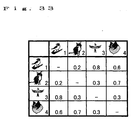
- Such relation levels are expressed in the form of correlation matrix, as shown in Fig.33.
- an illustration No.4 is the first to be selected, an illustration having a greater degree of relation therewith is selected from the correlation matrix of Fig.33.
- the illustrations listed in the order of greater degree of relation with the illustration No.4 are No.2, No.1 and No.3. Illustrations having a first and a second greatest degree of relation are selected. Therefore, the illustrations Nos.2 and 1 are selected in this example.
- the aforementioned sequence of document production operations automatically detect the descriptive region of a manuscript and add the illustration thereto based on only limited necessary items entered to the manuscript by the user. Furthermore, the operations determine the positions of the respective images of the illustration and the manuscript descriptive region according to a state of the descriptive region image, thereby accomplishing the layout in which the images of the illustration and descriptive region are laid in balance.
- illustrations as related to one another are selected from great illustration data and added to the produced document, which features a better coordination than a document with illustrations simply added thereto.
- Fig.34 is a block diagram showing an arrangement of an image production method and system according to a seventh embodiment of the invention.
- Fig.34 includes identical components to those of the system arrangement according to the first embodiment hereof. Therefore, such components are represented by like reference numerals and the detailed description thereof is omitted.
- the system of the seventh embodiment hereof includes the image input means 1, the image decoding means 2, the descriptive region detecting means 3, the input-image dividing means 4, the in-grid pixel counting means 5, the rectangular region generating means 6, the image characteristic value calculating means 7, the descriptive region image segmenting means 8, the in-segmental-descriptive-region-image pixel counting means 9, the layout pattern storage means 10, the table storage means 11, the layout pattern selecting means 12, illustration attribute storage means 24 for storing attributes of season or time which are imparted to the respective illustrations according to contents thereof, the illustration storage means 13, the illustration selecting means 14, the document producing means 15, the image encoding means 16 and the document output means 17.
- a hardware construction for carrying out the system of the above arrangement is essentially the same as the general-purpose computer system and is shown in Fig.2. Since this arrangement is the same as the construction of the first embodiment hereof, the description thereof is omitted.
- An illustration to be superimposed on the document is selected based on the decided layout pattern.
- the hardware of this embodiment hereof is constructed the same way as the general-purpose computer system, hence permitting the use of a system clock.
- Each illustration data piece stored in the illustration attribute storage means includes a piece of information about suitable date and time to be selected. For example, a certain illustration is imparted with an attribute values such as May, June'', 20:00 - 24:00'' and the like. Accordingly, when the document is produced, the illustration selecting means 14 refers to the system clock for selection of an illustration having attribute values suitable for the date and time of the document production.
- the aforementioned sequence of document production operations automatically detect the descriptive region of the manuscript and add the illustration thereto based on only limited necessary items entered to the manuscript by the user. Furthermore, the operations determine the positions of the respective images of the illustration and the manuscript descriptive region according to the state of the descriptive region image, thereby accomplishing the layout in which the images of the illustration and descriptive region are laid in balance.
- illustrations as related to one another are selected from great illustration data and added to the produced document, which features a better coordination than a document with illustrations simply added thereto.
- Fig.36 is a block diagram showing an arrangement of an image production method and a hardware construction of a system according to an eighth embodiment of the invention.
- Fig.36 The arrangement of Fig.36 is essentially the same as that of the general-purpose computer system. Further, Fig.36 includes identical components to those of the system arrangement according to the first embodiment hereof. Therefore, such components are represented by like reference numerals and the detailed description thereof is omitted.
- the system shown in Fig.36 includes the image input means 1, the document output means 17, the VRAM 101, the main storage 102, the auxiliary storage 103, the CPU 104, the data modem 109, the facsimile 110, TV-broadcasting receiver means 111 for receiving TV broadcasting, and image output means 112 for outputting TV broadcast images.
- the data modem 109 is connected to the facsimile 110 via the telephone line.
- the data modem is also connected to the image input means 1 and the image output means 17. Accordingly, the system of this embodiment is adapted to use a manuscript inputted via the facsimile 110 for production of an illustrated document according to the procedure taken by the first to the sixth embodiments hereof and then to output the resultant document to the facsimile 110.
- the TV broadcasting receiver means 111 serves to receive TV broadcast image signals, which are outputted by the image output means 112.
- a monitor (not shown) may be connected to the image output means 112 thereby displaying TV broadcast images or permitting the user to check an image of the document being produced.
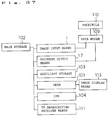
- Fig.37 is a block diagram showing an arrangement of an image production method and a hardware construction of a system according to a ninth embodiment of the invention.
- Fig.37 is essentially the same as that of the general-purpose computer system. Further, the arrangement of Fig.37 includes identical components to those of the system arrangement according to the first embodiment hereof. Therefore, such components are represented by like reference numerals and the description thereof is omitted.
- the system shown in Fig.36 includes the image input means 1, the document output means 17, the VRAM 101, the main storage 102, the auxiliary storage 103, the CPU 104, the data modem 109, the facsimile 110, TV-broadcasting receiver means 111 for receiving TV broadcasting, and image display means 113 for displaying the TV broadcast images.
- the data modem 109 is connected to the facsimile 110 via the telephone line.
- the data modem is also connected to the image input means 1 and the image output means 17. Accordingly, the system of this embodiment is adapted to use the manuscript inputted via the facsimile 110 for production of the illustrated document according to the procedure taken by the first to the sixth embodiments hereof and then to output the resultant document to the facsimile 110.
- the images received by the TV-broadcasting receiver means 111 may be displayed by the image display means 113.
- the image display means also permits the user to check an image of the document being produced.
- Fig.39 is a block diagram showing an arrangement of an image production method and system according to a tenth embodiment of the invention.
- the arrangement Fig.39 includes identical components to those of the system arrangement according to the first embodiment hereof. Therefore, such components are represented by like reference numerals and the detailed description thereof is omitted.
- the system of the tenth embodiment hereof includes the image input means 1, the image decoding means 2, the descriptive region detecting means 3, the input-image dividing means 4, the in-grid pixel counting means 5, the rectangular region generating means 6, the image characteristic value calculating means 7, the descriptive region image segmenting means 8, the in-segmental-descriptive-region-image pixel counting means 9, the layout pattern storage means 10, the table storage means 11, the layout pattern selecting means 12, the illustration storage means 13, the illustration selecting means 14, the document producing means 15, the image encoding means 16, the document output means 17, subjective information input means 60 for inputting subjective information of the user, and layout subjectiveness attribute storage means 61 for storing subjectiveness attributes of the layout patterns.
- a hardware construction for carrying out the system of the above arrangement is essentially the same as the general-purpose computer system and is shown in Fig.2. Since this arrangement is the same as the construction of the first embodiment hereof, the description thereof is omitted.
- the user uses the subjective information input means 60 for entering the user's subjectiveness and desired style of a produced document in subjective terms.
- an interface shown in Fig.41 is presented such that the user may enter subjective levels of between hard'' and soft'' and of between formal'' and informal''.
- a very formal and very hard'' style of document is desired.
- other subjective terms include simple'', complicated'', light'', heavy'' and the like.
- a layout pattern is selected by referring the image characteristic value to the table.
- Each layout pattern is imparted with a subjectivenes attributes which is stored in the layout subjectiveness attribute storage means 61.
- which layout pattern to select is decided based on the user's subjectiveness inputted at STEP H2. The decision is made by the known method (Literature 2: Miura et al., Construction of User Model in WWW Query by Subjective Description System KiSS'', IPS HI Report 96-HI69-4, 1996).
- the aforementioned sequence of document production operations automatically detect the descriptive region of the manuscript and add the illustration thereto based on only limited necessary items entered to the manuscript by the user. Furthermore, the operations determine the positions of the respective images of the illustration and the manuscript descriptive region according to the state of the descriptive region image, thereby accomplishing the layout in which the images of the illustration and descriptive region are laid in balance.
- the subjective information entered by the user is also taken into consideration thereby to provide the document of a layout close to the user's intention.
- the tenth embodiment hereof is carried out by adding the subjective information input means 60 and the layout subjectiveness attribute storage means 61 to the first embodiment hereof. It is to be understood that these means are applicable to any one of the second to the ninth embodiments of the invention.
- Fig.42 is a block diagram showing an arrangement of an image production method and system according to an eleventh embodiment of the invention.
- Fig.42 includes identical components to those of the system arrangement according to the first embodiment hereof. Therefore, such components are represented by like reference numerals and the detailed description thereof is omitted.
- the system of the eleventh embodiment hereof includes the image input means 1, the image decoding means 2, the descriptive region detecting means 3, the input-image dividing means 4, the in-grid pixel counting means 5, the rectangular region generating means 6, the image characteristic value calculating means 7, the descriptive region image segmenting means 8, the in-segmental-descriptive-region-image pixel counting means 9, the layout pattern storage means 10, the table storage means 11, the layout pattern selecting means 12, the illustration storage means 13, the illustration selecting means 14, the document producing means 15, the image encoding means 16, the document output means 17, the subjective information input means 60 for inputting subjective information of the user, and illustration subjectiveness attribute storage means 62 for storing subjectiveness attributes of the illustrations.
- a hardware construction for carrying out the system of the above arrangement is essentially the same as the general-purpose computer system and is shown in Fig.2. Since this arrangement is the same as the construction of the first embodiment hereof, the description thereof is omitted.
- the user uses the subjective information input means 60 for entering the user's subjectiveness and desired style of a produced document in subjective terms.
- each illustration is imparted with a subjectiveness attribute, which is stored in the illustration subjectiveness attribute storage means 62.
- which illustration to select is decided based on the user's subjective information inputted at STEP H2.
- the decision is made by the known method (Literature 2: Miura et al., Construction of User Model in WWW Query by Subjective Description System KiSS'', IPS HI Report 96-HI69-4, 1996).
- the aforementioned sequence of document production operations automatically detect the descriptive region of the manuscript and add the illustration thereto based on only limited necessary items entered to the manuscript by the user. Furthermore, the operations determine the positions of the respective images of the illustration and the manuscript descriptive region according to the state of the descriptive region image, thereby accomplishing the layout in which the images of the illustration and descriptive region are laid in balance.
- the subjective information entered by the user is also taken into consideration thereby to provide the document of a style close to the user's intention.
- the eleventh embodiment hereof is carried out by adding the subjective information input means 60 and the illustration subjectiveness attribute storage means 62 to the first embodiment hereof. It is to be understood that these means are applicable to any one of the second to the ninth embodiments of the invention.
- the layout pattern includes no illustration, consisting only of the descriptive region.
- the illustration is not superimposed.
- Such a case is also included in the scope of the invention.
- the invention further relates to a program information storage medium which contains a program for carrying out, by means of the computer, all or a part of the steps of the methods or all or a part of the functions of the means of the systems according to the foregoing embodiments hereof as well as set forth in the accompanying claims.
- the invention may be carried out by means of dedicated hardware circuitry for performing the functions of the components hereof. Otherwise, the invention may be carried out by means of the computer utilizing a program software for performing these functions.
- a fuzzy inference method and machine according to the invention are arranged such that inference results are subject to a clustering procedure for dynamically changing the number of outputs of defuzzification. Therefore, the defuzzification provides a real value reflecting the inference results more effectively.
- An image production method and system according to the invention (Claims 4, 5) are arranged such that a manuscript layout pattern including at least one of information items about a number of illustrations, a size and position of an illustration and a position of an image of a manuscript descriptive region is selected based on image characteristic values such as of a horizontal length, a vertical length, a mean pixel luminance, a color tone, a luminance distribution, a luminance centroid and the like of the image of the descriptive region exclusive of a background portion of an input image. This permits the output of a document featuring a layout varied according to the input image.
- An image production method and system according to the invention (Claims 6, 7) are arranged such that a manuscript schematic layout pattern including at least one of information items about an approximate position of an illustration and an approximate position of an image of a manuscript descriptive region is selected based on image characteristic values such as of a horizontal length, a vertical length, a mean pixel luminance, a color tone, a luminance distribution, a luminance centroid and the like of the image of the descriptive region exclusive of a background portion of an input image, and then the selected layout is subject to fine adjustment. This permits the production of a document more oriented to the manuscript.
- An image production method and system according to the invention (Claims 8, 9) are arranged such that a manuscript schematic layout pattern including at least one of information items about approximate positions of an illustration and an image of a manuscript descriptive region is selected based on image characteristic values such as of a horizontal length, a vertical length, a mean pixel luminance, a color tone, a luminance distribution, a luminance centroid and the like of the image of the descriptive region exclusive of a background portion of an input image, while segmental layout patterns to be laid based on the schematic layout pattern are selected. This is effective to increase the coordination of the layout pattern for permitting the production of documents featuring greater layout variations.
- An image production method and system according to the invention (Claims 10, 11) are arranged such that a table is used for selecting the layout pattern. This provides an easy selection of the layout pattern at reduced computation costs.
- An image production method and system according to the invention (Claims 12, 13) are arranged such that a rule-based inference is performed for the layout pattern selection.
- the layout pattern selection may be accomplished through inference on a non-linear relation without using a vast table.
- An image production method and system according to the invention (Claims 14, 15) are arranged such that a fuzzy inference based on fuzzy rules is performed for the layout pattern selection.
- the layout pattern selection may be accomplished through a simple inference on a non-linear relation.
- An image production method and system according to the invention (Claims 16, 17) are arranged such that the fuzzy rules are applied to the layout pattern selection and a clustering procedure is taken prior to a defuzzification processing for providing one or more outputs. This permits the fuzzy inference results to be more effectively incorporated in the layout pattern selection.
- An image production method and system according to the invention (Claims 18, 19) are arranged such that a correlation matrix of illustrations is used for selecting an illustration unit of a greater relation. Hence, there may be produced a document featuring a good coordination of illustrations.
- An image production method and system according to the invention (Claims 20, 21) are arranged such that an attribute value of season or time imparted to each illustration based on a content thereof is used for the illustration selection. This permits the selection of an illustration fitting a season or time when the document is produced. Hence, there may be produced documents suitable for time of year.
- An image production system according to the invention (Claim 22) is arranged such that a facsimile machine is employed as image input means for inputting an image. This permits an optional manuscript to be readily inputted via a telephone line.
- An image production system (Claim 23) is arranged such that a text font entered through a keyboard, as the image input means for inputting the image, is expanded into an image thereby to generate an input image. Hence, the input image may readily be generated.
- An image production system according to the invention (Claim 24) is arranged such that the facsimile machine is employed as document output means for outputting the produced documents. Hence, the produced documents may readily be outputted via the telephone line.
- An image production system according to the invention (Claim 25) is embodied in the form of a facsimile machine comprising an image production system of the invention and a scanner serving as the image input means which optically reads the manuscript.
- the illustrated documents may readily be produced in a manner as simple as that fax data is normally transmitted or received.
- An image production system (Claim 26) further comprises TV broadcasting receiver means for receiving TV broadcasting, and image output means for outputting image information inclusive of TV broadcast information received by the TV broadcasting receiver means.
- this image production system provides an easy checking of an image of a produced document.
- An image production system (Claim 27) further includes TV broadcasting receiver means for receiving TV broadcasting, and image display means for displaying image information inclusive of TV broadcast information received by the TV broadcasting receiver means.
- this image production system alone permits an image of a produced document to be checked.
- An image production method and system according to the invention (Claims 28, 29) are arranged such that user's subjectiveness is inputted for selection of a layout pattern which fits the user's subjectiveness. Hence, there may be produced a document of a layout close to the user's intention.
- An image production method and system according to the invention (Claims 30, 31) are arranged such that user's subjectiveness is inputted for selecting an illustration pattern which fits the user's subjectiveness. Hence, there may be produced a document added with an illustration close to the user's intention.
Landscapes
- Engineering & Computer Science (AREA)
- Computer Vision & Pattern Recognition (AREA)
- Artificial Intelligence (AREA)
- Physics & Mathematics (AREA)
- General Physics & Mathematics (AREA)
- Multimedia (AREA)
- Theoretical Computer Science (AREA)
- Processing Or Creating Images (AREA)
- Preparing Plates And Mask In Photomechanical Process (AREA)
- Editing Of Facsimile Originals (AREA)
- Image Processing (AREA)
Applications Claiming Priority (6)
| Application Number | Priority Date | Filing Date | Title |
|---|---|---|---|
| JP278389/97 | 1997-10-13 | ||
| JP27838997 | 1997-10-13 | ||
| JP27838997 | 1997-10-13 | ||
| JP2434798 | 1998-02-05 | ||
| JP2434798 | 1998-02-05 | ||
| JP24347/98 | 1998-02-05 |
Publications (3)
| Publication Number | Publication Date |
|---|---|
| EP0908848A2 true EP0908848A2 (fr) | 1999-04-14 |
| EP0908848A3 EP0908848A3 (fr) | 2001-09-05 |
| EP0908848B1 EP0908848B1 (fr) | 2006-07-19 |
Family
ID=26361845
Family Applications (1)
| Application Number | Title | Priority Date | Filing Date |
|---|---|---|---|
| EP98119223A Expired - Lifetime EP0908848B1 (fr) | 1997-10-13 | 1998-10-12 | Méthode et machine d'inference floue |
Country Status (3)
| Country | Link |
|---|---|
| US (2) | US6539365B1 (fr) |
| EP (1) | EP0908848B1 (fr) |
| DE (1) | DE69835263T2 (fr) |
Families Citing this family (5)
| Publication number | Priority date | Publication date | Assignee | Title |
|---|---|---|---|---|
| US9460441B2 (en) * | 2004-06-29 | 2016-10-04 | Textura Corporation | Construction payment management system and method with document exchange features |
| US8098936B2 (en) * | 2007-01-12 | 2012-01-17 | Seiko Epson Corporation | Method and apparatus for detecting objects in an image |
| US8229230B2 (en) * | 2008-07-30 | 2012-07-24 | Konica Minolta Laboratory U.S.A., Inc. | Method of digital image comparison for imaging software development |
| JP5249387B2 (ja) * | 2010-07-06 | 2013-07-31 | キヤノン株式会社 | 画像処理装置、画像処理方法、及びプログラム |
| JP7845095B2 (ja) * | 2022-07-25 | 2026-04-14 | 富士フイルムビジネスイノベーション株式会社 | 画像処理装置、画像処理システム、及び画像処理プログラム |
Family Cites Families (16)
| Publication number | Priority date | Publication date | Assignee | Title |
|---|---|---|---|---|
| US5255344A (en) * | 1988-05-20 | 1993-10-19 | Matsushita Electric Industrial Co., Ltd. | Inference rule determining method and inference device |
| US5263120A (en) * | 1991-04-29 | 1993-11-16 | Bickel Michael A | Adaptive fast fuzzy clustering system |
| JPH0654165A (ja) * | 1992-07-31 | 1994-02-25 | Ricoh Co Ltd | 画像形成装置 |
| JPH06131188A (ja) * | 1992-10-22 | 1994-05-13 | Hitachi Ltd | ファジィルール獲得方法およびファジィ推論システム |
| US5579471A (en) * | 1992-11-09 | 1996-11-26 | International Business Machines Corporation | Image query system and method |
| US5425368A (en) * | 1993-03-17 | 1995-06-20 | Board Of Regents, The University Of Texas System | Method and apparatus for estimating tissue volumes in magnetic resonance images |
| US5579439A (en) * | 1993-03-24 | 1996-11-26 | National Semiconductor Corporation | Fuzzy logic design generator using a neural network to generate fuzzy logic rules and membership functions for use in intelligent systems |
| US5544256A (en) * | 1993-10-22 | 1996-08-06 | International Business Machines Corporation | Automated defect classification system |
| US5647027A (en) * | 1994-10-28 | 1997-07-08 | Lucent Technologies Inc. | Method of image enhancement using convolution kernels |
| NL1000701C2 (nl) * | 1995-06-30 | 1996-12-31 | Oce Nederland Bv | Inrichting en werkwijze voor het extraheren van artikelen uit een document. |
| US5788640A (en) * | 1995-10-26 | 1998-08-04 | Peters; Robert Mitchell | System and method for performing fuzzy cluster classification of stress tests |
| US5765029A (en) * | 1996-05-08 | 1998-06-09 | Xerox Corporation | Method and system for fuzzy image classification |
| US5754739A (en) * | 1996-05-17 | 1998-05-19 | Motorola, Inc. | Adaptive system and method for choosing a selective call transmitter |
| US5731868A (en) * | 1997-02-06 | 1998-03-24 | Honeywell Inc | Method for characterizing the nature of fluid in machine for washing articles |
| US6011379A (en) * | 1997-03-12 | 2000-01-04 | U.S. Nanocorp, Inc. | Method for determining state-of-charge using an intelligent system |
| US6549658B1 (en) * | 1998-01-21 | 2003-04-15 | Xerox Corporation | Method and system for classifying and processing of pixels of image data |
-
1998
- 1998-10-12 EP EP98119223A patent/EP0908848B1/fr not_active Expired - Lifetime
- 1998-10-12 DE DE69835263T patent/DE69835263T2/de not_active Expired - Lifetime
- 1998-10-13 US US09/170,637 patent/US6539365B1/en not_active Expired - Fee Related
-
2002
- 2002-12-10 US US10/317,668 patent/US7072877B2/en not_active Expired - Lifetime
Also Published As
| Publication number | Publication date |
|---|---|
| US6539365B1 (en) | 2003-03-25 |
| US20030130968A1 (en) | 2003-07-10 |
| EP0908848B1 (fr) | 2006-07-19 |
| DE69835263D1 (de) | 2006-08-31 |
| EP0908848A3 (fr) | 2001-09-05 |
| DE69835263T2 (de) | 2006-11-23 |
| US7072877B2 (en) | 2006-07-04 |
Similar Documents
| Publication | Publication Date | Title |
|---|---|---|
| Lu et al. | Distance-reciprocal distortion measure for binary document images | |
| US7359568B2 (en) | Image processing apparatus and image processing method | |
| US8488190B2 (en) | Image processing apparatus, image processing apparatus control method, and storage medium storing program | |
| JP4378413B2 (ja) | 画像処理装置、画像形成装置、画像読取装置、画像処理システム、画像処理方法、画像処理プログラムおよびその記録媒体 | |
| WO1999038319A1 (fr) | Dispositif et procede de traitement d'image | |
| JP4745297B2 (ja) | デジタル画像における均一な色の領域を特定する方法およびシステム | |
| US7813546B2 (en) | Image processing device, program product and method | |
| US8929663B2 (en) | Image processing device identifying region in image as one of uniform region and nonuniform region | |
| US7072877B2 (en) | Fuzzy inference method and machine, and an image production method and system | |
| US7856144B2 (en) | Image retrieving apparatus, image retrieving method, program, and storage medium | |
| US20070165263A1 (en) | Image Processing Apparatus and Image Processing Program for Superimposing an Image | |
| US7539671B2 (en) | Image processing apparatus, image forming apparatus, method for searching processed document, program for searching processed document, and recording medium | |
| US20030053718A1 (en) | Image processing apparatus and method, and program | |
| US20060119897A1 (en) | Output apparatus and program thereof | |
| JP4033351B2 (ja) | ファジィ推論方法及びプログラム情報格納媒体 | |
| JP3598225B2 (ja) | 画像作成方法及びその装置 | |
| US20050030566A1 (en) | Method, system and recording medium for image processing | |
| US8787640B2 (en) | Image processing system, method, program, and storage medium to implement universal color design | |
| JP6736299B2 (ja) | 印刷装置、印刷方法、および、プログラム | |
| CN110956568B (zh) | 一种半色调图像的分享图像中独立秘密信息隐藏方法 | |
| JP6260144B2 (ja) | 画像処理装置およびコンピュータプログラム | |
| US9411543B2 (en) | Image processing apparatus | |
| Wang et al. | VivID: A visually improved GIF encoding network design | |
| US20260056688A1 (en) | Image forming apparatus and image processing method | |
| US7831093B2 (en) | Method for calculating and adjusting photo and text separation performance |
Legal Events
| Date | Code | Title | Description |
|---|---|---|---|
| PUAI | Public reference made under article 153(3) epc to a published international application that has entered the european phase |
Free format text: ORIGINAL CODE: 0009012 |
|
| AK | Designated contracting states |
Kind code of ref document: A2 Designated state(s): AT BE CH CY DE DK ES FI FR GB GR IE IT LI LU MC NL PT SE |
|
| AX | Request for extension of the european patent |
Free format text: AL;LT;LV;MK;RO;SI |
|
| RIC1 | Information provided on ipc code assigned before grant |
Free format text: 7G 06T 11/60 A, 7G 06F 7/00 B |
|
| PUAL | Search report despatched |
Free format text: ORIGINAL CODE: 0009013 |
|
| AK | Designated contracting states |
Kind code of ref document: A3 Designated state(s): AT BE CH CY DE DK ES FI FR GB GR IE IT LI LU MC NL PT SE |
|
| AX | Request for extension of the european patent |
Free format text: AL;LT;LV;MK;RO;SI |
|
| 17P | Request for examination filed |
Effective date: 20011113 |
|
| AKX | Designation fees paid |
Free format text: DE FR GB |
|
| 17Q | First examination report despatched |
Effective date: 20031020 |
|
| RIC1 | Information provided on ipc code assigned before grant |
Ipc: 7G 06T 11/60 A |
|
| RTI1 | Title (correction) |
Free format text: A FUZZY INFERENCE METHOD AND MACHINE |
|
| GRAP | Despatch of communication of intention to grant a patent |
Free format text: ORIGINAL CODE: EPIDOSNIGR1 |
|
| GRAS | Grant fee paid |
Free format text: ORIGINAL CODE: EPIDOSNIGR3 |
|
| GRAA | (expected) grant |
Free format text: ORIGINAL CODE: 0009210 |
|
| AK | Designated contracting states |
Kind code of ref document: B1 Designated state(s): DE FR GB |
|
| REG | Reference to a national code |
Ref country code: GB Ref legal event code: FG4D |
|
| REF | Corresponds to: |
Ref document number: 69835263 Country of ref document: DE Date of ref document: 20060831 Kind code of ref document: P |
|
| ET | Fr: translation filed | ||
| PLBE | No opposition filed within time limit |
Free format text: ORIGINAL CODE: 0009261 |
|
| STAA | Information on the status of an ep patent application or granted ep patent |
Free format text: STATUS: NO OPPOSITION FILED WITHIN TIME LIMIT |
|
| 26N | No opposition filed |
Effective date: 20070420 |
|
| PGFP | Annual fee paid to national office [announced via postgrant information from national office to epo] |
Ref country code: DE Payment date: 20091008 Year of fee payment: 12 |
|
| PGFP | Annual fee paid to national office [announced via postgrant information from national office to epo] |
Ref country code: GB Payment date: 20091007 Year of fee payment: 12 Ref country code: FR Payment date: 20091029 Year of fee payment: 12 |
|
| GBPC | Gb: european patent ceased through non-payment of renewal fee |
Effective date: 20101012 |
|
| PG25 | Lapsed in a contracting state [announced via postgrant information from national office to epo] |
Ref country code: FR Free format text: LAPSE BECAUSE OF NON-PAYMENT OF DUE FEES Effective date: 20101102 |
|
| REG | Reference to a national code |
Ref country code: FR Ref legal event code: ST Effective date: 20110630 |
|
| PG25 | Lapsed in a contracting state [announced via postgrant information from national office to epo] |
Ref country code: GB Free format text: LAPSE BECAUSE OF NON-PAYMENT OF DUE FEES Effective date: 20101012 |
|
| REG | Reference to a national code |
Ref country code: DE Ref legal event code: R119 Ref document number: 69835263 Country of ref document: DE Effective date: 20110502 |
|
| PG25 | Lapsed in a contracting state [announced via postgrant information from national office to epo] |
Ref country code: DE Free format text: LAPSE BECAUSE OF NON-PAYMENT OF DUE FEES Effective date: 20110502 |