EP0908861A2 - Procédé de transmission d'information sur le trafic - Google Patents
Procédé de transmission d'information sur le trafic Download PDFInfo
- Publication number
- EP0908861A2 EP0908861A2 EP98117135A EP98117135A EP0908861A2 EP 0908861 A2 EP0908861 A2 EP 0908861A2 EP 98117135 A EP98117135 A EP 98117135A EP 98117135 A EP98117135 A EP 98117135A EP 0908861 A2 EP0908861 A2 EP 0908861A2
- Authority
- EP
- European Patent Office
- Prior art keywords
- data
- traffic
- section
- information
- traffic information
- Prior art date
- Legal status (The legal status is an assumption and is not a legal conclusion. Google has not performed a legal analysis and makes no representation as to the accuracy of the status listed.)
- Withdrawn
Links
Images

Classifications
-
- G—PHYSICS
- G08—SIGNALLING
- G08G—TRAFFIC CONTROL SYSTEMS
- G08G1/00—Traffic control systems for road vehicles
- G08G1/01—Detecting movement of traffic to be counted or controlled
- G08G1/0104—Measuring and analyzing of parameters relative to traffic conditions
Definitions
- the invention relates to a method for determining Road routes, especially motorways, related traffic information, using local detectors Acquisition cross sections formed, traffic-related measured values recorded, preprocessed by means of local computers and on a Predefined data protocol standardized, aggregated and by radio transferred to a higher-level data processing system the transmitted data in at least one calculation method to determine traffic information processed, the input data at least vehicle speed v and traffic volume q are and that as the starting data at least cruising speed and traffic density k can produce on a detection cross section.
- DE-P 44 08 547 describes a method for traffic detection and traffic situation detection on highways, preferably Motorways, known.
- Cross sections are set up for track-related measuring points, with traffic sensors, such as induction loops, for vehicle detection and with a traffic data processing device are provided.
- traffic data such as vehicle speed, traffic volume and traffic density determined and from this determined traffic parameters in one Traffic data processing formed.
- Each form two neighboring measuring points a measuring section with a certain Track length. From the traffic data of two such measuring points traffic parameters are formed.
- These are one Speed density difference, calculated from local traffic data medium speed and traffic density, a trend factor, determined over a certain period of time the ratio of the traffic volumes of both measuring points as well a traffic intensity trend.
- Using a Fuzzy logic the probability of a critical traffic situation derived. When a probability threshold is reached can then be a control signal for a Variable message signs are generated.
- detectors are also known, which Presence and the speed of a moving object can capture.
- detectors work According to a passive infrared process, which can also be used with other methods can be combined.
- No method is known to date, traffic information covering the entire area to record and evaluate. Especially no methods are known to determine the traffic information route section variable, event-oriented if necessary and enable with little data transfer effort.
- a low data transmission effort is on the one hand Implementation of an energy-saving process required on the other hand, as transparent and easy to maintain as possible Generate databases.
- An essential aspect of the present invention is the optimal one Evaluation and further processing of the received data in a central unit to the from an economic point of view data collected and sent so comprehensive and To process as meaningfully as possible, but also to achieve results to arrive, the meaning of which is so clear and is as safe as possible.
- the present invention is based on the object of providing an area-wide traffic data acquisition of the generic type, through which reliable and sufficiently meaningful data bases for different traffic information services are provided with simple sensors and low data transmission and energy expenditure, in such a way that the recorded ones and sent data are analyzed and processed as comprehensively and meaningfully as possible, and the results are as clear and reliable as possible.
- the invention proposes a method for determining traffic information related to road routes, in particular highways, wherein local detection cross sections are formed by means of fixed detectors, traffic-related measured values are recorded, preprocessed by means of local computers and standardized, aggregated and per using a predetermined data protocol wireless transmission are transmitted to a higher-level data processing system, the transmitted data being processed in at least one calculation method for determining traffic information, the input data of which are at least vehicle speed v and traffic intensity q and which can produce at least travel speed and traffic density k on a detection cross section as output data, and wherein the data then in at least one complex extended processing method for determining traffic information related to routes ations are processed further.
- the invention enables the implementation of a step organized processing system, being short term Results can be achieved by expanding into the individual levels can be consolidated and refined. By the resolution into individual subtasks or stages results a high degree of flexibility and reliability through the formation of fallback levels. Through the local pre-analysis of traffic there are opportunities to extreme energy-saving, event-oriented data transmission too the higher-level data processing systems or centers.
- Fixed detectors are preferably used at connection points, Positioned nodes and the like. Furthermore the arrangement density of the fixed detectors becomes dependent determined by traffic expectation estimates. Consequently can be arranged by arranging many local detection systems Build comprehensive networks. With the invention it is also possible to organize an overall network structure. On Local detectors become critical traffic positions and preprocessor arranged by radio in preferably digital technology, the data to superordinate ones Forward data processing systems or centers. Further traffic models can then be applied to the data there become.
- Adjacent local detection cross sections can be a so-called route-related level of service in a higher-level Data processing system or one of the entire network assigned headquarters are determined.
- Measured data After a detector, for example a passive infrared detector, Measured data are delivered, they will be preprocessed, for example by calculating mean values, Plausibility checks and trend factor determinations carried out become. From the changes in the data or the data state codes themselves are then determined, for example in the form of a numerical value for conditions such as free traffic flow, Traffic jam, stop and go, traffic jam or standstill etc. Evaluation cycles can, for example, every 1 to 5 minutes to get voted. However, the evaluation cycle can be variable be determined, for example depending on the status codes or the traffic conditions. The same applies the data transfer rate, which depends, for example of the determined status code is used, for example one transmission every 30 minutes when traffic is free with averaging every 5 minutes. Depending on the fault condition the transmission density can be increased. In doing so the data transfer rates of adjacent acquisition cross sections matched to each other.
- a detector for example a passive infrared detector
- Measured data are delivered, they will be preprocessed, for example by calculating mean values, Plaus
- the measured values can be recorded in relation to the lane, but what is not absolutely necessary, other detection cross sections can also be used To be defined. It is also fundamental possible, vehicle type differentiation values, for example Detect trucks, cars and the like.
- source-to-target relationships by analyzing the data of all acquisition cross sections of a network determines that the data for route search, evaluated for the output of traffic management information, subjected to statistical analysis for clarification and that the data for making traffic development forecasts be evaluated.
- the invention provides methods for different Types and qualities of traffic information data to provide.
- the main task is to provide such data to prepare for the motor vehicle driver and this provide appropriate information. It can be for example, travel time displays, route displays, traffic forecast, Act traffic jams and the like.
- information displays arranged on which the motor vehicle driver their planned routes and travel time information are displayed to get. You can then, for example, under different Alternatives choose the fastest route. Additionally or alternatively, indications of traffic jam developments, Probabilities related to further development on the upcoming route section and the like are displayed. The range of applications is extensive.
- the invention provides an extremely flexible method, with which by linking different traffic models an almost network-wide, nationwide Traffic information system is buildable, which data for provides a wide variety of information purposes. It can be conventional and already known models and processes are used and be combined. Forecasts can be curve-based Forecasts at measuring points, model-based forecasts for Sections and meshes and additions of immeasurable effects using artificial intelligence. For the calculation Standard formulas of average values are used.
- the transmitted data can be calculated in two ways of different complexity. It is provided that one of the at least two calculation methods a simple interpolation procedure of low complexity is.
- the input data of the calculation process is lower Complexity is vehicle speed v and traffic volume q, baseline data are cruising speed and traffic density k. It is also provided that the calculation method low complexity an additional traffic jam message issues.
- a procedure as described requires only a minimum of input data and can be very reliable very quickly Statements about the traffic condition in the area of a measurement cross section to meet. The interpolation becomes simplistic assumed that all vehicles behave the same.
- Another calculation method can be based on data analysis process based on a fundamental diagram high complexity.
- Is a fundamental diagram a known curve related to a measurement cross section.
- the display is the curve of traffic q above the assignment k.
- the curve corresponds in simplified and heavily smoothed form essentially an asymmetrical Gaussian distribution and leaves statements about critical and uncritical States too.
- Input data of the calculation method high Complexity is vehicle speed v, traffic volume q and occupancy b, output data based on a travel time Cruising speed and traffic density k.
- the calculation method of high complexity additionally a traffic situation status signal, at least differentiates according to free / critical / traffic jam. This too the second method requires only a minimum of input data and can very quickly make very reliable statements about traffic conditions meet in the area of a measuring cross-section.
- the redundant application of at least two methods increased significantly increases security and enables a review of the Quality results.
- the present invention begins at this point and relates focus on analyzing the data for larger sections of the transport network. It is suggested that the transmitted data in at least a third, highly complex Calculation method for an advanced situation detection to be edited. The results are also included of the previous calculation methods.
- the highly complex Methods of extended situation detection are expanded Called machining process.
- the inventive method provides that by means of a further advanced processing methods based on the the traffic flow data determined on a detection cross section until the next acquisition cross section under Using a traffic model is estimated to be the closest Acquisition cross section determined corresponding data compared and correction values determined from the deviations and be introduced in a next estimation cycle.
- a traffic model is estimated to be the closest Acquisition cross section determined corresponding data compared and correction values determined from the deviations and be introduced in a next estimation cycle.
- the distance between one and the next acquisition cross section is segmented.
- the Segment number and segment length is not without influence and are definable depending on parameters.
- the correction values as parameters in the basis of the estimation Traffic model can be introduced.
- the detected, determined and estimated values around the simulated values of a fictitious Impurity point can be added.
- the invention proposes that at one further extended processing methods fuzzy logic used becomes an interpretation symbol from the preprocessed data the current traffic flow and an associated one To determine probability.
- the interpretation symbols and Probabilities are linked using a blocking matrix.
- Fuzzy logic is used. This can be used specifically for fault identification be used. It is advantageous that the further extended processing method, which under Use of fuzzy logic from the pre-processed data faults determined with the advanced machining process Use of filter estimation technology viewed from the data flow is connected upstream.
- the invention proposes that neuro-fuzzy logic be used becomes.
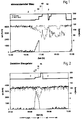
- the diagrams shown on the one hand show in the lower area the curvilinear course of qd over time, above the representation of speed over time and in the upper Area the representation of the determined situation.
- the exemplary filter logic brings one to the test results constructed situation analysis based on the filter reaction forth. Accordingly, the continuous operation of the Method according to the invention certain real standard situations in the traffic flow to typical sequences in the state sequences.
- an external cause of the fault is shown, a so-called immigration jam.
- Faults with external downstream causes first appear in the speed from the section exit.
- the local speed limits displayed in advance of a fault can change the speed pattern present. If a speed limit is switched in the area of the section output in anticipation of a changing disturbance, the speed cross section will decrease in the measurement cross section.
- Figure 1 The method according to the invention reacts to a drop in the speed level with the transition to monitoring state No. 7 critical speed ". It lingers and reaches the alarm threshold after about 15 minutes, although the fault has not yet entered the measuring section.
- This malfunction phase lasts about 1.5 hours, interrupted by two intermediate recuperations. The end of the traffic jam always remains within the measuring section.
- the first minor recovery changes to state No. 49. With the second recovery, the control status is resumed and shortly thereafter resumes Immigrant Disorder "switched.
- FIG. 2 shows the processing of an internal fault on the process side and shows the high sensitivity of the process to faults that are hardly detectable locally.
- a cause of bottleneck effects cannot be found with the aid of the method according to the invention, but the consequences of faults can be estimated. If the bottleneck effect is stronger and longer, this is reflected in the increase in the hypothetical flow in the medium range.
- the filter method according to the invention reacts after a short time by a state transition from No. 10 Compression "on No. 14 Congestion hazard ". This state is selected if, due to the accidentally balanced driving reactions, it is not inevitable, but nevertheless likely, that there is a build-up of traffic jams. In the example, a congestion forms that reaches the entrance cross-section after some time, state No. 16. The time advantage over the pure Local detection at this cross-section is about 7 minutes, and since the bottleneck has already lost its effect during this period, the logic immediately switches to state No. 17 Starting process ". A few minutes later the traffic jam has cleared.
- FIG. 3 finally shows the adaptability of the filter estimation method to various disturbances that occur during the day.
- Figure 3 shows the course of the situation analysis and a topographical representation of the traffic situation for four different disturbance deflections in succession.
- the information about disturbances inside a 3.8 km long measuring section results from the separate consideration of the speeds of two additional cross sections not used for the estimation.
- Fault 1 is an incoming traffic jam. This extends to the first reference cross section. This can be read from states 30 and 31, as well as from the drop in speed.
- the disturbance model remains inactive. Around 10.30 a.m., the traffic collapse occurs in the middle of a section due to an unexplained cause. The hypothetical flow almost reaches the threshold for congestion forecast. Due to fixed limit values, however, only the forecast Congestion risk ", condition No. 14, reached.
Landscapes
- Chemical & Material Sciences (AREA)
- Analytical Chemistry (AREA)
- Physics & Mathematics (AREA)
- General Physics & Mathematics (AREA)
- Traffic Control Systems (AREA)
Applications Claiming Priority (2)
| Application Number | Priority Date | Filing Date | Title |
|---|---|---|---|
| DE19740693 | 1997-09-16 | ||
| DE19740693 | 1997-09-16 |
Publications (2)
| Publication Number | Publication Date |
|---|---|
| EP0908861A2 true EP0908861A2 (fr) | 1999-04-14 |
| EP0908861A3 EP0908861A3 (fr) | 2000-08-23 |
Family
ID=7842516
Family Applications (1)
| Application Number | Title | Priority Date | Filing Date |
|---|---|---|---|
| EP98117135A Withdrawn EP0908861A3 (fr) | 1997-09-16 | 1998-09-10 | Procédé de transmission d'information sur le trafic |
Country Status (1)
| Country | Link |
|---|---|
| EP (1) | EP0908861A3 (fr) |
Cited By (5)
| Publication number | Priority date | Publication date | Assignee | Title |
|---|---|---|---|---|
| EP1061491A1 (fr) * | 1999-06-11 | 2000-12-20 | DDG Gesellschaft für Verkehrsdaten mbH | Procédé de filtrage de données du trafic pour déterminer la vitesse sur les routes |
| EP1528524A3 (fr) * | 2003-10-30 | 2007-12-26 | Daimler AG | Procédé de pronostic du trafic basé sur des données historiques |
| WO2015032499A1 (fr) * | 2013-09-06 | 2015-03-12 | Audi Ag | Procédé, système d'évaluation et véhicule permettant de pronostiquer au moins un paramètre d'embouteillage |
| CN113096397A (zh) * | 2021-03-31 | 2021-07-09 | 武汉大学 | 基于毫米波雷达与视频检测的交通拥堵分析方法 |
| US12230129B2 (en) | 2021-10-28 | 2025-02-18 | Toyota Motor Engineering & Manufacturing North America, Inc. | Monitoring a traffic condition of stopped or slow moving vehicles |
Family Cites Families (3)
| Publication number | Priority date | Publication date | Assignee | Title |
|---|---|---|---|---|
| SE470367B (sv) * | 1992-11-19 | 1994-01-31 | Kjell Olsson | Sätt att prediktera trafikparametrar |
| US5539645A (en) * | 1993-11-19 | 1996-07-23 | Philips Electronics North America Corporation | Traffic monitoring system with reduced communications requirements |
| DE19521917C2 (de) * | 1994-11-28 | 2001-03-01 | Mannesmann Ag | Verfahren und Vorrichtung zur Positionsbestimmung eines Fahrzeugs |
-
1998
- 1998-09-10 EP EP98117135A patent/EP0908861A3/fr not_active Withdrawn
Cited By (7)
| Publication number | Priority date | Publication date | Assignee | Title |
|---|---|---|---|---|
| EP1061491A1 (fr) * | 1999-06-11 | 2000-12-20 | DDG Gesellschaft für Verkehrsdaten mbH | Procédé de filtrage de données du trafic pour déterminer la vitesse sur les routes |
| EP1528524A3 (fr) * | 2003-10-30 | 2007-12-26 | Daimler AG | Procédé de pronostic du trafic basé sur des données historiques |
| WO2015032499A1 (fr) * | 2013-09-06 | 2015-03-12 | Audi Ag | Procédé, système d'évaluation et véhicule permettant de pronostiquer au moins un paramètre d'embouteillage |
| CN105474285A (zh) * | 2013-09-06 | 2016-04-06 | 奥迪股份公司 | 用于预测至少一个拥堵参数的方法、分析系统和车辆 |
| US9805594B2 (en) | 2013-09-06 | 2017-10-31 | Audi Ag | Method, evaluation system and vehicle for predicting at least one congestion parameter |
| CN113096397A (zh) * | 2021-03-31 | 2021-07-09 | 武汉大学 | 基于毫米波雷达与视频检测的交通拥堵分析方法 |
| US12230129B2 (en) | 2021-10-28 | 2025-02-18 | Toyota Motor Engineering & Manufacturing North America, Inc. | Monitoring a traffic condition of stopped or slow moving vehicles |
Also Published As
| Publication number | Publication date |
|---|---|
| EP0908861A3 (fr) | 2000-08-23 |
Similar Documents
| Publication | Publication Date | Title |
|---|---|---|
| EP1212738B1 (fr) | Procede de surveillance de l'etat du trafic sur un reseau routier comprenant des reductions effectives de trafic | |
| EP0740280B1 (fr) | Méthode de détection des pertubations pour trafic routièr | |
| EP0798684B1 (fr) | Procédé et système de saisie de situation de la circulation par un dispositif fixe de saisie de données | |
| DE102009033431B4 (de) | Verfahren und Vorrichtung zur dynamischen Steuerung einer Signalanlage | |
| DE10057796B4 (de) | Verfahren zur fahrzeugindividuellen Verkehrszustandsprognose | |
| EP3665036B1 (fr) | Procédé de détermination de condition d'au moins une ligne de traction le long d'un trajet | |
| EP4186775B1 (fr) | Procédé et dispositif de détection des propriétés d'un véhicule | |
| EP0978811A2 (fr) | Procédé et appareil de saisie de durée de trajets de véhicules | |
| EP0902405B1 (fr) | Procédé d'investigation d'information sur le trafic | |
| EP1573697B1 (fr) | Procede et systeme pour reconnaitre des perturbations prevues dans le temps, comprenant une centrale, par detection de flancs de brouillage au moyen de prevision de temps de trajet decoupee en sections | |
| DE10051777A1 (de) | Verfahren zur dynamischen Verkehrszustandsprognose | |
| DE10025039C2 (de) | Verfahren zur Ermittlung von Verkehrsregelungsphasendauern | |
| EP0902404B1 (fr) | Procédé de détermination d'information sur le trafic | |
| EP0903711A2 (fr) | Procédé de transmission d'information sur le trafic | |
| DE19941854A1 (de) | Steuerungsvorrichtung für eine Verkehrsampelkreuzung | |
| DE3100724A1 (de) | Verfahren zur ueberwachung des vorhandenseins von fahrzeugen innerhalb bestimmter verkehrsflaechen | |
| DE19944077A1 (de) | Verfahren und Vorrichtung zur Verkehrszustandsüberwachung | |
| DE4328939C2 (de) | Verfahren zur Erfassung von streckenbezogenen Verkehrsgrößen | |
| EP1528524B1 (fr) | Procédé de pronostic du trafic basé sur des données historiques | |
| EP0902403B1 (fr) | Procédé de détection d'information sur le trafic | |
| EP4516623A1 (fr) | Approche basée sur le débogage pour évaluer un ensemble de données d'un compteur d'essieux | |
| EP1758065A2 (fr) | Procédé destiné à prévoir l'état du trafic dans un réseau routier et centrale de gestion du trafic | |
| EP0753444B1 (fr) | Procédé pour la détection d'erreurs pour compteurs d'essieux à sections multiples | |
| DE102004009898B4 (de) | Verfahren zum Ermitteln des Verkehrszustandes auf einem Streckenabschnitt eines Straßennetzes sowie Verkehrsmanagementzentrale zur Durchführung des Verfahrens | |
| DE10359977B4 (de) | Verfahren zum Ermitteln einer Reisezeit |
Legal Events
| Date | Code | Title | Description |
|---|---|---|---|
| PUAI | Public reference made under article 153(3) epc to a published international application that has entered the european phase |
Free format text: ORIGINAL CODE: 0009012 |
|
| AK | Designated contracting states |
Kind code of ref document: A2 Designated state(s): AT BE CH CY DE DK ES FI FR GB GR IE IT LI LU MC NL PT SE |
|
| AX | Request for extension of the european patent |
Free format text: AL;LT;LV;MK;RO;SI |
|
| PUAL | Search report despatched |
Free format text: ORIGINAL CODE: 0009013 |
|
| AK | Designated contracting states |
Kind code of ref document: A3 Designated state(s): AT BE CH CY DE DK ES FI FR GB GR IE IT LI LU MC NL PT SE |
|
| AX | Request for extension of the european patent |
Free format text: AL;LT;LV;MK;RO;SI |
|
| 17P | Request for examination filed |
Effective date: 20010219 |
|
| AKX | Designation fees paid |
Free format text: AT BE CH CY DE DK ES FI FR GB GR IE IT LI LU MC NL PT SE |
|
| 17Q | First examination report despatched |
Effective date: 20031007 |
|
| STAA | Information on the status of an ep patent application or granted ep patent |
Free format text: STATUS: THE APPLICATION IS DEEMED TO BE WITHDRAWN |
|
| 18D | Application deemed to be withdrawn |
Effective date: 20040218 |