EP0909059A1 - Verfahren und Vorrichtung zur Auswertung von Daten eines Protokollanalysators - Google Patents
Verfahren und Vorrichtung zur Auswertung von Daten eines Protokollanalysators Download PDFInfo
- Publication number
- EP0909059A1 EP0909059A1 EP97307912A EP97307912A EP0909059A1 EP 0909059 A1 EP0909059 A1 EP 0909059A1 EP 97307912 A EP97307912 A EP 97307912A EP 97307912 A EP97307912 A EP 97307912A EP 0909059 A1 EP0909059 A1 EP 0909059A1
- Authority
- EP
- European Patent Office
- Prior art keywords
- data
- protocol
- protocol analyser
- modules
- analysing
- Prior art date
- Legal status (The legal status is an assumption and is not a legal conclusion. Google has not performed a legal analysis and makes no representation as to the accuracy of the status listed.)
- Withdrawn
Links
- 238000011156 evaluation Methods 0.000 title claims abstract description 17
- 238000000034 method Methods 0.000 title claims abstract description 15
- 238000004458 analytical method Methods 0.000 claims abstract description 35
- 238000012545 processing Methods 0.000 claims description 25
- 230000003287 optical effect Effects 0.000 claims description 2
- 238000004891 communication Methods 0.000 abstract description 7
- 238000012360 testing method Methods 0.000 abstract description 5
- 230000006870 function Effects 0.000 description 6
- 230000000694 effects Effects 0.000 description 2
- 230000003247 decreasing effect Effects 0.000 description 1
- 238000001514 detection method Methods 0.000 description 1
- 238000005259 measurement Methods 0.000 description 1
- 238000012986 modification Methods 0.000 description 1
- 230000004048 modification Effects 0.000 description 1
- 238000012549 training Methods 0.000 description 1
- 230000000007 visual effect Effects 0.000 description 1
- 238000012800 visualization Methods 0.000 description 1
Images

Classifications
-
- H—ELECTRICITY
- H04—ELECTRIC COMMUNICATION TECHNIQUE
- H04L—TRANSMISSION OF DIGITAL INFORMATION, e.g. TELEGRAPHIC COMMUNICATION
- H04L43/00—Arrangements for monitoring or testing data switching networks
- H04L43/18—Protocol analysers
Definitions
- the present invention relates generally to the field of protocol analysers and particularly to a method and apparatus for the evaluation of protocol analyser data, and in particular where protocol analyser data is made available from different protocol analysers.
- Protocol analysers or protocol monitors are devices which allow the recording of all kinds of data or messages exchanged between specified interfaces of distributed systems, e. g. communications systems which consist of a plurality of components. With protocol emulators or simulators, messages exchanged between the components of a system can be simulated. The recorded message exchanges are stored in a storage means and are usually called a log-file. Analysis of log-files may be used for the detection of errors, to prove compliance with predetermined rules or protocols, to test the compatibility of components or for testing the interoperability of different components. Analysis of the stored log-file data is usually made off-line, i. e. after a number of exchanged messages, sufficient for the requested analysis, have been stored.
- protocol analysers For analysing the log-file data, protocol analysers usually have a soft-ware package which allows, for example, visualisation of the messages exchanged, decoding of the exchanged messages and/or the comparison of the log-file with predetermined protocols.
- the quality and user-friendliness of the soft-ware differs considerably, usually decreasing with the specialisation of the protocol analysers.
- protocol analysers For testing complex communications systems a number of different protocol analysers are often needed. Sometimes different protocol analysers from different suppliers are used to analyse the same interface of the communication system. Alternatively, the log-files of remotely located communications systems may be analysed. In these cases the type of protocol analyser used for recording the log-file under consideration may not be available at the location where the log-file is to be analysed.
- protocol analysers As known from the state of art are several problems with regard to the use of different protocol analysers as known from the state of art.
- One problem of protocol analysers as known from the state of the art is that it is not always possible to make available all the necessary types of protocol analysers. It is another problem that if different types of protocol analysers are used, the users have to be trained for all of these different types of protocol analysers. Yet another problem is that the functionality required for a specific analysis may not be supported by the available protocol analyser, and the functionality of known protocol analysers is usually fixed. It is a further problem of known protocol analysers that during the analysis the protocol analyser is off-line and the recording of messages exchanged and the creation of a log-file for a particular interface is blocked.
- One aim of the invention is to avoid the drawbacks of the protocol analysers as known from the state of the art.
- the method includes the steps of inputting the protocol analyser data, decoding the inputted protocol analyser data and producing data of an intermediate data format, analysing the data of intermediate format, and outputting the results of the analysis.
- An apparatus includes means for inputting, storing, processing and outputting.
- the storing means is divided into storing areas for protocol analyser data, for decoding modules, for analysing modules, for intermediate data and for output data.
- the inputting means inputs the protocol analyser data and stores it in the storing means.
- the processing means selects the appropriate decoding module depending on the type of protocol analyser data.
- the processing means decodes the protocol analyser data with the selected decoding module and creates data of an intermediate format which is stored in the storing means.
- the processing means analyses the intermediate data with a predetermined module or modules of the analysing modules and stores the result of the analysis as output data in the storing means.
- the output data is outputted by the outputting means.
- Another apparatus includes means for inputting, storing, processing and outputting.
- the storing means is divided into storing areas for decoding modules, for analysing modules, for intermediate data and for output data.
- the inputting means inputs the protocol analyser data.
- the processing means selects the appropriate decoding module depending on the type of protocol analyser data.
- the processing means decodes the protocol analyser data with the selected decoding module and creates data of an intermediate format which is stored in the storing means.
- the processing means analyses the intermediate data with a predetermined module or modules of the analysing modules and stores the result of the analysis as output data in the storing means.
- the output data is outputted by the outputting means.
- An advantage of the present invention is that it allows the use of expensive measuring devices only for the purpose of capturing data.
- Another advantage of the present invention is that it allows the flexible evaluation of different types of protocol analyser data with a single method or apparatus, reducing the necessary training for the user and the cost of making available different types of protocol analysers.
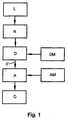
- Fig. 1 is a schematic flow chart of a method for the evaluation of protocol analyser data. It shows the protocol analyser data in the form of one or more log-files L, an inputting step R, to input in the log-file L, a decoding step D, which produces data IF of an intermediate format, an analysing step A and an outputting step O. It also shows decoding modules DM for the decoding step D and analysing modules AM for the analysing step A.
- the log-file L of that data is inputted in the first step.
- the inputted log-file L is decoded in the second step D, wherein the appropriate decoding module DM is selected for the given format of the inputted log-file L. It is also possible to effect the decoding at the same time as data is input, i. e. the first step and the second step are effected in parallel.
- the selection of the appropriate decoding module DM is made possible through information, e. g. header information, which characterises the different formats of the log-files representing the inputted data originating from different types of protocol analysers.
- the decoding produces data of an intermediate data format IF which is evaluated or analysed in the third step A.
- an separate third step it is also possible to effect the second and the third step or the first, second and third steps in parallel.
- different analysing modules AM are available.
- the kind of analysis has to be predetermined, i. e. the type of analysing module or modules AM has or have to be chosen.
- the results of the analysis are outputted O in a fourth step, e. g. in optical or acoustical form. It is also possible to output the results of the analysis in an electronically storable data file.
- the decoding modules used for decoding of the inputted log-files originating from different types of protocol analysers in the second step can easily be derived from the different types of log-files, if their formats are known. It is then possible to decode all information contained in each log-file originating form any given type of protocol analyser to an intermediate format. After decoding the inputted log-files L of different format, the data IF of intermediate format is uniform for all inputted log-files.
- the uniformity of the intermediate data IF in the intermediate format allows the analysis of all protocol analyser data with one set of analysing modules AM, regardless of the format of the different original log-files.
- the analysing modules AM represent the functionality of all of the used protocol analysers. All given analysing functions of the used protocol analysers are taken to create the analysing modules AM. On this basis each necessary function or analysing module AM has to be programmed.
- the available functions comprise, for example, the flow of the data and/or messages exchanged, statistics, time measurements and many others. It is also possible to create further analysing modules, which are not available from known protocol analysers.
- Fig. 2 Depicted in Fig. 2 is an apparatus for the evaluation of protocol analyser data. It shows an input means IN, a storing means M, an output means OUT and a processing means P.
- the input means IN can be, for example, a floppy-disk reader, a keyboard or an data interface, e. g. a RS-232 interface or a combination thereof.
- the output means OUT can be a monitor, a printer, a loudspeaker, a storing means or such like or a combination thereof.
- the processing means P can be a microprocessor which controls the input means IN, the output means OUT, the storing means M and processes the data to be analysed.
- the storing means M can be a volatile or non-volatile memory, which is divided into different storing areas. There are areas for inputted log-files L, for decoding modules DM, for analysing modules AM, for data IF of intermediate format and for output data O. Any standard computer, a. g. a personal computer, may be used to build the apparatus for the evaluation of protocol analyser data as shown in Fig. 2.
- decoding modules DM of the storing means M all decoding modules needed for the log-files that have to be analysed are stored.
- area for analysing modules AM of the storing means M all the analysing modules needed for the analysis to be carried out are stored. All the necessary decoding modules and analysing modules have to be made available and stored in the storing means before the start of analysis of log-files. As mentioned above, the decoding and analysing modules can easily be created, if the format of the log-files and the necessary analysis functions are known.
- any given log-file is inputted by the inputting means IN under the control of the processing means P, it is stored in the storing means M, in the area for log-files L. Subsequently the inputted and stored log-file L is decoded by the processing means P.
- the matching decoding module from the stored decoding modules DM is selected by the processing means P. For this purpose it is, for example, possible to analyse header information contained in the log-file to identify the matching decoding module.
- the decoded log-file is stored in the storing means, area IF, in an intermediate format for later analysis.
- Fig. 3 Depicted in Fig. 3 is another embodiment of an apparatus for the evaluation of protocol analyser data. It comprises the same means as depicted in Fig. 2 and explained above.
- storing means M is divided into areas for decoding modules DM, for analysing modules AM, for data in intermediate format IF and for output data O. Instead of inputting and storing the log-file that is to be analysed the log-file is decoded directly during inputting.
- data IF is analysed.
- the different analysing functions or modules stored in memory means M, area AM can be selected or predetermined for the analysis, e. g. by using the keyboard of the input means IN.
- the processing means P analyses data IF of intermediate format with the selected analysing module or modules AM and stores the results of the analysis in the storing means M, area O, for the output data.
- the output data O is afterwards outputted by the output means OUT under the control of the processing means P.
- the output of the output data O can be visual, acoustical and/or a data file in electronically storable form.
Landscapes
- Engineering & Computer Science (AREA)
- Computer Networks & Wireless Communication (AREA)
- Signal Processing (AREA)
- Maintenance And Management Of Digital Transmission (AREA)
Priority Applications (1)
| Application Number | Priority Date | Filing Date | Title |
|---|---|---|---|
| EP97307912A EP0909059A1 (de) | 1997-10-07 | 1997-10-07 | Verfahren und Vorrichtung zur Auswertung von Daten eines Protokollanalysators |
Applications Claiming Priority (1)
| Application Number | Priority Date | Filing Date | Title |
|---|---|---|---|
| EP97307912A EP0909059A1 (de) | 1997-10-07 | 1997-10-07 | Verfahren und Vorrichtung zur Auswertung von Daten eines Protokollanalysators |
Publications (1)
| Publication Number | Publication Date |
|---|---|
| EP0909059A1 true EP0909059A1 (de) | 1999-04-14 |
Family
ID=8229536
Family Applications (1)
| Application Number | Title | Priority Date | Filing Date |
|---|---|---|---|
| EP97307912A Withdrawn EP0909059A1 (de) | 1997-10-07 | 1997-10-07 | Verfahren und Vorrichtung zur Auswertung von Daten eines Protokollanalysators |
Country Status (1)
| Country | Link |
|---|---|
| EP (1) | EP0909059A1 (de) |
Cited By (2)
| Publication number | Priority date | Publication date | Assignee | Title |
|---|---|---|---|---|
| CN101262472B (zh) * | 2007-03-07 | 2011-09-28 | 力博特公司 | 一种多功能协议解析器及其实现方法 |
| US8489525B2 (en) | 2010-05-20 | 2013-07-16 | International Business Machines Corporation | Automatic model evolution |
Citations (2)
| Publication number | Priority date | Publication date | Assignee | Title |
|---|---|---|---|---|
| EP0371608A2 (de) * | 1988-11-29 | 1990-06-06 | International Business Machines Corporation | Objektüberwachung in einem Netzwerk |
| US5613117A (en) * | 1991-02-27 | 1997-03-18 | Digital Equipment Corporation | Optimizing compiler using templates corresponding to portions of an intermediate language graph to determine an order of evaluation and to allocate lifetimes to temporary names for variables |
-
1997
- 1997-10-07 EP EP97307912A patent/EP0909059A1/de not_active Withdrawn
Patent Citations (2)
| Publication number | Priority date | Publication date | Assignee | Title |
|---|---|---|---|---|
| EP0371608A2 (de) * | 1988-11-29 | 1990-06-06 | International Business Machines Corporation | Objektüberwachung in einem Netzwerk |
| US5613117A (en) * | 1991-02-27 | 1997-03-18 | Digital Equipment Corporation | Optimizing compiler using templates corresponding to portions of an intermediate language graph to determine an order of evaluation and to allocate lifetimes to temporary names for variables |
Non-Patent Citations (3)
| Title |
|---|
| HAYES S: "ANALYZING NETWORK PERFORMANCE MANAGEMENT", IEEE COMMUNICATIONS MAGAZINE, vol. 31, no. 5, 1 May 1993 (1993-05-01), pages 52 - 58, XP000367619 * |
| JANDER M: "A MULTIPLE-CHOICE PROTOCOL TESTER", DATA COMMUNICATIONS, vol. 23, no. 7, 1 May 1994 (1994-05-01), pages 41/42, XP000442731 * |
| SUNIL BHAT: "THE NETWORK ADVISOR ANALYSIS AND REAL-TIME ENVIRONMENT", HEWLETT-PACKARD JOURNAL, vol. 43, no. 5, 1 October 1992 (1992-10-01), pages 29 - 33, XP000349771 * |
Cited By (3)
| Publication number | Priority date | Publication date | Assignee | Title |
|---|---|---|---|---|
| CN101262472B (zh) * | 2007-03-07 | 2011-09-28 | 力博特公司 | 一种多功能协议解析器及其实现方法 |
| US8489525B2 (en) | 2010-05-20 | 2013-07-16 | International Business Machines Corporation | Automatic model evolution |
| US8577818B2 (en) | 2010-05-20 | 2013-11-05 | International Business Machines Corporation | Automatic model evolution |
Similar Documents
| Publication | Publication Date | Title |
|---|---|---|
| US4437184A (en) | Method of testing a data communication system | |
| US6158031A (en) | Automated code generating translator for testing telecommunication system devices and method | |
| EP1530847B1 (de) | Verfahren und system zur konfigurationssteuerung in telekommunikationsnetzen | |
| US5418793A (en) | Method and apparatus for testing a complex entity | |
| US20080313126A1 (en) | Method for a distributed control system | |
| US5729588A (en) | Enhanced recording verification system | |
| RU2156994C2 (ru) | Способ управления неисправностью системы в регистре исходных местоположений системы многостанционного доступа с кодовым разделением каналов (мдкрк), способ компенсирования несоответствия между текущими состояниями неисправностей систем, содержащих регистр исходных местоположений мдкрк и состояниями графиков неисправностей и способ обработки проявлений неисправностей | |
| CN109726020A (zh) | 系统对接方法、系统对接设备、存储介质及装置 | |
| CN115065736A (zh) | 报文处理方法、装置、电子设备及存储介质 | |
| JP4394225B2 (ja) | 通信システム用のコンフィグレーションデータを検証するための、方法、検証モジュール、サーバ、制御モジュール、および記憶手段 | |
| EP0909059A1 (de) | Verfahren und Vorrichtung zur Auswertung von Daten eines Protokollanalysators | |
| CN115220707B (zh) | 一种基于区块链的软件开发管理方法及系统 | |
| CN118740703B (zh) | 多通信协议测试方法、装置、终端及存储介质 | |
| US7389340B2 (en) | Execution sets for generated logs | |
| CN113158115B (zh) | 配置页面显示方法、装置、电子设备和存储介质 | |
| JP2019204408A (ja) | 異常操作検知装置、異常操作検知方法、およびプログラム | |
| US5838767A (en) | Method of simulative testing stored program control type electronic automatic exchange | |
| KR100621573B1 (ko) | 내장 시스템 소프트웨어를 테스트하기 위한 시스템 및 방법 | |
| CN114840422A (zh) | 测试方法、装置、电子设备及存储介质 | |
| CN114117915A (zh) | 模型的部署方法、装置和电子设备 | |
| JP3001432B2 (ja) | 電子交換機のシミュレート試験システムおよびシミュレート試験方法 | |
| CN114253815A (zh) | 通信内容分析方法及装置 | |
| KR100329860B1 (ko) | 통신 시스템의 인간친화형 명령어 처리방법 | |
| CN118505163B (zh) | 一种用于远程银行的质检方法、装置、计算机设备及介质 | |
| KR100621574B1 (ko) | 내장 시스템 소프트웨어 테스팅을 위한 테스트 드라이버 생성시스템 |
Legal Events
| Date | Code | Title | Description |
|---|---|---|---|
| PUAI | Public reference made under article 153(3) epc to a published international application that has entered the european phase |
Free format text: ORIGINAL CODE: 0009012 |
|
| AK | Designated contracting states |
Kind code of ref document: A1 Designated state(s): DE FR GB |
|
| 17P | Request for examination filed |
Effective date: 19991001 |
|
| AKX | Designation fees paid |
Free format text: DE FR GB |
|
| STAA | Information on the status of an ep patent application or granted ep patent |
Free format text: STATUS: THE APPLICATION IS DEEMED TO BE WITHDRAWN |
|
| 18D | Application deemed to be withdrawn |
Effective date: 20010501 |