EP0909448B1 - Elektrische vorrichtung mit poröser leiterisolierung imprägniert mit einem dielektrischen fluidum mit rheologischem übergangspunkt - Google Patents
Elektrische vorrichtung mit poröser leiterisolierung imprägniert mit einem dielektrischen fluidum mit rheologischem übergangspunkt Download PDFInfo
- Publication number
- EP0909448B1 EP0909448B1 EP97930932A EP97930932A EP0909448B1 EP 0909448 B1 EP0909448 B1 EP 0909448B1 EP 97930932 A EP97930932 A EP 97930932A EP 97930932 A EP97930932 A EP 97930932A EP 0909448 B1 EP0909448 B1 EP 0909448B1
- Authority
- EP
- European Patent Office
- Prior art keywords
- temperatures
- temperature range
- fluid
- dielectric fluid
- viscosity
- Prior art date
- Legal status (The legal status is an assumption and is not a legal conclusion. Google has not performed a legal analysis and makes no representation as to the accuracy of the status listed.)
- Expired - Lifetime
Links
Images
Classifications
-
- H—ELECTRICITY
- H01—ELECTRIC ELEMENTS
- H01B—CABLES; CONDUCTORS; INSULATORS; SELECTION OF MATERIALS FOR THEIR CONDUCTIVE, INSULATING OR DIELECTRIC PROPERTIES
- H01B3/00—Insulators or insulating bodies characterised by the insulating materials; Selection of materials for their insulating or dielectric properties
- H01B3/18—Insulators or insulating bodies characterised by the insulating materials; Selection of materials for their insulating or dielectric properties mainly consisting of organic substances
- H01B3/20—Insulators or insulating bodies characterised by the insulating materials; Selection of materials for their insulating or dielectric properties mainly consisting of organic substances liquids, e.g. oils
-
- Y—GENERAL TAGGING OF NEW TECHNOLOGICAL DEVELOPMENTS; GENERAL TAGGING OF CROSS-SECTIONAL TECHNOLOGIES SPANNING OVER SEVERAL SECTIONS OF THE IPC; TECHNICAL SUBJECTS COVERED BY FORMER USPC CROSS-REFERENCE ART COLLECTIONS [XRACs] AND DIGESTS
- Y10—TECHNICAL SUBJECTS COVERED BY FORMER USPC
- Y10T—TECHNICAL SUBJECTS COVERED BY FORMER US CLASSIFICATION
- Y10T428/00—Stock material or miscellaneous articles
- Y10T428/29—Coated or structually defined flake, particle, cell, strand, strand portion, rod, filament, macroscopic fiber or mass thereof
- Y10T428/2913—Rod, strand, filament or fiber
- Y10T428/2933—Coated or with bond, impregnation or core
- Y10T428/294—Coated or with bond, impregnation or core including metal or compound thereof [excluding glass, ceramic and asbestos]
-
- Y—GENERAL TAGGING OF NEW TECHNOLOGICAL DEVELOPMENTS; GENERAL TAGGING OF CROSS-SECTIONAL TECHNOLOGIES SPANNING OVER SEVERAL SECTIONS OF THE IPC; TECHNICAL SUBJECTS COVERED BY FORMER USPC CROSS-REFERENCE ART COLLECTIONS [XRACs] AND DIGESTS
- Y10—TECHNICAL SUBJECTS COVERED BY FORMER USPC
- Y10T—TECHNICAL SUBJECTS COVERED BY FORMER US CLASSIFICATION
- Y10T428/00—Stock material or miscellaneous articles
- Y10T428/29—Coated or structually defined flake, particle, cell, strand, strand portion, rod, filament, macroscopic fiber or mass thereof
- Y10T428/2913—Rod, strand, filament or fiber
- Y10T428/2933—Coated or with bond, impregnation or core
- Y10T428/294—Coated or with bond, impregnation or core including metal or compound thereof [excluding glass, ceramic and asbestos]
- Y10T428/2942—Plural coatings
- Y10T428/2947—Synthetic resin or polymer in plural coatings, each of different type
Definitions
- the present invention relates to an electric device which comprises one or more current- or voltage-carrying bodies, i.e. conductors, and a porous electrical insulation; arranged between or around the conductors, the insulation comprises an open porosity and is impregnated with a dielectric fluid.
- the present invention relates in particular to an electric device used in high voltage application with a porous electrical conductor insulation comprising a fiber-based material, especially a material containing cellulose-based fibers.
- a known electric device comprising insulated conductors operating at a high voltage, i.e. a voltage above 100 kV, such as a high-voltage transmission or distribution cable or a power transformer or reactor used in a network for transmission or distribution of electrical power
- a high voltage i.e. a voltage above 100 kV
- a high-voltage transmission or distribution cable or a power transformer or reactor used in a network for transmission or distribution of electrical power
- cellulose fibers mean pulp fibers which contain cellulose and to a varying extent lignin and hemi-cellulose.
- Conventional cellulose-based electrical insulations consists of wound or spun layers of tape or of preformed bodies manufactured by dewatering and/or pressing a slurry comprising the cellulosic fibers, commonly known as pressboard. Both wound and preformed insulations are impregnated with an electrically insulating fluid, a dielectric fluid, usually an organic fluid such as an oil. This impregnation is normally carried out prior to, in connection to or after the insulation have been applied around the conductor or between conductors.
- the active part of the insulation is the cellulose fibers in the paper or the board.
- the oil protect the insulation against moisture pick-up and fills all pores and voids, whereby the dielectrically weak air is replaced by the oil. It is also known to use porous tapes and boards containing polymer-based man-made fibers in such insulations and also impregnate porous fiber-based insulations with similar dielectric fluids.
- a fluid exhibiting a low-viscosity is desired.
- the fluid shall be viscous at normal operation conditions for the electrical device to avoid migration of the fluid in the porous insulation, and especially away from the porous insulation.
- ⁇ is the so called Darcy velocity of the fluid, defined as the volume flow divided by the sample area
- k is the permeability of the porous media
- ⁇ P is the pressure difference across the sample
- ⁇ is the dynamical viscosity of the fluid
- L is the thickness of the sample.
- dielectric fluids When using such dielectric fluids they can be chosen such that they are sufficiently viscous at normal operation temperatures to be essentially fully retained in the insulation also under the temperature fluctuations that occurs in the electric device during operation and also that this retention is unaffected of the temperature gradient that normally builds up over a conductor insulation for an electric device comprising conductors at high-voltage. This will mean that the impregnation will have to be carried out at a temperature substantially higher than the operation temperature the insulation is designed to operate at. The high impregnation temperature is needed to ensure that the insulation will be essentially fully impregnated.
- the oil described in US-A-3 668 128 comprise additions of from 1 up to 50 percent by weight of an alkene polymer with a molecular weight in the range 100-900 derived from an alkene with 3, 4 or 5 carbon atoms, e.g. polybutene.
- This oil exhibit a low viscosity at low temperatures, good oxidation resistance and also good resistance to gassing, i.e. the evolution of hydrogen gas which might occur, especially when an oil of low aromatic content, as the oil suggested in US-A-3 668 128, is exposed to electrical fields.
- EP-A1-0 231 402 a gel-forming compound is disclosed that exhibit a slow forming and thermally reversible gelling properties.
- the gel-forming compound is intended to be used as an encapsulant to ensure a good sealing and blocking of any interstices in the cable insulation such as unbonded interfaces or other internal spaces present between solid insulations, solid semi-conducting shields or layers and conductors in a cable insulated with solid polymeric insulation materials to avoid water from penetrating the insulation by intrusion and spreading along these internal interstices.
- This slow-forming thermally reversible gel-forming compound comprises an admixture of a polymer to a naphtenic or paraffinic oil and also embodiments using further admixtures of a comonomer and/or a block copolymer and is considered suitable as encapsulant due to its hydrofobic nature and the fact that it can be pumped into the interstices at a temperature below the maximum service temperature of the encapsulant itself.
- Similar gel-forming compounds for the same purpose i.e.
- an electric device comprising an electric conductor with a conductor insulation in the form of a porous insulation impregnated with a dielectric fluid that;
- the dielectric fluid shall exhibit a low temperature coefficient within both the first and second temperature ranges to ensure stable flow properties and flow behavior within these ranges, and that the change in viscosity within the limited third transition range is substantial, i.e. the change in viscosity is in the order of hundreds of Pas or more.
- an electric DC cable comprising: at least one conductor; a first semi-conducting shield disposed around the conductor; a porous insulation with an open porosity and impregnated with a dielectric fluid, outside the first semi-conducting shield; a second semi-conducting shield outside the insulation; and a mantle, wherein said dielectric fluid comprises a polymer and a hydrocarbon-based fluid, and is composed such that a part of the polymer molecules interacts with the hydrocarbon based fluid or another part of the polymer molecule in such a way that the dielectric fluid;
- the electric device is arranged with a dielectric fluid that comprises an admixture of a block copolymer to a hydrocarbon-based fluid, composed such;
- An admixture comprising a di- or tri block copolymer, such as a styrene-butadiene-styrene block polymer or styrene-ethylene-butene-styrene in a hydrocarbon-based fluid, such as an electrical insulation oil based on a mineral oil, exhibits the temperature dependent behavior as described in the foregoing.
- a di- or tri block copolymer such as a styrene-butadiene-styrene block polymer or styrene-ethylene-butene-styrene in a hydrocarbon-based fluid, such as an electrical insulation oil based on a mineral oil
- the admixture is composed such;
- the change between the high and the low viscosity states is reversible.
- the dielectric fluids according to the embodiments described in the foregoing exhibits a viscosity at the first lower temperature range, comprising temperatures up to 100 °C, preferably temperatures between 0° C to 80 °C, of 10 Pas or more, preferably 100 Pas or more and a viscosity in elevated temperatures in the second temperature range of 200 mPas or less.
- This second temperature range comprises temperatures of 80 °C or more, preferably temperatures within the range 95° C to 150° C, favorably this higher range do not include temperatures above 120° C.
- An electric device comprising a conductor provided with a porous conductor insulation impregnated with a dielectric fluid as defined in the foregoing exhibit an insulation of its conductors that ensures stable dielectric properties and an essentially improved impregnation process, which reduces the risk for unfilled voids remaining in the insulation after impregnation and also reduce the risk for forming voids in the insulation during operation due to migration of the fluid during operation. It has been found that conditions for impregnation have been improved such that the impregnation time can be shortened and/or the impregnation temperature can be lowered .
- an electric device according to the present invention will exhibit a very low migration of dielectric fluid within the insulations or out from them during the special conditions that prevail in an installation for high-voltage direct current transmission of electric power. This is especially important due to the long life such installations are designed for, and the limited access for maintenance to such installations of being installed in remote locations or even sub-sea.
- One further advantage for a high-voltage direct current cable according to the present invention is that the reduced flow of dielectric fluid within the insulation during operations essentially eliminates or at least substantially reduces the risk oil-drainage in parts of the cable being located at higher levels than other parts which might have been laid at the bottom of the sea. Further the span in operation temperature have for an electric device according to the present invention been extended by raising the upper limit where the fluid is essentialy retained in the insulation. That is the tendency for migration at these raised operation temperatures and thus the risk for formation of voids under such conditions is substantially reduced.
- an electric cable as defined in the foregoing is designed for operation under the specific conditions prevailing in installations for high-voltage direct current transmission of electric power.
- a HVDC-cable has at its center one or more conductors, preferably the or each conductor comprises a plurality of wires made from a metal which is a good electric conductor such as copper or aluminum or an alloy based on either of them.
- a first semi-conducting shield preferably made by wounding sheet-paper or tape comprising cellulose-fiber and a conducting particulate material such as soot or carbon black around said core arranged.
- An insulation likewise produced by wounding or spinning sheet-paper or paper tape comprising cellulose fiber around the first semi-conducting shield.
- a second semi-conducting shield similar to the first arranged.
- a mantle is arranged to mechanically shield and protect the cable from outside forces and also from water penetration.
- This mantle normally is made in a metal such as lead or steel and often also comprises a reinforcement in the form of steel wires.
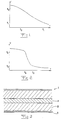
- Figure 1 shows a graph illustrating how the viscosity varies with temperature for a dielectric that are used for impregnation of a porous insulation in an electric device according to prior art.
- Figure 2 shows a graph illustrating how the viscosity varies with temperature for a dielectric that are used for impregnation of a porous insulation in an electric device according to one embodiment of the present invention.
- Figure 3 shows a section-view of a cable for high-voltage direct current transmission of electric power according to one embodiment of the present invention.
- the viscosity V as a function of temperature T for a dielectric fluid used for impregnation of porous insulation in an electric device according to prior art is illustrated in figure 1.
- the temperature or temperature range t 1 is the lowest temperature at which the viscosity v 1 is sufficiently low to ensure that essentially all voids in a porous material is fully impregnated with the dielectric fluid.
- the temperature or range of temperatures t 2 is the highest temperature at which the viscosity v 2 is sufficiently high to ensure that the dielectric fluid is retained in an insulation it has been impregnated into. This temperature t 2 is of course much dependent on the overall conditions during operation and will be affected by many parameters. Therefore it has to be an approximated estimate based on empirical knowledge.
- the temperature t 1 to which the fluid need to be heated during impregnation, be relatively high.
- the energy consumption for impregnation will be high and often there will be a risk for degrading the insulation material.
- a lower impregnation temperature can be used at the cost of a prelonged processing or by adjustment of the formulation to lower the viscosity at a suitable and economically suitable temperature for impregnation.
- Such an adjustment of the formulation will, however, also lower the viscosity at lower temperatures, i.e. operating temperatures, and the full retention of the dielectric fluid in the insulation during operation is at risk. Consequently, to ensure full retention at operating temperature a dielectric fluid formulation requiring a high degree of impregnation need to be used.
- Temperature or temperature range t 3 is the lowest temperature at which the viscosity v 3 is sufficiently low to ensure that essentially all voids in a porous material are filled with the dielectric fluid.
- the temperature or temperature range t 4 is the highest temperature at which the viscosity v 4 is sufficiently high to ensure that the dielectric fluid is retained in an insulation it has been impregnated into. Temperature t 4 as temperature t 2 is much dependent on the overall conditions during operation and will be affected by many parameters. Therefore, it is an estimate based on empirical knowledge.
- the temperature dependence of the dielectric fluid used in a device according to the invention exhibits a typical transition point or a transition zone, i.e. a limited temperature range over which the viscosity changes from its high viscosity state to its low viscosity state and that the viscosity both below and above this transition zone exhibit a low temperature dependence.
- This change in viscosity with temperature over the transition zone is as described in the foregoing related to a structural change within the dielectric fluid due to the interaction of a functional part in the added polymer with the base fluid or with other parts or groups within the polymer itself.
- the temperature difference between the lowest impregnation temperature at which an essentially complete impregnation is obtained and the highest safe retention temperature in a dielectric fluid as used in the invention t 3 -t 4 is much lower than the same temperature difference for a dielectric fluid as used in a conventional electric device t 1 -t 2 .
- a lower impregnation temperature can be used without putting the retention during operation at risk even when operating at relatively high operating temperatures.
- stable dielectric properties and an essential elimination or substantial reduction of the tendency to form accumulations of space charges in the insulation during operation can be ensured for an electric device according to the invention.
- an electric device according to the present invention comprising such a dielectric fluid as shown in figure 2 as it offers stable dielectrical properties. It can be expected that the improved conditions for impregnation will result in a reduction in the number of unfilled voids both directly after impregnation and after use at the cyclic temperature fluctuations and build up of temperature gradients in the device that occurs in a device operating under the special conditions that prevails in equipment or installations for high-voltage direct current transmission of electric power.
- an electric device will exhibit a very low migration of dielectric fluid within the insulations or out from them during the special conditions that prevail in an installation for high-voltage direct current transmission of electric power. This is especially important due to the long life such installations are designed for and the limited access for maintenance to such installations of being installed in remote locations or even sub-sea.
- One further advantage for a high-voltage direct current cable according to the present invention is that the reduced flow of dielectric fluid within the insulation even during operations at high temperatures essentially eliminates or at least substantially reduces the risk oil-drainage in parts of the cable being located at higher levels than other parts which might have been laid at the bottom of the sea.
- a dielectric fluid was prepared by adding a styrene-butadiene-styrene, block copolymer', often called SBS, a di-block copolymer with a high butadiene content to an insulating oil based on a mineral oil with a high content of naphtenics.
- SBS styrene-butadiene-styrene, block copolymer'
- the styrene-butadiene block copolymer is selectively dissolved as polystyrene and polybutadiene exhibit differentiated solubility. This results in a micro-separation of this two polymer-blocks.
- the solubility of polystyrene is low in the low temperature ranges and as the concentration of undissolved polystyrene becomes sufficiently high a micell-like structure essentially of polybutene is formed in the fluid around a nucleous of undisolved polystyrene. This micell-like structure interacts resulting in an increased viscosity at lower temperatures.
- the temperature range for this phase transition will depend on polymer concentration, as the interaction between the polymers, causing the development of a network at high concentrations can occure even when a large portion of the polystyrene is dissolved.
- the temperature range for the transition, t 4 - t 3 has been found to vary between 60 and 75 °C for concentrations of 3-7 % by weight.
- a dielectric fluid was prepared by adding a styrene-butadiene-styrene block copolymer; SBS, a di-block copolymer with a high butadiene content but with a lower number average molecular weight in to the block polymer used in Example 1, to a insulating oil based on a mineral oil with a high content of naphtenics.
- the resulting oil exhibit in principle the same solubility, development of a network like structure at low temperatures and a phase transition were the network structure is broken at higher temperatures as already discussed under example 1.
- the temperature range for the phase transition t 4 - t 3 was found to be between 50 and 55 °C for concentrations of 3 to 7 % by weight.
- styrene-butadiene-styrene block copolymer was replaced by Styrene-Ethylene-Butene-Styrene block coploymer, SEBS.
- the resulting oil exhibit in principle the same solubility, development of a network like structure at low temperatures and a phase transition were the network structure is broken at higher temperatures as already discussed under example 1.
- the temperature range for the phase transition t4- t 3 was found to be between 50 and 70 °.C for concentrations of 3 to 7 % by weight.
- a cable comprising a wound paper-insulation impregnated with the dielectric described in the foregoing where essentially all voids in the insulation is filled by the dielectric fluid , i.e. that the insulation is essentially fully impregnated.
- a cable is also likely to, after use at elevated temperatures and high electrical, essentially static fields, exhibit a low number of unfilled voids and thus be less sensitive to dielectric breakdown.
Landscapes
- Chemical & Material Sciences (AREA)
- Oil, Petroleum & Natural Gas (AREA)
- Physics & Mathematics (AREA)
- Spectroscopy & Molecular Physics (AREA)
- Organic Insulating Materials (AREA)
- Compositions Of Macromolecular Compounds (AREA)
Claims (20)
- Elektrisches Gleichstromkabel mitwobei die genannte dielektrische Flüssigkeit ein Polymer und eine auf Kohlenwasserstoff basierende Flüssigkeit enthält, dadurch gekennzeichnet, daß die genannte dielektrische Flüssigkeit derart zusammengesetzt ist, daß ein Teil der Polymermoloküle mit der auf Kohlenwasserstoff basierenden Flüssigkeit oder einem anderen Teil der Polymermoloküle derart zur gegenseitigen Beeinflussung gelangt, daß die dielektrische Flüssigkeitmindestens einem Leiter,einem ersten halbleitenden Schild (Schicht), der um den Leiter herum angebracht ist,einer porösen Isolation, welche offene Poron hat und mit einer dielektrischen Flüssigkeit auf der Außenseite des ersten halbleitenden Schildes imprägniert ist,einem zweiten halbleitenden Schild (Schicht) auf der Außenseite der Isolation undeinem Mantel,bei Temperaturen innerhalb eines ersten niedrigen Temperaturbereiches sich in einem hoch-viskosen und elastischen, im wesentlichen gelierten Zustand befindet, der eine Viskosität von 10 Pas oder mehr hat,bei erhöhten Temperaturen in einem zweiten höheren Temperaturbereich sich in einem niedrig-viskosen, im wesentlichen newtonschen leicht fließendem Zustand befindet, der eine Viskosität von 200 mPas oder weniger hat,und daß die Viskosität der dielektrischen Flüssigkeit sich über einen dritten begrenzten Temperaturbereich, dem Übergangsbereich, zwischen dem niedrig-viskosen Zustand und dem hoch-viskosen Zustand in einen viskoelastischen Zustand verändert und daß dieser Übergangsbereich Temperaturen zwischen dem ersten und dem zweiten Temperaturbereich aufweist.
- Kabel nach Anspruch 1, dadurch gekennzeichnet,daß die Leiterisolation in dem Kabel mit einer dielektrischen Flüssigkeit imprägniert ist, welche ein Blockkopolymer und eine auf Kohlenwasserstoff basierende Flüssigkeit enthält,daß das Blockkopolymer mindestens einen Block in dem Blockkopolymer enthält, welcher eine niedrige Löslichkeit in der auf Kohlenwasserstoff basierende Flüssigkeit in einem ersten niedrigen Temperaturbereich dergestalt hat, daß das Blockkopolymer in der auf Kohlenwasserstoff basierende Flüssigkeit nur teilweise gelöst wird und ein hoch-viskosen und elastisches Gel bei Temperaturen in dem genannten ersten Temperaturbereiches gebildet wird,daß im wesentlichen alle Blöcke des Blockkopolymers in der auf Kohlenwasserstoff basierende Flüssigkeit bei erhöhten Temperaturen in einem zweiten höheren Temperaturbereich dergestalt löslich sind, daß eine im wesentlichen newtonsche Flüssigkeit gebildet wird, die bei Temperaturen in dem genannten zweiten Temperaturbereich eine niedrige Viskosität aufweist, unddaß die Löslichkeit eines oder mehrerer der Blöcke des Blockkopolymeres sich wesentlich über einen dritten begrenzten Temperaturbereich, den Übergangsbereich, welcher Temperaturen zwischen dem ersten und dem zweiten Temperaturbereich aufweist, dergestalt ändert, daß die Viskosität der dielektrischen Flüssigkeit zwischen dem niedrig-viskosen und dem hoch-viskosen Zustand über den Übergangsbereich geändert wird.
- Kabel nach Anspruch 2, dadurch gekennzeichnet, daß die dielektrische Flüssigkeit ein Di- oder Tri-Blockkopolymer und ein elektrisches Isolationsöl auf Mineralölbasis enthält.
- Kabel nach Anspruch 3, dadurch gekennzeichnet, daß die dielektrische Flüssigkeit ein Styren-Butadien-Styren-Blockkopolymer und ein elektrisches Isolationsöl enthält.
- Kabel nach Anspruch 3, dadurch gekennzeichnet, daß die dielektrische Flüssigkeit ein Styren-Ethylen-Buten-Styren-Blockkopolymer und ein elektrisches Isolationsöl enthält.
- Kabel nach einem der Ansprüche 3, 4 oder 5, dadurch gekennzeichnet, daß die dielektrische Flüssigkeit ein auf Mineralöl basierendes elektrisches Isolieröl enthält.
- Kabel nach einem der Ansprüche 3 bis 6, dadurch gekennzeichnet, daß die dielektrisch Flüssigkeit ein elektrisches Isolieröl mit einem hohen Gehalt an Naphthenen enthält.
- Kabel nach einem der Ansprüche 3 bis 6, dadurch gekennzeichnet, daß die dielektrisch Flüssigkeit ein elektrisches Isolieröl mit einem hohen Gehalt an Paraffinen enthält.
- Kabel nach Anspruch 1, dadurch gekennzeichnet,daß die Leiterisolation in dem Kabel mit einer dielektrischen Flüssigkeit imprägniert ist, die eine auf Kohlenwasserstoff basierende Flüssigkeit und ein Polymer enthält,daß ein Teil des Polymers, wenn es in der auf Kohlenwasserstoff basierende Flüssigkeit vorhanden ist, eine starke Tendenz zeigt, bei Temperaturen in einem ersten niedrigen Temperaturbereich sich mit der auf Kohlenwasserstoff basierende Flüssigkeit gegenseitig zu beeinflussen und sich mit dem gleichen Teil anderer Polymermoloküle gegenseitig zu beeinflussen, wobei es zur Bildung längerer und stärker verzweigter Polymermoloküle oder vernetzter Brücken in der Flüssigkeit kommt, welche dadurch die Fließeigenschaften eines hoch-viskosen und elastischen Gels bei Temperaturen in dem genannten ersten Temperaturbereich aufweisen,daß diese Tendenz zur Bildung längerer und stärker verzweigter Moleküle und vernetzter Brücken bei erhöhten Temperaturen in einem zweiten höheren Temperaturbereich wesentlich dergestalt reduziert ist, daß eine Flüssigkeit eine niedrige Viskosität und im wesentlichen newtonsches Verhalten bei Temperaturen in dem genannten zweiten Temperaturbereich aufweist, unddaß diese Tendenz zur Bildung längerer und stärker verzweigter Moleküle und vernetzter Brücken sich wesentlich über einen dritten begrenzten Temperaturbereich, dem Übergangsbereich, der Temperaturen zwischen dem ersten und dem zweiten Temperaturbereich aufweist, dergestalt ändert, daß die Viskosität der dielektrische Flüssigkeit sich zwischen dem niedrig-viskosen und dem hoch-viskosen Zustand über den Übergangsbereich ändert und viskoelastische Eigenschaften aufweist.
- Kabel nach einem der vorhergehenden Ansprüche, dadurch gekennzeichnet, daß der Übergang zwischen dem hoch-viskosen und dem niedrig-viskosen Zustand, den die dielektrische Flüssigkeit zeigt, umkehrbar ist.
- Kabel nach einem der vorhergehenden Ansprüche, dadurch gekennzeichnet, daß der erste Temperaturbereich Temperaturen bis zu 100° C umfaßt.
- Kabel nach Anspruch 11, dadurch gekennzeichnet, daß der erste Temperaturbereich Temperaturen von 0° C bis 80° C umfaßt.
- Kabel nach einem der vorhergehenden Ansprüche, dadurch gekennzeichnet, daß der zweite Temperaturbereich Temperaturen von 80° C und mehr umfaßt.
- Kabel nach Anspruch 13, dadurch gekennzeichnet, daß der zweite Temperaturbereich Temperaturen im Bereich von 95° C bis 150° C umfaßt.
- Kabel nach Anspruch 14, dadurch gekennzeichnet, daß der zweite Temperaturbereich Temperaturen im Bereich von 95° C bis 120° C umfaßt.
- Kabel nach einem der vorhergehenden Ansprüche, dadurch gekennzeichnet, daß die dielektrische Flüssigkeit bei Temperaturen in dem ersten Temperaturbereich eine Viskosität von 100 Pas oder mehr aufweist.
- Kabel nach einem der vorhergehenden Ansprüche, dadurch gekennzeichnet, daß die auf Kohlenwasserstoff basierende Flüssigkeit auf synthetischem Öl basiert.
- Kabel nach einem der Ansprüche 1 bis 16, dadurch gekennzeichnet, daß die auf Kohlenwasserstoff basierende Flüssigkeit auf pflanzlichem Öl basiert.
- Kabel für eine Hochspannungs-Gleichstrom-Übertragung von elektrischer Energie nach einem der vorhergehenden Ansprüche, dadurch gekennzeichnet, daß das HGÜ-Kabel enthält:mindestens einen Leiter,einen ersten halbleitenden Schild (Schicht), der um den Leiter herum angebracht ist,eine Isolation außen auf dem ersten halbleitenden Schild,einen zweiten halbleitenden Schild (Schicht) außen auf der Isolationund einem Mantel.
- Verwendung des Kabels nach einem der vorhergehenden Ansprüche für Hochspannungs-Gleichstrom-Übertragungen (HGÜ) von elektrischer Energie.
Applications Claiming Priority (3)
| Application Number | Priority Date | Filing Date | Title |
|---|---|---|---|
| SE9602647 | 1996-07-04 | ||
| SE9602647A SE9602647D0 (sv) | 1996-07-04 | 1996-07-04 | Vätska innefattande minst en kolväteblandning med oljekaraktär, kabel samt användning av en vätska |
| PCT/SE1997/001095 WO1998001869A1 (en) | 1996-07-04 | 1997-07-03 | An electric device with a porous conductor insulation impregnated with a dielectric fluid exhibiting a rheologic transition point |
Publications (2)
| Publication Number | Publication Date |
|---|---|
| EP0909448A1 EP0909448A1 (de) | 1999-04-21 |
| EP0909448B1 true EP0909448B1 (de) | 2002-01-30 |
Family
ID=20403277
Family Applications (1)
| Application Number | Title | Priority Date | Filing Date |
|---|---|---|---|
| EP97930932A Expired - Lifetime EP0909448B1 (de) | 1996-07-04 | 1997-07-03 | Elektrische vorrichtung mit poröser leiterisolierung imprägniert mit einem dielektrischen fluidum mit rheologischem übergangspunkt |
Country Status (7)
| Country | Link |
|---|---|
| US (1) | US6245426B1 (de) |
| EP (1) | EP0909448B1 (de) |
| JP (1) | JP2000517094A (de) |
| DE (1) | DE69710196D1 (de) |
| NO (1) | NO985998L (de) |
| SE (1) | SE9602647D0 (de) |
| WO (1) | WO1998001869A1 (de) |
Families Citing this family (5)
| Publication number | Priority date | Publication date | Assignee | Title |
|---|---|---|---|---|
| SE0002019D0 (sv) * | 2000-05-31 | 2000-05-31 | Abb Ab | Insulated electric cable |
| US20050083160A1 (en) * | 2003-10-15 | 2005-04-21 | General Electric Company | Insulation system for oil filled environments |
| JP4843375B2 (ja) * | 2006-05-17 | 2011-12-21 | 株式会社東芝 | スイッチギヤ |
| EP2254126A1 (de) * | 2009-05-20 | 2010-11-24 | Nexans | Organogel für elektrische Kabelisolierschichten |
| US9739295B2 (en) | 2010-03-15 | 2017-08-22 | The Hong Kong University Of Science And Technology | Fluidic logic gates and apparatus for controlling flow of ER fluid in a channel |
Family Cites Families (20)
| Publication number | Priority date | Publication date | Assignee | Title |
|---|---|---|---|---|
| GB1271981A (en) | 1969-01-09 | 1972-04-26 | British Insulated Callenders | Improvements in and relating to electrical insulating oils and to electrical apparatus incorporating them |
| US3780206A (en) * | 1971-11-26 | 1973-12-18 | British Insulated Callenders | Electric cables |
| US4109098A (en) * | 1974-01-31 | 1978-08-22 | Telefonaktiebolaget L M Ericsson | High voltage cable |
| US4095039A (en) * | 1976-04-16 | 1978-06-13 | General Cable Corporation | Power cable with improved filling compound |
| US4176240A (en) * | 1978-05-30 | 1979-11-27 | Bell Telephone Laboratories, Incorporated | Filled electrical cable |
| CA1156450A (en) | 1981-01-30 | 1983-11-08 | John M. R. Hagger | Electric cables and compositions for use in them |
| GB2131045B (en) * | 1981-01-30 | 1985-01-03 | Bicc Plc | Compositions for use in electric cables |
| US4351913A (en) * | 1981-02-19 | 1982-09-28 | Siecor Corporation | Filling materials for electrical and light waveguide communications cables |
| US4324453A (en) * | 1981-02-19 | 1982-04-13 | Siecor Corporation | Filling materials for electrical and light waveguide communications cables |
| US4798853A (en) * | 1984-12-28 | 1989-01-17 | Shell Oil Company | Kraton G thermoplastic elastomer gel filling composition for cables |
| GB2168991A (en) * | 1984-12-28 | 1986-07-02 | Shell Int Research | Thermally reversible encapsulating gel compound for filling cables |
| DE3580917D1 (de) * | 1985-12-12 | 1991-01-24 | Mitsui Petrochemical Ind | Gelbildende compoundmasse zum fuellen von kabeln. |
| US4852965A (en) * | 1987-02-27 | 1989-08-01 | American Telephone And Telegraph Company At&T Bell Laboratories | Composite service and distribution communications media |
| US4807961A (en) * | 1987-04-08 | 1989-02-28 | American Telephone And Telegraph Company | Local area network system |
| US4942270A (en) * | 1987-07-13 | 1990-07-17 | Raychem Corporation | Cable sealing apparatus comprising heat resistant gel compositions |
| US5360350A (en) | 1991-08-23 | 1994-11-01 | The Whitaker Corporation | Sealant compositions and sealed electrical connectors |
| JP2544870B2 (ja) * | 1992-06-26 | 1996-10-16 | 住友電気工業株式会社 | 直流ofケ―ブル |
| US5281757A (en) * | 1992-08-25 | 1994-01-25 | Pirelli Cable Corporation | Multi-layer power cable with metal sheath free to move relative to adjacent layers |
| US5306867A (en) * | 1992-08-31 | 1994-04-26 | At&T Bell Laboratories | Cables which include waterblocking provisions |
| NO952808L (no) * | 1995-07-14 | 1997-01-15 | Norsk Hydro As | Elektrisk isolerende oljebasert sammensetning og dens anvendelse |
-
1996
- 1996-07-04 SE SE9602647A patent/SE9602647D0/xx unknown
-
1997
- 1997-07-03 WO PCT/SE1997/001095 patent/WO1998001869A1/en not_active Ceased
- 1997-07-03 JP JP10505114A patent/JP2000517094A/ja active Pending
- 1997-07-03 DE DE69710196T patent/DE69710196D1/de not_active Expired - Lifetime
- 1997-07-03 EP EP97930932A patent/EP0909448B1/de not_active Expired - Lifetime
- 1997-07-03 US US09/214,297 patent/US6245426B1/en not_active Expired - Fee Related
-
1998
- 1998-12-18 NO NO985998A patent/NO985998L/no not_active Application Discontinuation
Also Published As
| Publication number | Publication date |
|---|---|
| NO985998D0 (no) | 1998-12-18 |
| WO1998001869A1 (en) | 1998-01-15 |
| US6245426B1 (en) | 2001-06-12 |
| EP0909448A1 (de) | 1999-04-21 |
| NO985998L (no) | 1999-03-04 |
| JP2000517094A (ja) | 2000-12-19 |
| DE69710196D1 (de) | 2002-03-14 |
| SE9602647D0 (sv) | 1996-07-04 |
Similar Documents
| Publication | Publication Date | Title |
|---|---|---|
| EP1042760B1 (de) | Die verwendung dielektrischer gelierender zusammensetzungen, ein isoliertes gleichstromkabel mit socher dielektrischen gelierenden zusammensetzung und verfahren zur herstellung eines gleichstromkabels mit solcher gelierenden zusammensetzung | |
| US6184473B1 (en) | Electrical cable having a self-sealing agent and method for preventing water from contacting the conductor | |
| US4791240A (en) | Electric cable with stranded conductor filled with water blocking compound and with extruded insulation | |
| EP0909448B1 (de) | Elektrische vorrichtung mit poröser leiterisolierung imprägniert mit einem dielektrischen fluidum mit rheologischem übergangspunkt | |
| US6391447B1 (en) | Method for manufacturing an electric device having an insulation system impregnated with a dielectric fluid | |
| AU737130B2 (en) | An insulated electric direct current cable | |
| AU737200B2 (en) | A dielectric gelling composition, a method of manufacturing such a dielectric gelling composition and an electric DC-cable comprising an insulation system impregnated with such a dielectric gelling composition | |
| WO1997004466A1 (en) | Power cable, manufacturing method and impregnating compound | |
| US4774382A (en) | Direct current cable insulation with insulating composition including electronegative gas | |
| EP3544035B1 (de) | Reparatur der gel-isolierung von elektrischen vorrichtungen | |
| WO2017088932A1 (en) | Composite insulation material for an electric power cable, process to manufacture a power cable and a power cable containing the insulation material | |
| CA1190732A (en) | Extension of cable life | |
| WO1996008020A1 (en) | Electric device | |
| Chan et al. | Polypropylene/paper laminates as high voltage power cable insulation | |
| SE505246C3 (sv) | Elektrisk anordning innefattande en elektrisk isolering som formats utifrån en isolermassa innehållande cellulosafibrer | |
| AU1544499A (en) | Power cable with water swellable agents and elongated metal elements outside cable insulation | |
| Verne et al. | Polyethylene and Hydrocarbons—20 Years of Harmony in the Fully-Filled Cable | |
| JPS5956314A (ja) | ケ−ブル絶縁体の分解を抑制する方法 | |
| WO2001093279A2 (en) | Insulated electric cable |
Legal Events
| Date | Code | Title | Description |
|---|---|---|---|
| PUAI | Public reference made under article 153(3) epc to a published international application that has entered the european phase |
Free format text: ORIGINAL CODE: 0009012 |
|
| 17P | Request for examination filed |
Effective date: 19981215 |
|
| AK | Designated contracting states |
Kind code of ref document: A1 Designated state(s): DE DK ES FI FR GB IE IT NL SE |
|
| 17Q | First examination report despatched |
Effective date: 20000523 |
|
| GRAG | Despatch of communication of intention to grant |
Free format text: ORIGINAL CODE: EPIDOS AGRA |
|
| GRAG | Despatch of communication of intention to grant |
Free format text: ORIGINAL CODE: EPIDOS AGRA |
|
| GRAH | Despatch of communication of intention to grant a patent |
Free format text: ORIGINAL CODE: EPIDOS IGRA |
|
| GRAH | Despatch of communication of intention to grant a patent |
Free format text: ORIGINAL CODE: EPIDOS IGRA |
|
| GRAA | (expected) grant |
Free format text: ORIGINAL CODE: 0009210 |
|
| REG | Reference to a national code |
Ref country code: GB Ref legal event code: IF02 |
|
| AK | Designated contracting states |
Kind code of ref document: B1 Designated state(s): DE DK ES FI FR GB IE IT NL SE |
|
| PG25 | Lapsed in a contracting state [announced via postgrant information from national office to epo] |
Ref country code: NL Free format text: LAPSE BECAUSE OF FAILURE TO SUBMIT A TRANSLATION OF THE DESCRIPTION OR TO PAY THE FEE WITHIN THE PRESCRIBED TIME-LIMIT Effective date: 20020130 Ref country code: FR Free format text: LAPSE BECAUSE OF FAILURE TO SUBMIT A TRANSLATION OF THE DESCRIPTION OR TO PAY THE FEE WITHIN THE PRESCRIBED TIME-LIMIT Effective date: 20020130 Ref country code: FI Free format text: LAPSE BECAUSE OF FAILURE TO SUBMIT A TRANSLATION OF THE DESCRIPTION OR TO PAY THE FEE WITHIN THE PRESCRIBED TIME-LIMIT Effective date: 20020130 |
|
| REF | Corresponds to: |
Ref document number: 69710196 Country of ref document: DE Date of ref document: 20020314 |
|
| REG | Reference to a national code |
Ref country code: IE Ref legal event code: FG4D |
|
| PG25 | Lapsed in a contracting state [announced via postgrant information from national office to epo] |
Ref country code: SE Free format text: LAPSE BECAUSE OF FAILURE TO SUBMIT A TRANSLATION OF THE DESCRIPTION OR TO PAY THE FEE WITHIN THE PRESCRIBED TIME-LIMIT Effective date: 20020430 Ref country code: DK Free format text: LAPSE BECAUSE OF FAILURE TO SUBMIT A TRANSLATION OF THE DESCRIPTION OR TO PAY THE FEE WITHIN THE PRESCRIBED TIME-LIMIT Effective date: 20020430 |
|
| PG25 | Lapsed in a contracting state [announced via postgrant information from national office to epo] |
Ref country code: DE Free format text: LAPSE BECAUSE OF FAILURE TO SUBMIT A TRANSLATION OF THE DESCRIPTION OR TO PAY THE FEE WITHIN THE PRESCRIBED TIME-LIMIT Effective date: 20020501 |
|
| NLV1 | Nl: lapsed or annulled due to failure to fulfill the requirements of art. 29p and 29m of the patents act | ||
| PG25 | Lapsed in a contracting state [announced via postgrant information from national office to epo] |
Ref country code: IE Free format text: LAPSE BECAUSE OF NON-PAYMENT OF DUE FEES Effective date: 20020703 |
|
| PG25 | Lapsed in a contracting state [announced via postgrant information from national office to epo] |
Ref country code: ES Free format text: LAPSE BECAUSE OF FAILURE TO SUBMIT A TRANSLATION OF THE DESCRIPTION OR TO PAY THE FEE WITHIN THE PRESCRIBED TIME-LIMIT Effective date: 20020730 |
|
| EN | Fr: translation not filed | ||
| PLBE | No opposition filed within time limit |
Free format text: ORIGINAL CODE: 0009261 |
|
| STAA | Information on the status of an ep patent application or granted ep patent |
Free format text: STATUS: NO OPPOSITION FILED WITHIN TIME LIMIT |
|
| 26N | No opposition filed | ||
| REG | Reference to a national code |
Ref country code: IE Ref legal event code: MM4A |
|
| PGFP | Annual fee paid to national office [announced via postgrant information from national office to epo] |
Ref country code: GB Payment date: 20040630 Year of fee payment: 8 |
|
| PG25 | Lapsed in a contracting state [announced via postgrant information from national office to epo] |
Ref country code: IT Free format text: LAPSE BECAUSE OF NON-PAYMENT OF DUE FEES Effective date: 20050703 Ref country code: GB Free format text: LAPSE BECAUSE OF NON-PAYMENT OF DUE FEES Effective date: 20050703 |
|
| GBPC | Gb: european patent ceased through non-payment of renewal fee |
Effective date: 20050703 |