EP0909618A2 - Procédé et appareil pour l'acétylation de matières lignocellulosiques - Google Patents
Procédé et appareil pour l'acétylation de matières lignocellulosiques Download PDFInfo
- Publication number
- EP0909618A2 EP0909618A2 EP98117528A EP98117528A EP0909618A2 EP 0909618 A2 EP0909618 A2 EP 0909618A2 EP 98117528 A EP98117528 A EP 98117528A EP 98117528 A EP98117528 A EP 98117528A EP 0909618 A2 EP0909618 A2 EP 0909618A2
- Authority
- EP
- European Patent Office
- Prior art keywords
- fibres
- process according
- chamber
- acetylation
- laser light
- Prior art date
- Legal status (The legal status is an assumption and is not a legal conclusion. Google has not performed a legal analysis and makes no representation as to the accuracy of the status listed.)
- Withdrawn
Links
Images
Classifications
-
- C—CHEMISTRY; METALLURGY
- C08—ORGANIC MACROMOLECULAR COMPOUNDS; THEIR PREPARATION OR CHEMICAL WORKING-UP; COMPOSITIONS BASED THEREON
- C08H—DERIVATIVES OF NATURAL MACROMOLECULAR COMPOUNDS
- C08H8/00—Macromolecular compounds derived from lignocellulosic materials
-
- D—TEXTILES; PAPER
- D06—TREATMENT OF TEXTILES OR THE LIKE; LAUNDERING; FLEXIBLE MATERIALS NOT OTHERWISE PROVIDED FOR
- D06M—TREATMENT, NOT PROVIDED FOR ELSEWHERE IN CLASS D06, OF FIBRES, THREADS, YARNS, FABRICS, FEATHERS OR FIBROUS GOODS MADE FROM SUCH MATERIALS
- D06M10/00—Physical treatment of fibres, threads, yarns, fabrics or fibrous goods made from such materials, e.g. by ultrasonic waves, corona discharge, irradiation, electric currents or magnetic fields; Physical treatment combined with treatment with chemical compounds or elements
- D06M10/001—Treatment with visible light, infrared or ultraviolet, X-rays
-
- D—TEXTILES; PAPER
- D06—TREATMENT OF TEXTILES OR THE LIKE; LAUNDERING; FLEXIBLE MATERIALS NOT OTHERWISE PROVIDED FOR
- D06M—TREATMENT, NOT PROVIDED FOR ELSEWHERE IN CLASS D06, OF FIBRES, THREADS, YARNS, FABRICS, FEATHERS OR FIBROUS GOODS MADE FROM SUCH MATERIALS
- D06M10/00—Physical treatment of fibres, threads, yarns, fabrics or fibrous goods made from such materials, e.g. by ultrasonic waves, corona discharge, irradiation, electric currents or magnetic fields; Physical treatment combined with treatment with chemical compounds or elements
- D06M10/003—Treatment with radio-waves or microwaves
-
- D—TEXTILES; PAPER
- D06—TREATMENT OF TEXTILES OR THE LIKE; LAUNDERING; FLEXIBLE MATERIALS NOT OTHERWISE PROVIDED FOR
- D06M—TREATMENT, NOT PROVIDED FOR ELSEWHERE IN CLASS D06, OF FIBRES, THREADS, YARNS, FABRICS, FEATHERS OR FIBROUS GOODS MADE FROM SUCH MATERIALS
- D06M10/00—Physical treatment of fibres, threads, yarns, fabrics or fibrous goods made from such materials, e.g. by ultrasonic waves, corona discharge, irradiation, electric currents or magnetic fields; Physical treatment combined with treatment with chemical compounds or elements
- D06M10/005—Laser beam treatment
-
- D—TEXTILES; PAPER
- D06—TREATMENT OF TEXTILES OR THE LIKE; LAUNDERING; FLEXIBLE MATERIALS NOT OTHERWISE PROVIDED FOR
- D06M—TREATMENT, NOT PROVIDED FOR ELSEWHERE IN CLASS D06, OF FIBRES, THREADS, YARNS, FABRICS, FEATHERS OR FIBROUS GOODS MADE FROM SUCH MATERIALS
- D06M10/00—Physical treatment of fibres, threads, yarns, fabrics or fibrous goods made from such materials, e.g. by ultrasonic waves, corona discharge, irradiation, electric currents or magnetic fields; Physical treatment combined with treatment with chemical compounds or elements
- D06M10/04—Physical treatment combined with treatment with chemical compounds or elements
- D06M10/08—Organic compounds
-
- D—TEXTILES; PAPER
- D06—TREATMENT OF TEXTILES OR THE LIKE; LAUNDERING; FLEXIBLE MATERIALS NOT OTHERWISE PROVIDED FOR
- D06M—TREATMENT, NOT PROVIDED FOR ELSEWHERE IN CLASS D06, OF FIBRES, THREADS, YARNS, FABRICS, FEATHERS OR FIBROUS GOODS MADE FROM SUCH MATERIALS
- D06M13/00—Treating fibres, threads, yarns, fabrics or fibrous goods made from such materials, with non-macromolecular organic compounds; Such treatment combined with mechanical treatment
- D06M13/10—Treating fibres, threads, yarns, fabrics or fibrous goods made from such materials, with non-macromolecular organic compounds; Such treatment combined with mechanical treatment with compounds containing oxygen
- D06M13/184—Carboxylic acids; Anhydrides, halides or salts thereof
- D06M13/188—Monocarboxylic acids; Anhydrides, halides or salts thereof
-
- D—TEXTILES; PAPER
- D06—TREATMENT OF TEXTILES OR THE LIKE; LAUNDERING; FLEXIBLE MATERIALS NOT OTHERWISE PROVIDED FOR
- D06M—TREATMENT, NOT PROVIDED FOR ELSEWHERE IN CLASS D06, OF FIBRES, THREADS, YARNS, FABRICS, FEATHERS OR FIBROUS GOODS MADE FROM SUCH MATERIALS
- D06M2101/00—Chemical constitution of the fibres, threads, yarns, fabrics or fibrous goods made from such materials, to be treated
- D06M2101/02—Natural fibres, other than mineral fibres
- D06M2101/04—Vegetal fibres
- D06M2101/06—Vegetal fibres cellulosic
Definitions
- This invention is concerned with the acetylation of lignocellulosic or natural fibres of all types including but not limited to jute, hemp, wood fibre, sisal, cotton, coir, wheat straw, hemp, tow, and flax, both seed and straw, and mixtures of same.
- the invention has particular application where the fibres can take up a sliver form, such as the from for example in which hemp takes up as it leaves the carding engine.
- the slivers are usually rolled for transportation.
- Acetylation of the fibres is a process which is effected where the propensity of the fibres to absorb water is undesirable and it is desired to minimise bio-degradation thereof.
- this invention is concerned with a general acetylation process for the fibres, it is of particular use where the fibres especially in sliver form are to be incorporated into composites where the hydrophobic qualities of such fibres are desirable.
- Such composites may be used in the building and pipe lining industries.
- such composites can be used as cladding and roofing sheets for buildings or such composites can be used in pipe lining systems which are referred to as 'cured in place' lining systems wherein a tubular structure of resin impregnable material is impregnated with resin and is then placed in position on the pipeline or passageway surface. The resin is subsequently cured so that the tube becomes a hard lining pipe.
- pipe lining technology is given in U.S. Patent No. 4009063 and in U.S. Patent No. 4064211.
- European Patent No. 0213252 International Patent Application No. PCT/GB95/00371, European Patent Application No. 0650998, and International Patent Application No. PCT/SE93/00712. These specifications describe methods of acetylation wherein particular significance is attributed to the means of removal of the excess acetylating agent.
- European Patent No. 0213252 the material to be acetylated is placed into a basket which is immersed in an acetylating agent which impregnates the fibres, and the acetylating agent is then drained before other steps in the process are executed.
- European Patent Application No. 0650998 discloses the use of a superheated chemical vapour to remove most of the excess acetylating agent and acetylation reaction products.
- acetylating agent common to all processes disclosed in the above patent specifications is acetic anhydride, which has a particularly acrid vapour and is also an expensive chemical, and thus there is a requirement for recovery of the chemical and post-acetylation treatment of the acetylated fibres to remove any acrid vapours therefrom.
- the duration of the acetylation process is described above is lengthy. Although large batches of the fibres may be processed to increase the overall throughput of such processes, there is still a requirement that the fibres be brought into contact with an acetylating agent for a predetermined period of time and at certain conditions. Times may range from between an hour and ten hours, and if the acetylation conditions are particularly extreme, the duration of the process necessitates the construction of specialised acetylating vessels, which increases the cost of the process significantly.
- a process for the acetylation of the fibres by putting them in a treatment chamber in which is contained an acetylation medium, and simultaneously subjecting the fibres to laser light and/or infra red radiation.
- the laser light if used, is preferably in the infra red spectrum.
- the laser light is used may be a CO2 laseer.
- fibres are in sliver form, it is preferred that they sliver or slivers are fed into, through and out of the treatment chamber as the laser light energy is being applied.
- the laser light or infra red radiation is diffused in order that the light will fall on a greater volume of the fibres, to ensure more effective acetylation.
- the fibres in sliver form are fed through the treatment chamber continuously by a suitable drive means comprising drive rolls which are arranged to feed the fibres but not to pull them apart and disintegrate the sliver form of same.
- a suitable drive means comprising drive rolls which are arranged to feed the fibres but not to pull them apart and disintegrate the sliver form of same.
- the treatment chamber may be transparent to the laser light or radiation so that the source can be located outside the chamber, and the light may be deflected by parabolic mirrors for the dispersion of same. Any number of laser beams or radiation sources and parabolic mirrors may be used.
- the treatment chamber may be elongated, preferably cylindrical, and may have slots at the ends for the feeding in and feeding out of the fibres, and in a preferred form, there are bulkhead enclosures at the inlet end and outlet end, so that the fibres can be stored in these enclosures before and after treatment.
- the enclosures can be differentially pressurised whereby the treatment medium can be caused to flow from the inlet end to the outlet end as the fibres move through the chamber.
- the treatment medium preferably is acetic anhydride which is supplied only in sufficient quantity to acetylate the fibres to the required degree, although this is not essential to the invention.
- the laser light or infra red radiation has the effect of heating the fibres, which enhances the acetylation process, but as an additional measure, to accelerate the acetylation process, heating for example by microwave energy may also be applied to the fibres, for example in the same chamber containing the fibres or in a separate chamber.
- the microwave or other energy has the effect of heating the acetic anhydride, and the heating of both the fibres and the medium accelerates the acetylation process, and the treatment time can be reduced.
- the chamber may suitably be a glass tube.
- the acetic anhydride may be introduced at the inlet end, and at the outlet end acetic acid may be drawn off.
- the fibres Prior to the treatment, it is preferable to first dry the fibres. Any suitable means may be used.
- the invention also extends to an apparatus comprising the features for carrying out the method of the invention in its widest or any preferred form.
- fibres in sliver form are acetylated by being fed continuously through an atmosphere of acetylating agent.
- the atmosphere may be heated, preferably be microwave energy.
- the sliver may be heated by laser light and/or infra red radiation.
- the heating of the atmosphere and the sliver may be effected in sequence.
- the laser light and/or infra red radiation is applied to heat the fibres before they pass into the chamber where the heat is applied to the acetylating agent, which is preferably acetic anhidride.
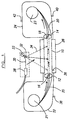
- the apparatus shown comprises a clear glass chamber 10 which is of cylindrical form and is arranged with its axis horizontal. Its ends 12 and 14 form inlet and outlet ends respectively, and each end is closed by a stopper, the stoppers having slots 16, 18 therein to allow slivers of fibres 20 to be passed through the chamber 10. There may be as many of six slivers 20 passed through the chamber 10 at the same time.
- inlet enclosure 22 At the inlet end 12, there is an inlet enclosure 22 in which there is a roll (or rolls) 21 carrying the slivers 20, from which they are unwound and at the outlet end there is an outlet enclosure 24 of similar form which also carries a roll (or rolls) 23 onto which the fibres (after treatment) are rewound.
- the enclosures are sealed to the chamber 10 so as to be capable of containing elevated pressures therein. As the slivers of fibres are not capable of withstanding high tensile forces the rolls are driven in such a manner to prevent the slivers from being pulled apart as they are fed through the chamber 10.
- a heater 26 Surrounding the chamber 10 is a heater 26, which may be electric in nature or it may be a microwave heater, in order to keep the temperature of the inside of the chamber 10 elevated.
- a translucent window in the heater which may simply be a gap, so that laser light from a laser source 28 may pass into the chamber 10.
- the beam 30 from the laser 28 initially travels parallel to the chamber axis, but then it strikes a parabolic mirror 32, by which the light is not only turned through 90°, but also it is diffused into a wide beam 34 to impinge widely on the fibres 20 as they travel through the chamber 10.
- the dispersing of the beam of the laser may be by driving the mirror 32 in an oscillatory manner by a motor 33, so that the beam scans the fibres 20 as opposed to being widened.
- acetic anhydride is introduced into the chamber 10 at the inlet end 12 through an inlet 36.
- Inert gas is also introduced into the inlet enclosure 22 through inlet 38, and simultaneously, the pressure in the inlet enclosure 22 is maintained at a higher level than that in enclosure 24 so that with the feed of the fibres 20 through the chamber 10, there is also a flow of the acetic anhydride along the chamber 10 in the same direction.
- the laser light heats up the fibres 20 and enhances the acetylation process, which also helped by the heating of the chamber interior by the heater 26.
- the method and apparatus provide a means for the effective acetylation of fibres of the type set forth above.
- the inert gas and acetic acid resulting from the process and collecting in the enclosure 24 are collected by being drawn off through outlets 40 and 42 and can be recycled if appropriate.
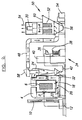
- the apparatus shown comprises a clear glass chamber 10 which is of cylindrical form and is arranged with its axis horizontal. Its ends 12 and 14 form inlet and outlet ends respectively, and each end is closed by a stopper, the stoppers having slots 16, 18 therein to allow slivers of fibres 20 to be passed through the chamber 10.
- the fibres are passed through the chamber continuously, but as in the first embodiment, continuous means that they may move continuously without stopping, or they may move step by step with a dwell time between steps, but the method is not a batch process. There may be as many of six slivers 20 passed through the chamber 10 at the same time.
- inlet enclosure 22 At the inlet end 12, there is an inlet enclosure 22 in which there is a roll (or rolls) 21 carrying the slivers 20, from which they are unwound and at the outlet end of the apparatus there is an outlet enclosure 24 of similar form which also carries a roll (or rolls) 23 onto which the fibres (after treatment) are rewound.
- the enclosures are sealed so as to be capable of containing elevated pressures therein. As the slivers of fibres are not capable of withstanding high tensile forces the rolls are driven in such a manner to prevent the slivers from being pulled apart as they are fed through the chamber 10.
- a heater 26 Surrounding the chamber 10 is a heater 26 (optional), which may be electric in nature, in order to keep the temperature of the inside of the chamber 10 elevated.
- a translucent window in the heater which may simply be a gap, so that laser light from a laser source 28 may pass into the chamber 10.
- the beam 30 from the laser 28 initially travels parallel to the chamber axis, but then it strikes a parabolic mirror 32, by which the light is not only turned through 90°, but also it is diffused into a wide beam 34 to impinge widely on the fibres 20 as they travel through the chamber 10.
- the dispersing of the beam of the laser may be by driving the mirror 32 in an oscillatory manner by a motor 33, so that the beam scans the fibres 20 as opposed to being widened.
- a microwave treatment chamber 4Y through which the fibres 20 pass.
- a guide tube 6Y surrounded by the wave guide and micro wave energy sources 14Y, from which the microwave energy emerges in an inwards radial direction as shown by the arrows.
- the micro waves heat the acetic anhydride which is inserted into the tube 6Y at the inlet end as shown by 50Y, whereby the fibres 20 as they pass through the tube are acetylated.
- acetic anhydride is introduced into the tube 6Y at the inlet end 50Y.
- Inert gas may also be introduced into the inlet enclosure 22 at inlet 38, and simultaneously, the pressure in the inlet enclosure 22 is maintained at a higher level than that in enclosure 24 so that with the feed of the fibres 20 through the chambers 10 and 6Y, there is also a flow of the acetic anhydride along the chambers 10 and 6Y in the same direction.
- the laser light heats up the fibres 20 and enhances the acetylation process carried out by micro wave heating of the acetic anhydride
- the method and apparatus of Fig.2 provide a means for the effective acetylation of fibres in sliver form.
- the inert gas and acetic acid resulting from the process and collecting in the enclosure 24 are collected by being drawn off through outlets 40 and 42 and can be recycled if appropriate.
- the invention provides a number of aspects, including the acetylation of fibres using laser light and/or infra red radiation, the acetylation of fibres in sliver form wherein the slivers are passed through a treatment chamber, the combined heating, especially using micrwave energy, and laser or infra red radiation, for acetylation of fibres, and the sequential steps of heating the fibres in sliver form using laser and/or infra red, and heating of the acetylating medium, in the acetylation of the fibres of the sliver, and the invention also extends to any feature or features (method or apparatus) of any aspect in combination with any feature or features (method or apparatus) of any other aspect not identified by the application but which is shown to be novel and inventive in the future.
Landscapes
- Engineering & Computer Science (AREA)
- Textile Engineering (AREA)
- Chemical & Material Sciences (AREA)
- Chemical Kinetics & Catalysis (AREA)
- Materials Engineering (AREA)
- Health & Medical Sciences (AREA)
- Life Sciences & Earth Sciences (AREA)
- Medicinal Chemistry (AREA)
- Polymers & Plastics (AREA)
- Organic Chemistry (AREA)
- Biochemistry (AREA)
- Physics & Mathematics (AREA)
- Optics & Photonics (AREA)
- Chemical Or Physical Treatment Of Fibers (AREA)
- Treatment Of Fiber Materials (AREA)
Applications Claiming Priority (4)
| Application Number | Priority Date | Filing Date | Title |
|---|---|---|---|
| GBGB9719555.6A GB9719555D0 (en) | 1997-09-16 | 1997-09-16 | Improvements relating to the acetylation of lignocellulosic materials and appl ications thereof |
| GB9719555 | 1997-09-16 | ||
| GBGB9725083.1A GB9725083D0 (en) | 1997-11-28 | 1997-11-28 | Improvements relating to the acetylation of lignocellulosic materials and applications thereof |
| GB9725083 | 1997-11-28 |
Publications (2)
| Publication Number | Publication Date |
|---|---|
| EP0909618A2 true EP0909618A2 (fr) | 1999-04-21 |
| EP0909618A3 EP0909618A3 (fr) | 2000-03-29 |
Family
ID=26312247
Family Applications (1)
| Application Number | Title | Priority Date | Filing Date |
|---|---|---|---|
| EP98117528A Withdrawn EP0909618A3 (fr) | 1997-09-16 | 1998-09-16 | Procédé et appareil pour l'acétylation de matières lignocellulosiques |
Country Status (1)
| Country | Link |
|---|---|
| EP (1) | EP0909618A3 (fr) |
Cited By (3)
| Publication number | Priority date | Publication date | Assignee | Title |
|---|---|---|---|---|
| US6723766B1 (en) | 1999-06-10 | 2004-04-20 | Yamaha Corporation | Method for manufacturing ligneous material |
| WO2012087879A3 (fr) * | 2010-12-23 | 2012-11-08 | Eastman Chemical Company | Modification chimique et chauffage de bois dans deux récipients avec confinement de vapeur facultatif |
| US8906466B2 (en) | 2009-06-25 | 2014-12-09 | Eastman Chemical Company | Esterified lignocellulosic materials and methods for making them |
Family Cites Families (3)
| Publication number | Priority date | Publication date | Assignee | Title |
|---|---|---|---|---|
| DD105850A1 (fr) * | 1973-05-30 | 1974-05-12 | ||
| CA2101617C (fr) * | 1993-07-29 | 2001-02-06 | Yoshihiro Hirano | Methode de fabrication de planches de bois |
| GB9403509D0 (en) * | 1994-02-24 | 1994-04-13 | Bp Chem Int Ltd | Acetylation of lignocellulosic materials |
-
1998
- 1998-09-16 EP EP98117528A patent/EP0909618A3/fr not_active Withdrawn
Cited By (5)
| Publication number | Priority date | Publication date | Assignee | Title |
|---|---|---|---|---|
| US6723766B1 (en) | 1999-06-10 | 2004-04-20 | Yamaha Corporation | Method for manufacturing ligneous material |
| US8906466B2 (en) | 2009-06-25 | 2014-12-09 | Eastman Chemical Company | Esterified lignocellulosic materials and methods for making them |
| WO2012087879A3 (fr) * | 2010-12-23 | 2012-11-08 | Eastman Chemical Company | Modification chimique et chauffage de bois dans deux récipients avec confinement de vapeur facultatif |
| US9282594B2 (en) | 2010-12-23 | 2016-03-08 | Eastman Chemical Company | Wood heater with enhanced microwave launching system |
| US9456473B2 (en) | 2010-12-23 | 2016-09-27 | Eastman Chemical Company | Dual vessel chemical modification and heating of wood with optional vapor |
Also Published As
| Publication number | Publication date |
|---|---|
| EP0909618A3 (fr) | 2000-03-29 |
Similar Documents
| Publication | Publication Date | Title |
|---|---|---|
| Samanth et al. | Conventional and unconventional chemical treatment methods of natural fibres for sustainable biocomposites | |
| CA2083116C (fr) | Procede et appareil de fabrication de tapis de protection | |
| Ramírez et al. | Acetylation of bacterial cellulose catalyzed by citric acid: Use of reaction conditions for tailoring the esterification extent | |
| US5344462A (en) | Gas plasma treatment for modification of surface wetting properties | |
| BG62778B1 (bg) | Метод за активиране на полизахариди, полизахаридиполучени по този метод и тяхното използване | |
| Dun et al. | Sisal fiber reinforced high density polyethylene pre-preg for potential application in filament winding | |
| CN1092077A (zh) | 改进纤维素乙酰化过程的新方法 | |
| EP0650998A1 (fr) | Acétylation de matériaux lignocellulosiques | |
| GB2155479A (en) | Production of cellulose carbamate | |
| GR3000497T3 (en) | Method for making fibre/fibre matrix composite materials having their fibres strictly arranged and oriented | |
| Darmanto et al. | Effects of alkali and steaming on mechanical properties of snake fruit (Salacca) fiber | |
| NZ298164A (en) | Acetylation of lignocellulosic fibres with superheated acetic anhydride | |
| Mosiewicki et al. | Characterization of fiber surface treatments in natural fiber composites by infrared and Raman spectroscopy | |
| WO1998001497A1 (fr) | Acetylation de substances ligno-cellulosiques et ses applications | |
| US3403145A (en) | Acetylation of cellulose | |
| EP0915121A1 (fr) | Améliorations concernant des récipients de traitement utilisés, par example dans l'acétylation de matériaux lignocellulosiques and méthodes de traitement | |
| Thomas et al. | Improvement of fibre/matrix bonding in carbon-fibre/acrylic composites by electron-irradiation: concept of difunctional chemical coupling agent | |
| EP0608949B1 (fr) | Procédé de préparation de fibres végétals résistants à l'humidité | |
| Whitfield et al. | Wool Stabilization by Interfacial Polymerization: Part VIII: Location and Nature of the Polymer | |
| EP0909618A3 (fr) | Procédé et appareil pour l'acétylation de matières lignocellulosiques | |
| Awada et al. | High strength paper production based on esterification of thermomechanical pulp fibers in the presence of poly (vinyl alcohol) | |
| WO1998051960A1 (fr) | Ameliorations relatives a la polymerisation des systemes de resine synthetique, par exemple pour les revetements interieurs des tuyaux et des conduites | |
| JP3104026B2 (ja) | カーボンフアイバのフエノールトリアジン樹脂仕上げ体 | |
| FI791709A7 (fi) | Menetelmä ja laite turpoamiskykyisen verkkoutetun karboksialkyyliselluloosan valmistamiseksi luonnossa esiiesiintyvästä selluloosasta tai selluloosahydraatista, ja sen käyttö. | |
| Hassan et al. | Effect of radiation pretreatment on photo-grafting of acrylamide on cellulose |
Legal Events
| Date | Code | Title | Description |
|---|---|---|---|
| PUAI | Public reference made under article 153(3) epc to a published international application that has entered the european phase |
Free format text: ORIGINAL CODE: 0009012 |
|
| AK | Designated contracting states |
Kind code of ref document: A2 Designated state(s): AT BE CH CY DE DK ES FI FR GB GR IE IT LI LU MC NL PT SE |
|
| AX | Request for extension of the european patent |
Free format text: AL;LT;LV;MK;RO;SI |
|
| PUAL | Search report despatched |
Free format text: ORIGINAL CODE: 0009013 |
|
| AK | Designated contracting states |
Kind code of ref document: A3 Designated state(s): AT BE CH CY DE DK ES FI FR GB GR IE IT LI LU MC NL PT SE |
|
| AX | Request for extension of the european patent |
Free format text: AL;LT;LV;MK;RO;SI |
|
| AKX | Designation fees paid | ||
| REG | Reference to a national code |
Ref country code: DE Ref legal event code: 8566 |
|
| STAA | Information on the status of an ep patent application or granted ep patent |
Free format text: STATUS: THE APPLICATION IS DEEMED TO BE WITHDRAWN |
|
| 18D | Application deemed to be withdrawn |
Effective date: 20000930 |