EP0909729A1 - Silo für Schüttgut - Google Patents
Silo für Schüttgut Download PDFInfo
- Publication number
- EP0909729A1 EP0909729A1 EP98203307A EP98203307A EP0909729A1 EP 0909729 A1 EP0909729 A1 EP 0909729A1 EP 98203307 A EP98203307 A EP 98203307A EP 98203307 A EP98203307 A EP 98203307A EP 0909729 A1 EP0909729 A1 EP 0909729A1
- Authority
- EP
- European Patent Office
- Prior art keywords
- pipe
- silo
- silo according
- bulk goods
- wall
- Prior art date
- Legal status (The legal status is an assumption and is not a legal conclusion. Google has not performed a legal analysis and makes no representation as to the accuracy of the status listed.)
- Withdrawn
Links
- 229920002994 synthetic fiber Polymers 0.000 claims abstract description 6
- 239000000463 material Substances 0.000 claims description 12
- 229910000831 Steel Inorganic materials 0.000 claims description 5
- 230000008878 coupling Effects 0.000 claims description 5
- 238000010168 coupling process Methods 0.000 claims description 5
- 238000005859 coupling reaction Methods 0.000 claims description 5
- 239000010959 steel Substances 0.000 claims description 5
- 238000000034 method Methods 0.000 claims description 2
- 238000005192 partition Methods 0.000 claims description 2
- 239000000428 dust Substances 0.000 description 7
- 230000032258 transport Effects 0.000 description 5
- 230000008901 benefit Effects 0.000 description 2
- 238000000151 deposition Methods 0.000 description 2
- 230000005484 gravity Effects 0.000 description 2
- 229920001592 potato starch Polymers 0.000 description 2
- 238000004804 winding Methods 0.000 description 2
- 230000002411 adverse Effects 0.000 description 1
- 230000000694 effects Effects 0.000 description 1
- 238000004880 explosion Methods 0.000 description 1
- 239000004744 fabric Substances 0.000 description 1
- -1 for example Polymers 0.000 description 1
- 231100000206 health hazard Toxicity 0.000 description 1
- 239000012466 permeate Substances 0.000 description 1
- 230000000630 rising effect Effects 0.000 description 1
- 238000007789 sealing Methods 0.000 description 1
Images


Classifications
-
- B—PERFORMING OPERATIONS; TRANSPORTING
- B65—CONVEYING; PACKING; STORING; HANDLING THIN OR FILAMENTARY MATERIAL
- B65G—TRANSPORT OR STORAGE DEVICES, e.g. CONVEYORS FOR LOADING OR TIPPING, SHOP CONVEYOR SYSTEMS OR PNEUMATIC TUBE CONVEYORS
- B65G65/00—Loading or unloading
- B65G65/30—Methods or devices for filling or emptying bunkers, hoppers, tanks, or like containers, of interest apart from their use in particular chemical or physical processes or their application in particular machines, e.g. not covered by a single other subclass
- B65G65/34—Emptying devices
- B65G65/36—Devices for emptying from the top
- B65G65/38—Mechanical devices
-
- B—PERFORMING OPERATIONS; TRANSPORTING
- B65—CONVEYING; PACKING; STORING; HANDLING THIN OR FILAMENTARY MATERIAL
- B65G—TRANSPORT OR STORAGE DEVICES, e.g. CONVEYORS FOR LOADING OR TIPPING, SHOP CONVEYOR SYSTEMS OR PNEUMATIC TUBE CONVEYORS
- B65G11/00—Chutes
- B65G11/10—Chutes flexible
- B65G11/106—Chutes flexible for bulk
-
- B—PERFORMING OPERATIONS; TRANSPORTING
- B65—CONVEYING; PACKING; STORING; HANDLING THIN OR FILAMENTARY MATERIAL
- B65G—TRANSPORT OR STORAGE DEVICES, e.g. CONVEYORS FOR LOADING OR TIPPING, SHOP CONVEYOR SYSTEMS OR PNEUMATIC TUBE CONVEYORS
- B65G65/00—Loading or unloading
- B65G65/30—Methods or devices for filling or emptying bunkers, hoppers, tanks, or like containers, of interest apart from their use in particular chemical or physical processes or their application in particular machines, e.g. not covered by a single other subclass
- B65G65/34—Emptying devices
- B65G65/36—Devices for emptying from the top
- B65G65/365—Devices for emptying from the top comprising a vertical passage located inside the container
Definitions
- the invention relates to a silo for the storage of bulk goods, comprising a floor, a side wall and a roof, which silo is provided with first conveyor means for vertical transport of said bulk goods within the silo, which first conveyor means comprise a pipe which is adjustable for length and which extends substantially in vertical direction within said silo, an upper end of which pipe is connected to the interior of the silo at a fixed distance from the roof, and a lower end of which is connected to second conveyor means for horizontal transport of said bulk goods within the silo, which second conveyor means are connected to the interior of the silo and which are vertically adjustable between the upper end of said pipe and the floor of the silo.
- a silo of this kind comprises a substantially cylindrical structure, wherein a column is disposed centrally with respect to the outside wall, which column is provided with a drop shaft along at least part of its length.
- a bridge is provided between the column with the drop shaft and the side wall, which bridge is capable of rotation in a horizontal plane around the column with the drop shaft.
- the bridge carries a frame by means of hoisting cables, which frame extends radially outwards with respect to the column with the drop shaft, and which is movable in the longitudinal direction of the column with the drop shaft.
- the frame supports a screw conveyor for moving the bulk goods within the silo upon emptying and filling of the silo.
- a telescopic down pipe is provided between the bridge and the frame, which down pipe extends substantially vertically within the silo and whose length can be adjusted by telescoping the telescopic pipe sections in and out.
- the upper end of the down pipe is connected to the bridge of the silo at a fixed distance from the roof, whilst the lower end of the down pipe is connected to the frame, which is connected to the bridge via hoisting cables, and which is vertically adjustable between the upper end of the pipe and the floor of the silo.
- the down pipe transports the bulk goods vertically from the upper end of the down pipe to the lower end of the down pipe.
- the frame follows the rising or descending level of the top layer of bulk goods present in the silo upon emptying and filling of the silo.
- the screw conveyor transports the bulk goods to the drop shaft in the column, after which the bulk goods, once it has fallen through the drop shaft, is discharged from the silo by means of a next screw conveyor and a long discharge screw conveyor.
- the drop shaft is provided with hatches which can be hoisted up, which hatches close the drop shaft exactly to the level of the top layer of the bulk goods at all times.
- a drawback of the known silo is that the telescopic down pipe does not function very satisfactorily. Dust is blown from the down pipe into the interior of the silo through the sealing surfaces of the telescopic pipe sections, due to the pressure that is generated within the down pipe by the falling bulk goods. Not only does this dust considerably increase the risk of dust explosions in the silo, but the fact that persons who are present in the silo breathe in this dust constitutes a health hazard. Moreover, the dust interferes with the telescoping of the pipe sections of the down pipe, which has an adverse effect on the reliability of the silo. The settling dust furthermore leads to fouling of the other parts of the interior of the silo.
- the silo according to the invention is characterized in that the pipe is provided with a flexible wall. This makes it possible to adjust the pipe for length, whilst the pipe wall is dustproof along the length of the pipe.
- the pipe wall comprises a cloth-like material, in particular a synthetic cloth. This makes it possible to fold the pipe wall.
- a synthetic cloth is that in addition to being dustproof, it is light in weight and thin, so that the cloth will take up little space when being folded.
- the silo according to the invention is characterized in that the pipe wall is provided with substantially annular supporting segments, in particular steel ribs.
- the pipe wall is annularly supported, so that a sufficiently wide flow channel is formed inside the pipe.
- steel ribs are used as supporting segments, because they are not very thick.
- the thickness of the ribs is preferably 3 - 6 mm, in particular 4 mm.
- annular is also meant to include angular, for example triangular or multiangular.
- the silo according to the invention is characterized in that said supporting segments are coaxially spaced apart in longitudinal direction, said spacing preferably being 10 - 20 cm, in particular about 15 cm.
- said spacing preferably being 10 - 20 cm, in particular about 15 cm.
- the silo according to the invention is characterized in that the pipe wall is provided with weights, preferably weights which are substantially annular.
- the material of the wall is pulled taut in downward direction by the force of gravity when the pipe is being adjusted to a greater length, as a result of which the flow channel inside the pipe is elongated in the longitudinal direction of the pipe.
- the material of the wall can fold up between the weights when the pipe is adjusted to a smaller length.
- Said weights and said supporting segments may be integrated.
- the silo according to the invention is characterized in that said pipe is provided with guide means.
- the pipe can be adjusted along its longitudinal axis without buckling when being adjusted to a smaller length.
- the silo according to the invention is characterized in that the guide means comprise at least two, preferably four guide poles and/or partitions, which are attached to the second conveyor along the circumference of the lower end of the pipe.
- the guide means comprise at least two, preferably four guide poles and/or partitions, which are attached to the second conveyor along the circumference of the lower end of the pipe.
- the silo according to the invention is characterized in that the guide means comprise at least two cables on either side of the pipe.
- the pipe is supported along its entire length.
- the silo according to the invention is characterized in that the pipe is provided with a continuous flow channel in its longitudinal direction, in particular a continuous flow channel whose inside diameter is substantially equal to the inside diameter of the pipe.
- the invention furthermore relates to a method for filling a silo with bulk goods.
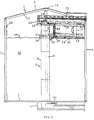
- Figure 1 shows a cross-section of a substantially cylindrical silo 1 comprising a floor 2, a side wall 3 and a roof 4.
- a column 5 is centrally disposed on the floor 2 of the silo 1.
- Column 5 comprises a steel cylinder 6, which is anchored in a recessed portion 7 of the floor.
- a longitudinally extending drop shaft 8 is recessed in the cylinder over a large part of the length thereof.
- the height of the side wall 3 of silo 1 of Figure 1 is about 32 m, whilst the diameter of the silo 1 is about 48 m.
- the surface area of floor 2 of silo 1 is about 1266 m 2 .
- drop shaft 8 is closed by a number of hatch-shaped segments 9, which are mounted in a guide 10 near the outer shell of cylinder 6. Segments 9 are interconnected in spaced-apart relationship by means of two parallel hoisting chains extending in the longitudinal direction of chamber 8.
- column 5 is axially continuous and rigid.
- Column 5 is fixedly connected to roof trusses 12 near ridge 13 of roof 4 of silo 1.
- the column 5 with the drop shaft 8 thus forms a rigid connection between the floor 2 and the roof 4 of the silo.
- Cylinder 6 of column 5 is connected to roof trusses 12 by means of a ring (not shown), to which an octagonal star is secured. Said ring is thereby connected to the upper side of part 34 of cylinder 6, and the eight sides of the star are each connected to a roof truss.
- a bridge 15 is present between column 5 and side wall 3 of the silo, which bridge is rotatably supported on the thick part of column 5 via support wheels, and which is connected to side wall 3 by means of wheels which are supported on a guide rail 16.
- Bridge 15 carries a frame 18 via hoisting cables 17, which frame can be moved in the longitudinal direction of column 5 by means of a winch 32.
- Frame 18 supports two parallel screw conveyors 19, 20 of opposite pitch.
- a vertically extending pipe 21 having a flexible wall and being adjustable for length is provided between bridge 15 and frame 18. The pipe 21 and its operation will be discussed further on in this application.
- the column with the drop shaft and the conveyor which is rotatable with respect to the longitudinal axis thereof are electrically connected by means of a cable (not shown) which is fitted near the part 34 having the smaller diameter. Power supply signals and control signals can be transmitted via said cable.
- the cable is connected to a switch box present outside the silo.
- the filling of the silo 1 takes place as follows. Bulk goods is supplied from outside silo 1 via a screw conveyor 22. Under the influence of the force of gravity, the bulk goods falls via a pipe 23 on a ring conveyor 33, and from said ring conveyor 33 it is carried, by means of a screw conveyor 24 which is present on bridge 15, to the pipe 21, which has a flexible wall and which is adjustable for length. The bulk goods falls via pipe 21 on frame 18, which is present at the level of the top layer of the bulk goods 35 which is already present in silo 1. The bulk goods being supplied is transported to an opening in frame 18 via a screw conveyor 26, where it falls between screw conveyors 19 and 20.
- the bulk goods is deposited on said top layer 25 by said screw conveyors in a bead-like layer of substantially uniform thickness, which extends radially outwards with respect to column 5 with the drop shaft 8.
- conveyor 14 is rotated through an angle of 3 - 5° with respect to the longitudinal axis of the column with the drop shaft 8 by means of a drive unit (not shown). During said rotation, a guide member 27 of frame 18 is led around column 5.
- the emptying of the silo takes place as follows.
- the stacked hatch-shaped segments 9 are hoisted up along guide 10 of drop shaft 8 in cylinder 6 by means of hoisting chains 11, so that an opening is formed in drop shaft 8 just below top layer 25 ( Figure 2).
- Screw conveyors 19, 20 transport the bulk goods radially inwards from top layer 25 to turning screw 28, which functions to loosen the material, and to a row of blades 29.
- Conveyor 14 thereby rotates in a horizontal plane around column 5 in a continuous movement.
- Row of blades 29 is thereby rotated around column 5, so that the bulk goods is carried to the opening op drop shaft 8 by the blades of row of blades 29.
- the bulk goods falls down via drop shaft 8 in column 5, and it is discharged to the outside via screw conveyor 30 and long discharge screw conveyor, by way of the recessed portion 7 of floor 2 of silo 1.
- pipe 21 is schematically illustrated therein.
- the pipe has a diameter of 600 mm, and a length which is adjustable between 1.2 m and 32 m.
- the upper end 41 of pipe 21 is connected to column 6, via bridge 15, at a fixed distance from roof 4 of silo 1, whilst the lower end 42 of pipe 21 is connected to frame 18, which frame 18 is vertically movable along column 6.
- Pipe 21 is disposed near column 6, and extends substantially parallel thereto.
- Pipe 21 has a flexible wall 43 of synthetic cloth. Wall 43 is provided with spaced-apart, annular steel ribs 44, as a result of which a continuous flow channel extending along the length of pipe 21 is formed inside pipe 21, the inside diameter of which is substantially equal to the inside diameter of pipe 21.
- Pipe 21 comprises a number of pipe sections 46, each having a length of 3 m, which are coupled together by means of quick-action couplings 45.
- Said quick-action couplings for example comprise a substantially annular member having a U-shaped cross-section with inwardly extending legs.
- Ribs 44 are supported on frame 18 at the location of the lowermost part 47 of pipe 21, whilst the material of wall 43 is folded therebetween.
- the material of wall 43 that is present between the supported rib 44 and the lowermost unsupported rib 44 will be folded as soon as a rib 44 is supported by frame 47 near said lowermost part 47, in such a manner that the passage inside pipe 21 remains substantially clear.
- the material of wall 43 of pipe 21 comprises weakened parts so as to have the folding of the material take place in a controlled manner.
- Figure 3 shows three of four guide poles 51 which are disposed around the lowermost part 47 of pipe 21, which guide the pipe during folding and unfolding.
- the length of the guide poles corresponds with the minimum distance between bridge 15 and frame 18, which is 1.2 m in the present example.
- Guide poles 51 also provide support for the folded lowermost part 47 of pipe 21 when said part is loaded in a direction transversely to its longitudinal axis.
- Pipe 21 is not used when the silo is being emptied. Consequently, it is preferred not to place pipe sections 46 between bridge 15 and frame 18 until the silo is to be filled, and that in pairs during the lowering of frame 18.
- the frame When changing over from emptying to filling of the silo, the frame must be raised once, therefore, so that the pipe sections can be placed during downward movement.
- pipe 21 with flexible wall 43 is adjustable for length by folding and unfolding the material of wall 43, whilst the material of wall 43 seals pipe 21 dust-tight over the entire length thereof.
- the bulk goods which falls vertically downwards through the passage does not cause any dust to permeate through the pipe wall into the interior of the silo.
Landscapes
- Engineering & Computer Science (AREA)
- Mechanical Engineering (AREA)
- Filling Or Emptying Of Bunkers, Hoppers, And Tanks (AREA)
- Storage Of Harvested Produce (AREA)
Applications Claiming Priority (2)
| Application Number | Priority Date | Filing Date | Title |
|---|---|---|---|
| NL1007301 | 1997-10-17 | ||
| NL1007301A NL1007301C2 (nl) | 1997-10-17 | 1997-10-17 | Silo voor een bulkgoed. |
Publications (1)
| Publication Number | Publication Date |
|---|---|
| EP0909729A1 true EP0909729A1 (de) | 1999-04-21 |
Family
ID=19765854
Family Applications (1)
| Application Number | Title | Priority Date | Filing Date |
|---|---|---|---|
| EP98203307A Withdrawn EP0909729A1 (de) | 1997-10-17 | 1998-09-30 | Silo für Schüttgut |
Country Status (2)
| Country | Link |
|---|---|
| EP (1) | EP0909729A1 (de) |
| NL (1) | NL1007301C2 (de) |
Cited By (1)
| Publication number | Priority date | Publication date | Assignee | Title |
|---|---|---|---|---|
| CN106869507A (zh) * | 2017-01-09 | 2017-06-20 | 中交航局安装工程有限公司 | 一种跨球形仓超大桁架的安装工艺 |
Citations (4)
| Publication number | Priority date | Publication date | Assignee | Title |
|---|---|---|---|---|
| GB828676A (en) * | 1958-02-04 | 1960-02-24 | Onoda Cement Co Ltd | A flexible connecting tube for conveyor pipes |
| DE3838541A1 (de) * | 1988-11-14 | 1990-05-17 | Ladwein Rosemarie | Verfahren zum beschicken eines vorratsbehaelters mit einer trockenmischung und vorrichtung zur durchfuehrung des verfahrens |
| WO1992016443A1 (en) * | 1991-03-14 | 1992-10-01 | Th. Rasmussen Mølle- Og Maskinbyggeri A/S | Device for delivering flowable bulk cargo |
| DE29611859U1 (de) * | 1996-07-08 | 1996-09-05 | Buddenberg, Thorsten, 47447 Moers | Schüttgutsilo |
-
1997
- 1997-10-17 NL NL1007301A patent/NL1007301C2/nl not_active IP Right Cessation
-
1998
- 1998-09-30 EP EP98203307A patent/EP0909729A1/de not_active Withdrawn
Patent Citations (4)
| Publication number | Priority date | Publication date | Assignee | Title |
|---|---|---|---|---|
| GB828676A (en) * | 1958-02-04 | 1960-02-24 | Onoda Cement Co Ltd | A flexible connecting tube for conveyor pipes |
| DE3838541A1 (de) * | 1988-11-14 | 1990-05-17 | Ladwein Rosemarie | Verfahren zum beschicken eines vorratsbehaelters mit einer trockenmischung und vorrichtung zur durchfuehrung des verfahrens |
| WO1992016443A1 (en) * | 1991-03-14 | 1992-10-01 | Th. Rasmussen Mølle- Og Maskinbyggeri A/S | Device for delivering flowable bulk cargo |
| DE29611859U1 (de) * | 1996-07-08 | 1996-09-05 | Buddenberg, Thorsten, 47447 Moers | Schüttgutsilo |
Cited By (1)
| Publication number | Priority date | Publication date | Assignee | Title |
|---|---|---|---|---|
| CN106869507A (zh) * | 2017-01-09 | 2017-06-20 | 中交航局安装工程有限公司 | 一种跨球形仓超大桁架的安装工艺 |
Also Published As
| Publication number | Publication date |
|---|---|
| NL1007301C2 (nl) | 1999-04-20 |
Similar Documents
| Publication | Publication Date | Title |
|---|---|---|
| US6203261B1 (en) | Adjustable reclaiming device for moving bulk material | |
| AU679239B2 (en) | Method of servicing interior of large container and service apparatus | |
| US5154271A (en) | Telescopic chute | |
| US4708562A (en) | Apparatus for lining the inner wall of a vessel with bricks | |
| US5372229A (en) | Device for delivering flowable bulk cargo | |
| RU2076837C1 (ru) | Устройство для разгрузки сыпучих материалов из закрытого хранилища и способ ее осуществления | |
| JPS62255322A (ja) | サイロ内に配置されたテレスコ−プ式の落下管を備えたサイロ排出装置 | |
| JP2000509356A (ja) | 立て形ベルトコンベア装置 | |
| IE41500B1 (en) | A vertical silo having unloading device | |
| KR102241236B1 (ko) | 링크식 스크레이퍼 리크레이머 | |
| US5351805A (en) | Method and apparatus for unloading bulk materials | |
| EP0118531B1 (de) | Vorrichtung und verfahren zum entladen von massengut | |
| US5944168A (en) | Crescent shaped support cover | |
| JPS61502460A (ja) | ばら荷のための円形輪郭を有する貯蔵所 | |
| EP0909729A1 (de) | Silo für Schüttgut | |
| CN114873312B (zh) | 散状物料装车用料口自动对准装置 | |
| US4815925A (en) | Circular storage container for granular materials with a vertically movable lateral conveyor | |
| US4738350A (en) | Apparatus for unloading bulk materials | |
| CN216763585U (zh) | 一种多功能用在线装车设备 | |
| CN214495000U (zh) | 卸料装置及使用该卸料装置的负压散料输送系统 | |
| CN113428683B (zh) | 一种板带复合散状物料装船机 | |
| CN214217512U (zh) | 一种防破碎伸缩溜筒装置 | |
| CN216613233U (zh) | 一种粮食装船机 | |
| US4957198A (en) | Apparatus and method for unloading bulk materials | |
| KR102550230B1 (ko) | 석탄을 윈드로 방식으로 쌓는 트리퍼용 슈트장치 |
Legal Events
| Date | Code | Title | Description |
|---|---|---|---|
| PUAI | Public reference made under article 153(3) epc to a published international application that has entered the european phase |
Free format text: ORIGINAL CODE: 0009012 |
|
| AK | Designated contracting states |
Kind code of ref document: A1 Designated state(s): DE FR NL |
|
| AX | Request for extension of the european patent |
Free format text: AL;LT;LV;MK;RO;SI |
|
| 17P | Request for examination filed |
Effective date: 19991014 |
|
| AKX | Designation fees paid |
Free format text: DE FR NL |
|
| RAP1 | Party data changed (applicant data changed or rights of an application transferred) |
Owner name: SPAANS BULK HANDLING SYSTEMS B.V. |
|
| 17Q | First examination report despatched |
Effective date: 20010404 |
|
| STAA | Information on the status of an ep patent application or granted ep patent |
Free format text: STATUS: THE APPLICATION IS DEEMED TO BE WITHDRAWN |
|
| 18D | Application deemed to be withdrawn |
Effective date: 20030401 |