EP0909764B1 - 11 Beta-Benzaldoxim-9 Alpha, 10 Alpha-epoxy-estr-4-en-Derivate, Verfahren zu ihrer Herstellung und diese Verbindungen enthaltende pharmazeutische Präparate - Google Patents
11 Beta-Benzaldoxim-9 Alpha, 10 Alpha-epoxy-estr-4-en-Derivate, Verfahren zu ihrer Herstellung und diese Verbindungen enthaltende pharmazeutische Präparate Download PDFInfo
- Publication number
- EP0909764B1 EP0909764B1 EP98118613A EP98118613A EP0909764B1 EP 0909764 B1 EP0909764 B1 EP 0909764B1 EP 98118613 A EP98118613 A EP 98118613A EP 98118613 A EP98118613 A EP 98118613A EP 0909764 B1 EP0909764 B1 EP 0909764B1
- Authority
- EP
- European Patent Office
- Prior art keywords
- carbon atoms
- epoxy
- alkyl
- oxime
- benzaldehyde
- Prior art date
- Legal status (The legal status is an assumption and is not a legal conclusion. Google has not performed a legal analysis and makes no representation as to the accuracy of the status listed.)
- Expired - Lifetime
Links
- 0 *C(CC1)C(*)(C[C@@]2c(cc3)ccc3C([Tl])=*)C1C(CC1)C22OC2(CC2)C1=CC2=O Chemical compound *C(CC1)C(*)(C[C@@]2c(cc3)ccc3C([Tl])=*)C1C(CC1)C22OC2(CC2)C1=CC2=O 0.000 description 1
Classifications
-
- C—CHEMISTRY; METALLURGY
- C07—ORGANIC CHEMISTRY
- C07J—STEROIDS
- C07J41/00—Normal steroids containing one or more nitrogen atoms not belonging to a hetero ring
- C07J41/0033—Normal steroids containing one or more nitrogen atoms not belonging to a hetero ring not covered by C07J41/0005
- C07J41/0077—Normal steroids containing one or more nitrogen atoms not belonging to a hetero ring not covered by C07J41/0005 substituted in position 11-beta by a carbon atom, further substituted by a group comprising at least one further carbon atom
- C07J41/0083—Normal steroids containing one or more nitrogen atoms not belonging to a hetero ring not covered by C07J41/0005 substituted in position 11-beta by a carbon atom, further substituted by a group comprising at least one further carbon atom substituted in position 11-beta by an optionally substituted phenyl group not further condensed with other rings
-
- C—CHEMISTRY; METALLURGY
- C07—ORGANIC CHEMISTRY
- C07J—STEROIDS
- C07J71/00—Steroids in which the cyclopenta(a)hydrophenanthrene skeleton is condensed with a heterocyclic ring
- C07J71/0005—Oxygen-containing hetero ring
- C07J71/001—Oxiranes
Definitions
- the invention relates to new 9 ⁇ , 10 ⁇ -epoxides of benzaldoxime-4,9-estradienes, their preparation and containing these compounds pharmaceutical preparations.
- Such Altered uterine lining is capable of a fertilized egg cell (Blastocyst) to implant (nidation of the embryo). The further preservation of the specific uterine tissue after implantation for nutrition and the growth of the embryo is also highly dependent on that Affects progesterone levels.
- progesterone is involved in the control of ovulation processes is involved. Applied or secreted in high doses Progesterone possesses anti-ovulatory properties because it is inhibited pituitary gonadotropin secretion occurs. this is a indispensable prerequisite for the maturation of the follicle and the subsequent Ovulation.
- progesterone receptors In addition to the progesterone itself, the progesterone receptors also appear play an important role in the control of pathophysiological Processes of the human body play a role. Progesterone receptors are, as has been shown, both in sick people Tissue of the endometrium (endometriosis) as well as cancerous degenerate tissues of the uterus, breast, and central nervous system (Meningioma). Stimulating the formation of these progesterone receptors takes place through estrogens. The receptors transmit the effect of the hormone progesterone on transcription. It was however proven (Chwalisz, K.
- Progesterone can inhibit the synthesis of estrogen receptors and the formation of other receptors of its own without itself having an affinity for the estrogen receptor. But antigestagens are also able to modulate the effects of estrogens, although they too have no affinity for the estrogen receptor at the cellular level and are quite capable of causing an increase in the estrogen receptors. Such effects can be used to exert a favorable influence on diseases of the endometrium or tumor tissues in the diseased tissue which is equipped with estrogen and / or progesterone receptors. Antigestagens are of interest in endometriosis because, in addition to acting in the tissue, they can also inhibit ovulation.
- the ovarian hormone production is partially inhibited and thus the stimulation effect on the diseased tissue that is attributable to this part can be reduced.
- the endometrium which is constantly being remodeled due to hormonal influences, can be temporarily and reversibly converted into a dormant state.
- the tissue of endometrial foci can regress to a normal state and the disease can be contained.
- antigestagens also have affinities for the glucocorticoid receptor.
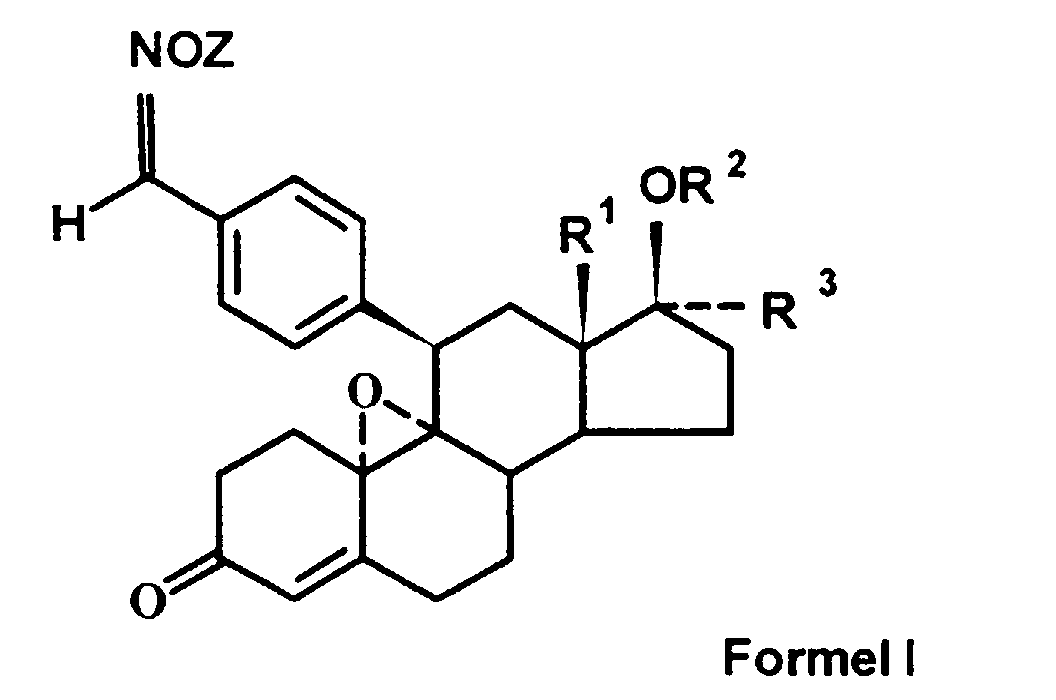
- the object of the present invention is to provide 11 ⁇ -benzaldoxime-9 ⁇ , 10 ⁇ -epoxy-estr-4-ene derivatives of the general formula I. and to provide their pharmaceutically acceptable salts and a process for their preparation. Another object is to provide pharmaceutical preparations which contain at least one compound of the general formula I or its pharmaceutically acceptable salts.
- R 1 is a hydrogen atom or an alkyl radical with 1-6 carbon atoms
- R 2 represents a hydrogen atom, an alkyl, aryl, aralkyl or alkylaryl group each having 1-10 carbon atoms, an acyl radical having 1-10 carbon atoms or a radical -CONHR 4 or -COOR 4
- R 4 is a hydrogen atom, denotes an alkyl, aryl, aralkyl or alkylaryl radical each having 1-10 carbon atoms
- the invention further relates to a process for the preparation of the compounds according to the general formula I and their pharmaceutically acceptable salts, which is characterized in that a compound of the general formula II, in which R 1 , R 2 , R 3 and Z have the meaning given above with an oxidizing agent such as peracids or hydrogen peroxide in solutions or suspensions, esterifying or etherifying the free 11 ⁇ -benzaldimine group which may be present to give another compound of the formula (I) or converted to an acceptable salt.
- an oxidizing agent such as peracids or hydrogen peroxide in solutions or suspensions, esterifying or etherifying the free 11 ⁇ -benzaldimine group which may be present to give another compound of the formula (I) or converted to an acceptable salt.
- esterification of the free hydroxyl groups can be carried out in a manner known per se with acid anhydrides or acid chlorides in the presence of bases, preferably pyridine, in special cases also in the presence of dimethylaminopyridine, urethane formation by reaction with isocyanates in inert solvents or by reaction with carbamoyl chlorides and the etherification with alkyl or aryl halides in the presence of bases, preferably potassium tert-butoxide.
- bases preferably pyridine
- the resulting compound of general formula 1 according to the invention is optionally converted into an acid addition salt, preferably into a salt of a physiologically acceptable acid.
- physiologically acceptable acids are, for example, hydrochloric acid, hydrobromic acid, phosphoric acid, sulfuric acid, oxalic acid, maleic acid, fumaric acid, lactic acid, tartaric acid, malic acid, citric acid, salicylic acid, adipic acid and benzoic acid.
- Other acids that can be used are described, for example, in Advances in Pharmaceutical Research, Vol. 10, pages 224-225, Birkhauser Verlag, Basel and Stuttgart, 1966.
- the nucleophilicity of the acids must not be sufficient under the reaction conditions to open the epoxy group.
- the acid addition compounds are generally prepared in a manner known per se by mixing the free base or its solutions with a corresponding acid or its solutions in an organic solvent. It is also possible to prepare physiologically acceptable aqueous solutions of acid addition salts of the compounds of the general formula I in aqueous acid solutions.
- the acid addition products of the general compound I can be converted into the free base in a manner known per se with alkalis or with ion exchangers.
- the present invention relates to drugs for oral, rectal, subcutaneous, intravenous or intramuscular use, which together with the usual carriers and diluents at least a compound of the general formula I or its acid addition salts contained as an active ingredient.
- compositions of the invention are made with the usual solid or liquid carriers and / or diluents and the generally commonly used auxiliaries according to the desired type of application in a suitable dosage and in an produced in a known manner.
- a preferred oral dosage form tablets, film-coated tablets, coated tablets, Capsules, pills, powders, solutions or suspensions also as depot form prepared.
- parenteral dosage forms such as injection solutions or suppositories should also be considered.
- Pharmaceutical forms as tablets can, for example, by mixing the active ingredient with known excipients, such as dextrose. Sugar, sorbitol, mannitol, polyvinylpyrrolidone, disintegrants such as corn starch or alginic acid, binders such as starch or gelatin, lubricants such as magnesium stearate or talc and / or agents that can achieve a depot effect, such as carboxyl polymethylene, carboxymethyl cellulose, cellulose acetate phthalate or polyvinyl acetate.
- the tablets can also consist of several layers.
- Dragees can be prepared analogously by coating cores produced analogously to tablets with agents usually used in tablet coatings, for example polyvinylpyrrolidone or shellac, gum arabic, talc, titanium dioxide or sugar.
- the coated tablet casing can also consist of several layers, using, for example, the above-mentioned auxiliaries.
- the solutions or suspensions with the active ingredient according to the invention can be mixed with substances such as saccharin, cyclamate or sugar and / or with aromatic substances such as vanillin or orange extract to improve the taste.
- suspension auxiliaries such as sodium carboxymethyl cellulose or preservatives such as p-hydroxybenzoic acid.
- Capsules can be prepared by mixing the medicinal substance with carriers such as lactose or sorbitol, which are then introduced into the capsules. Suppositories are preferably produced by mixing the active ingredient with suitable carrier materials such as neutral fats or polyethylene glycols or their derivatives.
- the 11 ⁇ -benzaldoxime-9 ⁇ , 10 ⁇ -epoxy-estr-4-ene derivatives according to the invention are antigestagens compounds that are only mediocre Affinity to be bound to the progesterone receptor (see Tab. 1) but surprisingly a stronger one in vivo subcutaneously on the rat Acts as RU 486 (mifepristone) and as the corresponding 4,9-dienes of the formula II (cf. Tab. 2).
- the in vivo effect is also based on the antigestagenic effect of the compounds according to the invention.
- the compound is formed during the production of 4- [17 ⁇ -methoxy-17 ⁇ - (methoxy-methyl) -3-oxo-estra-4,9-dien-11 ⁇ -yl] -benzaldehyde-1- (E) -oxime (according to DE 43 32 283) and is separated off and isolated therefrom by chromatography. M.p.
- the compound is formed during the production of 4- [17 ⁇ -hydroxy-17 ⁇ (meth-oxymethyl) -3-oxo-estra-4,9-dien-11 ⁇ -yl] -benzaldehyde-1 - (E) -oxime (according to DE 43 32 283) and is separated and isolated from this by chromatography. M.p.
- Glucocorticoid receptor thymus cytosol of the adrenalectomized rat. Thymi stored at -30 ° C. Buffer: TED. Tracer: 3 H-dexamethasone, 20nM. Reference substance: dexamethasone. Estrogen receptor: uterine cytosol of the immature rabbit, stored at -30 ° C. Buffer: TED with 250 mM sucrose. Tracer: 3 H-estradiol, 3nM. Reference substance: 17 ⁇ -estradiol.
- the bound and free steroid were separated by mixing in activated charcoal / dextran (1% / 0.1%), centrifuging and measuring the receptor-bound 3 H- Activity in the supernatant.
- the IC 50 for the reference substance and for the compound to be tested were determined from the measurement in concentration series and the relative molar binding affinity was determined as the quotient of the two values ( ⁇ 100%). After an incubation period of 18 hours at 0-4 ° C., bound and free steroid were separated by mixing in activated charcoal / dextran / 1% / 0.1%), centrifuging and measuring the bound 3 H activity in the supernatant. The IC 50 for the substance to be tested and for the reference compound were determined from the measurement in concentration series and the relative molar binding affinity was determined as the quotient of the two values ( ⁇ 100%).
- mice were mated in the Prooestrus stage. Upon proof of sperm in the vaginal area on the next day is called day 1 (d 1) of pregnancy. Treatment of rats with test substance or vehicle takes place with 0.2 ml benzoyl benzoate / castor oil (1 + 4 v / v) subcutaneously from day 5 to day 7 (d5 -d7), the autopsy is carried out on Day d 9. The rate of completely inhibited pregnancies in the individual Groups are shown in Table 2. Thus, for Examples 1 (J 1102), 3 (J 1116), 8 (J 1204) and 9 (J 1120) one by a factor of 10 superior nidation inhibition compared to RU 486 (mifepristone) determined.
Landscapes
- Chemical & Material Sciences (AREA)
- Organic Chemistry (AREA)
- Health & Medical Sciences (AREA)
- General Health & Medical Sciences (AREA)
- Steroid Compounds (AREA)
- Pharmaceuticals Containing Other Organic And Inorganic Compounds (AREA)
Abstract
Description
Ihre biologische Wirkung ist noch nicht bekannt.
Antigestagene sind bei einer Endometriose von Interesse, weil sie neben der Wirkung im Gewebe auch eine Hemmung der Ovulation hervorrufen können. Durch den antiovulatorischen Effekt der Antigestagene wird die ovarielle Hormonproduktion teilweise gehemmt und damit kann der auf diesen Teil entfallende Stimulationseffekt auf das erkrankte Gewebe reduziert werden. Durch eine Hemmung der Ovulation kann bei einer Endometriose das durch Hormoneinflüsse ständig im Umbau befindliche Endometrium zeitweilig und reversibel in einen ruhenden Zustand überführt werden. Das Gewebe von Endometrioseherden kann sich auf einen normalen Status rückbilden, die Erkrankung eingedämmt werden.
Antigestagene besitzen neben ihrer Affinität zum Progesteronrezeptor auch Affinitäten zum Glucocorticoidrezeptor. Bei der Langzeitbehandlung von Patienten, bei denen die Hemmung von Progesteronrezeptoren im Vordergrund steht, sind bei den erforderlichen therapeutischen Dosierungen antiglucocorticoide Nebenwirkungen nicht erwünscht und können zum Abbruch der Therapie führen. Es ist daher sehr wünschenswert, Verbindungen zu entwickeln, die als Antigestagene nur geringe oder keine antiglucocorticoide Wirkung aufweisen, um therapeutsche Behandlungen, die Wochen oder Monate dauern können, ohne diese Nebenwirkungen durchführen zu können.

Eine weitere Aufgabe ist es, pharmazeutische Präparate, die mindestens eine Verbindung der allgemeinen Formel I oder deren pharmazeutisch annehmbaren Salze enthalten, zur Verfügung zu stellen.

steht R2 für ein Wasserstoffatom, eine Alkyl-, Aryl-, Aralkyl-, oder Alkylarylgruppe mit jeweils 1-10 Kohlenstoffatomen , einen Acylrest mit 1-10 Kohlenstoffatomen oder einen Rest -CONHR4 oder -COOR4 , wobei R4 ein Wasserstoffatom, eine Alkyl-, Aryl-, Aralkyl- oder Alkylarylrest mit jeweils 1-10 Kohlenstoffatomen bedeutet,
steht R3 für ein Wasserstoffatom, einen Alkyl-, Aryl-, Aralkyl- oder Alkylarylgruppe mit jeweils 1-10 Kohlenstoffatomen, einen Rest -(CH2)nCH2Y, wobei n = 0, 1 oder 2 ist, Y für ein Fluor-, Chlor-, Brom-, oder lodatom für eine Cyano-, Azido- oder Rhodanogruppe, für einen Rest OR5 oder SR5 steht, wobei R5 ein Wasserstoffatom, ein Alkyl-, Aryl-, Aralkyl- oder Alkylarylrest mit jeweils 1-10 Kohlenstoffatomen oder ein Acylrest COR5 mit 1-10 Kohlenstoffatomen ist, einen Rest OR5, wobei R5 ein Wasserstoffatom, ein Alkyl-, Aryl-, Aralkyl- oder Alkylarylrest mit jeweils 1 - 10 Kohlenstoffatomen oder ein Acylrest COR5 mit 1-10 Kohlenstoffatomen bedeutet,
einen Rest - (CH2)m-CH=CH(CH2)n-R6, wobei m =0, 1, 2 oder 3 und n = 0, 1 oder 2 ist und R6 für ein Wasserstoffatom, einen Alkyl-, Aryl-, Aralkyl- oder Alkylarylrest mit jeweils 1-10 Kohlenstoffatomen oder eine Hydroxylgruppe, eine Alkoxy- oder Acyloxygruppe mit jeweils 1-10 Kohlenstoffatomen steht,
einen Rest - (CH2)oC≡CR7, wobei o = 0,1 oder 2 und R7 für ein Wasserstoffatom, ein Fluor-, Chlor-, Brom- oder lodatom, einen Alkyl-, Aryl-, Aralkyl- oder Alkylarylrest mit jeweils 1-10 Kohlenstoffatomen oder einen Acylrest mit 1-10 Kohlenstoffatomen steht,
Z für ein Wasserstoffatom, eine Alkyl-, Aryl-, Alkylaryl- oder Arylalkylgruppe mit jeweils 1-10 Kohlenatoffatomen, einen Acylrest mit 1-10 Kohlenstoffatomen, einen Rest CONHR4 oder COOR4 steht, wobei R4 ein Wasserstoffatom, einen Alkyl-, Aryl-, Aralkyl- oder Alkylarylrest mit jeweils 1 - 10 Kohlenstoffatomen bedeutet, oder für ein Alkali- oder Erdalkalimetallatom, sowie deren pharmazeutisch annehmbaren Salze steht.

Die Säureaddtionsverbindungen werden in der Regel in an sich bekannter Weise durch Mischen der freien Base oder deren Lösungen mit einer entsprechenden Säure oder deren Lösungen in einem organischen Lösungsmittel hergestellt. Ferner ist es möglich, physiologisch verträgliche wäßrige Lösungen von Säureadditionssalzen der Verbindungen der allgemeinen Formel I in wäßrigen Säurelösungen herzustellen.
Die Säureadditionsprodukte der allgemeinen Verbindung I können in an sich bekannter Weise mit Alkalien oder mit lonenaustauschern in die freie Base überführt werden.
Arzneiformen als Tabletten können beispielsweise durch Mischen des Wirkstoffes mit bekannten Hilfsstoffen, wie Dextrose. Zucker, Sorbit, Mannit, Polyvinylpyrrolidon, Sprengmitteln wie Maisstärke oder Alginsäure, Bindemitteln wie Stärke oder Gelatine, Gleitmitteln wie Magnesiumstearat oder Talk und/oder Mitteln, die einen Depoteffekt erzielen können, wie Carboxylpolymethylen, Carboxymethylcellulose, Celluloseacetatphthalat oder Polyvinylacetat, erhalten werden. Die Tabletten können auch aus mehreren Schichten bestehen.
Analog lassen sich Dragees durch Überziehen von analog den Tabletten hergestellten Kernen mit üblicherweise in Drageeüberzügen verwendeten Mitteln, beispielsweise Polyvinylpyrrolidon oder Schellack, Gummiarabicum, Talk, Titandioxid, oder Zucker bereiten. Die Drageehülle kann dabei auch aus mehreren Schichten bestehen, wobei beispielsweise oben genannte Hilfsstoffe verwendet werden.
Die Lösungen oder Suspensionen mit dem erfindungsgemäßen Wirkstoff können zur Verbesserung des Geschmacks mit Stoffen wie Saccharin, Cyclamat oder Zucker und / oder mit Aromastoffen, wie Vanillin oder Orangeextrakt versetzt werden. Weiterhin können sie mit Suspendierhilfsstoffen wie Natriumcarboxyme-thylcellulose oder Konservierungsmitteln wie p-Hydroxybenzoesäure vermischt werden.
Die Bereitung von Kapseln kann durch Mischen des Arzneistoffes mit Trägern wie Milchzucker oder Sorbit erfolgen, die dann in die Kapseln eingebracht werden.
Die Herstellung von Suppositorien erfolgt vorzugsweise durch Mischung des Wirkstoffes mit geeigneten Trägermaterialien wie Neutralfetten oder Polyethylenglykolen oder dessen Derivaten.
| Rezeptorbindung von ausgewählten 11β-Benzaldoxim-9α, 10α-epoxy-estr-4-en-Derivaten | ||
| Verbindung nach Beispiel | relative molare Bindungsaffinität RBA (%) zum Progesteronrezeptor Progesteron = 100 % | relative molare Bindungsaffinität RBA (%) zum Glucocorticoidrezeptor Dexamethason = 100 % |
| 1 ( J 1102) | 88 | 12 |
| 2 (J 1160) | 49 | 18 |
| 3 ( J 1116) | 47 | 12 |
| 4 (J 1182) | 29 | |
| 5 ( J 1130) | 59 | 15 |
| 6 ( J 1180) | 31 | 8 |
| 9 ( J 1120) | 63 | 15 |
| 16 (J 1186) | 64 | 13 |
| 17 (J 1131) | 68 | 30 |
| zum Vergleich: | ||
| RU 486 (Mifepriston) | 506 | 685 |
| J 867 | 302 | 77 |
| ZK 98299 (Onapriston) | 22 | 39 |
| Frühabortive Wirkung bei der Ratte nach subcutaner Applikation vom 5.-7. Graviditätstag [Applikation 0,2 ml /Tier/ Tag in Benzoylbenzoat /Rizinusöl (1+4 v/v)] | |||
| Substanz | Dosis (mg/Tier/Tag) | komplette Graviditätshemmung | |
| N# /N | % | ||
| Vehikel | 0/6 | 0 | |
| Beispiel 1 (J 1102) | 3 | 5/5 | 100 |
| 1 | 5/5 | 100 | |
| 0,3 | 0/5 | 0 | |
| Beispiel 3 (J 1116) | 3 | 5/5 | 100 |
| 1 | 5/5 | 100 | |
| 0,3 | 5/5 | 100 | |
| 0,1 | 2/4 | 50 | |
| Beispiel 8 ( J 1204) | 1 | 5/5 | 100 |
| Beispiel 9 (J 1120) | 3 | 5/5 | 100 |
| 1 | 5/5 | 100 | |
| 0,3 | 1/5 | 20 | |
| RU 486 | 3 | 5/5 | 100 |
| 1 | 1/5 | 20 | |
| 0,3 | 0/5 | 0 | |
| J 867 | 3 | 5/5 | 100 |
| 1 | 5/5 | 100 | |
| 0,3 | 0/5 | 0 |
Schmp. 137 - 143 °C (Aceton/Methyl-tert.butylether); αD = + 142 ° (CHCl3); IR in KBr [cm-1]: 1662 (C=C-C=O); UV [MeOH]: λmax 254 nm ε = 23 700, 1H-NMR: [CDCl3; TMS] (δ, ppm): 0,49 (s, 3H, H-18); 3,18 (d,1H, J = 6,3 Hz, 11αH); 3,26 (s, 3H , OCH 3); 3,41 (s, 3H, OCH 3); 3,44 und 3,61 (2d, 2H, J = 10.8 Hz, 17α-CH 2OCH3); 6,11 (s, 1H, H-4); 7,28 (d, 2H, J=7,8 Hz, H-2'); 7,52 (d, 2H, J=7,8 Hz, H-3'); 7,85 (s, 1H, OH);8,12 (s, 1H CH=N-OH).
Schmp. 120-138 °C (Methyl-tert.butylether); αD = 217 ° (CHCl3); IR in KBr [cm-1]: 1649 (C=C-C=O); UV [MeOH]: λmax 256 nm; 1H-NMR: [CDCl3; TMS] (δ, ppm): 0,54 (s, 3H, H-18); 3,26 (s, 3H , OCH3); 3,41 (s, 3H, OCH 3); 3,42 und 3,58 (2d, 2H, J = 10.5 Hz, 17α-CH 2OCH3); 4,39 (d, J = 7.3 Hz,H-11) 5,79 (s, 1H, H-4); 7,26 (d, 2H, J = 8,9 Hz, H-2' ); 7,88 (d, 2H, J = 8,9 Hz, H-3'); 7,33 (s, 1H CH=N-OH); 9,38 (s, 1H, OH).
Schmp. 145 - 155 °C Zers. (Aceton); αD = + 145 ° (CHCl3); IR in KBr [cm-1] 1660 (C=C-C=O); UV [MeOH]: λmax 255 nm ε = 24 800, 1H-NMR: [CDCl3; TMS] (δ, ppm): 0,48 (s, 3H, H-18); 2,85 (s, 1H, OH); 3,20 (d, 1H, J = 6,3 Hz, 11α-H); 3,42 (s, 3H, OCH 3); 3,25 und 3,63 (2d, 2H, J = 9,0 Hz, 17α-CH 2OCH3)1 6,11 (s, 1H, H-4); 7,27 (d, 2H, J = 7,8 Hz, H-2'); 7,52 (d, 2H, J =7,8 Hz, H-3')); 7,87 (s, 1H, OH); 8,11 (s, 1H CH=N-OH).
Schmp. 135-146 °C (Aceton); αD = + 192 ° (CHCl3); IR in KBr [cm-1]: 1650 (C=C-C=O); UV [MeOH]: λmax 257 nm; λmax 302 nm 1H-NMR: [CDCl3; TMS] (δ, ppm): 0,54 (s, 3H, H-18); 3,42 (s, 3H, OCH 3); 3,23 und 3,57 (2d, 2H, J = 9.1 Hz, 17α-CH 2OCH3), 4,41 (d, J = 7.2 Hz,H-11) 5,79 (s, 1H, H-4); 7,26 (d, 2H, J = 8,4 Hz, H-2'); 7,86 (d, 2H, J = 8,4 Hz, H-3'); 7,33 (s, 1H CH=N-OH) ; 8,56 (s, 1H, OH).
Ausbeute: 85 % d.Th.; Schmp. 115 °C Zers. (Essigester); αD = + 209 ° (CHCl3); IR in KBr [cm-1]: 1655 (C=C-C=O), 1768 (OAc); 3519 (OH); UV [MeOH]: λmax 272 nm ε = 27 900, λmax 297 nm ε = 26 000; 1H-NMR: [CDCl3; TMS] (δ, ppm): 0,52 (s, 3H, H-18); 2,23 (s, 3H, OCOCH 3); 3,22 und 3,56 (2d, 2H, J = 9.0 Hz, 17α-CH 2OCH3); 3,41 (s, 3H, OCH 3); 4,41 (d, 1H, J = 7.2 Hz, H-11α); 5,79 (s, 1H, H-4); 7,25 ((d, 2H, J = 6,6 Hz, H-2'); 7,64 (d, 4H, J = 6.6 Hz, H-3'); 8,32 (s, 1H CH=N).
1H-NMR: [CDCl3; TMS] (δ, ppm): 0,47 (s, 3H, H-18); 3,21 (d, 1H, J = 6.0 Hz, H-11α);
3,25 (s, 3H, OCH 3); 3,42 (s, 3H, OCH 3); 3,44 und 3,62 (2d, 2H, J = 10.8 Hz, 17α-CH 2OCH3); 6,11 (s, 1H, H-4); 7,33 (d, 2H J= 8,4 Hz, H-2'); 7,68 (d, 2H, J = 8,4 Hz, H-3'); 8,32 (s, 1H CH=N).
Ausbeute : 70 % d. Th.; Schmp.:110 -123 °C (Zers.) αD = + 171 ° (CHCl3); IR in KBr [cm-1]: 1655 (C=C-C=O), 1769 (OAc); UV [MeOH]: λmax 269 nm ε = 21 700 λmax 297 nm ε = 21 300; 1H-NMR: [CDCl3; TMS] (δ, ppm): 0,51 (s, 3H, H-18); 3,25 (s, 3 H, OCH 3); 3,40 und 3,55 (2d, 2H, J = 9.0 Hz, 17α-CH 2OCH3); 3,41 (s, 3H, OCH 3); 3,92 (s, 3H, COOCH 3) 4,40 (d, 1H, J = 7.2 Hz, H-11α); 5,78 (s, 1H, H-4); 7,26 (d, 2H, J = 8,1 Hz., H-2'); 7,63 (d, 4H, J = 8,1 Hz, H-3'); 8,31 (s, 1H CH=NOR).
Ausbeute : 61 % d. Th.; Schmp.: 158-163 °C (Zers.); αD = + 203° (CHCl3); IR in KBr [cm-1]: 1648 (C=C-C=O), 1747, 1781[O-(C=O)-OCH3]; UV [MeOH]: λmax 269 nm ε = 25 700 λmax 297 nm ε = 24 200; 1H-NMR: [CDCl3; TMS] (δ, ppm): 0,51 (s, 3H, H-18); 3,21 und 3,56 (2d, 2H, J = 7,5 Hz, 17α-CH 2OCH3); 3,41 (s, 3H, OCH 3); 3,93 (s, 3H, COOCH 3) 4,41 (d, 1H, J = 7.2 Hz, H-11α); 5,79 (s, 1H, H-4); 7,26 (d, 2H, J = 7,2 Hz, H-2'); 7,64 (d, 4H, J = 8,4 Hz, H-3'); 8,32 (s, 1H CH =NOR).
Ausbeute : 72 % d. Th.; Schmp.: 151 -171 °C (Zers.); αD = + 201° (CHCl3); IR in KBr [cm-1]: 1655 (C=C-C=O), 1742, 1758 [O-(C=O)-OC2H5]; UV [MeOH]: λmax 270 nm ε = = 25 890; λmax 297 nm ε = 24 270; 1H-NMR: [CDCl3; TMS] (δ, ppm): 0,52 (s, 3H, H-18); 1,38 (t, 3H, J = 7,2 Hz, CH2CH 3); 2,57 (s, 1H, OH); 3,21 und 3,56 (2d, 2H, J = 9,0 Hz, 17α-CH 2OCH3); 3,41 (s, 3H, CH2OCH 3); 4, 34 (q, 2H, OCH 2CH3); 4,37 (d, 1H, J = 7.2 Hz, H-11α); 5,79 (s, 1H, H-4); 7,25 (d, 2H, J = 7,2 Hz, H-2'); 7,64 (d, 4H, J = 8,4 Hz, H-3'); 8,31 (s, 1H CH =NOR).
Ausbeute: 1,3 g (52 % d.Th.) 4-[17β-Methoxy-17α-(2-propoxymethyl)-3-oxoestra-4,9-dien-11β-yl]benzaldehyd-1.
Schmp. 167 - 177 °C (Methyl-tert.butylether/Hexan); αD = + 173 ° (CHCl3); IR in KBr
[cm-1]: 1660 (C=C-C=O); 1694 (CHO); UV [MeOH]: λmax 263 nm ε = 19 420, λmax 299 nm ε = 21 840; 1H-NMR: [CDCl3; TMS] (δ, ppm): 0,50 (s, 3H, H-18); 1,22 [t, 6H, J = 5,8 Hz, (CH 3)2 CH-O-); 2,96 (s, 1H, OCH 3); 3,44 und 3,58 [2d, 2H, J =10,4 und 10,8 Hz, (CH3)2-CH-O-CH 2]; 3,59 (m,2H, CH 2-CH); 4,42 (d, 1H, J = 7,3 Hz, H-11α); 5,79 (s, 1H, H-4); 7,37 (d, 2H, J = 8,1 Hz, H-2'); 7,79 (d, 2H, J = 8,3 Hz, H-3'); 9,96 (s, 1H CH=O).
Schmp. 143 Zers. °C (Aceton/Hexan); αD = + 199 ° (CHCl3); IR in KBr [cm-1]: 1633 (C=C-C=O); UV [MeOH]: λmax 264 nm ε = 23 080, λmax 299 nm ε = 22 670; 1H-NMR: [CDCl3; TMS] (δ, ppm): 0,54 (s, 3H, H-18); 1,22 [t, 6H, J = 6,0 Hz, (CH 3)2 CH-O-); 3,26 (s, 1H, OCH 3); 3,43 und 3,62 [2d, 2H, J =10,5 und 10,8 Hz, (CH3)2-CH-O-CH 2]; 3,59 (m,2H, CH 2-CH); 4,37 (d, 1H, J = 6,9 Hz, H-11α); 5,79 (s, 1H, H-4); 7,21 (d, 2H, J = 8,1 Hz, H-2'); 7,48 (d, 2H, J = 8,4 Hz, H-3'); 7,99 (s, 1H, OH); 8,1 (s, 1H CH=NH).
Schmp. 132 - 142 °C (Methyl-tert.butylether/Hexan); αD = + 186 ° (CHCl3); IR in KBr [cm-1]: 1660 (C=C-C=O); 1705 (CHO); UV [MeOH]: λmax 264 nm ε = 19 720, λmax 299 nm ε = 22 300; 1H-NMR: [CDCl3; TMS] (δ, ppm): 0,51 (s, 3H, H-18); 1,21 [m, 6H, ΣJ = 9,9 Hz, (CH 3)2 CHO); 2,84 (s, 1H, OH); 3,21 und 3,64 [2d, 2H, J = 9 Hz, (CH 3)2-CH-O-CH 2]; 4,41 (d, 1H, J = 5,7 Hz, H-11α); 5,80 (s, 1H, H-4); 7,38 (d, 2H, J = 8,1 Hz, H-2'); 7,81 (d, 2H, J = 8,4 Hz, H-3'); 9,97 (s, 1H CH=O).
Schmp. 184 -188°C (Aceton/Hexan). αD = + 224° (CHCl3); IR in KBr [cm-1] 1655 (C=C-C=O); 1733, 1748 (C2H5NH-C=O-O-N=CH); UV [MeOH]: λmax 272 nm ε = 28 600, λmax 297 nm ε = 25 900 ; 1H-NMR: [CDCl3; TMS] (δ, ppm): 0,53 (s, 3H, H-18); 1,24 (t, 3H, J = 7,2 Hz, NHCH2CH 3); 3,42 (s, 3H, OCH 3); 3,22 und 3,57 (2d, 2H, J = 9,1 Hz, 17α-CH 2OCH3); 6,11 (s, 1H, H-4); 6,26 (t, 1H, NHEt); 7,35 (d, 2H, J = 8,4 Hz, H-2'); 7,64 (d, 2H, J = 8,4 Hz, H-3'); 8,30 (s, 1H CH=N-OR).
ε = 26 680; 1H-NMR [CDCl3; TMS] (δ, ppm): 0,57 (s, 3H, H-18); 3,22 (d, 1H, J = 6,0 Hz, H-11α); 3,70 und 3,98 (2d, 2H, J = 10.8 Hz, 17α-CH 2OCH3); 6,12 (s, 1H, H-4); 7,27 (d, 2H, J = 7,8 Hz, H-2'); 7,54 (d, 2H, J = 8,1 Hz, H-3'); 7,60 (s, 1H, NOH); 8,11 (s, 1H CH=N-OH).
Progesteron-Rezeptor: Uterus-Cytosol des Estradiol-geprimten Kaninchens, aufbe-wahrt bei -30° C. Puffer für Homogenisation und Inkubation: TED-Puffer 20 mM Tris/HCI, pH= 7,4; 1mM Ethylendiamintetraacetat, 2 mM Dithiothreitol) mit 250mM Saccharose. Tracer: 3H-ORG 2058, 5nM; Referenzsubstanz: Progesteron.
Glucocorticoid-Rezeptor: Thymus-Cytosol der adrenalectomierten Ratte. Thymi aufbewahrt bei -30 °C. Puffer: TED. Tracer: 3H-Dexamethason, 20nM. Referenzsub-stanz: Dexamethason.
Estrogen-Rezeptor: Uterus-Cytosol des unreifen Kaninchens, aufbe-wahrt bei -30 °C. Puffer:TED mit 250 mM Saccharose. Tracer: 3H-Estradiol, 3nM. Referenzsubstanz: 17β-Estradiol.
Nach einer Inkubationsdauer von 18 Stunden bei 0-4 °C erfolgte die Trennung von gebundenen und freiem Steroid durch Einmischen von Aktivkohle/Dextran / 1%/0,1 %), abzentrifugieren und Messung der gebundenen 3H-Aktivität im Überstand.
Aus der Messung in Konzentrationsreihen wurden die IC50 für die zu testende Substanz und für die Referenzverbindung ermittelt und als Quotient beider Werte (x 100 %) die relative molare Bindungsaffinität bestimmt.
Claims (8)
- R1
- ein Wasserstoffatom oder ein Alkylrest mit 1-6 Kohlenstoffatomen ist,
- R2
- für ein Wasserstoffatom, eine Alkyl-, Aryl-, Aralkyl-, oder
Alkylarylgruppe mit jeweils 1-10 Kohlenstoffatomen, einen
Acylrest mit 1-10 Kohlenstoffatomen oder
einen Rest -CONHR4 oder -COOR4 steht,
wobei R4 ein Wasserstoffatom, einen Alkyl-, Aryl-, Aralkyl- oder Alkylarylrest mit jeweils 1-10 Kohlenstoffatomen bedeutet, - R3
- für ein Wasserstoffatom, eine Alkyl-, Aryl-, Aralkyl- oder
Alkylarylgruppe mit jeweils 1- 10 Kohlenstoffatomen,
- einen Rest -(CH2)nCH2Y,
wobei n = 0, oder 2 ist, Y für ein Fluor-, Chlor-, Brom- oder lodatom , für eine Cyano-, Azido- oder Rhodanogruppe, für einen Rest OR5 oder SR5 steht,
wobei R5 ein Wasserstoffatom, einen Alkyl-, Aryl-, Aralkyl- oder Alkylarylrest mit jeweils 1-10 Kohlenstoffatomen oder ein Acylrest COR5 mit 1-10 Kohlenstoffatomen ist, - einen Rest OR5,
wobei R5 ein Wasserstoffatom, einen Alkyl-, Aryl-, Aralkyl- oder Alkylarylrest mit jeweils 1-10 Kohlenstoffatomen oder ein Acylrest COR5 mit 1-10 Kohlenstoffatomen bedeutet, - einen Rest - (CH2)m-CH=CH(CH2)n-R6,
wobei m =0, 1, 2 oder 3 und n = 0, 1 oder 2 ist und R6 für ein Wasserstoffatom, ein Alkyl-, Aryl-, Aralkyl- oder Alkylarylrest mit jeweils 1-10 Kohlenstoffatomen oder eine Hydroxylgruppe, eine Alkoxy- oder Acyloxygruppe mit jeweils 1- 10 Kohlenstoffatomen steht, - einen Rest - (CH2)oC≡CR7,
wobei o = 0,1 1 oder 2 und R7 für ein Wasserstoffatom, ein Fluor-, Chlor-, Brom- oder Iodatom, ein Alkyl-, Aryl-, Aralkyl- oder Alkylarylrest mit jeweils 1-10 Kohlenstoffatomen oder ein Acylrest mit 1-10 Kohlenstoffatomen ist,
- einen Rest -(CH2)nCH2Y,
- Z
- für ein Wasserstoffatom, eine Alkyl-, Aryl-, Alkylaryl- oder
Arylalkylgruppe mit jeweils 1-10 Kohlenstoffatomen, einen
Acylrest mit 1-10 Kohlenstoffatomen, einen Rest CONHR4
oder COOR4
wobei R4 ein Wasserstoffatom, einen Alkyl-, Aryl-, Aralkyl- oder Alkylarylrest mit jeweils 1 - 10 Kohlenstoffatomen bedeutet,
oder für ein Alkali- oder Erdalkalimetallatom steht,
dadurch gekennzeichnet, daß
- R1
- ein Wasserstoffatom, eine Methyl- oder Ethylgruppe ist.
dadurch gekennzeichnet, daß
- R2
- für eine Alkyl- oder Arylgruppe mit
jeweils 1-6 Kohlenstoffatomen, einen Acylrest mit
1-6 Kohlenstoffatomen oder einen Rest -CONHR4 oder
-COOR4 steht,
wobei R4 ein Alkyl- oder Arylrest mit jeweils 1-6 Kohlenstoffatomen bedeutet.
dadurch gekennzeichnet, daß
- R3
- für eine Alkylgruppe mit 1 - 6 Kohlenstoffatomen steht.
dadurch gekennzeichnet, daß
- R3
- für einen Rest OR5 steht,
wobei R5 ein Alkyl- oder Arylrest mit jeweils 1 - 6 Kohlenstoffatomen oder ein Acylrest COR5 mit 1- 6 Kohlenstoffatomen ist.
dadurch gekennzeichnet, daß
- R3
- einen Rest - (CH2)oC≡CR7 darstellt,
wobei o = 0,1 oder 2 und R7 ein Alkyl- oder ein Acylrest mit jeweils 1-6 Kohlenstoffatomen ist.
nämlich
dadurch gekennzeichnet,
daß man Verbindungen der allgemeinen Formel II,

- R1
- ein Wasserstoffatom oder ein Alkylrest mit 1-6 Kohlenstoffatomen ist,
- R2
- für ein Wasserstoffatom, eine Alkyl-, Aryl-, Aralkyl-, oder
Alkylarylgruppe mit jeweils 1-10 Kohlenstoffatomen,
einen Acylrest mit 1-10 Kohlenstoffatomen oder
einen Rest -CONHR4 oder -COOR4 steht,
wobei R4 ein Wasserstoffatom, eine Alkyl-, Aryl-, Aralkyl- oder Alkylarylrest mit jeweils 1-10 Kohlenstoffatomen bedeutet, - R3
- für ein Wasserstoffatom, einen Alkyl-, Aryl-, Aralkyl- oder
Alkylarylgruppe mit jeweils 1-10 Kohlenstoffatomen,
einen Rest -(CH2)nCH2Y,
wobei n = 0, 1 oder 2 ist, Y für ein Fluor-, Chlor-, Brom-, oder lodatom , für eine Cyano-, Azido- oder Rhodanogruppe,für einen Rest OR5 oder SR5
wobei R5 ein Wasserstoffatom, ein Alkyl-, Aryl-, Aralkyl- oder Alkylarylrest mit jeweils 1-10 Kohlenstoffatomen oder ein Acylrest COR5 mit 1-10 Kohlenstoffatomen ist,- einen Rest OR5,
wobei R5 ein Wasserstoffatom, ein Alkyl-, Aryl-, Aralkyl- oder Alkylarylrest mit jeweils 1-10 Kohlenstoffatomen oder ein Acylrest COR5 mit 1-10 Kohlenstoffatomen bedeutet, - einen Rest - (CH2)m-CH=CH(CH2)n-R6,
wobei m =0, 1, 2 oder 3 und n = 0, 1 oder 2 ist und R6 für ein Wasserstoffatom, ein Alkyl-, Aryl-, Aralkyl- oder Alkylarylrest mit jeweils 1-10 Kohlenstoffatomen oder eine Hydroxylgruppe, eine Alkoxy- oder Acyloxygruppe mit jeweils 1- 10 Kohlenstoffatomen steht, - einen Rest - (CH2)oC≡CR7,
wobei o = 0,1 oder 2 und R7 für ein Wasserstoffatom, ein Fluor-, Chlor-, Brom- oder lodatom, ein Alkyl-, Aryl-, Aralkyl- oder Alkylarylrest mit jeweils 1-10 Kohlenstoffatomen oder ein Acylrest mit 1-10 Kohlenstoffatomen ist, steht,
- einen Rest OR5,
- Z
- für ein Wasserstoffatom, eine Alkyl-, Aryl-, Alkylaryl- oder
Arylalkylgruppe mit jeweils 1-10 Kohlenstoffatomen, ein
Acylrest mit 1-10 Kohlenstoffatomen,
einen Rest CONHR4 oder COOR4,
wobei R4 ein Wasserstoffatom, eine Alkyl-, Aryl-, Aralkyl- oder Alkylarylrest mit 1 - 10 Kohlenstoffatomen bedeutet,
oder ein Alkali- oder Erdalkalimetallatom steht,
mit einem Oxydationsmittel wie Persäuren oder Wasserstoffperoxid in Lösungen oder Suspensionen umsetzt, die gegebenenfalls vorliegende freie 11 β-Benzaldimin-gruppe zu einer anderen Verbindung der Formel (I) verestert, verethert oder in ein annehmbares Salz überführt.
Applications Claiming Priority (2)
| Application Number | Priority Date | Filing Date | Title |
|---|---|---|---|
| DE19745085 | 1997-10-11 | ||
| DE19745085A DE19745085A1 (de) | 1997-10-11 | 1997-10-11 | 11ß-Benzaldoxim-9alpha,10alpha-epoxy-estr-4-en-Derivate, Verfahren zu ihrer Herstellung und diese Verbindungen enthaltende pharmazeutische Präparate |
Publications (2)
| Publication Number | Publication Date |
|---|---|
| EP0909764A1 EP0909764A1 (de) | 1999-04-21 |
| EP0909764B1 true EP0909764B1 (de) | 1999-09-29 |
Family
ID=7845335
Family Applications (1)
| Application Number | Title | Priority Date | Filing Date |
|---|---|---|---|
| EP98118613A Expired - Lifetime EP0909764B1 (de) | 1997-10-11 | 1998-10-01 | 11 Beta-Benzaldoxim-9 Alpha, 10 Alpha-epoxy-estr-4-en-Derivate, Verfahren zu ihrer Herstellung und diese Verbindungen enthaltende pharmazeutische Präparate |
Country Status (3)
| Country | Link |
|---|---|
| EP (1) | EP0909764B1 (de) |
| AT (1) | ATE185145T1 (de) |
| DE (2) | DE19745085A1 (de) |
Families Citing this family (10)
| Publication number | Priority date | Publication date | Assignee | Title |
|---|---|---|---|---|
| ATE307823T1 (de) * | 2002-05-03 | 2005-11-15 | Schering Ag | 17a-fluoralkyl-11beta-benzaldoxim-steroide, verfahren zu deren herstellung, diese steroide enthaltende pharmazeutische präparate sowie deren verwendung zur herstellung von arzneimitteln |
| DE10221034A1 (de) | 2002-05-03 | 2003-11-20 | Schering Ag | 17alpha-Fluoralkyl-11ß-benzaldoxim-Steroide, Verfahren zu deren Herstellung, diese Steroide enthaltende pharmazeutische Präparate sowie deren Verwendung zur Herstellung von Arzneimitteln |
| WO2004014935A1 (de) * | 2002-08-02 | 2004-02-19 | Schering Aktiengesellschaft | Progesteronrezeptormodulatoren mit erhöhter antigonadotroper aktivität für die weibliche fertilitätskontrolle und hormonersatztherapie |
| DE10236405A1 (de) * | 2002-08-02 | 2004-02-19 | Schering Ag | Progesteronrezeptormodulatoren mit erhöhter antigonadotroper Aktivität für die weibliche Fertilitätskontrolle und Hormonersatztherapie |
| DE102009034366A1 (de) | 2009-07-20 | 2011-01-27 | Bayer Schering Pharma Aktiengesellschaft | 17-Hydroxy-17-pentafluorethyl-estra-4,9(10)-dien-11-methylenoxyalkylenaryl-Derivate, Verfahren zu ihrer Herstellung und ihre Verwendung zur Behandlung von Krankheiten |
| DE102009034368A1 (de) | 2009-07-20 | 2011-01-27 | Bayer Schering Pharma Aktiengesellschaft | 17-Hydroxy-17-pentafluorethyl-estra-4,9(10)-dien-11-acyloxyalkylenphenyl-Derivate, Verfahren zu ihrer Herstellung und ihre Verwendung zur Behandlung von Krankheiten |
| DE102009034367A1 (de) | 2009-07-20 | 2011-01-27 | Bayer Schering Pharma Aktiengesellschaft | 17-Hydroxy-17-pentafluorethyl-estra-4,9(10)-dien-11-benzyliden-Derivate, Verfahren zu deren Herstellung und deren Verwendung zur Behandlung von Krankheiten |
| DE102009034526A1 (de) | 2009-07-21 | 2011-02-10 | Bayer Schering Pharma Aktiengesellschaft | 17-Hydroxy-17-pentafluorethyl-estra-4,9(10)-dien-11-ethinylphenyl-Derivate, Verfahren zu deren Herstellung und deren Verwendung zur Behandlung von Krankheiten |
| DE102010007719A1 (de) | 2010-02-10 | 2011-08-11 | Bayer Schering Pharma Aktiengesellschaft, 13353 | Progesteronrezeptorantagonisten |
| DE102010007722A1 (de) | 2010-02-10 | 2011-08-11 | Bayer Schering Pharma Aktiengesellschaft, 13353 | Progesteronrezeptorantagonisten |
Family Cites Families (9)
| Publication number | Priority date | Publication date | Assignee | Title |
|---|---|---|---|---|
| ZA8231B (en) * | 1981-01-09 | 1982-11-24 | Roussel Uclaf | New 11 -substituted steroid derivatives, their preparation, their use as medicaments, the compositions containing them and the new intermediates thus obtained |
| FR2522328B1 (fr) * | 1982-03-01 | 1986-02-14 | Roussel Uclaf | Nouveaux produits derives de la structure 3-ceto 4,9 19-nor steroides, leur procede de preparation et leur application comme medicaments |
| FR2573657B1 (fr) * | 1984-11-29 | 1989-05-12 | Roussel Uclaf | Produit comprenant une substance antiprogestomimetique et une substance uterotonique |
| FR2586021B1 (fr) * | 1985-08-09 | 1988-10-14 | Roussel Uclaf | Nouveaux produits derives de la structure 5a-oh d 9(10) 19-nor steroides |
| FR2598421B1 (fr) * | 1986-05-06 | 1988-08-19 | Roussel Uclaf | Nouveaux produits 19-nor ou 19-nor d-homo steroides substitues en position 11b par un radical phenyle portant un radical alkynyle, leur procede de preparation, leur application comme medicaments et les compositions les renfermant |
| DE4332283A1 (de) * | 1993-09-20 | 1995-04-13 | Jenapharm Gmbh | Neue 11-Benzaldoximestradien-Derivate, Verfahren zu ihrer Herstellung und diese Verbindungen enthaltende Arzneimittel |
| DE4332284C2 (de) * | 1993-09-20 | 1997-05-28 | Jenapharm Gmbh | 11-Benzaldoxim-17beta-methoxy-17alpha-methoxymethyl-estradien-Derivate, Verfahren zu ihrer Herstellung und diese Verbindungen enthaltende Arzneimittel |
| PT787002E (pt) * | 1994-10-24 | 2007-03-30 | Schering Ag | Antagonistas de progesterona competitivos para controlo de fertilidade feminina orientado pela necessidade |
| ZA9510926B (en) * | 1994-12-23 | 1996-07-03 | Schering Ag | Compounds with progesterone-antagonistic and antiestrogenic action to be used together for female contraception |
-
1997
- 1997-10-11 DE DE19745085A patent/DE19745085A1/de not_active Withdrawn
-
1998
- 1998-10-01 DE DE59800034T patent/DE59800034D1/de not_active Expired - Lifetime
- 1998-10-01 EP EP98118613A patent/EP0909764B1/de not_active Expired - Lifetime
- 1998-10-01 AT AT98118613T patent/ATE185145T1/de not_active IP Right Cessation
Also Published As
| Publication number | Publication date |
|---|---|
| ATE185145T1 (de) | 1999-10-15 |
| DE59800034D1 (de) | 1999-11-04 |
| EP0909764A1 (de) | 1999-04-21 |
| DE19745085A1 (de) | 1999-04-15 |
Similar Documents
| Publication | Publication Date | Title |
|---|---|---|
| EP0648778B1 (de) | Neue 11-Benzaldoximestradien-Derivate, Verfahren zu ihrer Herstellung und diese Verbindungen enthaltende Arzneimittel | |
| EP0648779B1 (de) | Neue 11-Benzaldoxim-17beta methoxy-17alpha-methoxymethyl-estradien-Derivate, Verfahren zu ihrer Herstellung und diese Verbindungen enthaltende Arzneimittel | |
| EP2456781B1 (de) | 17-hydroxy-17-pentafluorethyl-estra-4,9 (10)-dien-11-acyloxyalkylenphenyl-derivate, verfahren zu ihrer herstellung und ihre verwendung zur behandlung von krankheiten | |
| DE69932515T2 (de) | 17 beta-nitro-11 beta-arylsteroide und deren derivate mit hormonalen agonist- oder antagonisteigenschaften | |
| DE69932432T2 (de) | 17-beta-amino und hydroxylamino-11 beta-arylsteroide und deren derivate mit hormonalen agonist- oder antiagonisteigenschaften | |
| EP1060187B1 (de) | S-substituierte 11beta-benzaldoxim-estra-4,9-dien-kohlensäurethiolester, verfahren zu deren herstellung und diese verbindungen enthaltene pharmazeutische zubereitungen | |
| WO2011098437A2 (de) | Progesteronrezeptorantagonisten | |
| DE69910068T2 (de) | 17beta-acyl-17alpha-propynyl-11beta-arylsteroide und ihre derivate mit agonistischen oder antagonistischen hormonalen aktivitäten | |
| DE69402114T2 (de) | Neue 19-Nor-Steroide mit einer 11-Beta-Phenoxysulfonamid- oder 11-Beta-Phenoxysulfonylurea-Gruppe, Verfahren und Zwischenprodukte zu ihrer Herstellung sowie Medikamenten und pharmazeutische Präparate davon | |
| EP1525215B1 (de) | Progesteronrezeptormodulatoren mit erhöhter antigonadotroper aktivität für die weibliche fertilitätskontrolle und hormonersatztherapie | |
| EP0909764A1 (de) | 11 Beta-Benzaldoxim-9 Alpha, 10 Alpha-epoxy-estr-4-en-Derivate, Verfahren zu ihrer Herstellung und diese Verbindungen enthaltende pharmazeutische Präparate | |
| DE10236405A1 (de) | Progesteronrezeptormodulatoren mit erhöhter antigonadotroper Aktivität für die weibliche Fertilitätskontrolle und Hormonersatztherapie | |
| EP1501859B1 (de) | 17a-FLUORALKYL-11BETA-BENZALDOXIM-STEROIDE, VERFAHREN ZU DEREN HERSTELLUNG, DIESE STEROIDE ENTHALTENDE PHARMAZEUTISCHE PRÄPARATE SOWIE DEREN VERWENDUNG ZUR HERSTELLUNG VON ARZNEIMITTELN | |
| DE102004025966A1 (de) | Estradiol-Prodrugs | |
| DE60002692T2 (de) | Leberspezifische gallensaeurederivate des antiglukokorticoids ru486 | |
| DE4434488A1 (de) | Steroidester und -amide, Verfahren zu ihrer Herstellung und ihre pharmazeutische Verwendung | |
| DE19961219A1 (de) | 11beta-Phenylestratrien-Derivate mit Fluoralkylgruppen in der aromatischen Seitenkette, deren Herstellung und diese Verbindungen enthaltende pharmazeutische Zusammensetzungen | |
| EP1737880B1 (de) | 17 alpha-fluor 17 beta-hydroximinomethyl-steroide, ein verfahren zu deren herstellung und diese verbindung enthaltende pharmazeutische zusammensetzungen | |
| DE19943708A1 (de) | Neue C13-substituierte Estra-1,3,5(10)-trien-3-yl-sulfamate, Verfahren zu deren Herstellung und diese Verbindungen enthaltende pharmazeutische Zusammensetzungen | |
| EP0780397B1 (de) | Neue 17alpha-Cyanomethylestra-4,9-dien-derivate, Verfahren zu ihrer Herstellung und diese Verbindungen enthaltende pharmazeutische Zusammensetzungen | |
| CH615442A5 (en) | Process for the preparation of 17alpha,21-diesters of 17alpha,21-dihydroxysteroids of the pregnane series | |
| DE3644358A1 (de) | 10(beta)-alkynyl-4,9(11)-oestradien-derivate, verfahren zu deren herstellung und arzneimittel, welche diese enthalten | |
| WO1998024803A9 (de) | Steroidester, verfahren zu ihrer herstellung und ihre pharmazeutische verwendung | |
| DE2246462B2 (de) | ihrer Herstellung sowie diese enthaltende Arzneimittel | |
| DE19548449A1 (de) | 17alpha-Cyanomethyl-3-oxyiminoestra-4,9-dien-3-on-17beta-yl-derivate, Verfahren zu ihrer Herstellung und diese Verbindungen enthaltende pharmazeutische Zusammensetzungen |
Legal Events
| Date | Code | Title | Description |
|---|---|---|---|
| PUAI | Public reference made under article 153(3) epc to a published international application that has entered the european phase |
Free format text: ORIGINAL CODE: 0009012 |
|
| 17P | Request for examination filed |
Effective date: 19981013 |
|
| AK | Designated contracting states |
Kind code of ref document: A1 Designated state(s): AT BE CH CY DE DK ES FI FR GB GR IE IT LI LU MC NL PT SE |
|
| AX | Request for extension of the european patent |
Free format text: AL PAYMENT 19981013;LT PAYMENT 19981013;LV PAYMENT 19981013;MK PAYMENT 19981013;RO PAYMENT 19981013;SI PAYMENT 19981013 |
|
| GRAG | Despatch of communication of intention to grant |
Free format text: ORIGINAL CODE: EPIDOS AGRA |
|
| GRAG | Despatch of communication of intention to grant |
Free format text: ORIGINAL CODE: EPIDOS AGRA |
|
| GRAH | Despatch of communication of intention to grant a patent |
Free format text: ORIGINAL CODE: EPIDOS IGRA |
|
| 17Q | First examination report despatched |
Effective date: 19990611 |
|
| GRAH | Despatch of communication of intention to grant a patent |
Free format text: ORIGINAL CODE: EPIDOS IGRA |
|
| GRAA | (expected) grant |
Free format text: ORIGINAL CODE: 0009210 |
|
| RAP1 | Party data changed (applicant data changed or rights of an application transferred) |
Owner name: JENAPHARM GMBH & CO. KG |
|
| AK | Designated contracting states |
Kind code of ref document: B1 Designated state(s): AT BE CH CY DE DK ES FI FR GB GR IE IT LI LU MC NL PT SE |
|
| AX | Request for extension of the european patent |
Free format text: AL PAYMENT 19981013;LT PAYMENT 19981013;LV PAYMENT 19981013;MK PAYMENT 19981013;RO PAYMENT 19981013;SI PAYMENT 19981013 |
|
| LTIE | Lt: invalidation of european patent or patent extension | ||
| PG25 | Lapsed in a contracting state [announced via postgrant information from national office to epo] |
Ref country code: SE Free format text: THE PATENT HAS BEEN ANNULLED BY A DECISION OF A NATIONAL AUTHORITY Effective date: 19990929 Ref country code: IT Free format text: LAPSE BECAUSE OF FAILURE TO SUBMIT A TRANSLATION OF THE DESCRIPTION OR TO PAY THE FEE WITHIN THE PRE;WARNING: LAPSES OF ITALIAN PATENTS WITH EFFECTIVE DATE BEFORE 2007 MAY HAVE OCCURRED AT ANY TIME BEFORE 2007. THE CORRECT EFFECTIVE DATE MAY BE DIFFERENT FROM THE ONE RECORDED.SCRIBED TIME-LIMIT Effective date: 19990929 Ref country code: GR Free format text: LAPSE BECAUSE OF NON-PAYMENT OF DUE FEES Effective date: 19990929 Ref country code: FI Free format text: LAPSE BECAUSE OF NON-PAYMENT OF DUE FEES Effective date: 19990929 Ref country code: ES Free format text: THE PATENT HAS BEEN ANNULLED BY A DECISION OF A NATIONAL AUTHORITY Effective date: 19990929 Ref country code: CY Free format text: LAPSE BECAUSE OF NON-PAYMENT OF DUE FEES Effective date: 19990929 |
|
| REF | Corresponds to: |
Ref document number: 185145 Country of ref document: AT Date of ref document: 19991015 Kind code of ref document: T |
|
| REG | Reference to a national code |
Ref country code: CH Ref legal event code: EP |
|
| PG25 | Lapsed in a contracting state [announced via postgrant information from national office to epo] |
Ref country code: LU Free format text: LAPSE BECAUSE OF NON-PAYMENT OF DUE FEES Effective date: 19991001 |
|
| REF | Corresponds to: |
Ref document number: 59800034 Country of ref document: DE Date of ref document: 19991104 |
|
| ET | Fr: translation filed | ||
| GBT | Gb: translation of ep patent filed (gb section 77(6)(a)/1977) |
Effective date: 19991108 |
|
| REG | Reference to a national code |
Ref country code: IE Ref legal event code: FG4D Free format text: GERMAN |
|
| PG25 | Lapsed in a contracting state [announced via postgrant information from national office to epo] |
Ref country code: PT Free format text: LAPSE BECAUSE OF FAILURE TO SUBMIT A TRANSLATION OF THE DESCRIPTION OR TO PAY THE FEE WITHIN THE PRESCRIBED TIME-LIMIT Effective date: 19991229 Ref country code: DK Free format text: LAPSE BECAUSE OF FAILURE TO SUBMIT A TRANSLATION OF THE DESCRIPTION OR TO PAY THE FEE WITHIN THE PRESCRIBED TIME-LIMIT Effective date: 19991229 |
|
| AKX | Designation fees paid |
Free format text: AT BE CH CY DE DK ES FI FR GB GR IE IT LI LU MC NL PT SE |
|
| AXX | Extension fees paid |
Free format text: AL PAYMENT 19981013;LT PAYMENT 19981013;LV PAYMENT 19981013;MK PAYMENT 19981013;RO PAYMENT 19981013;SI PAYMENT 19981013 |
|
| PG25 | Lapsed in a contracting state [announced via postgrant information from national office to epo] |
Ref country code: MC Free format text: LAPSE BECAUSE OF NON-PAYMENT OF DUE FEES Effective date: 20000430 |
|
| PG25 | Lapsed in a contracting state [announced via postgrant information from national office to epo] |
Ref country code: IE Free format text: LAPSE BECAUSE OF NON-PAYMENT OF DUE FEES Effective date: 20000719 |
|
| PLBE | No opposition filed within time limit |
Free format text: ORIGINAL CODE: 0009261 |
|
| STAA | Information on the status of an ep patent application or granted ep patent |
Free format text: STATUS: NO OPPOSITION FILED WITHIN TIME LIMIT |
|
| REG | Reference to a national code |
Ref country code: IE Ref legal event code: FD4D |
|
| 26N | No opposition filed | ||
| PG25 | Lapsed in a contracting state [announced via postgrant information from national office to epo] |
Ref country code: BE Free format text: LAPSE BECAUSE OF NON-PAYMENT OF DUE FEES Effective date: 20001031 |
|
| BERE | Be: lapsed |
Owner name: JENAPHARM G.M.B.H. & CO. K.G. Effective date: 20001031 |
|
| REG | Reference to a national code |
Ref country code: GB Ref legal event code: IF02 |
|
| REG | Reference to a national code |
Ref country code: CH Ref legal event code: PUE Owner name: SCHERING AKTIENGESELLSCHAFT Free format text: JENAPHARM GMBH & CO. KG#OTTO-SCHOTT-STRASSE 15#07745 JENA (DE) -TRANSFER TO- SCHERING AKTIENGESELLSCHAFT#MUELLERSTRASSE 178#13353 BERLIN (DE) Ref country code: CH Ref legal event code: NV Representative=s name: E. BLUM & CO. PATENTANWAELTE |
|
| NLS | Nl: assignments of ep-patents |
Owner name: SCHERING AG |
|
| REG | Reference to a national code |
Ref country code: GB Ref legal event code: 732E |
|
| REG | Reference to a national code |
Ref country code: FR Ref legal event code: TP |
|
| REG | Reference to a national code |
Ref country code: CH Ref legal event code: PFA Owner name: SCHERING AKTIENGESELLSCHAFT Free format text: SCHERING AKTIENGESELLSCHAFT#MUELLERSTRASSE 178#13353 BERLIN (DE) -TRANSFER TO- SCHERING AKTIENGESELLSCHAFT#MUELLERSTRASSE 178#13353 BERLIN (DE) |
|
| REG | Reference to a national code |
Ref country code: CH Ref legal event code: PFA Owner name: BAYER SCHERING PHARMA AKTIENGESELLSCHAFT Free format text: SCHERING AKTIENGESELLSCHAFT#MUELLERSTRASSE 178#13353 BERLIN (DE) -TRANSFER TO- BAYER SCHERING PHARMA AKTIENGESELLSCHAFT#MUELLERSTRASSE 178#13353 BERLIN (DE) |
|
| REG | Reference to a national code |
Ref country code: FR Ref legal event code: CD |
|
| PGFP | Annual fee paid to national office [announced via postgrant information from national office to epo] |
Ref country code: DE Payment date: 20091026 Year of fee payment: 12 Ref country code: CH Payment date: 20091026 Year of fee payment: 12 Ref country code: AT Payment date: 20091015 Year of fee payment: 12 |
|
| PGFP | Annual fee paid to national office [announced via postgrant information from national office to epo] |
Ref country code: NL Payment date: 20091016 Year of fee payment: 12 |
|
| PGFP | Annual fee paid to national office [announced via postgrant information from national office to epo] |
Ref country code: GB Payment date: 20091022 Year of fee payment: 12 Ref country code: FR Payment date: 20091110 Year of fee payment: 12 |
|
| REG | Reference to a national code |
Ref country code: NL Ref legal event code: V1 Effective date: 20110501 |
|
| REG | Reference to a national code |
Ref country code: CH Ref legal event code: PL |
|
| GBPC | Gb: european patent ceased through non-payment of renewal fee |
Effective date: 20101001 |
|
| PG25 | Lapsed in a contracting state [announced via postgrant information from national office to epo] |
Ref country code: LI Free format text: LAPSE BECAUSE OF NON-PAYMENT OF DUE FEES Effective date: 20101031 Ref country code: FR Free format text: LAPSE BECAUSE OF NON-PAYMENT OF DUE FEES Effective date: 20101102 Ref country code: CH Free format text: LAPSE BECAUSE OF NON-PAYMENT OF DUE FEES Effective date: 20101031 |
|
| REG | Reference to a national code |
Ref country code: FR Ref legal event code: ST Effective date: 20110630 |
|
| PG25 | Lapsed in a contracting state [announced via postgrant information from national office to epo] |
Ref country code: GB Free format text: LAPSE BECAUSE OF NON-PAYMENT OF DUE FEES Effective date: 20101001 Ref country code: NL Free format text: LAPSE BECAUSE OF NON-PAYMENT OF DUE FEES Effective date: 20110501 Ref country code: AT Free format text: LAPSE BECAUSE OF NON-PAYMENT OF DUE FEES Effective date: 20101001 |
|
| REG | Reference to a national code |
Ref country code: DE Ref legal event code: R119 Ref document number: 59800034 Country of ref document: DE Effective date: 20110502 |
|
| PG25 | Lapsed in a contracting state [announced via postgrant information from national office to epo] |
Ref country code: DE Free format text: LAPSE BECAUSE OF NON-PAYMENT OF DUE FEES Effective date: 20110502 |