EP0909785A2 - Antistatisch-ausgerüstete Polymere - Google Patents
Antistatisch-ausgerüstete Polymere Download PDFInfo
- Publication number
- EP0909785A2 EP0909785A2 EP98811009A EP98811009A EP0909785A2 EP 0909785 A2 EP0909785 A2 EP 0909785A2 EP 98811009 A EP98811009 A EP 98811009A EP 98811009 A EP98811009 A EP 98811009A EP 0909785 A2 EP0909785 A2 EP 0909785A2
- Authority
- EP
- European Patent Office
- Prior art keywords
- alkyl
- oder
- tert
- butyl
- bis
- Prior art date
- Legal status (The legal status is an assumption and is not a legal conclusion. Google has not performed a legal analysis and makes no representation as to the accuracy of the status listed.)
- Withdrawn
Links
- 0 *OP(OC1)OCC11COP(O*)OC1 Chemical compound *OP(OC1)OCC11COP(O*)OC1 0.000 description 1
- NDZGQNLEQQRKAC-UHFFFAOYSA-N CCC(CC)(Oc1c(C(C)(C)C)cc(C(C)(C)C)cc1C)POCC Chemical compound CCC(CC)(Oc1c(C(C)(C)C)cc(C(C)(C)C)cc1C)POCC NDZGQNLEQQRKAC-UHFFFAOYSA-N 0.000 description 1
Classifications
-
- C—CHEMISTRY; METALLURGY
- C08—ORGANIC MACROMOLECULAR COMPOUNDS; THEIR PREPARATION OR CHEMICAL WORKING-UP; COMPOSITIONS BASED THEREON
- C08L—COMPOSITIONS OF MACROMOLECULAR COMPOUNDS
- C08L21/00—Compositions of unspecified rubbers
-
- C—CHEMISTRY; METALLURGY
- C08—ORGANIC MACROMOLECULAR COMPOUNDS; THEIR PREPARATION OR CHEMICAL WORKING-UP; COMPOSITIONS BASED THEREON
- C08K—Use of inorganic or non-macromolecular organic substances as compounding ingredients
- C08K5/00—Use of organic ingredients
- C08K5/04—Oxygen-containing compounds
- C08K5/09—Carboxylic acids; Metal salts thereof; Anhydrides thereof
- C08K5/098—Metal salts of carboxylic acids
-
- C—CHEMISTRY; METALLURGY
- C08—ORGANIC MACROMOLECULAR COMPOUNDS; THEIR PREPARATION OR CHEMICAL WORKING-UP; COMPOSITIONS BASED THEREON
- C08L—COMPOSITIONS OF MACROMOLECULAR COMPOUNDS
- C08L23/00—Compositions of homopolymers or copolymers of unsaturated aliphatic hydrocarbons having only one carbon-to-carbon double bond; Compositions of derivatives of such polymers
- C08L23/02—Compositions of homopolymers or copolymers of unsaturated aliphatic hydrocarbons having only one carbon-to-carbon double bond; Compositions of derivatives of such polymers not modified by chemical after-treatment
- C08L23/04—Homopolymers or copolymers of ethene
- C08L23/06—Polyethylene
-
- C—CHEMISTRY; METALLURGY
- C08—ORGANIC MACROMOLECULAR COMPOUNDS; THEIR PREPARATION OR CHEMICAL WORKING-UP; COMPOSITIONS BASED THEREON
- C08L—COMPOSITIONS OF MACROMOLECULAR COMPOUNDS
- C08L53/00—Compositions of block copolymers containing at least one sequence of a polymer obtained by reactions only involving carbon-to-carbon unsaturated bonds; Compositions of derivatives of such polymers
- C08L53/02—Compositions of block copolymers containing at least one sequence of a polymer obtained by reactions only involving carbon-to-carbon unsaturated bonds; Compositions of derivatives of such polymers of vinyl-aromatic monomers and conjugated dienes
-
- C—CHEMISTRY; METALLURGY
- C08—ORGANIC MACROMOLECULAR COMPOUNDS; THEIR PREPARATION OR CHEMICAL WORKING-UP; COMPOSITIONS BASED THEREON
- C08L—COMPOSITIONS OF MACROMOLECULAR COMPOUNDS
- C08L77/00—Compositions of polyamides obtained by reactions forming a carboxylic amide link in the main chain; Compositions of derivatives of such polymers
-
- C—CHEMISTRY; METALLURGY
- C08—ORGANIC MACROMOLECULAR COMPOUNDS; THEIR PREPARATION OR CHEMICAL WORKING-UP; COMPOSITIONS BASED THEREON
- C08L—COMPOSITIONS OF MACROMOLECULAR COMPOUNDS
- C08L9/00—Compositions of homopolymers or copolymers of conjugated diene hydrocarbons
- C08L9/06—Copolymers with styrene
-
- C—CHEMISTRY; METALLURGY
- C08—ORGANIC MACROMOLECULAR COMPOUNDS; THEIR PREPARATION OR CHEMICAL WORKING-UP; COMPOSITIONS BASED THEREON
- C08L—COMPOSITIONS OF MACROMOLECULAR COMPOUNDS
- C08L2201/00—Properties
- C08L2201/04—Antistatic
-
- C—CHEMISTRY; METALLURGY
- C08—ORGANIC MACROMOLECULAR COMPOUNDS; THEIR PREPARATION OR CHEMICAL WORKING-UP; COMPOSITIONS BASED THEREON
- C08L—COMPOSITIONS OF MACROMOLECULAR COMPOUNDS
- C08L2205/00—Polymer mixtures characterised by other features
- C08L2205/03—Polymer mixtures characterised by other features containing three or more polymers in a blend
- C08L2205/035—Polymer mixtures characterised by other features containing three or more polymers in a blend containing four or more polymers in a blend
-
- C—CHEMISTRY; METALLURGY
- C08—ORGANIC MACROMOLECULAR COMPOUNDS; THEIR PREPARATION OR CHEMICAL WORKING-UP; COMPOSITIONS BASED THEREON
- C08L—COMPOSITIONS OF MACROMOLECULAR COMPOUNDS
- C08L71/00—Compositions of polyethers obtained by reactions forming an ether link in the main chain; Compositions of derivatives of such polymers
- C08L71/02—Polyalkylene oxides
Definitions
- the invention relates to antistatic high density polyethylene (HDPE), polyamide 11, polyamide 12 (PA 11, PA 12), natural or synthetic elastomeric polymers or Copolymers and natural or synthetic elastic vulcanizates, a process for Production of these antistatic co / polymers and the use of an antistatic for antistatic finishing of HDPE, PA 11, PA12, natural or synthetic elastomeric polymers or copolymers and natural or synthetic elastic Vulcanizates.
- HDPE high density polyethylene
- PA 11, PA 12 polyamide 12
- natural or synthetic elastomeric polymers or Copolymers and natural or synthetic elastic vulcanizates a process for Production of these antistatic co / polymers and the use of an antistatic for antistatic finishing of HDPE, PA 11, PA12, natural or synthetic elastomeric polymers or copolymers and natural or synthetic elastic Vulcanizates.
- a disadvantage of many polymers and thus also the above-mentioned polymers lies in their strong electrostatic chargeability. Once applied, loads can cannot be dissipated quickly enough due to the low conductivity. In addition to aesthetic and technical reasons, however, safety aspects often require one rapid charge discharge. If this is not guaranteed, it can become dirty Polymer surfaces, charging people when they come into contact with polymers, production disruptions by gluing film webs, lump formation in polymer powders and Sparking from strong charges with subsequent ignition of dust or Solvent / air mixtures come.
- the antistatic agent of the present invention is known per se and in EP-A-751 179 described for halogen-containing polymers.
- the antistatic polymers are extremely stable and also detect Long storage and / or thermal stress still high electrical conductivities.
- the antistatic is free of amines and therefore hardly corrosive to metallic substrates.
- elastomeric polymers or copolymers are, for example, copolymers of Styrene or ⁇ -methylstyrene with dienes or acrylic derivatives, e.g. Styrene-butadiene, styrene-butadiene-alkyl acrylate and methacrylate, styrene-maleic anhydride, and block copolymers of styrene, e.g. Styrene-butadiene-styrene, styrene-isoprene-styrene, styrene-ethylene / butylene-styrene or styrene-ethylene / propylene-styrene.
- styrene e.g. Styrene-butadiene-styrene, styrene-isoprene-styrene, styrene-ethylene / butylene-st
- graft copolymers of styrene or ⁇ -methylstyrene e.g. Styrene on Polybutadiene, styrene and maleic anhydride on polybutadiene, styrene and maleimide on polybutadiene or styrene and acrylonitrile on ethylene-propylene-diene terpolymers,
- Polyamide 11 and polyamide 12 are also suitable.
- Polyurethanes derived from polyethers, polyesters and polybutadienes are also suitable with terminal hydroxyl groups on the one hand and aliphatic or aromatic polyisocyanates on the other hand.
- Suitable polymers are aqueous emulsions more natural or synthetic Rubbers such as Natural rubber latex or latices of carboxylated styrene-butadiene copolymers.
- HDPE is preferred as component a).
- elastomers which contain a polydiene, such as for example polybutadiene rubber.
- elastomers are those based on conjugated dienes with monovinyl substituted aromatics. These are preferably block copolymers, in which the one block consists essentially of the vinyl-substituted aromatic consists and the other block of polymerized conjugated diene. The production such polymers and their use is described for example in EP-A-0 346 823.
- 1,3-butadiene 1,3-butadiene, isoprene, 2,3-dimethyl-1,3-butadiene, Piperylene or 3-butyl-1,3-octadiene.
- vinyl-substituted aromatics examples include styrene, 3-methylstyrene, 4-n-propylstyrene, 4-cyclohexylstyrene, 4-decylstyrene, 2-ethyl-4-benzylstyrene, 4-p-toluylstyrene, 4- (4-phenyl-n-butyl) styrene, 1-vinylnaphthalene or 2-vinylnaphthalene.
- Star-branched styrene-butadiene block copolymers and their production are, for example described in DE-OS-39 14 945.
- High Impact Polystyrenes which contain polybutadiene are also suitable.
- R 1 preferably denotes H or C 1 -C 4 -alkyl and very particularly preferably H.
- R 2 is preferably C 6 -C 20 alkyl or C 6 -C 20 alkenyl.
- n is preferably a number between 2 and 20 and very particularly preferably a number between 2 and 14.
- p is preferably a number between 2 and 6 and the number 4 is very particularly preferred.
- q is preferably the number 0 or 1 and r is the number 1 and very particularly preferably q is the number 0 and r is the number 1.
- Compounds of formula (I) are particularly preferred in which R 1 H, R 2 C 6 -C 20 alkyl or C 6 -C 20 alkenyl, R 3 H or CH 3 , n is a number between 2 and 14, q zero and r is one.
- Polypropylene glycol lauryl esters, polypropylene glycol oleate esters are particularly preferred, Polyethylene glycol monomethyl ether, polyethylene glycol dimethyl ether, polyethylene glycol lauryl ester, Polyethylene glycol yeast ester, polyethylene glycol oleyl ether, polyethylene glycol sorbitan monolauryl ester, Polyethylene glycol stearyl ester, polyethylene glycol polypropylene glycol lauryl ether and polyethylene glycol lauryl ether carboxylic acid.
- Polyethylene glycol oleyl ethers are very particularly preferred and especially Polyethylene glycol lauryl ester.
- the compound of formula (I) which can be used according to the invention as component (b) can be in an amount of, for example, 0.05 to 50, advantageously 0.05 to 30, particularly preferably 0.05 to 20 parts by weight, based on 100 parts by weight of polymer, can be used.
- M is derived from the metals Li as an alkali metal, alkaline earth metal or zinc cation, Na, K, Cs, Ca, Mg, Sr, Ba and Zn.
- M is derived from the metals Li, Na, K, Ca, Mg and Zn.
- A is the anion of an inorganic protonic acid or a single or multiple organic carboxylic acid, which also includes acids which are not in free form exist, but only exist in the form of their salts.
- A is preferably derived from acids from the group of inorganic oxygen acids, inorganic complex acids and the organic carboxylic acids.
- the following anions are examples: Perchlorate, hexafluorophosphate, trifluoromethyl sulfonate, tetrafluoroborate or Perfluorobutyl sulfonate, acetate, propionate, maleate or citrate.
- component (c) is an inorganic salt selected from the group: LiCIO 4 , LiCF 3 SO 3 , NaCIO 4 , NaCF 3 SO 3 , KCIO 4 , KPF 6 , KCF 3 SO 3 , KC 4 F 9 SO 3 , Ca (CIO 4 ) 2 , Ca (PF 6 ) 2 , CaCF 3 SO 3 , Mg (CIO 4 ) 2 , Mg (CF 3 SO 3 ) 2 , Zn (CIO 4 ) 2 , Zn (PF 6 ) 2 and Ca (CF 3 SO 3 ) 2 .
- LiCIO 4 LiCF 3 SO 3 , NaCIO 4 , NaCF 3 SO 3 , KCIO 4 , KPF 6 , KCF 3 SO 3 , KC 4 F 9 SO 3 , Ca (CIO 4 ) 2 , Ca (PF 6 ) 2 , CaCF 3 SO 3 , Mg (CIO 4 ) 2 , Mg (CF 3 SO 3 ) 2 , Zn (C
- Preferred organic salts are sodium acetate, sodium propionate, potassium hydrogen maleate, Sodium citrate or potassium sodium citrate.
- the salts can also contain different amounts of water of crystallization.
- the composition very particularly preferably contains NaCIO 4 , LiCF 3 SO 3 , KCIO 4 or LiCIO 4 as the inorganic salt (c).
- the inorganic salt which can be used according to the invention as component (c) can be in a Amount of, for example, less than 10, suitably less than 5, particularly preferably 0.005 to 3 parts by weight, based on 100 parts by weight of polymer, are used. )
- the weight ratio is Component (b) to component (c) between 1: 1 and 100: 1.
- the polymeric composition according to the invention preferably contains no polyoxyalkylene Ammonium salts, especially no N, polyoxyalkylene N, N, N trialkylammonium salts or N, N dipolyoxyalkylene, N, N dialkylammonium salts. Those are also preferred corresponding amines are not included.
- Alkali salts of alkyl sulfonates, especially Na alkyl sulfonates are also not as additives in the context of the present invention suitable.
- the polymeric composition according to the invention can contain further additives.
- This further additives belong above all to the group of thermal and / or light stabilizers.
- the thermal stabilization includes both the processing and the Use (long-term stability). They are known to the person skilled in the art and for the most part commercially available.
- Alkylated monophenols e.g. 2,6-di-tert-butyl-4-methylphenol, 2-butyl-4,6-dimethylphenol, 2,6-di-tert-butyl-4-ethylphenol, 2,6-di-tert- butyl-4-n-butylphenol, 2,6-di-tert-butyl-4-isobutylphenol, 2,6-di-cyclopentyl-4-methylphenol, 2- ( ⁇ -methylcyclohexyl) -4,6-dimethylphenol, 2, 6-di-octadecyl-4-methylphenol, 2,4,6-tri-cyclohexylphenol, 2,6-di-tert-butyl-4-methoxymethylphenol, linear or branched nonylphenols such as 2,6-di-nonyl, for example -4-methylphenol, 2,4-dimethyl-6- (1'-methyl-undec-1'-yl) phenol,
- Alkylthiomethylphenols for example 2,4-dioctylthiomethyl-6-tert-butylphenol, 2,4-dioctylthiomethyl-6-methylphenol, 2,4-dioctylthiomethyl-6-ethylphenol, 2,6-didodecylthiomethyl-4 -nonylphenol.
- Hydroquinones and alkylated hydroquinones for example 2,6-di-tert-butyl-4-methoxyphenol, 2,5-di-tert-butyl-hydroquinone, 2,5-di-tert-amyl-hydroquinone, 2,6-diphenyl- 4-octadecyloxyphenol, 2,6-di-tert-butyl-hydroquinone, 2,5-di-tert-butyl-4-hydroxyanisole, 3,5-di-tert-butyl-4-hydroxyanisole, 3,5-di- tert-butyl-4-hydroxyphenyl stearate, bis (3,5-di-tert-butyl-4-hydroxyphenyl) adipate.
- 2,6-di-tert-butyl-4-methoxyphenol 2,5-di-tert-butyl-hydroquinone, 2,5-di-tert-amyl-hydroquinone, 2,6-
- Tocopherols e.g. ⁇ -tocopherol, ⁇ -tocopherol, ⁇ -tocopherol, ⁇ -tocopherol and mixtures thereof (vitamin E).
- Hydroxylated thiodiphenyl ethers for example 2,2'-thio-bis (6-tert-butyl-4-methylphenol), 2,2'-thio-bis (4-octylphenol), 4,4'-thio-bis (6-tert -butyl-3-methylphenol), 4,4'-thio-bis (6-tert-butyl-2-methylphenol), 4,4'-thio-bis (3,6-di-sec.-amylphenol), 4,4'-bis (2,6-dimethyl-4-hydroxyphenyl) disulfide.
- Alkylidene bisphenols for example 2,2'-methylene-bis (6-tert-butyl-4-methylphenol), 2,2'-methylene-bis (6-tert-butyl-4-ethylphenol), 2,2'- Methylene bis [4-methyl-6- (a-methylcyclohexyl) phenol], 2,2'-methylene bis (4-methyl-6-cyclohexylphenol), 2,2'-methylene bis (6-nonyl- 4-methylphenol), 2,2'-methylene-bis (4,6-di-tert-butylphenol), 2,2'-ethylidene-bis (4,6-di-tert-butylphenol), 2,2'- Ethylidene-bis (6-tert-butyl-4-isobutylphenol), 2,2'-methylene-bis [6- (a-methylbenzyl) -4-nonylphenol], 2,2'-methylene-bis [6- ( ⁇ , ⁇ -dimethylbenzyl
- O-, N- and S-benzyl compounds for example 3,5,3 ', 5'-tetra-tert-butyl-4,4'-dihydroxydibenzyl ether, octadecyl-4-hydroxy-3,5-dimethylbenzyl-mercaptoacetate, tridecyl- 4-hydroxy-3,5-di-tert-butylbenzyl mercaptoacetate, tris (3,5-di-tert-butyl-4-hydroxybenzyl) amine, bis (4-tert-butyl-3-hydroxy-2,6-dimethylbenzyl ) -dithioterephthalate, bis (3,5-di-tert-butyl-4-hydroxybenzyl) sulfide, isooctyl-3,5-di-tert-butyl-4-hydroxybenzyl-mercaptoacetate.
- hydroxybenzylated malonates e.g. dioctadecyl-2,2-bis (3,5-di-tert-butyl-2-hydroxybenzyl) malonate, di-octadecyl-2- (3-tert-butyl-4-hydroxy-5-methylbenzyl) -malonate, di-dodecylmercaptoethyl-2,2-bis (3,5-di-tert-butyl-4-hydroxybenzyl) -malonate, di- [4- (1,1,3,3-tetramethylbutyl) phenyl] - 2,2-bis (3,5-di-tert-butyl-4-hydroxybenzyl) malonate.
- dioctadecyl-2,2-bis (3,5-di-tert-butyl-2-hydroxybenzyl) malonate di-octadecyl-2- (3-tert-butyl-4-hydroxybenzyl) malonate
- Hydroxybenzyl aromatics for example 1,3,5-tris (3,5-di-tert-butyl-4-hydroxybenzyl) -2,4,6-trimethylbenzene, 1,4-bis (3,5-di-tert- butyl-4-hydroxybenzyl) -2,3,5,6-tetramethylbenzene, 2,4,6-tris (3,5-di-tert-butyl-4-hydroxybenzyl) phenol.
- Triazine compounds e.g. 2,4-bis-octylmercapto-6- (3,5-di-tert-butyl-4-hydroxyanilino) -1,3,5-triazine, 2-octylmercapto-4,6-bis (3,5 -di-tert-butyl-4-hydroxyanilino) -1,3,5-triazine, 2-octylmercapto-4,6-bis (3,5-di-tert-butyl-4-hydroxyphenoxy) -1,3,5 -triazine, 2,4,6-tris (3,5-di-tert-butyl-4-hydroxyphenoxy) -1,2,3-triazine, 1,3,5-tris (3,5-di-tert- butyl-4-hydroxybenzyl) isocyanurate, 1,3,5-tris (4-tert-butyl-3-hydroxy-2,6-dimethylbenzyl) isocyanurate, 2,
- Benzylphosphonates e.g. dimethyl-2,5-di-tert-butyl-4-hydroxybenzylphosphonate, diethyl-3,5-di-tert-butyl-4-hydroxybenzylphosphonate, dioctadecyl-3,5-di-tert-butyl-4-hydroxybenzylphosphonate , Dioctadecyl-5-tert-butyl-4-hydroxy-3-methylbenzylphosphonate, Ca salt of the 3,5-di-tert-butyl-4-hydroxybenzylphosphonic acid monoethyl ester.
- Acylaminophenols for example 4-hydroxylauric anilide, 4-hydroxystearic anilide, N- (3, 5-di-tert-butyl-4-hydroxyphenyl) carbamic acid octyl ester.
- esters of ⁇ - (3,5-di-tert-butyl-4-hydroxyphenyl) propionic acid with mono- or polyhydric alcohols such as with methanol, ethanol, n-octanol, i-octanol, octadecanol, 1,6-hexanediol , 1,9-nonanediol, ethylene glycol, 1,2-propanediol, neopentyl glycol, thiodiethylene glycol, diethylene glycol, triethylene glycol, pentaerythritol, tris (hydroxyethyl) isocyanurate, N, N'-bis (hydroxyethyl) oxalic acid diamide, 3-thiaundecanol, 3- Thiapentadecanol, trimethylhexanediol, trimethylolpropane, 4-hydroxymethyl-1-phospha-2,6,7-trioxabi
- esters of ⁇ - (5-tert-butyl-4-hydroxy-3-methylphenyl) propionic acid with mono- or polyhydric alcohols such as with methanol, ethanol, n-octanol, i-octanol, octadecanol, 1,6-hexanediol , 1,9-nonanediol, ethylene glycol, 1,2-propanediol, neopentyl glycol, thiodiethylene glycol, diethylene glycol, triethylene glycol, pentaerythritol, tris (hydroxyethyl) isocyanurate, N, N'-bis (hydroxyethyl) oxalic acid diamide, 3-thiaundecanol, 3 -Thiapentadecanol, trimethylhexanediol, trimethylolpropane, 4-hydroxymethyl-1-phospha-2,6,7-triox
- esters of ⁇ - (3,5-dicyclohexyl-4-hydroxyphenyl) propionic acid with mono- or polyhydric alcohols such as with methanol, ethanol, octanol, octadecanol, 1,6-hexanediol, 1,9-nonanediol, ethylene glycol, 1 , 2-propanediol, neopentylglycol, thiodiethylene glycol, diethylene glycol, triethylene glycol, pentaerythritol, tris (hydroxyethyl) isocyanurate, N, N'-bis (hydroxyethyl) oxalic acid diamide, 3-thiaundecanol, 3-thiapentadecanol, trimethylhexanediol, trimethylolpropane, trimethyl 1-phospha-2,6,7-trioxabicyclo [2.2.2] octane.
- esters of 3,5-di-tert-butyl-4-hydroxyphenylacetic acid with monohydric or polyhydric alcohols such as with methanol, ethanol, octanol, octadecanol, 1,6-hexanediol, 1,9-nonanediol, ethylene glycol, 1,2-propanediol , Neopentyl glycol, thiodiethylene glycol, diethylene glycol, triethylene glycol, pentaerythritol, tris (hydroxyethyl) isocyanurate, N, N'-bis (hydroxyethyl) oxalic acid diamide, 3-thiaundecanol, 3-thiapentadecanol, trimethylhexane diol, trimethylymethyl propane, 4-hydroxymolol propane 2,6,7-trioxabicyclo- [2.2.2] octane.
- monohydric or polyhydric alcohols such as with m
- Amine antioxidants such as N, N'-di-isopropyl-p-phenylenediamine, N, N'-di-secbutyl-p-phenylenediamine, N, N'-bis (1,4-dimethyl-pentyl) -p-phenylenediamine , N, N'-bis (1-ethyl-3-methyl-pentyl) -p-phenylenediamine, N, N'-bis (1-methyl-heptyl) -p-phenylenediamine, N, N'-dicyclohexyl-p- phenylenediamine, N, N'-diphenyl-p-phenylenediamine, N, N'-di- (2-naphthyl) -p-phenylenediamine, N-isopropyl-N'-phenyl-p-phenylenediamine, N- (1,3- Dimethyl-butyl) -N'
- 2-hydrozybenzophenones such as, for example, the 4-hydroxy, 4-methoxy, 4-octoxy, 4-decyloxy, 4-dodecyloxy, 4-benzyloxy, 4,2 ', 4'-trihydroxy, 2'-Hydroxy-4,4'-dimethoxy derivative.
- Esters of optionally substituted benzoic acids such as 4-tert-butylphenyl salicylate, phenyl salicylate, octylphenyl salicylate, dibenzoylresorcinol, bis (4-tert-butylbenzoyl) resorcinol, benzoylresorcinol, 3,5-di-tert-butyl-4-hydroxybenzoic acid -2,4-di-tert-butylphenyl ester, 3,5-di-tert-butyl-4-hydroxybenzoic acid hexadecyl ester, 3,5-di-tert-butyl-4-hydroxybenzoic acid octadecyl ester, 3,5-di-tert-butyl -4-hydroxybenzoic acid 2-methyl-4,6-di-tert-butylphenyl ester.
- Acrylates such as, for example, ⁇ -cyano- ⁇ , ⁇ -diphenylacrylic acid ethyl or isooctyl ester, ⁇ -carbomethoxy-cinnamic acid methyl ester, ⁇ -cyano- ⁇ -methyl-p-methoxy-cinnamic acid methyl ester or - butyl ester, ⁇ -carbomethoxy-p- methoxy cinnamic acid methyl ester, N- ( ⁇ -carbomethoxy- ⁇ -cyanovinyl) -2-methyl-indoline.
- Nickel compounds such as nickel complexes of 2,2'-thio-bis [4- (1,1,3,3-tetramethylbutyl) phenol], such as the 1: 1 or the 1: 2 complex, optionally with additional ligands , such as n-butylamine, triethanolamine or N-cyclohexyl-diethanolamine, nickel dibutyldithiocarbamate, nickel salts of 4-hydroxy-3,5-di-tert-butylbenzylphosphonic acid monoalkyl esters, such as of the methyl or ethyl ester, nickel complexes of ketoximes, such as of 2-hydroxy -4-methyl-phenyl-undecyl ketoxime, nickel complexes of 1-phenyl-4-lauroyl-5-hydroxy-pyrazole, optionally with additional ligands.
- additional ligands such as n-butylamine, triethanolamine or N-cyclohexyl-diethanolamine, nickel dibutyld
- Sterically hindered amines such as, for example, bis (2,2,6,6-tetramethyl-piperidin-4-yl) sebacate, bis (2,2,6,6-tetramethyl-piperidin-4-yl) succinate, bis (1,2,2,6,6-pentamethylpiperidin-4-yl) sebacate, bis (1-octyloxy-2,2,6,6-tetramethylpiperidin-4-yl) sebacate, n-butyl-3,5 -di-tert-butyl-4-hydroxybenzyl-malonic acid bis (1,2,2,6,6-pentamethylpiperidyl) ester, condensation product of 1-hydroxyethyl-2,2,6,6-tetramethyl-4-hydroxypiperidine and Succinic acid, linear or cyclic condensation products of N, N'-bis (2,2,6,6-tetramethyl-4-piperidyl) hexamethylene diamine and 4-tert-octylamino-2,6
- Oxalic acid diamides such as 4,4'-di-octyloxy-oxanilide, 2,2'-diethoxy-oxanilide, 2,2'-di-octyloxy-5,5'-di-tert-butyl-oxanilide, 2,2 '-Di-dodecyloxy-5,5'-di-tert-butyl-oxanilide,2-ethoxy-2'-ethyl-oxanilide, N, N'-bis (3-dimethylaminopropyl) oxalamide, 2-ethoxy-5-tert -butyl-2'-ethyloxanilide and its mixture with 2-ethoxy-2'-ethyl-5,4'-di-tert-butyl-oxanilide, mixtures of o- and p-methoxy- and of o- and p-ethoxy -di-substituted
- Metal deactivators such as, for example, N, N'-diphenyloxalic acid diamide, N-salicylal-N'-salicyloylhydrazine, N, N'-bis (salicyloyl) hydrazine, N, N'-bis (3,5-di-tert-butyl) -4-hydroxyphenylpropionyl) hydrazine, 3-salicyloylamino-1,2,4-triazole, bis (benzylidene) oxalic acid dihydrazide, oxanilide, isophthalic acid dihydrazide, sebacic acid bis-phenylhydrazide, N, N'-diacetyl adipic acid dihydrazide, N, N'-bis-salicyloyl-oxalic acid dihydrazide, N, N'-bis-salicyloyl-thiopropionic acid dihydrazide.
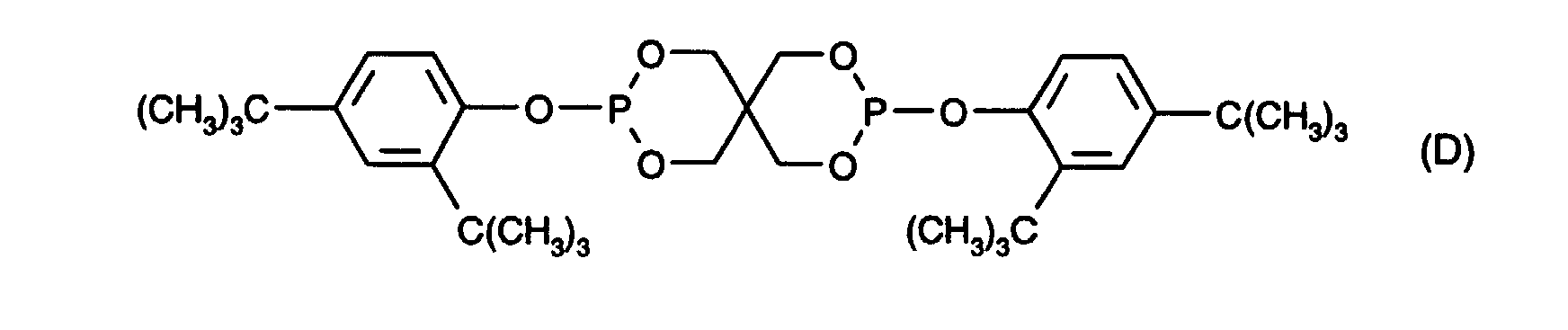
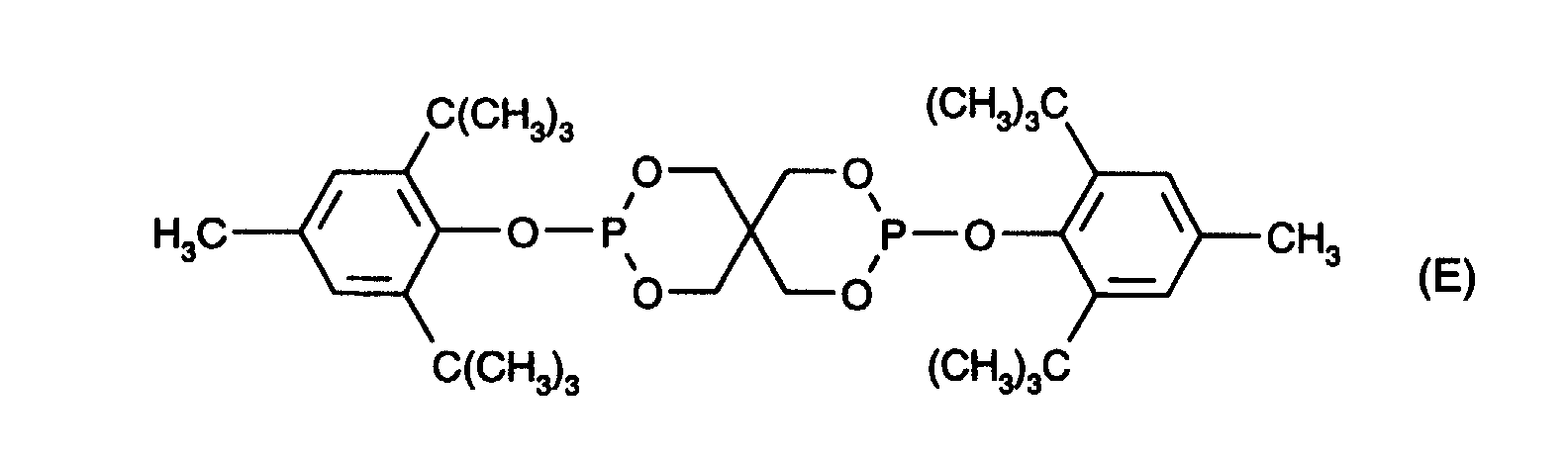
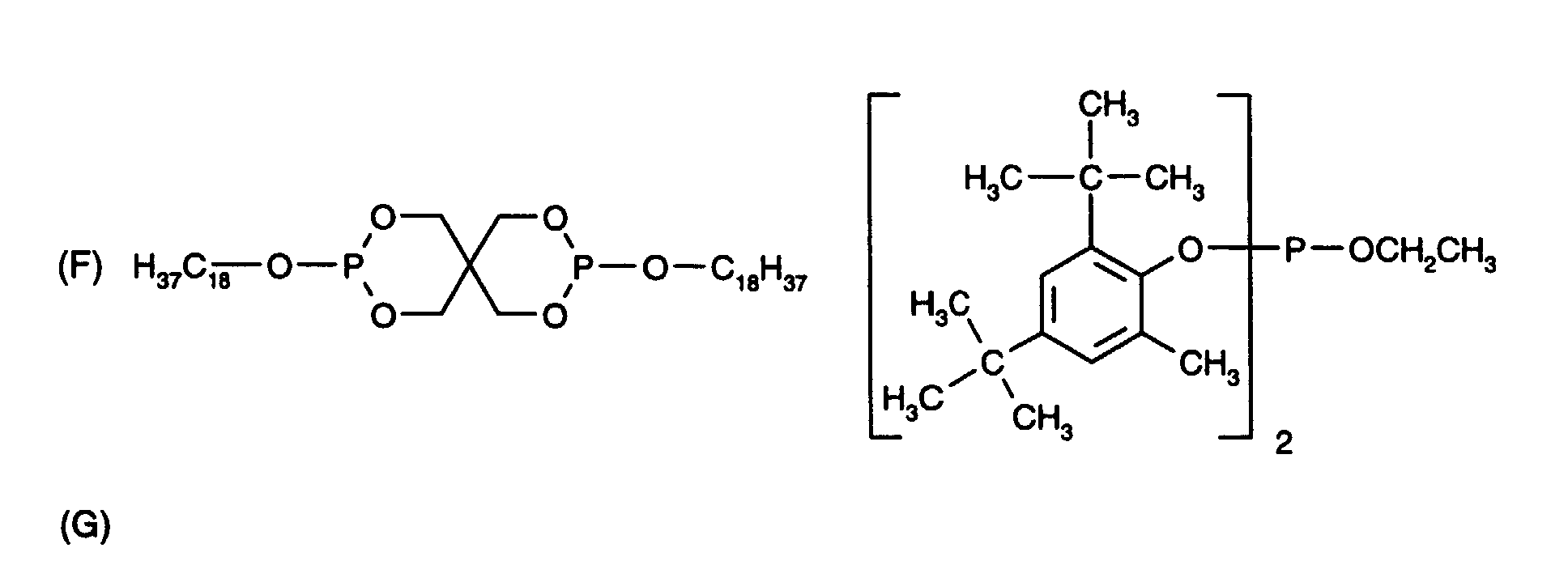
- Phosphites and phosphonites such as triphenyl phosphite, diphenylalkyl phosphites , phenyl dialkyl phosphites , tris (nonylphenyl) phosphite, trilauryl phosphite, trioctadecyl phosphite, distearyl pentaerythritol diphosphite, tris (2,4-di-tert-butylphenylphosphite), 2,4-di-tert-butylphenyl) pentaerythritol diphosphite, bis (2,6-di-tert-butyl-4-methylphenyl) pentaerythritol diphosphite, bis-isodecyloxy-pentaerythritol diphosphite, bis (2,4-di-tert-butyl6 -methylphenyl) pentt
- phosphites are particularly preferably used:
- Tris (2,4-di-tert-butylphenyl) phosphite (Irgafos®168, Ciba-Geigy), tris (nonylphenyl) phosphite,
- Hydroxylamines such as N, N-dibenzylhydroxylamine, N, N-diethylhydroxylamine, N, N-dioctylhydroxylamine, N, N-dilaurylhydroxylamine, N, N-ditetradecylhydroxylamine, N, N-dihexadecylhydroxylamine, N, N-dioctadecylhydroxylamine, N-hexadamine -N-octadecylhydroxylamine, N-heptadecyl-N-octadecylhydroxylamine, N, N-dialkylhydroxylamine from hydrogenated tallow fatty amines.
- Nitrones such as N-benzyl-alpha-phenyl-nitron, N-ethyl-alpha-methyl-nitron, N-octyl-alphaheptyl-nitron, N-lauryl-alpha-undecyl-nitron, N-tetradecyl-alpha-tridecyl -nitron, N-hexadecyl-alpha-pentadecyl-nitron, N-octadecyl-alpha-heptadecyl-nitron, N-hexadecyl-alpha-heptadecyl-nitron, N-octadecyl-alpha-pentadecyl-nitron, N-heptadecyl-alpha-heptadecyl -nitrone, N-octadecyl-alpha-hexadecyl-nitron, nitrones derived from N, N-dialky
- Thiosynergists such as thiodipropionic acid di-lauryl ester or thiodipropionic acid distearyl ester.
- Peroxide-destroying compounds such as esters of ⁇ -thio-dipropionic acid, for example the lauryl, stearyl, myristyl or tridecyl ester, mercaptobenzimidazole, the zinc salt of 2-mercaptobenzimidazole, zinc dibutyl dithiocarbamate, dioctadecyl disulfide, penta -dodecylmercapto) propionate.
- esters of ⁇ -thio-dipropionic acid for example the lauryl, stearyl, myristyl or tridecyl ester, mercaptobenzimidazole, the zinc salt of 2-mercaptobenzimidazole, zinc dibutyl dithiocarbamate, dioctadecyl disulfide, penta -dodecylmercapto) propionate.
- Polyamide stabilizers such as copper salts in combination with iodides and / or phosphorus compounds and salts of divalent manganese.
- Basic co-stabilizers such as melamine, polyvinylpyrrolidone, dicyandiamide, triallyl cyanurate, urea derivatives, hydrazine derivatives, amines, polyamides, polyurethanes, alkali and alkaline earth metal salts of higher fatty acids, for example Ca stearate, Zn stearate, Mg behenate , Mg stearate, Na ricinoleate, K palmitate, antimony pyrocatecholate or zinc pyrocatecholate.
- Basic co-stabilizers such as melamine, polyvinylpyrrolidone, dicyandiamide, triallyl cyanurate, urea derivatives, hydrazine derivatives, amines, polyamides, polyurethanes, alkali and alkaline earth metal salts of higher fatty acids, for example Ca stearate, Zn stearate, Mg behenate , Mg stearate, Na
- Nucleating agents such as, for example, inorganic substances such as talc, metal oxides such as titanium dioxide or magnesium oxide, phosphates, carbonates or sulfates of preferably alkaline earth metals; organic compounds such as mono- or polycarboxylic acids and their salts such as 4-tert-butylbenzoic acid, adipic acid, diphenylacetic acid, sodium succinate or sodium benzoate; polymeric compounds such as ionic copolymers ("ionomers").
- inorganic substances such as talc, metal oxides such as titanium dioxide or magnesium oxide, phosphates, carbonates or sulfates of preferably alkaline earth metals
- organic compounds such as mono- or polycarboxylic acids and their salts such as 4-tert-butylbenzoic acid, adipic acid, diphenylacetic acid, sodium succinate or sodium benzoate
- polymeric compounds such as ionic copolymers ("ionomers").
- Fillers and reinforcing agents such as calcium carbonate, silicates, glass fibers, glass balls, talc, kaolin, mica, barium sulfate, metal oxides and hydroxides, carbon black, graphite, wood flour and flours or fibers of other natural products, synthetic fibers.
- additives such as plasticizers, lubricants, emulsifiers, pigments, rheological additives, catalysts, flow control agents, optical brighteners, flame retardants, blowing agents.
- Benzofuranones or indolinones such as, for example, in US 4,325,863; US 4,338,244; U.S. 5,175,312, U.S. 5,216,052; US 5,252,643; DE-A-4316611; DE-A-4316622; DE-A-4316876; EP-A-0589839 or EP-A-0591102, or 3- [4- (2-acetoxyethoxy) phenyl] -5,7-di-tert-butyl-benzofuran-2-one, 5,7-di -tert-butyl-3- [4- (2-stearoyloxyethoxy) phenyl] benzofuran-2-one, 3,3'-bis [5,7-di-tert-butyl-3- (4- [2- hydroxyethoxy] phenyl) benzofuran-2-one], 5,7-di-tert-butyl-3- (4-ethoxyphenyl) benzo
- Suitable lubricants are: Montan waxes, fatty acid esters, PE waxes, amide waxes, polyol partial esters, partially saponified PE waxes, so-called complex esters chloroparaffins, glycerol esters, alkaline earth soaps or fat ketones as described in DE4204887.
- Lubricants that can be used are also described in "Taschenbuch der Kunststoff-Additive", edited by R. Gumbleter and H. Müller, Hanser Verlag, 3rd edition, 1990, pages 443-503. Further lubricant designs, in particular combinations, can be found in EP0062813 and EP 0336289.
- composition that additionally contains a phenolic antioxidant and / or a phosphite, in particular 0.1 to 5.0 parts per 100 parts of polymer.
- A is an anion of an inorganic protonic acid or a single or multiple organic carboxylic acid; to improve the antistatic property of high density polyethylene (HDPE), polyamide 11, polyamide 12 (PA 11, PA 12), a natural or synthetic elastomeric polymer or copolymer or a natural or synthetic elastic vulcanizate.
- HDPE high density polyethylene
- PA 11, PA 12 polyamide 12, PA 12
- PA 11 PA 12 polyamide 12, PA 12
- a natural or synthetic elastomeric polymer or copolymer or a natural or synthetic elastic vulcanizate is an anion of an inorganic protonic acid or a single or multiple organic carboxylic acid
- A is an anion of an inorganic protonic acid or a single or multiple organic carboxylic acid; as such or in the form of their individual constituents and, if appropriate, further additives with a high-density polyethylene (HDPE), PA 11, PA 12, a natural or synthetic elastomeric polymer or copolymer or a natural or synthetic elastic vulcanizate; mixed.
- HDPE high-density polyethylene
- PA 11 PA 12
- PA 12 a natural or synthetic elastomeric polymer or copolymer or a natural or synthetic elastic vulcanizate
- composition according to the invention can be produced in a manner known per se for which purpose using devices known per se, such as calenders, Mixers, kneaders, extruders and the like, the additives mentioned and optionally other additives mixed with the polymer.
- the additives can be used individually or in Mixture can be added together. So-called masterbatches are also possible to use.
- the antistatic polymer obtainable according to the present invention can be brought into the desired shape in known ways. Such processes are, for example, grinding, calendering, extruding, injection molding, spinning, press melting, rotary casting, thermoforming or extrusion blowing.
- the antistatic polymer can also be processed into foams.
- the following examples further illustrate the invention. As in the rest of the description, parts and percentages relate to the weight, unless stated otherwise. When specifying number intervals, as in the rest of the description, the limit values are included.
- HD-PE powder Hostalen® GF 7660, Hoechst
- 1.2 g of a solution of polyethylene glycol laurate (Irgastat® 51, Ciba Specialty Chemicals) containing 5% NaCIO 4 ⁇ H 2 O are mixed with a spatula and this mixture on a two-roll calender at 160 ° C (rolling time 5 min, speed 26/32 U / min, gap 0.5 mm) processed into a rolled skin.
- press plates of 0.5 mm thickness are then produced in a heated high-pressure press (heating temperature 180 ° C, heating time 5 min).
- the press plates are cooled in a second, water-cooled press (5 min) under pressure.
- the plates show at 20% r. F. a surface resistance R OG (measured with the protective ring electrode according to DIN 53482, 20 cm 2 , gap 5 mm, after 5 minutes at 500 volts) of 1.05 • 10 11 ohms, which after one week's storage in air at approx. 50 % RH falls to 1.1 • 10 10 ohms.
- R OG surface resistance measured with the protective ring electrode according to DIN 53482, 20 cm 2 , gap 5 mm, after 5 minutes at 500 volts
- the platelets show a surface resistance R OG of 8.7 • 10 9 ohms, after 3 days 4.5 • 10 9 ohms (at 50% rh). Measurements are made according to DIN 53482 with a protective ring electrode (20 cm 2 , Gap 5mm, after 5 minutes at 500 volts). The surface resistances measured with a spring tongue electrode according to DIN 53482 are R OA 1.4 • 10 10 ohms (after 1 day) and 9.1 • 10 9 ohms (after 3 days).
- SB block copolymer (Styrolux® RE 31, BASF) are mixed with 0.90 g of a solution of polyethylene glycol laurate (Irgastat® 51, Ciba Specialty Chemicals) containing 5% NaCIO 4 .H 2 O and mixed with a spatula .
- This mixture is processed on a two-roll calender at 180 ° C (rolling time 5 min, speed 26/32 U / min, gap 0.50 mm.
- the removed mass is used to press plates at 190 ° C (5 min) in a heated high-pressure press 0.5 mm thick.
- the plates are cooled in a second, water-cooled press (5 min) under pressure.
- the plates show a surface resistance R OG of 1 • 10 12 ohms at 20% RH, which follows one week's storage in air (50% rh) falls to 2.8 • 10 9 ohms. Measurements are made with a protective ring electrode according to DIN 53482. The plates are white-opaque.
- the vulcanization parameters are determined in a rheometer (Monsanto) at 160 ° C. The remaining mixture is then vulcanized in a 2 mm mold at 160 ° C and 100 bar to T 95. 3 days after production, the electrical resistance values according to DIN 53482 are determined with a protective ring electrode (20 cm 2 , gap 5 mm, after 5 minutes at 500 volts).
- the surface resistance R OG at 50% RH is 5 • 10 9 ohms, the volume resistance R V 4 • 10 8 ohms.
- the remaining mixture is then vulcanized in a 2 mm mold at 160 ° C. and 100 bar in a heatable press up to T 95. 3 days after production, the electrical resistance values according to DIN 53482 are determined with a protective ring electrode (20 cm 2 , gap 5 mm, after 5 minutes at 500 volts).
- the surface resistance R OG is 1.4 • 10 9 ohms at 50% RH, the volume resistance R V 4 • 10 7 ohms.
- a mixture of BR / SBR / IR basic mixture consisting of 10 parts Cariflex® IR 305, 20 T. Cariflex SBR 1210, 70 T. Tuellene® BR 1220, 30 T. Aerosil® VN 3, 0.5 parts Dicup® 40 become 5 Parts of polyethylene glycol laurate (Irgastat® 51, Ciba Specialty Chemicals, containing 5% NaCIO 4 .H 2 O) were added and mixed on a two-roll calender for 20 minutes at 60 ° C. (17/21 rpm). The vulcanization parameters are determined in a rheometer (Monsanto) at 160 ° C. with 5 g of the rolled skin obtained.
- the remaining mixture is then vulcanized in a 2 mm mold at 160 ° C. and 100 atm pressure in a press up to T 95. 3 days after production, the electrical resistance values according to DIN 53482 are determined with a protective ring electrode (20 cm 2 , gap 5 mm, after 5 minutes at 500 volts).
- the surface resistance R OG at 50% RH is 1 • 10 9 ohms, the volume resistance R V 6 • 10 7 ohms.
- the plates show a surface resistance R OG (measured with the protective ring electrode according to DIN 53482, 20 cm 2 , gap 5 mm, after 5 minutes at 500 volts) of 1 • 10 10 ohms (at 55% RH) and one Surface resistance R OA (measured with the spring tongue electrode according to DIN 53482) of 2 • 10 11 ohms (at 55% RH).
- R OG surface resistance measured with the protective ring electrode according to DIN 53482, 20 cm 2 , gap 5 mm, after 5 minutes at 500 volts
- R OA measured with the spring tongue electrode according to DIN 53482
- the plates show a surface resistance R OG of 2.5 • 10 11 ohms one week after production at 50% rh (measured with the protective ring electrode according to DIN 53482, 20 cm 2 , gap 5 mm, after 5 min at 500 volts).
- a comparison sample without an antistatic additive shows> 2 • 10 14 ohms.
- a surface resistance R OA of 7 • 10 10 ohms is obtained for press plates with an antistatic according to the invention and a volume resistance R v of 4.5 • 10 8 ohms.
- the corresponding volume resistance of a sample without additive is 2 • 10 12 ohms, measured with the ring electrode.
Landscapes
- Chemical & Material Sciences (AREA)
- Health & Medical Sciences (AREA)
- Chemical Kinetics & Catalysis (AREA)
- Medicinal Chemistry (AREA)
- Polymers & Plastics (AREA)
- Organic Chemistry (AREA)
- Compositions Of Macromolecular Compounds (AREA)
Abstract
Description
Besonders bevorzugt sind Verbindungen der Formel (I), worin R1 H, R2 C6-C20-Alkyl oder C6-C20-Alkenyl, R3 H oder CH3, n eine Zahl zwischen 2 und 14, q null und r eins ist.



Montanwachs, Fettsäureester, PE-Wachse, Amidwachse, Polyolpartialester, teilverseifte PE-Wachse, sogenannte Komplexester Chlorparaffine, Glycerinester, Erdalkaliseifen oder Fettketone wie in DE4204887 beschrieben. Verwendbare Gleitmittel sind auch in "Taschenbuch der Kunststoff-Additive", Herausgeber R. Gächter und H. Müller, Hanser Verlag, 3.Auflage, 1990, Seiten 443-503 beschrieben. Weitere Gleitmittelausführungen insbesondere Kombinationen sind zu entnehmen in EP0062813 und EP 0336289.
- M ein z-wertiges Alkalimetall-, Erdalkalimetall- oder Zinkkation,
- a und b, unabhängig voneinander, eine Zahl zwischen 1 und 6, und
zur Verbesserung der antistatischen Eigenschaft von Polyethylen hoher Dichte (HDPE), Polyamid 11, Polyamid 12 (PA 11, PA 12), einem natürlichen oder synthetischen elastomeren Polymer oder Copolymer oder einem natürlichen oder synthetischen elastischen Vulkanisat.
ein Polyoxyalkylen der Formel
- M ein z-wertiges Alkalimetall-, Erdalkalimetall- oder Zinkkation,
- a und b, unabhängig voneinander, eine Zahl zwischen 1 und 6, und
als solche oder in Form ihrer einzelnen Bestandteile und gegebenenfalls weiterer Zusätze mit einem Polyethylen hoher Dichte (HDPE), PA 11, PA 12, einem natürlichen oder synthetischen elastomeren Polymer oder Copolymer oder einem natürlichen oder synthetischen elastischen Vulkanisat;
vermischt.
Die folgenden Beispiele erläutern die Erfindung weiter. Teile und Prozente beziehen sich, wie auch in der übrigen Beschreibung, auf das Gewicht, sofern nicht anders angegeben. Bei Angaben von Zahlenintervallen, wie auch in der übrigen Beschreibung, sind die Grenzwerte eingeschlossen.
Der entsprechende Durchgangswiderstand einer Probe ohne Zusatz beträgt 2•1012 Ohm, mit der Ringelektrode gemessen.
Eine Probe ohne antistatischen Zusatz weist 1•1013 Ohm auf.
Der Durchgangswiderstand Rv der Probe mit Antistatikum beträgt 4.1•109 Ohm.
Der entsprechende Durchgangswiderstand einer Probe ohne Zusatz beträgt 3•1012 Ohm (50% r.F.).
Claims (12)
- Zusammensetzung enthaltendA ein Anion einer anorganischen Protonensäure oder einer einfachen oder mehrfachen organischen Carbonsäure ist.(a) Polyethylen hoher Dichte (HDPE), Polyamid 11, Polyamid 12 (PA 11, PA 12), ein natürliches oder synthetisches elastomeres Polymer oder Copolymer oder ein natürliches oder synthetisches elastische Vulkanisat;(b) ein Polyoxyalkylen der Formelund (c) ein Salz der Formel {Mz+ aA(az/b)- b} wobeiR1-O-[CH(R3)-CH2-O-]n-[CH2-[CH(OH)]p-CH2-O]q-[C(O)]r-R2 (I), wobeiR1 H, C1-C24-Alkyl, C2-C24-Alkenyl, CH2=CH-C(O) oder CH2=CCH3-C(O),R2 C1-C24-Alkyl, C2-C24-Alkenyl, CH2-COOH, oder N(C1-C20-Alkyl)2,R3 H oder CH3,n eine Zahl grösser oder gleich 2,p eine Zahl von 1 bis 6, undq und r, unabhängig voneinander, 0 oder 1 ist;M ein z-wertiges Alkalimetall-, Erdalkalimetall- oder Zinkkation,a und b, unabhängig voneinander, eine Zahl zwischen 1 und 6, und
- Zusammensetzung nach Anspruch 1, enthaltend als Komponente a) HDPE.
- Zusammensetzung nach Anspruch 1, enhaltend als Komponente a) ein synthetisches oder natürliches Elastomer, welches ein Polydien enthält.
- Zusammensetzung nach Anspruch 1, enthaltend ein synthetisches Elastomer auf Basis konjugierter Diene mit monovinylsubstituierten Aromaten.
- Zusammensetzung gemäss Anspruch 1, enthaltend als Komponente (b) Polypropylenglykollaurylester, Polypropylenglykololeylester, Polyethylenglykolmonomethylether, Polyethylenglykoldimethylether, Polyethylenglykollaurylester, Polyethylenglykololeylester, Polyethylenglykololeylether, Polyethylenglykolsorbitanmonolaurylester, Polyethylenglykolstearylester, Polyethylenglykolpolypropylenglykollaurylether oder Polyethylenglykollaurylethercarbonsäure.
- Zusammensetzung nach Anspruch 5, enthaltend als Komponente b) Polyethylenglykololeylether oder Polyethylenglykollaurylester.
- Zusamensetzung nach Anspruch 1, enthaltend 0,05 bis 20 Gew.-Teilen, bezogen auf 100 Gew.-Teile Polymer, der Komponente b).
- Zusammensetzung nach Anspruch 1 enthaltend als anorganisches Salz (c) NaCIO4, LiCF3SO3, KCIO4 oder LiCIO4.
- Zusammensetzung nach Anspruch 1, enthaltend 0,005 bis 3 Gew.-Teilen, bezogen auf 100 Gew.-Teile Polymer der Komponente c).
- Zusammensetzung nach Anspruch 1, worin das Gewichtsverhältnis von Komponente (b) zu Komponente (c) zwischen 1:1 und 100:1 beträgt.
- Verwendung einer Additivmischung, enthaltend
ein Polyoxyalkylen der Formelund ein Salz der Formel {Mz+ aA(az/b)- b} wobeiR1-O-[CH(R3)-CH2-O-]n-[CH2-[CH(OH)]p-CH2-O]q-[C(O)]r-R2 (I), wobeiR1 H, C1-C24-Alkyl, C2-C24-Alkenyl, CH2=CH-C(O)- oder CH2=CCH3-C(O)-,R2 C1-C24-Alkyl, C2-C24-Alkenyl, CH2-COOH oder N(C1-C20-Alkyl)2,R3 H oder CH3,n eine Zahl grösser oder gleich 2,p eine Zahl von 1 bis 6, undq und r, unabhängig voneinander, 0 oder 1 ist;A ein Anion einer anorganischen Protonensäure oder einer einfachen oder mehrfachen organischen Carbonsäure ist;M ein z-wertiges Alkalimetall-, Erdalkalimetall- oder Zinkkation,a und b, unabhängig voneinander, eine Zahl zwischen 1 und 6, und
zur Verbesserung der antistatischen Eigenschaft von Polyethylen hoher Dichte (HDPE), Polyamid 11, Polyamid 12 (PA 11, PA 12), einem natürlichen oder synthetischen elastomeren Polymer oder Copolymer oder einem natürlichen oder synthetischen elastischen Vulkanisat. - Verfahren zur Herstellung von einem antistatisch-ausgerüsteten Polyethylen hoher Dichte (HDPE), Polyamid 11, Polyamid 12 (PA 11, PA 12), einem natürlichen oder synthetischen elastomeren Polymer oder Copolymer oder einem natürlichen oder synthetischen elastischen Vulkanisat, dadurch gekennzeichnet, dass man unter Verwendung von Vorrichtungen, wie Kalander, Mischer, Kneter, Extruder eine Additivmischung,
enthaltend
ein Polyoxyalkylen der Formelund ein Salz der Formel {Mz+ aA(az/b)- b} wobeiR1-O-[CH(R3)-CH2-O-]n-[CH2-[CH(OH)]p-CH2-O]q-[C(O)]r-R2 (I), wobeiR1 H, C1-C24-Alkyl, C2-C24-Alkenyl, CH2=CH-C(O)- oder CH2=CCH3-C(O)-,R2 C1-C24-Alkyl, C2-C24-Alkenyl, CH2-COOH oder N(C1-C20-Alkyl)2,R3 H oder CH3,n eine Zahl grösser oder gleich 2,p eine Zahl von 1 bis 6, undq und r, unabhängig voneinander, 0 oder 1 ist;als solche oder in Form ihrer einzelnen Bestandteile und gegebenenfalls weiterer Zusätze mit einem Polyethylen hoher Dichte (HDPE), PA 11, PA 12, einem natürlichen oder synthetischen elastomeren Polymer oder Copolymer oder einem natürlichen oder synthetischen elastischen Vulkanisat;M ein z-wertiges Alkalimetall-, Erdalkalimetall- oder Zinkkation,a und b, unabhängig voneinander, eine Zahl zwischen 1 und 6, undA ein Anion einer anorganischen Protonensäure oder einer organischen Sauerstoffsäure des Schwefels ist;
vermischt.
Applications Claiming Priority (3)
| Application Number | Priority Date | Filing Date | Title |
|---|---|---|---|
| CH241097 | 1997-10-16 | ||
| CH241097 | 1997-10-16 | ||
| CH2410/97 | 1997-10-16 |
Publications (2)
| Publication Number | Publication Date |
|---|---|
| EP0909785A2 true EP0909785A2 (de) | 1999-04-21 |
| EP0909785A3 EP0909785A3 (de) | 1999-08-25 |
Family
ID=4233149
Family Applications (1)
| Application Number | Title | Priority Date | Filing Date |
|---|---|---|---|
| EP98811009A Withdrawn EP0909785A3 (de) | 1997-10-16 | 1998-10-07 | Antistatisch-ausgerüstete Polymere |
Country Status (3)
| Country | Link |
|---|---|
| EP (1) | EP0909785A3 (de) |
| JP (1) | JPH11236484A (de) |
| CA (1) | CA2249892A1 (de) |
Cited By (3)
| Publication number | Priority date | Publication date | Assignee | Title |
|---|---|---|---|---|
| WO2000068027A3 (en) * | 1999-05-06 | 2001-05-17 | Bridgestone Corp | Improved electrical conductivity of silica-filled rubber compositions |
| WO2001079354A1 (en) | 2000-04-12 | 2001-10-25 | Sanko Chemical Industry Co., Ltd. | Antistatic composition |
| EP1130034A3 (de) * | 2000-03-01 | 2003-06-04 | Bayer Ag | Kautschuke mit Polyether-Seitengruppen |
Families Citing this family (1)
| Publication number | Priority date | Publication date | Assignee | Title |
|---|---|---|---|---|
| JP2002226704A (ja) * | 2001-02-06 | 2002-08-14 | Riken Technos Corp | 制電性組成物 |
Family Cites Families (4)
| Publication number | Priority date | Publication date | Assignee | Title |
|---|---|---|---|---|
| JPS61261359A (ja) * | 1985-05-15 | 1986-11-19 | Japan Synthetic Rubber Co Ltd | 熱可塑性樹脂組成物 |
| JPH04170450A (ja) * | 1990-11-02 | 1992-06-18 | Tokyo Ink Kk | 帯電防止性熱可塑性樹脂組成物 |
| JP2662158B2 (ja) * | 1992-01-29 | 1997-10-08 | バイエル・アントウエルペン・エヌ・ベー | 熱可塑性ポリマー用帯電防止剤 |
| DE59611354D1 (de) * | 1995-06-28 | 2006-07-20 | Crompton Vinyl Additives Gmbh | Antistatisch-ausgerüstete halogenhaltige Polymere |
-
1998
- 1998-10-07 EP EP98811009A patent/EP0909785A3/de not_active Withdrawn
- 1998-10-14 CA CA002249892A patent/CA2249892A1/en not_active Abandoned
- 1998-10-15 JP JP10309431A patent/JPH11236484A/ja active Pending
Cited By (6)
| Publication number | Priority date | Publication date | Assignee | Title |
|---|---|---|---|---|
| WO2000068027A3 (en) * | 1999-05-06 | 2001-05-17 | Bridgestone Corp | Improved electrical conductivity of silica-filled rubber compositions |
| EP1130034A3 (de) * | 2000-03-01 | 2003-06-04 | Bayer Ag | Kautschuke mit Polyether-Seitengruppen |
| WO2001079354A1 (en) | 2000-04-12 | 2001-10-25 | Sanko Chemical Industry Co., Ltd. | Antistatic composition |
| EP1273629A4 (de) * | 2000-04-12 | 2004-12-29 | Sanko Chemical Industry Co Ltd | Antistatische zusammensetzung |
| US7192538B2 (en) | 2000-04-12 | 2007-03-20 | Sanko Chemical Industry Co., Ltd. | Antistatic composition |
| US8501044B2 (en) | 2000-04-12 | 2013-08-06 | Sanko Chemical Industry Co., Ltd. | Antistatic composition |
Also Published As
| Publication number | Publication date |
|---|---|
| CA2249892A1 (en) | 1999-04-16 |
| JPH11236484A (ja) | 1999-08-31 |
| EP0909785A3 (de) | 1999-08-25 |
Similar Documents
| Publication | Publication Date | Title |
|---|---|---|
| DE10116305B4 (de) | Synergistische Gemische von UV-Absorptionsmitteln in Polyolefinen | |
| DE60309665T2 (de) | Stabilisierung von polyolefinen, die in permanentem kontakt mit chloriertem wasser stehen | |
| DE60009036T2 (de) | Synthetische polymere enthaltend additivmischungen mit erhöhtem effekt | |
| EP2215156B1 (de) | Flüssige stabilisatormischung | |
| EP0905181B1 (de) | Stabilisatorgemisch für organische Materialien | |
| DE10009416A1 (de) | Stabilisatorkombination für das Rotationsformverfahren | |
| EP2004742A1 (de) | Zusammensetzung, enthaltend polymere, farbmittel und stabilisatoren | |
| DE60106583T2 (de) | Synergistische stabilisatorzusammensetzungen für thermoplastische polymere, die im längeren kontakt mit wasser stehen | |
| DE60306371T2 (de) | Amorphe feste modifikation von bis(2,4-dicumylphenyl) pentaerythritdiphosphit | |
| DE19820157B4 (de) | Neue Verbindungen auf Basis von Polyalkyl-1-oxa-diazaspirodecan-Verbindungen | |
| DE69705426T2 (de) | Lichtstabilisierte, flammfeste styrolhomopolymere und copolymere | |
| DE60306206T2 (de) | Antistatische zusammensetzung | |
| DE60009939T2 (de) | Stabilisatoren und ozonschutzmittel fuer elastomere | |
| EP1976925B1 (de) | Stabilisatormischung | |
| EP0878502A2 (de) | Formulierungen von Vitamin E zur Stabilisierung von polymeren organischen Materialien | |
| DE10051198A1 (de) | Stabilisatoren für Emulsions-Rohkautschuke, synthetischen Latex und Naturkautschuklatex | |
| EP2057219B1 (de) | Verfahren zur herstellung einer antistatischen zusammensetzung | |
| DE60016793T2 (de) | Dimere lichtstabilisatoren für polyolefine und ihre kopolymere | |
| WO2008084046A1 (de) | Weichmacher für polyvinylacetale und polysulfide | |
| DE19733717A1 (de) | Stabilisatormischungen | |
| EP2318454B1 (de) | Stabilisatoren für unbelebte organische materialien | |
| DE19855598A1 (de) | Stabilisierung von Polyamid, Polyester und Polyacetal | |
| EP2185641B1 (de) | Stabilisatormischung | |
| EP3259313B1 (de) | Lichtstabilisierte polyolefinfolien, bänder und monofilamente | |
| EP0742254A2 (de) | Kunststoff mit verminderter Geschwindigkeit der Schwefelaufnahme |
Legal Events
| Date | Code | Title | Description |
|---|---|---|---|
| PUAI | Public reference made under article 153(3) epc to a published international application that has entered the european phase |
Free format text: ORIGINAL CODE: 0009012 |
|
| AK | Designated contracting states |
Kind code of ref document: A2 Designated state(s): BE DE ES FR GB IT NL |
|
| AX | Request for extension of the european patent |
Free format text: AL;LT;LV;MK;RO;SI |
|
| PUAL | Search report despatched |
Free format text: ORIGINAL CODE: 0009013 |
|
| AK | Designated contracting states |
Kind code of ref document: A3 Designated state(s): AT BE CH CY DE DK ES FI FR GB GR IE IT LI LU MC NL PT SE |
|
| AX | Request for extension of the european patent |
Free format text: AL;LT;LV;MK;RO;SI |
|
| RTI1 | Title (correction) |
Free format text: ANTISTATIC POLYMERS |
|
| 17P | Request for examination filed |
Effective date: 19990920 |
|
| AKX | Designation fees paid |
Free format text: BE DE ES FR GB IT NL |
|
| 17Q | First examination report despatched |
Effective date: 20020610 |
|
| STAA | Information on the status of an ep patent application or granted ep patent |
Free format text: STATUS: THE APPLICATION IS DEEMED TO BE WITHDRAWN |
|
| 18D | Application deemed to be withdrawn |
Effective date: 20021022 |