EP0909796B1 - Verfahren zur Konditionierung organischer Pigmente - Google Patents
Verfahren zur Konditionierung organischer Pigmente Download PDFInfo
- Publication number
- EP0909796B1 EP0909796B1 EP98118763A EP98118763A EP0909796B1 EP 0909796 B1 EP0909796 B1 EP 0909796B1 EP 98118763 A EP98118763 A EP 98118763A EP 98118763 A EP98118763 A EP 98118763A EP 0909796 B1 EP0909796 B1 EP 0909796B1
- Authority
- EP
- European Patent Office
- Prior art keywords
- pigment
- aliphatic
- surfactant
- process according
- formula
- Prior art date
- Legal status (The legal status is an assumption and is not a legal conclusion. Google has not performed a legal analysis and makes no representation as to the accuracy of the status listed.)
- Expired - Lifetime
Links
- 239000012860 organic pigment Substances 0.000 title claims description 48
- 238000000034 method Methods 0.000 title claims description 40
- 230000003750 conditioning effect Effects 0.000 title claims description 25
- 239000000049 pigment Substances 0.000 claims description 142
- 125000001931 aliphatic group Chemical group 0.000 claims description 51
- 239000004094 surface-active agent Substances 0.000 claims description 51
- 239000000203 mixture Substances 0.000 claims description 41
- XLYOFNOQVPJJNP-UHFFFAOYSA-N water Substances O XLYOFNOQVPJJNP-UHFFFAOYSA-N 0.000 claims description 26
- MRUAUOIMASANKQ-UHFFFAOYSA-N cocamidopropyl betaine Chemical compound CCCCCCCCCCCC(=O)NCCC[N+](C)(C)CC([O-])=O MRUAUOIMASANKQ-UHFFFAOYSA-N 0.000 claims description 24
- 229940073507 cocamidopropyl betaine Drugs 0.000 claims description 24
- 230000001143 conditioned effect Effects 0.000 claims description 21
- 125000004432 carbon atom Chemical group C* 0.000 claims description 18
- 239000001257 hydrogen Substances 0.000 claims description 17
- 229910052739 hydrogen Inorganic materials 0.000 claims description 17
- 239000007788 liquid Substances 0.000 claims description 16
- UHOKSCJSTAHBSO-UHFFFAOYSA-N indanthrone blue Chemical compound C1=CC=C2C(=O)C3=CC=C4NC5=C6C(=O)C7=CC=CC=C7C(=O)C6=CC=C5NC4=C3C(=O)C2=C1 UHOKSCJSTAHBSO-UHFFFAOYSA-N 0.000 claims description 15
- 125000004169 (C1-C6) alkyl group Chemical group 0.000 claims description 14
- 235000019239 indanthrene blue RS Nutrition 0.000 claims description 14
- 125000000623 heterocyclic group Chemical group 0.000 claims description 13
- 150000001721 carbon Chemical group 0.000 claims description 11
- 229910052799 carbon Inorganic materials 0.000 claims description 11
- 150000001768 cations Chemical class 0.000 claims description 10
- 150000002431 hydrogen Chemical class 0.000 claims description 10
- 125000003161 (C1-C6) alkylene group Chemical group 0.000 claims description 9
- 239000000654 additive Substances 0.000 claims description 9
- 238000001914 filtration Methods 0.000 claims description 9
- 125000005842 heteroatom Chemical group 0.000 claims description 9
- GPRLSGONYQIRFK-UHFFFAOYSA-N hydron Chemical compound [H+] GPRLSGONYQIRFK-UHFFFAOYSA-N 0.000 claims description 9
- NRCMAYZCPIVABH-UHFFFAOYSA-N Quinacridone Chemical compound N1C2=CC=CC=C2C(=O)C2=C1C=C1C(=O)C3=CC=CC=C3NC1=C2 NRCMAYZCPIVABH-UHFFFAOYSA-N 0.000 claims description 8
- 125000004122 cyclic group Chemical group 0.000 claims description 7
- GWVMLCQWXVFZCN-UHFFFAOYSA-N isoindoline Chemical compound C1=CC=C2CNCC2=C1 GWVMLCQWXVFZCN-UHFFFAOYSA-N 0.000 claims description 7
- 125000002080 perylenyl group Chemical group C1(=CC=C2C=CC=C3C4=CC=CC5=CC=CC(C1=C23)=C45)* 0.000 claims description 7
- CSHWQDPOILHKBI-UHFFFAOYSA-N peryrene Natural products C1=CC(C2=CC=CC=3C2=C2C=CC=3)=C3C2=CC=CC3=C1 CSHWQDPOILHKBI-UHFFFAOYSA-N 0.000 claims description 7
- IEQIEDJGQAUEQZ-UHFFFAOYSA-N phthalocyanine Chemical compound N1C(N=C2C3=CC=CC=C3C(N=C3C4=CC=CC=C4C(=N4)N3)=N2)=C(C=CC=C2)C2=C1N=C1C2=CC=CC=C2C4=N1 IEQIEDJGQAUEQZ-UHFFFAOYSA-N 0.000 claims description 7
- 125000003031 C5-C7 cycloalkylene group Chemical group 0.000 claims description 6
- UFHFLCQGNIYNRP-UHFFFAOYSA-N Hydrogen Chemical compound [H][H] UFHFLCQGNIYNRP-UHFFFAOYSA-N 0.000 claims description 6
- 125000000129 anionic group Chemical group 0.000 claims description 6
- 239000002563 ionic surfactant Substances 0.000 claims description 6
- 150000003839 salts Chemical class 0.000 claims description 6
- 229910001413 alkali metal ion Inorganic materials 0.000 claims description 5
- 125000002947 alkylene group Chemical group 0.000 claims description 5
- 229920002521 macromolecule Polymers 0.000 claims description 5
- 238000004381 surface treatment Methods 0.000 claims description 5
- 238000004519 manufacturing process Methods 0.000 claims description 4
- WGTDLPBPQKAPMN-KTKRTIGZSA-N 2-[2-[(z)-heptadec-8-enyl]-4,5-dihydroimidazol-1-yl]ethanol Chemical compound CCCCCCCC\C=C/CCCCCCCC1=NCCN1CCO WGTDLPBPQKAPMN-KTKRTIGZSA-N 0.000 claims description 3
- 239000011203 carbon fibre reinforced carbon Substances 0.000 claims description 3
- 239000008199 coating composition Substances 0.000 claims description 3
- 239000000725 suspension Substances 0.000 claims description 3
- 230000000996 additive effect Effects 0.000 claims description 2
- 125000004181 carboxyalkyl group Chemical group 0.000 claims description 2
- 150000002500 ions Chemical class 0.000 claims description 2
- 239000004800 polyvinyl chloride Substances 0.000 description 36
- 229920000915 polyvinyl chloride Polymers 0.000 description 36
- -1 aliphatic alcohols Chemical class 0.000 description 28
- 238000012360 testing method Methods 0.000 description 23
- OKKJLVBELUTLKV-UHFFFAOYSA-N Methanol Chemical compound OC OKKJLVBELUTLKV-UHFFFAOYSA-N 0.000 description 18
- HEMHJVSKTPXQMS-UHFFFAOYSA-M Sodium hydroxide Chemical compound [OH-].[Na+] HEMHJVSKTPXQMS-UHFFFAOYSA-M 0.000 description 18
- 150000001875 compounds Chemical class 0.000 description 15
- 235000019329 dioctyl sodium sulphosuccinate Nutrition 0.000 description 12
- YHAIUSTWZPMYGG-UHFFFAOYSA-L disodium;2,2-dioctyl-3-sulfobutanedioate Chemical compound [Na+].[Na+].CCCCCCCCC(C([O-])=O)(C(C([O-])=O)S(O)(=O)=O)CCCCCCCC YHAIUSTWZPMYGG-UHFFFAOYSA-L 0.000 description 12
- 125000000217 alkyl group Chemical group 0.000 description 10
- 239000002002 slurry Substances 0.000 description 10
- 239000000843 powder Substances 0.000 description 9
- 239000002253 acid Substances 0.000 description 8
- 239000000463 material Substances 0.000 description 8
- 125000003545 alkoxy group Chemical group 0.000 description 7
- 239000000839 emulsion Substances 0.000 description 7
- 229910052736 halogen Inorganic materials 0.000 description 7
- 150000002367 halogens Chemical class 0.000 description 7
- 239000003973 paint Substances 0.000 description 7
- 239000007787 solid Substances 0.000 description 7
- 125000004191 (C1-C6) alkoxy group Chemical group 0.000 description 6
- RBTKNAXYKSUFRK-UHFFFAOYSA-N heliogen blue Chemical compound [Cu].[N-]1C2=C(C=CC=C3)C3=C1N=C([N-]1)C3=CC=CC=C3C1=NC([N-]1)=C(C=CC=C3)C3=C1N=C([N-]1)C3=CC=CC=C3C1=N2 RBTKNAXYKSUFRK-UHFFFAOYSA-N 0.000 description 6
- 229910052757 nitrogen Inorganic materials 0.000 description 6
- 0 *CC*(C*)N(**)C1CCC1 Chemical compound *CC*(C*)N(**)C1CCC1 0.000 description 5
- ZAMOUSCENKQFHK-UHFFFAOYSA-N Chlorine atom Chemical compound [Cl] ZAMOUSCENKQFHK-UHFFFAOYSA-N 0.000 description 5
- GWEVSGVZZGPLCZ-UHFFFAOYSA-N Titan oxide Chemical compound O=[Ti]=O GWEVSGVZZGPLCZ-UHFFFAOYSA-N 0.000 description 5
- 150000001408 amides Chemical class 0.000 description 5
- 239000000460 chlorine Substances 0.000 description 5
- 229910052801 chlorine Inorganic materials 0.000 description 5
- 125000002496 methyl group Chemical group [H]C([H])([H])* 0.000 description 5
- 125000004433 nitrogen atom Chemical group N* 0.000 description 5
- 229920003023 plastic Polymers 0.000 description 5
- 239000004033 plastic Substances 0.000 description 5
- 125000004079 stearyl group Chemical group [H]C([*])([H])C([H])([H])C([H])([H])C([H])([H])C([H])([H])C([H])([H])C([H])([H])C([H])([H])C([H])([H])C([H])([H])C([H])([H])C([H])([H])C([H])([H])C([H])([H])C([H])([H])C([H])([H])C([H])([H])C([H])([H])[H] 0.000 description 5
- RSWGJHLUYNHPMX-UHFFFAOYSA-N Abietic-Saeure Natural products C12CCC(C(C)C)=CC2=CCC2C1(C)CCCC2(C)C(O)=O RSWGJHLUYNHPMX-UHFFFAOYSA-N 0.000 description 4
- IJGRMHOSHXDMSA-UHFFFAOYSA-N Atomic nitrogen Chemical compound N#N IJGRMHOSHXDMSA-UHFFFAOYSA-N 0.000 description 4
- VGGSQFUCUMXWEO-UHFFFAOYSA-N Ethene Chemical compound C=C VGGSQFUCUMXWEO-UHFFFAOYSA-N 0.000 description 4
- 239000005977 Ethylene Substances 0.000 description 4
- 150000007513 acids Chemical class 0.000 description 4
- 125000002915 carbonyl group Chemical group [*:2]C([*:1])=O 0.000 description 4
- 235000014113 dietary fatty acids Nutrition 0.000 description 4
- 125000003438 dodecyl group Chemical group [H]C([H])([H])C([H])([H])C([H])([H])C([H])([H])C([H])([H])C([H])([H])C([H])([H])C([H])([H])C([H])([H])C([H])([H])C([H])([H])C([H])([H])* 0.000 description 4
- 150000002148 esters Chemical class 0.000 description 4
- 239000000194 fatty acid Substances 0.000 description 4
- 229930195729 fatty acid Natural products 0.000 description 4
- 150000004665 fatty acids Chemical class 0.000 description 4
- 239000000976 ink Substances 0.000 description 4
- 229910052751 metal Inorganic materials 0.000 description 4
- 239000002184 metal Substances 0.000 description 4
- QPJVMBTYPHYUOC-UHFFFAOYSA-N methyl benzoate Chemical compound COC(=O)C1=CC=CC=C1 QPJVMBTYPHYUOC-UHFFFAOYSA-N 0.000 description 4
- 239000002736 nonionic surfactant Substances 0.000 description 4
- 239000002904 solvent Substances 0.000 description 4
- 125000001424 substituent group Chemical group 0.000 description 4
- ZWEHNKRNPOVVGH-UHFFFAOYSA-N 2-Butanone Chemical compound CCC(C)=O ZWEHNKRNPOVVGH-UHFFFAOYSA-N 0.000 description 3
- CSCPPACGZOOCGX-UHFFFAOYSA-N Acetone Chemical compound CC(C)=O CSCPPACGZOOCGX-UHFFFAOYSA-N 0.000 description 3
- LYCAIKOWRPUZTN-UHFFFAOYSA-N Ethylene glycol Chemical compound OCCO LYCAIKOWRPUZTN-UHFFFAOYSA-N 0.000 description 3
- PEDCQBHIVMGVHV-UHFFFAOYSA-N Glycerine Chemical compound OCC(O)CO PEDCQBHIVMGVHV-UHFFFAOYSA-N 0.000 description 3
- ZMXDDKWLCZADIW-UHFFFAOYSA-N N,N-Dimethylformamide Chemical compound CN(C)C=O ZMXDDKWLCZADIW-UHFFFAOYSA-N 0.000 description 3
- KHPCPRHQVVSZAH-HUOMCSJISA-N Rosin Natural products O(C/C=C/c1ccccc1)[C@H]1[C@H](O)[C@@H](O)[C@@H](O)[C@@H](CO)O1 KHPCPRHQVVSZAH-HUOMCSJISA-N 0.000 description 3
- 239000003945 anionic surfactant Substances 0.000 description 3
- 125000003710 aryl alkyl group Chemical group 0.000 description 3
- 125000003118 aryl group Chemical group 0.000 description 3
- 238000007429 general method Methods 0.000 description 3
- 125000001570 methylene group Chemical group [H]C([H])([*:1])[*:2] 0.000 description 3
- 229910052760 oxygen Inorganic materials 0.000 description 3
- 239000000979 synthetic dye Substances 0.000 description 3
- 239000001040 synthetic pigment Substances 0.000 description 3
- KHPCPRHQVVSZAH-UHFFFAOYSA-N trans-cinnamyl beta-D-glucopyranoside Natural products OC1C(O)C(O)C(CO)OC1OCC=CC1=CC=CC=C1 KHPCPRHQVVSZAH-UHFFFAOYSA-N 0.000 description 3
- KAKZBPTYRLMSJV-UHFFFAOYSA-N Butadiene Chemical compound C=CC=C KAKZBPTYRLMSJV-UHFFFAOYSA-N 0.000 description 2
- RYGMFSIKBFXOCR-UHFFFAOYSA-N Copper Chemical compound [Cu] RYGMFSIKBFXOCR-UHFFFAOYSA-N 0.000 description 2
- PXGOKWXKJXAPGV-UHFFFAOYSA-N Fluorine Chemical compound FF PXGOKWXKJXAPGV-UHFFFAOYSA-N 0.000 description 2
- XEEYBQQBJWHFJM-UHFFFAOYSA-N Iron Chemical compound [Fe] XEEYBQQBJWHFJM-UHFFFAOYSA-N 0.000 description 2
- PXHVJJICTQNCMI-UHFFFAOYSA-N Nickel Chemical compound [Ni] PXHVJJICTQNCMI-UHFFFAOYSA-N 0.000 description 2
- REYJJPSVUYRZGE-UHFFFAOYSA-N Octadecylamine Chemical compound CCCCCCCCCCCCCCCCCCN REYJJPSVUYRZGE-UHFFFAOYSA-N 0.000 description 2
- 229910019142 PO4 Inorganic materials 0.000 description 2
- 239000004698 Polyethylene Substances 0.000 description 2
- PPBRXRYQALVLMV-UHFFFAOYSA-N Styrene Chemical compound C=CC1=CC=CC=C1 PPBRXRYQALVLMV-UHFFFAOYSA-N 0.000 description 2
- QAOWNCQODCNURD-UHFFFAOYSA-N Sulfuric acid Chemical compound OS(O)(=O)=O QAOWNCQODCNURD-UHFFFAOYSA-N 0.000 description 2
- WYURNTSHIVDZCO-UHFFFAOYSA-N Tetrahydrofuran Chemical compound C1CCOC1 WYURNTSHIVDZCO-UHFFFAOYSA-N 0.000 description 2
- 239000003929 acidic solution Substances 0.000 description 2
- 150000001298 alcohols Chemical class 0.000 description 2
- 125000004453 alkoxycarbonyl group Chemical group 0.000 description 2
- 150000001412 amines Chemical class 0.000 description 2
- 125000004104 aryloxy group Chemical group 0.000 description 2
- 125000004429 atom Chemical group 0.000 description 2
- 238000000576 coating method Methods 0.000 description 2
- 229910052802 copper Inorganic materials 0.000 description 2
- 239000010949 copper Substances 0.000 description 2
- 238000011161 development Methods 0.000 description 2
- SWXVUIWOUIDPGS-UHFFFAOYSA-N diacetone alcohol Chemical compound CC(=O)CC(C)(C)O SWXVUIWOUIDPGS-UHFFFAOYSA-N 0.000 description 2
- 150000001991 dicarboxylic acids Chemical class 0.000 description 2
- 239000002270 dispersing agent Substances 0.000 description 2
- 239000006185 dispersion Substances 0.000 description 2
- UKMSUNONTOPOIO-UHFFFAOYSA-N docosanoic acid Chemical compound CCCCCCCCCCCCCCCCCCCCCC(O)=O UKMSUNONTOPOIO-UHFFFAOYSA-N 0.000 description 2
- 238000011156 evaluation Methods 0.000 description 2
- 230000001747 exhibiting effect Effects 0.000 description 2
- 229910052731 fluorine Inorganic materials 0.000 description 2
- 239000011737 fluorine Substances 0.000 description 2
- 238000009472 formulation Methods 0.000 description 2
- 238000000227 grinding Methods 0.000 description 2
- 150000002391 heterocyclic compounds Chemical class 0.000 description 2
- 150000002462 imidazolines Chemical class 0.000 description 2
- 229910052500 inorganic mineral Inorganic materials 0.000 description 2
- HQKMJHAJHXVSDF-UHFFFAOYSA-L magnesium stearate Chemical compound [Mg+2].CCCCCCCCCCCCCCCCCC([O-])=O.CCCCCCCCCCCCCCCCCC([O-])=O HQKMJHAJHXVSDF-UHFFFAOYSA-L 0.000 description 2
- 229940095102 methyl benzoate Drugs 0.000 description 2
- 239000011707 mineral Substances 0.000 description 2
- 125000001421 myristyl group Chemical group [H]C([*])([H])C([H])([H])C([H])([H])C([H])([H])C([H])([H])C([H])([H])C([H])([H])C([H])([H])C([H])([H])C([H])([H])C([H])([H])C([H])([H])C([H])([H])C([H])([H])[H] 0.000 description 2
- GLDOVTGHNKAZLK-UHFFFAOYSA-N octadecan-1-ol Chemical compound CCCCCCCCCCCCCCCCCCO GLDOVTGHNKAZLK-UHFFFAOYSA-N 0.000 description 2
- 125000001117 oleyl group Chemical group [H]C([*])([H])C([H])([H])C([H])([H])C([H])([H])C([H])([H])C([H])([H])C([H])([H])C([H])([H])/C([H])=C([H])\C([H])([H])C([H])([H])C([H])([H])C([H])([H])C([H])([H])C([H])([H])C([H])([H])C([H])([H])[H] 0.000 description 2
- 125000000913 palmityl group Chemical group [H]C([*])([H])C([H])([H])C([H])([H])C([H])([H])C([H])([H])C([H])([H])C([H])([H])C([H])([H])C([H])([H])C([H])([H])C([H])([H])C([H])([H])C([H])([H])C([H])([H])C([H])([H])C([H])([H])[H] 0.000 description 2
- 239000000123 paper Substances 0.000 description 2
- 239000002245 particle Substances 0.000 description 2
- KJOLVZJFMDVPGB-UHFFFAOYSA-N perylenediimide Chemical compound C=12C3=CC=C(C(NC4=O)=O)C2=C4C=CC=1C1=CC=C2C(=O)NC(=O)C4=CC=C3C1=C42 KJOLVZJFMDVPGB-UHFFFAOYSA-N 0.000 description 2
- 150000002979 perylenes Chemical class 0.000 description 2
- 235000021317 phosphate Nutrition 0.000 description 2
- XQZYPMVTSDWCCE-UHFFFAOYSA-N phthalonitrile Chemical compound N#CC1=CC=CC=C1C#N XQZYPMVTSDWCCE-UHFFFAOYSA-N 0.000 description 2
- 229920006391 phthalonitrile polymer Polymers 0.000 description 2
- 229920000573 polyethylene Polymers 0.000 description 2
- 229920000642 polymer Polymers 0.000 description 2
- 239000002243 precursor Substances 0.000 description 2
- 229920005989 resin Polymers 0.000 description 2
- 239000011347 resin Substances 0.000 description 2
- 229910001415 sodium ion Inorganic materials 0.000 description 2
- 239000006104 solid solution Substances 0.000 description 2
- 239000004408 titanium dioxide Substances 0.000 description 2
- 239000001993 wax Substances 0.000 description 2
- 239000001052 yellow pigment Substances 0.000 description 2
- 125000004178 (C1-C4) alkyl group Chemical group 0.000 description 1
- CBGBMDNBHHELTJ-UHFFFAOYSA-N 1,2-dimethylperylene Chemical group C1=CC(C2=C(C(C)=CC=3C2=C2C=CC=3)C)=C3C2=CC=CC3=C1 CBGBMDNBHHELTJ-UHFFFAOYSA-N 0.000 description 1
- 125000005838 1,3-cyclopentylene group Chemical group [H]C1([H])C([H])([H])C([H])([*:2])C([H])([H])C1([H])[*:1] 0.000 description 1
- RYHBNJHYFVUHQT-UHFFFAOYSA-N 1,4-Dioxane Chemical compound C1COCCO1 RYHBNJHYFVUHQT-UHFFFAOYSA-N 0.000 description 1
- 125000004955 1,4-cyclohexylene group Chemical group [H]C1([H])C([H])([H])C([H])([*:1])C([H])([H])C([H])([H])C1([H])[*:2] 0.000 description 1
- KWKAKUADMBZCLK-UHFFFAOYSA-N 1-octene Chemical group CCCCCCC=C KWKAKUADMBZCLK-UHFFFAOYSA-N 0.000 description 1
- ZJQZWNLKRBUEKX-UHFFFAOYSA-N 2,5-dianilinoterephthalic acid Chemical compound OC(=O)C=1C=C(NC=2C=CC=CC=2)C(C(=O)O)=CC=1NC1=CC=CC=C1 ZJQZWNLKRBUEKX-UHFFFAOYSA-N 0.000 description 1
- GLKRSFJCYTXIOF-UHFFFAOYSA-N 2-octadecylguanidine Chemical compound CCCCCCCCCCCCCCCCCCN=C(N)N GLKRSFJCYTXIOF-UHFFFAOYSA-N 0.000 description 1
- 125000000094 2-phenylethyl group Chemical group [H]C1=C([H])C([H])=C(C([H])=C1[H])C([H])([H])C([H])([H])* 0.000 description 1
- XQGDNRFLRLSUFQ-UHFFFAOYSA-N 2H-pyranthren-1-one Chemical class C1=C(C2=C3C4=C56)C=CC3=CC5=C3C=CC=CC3=CC6=CC=C4C=C2C2=C1C(=O)CC=C2 XQGDNRFLRLSUFQ-UHFFFAOYSA-N 0.000 description 1
- MTKKGHVQPVOXIL-UHFFFAOYSA-N 3h-isoindol-1-amine Chemical compound C1=CC=C2C(N)=NCC2=C1 MTKKGHVQPVOXIL-UHFFFAOYSA-N 0.000 description 1
- BTXXTMOWISPQSJ-UHFFFAOYSA-N 4,4,4-trifluorobutan-2-one Chemical compound CC(=O)CC(F)(F)F BTXXTMOWISPQSJ-UHFFFAOYSA-N 0.000 description 1
- BCFOOQRXUXKJCL-UHFFFAOYSA-N 4-amino-4-oxo-2-sulfobutanoic acid Chemical class NC(=O)CC(C(O)=O)S(O)(=O)=O BCFOOQRXUXKJCL-UHFFFAOYSA-N 0.000 description 1
- ZCYVEMRRCGMTRW-UHFFFAOYSA-N 7553-56-2 Chemical compound [I] ZCYVEMRRCGMTRW-UHFFFAOYSA-N 0.000 description 1
- BQACOLQNOUYJCE-FYZZASKESA-N Abietic acid Natural products CC(C)C1=CC2=CC[C@]3(C)[C@](C)(CCC[C@@]3(C)C(=O)O)[C@H]2CC1 BQACOLQNOUYJCE-FYZZASKESA-N 0.000 description 1
- HRPVXLWXLXDGHG-UHFFFAOYSA-N Acrylamide Chemical compound NC(=O)C=C HRPVXLWXLXDGHG-UHFFFAOYSA-N 0.000 description 1
- NLHHRLWOUZZQLW-UHFFFAOYSA-N Acrylonitrile Chemical compound C=CC#N NLHHRLWOUZZQLW-UHFFFAOYSA-N 0.000 description 1
- QGZKDVFQNNGYKY-UHFFFAOYSA-N Ammonia Chemical compound N QGZKDVFQNNGYKY-UHFFFAOYSA-N 0.000 description 1
- QGZKDVFQNNGYKY-UHFFFAOYSA-O Ammonium Chemical compound [NH4+] QGZKDVFQNNGYKY-UHFFFAOYSA-O 0.000 description 1
- 235000021357 Behenic acid Nutrition 0.000 description 1
- BVKZGUZCCUSVTD-UHFFFAOYSA-M Bicarbonate Chemical compound OC([O-])=O BVKZGUZCCUSVTD-UHFFFAOYSA-M 0.000 description 1
- WKBOTKDWSSQWDR-UHFFFAOYSA-N Bromine atom Chemical compound [Br] WKBOTKDWSSQWDR-UHFFFAOYSA-N 0.000 description 1
- 125000006577 C1-C6 hydroxyalkyl group Chemical group 0.000 description 1
- 125000000041 C6-C10 aryl group Chemical group 0.000 description 1
- BHPQYMZQTOCNFJ-UHFFFAOYSA-N Calcium cation Chemical compound [Ca+2] BHPQYMZQTOCNFJ-UHFFFAOYSA-N 0.000 description 1
- BVKZGUZCCUSVTD-UHFFFAOYSA-L Carbonate Chemical compound [O-]C([O-])=O BVKZGUZCCUSVTD-UHFFFAOYSA-L 0.000 description 1
- VEXZGXHMUGYJMC-UHFFFAOYSA-M Chloride anion Chemical compound [Cl-] VEXZGXHMUGYJMC-UHFFFAOYSA-M 0.000 description 1
- 235000013162 Cocos nucifera Nutrition 0.000 description 1
- 244000060011 Cocos nucifera Species 0.000 description 1
- MYMOFIZGZYHOMD-UHFFFAOYSA-N Dioxygen Chemical compound O=O MYMOFIZGZYHOMD-UHFFFAOYSA-N 0.000 description 1
- 208000000655 Distemper Diseases 0.000 description 1
- SNRUBQQJIBEYMU-UHFFFAOYSA-N Dodecane Natural products CCCCCCCCCCCC SNRUBQQJIBEYMU-UHFFFAOYSA-N 0.000 description 1
- 244000068988 Glycine max Species 0.000 description 1
- 235000010469 Glycine max Nutrition 0.000 description 1
- DGAQECJNVWCQMB-PUAWFVPOSA-M Ilexoside XXIX Chemical compound C[C@@H]1CC[C@@]2(CC[C@@]3(C(=CC[C@H]4[C@]3(CC[C@@H]5[C@@]4(CC[C@@H](C5(C)C)OS(=O)(=O)[O-])C)C)[C@@H]2[C@]1(C)O)C)C(=O)O[C@H]6[C@@H]([C@H]([C@@H]([C@H](O6)CO)O)O)O.[Na+] DGAQECJNVWCQMB-PUAWFVPOSA-M 0.000 description 1
- WHXSMMKQMYFTQS-UHFFFAOYSA-N Lithium Chemical compound [Li] WHXSMMKQMYFTQS-UHFFFAOYSA-N 0.000 description 1
- FYYHWMGAXLPEAU-UHFFFAOYSA-N Magnesium Chemical compound [Mg] FYYHWMGAXLPEAU-UHFFFAOYSA-N 0.000 description 1
- FXHOOIRPVKKKFG-UHFFFAOYSA-N N,N-Dimethylacetamide Chemical compound CN(C)C(C)=O FXHOOIRPVKKKFG-UHFFFAOYSA-N 0.000 description 1
- 229910002651 NO3 Inorganic materials 0.000 description 1
- NHNBFGGVMKEFGY-UHFFFAOYSA-N Nitrate Chemical compound [O-][N+]([O-])=O NHNBFGGVMKEFGY-UHFFFAOYSA-N 0.000 description 1
- 229910018830 PO3H Inorganic materials 0.000 description 1
- NBIIXXVUZAFLBC-UHFFFAOYSA-L Phosphate ion(2-) Chemical compound OP([O-])([O-])=O NBIIXXVUZAFLBC-UHFFFAOYSA-L 0.000 description 1
- ABLZXFCXXLZCGV-UHFFFAOYSA-N Phosphorous acid Chemical class OP(O)=O ABLZXFCXXLZCGV-UHFFFAOYSA-N 0.000 description 1
- LGRFSURHDFAFJT-UHFFFAOYSA-N Phthalic anhydride Natural products C1=CC=C2C(=O)OC(=O)C2=C1 LGRFSURHDFAFJT-UHFFFAOYSA-N 0.000 description 1
- 239000004952 Polyamide Substances 0.000 description 1
- 229920002873 Polyethylenimine Polymers 0.000 description 1
- 239000004743 Polypropylene Substances 0.000 description 1
- XBDQKXXYIPTUBI-UHFFFAOYSA-M Propionate Chemical compound CCC([O-])=O XBDQKXXYIPTUBI-UHFFFAOYSA-M 0.000 description 1
- 229920000297 Rayon Polymers 0.000 description 1
- 229910006069 SO3H Inorganic materials 0.000 description 1
- 235000021355 Stearic acid Nutrition 0.000 description 1
- 229910000831 Steel Inorganic materials 0.000 description 1
- QAOWNCQODCNURD-UHFFFAOYSA-L Sulfate Chemical compound [O-]S([O-])(=O)=O QAOWNCQODCNURD-UHFFFAOYSA-L 0.000 description 1
- ULUAUXLGCMPNKK-UHFFFAOYSA-N Sulfobutanedioic acid Chemical class OC(=O)CC(C(O)=O)S(O)(=O)=O ULUAUXLGCMPNKK-UHFFFAOYSA-N 0.000 description 1
- XSQUKJJJFZCRTK-UHFFFAOYSA-N Urea Chemical compound NC(N)=O XSQUKJJJFZCRTK-UHFFFAOYSA-N 0.000 description 1
- HCHKCACWOHOZIP-UHFFFAOYSA-N Zinc Chemical compound [Zn] HCHKCACWOHOZIP-UHFFFAOYSA-N 0.000 description 1
- SMEGJBVQLJJKKX-HOTMZDKISA-N [(2R,3S,4S,5R,6R)-5-acetyloxy-3,4,6-trihydroxyoxan-2-yl]methyl acetate Chemical compound CC(=O)OC[C@@H]1[C@H]([C@@H]([C@H]([C@@H](O1)O)OC(=O)C)O)O SMEGJBVQLJJKKX-HOTMZDKISA-N 0.000 description 1
- 229940081735 acetylcellulose Drugs 0.000 description 1
- 238000010306 acid treatment Methods 0.000 description 1
- 150000001252 acrylic acid derivatives Chemical class 0.000 description 1
- 125000003342 alkenyl group Chemical group 0.000 description 1
- IYABWNGZIDDRAK-UHFFFAOYSA-N allene Chemical group C=C=C IYABWNGZIDDRAK-UHFFFAOYSA-N 0.000 description 1
- 229910052782 aluminium Inorganic materials 0.000 description 1
- CEGOLXSVJUTHNZ-UHFFFAOYSA-K aluminium tristearate Chemical compound [Al+3].CCCCCCCCCCCCCCCCCC([O-])=O.CCCCCCCCCCCCCCCCCC([O-])=O.CCCCCCCCCCCCCCCCCC([O-])=O CEGOLXSVJUTHNZ-UHFFFAOYSA-K 0.000 description 1
- 229940063655 aluminum stearate Drugs 0.000 description 1
- 125000004103 aminoalkyl group Chemical group 0.000 description 1
- 125000001204 arachidyl group Chemical group [H]C([*])([H])C([H])([H])C([H])([H])C([H])([H])C([H])([H])C([H])([H])C([H])([H])C([H])([H])C([H])([H])C([H])([H])C([H])([H])C([H])([H])C([H])([H])C([H])([H])C([H])([H])C([H])([H])C([H])([H])C([H])([H])C([H])([H])C([H])([H])[H] 0.000 description 1
- HNYOPLTXPVRDBG-UHFFFAOYSA-N barbituric acid Chemical compound O=C1CC(=O)NC(=O)N1 HNYOPLTXPVRDBG-UHFFFAOYSA-N 0.000 description 1
- 229940116226 behenic acid Drugs 0.000 description 1
- 125000001797 benzyl group Chemical group [H]C1=C([H])C([H])=C(C([H])=C1[H])C([H])([H])* 0.000 description 1
- GDTBXPJZTBHREO-UHFFFAOYSA-N bromine Substances BrBr GDTBXPJZTBHREO-UHFFFAOYSA-N 0.000 description 1
- 229910052794 bromium Inorganic materials 0.000 description 1
- JHIWVOJDXOSYLW-UHFFFAOYSA-N butyl 2,2-difluorocyclopropane-1-carboxylate Chemical compound CCCCOC(=O)C1CC1(F)F JHIWVOJDXOSYLW-UHFFFAOYSA-N 0.000 description 1
- 125000000484 butyl group Chemical group [H]C([*])([H])C([H])([H])C([H])([H])C([H])([H])[H] 0.000 description 1
- 125000004744 butyloxycarbonyl group Chemical group 0.000 description 1
- 239000006227 byproduct Substances 0.000 description 1
- 229910001424 calcium ion Inorganic materials 0.000 description 1
- 239000004202 carbamide Substances 0.000 description 1
- 125000003178 carboxy group Chemical group [H]OC(*)=O 0.000 description 1
- 150000007942 carboxylates Chemical group 0.000 description 1
- 239000003054 catalyst Substances 0.000 description 1
- 125000002091 cationic group Chemical group 0.000 description 1
- 229920002301 cellulose acetate Polymers 0.000 description 1
- 229920001727 cellulose butyrate Polymers 0.000 description 1
- 239000004568 cement Substances 0.000 description 1
- 238000005119 centrifugation Methods 0.000 description 1
- 238000007385 chemical modification Methods 0.000 description 1
- 238000006243 chemical reaction Methods 0.000 description 1
- 239000010941 cobalt Substances 0.000 description 1
- 229910017052 cobalt Inorganic materials 0.000 description 1
- GUTLYIVDDKVIGB-UHFFFAOYSA-N cobalt atom Chemical compound [Co] GUTLYIVDDKVIGB-UHFFFAOYSA-N 0.000 description 1
- 238000001816 cooling Methods 0.000 description 1
- 229920001577 copolymer Polymers 0.000 description 1
- 238000005859 coupling reaction Methods 0.000 description 1
- 239000013078 crystal Substances 0.000 description 1
- 125000004093 cyano group Chemical group *C#N 0.000 description 1
- 125000000753 cycloalkyl group Chemical group 0.000 description 1
- 125000002993 cycloalkylene group Chemical group 0.000 description 1
- 238000010908 decantation Methods 0.000 description 1
- 125000002704 decyl group Chemical group [H]C([H])([H])C([H])([H])C([H])([H])C([H])([H])C([H])([H])C([H])([H])C([H])([H])C([H])([H])C([H])([H])C([H])([H])* 0.000 description 1
- 210000003298 dental enamel Anatomy 0.000 description 1
- 125000006159 dianhydride group Chemical group 0.000 description 1
- NBIIXXVUZAFLBC-UHFFFAOYSA-M dihydrogenphosphate Chemical compound OP(O)([O-])=O NBIIXXVUZAFLBC-UHFFFAOYSA-M 0.000 description 1
- 150000002009 diols Chemical class 0.000 description 1
- PPSZHCXTGRHULJ-UHFFFAOYSA-N dioxazine Chemical compound O1ON=CC=C1 PPSZHCXTGRHULJ-UHFFFAOYSA-N 0.000 description 1
- 150000005125 dioxazines Chemical class 0.000 description 1
- ZITKDVFRMRXIJQ-UHFFFAOYSA-N dodecane-1,2-diol Chemical compound CCCCCCCCCCC(O)CO ZITKDVFRMRXIJQ-UHFFFAOYSA-N 0.000 description 1
- JRBPAEWTRLWTQC-UHFFFAOYSA-N dodecylamine Chemical compound CCCCCCCCCCCCN JRBPAEWTRLWTQC-UHFFFAOYSA-N 0.000 description 1
- 238000001035 drying Methods 0.000 description 1
- 230000000694 effects Effects 0.000 description 1
- 229920001971 elastomer Polymers 0.000 description 1
- 230000008030 elimination Effects 0.000 description 1
- 238000003379 elimination reaction Methods 0.000 description 1
- 150000002170 ethers Chemical class 0.000 description 1
- 125000003754 ethoxycarbonyl group Chemical group C(=O)(OCC)* 0.000 description 1
- 125000001495 ethyl group Chemical group [H]C([H])([H])C([H])([H])* 0.000 description 1
- 125000000816 ethylene group Chemical group [H]C([H])([*:1])C([H])([H])[*:2] 0.000 description 1
- 239000000835 fiber Substances 0.000 description 1
- 150000002334 glycols Chemical class 0.000 description 1
- 150000004820 halides Chemical class 0.000 description 1
- 125000004051 hexyl group Chemical group [H]C([H])([H])C([H])([H])C([H])([H])C([H])([H])C([H])([H])C([H])([H])* 0.000 description 1
- 125000005935 hexyloxycarbonyl group Chemical group 0.000 description 1
- 125000004435 hydrogen atom Chemical group [H]* 0.000 description 1
- QAOWNCQODCNURD-UHFFFAOYSA-M hydrogensulfate Chemical compound OS([O-])(=O)=O QAOWNCQODCNURD-UHFFFAOYSA-M 0.000 description 1
- 125000002887 hydroxy group Chemical group [H]O* 0.000 description 1
- 150000002460 imidazoles Chemical class 0.000 description 1
- 125000002636 imidazolinyl group Chemical group 0.000 description 1
- 238000011065 in-situ storage Methods 0.000 description 1
- 239000001023 inorganic pigment Substances 0.000 description 1
- 229910052740 iodine Inorganic materials 0.000 description 1
- 239000011630 iodine Substances 0.000 description 1
- 229910052742 iron Inorganic materials 0.000 description 1
- 150000002576 ketones Chemical class 0.000 description 1
- 239000004922 lacquer Substances 0.000 description 1
- 229910001416 lithium ion Inorganic materials 0.000 description 1
- 150000004668 long chain fatty acids Chemical class 0.000 description 1
- 239000011777 magnesium Substances 0.000 description 1
- 229910001425 magnesium ion Inorganic materials 0.000 description 1
- 235000019359 magnesium stearate Nutrition 0.000 description 1
- OBQVOBQZMOXRAL-UHFFFAOYSA-L magnesium;docosanoate Chemical compound [Mg+2].CCCCCCCCCCCCCCCCCCCCCC([O-])=O.CCCCCCCCCCCCCCCCCCCCCC([O-])=O OBQVOBQZMOXRAL-UHFFFAOYSA-L 0.000 description 1
- 150000002734 metacrylic acid derivatives Chemical class 0.000 description 1
- 229910021645 metal ion Inorganic materials 0.000 description 1
- 150000002739 metals Chemical class 0.000 description 1
- 125000001160 methoxycarbonyl group Chemical group [H]C([H])([H])OC(*)=O 0.000 description 1
- 125000000325 methylidene group Chemical group [H]C([H])=* 0.000 description 1
- 238000013508 migration Methods 0.000 description 1
- 230000005012 migration Effects 0.000 description 1
- 238000003801 milling Methods 0.000 description 1
- 238000002156 mixing Methods 0.000 description 1
- GOQYKNQRPGWPLP-UHFFFAOYSA-N n-heptadecyl alcohol Natural products CCCCCCCCCCCCCCCCCO GOQYKNQRPGWPLP-UHFFFAOYSA-N 0.000 description 1
- OBJNZHVOCNPSCS-UHFFFAOYSA-N naphtho[2,3-f]quinazoline Chemical class C1=NC=C2C3=CC4=CC=CC=C4C=C3C=CC2=N1 OBJNZHVOCNPSCS-UHFFFAOYSA-N 0.000 description 1
- 125000004923 naphthylmethyl group Chemical group C1(=CC=CC2=CC=CC=C12)C* 0.000 description 1
- 229910052759 nickel Inorganic materials 0.000 description 1
- 125000000449 nitro group Chemical group [O-][N+](*)=O 0.000 description 1
- QJGQUHMNIGDVPM-UHFFFAOYSA-N nitrogen group Chemical group [N] QJGQUHMNIGDVPM-UHFFFAOYSA-N 0.000 description 1
- 239000002687 nonaqueous vehicle Substances 0.000 description 1
- QIQXTHQIDYTFRH-UHFFFAOYSA-N octadecanoic acid Chemical compound CCCCCCCCCCCCCCCCCC(O)=O QIQXTHQIDYTFRH-UHFFFAOYSA-N 0.000 description 1
- OQCDKBAXFALNLD-UHFFFAOYSA-N octadecanoic acid Natural products CCCCCCCC(C)CCCCCCCCC(O)=O OQCDKBAXFALNLD-UHFFFAOYSA-N 0.000 description 1
- 125000002347 octyl group Chemical group [H]C([*])([H])C([H])([H])C([H])([H])C([H])([H])C([H])([H])C([H])([H])C([H])([H])C([H])([H])[H] 0.000 description 1
- 239000003921 oil Substances 0.000 description 1
- 239000003960 organic solvent Substances 0.000 description 1
- 150000002916 oxazoles Chemical class 0.000 description 1
- 150000002917 oxazolidines Chemical class 0.000 description 1
- 150000002918 oxazolines Chemical class 0.000 description 1
- 239000001301 oxygen Substances 0.000 description 1
- 125000004430 oxygen atom Chemical group O* 0.000 description 1
- 239000006072 paste Substances 0.000 description 1
- 125000001147 pentyl group Chemical group C(CCCC)* 0.000 description 1
- 125000001148 pentyloxycarbonyl group Chemical group 0.000 description 1
- FVDOBFPYBSDRKH-UHFFFAOYSA-N perylene-3,4,9,10-tetracarboxylic acid Chemical compound C=12C3=CC=C(C(O)=O)C2=C(C(O)=O)C=CC=1C1=CC=C(C(O)=O)C2=C1C3=CC=C2C(=O)O FVDOBFPYBSDRKH-UHFFFAOYSA-N 0.000 description 1
- 125000006678 phenoxycarbonyl group Chemical group 0.000 description 1
- NBIIXXVUZAFLBC-UHFFFAOYSA-K phosphate Chemical compound [O-]P([O-])([O-])=O NBIIXXVUZAFLBC-UHFFFAOYSA-K 0.000 description 1
- 239000010452 phosphate Substances 0.000 description 1
- 230000019612 pigmentation Effects 0.000 description 1
- 239000004014 plasticizer Substances 0.000 description 1
- 229920002647 polyamide Polymers 0.000 description 1
- 229920000768 polyamine Polymers 0.000 description 1
- 239000004417 polycarbonate Substances 0.000 description 1
- 229920000515 polycarbonate Polymers 0.000 description 1
- 229920000570 polyether Polymers 0.000 description 1
- 229920000098 polyolefin Polymers 0.000 description 1
- 229920000137 polyphosphoric acid Polymers 0.000 description 1
- 229920001155 polypropylene Polymers 0.000 description 1
- 229920002635 polyurethane Polymers 0.000 description 1
- 239000004814 polyurethane Substances 0.000 description 1
- 229920002689 polyvinyl acetate Polymers 0.000 description 1
- 239000011118 polyvinyl acetate Substances 0.000 description 1
- 229910001414 potassium ion Inorganic materials 0.000 description 1
- 238000001556 precipitation Methods 0.000 description 1
- 238000002360 preparation method Methods 0.000 description 1
- 239000003755 preservative agent Substances 0.000 description 1
- 125000002924 primary amino group Chemical group [H]N([H])* 0.000 description 1
- 239000000047 product Substances 0.000 description 1
- 125000001436 propyl group Chemical group [H]C([*])([H])C([H])([H])C([H])([H])[H] 0.000 description 1
- 125000004805 propylene group Chemical group [H]C([H])([H])C([H])([*:1])C([H])([H])[*:2] 0.000 description 1
- 125000004742 propyloxycarbonyl group Chemical group 0.000 description 1
- UBQKCCHYAOITMY-UHFFFAOYSA-N pyridin-2-ol Chemical class OC1=CC=CC=N1 UBQKCCHYAOITMY-UHFFFAOYSA-N 0.000 description 1
- 150000003222 pyridines Chemical class 0.000 description 1
- 150000003856 quaternary ammonium compounds Chemical class 0.000 description 1
- 239000011369 resultant mixture Substances 0.000 description 1
- 230000000717 retained effect Effects 0.000 description 1
- 238000012552 review Methods 0.000 description 1
- 125000006413 ring segment Chemical group 0.000 description 1
- 229910052710 silicon Inorganic materials 0.000 description 1
- 239000010703 silicon Substances 0.000 description 1
- 239000000344 soap Substances 0.000 description 1
- 239000011734 sodium Substances 0.000 description 1
- 239000008117 stearic acid Substances 0.000 description 1
- 239000010959 steel Substances 0.000 description 1
- 239000000126 substance Substances 0.000 description 1
- 238000006467 substitution reaction Methods 0.000 description 1
- 230000008961 swelling Effects 0.000 description 1
- 238000003786 synthesis reaction Methods 0.000 description 1
- YLQBMQCUIZJEEH-UHFFFAOYSA-N tetrahydrofuran Natural products C=1C=COC=1 YLQBMQCUIZJEEH-UHFFFAOYSA-N 0.000 description 1
- 239000004753 textile Substances 0.000 description 1
- 239000005028 tinplate Substances 0.000 description 1
- 150000004072 triols Chemical class 0.000 description 1
- JSPLKZUTYZBBKA-UHFFFAOYSA-N trioxidane Chemical class OOO JSPLKZUTYZBBKA-UHFFFAOYSA-N 0.000 description 1
- 125000002948 undecyl group Chemical group [H]C([*])([H])C([H])([H])C([H])([H])C([H])([H])C([H])([H])C([H])([H])C([H])([H])C([H])([H])C([H])([H])C([H])([H])C([H])([H])[H] 0.000 description 1
- 239000002966 varnish Substances 0.000 description 1
- 229920002554 vinyl polymer Polymers 0.000 description 1
- 239000000341 volatile oil Substances 0.000 description 1
- 238000005406 washing Methods 0.000 description 1
- 229910052725 zinc Inorganic materials 0.000 description 1
- 239000011701 zinc Substances 0.000 description 1
- XOOUIPVCVHRTMJ-UHFFFAOYSA-L zinc stearate Chemical compound [Zn+2].CCCCCCCCCCCCCCCCCC([O-])=O.CCCCCCCCCCCCCCCCCC([O-])=O XOOUIPVCVHRTMJ-UHFFFAOYSA-L 0.000 description 1
Classifications
-
- C—CHEMISTRY; METALLURGY
- C08—ORGANIC MACROMOLECULAR COMPOUNDS; THEIR PREPARATION OR CHEMICAL WORKING-UP; COMPOSITIONS BASED THEREON
- C08K—Use of inorganic or non-macromolecular organic substances as compounding ingredients
- C08K9/00—Use of pretreated ingredients
- C08K9/04—Ingredients treated with organic substances
-
- C—CHEMISTRY; METALLURGY
- C09—DYES; PAINTS; POLISHES; NATURAL RESINS; ADHESIVES; COMPOSITIONS NOT OTHERWISE PROVIDED FOR; APPLICATIONS OF MATERIALS NOT OTHERWISE PROVIDED FOR
- C09B—ORGANIC DYES OR CLOSELY-RELATED COMPOUNDS FOR PRODUCING DYES, e.g. PIGMENTS; MORDANTS; LAKES
- C09B67/00—Influencing the physical, e.g. the dyeing or printing properties of dyestuffs without chemical reactions, e.g. by treating with solvents grinding or grinding assistants, coating of pigments or dyes; Process features in the making of dyestuff preparations; Dyestuff preparations of a special physical nature, e.g. tablets, films
- C09B67/0001—Post-treatment of organic pigments or dyes
- C09B67/002—Influencing the physical properties by treatment with an amine
-
- C—CHEMISTRY; METALLURGY
- C09—DYES; PAINTS; POLISHES; NATURAL RESINS; ADHESIVES; COMPOSITIONS NOT OTHERWISE PROVIDED FOR; APPLICATIONS OF MATERIALS NOT OTHERWISE PROVIDED FOR
- C09B—ORGANIC DYES OR CLOSELY-RELATED COMPOUNDS FOR PRODUCING DYES, e.g. PIGMENTS; MORDANTS; LAKES
- C09B67/00—Influencing the physical, e.g. the dyeing or printing properties of dyestuffs without chemical reactions, e.g. by treating with solvents grinding or grinding assistants, coating of pigments or dyes; Process features in the making of dyestuff preparations; Dyestuff preparations of a special physical nature, e.g. tablets, films
- C09B67/0001—Post-treatment of organic pigments or dyes
- C09B67/0014—Influencing the physical properties by treatment with a liquid, e.g. solvents
Definitions
- This invention relates to a process for preparing pigment compositions having improved dispersibility in plastics and other macromolecular materials by conditioning organic pigments with non-solvents containing certain surfactants.
- Organic pigments in the form initially obtained after chemical synthesis are generally unsuitable for use as pigments and must be subjected to one or more additional finishing steps that modify particle size, particle shape, and/or crystal structure in such a way that provides good pigmentary quality.
- K. Merkle and H. Schulfer "Surface Treatment of Organic Pigments” in Pigment Handbook, Vol. III (New York: John Wiley & Sons, Inc., 1973), page 157; R.B. McKay, "The Development of Organic Pigments with Particular Reference to Physical Form and Consequent Behavior in Use” in Rev. Prog. Coloration, 10 , 25-32 (1979); and R.B. McKay, "Control of the application performance of classical organic pigments” in JOCCA, 89-93 (1989).
- conditioning with a strong acid involves treating the crude pigment with aqueous mineral acid such as sulfuric acid in a process known as "acid pasting" (in which an acidic solution containing protonated pigment is formed) or “acid swelling” (in which a suspension of protonated pigment is formed).
- acid pasting in which an acidic solution containing protonated pigment is formed
- acid swelling in which a suspension of protonated pigment is formed.
- the pigment is precipitated by adding the strongly acidic solution to a liquid in which the pigments are completely or almost completely insoluble, such as water or methanol or other lower aliphatic alcohols, as well as mixtures thereof.
- U.S. Patent 5,662,739 describes a method for improving the dispersibility of quinacridone and dioxazine pigments by using certain fatty acid taurides.
- the fatty acid taurides are amides rather than ammonium or amine compounds such as used in the present invention.
- JP-48-39213-B discloses special amphoteric amino compounds containing carboxylate groups as surfactants for the pigment preparation.
- European Patent Application 758,004 describes a method for improving the dispersibility for a specific pigment, Pigment Yellow 12, by carrying out the preparative coupling reaction in the presence of certain cationic and amine oxide surfactants.
- the European application does not mention other types of pigments and does not suggest that pigments could be conditioned in the presence of such surfactants.
- An object of the present invention was reducing or eliminating the use of strong acids and eliminating further surface treatment steps while at the same time providing organic pigments that can be easily dispersed in plastics. These and other objects have been achieved by conditioning organic pigments with non-solvents containing specific types of nitrogen-containing surfactants.
- This invention relates to a process for preparing pigment compositions comprising
- This invention further relates to pigment compositions prepared by the process of this invention and to the use of such pigment compositions in the pigmentation of macromolecular substances, coatings, and inks.
- Suitable organic pigments that can be conditioned according to the process of the present invention include perylene, phthalocyanine, indanthrone, isoindoline, and quinacridone pigments, as well as other known organic pigments. Mixtures, including solid solutions, of such pigments are also suitable.
- Perylenes particularly the diimides and dianhydrides of perylene-3,4,9,10-tetracarboxylic acid, are particularly suitable organic pigments.
- Suitable perylene pigments can be unsubstituted or substituted, for example, with one or more alkyl, alkoxy, halogens such as chlorine, or other substituents typical of perylene pigments, including those substituted at imide nitrogen atoms with chemically reasonable groups such as alkyl.
- Crude perylenes can be prepared by methods known in the art. E.g., W. Herbst and K. Hunger, Industrial Organic Pigments (New York: VCH Publishers, Inc., 1993), pages 9 and 467-475, H.
- Phthalocyanine pigments are also suitable organic pigments. Although copper phthalocyanines are preferred, other metal-containing phthalocyanine pigments, such as those based on zinc, cobalt, iron, nickel, and other such metals, may also be used. Metal-free phthalocyanines are also suitable but are generally less preferred. Phthalocyanine pigments can be unsubstituted or partially substituted, for example, with one or more alkyl, alkoxy, halogens such as chlorine, or other substituents typical of phthalocyanine pigments.
- Crude phthalocyanines can be prepared by any of several methods known in the art but are preferably prepared by a reaction of phthalic anhydride, phthalonitrile or derivatives thereof with a metal donor, a nitrogen donor (such as urea or the phthalonitrile itself), and an optional catalyst, preferably in an organic solvent.
- a metal donor such as urea or the phthalonitrile itself
- an optional catalyst preferably in an organic solvent.
- Suitable pigments also include indanthrone pigments prepared by methods known in the art. E.g., W. Herbst and K. Hunger, Industrial Organic Pigments (New York: VCH Publishers, Inc., 1993), pages 498-500; H. Zollinger, Color Chemistry (VCH Verlagsgessellschaft, 1991), pages 219-220 (see also page 237); and M.S. Whelen, "Anthraquinone-azines" in The Chemistry of Synthetic Dyes and Pigments , ed. H.A. Lubs (Malabar, Florida: Robert E. Krieger Publishing Company, 1955), pages 512-522.
- indanthrone pigments prepared by methods known in the art. E.g., W. Herbst and K. Hunger, Industrial Organic Pigments (New York: VCH Publishers, Inc., 1993), pages 498-500; H. Zollinger, Color Chemistry (VCH Verlagsgessellschaft, 1991), pages 219-220 (see also page 237); and M.S. Whe
- Indanthrone pigments can be unsubstituted or partially substituted, for example, with one or more alkyl, alkoxy, halogens such as chlorine, or other substituents typical of indanthrone pigments.
- Underivatized indanthrone (Pigment Blue 60 or, alternatively, Vat Blue 4) is particularly preferred.
- Isoindoline pigments which can optionally be symmetrically or unsymmetrically substituted, are also suitable organic pigments and can be prepared by methods known in the art. E.g., W. Herbst and K. Hunger, Industrial Organic Pigments (New York: VCH Publishers, Inc., 1993), pages 398-415.
- a particularly preferred isoindoline pigment, Pigment Yellow 139 is a symmetrical adduct of iminoisoindoline and barbituric acid precursors.
- Quinacridone pigments are also suitable organic pigments.
- Quinacridones (which, as used herein, includes unsubstituted quinacridone, quinacridone derivatives, and solid solutions thereof) can be prepared by any of several methods known in the art but are preferably prepared by thermally ring-closing various 2,5-dianilinoterephthalic acid precursors in the presence of polyphosphoric acid. E.g., S.S. Labana and L.L. Labana, "Quinacridones" in Chemical Review, 67 , 1-18 (1967), and U.S. Patents 3,157,659, 3,256,285, 3,257,405, and 3,317,539.
- Suitable quinacridone pigments can be unsubstituted or substituted (for example, with one or more alkyl, alkoxy, halogens such as chlorine, or other substituents typical of quinacridone pigments).
- organic pigments include dioxazines (that is, triphenedioxazines), 1,4-diketopyrrolopyrroles, anthrapyrimidines, anthanthrones, flavanthrones, indanthrones, perinones, pyranthrones, thioindigos, 4,4'-diamino-1,1'-dianthraquinonyl, and azo compounds, as well as substituted derivatives thereof.
- dioxazines that is, triphenedioxazines
- 1,4-diketopyrrolopyrroles 1,4-diketopyrrolopyrroles
- anthrapyrimidines anthanthrones
- flavanthrones flavanthrones
- indanthrones perinones
- pyranthrones thioindigos
- 4,4'-diamino-1,1'-dianthraquinonyl thioindigos
- the process of the present invention is suitable for conditioning crude organic pigments but it is also possible to use this process to improve the dispersibility of pigments already conditioned using other conditioning methods.
- An organic pigment is first mixed in step (a) with surfactant (1) in the non-solvent liquid (2).
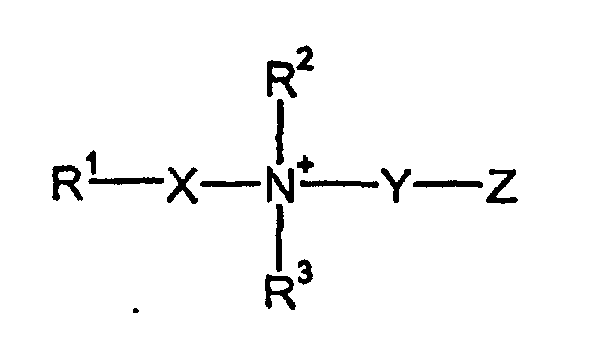
- Suitable surfactants are ionic surfactants of formula (I) in which R 1 , R 2 , R 3 , X, Y, and Z are defined as above, and ionic or nonionic surfactants of formula (II) in which R 1 , R 2 , R 3 , X, Y, and Z' are defined as above.
- heteroatoms are preferably not located adjacent to each other or, when X is a direct bond, adjacent to the N + of formula (I) or the N of formula (II).
- -O-, -S-, -CONH-, and -NHCO- groups cannot be attached directly to the N + of formula (I) and are not attached directly to the N of formula (II).
- the C 8 -C 30 aliphatic groups can be substituted with groups such as C 1 -C 6 alkoxy, halogen (especially fluorine in -CF 2 - groups), hydroxy, oxo (i.e., as a keto oxygen), (C 1 -C 6 alkoxy)carbonyl, (C 6 -C 10 aryloxy)-carbonyl, and cyano.
- Suitable C 8 -C 30 aliphatic groups include alkyl groups such as octyl, decyl, undecyl, lauryl (i.e., dodecyl), myristyl (i.e., tetradecyl), cetyl (i.e., hexadecyl), stearyl (i.e., octadecyl), eicosanyl, and docosanyl, as well as isomeric forms thereof; corresponding alkenyl, alkadienyl, and alkatrienyl groups such as 8-heptadecenyl or 9-octa-decenyl (as its oleyl Z-isomer or elaidyl E-isomer); amidoalkyl groups such as cocamidoalkyl (i.e., coconut fatty acid amides of aminoalkyl groups, particularly cocamidopropyl) and ricinole
- C 8 -C 30 aliphatic groups include cocamidopropyl, lauryl, stearyl, 8-heptadecenyl, and oleyl. It is also possible, although not preferred, to replace some or all of the main-chain carbon atoms of group R 1 with -OSi(C 1 -C 4 alkyl)2- groups, which means that the term "C 8 -C 30 aliphatic" as used herein also includes polysiloxane groups in which silicon and oxygen atoms are not attached directly to the nitrogen atom of compounds of formulas (I) and (II) but are instead attached through one or more intervening carbon atoms.
- difunctional C 1 -C 8 (cyclo)aliphatic refers to straight or branched chain difunctional aliphatic hydrocarbon groups having from 1 to 8 carbon atoms and to cyclic hydrocarbon groups having 5 to 8 ring carbon atoms, as well as to difunctional C 5 -C 7 cycloaliphatic groups that can be attached to either or both of group Z and the nitrogen atom of compounds of formulas (I) and (II) through methylene, ethylene, or propylene groups, provided that the total number of main-chain and ring carbon atoms does not exceed eight.
- Examples of difunctional C 1 -C 8 (cyclo)aliphatic groups are C 1 -C 8 alkylene, such as propylene, butylene, pentylene, hexylene, heptylene, and octylene (and alkyl-substituted derivatives up to a total of eight carbon atoms), and C 5 -C 8 cycloalkylene, such as 1,2- and 1,3-cyclopentylene, 1,2-, 1,3-, and 1,4-cyclohexylene, and 1,2-, 1,3-, and 1,4-cycloheptylene.
- C 1 -C 8 alkylene such as propylene, butylene, pentylene, hexylene, heptylene, and octylene (and alkyl-substituted derivatives up to a total of eight carbon atoms)
- C 5 -C 8 cycloalkylene such as 1,2- and 1,3-cyclopentylene, 1,2-,
- Carbon-carbon double bonds can also be present in the chain as long as they are not adjacent to the N + and N of formulas (I) and (II), respectively, or to OH.
- Preferred difunctional (cyclo)aliphatic groups are C 1 -C 6 alkylene groups, especially methylene and ethylene groups.
- C 1 -C 6 alkyl refers to straight or branched chain aliphatic hydrocarbon groups having from 1 to 6 carbon atoms, also referred to as lower alkyl. Examples of C 1 -C 6 alkyl are methyl, ethyl, propyl, butyl, pentyl, hexyl, and the isomeric forms thereof.
- C 1 -C 6 alkoxy refers to straight or branched chain alkyl oxy groups having from 1 to 6 carbon atoms. Examples of C 1 -C 6 alkoxy are methoxy, ethoxy, propoxy, butoxy, pentyloxy, hexyloxy, and the isomeric forms thereof.
- C 7 -C 16 aralkyl refers to C 1 -C 6 alkyl substituted with C 6 -C 10 aryl such that the total number of carbon atoms is from 7 to 16.
- Examples of C 7 -C 16 aralkyl are benzyl, phenethyl, and naphthylmethyl.
- (C 1 -C 6 alkoxy)carbonyl refers to straight or branched chain alkoxycarbonyl groups having from 1 to 6 carbon atoms in the alkoxy portion.
- Examples of (C 1 -C 6 alkoxy)carbonyl are methoxycarbonyl, ethoxycarbonyl, propoxycarbonyl, butoxycarbonyl, pentyloxycarbonyl, hexyloxycarbonyl, and the isomeric forms thereof.
- the term "(C 6 -C 10 aryloxy)carbonyl” refers to phenoxycarbonyl and 1- or 2-naphthoxycarbonyl, in which the aryl portion can optionally be further substituted with halogen, alkyl, alkoxy, alkoxycarbonyl, or nitro. Examples of halogen are fluorine, chlorine, bromine, and iodine.
- Suitable cations include metal ions, such as alkali metal ions (e.g., lithium, sodium, or potassium ions), alkaline earth ions (e.g., magnesium or calcium ions), aluminum ions, and ammonium ions such as R a R b R c R d N + (in which R a , R b , R c , and R d independently are hydrogen, C 1 -C 6 alkyl, C 1 -C 6 hydroxyalkyl, C 7 -C 16 aralkyl, and the like, such as NH 4 + ).
- alkali metal ions e.g., lithium, sodium, or potassium ions
- alkaline earth ions e.g., magnesium or calcium ions
- aluminum ions e.g., aluminum ions
- ammonium ions such as R a R b R c R d N + (in which R a , R b , R c , and R d independently are hydrogen, C
- Surfactants of formula (I) and formula (II) that do not contain heterocyclic rings formed by X and R 2 taken together are generally more preferred than those containing heterocyclic rings.
- Particularly preferred surfactants of formula (I) are amphoteric compounds in which Z is an anionic -COO - or -SO 3 - group.
- Especially preferred surfactants of formula (I) are cocamidopropyl betaine, an amphoteric compound in which R 1 is cocamidopropyl, R 2 and R 3 are methyl, X is a direct bond, Y is methylene, and Z is -COO - ), and N-[3-(cocamido)propyl-N-(2-hydroxy-3-sulfopropyl)-N,N-dimethylbetaine, an amphoteric compound in which R 1 is cocamidopropyl, R 2 and R 3 are methyl, X is a direct bond, Y is 2-hydroxypropyl, and Z is -SO 3 - .
- Particularly preferred surfactants of formula (II) are compounds in which Z' is -COO - M + or -SO 3 - M + (where M + is a hydrogen ion and/or an alkali metal ion).
- An especially preferred surfactant of formula (II) is N-lauryl- ⁇ -iminodipropionic acid sodium salt, a compound in which R 1 is lauryl, R 2 is carboxyethyl, X is a direct bond, Y is ethylene, and Z is -COO - Na + .
- octadecylguanidine polyoxyethanol a compound of formula (II) in which R 1 is octadecyl, R 2 is hydrogen, X is a direct bond, -YZ is -(CH 2 CH 2 O) x -H).
- Cyclic surfactants of formulas (I) and (II), in which X and R 2 together with the N + (i.e., in formula (I)) or the N (i.e., in formula (II)) form five- to seven-membered rings, are heterocyclic compounds containing at least the one ring nitrogen atom shown in the formulas.
- Group X of such heterocyclic compounds are not direct bonds but must always contain at least one atom such that group R 1 is not connected directly to the nitrogen atom shown in formulas (I) and (II), respectively.
- Group X can contain more than one such atom as long as the resultant heterocyclic ring contains no more than seven ring atoms.
- group X can be groups having the formulas and the like, thereby forming heterocyclic rings that can be represented by the following formulas for surfactants of formula (I) and the like (wherein R 1 , R 3 , Y, and Z are defined as above and R 2 completes a five- to seven-membered ring), and the following formulas for surfactants of formula (II) and the like (wherein R 1 , Y, and Z' are defined as above and R 2 completes a five- to seven-membered ring).
- the heterocyclic moiety can be unsaturated, including being an aromatic ring as long as group Y is not attached to an aromatic quaternary ring nitrogen.
- heterocyclic moiety can also contain additional heteroatoms such as N, O, or S in place of one or more ring carbon atoms, preferably such that no two heteroatoms are directly bonded to each other.
- Heterocyclic ring systems that can be incorporated into surfactants of formulas (I) and (II) include imidazolines, imidazoles, oxazolidines, oxazolines, and oxazoles.
- Preferred heterocyclic ring systems are imidazolines in which group R 1 is attached to the C-2 ring carbon atom and Y is attached to one of the ring nitrogen atoms.
- Particularly preferred surfactants containing such heterocyclic moieties are 2-(8-heptadecenyl)-2-imidazoline-1-ethanol, a compound of formula (II) in which X and R 2 together form an imidazoline moiety, R 1 is 8-heptadecenyl, Y is ethylene, and Z is OH and which is represented by the following formula and 4,5-dihydro-1-(hydroxyethyl)-1(or 3)-(2-hydroxy-3-sulfopropyl)-2-norcocoalkylimidazolinium inner salt, an amphoteric compound within the scope of formula (I) and represented by one or both of the following formulas and/or where R represents norcocoalkyl.
- surfactants outside the definition of formulas (I) and (II), as well as other conventional additives.
- suitable such additives include long-chain fatty acids, such as stearic acid or behenic acid, or corresponding amides, esters, or salts, such as magnesium stearate, zinc stearate, aluminum stearate, or magnesium behenate; resin acids, such as abietic acid, rosin soap, hydrogenated or dimerized rosin; C 12 -C 18 -paraffin-disulfonic acids; sulfonated dicarboxylic acids or corresponding esters or amides thereof, such as sulfosuccinates, sulfosuccinamates, and derivatives thereof; alkyl phosphates and phosphonates; amines, such as laurylamine or stearylamine; polyamines, such as polyethylenimines; quaternary ammonium compounds, such as
- Such additives can be incorporated in amounts ranging from about 0.1 to 20% by weight (preferably 0.1 to 5% by weight), based on the amount of the surfactants according to the invention.
- Conventional additives can themselves sometimes improve pigment dispersibility.
- pigments conditioned with the surfactants of formula (I) and (II) according to the invention exhibit improved dispersibilities relative to pigments that are not treated with surfactants according to the invention.
- Conditioning step (a) is carried in a liquid (2) in which the organic pigment is substantially insoluble, preferably water, a water-soluble (including partly water-soluble) organic liquid, or mixtures thereof.
- suitable liquids include water and mixtures of water and lower aliphatic alcohols, such as methanol; ketones and ketoalcohols, such as acetone, methyl ethyl ketone, and diacetone alcohol; amides, such as dimethylformamide and dimethylacetamide; ethers, such as tetrahydrofuran and dioxane; alkylene glycols and triols, such as ethylene glycol and glycerol; and other such organic liquids known in the art.
- Other organic liquids can be used but are generally less preferred.
- at least 0.1% by weight preferably 0.1 to 100% by weight (that is, a one-to-one weight ratio) and more preferably 2 to 15% by weight) of the surfactant, relative to the organic pigment, is used.
- step (a) The temperature for step (a) is maintained between 50°C and 200°C, preferably between 70°C and 150°C.
- the conditioned organic pigment can optionally be surface treated in step (b), either in situ or after being isolated, by mixing the conditioned organic pigment with a suitable surface treatment additive in a liquid (such as those described above) in which the organic pigment is substantially insoluble.
- suitable additives include the additives described above for use in conjunction with the surfactants of the invention.
- the conditioned and optionally surface-treated organic pigment is collected in step (c) by methods known in the art but is preferably collected by filtration followed by washing to remove residual salts and solvent. Other collection methods known in the art, such as centrifugation or even simple decantation, are suitable but generally less preferred.
- the pigment is then dried for use or for further manipulation before use.
- the pigments of this invention give a very good tinctorial yield and are readily dispersible (for example, in plastic materials). Because of their light stability and migration properties, the pigments according to the present invention are suitable for many different pigment applications.
- the pigments of the present invention are particularly suitable for use with macromolecular materials, especially synthetically produced macromolecular substances.
- synthetic macromolecular substances include plastic materials, such as polyvinyl chloride, polyvinyl acetate, and polyvinyl propionate; polyolefins, such as polyethylene and polypropylene; high molecular weight polyamides; polymers and copolymers of acrylates, methacrylates, acrylonitrile, acrylamide, butadiene, or styrene; polyurethanes; and polycarbonates.
- suitable macromolecular substances include those of a natural origin, such as rubber; those obtained by chemical modification, such as acetyl cellulose, cellulose butyrate, or viscose; or those produced synthetically, such as polymers, polyaddition products, and polycondensates.
- the materials pigmented with the pigments of the invention can have any desired shape or form, including molded articles, films, and fibers.
- the pigments of the present invention are also suitable for pigmented mixtures with other materials, pigment formulations, coating compositions and paints, printing ink, and colored paper.
- mixtures with other materials is understood to include, for example, mixtures with inorganic white pigments, such as titanium dioxide (rutile) or cement, or other inorganic pigments.
- pigment formulations include flushed pastes with organic liquids or pastes and dispersions with water, dispersants, and, if appropriate, preservatives.
- coating compositions and paints in which pigments,of this invention can be used include, for example, physically or oxidatively drying lacquers, stoving enamels, reactive paints, two-component paints, solvent- or water-based paints, emulsion paints for weatherproof coatings, and distempers.
- Printing inks include those known for use in paper, textile, and tinplate printing.
- Pigment dispersibilities in polyvinyl chloride were evaluated by comparing hot-milled and cold-milled color development according to the following procedure. For each sample tested, a mixture of 48.95 g of flexible PVC and 1.0 g of a 50% titanium dioxide paste was added to a hot (155°C) two-roll mill having a nip thickness of 25 mils (ca. 0.6 mm) and fluxed until uniform. A 0.050 g portion of the test pigment or comparison pigment was sprinkled into the nip over a period of about ten seconds, after which the fluxed material was cut and rolled on the mill for five minutes. The pigmented sheet was then removed from the mill and placed on a clean flat surface to cool.
- PVC polyvinyl chloride
- a piece cut from the resultant sheet and allowed to cool to room temperature was used as the "hot-milled" sample for evaluation.
- a sample cut from the same sheet while still warm was placed on a cold (24°C) two-roll mill having a nip thickness of 21 mils (ca. 0.5 mm), then folded and passed through the mill seven times. The cold-rolled sheet was again fluxed in the hot mill until smooth.
- a sample cut from the resultant sheet was used as the "cold-milled” sample for evaluation.
- the reflectances of corresponding hot-milled and cold-milled samples were determined using a Datacolor CS-5 spectrophotometer and converted to K/S values according to the Kubelka-Munk equation.
- Dispersibilities were calculated by comparing the K/S value of each hot-milled sample with the K/S value of the corresponding cold-milled samples (which are assumed to have reached 100% dispersion and maximum K/S values). In general, dispersibilities were considered excellent for values of 80 to 100%, good for values of 60 to less than 80%, fair if 40 to less than 60%, poor if 20 to less than 40%, and very poor if less than 20%.
- Examples 1-5 and 9 describe the conditioning of crude dimethyl perylenediimide presscake (Pigment Red 179) according to the invention.
- Examples 1-5 (but not Example 9) also included sodium dioctyl sulfosuccinate and aliphatic naphtha during conditioning.
- Comparison Example 6 was carried out by the same general method as used for Example 2 except for omitting the cocamidopropyl betaine surfactant.
- Comparison Examples 7, 8, 10, and 11 were carried out by the same general method as used for Example 1 except for using surfactants not according to the invention.
- Crude dimethyl perylenediimide presscake (86.1 g, corresponding to 26.0 g of 100% strength pigment) was slurried in a mixture of 111 g of methanol, 192.9 g of water, 2.6 g of 50% sodium hydroxide, and 7.4 g of 35% cocamidopropyl betaine.
- the resultant slurry was heated to 135°C for four hours in a laboratory Parr reactor, then cooled to 45°C and diluted to 700 ml with water.
- An aqueous emulsion containing 0.08 g of sodium dioctyl sulfosuccinate and 0.8 g of aliphatic naphtha was added and the slurry was held at 45°C for three hours.
- the solid component was collected by filtration, washed, dried, and pulverized to a powder having excellent dispersibility in PVC. Test results are shown in Table 1.
- Crude dimethyl perylenediimide presscake (86.1 g, corresponding to 26.0 g of 100% strength pigment) was slurried in a mixture of 303.9 g of water, 2.6 g 50% sodium hydroxide, and 7.4 g of 35% cocamidopropyl betaine. The resultant slurry was heated at 145°C for four hours, then cooled and diluted to 700 ml with water. An aqueous emulsion containing 0.08 g of sodium dioctyl sulfosuccinate and 0.8 g of aliphatic naphtha was added and the slurry heated at 45°C for three hours. The solid component was collected by filtration, washed with water, dried, and pulverized to a powder having excellent dispersibility in PVC. Test results are shown in Table 1.
- a pigment was prepared in the same manner as Example 1 except that N-[3-(cocamido)propyl-N-(2-hydroxy-3-sulfopropyl)-N,N-dimethylbetaine was used instead of cocamidopropyl betaine.
- the resultant pigment exhibited excellent dispersibility in PVC. Test results are shown in Table 1.
- a pigment was prepared in the same manner as Example 1 except that 2-(8-heptadecenyl)-2-imidazoline-1-ethanol was used instead of cocamidopropyl betaine.
- the resultant pigment exhibited excellent dispersibility in PVC. Test results are shown in Table 1.
- a pigment was prepared in the same manner as Example 1 except that 4,5-dihydro-1-(hydroxyethyl)-1(or 3)-(2-hydroxy-3-sulfopropyl)-2-norcocoalkylimidazolinium inner salt was used instead of cocamidopropyl betaine.
- the resultant pigment exhibited excellent dispersibility in PVC. Test results are shown in Table 1.
- Crude dimethyl perylenediimide (86.1 g, corresponding to 26.0 g of 100% strength pigment) was slurried in a mixture of 296.1 g of methanol, 15.2 g of water, and 2.6 g of 50% sodium hydroxide. The resultant slurry was heated at 120 EC for four hours, then cooled and diluted to 700 ml with water. An aqueous emulsion containing 0.8 g of sodium dioctyl sulfosuccinate and 13.0 g of aliphatic naphtha was added and the slurry heated at 45°C for three hours. The solid component was collected by filtration, washed, dried, and pulverized to a powder having poor dispersibility in PVC. Test results are shown in Table 1.
- a comparison pigment was prepared in the same manner as Example 1 except that the non-ionic surfactant Tergitol® 15-5-9 (not according to the invention) was used instead of cocamidopropyl betaine.
- the resultant pigment exhibited good dispersibility in PVC but was inferior to the pigment of Example 1 of the invention. Test results are shown in Table 1.
- a comparison pigment was prepared in the same manner as Example 1 except that the anionic surfactant Dyasulf® C-70 (not according to the invention) was used instead of cocamidopropyl betaine.
- the resultant pigment exhibited good dispersibility in PVC but was inferior to the pigment of Example 1 of the invention. Test results are shown in Table 1.
- a comparison pigment was prepared in the same manner as Example 9 except that the non-ionic surfactant used in comparison Example 7 was used instead of cocamidopropyl betaine.
- the resultant pigment exhibited fair dispersibility in PVC but was inferior to the pigment of Example 9 of the invention. Test results are shown in Table 1.
- a comparison pigment was prepared in the same manner as Example 9 except that the anionic surfactant used in comparison Example 8 was used instead of cocamidopropyl betaine.
- the resultant pigment exhibited fair dispersibility in PVC but was inferior to the pigment of Example 9 of the invention. Test results are shown in Table 1. Dispersibilities in PVC for Examples 1-11 Example Dispersibility in PVC Calculated (%) Rating 1 83.5% Excellent 2 81.9% Excellent 3 81.7% Excellent 4 81.1% Excellent 5 82.1% Excellent 6 (comp) 34.5% Poor 7 (comp) 69.8% Good 8 (comp) 69.6% Good 9 71.0% Good 10 (comp) 56.6% Fair 11 (comp) 55.5% Fair
- Examples 1-11 show that conditioning perylene pigments in the presence of surfactants according to the invention (i.e., Examples 1-5 and 9) provides more highly dispersible pigments than untreated pigments (i.e., Example 6) or pigments conditioned with non-ionic and anionic surfactants not according to the invention (i.e., Examples 7, 8, 10, and 11).
- conditioning in the presence of sodium dioctyl sulfosuccinate and aliphatic naphtha provided pigments having improved dispersibility relative to untreated pigments, the corresponding pigments conditioned according to the invention were always superior.
- Example 12 describes the conditioning of crude perylenediimide presscake (Pigment Violet 29) according to the invention.
- Comparison Example 13 was carried out by the same method as used for Example 12 except for omitting the N-lauryl- ⁇ -iminodipropionic acid sodium salt.
- Comparison Example 14 was carried out by the same method as used for Example 12 except for omitting the N-lauryl- ⁇ -iminodipropionic acid sodium salt and the mixture of sodium dioctyl sulfosuccinate and aliphatic naphtha during conditioning.
- Crude perylenediimide presscake (83.9 g, corresponding to 26.0 g of 100% strength pigment) was slurried in a mixture of 185.1 g of methanol, 119.7 g of water, 2.6 g of 50% sodium hydroxide, and 8.7 g of 30% N-lauryl- ⁇ -iminodipropionic acid sodium salt.
- the resultant slurry was heated at 125°C for six hours in a laboratory Parr reactor, then cooled and diluted to 700 ml with water.
- a comparison pigment was prepared in the same manner as Example 12 except that the N-lauryl- ⁇ -iminodipropionic acid sodium salt was omitted.
- the resultant pigment exhibited very poor dispersibility in PVC. Test results are shown in Table 2.
- a comparison pigment was prepared in the same manner as Example 12 except that the N-lauryl- ⁇ -iminodipropionic acid sodium salt and the mixture of sodium dioctyl sulfosuccinate and aliphatic naphtha were omitted.
- the resultant pigment exhibited very poor dispersibility in PVC. Test results are shown in Table 2. Dispersibilities in PVC for Examples 12-14 Example Dispersibility in PVC Calculated (%) Rating 12 78.8% Good 13 (comp) 18.2% Very poor 14 (comp) 12.8% Very poor
- Examples 12-14 show that conditioning perylene pigments in the presence of N-lauryl- ⁇ -iminodipropionic acid sodium salt according to the invention provides a highly dispersible pigment when compared to the untreated pigment or to pigment treated only with a mixture of sodium dioctyl sulfosuccinate and aliphatic naphtha.
- Example 15 describes the conditioning of crude indanthrone (Pigment Blue 60 or Vat Blue 4; obtained as Indanthrene Blue RSN (CDP) from Sunbelt Corporation) according to the invention.
- Comparison Example 16 was carried out by the same method except for omitting the cocamidopropyl betaine surfactant.
- indanthrone 100 parts were introduced into a ball mill containing 3000 parts of steel balls as grinding elements.
- the capacity of the ball mill was such that it was 60% full when completely charged.
- the mill was rotated for 48 hours, after which the powder was discharged through a screen that retained the grinding elements.
- the milled powder was added to water (four times the weight of the pigment) and stirred until thoroughly wet.
- the wetted powder was treated with methyl benzoate (80% by weight of pigment powder), then heated at 140°C for eight hours. After the mixture was cooled, the methyl benzoate was hydrolyzed using 50% aqueous sodium hydroxide at 90°C for 2 hours.
- a comparison pigment was prepared in the same manner as Example 15 except that the cocamidopropyl betaine was omitted.
- the resultant pigment exhibited good dispersibility in PVC. Test results are shown in Table 3. Dispersibilities in PVC for Examples 15 and 16 Example Dispersibility in PVC Calculated (%) Rating 15 80.7% Excellent 16 (comp) 62.7% Good
- Examples 15 and 16 show that the dispersibility of indanthrone was improved by conditioning in the presence of cocamidopropyl betaine according to the invention.
- Example 17 describes the conditioning of a mixture of copper phthalocyanines containing 70% by weight of chlorine-free copper phthalocyanine and 30% by weight of monochlorinated copper phthalocyanine according to the invention.
- Comparison Example 18 was carried out by the same method except for omitting the surfactant.
- Example 15 was repeated except for replacing the indanthrone with a mixture of 70% by weight chlorine-free copper phthalocyanine (obtained from Toyo Ink Inc.) and 30% by weight monochlorinated copper phthalocyanine (obtained from Sanyo Color Works). The resultant pigment having good dispersibility in PVC. Test results are shown in Table 4.
- a comparison pigment was prepared in the same manner as Example 17 except that the cocamidopropyl betaine was omitted.
- the resultant pigment exhibited fair dispersibility in PVC. Test results are shown in Table 4. Dispersibilities in PVC for Examples 17 and 18 Example Dispersibility in PVC Calculated (%) Rating 17 63.2% Good 18 (comp) 47.7% Fair
- Examples 17 and 18 show that the dispersibility of chlorinated copper phthalocyanine pigments was improved by conditioning in the presence of cocamidopropyl betaine according to the invention.
- Examples 19 and 21 describe the conditioning of crude Pigment Yellow 139 (an isoindoline pigment) according to the invention.
- Example 21 also included sodium dioctyl sulfosuccinate and aliphatic naphtha during conditioning.
- Comparison Examples 20 and 22 were carried out by the same general method as used for Examples 19 and 21, respectively, except for omitting the cocamidopropyl betaine surfactant.
- Crude Pigment Yellow 139 presscake (55.75 g, corresponding to 20 g of 100% strength pigment) was slurried in 300 g of water. When the mixture had become uniform, 5.7 g of cocamidopropyl betaine was added and the pH was adjusted to 6.0. The mixture was heated at 130°C for two hours in a laboratory Parr reactor, then cooled to room temperature. The solid component was collected by filtration and washed with water. The wet presscake was dried in the oven at 60°C overnight to yield 20.0 g of a yellow pigment exhibiting soft texture with fair dispersibility in PVC. Test results are shown in Table 5.
- a comparison pigment was prepared in the same manner as Example 19 except that the cocamidopropyl betaine was omitted.
- the resultant pigment exhibited poor dispersibility in PVC. Test results are shown in Table 5.
- Example 19 was repeated except that the cooled mixture from the Parr reactor was treated with an aqueous emulsion of 0.6 g of sodium dioctyl sulfosuccinate, 10.0 g of aliphatic naphtha, and 40.0 g of water and the resultant mixture was stirred at 45°C for 3 hours, after which the resultant slurry was filtered and washed with water.
- the wet presscake was dried in an oven at 60°C overnight to yield 20.0 g of a yellow pigment exhibiting soft texture with excellent dispersibility in PVC. Test results are shown in Table 5.
- a comparison pigment was prepared in the same manner as Example 21 except that the cocamidopropyl betaine was omitted.
- the resultant pigment exhibited good dispersibility in PVC. Test results are shown in Table 5. Dispersibilities in PVC for Examples 19-22 Example Dispersibility in PVC Calculated (%) Rating 19 56.2% Fair 20 (comp) 31.5% Poor 21 88.7% Excellent 22 (comp) 64.2% Good
- Examples 19-22 show that conditioning isoindoline pigments in the presence of cocamidopropyl betaine according to the invention provides more highly dispersible pigments than untreated pigments.
- conditioning in the presence of a mixture of sodium dioctyl sulfosuccinate and aliphatic naphtha provided pigments having improved dispersibility relative to untreated pigments, the pigments conditioned according to the invention were always superior to corresponding pigments that were not conditioned according to the invention.
- the pigment of Example 19 exhibited only fair dispersibility, the corresponding comparison pigment of Example 20 was inferior.
Landscapes
- Chemical & Material Sciences (AREA)
- Chemical Kinetics & Catalysis (AREA)
- Organic Chemistry (AREA)
- Health & Medical Sciences (AREA)
- Medicinal Chemistry (AREA)
- Polymers & Plastics (AREA)
- Pigments, Carbon Blacks, Or Wood Stains (AREA)
- Inks, Pencil-Leads, Or Crayons (AREA)
- Paints Or Removers (AREA)
Claims (19)
- Verfahren zur Herstellung von Pigmentzusammensetzungen, umfassend:(a) Konditionieren eines organischen Pigments bei einer Temperatur von 50 bis 200 °C mit(1) wenigstens etwa 0,1 Gew.-%, relativ zu dem organischen Pigment, eines oder mehrerer Tenside, die folgendes umfassen:i) ein ionisches Tensid mit der Formelwobei
- R1
- eine aliphatische C8-C30-Gruppe oder modifizierte aliphatische C8-C30-Gruppe ist, bei der wenigstens ein Kohlenstoffatom in der Hauptkette durch -O-, -S-, -CONH-, -NHCO-, -CH=CH-, -OSi(C1-C4-alkyl)2- oder gegebenenfalls substituiertes C5-C7-Cycloalkylen ersetzt ist;
- R2
- Wasserstoff, C1-C6-Alkyl oder -Y-Z' ist;
- R3
- Wasserstoff oder C1-C6-Alkyl ist oder R2 und R3 zusammen C4-C7-Alkylen sind;
- X
- eine direkte Bindung oder -NHC(=NH)- ist oder X und R2 zusammen mit der N+-Form einen fünf- bis siebengliedrigen heterocyclischen Ring bilden;
- Y
- eine difunktionelle (cyclo)aliphatische C1-C8-Gruppe ist, wobei auch Kohlenstoff-Kohlenstoff-Doppelbindungen in der Kette vorhanden sein können, solange sie nicht dem N+ oder OH benachbart sind, und wobei ein oder mehrere Heteroatome ein oder mehrere Kohlenstoffatome in der aliphatischen Kette und/oder dem cycloaliphatischen Ring ersetzen können, solange diese Heteroatome nicht einander oder dem N+ und Z (und gegebenenfalls Z') benachbart sind, und wobei 1 bis 8 Kohlenstoffatome in den aliphatischen Kohlenwasserstoffgruppen geradkettig oder verzweigt sind;
- Z
- -COO-, -SO3 -, -PO3 2-·1/n Mn+ (wobei Mn+ ein Wasserstoffion oder ein n-wertiges Kation ist) oder OH ist, mit der Maßgabe, dass dann, wenn Z = OH ist, ein anionisches Gegenion vorhanden sein muss; und
- Z'
- -COO-·1/n Mn+, -SO3 -·1/n Mn+ oder -PO3 2-·2/n Mn+ (wobei Mn+ ein Wasserstoffion und/oder ein n-wertiges Kation ist) oder OH ist, mit der Maßgabe, dass Z' = OH sein muss, wenn Z = OH ist;
ii) ein Tensid mit der Formelwobei
- R1
- eine aliphatische C8-C30-Gruppe oder modifizierte aliphatische C8-C30-Gruppe ist, bei der wenigstens ein Kohlenstoffatom in der Hauptkette durch -O-, -S-, -CONH-, -NHCO-, -CH=CH-, -OSi(C1-C4-alkyl)2- oder gegebenenfalls substituiertes C5-C7-Cycloalkylen ersetzt ist;
- R2
- Wasserstoff, C1-C6-Alkyl oder -Y-Z' ist;
- X
- eine direkte Bindung oder -NHC(=NH)- ist oder X und R2 zusammen mit der N-Form einen fünfbis siebengliedrigen heterocyclischen Ring bilden;
- Y
- eine difunktionelle (cyclo)aliphatische C1-C8-Gruppe ist, wobei auch Kohlenstoff-Kohlenstoff-Doppelbindungen in der Kette vorhanden sein können, solange sie nicht dem N+ oder OH benachbart sind, und wobei ein oder mehrere Heteroatome ein oder mehrere Kohlenstoffatome in der aliphatischen Kette und/oder dem cycloaliphatischen Ring ersetzen können, solange diese Heteroatome nicht einander oder dem N und Z (gegebenenfalls Z') benachbart sind, und wobei 1 bis 8 Kohlenstoffatome in den aliphatischen Kohlenwasserstoffgruppen geradkettig oder verzweigt sind; und
- Z'
- -COO-·1/n Mn+, -SO3 -·1/n Mn+ oder -PO3 2-.2/n Mn+ (wobei Mn+ ein Wasserstoffion und/oder ein n-wertiges Kation ist) oder OH ist; oder
iii) ein Tensid mit der Formeloder oder
oder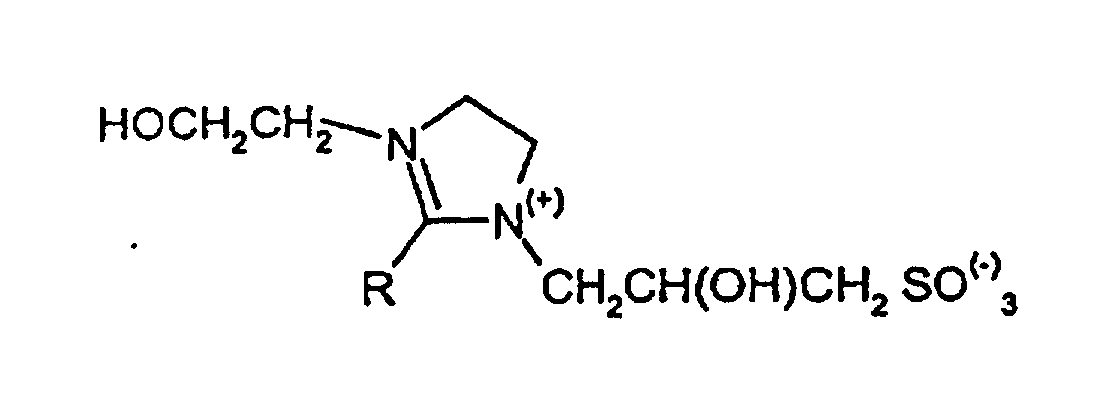 wobei R nor-Kokosalkyl darstellt;
oderiv) Gemische davon; und(2) 1 bis 100 Gewichtsteilen, pro Gewichtsteil des organischen Pigments, einer Flüssigkeit, in der das organische Pigment im wesentlichen unlöslich ist;
so dass eine Suspension des konditionierten organischen Pigments in der Flüssigkeit entsteht;(b) gegebenenfalls Oberflächenbehandeln des konditionierten organischen Pigments; und(c) Gewinnen des konditionierten organischen Pigments. - Verfahren gemäß Anspruch 1, wobei das organische Pigment ein Perylen, Phthalocyanin, Indanthron, Isoindolin oder Chinakridon ist.
- Verfahren gemäß Anspruch 1, wobei Tensid (1) ein nichtcyclisches ionisches Tensid mit der Formelist, wobei
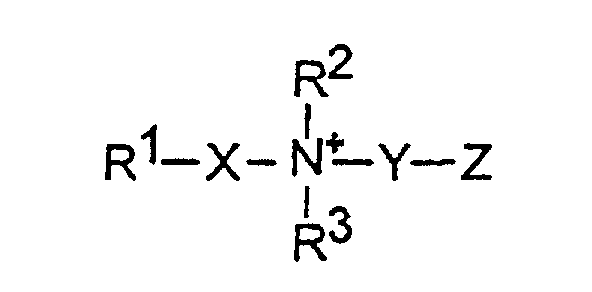
- R1
- eine aliphatische C8-C30-Gruppe oder modifizierte aliphatische C8-C30-Gruppe ist, bei der wenigstens ein Kohlenstoffatom in der Hauptkette durch -O-, -CONH-, -NHCO- oder -CH=CH- ersetzt ist;
- R2 und R3
- unabhängig voneinander Wasserstoff oder C1-C6-Alkyl sind;
- X
- eine direkte Bindung oder -NHC(=NH)- ist;
- Y
- C1-C6-Alkylen ist;
- Z
- -COO-, -SO3 - oder OH ist, mit der Maßgabe, dass dann, wenn Z = OH ist, eine stöchiometrische Menge eines anionischen Gegenions vorhanden sein muss.
- Verfahren gemäß Anspruch 1, wobei es sich bei Tensid (1) um Kokosamidopropylbetain oder N-[3-(Kokosamido)propyl-N-(2-hydroxy-3-sulfopropyl)-N,N-dimethylbetain handelt.
- Verfahren gemäß Anspruch 1, wobei Tensid (1) ein nichtcyclisches Tensid mit der Formelist, wobei
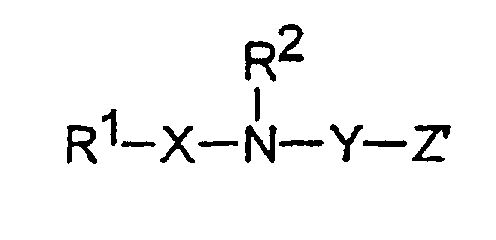
- R1
- eine aliphatische C8-C30-Gruppe oder modifizierte aliphatische C8-C30-Gruppe ist, bei der wenigstens ein Kohlenstoffatom in der Hauptkette durch -O-, -CONH-, -NHCO- oder -CH=CH- ersetzt ist;
- R2
- Wasserstoff, C1-C6-Alkyl oder Carboxyalkyl ist;
- X
- eine direkte Bindung oder -NHC(=NH)- ist;
- Y
- C1-C6-Alkylen ist; und
- Z'
- -COO-M+ oder -SO3 -M+ (wobei M+ Wasserstoff oder ein Alkalimetallion ist) oder OH ist.
- Verfahren gemäß Anspruch 1, wobei Tensid (1) das N-Lauryl-β-iminodipropionsäure-Natriumsalz ist.
- Verfahren gemäß Anspruch 1, wobei Tensid (1) ein cyclisches Tensid mit der Formelist, wobei
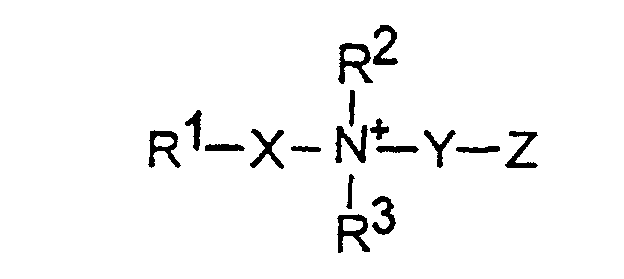
- R1
- eine aliphatische C8-C30-Gruppe oder modifizierte aliphatische C8-C30-Gruppe ist, bei der wenigstens ein Kohlenstoffatom in der Hauptkette durch -O-, -CONH-, -NHCO- oder -CH=CH- ersetzt ist;
- X und R2
- zusammen mit der N+-Form einen fünf- bis siebengliedrigen Ring bilden;
- Y
- C1-C6-Alkylen ist; und
- Z'
- -COO-, -SO3 - oder OH ist.
- Verfahren gemäß Anspruch 1, wobei es sich bei Tensid (1) um das innere Salz von 4,5-Dihydro-1-(hydroxyethyl)-1(oder 3)-(2-hydroxy-3-sulfopropyl)-2-norkokosalkylimidazolinium handelt.
- Verfahren gemäß Anspruch 1, wobei Tensid (1) ein nichtcyclisches Tensid mit der Formelist, wobei
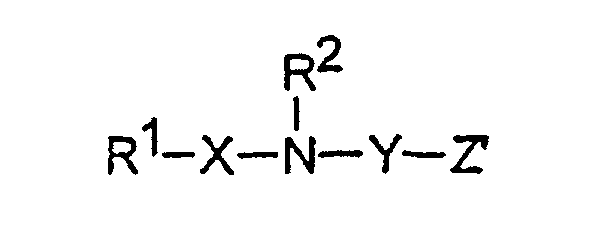
- R1
- eine aliphatische C8-C30-Gruppe oder modifizierte aliphatische C8-C30-Gruppe ist, bei der wenigstens ein Kohlenstoffatom in der Hauptkette durch -O-, -CONH-, -NHCO- oder -CH=CH- ersetzt ist;
- X und R2
- zusammen mit der N-Form einen fünf- bis siebengliedrigen Ring bilden;
- Y
- C1-C6-Alkylen ist; und
- Z'
- -COO-M+ oder -SO3 -M+ (wobei M+ Wasserstoff oder ein Alkalimetallion ist) oder OH ist.
- Verfahren gemäß Anspruch 1, wobei es sich bei Tensid (1) um 2-(8-Heptadecenyl)-2-imidazolin-1-ethanol handelt.
- Verfahren gemäß Anspruch 1, wobei 0,1 bis 100 Gew.-% des Tensids (1), relativ zu dem organischen Pigment, verwendet werden.
- Verfahren gemäß Anspruch 1, wobei in Schritt (a) 6 bis 12 Gewichtsteile der Flüssigkeit (2) pro Gewichtsteil des organischen Pigments verwendet werden.
- Verfahren gemäß Anspruch 1, wobei die Flüssigkeit (2), in der das organische Pigment suspendiert wird, Wasser, eine wasserlösliche organische Flüssigkeit oder ein Gemisch davon ist.
- Verfahren gemäß Anspruch 1, wobei das konditionierte Pigment mit einem Oberflächenbehandlungsadditiv behandelt wird.
- Verfahren gemäß Anspruch 1, wobei das konditionierte Pigment durch Filtration gewonnen wird.
- Pigmentzusammensetzung, die nach dem Verfahren von Anspruch 1 hergestellt ist.
- Pigmentierte makromolekulare Substanz, die als Pigment eine Pigmentzusammensetzung enthält, die nach dem Verfahren von Anspruch 1 hergestellt ist.
- Pigmentierte Beschichtungszusammensetzung, die als Pigment eine Pigmentzusammensetzung enthält, die gemäß Anspruch 1 hergestellt ist.
- Pigmentierte Drucktinte, die als Pigment eine Pigmentzusammensetzung enthält, die gemäß Anspruch 1 hergestellt ist.
Applications Claiming Priority (2)
| Application Number | Priority Date | Filing Date | Title |
|---|---|---|---|
| US08/953,602 US5900050A (en) | 1997-10-17 | 1997-10-17 | Method for conditioning organic pigments |
| US953602 | 1997-10-17 |
Publications (2)
| Publication Number | Publication Date |
|---|---|
| EP0909796A1 EP0909796A1 (de) | 1999-04-21 |
| EP0909796B1 true EP0909796B1 (de) | 2002-09-04 |
Family
ID=25494241
Family Applications (1)
| Application Number | Title | Priority Date | Filing Date |
|---|---|---|---|
| EP98118763A Expired - Lifetime EP0909796B1 (de) | 1997-10-17 | 1998-10-05 | Verfahren zur Konditionierung organischer Pigmente |
Country Status (7)
| Country | Link |
|---|---|
| US (1) | US5900050A (de) |
| EP (1) | EP0909796B1 (de) |
| JP (1) | JPH11302554A (de) |
| KR (1) | KR100573339B1 (de) |
| CA (1) | CA2250632C (de) |
| DE (1) | DE69807620T2 (de) |
| TW (1) | TW473520B (de) |
Families Citing this family (13)
| Publication number | Priority date | Publication date | Assignee | Title |
|---|---|---|---|---|
| DE69802430T2 (de) * | 1997-01-09 | 2002-07-18 | Ciba Speciality Chemicals Holding Inc., Basel | Kompositpigment |
| US6284184B1 (en) | 1999-08-27 | 2001-09-04 | Avaya Technology Corp | Method of laser marking one or more colors on plastic substrates |
| DE10031558A1 (de) * | 2000-06-28 | 2002-01-10 | Clariant Gmbh | Verfahren zur Konditionierung von organischen Pigmenten |
| US6403797B1 (en) | 2000-12-22 | 2002-06-11 | Bayer Corporation | Process for the preparation of perylene pigments |
| JP4573088B2 (ja) * | 2002-05-29 | 2010-11-04 | Dic株式会社 | 有機顔料組成物の製造方法および顔料分散体 |
| AU2003294031A1 (en) * | 2002-12-04 | 2004-06-23 | Ciba Specialty Chemicals Holding Inc. | Dust-free pigment compositions obtainable by spray-drying |
| JP4752590B2 (ja) * | 2006-04-18 | 2011-08-17 | Dic株式会社 | ポリハロゲン化亜鉛フタロシアニン顔料組成物及びカラーフィルタ |
| US7449059B2 (en) * | 2006-08-02 | 2008-11-11 | Sun Chemical Corporation | Conditioning method for indanthrone pigments |
| US9175168B2 (en) | 2006-09-14 | 2015-11-03 | Sun Chemical Corporation | Pigments with improved dispersibility |
| JP5291298B2 (ja) * | 2007-04-06 | 2013-09-18 | 積水化学工業株式会社 | 蛍光体ペースト組成物 |
| JP7461222B2 (ja) * | 2020-05-26 | 2024-04-03 | サカタインクス株式会社 | フィルム用グラビア印刷インキ組成物、印刷方法、印刷物及びラミネート積層体 |
| JP7509595B2 (ja) * | 2020-07-21 | 2024-07-02 | サカタインクス株式会社 | フィルム用グラビア印刷インキ組成物 |
| CN118772706B (zh) * | 2024-06-25 | 2025-04-01 | 雅图高新材料股份有限公司 | 一种轨道交通涂装用水性双组份金属漆及其制备方法 |
Family Cites Families (11)
| Publication number | Priority date | Publication date | Assignee | Title |
|---|---|---|---|---|
| US2268144A (en) * | 1940-03-28 | 1941-12-30 | Harmon Color Works Inc | Recovering pigments |
| JPS4839213B1 (de) * | 1968-08-08 | 1973-11-22 | ||
| GB1578859A (en) * | 1978-03-02 | 1980-11-12 | Yorkshire Chemicals Ltd | Sublimable dye preparations and processes for their production |
| JPS55104362A (en) * | 1979-02-03 | 1980-08-09 | Nippon Paint Co Ltd | Pigment composition for paint |
| US4507126A (en) * | 1983-05-04 | 1985-03-26 | Ciba-Geigy Corporation | Cold water dispersible dyestuff granulates |
| US4929279A (en) * | 1989-02-21 | 1990-05-29 | Basf Corporation | Process for dispersing organic pigments with ultrasonic radiation |
| CH685561A5 (de) * | 1992-01-27 | 1995-08-15 | Polygon Chemie Ag | Verwendung von von beta-Alanin und dessen Homologen abgeleiteten Tensiden zur Verbesserung der Wasserlöslichkeit von Farbstoffen und optischen Aufhellern. |
| JP3201089B2 (ja) * | 1993-07-29 | 2001-08-20 | ぺんてる株式会社 | 感熱孔版シ−トの原稿作成用インキ |
| DE4400329A1 (de) * | 1994-01-07 | 1995-07-20 | Hoechst Ag | Verwendung von Fettsäuretauriden zum Dispergieren polycyclischer Pigmente |
| TW367348B (en) * | 1995-07-12 | 1999-08-21 | Ciba Sc Holding Ag | Production of pigments |
| US5728206A (en) * | 1996-12-20 | 1998-03-17 | Bayer Corporation | Surface-treated organic pigments |
-
1997
- 1997-10-17 US US08/953,602 patent/US5900050A/en not_active Expired - Lifetime
-
1998
- 1998-09-23 TW TW087115799A patent/TW473520B/zh not_active IP Right Cessation
- 1998-10-05 DE DE69807620T patent/DE69807620T2/de not_active Expired - Fee Related
- 1998-10-05 EP EP98118763A patent/EP0909796B1/de not_active Expired - Lifetime
- 1998-10-12 JP JP10303235A patent/JPH11302554A/ja active Pending
- 1998-10-14 CA CA002250632A patent/CA2250632C/en not_active Expired - Fee Related
- 1998-10-16 KR KR1019980043370A patent/KR100573339B1/ko not_active Expired - Fee Related
Also Published As
| Publication number | Publication date |
|---|---|
| KR100573339B1 (ko) | 2006-08-30 |
| KR19990037163A (ko) | 1999-05-25 |
| CA2250632C (en) | 2008-07-29 |
| US5900050A (en) | 1999-05-04 |
| DE69807620T2 (de) | 2003-08-07 |
| EP0909796A1 (de) | 1999-04-21 |
| JPH11302554A (ja) | 1999-11-02 |
| TW473520B (en) | 2002-01-21 |
| CA2250632A1 (en) | 1999-04-17 |
| DE69807620D1 (de) | 2002-10-10 |
Similar Documents
| Publication | Publication Date | Title |
|---|---|---|
| JP3413223B2 (ja) | 顔料調製物 | |
| EP0909796B1 (de) | Verfahren zur Konditionierung organischer Pigmente | |
| US5958129A (en) | Pigment formulations and processes for their preparation | |
| CA2337314C (en) | Method for preparing organic pigments | |
| US5112404A (en) | Pigment formulations, processes for their preparation and their use | |
| KR19990072803A (ko) | 페릴렌화합물및안료조제물 | |
| KR100740040B1 (ko) | 디케토피롤로피롤 안료 및 염기성 페릴렌 분산제에 기초한안료 제제 | |
| JP2011190449A (ja) | 有機顔料の調整法 | |
| KR20000076524A (ko) | 2종 이상의 페릴렌 화합물을 포함하는 안료 제제 | |
| US6013126A (en) | Process for conditioning organic pigments | |
| EP0849336B1 (de) | Verfahren zur Behandlung der Oberfläche von organischen Pigmenten | |
| EP0849335B9 (de) | Oberflächenbehandelte organische Pigmente | |
| CA2364991C (en) | Process for the preparation of perylene pigments | |
| US4255203A (en) | Pigment formulations | |
| MXPA98008516A (en) | A method for conditioning organi pigments |
Legal Events
| Date | Code | Title | Description |
|---|---|---|---|
| PUAI | Public reference made under article 153(3) epc to a published international application that has entered the european phase |
Free format text: ORIGINAL CODE: 0009012 |
|
| AK | Designated contracting states |
Kind code of ref document: A1 Designated state(s): CH DE FR GB LI |
|
| AX | Request for extension of the european patent |
Free format text: AL;LT;LV;MK;RO;SI |
|
| 17P | Request for examination filed |
Effective date: 19991021 |
|
| AKX | Designation fees paid |
Free format text: CH DE FR GB LI |
|
| 17Q | First examination report despatched |
Effective date: 20000505 |
|
| GRAG | Despatch of communication of intention to grant |
Free format text: ORIGINAL CODE: EPIDOS AGRA |
|
| GRAG | Despatch of communication of intention to grant |
Free format text: ORIGINAL CODE: EPIDOS AGRA |
|
| GRAH | Despatch of communication of intention to grant a patent |
Free format text: ORIGINAL CODE: EPIDOS IGRA |
|
| GRAH | Despatch of communication of intention to grant a patent |
Free format text: ORIGINAL CODE: EPIDOS IGRA |
|
| GRAA | (expected) grant |
Free format text: ORIGINAL CODE: 0009210 |
|
| AK | Designated contracting states |
Kind code of ref document: B1 Designated state(s): CH DE FR GB LI |
|
| REG | Reference to a national code |
Ref country code: GB Ref legal event code: FG4D |
|
| REG | Reference to a national code |
Ref country code: CH Ref legal event code: EP |
|
| REG | Reference to a national code |
Ref country code: CH Ref legal event code: NV Representative=s name: E. BLUM & CO. PATENTANWAELTE |
|
| REF | Corresponds to: |
Ref document number: 69807620 Country of ref document: DE Date of ref document: 20021010 |
|
| ET | Fr: translation filed | ||
| PLBE | No opposition filed within time limit |
Free format text: ORIGINAL CODE: 0009261 |
|
| STAA | Information on the status of an ep patent application or granted ep patent |
Free format text: STATUS: NO OPPOSITION FILED WITHIN TIME LIMIT |
|
| 26N | No opposition filed |
Effective date: 20030605 |
|
| REG | Reference to a national code |
Ref country code: CH Ref legal event code: PUE Owner name: BAYER POLYMERS LLC Free format text: BAYER CORPORATION#100 BAYER ROAD#PITTSBURGH, PA 15205-9741 (US) -TRANSFER TO- BAYER POLYMERS LLC#100 BAYER ROAD#PITTSBURGH, PA 15205-9741 (US) Ref country code: CH Ref legal event code: PUE Owner name: SUN CHEMICAL CORPORATION Free format text: BAYER POLYMERS LLC#100 BAYER ROAD#PITTSBURGH, PA 15205-9741 (US) -TRANSFER TO- SUN CHEMICAL CORPORATION#222 BRIDGE PLAZA SOUTH#FORT LEE, NJ 07024 (US) |
|
| REG | Reference to a national code |
Ref country code: GB Ref legal event code: 732E |
|
| REG | Reference to a national code |
Ref country code: FR Ref legal event code: TP |
|
| REG | Reference to a national code |
Ref country code: CH Ref legal event code: PFA Owner name: SUN CHEMICAL CORPORATION Free format text: SUN CHEMICAL CORPORATION#222 BRIDGE PLAZA SOUTH#FORT LEE, NJ 07024 (US) -TRANSFER TO- SUN CHEMICAL CORPORATION#35 WATERVIEW BOULEVARD#PARSIPPANY, NJ 07054-1285 (US) |
|
| REG | Reference to a national code |
Ref country code: CH Ref legal event code: PFA Owner name: SUN CHEMICAL CORPORATION Free format text: SUN CHEMICAL CORPORATION#35 WATERVIEW BOULEVARD#PARSIPPANY, NJ 07054-1285 (US) -TRANSFER TO- SUN CHEMICAL CORPORATION#35 WATERVIEW BOULEVARD#PARSIPPANY, NJ 07054-1285 (US) |
|
| PGFP | Annual fee paid to national office [announced via postgrant information from national office to epo] |
Ref country code: DE Payment date: 20070927 Year of fee payment: 10 |
|
| PG25 | Lapsed in a contracting state [announced via postgrant information from national office to epo] |
Ref country code: DE Free format text: LAPSE BECAUSE OF NON-PAYMENT OF DUE FEES Effective date: 20090501 |
|
| PGFP | Annual fee paid to national office [announced via postgrant information from national office to epo] |
Ref country code: GB Payment date: 20100929 Year of fee payment: 13 |
|
| GBPC | Gb: european patent ceased through non-payment of renewal fee |
Effective date: 20111005 |
|
| PG25 | Lapsed in a contracting state [announced via postgrant information from national office to epo] |
Ref country code: GB Free format text: LAPSE BECAUSE OF NON-PAYMENT OF DUE FEES Effective date: 20111005 |
|
| REG | Reference to a national code |
Ref country code: FR Ref legal event code: PLFP Year of fee payment: 18 |
|
| REG | Reference to a national code |
Ref country code: FR Ref legal event code: PLFP Year of fee payment: 19 |
|
| REG | Reference to a national code |
Ref country code: FR Ref legal event code: PLFP Year of fee payment: 20 |
|
| PGFP | Annual fee paid to national office [announced via postgrant information from national office to epo] |
Ref country code: FR Payment date: 20171025 Year of fee payment: 20 |
|
| PGFP | Annual fee paid to national office [announced via postgrant information from national office to epo] |
Ref country code: CH Payment date: 20171027 Year of fee payment: 20 |
|
| REG | Reference to a national code |
Ref country code: CH Ref legal event code: PL |