EP0910042A2 - Procédé et appareil pour coder ou décoder des données vidéo numériques - Google Patents
Procédé et appareil pour coder ou décoder des données vidéo numériques Download PDFInfo
- Publication number
- EP0910042A2 EP0910042A2 EP98308368A EP98308368A EP0910042A2 EP 0910042 A2 EP0910042 A2 EP 0910042A2 EP 98308368 A EP98308368 A EP 98308368A EP 98308368 A EP98308368 A EP 98308368A EP 0910042 A2 EP0910042 A2 EP 0910042A2
- Authority
- EP
- European Patent Office
- Prior art keywords
- block
- area
- block portion
- image
- transformation
- Prior art date
- Legal status (The legal status is an assumption and is not a legal conclusion. Google has not performed a legal analysis and makes no representation as to the accuracy of the status listed.)
- Ceased
Links
Images







Classifications
-
- H—ELECTRICITY
- H04—ELECTRIC COMMUNICATION TECHNIQUE
- H04N—PICTORIAL COMMUNICATION, e.g. TELEVISION
- H04N19/00—Methods or arrangements for coding, decoding, compressing or decompressing digital video signals
- H04N19/60—Methods or arrangements for coding, decoding, compressing or decompressing digital video signals using transform coding
-
- H—ELECTRICITY
- H04—ELECTRIC COMMUNICATION TECHNIQUE
- H04N—PICTORIAL COMMUNICATION, e.g. TELEVISION
- H04N19/00—Methods or arrangements for coding, decoding, compressing or decompressing digital video signals
- H04N19/90—Methods or arrangements for coding, decoding, compressing or decompressing digital video signals using coding techniques not provided for in groups H04N19/10-H04N19/85, e.g. fractals
- H04N19/99—Methods or arrangements for coding, decoding, compressing or decompressing digital video signals using coding techniques not provided for in groups H04N19/10-H04N19/85, e.g. fractals involving fractal coding
-
- G—PHYSICS
- G06—COMPUTING OR CALCULATING; COUNTING
- G06T—IMAGE DATA PROCESSING OR GENERATION, IN GENERAL
- G06T9/00—Image coding
- G06T9/001—Model-based coding, e.g. wire frame
Definitions
- This invention relates generally to an encoding method and apparatus, a decoding method and apparatus and a recording medium, such as those usable in a system for high efficiency picture encoding or decoding for efficient picture transmission or storage.
- JPEG Joint Photographic Expert Group
- DCT Discrete Cosine Transformation
- IFS Iterated Function System
- IFS The basic structure of IFS is set forth in Arnuad E. Jaquin's thesis entitled “Image Coding Based on a Fractal Theory of Iterated Contractive Image Transformations", (IEEE Transactions on Image Processing, Vol. 1, No. 1, pp. 18-30), and is further set forth in U.S. Patent Nos. 5,347,600; 5,065,447 and 4,941,193, all issued to Barnsley et al.
- the encoding and decoding devices as generally set forth in these references will now be described with reference to prior art Figures 19 and 20.
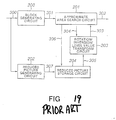
- FIG. 19 the operation of an encoding device according to the prior art is shown.
- an original picture 300 is entered to a block generating circuit 200 and is therein split into a plurality of blocks 301. All of blocks 301 together cover the entire original picture 300, but do not overlap with each other.
- Original picture 300 is also forwarded to reduced picture generating circuit 202 which produces a picture 307 having a reduced size, such as by way of a reduction scheme known in the art.
- the reduced picture is forwarded to and stored within reduced picture storage circuit 204.
- Each of blocks 301 is forwarded to a proximate area search circuit 201 which searches reduced size picture 307 stored in reduced picture storage circuit 204 to determine whether any portions of the reduced size picture are analogous to the particular block 301 being searched.
- this search includes searching for portions of reduced size picture 307 which are of different size, position, perspective, or orientation than the block 301 being searched.
- similar block position information 306 which specifies the position of the selected portion 305 within the reduced size picture 307, is transmitted to reduced picture storage circuit 204.
- selected portion 305 of the reduced size picture 307 stored within reduced picture storage circuit 204 is extracted, and is transmitted to a rotation/inversion/level value conversion circuit 203.
- Rotation/inversion/level value conversion circuit 203 processes portion 305 of reduced size picture 307 by a rotation/inversion/level value transformation in accordance with transformation parameters 304 which are supplied from proximate area search circuit 201. These transformation parameters 304 are indicative of the transformation which must be performed on selected portion 305 of reduced size picture 307 in order to transform that selected portion into block 301. These parameters are determined when a particular portion 305 of reduced size picture 307 is found to most closely correspond to block 301 being searched. Upon transformation by rotation/inversion/level value conversion circuit 203, a transform reduced-size picture 303 is forwarded to proximate area search circuit 201. There as a result, transformation parameters 304 and similar block position information 306 are output as ISF codes 302.
- a first picture is input to the system, and the output includes at least transformation parameters, for transforming a first block of that first picture into a second similar block of a reduced size picture, and position information, for determining the position of the second block within the encoded picture.
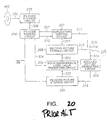
- a decoding apparatus in which the IFS codes recorded on, for example, a disc 400, including transformation parameters and similar block position information 302 that are output by the encoding device of Fig. 19, are entered into and stored in an IFS code storage circuit 205.
- IFS codes 302 are then sequentially read out from IFS code storage circuit 205 for each block, and are forwarded to an IFS code read out circuit 206.
- IFS code read out circuit 206 divides the codes into similar block position information 306 and transformation parameters 304 as had been produced by the encoder. Similar block position information 306 is then forwarded to reduced picture storage circuit 204 in order to reproduce the area of the reduced-size picture specified by similar block position information 306.
- the portion 305 of the reduced size picture stored in reduced picture storage circuit 204 corresponding to the specified area is then transmitted to a rotation/inversion/level value conversion circuit 203, and is transformed in accordance with transformation parameters 304 which are supplied from IFS code read out circuit 206.
- the resulting transformed picture 303 forwarded from rotation/inversion/level conversion circuit 203 is stored within decoded picture storage circuit 208. This procedure is performed for each block in the picture for which IFS codes are provided.
- IFS read out circuit 206 sends a READ OUT END notification signal 310 to duplication control circuit 207. It is then determined by duplication control circuit 207 whether information for all blocks has been obtained. If not, a repeat command 309 is sent to IFS code read out circuit 206, the IFS codes 302 are input once again, and the procedure begins again. The information for all blocks has been read out, and decoding continues through a recursive decoding procedure.
- Duplication control circuit 207 counts the number of recursive decoding/duplicating operations that have been executed, and if this count has not reached a predetermined value, duplication control circuit 207 sends a reprocessing command signal 311 to a switch 209 in order to send partially decoded picture 313 to reduced picture generating circuit 202 via information path 314.
- Reduced picture generating circuit 202 generates a partially decoded reduced size picture 315 of decoded picture 313 in a manner similar to that as in the encoding device in order to re-write the contents of the picture stored in reduced picture storage circuit 204 and to enable a next recursive decoding step to start with partially decoded reduced picture 315.
- a decoded picture output control signal is sent by reprocessing command signal 311 to switch 209 in order to couple a decoded picture 313 output from decoded picture storage circuit 208 to a picture output port 316.
- Decoded picture 313 comprises a conglomeration picture of all of the decoded blocks noted above after being recursively decoded for a predetermined number of iterations and is read out from decoded picture storage circuit 208 in accordance with control signal 312.
- the words of the codes are coded in a variable length manner, i.e., variable length Huffman encoding or the like is applied to the code or codes, in order to form the bit stream.
- variable length Huffman encoding or the like is applied to the code or codes, in order to form the bit stream.
- the entire bit stream is read out, beginning with header portion thereof, until the code corresponding to the predetermined area picture appears.
- the domain blocks associated with the desired range blocks may be positioned anywhere within the picture.
- An encoding technique includes the step of splitting an input image into a plurality of first and second block portions. Transform processing is performed on each second block portion, and a determination is made as to which of the transformed block portions residing in the same predefined area of the input image as a preselected first block portion is most similar to that preselected first block portion. Block position information indicating the position of the selected second block portion and a transformation parameter representing the transform processing of that selected second block portion are output as a code.
- a decoding technique in accordance with a further aspect of the invention allows for decoding from a code representing blocks from a predetermined area of an image.
- the received code includes block portion information indicating a position in a particular area of a picture of a pretransformed block and a transformation parameter representing the transform processing of the pretransformed block.
- Processing of the block identified by the block position information and based on the transformation parameter within the predetermined area is performed recursively to reconstruct a predetermined area of the decoded picture from the transformation process blocks.
- a recording medium for storing a computer program for operation on a general purpose computer for implementing the encoding and decoding method in accordance with the invention, and for outputting a coded bit stream in the encoding case, and a decoded predetermined area of a coded picture in the decoding case.
- a preferred embodiment of the invention provides an encoding and/or decoding apparatus and method that allow for only a portion of an encoded picture to be decoded, as desired.
- a portion of a picture to be decoded may be extracted from a bit stream including encoded information for an entire picture without reading each portion of information in the bit stream.
- a portion only of an encoded picture may be decoded, as desired.
- a recording medium may be provided including all information for implementing an improved encoding and decoding method in which a portion of a picture to be decoded may be extracted from a bit stream including encoded information for an entire picture without reading each portion of information in the bit stream.
- an encoding device constructed in accordance with a first embodiment of the invention includes a picture memory 3 for receiving and storing an input picture 100, a first block generator 1 for generating a plurality of first block portions and a second block generator 2 for generating a plurality of second block portions, each of which receives input picture 100 as a first input picture 101 and a second input picture 102, respectively, and a controller 4 for generating a control signal 103 to control the reading of first and second input pictures 101 and 102 from picture memory 3.
- the second block portions are twice the size of the first block portions.
- a picture transformation generator 6 for transforming a plurality of second block portions 106 received from second block generator is provided.
- transformed block portions 107 are forwarded to a proximate block search unit 5 which searches for a second transformed block portion 107 received from second block generator that is most similar to a first block portion 104 received from first block generator 1.
- Proximate block search unit 5 outputs a control signal 105 to controller 4 to prompt the system to output the next portion of picture 100 from picture memory 3.
- An area determiner 7 receives input picture 101 and divides that input picture into a plurality of areas based upon an external input. Depending upon the location of the first block to be searched, area determiner 7 outputs a control signal 109 to picture memory 3 to output only a portion of input picture 100 as input picture 102 corresponding to the area of picture 100 that includes the first block to be searched.
- a header information generator 29 receives a first block number or address 111 from first block generator 1, a corresponding second block number or address 108 from second block generator 2 and screen splitting information 112 from the same external input that provides this information to area determinator 7, in order to generate header information 152.
- the first block portion number or address 111, the second block portion number or address 108, the associated transform parameter 110 indicative of the transformation of the selected second block portion 106 to result in the corresponding first block portion 104, and header information 152 are forwarded to encoder/multiplexer 8 which provides a final encoded output 120 to be recorded on a recording medium 400 or to be transmitted over a communication network 500.
- Iterative transform encoding is a technique which is performed by repeatedly executing contractive mapping from a domain block to a range block for all range blocks making up a full picture.
- This mapping may include transforming the domain block in any number of ways including rotation, lateral or vertical movement, enlargement or contraction, or change of perspective or orientation.
- a range block R k corresponds to a first block portion 104 while the domain block D k corresponds to a second block portion 106.
- the block size of R k is m ⁇ n, while that of D k is M ⁇ N.
- mapping block D k to block R k by affine transformation can be expressed by the following equation (3)
- the transformation between two blocks, such as transformation including rotation, lateral or vertical movement, contraction or enlargement, can be represented fully by this equation (3), each of the parameters indicating various transformations, as is well known in the art.
- ( x , y ) represents the coordinates of a point before affine transformation
- (a i x + b i y + e i , c i x + d i y + f i ) represent the coordinates of a point after transformation denoted as v i ( x , y )
- Picture transformation generator 6 (Fig. 1) includes circuits or processing modules for transformation, such as rotation, lateral or vertical movement, contraction or enlargement, and can therefore perform all of the functions that are represented in equation (3).
- the upper left corner of the domain block D k is mapped to the upper left corner of range block R k .
- the transformation of the gray tone values of pixels in a block picture are similarly realized by an affine transformation as noted above.
- one or more of a plurality of transformation coefficients (a i , b i , c i , d i , e i , f i ) of equation (3) can be changed in a plurality of ways to alter the transform applied to the second block portion 106 by picture transformation generator 6.
- the plurality of second block portions 106 generated from second block generator 2 are transformed in various ways to obtain a plurality of transformed block portions 107. Of these plural transformed block portions 107, the transformed block portion closest to the one first block picture 104 is detected by proximate block search unit 5.
- Digitized picture 100 is input to picture memory 3 and is stored therein. Under the control of controller 4, first input picture 101 is supplied to first block generator 1 and area determiner 7. Area determiner 7 receives screen splitting information 112 from the external source, and thereafter determines the area of second input picture 102 which is to be read out from picture memory 3 to second block generator 2. This area is determined so that the portion of second input picture 102 forwarded to second block generator 2 corresponds to the same area of input picture 100 in which the first block to be tested from first input picture 101 is located.
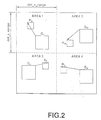
- the portion of second input picture 102 read out from picture memory 3 will include all portions of area 1, but no portions of the picture from any additional areas. In this example, only the portion of input picture 100 corresponding to area 1 will be forwarded to second block generator 2.
- a domain block can be positioned anywhere in the image for a particular range block, in the present invention, the domain block must be positioned in the same area of picture 100 as the associated range block. Therefore, it is ensured that the eventual second transform block portion 107 utilized to encode the corresponding first block portion 104 will be located in the same area of input picture 100.
- area determiner 7 splits the screen shown in Fig. 2 both vertically and horizontally in accordance with screen splitting information 112. While the screen splitting information in this example indicates the screen should be split vertically into upper and lower portions, and horizontally into left and right portions, screen splitting information 112 from the external input can split the screen into any number of areas, and in any desired combination.
- the screen is split into four areas, area 1 - area 4, each having a lateral width of def_x_range and a longitudinal width of def_y_range.
- a range block (first block) R k corresponding to a domain block (second block) D k is selected in the first area.
- a range block (first block) R m corresponding to a domain block to a domain block (second block) D n is selected in the second area.
- a range block (first block) R n corresponding to a domain block (second block) D n is selected.
- a range block (first block) R s corresponding to a domain block (second block) D s is selected.
- a transformation is performed on each of these domain blocks (second blocks) corresponding to the range block (first block) in the same area by mapping.
- the domain block corresponding to each particular selected range block is positioned within the same area as the corresponding range block.
- iterated function coding is independently carried out in each area of the picture.
- the transform/encoding operation (as set forth in Fig. 4) is independently performed on each defined area in the picture.
- a first block picture is split (generated) from the picture 100 stored in picture memory 3, producing a plurality of first block portions 104.
- a second block portion 106 located within the same defined area of input picture 100 as the first block picture is split (generated) from the picture 100 stored in picture memory 3 and is transformed according to a defined transform procedure, generating transformed second block portion 107. Then, processing transfers to inquiry S3.
- a comparison is performed by proximate block search unit 5 to determine whether the current transformed second block portions 107 within the same area of input picture 100 as the selected first block portion 104 is the most similar to the selected one of the plurality of first block portions 104 generated at step S1.
- This comparison is performed by taking the absolute value sum of error between each corresponding pixel of the current first and second block portions.
- the comparison between block portions may also be made by using the square sum of error, in an alternative embodiment.
- Inquiry is made as to whether the calculated error between the current block portion is less than a predetermined threshold. If answered in the affirmative, this block portion is stored as one candidacy of the most similar block portion in step S4, and operation proceeds to inquiry S5. If answered in the negative, operation proceeds to inquiry S5.
- Inquiry S5 determines whether all of the second block portions 106 positioned within the same area as the selected first block portion 104 being searched have been processed. If all the second block potions 106 in this area have not been processed, operation returns to step S2, and a next second block portion 106 within the selected area of picture 100 is generated and transformed in accordance with step S2. However, if all of the second block portions 106 within the predefined area have been processed, the operation proceeds to step S6 where the second block portion having a minimum error is selected from the candidates of the second block portions 106 which were temporarily stored.
- step S7 the transform parameter 110 from picture transform generator 6 and the number address from the second block generator corresponding to the selected second block portion 106, along with the number or address 111 of the first block portion 104 from the first block generator are forwarded to the coding/multiplexer 8. Operation then proceeds to inquiry S8.
- Inquiry S8 determines whether all of the first block portions 104 within the screen have been processed, or at least whether all first block portions 104 within the area of the screen that the user wishes to encode have been processed. If this inquiry is answered in the negative, control is passed back to step S1, where a next first block portion 104 is generated. If this inquiry is answered in the affirmative, the procedure comes to an end since the entire screen has been encoded.
- each area is individually IFS encoded according to the procedure described above with respect to Fig. 4.
- header information generator 29 receives the number or address 111 of first block portion 104, the number or address 108 of second block portion 106 and the screen splitting information 112 received from the external input source.
- header information generator In accordance with screen splitting information 112, header information generator generates information indicating screen size, the number of split screens and their sizes in accordance with the screen splitting information 112, and the size of the block for the data representing each of the first block portions 104 and the second block portions 106 in accordance with the number or address 111 of the first block portions 104 and the number or address 108 of the second block portions 106, all as shown in Fig. 14.
- Code length for each code is important because in accordance with the invention, a fixed length coding scheme, rather than a variable length data size is utilized.
- This fixed length coding allows random, immediate access to any particular first block portion information since the location thereof is known.
- the second block portion address 108 and transformation parameter 110 for each first block portion 104 will always be positioned in the same location in the data stream, and can be easily accessed. If a variable length encoding scheme were utilized, it would be necessary to read the entire stream of data in order to arrive at a particular selected block. In accordance with the invention, when only a particular portion of an image is to be decoded, it is possible to address immediately the necessary blocks in the coded information data stream in order to decode the appropriate areas of the picture including the portion of the picture which is to be displayed.
- coding/multiplexer 8 Upon receipt of the header information from header information generator 29, coding/multiplexer 8 receives the number or address 111 of the first block portion 104, the number or address 108 of the selected second block portions 106 and the transform parameter 110 associated therewith for each first block 104 portion in turn, and multiplexes the header information 152 and the transform parameter 110, the number or address 108 of the selected second block portion 106 corresponding to each first block portion 104 in order of the number or address 111 of the first block portion 104.
- This information is code/multiplexed by coding/multiplexer 8 in a predetermined order using fixed length encoding, and a coded bit stream 120 is output therefrom.
- This output coded bit stream 120 may be recorded on a recording medium 400 such as a CD-ROM, or transmitted over a communication network 500.
- the encoding device constructed in accordance with the second embodiment includes a first block generator 1 for generating a plurality of first block portions 104 from a received input picture 100, a second block generator 2 for generating a plurality of second block portions 106 from a received input picture 100 and a second block picture memory 14 for storing the plurality of second block portions 106 generated from second block generator 2.
- the encoding device further includes a picture transform generator 6 for carrying out a predetermined transform on a second block portion 122 of second block picture 106 received from second block picture memory 14. Also included is an approximate block search unit 13 for searching for a transformed second block portion 107 received from picture transform generator 6 which is most similar to the selected first block portion 104 received from first block generator 1.
- a controller 4 is also provided for generating control signal 133 for controlling the transmission of transformed second block portions 122 to picture transform generator 6 to perform the search therein.
- An area determiner 7 is provided for determining an area of picture 100 from which the second block portions 106 are to be supplied to the picture transform generator 6. This area is selected so that the first block portion 104 received from first block generator 1 is positioned within the same area of picture 100 as the plurality of second block portions 106. This information is determined by area determiner 7 using screen splitting information 112 received from an external input.
- Area determiner 7 generates a control signal 118 to select the second block portions 106 which are positioned in the same area of picture 100 corresponding to first block portion 104.
- a header information generator 29 is also provided for receiving the number or address of first block portion 111 from first block generator 1 and the number or address 108 of the second block portion 106 selected by the approximate block search unit 13 as being most similar to first block portion 104, and screen splitting information 112 to generate header information 152, which is forwarded to coding multiplexer 8.
- Coding multiplexer 8 receives the block numbers or addresses of the first and second block portions 111 and 108, transform parameter 110 from picture transform generator 6 and indicative of the transform which must be performed on the selected second block portion 106 to transform that selected second block portion into first block portion 104, and header information from header information generator 29.
- the coding multiplexer 8 provides a final encoded output 120 to be recorded on a recording medium 400 or transmitted over a communication network 500.
- step S11 all of the second block portions 106 that make up picture 100 are sequentially generated prior to generation of any of the first block portions 104, and are stored and held in second block picture memory 14.
- step S12 the first block portion 104 of the coding target (the first block picture in the area of picture 100 which is to be decoded) is generated.
- steps S11 and S12 a digitized picture 100 is input to first block generator 1 and second block generator 2, where the first block portion 104 and the plurality of second block portions 106 are generated, respectively. Operation proceeds to step S13.
- step S13 the encoding technique of the second embodiment is similar to that discussed above with respect to the first embodiment. Specifically, in step S13, area determiner 7 determines from among the predefined areas into which the entire screen has been divided in accordance with screen-splitting information 112, the area of picture 100 in which the first block portion 104 is located. Then, a second block portion 122 located in the same area of picture 100 as the area where first block portion 104 is located is read out from second block picture memory 14 and is transformed by picture transform generator 6. Operation then proceeds to step S14.
- approximate block search unit 13 compares the transformed second block portion 107 transformed at step S13 and the first block portion 104. This comparison is performed to determine which second block portion 122 has the least error between it and the first block portion 104 to be coded. From among all of the second block portions 122 in the candidate area of picture 100, the number or address 108 and the transform parameter 110 of the second block portion 122 having the minimum error between the second block portion 122 and the first block portion 104 is selected. This selection process is performed (as noted with respect to the first embodiment), wherein the error for a transformed second block portion 107 to be tested is compared with a threshold value.
- step S15 If the error is smaller than the threshold, then operation proceeds to step S15, and the second block portion 122 is stored as a candidate for the most similar second block portion.
- the transform parameter 110 and the number or address 108 of the selected second block portion 122 are temporarily stored. Operation then proceeds to inquiry S16. Also from S14, if the error is not smaller than the threshold or the previous smallest error, operation proceeds to inquiry S16. Inquiry S16 determines whether all of the second block portions 122 in the defined area containing first block portion 104 have been processed.
- control signal 119 is generated and transmitted to controller 4 from the approximate block search unit 13
- control signal 119 is generated and transmitted to controller 4 from the approximate block search unit 13. Operation then proceeds to step S17.
- step S17 in response to the control signal 133, transform parameter 110 and the number or address 108 of the second selected block portion 122 having minimum error between the data of the second block portion and the first block portion 104 are selected of all of the candidates of the second block portions 106 which were temporarily stored.
- the operation then proceeds to step S18 whereat the selected transform parameter 110 from picture transform generator 6, the selected number or address 108 of the selected second block portion 122 and the number or address 111 of the first block portion are sent to the coding multiplexer 8. Operation then proceeds to S19 to inquire whether all of the first block portions 104 in the picture 100 have been processed. If not, control returns to step S12 to generate an additional first block portion 104. If all first block portions 104 have been processed, the procedure ends since an entire screen has been encoded.
- Fig. 7 an encoding apparatus constructed in accordance with a third embodiment of the invention will now be described.
- the encoding apparatus depicted in Fig. 7 is similar to the apparatus described above, but includes an area extractor 115 for extracting an area from picture 100 instead of the area determiner 7, and a local memory 116 for storing the area extracted by the area extractor 115.
- the remainder of the elements are similar to those set forth in the previously described embodiments, and therefore, are denoted by similar reference numerals.
- the operation of the encoding device constructed in accordance with this third embodiment will now be described. In this encoding device, a digitized picture 100 is input to picture memory 3.
- a first picture 126 and a second picture 127 are output from local memory 116 to first block generator 1 and second block generator 2, respectively.
- the processing of a first block portion 104 and a second block portion 106, which are generated by the respective first and second block generators 1 and 2 is substantially similar to the processing described with respect to the first embodiment.
- area picture 125 After all of the first block portions 104 included within the area picture 125 are encoded, if another portion of picture 100 is to be coded, another area picture 125 may be extracted in a similar fashion from picture memory 3 by area extractor 115 in accordance with reading control signal 123 from controller 4. This additional area will then be stored in local memory 116, and a similar operation as noted above will be carried out.
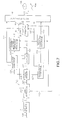
- the encoding device constructed in accordance with the fourth embodiment of the invention includes a picture memory 3 for storing an input picture 100, a screen splitter 22 for splitting the screen of picture 100 into a plurality of predetermined areas in accordance with screen splitting information 112 received from an external input source, a first area iterated function coding section 23 for carrying out iterated function coding with respect to a first predefined area, a second area iterated function coder 24 for carrying out iterated function coding with respect to a second predefined area, and other area iterated function coding sections represented generally by a K-th area iterated function coding section 25 for carrying out iterated function coding with respect to a K-th predetermined area.
- the elements included in each iterated function coder area are identical.
- a multiplexer 26 is also provided for multiplexing header information and the coded bit stream from each of the pre
- a digitized picture 100 is input and stored in picture memory 3
- picture 100 is forwarded to screen splitter 22 whereat the entire screen of picture 100 is split into a plurality of areas in accordance with the screen splitting information 112 received from the external input.
- the screen is split into K areas.
- Split area pictures 134, 135, ... 136 are forwarded to first, second, ... and K-th iterated function coder areas 3, 24, ... 25, respectively.
- iterated function coding is carried out independently.
- K is equal to 4
- the input picture is divided into four areas.
- the first iterated function coder 23 performs iterated function coding on an image of area 1 (as shown in Fig. 2)
- the second area iterated function coder 24 performs iterated function coding on an image of area 2, and so on, with the K-th area iterated function coder 25 performing the iterated function coding on an image of area 4.
- Coded bit streams 137, 138, ... 139 are output respectively from first, second, ... K-th area iterated function coders 23, 24, ... 25.
- Screen splitting information 112 is also forwarded to multiplexer 26 along with the coded bit streams. Multiplexer 26 then generates header information and multiplexes the header information and coded bit streams 137, 138 and 139, and transmits this multiplexed information as a coded bit stream 151.
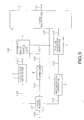
- Fig. 9 depicts the internal structure of the first area iterated function coder 23. Each of the other area iterated function coders are formed of the same internal structure.
- a first area picture 134 is input to a local memory 27, and first picture 140 and second picture 141 are read out from local memory 27 in accordance with a control signal 142 from controller 4, as prompted by signal 143 from proximate block search unit 5, and are output to first block generator 1 and second block generator 2, respectively.
- the remainder of the processing is similar to that set forth with respect to the embodiments discussed above, including the generation of a plurality of first block portions 144, the generation of a plurality of second block portions 145, the transformation of these second block portions 145 by picture transform generator 6 into transformed second block portions 147, the determination in proximate block search unit 5 of minimum error, and the multiplexing and output of the information as encoded data stream 137 by coding/multiplexer 8.
- This embodiment is characterized in that high speed coding is carried out by parallel processing by a plurality of coding sections as opposed to the sequential coding carried out in the prior embodiments. Thus, encoding can take place at a much higher rate.
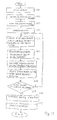
- a method for implementing a fifth encoding embodiment of the invention is depicted.
- the flowchart set forth may be programmed into a general purpose computer.
- this program at the first step S21, an input picture is stored in a frame memory in the general computer.
- the picture stored at step S21 is split to generate a plurality of first block portions.
- the picture stored at step S21 is similarly split to generate a plurality of second block portions.
- step S24 determines all of the second block portions that belong to the same area as each of the first block portions.
- step S25 a first block portion stored and produced at step S22, and all of the second block portions produced at step S23 that are positioned in the same predetermined area as the first block portion, are read out. Then, operation proceeds to step S26 in which each of the second block portions which is read out at step S25 is transformed. At the subsequent step S27, a determination is made as to which of the transformed second block portions is closest to the selected first block portion, i.e., which of the second block portions has the least error between it and the selected first block portion. This determination is made utilizing the threshold processing noted above with respect to the first embodiment, and at step S28, the second block portion having the minimum error is selected.
- step S30 which generates header information including information indicating a screen size, number of split screens and block size of the first and second block portions are formed into a header, such as that shown in Fig. 14.
- step S31 each of the block numbers or addresses and the transform parameters obtained in the transform generation of the transformed second block portions corresponding to the first block portions and the generated header information are coded/multiplexed and transmitted. On completion of this step S31, processing ends.
- a header of the format shown in Fig. 14 is utilized. It is assumed that the number of areas into which the screen has been divided (as shown in Fig. 2) are all equal in size. However, in accordance with the invention, the areas into which the screen is divided, or defined, need not be of the same size.
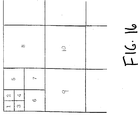
- an area design such as that shown in Fig. 16 may be used as a hierarchy structure wherein four areas (1-4) are provided at a small size, three additional areas (5-7) are provided at a medium size, and three final areas (8-10) are provided at a larger size.
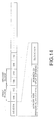
- an advanced header such as that shown in Fig. 15, is employed.
- the header includes information of screen size (horizontal and vertical), and a number of split screens. Since the area sizes may be different, a hierarchy structure of blocks indicating a number of a hierarchy, a picture format indicating the overall format of the picture, and information regarding the size of each block. Therefore, this hierarchy structure indicates a small block and its size definition, a medium block and its size definition and a large block and its size definition. In this manner, since the information is coded in a fixed length format, when a particular area of the picture is to be accessed, it is possible to jump directly to the portion of the bit stream containing the information for this area even though the picture areas are of different sizes, and therefore include different amounts of information. It is not necessary to read through the entire data stream as in the prior art.
- the enhanced header allows for the more specific tailoring of an encoding scheme for a particular image while still allowing for direct, non-sequential access to portions of the data stream.
- This decoding apparatus may be employed for decoding information encoded by any of the iterative picture transforming coding devices explained above.
- a storage medium 400, a communication network 500, or other data input device provides an encoded bit stream to a decoding area picture controller 17.
- This decoding area picture controller 17 receives encoded bit stream 120 and decoding target area information 128 from an external input. This target area information 128 is used in controlling the portion of a picture, and thus bit stream 120, to be decoded.
- a demultiplex/decoder 9 for carrying out demultiplexing and decoding receives the selected portion 129 of encoded bit stream 120 and provides a number or address 111 of the first block portion 104 to be decoded to a picture memory 11 and provides a number or address 108 of the second block portion 106 corresponding to first block portion 104 and the screen splitting information 112 to a transformation origin block reproducer 10.
- the demultiplex/decoder also provides transformation parameters 110 to a picture transform generator 6. Transformation origin block reproducer 10 forwards a transformation origin block 106 corresponding to the provided number or address 108 of the second block portion to the picture transfer generator 6, and the picture transform generator carries out a transform on transformation origin block 106 using the provided transform parameter 110.
- Picture memory 11 stores a plurality of transformed block portions 107 output from picture transform generator 6, and the output of the picture memory is coupled to a controller 12 for controlling a series of iterative loops for the decoding apparatus.
- An area extractor 28 extracts a predetermined area from the picture to be output by the decoding device.
- Storage medium 400, communication network 500, or other data input device provides an encoded bit stream 120 to the decoding area picture controller 17 to which decoding target area information 128 also is provided.
- the decoding area picture controller determines the portion of coded bit stream 120 corresponding to the decoding target area and outputs a decoding target coded bit stream 129 to the demultiplex/decoder 9.
- decoding area picture controller determines the number of predefined areas which include portions of the image to be decoded.
- target coded bit stream 129 includes data corresponding only to the predefined areas of encoded bit stream 120 that are to be decoded.
- Target coded bit stream 129 is demultiplexed and fixed length decoded by the demultiplex/decoder 9 and the number or address 111 of a first block portion 104 that is positioned within the area indicated by the target coded bit stream, i.e. which includes information to be decoded and displayed, is provided to the picture memory 11.
- Screen splitting information 112 and the number or address 108 of a second block portion 106 are provided to the transformation origin block reproducer 10.
- a demultiplexed transformation parameter 110 is provided to the picture transform generator 6.
- the transformation origin block reproducer 10 determines, by the position of the second block portion in the screen (based on the number or address 108 of the second block portion and the memory location for the first block portion), the transformation origin block 106 which is provided to the picture transform generator 6 and is transformed thereby in accordance with transform parameter 110.
- a transformed block portion 107 thus obtained from picture transform generator 6 is provided to and stored in picture memory 11 at a position designated by the number or address 111 of the first block portion. This procedure is repeated until the entire decoding target coded bit stream has been read out, and all of the second transformed block portions 107 have been written into the picture memory. Then, this picture information is fed back to transformation origin block producer 10 under the control of controller 12 which couples a control signal 116 to the transformation origin block reproducer.
- the IFS decoding procedure is performed on only the transformed second block portions stored in picture memory 11 in an iterative, recursive procedure for a predetermined number of iterations.
- the finally decoded picture 117 is provided from controller 12 to target area extractor 28 which selects and displays only the portion of the picture designated by the decoding target area information 128 and outputs this selected information as an output picture 150.
- target area extractor 28 selects and displays only the portion of the picture designated by the decoding target area information 128 and outputs this selected information as an output picture 150. It should be appreciated that while less than the entire picture need be decoded, more than the final display is likely to be decoded. For example, if a user wishes to display a portion of a picture in area 1, and a portion of a picture in an area 2, the entire area 1 and area 2 are decoded, but areas 3, 4 and any subsequent areas need not be decoded.
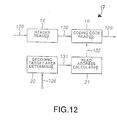
- the decoding area picture controller 17 of the decoding device of the invention includes a header reader 18 for reading a header from the encoded bit stream 120, a coding code reader 19 for reading a coding code including the read address information from the encoded bit stream 130 supplied from the header reader, and a decoding target area determiner 20 for receiving the decoding target area information 128 to determine a decoding area in the screen image and provide decoding target block picture information 131 to a read address calculator 21.
- Read address calculator 21 calculates the read address of information from that portion of encoded bit stream 120 corresponding to the portion of an image to be decoded and provides the read address information 132 to decoding code reader 19.
- header reader 18 receives encoded bit stream 120 and extracts the header therefrom.
- this header includes screen size information, information indicating the number of split screens, and information indicating the sizes of first and second blocks.
- the header could include the information shown in Fig. 15 if the areas of the picture have a hierarchy structure.
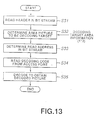
- step S32 the decoding target area determiner 20, to which the decoding target area information 128 has been input, determines the areas of the picture that are to be decoded, i.e., those areas of the picture which contain at least one pixel that eventually is to be displayed as an output picture.
- the decoding target area determiner 20 determines the areas of the picture that are to be decoded, i.e., those areas of the picture which contain at least one pixel that eventually is to be displayed as an output picture.
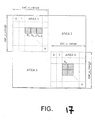
- three range blocks R k , R k+1 and R k+2 indicated by crosshatch are located in area 1 and are to be decoded. As has been described above, these three range blocks (first blocks) are generated by mapping transformed domain blocks (second blocks) positioned within the same area 1.
- step S33 the decoding target area determined by the decoding target area determiner 20, which includes the addresses of picture information of all of the range blocks within area 1, is provided to the read address calculator 21, where the location of each code within coded bit stream that corresponds to the decoding target area for each range block to be decoded is calculated and output as read address information 132.
- step S34 decoding reader 19 uses the read address information to read out the codes of all the range blocks in area 1 which are to become the decoded target area.
- step S35 this operation is performed by demultiplexer/decoding
- the target coded bit stream 129 corresponding to the particular area of the picture to be decoded is decoded, and the decoded data is output from demultiplex/decoder 9.
- the coding code following the header includes only the number or address 108 of the second block portion, and the transform parameter 110 associated therewith for each first block portion. Therefore, by carrying out fixed length coding on the number or address and the transform parameter of each second block at the coding side, the position in the coded bit stream of the coding code for a particular first block portion may be instantly calculated and accessed.
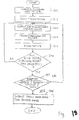
- decoding may be implemented in a general purpose computer. The embodiment of decoding in a general purpose computer will be described with respect to the flowchart of Fig. 18.
- step S41 of Fig. 18, decoding target area information is input and the coded bit stream including only information corresponding to the areas of the picture to be decoded based on the decoding target area information is extracted.
- step S42 the coded bit stream extracted at step S41 and the header associated therewith are demultiplexed and fixed length decoded, and a number of addresses of first block portions, a number of addresses of associated second block portions and the transform parameter for each second block portion, and screen splitting information are demultiplexed.
- step S43 where the transformation origin block portion (second block portion) for positioning an eventual transformed second block portion is reproduced on the basis of the number or address of second block portions obtained at step S42.
- a second block portion is transformed/generated on the basis of the transform parameter obtained at step S42 and the transformation origin block portion obtained at step S43.
- the operation then proceeds to step S45 wherein the block portion transformed at step S44 is stored at the address indicated by the number or address of the first block portion.
- step S46 determines whether all of the first block portions in the decoding target area have been decoded. If all of the first block portions have not been decoded, operation reverts to step S43, and the next original transform block portion for the next first block portion is reproduced. Otherwise, if all of the first block portions have been decoded, the operation proceeds to inquiry S47 to determine whether or not the iterated transform operation has been performed a predetermined number of times. If not, the operation again reverts to step S43 and the aforedescribed operation is performed again. Otherwise, operation proceeds to step S48, in which the image of the target area which is requested to be displayed by a user is extracted from the decoded image, and the extracted image is output as a final decoded image.
- the local memory section 116 of the embodiment of the encoding device shown in Fig. 7 and the local memory section 27 of the area iterated function coder of the fourth embodiment shown in Fig. 9 will now be described, making further reference to Fig. 21.
- a high-speed memory such as SDRAM (synchronous dynamic random access memory) may be used.
- SDRAM synchronous dynamic random access memory
- a cache memory may be used.
- the storage capacity for the local memory may be determined by, for example, the values of def_x_range (pixel) in the lateral direction and def_y_range (row) in the longitudinal direction in Fig. 21. If a first block picture R x is the current coding target block, a second block picture Dk is the reference block that is searched. In this case, since the number or address of the second block picture Dk is searched for only in the area determined by the broken line, the number of target blocks is smaller than in the case where the entire screen is used as the target. As a result, the bit length required for coding the number of addresses of the second block picture may be reduced. Thus, by dividing the picture into areas to be searched, since the search range is narrowed in the encoding device, the processing time is significantly reduced.
- a recording medium for storing a computer program so as to encode and decode in accordance with the invention includes instructions for implementing the encoding technique set forth in Fig. 10, and the decoding technique set forth in the flowchart of Fig. 13.
- a specific example of such media includes a digital video disk.
- Examples of applications of the present invention include a picture transmitting/receiving device, a picture data base, a picture compressing/decoding device for the purpose of down-loading image information from the internet, an electronic still camera, a game machine, an encoding/decoding device having a display unit which enables variable size display, a text compression restoring section in a picture editing device, an authoring tool or a high-speed rendering chip, as well as software realizing the same.
- threshold processing but also minimum value detection are performed.
- a second block produce less than a predetermined error, but it also should produce an error smaller than all of the other second blocks.
- only threshold processing need be performed. In this case, when an error is found that is less than a threshold values the second block resulting in that error is used, and no further searching need be performed. while matching precision may be reduced, processing time is reduced.
- the encoding technique embodying the present invention maps a transform between a range block and a domain block in an area generated by splitting the screen into a plurality of equal, or unequal areas.
- the size of each area picture may be reduced.
- the decoding time and the decoder memory capacity may be reduced.
- the decoding technique embodying the present invention only the encoded data corresponding to the block portions in a target area to be decoded need to be read out from the bit stream. Therefore, it is not necessary to read the entire coded bit stream from the leading part therefore as in the conventional technique, and the decoding processing time may be reduced.
Landscapes
- Engineering & Computer Science (AREA)
- Multimedia (AREA)
- Signal Processing (AREA)
- Physics & Mathematics (AREA)
- General Physics & Mathematics (AREA)
- Theoretical Computer Science (AREA)
- Compression Or Coding Systems Of Tv Signals (AREA)
Applications Claiming Priority (3)
| Application Number | Priority Date | Filing Date | Title |
|---|---|---|---|
| JP28544797 | 1997-10-17 | ||
| JP285447/97 | 1997-10-17 | ||
| JP28544797 | 1997-10-17 |
Publications (2)
| Publication Number | Publication Date |
|---|---|
| EP0910042A2 true EP0910042A2 (fr) | 1999-04-21 |
| EP0910042A3 EP0910042A3 (fr) | 2000-03-08 |
Family
ID=17691643
Family Applications (1)
| Application Number | Title | Priority Date | Filing Date |
|---|---|---|---|
| EP98308368A Ceased EP0910042A3 (fr) | 1997-10-17 | 1998-10-14 | Procédé et appareil pour coder ou décoder des données vidéo numériques |
Country Status (3)
| Country | Link |
|---|---|
| US (1) | US6356667B1 (fr) |
| EP (1) | EP0910042A3 (fr) |
| KR (1) | KR19990037167A (fr) |
Families Citing this family (4)
| Publication number | Priority date | Publication date | Assignee | Title |
|---|---|---|---|---|
| KR100828342B1 (ko) * | 2000-06-10 | 2008-05-08 | 삼성전자주식회사 | 화질 열화를 줄인 데이터 레이트 감소 장치 |
| KR100689474B1 (ko) * | 2005-01-27 | 2007-03-08 | 삼성전자주식회사 | 다중 화면을 제공하는 트랜스포트 스트림 수신 장치 및 그제어 방법 |
| US9076239B2 (en) | 2009-04-30 | 2015-07-07 | Stmicroelectronics S.R.L. | Method and systems for thumbnail generation, and corresponding computer program product |
| US9286643B2 (en) | 2011-03-01 | 2016-03-15 | Applaud, Llc | Personalized memory compilation for members of a group and collaborative method to build a memory compilation |
Family Cites Families (3)
| Publication number | Priority date | Publication date | Assignee | Title |
|---|---|---|---|---|
| US4941193A (en) * | 1987-10-02 | 1990-07-10 | Iterated Systems, Inc. | Methods and apparatus for image compression by iterated function system |
| US5065447A (en) * | 1989-07-05 | 1991-11-12 | Iterated Systems, Inc. | Method and apparatus for processing digital data |
| US5917962A (en) * | 1995-06-06 | 1999-06-29 | Apple Computer, Inc. | Method and apparatus for partitioning an image |
-
1998
- 1998-10-14 EP EP98308368A patent/EP0910042A3/fr not_active Ceased
- 1998-10-15 US US09/173,116 patent/US6356667B1/en not_active Expired - Fee Related
- 1998-10-17 KR KR1019980043421A patent/KR19990037167A/ko not_active Withdrawn
Also Published As
| Publication number | Publication date |
|---|---|
| KR19990037167A (ko) | 1999-05-25 |
| US6356667B1 (en) | 2002-03-12 |
| EP0910042A3 (fr) | 2000-03-08 |
Similar Documents
| Publication | Publication Date | Title |
|---|---|---|
| US6567531B1 (en) | Image processing apparatus, image processing method, and providing medium | |
| US6567561B2 (en) | Video coding and video decoding apparatus | |
| US6744817B2 (en) | Motion predictive arbitrary visual object encoding and decoding system | |
| US6330364B1 (en) | Video coding and video decoding apparatus | |
| US6215421B1 (en) | Coding apparatus and method, decoding apparatus and method, data processing system, and storage medium | |
| US6965697B1 (en) | Coding apparatus and method, decoding apparatus and method, data processing system, storage medium, and signal | |
| KR100647022B1 (ko) | 부호화 장치 및 부호화 방법, 복호 장치 및 복호 방법, 정보 처리 장치 및 정보 처리 방법 및 제공 매체 | |
| KR100378339B1 (ko) | 동화상 부호방법 및 부호장치와 동화상 부호 프로그램을기록하는 기록매체 | |
| EP0910042A2 (fr) | Procédé et appareil pour coder ou décoder des données vidéo numériques | |
| US6198851B1 (en) | Apparatus and method for encoding/decoding | |
| KR100742518B1 (ko) | 정보의 압축 저장 | |
| US6339659B1 (en) | Fractal coding/decoding of picture data using memory capacity information | |
| KR100711012B1 (ko) | 코딩 장치 및 방법, 디코딩 장치 및 방법, 데이터 처리 시스템, 기억 매체 및 신호 | |
| JP3546720B2 (ja) | 符号化装置及び方法、復号装置及び方法並びに記録媒体 | |
| EP0911760B1 (fr) | Appareil et procédé de transformation itérative et de décodage d'image | |
| JPH07193809A (ja) | 画像データの符号化および復号化方法 | |
| JP4174111B2 (ja) | 符号化方法及び装置 | |
| JP3066278B2 (ja) | 画像符号化装置及び画像復号化装置 | |
| KR20000028877A (ko) | 부호화 장치와 방법, 복호화 장치와 방법, 데이터 처리시스템, 저장 매체, 및 신호 | |
| US20020094126A1 (en) | Fractal image compression | |
| Chang et al. | Reversible data embedding based on prediction approach for VQ and SMVQ compressed images | |
| JPH10150664A (ja) | 映像信号符号化装置および復号化装置 | |
| JPH0813141B2 (ja) | 静止画像の符号化方式 | |
| KR19980055985A (ko) | 이산 코사인 변환(dct) 계수의 지그재그 스캔을 위한 판독 어드레스 발생장치 | |
| JPH11103462A (ja) | 符号化装置及び方法、復号化装置及び方法並びに記録媒体 |
Legal Events
| Date | Code | Title | Description |
|---|---|---|---|
| PUAI | Public reference made under article 153(3) epc to a published international application that has entered the european phase |
Free format text: ORIGINAL CODE: 0009012 |
|
| AK | Designated contracting states |
Kind code of ref document: A2 Designated state(s): DE FR GB |
|
| AX | Request for extension of the european patent |
Free format text: AL;LT;LV;MK;RO;SI |
|
| PUAL | Search report despatched |
Free format text: ORIGINAL CODE: 0009013 |
|
| AK | Designated contracting states |
Kind code of ref document: A3 Designated state(s): AT BE CH CY DE DK ES FI FR GB GR IE IT LI LU MC NL PT SE |
|
| AX | Request for extension of the european patent |
Free format text: AL;LT;LV;MK;RO;SI |
|
| 17P | Request for examination filed |
Effective date: 20000807 |
|
| AKX | Designation fees paid |
Free format text: DE FR GB |
|
| 17Q | First examination report despatched |
Effective date: 20010406 |
|
| GRAG | Despatch of communication of intention to grant |
Free format text: ORIGINAL CODE: EPIDOS AGRA |
|
| STAA | Information on the status of an ep patent application or granted ep patent |
Free format text: STATUS: THE APPLICATION HAS BEEN REFUSED |
|
| 18R | Application refused |
Effective date: 20021109 |