EP0910076A2 - Magneto-optical disc and manufacturing method thereof - Google Patents
Magneto-optical disc and manufacturing method thereof Download PDFInfo
- Publication number
- EP0910076A2 EP0910076A2 EP98119153A EP98119153A EP0910076A2 EP 0910076 A2 EP0910076 A2 EP 0910076A2 EP 98119153 A EP98119153 A EP 98119153A EP 98119153 A EP98119153 A EP 98119153A EP 0910076 A2 EP0910076 A2 EP 0910076A2
- Authority
- EP
- European Patent Office
- Prior art keywords
- rare earth
- transition metal
- alloy film
- metal alloy
- optical disc
- Prior art date
- Legal status (The legal status is an assumption and is not a legal conclusion. Google has not performed a legal analysis and makes no representation as to the accuracy of the status listed.)
- Withdrawn
Links
Images



Classifications
-
- G—PHYSICS
- G11—INFORMATION STORAGE
- G11B—INFORMATION STORAGE BASED ON RELATIVE MOVEMENT BETWEEN RECORD CARRIER AND TRANSDUCER
- G11B11/00—Recording on or reproducing from the same record carrier wherein for these two operations the methods are covered by different main groups of groups G11B3/00 - G11B7/00 or by different subgroups of group G11B9/00; Record carriers therefor
- G11B11/10—Recording on or reproducing from the same record carrier wherein for these two operations the methods are covered by different main groups of groups G11B3/00 - G11B7/00 or by different subgroups of group G11B9/00; Record carriers therefor using recording by magnetic means or other means for magnetisation or demagnetisation of a record carrier, e.g. light induced spin magnetisation; Demagnetisation by thermal or stress means in the presence or not of an orienting magnetic field
- G11B11/105—Recording on or reproducing from the same record carrier wherein for these two operations the methods are covered by different main groups of groups G11B3/00 - G11B7/00 or by different subgroups of group G11B9/00; Record carriers therefor using recording by magnetic means or other means for magnetisation or demagnetisation of a record carrier, e.g. light induced spin magnetisation; Demagnetisation by thermal or stress means in the presence or not of an orienting magnetic field using a beam of light or a magnetic field for recording by change of magnetisation and a beam of light for reproducing, i.e. magneto-optical, e.g. light-induced thermomagnetic recording, spin magnetisation recording, Kerr or Faraday effect reproducing
- G11B11/10582—Record carriers characterised by the selection of the material or by the structure or form
-
- G—PHYSICS
- G11—INFORMATION STORAGE
- G11B—INFORMATION STORAGE BASED ON RELATIVE MOVEMENT BETWEEN RECORD CARRIER AND TRANSDUCER
- G11B11/00—Recording on or reproducing from the same record carrier wherein for these two operations the methods are covered by different main groups of groups G11B3/00 - G11B7/00 or by different subgroups of group G11B9/00; Record carriers therefor
- G11B11/10—Recording on or reproducing from the same record carrier wherein for these two operations the methods are covered by different main groups of groups G11B3/00 - G11B7/00 or by different subgroups of group G11B9/00; Record carriers therefor using recording by magnetic means or other means for magnetisation or demagnetisation of a record carrier, e.g. light induced spin magnetisation; Demagnetisation by thermal or stress means in the presence or not of an orienting magnetic field
- G11B11/105—Recording on or reproducing from the same record carrier wherein for these two operations the methods are covered by different main groups of groups G11B3/00 - G11B7/00 or by different subgroups of group G11B9/00; Record carriers therefor using recording by magnetic means or other means for magnetisation or demagnetisation of a record carrier, e.g. light induced spin magnetisation; Demagnetisation by thermal or stress means in the presence or not of an orienting magnetic field using a beam of light or a magnetic field for recording by change of magnetisation and a beam of light for reproducing, i.e. magneto-optical, e.g. light-induced thermomagnetic recording, spin magnetisation recording, Kerr or Faraday effect reproducing
- G11B11/10582—Record carriers characterised by the selection of the material or by the structure or form
- G11B11/10586—Record carriers characterised by the selection of the material or by the structure or form characterised by the selection of the material
- G11B11/10589—Details
- G11B11/10591—Details for improving write-in properties, e.g. Curie-point temperature
-
- Y—GENERAL TAGGING OF NEW TECHNOLOGICAL DEVELOPMENTS; GENERAL TAGGING OF CROSS-SECTIONAL TECHNOLOGIES SPANNING OVER SEVERAL SECTIONS OF THE IPC; TECHNICAL SUBJECTS COVERED BY FORMER USPC CROSS-REFERENCE ART COLLECTIONS [XRACs] AND DIGESTS
- Y10—TECHNICAL SUBJECTS COVERED BY FORMER USPC
- Y10S—TECHNICAL SUBJECTS COVERED BY FORMER USPC CROSS-REFERENCE ART COLLECTIONS [XRACs] AND DIGESTS
- Y10S428/00—Stock material or miscellaneous articles
- Y10S428/913—Material designed to be responsive to temperature, light, moisture
-
- Y—GENERAL TAGGING OF NEW TECHNOLOGICAL DEVELOPMENTS; GENERAL TAGGING OF CROSS-SECTIONAL TECHNOLOGIES SPANNING OVER SEVERAL SECTIONS OF THE IPC; TECHNICAL SUBJECTS COVERED BY FORMER USPC CROSS-REFERENCE ART COLLECTIONS [XRACs] AND DIGESTS
- Y10—TECHNICAL SUBJECTS COVERED BY FORMER USPC
- Y10S—TECHNICAL SUBJECTS COVERED BY FORMER USPC CROSS-REFERENCE ART COLLECTIONS [XRACs] AND DIGESTS
- Y10S430/00—Radiation imagery chemistry: process, composition, or product thereof
- Y10S430/146—Laser beam
-
- Y—GENERAL TAGGING OF NEW TECHNOLOGICAL DEVELOPMENTS; GENERAL TAGGING OF CROSS-SECTIONAL TECHNOLOGIES SPANNING OVER SEVERAL SECTIONS OF THE IPC; TECHNICAL SUBJECTS COVERED BY FORMER USPC CROSS-REFERENCE ART COLLECTIONS [XRACs] AND DIGESTS
- Y10—TECHNICAL SUBJECTS COVERED BY FORMER USPC
- Y10T—TECHNICAL SUBJECTS COVERED BY FORMER US CLASSIFICATION
- Y10T428/00—Stock material or miscellaneous articles
- Y10T428/21—Circular sheet or circular blank
Definitions
- This invention relates to an optical disc having two layers of different rare earth-transition metal alloy films, and a manufacturing method for this optical disc.
- magneto-optical discs there are a magneto-optical disc and a phase-change disc.
- magnetic domains are written on magnetic thin films, by way of recording the information by exploiting the thermal energy, such as semiconductor laser, and the information thus recorded is read out using the photomagnetic effect.
- the recording materials used for this magneto-optical disc films of rare earth-transition metal alloys, obtained on combining rare earth elements, such as Gd, Tb or Dy, and transition metals, such as Fe or Co, are predominantly used.
- the magneto-optical disc employing the films of rare earth-transition metal alloys such a magneto-optical disc is proposed in which the rare earth-transition metal alloy film is sandwiched between dielectric films of, for example, Si 3 N 4 , and a reflective film of, for example, Al, is formed on one or the other dielectric film, to provide a four-layer structure.
- the above-described magneto-optical disc is of a recording format in which a TbFeCoCr alloy film is used as the rare earth-transition metal alloy film and in which recording/reproduction is performed with a track pitch of approximately 1.6 ⁇ m and a bit length of approximately 0.83 ⁇ m.
- the track pitch and the pit length are set to approximately 0.9 ⁇ m and to approximately 0.45 ⁇ m, respectively, in order to achieve higher recording density.
- the track pitch and the pit length are reduced further for achieving higher recording density, the playback output is lowered, such that recording/reproduction cannot be realized.
- TbFeCoCr alloy film It may be envisaged to improve photomagnetic effects of the TbFeCoCr alloy film. With this magneto-optical disc, it suffices if the Kerr rotation angle of the rare earth-transition metal alloy film is increased for the laser light illuminated for playback. In order to realize this, it suffices to eliminate Cr from the TbFeCoCr alloy film, that is to use a TbFeCo alloy film. If the TbFeCo alloy film is used as a recording material, the Kerr rotation angle of the laser light illuminated on the recording layer is increased, as a result of which the playback output is improved.
- this TbFeCo alloy film is not optimum in magnetic properties, as compared to a TbFeCoCr alloy film with an oxide film deposited thereon, such that a magnetic domain cannot be formed satisfactorily in a low external magnetic field.
- a magneto-optical disc employing the TbFeCo alloy film as a recording material recording cannot be made satisfactorily with an external magnetic field only large enough to make recording on the TbFeCoCr alloy film carrying an oxide film.
- the TbFeCo alloy film is formed by sputtering in an Ar gas atmosphere. If an oxygen gas is mixed, Tb of the TbFeCo alloy film is selectively oxidized, because Cr is not contained therein. If Tb is selectively oxidized in the TbFeCo alloy film, magnetic characteristics are deteriorated. That is, with the present TbFeCo alloy film, it is different to control the film thickness to form the oxide film, such that, if it is attempted to deposit an oxide film, an excessively oxidized state is produced. The result is that the magneto-optical disc has only poor recording/reproducing characteristics.
- the magneto-optical disc As a magneto-optical disc, developed to eliminate this inconvenience, there is known such a disc which has two sorts of the rare earth-transition metal alloy films. Specifically, the magneto-optical disc is of a layered structure of a GdFeCo alloy film and a TbFeCo alloy film. With this magneto-optical disc, the force of magnetic coupling by exchange reciprocal action operates between the GdFeCo alloy film and the TbFeCo alloy film, thus improving magnetic characteristics on the whole.
- the present inventors have found that the strength of the exchange reciprocal action produced between the two sorts of the rare earth-transition metal alloy films depends on the degree of oxidation occurring between the two films.
- the exchange reciprocal action produced between the two sorts of the rare earth-transition metal alloy films operates most strongly between the transition metal elements of one of the films and the transition metal elements of the other film, and means coupling between the transition metal elements of one of the films and the transition metal elements of the other film in a state of spin in mutually anti-parallel directions.
- the present inventors have found that, by setting the degree of oxidation occurring between the two sorts of the rare earth-transition metal alloy films, recording can be achieved even with the small external magnetic field. This finding has led to completion of the present invention.
- the present invention provides an optical disc including a first rare earth-transition metal alloy film containing rare earth elements and transition elements, and a second rare earth-transition metal alloy film layered on the first rare earth-transition metal alloy film.
- the second rare earth-transition metal alloy film has a composition different from that of the first rare earth-transition metal alloy film and contains rare earth elements and transition elements.
- An oxidized area defined between the first rare earth-transition metal alloy film and the second rare earth-transition metal alloy film has an oxygen content not higher than 2.5 atom% and a thickness not larger than 7 nm.
- the thickness and the oxygen content in the oxidized area on the interface between the first rare earth-transition metal alloy film and the second rare earth-transition metal alloy film are prescribed to defined values.
- the exchange reciprocal action operates satisfactorily between the first rare earth-transition metal alloy film and the second rare earth-transition metal alloy film, so that, with the present optical disc, there result optimum magnetic characteristics of the first rare earth-transition metal alloy film and the second rare earth-transition metal alloy film.
- the present invention also provides a method for producing an optical disc including a step of forming on a substrate a first rare earth-transition metal alloy film containing rare earth elements and transition elements, and a step of forming a second rare earth-transition metal alloy film on the first rare earth-transition metal alloy film so that an oxidized area on an interface between the first rare earth-transition metal alloy film and the second rare earth-transition metal alloy film will be 7 nm or less and so that the oxygen content in an oxidized area will be 2.5 atom% or less.
- the state of oxygen in the oxidized area on the interface between the first rare earth-transition metal alloy film and the second rare earth-transition metal alloy film can be optimized, so that there is generated satisfactory exchange reciprocal action between the first rare earth-transition metal alloy film and the second rare earth-transition metal alloy film.
- the first rare earth-transition metal alloy film and the second rare earth-transition metal alloy film can be improved in magnetic characteristics and hence an optical disc may be produced which enables satisfactory recording even with a low recording magnetic field.
- the present optical disc in which the oxygen content and the thickness of the oxidized area on the interface between the first rare earth-transition metal alloy film and the second rare earth-transition metal alloy film.
- the magnetic characteristics of the the first rare earth-transition metal alloy film and the second rare earth-transition metal alloy film can be optimized to enable optimum recording even for a low magnetic field.
- the first rare earth-transition metal alloy film and the second rare earth-transition metal alloy film having superior magnetic properties can be formed to provide an optical disc which allows for satisfactory recording even with a low magnetic field.
- An optical disc 1 shown in Fig.1 includes a disc-shaped substrate 2, a first dielectric film 3, formed on the substrate 2, a first rare earth-transition metal alloy film 4, a second rare earth-transition metal alloy film 5, formed on this first rare earth-transition metal alloy film 4, a second dielectric film 6, formed on this second rare earth-transition metal alloy film 5 and a reflective film 7 formed on the second dielectric film 6.
- the substrate 2 may be formed of a routinely used material, such as synthetic resin, e.g., polycarbonates, or glass.
- the first dielectric film 3 and the second dielectric film 6 maybe formed of, for example, Si 3 N 4 .
- the reflective film 7 may be formed of, for example, Al.
- the materials that go to make up the respective layers may be of any known materials and are not limited to the above specified materials.
- the first rare earth-transition metal alloy film 4 is e.g., a GdFeCo alloy film
- the second rare earth-transition metal alloy film 5 is e.g., a TbFeCo alloy film.
- the materials that go to make up the first and second rare earth-transition metal alloy films 4, 5 may be of any suitable material containing an alloy of rare earth elements and transition elements, without being limited to the above specified materials.
- an oxidized area in an interface between the first and second rare earth-transition metal alloy films 4, 5 is not larger than 7 nm, with the oxygen content in this oxidized area being not larger than 2.5 atom%.
- the first and second rare earth-transition metal alloy films 4, 5 are formed by thin film forming means, such as sputtering or vacuum evaporation, as will be explained in detail, with the oxidized area being limited to the above range.
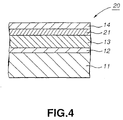
- the optical disc 1 can be produced by a sputtering device, not shown, used for producing the optical disc 10 shown in Fig.2. That is, this disc 10 has a structure which is comprised of a first dielectric film 12, a GdFeCo alloy film 13 and a second dielectric film 14, formed in this order on a silicone wafer 11.
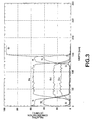
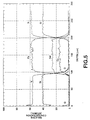
- Fig.3 shows the results of AES analysis performed from the second dielectric film 14.
- the abscissa denotes the depth of a disc 10, with the surface of the second dielectric film 14 being set to 0 nm, and the ordinate denotes the relative concentration of respective elements.
- Fig.6 shows, to an enlarged scale, an interface portion between the second dielectric film 14 and the GdFeCo alloy film 13 in Figs.3 and 5, in order to show only a profile concerning oxygen.
- the oxidized area on an interface between the GdFeCo alloy film 13 and the second dielectric film 14 is approximately 6 nm in thickness, with the oxygen content in the oxidized area being approximately 1.2 atom%.
- the oxygen content of the oxidized area, that is the oxidized layer 21 is approximately 5.8 atom%, with the thickness of the oxidized area, that is the oxidized layer 21, being approximately 7 nm.
- the thickness of the oxidized area was set as the total half-value width of an oxygen identifying peak, while the oxygen content of the oxidized area was set as the peak value of the oxygen identifying peak.
- the optical disc 1 shown in Fig.1 was produced.
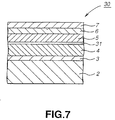
- an optical disc 30 shown in Fig.7 was produced. That is, this optical disc 30 has an oxidized layer 31 of the oxygen content of approximately 5.8 atom% between the first rare earth-transition metal alloy film 4 and the second rare earth-transition metal alloy film 5.
- an optical disc having the oxygen content of the oxidized area of 3.8 atom% was also prepared.
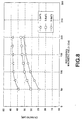
- the relation between the recording magnetic field and the CN ratio was checked.
- the CN ratio of the optical disc 1 is not less than 40 dB, even if the recording magnetic field is as low as approximately 100 Oe.
- the CN ratio of the optical disc 30 is lower at all times than that of the optical disc 1 and is of the order of 35 dB at most.
- the CN ratio of the optical disc having the oxygen content of the oxidized area of 3.8 atom% is at all times lower than that of the optical disc 1, and is of the order of 38 db at most.
- the track pitch is approximately 0.9 ⁇ m and the pit length is 0.45 ⁇ m
- the CN ratio not lower than 40 dB is required for the recording magnetic field of 150 Oe.
- the above-described optical disc 1 meets this condition.
- the CN ratio is significantly lower than 40 db and is approximately 34 dB for the recording magnetic field of 150 Oe.
- the CN ratio is not in excess of 40 dB for the recording magnetic field of 150 Oe, even with the optical disc having the oxygen content of the oxidized area of 3.8 atom%. Therefore, with the optical disc 30, it is not possible to increase the track pitch and the pit length to approximately 0.9 ⁇ m and to 0.45 ⁇ m, respectively, for the purpose of achieving high recording density.
- the optical disc 1 is in meeting with the format for the track pitch of approximately 0.9 ⁇ m and the pit length of approximately 0.45 ⁇ m for achieving high recording density.
- the exchange reciprocal action operates satisfactorily between the first rare earth-transition metal alloy film 4 and the second rare earth-transition metal alloy film 5 to improve magnetic characteristics.
- this reciprocal exchange action operates between rare earth elements or transition elements of the first rare earth-transition metal alloy film 4 and the transition elements or rare earth elements of the second rare earth-transition metal alloy film 5.
- the result is that the first rare earth-transition metal alloy film 4 and the second rare earth-transition metal alloy film 5 permit optimum recording even for a low magnetic field.
- rare earth elements on the interface between the first rare earth-transition metal alloy film 4 and the second rare earth-transition metal alloy film 5 are selectively oxidized, as a result of which the interface between the first rare earth-transition metal alloy film 4 and the second rare earth-transition metal alloy film 5 is transition element rich at the same time as the perpendicular magnetic anisotropic energy constant is lowered. Therefore, with the optical disc 30, the magnetic characteristics are deteriorated, such that recording cannot be achieved satisfactorily for the low magnetic field.
- the CN ratio needs to be in excess of 40 dB for the recording magnetic field of 150 Oe.
- the thickness and threshold values of the oxygen content of the oxidized area formed on the interface between the first rare earth-transition metal alloy film 4 and the second rare earth-transition metal alloy film 5 was checked.
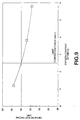
- the oxygen content of the oxidized area was found by preparing a plurality of optical discs, in which the thickness of the oxidized area was constant at X nm and the oxygen content of the oxidized area was varied, and by measuring the CN ratio at the recording magnetic field of 150 Oe for each disc. The results are shown in Fig.9.
- Fig.9 it is when the oxygen content of the oxidized area is 2.5 atom% or lower that the CN ratio at the recording magnetic field of 150 Oe is 40 db or higher. Stated differently, should the oxygen content of the oxidized area of the optical disc 1 be 2.5 atom% or less, optimum recording can be achieved even with the low recording magnetic field.
- the thickness of the oxidized area was found by preparing a plurality of optical discs, in which the oxygen content of the oxidized area was constant at X atom% and the thickness of the oxidized area was varied, and by measuring the CN ratio for the recording magnetic field of 150 Oe of the optical discs. The results are shown in Fig.10.
- the thickness of the oxidized area is 7 nm or less that the CN ratio at the recording magnetic field of 150 Oe is 40 dB or higher. Stated differently, should the thickness of the oxidized area of the optical disc 1 be 7 nm, optimum recording can be achieved even with the low recording magnetic field.
- magnetic characteristics of the first and second rare earth-transition metal alloy films 4, 5 can be improved by setting the oxygen content of the oxidized area formed on the interface between the first and second rare earth-transition metal alloy films 4, 5 to 2.5 atom% and by setting the thickness of this oxidized area to 7 nm or less. That is, if, in the present optical disc 1, the oxygen content and thickness of the oxidized area are set to predetermined values, optimum recording can be realized even with the low recording magnetic field.
- the manufacturing method for an optical disc according to the present invention is applied to manufacturing the above-described optical disc.
- the first dielectric film 3 of Si 3 N 4 is first formed on the disc-shaped substrate 2.
- the first rare earth-transition metal alloy film 4 and the second rare earth-transition metal alloy film 5 are formed in this order.
- the second rare earth-transition metal alloy film 5 is formed in this order to form the optical disc 1.
- thin-film forming techniques such as sputtering or vacuum evaporation, are used for forming the respective layers.
- an oxidized area is formed on an interface between the first rare earth-transition metal alloy film 4 and the second rare earth-transition metal alloy film 5.
- This oxidized area is formed at the time of forming the first rare earth-transition metal alloy film 4 by ambient oxygen or water mixing into the vicinity of the surface of the first rare earth-transition metal alloy film 4. That is, rare earth elements are selectively oxidized to form an oxidized area by oxygen mixing to the interface between the first rare earth-transition metal alloy film 4 and the second rare earth-transition metal alloy film 5.
- the first rare earth-transition metal alloy film 4 and the second rare earth-transition metal alloy film 5 are formed so that the content of oxygen of the oxidized area is 2.5 atom% or less and so that the thickness of the oxidized area will be 7 nm or less.
- the first and second rare earth-transition metal alloy films are formed in a high vacuum chamber using a sputtering method.
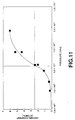
- Fig. 11 shows the relation between the pressure in the chamber and the oxygen content in the oxidized area.
- the pressure in the chamber is preferably not higher than 1.0 X 10 -4 [hPa]. That is, by setting the pressure in the chamber to not higher than 1.0 X 10 -4 [hPa], the oxygen content of the oxidized area can be controlled to be not higher than 2.5 atom%.
- the oxidized area on the interface between the first rare earth-transition metal alloy film 4 and the second rare earth-transition metal alloy film 5 can be formed to a desired state, as discussed previously.
- the present technique since the oxidized area on the interface between the first rare earth-transition metal alloy film 4 and the second rare earth-transition metal alloy film 5 is of the desired oxygen content and of desired thickness, a large exchange reciprocal action can be generated between the first rare earth-transition metal alloy film 4 and the second rare earth-transition metal alloy film 5. This optimizes the magnetic characteristics of the films 4 and 5, so that, with the present technique, an optical disc can be manufactured on which optimum recording can be achieved even with the low recording magnetic field.
Abstract
Description
Claims (4)
- An optical disc comprising:a first rare earth-transition metal alloy film containing rare earth elements and transition elements; anda second rare earth-transition metal alloy film layered on said first rare earth-transition metal alloy film, said second rare earth-transition metal alloy film having a composition different from that of said first rare earth-transition metal alloy film and containing rare earth elements and transition elements; whereinan oxidized area defined between said first rare earth-transition metal alloy film and the second rare earth-transition metal alloy film has an oxygen content not higher than 2.5 atom% and a thickness not larger than 7 nm.
- The optical disc according to claim 1 wherein said first rare earth-transition metal alloy film is a GdFeCo alloy film and wherein said second rare earth-transition metal alloy film is a TbFeCo film.
- A method for producing an optical disc comprising::a step of forming on a substrate a first rare earth-transition metal alloy film containing rare earth elements and transition elements; anda step of forming a second rare earth-transition metal alloy film on said first rare earth-transition metal alloy film so that an oxidized area on an interface between said first rare earth-transition metal alloy film and the second rare earth-transition metal alloy film will be 7 nm or less and so that the oxygen content in an oxidized area will be 2.5 atom% or less.
- The method according to claim 3 wherein said first rare earth-transition metal alloy film and the second rare earth-transition metal alloy film are formed in an atmosphere of 1.0 X 10⁻⁴ [hPa] or less.
Applications Claiming Priority (3)
| Application Number | Priority Date | Filing Date | Title |
|---|---|---|---|
| JP9280824A JPH11120635A (en) | 1997-10-14 | 1997-10-14 | Optical disc and method of manufacturing the same |
| JP280824/97 | 1997-10-14 | ||
| JP28082497 | 1997-10-14 |
Publications (2)
| Publication Number | Publication Date |
|---|---|
| EP0910076A2 true EP0910076A2 (en) | 1999-04-21 |
| EP0910076A3 EP0910076A3 (en) | 2000-11-15 |
Family
ID=17630502
Family Applications (1)
| Application Number | Title | Priority Date | Filing Date |
|---|---|---|---|
| EP98119153A Withdrawn EP0910076A3 (en) | 1997-10-14 | 1998-10-09 | Magneto-optical disc and manufacturing method thereof |
Country Status (3)
| Country | Link |
|---|---|
| US (1) | US6048597A (en) |
| EP (1) | EP0910076A3 (en) |
| JP (1) | JPH11120635A (en) |
Families Citing this family (1)
| Publication number | Priority date | Publication date | Assignee | Title |
|---|---|---|---|---|
| CA2578258C (en) * | 2004-08-25 | 2012-11-13 | Cadbury Adams Usa Llc | Liquid-filled chewing gum composition |
Family Cites Families (14)
| Publication number | Priority date | Publication date | Assignee | Title |
|---|---|---|---|---|
| EP0454858B1 (en) * | 1989-11-10 | 1996-08-14 | Mitsubishi Chemical Corporation | Magnetooptical recording medium |
| JP3122151B2 (en) * | 1991-02-28 | 2001-01-09 | ソニー株式会社 | Magneto-optical recording medium |
| JP2929745B2 (en) * | 1991-03-11 | 1999-08-03 | 富士通株式会社 | Method for manufacturing magneto-optical recording medium |
| US5637411A (en) * | 1991-07-29 | 1997-06-10 | Hitachi Maxell, Ltd. | Magneto-optical recording medium and process for producing the same |
| JPH0689474A (en) * | 1992-05-26 | 1994-03-29 | Nec Corp | Production of magneto-optical recording medium |
| JPH0684213A (en) * | 1992-09-03 | 1994-03-25 | Seiko Epson Corp | Magneto-optical recording medium and its production |
| JPH06333285A (en) * | 1993-03-22 | 1994-12-02 | Tosoh Corp | Magneto-optical recording medium and manufacturing method thereof |
| JPH06333280A (en) * | 1993-05-25 | 1994-12-02 | Nikon Corp | Magneto-optical recording medium which enables overwriting |
| US5577020A (en) * | 1993-10-08 | 1996-11-19 | Tdk Corporation | Magneto-optical disc with intermediate film layer between a recording film and a dielectric film |
| JP3414823B2 (en) * | 1994-03-15 | 2003-06-09 | 富士通株式会社 | Magneto-optical recording medium |
| US6061307A (en) * | 1994-05-10 | 2000-05-09 | Hitachi Maxell, Ltd. | Magneto-optical recording medium having a plurality of magnetic layers |
| JPH09120595A (en) * | 1995-10-23 | 1997-05-06 | Sharp Corp | Magneto-optical recording medium |
| JP3359804B2 (en) * | 1996-01-22 | 2002-12-24 | シャープ株式会社 | Magneto-optical recording medium and magneto-optical recording method using the same |
| JP3452451B2 (en) * | 1996-10-25 | 2003-09-29 | シャープ株式会社 | Magneto-optical recording medium and magneto-optical recording method |
-
1997
- 1997-10-14 JP JP9280824A patent/JPH11120635A/en not_active Abandoned
-
1998
- 1998-10-09 EP EP98119153A patent/EP0910076A3/en not_active Withdrawn
- 1998-10-13 US US09/169,992 patent/US6048597A/en not_active Expired - Fee Related
Also Published As
| Publication number | Publication date |
|---|---|
| EP0910076A3 (en) | 2000-11-15 |
| JPH11120635A (en) | 1999-04-30 |
| US6048597A (en) | 2000-04-11 |
Similar Documents
| Publication | Publication Date | Title |
|---|---|---|
| US5939187A (en) | Magneto-optical recording medium | |
| US4975339A (en) | Magneto-optical recording medium with at least one protective layer containing platinum and/or palladium | |
| EP0282356B1 (en) | Magneto-optical recording medium and method | |
| US4837118A (en) | Magneto-optical recording medium | |
| US5901118A (en) | Magneto-optical recording medium having a readout layer and a recording layer | |
| US5639563A (en) | Magneto-optical recording medium | |
| JP2504946B2 (en) | Magneto-optical recording medium | |
| US6048597A (en) | Optical device and manufacturing method thereof | |
| JP2620088B2 (en) | Magneto-optical recording element and manufacturing method thereof | |
| EP0674310B1 (en) | Magneto-optical recording medium and method of producing the same | |
| JP2770515B2 (en) | Magneto-optical recording medium and method of manufacturing the same | |
| KR100209584B1 (en) | Magneto-optical disk | |
| JP3794596B2 (en) | Magneto-optical recording medium | |
| JP4312425B2 (en) | Magneto-optical recording medium | |
| JP3592399B2 (en) | Magneto-optical recording medium | |
| JPH05217226A (en) | Magneto-optical recording medium | |
| JPH07141709A (en) | Magneto-optical recording medium | |
| JPS63104243A (en) | Magneto-optical recording element | |
| JP2001014746A (en) | Magneto-optical recording medium | |
| JPH1173696A (en) | Magneto-optical recording medium | |
| US20050190658A1 (en) | Magneto-optical recording medium, and method for fabricating the same | |
| JPH08315435A (en) | Magneto-optical recording medium | |
| JPH10334528A (en) | Magneto-optical recording medium | |
| JPH0810498B2 (en) | Magneto-optical recording element | |
| JPH06131717A (en) | Magneto-optical recording medium |
Legal Events
| Date | Code | Title | Description |
|---|---|---|---|
| PUAI | Public reference made under article 153(3) epc to a published international application that has entered the european phase |
Free format text: ORIGINAL CODE: 0009012 |
|
| AK | Designated contracting states |
Kind code of ref document: A2 Designated state(s): DE FR GB |
|
| AX | Request for extension of the european patent |
Free format text: AL;LT;LV;MK;RO;SI |
|
| PUAL | Search report despatched |
Free format text: ORIGINAL CODE: 0009013 |
|
| AK | Designated contracting states |
Kind code of ref document: A3 Designated state(s): AT BE CH CY DE DK ES FI FR GB GR IE IT LI LU MC NL PT SE |
|
| AX | Request for extension of the european patent |
Free format text: AL;LT;LV;MK;RO;SI |
|
| 17P | Request for examination filed |
Effective date: 20010417 |
|
| AKX | Designation fees paid |
Free format text: DE FR GB |
|
| STAA | Information on the status of an ep patent application or granted ep patent |
Free format text: STATUS: THE APPLICATION HAS BEEN WITHDRAWN |
|
| 18W | Application withdrawn |
Effective date: 20031210 |