EP0910196A1 - Übertragung elektronischer Post zwischen einem Server unt einem Modem - Google Patents
Übertragung elektronischer Post zwischen einem Server unt einem Modem Download PDFInfo
- Publication number
- EP0910196A1 EP0910196A1 EP98402296A EP98402296A EP0910196A1 EP 0910196 A1 EP0910196 A1 EP 0910196A1 EP 98402296 A EP98402296 A EP 98402296A EP 98402296 A EP98402296 A EP 98402296A EP 0910196 A1 EP0910196 A1 EP 0910196A1
- Authority
- EP
- European Patent Office
- Prior art keywords
- modem
- server
- terminal
- message
- electronic
- Prior art date
- Legal status (The legal status is an assumption and is not a legal conclusion. Google has not performed a legal analysis and makes no representation as to the accuracy of the status listed.)
- Withdrawn
Links
- 230000005540 biological transmission Effects 0.000 title claims description 21
- 238000000034 method Methods 0.000 claims abstract description 24
- 230000004044 response Effects 0.000 claims abstract description 6
- 230000006835 compression Effects 0.000 claims description 4
- 238000007906 compression Methods 0.000 claims description 4
- 102100036409 Activated CDC42 kinase 1 Human genes 0.000 description 3
- 101000928956 Homo sapiens Activated CDC42 kinase 1 Proteins 0.000 description 3
- 238000010586 diagram Methods 0.000 description 3
- 101100288236 Arabidopsis thaliana KRP4 gene Proteins 0.000 description 2
- 101100433979 Bos taurus TNK2 gene Proteins 0.000 description 2
- 101100385394 Zea mays ACK2 gene Proteins 0.000 description 2
- 230000015556 catabolic process Effects 0.000 description 2
- 230000006837 decompression Effects 0.000 description 1
- 230000006870 function Effects 0.000 description 1
- 230000011664 signaling Effects 0.000 description 1
- 230000001502 supplementing effect Effects 0.000 description 1
- 230000001960 triggered effect Effects 0.000 description 1
Images
Classifications
-
- H—ELECTRICITY
- H04—ELECTRIC COMMUNICATION TECHNIQUE
- H04M—TELEPHONIC COMMUNICATION
- H04M11/00—Telephonic communication systems specially adapted for combination with other electrical systems
- H04M11/06—Simultaneous speech and data transmission, e.g. telegraphic transmission over the same conductors
-
- H—ELECTRICITY
- H04—ELECTRIC COMMUNICATION TECHNIQUE
- H04L—TRANSMISSION OF DIGITAL INFORMATION, e.g. TELEGRAPHIC COMMUNICATION
- H04L51/00—User-to-user messaging in packet-switching networks, transmitted according to store-and-forward or real-time protocols, e.g. e-mail
- H04L51/42—Mailbox-related aspects, e.g. synchronisation of mailboxes
Definitions
- the present invention relates to a method for transmitting email between a server and a modem across a network telecommunications.
- the server is typically a server of service provider, such as an Internet access server.
- the modem makes it possible to connect one or more computer terminals, or computers, on the telecommunications network.
- the first terminal first establishes a communication with a service provider server for forward the e-mail message and e-mail address to the latter from the second terminal.
- the server stores the email message, which can be read later by the second terminal. So the messages electronic messages intended for a terminal cannot be received at the terminal only when it is on. This entails risks of loss of messages, especially when the terminal user is absent for a long period of time and can only consult during this period his email stored in the provider server services. In such a case, in fact, part of his email can be deleted by the service provider to free up space by memory in the server.
- Modems currently available on the market are capable receive and store representative fax data or voice messages, regardless of the terminal on / off state to which they are connected.
- These modems such as the "Self-memory" modem 33600 “(registered trademark) manufactured by the French company OLITEC, one of the present plaintiffs, have a memory which stores the data received even when the associated terminal is switched off. The data stored in the modem is then supplied to the terminal either automatically when the latter is started, or on request of the terminal after switching on.
- modems are mainly designed for the storage of data, such as faxes or voice messages, which are directly transmitted through the telecommunications network public switched from a calling terminal.
- the method further includes a step of transmitting to the computer said at least one electronic message stored in the modem.
- computer status means either that the computer is not physically connected to the modem, or that it is connected physically to the modem and turned on, that is, it is physically connected to the modem and off.
- the server memorizes the email received from the same regardless of the recipient of this mail, and waits in all cases of being asked to forward this email to the recipient subscriber.
- the server can therefore be designed to process indifferently requests coming from modems or terminals.
- the email message stored in the modem is retrieved by the computer after it has been started up, either automatically upon switching on, or on request from the computer.
- the predetermined time is stored in the modem and can be programmed by a modem user. This moment is understood by example in a period of low pricing for communications on the telecommunications network and / or during a period when the server is little used. So the modem can quickly retrieve and store electronic messages while minimizing communication costs.
- the steps of transmitting the message to the modem and storing the email in the modem are implemented for the electronic message only if the latter has a size at most equal to a maximum size preselected by a user. This avoids memorizing too much long messages in the modem which would clutter the memory of this one.
- the email message identifier includes the size of the message and optionally a title for it.
- the step of interrogation of the server by the modem includes the following steps: establishing a communication between the modem and the server through the telecommunications network to the predetermined instant and regardless of the state of the computer, and transmission from the modem to the server of at least one identifier a modem and / or computer user.
- the aforementioned identifier includes for example an access code and / or a password.
- a step of automatic breakdown of communication between the modem and the server can be scheduled after the memorization step of the email message in the modem. Communication breakdown can be performed at the initiative of the server or the modem.
- the step of memorizing the electronic message is preceded by a step of compressing the electronic message in the modem, in order to optimize the occupation of the memory storing the e-mail messages in the modem. Decompression of electronic message is then implemented by the modem immediately before the e-mail message is retrieved by the terminal.
- the process according to the invention can also comprise a step of deleting the electronic message in the server after the step of memorizing the electronic message in the modem.
- the modem includes means for transmitting the electronic message to terminal.
- the modem may also include means for compressing the electronic message before storing the message electronic by means of storage.
- the interrogation means includes means for establish communication at the predetermined time between the modem and the server through the telecommunications network regardless of the state of the terminal, and a means for transmitting at least one identifier from a modem and / or terminal user to the server.
- a means can then be provided in the modem to break the communication between the modem and the server after the message electronics received and stored by the modem.
- the modem may further include a means for transmitting the server a maximum size indicating that no e-mail message larger than the maximum size must not be transmitted to the modem, and / or a means to accept or refuse the transmission from the server to the modem of an email message based on a size of this message previously received from the server.
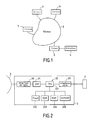
- a service provider server 1 and a modem 2 are connected to a telecommunications network 3, such as the network public switched telephone network, the integrated digital network services (ISDN) or an X25 type network.
- a terminal 4 of the microcomputer type PC (Personal Computer) is connected to modem 2.
- the server service provider 1 is for example a network access server Internet, and contains mailboxes to store electronic messages (in English: E-mails) received on the network Internet and intended for service provider subscribers corresponding.
- the user of terminal 4 is subscribed to the Internet with said service provider, and can in particular exchange, via the server 1, email messages with other subscribers using terminals 5 each equipped with a modem (not shown).
- Electronic messages from terminals 5 and intended at terminal 4 are thus stored in the provider server of services 1.
- the user of this terminal can consult his email stored in the server 1.
- the terminal user 4 can also send e-mail messages to others terminals 5 via server 1.
- the modem 2 when the modem 2 is not used for transmitting / receiving data, i.e. for example when the terminal 4 is off, or is on but is not communicating on the telecommunications network 3, the modem 2 interrogates the server 1 at predetermined times, independently of the associated terminal 4, so to consult the electronic mail addressed to terminal 4. This electronic mail electronics is then downloaded and then stored in modem 2, to be subsequently transmitted to terminal 4, for example at the request of this terminal.
- Modem 2 includes a line interface 20, a signal processing processor 21, a management unit 22 and a serial interface 23.
- the line interface 20 makes it possible to adapt the modem 2 to the network of telecommunication 3.
- the signal processing processor 21, of the type DSP (Digital Signal Processor), provides the classic functions of modulation and demodulation of the modem 2.
- the management unit 22 manages on the one hand the transmission and reception of data in the same way as in a conventional modem, and on the other hand the interrogation of server 1, storing received electronic messages and transmitting electronic messages stored in terminal 4.
- the serial interface 23 used to connect terminal 4 to modem 2.
- the management unit 22 mainly includes a microprocessor 221, a non-volatile memory 222, of Flash type, for storing the received e-mail messages, ROM read only memory Memory) 223 containing modem management programs executed by microprocessor 221, a random access memory RAM (Random Access Memory) 224 to temporarily store data for execution of management programs, and non-volatile memory programmable EEPROM (Electrical Erasable Programmable Read Only Memory) 225 whose role is explained below.
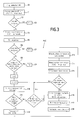
- FIG 3 shows an ALG mail transmission algorithm electronics according to the invention, implemented in part by the microprocessor 221 of modem 2 and partly by the server service provider 1.
- the first access code CA1 and the first password MP1 constitute identifiers of the electronic mail service set up works by the server 1 in accordance with the invention. More precisely, when server 1 receives the code CA1 and the password MP1, it recognizes that the caller wants to retrieve their email.
- the second access code CA2 and the second password MP2 are identifiers of the user of modem 2 and terminal 4, and therefore of the mailbox associated with this user in the server 1.
- the access code CA2 and the password MP2 can be identical to those normally dialed by the user on terminal 4 to connect to the Internet via the service provider server 1.
- the instants T correspond to one or more hours of the day chosen according to specific criteria by the user. Typically, instants T are included in low pricing periods for communications on the telecommunications network 3.
- the tmax size parameter allows the user to manage occupying memory 222 and preventing messages that are too long clutter memory.
- the tmax parameter can however have a value which means "unlimited size”.
- the modem 2 interrogates server 1 to consult any messages electronic devices stored for terminal 4 in the server.
- the modem 2 dials the NT telephone number of server 1, at an instant predetermined T, and independently of the terminal 4.
- the server 1 responds by sending a signaling message of type to modem 2 "CONNECTION" to connect the server 1 and the modem 2 through telecommunication network 3.
- Server 1 invites by elsewhere the modem 2 to provide him with an access code and a password.
- the first access code CA1 and the first password MP1 are then transmitted by the modem 2 to the server 1 then verified by the latter. If, at a step E2, one of the elements CA1 and MP1 is not recognized by the server, the ALG algorithm is terminated at a step E3 by sending from server 1 to modem 2 an error message such as "code incorrect access and / or password ”followed by the breach of the communication between modem 2 and server 1.
- the error message mentioned above is stored in modem 2, to be supplied to terminal 4 following, for example, a request from the latter.
- the server 1 opens this service and transmits an ACK1 acknowledgment signal to modem 2 in one step E4.
- the modem 2 transmits an options frame TO to server 1.
- the TO options frame contains the second access code CA2, the second password MP2, the maximum desired size tmax of email messages, as well as the first and second parameters P1 and P2 options.
- a step E6 the server 1 checks the access code CA2 and the word MP2 password. If one of the elements CA2, MP2 is not recognized by the server 1, the ALG algorithm is terminated in step E7 by sending from server 1 to modem 2 an error message such as "code access and / or password unknown ”followed by the breach of the communication between modem 2 and server 1.
- the error message mentioned above is stored in modem 2, to be supplied to terminal 4 following, for example, a request from the latter.
- server 1 determines in a step E8 if there are messages size less than or equal to the maximum size desired tmax in the mailbox associated with this user. If none message of size less than or equal to size tmax is not present in this mailbox, the ALG algorithm is terminated in step E9 by sending an end message from server 1 to modem 2 followed by broken communication between the modem and the server. The message above is stored in modem 2, to then be supplied at terminal 4.
- This end message is of the “no message” type if none message, even of any size, is only stored in server 1 for the user of modem 2. On the other hand, if there are messages in the server 1 for the modem user 2 which are larger than the size tmax, and if the first option parameter P1 is at the first value, the end message -contains a list of these messages, and indicates including the size of each of these messages.
- step E8 If, in step E8, there are large electronic messages less than or equal to the size tmax for terminal 4 in server 1, then a loop comprising steps E10 to E14 is implemented for each of these messages.
- the server 1 transmits the size of the message to modem 2.
- modem 2 indicates to the server 1 whether or not it accepts the message. Modem 2 can in particular refuse the message if before (during loops E10-E14 previous) it has already received a large number of messages and the maximum memory capacity 222 would be exceeded if it also received this message. If the message is refused in step E11, the server 1 sends at modem 2 the size of the next message, and so on.
- step E11 the server 1 transmits this message to modem 2 in step E12.
- Representative data from messages are demodulated by the DSP 21 processor and then compressed by the microprocessor 221 in step E13, to be stored in the Flash memory 222 in step E14.
- the compression performed in step E13 is based on a known compression technique, for example a compression technique known as "Lempel and Ziv”.
- modem 2 returns an acknowledgment signal ACK2 to server 1. If the second P2 option parameter is at the third value, the message transmitted by the server 1 to the modem 2 is deleted, at a step E15, in the box letters associated with modem 2 from server 1 in response to reception by the ACK2 acknowledgment signal server.
- a list (of the respective sizes) of messages remaining in server 1 for the user is forwarded to modem 2 at a step E16 if the first option parameter P1 is at the first value.
- the messages remaining in the server are either messages larger than the tmax size, i.e. messages that have been refused by the modem in step E11.
- the messages remaining in the server can be consulted later by the user via the terminal 4.
- step E17 the communication between the modem 2 and server 1 is broken, then the ALG algorithm returns to step E1, which will be implemented at the next instant T stored in the modem 2.
- the terminal 4 recovers the messages electronics stored in memory 222 of modem 2 at an instant which terminal 4 is on but is not in communication on the network 3.
- a appropriate program is launched, automatically or under command user, to retrieve stored email messages in modem 2.
- Electronic messages retrieved by the terminal 4 are preferably integrated into a software database usually used by terminal 4 to communicate on the network Internet.
- the modem 2 can also directly break communication with server 1 (step E17) after step E10, before the size of all messages of smaller size or equal to tmax have been transmitted to it, if the memory capacity 222 is reached or almost reached.
- modem 2 can interrogate server 1 at predetermined times T when modem 2 is not requested by terminal 4.
- Significant interest in the process according to the invention is to be able to go and recover, at instants selected, e-mail in server 1 while terminal 4 is off.
- email can also be retrieved by modem 2 while terminal 4 is on but is not in communication on the telecommunications network 3.
- the terminal 4 requests modem 2 to communicate on the telecommunication 3, or the Internet, while the ALG algorithm is running, the ALG algorithm is completed, that is to say until reaching one of the stages E7, E9 and E17.
- terminal 4 is in communication on the telecommunications network 3 via modem 2 at one of the predetermined times T stored in the modem, priority is given to communication in course, and the ALG algorithm is not triggered at this time.
- modem 2 cannot trigger step E1 at time T, either because the modem is already requested by terminal 4 for a communication on network 3 as indicated above, either because the telecommunication line serving server 1 is busy, the modem 2 retries to poll server 1 at time intervals regular, at most up to a predetermined number of attempts. In practical, 3 or 4 attempts to interrogate the server in 3 or 4 minutes interval can be performed by the modem. The duration of regular time intervals and the predetermined number of attempts can be included in user-programmed PR parameters at the preliminary stage E0.
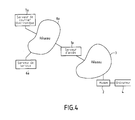
- FIG 4 shows a second embodiment of the invention.
- the same references as in Figure 1 are used to designate identical elements.
- the second embodiment of the invention differs from that shown in Figure 1 in that multiple provider servers services 1a, 6a and 7a are used.
- Servers 1a, 6a and 7a are respectively a remote access server, a service server and a mail server.
- Servers 1a, 6a and 7a are linked between them through a telecommunication network 8a, comprising by example a local area network LAN (Local Area Network) and / or a WAN (Wide Area Network) long distance network.
- Server 1a is connected to the telecommunications network 3.
- the networks of telecommunications 3 and 8a can be partially confused.
- the messages received by the service provider over the Internet for service provider subscribers are stored in the server e-mail 7a and not in the remote access server la.
- the mail server 7a can also be a server from a service provider other than that of server 1a.
Landscapes
- Engineering & Computer Science (AREA)
- Computer Networks & Wireless Communication (AREA)
- Signal Processing (AREA)
- Telephonic Communication Services (AREA)
- Data Exchanges In Wide-Area Networks (AREA)
- Information Transfer Between Computers (AREA)
Applications Claiming Priority (2)
| Application Number | Priority Date | Filing Date | Title |
|---|---|---|---|
| FR9711745 | 1997-09-22 | ||
| FR9711745A FR2762949B1 (fr) | 1997-09-22 | 1997-09-22 | Transmission de courrier electronique entre un serveur et un modem |
Publications (1)
| Publication Number | Publication Date |
|---|---|
| EP0910196A1 true EP0910196A1 (de) | 1999-04-21 |
Family
ID=9511315
Family Applications (1)
| Application Number | Title | Priority Date | Filing Date |
|---|---|---|---|
| EP98402296A Withdrawn EP0910196A1 (de) | 1997-09-22 | 1998-09-17 | Übertragung elektronischer Post zwischen einem Server unt einem Modem |
Country Status (2)
| Country | Link |
|---|---|
| EP (1) | EP0910196A1 (de) |
| FR (1) | FR2762949B1 (de) |
Cited By (1)
| Publication number | Priority date | Publication date | Assignee | Title |
|---|---|---|---|---|
| GB2355132A (en) * | 1999-09-01 | 2001-04-11 | Inventec Corp | Electronic mail message checking system |
Families Citing this family (1)
| Publication number | Priority date | Publication date | Assignee | Title |
|---|---|---|---|---|
| GB9923197D0 (en) * | 1999-10-01 | 1999-12-01 | Wilson Gordon M | Apparatus for internet access |
Citations (6)
| Publication number | Priority date | Publication date | Assignee | Title |
|---|---|---|---|---|
| WO1990003074A1 (fr) * | 1988-09-06 | 1990-03-22 | Capricom S.A. | Systeme d'avertissement automatique de la reception de messages dans un systeme de messagerie electronique |
| WO1990014726A1 (en) * | 1989-05-22 | 1990-11-29 | Leslie Hatton | Apparatus for forwarding a message |
| LU88213A1 (fr) * | 1993-01-18 | 1994-09-09 | Guy Felten | Centre de communication pour ordinateurs |
| US5548789A (en) * | 1991-01-24 | 1996-08-20 | Canon Kabushiki Kaisha | Message communication processing apparatus for selectively converting storing and transmitting messages of different lengths |
| WO1997001919A1 (en) * | 1995-06-26 | 1997-01-16 | Wang Kevin Kuan Pin | Ever ready telephonic answering machine for receiving and delivering electronic messages |
| WO1997017765A2 (en) * | 1995-11-07 | 1997-05-15 | Cooper R Ross | Internet answering machine |
-
1997
- 1997-09-22 FR FR9711745A patent/FR2762949B1/fr not_active Expired - Fee Related
-
1998
- 1998-09-17 EP EP98402296A patent/EP0910196A1/de not_active Withdrawn
Patent Citations (6)
| Publication number | Priority date | Publication date | Assignee | Title |
|---|---|---|---|---|
| WO1990003074A1 (fr) * | 1988-09-06 | 1990-03-22 | Capricom S.A. | Systeme d'avertissement automatique de la reception de messages dans un systeme de messagerie electronique |
| WO1990014726A1 (en) * | 1989-05-22 | 1990-11-29 | Leslie Hatton | Apparatus for forwarding a message |
| US5548789A (en) * | 1991-01-24 | 1996-08-20 | Canon Kabushiki Kaisha | Message communication processing apparatus for selectively converting storing and transmitting messages of different lengths |
| LU88213A1 (fr) * | 1993-01-18 | 1994-09-09 | Guy Felten | Centre de communication pour ordinateurs |
| WO1997001919A1 (en) * | 1995-06-26 | 1997-01-16 | Wang Kevin Kuan Pin | Ever ready telephonic answering machine for receiving and delivering electronic messages |
| WO1997017765A2 (en) * | 1995-11-07 | 1997-05-15 | Cooper R Ross | Internet answering machine |
Cited By (1)
| Publication number | Priority date | Publication date | Assignee | Title |
|---|---|---|---|---|
| GB2355132A (en) * | 1999-09-01 | 2001-04-11 | Inventec Corp | Electronic mail message checking system |
Also Published As
| Publication number | Publication date |
|---|---|
| FR2762949B1 (fr) | 2000-08-04 |
| FR2762949A1 (fr) | 1998-11-06 |
Similar Documents
| Publication | Publication Date | Title |
|---|---|---|
| EP0438098B1 (de) | Schutzverfahren gegen Überlastung der Besucherdatei eines zellularen Funktelefonsystems | |
| US5903627A (en) | System and method for improving delivery of messages to a messaging system | |
| EP1087321A1 (de) | Verfahren zum Manipulieren einer bereits gesendeten elektronischen Postsendung und dafür geeigneter Server | |
| EP0631452B1 (de) | Verwaltungsverfahren eines Botschaftensystems für Zellularfunknachrichtensystem | |
| WO2004028108A2 (en) | Method for archiving multimedia messages | |
| EP2792176B1 (de) | Verwaltung der konnektivität eines endgeräts | |
| KR100472441B1 (ko) | 인터넷 메일장치의 선택된 전자메일 수신방법 | |
| EP1636975B1 (de) | Terminal und server zum synchronisieren von kontakten | |
| GB2355132A (en) | Electronic mail message checking system | |
| FR2762949A1 (fr) | Transmission de courrier electronique entre un serveur et un modem | |
| FR2814623A1 (fr) | Procede pour mettre en relation deux terminaux, a travers un reseau informatique, terminal et serveur de mise en relation associes | |
| EP1435154B1 (de) | Kommunikationsplattform an bord eines fahrzeugs | |
| EP1058887A2 (de) | Privates insformationssystem und verschiedene gebrauchsverfahren dafür | |
| EP1065866A1 (de) | Verfahren und Vorrichtung zur Steuerung des Zugriffs auf Dienstleistungen in einem Telekommunikationsendgerät | |
| FR2805114A1 (fr) | Procede de configuration d'un terminal pour communiquer a travers un reseau informatique, terminal universel pour la mise en oeuvre du procede et procede de standardisation des fabricants de stockage du terminal | |
| WO2002063854A2 (fr) | Procede et equipement pour l'activation d'une fonction de communication d'informations par un equipement distant | |
| WO2007042720A2 (fr) | Notification de reception de messages asynchrones | |
| EP2146494B1 (de) | Verwaltungsverfahren von persönlichen Multimediadaten in einem Funknetz und entsprechende Anlage | |
| EP1820328B1 (de) | Einheitliches anruflogbuchverfahren und system | |
| WO2004049653A1 (fr) | Procede de gestion de messages, systeme et entites de communication pour la mise en oeuvre du procede | |
| EP1914946B1 (de) | Verfahren zur Übertragung von Nachrichten auf ein mobiles Endgerät, dazugehöriger Server und dazugehöriges Computerprogrammprodukt | |
| WO2012035236A1 (fr) | Gestion de l'acces au statut d'une ressource | |
| EP2569927A1 (de) | Übertragung eines anrufes von einem festen, an ein lokales netz angeschlossenen kommunikationsendgerät an ein mobiles kommunikationsendgerät mit anschluss an ein mobiles netz | |
| FR2805113A1 (fr) | Procede de configuration d'un terminal pour communiquer a travers un reseau informatique | |
| WO1999034562A1 (fr) | Procede de communication entre deux terminaux d'un reseau informatique tel que l'internet |
Legal Events
| Date | Code | Title | Description |
|---|---|---|---|
| PUAI | Public reference made under article 153(3) epc to a published international application that has entered the european phase |
Free format text: ORIGINAL CODE: 0009012 |
|
| AK | Designated contracting states |
Kind code of ref document: A1 Designated state(s): BE CH DE GB IE IT LI LU MC NL SE |
|
| AX | Request for extension of the european patent |
Free format text: AL;LT;LV;MK;RO;SI |
|
| 17P | Request for examination filed |
Effective date: 19991018 |
|
| AKX | Designation fees paid |
Free format text: BE CH DE GB IE IT LI LU MC NL SE |
|
| STAA | Information on the status of an ep patent application or granted ep patent |
Free format text: STATUS: THE APPLICATION IS DEEMED TO BE WITHDRAWN |
|
| 18D | Application deemed to be withdrawn |
Effective date: 20020403 |