EP0910859B1 - Schaltgerät wie umpolschalter für eine elektrische anlage - Google Patents
Schaltgerät wie umpolschalter für eine elektrische anlage Download PDFInfo
- Publication number
- EP0910859B1 EP0910859B1 EP97947093A EP97947093A EP0910859B1 EP 0910859 B1 EP0910859 B1 EP 0910859B1 EP 97947093 A EP97947093 A EP 97947093A EP 97947093 A EP97947093 A EP 97947093A EP 0910859 B1 EP0910859 B1 EP 0910859B1
- Authority
- EP
- European Patent Office
- Prior art keywords
- control shaft
- switchgear
- switchgear according
- control
- block
- Prior art date
- Legal status (The legal status is an assumption and is not a legal conclusion. Google has not performed a legal analysis and makes no representation as to the accuracy of the status listed.)
- Expired - Lifetime
Links
- 238000010616 electrical installation Methods 0.000 title claims description 3
- 238000009434 installation Methods 0.000 claims description 6
- 238000009825 accumulation Methods 0.000 claims description 5
- 238000013519 translation Methods 0.000 description 7
- 238000004519 manufacturing process Methods 0.000 description 3
- 230000007246 mechanism Effects 0.000 description 3
- 230000004048 modification Effects 0.000 description 3
- 238000012986 modification Methods 0.000 description 3
- 230000007935 neutral effect Effects 0.000 description 3
- 230000008878 coupling Effects 0.000 description 2
- 238000010168 coupling process Methods 0.000 description 2
- 238000005859 coupling reaction Methods 0.000 description 2
- 238000005520 cutting process Methods 0.000 description 2
- 230000009467 reduction Effects 0.000 description 2
- 125000006850 spacer group Chemical group 0.000 description 2
- 208000031968 Cadaver Diseases 0.000 description 1
- 230000009471 action Effects 0.000 description 1
- 230000005540 biological transmission Effects 0.000 description 1
- 230000000295 complement effect Effects 0.000 description 1
- 239000004020 conductor Substances 0.000 description 1
- 238000013461 design Methods 0.000 description 1
- 238000006073 displacement reaction Methods 0.000 description 1
- 238000009826 distribution Methods 0.000 description 1
- 238000012423 maintenance Methods 0.000 description 1
- 238000000034 method Methods 0.000 description 1
- 238000012544 monitoring process Methods 0.000 description 1
- 238000005457 optimization Methods 0.000 description 1
- 238000003860 storage Methods 0.000 description 1
Images



Classifications
-
- H—ELECTRICITY
- H01—ELECTRIC ELEMENTS
- H01H—ELECTRIC SWITCHES; RELAYS; SELECTORS; EMERGENCY PROTECTIVE DEVICES
- H01H19/00—Switches operated by an operating part which is rotatable about a longitudinal axis thereof and which is acted upon directly by a solid body external to the switch, e.g. by a hand
- H01H19/54—Switches operated by an operating part which is rotatable about a longitudinal axis thereof and which is acted upon directly by a solid body external to the switch, e.g. by a hand the operating part having at least five or an unspecified number of operative positions
- H01H19/60—Angularly-movable actuating part carrying no contacts
- H01H19/635—Contacts actuated by rectilinearly-movable member linked to operating part, e.g. by pin and slot
-
- H—ELECTRICITY
- H01—ELECTRIC ELEMENTS
- H01H—ELECTRIC SWITCHES; RELAYS; SELECTORS; EMERGENCY PROTECTIVE DEVICES
- H01H11/00—Apparatus or processes specially adapted for the manufacture of electric switches
- H01H11/0006—Apparatus or processes specially adapted for the manufacture of electric switches for converting electric switches
-
- H—ELECTRICITY
- H01—ELECTRIC ELEMENTS
- H01H—ELECTRIC SWITCHES; RELAYS; SELECTORS; EMERGENCY PROTECTIVE DEVICES
- H01H9/00—Details of switching devices, not covered by groups H01H1/00 - H01H7/00
- H01H9/0066—Auxiliary contact devices
Definitions
- the present invention relates to a breaking device such as a change-over switch for an electrical installation, this device comprising at least two superimposed cut-off blocks, each cut-off block comprising at least two pairs of terminals intended to be connected to at least two phases of said phase installation, at least two pairs of fixed contacts coupled to said terminals and to at least two movable contacts with two stable positions, one closed position in which each movable contact connects the fixed contacts of the same pair to establish the passage of electric current and an open position in which each contact mobile separates said fixed contacts to interrupt the passage of said current electric, the movable contacts being mounted on a common movable bar arranged to move in translation, said apparatus also comprising at least two actuating blocks, each being arranged to move said movable bar of the block corresponding cutoff, and a control block provided with a control shaft can be coupled to a handle and arranged to simultaneously control said actuation blocks.
- a breaking device such as a change-over switch for an electrical installation
- this device comprising at least two superimposed cut
- Such switching devices are generally used for electrical distribution at low voltage single-phase, three-phase or four-phase, the intensity ranging from a few tens to several hundred amps. they ensure the switching, the inversion of source or load swap of two low voltage power circuits as well as their safety sectioning.
- a switching device equivalent to a change-over switch two switches are superimposed in known manner standards placed in the same direction, each consisting of a cut-off block, its actuation block and its control block, which requires having the all parts in duplicate. Then we couple the control handle of the upper switch to the two actuation blocks by extending the shaft of control of said control block by a specific shaft extension, the points connecting rods provided in the actuation blocks being modified on the shaft control.
- the handle can have three stable positions, a middle position "0" and two positions "I", "II” on either side of the middle position, for example at - 65 ° and at + 65 °.
- Reversing switches of this type allow only only two switching combinations: in the first combination, one of the switches is closed when the other is open and, in the middle position, both switches are open. In the second combination, one of the switches is closed when the other is open and, in the middle position, the two switches are closed simultaneously.
- the object of the present invention is to overcome the drawbacks mentioned above by making a breaking device, such as a change-over switch, in which the actuation block and the control block were the subject value analysis and have been optimized to reduce the number of coins and necessary references, facilitate assembly, allow realization simply and at lower cost of a "bypass" type device or a 6 or 8 pole device. Moreover, the optimization of said blocks makes it possible to offer a number of combinations of switching greater than two. As a result, a cutting device is obtained having a best value for money with new features.
- the reduction and simplification of the number of parts and references favor the reduction of the price of returns from the set and simplifies management. For example, the number of pieces and of references can be divided by three compared to standard switching devices.
- a switching device as defined in the preamble and characterized in that the actuating blocks overlap back to back and are arranged between the cut-off blocks reversed with respect to each other.
- the actuation blocks may each include a housing provided with at least one bottom, the two housings being arranged to fit into each other at their bottom or may include a single and common housing provided with at least one wall central unit constituting the bottom of each actuation block.
- each actuation block comprises at least one connecting rod coupled at one of its ends to the control shaft and a drive rod pivotally mounted about a fixed central axis on said housing and coupled on the one hand to the free end of the connecting rod and on the other hand to the bar mobile of the corresponding cut-off block.
- each actuation block includes an accumulation device energy in the form of a spring provided with two free ends, one being integral with the housing and the other with the drive rod, this spring making it possible to quickly switch the corresponding switch block.
- the drive rod is preferably coupled to the bar by at least one post housed in a corresponding recess provided in said bar and delimited by two stops, this tenon being integral with the corresponding free end of the spring.
- the drive rod is coupled to the rod by at least a first pin, this pin being guided in a first groove provided in said housing and extending over an arc centered on the axis of pivoting of said drive rod.
- the groove can extend over an angular sector slightly less than 180 °, the housing having a second identical groove, diametrically opposite, arranged to guide a second pin provided on the drive rod opposite the first journal.
- the connecting rod, the drive rod and the spring are removable parts, their configuration being modifiable so as to create several switching combinations between the two switching blocks.
- control shaft is guided in rotation in the body of said control unit and is coupled to an accessible handle outside the device, this control shaft being coupled to the connecting rods of the two actuation blocks at two separate pivot points.
- the control shaft advantageously comprises two opposite, parallel disks between them and perpendicular to the axis of rotation Y of the control shaft, each disc comprising at least one pivot arranged to be housed in a housing suitable provided in the corresponding connecting rod.
- the housing provided in the end of the connecting rods mounted on the pivots of the control shaft has an oblong shape arranged to allow a set of operation between the shaft and the corresponding connecting rod.
- At least one disc has at least two locations suitable for receiving said pivot so as to modify the point of pivoting of the connecting rods on said control shaft.
- the connecting rods have a first defined length
- the pivots receiving the connecting rods on the control axis are arranged symmetrically with respect to the longitudinal axis X of the device passing through the axis of Y rotation of the drive shaft and the drive shaft has three positions stable corresponding to three positions of the handle: a middle position "0" and two positions "I” and "II” at right angles on either side of the middle position.
- the connecting rods have a second length defined less than the first length
- the pivots receiving the connecting rods on the shaft control are diametrically opposed with respect to the axis of rotation Y of the shaft of control and the control shaft has two stable positions corresponding to two positions "I" and "II" at right angles to the handle.
- the control shaft advantageously comprises at least one cam arranged to actuate at least one auxiliary contact mounted in said device, the body of the block control being provided with at least one interior housing for receiving said contact auxiliary.
- control shaft has at its end opposite to the control handle a square section arranged to control a third cut-off block provided on said device.
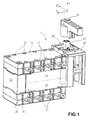
- the switching device 1 corresponds to a change-over switch and has two cut-off blocks 10, 20 superimposed, one upper block 10 and a lower block 20, returned relative to each other. he also comprises two actuating blocks 30, 40, one for each block of break, arranged back to back and grouped in a common box 50 mounted between the two cut-off blocks 10, 20. Finally, it includes a control block 60 arranged generally to the right of the actuating blocks 30, 40 and provided with a shaft control 64 can receive a control handle 61. It is a handle with three stable positions, a middle position called "0" and two positions called “I” and “II" at right angles on either side of the middle position, an angle of total operation of 180 °.
- Each cut-off block 10, 20 comprises, so known, at least two and, in this case, four pairs of connection terminals 11, 21 intended to be connected to the electrical conductors of an installation, in this case, four-pole, three phases and one neutral.
- each block break 10, 20 has as many pairs of fixed contacts as pairs of terminals connection and as many mobile contacts as pairs of fixed contacts.
- the movable contacts are mounted on a movable bar arranged to slide in translation between two stable positions: a closed position when the contacts mobile connect the corresponding pairs of fixed contacts and that the electrical connection is ensured, and an open position when the movable contacts separate the pairs of corresponding fixed contacts and that the electrical connection is interrupted.
- each cut-off block 10, 20 is actuated by its actuation block 30, 40, which is controlled by the control block 60.
- This control block 60 is closed in its upper part by a plate called “plastron” 62 and can be opened in its lower part. It has a height equivalent to that of the cut-off block upper 10 and actuating blocks 30, 40. It does not need to be extend beyond.
- the cut-off blocks 10, 20 and actuation blocks 30, 40 are fitted into each other by means of complementary profiles and are held by fixing screws 12 visible in Figure 1 on the upper side of the upper disconnection block 10.
- the switching device 1 is shown partially and in exploded view.
- the control handle and the cut-off block lower have been removed.
- the front plate 62 and the upper cut-off block 10 have been raised to show the inside of the upper actuator block 30, the inside of the control block 60 and the underside of the upper cut-off block 10 with its bar mobile 13.
- the actuating blocks 30, 40 are grouped in the common housing 50 provided with side walls 51 and a central wall 52 separating the housing 50 into two equal parts in the direction of its height, this wall median 52 constituting the bottom of each actuating block 30, 40.
- the common housing 50 is made in one piece with the body 63 of the control block 60 to simplify their manufacture and assembly.
- This common box 50 in two separate, identical and nestable boxes, one for each actuating block 30, 40.
- This embodiment is advantageous because it makes it possible to manufacture switches simple with the same housing.
- the control unit 60 comprises a shaft of control 64 guided in rotation in the body 63, this shaft being connected to the handle control 61 by square coupling 65.
- the actuating blocks 30, 40 are identical but reversed with respect to each other since they are placed back to back of on either side of the middle wall 52 of the common housing 50. The same parts will bear the same reference.
- Each actuating block 30, 40 comprises a connecting rod 31, a first end of which is coupled to the control shaft 64 and a link drive 32 pivotally mounted about a central axis 33 fixed relative to the case 50.
- Said link 32 is coupled on the one hand to the second end of the link 31 and on the other hand to the movable bar 13 of the corresponding cut-off block 10, 20.
- Each actuating block 30, 40 also includes an accumulation device energy in the form of a spring 34, more precisely consisting of a spring torsion, provided with two free ends 35, 36, one 35 secured to the housing 50 and the other 36 secured to the link 32.
- This torsion spring 34 allowing the action abrupt mechanism, accelerates the switching of the movable bar 13 and by therefore the switching of the corresponding movable contacts, i.e. the passage from the open position to the closed position and vice versa.
- the link between the connecting rod 31 and the connecting rod 32 takes place around a first pin 37 guided in a first groove 38 in an arc, provided in the housing 50 and extending over a angular sector slightly less than 180 °, the center of which coincides with the axis pivot 33 of the link 32.
- a second pin 39 is provided on the link 32, diametrically opposite to the first 37, and arranged to slide in a second identical groove 41, with the same center and symmetrical.
- the link between the link 32 and the movable bar 13 of the corresponding cutting block 10, 20 is effected by a tenon 42 secured to the link 32 and housed in a recess 14 formed in the bar 13.
- This recess is delimited by two stops 15, 16 allowing movement in translation of the tenon 42 relative to the bar 13.
- This tenon 42 is stressed by the spring 34, its corresponding free end 36 being housed in an orifice through 43 provided in said stud 42.
- All the parts making up a block actuator 30, 40 namely the rod 31, the drive rod 32 and the spring 34, are assembled by interlocking and are therefore easily removable. This allows their respective positions to be changed in the same actuation block 30, 40 and from one block to another.
- the different configurations obtained allow to realize different switching combinations between the two cut-off blocks 10, 20.
- the link 32 can be coupled to the link 31 at its end carrying the pin 42.
- the link 32 can be positioned in the other direction, the position of the spring being also modified.
- FIG 3 partially illustrates the apparatus 1 of Figure 2 and in particular the block of lower cutout 20 with its movable bar 13, the control shaft 64 and the two actuating blocks 30, 40 without the springs or the common housing 50.
- This shaft control 64 comprises two discs 66, 67 parallel to each other and perpendicular to the axis of rotation Y of said shaft, each disc being provided with a pivot 68, 69 for each connecting rod 31.
- the two pivots 68, 69 are not directly superimposed, they are offset from each other. Their respective position on their disc 66, 67 can be modified as we will see later.
- each connecting rod 31 has an oblong housing 44 capable of receiving its pivot 68, 69, which leaves the rod 31 a certain play in its displacement relative to the shaft of command 64, the value of which is explained below.
- This figure illustrates the connecting rods 31 and the drive rods 32 of the two actuating blocks 30, 40 in the same configuration but returned one relative to the other.
- the pin 42 of the link 32 of the lower actuating block 40 is housed in the recess 14 of the movable bar 13 of the lower cutout block 20.
- the cams 71 are arranged to control auxiliary contacts 80 in operation the position of the control shaft 64.
- One or more auxiliary contacts 80 to opening or closing are generally associated with each cut-off block to allow the transmission via an electrical link of information relating to the position of these cut-off blocks 10, 20 towards one or more control circuits or monitoring (auxiliary relays, PLCs, alarms, etc.).
- the contacts auxiliaries provide precut information to the equipment connected in downstream to trigger them before the triggering of the block (s) concerned.
- These auxiliary contacts 80 are of the standard type and include a piston 81 directly controlled by the cams 71 provided on the shaft control 64. If necessary, additional auxiliary contacts 82 can be added opposite the barrel 72.
- these auxiliary contacts 82 are controlled by a paddle device 83 actuated by said barrel 72. All these auxiliary contacts 80, 82 are easily housed and fixed by screws in the control unit 60 to the by means of the longitudinal grooves 75 and of supports 76 provided in the body 63 of this block, visible in figure 2.
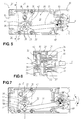
- Figures 5 to 7 illustrate in more detail the actuating blocks 30, 40 and the block control 60.
- Figure 5 is a top view of the upper actuator block 30 in which we find the control shaft 64, the connecting rod 31, its pivot link 68 shown in dotted lines with the control shaft 64, the drive rod 32, its fixed pivot axis 33, its two pins 37, 39 guided in the grooves 38, 41, the actuating pin 42 of the movable bar 13 and the spring 34.
- Figure 6 is a cross section of Figure 5 showing the blocks upper 30 and lower 40 actuator, the common housing 50 and the shaft command 64. It is clear from this figure that the parts making up each actuator block 30, 40 are arranged inversely to correspond to their cut-off block 10, 20 also reversed.
- Figure 7 illustrates the block actuator 30 of Figure 5, the control shaft 64 having rotated about 45 ° counterclockwise following arrow F.
- FIGs 8 to 12 illustrate the different possible configurations of the blocks actuation 30, 40 and therefore the different switching combinations obtained for each configuration with the device 1 according to the invention.
- the figures marked with index A represent the upper actuating block 30 seen from above and the figures bearing the index B represent the lower actuation block 40 with a view to below.
- the switching positions of the blocks 10, 20 are symbolized by “1” for the closed position and by "0" for the open position.
- the positions of the handle 61 or of the control shaft 64 are symbolized by "0” for the middle position, by "I” for the 90 ° position counterclockwise (arrow F) with respect to "0” and with “II” for the 90 ° position clockwise (arrow G) relative to "0".
- the respective position of the connecting rods 31, connecting rods 32 and 34 springs may vary.
- the position of the pivots 68, 69 can be modified. he it is specified that these modifications are made in the factory during the assembly of the devices and according to specific customer needs.
- Figures 8-10 all parts are identical from one configuration to another and the pivots 68, 69 are arranged symmetrically with respect to the longitudinal axis X.
- the configuration actuation blocks 30, 40 shown corresponds to the middle position "0" of the handle 61.
- FIGS. 8A and 8B the connecting rods 31, connecting rods 32 and spring 34 are arranged as in the preceding figures.
- the connection between the connecting rod 31 and the connecting rod 32 of each actuating block 30, 40 takes place on the first pin 37 housed in the first groove 38 and the spring 34 is substantially in the central axis Z.
- the combination is obtained following switching: upper cut-off block 10 handle (angle) lower cut-off block 20 1 I (-90 °) 0 0 0 (0) 0 0 II (+ 90 °) 1
- This combination provides a three-position change-over switch. stable with the two cut-off blocks 10, 20 in the intermediate position opened.
- This combination provides an overlapping changeover switch. contact, at three stable positions with an intermediate position where the two blocks of cut-off 10, 20 are in the closed position.
- This combination provides a three-position overlay switch stable with, in position "II", the superposition of the two cut-off blocks 10, 20 in closed position.
- This combination provides a simple switch with two stable positions with, in position "I”, the two cut-off blocks 10, 20 in the open position and, in position "II", the two cut-off blocks 10, 20 in the closed position.
- This combination provides a two-position change-over switch stable.
- the design of the actuation blocks 30, 40 and of the control block 60 authorizes a great flexibility of use.
- the common box 50 comprising the blocks actuation 30, 40 can be used without modification despite the difference in length of the cut-off blocks 10, 20.
- a simple "spacer” box 55 can be interposed between the two cut-off blocks 10, 20 as an extension of the common housing 50. This "spacer” box has no actuation mechanism given that the movable contact corresponding to the neutral of each cut-off block 10, 20 is mounted on the movable bar, which is actuated by said actuating blocks 30, 40 as described above.
Landscapes
- Driving Mechanisms And Operating Circuits Of Arc-Extinguishing High-Tension Switches (AREA)
- Scissors And Nippers (AREA)
Claims (18)
- Schaltgerät (1) wie Umpolschalter für eine elektrische Anlage, wobei das Gerät mindestens zwei übereinanderliegende Schaltgerätblöcke (10,20) umfaßt, wobei jeder Schaltblock mindestens zwei Anschlußklemmenpaare (11) aufweist, die dazu bestimmt sind, mit mindestens zwei Phasen der Anlage verbunden zu werden, mindestens zwei Paare von Festkontakten, die mit den Verbindungsklemmen verbunden sind, und mindestens zwei bewegliche Kontakte mit zwei stabilen Positionen, davon eine geschlossene Position, in der jeder bewegliche Kontakt die Festkontakte eines selben Paares verbindet, um den Durchgang von elektrischem Strom aufzubauen, und eine offene Position, in der jeder bewegliche Kontakt die Festkontakte trennt, um den Durchgang des elektrischen Stroms zu unterbrechen, wobei die beweglichen Kontakte auf einem gemeinsamen beweglichen Stab (13) montiert sind, der so angeordnet ist, daß er sich in Form einer Translationsbewegung verlagert, wobei das Gerät außerdem mindestens zwei Betätigungsblöcke (30,40) aufweist, wovon jeder so angeordnet ist, daß er den beweglichen Stab (13) des entsprechenden Schaltblockes (10,20) verlagert, und ein mit einer Steuerwelle (64) versehener Steuerblock (60), die mit einem Handgriff (61) verbunden werden kann und so angeordnet ist, daß sie die Betätigungsblöcke (30, 40) gleichzeitig steuert, dadurch gekennzeichnet, daß die Betätigungsblöcke (30,40) Rücken an Rücken übereinanderliegen und zwischen den Schaltblöcken (10,20) im Verhältnis zueinander umgekehrt angeordnet sind
- Gerät nach Anspruch 1, dadurch gekennzeichnet, daß die Betätigungsblöcke (30,40) jeweils ein Gehäuse aufweisen, das mindestens mit einem Boden versehen ist, wobei die zwei Gehäuse so angeordnet sind, daß sie auf der Höhe ihres Bodens ineinander einpaßbar sind.
- Gerät nach Anspruch 1, dadurch gekennzeichnet, daß die Betätigungsblöcke (30,40) ein einziges und gemeinsames Gehäuse (50) aufweisen, das mit mindestens einer Mittelwand (52) versehen ist, die den Boden eines jeden Betätigungsblockes darstellt
- Gerät nach Anspruch 2 oder 3, dadurch gekennzeichnet, daß jeder Betätigungsblock (30,40) mindestens eine, an einem ihrer Enden mit der Steuerwelle (64) verbundene Kurbelstange (31) und einen Antriebsschwingarm (32) aufweist, die um eine feste Mittelachse (33) auf dem Gehäuse (50) drehbar angebracht, und einerseits mit dem freien Ende der Kurbelstange (31), und andererseits mit der beweglichen Stange (13) des entsprechenden Schaltblockes (10,20) verbunden ist.
- Gerät nach Anspruch 4, dadurch gekennzeichnet, daß jeder Betätigungsblock (30,40) eine Energiesammlungsvorrichtung in Form einer mit zwei freien Enden versehenen Feder (34) aufweist, wovon eines (35) mit dem Gehäuse (50) verbunden ist und das andere (36) mit dem Antriebsschwingarm (32) verbunden ist, wobei diese Feder (34) die schnelle Umschaltung des entsprechenden Schaltblockes (10, 20) ermöglicht.
- Gerät nach Anspruch 5, dadurch gekennzeichnet, daß der Antriebsschwingarm (32) mit dem beweglichen Stab (13) mittels eines in einer in der Stange (13) vorgesehenen entsprechenden Aussparung (14) untergebrachten Zapfens (42) verbunden ist, der durch zwei Anschläge (15,16) begrenzt ist, wobei der Zapfen mit dem entsprechenden freien Ende (36) der Feder (34) verbunden ist.
- Gerät nach Anspruch 4, dadurch gekennzeichnet, daß der Antriebsschwingarm (32) mittels einem ersten Drehzapfen (37,39) mit der Kurbelstange (31) verbunden ist, wobei dieser Drehzapfen in einer in dem Gehäuse (50) vorgesehenen ersten Nut (38,41) geführt ist, die sich über einen auf der Schwenkachse (33) zentrierten Kreisbogen des Antriebsschwingarms (32) erstreckt.
- Gerät nach Anspruch 7, dadurch gekennzeichnet, daß sich die Nut (38,41) über einen Winkelbereich erstreckt, der etwas kleiner ist als 180°, wobei das Gehäuse (50) eine identische, diametral gegenüberliegende zweite Nut (38,41) aufweist, die so angeordnet ist, daß sie einen auf dem Antriebsschwingarm (32) vorgesehenen zweiten Drehzapfen (37,39) über den ersten Drehzapfen (37,39) zu dem gegenüberliegenden führt.
- Gerät nach Anspruch 8, dadurch gekennzeichnet, daß die Kurbelstange (31), der Antriebsschwingarm (32) und die Feder (34) entfernbare Teile sind, wobei ihre Konfiguration so veränderbar ist, daß mehrere Umschaltungskombinationen zwischen den zwei Schaltgerätblöcken (10,20) erzeugt werden.
- Gerät nach Anspruch 4, dadurch gekennzeichnet, daß die Steuerwelle (64) in dem Körper (63) des Steuerblockes (60) drehbar geführt und mit einem außen auf dem Gerät (1) zugänglichen Handgriff (61) verbunden ist, wobei diese Steuerwelle an zwei unterschiedlichen Schwenkpunkten mit den Kurbelstangen (31) der zwei Betätigungsblöcke (30,40) verbunden ist.
- Gerät nach Anspruch 10, dadurch gekennzeichnet, daß die Steuerwelle (64) zwei einander gegenüberliegende Scheiben (66,67) aufweist, die zueinander parallel und senkrecht zur Drehachse Y der Steuerwelle (64) angeordnet sind, wobei jede Scheibe mindestens einen Drehpunkt (68,69) aufweist, der so angeordnet ist, daß er in einem in der entsprechenden Kurbelstange (31) vorgesehenen Sitz (44) aufgenommen wird.
- Gerät nach Anspruch 11, dadurch gekennzeichnet, daß der in dem Ende der auf dem Drehpunkt (68,69) der Steuerwelle (64) angebrachten Kurbelstangen (31) vorgesehene Sitz (44) eine längliche Form aufweist und so angeordnet ist, daß er einen Bewegungsspielraum zwischen der Welle (64) und der Kurbelstange (31) ermöglicht.
- Gerät nach Anspruch 12, dadurch gekennzeichnet, daß mindestens eine Scheibe (66,67) mindestens zwei Stellen aufweist, die dazu geeignet sind, den Drehpunkt (68,69) so aufzunehmen, daß der Schwenkpunkt der Kurbelstangen (31) auf der Steuerwelle (64) verändert wird.
- Gerät nach den Ansprüchen 9 und 13, dadurch gekennzeichnet, daß die Kurbelstangen (31) eine erste definierte Länge aufweisen, daß die Drehpunkte (68,69), die die Kurbelstangen auf der Steuerwelle (64) aufnehmen, im Verhältnis zu der Längsachse X des Gerätes (1) symmetrisch angeordnet sind und über die Drehachse Y der Steuerwelle (64) verlaufen, und daß die Steuerwelle (64) drei stabile Positionen umfaßt, die drei Positionen des Handgriffes (61) entsprechen: eine Mittelposition "0" und zwei Positionen "I" und "II" in rechtem Winkel beiderseits der Mittelposition.
- Gerät nach den Ansprüchen 9 und 13, dadurch gekennzeichnet, daß die Kurbelstangen (31) eine zweite Länge aufweisen, die kleiner als die erste Länge definiert ist, daß die Drehpunkte (68,69), die die Kurbelstangen (31) auf der Steuerwelle (64) aufnehmen, im Verhältnis zur Drehachse Y der Steuerwelle (64) einander diametral gegenüberliegen, und daß die Steuerwelle (64) zwei stabile Positionen aufweist, die zwei Positionen "I" und "II" in rechtem Winkel von dem Handgriff (61) entsprechen.
- Gerät nach Anspruch 10, dadurch gekennzeichnet, daß die Steuerwelle (64) mindestens einen Nocken (71) aufweist, der so angeordnet ist, daß er mindestens einen in dem Gerät (1) angebrachten Hilfskontakt (80) betätigt.
- Gerät nach Anspruch 16, dadurch gekennzeichnet, daß der Körper (63) des Steuerblockes (60) mit einem Innensitz (75,76) zur Aufnahme des Hilfskontaktes (80) versehen ist.
- Gerät nach Anspruch 10, dadurch gekennzeichnet, daß die Steuerwelle (64) an ihrem dem Steuerhandgriff (61) gegenüberliegenden Ende eine quadratische Sektion (74) aufweist, die so angeordnet ist, daß sie einen auf dem Gerät (1) vorgesehenen dritten Schaltgerätblock steuert.
Applications Claiming Priority (3)
| Application Number | Priority Date | Filing Date | Title |
|---|---|---|---|
| FR9614559 | 1996-11-25 | ||
| FR9614559A FR2756412B1 (fr) | 1996-11-25 | 1996-11-25 | Appareil de coupure tel qu'un commutateur-inverseur pour une installation electrique |
| PCT/FR1997/002083 WO1998024102A1 (fr) | 1996-11-25 | 1997-11-19 | Appareil de coupure tel qu'un commutateur-inverseur pour une installation electrique |
Publications (2)
| Publication Number | Publication Date |
|---|---|
| EP0910859A1 EP0910859A1 (de) | 1999-04-28 |
| EP0910859B1 true EP0910859B1 (de) | 2002-02-20 |
Family
ID=9498099
Family Applications (1)
| Application Number | Title | Priority Date | Filing Date |
|---|---|---|---|
| EP97947093A Expired - Lifetime EP0910859B1 (de) | 1996-11-25 | 1997-11-19 | Schaltgerät wie umpolschalter für eine elektrische anlage |
Country Status (6)
| Country | Link |
|---|---|
| EP (1) | EP0910859B1 (de) |
| CN (1) | CN1122289C (de) |
| DE (1) | DE69710581T2 (de) |
| ES (1) | ES2173496T3 (de) |
| FR (1) | FR2756412B1 (de) |
| WO (1) | WO1998024102A1 (de) |
Families Citing this family (11)
| Publication number | Priority date | Publication date | Assignee | Title |
|---|---|---|---|---|
| US7214895B2 (en) | 2004-07-01 | 2007-05-08 | Rockwell Automation Technologies, Inc. | Illuminated disconnecting handle for use with CDM |
| US7015403B2 (en) | 2004-07-01 | 2006-03-21 | Rockwell Automation Technologies, Inc. | Disconnecting handle with auxiliary contacts for use with CDM |
| FR2954619B1 (fr) | 2009-12-17 | 2014-07-11 | Schneider Electric Ind Sas | Dispositif d'inversion de phases a bagues de contact |
| FR2979746B1 (fr) | 2011-09-01 | 2016-07-01 | Socomec Sa | Appareil de coupure electrique a haute tenue electrodynamique |
| FR2979743B1 (fr) | 2011-09-01 | 2013-08-30 | Socomec Sa | Chariot porte contact mobile et appareil de coupure electrique equipe d'un tel chariot |
| FR2979744B1 (fr) | 2011-09-01 | 2015-05-01 | Socomec Sa | Appareil de coupure electrique a haut pouvoir de fermeture |
| CN105761962B (zh) * | 2016-04-06 | 2018-05-11 | 中国船舶重工集团公司第七一二研究所 | 一种电动转换开关 |
| US10263400B2 (en) * | 2016-09-08 | 2019-04-16 | Hubbell Incorporated | Actuator assembly for electrical switches housed in an enclosure |
| CN109559928B (zh) * | 2017-09-27 | 2019-11-26 | 菏泽峥艳电力科技有限公司 | 一种大容量智能换相开关 |
| ES2840229T3 (es) | 2018-03-09 | 2021-07-06 | Gorlan Team Slu | Módulo de conmutador accionado por leva y método de fabricación del mismo |
| CO2019006270A1 (es) * | 2019-06-15 | 2019-12-20 | Gualdron Florez Jesus | Equipo interruptor seccionador para procedimiento de seguridad eléctrica y cumplimiento de las cinco reglas de oro de seguridad eléctrica desde un mismo equipo |
Family Cites Families (2)
| Publication number | Priority date | Publication date | Assignee | Title |
|---|---|---|---|---|
| FR2591026B1 (fr) * | 1985-11-29 | 1988-10-07 | Socomec Sa | Ensemble de manoeuvre motorise a telecommande pour commutateur de puissance |
| DE4305746C2 (de) * | 1993-02-25 | 1996-05-23 | Peterreins Schalttechnik Gmbh | Lastschalteranordnung und Gehäuse zur Aufnahme dieser Lastschalteranordnung |
-
1996
- 1996-11-25 FR FR9614559A patent/FR2756412B1/fr not_active Expired - Fee Related
-
1997
- 1997-11-19 DE DE69710581T patent/DE69710581T2/de not_active Expired - Lifetime
- 1997-11-19 ES ES97947093T patent/ES2173496T3/es not_active Expired - Lifetime
- 1997-11-19 WO PCT/FR1997/002083 patent/WO1998024102A1/fr not_active Ceased
- 1997-11-19 EP EP97947093A patent/EP0910859B1/de not_active Expired - Lifetime
- 1997-11-19 CN CN 97191864 patent/CN1122289C/zh not_active Expired - Fee Related
Also Published As
| Publication number | Publication date |
|---|---|
| FR2756412B1 (fr) | 1998-12-31 |
| FR2756412A1 (fr) | 1998-05-29 |
| CN1122289C (zh) | 2003-09-24 |
| CN1209902A (zh) | 1999-03-03 |
| DE69710581T2 (de) | 2002-10-24 |
| DE69710581D1 (de) | 2002-03-28 |
| EP0910859A1 (de) | 1999-04-28 |
| WO1998024102A1 (fr) | 1998-06-04 |
| ES2173496T3 (es) | 2002-10-16 |
| HK1017766A1 (en) | 1999-11-26 |
Similar Documents
| Publication | Publication Date | Title |
|---|---|---|
| EP3494587B1 (de) | Steuermodule für ein modulares schaltegrät und erhaltenes modulares schaltgerät | |
| EP0829890B1 (de) | Mehrphasiger elektrischer Schalter mit einer Schaltwelle je Phase | |
| EP0910859A1 (de) | Schaltgerät wie umpolschalter für eine elektrische anlage | |
| EP1170769A1 (de) | Schnelleinschaltvorrichtung für Modulschutzschalter | |
| EP1648008B1 (de) | Schaltgerät mit Frontbedienung oder Seitenbedienung | |
| EP2335262A1 (de) | Elektrische schaltvorrichtung, die mit zwei schaltern ausgestattet ist, wie etwa einem sammelschienen-sektionalisierungsschalter und einem erdungsschalter, und mit einem den mobilen kontakten der schalter gemeinsamen ansteuermittel | |
| CH686464A5 (fr) | Disjoncteur á commande manuelle variable. | |
| FR2752084A1 (fr) | Appareil de coupure pour une installation electrique, interrupteur multipolaire et commutateur-inverseur realises avec ledit appareil | |
| EP3333871B1 (de) | Elektrisches gerät zur unterbrechung eines elektrischen stroms | |
| FR2722912A1 (fr) | Interrupteurs electriques moyenne tension | |
| FR2513006A1 (fr) | Dispositif interrupteur modulaire a poles multiples | |
| FR2818434A1 (fr) | Appareil de coupure electrique pour installation electrique | |
| BE1004594A3 (fr) | Dispositif de condamnation mecanique et electrique pour contacteurs. | |
| EP0200617B1 (de) | An ein Schaltgerät mit zwei Stellungen anpassbare elektrische Antriebsvorrichtung | |
| FR2818003A1 (fr) | Dispositif de commutation comportant un contact rotatif monte flottant et a double coupure | |
| WO2007036624A1 (fr) | Module de coupure pour appareil electrique et appareil electrique equipe d'un tel module | |
| EP0996959A1 (de) | Elektrischer leistungsschalter für elektrische anlage mit alternativer niederspannung | |
| EP2023361B1 (de) | Schaltvorrichtung vom Dreiphasentyp unter Metallmantel zur Abgrenzung und mit reduzierten Übertragungskräften pro Phase | |
| FR2576141A1 (fr) | Disjoncteur basse tension, avec verrou de maintien agence dans une chambre separee | |
| WO2011128754A1 (fr) | Boîtier de fusible et appareil de coupure électrique équipé d'un tel boîtier | |
| EP3839997B1 (de) | Mehrpoliges elektrisches schutzsystem und elektrische anlage mit einem solchen system | |
| EP0373018B1 (de) | Handbetätigter Mechanismus für schnelle Unterbrechung für elektrische Schalter | |
| FR2812967A1 (fr) | Actionneur mecanique pour manoeuvrer un commutateur electrique a trois positions de commutation | |
| EP2442337B1 (de) | Schlüsselkontaktvorrichtung | |
| FR2709863A1 (fr) | Disjoncteur à arbre de commutation rotatif. |
Legal Events
| Date | Code | Title | Description |
|---|---|---|---|
| PUAI | Public reference made under article 153(3) epc to a published international application that has entered the european phase |
Free format text: ORIGINAL CODE: 0009012 |
|
| 17P | Request for examination filed |
Effective date: 19981126 |
|
| AK | Designated contracting states |
Kind code of ref document: A1 Designated state(s): DE ES FR IT |
|
| GRAG | Despatch of communication of intention to grant |
Free format text: ORIGINAL CODE: EPIDOS AGRA |
|
| 17Q | First examination report despatched |
Effective date: 20010412 |
|
| GRAG | Despatch of communication of intention to grant |
Free format text: ORIGINAL CODE: EPIDOS AGRA |
|
| GRAH | Despatch of communication of intention to grant a patent |
Free format text: ORIGINAL CODE: EPIDOS IGRA |
|
| GRAH | Despatch of communication of intention to grant a patent |
Free format text: ORIGINAL CODE: EPIDOS IGRA |
|
| GRAA | (expected) grant |
Free format text: ORIGINAL CODE: 0009210 |
|
| AK | Designated contracting states |
Kind code of ref document: B1 Designated state(s): DE ES FR IT |
|
| REF | Corresponds to: |
Ref document number: 69710581 Country of ref document: DE Date of ref document: 20020328 |
|
| REG | Reference to a national code |
Ref country code: ES Ref legal event code: FG2A Ref document number: 2173496 Country of ref document: ES Kind code of ref document: T3 |
|
| PLBE | No opposition filed within time limit |
Free format text: ORIGINAL CODE: 0009261 |
|
| STAA | Information on the status of an ep patent application or granted ep patent |
Free format text: STATUS: NO OPPOSITION FILED WITHIN TIME LIMIT |
|
| 26N | No opposition filed |
Effective date: 20021121 |
|
| PGFP | Annual fee paid to national office [announced via postgrant information from national office to epo] |
Ref country code: DE Payment date: 20141124 Year of fee payment: 18 Ref country code: ES Payment date: 20141111 Year of fee payment: 18 |
|
| PGFP | Annual fee paid to national office [announced via postgrant information from national office to epo] |
Ref country code: FR Payment date: 20141128 Year of fee payment: 18 |
|
| PGFP | Annual fee paid to national office [announced via postgrant information from national office to epo] |
Ref country code: IT Payment date: 20141120 Year of fee payment: 18 |
|
| REG | Reference to a national code |
Ref country code: DE Ref legal event code: R119 Ref document number: 69710581 Country of ref document: DE |
|
| PG25 | Lapsed in a contracting state [announced via postgrant information from national office to epo] |
Ref country code: IT Free format text: LAPSE BECAUSE OF NON-PAYMENT OF DUE FEES Effective date: 20151119 |
|
| REG | Reference to a national code |
Ref country code: FR Ref legal event code: ST Effective date: 20160729 |
|
| PG25 | Lapsed in a contracting state [announced via postgrant information from national office to epo] |
Ref country code: DE Free format text: LAPSE BECAUSE OF NON-PAYMENT OF DUE FEES Effective date: 20160601 |
|
| PG25 | Lapsed in a contracting state [announced via postgrant information from national office to epo] |
Ref country code: FR Free format text: LAPSE BECAUSE OF NON-PAYMENT OF DUE FEES Effective date: 20151130 |
|
| REG | Reference to a national code |
Ref country code: ES Ref legal event code: FD2A Effective date: 20161227 |
|
| PG25 | Lapsed in a contracting state [announced via postgrant information from national office to epo] |
Ref country code: ES Free format text: LAPSE BECAUSE OF NON-PAYMENT OF DUE FEES Effective date: 20151120 |