EP0911005B1 - Medizinische Bandage - Google Patents
Medizinische Bandage Download PDFInfo
- Publication number
- EP0911005B1 EP0911005B1 EP98118612A EP98118612A EP0911005B1 EP 0911005 B1 EP0911005 B1 EP 0911005B1 EP 98118612 A EP98118612 A EP 98118612A EP 98118612 A EP98118612 A EP 98118612A EP 0911005 B1 EP0911005 B1 EP 0911005B1
- Authority
- EP
- European Patent Office
- Prior art keywords
- upper arm
- forearm
- bandage according
- region
- bandage
- Prior art date
- Legal status (The legal status is an assumption and is not a legal conclusion. Google has not performed a legal analysis and makes no representation as to the accuracy of the status listed.)
- Expired - Lifetime
Links
Images


Classifications
-
- A—HUMAN NECESSITIES
- A61—MEDICAL OR VETERINARY SCIENCE; HYGIENE
- A61F—FILTERS IMPLANTABLE INTO BLOOD VESSELS; PROSTHESES; DEVICES PROVIDING PATENCY TO, OR PREVENTING COLLAPSING OF, TUBULAR STRUCTURES OF THE BODY, e.g. STENTS; ORTHOPAEDIC, NURSING OR CONTRACEPTIVE DEVICES; FOMENTATION; TREATMENT OR PROTECTION OF EYES OR EARS; BANDAGES, DRESSINGS OR ABSORBENT PADS; FIRST-AID KITS
- A61F13/00—Bandages or dressings; Absorbent pads
- A61F13/10—Bandages or dressings; Absorbent pads specially adapted for fingers, hands or arms; Finger-stalls; Nail-protectors
-
- A—HUMAN NECESSITIES
- A61—MEDICAL OR VETERINARY SCIENCE; HYGIENE
- A61F—FILTERS IMPLANTABLE INTO BLOOD VESSELS; PROSTHESES; DEVICES PROVIDING PATENCY TO, OR PREVENTING COLLAPSING OF, TUBULAR STRUCTURES OF THE BODY, e.g. STENTS; ORTHOPAEDIC, NURSING OR CONTRACEPTIVE DEVICES; FOMENTATION; TREATMENT OR PROTECTION OF EYES OR EARS; BANDAGES, DRESSINGS OR ABSORBENT PADS; FIRST-AID KITS
- A61F5/00—Orthopaedic methods or devices for non-surgical treatment of bones or joints; Nursing devices ; Anti-rape devices
- A61F5/37—Restraining devices for the body or for body parts; Restraining shirts
- A61F5/3715—Restraining devices for the body or for body parts; Restraining shirts for attaching the limbs to other parts of the body
- A61F5/3723—Restraining devices for the body or for body parts; Restraining shirts for attaching the limbs to other parts of the body for the arms
- A61F5/3738—Slings
Definitions
- the invention describes a medical armband with bezel and guide of the forearm and upper arm or shoulder.
- Orthopedic bandages perform a fixing, guiding, supporting and / or supporting function on the extremities of the human body according to their construction and their field of indication. These medical bandages must have a three-dimensional shape in order to correspond to the anatomical conditions in order to be able to act positively and non-positively on the human body from the outside.
- Such medical bandages are produced by cutting out blanks from flat material, for example from neoprene, knitted fabrics or fabrics.
- the anatomically correct shape is achieved by the shape of the blanks or darts, for example with gussets, and the subsequent joining of the blanks, as is also common with clothing.
- the assembly can be done by sewing, gluing or other common methods.
- thermoplastic plastic sheet material is anatomically correct to form orthopedic orthoses and prostheses.
- materials such as Polyethylene (HDPE), polypropylene or a copolymer PP have one thermoplastic forming range from approx. 170 ° C to 250 ° C and are according to the Cooling largely rigid, so that they are not used for medical bandages come.
- HDPE Polyethylene
- polypropylene polypropylene
- copolymer PP have one thermoplastic forming range from approx. 170 ° C to 250 ° C and are according to the Cooling largely rigid, so that they are not used for medical bandages come.
- bandages which usually only consist of two belts, do not have the problem of sweating, but are related to their construction on their therapy safety and function mostly doubtful and therefore insufficient.
- the bandage for the shoulder and upper arm area consists of an upper arm part and a forearm part.
- the upper arm part is U-shaped, the mouth, which denotes the area of the upper arm part in which the first and second legs meet, rests on the patient's shoulder, the first leg extends anteriorly to approximately the elbow joint and the second Thigh extends posteriorly to approximately the elbow joint.
- the forearm part is formed from three sections, a first section that lies in the ulnar forearm area when the forearm is bent at an angle of approximately 90 ° anterior, a second section that is connected to the second leg of the upper arm part and that runs anteriorly over the elbow joint and opens into the first section, a third section which is connected to the first leg of the upper arm part and extends posteriorly over the elbow joint and opens into the first section, the ends of the second and third sections being connected to one another. Furthermore, a carrying strap is attached to the upper arm part and a holding belt is attached to the forearm part in order to fix the bandage according to the invention to the body. When the bandage is not sewn, the second section and the third section of the forearm part form an angle of 20 ° to 150 °, preferably 60 ° to 120 °.
- the upper arm part is at the ends of the Leg elastic sections available.
- the components of the bandage are made of a textile-laminated material
- Foam or nonwoven fabric consist of a molded foam peat or nonwoven.
- the forearm part has also proven to be advantageous if reinforcements in the first Section are incorporated, which have the shape of a rod or a rail and which are made of plastic.
- the holding belt from the forearm part advantageously runs from the hand region dorsally in the lumbar region to the distal upper arm and encloses it running from posterior to anterior to lateral.
- the holding belt ensures that the forearm is securely attached to the ventral body.
- the movement of the distal upper arm is controlled in the sense of flexion or extension and the antetorsion of the shoulder joint.
- the straps can be fixed by, for example, Velcro fasteners or Press studs.
- the straps preferably consist of a laminated foam or a laminated one Nonwoven fabric.
- the straps have a high cushioning effect and a preferred elongation of less than about 50 N under load 35%, particularly preferably a longitudinal expansion of less than 10%.
- the bandage according to the invention serves in particular as a post-traumatic and postoperative special bandage for injuries in the shoulder and upper arm area, for Example distortions, rotator cuff injuries and other injuries, surgical procedures and chronic illnesses that immobilize the shoulder require.
- the open construction also enables simple and painless Put on the bandage according to the invention. This is a particular advantage, especially since Patient can put the bandage on himself. Furthermore, one is considered to be very uncomfortable perceived sweating of the patient very strongly prevented.
- the upper arm part 1 is shown in FIG.
- the upper arm part 1 is U-shaped in such a way that it adapts perfectly to the anatomical conditions of the upper arm and the shoulder of the patient.
- the upper arm part 1 consists of two legs 12, 13 which converge in the mouth 11.
- the mouth 11 is on the patient's shoulder when the bandage 100 is applied.
- a reinforcement 16 is incorporated in the mouth 11, which is rod-shaped and made of plastic.
- the shoulder strap 3 is sewn onto the center of the mouth 11, specifically opposite the legs 12, 13.
- the elastic sections 14, 15 are sewn to the second 22 or third section 23 of the forearm part 2.
- the first section 21 also carries rail-shaped reinforcements 24, which are also made of plastic.
- a hand fixation 25 is formed on the forearm part 2 and is composed of two reins 251, 252, which enclose an angle of 90 °. At the ends of the reins 251, 252 there are two Velcro fasteners 253, 254 which are connected to one another so that the hand fixation 25 encloses the patient's hand.
- the tether 4 is attached centrally to the hand fixation 25.
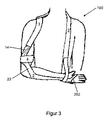
- the bandage 100 shown in FIG. 3, that on the right shoulder or the the patient's right forearm is essentially made up of the upper arm part 1 and the forearm part 2 together.
- the upper arm part 1 is fixed ventrally to the forearm in the area of the wrist with a shoulder strap 3, which runs from the shoulder to the neck area.
- the carrying strap 3 is fixed by means of a Velcro fastener, so that a loop is formed around the forearm.
- the forearm part 2 is fixed with a holding belt 4 which, coming from the region of the hand, runs dorsally in the lumbar region to the distal upper arm.
- the tether 4 is also fixed by means of a Velcro fastener.
- the entire belt guide system thus ensures the position of the bandage on the patient in a symbiosis.
Landscapes
- Health & Medical Sciences (AREA)
- Engineering & Computer Science (AREA)
- Biomedical Technology (AREA)
- Heart & Thoracic Surgery (AREA)
- Vascular Medicine (AREA)
- Life Sciences & Earth Sciences (AREA)
- Animal Behavior & Ethology (AREA)
- General Health & Medical Sciences (AREA)
- Public Health (AREA)
- Veterinary Medicine (AREA)
- Nursing (AREA)
- Orthopedic Medicine & Surgery (AREA)
- Orthopedics, Nursing, And Contraception (AREA)
- Surgical Instruments (AREA)
- Media Introduction/Drainage Providing Device (AREA)
- Materials For Medical Uses (AREA)
- Prostheses (AREA)
Description
Diese medizinischen Bandagen müssen eine dreidimensionale Form aufweisen, um den anatomischen Gegebenheiten zu entsprechen, um form- und kraftschlüssig von extern auf den menschlichen Körper einwirken zu können.
Das Zusammenfügen kann durch Nähen, Kleben oder andere übliche Verfahren erfolgen.
Das Unterarmteil ist aus drei Abschnitten gebildet, einem ersten Abschnitt, der bei in einem Winkel von ungefähr 90° anterior angewinkeltem Unterarm im ulnaren Unterarmbereich liegt, einem zweiten Abschnitt, der mit dem zweiten Schenkel des Oberarmteils verbunden ist und der anterior über das Ellenbogengelenk verläuft und in dem ersten Abschnitt mündet, einem dritten Abschnitt, der mit dem ersten Schenkel des Oberarmteils verbunden ist und posterior über das Ellenbogengelenk verläuft und in dem ersten Abschnitt mündet, wobei die Enden des zweiten und des dritten Abschnitts miteinander verbunden sind. Weiterhin sind an dem Oberarmteil ein Tragegurt und an dem Unterarmteil ein Haltegurt angebracht sind, um die erfindungsgemäße Bandage am Körper zu fixieren.
Bei unvernähter Bandage schließen der zweite Abschnitt und der dritte Abschnitt des Unterarmteils einen Winkel von 20° bis 150° ein, bevorzugt 60° bis 120°.
Dadurch werden die Schulterpartie und insbesondere der Oberarmkopf sicher geführt.
Die Handführung führt die Hand und verhindert so eine übermäßige Ulnarflexion, des weiteren wirkt diese einer Überdehnung der Sehnen und des Bandapparates entgegen, die meist im volaren Bereich sehr empfindlich sind.
Der Tragegurt sorgt für eine sichere Positionierung des Oberarmteils und führt zu einer Gewichtsentlastung des Unterarmes, was sich positiv auf das Schultergelenk auswirkt. Üblicherweise unterliegt das Schultergelenk einer ständigen Krafteinwirkung aufgrund des Gewichts des Unterarms. Diese Zugkraft wirkt sich nachteilig auf den Sehnen- und Bandapparat des Schultergelenkes aus.
Der Haltegurt sorgt für eine sichere Fixierung des Unterarmes am ventralen Leib. Durch die Fassung des distalen Oberarmes wird die Bewegung im Sinne der Flexion beziehungsweise Extension sowie der Antetorsion des Schultergelenkes kontrolliert geführt.
- eine explizite Paßform, um eine sichere und stabile Fixation der Schulter und des Oberarmes zu gewährleisten.
- ein gut eingefaßtes Schultergelenk mit entsprechender Fixationsübergang zum thorakalen Bereich
- die Figur 1
- das Oberarmteil,
- die Figur 2
- das Unterarmteil mit aufgetrennten Nähnähten und
- die Figur 3
- die am rechten Arm des Patienten angelegte erfindungsgemäße Bandage, bestehend aus Oberarm- und Unterarmteil samt Verbindungsvorrichtungen und Gurten.
An den Enden der im wesentlichen rechteckig geformten Schenkel 12, 13 befinden sich zwei elastische Abschnitte 14, 15, die aufgrund ihrer Flexibilität einen optimalen Sitz der Bandage 100 gewährleisten. Die elastischen Abschnitte 14, 15 werden mit dem zweiten 22 beziehungsweise dritten Abschnitt 23 des Unterarmteils 2 vernäht.
Im Bereich 221 ist der elastische Abschnitt 14 des ersten Schenkels 12 vom Oberarmteil angenäht, im Bereich 231 der elastische Abschnitt 15. Der erste Abschnitt 21 trägt des weiteren schienenförmige Verstärkungen 24, die ebenfalls aus Kunststoff gefertigt sind. In der hier dargestellten vorteilhaften Ausführungsform der Bandage 100 ist am Unterarmteil 2 eine Handfixierung 25 angeformt, die sich aus zwei Zügel 251, 252 zusammensetzt, die einen Winkel von 90° einschließen. An den Enden der Zügel 251, 252 befinden sich zwei Klettverschlüsse 253, 254, die miteinander verbunden werden, so daß die Handfixierung 25 die Hand des Patienten umschließt. Zentral an der Handfixierung 25 ist der Haltegurt 4 befestigt.
Das Unterarmteil 2 wird mit einem Haltegurt 4 fixiert, der von der Handregion kommend nach dorsal im Lendenbereich zum distalen Oberarm verläuft. Die Fixierung des Haltegurts 4 erfolgt ebenfalls durch einen Klettverschluß.
Das gesamte Gurtführungssystem sorgt so in einer Symbiose für die Sicherung der Position der Bandage am Patienten.
Claims (12)
- Bandage 100 für den Schulter- und Oberarmbereich, bestehend aus einem Oberarmteil 1 und einem Unterarmteil 2, wobeidas Oberarmteil 1 U-förmig ausgebildet ist, wobei der in dem Bereich des Oberarmteils 1, in dem der erste 12 und der zweite 13 Schenkel zusammenlaufen, liegende Mund 11 auf der Schulter aufliegt, der erste Schenkel 12 sich anterior bis annähernd zum Ellenbogengelenk erstreckt und der zweite Schenkel 13 sich posterior bis annähemd zum Ellenbogengelenk erstreckt, unddas Unterarmteil 2 aus drei Abschnitten 21, 22, 23 gebildet ist,einem ersten Abschnitt 21, der bei in einem Winkel von ungefähr 90° anterior angewinkeltem Unterarm im ulnaren Unterarmbereich liegt,einem zweiten Abschnitt 22, der mit dem zweiten Schenkel 13 des Oberarmteils 1 verbunden ist und der anterior über das Ellenbogengelenk verläuft und in den ersten Abschnitt 21 mündet,einem dritten Abschnitt 23, der mit dem ersten Schenkel 12 des Oberarmteils 1 verbunden ist und posterior über das Ellenbogengelenk verläuft und in den ersten Abschnitt 21 mündet, wobei die Enden des zweiten 22 und des dritten Abschnitts 23 miteinander verbunden sind, wobei an dem Oberarmteil 1 ein Tragegurt 3 und an dem Unterarmteil 2 ein Haltegurt 4 angebracht sind.
- Bandage nach Anspruch 1, dadurch gekennzeichnet, daß die Bestandteile aus einem textilkaschierten Schaumstoff oder Vliesstoff bestehen.
- Bandage nach Anspruch 1, dadurch gekennzeichnet, daß die Bestandteile aus einem geformten Schaumstoff oder Vliesstoff bestehen.
- Bandage nach Anspruch 1, dadurch gekennzeichnet, daß in dem Oberarmteil 1 an den Enden der Schenkel 12, 13 elastische Abschnitte 14, 15 vorhanden sind.
- Bandage nach Anspruch 1, dadurch gekennzeichnet, daß in dem Oberarmteil 1 zentral im Mundbereich 11 eine entsprechend geformte Verstärkung 16 vorhanden ist.
- Bandage nach Anspruch 1, dadurch gekennzeichnet, daß das Unterarmteil 2 eine Handführung oder Handfixierung 25 aufweist.
- Bandage nach Anspruch 1, dadurch gekennzeichnet, daß im ersten Abschnitt 21 des Unterarmteils Verstärkungen 24 eingearbeitet sind.
- Bandage nach Anspruch 1, dadurch gekennzeichnet, daß das Oberarmteil 1 mit einem Tragegurt 3, der von der Schulter zum anterialen Thoraxbereich verläuft, nach ventral zum Unterarm im Bereich des Handgelenkes fixiert wird.
- Bandage nach Anspruch 1, dadurch gekennzeichnet, daß der Tragegurt 3 im Bereich des Überganges der Halswirbelsäule zum Schultergürtel ein partielles Polster beinhaltet.
- Bandage nach Anspruch 1, dadurch gekennzeichnet, daß der Haltegurt 4 vom Unterarmteil 2 von der Handregion kommend nach dorsal im Lendenbereich zum distalen Oberarm verläuft und diesen von posterior nach anterior verlaufend nach lateral umschließt.
- Bandage nach Anspruch 1, dadurch gekennzeichnet, daß die Gurte 3, 4 aus einem laminierten Schaumstoff oder einem laminierten Vliesstoff bestehen.
- Bandage nach Anspruch 1, dadurch gekennzeichnet, daß die Gurte 3, 4 einen hohen Polstereffekt und unter Belastung von annähernd 50 N eine bevorzugte Längsdehnung von kleiner 35%, besonders bevorzugt eine Längsdehnung von kleiner 10 %, aufweisen.
Applications Claiming Priority (2)
| Application Number | Priority Date | Filing Date | Title |
|---|---|---|---|
| DE19745705A DE19745705C1 (de) | 1997-10-16 | 1997-10-16 | Medizinische Bandage |
| DE19745705 | 1997-10-16 |
Publications (3)
| Publication Number | Publication Date |
|---|---|
| EP0911005A2 EP0911005A2 (de) | 1999-04-28 |
| EP0911005A3 EP0911005A3 (de) | 2000-03-22 |
| EP0911005B1 true EP0911005B1 (de) | 2003-03-05 |
Family
ID=7845708
Family Applications (1)
| Application Number | Title | Priority Date | Filing Date |
|---|---|---|---|
| EP98118612A Expired - Lifetime EP0911005B1 (de) | 1997-10-16 | 1998-10-01 | Medizinische Bandage |
Country Status (6)
| Country | Link |
|---|---|
| US (1) | US6099489A (de) |
| EP (1) | EP0911005B1 (de) |
| AT (1) | ATE233524T1 (de) |
| AU (1) | AU731673B2 (de) |
| DE (2) | DE19745705C1 (de) |
| ES (1) | ES2191895T3 (de) |
Families Citing this family (52)
| Publication number | Priority date | Publication date | Assignee | Title |
|---|---|---|---|---|
| US7214847B1 (en) | 1997-09-22 | 2007-05-08 | Argentum Medical, L.L.C. | Multilayer conductive appliance having wound healing and analgesic properties |
| US6087549A (en) | 1997-09-22 | 2000-07-11 | Argentum International | Multilayer laminate wound dressing |
| US8801681B2 (en) | 1995-09-05 | 2014-08-12 | Argentum Medical, Llc | Medical device |
| US5814094A (en) | 1996-03-28 | 1998-09-29 | Becker; Robert O. | Iontopheretic system for stimulation of tissue healing and regeneration |
| US6861570B1 (en) | 1997-09-22 | 2005-03-01 | A. Bart Flick | Multilayer conductive appliance having wound healing and analgesic properties |
| US8455710B2 (en) | 1997-09-22 | 2013-06-04 | Argentum Medical, Llc | Conductive wound dressings and methods of use |
| DE19724322A1 (de) * | 1997-06-10 | 1998-12-17 | Beiersdorf Ag | Bandage für den Arm mit Einfassung der Schulter |
| US6113562A (en) | 1998-06-01 | 2000-09-05 | Peter M. Bonutti | Shoulder orthosis |
| US6945945B2 (en) * | 2000-06-28 | 2005-09-20 | Givmohr Corporation | Flaccid upper extremity positioning apparatus |
| US6398746B2 (en) * | 2000-07-21 | 2002-06-04 | Meghan Bramlage | Shoulders stabilizing brace |
| US6502577B1 (en) | 2000-09-18 | 2003-01-07 | Peter M. Bonutti | Method for moving finger joints |
| US6503213B2 (en) | 2000-12-01 | 2003-01-07 | Peter M. Bonutti | Method of using a neck brace |
| US6575926B2 (en) * | 2000-12-15 | 2003-06-10 | Bonutti 2003 Trust-A | Myofascial strap |
| US6485445B1 (en) * | 2001-05-11 | 2002-11-26 | Debra A. Hiltner | Convertible arm supporting apparatus |
| US20040250332A1 (en) * | 2003-06-10 | 2004-12-16 | Tadin Tony G. | Hand rest method and apparatus |
| US7364556B2 (en) * | 2003-11-04 | 2008-04-29 | Beiersdorf, Inc. | Wrist brace having an adjustable thumb strap and method of using same |
| USD496465S1 (en) | 2003-11-04 | 2004-09-21 | Beiersdorf, Inc. | Wrist brace with adjustable thumb closure |
| US8196588B1 (en) | 2004-02-17 | 2012-06-12 | Ron Krenzel | Immobilizer |
| US7452342B2 (en) | 2004-03-08 | 2008-11-18 | Bonutti Research Inc. | Range of motion device |
| US8066656B2 (en) | 2005-10-28 | 2011-11-29 | Bonutti Research, Inc. | Range of motion device |
| US7018349B1 (en) * | 2004-11-05 | 2006-03-28 | Fancastic Products, Inc. | Disposable, size-adaptable arm sling |
| US7749179B2 (en) * | 2005-05-13 | 2010-07-06 | Djo, Llc | Device for stabilizing an arm |
| US20070016121A1 (en) * | 2005-07-14 | 2007-01-18 | Marek Kaminski | An orthopedic appliance and method to reduce anterior dislocation of shoulder and to provide post reduction immobilization |
| US8012108B2 (en) | 2005-08-12 | 2011-09-06 | Bonutti Research, Inc. | Range of motion system and method |
| US7854711B2 (en) * | 2006-03-06 | 2010-12-21 | Brooks Lucille S | Arm sling and method of making |
| DE102006028385B3 (de) * | 2006-06-19 | 2007-07-19 | Udo John | Schulterbandage |
| US8920346B2 (en) | 2007-02-05 | 2014-12-30 | Bonutti Research Inc. | Knee orthosis |
| US7841997B1 (en) | 2007-04-23 | 2010-11-30 | Tracy Heller | Sling with pockets |
| WO2009015364A1 (en) | 2007-07-25 | 2009-01-29 | Bonutti Research Inc. | Orthosis apparatus and method of using an orthosis apparatus |
| US20090131844A1 (en) * | 2007-11-21 | 2009-05-21 | John Harvey Dean | Tension Strap for Migration Prevention and Patellar Stabilization for Use With Knee Braces |
| US8905950B2 (en) | 2008-03-04 | 2014-12-09 | Bonutti Research, Inc. | Shoulder ROM orthosis |
| DE202008006871U1 (de) | 2008-05-20 | 2008-10-02 | John, Udo | Schulterbandage zur Ruhigstellung der Schulter nach Schulter- und Oberarmverletzungen |
| EP2501345A4 (de) | 2009-11-18 | 2017-12-06 | Cradle Medical, Inc. | Schulterimmobilisierungs- und bruchstabilisierungsvorrichtung |
| US8865962B2 (en) | 2010-11-11 | 2014-10-21 | Linda A. Weidemann-Hendrickson | Multipurpose medical wrap |
| US9827133B1 (en) | 2010-12-02 | 2017-11-28 | Ronald Louis Krenzel | Selectively adjustable arm and shoulder support |
| US9044324B2 (en) | 2010-12-02 | 2015-06-02 | Ronald Louis Krenzel | Selectively adjustable arm and shoulder support |
| US9125787B2 (en) | 2011-09-30 | 2015-09-08 | Covidien Lp | Compression garment having a foam layer |
| US20130237893A1 (en) * | 2012-03-08 | 2013-09-12 | Shzabette Elizabeth Knox | Infant and Child Upper Extremity And Thoracic Stability Brace |
| GB2511719A (en) * | 2012-04-16 | 2014-09-17 | David Michael John Finch | Adjustable anatomical arm sling with optional bag |
| CN104519840B (zh) | 2012-04-27 | 2016-10-12 | Bsn医疗有限公司 | 用于固定肩关节的矫形器械 |
| EP2792337B1 (de) | 2013-04-17 | 2018-03-14 | BSN medical GmbH | Verschluss |
| DE102012009107A1 (de) | 2012-04-27 | 2013-10-31 | Bsn Medical Gmbh | Orthese zum Fixieren eines Schultergelenks |
| US20150208736A1 (en) * | 2012-08-06 | 2015-07-30 | Hans Bergman | Forearm support garment |
| JP5597234B2 (ja) * | 2012-11-08 | 2014-10-01 | 日立アロカメディカル株式会社 | X線測定補助具 |
| US9402759B2 (en) | 2013-02-05 | 2016-08-02 | Bonutti Research, Inc. | Cervical traction systems and method |
| US9402779B2 (en) | 2013-03-11 | 2016-08-02 | Covidien Lp | Compression garment with perspiration relief |
| US9668902B1 (en) | 2014-04-15 | 2017-06-06 | Ronald Louis Krenzel | Selectively adjustable arm and shoulder support |
| US10610400B1 (en) | 2014-04-15 | 2020-04-07 | Ronald Louis Krenzel | Selectively adjustable arm and shoulder support |
| US10434004B2 (en) * | 2014-04-30 | 2019-10-08 | Shin-ichi NAKAMITSU | Shoulder brace for non-surgical treatment for acromioclavicular joint dislocation or distal clavicle fracture |
| US11464666B2 (en) * | 2015-08-11 | 2022-10-11 | Innovation Lab, LLC | Hand elevation device and methods of use |
| US10285841B2 (en) * | 2015-09-04 | 2019-05-14 | Rojan John Pappady | Stabilizing and mobility-enhancing brace for the shoulder joint |
| US20230121418A1 (en) * | 2021-10-15 | 2023-04-20 | Thomas Illu | Limb capture device |
Family Cites Families (16)
| Publication number | Priority date | Publication date | Assignee | Title |
|---|---|---|---|---|
| US1490381A (en) * | 1922-11-27 | 1924-04-15 | Irving C Gobar | Arm sling |
| US3404650A (en) * | 1965-04-14 | 1968-10-08 | Manitowoc Shipbuilding Inc | System and apparatus for translating and discharging a load |
| US3404680A (en) * | 1965-10-22 | 1968-10-08 | Alexander P. Guttman | Shoulder sling |
| US4446858A (en) * | 1982-06-28 | 1984-05-08 | Verter Allan H | Arm and shoulder brace |
| US4437459A (en) * | 1982-09-29 | 1984-03-20 | Deborah Slavetskas | Hemi-sling |
| FR2578947B1 (fr) * | 1985-03-14 | 1987-11-13 | Pacchiarotti Louis | Tuyau en beton muni d'anneaux de prehension |
| DE3514305A1 (de) * | 1985-04-19 | 1986-10-23 | Peter Dr. 8000 München Habermeyer | Fixier-verband |
| DE4029622C1 (de) * | 1990-09-19 | 1992-03-12 | Miro Klinik- Und Aerztebedarf Gmbh, 5276 Wiehl, De | |
| AT396649B (de) * | 1991-07-15 | 1993-10-25 | Erwin Podolsky Ges M B H | Bandagensystem |
| US5405312A (en) * | 1992-06-22 | 1995-04-11 | Safe-T-Gard Corporation | Custom fit body guards |
| US5383844A (en) * | 1992-09-21 | 1995-01-24 | Smith & Nephew Donjoy, Inc. | Humeral fracture brace |
| US5695452A (en) | 1993-02-16 | 1997-12-09 | Grim; Tracy E. | Formed resilient orthopaedic device |
| DE4314785C1 (de) | 1993-05-05 | 1994-06-16 | Habermeyer Peter | Bandagen-System |
| US5830165A (en) * | 1994-01-03 | 1998-11-03 | Rowe; Denis O. | Upper extremity swathe sling apparatus |
| US5413552A (en) * | 1994-06-06 | 1995-05-09 | Iwuala; Gloria D. | Arm sling with humeral stabilizer |
| DE9416590U1 (de) * | 1994-10-15 | 1994-12-08 | Habermeyer, Peter, Prof. Dr.med., 70184 Stuttgart | Bandagen-System |
-
1997
- 1997-10-16 DE DE19745705A patent/DE19745705C1/de not_active Expired - Fee Related
-
1998
- 1998-09-10 AU AU84174/98A patent/AU731673B2/en not_active Expired
- 1998-10-01 EP EP98118612A patent/EP0911005B1/de not_active Expired - Lifetime
- 1998-10-01 AT AT98118612T patent/ATE233524T1/de active
- 1998-10-01 DE DE59807369T patent/DE59807369D1/de not_active Expired - Lifetime
- 1998-10-01 ES ES98118612T patent/ES2191895T3/es not_active Expired - Lifetime
- 1998-10-15 US US09/173,280 patent/US6099489A/en not_active Expired - Lifetime
Also Published As
| Publication number | Publication date |
|---|---|
| AU8417498A (en) | 1999-05-06 |
| EP0911005A3 (de) | 2000-03-22 |
| US6099489A (en) | 2000-08-08 |
| AU731673B2 (en) | 2001-04-05 |
| ES2191895T3 (es) | 2003-09-16 |
| ATE233524T1 (de) | 2003-03-15 |
| EP0911005A2 (de) | 1999-04-28 |
| DE19745705C1 (de) | 1999-02-11 |
| DE59807369D1 (de) | 2003-04-10 |
Similar Documents
| Publication | Publication Date | Title |
|---|---|---|
| EP0911005B1 (de) | Medizinische Bandage | |
| EP2219568B1 (de) | Sprunggelenkorthesensystem | |
| DE19802336C2 (de) | Bandage für das Handgelenk | |
| EP1179325A1 (de) | Bandage für das Sprunggelenk | |
| EP2858606B1 (de) | Orthese | |
| EP1093779B1 (de) | Bandage zur Entlastung der Muskulatur beim Muskelfaserriss | |
| DE3788068T2 (de) | Elastische stütze zur verwendung mit einer orthopädischen vorrichtung. | |
| EP3328323B1 (de) | Prothesenschafthaltevorrichtung und system aus prothesenschaft und prothesenschafthaltevorrichtung | |
| DE102018132640B4 (de) | Elastisches Flächenmaterial, Bandage daraus und Verfahren zu dessen Herstellung | |
| DE102012014541B3 (de) | Schulterabduktionsorthese | |
| DE102019113147B4 (de) | Verstärkungselement für eine Knöchelschiene und Knöchelschiene | |
| DE202024102521U1 (de) | Hüftorthese zur Mobilisierung eines Hüftgelenks | |
| DE102020132128A1 (de) | Rückenorthese und Kit für eine Rückenorthese | |
| EP0988006B1 (de) | Bandage für den arm mit einfassung der schulter | |
| DE102005062477B4 (de) | Orthopädisches Hilfsmittel | |
| EP3536285A1 (de) | Modulare orthese, insbesondere für patienten mit osteoporose | |
| DE202016004074U1 (de) | Sprunggelenk-Orthese zum Stabilisieren eines menschlichen Sprunggelenks | |
| EP1753379B1 (de) | Bandage für den schulter- und oberarmbereich | |
| AT395525B (de) | Spreizhose fuer saeuglinge | |
| DE102006028385B3 (de) | Schulterbandage | |
| DE102023133446A1 (de) | Hüftorthese zur Mobilisierung eines Hüftgelenks | |
| DE19804055B4 (de) | Vorrichtung zur Therapie des Impingementsyndroms | |
| DE102022213570A1 (de) | Reversibel schließbare Extremitätenorthese oder -bandage oder Sporthilfsmittel | |
| DE19519558A1 (de) | Orthese | |
| DE102020101745A1 (de) | Kniegelenkbandage |
Legal Events
| Date | Code | Title | Description |
|---|---|---|---|
| PUAI | Public reference made under article 153(3) epc to a published international application that has entered the european phase |
Free format text: ORIGINAL CODE: 0009012 |
|
| AK | Designated contracting states |
Kind code of ref document: A2 Designated state(s): AT DE ES FR GB IT NL SE |
|
| AX | Request for extension of the european patent |
Free format text: AL;LT;LV;MK;RO;SI |
|
| PUAL | Search report despatched |
Free format text: ORIGINAL CODE: 0009013 |
|
| AK | Designated contracting states |
Kind code of ref document: A3 Designated state(s): AT BE CH CY DE DK ES FI FR GB GR IE IT LI LU MC NL PT SE |
|
| AX | Request for extension of the european patent |
Free format text: AL;LT;LV;MK;RO;SI |
|
| RIC1 | Information provided on ipc code assigned before grant |
Free format text: 7A 61F 5/37 A, 7A 61F 13/10 B |
|
| 17P | Request for examination filed |
Effective date: 20000212 |
|
| AKX | Designation fees paid |
Free format text: AT DE ES FR GB IT NL SE |
|
| RAP1 | Party data changed (applicant data changed or rights of an application transferred) |
Owner name: BSN MEDICAL GMBH & CO. KG |
|
| GRAG | Despatch of communication of intention to grant |
Free format text: ORIGINAL CODE: EPIDOS AGRA |
|
| 17Q | First examination report despatched |
Effective date: 20020517 |
|
| GRAG | Despatch of communication of intention to grant |
Free format text: ORIGINAL CODE: EPIDOS AGRA |
|
| GRAH | Despatch of communication of intention to grant a patent |
Free format text: ORIGINAL CODE: EPIDOS IGRA |
|
| GRAH | Despatch of communication of intention to grant a patent |
Free format text: ORIGINAL CODE: EPIDOS IGRA |
|
| GRAA | (expected) grant |
Free format text: ORIGINAL CODE: 0009210 |
|
| AK | Designated contracting states |
Designated state(s): AT DE ES FR GB IT NL SE |
|
| REG | Reference to a national code |
Ref country code: GB Ref legal event code: FG4D Free format text: NOT ENGLISH |
|
| REF | Corresponds to: |
Ref document number: 59807369 Country of ref document: DE Date of ref document: 20030410 Kind code of ref document: P |
|
| REG | Reference to a national code |
Ref country code: SE Ref legal event code: TRGR |
|
| GBT | Gb: translation of ep patent filed (gb section 77(6)(a)/1977) |
Effective date: 20030425 |
|
| REG | Reference to a national code |
Ref country code: ES Ref legal event code: FG2A Ref document number: 2191895 Country of ref document: ES Kind code of ref document: T3 |
|
| ET | Fr: translation filed | ||
| PLBE | No opposition filed within time limit |
Free format text: ORIGINAL CODE: 0009261 |
|
| STAA | Information on the status of an ep patent application or granted ep patent |
Free format text: STATUS: NO OPPOSITION FILED WITHIN TIME LIMIT |
|
| 26N | No opposition filed |
Effective date: 20031208 |
|
| NLT1 | Nl: modifications of names registered in virtue of documents presented to the patent office pursuant to art. 16 a, paragraph 1 |
Owner name: BSN MEDICAL GMBH Owner name: BSN MEDICAL MANAGEMENT GMBH |
|
| REG | Reference to a national code |
Ref country code: ES Ref legal event code: PC2A |
|
| REG | Reference to a national code |
Ref country code: FR Ref legal event code: TP Ref country code: FR Ref legal event code: CD |
|
| PGFP | Annual fee paid to national office [announced via postgrant information from national office to epo] |
Ref country code: AT Payment date: 20101014 Year of fee payment: 13 |
|
| PGFP | Annual fee paid to national office [announced via postgrant information from national office to epo] |
Ref country code: GB Payment date: 20110928 Year of fee payment: 14 |
|
| PGFP | Annual fee paid to national office [announced via postgrant information from national office to epo] |
Ref country code: SE Payment date: 20111011 Year of fee payment: 14 Ref country code: FR Payment date: 20111103 Year of fee payment: 14 |
|
| REG | Reference to a national code |
Ref country code: NL Ref legal event code: PLED Effective date: 20121211 |
|
| REG | Reference to a national code |
Ref country code: FR Ref legal event code: GC Effective date: 20130108 |
|
| REG | Reference to a national code |
Ref country code: GB Ref legal event code: 732E Free format text: REGISTERED BETWEEN 20130221 AND 20130227 |
|
| REG | Reference to a national code |
Ref country code: AT Ref legal event code: MM01 Ref document number: 233524 Country of ref document: AT Kind code of ref document: T Effective date: 20121001 |
|
| GBPC | Gb: european patent ceased through non-payment of renewal fee |
Effective date: 20121001 |
|
| REG | Reference to a national code |
Ref country code: FR Ref legal event code: ST Effective date: 20130628 |
|
| PG25 | Lapsed in a contracting state [announced via postgrant information from national office to epo] |
Ref country code: AT Free format text: LAPSE BECAUSE OF NON-PAYMENT OF DUE FEES Effective date: 20121001 Ref country code: GB Free format text: LAPSE BECAUSE OF NON-PAYMENT OF DUE FEES Effective date: 20121001 Ref country code: SE Free format text: LAPSE BECAUSE OF NON-PAYMENT OF DUE FEES Effective date: 20121002 |
|
| PG25 | Lapsed in a contracting state [announced via postgrant information from national office to epo] |
Ref country code: FR Free format text: LAPSE BECAUSE OF NON-PAYMENT OF DUE FEES Effective date: 20121031 |
|
| REG | Reference to a national code |
Ref country code: FR Ref legal event code: GC Effective date: 20131007 |
|
| REG | Reference to a national code |
Ref country code: FR Ref legal event code: GC Effective date: 20151215 |
|
| PGFP | Annual fee paid to national office [announced via postgrant information from national office to epo] |
Ref country code: ES Payment date: 20151214 Year of fee payment: 18 |
|
| PG25 | Lapsed in a contracting state [announced via postgrant information from national office to epo] |
Ref country code: IT Free format text: LAPSE BECAUSE OF NON-PAYMENT OF DUE FEES Effective date: 20151001 |
|
| PG25 | Lapsed in a contracting state [announced via postgrant information from national office to epo] |
Ref country code: IT Free format text: LAPSE BECAUSE OF NON-PAYMENT OF DUE FEES Effective date: 20151001 |
|
| PGRI | Patent reinstated in contracting state [announced from national office to epo] |
Ref country code: IT Effective date: 20170111 |
|
| PGFP | Annual fee paid to national office [announced via postgrant information from national office to epo] |
Ref country code: IT Payment date: 20151223 Year of fee payment: 18 |
|
| REG | Reference to a national code |
Ref country code: DE Ref legal event code: R082 Ref document number: 59807369 Country of ref document: DE Representative=s name: UEXKUELL & STOLBERG PARTNERSCHAFT VON PATENT- , DE Ref country code: DE Ref legal event code: R081 Ref document number: 59807369 Country of ref document: DE Owner name: BSN MEDICAL GMBH, DE Free format text: FORMER OWNER: BSN MEDICAL GMBH, 20253 HAMBURG, DE |
|
| REG | Reference to a national code |
Ref country code: DE Ref legal event code: R082 Ref document number: 59807369 Country of ref document: DE Representative=s name: UEXKUELL & STOLBERG PARTNERSCHAFT VON PATENT- , DE Ref country code: DE Ref legal event code: R081 Ref document number: 59807369 Country of ref document: DE Owner name: BSN MEDICAL GMBH, DE Free format text: FORMER OWNER: BSN MEDICAL HOLDING GMBH, 20253 HAMBURG, DE |
|
| REG | Reference to a national code |
Ref country code: NL Ref legal event code: RF Free format text: RIGHT OF PLEDGE, REMOVED Effective date: 20170601 |
|
| PG25 | Lapsed in a contracting state [announced via postgrant information from national office to epo] |
Ref country code: IT Free format text: LAPSE BECAUSE OF NON-PAYMENT OF DUE FEES Effective date: 20161001 |
|
| PGRI | Patent reinstated in contracting state [announced from national office to epo] |
Ref country code: IT Effective date: 20170111 |
|
| PGFP | Annual fee paid to national office [announced via postgrant information from national office to epo] |
Ref country code: DE Payment date: 20171004 Year of fee payment: 20 |
|
| REG | Reference to a national code |
Ref country code: FR Ref legal event code: RG Effective date: 20180112 |
|
| PGFP | Annual fee paid to national office [announced via postgrant information from national office to epo] |
Ref country code: NL Payment date: 20171016 Year of fee payment: 20 |
|
| PG25 | Lapsed in a contracting state [announced via postgrant information from national office to epo] |
Ref country code: ES Free format text: LAPSE BECAUSE OF FAILURE TO SUBMIT A TRANSLATION OF THE DESCRIPTION OR TO PAY THE FEE WITHIN THE PRESCRIBED TIME-LIMIT Effective date: 20030305 |
|
| REG | Reference to a national code |
Ref country code: ES Ref legal event code: FD2A Effective date: 20180625 |
|
| PG25 | Lapsed in a contracting state [announced via postgrant information from national office to epo] |
Ref country code: ES Free format text: LAPSE BECAUSE OF FAILURE TO SUBMIT A TRANSLATION OF THE DESCRIPTION OR TO PAY THE FEE WITHIN THE PRESCRIBED TIME-LIMIT Effective date: 20161002 |
|
| REG | Reference to a national code |
Ref country code: DE Ref legal event code: R071 Ref document number: 59807369 Country of ref document: DE |
|
| REG | Reference to a national code |
Ref country code: NL Ref legal event code: MK Effective date: 20180930 |
|
| RIC2 | Information provided on ipc code assigned after grant |
Ipc: A61F 13/10 20060101ALI20000202BHEP Ipc: A61F 5/37 20060101AFI20000202BHEP |