EP0911111A2 - Verfahren und Zusammensetzungen zum Erhalten einer kinetisches kontrollierten Lötverbindung - Google Patents
Verfahren und Zusammensetzungen zum Erhalten einer kinetisches kontrollierten Lötverbindung Download PDFInfo
- Publication number
- EP0911111A2 EP0911111A2 EP98308345A EP98308345A EP0911111A2 EP 0911111 A2 EP0911111 A2 EP 0911111A2 EP 98308345 A EP98308345 A EP 98308345A EP 98308345 A EP98308345 A EP 98308345A EP 0911111 A2 EP0911111 A2 EP 0911111A2
- Authority
- EP
- European Patent Office
- Prior art keywords
- layer
- solder
- quenching
- control
- solder layer
- Prior art date
- Legal status (The legal status is an assumption and is not a legal conclusion. Google has not performed a legal analysis and makes no representation as to the accuracy of the status listed.)
- Withdrawn
Links
Images


Classifications
-
- B—PERFORMING OPERATIONS; TRANSPORTING
- B23—MACHINE TOOLS; METAL-WORKING NOT OTHERWISE PROVIDED FOR
- B23K—SOLDERING OR UNSOLDERING; WELDING; CLADDING OR PLATING BY SOLDERING OR WELDING; CUTTING BY APPLYING HEAT LOCALLY, e.g. FLAME CUTTING; WORKING BY LASER BEAM
- B23K35/00—Rods, electrodes, materials, or media, for use in soldering, welding, or cutting
- B23K35/02—Rods, electrodes, materials, or media, for use in soldering, welding, or cutting characterised by mechanical features, e.g. shape
- B23K35/0222—Rods, electrodes, materials, or media, for use in soldering, welding, or cutting characterised by mechanical features, e.g. shape for use in soldering or brazing
- B23K35/0233—Sheets or foils
- B23K35/0238—Sheets or foils layered
-
- B—PERFORMING OPERATIONS; TRANSPORTING
- B23—MACHINE TOOLS; METAL-WORKING NOT OTHERWISE PROVIDED FOR
- B23K—SOLDERING OR UNSOLDERING; WELDING; CLADDING OR PLATING BY SOLDERING OR WELDING; CUTTING BY APPLYING HEAT LOCALLY, e.g. FLAME CUTTING; WORKING BY LASER BEAM
- B23K35/00—Rods, electrodes, materials, or media, for use in soldering, welding, or cutting
- B23K35/001—Interlayers, transition pieces for metallurgical bonding of workpieces
Definitions
- This invention relates to solder bonding and, in particular, to methods and compositions for achieving a kinetically-controlled solder bond.
- the invention has particular application to the parts bonding of laser chips to optical subassemblies.
- soldering For example, a metal mixture (a solder), is disposed between a laser chip and a substrate, and the solder is melted in contact with the two parts and then resolidified. Generally, resolidification is achieved via thermodynamic bonds, that is, by reducing the temperature of the parts and the solder, which causes the material of the solder to freeze with the material of the parts. If the parts are never again exposed to a temperature high enough to melt the solder, the bond remains solid.
- a metal mixture a solder
- thermodynamic bonds One disadvantage of soldering methods involving thermodynamic bonds is that they cannot be used with a high probability of success if after the initial bond is formed, the parts must be raised to a temperature close to or above the softening point of the solder.
- the solidus line of the composition may be at approximately 280 degrees Centigrade.
- the integrity of the solder may be jeopardized if the parts are later raised above that solidus line. This is an especially difficult problem when the parts must be maintained in a precise dimensional alignment, which is the case when lasers are bonded in an optical system.
- efforts recently have been directed toward developing bonds that will remain intact even at temperatures above the melting point of the original solder composition. In S.
- a solder comprising one or more layers of elements may be incorporated on one part or the other. Additional layers of solder elements may be added to the solder to cause the melting point of the solder to vary as the elements of the parts are absorbed within the solder. These additional layers are referred to herein as "quenching layers.” Thus, freezing may be induced with the incorporation of quenching layers of additional elements rather than by solely lowering the temperature. In such solder arrangements, the bond can sometimes be made so that it will remain solid even at temperatures above the melting point of the original solder composition.
- a kinetically-controlled bond involving the use of quenching layers involves the use of a gold-tin (AuSn) solder in the bonding of gold (Au) or gold-covered parts.
- AuSn gold-tin
- Au gold-tin
- Au gold-tin
- the solder layer typically will comprise a plurality of layers, such as alternating layers of gold and tin. The solder layer is melted by applying a temperature to it and the substrate that is slightly above the eutectic point of the solder, to ensure complete melting of the solder layer.
- a quenching layer such as an additional layer of gold
- the second part the laser chip
- the second part the laser chip
- one or more additional solder layers or quenching layers may be added before the second part is applied. As the solder and quenching layers freeze, they bond the two parts together.
- the quenching layer increases the bond strength and provides some added control over the bonding.
- the temperature at which the mixture is solid rises as a function of the atomic fraction of gold in the mixture.
- the incorporation of additional gold which is not part of the original solder layer allows one to adjust the rate at which the material is brought to freezing, as opposed to by simply lowering the temperature.
- this type of solder bond remains difficult to control under most circumstances, because the additional elements often will be rapidly incorporated into the solder layer, such that the bond must be made quickly to avoid premature freezing. There generally remains a need for obtaining better control over this soldering process.
- Oxidation may occur before the bond is formed or during storage. Also, oxide layers and intermetallic compounds formed on the surface of the solder layer prior to bonding can cause a lack of, or a deficiency in, the metal-metal contact and lead to the formation of a bond with undesirable characteristics such as poor strength or low electrical conductivity. Oxidation is particularly problematic when tin (Sn) is used in the solder layer. When tin is used, it may diffuse to the surface of the solder and cause the formation of a layer of Sn0 2 .
- the present invention is addressed to improved methods of forming solder bonds and improved solder bond compositions.
- greater control is achieved over the reaction rates and bonding process so improved bonds may be formed remaining solid even at temperatures above the melting point of the original solder composition. Oxidation of solder materials is also controlled. Further advantages may appear more fully upon consideration of the illustrative embodiments described in detail below in connection with the accompanying drawings.
- the invention embraces a method of obtaining control over the soldering process and reaction rates and also preventing the oxidation of solder materials through incorporation of one or more additional control layers.
- a solder layer preferably a multi-layer film, is used with a quenching layer to bind two parts together.
- the control layer When heat is applied to the composition, the control layer is dissolved which allows the quenching layer to mix with the solder layer; thus, the interaction of the solder layer and quenching layer can be controlled with the additional control layer.
- the control layer can further act as an anti-oxidation or barrier layer, and additional control or barrier layers may be applied.
- thin films of platinum are used to control the diffusion of gold (Au) into a gold-tin (Au-Sn) solder and to prevent oxidation of tin (Sn).
- the invention further embraces a composition for use in bonding a optical subassembly bonded to a laser chip which preferably is comprised of a solder layer of gold-tin (AuSn), a barrier layer of platinum (Pt), and a quenching layer of gold.
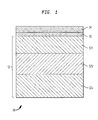
- Fig. 1 is a schematic cross-section of a structure for solder bonding according to the present invention.
- Fig 2 illustrates the inventive method of solder bonding applying the structure of Fig. 1 between two parts to be bound together.
- Fig. 3 shows a schematic cross-section of an alternate structure for solder bonding involving an oxidation barrier with attachment layers and also showing the substrates.
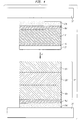
- Fig. 4 shows a schematic cross-section of a two-part embodiment of the invention involving use of the kinetic control principle as a function of both parts.
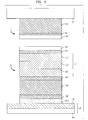
- Fig. 5 shows a schematic cross-section of a two-part embodiment of the invention involving use of the kinetic control principle as a function of one part.
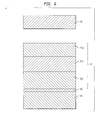
- Fig. 6 shows a schematic cross-section of a two-part embodiment of the invention representing the structure which is the object of a working example discussed herein to assess the soldering characteristics based on layer thicknesses.
- This invention has particular application to technologies for bonding laser chips to optical sub-assemblies (OSAs) with hard (gold-tin) solders that should remain intact at high temperatures (325-350-C).
- OSAs optical sub-assemblies
- gold-tin hard solders that should remain intact at high temperatures (325-350-C).
- the invention has applications beyond the area of laser chips, including solder bonds in silicon and gallium arsenide circuits and the bonding of components to submounts and materials other than those involving gold and tin.
- the description herein is directed principally to optical subassemblies and gold-tin solders, it should be understood that the invention pertains to other applications as well.
- Fig. 1 is a schematic cross section of a structure 10 for solder bonding in accordance with the invention, showing only the principal solder layers without the substrates to be bonded.
- the structure 10 for achieving the desired solder bond is a multilayered structure comprising at least one bond layer or solder layer 12, which is comprised of a plurality of alternating layers of solder material, 12a, 12b, and 12c.
- the solder layer is comprised of a plurality of layers, as shown in Fig. 1.
- a quenching layer 14 is used which induces the solidus line of the solder mixture to rise as it (the quenching layer) is incorporated into the solder 12.
- a control layer 16 disposed between the solder layer 12 and the quenching layer 14 is a control layer 16.
- the solder layer 12 and quenching layer 14 combination is referred to as a binary system for solder bonding. Since with the invention a control layer 16 is used between the solder and quenching layers, there is a deviation from the binary soldering structure.
- control layer is comprised of an element that reacts more slowly with the solder material than the quenching material reacts with the solder material.
- the control layer is preferably: 1) thin in comparison to either the solder or quenching layers so it dissolves rapidly without changing the melting behavior of the binary substantially by its own action; 2) easily incorporated into the other layers; 3) a minority element so that the basic properties of the binary system remain unchanged and can be calculated using binary phase diagrams as approximations.
- the choice and thickness of this control layer permits control over the induced freezing (quenching) of the solder.
- the control layer prevents the material of the solder from interacting with material from the quenching layer for a period of time dictated by temperature and the thickness and composition of the layers.
- solder layer 12 comprised of a plurality of alternating layers 12a, 12b, and 12c, and the quenching 14 and control 16 layers.
- first part or base 30 and the second part 32 are shown to be bonded together.
- the solder layer 12 is adhered to the base 30.
- the quenching layer 14 and control layer 16 are applied to the second part 32.
- the base 30 and solder 12 are heated to a temperature at or preferably above the melting point of the solder 12 to ensure complete mixing and to compensate for the later addition of other materials.
- the eutectic point of a gold/tin solder typically is at about 280 degrees Centigrade; in such a case, the base may be heated to approximately 320 degrees Centigrade or more.
- the second part 32, with the quenching layer 14 and control layer 16, are then applied to the base 30 and solder 12, along the direction of arrow A.
- the heat of the solder 12 will cause the control layer 16 to dissolve into the solder 12.
- the dissolution of the control layer 16 frees the quenching layer 14, allowing the quenching layer to interact with the solder.
- control layer 16 and quenching layer 14 can be applied directly to the solder layer 12, before application of the second part 32 to be bonded, or they may be disposed between the solder layer 12 and the first part 30.
- the solder layer comprises alternating layers of gold and tin.
- the solder layer 12 comprises a first solder layer 12a of gold, a second solder layer 12b of tin, and a third solder layer 12c of gold.
- the control layer 16 is preferably comprised of platinum (Pt), but also may be comprised of a transition element such as iron (Fe), nickel (Ni), cobalt (Co), or palladium (Pd).
- the quenching layer 14 is preferably comprised of gold.
- the invention offers flexibility with regard to the composition and arrangement of the solder layers, as is further illustrated below with reference to Figs. 3-5.
- the solder layer 12 can be in multilayer thin film form as shown, or it can be a homogeneous mixture at or close to the eutectic point.
- it is a composite of two chemical elements, such as gold-tin (AuSn) or lead-tin (PbSn).
- AuSn gold-tin
- PbSn lead-tin
- the quenching layer advantageously is Au
- the solder layer is PbSn
- platinum is particularly advantageous for use as the control layer. Platinum may dissolve in a PbSn solders. See , e.g., B.
- quenching layer There can be one quenching layer or plural quenching layers with plural control and barrier layers disposed between them.
- Each quenching layer further may be comprised of a mixture of metal layers, for example, alternating layers of Au, Sn, and Au.
- the quenching layer can be unitary, that is, comprised of a single chemical element as shown above. The important thing is that the control layer intervene between the quenching and solder layers to prevent uncontrolled interaction between the two.
- an antioxidation or barrier layer 18 As in Figure 2, there is shown the solder layer 12 (comprised of three layers 12a, 12b, and 12c); the quenching layer 14; the control layer 16; and the two parts 30, 32 to be bonded together.
- a barrier layer 18 is further disposed on the surface of the solder layer 12 or between the solder layer 12 and control layer 16. The barrier layer 18 prohibits undesired oxidation of the solder or oxidizable components thereof.
- an adhesive layer 20 may be disposed between the solder layer 18 and the base 30 to help secure the solder to the base.
- the barrier layer 18 is advantageously comprised of platinum (Pt), with the adhesive layer 20 comprised of titanium (Ti).
- the barrier layer 18 and adhesive layer 20 may be disposed between the quenching layer 14 and the second part to be bonded 32. That is, referring to Fig. 3, the barrier layer 18 may be disposed on top of the quenching layer 14, with the adhesive layer 20 disposed between the barrier layer 18 and the second part 32. In any case, it should be understood that the presence of additional layers may influence the choice of thicknesses for the operative layers.
- control of the final solder is improved, as the platinum represents an independent type of control that is more robust than the layer thickness or temperature variables used in previous methods. This is due at least in part to the high activation energy for platinum penetration, which leads to a rapid bonding at a sufficiently high temperature, with very low values at temperatures typical of fabrication.
- parts bonded with a AuSn solder to parts having Au and Pt layers have been shown to exhibit a time-dependent penetration of the Pt layer related to the Pt layer thickness.
- the Pt can be incorporated into the bond in a controlled fashion depending upon the variables for Pt thickness, AuSn composition, bond temperature, and bond time.
- Preferred variables for bonding a silicon substrate having a silicon dioxide surface layer to a semiconductor laser chip are provided below with reference too Figure 5, and a method of determining structure characteristics given the temperature variable is described in Example I below with reference to Fig. 6.
- Fig. 4 reflects an embodiment where the kinetic control principle operates as a co-function of two parts, that is, the barrier layer and the control layer are applied separately to the two parts, and then bonded together.
- Fig. 5 reflects an embodiment where the kinetic control principle operates basically as a function of one of the two parts, that is the barrier layer and control layer are applied to one part (part B in Fig. 5), with the other part (part C), serving primarily as a bondable partner.
- solder layer 12' disposed on the surface of the first part 30.
- the first part 30' may be comprised of silicon or silicon dioxide (Si0 2 ), with the second part 32' being part of a semiconductor laser chip.
- the solder layer 12' on the first part 30,' is preferably comprised of three alternating layers of gold (12a'), tin (12b'), and gold (12c').
- the quenching layer 14' and control layer 16' are applied to the second part 32.
- a first barrier layer 18a' and adhesive layer 20a' are applied between the solder layer 12' and the first part 30.
- a second barrier layer 18b' and adhesive layer 20b' are applied between the quenching layer 14' and the second part 32.
- the quenching layer 14' is preferably comprised of gold
- the control layer 16' is preferably comprised of platinum
- the first and second barrier layers 18a,' 18b,' are also preferably comprised of platinum
- the adhesive layers 20a,' 20b,' are preferably comprised of titanium (Ti).
- a final wetting layer of gold 22 may be applied over the control layer 16.'
- the control layer 16' which operates to control the mixing of the quenching layer 14' with the solder 12' is applied initially to only the second part 32.'
- the kinetic control (as opposed to thermodynamic control), over the freezing of the solder will only be initiated as the two parts are secured together along the direction of arrow A.'
- FIG. 5 there is shown an alternative soldering structure in which the kinetic control layer and the barrier layer are applied on the same part (in contrast to Fig. 4 where they are shown on different parts).
- Fig. 5 shows a first part 30" comprised of a silicon substrate 30a" having a silicon dioxide (Si0 2 ) surface layer 30b."
- a first adhesive layer 20a" of titanium of preferably about 1000 nm in thickness is applied to adhere a first barrier layer 18a" to the first part 30.”
- the first barrier layer 18a" preferably comprises a layer of platinum of about 2000 nm in thickness.
- the quenching layer 14a preferably of gold and about 10,000 nm in thickness, is applied directly on the first barrier layer 18a.”
- the quenching layer 14a” is followed by a control layer 16a" of platinum, preferably of about 300 to 450 nm in thickness.
- the solder layer 12 comprising alternating layers of gold 12a" (about 500 to 5,700 nm), tin 12b" (about 5,700 to 7,000 nm) and gold 12c" (about 2,200 to 2,800 nm), is applied over the control layer, followed by a second control layer 16b" of platinum (about 35 to 90 nm), and a first wetting layer 22a" of gold (preferably about 500 nm in thickness).
- a quenching layer of gold 14b" (preferably 4 microns in thickness)
- a third control layer of platinum 16c (about 2,000 nm in thickness)
- a second wetting layer 22b" of gold (about 1,500 nm in thickness).
- Fig. 5 The structure of Fig. 5 is important for it shows that both aspects of the kinetic control principle of the instant invention (i.e., control and anti-oxidation), can operate together (or simultaneously on the same part), to provide both resistance to surface oxidation during storage or preparation and controlled solidification of the solder material by use of a break-through control layer overlying the quenching layer. That is, on Part B, there is shown a barrier layer 18a" to control oxidation, and two control layers 16a," 16b,” to control solidification of the solder.
- the second control layer 16b" can serve both to control the bonding process and oxidation on the surface of the solder 12.”
- the quenching process could proceed on both parts, with the second quenching layer 14b” acting simultaneously with the first quenching layer 14a,” to adjust the melting point of the solder layer 12" from opposing directions; that is, the first quenching layer 14a” operates from the direction of the first part 30" at the first solder layer 12a," and the second quenching layer 14b" operates from the direction of the second part 32" at the third solder layer 12c.” It may be desirable to incorporate this shared function of the layers due to practical constraints relating to thickness of the layers on a single part. In any event, these structures illustrate the flexibility of the kinetic control according to the invention and its applications to other designs.
- Figure 6 represents a structure for illustrating calculations for determining the characteristics of a specific layer structure based on the use of binary phase diagrams for the solder system. Calculations are presented below as an executable MATHCAD program in MATHCAD 5.0 which is a program well known in the field to produce results in the form indicated below.
- MATHCAD 5.0 is a program well known in the field to produce results in the form indicated below.
- ⁇ ⁇ ⁇ ⁇ ⁇ ⁇ ⁇ ⁇ ⁇ ⁇ ⁇ ⁇ ⁇ ⁇ ⁇ ⁇ ⁇ ⁇ ⁇ ⁇ ⁇ ⁇ ⁇ ⁇ ⁇ ⁇ ⁇ ⁇ ⁇ ⁇ ⁇ ⁇ ⁇ ⁇ ⁇ ⁇ ⁇ ⁇ ⁇ ⁇ ⁇ ⁇ ⁇ ⁇ ⁇ ⁇ ⁇ ⁇ ⁇ ⁇ ⁇ ⁇ ⁇ ⁇ ⁇ ⁇ ⁇ ⁇ ⁇ ⁇ ⁇ ⁇ ⁇ ⁇ ⁇ ⁇ ⁇ ⁇ ⁇ ⁇ ⁇ ⁇ ⁇ ⁇ ⁇ ⁇ ⁇ ⁇ ⁇ ⁇ ⁇ ⁇ ⁇ ⁇ ⁇ ⁇ ⁇ ⁇ ⁇ ⁇ ⁇ ⁇ ⁇ ⁇ ⁇ ⁇ ⁇ ⁇ ⁇ ⁇ ⁇ ⁇ ⁇ ⁇ ⁇ ⁇ ⁇ ⁇ ⁇ ⁇ ⁇ ⁇ ⁇ ⁇ ⁇ ⁇ ⁇ ⁇ ⁇ ⁇ ⁇ ⁇ ⁇ ⁇ ⁇ ⁇
- Calculations to determine layer thicknesses and the behavior of the structure generally can be made by applying the following five steps: 1) determining the solidus and liquidus lines in the region of compositions of interest; 2) applying the Lever Rule, a well known formula in the field, to determine the fraction of the solder that is liquid; 3) determining the atomic fraction of each element in a given set of thin film layers; 4) using published or experimentally-determined information on the dissolution rates of potential control materials to choose a control layer material that will dissolve at an appropriate time in the solder bond process; and 5) applying formulas known in the field to design a solder layer sequence that will have the properties of being liquid until the quenching layer is exposed and that will solidify once the control layer is dissolved and the quenching layer mixes with the solder.
- the supposition is made that the control layer is a minority element. To illustrate the invention, these steps are performed below considered with the solder structure of Figure 6.
- Step 1 First, the liquid fraction of the solder for various compositions of the elements can be determined considering the amount of material in each layer and the mode of incorporating the materials into the solder.
- T(X) the Temperature T(X) as a function of the composition (X) of the material.
- T(X) the Temperature T(X)
- the liquidus and solidus curves are transformed from composition to temperature variables.
- TOL 10 -2 .
- the functions for the liquidus and solidus curves in the area of interest reference is made to J. Ciulik and M.R. Notis, "The Au-Sn Phase Diagram, " JOURNAL OF ALLOYS AND COMPOUNDS, Vol.
- LVR(X_Sn,T): X_Sn - X_Sn_sol(T) (X_Sn_liq(T) - X_Sn_sol(T))
- the dissolution of the control layer or barrier material into the solder may itself cause changes in the liquid composition of the solder, for example, by binding one of the elements of the solder more strongly than the partner element does and causing precipitation of the bound element.
- incorporation of Pt used as a control layer causes such changes.
- platinum to be a "sink" for tin.
- the material which precipitates can be represented roughly by the chemical composition of AuPtSn 2 , and then we calculate an effective tin concentration of the remaining solder by removing from the binary composition an amount of tin appropriate to the platinum reacted. This same method can be used for other systems, for example, the Pt-Pb-Sn system or the Au-Co-Sn system, among others.
- material derived from a layered structure comprising initially 400 nm of Sn and 700 nm of Au has an effective tin concentration of 26.3% and, when raised to a temperature of 350 degrees Celsius, is 96.6% liquid.
Landscapes
- Engineering & Computer Science (AREA)
- Mechanical Engineering (AREA)
- Semiconductor Lasers (AREA)
- Die Bonding (AREA)
- Electric Connection Of Electric Components To Printed Circuits (AREA)
Applications Claiming Priority (2)
| Application Number | Priority Date | Filing Date | Title |
|---|---|---|---|
| US955686 | 1997-10-22 | ||
| US08/955,686 US5990560A (en) | 1997-10-22 | 1997-10-22 | Method and compositions for achieving a kinetically controlled solder bond |
Publications (2)
| Publication Number | Publication Date |
|---|---|
| EP0911111A2 true EP0911111A2 (de) | 1999-04-28 |
| EP0911111A3 EP0911111A3 (de) | 2003-10-08 |
Family
ID=25497203
Family Applications (1)
| Application Number | Title | Priority Date | Filing Date |
|---|---|---|---|
| EP98308345A Withdrawn EP0911111A3 (de) | 1997-10-22 | 1998-10-13 | Verfahren und Zusammensetzungen zum Erhalten einer kinetisch kontrollierten Lötverbindung |
Country Status (3)
| Country | Link |
|---|---|
| US (1) | US5990560A (de) |
| EP (1) | EP0911111A3 (de) |
| JP (1) | JPH11192581A (de) |
Cited By (9)
| Publication number | Priority date | Publication date | Assignee | Title |
|---|---|---|---|---|
| EP1002612A1 (de) * | 1998-11-20 | 2000-05-24 | Lucent Technologies Inc. | Kinetisch überprüfte Lötverbindung |
| WO2003097294A1 (en) * | 2002-05-14 | 2003-11-27 | Freescale Semiconductor, Inc. | Solder compositions for attaching a die to a substrate |
| WO2003083545A3 (en) * | 2002-03-27 | 2004-02-26 | Intel Corp | Assembly of active optical devices on a substrate |
| WO2004042819A1 (en) * | 2002-11-06 | 2004-05-21 | Koninklijke Philips Electronics N.V. | Device comprising circuit elements connected by bonding bump structure |
| US7449784B2 (en) | 2003-09-15 | 2008-11-11 | Nuvotronics, Llc | Device package and methods for the fabrication and testing thereof |
| EP2009971A4 (de) * | 2006-04-17 | 2011-01-12 | Dowa Electronics Materials Co Ltd | Lotschicht, substrat für einen anordnungsübergang damit und prozess zum herstellen des substrats |
| US8747579B2 (en) | 2007-02-27 | 2014-06-10 | Dowa Electronics Materials Co., Ltd. | Solder layer and device bonding substrate using the same and method for manufacturing such a substrate |
| CN105103287A (zh) * | 2013-03-26 | 2015-11-25 | 欧司朗光电半导体有限公司 | 借助于等温凝固反应来连接接合配对件以形成In-Bi-Ag连接层的方法和接合配对件的相应装置 |
| US10319654B1 (en) | 2017-12-01 | 2019-06-11 | Cubic Corporation | Integrated chip scale packages |
Families Citing this family (23)
| Publication number | Priority date | Publication date | Assignee | Title |
|---|---|---|---|---|
| JPH086039B2 (ja) * | 1990-08-01 | 1996-01-24 | 信越化学工業株式会社 | オルガノポリシロキサン組成物及びそのゲル硬化物 |
| US6186674B1 (en) * | 1998-09-15 | 2001-02-13 | Lucent Technologies, Inc. | Optical sub-assembly package mount |
| US6214646B1 (en) * | 2000-02-29 | 2001-04-10 | Lucent Technologies Inc. | Soldering optical subassemblies |
| JP3882712B2 (ja) * | 2002-08-09 | 2007-02-21 | 住友電気工業株式会社 | サブマウントおよび半導体装置 |
| DE10251658B4 (de) * | 2002-11-01 | 2005-08-25 | Atotech Deutschland Gmbh | Verfahren zum Verbinden von zur Herstellung von Mikrostrukturbauteilen geeigneten, mikrostrukturierten Bauteillagen sowie Mikrostrukturbauteil |
| JP4979944B2 (ja) * | 2003-08-26 | 2012-07-18 | 株式会社トクヤマ | 素子接合用基板、素子接合基板及びその製造方法 |
| JP4580633B2 (ja) * | 2003-11-14 | 2010-11-17 | スタンレー電気株式会社 | 半導体装置及びその製造方法 |
| TWI229911B (en) * | 2003-12-16 | 2005-03-21 | Univ Nat Central | Method for controlling the bond microstructures |
| CN100428432C (zh) * | 2004-03-24 | 2008-10-22 | 德山株式会社 | 元件接合用基板及其制造方法 |
| DE102005029246B4 (de) * | 2005-03-31 | 2023-06-22 | OSRAM Opto Semiconductors Gesellschaft mit beschränkter Haftung | Halbleiterchip mit einer Lötschichtenfolge und Verfahren zum Löten eines Halbleiterchips |
| US8013957B2 (en) * | 2005-05-21 | 2011-09-06 | The Hong Kong University Of Science And Technology | Transflective liquid crystal device and method of manufacturing the same |
| DE102005024430B4 (de) * | 2005-05-24 | 2009-08-06 | Infineon Technologies Ag | Verfahren zum Beschichten eines Siliziumwafers oder Siliziumchips |
| US20080035703A1 (en) * | 2006-08-09 | 2008-02-14 | Daewoong Suh | Oxidation resistant solder preform |
| WO2008060447A2 (en) * | 2006-11-09 | 2008-05-22 | Quantum Leap Packaging, Inc. | Microcircuit package having ductile layer |
| FR2939240B1 (fr) * | 2008-12-03 | 2011-02-18 | Saint Gobain | Element en couches et dispositif photovoltaique comprenant un tel element |
| US8707734B2 (en) * | 2009-10-19 | 2014-04-29 | The Regents Of The University Of Michigan | Method of embedding material in a glass substrate |
| US9024205B2 (en) * | 2012-12-03 | 2015-05-05 | Invensas Corporation | Advanced device assembly structures and methods |
| US9070387B1 (en) | 2013-08-23 | 2015-06-30 | Western Digital Technologies, Inc. | Integrated heat-assisted magnetic recording head/laser assembly |
| US9042048B1 (en) | 2014-09-30 | 2015-05-26 | Western Digital (Fremont), Llc | Laser-ignited reactive HAMR bonding |
| US9202478B1 (en) | 2015-02-10 | 2015-12-01 | Western Digital (Fremont), Llc | Method and structure for soldering a laser submount to a mounting face of a slider |
| US20160339538A1 (en) * | 2015-05-18 | 2016-11-24 | Toyota Motor Engineering & Manufacturing North America, Inc. | High temperature bonding processes incorporating traces |
| CN108015412A (zh) * | 2016-11-01 | 2018-05-11 | 福州高意光学有限公司 | 一种光学元件与基片的粘接方法 |
| CN113823613B (zh) * | 2021-11-24 | 2022-02-15 | 深圳市时代速信科技有限公司 | 半导体器件和半导体器件的制备方法 |
Family Cites Families (3)
| Publication number | Priority date | Publication date | Assignee | Title |
|---|---|---|---|---|
| JPS57112972A (en) * | 1980-12-31 | 1982-07-14 | Ibm | Brazing method |
| US5197654A (en) * | 1991-11-15 | 1993-03-30 | Avishay Katz | Bonding method using solder composed of multiple alternating gold and tin layers |
| US5559817A (en) * | 1994-11-23 | 1996-09-24 | Lucent Technologies Inc. | Complaint layer metallization |
-
1997
- 1997-10-22 US US08/955,686 patent/US5990560A/en not_active Expired - Lifetime
-
1998
- 1998-10-13 EP EP98308345A patent/EP0911111A3/de not_active Withdrawn
- 1998-10-19 JP JP10296665A patent/JPH11192581A/ja active Pending
Cited By (20)
| Publication number | Priority date | Publication date | Assignee | Title |
|---|---|---|---|---|
| EP1002612A1 (de) * | 1998-11-20 | 2000-05-24 | Lucent Technologies Inc. | Kinetisch überprüfte Lötverbindung |
| WO2003083545A3 (en) * | 2002-03-27 | 2004-02-26 | Intel Corp | Assembly of active optical devices on a substrate |
| WO2003097294A1 (en) * | 2002-05-14 | 2003-11-27 | Freescale Semiconductor, Inc. | Solder compositions for attaching a die to a substrate |
| US6740544B2 (en) | 2002-05-14 | 2004-05-25 | Freescale Semiconductor, Inc. | Solder compositions for attaching a die to a substrate |
| WO2004042819A1 (en) * | 2002-11-06 | 2004-05-21 | Koninklijke Philips Electronics N.V. | Device comprising circuit elements connected by bonding bump structure |
| US8703603B2 (en) | 2003-09-15 | 2014-04-22 | Nuvotronics, Llc | Device package and methods for the fabrication and testing thereof |
| US9647420B2 (en) | 2003-09-15 | 2017-05-09 | Nuvotronics, Inc. | Package and methods for the fabrication and testing thereof |
| US9817199B2 (en) | 2003-09-15 | 2017-11-14 | Nuvotronics, Inc | Device package and methods for the fabrication and testing thereof |
| US7888793B2 (en) | 2003-09-15 | 2011-02-15 | Nuvotronics, Llc | Device package and methods for the fabrication and testing thereof |
| US7508065B2 (en) | 2003-09-15 | 2009-03-24 | Nuvotronics, Llc | Device package and methods for the fabrication and testing thereof |
| US7449784B2 (en) | 2003-09-15 | 2008-11-11 | Nuvotronics, Llc | Device package and methods for the fabrication and testing thereof |
| US9410799B2 (en) | 2003-09-15 | 2016-08-09 | Nuvotronics, Inc. | Device package and methods for the fabrication and testing thereof |
| US8993450B2 (en) | 2003-09-15 | 2015-03-31 | Nuvotronics, Llc | Device package and methods for the fabrication and testing thereof |
| US8516692B2 (en) | 2006-04-17 | 2013-08-27 | Dowa Electronics Materials Co., Ltd. | Solder layer, substrate for device joining utilizing the same and method of manufacturing the substrate |
| EP2009971A4 (de) * | 2006-04-17 | 2011-01-12 | Dowa Electronics Materials Co Ltd | Lotschicht, substrat für einen anordnungsübergang damit und prozess zum herstellen des substrats |
| US8747579B2 (en) | 2007-02-27 | 2014-06-10 | Dowa Electronics Materials Co., Ltd. | Solder layer and device bonding substrate using the same and method for manufacturing such a substrate |
| CN105103287A (zh) * | 2013-03-26 | 2015-11-25 | 欧司朗光电半导体有限公司 | 借助于等温凝固反应来连接接合配对件以形成In-Bi-Ag连接层的方法和接合配对件的相应装置 |
| CN105103287B (zh) * | 2013-03-26 | 2018-03-23 | 欧司朗光电半导体有限公司 | 借助于等温凝固反应来连接接合配对件以形成In‑Bi‑Ag 连接层的方法和接合配对件的相应装置 |
| US10319654B1 (en) | 2017-12-01 | 2019-06-11 | Cubic Corporation | Integrated chip scale packages |
| US10553511B2 (en) | 2017-12-01 | 2020-02-04 | Cubic Corporation | Integrated chip scale packages |
Also Published As
| Publication number | Publication date |
|---|---|
| JPH11192581A (ja) | 1999-07-21 |
| US5990560A (en) | 1999-11-23 |
| EP0911111A3 (de) | 2003-10-08 |
Similar Documents
| Publication | Publication Date | Title |
|---|---|---|
| US5990560A (en) | Method and compositions for achieving a kinetically controlled solder bond | |
| US5234153A (en) | Permanent metallic bonding method | |
| JPS61154764A (ja) | 構造部材の金属結合の方法及び結合材料 | |
| Humpston et al. | Principles of soldering | |
| US5197654A (en) | Bonding method using solder composed of multiple alternating gold and tin layers | |
| EP0629467B1 (de) | Bleifreie Zinn-Wismut Weichlotlegierungen | |
| JP2000210767A (ja) | 2つの部品の接合方法 | |
| US9095936B2 (en) | Variable melting point solders | |
| Rönkä et al. | A diffusion-kinetic model for predicting solder/conductor interactions in high density interconnections | |
| US20050133572A1 (en) | Methods of forming solder areas on electronic components and electronic components having solder areas | |
| US5917200A (en) | Optical semiconductor device | |
| JP5943065B2 (ja) | 接合方法、電子装置の製造方法、および電子部品 | |
| US7442582B2 (en) | Method for producing a chip-substrate connection | |
| Reeve et al. | Advances in Pb-free solder microstructure control and interconnect design | |
| WO2003097294A1 (en) | Solder compositions for attaching a die to a substrate | |
| CN110770894A (zh) | 用于将半导体芯片固定在基板上的方法和电子器件 | |
| Rönkä et al. | The local nominal composition-useful concept for microjoining and interconnection applications | |
| US10376997B2 (en) | Transient liquid phase bonding process and assemblies formed thereby | |
| JP3718380B2 (ja) | はんだ接続構造を有する回路装置およびその製造方法 | |
| JP3243834B2 (ja) | 半田材及び接合方法 | |
| US6203929B1 (en) | Gold plated solder material and method of fluxless soldering using solder | |
| Choquette | Liquid-phase diffusion bonding and the development of a Cu-Ni/Sn composite solder paste for high temperature lead-free electrical connections | |
| JP2003286531A (ja) | はんだ接合層 | |
| Korhonen et al. | Interconnections based on Bi-coated SnAg solder balls | |
| JP7526116B2 (ja) | はんだの溶融持続時間算出方法 |
Legal Events
| Date | Code | Title | Description |
|---|---|---|---|
| PUAI | Public reference made under article 153(3) epc to a published international application that has entered the european phase |
Free format text: ORIGINAL CODE: 0009012 |
|
| AK | Designated contracting states |
Kind code of ref document: A2 Designated state(s): AT BE CH CY DE DK ES FI FR GB GR IE IT LI LU MC NL PT SE |
|
| AX | Request for extension of the european patent |
Free format text: AL;LT;LV;MK;RO;SI |
|
| PUAL | Search report despatched |
Free format text: ORIGINAL CODE: 0009013 |
|
| AK | Designated contracting states |
Kind code of ref document: A3 Designated state(s): AT BE CH CY DE DK ES FI FR GB GR IE IT LI LU MC NL PT SE |
|
| AX | Request for extension of the european patent |
Extension state: AL LT LV MK RO SI |
|
| STAA | Information on the status of an ep patent application or granted ep patent |
Free format text: STATUS: THE APPLICATION IS DEEMED TO BE WITHDRAWN |
|
| 18D | Application deemed to be withdrawn |
Effective date: 20030503 |