EP0911254A2 - Simulationsverfahren zur Luftblasenumhüllung eines Schiffes - Google Patents
Simulationsverfahren zur Luftblasenumhüllung eines Schiffes Download PDFInfo
- Publication number
- EP0911254A2 EP0911254A2 EP98402626A EP98402626A EP0911254A2 EP 0911254 A2 EP0911254 A2 EP 0911254A2 EP 98402626 A EP98402626 A EP 98402626A EP 98402626 A EP98402626 A EP 98402626A EP 0911254 A2 EP0911254 A2 EP 0911254A2
- Authority
- EP
- European Patent Office
- Prior art keywords
- bubble
- given
- cos
- ship
- calculating
- Prior art date
- Legal status (The legal status is an assumption and is not a legal conclusion. Google has not performed a legal analysis and makes no representation as to the accuracy of the status listed.)
- Withdrawn
Links
Images






Classifications
-
- G—PHYSICS
- G01—MEASURING; TESTING
- G01M—TESTING STATIC OR DYNAMIC BALANCE OF MACHINES OR STRUCTURES; TESTING OF STRUCTURES OR APPARATUS, NOT OTHERWISE PROVIDED FOR
- G01M10/00—Hydrodynamic testing; Arrangements in or on ship-testing tanks or water tunnels
-
- B—PERFORMING OPERATIONS; TRANSPORTING
- B63—SHIPS OR OTHER WATERBORNE VESSELS; RELATED EQUIPMENT
- B63B—SHIPS OR OTHER WATERBORNE VESSELS; EQUIPMENT FOR SHIPPING
- B63B1/00—Hydrodynamic or hydrostatic features of hulls or of hydrofoils
- B63B1/32—Other means for varying the inherent hydrodynamic characteristics of hulls
- B63B1/34—Other means for varying the inherent hydrodynamic characteristics of hulls by reducing surface friction
- B63B1/38—Other means for varying the inherent hydrodynamic characteristics of hulls by reducing surface friction using air bubbles or air layers gas filled volumes
-
- B—PERFORMING OPERATIONS; TRANSPORTING
- B63—SHIPS OR OTHER WATERBORNE VESSELS; RELATED EQUIPMENT
- B63B—SHIPS OR OTHER WATERBORNE VESSELS; EQUIPMENT FOR SHIPPING
- B63B71/00—Designing vessels; Predicting their performance
- B63B71/10—Designing vessels; Predicting their performance using computer simulation, e.g. finite element method [FEM] or computational fluid dynamics [CFD]
-
- F—MECHANICAL ENGINEERING; LIGHTING; HEATING; WEAPONS; BLASTING
- F15—FLUID-PRESSURE ACTUATORS; HYDRAULICS OR PNEUMATICS IN GENERAL
- F15D—FLUID DYNAMICS, i.e. METHODS OR MEANS FOR INFLUENCING THE FLOW OF GASES OR LIQUIDS
- F15D1/00—Influencing flow of fluids
- F15D1/10—Influencing flow of fluids around bodies of solid material
- F15D1/12—Influencing flow of fluids around bodies of solid material by influencing the boundary layer
-
- G—PHYSICS
- G06—COMPUTING OR CALCULATING; COUNTING
- G06F—ELECTRIC DIGITAL DATA PROCESSING
- G06F9/00—Arrangements for program control, e.g. control units
- G06F9/06—Arrangements for program control, e.g. control units using stored programs, i.e. using an internal store of processing equipment to receive or retain programs
- G06F9/44—Arrangements for executing specific programs
- G06F9/455—Emulation; Interpretation; Software simulation, e.g. virtualisation or emulation of application or operating system execution engines
-
- G—PHYSICS
- G09—EDUCATION; CRYPTOGRAPHY; DISPLAY; ADVERTISING; SEALS
- G09B—EDUCATIONAL OR DEMONSTRATION APPLIANCES; APPLIANCES FOR TEACHING, OR COMMUNICATING WITH, THE BLIND, DEAF OR MUTE; MODELS; PLANETARIA; GLOBES; MAPS; DIAGRAMS
- G09B9/00—Simulators for teaching or training purposes
- G09B9/02—Simulators for teaching or training purposes for teaching control of vehicles or other craft
- G09B9/06—Simulators for teaching or training purposes for teaching control of vehicles or other craft for teaching control of ships, boats, or other waterborne vehicles
- G09B9/066—Sailing; Surfing
-
- Y—GENERAL TAGGING OF NEW TECHNOLOGICAL DEVELOPMENTS; GENERAL TAGGING OF CROSS-SECTIONAL TECHNOLOGIES SPANNING OVER SEVERAL SECTIONS OF THE IPC; TECHNICAL SUBJECTS COVERED BY FORMER USPC CROSS-REFERENCE ART COLLECTIONS [XRACs] AND DIGESTS
- Y02—TECHNOLOGIES OR APPLICATIONS FOR MITIGATION OR ADAPTATION AGAINST CLIMATE CHANGE
- Y02T—CLIMATE CHANGE MITIGATION TECHNOLOGIES RELATED TO TRANSPORTATION
- Y02T70/00—Maritime or waterways transport
- Y02T70/10—Measures concerning design or construction of watercraft hulls
Definitions
- the present invention relates to a method and an apparatus for numerical simulation of skin friction reduction by enveloping a ship with bubbles and to a computer-readable memory medium having a simulation program recorded, and relates in particular to a friction-reduction technology by jetting micro-bubbles into the boundary layer to envelope the submerged surfaces of a ship.
- Friction-reducing ships presented in these publications are based on jetting a gas such as air from a cruising ship into water to produce micro-bubbles (bubbles hereinbelow) in the boundary layer between the ship and water to reduce the skin-friction by the effect of those bubbles enveloping the submerged surfaces.
- CFD computed fluid dynamics
- This method is based on solving three-dimensional Navier-Stokes equations describing viscous flow fields directly or approximately by numerical analysis.
- Turbulent flow over the ship surface is modeled numerically (turbulent modeling) by dividing the flow fields including the turbulent boundary layer into a plurality of orthogonal three-dimensional lattices (cells) so that three-dimensional Navier-Stokes equations can be solved in individual cells to compute the turbulent flow energy and an energy dissipation factor (a proportion of energy loss due to frictional heat) in each cell.
- Such numeral simulation studies of turbulent flow field around the ship surface enables to design a friction-reducing ship with minimal experimentations.
- the present invention provides an approach to solving many of the foregoing problems under several objectives outlined below.
- An apparatus to perform the simulation method is comprised by means to perform analytical steps of:
- a memory medium is comprised by an application program to perform the steps of:
- Figure 1 shows the coordinate system used in the basic theory.
- Figure 2 is an illustration of a bubble distribution used in computation.
- FIG. 3 is a flowchart of the method.
- Figure 4 is a graph showing a convergence state of void fraction distributions after a low number of iterations.
- Figure 5 is a graph showing converged void fraction distribution.
- Figure 6 is a first distribution graph for the bubble diameter of 500 ⁇ m showing the computational results of void fraction distributions in the girth direction of the ship at various longitudinal locations.
- Figure 7 is a second distribution graph for the bubble diameter of 500 ⁇ m showing the computational results of void fraction distributions in the girth direction of the ship at various longitudinal locations.
- Figure 8 is a third distribution graph for the bubble diameter of 500 ⁇ m showing the computational results of void fraction distributions in the girth direction of the ship at various longitudinal locations.
- Figure 9 is a fourth distribution graph the bubble diameter of 500 ⁇ m showing the computational results of void fraction distributions in the girth direction of the ship at various longitudinal locations.
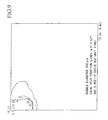
- Figure 10 is a graph showing computational results of enveloping the ship with bubbles.
- Figure 11 is a first distribution graph the bubble diameter of 1,000 ⁇ m showing the computational results of void fraction distributions in the girth direction of the ship at various longitudinal locations.
- Figure 12 is a second distribution graph the bubble diameter of 1,000 ⁇ m showing the computational results of void fraction distributions in the girth direction of the ship at various longitudinal locations.
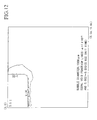
- Figure 13 is a third distribution graph the bubble diameter of 1,000 ⁇ m showing the computational results of void fraction distributions in the girth direction of the ship at various longitudinal locations.
- Figure 14 is a fourth distribution graph the bubble diameter of 1,000 ⁇ m showing the computational results of void fraction distributions in the girth direction of the ship at various longitudinal locations.
- the method is based on a CFD analysis based on a ⁇ - ⁇ model of flow data in a given cell generated on the hull surfaces of a ship, where ⁇ is the turbulent flow energy and ⁇ is the energy dissipation factor. Derived values of ⁇ and ⁇ are applied in the kinetic equations of bubble motion shown below to compute the number of bubbles existing in individual cells surrounding the submerged surfaces, thereby arriving at the overall bubble distributions on the hull surfaces.
- a bubble at a point (i, j, k) at a given time will move to one of the following six points after a passage of one unit time.
- This concentration is expressed as P n i,j,k
- P n+1 i,j,k (P n i,j,k+1 + P n i,j,k-1 + P n i,j+1,k + P n i,j-1,k + P n i+1,j,k + P n i-1,j,k )/6
- equation (2) The difference between equation (1) and a concentration P n i,j,k at a unit time earlier, equation (2) is obtained:
- a dispersion equation in an isotropic turbulent flow may be considered as in equation (3), for a variable bubble concentration P and a dispersion coefficient D:
- equation (3) is rewritten as a difference equation between a concentration P n i,j,k at time n and a concentration P n+1 i,j,k at time n+1, equation (4) is obtained.
- equation (5) if the turbulent flow is isotropic, from the definition of dispersion coefficient, equation (5) is established: where the brackets ⁇ > indicate a collective average (ensemble average) of all the bubbles involved in the dispersion process. "u” is a deviation from an average bubble velocity value of bubbles, and “l” is a deviation in displacement.
- equation (6) matches equation (2) describing the random motion of bubbles. Therefore, it is possible to solve dispersion equations in an isotropic turbulent flow using a Monte Carlo Methods which directly simulates bubble motion using random numbers.
- Figure 1 shows the basic coordinate system for describing the equations of bubbles motion.
- the XYZ-O system is a solid coordinate space, and Z-axis is the plumb vertical direction.
- Velocity parameters u x , u y , u z are average fluid velocities (in this case water velocity surrounding the ship) in the X-, Y- and Z-directions, respectively.
- This coordinate system will be used in the following to explain: (1) equations of motion when the bubbles are remote from the ship surface; (2) equations of motion when the bubbles are sticking to the ship surface; (3) effects of turbulent dispersion; and (4) definition of void fraction.
- Equation (7) expresses the lift force L in terms of a liquid density ⁇ (kg/m 3 ), fluid velocity U (m/s), a bubble radius R (m), and a kinetic viscosity coefficient ⁇ (m 2 /s).
- ⁇ liquid density
- U fluid velocity
- R bubble radius
- ⁇ kinetic viscosity coefficient
- equations of motion for bubbles within a cell in the coordinate system are expressed in equations (9) ⁇ (11) in X-, Y- and Z-directions, where u x , u y, and u z are average velocities of water (m/s) in the X-, Y- and Z-directions, u' x , u' y , and u' z are average velocities for directional bubble flows, m is a mass of a bubble (kg), m A is an addition mass (kg), ⁇ is a static viscosity coefficient (m 2 /s), and g is gravitational acceleration (m/s 2 ).
- equations of motion of bubbles in the three coordinate directions are developed by expressing the directional turbulent flow velocities as a function of a sum of the average fluid velocity and the directional bubble flow velocity.
- equations (9) ⁇ (11) the first term on the right hand side of the equation is selected by using Stokes approximation for solid sphere.
- equations of motion can be derived from equations (9) ⁇ (11) as equations (12) ⁇ (14).
- Nx, Ny, Nz are effective vertical force (in Newton)
- Fx, Fy, Fz are frictional forces (in Newton).
- Markov process is a process in which a probability of an event at a certain time is affected by a past probability at a preceding one unit time, and first-order Markov process describes a random phenomenon at a certain time by a first-order equation of random phenomenon at a preceding one unit time.
- the magnitude of perturbation u' n+1 at (n+1) unit time is given by a first-order equation of the magnitude of a perturbation at n unit time as in the following equation (20).
- u' n+1 ⁇ u' n + ⁇ n
- ⁇ is a constant of a value 0 ⁇ 1
- ⁇ n is normal random number of a zero average value and a standard deviation ⁇ 0 .
- Self correlation function R (m, ⁇ t) of the magnitude u' n of a perturbation obtained from equation (20) is shown in equation (21) below.
- an integral time-scale T* which is defined as an attenuation time constant or a life-time of a perturbation in the turbulent boundary layer.
- a void fraction can be obtained by dividing a volume v i of bubbles existing in a cell at a given time with the volume of the cell ⁇ V. For example, in a case shown in Figure 2, there are ten bubbles within a cell so that the void fraction is obtained by equation (33).
- the flowchart indicates various steps in the simulation program which is recorded in a computer.
- the simulation is predicated on the use a known model for ⁇ - ⁇ turbulent flow to simulate the flow data on the hull surfaces by means of CFD data.
- the model is used to pre-calculate basic flow parameters based on the shape and size of the ship, cruising speed and the like.
- the basic flow parameters include: division of the flow fields including the turbulent boundary layer into a suitable number of cells; average values of directional fluid flow velocities u x , u y , u z ; time-averaged pressure Pr; turbulent flow energy ⁇ and energy dissipation factor ⁇ .
- Bubble jet outlets are rectangular shaped with 0.3 m width, and twenty-five such outlets arranged in a line along the girth direction at 0.12 m from the bow of the ship.
- integral time-scale T* is computed as 0.1 ⁇ 2.9 s.
- the unit time (computational increment ⁇ t) will be selected so as to be sufficiently smaller than the smallest integral time-scale (0.1 s). In this case, it is taken as 1/10 to yield 0.01 s as the unit time.
- Computation is started by initializing the positions of bubbles and initial bubble velocity (step S1). For example, a plurality of jet outlets (25 in this case) in the girth direction of the ship are represented by intersections of the lattice structure. One of these intersections (terminal end, for example) is selected as the initial ejection of a jet bubble.
- the parameter for bubble location "pr”, the time parameter "n" are both set to [0] but the initial velocity may be set to zero or to some other value.
- step S2 a uniform random number between [-180°, 180°] for movement angle ⁇ , and a uniform random number between [-90°, 90°] for movement angle ⁇ are generated by each random number generator, and the resulting values are substituted into ⁇ , ⁇ in equations (17) ⁇ (19).
- Another random number generator produces normal random numbers having zero average and a standard deviation ⁇ 0 and are entered in ⁇ n in equation (20).
- the integral time-scale T* and the unit time ⁇ t computed on the basis of the integral time-scale T* are entered in equation (23) to compute a constant ⁇ .
- This constant ⁇ is entered in equation (20) together with the magnitude of the perturbation u' n at a past time (preceding one unit time) obtained from equation (29) to produce the magnitude of a perturbation at a current time u' n+1 .
- Directional bubble velocities u' x , u' y , u' z are thus obtained according to the random numbers generated by various algorithms.
- step S3 it is examined whether or not the bubble ejected into water in step S1 has left the ship surface (step S3).
- the results of computation of the directional bubble velocities u' x , u' y , u' z show where the bubble is now, i.e., which cell is now occupied by a bubble.
- step S3 if it is decided that the bubble has left the ship surface, the bubble location (cell location) in the next instant (succeeding unit time) is computed (step S4) using the equations of motion (9) ⁇ (11).
- step S3 if it is decided that the bubble has not left the ship surface, i.e. still sticking to the surface, then initialization of effective vertical forces in the coordinate directions Nx, Ny, Nz is performed (step S5). Then, the bubble location (cell location) in the next instant (succeeding unit time) is computed (step S6) according to the equations of motion (12) ⁇ (14), and it is then examined (step S7) whether the computed results from equations (12) ⁇ (14) satisfy the restriction condition equations (15), (16).
- step S8 the initial values of the effective vertical forces Nx, Ny, Nz in step S5 are corrected (step S8), and the iteration processes for steps S6, S7 are continued until the computed results satisfy the restriction condition equations (15), (16).
- step S7 When the restriction condition equations (15), (16) are satisfied by a series of iteration of steps S6 ⁇ S8, the decision in step S7 becomes [yes], and the process advances to examining whether the effective vertical forces Nx, Ny, Nz are less than zero (step S9). If the judgment in step S9 is [yes], this data stream is forwarded to step S4, and if the judgment is [no], then it proceeds to step S10.
- step S9 The data stream from [no] in step S9 and the computation results in step S4 are merged in step S10 to examine whether the bubble is below the stationary water surface, i.e. whether or not the bubble resides in the water. If the decision in step S10 is [yes], a void fraction in each cell is computed (step S11) according to equation (33). If the decision in step S10 is [no], void fraction is not computed.
- step S2 a new bubble (second bubble) is ejected into water, and a total of two bubbles (first and second bubbles) are now located in the turbulent boundary layer.
- perturbation computations for the directional bubble velocities are performed using the random number generators.
- the old location determined by the steps presented above will be changed to a new location at a succeeding unit time ⁇ t.
- For the second bubble its location at a unit time ⁇ t is obtained based on the initial bubble location as described above for the first bubble.
- Figures 4 and 5 show the computed distributions of void fractions in individual cells in the girth direction.
- the bubbles ejected into the turbulent flow boundary layer move in the opposite direction to the moving direction of the ship, resulting in longitudinal flows of bubbles along the bottom surface. Therefore, Figures 4 and 5 show computed void fraction data on the x-axis and the positions of different cells along the girth (transverse) direction on the y-axis, at various longitudinal positions of the ship.
- Figure 4 shows the results after 1 ⁇ 5 iteration steps while Figure 5 shows the results after 96 ⁇ 100 iterations.
- Bubble locations are thus determined by performing a number of iterative steps (100 for example) for sufficient convergence (step S3 or S6), and corresponding void fractions are computed (step S11).
- the initial bubble location (jet outlet) is changed (step S13). This means that the initial bubble jet outlet was selected from one of the outlets (lattice intersections) lined up in the girth direction in step S1, but this is changed to an intersection adjacent to the old intersection.
- the steps S2 ⁇ S11 are repeated for the second intersection. By repeating this process for 100 bubbles for all the adjacent twenty five jet outlets, corresponding void fractions for all the transverse outlets are computed.
- step S14 When the computations are thus completed for all the jet outlets, void fractions in the overall submerged surface of the ship are computed in step S14, and the results are examined for convergence.
- the bubbles ejected from the ship move opposite to the ship in the longitudinal direction of the ship so that it is necessary to examine whether the void fraction results are converging at various longitudinal positions in step S14. If the decision is [yes], the entire simulation process is considered to be completed, and if the decision is [no], the simulation process is continued until the void fractions are converged in all the longitudinal cells.
- Figures 6 ⁇ 9 show the results of void fraction computation for different simulation section showing S.S. value.
- S.S. value the larger the S.S. value, closer the distribution of void fractions are to the jet outlets.
- the distribution of void fraction moves to the stern of the ship.
- the smallest value of the time increment in the contour curves is 1 ⁇ 10 -5 , but higher values are in a range of 0.002 ⁇ 0.02 (at 0.002 unit time).
- void fraction peaks are observed on the bottom surface, and towards the stern of the ship, and it is observed also that the bubbles tend to disperse to the lateral hull surfaces, and peak values are higher. This is considered to be the effects of cell spacing in the normal direction to the ship surface and the fluid flow velocity.
- Figure 10 is a bottom view of bubble traces obtained by the computational process.
- the results indicate that most of the bubbles flow in contact with the bottom surface. This is considered to be a result of low relative velocity of the water flowing along the bottom surface, so that Saffman lift hardly influences the bubble behavior, and in the bottom regions where the turbulent boundary layer is thin, hydrostatic pressure gradient is low and exerts little effect on the bubble dispersion so that lift forces are predominant. The results did not show such large dispersions to cause most of the bottom bubbles to escape from the middle region of the ship to the lateral hull surfaces.
- Table 1 below shows computed results of flow fields with no-bubbles near the aft-keel region of the ship at different S.S. value.
- data are shown for comparison of average cell spacing at normal to the keel (into water) at one cell spacing and downstream bubble velocities at the same one cell spacing.
- Figure 10 it is seen that local void fractions are high in some regions along the bottom surface because the bubbles are forced against the bottom surface.
- the void fractions are averaged by the cell volume so that, in the center region of the bottom section where the cell spacings in the normal direction are large, void fraction peaks become smaller. To improve the results, it is considered necessary to match the cell spacings (into the water) to the bubble diameters.
- Figures 11 ⁇ 14 show longitudinal cross sectional views of the void fraction distribution for bubbles of 1,000 ⁇ m radius for comparison with Figures 6 ⁇ 9 showing the same for bubbles of 500 ⁇ m radius.
- void fraction distribution for bubbles of 1,000 ⁇ m show less dispersion in the girth direction than bubbles of 500 ⁇ m, and the peak value for 1,000 ⁇ m bubbles is higher than the peak value for 500 ⁇ m bubbles. This is considered to be an effect of the number of jet outlets.
- the tendency for the bubbles to stick to the bottom surface does not appear to be significantly different for both diameters.
Landscapes
- Engineering & Computer Science (AREA)
- Physics & Mathematics (AREA)
- Fluid Mechanics (AREA)
- Theoretical Computer Science (AREA)
- General Engineering & Computer Science (AREA)
- Mechanical Engineering (AREA)
- Software Systems (AREA)
- General Physics & Mathematics (AREA)
- Ocean & Marine Engineering (AREA)
- Combustion & Propulsion (AREA)
- Chemical & Material Sciences (AREA)
- Aviation & Aerospace Engineering (AREA)
- Business, Economics & Management (AREA)
- Educational Administration (AREA)
- Educational Technology (AREA)
- Aerodynamic Tests, Hydrodynamic Tests, Wind Tunnels, And Water Tanks (AREA)
- Management, Administration, Business Operations System, And Electronic Commerce (AREA)
Applications Claiming Priority (3)
| Application Number | Priority Date | Filing Date | Title |
|---|---|---|---|
| JP292999/97 | 1997-10-24 | ||
| JP29299997 | 1997-10-24 | ||
| JP9292999A JPH11124078A (ja) | 1997-10-24 | 1997-10-24 | 船体における気泡の被覆状態シミュレーション方法及び装置並びにその被覆状態シミュレーションプログラムが記憶されたコンピュータによって読み取り可能な記憶媒体 |
Publications (2)
| Publication Number | Publication Date |
|---|---|
| EP0911254A2 true EP0911254A2 (de) | 1999-04-28 |
| EP0911254A3 EP0911254A3 (de) | 2000-10-18 |
Family
ID=17789174
Family Applications (1)
| Application Number | Title | Priority Date | Filing Date |
|---|---|---|---|
| EP98402626A Withdrawn EP0911254A3 (de) | 1997-10-24 | 1998-10-22 | Simulationsverfahren zur Luftblasenumhüllung eines Schiffes |
Country Status (9)
| Country | Link |
|---|---|
| EP (1) | EP0911254A3 (de) |
| JP (1) | JPH11124078A (de) |
| KR (1) | KR19990036946A (de) |
| CN (1) | CN1219653A (de) |
| BR (1) | BR9804508A (de) |
| CA (1) | CA2247604A1 (de) |
| FI (1) | FI982302A7 (de) |
| NO (1) | NO984919L (de) |
| TW (1) | TW370597B (de) |
Cited By (3)
| Publication number | Priority date | Publication date | Assignee | Title |
|---|---|---|---|---|
| CN116443209A (zh) * | 2023-03-20 | 2023-07-18 | 江南造船(集团)有限责任公司 | 一种基于cfd分析的测深仪安装方法 |
| CN118565761A (zh) * | 2024-08-02 | 2024-08-30 | 江西飞行学院 | 一种储能发射式结构物旋转入水试验平台及试验分析方法 |
| CN119880340A (zh) * | 2025-02-05 | 2025-04-25 | 哈尔滨工程大学 | 水域边界附近考虑相变效应的气泡动力学特性预测方法及系统 |
Families Citing this family (4)
| Publication number | Priority date | Publication date | Assignee | Title |
|---|---|---|---|---|
| JP5931268B1 (ja) * | 2015-12-07 | 2016-06-08 | 有限会社ランドエンジニアリング | 船舶全体の摩擦抵抗低減量の推定方法 |
| CN110968971B (zh) * | 2019-11-13 | 2023-09-22 | 中国舰船研究设计中心 | 一种实尺度的舰船声纳导流罩空化数值预报方法 |
| CN111222202B (zh) * | 2020-01-19 | 2023-08-01 | 智慧航海(青岛)科技有限公司 | 一种基于虚拟试验平台的船体网格自动划分方法 |
| CN114154246B (zh) * | 2021-12-07 | 2023-06-13 | 中国船舶科学研究中心 | 一种旋转圆筒减摩阻功效试验评估方法 |
Citations (6)
| Publication number | Priority date | Publication date | Assignee | Title |
|---|---|---|---|---|
| JPS5083992A (de) | 1973-11-27 | 1975-07-07 | ||
| JPS53136289A (en) | 1977-04-30 | 1978-11-28 | Takumi Yoshii | Method of decreasing resistance between solid and liquid utilizing air bubble |
| JPS60139586A (ja) | 1983-12-26 | 1985-07-24 | Ishikawajima Harima Heavy Ind Co Ltd | 船舶の摩擦抵抗減少装置 |
| JPS6139691U (ja) | 1984-08-17 | 1986-03-13 | 三菱重工業株式会社 | 船体摩擦抵抗軽減装置 |
| JPS6171290A (ja) | 1984-09-14 | 1986-04-12 | Yano Denki Seisakusho:Kk | 流体摩擦抵抗減少法 |
| JPS61128185U (de) | 1985-01-31 | 1986-08-11 |
Family Cites Families (2)
| Publication number | Priority date | Publication date | Assignee | Title |
|---|---|---|---|---|
| US5557556A (en) * | 1994-09-30 | 1996-09-17 | The United States Of America As Represented By The Secretary Of The Navy | Power plant simulation for waterborne vessel computer-assisted design and evaluation |
| WO1997020728A1 (en) * | 1995-12-04 | 1997-06-12 | Ishikawajima-Harima Heavy Industries Co., Ltd. | Method of reducing friction resistance of hull, ship whose friction resistance is reduced by the method, and method of analyzing jetted bubbles on ship |
-
1997
- 1997-10-24 JP JP9292999A patent/JPH11124078A/ja active Pending
-
1998
- 1998-09-17 TW TW087115500A patent/TW370597B/zh active
- 1998-09-17 CA CA002247604A patent/CA2247604A1/en not_active Abandoned
- 1998-10-08 KR KR1019980042051A patent/KR19990036946A/ko not_active Ceased
- 1998-10-22 NO NO984919A patent/NO984919L/no not_active Application Discontinuation
- 1998-10-22 EP EP98402626A patent/EP0911254A3/de not_active Withdrawn
- 1998-10-23 FI FI982302A patent/FI982302A7/fi unknown
- 1998-10-23 CN CN98123440A patent/CN1219653A/zh active Pending
- 1998-10-23 BR BR9804508-3A patent/BR9804508A/pt not_active Application Discontinuation
Patent Citations (6)
| Publication number | Priority date | Publication date | Assignee | Title |
|---|---|---|---|---|
| JPS5083992A (de) | 1973-11-27 | 1975-07-07 | ||
| JPS53136289A (en) | 1977-04-30 | 1978-11-28 | Takumi Yoshii | Method of decreasing resistance between solid and liquid utilizing air bubble |
| JPS60139586A (ja) | 1983-12-26 | 1985-07-24 | Ishikawajima Harima Heavy Ind Co Ltd | 船舶の摩擦抵抗減少装置 |
| JPS6139691U (ja) | 1984-08-17 | 1986-03-13 | 三菱重工業株式会社 | 船体摩擦抵抗軽減装置 |
| JPS6171290A (ja) | 1984-09-14 | 1986-04-12 | Yano Denki Seisakusho:Kk | 流体摩擦抵抗減少法 |
| JPS61128185U (de) | 1985-01-31 | 1986-08-11 |
Non-Patent Citations (3)
| Title |
|---|
| MENG J.C.S. UHLMAN J.S.: "micro-bubble formulation and splitting in a turbulent boundary layer for turbulence reduction. a symposium in honor of maurice holt on his 70 th birthday", 1989, WILLAMSBURG, VA, pages: 168 - 217 |
| SAFFMAN: "the lift on a small sphere in a slow shear flow, jfm", vol. 22 |
| TOMOMASA TATSUMI: "science of turbulent flow", TYKYO UNIVERSITY PRESS, pages: 372 |
Cited By (3)
| Publication number | Priority date | Publication date | Assignee | Title |
|---|---|---|---|---|
| CN116443209A (zh) * | 2023-03-20 | 2023-07-18 | 江南造船(集团)有限责任公司 | 一种基于cfd分析的测深仪安装方法 |
| CN118565761A (zh) * | 2024-08-02 | 2024-08-30 | 江西飞行学院 | 一种储能发射式结构物旋转入水试验平台及试验分析方法 |
| CN119880340A (zh) * | 2025-02-05 | 2025-04-25 | 哈尔滨工程大学 | 水域边界附近考虑相变效应的气泡动力学特性预测方法及系统 |
Also Published As
| Publication number | Publication date |
|---|---|
| JPH11124078A (ja) | 1999-05-11 |
| CN1219653A (zh) | 1999-06-16 |
| CA2247604A1 (en) | 1999-04-24 |
| KR19990036946A (ko) | 1999-05-25 |
| BR9804508A (pt) | 1999-11-23 |
| NO984919D0 (no) | 1998-10-22 |
| FI982302A7 (fi) | 1999-04-25 |
| EP0911254A3 (de) | 2000-10-18 |
| TW370597B (en) | 1999-09-21 |
| NO984919L (no) | 1999-04-26 |
| FI982302A0 (fi) | 1998-10-23 |
Similar Documents
| Publication | Publication Date | Title |
|---|---|---|
| Malik et al. | Effect of nose bluntness on boundary layer stability and transition | |
| Roveda et al. | Hybrid Euler/direct simulation Monte Carlo calculation of unsteady slit flow | |
| Shang | An assessment of numerical solutions of the compressible Navier-Stokes equations | |
| Kurbatskii et al. | Application of pressure-based coupled solver to the problem of hypersonic missiles with aerospikes | |
| Wang et al. | Mixed element type unstructured grid generation and its application to viscous flow simulation | |
| CA2247604A1 (en) | Simulation method and apparatus for bubble enveloping of ship and computer-readable memory medium with simulation program | |
| Subbareddy et al. | A synthetic inflow generation method using the attached eddy hypothesis | |
| Nompelis et al. | Computational investigation of hypersonic viscous/inviscid interactions in high enthalpy flows | |
| Riabov | Comparative similarity analysis of hypersonic rarefied gas flows near simple-shape bodies | |
| Ekanayake | Numerical simulation of a convergent divergent supersonic nozzle flow | |
| Wu et al. | Dynamics of pore flow between shark dermal denticles | |
| Vaganov et al. | Numerical simulation of aerodynamics of winged re-entry space vehicle | |
| Santos et al. | Calculation of shock wave structure over power law bodies in hypersonic flow | |
| Shao et al. | High-fidelity modeling and simulation approach for bow wave breaking of a KRISO container ship | |
| Cenko et al. | Evaluation of the capabilities of CFD to predict store trajectories from attack aircraft | |
| DeBonis et al. | Validation of the NPARC code for nozzle afterbody flows at transonic speeds | |
| Glass | Non-Continuum Hypersonic Shock Interactions on a Simulated Airbreathing Engine Cowl | |
| Macrossan et al. | Chemical nonequilibrium inviscid flow over a blunt cone at incidence | |
| FEIEREISEN et al. | Three dimensional discrete particle simulation of an AOTV | |
| Esfahanian et al. | Practical prediction of supersonic viscous flows over complex configurations using personal computers | |
| Sidorenko et al. | Two-dimensional gas dynamics modeling of the relaxation of particles behind the transmitted shock wave | |
| Wrisdale et al. | Navier-Stokes calculations of a twin-nozzle rocket plume | |
| Lee et al. | Computational investigation and design optimization of a lateral-jet-controlled missile | |
| Belotserkovskii | Numerical experiment in gas dynamics | |
| Reed | Propulsive-jet flow field analysis using the three-dimensional Navier-Stokes equations |
Legal Events
| Date | Code | Title | Description |
|---|---|---|---|
| PUAI | Public reference made under article 153(3) epc to a published international application that has entered the european phase |
Free format text: ORIGINAL CODE: 0009012 |
|
| AK | Designated contracting states |
Kind code of ref document: A2 Designated state(s): AT BE CH CY DE DK ES FI FR GB GR IE IT LI LU MC NL PT SE |
|
| AX | Request for extension of the european patent |
Free format text: AL;LT;LV;MK;RO;SI |
|
| PUAL | Search report despatched |
Free format text: ORIGINAL CODE: 0009013 |
|
| AK | Designated contracting states |
Kind code of ref document: A3 Designated state(s): AT BE CH CY DE DK ES FI FR GB GR IE IT LI LU MC NL PT SE |
|
| AX | Request for extension of the european patent |
Free format text: AL;LT;LV;MK;RO;SI |
|
| AKX | Designation fees paid | ||
| REG | Reference to a national code |
Ref country code: DE Ref legal event code: 8566 |
|
| STAA | Information on the status of an ep patent application or granted ep patent |
Free format text: STATUS: THE APPLICATION IS DEEMED TO BE WITHDRAWN |
|
| 18D | Application deemed to be withdrawn |
Effective date: 20010419 |