EP0911308A1 - Procédé de préparation d'oléfines par conversion directe de plusieurs hydrocarbures - Google Patents
Procédé de préparation d'oléfines par conversion directe de plusieurs hydrocarbures Download PDFInfo
- Publication number
- EP0911308A1 EP0911308A1 EP98119730A EP98119730A EP0911308A1 EP 0911308 A1 EP0911308 A1 EP 0911308A1 EP 98119730 A EP98119730 A EP 98119730A EP 98119730 A EP98119730 A EP 98119730A EP 0911308 A1 EP0911308 A1 EP 0911308A1
- Authority
- EP
- European Patent Office
- Prior art keywords
- catalyst
- hydrocarbons
- ethane
- pyrolysis
- reactor
- Prior art date
- Legal status (The legal status is an assumption and is not a legal conclusion. Google has not performed a legal analysis and makes no representation as to the accuracy of the status listed.)
- Granted
Links
- 229930195733 hydrocarbon Natural products 0.000 title claims abstract description 107
- 150000002430 hydrocarbons Chemical class 0.000 title claims abstract description 107
- 238000006243 chemical reaction Methods 0.000 title claims abstract description 47
- 238000000034 method Methods 0.000 title claims abstract description 33
- 150000001336 alkenes Chemical class 0.000 title claims abstract description 12
- 238000002360 preparation method Methods 0.000 title description 3
- 239000003054 catalyst Substances 0.000 claims abstract description 71
- 238000000197 pyrolysis Methods 0.000 claims abstract description 53
- 239000004215 Carbon black (E152) Substances 0.000 claims abstract description 36
- 239000007789 gas Substances 0.000 claims abstract description 30
- 239000007787 solid Substances 0.000 claims abstract description 6
- OTMSDBZUPAUEDD-UHFFFAOYSA-N Ethane Chemical compound CC OTMSDBZUPAUEDD-UHFFFAOYSA-N 0.000 claims description 57
- 239000003921 oil Substances 0.000 claims description 47
- VGGSQFUCUMXWEO-UHFFFAOYSA-N Ethene Chemical compound C=C VGGSQFUCUMXWEO-UHFFFAOYSA-N 0.000 claims description 24
- 239000005977 Ethylene Substances 0.000 claims description 24
- 239000000203 mixture Substances 0.000 claims description 20
- 238000004821 distillation Methods 0.000 claims description 16
- ATUOYWHBWRKTHZ-UHFFFAOYSA-N Propane Chemical compound CCC ATUOYWHBWRKTHZ-UHFFFAOYSA-N 0.000 claims description 15
- 238000011069 regeneration method Methods 0.000 claims description 15
- 230000008929 regeneration Effects 0.000 claims description 14
- 239000000295 fuel oil Substances 0.000 claims description 12
- 239000000047 product Substances 0.000 claims description 12
- 238000011144 upstream manufacturing Methods 0.000 claims description 12
- 238000007233 catalytic pyrolysis Methods 0.000 claims description 11
- 238000000926 separation method Methods 0.000 claims description 10
- 238000010791 quenching Methods 0.000 claims description 9
- 230000000171 quenching effect Effects 0.000 claims description 9
- 230000000694 effects Effects 0.000 claims description 8
- 239000006227 byproduct Substances 0.000 claims description 7
- 239000001294 propane Substances 0.000 claims description 7
- VYPSYNLAJGMNEJ-UHFFFAOYSA-N Silicium dioxide Chemical compound O=[Si]=O VYPSYNLAJGMNEJ-UHFFFAOYSA-N 0.000 claims description 6
- 229910052783 alkali metal Inorganic materials 0.000 claims description 6
- 229910052784 alkaline earth metal Inorganic materials 0.000 claims description 6
- 239000001273 butane Substances 0.000 claims description 6
- IJDNQMDRQITEOD-UHFFFAOYSA-N n-butane Chemical compound CCCC IJDNQMDRQITEOD-UHFFFAOYSA-N 0.000 claims description 6
- OFBQJSOFQDEBGM-UHFFFAOYSA-N n-pentane Natural products CCCCC OFBQJSOFQDEBGM-UHFFFAOYSA-N 0.000 claims description 6
- 239000000571 coke Substances 0.000 claims description 5
- PNEYBMLMFCGWSK-UHFFFAOYSA-N aluminium oxide Inorganic materials [O-2].[O-2].[O-2].[Al+3].[Al+3] PNEYBMLMFCGWSK-UHFFFAOYSA-N 0.000 claims description 4
- 229910052593 corundum Inorganic materials 0.000 claims description 4
- 239000002283 diesel fuel Substances 0.000 claims description 4
- 239000012263 liquid product Substances 0.000 claims description 4
- 229910001845 yogo sapphire Inorganic materials 0.000 claims description 4
- YKTSYUJCYHOUJP-UHFFFAOYSA-N [O--].[Al+3].[Al+3].[O-][Si]([O-])([O-])[O-] Chemical class [O--].[Al+3].[Al+3].[O-][Si]([O-])([O-])[O-] YKTSYUJCYHOUJP-UHFFFAOYSA-N 0.000 claims description 3
- 239000003513 alkali Substances 0.000 claims description 3
- 150000001340 alkali metals Chemical class 0.000 claims description 3
- 229910052681 coesite Inorganic materials 0.000 claims description 3
- 229910052906 cristobalite Inorganic materials 0.000 claims description 3
- 238000005194 fractionation Methods 0.000 claims description 3
- 239000002808 molecular sieve Substances 0.000 claims description 3
- 239000003208 petroleum Substances 0.000 claims description 3
- 238000012545 processing Methods 0.000 claims description 3
- 239000000377 silicon dioxide Substances 0.000 claims description 3
- URGAHOPLAPQHLN-UHFFFAOYSA-N sodium aluminosilicate Chemical compound [Na+].[Al+3].[O-][Si]([O-])=O.[O-][Si]([O-])=O URGAHOPLAPQHLN-UHFFFAOYSA-N 0.000 claims description 3
- 238000000638 solvent extraction Methods 0.000 claims description 3
- 229910052682 stishovite Inorganic materials 0.000 claims description 3
- 238000004227 thermal cracking Methods 0.000 claims description 3
- 229910052723 transition metal Inorganic materials 0.000 claims description 3
- 150000003624 transition metals Chemical class 0.000 claims description 3
- 229910052905 tridymite Inorganic materials 0.000 claims description 3
- 230000003247 decreasing effect Effects 0.000 claims description 2
- -1 ethylene, propylene Chemical group 0.000 abstract 1
- 239000007788 liquid Substances 0.000 abstract 1
- 239000003502 gasoline Substances 0.000 description 18
- 238000005516 engineering process Methods 0.000 description 15
- 239000000463 material Substances 0.000 description 9
- 125000004805 propylene group Chemical group [H]C([H])([H])C([H])([*:1])C([H])([H])[*:2] 0.000 description 7
- 238000004523 catalytic cracking Methods 0.000 description 6
- QQONPFPTGQHPMA-UHFFFAOYSA-N propylene Natural products CC=C QQONPFPTGQHPMA-UHFFFAOYSA-N 0.000 description 6
- 125000003118 aryl group Chemical group 0.000 description 5
- 238000005507 spraying Methods 0.000 description 5
- 238000011020 pilot scale process Methods 0.000 description 4
- 238000007670 refining Methods 0.000 description 4
- 238000012360 testing method Methods 0.000 description 4
- VNWKTOKETHGBQD-UHFFFAOYSA-N methane Chemical compound C VNWKTOKETHGBQD-UHFFFAOYSA-N 0.000 description 3
- 238000006384 oligomerization reaction Methods 0.000 description 3
- 239000002245 particle Substances 0.000 description 3
- KAKZBPTYRLMSJV-UHFFFAOYSA-N Butadiene Chemical compound C=CC=C KAKZBPTYRLMSJV-UHFFFAOYSA-N 0.000 description 2
- 238000004519 manufacturing process Methods 0.000 description 2
- JRZJOMJEPLMPRA-UHFFFAOYSA-N olefin Natural products CCCCCCCC=C JRZJOMJEPLMPRA-UHFFFAOYSA-N 0.000 description 2
- 238000005457 optimization Methods 0.000 description 2
- 239000000376 reactant Substances 0.000 description 2
- 238000002352 steam pyrolysis Methods 0.000 description 2
- 125000000383 tetramethylene group Chemical group [H]C([H])([*:1])C([H])([H])C([H])([H])C([H])([H])[*:2] 0.000 description 2
- KKCBUQHMOMHUOY-UHFFFAOYSA-N Na2O Inorganic materials [O-2].[Na+].[Na+] KKCBUQHMOMHUOY-UHFFFAOYSA-N 0.000 description 1
- 229910000287 alkaline earth metal oxide Inorganic materials 0.000 description 1
- 230000003197 catalytic effect Effects 0.000 description 1
- 238000005336 cracking Methods 0.000 description 1
- 238000010586 diagram Methods 0.000 description 1
- 238000009826 distribution Methods 0.000 description 1
- 125000000219 ethylidene group Chemical group [H]C(=[*])C([H])([H])[H] 0.000 description 1
- 238000005243 fluidization Methods 0.000 description 1
- 239000001257 hydrogen Substances 0.000 description 1
- 229910052739 hydrogen Inorganic materials 0.000 description 1
- 125000004435 hydrogen atom Chemical class [H]* 0.000 description 1
- 238000009776 industrial production Methods 0.000 description 1
- 238000009434 installation Methods 0.000 description 1
- JEIPFZHSYJVQDO-UHFFFAOYSA-N iron(III) oxide Inorganic materials O=[Fe]O[Fe]=O JEIPFZHSYJVQDO-UHFFFAOYSA-N 0.000 description 1
- 238000011160 research Methods 0.000 description 1
- 238000010517 secondary reaction Methods 0.000 description 1
- 239000011949 solid catalyst Substances 0.000 description 1
- 238000004230 steam cracking Methods 0.000 description 1
- 239000000126 substance Substances 0.000 description 1
- 238000012546 transfer Methods 0.000 description 1
- 229910000314 transition metal oxide Inorganic materials 0.000 description 1
Images
Classifications
-
- C—CHEMISTRY; METALLURGY
- C10—PETROLEUM, GAS OR COKE INDUSTRIES; TECHNICAL GASES CONTAINING CARBON MONOXIDE; FUELS; LUBRICANTS; PEAT
- C10G—CRACKING HYDROCARBON OILS; PRODUCTION OF LIQUID HYDROCARBON MIXTURES, e.g. BY DESTRUCTIVE HYDROGENATION, OLIGOMERISATION, POLYMERISATION; RECOVERY OF HYDROCARBON OILS FROM OIL-SHALE, OIL-SAND, OR GASES; REFINING MIXTURES MAINLY CONSISTING OF HYDROCARBONS; REFORMING OF NAPHTHA; MINERAL WAXES
- C10G11/00—Catalytic cracking, in the absence of hydrogen, of hydrocarbon oils
- C10G11/14—Catalytic cracking, in the absence of hydrogen, of hydrocarbon oils with preheated moving solid catalysts
- C10G11/18—Catalytic cracking, in the absence of hydrogen, of hydrocarbon oils with preheated moving solid catalysts according to the "fluidised-bed" technique
-
- C—CHEMISTRY; METALLURGY
- C07—ORGANIC CHEMISTRY
- C07C—ACYCLIC OR CARBOCYCLIC COMPOUNDS
- C07C4/00—Preparation of hydrocarbons from hydrocarbons containing a larger number of carbon atoms
- C07C4/02—Preparation of hydrocarbons from hydrocarbons containing a larger number of carbon atoms by cracking a single hydrocarbon or a mixture of individually defined hydrocarbons or a normally gaseous hydrocarbon fraction
- C07C4/06—Catalytic processes
-
- C—CHEMISTRY; METALLURGY
- C07—ORGANIC CHEMISTRY
- C07C—ACYCLIC OR CARBOCYCLIC COMPOUNDS
- C07C2521/00—Catalysts comprising the elements, oxides or hydroxides of magnesium, boron, aluminium, carbon, silicon, titanium, zirconium or hafnium
- C07C2521/02—Boron or aluminium; Oxides or hydroxides thereof
- C07C2521/04—Alumina
-
- C—CHEMISTRY; METALLURGY
- C07—ORGANIC CHEMISTRY
- C07C—ACYCLIC OR CARBOCYCLIC COMPOUNDS
- C07C2521/00—Catalysts comprising the elements, oxides or hydroxides of magnesium, boron, aluminium, carbon, silicon, titanium, zirconium or hafnium
- C07C2521/06—Silicon, titanium, zirconium or hafnium; Oxides or hydroxides thereof
- C07C2521/08—Silica
-
- C—CHEMISTRY; METALLURGY
- C07—ORGANIC CHEMISTRY
- C07C—ACYCLIC OR CARBOCYCLIC COMPOUNDS
- C07C2521/00—Catalysts comprising the elements, oxides or hydroxides of magnesium, boron, aluminium, carbon, silicon, titanium, zirconium or hafnium
- C07C2521/12—Silica and alumina
-
- C—CHEMISTRY; METALLURGY
- C07—ORGANIC CHEMISTRY
- C07C—ACYCLIC OR CARBOCYCLIC COMPOUNDS
- C07C2523/00—Catalysts comprising metals or metal oxides or hydroxides, not provided for in group C07C2521/00
- C07C2523/02—Catalysts comprising metals or metal oxides or hydroxides, not provided for in group C07C2521/00 of the alkali- or alkaline earth metals or beryllium
-
- C—CHEMISTRY; METALLURGY
- C07—ORGANIC CHEMISTRY
- C07C—ACYCLIC OR CARBOCYCLIC COMPOUNDS
- C07C2523/00—Catalysts comprising metals or metal oxides or hydroxides, not provided for in group C07C2521/00
- C07C2523/02—Catalysts comprising metals or metal oxides or hydroxides, not provided for in group C07C2521/00 of the alkali- or alkaline earth metals or beryllium
- C07C2523/04—Alkali metals
-
- C—CHEMISTRY; METALLURGY
- C07—ORGANIC CHEMISTRY
- C07C—ACYCLIC OR CARBOCYCLIC COMPOUNDS
- C07C2529/00—Catalysts comprising molecular sieves
-
- Y—GENERAL TAGGING OF NEW TECHNOLOGICAL DEVELOPMENTS; GENERAL TAGGING OF CROSS-SECTIONAL TECHNOLOGIES SPANNING OVER SEVERAL SECTIONS OF THE IPC; TECHNICAL SUBJECTS COVERED BY FORMER USPC CROSS-REFERENCE ART COLLECTIONS [XRACs] AND DIGESTS
- Y10—TECHNICAL SUBJECTS COVERED BY FORMER USPC
- Y10S—TECHNICAL SUBJECTS COVERED BY FORMER USPC CROSS-REFERENCE ART COLLECTIONS [XRACs] AND DIGESTS
- Y10S585/00—Chemistry of hydrocarbon compounds
- Y10S585/919—Apparatus considerations
- Y10S585/921—Apparatus considerations using recited apparatus structure
-
- Y—GENERAL TAGGING OF NEW TECHNOLOGICAL DEVELOPMENTS; GENERAL TAGGING OF CROSS-SECTIONAL TECHNOLOGIES SPANNING OVER SEVERAL SECTIONS OF THE IPC; TECHNICAL SUBJECTS COVERED BY FORMER USPC CROSS-REFERENCE ART COLLECTIONS [XRACs] AND DIGESTS
- Y10—TECHNICAL SUBJECTS COVERED BY FORMER USPC
- Y10S—TECHNICAL SUBJECTS COVERED BY FORMER USPC CROSS-REFERENCE ART COLLECTIONS [XRACs] AND DIGESTS
- Y10S585/00—Chemistry of hydrocarbon compounds
- Y10S585/919—Apparatus considerations
- Y10S585/921—Apparatus considerations using recited apparatus structure
- Y10S585/922—Reactor fluid manipulating device
- Y10S585/923—At reactor inlet
Definitions
- the present invention relates to a technological process for the preparation of lower olefins with stress on ethylene by conversion of hydrocarbons.
- the fluidization state of the catalyst in the lift pipe is optimized by installation of special equipment in the pre-lift section of the lift pipe and thereby the contact state of the catalyst and the feed oil for the catalytic cracking in the lift pipe is improved and more ideal product distribution of the catalytic cracking is obtained.
- Chinese patent ZL 8910052, USP 5,264,115 and USP 5,506,365 provide a fluidized bed process and device for converting hydrocarbons which consists of a steam pyrolysis section for light hydrocarbon fractions at the upstream of a reaction zone and a catalytic cracking section for heavy hydrocarbon fractions at the downstream of said reaction zone in a tubular reaction zone with an upstream or downstream flow in the presence of the catalyst particles in a fluidized phase.
- the applied catalyst belongs to the type of catalytic cracking.
- the purpose is to obtain a propylene yield slightly higher than the conventional catalytic cracking while raising the yields of gasoline and diesel oil in the product.
- the major characteristic is to separate C 2 components from the product and then introduce them into an oligomerization reactor to proceed the oligomerization reaction; the remained C 2 components and the oligomerization products are returned to the lift pipe to proceed the steam cracking reaction so that the purpose of raise the yields of fuel oils and propylene is achieved. It can be seen from the example that the yields of the C 2 olefin, C 3 olefin in this technology are both lower than 7.0% by weight.
- the present invention is to provide an effecfive method which allows different feed conduct the prolysis under different process conditions so that optimizing the reaction conditions and product structure, raising the yield of ethylene and saving the capital and operation costs can be realized.
- some pyrolyzed by-products e.g etheane, propane etc
- the major characteristic of the present invention is the multiple feed accompanied by ethane re-refining for the purpose of producing more ethylene.
- the feed hydrocarbons are not only one and the desired pyrolysis conditions for various hydrocarbons are not completely the same.
- the optimal reaction temperature for ethane is higher than that for naphtha and the optimal reaction temperature for naphtha is higher than that for vacuum distillates, and so on.
- separate heaters are used in the tubular heater pyrolysis technology.
- the optimal pyrolysis temperature for the atmospheric residue is 650-750°C, but the pyrolysis rate of ethane in this temperature range can not meet the need of industrial production; if the pyrolysis temperature is raised to above 800°C to meet the conditions for ethane pyrolysis, the pyrolysis extent of the atmospheric residue can not be controlled. In the above case, it is possible to feed the atmospheric residue and ethane separately and attain desired pyrolysis extents for various feeds by using the method of the multiple feed at separate points of the present invention.
- One aspect of the present invention is therefore to provide a process for catalytic pyrolysis of hydrocarbon feeds to produce lower olefins with stress on ethylene and co-produce light aromatics, which is to bring the hydrocarbon feeds into contact with a solid granular catalyst in a piston flow reactor to proceed catalytic pyrolysis;
- the hydrocarbon feeds include two or more hydrocarbons having different physicochemical properties, the feed hydrocarbons are mixed with steam and introduced, the general reaction conditions in the reaction zone are: temperature 600-900°C, pressure 0.13-0.40 MPa (absolute), total steam/hydrocarbon ratio 0.1-1.0, total catalyst/oil ratio 5-100 and the catalyst/oil contact time 0.02-5 s; the oil gas after reaction is separated quickly from the catalyst and quenched, the catalyst is recycled for reuse after regeneration, different feeds are introduced from different positions, hydrocarbons difficult to pyrolyze are first introduced into the reactor and brought into contact with the catalyst of high temperatures and high activities from the regenerator and the pyr
- Another aspect of the present invention is to provide a process for direct conversion of heavy hydrocarbons to produce lower olefins with stress on ethylene and co-produce light aromatics, which is to bring the hydrocarbon feeds into contact with a solid granular catalyst in a piston flow reactor to proceed catalytic pyrolysis, the feed hydrocarbons are mixed with steam and introduced, the general reaction conditions in the reaction zone are: temperature 600-900°C, pressure 0.13-0.40 MPa (absolute), total steam/hydrocarbon ratio 0.1-1.0, total catalyst/oil ratio 5-100 and the catalyst/oil contact time 0.02-5 s; the oil gas after reaction is separated quickly from the catalyst and quenched, the catalyst is recycled for reuse after regeneration; the oil gas enters a fractionation and separation system to proceed the separation, a product gas mainly containing ethylene, the by-product ethane, and a liquid product rich in aromatics can be obtained, the highly pure by-product ethane from the separation system and/or the gases containing ethane
- Hydrocarbons entering the reactor from different inlets are subjected to different reaction conditions, for light hydrocarbons, which are difficult to pyrolyze, the pyrolysis temperature is higher and the pyrolysis time is longer, while for heavy hydrocarbons, which are difficult to pyrolyze, the reaction temperature is lower and the pyrolysis time is shorter. Hydrocarbons with different properties are fed to the reactor in sequence and the differences in the residence times in the reactor of adjacent hydrocarbons are 0.01-3 s.
- Hydrocarbons hard to pyrolyze are first fed to the reactor and brought into contact with the catalyst of high temperatures and high activities Born the regenerator and the pyrolysis reaction takes place, at the same time, the catalyst cools down and deactivates and then other hydrocarbon feeds easy to pyrolyze are fed in sequence, the hydrocarbons fed later play a role of quenching those fed earlier.
- This method is usable for the technology in which one or multiple hydrocarbon oil(s) are used as the feed(s), said hydrocarbons include ethane, propane, butane, light hydrocarbons and heavy hydrocarbons.
- Said heavy hydrocarbons are referred to the hydrocarbons with a distillation range higher than 350°C, including straight run heavy hydrocarbons and secondary processing heavy hydrocarbons, i.e., various straight run wax oils, coker wax oils, straight run vacuum gas oils, atmospheric residues, coker gas oils, thermal cracking heavy oils, solvent-deasphalted oils and various solvent extraction residues of heavy hydrocarbons;
- said light hydrocarbons are referred to hydrocarbons with a distillation range lower than 350°C, such as LPG, refinery petroleum gases, oil field gases, oil field light hydrocarbons, naphtha and light diesel oil.
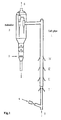
- the particular process is described as follows (see Fig. 1): the regenerated catalyst 4 from the regenerator enters the lift pipe 1, and then flows upward under the driving of the pre-lifting steam and pre-lifting dry gas introduced from the bottom of the lift pipe; the pre-lifting dry gas is highly pure ethane from the separation zone of the pyrolyzed gas and/or light hydrocarbon gases of other sources containing ethane, steam is added at the same time; ethane quickly pyrolyzes under the action of the hot catalyst at 780-900°C, ethane may also be sprayed from inlet I.
- a mixture of propane and/or butane from the separation zone and/or other sources and a certain amount of steam is atomized and sprayed from feed inlet II into the lift pipe, where the mixture comes into contact with the mixed stream of the catalyst and the ethane reactant at about 780-850°C and the catalytic pyrolysis reaction takes place.
- a mixture of the light hydrocarbons having a distillation range lower than 350°C and a certain amount of steam is atomized and sprayed from feed inlet III into the lift pipe, where the mixture comes into contact with the mixture of the catalyst and the upstream reactants at 720-830°C and the catalytic pyrolysis reaction takes place.
- a mixture of heavy hydrocarbons having a distillation range higher than 350°C and a certain amount of steam is atomized and sprayed from feed inlet IV into the lift pipe, where the mixture comes into contact with the mixture of the catalyst and the upstream reaction stream at about 680-800°C and the catalytic pyrolysis reaction takes place.
- the distances among the feed inlets for various hydrocarbons are calculated to allow the differences in the residence time of the adjacent hydrocarbons introduced into the reactor in sequence to be 0.01-3 s.
- Heavier feed oils are sprayed in sequence into the lift pipe at the inlets above the inlets from which the lighter feed oils are sprayed and may play a role of quenching the pyrolyzed stream of lighter feed oils so that the secondary reactions of the pyrolyzed stream of the lighter feed oils are quickly stopped or slowed down.
- the mixture of the catalyst and the reaction stream of the hydrocarbon feeds in the lift pipe flows upward and enters the subsider 3, wherein fast separation of gas/solid stream is performed.
- the reaction stream is removed from the outlet 6 at the top of the subsider, while the deactivated catalyst drops down along the subsider and is stripped by the stripping steam sprayed from the pipeline 5.
- the stripped catalyst to be regenerated goes down and enters the regenerator, wherein the coke-burning regeneration reaction is carried out, the regeneration temperature being 700-950°C.
- the catalyst absorbs a great amount of heat and its temperature rises to 800-900°C.
- the high temperature regenerated catalyst is recycled back to the pre-lift section of the lift pipe along the regeneration inclined pipe for reuse.
- the reaction stream removed from exit 6 enters the fractionation system and separates into pyrolyzed gas and a liquid product rich in aromatics, the pyrolyzed gas is then separated in the separation system into highly pure individual hydrocarbons (CH 4 , C 2 H 4 , C 2 H 6 , C 3 H 6 , C 3 H 8 , C 4 H 8 , C 4 H 6 , C 4 H 10 ), wherein the highly pure ethane returns to the bottom of the lift pipe for pyrolysis or is delivered to the ethane pyrolysis heater for pyrolysis.
- highly pure individual hydrocarbons CH 4 , C 2 H 4 , C 2 H 6 , C 3 H 6 , C 3 H 8 , C 4 H 8 , C 4 H 6 , C 4 H 10
- the components of the special catalyst (LCM) used for the catalytic pyrolysis can be selected from SiO 2 , Al 2 O 3 and oxides of alkali metals, alkali earth metals and transition metals or mixtures thereof, aluminum silicate modified with oxides of alkali or alkali earth metals can also be used, and optionally, a part of molecular sieves are added.
- feed hydrocarbon to be pyrolyzed are two or more in the scope of ethane, propane, butane, light hydrocarbons having a distillation range lower than 350°C and heavy hydrocarbons having a distillation range higher than 350°C, different feeds can enter the device from different positions according to the above method to realize the optimization of the pyrolysis conditions.
- This example is the pyrolysis results using an atmospheric residue and ethane as a co-feed.
- the pyrolysis test is carried out on a high-low parallel lift pipe pilot-scale device with a total length of the lift pipe being 15.42 m, its internal diameter being 19 mm and a capacity being 0.24 t/d.
- Ethane which is difficult to pyrolyze, is first introduced into the lift pipe from the bottom of the lift pipe and brought into contact with the hot and active regenerated catalyst so that reaction takes place, the temperature of the regenerated catalyst at this moment is 820°C, the temperature of the hydrocarbon/catalyst mixture after introducing ethane is 810°C.
- the inlet of the atmospheric residue is located 4.2 m above the inlet of ethane.
- the residence time of ethane from the bottom to this point is 0.45 s.
- the temperature of the mixed stream after introducing the atmospheric residue is 740°C, the temperature at the outlet of the lift pipe is 710°C.
- the catalyst used in this example is numbered as LCM-A, its properties and composition are shown in Table 1.
- the process conditions and the material balance in a pilot-scale test of the lift pipe are shown in Table 2. For comparison, the result of the pilot-scale test is also shown when the atmospheric residue and ethane is mixed and fed from the same inlet.
- Table 2 show that, in the technology of ethylene production from atmospheric residues with ethane re-refining, rather optimal pyrolysis conditions for both the atmospheric residue and ethane are realized and the conversions are appropriate when the method of multiple feed at separate point of the present invention are adopted.
- the yield of ethylene from the individual pyrolysis of the atmospheric residue is 22.36 wt%, while that after the re-refining of 4.56% of ethane attains 25.63 wt%.
- This example is the pyrolysis results using an atmospheric residue and a straight run gasoline as a co-feed, the process conditions and the material balance in a pilot-scale test of the lift pipe are shown in Table 3.
- the straight run gasoline is introduced into the device from the bottom of the lift pipe, the number of the catalyst used is LCM-B, its propertied and composition are seen in Table 1.
- the temperature of the catalyst/oil mixture is 780°C
- the atmospheric residue is sprayed at the position 4.2 m above the inlet of the straight run gasoline
- the residence time of the straight run gasoline from the bottom to this point is 0.6 s
- the temperature of the mixed stream after spraying the atmospheric reside is 700°C
- the temperature at the outlet of the lift pipe is 660°C
Landscapes
- Chemical & Material Sciences (AREA)
- Organic Chemistry (AREA)
- Oil, Petroleum & Natural Gas (AREA)
- Engineering & Computer Science (AREA)
- Chemical Kinetics & Catalysis (AREA)
- General Chemical & Material Sciences (AREA)
- Production Of Liquid Hydrocarbon Mixture For Refining Petroleum (AREA)
- Organic Low-Molecular-Weight Compounds And Preparation Thereof (AREA)
- Low-Molecular Organic Synthesis Reactions Using Catalysts (AREA)
- Catalysts (AREA)
Applications Claiming Priority (2)
| Application Number | Priority Date | Filing Date | Title |
|---|---|---|---|
| CN97119048A CN1056595C (zh) | 1997-10-20 | 1997-10-20 | 多种进料烃类直接转化制烯烃方法 |
| CN97119048 | 1997-10-20 |
Publications (2)
| Publication Number | Publication Date |
|---|---|
| EP0911308A1 true EP0911308A1 (fr) | 1999-04-28 |
| EP0911308B1 EP0911308B1 (fr) | 2002-11-27 |
Family
ID=5175152
Family Applications (1)
| Application Number | Title | Priority Date | Filing Date |
|---|---|---|---|
| EP98119730A Expired - Lifetime EP0911308B1 (fr) | 1997-10-20 | 1998-10-20 | Procédé de préparation d'oléfines par conversion directe de plusieurs hydrocarbures |
Country Status (4)
| Country | Link |
|---|---|
| US (1) | US6420621B2 (fr) |
| EP (1) | EP0911308B1 (fr) |
| CN (1) | CN1056595C (fr) |
| DE (1) | DE69809685T2 (fr) |
Cited By (7)
| Publication number | Priority date | Publication date | Assignee | Title |
|---|---|---|---|---|
| FR2829143A1 (fr) * | 2001-08-29 | 2003-03-07 | China Petroleum & Chemical | Procede de craquage catalytique d'hydrocarbures de petrole |
| US6867341B1 (en) | 2002-09-17 | 2005-03-15 | Uop Llc | Catalytic naphtha cracking catalyst and process |
| EP2690159A4 (fr) * | 2011-03-25 | 2014-09-03 | Jx Nippon Oil & Energy Corp | Procédé de production d'hydrocarbures aromatiques monocycliques |
| WO2017065810A1 (fr) * | 2015-10-14 | 2017-04-20 | Saudi Arabian Oil Company | Procédés et systèmes de craquage catalytique sur lit fluidisé |
| EP3225678A3 (fr) * | 2004-03-08 | 2018-01-03 | China Petroleum & Chemical Corporation | Procede de cracking catalytique en lit fluidise avec deux zones de reaction |
| US9862897B2 (en) | 2013-02-21 | 2018-01-09 | Jx Nippon Oil & Energy Corporation | Method for producing monocyclic aromatic hydrocarbon |
| US10087376B2 (en) | 2010-01-20 | 2018-10-02 | Jx Nippon Oil & Energy Corporation | Method for producing monocyclic aromatic hydrocarbons |
Families Citing this family (31)
| Publication number | Priority date | Publication date | Assignee | Title |
|---|---|---|---|---|
| US20050085677A1 (en) * | 2003-10-15 | 2005-04-21 | Fina Technology, Inc. | Method for improved production of cyclohexenyl and alkenyl aromatic compounds |
| CN100487080C (zh) * | 2004-03-08 | 2009-05-13 | 中国石油化工股份有限公司 | 一种生产低碳烯烃和芳烃的化工型炼油方法 |
| US7560020B2 (en) * | 2006-10-30 | 2009-07-14 | Exxonmobil Chemical Patents Inc. | Deasphalting tar using stripping tower |
| CN101362959B (zh) * | 2007-08-09 | 2012-09-05 | 中国石油化工股份有限公司 | 一种制取丙烯和高辛烷值汽油的催化转化方法 |
| CN101362669B (zh) * | 2007-08-09 | 2012-12-12 | 中国石油化工股份有限公司 | 一种制取乙烯、丙烯和芳烃的催化转化方法 |
| RU2464298C2 (ru) * | 2007-08-09 | 2012-10-20 | Чайна Петролеум & Кемикал Корпорейшн | Способ каталитической конверсии (варианты) |
| ES2645694T3 (es) * | 2008-12-10 | 2017-12-07 | Reliance Industries Limited | Procedimiento de craqueo catalítico en lecho fluidizado (FCC) para fabricar propileno y etileno con un rendimiento aumentado |
| CN101760227B (zh) * | 2008-12-25 | 2013-06-05 | 中国石油化工股份有限公司 | 一种制取丙烯和高辛烷值汽油的催化转化方法 |
| WO2010073841A1 (fr) | 2008-12-26 | 2010-07-01 | 新日本石油株式会社 | Procédé pour le raffinage de dicyclopentadiène |
| US9458390B2 (en) * | 2009-07-01 | 2016-10-04 | Exxonmobil Chemical Patents Inc. | Process and system for preparation of hydrocarbon feedstocks for catalytic cracking |
| US9181146B2 (en) | 2010-12-10 | 2015-11-10 | Exxonmobil Chemical Patents Inc. | Process for the production of xylenes and light olefins |
| WO2012101092A1 (fr) | 2011-01-24 | 2012-08-02 | Shell Internationale Research Maatschappij B.V. | Procédé de fabrication d'oxyde d'éthylène |
| CA2824902C (fr) | 2011-01-24 | 2019-03-19 | Michiel Johannes Franciscus Maria Verhaak | Procede de fabrication d'oxyde d'ethylene |
| US8921633B2 (en) | 2012-05-07 | 2014-12-30 | Exxonmobil Chemical Patents Inc. | Process for the production of xylenes and light olefins |
| US8937205B2 (en) | 2012-05-07 | 2015-01-20 | Exxonmobil Chemical Patents Inc. | Process for the production of xylenes |
| US9181147B2 (en) | 2012-05-07 | 2015-11-10 | Exxonmobil Chemical Patents Inc. | Process for the production of xylenes and light olefins |
| WO2014210565A2 (fr) | 2013-06-28 | 2014-12-31 | Le Duc Hong | Dispositif et procédé d'ancrage de cathéter |
| US10767117B2 (en) | 2017-04-25 | 2020-09-08 | Saudi Arabian Oil Company | Enhanced light olefin yield via steam catalytic downer pyrolysis of hydrocarbon feedstock |
| US10870802B2 (en) | 2017-05-31 | 2020-12-22 | Saudi Arabian Oil Company | High-severity fluidized catalytic cracking systems and processes having partial catalyst recycle |
| US10889768B2 (en) | 2018-01-25 | 2021-01-12 | Saudi Arabian Oil Company | High severity fluidized catalytic cracking systems and processes for producing olefins from petroleum feeds |
| CN110724550B (zh) * | 2018-07-16 | 2021-04-06 | 中国石油化工股份有限公司 | 一种采用快速流化床进行催化裂解的方法和系统 |
| US11066605B2 (en) | 2019-11-12 | 2021-07-20 | Saudi Arabian Oil Company | Systems and methods for catalytic upgrading of vacuum residue to distillate fractions and olefins |
| US11066606B2 (en) | 2019-11-12 | 2021-07-20 | Saudi Arabian Oil Company | Systems and methods for catalytic upgrading of vacuum residue to distillate fractions and olefins with steam |
| US11434432B2 (en) | 2020-09-01 | 2022-09-06 | Saudi Arabian Oil Company | Processes for producing petrochemical products that utilize fluid catalytic cracking of a greater boiling point fraction with steam |
| US11332680B2 (en) | 2020-09-01 | 2022-05-17 | Saudi Arabian Oil Company | Processes for producing petrochemical products that utilize fluid catalytic cracking of lesser and greater boiling point fractions with steam |
| US11505754B2 (en) | 2020-09-01 | 2022-11-22 | Saudi Arabian Oil Company | Processes for producing petrochemical products from atmospheric residues |
| US11230673B1 (en) | 2020-09-01 | 2022-01-25 | Saudi Arabian Oil Company | Processes for producing petrochemical products that utilize fluid catalytic cracking of a lesser boiling point fraction with steam |
| US11352575B2 (en) | 2020-09-01 | 2022-06-07 | Saudi Arabian Oil Company | Processes for producing petrochemical products that utilize hydrotreating of cycle oil |
| US11242493B1 (en) | 2020-09-01 | 2022-02-08 | Saudi Arabian Oil Company | Methods for processing crude oils to form light olefins |
| US11230672B1 (en) | 2020-09-01 | 2022-01-25 | Saudi Arabian Oil Company | Processes for producing petrochemical products that utilize fluid catalytic cracking |
| CN112973579B (zh) * | 2021-02-07 | 2022-04-12 | 中国科学院过程工程研究所 | 一种气固短接触时间的反应装置及其应用 |
Citations (1)
| Publication number | Priority date | Publication date | Assignee | Title |
|---|---|---|---|---|
| US5506365A (en) * | 1987-12-30 | 1996-04-09 | Compagnie De Raffinage Et De Distribution Total France | Process and apparatus for fluidized-bed hydrocarbon conversion |
Family Cites Families (15)
| Publication number | Priority date | Publication date | Assignee | Title |
|---|---|---|---|---|
| GB1493888A (en) | 1975-09-25 | 1977-11-30 | British Petroleum Co | Olefins production |
| US4291185A (en) * | 1978-12-14 | 1981-09-22 | Mobil Oil Corporation | Alkylation of benzene in petroleum |
| JPS585225B2 (ja) | 1978-12-21 | 1983-01-29 | 工業技術院長 | コ−クス粒子の加熱方法 |
| US4242100A (en) * | 1979-10-15 | 1980-12-30 | Tri-Pak, Inc. | Motor fuel composition |
| US4320241A (en) * | 1980-08-28 | 1982-03-16 | Occidental Research Corporation | Process for converting oxygenated hydrocarbons into hydrocarbons |
| US4422925A (en) * | 1981-12-28 | 1983-12-27 | Texaco Inc. | Catalytic cracking |
| US4670021A (en) * | 1983-01-10 | 1987-06-02 | Texaco Inc. | Detergent and corrosion inhibiting additive and motor fuel composition containing same |
| US4663019A (en) | 1984-03-09 | 1987-05-05 | Stone & Webster Engineering Corp. | Olefin production from heavy hydrocarbon feed |
| US4693991A (en) * | 1986-05-02 | 1987-09-15 | Phillips Petroleum Company | Hydrotreating catalyst composition |
| FR2625509B1 (fr) * | 1987-12-30 | 1990-06-22 | Total France | Procede et dispositif de conversion d'hydrocarbures en lit fluidise |
| US5173174A (en) * | 1988-07-07 | 1992-12-22 | Uop | Metal-tolerant FCC catalyst and process |
| ATE89308T1 (de) | 1989-02-08 | 1993-05-15 | Stone & Webster Eng Corp | Verfahren zur herstellung von olefinen. |
| FR2654435B1 (fr) * | 1989-11-10 | 1992-03-13 | Total France | Procede et dispositif de mise en contact d'une charge d'hydrocarbures avec des particules solides chaudes, dans un reacteur tubulaire a lit fluidise ascendant. |
| JP2966985B2 (ja) * | 1991-10-09 | 1999-10-25 | 出光興産株式会社 | 重質炭化水素油の接触水素化処理方法 |
| CN1030313C (zh) * | 1992-07-16 | 1995-11-22 | 中国石油化工总公司 | 重质烃类直接转化制取乙烯的方法 |
-
1997
- 1997-10-20 CN CN97119048A patent/CN1056595C/zh not_active Expired - Fee Related
-
1998
- 1998-10-19 US US09/174,462 patent/US6420621B2/en not_active Expired - Lifetime
- 1998-10-20 DE DE69809685T patent/DE69809685T2/de not_active Expired - Lifetime
- 1998-10-20 EP EP98119730A patent/EP0911308B1/fr not_active Expired - Lifetime
Patent Citations (1)
| Publication number | Priority date | Publication date | Assignee | Title |
|---|---|---|---|---|
| US5506365A (en) * | 1987-12-30 | 1996-04-09 | Compagnie De Raffinage Et De Distribution Total France | Process and apparatus for fluidized-bed hydrocarbon conversion |
Cited By (12)
| Publication number | Priority date | Publication date | Assignee | Title |
|---|---|---|---|---|
| FR2829143A1 (fr) * | 2001-08-29 | 2003-03-07 | China Petroleum & Chemical | Procede de craquage catalytique d'hydrocarbures de petrole |
| US6867341B1 (en) | 2002-09-17 | 2005-03-15 | Uop Llc | Catalytic naphtha cracking catalyst and process |
| US7314964B2 (en) | 2002-09-17 | 2008-01-01 | Uop Llc | Catalytic naphtha cracking catalyst and process |
| US7446071B2 (en) | 2002-09-17 | 2008-11-04 | Uop Llc | Catalytic naphtha cracking catalyst and process |
| US7585489B2 (en) | 2002-09-17 | 2009-09-08 | Uop Llc | Catalytic naphtha cracking catalyst and process |
| EP3225678A3 (fr) * | 2004-03-08 | 2018-01-03 | China Petroleum & Chemical Corporation | Procede de cracking catalytique en lit fluidise avec deux zones de reaction |
| US10087376B2 (en) | 2010-01-20 | 2018-10-02 | Jx Nippon Oil & Energy Corporation | Method for producing monocyclic aromatic hydrocarbons |
| EP2690159A4 (fr) * | 2011-03-25 | 2014-09-03 | Jx Nippon Oil & Energy Corp | Procédé de production d'hydrocarbures aromatiques monocycliques |
| US9233892B2 (en) | 2011-03-25 | 2016-01-12 | Jx Nippon Oil & Energy Corporation | Method for producing monocyclic aromatic hydrocarbons |
| US9862897B2 (en) | 2013-02-21 | 2018-01-09 | Jx Nippon Oil & Energy Corporation | Method for producing monocyclic aromatic hydrocarbon |
| WO2017065810A1 (fr) * | 2015-10-14 | 2017-04-20 | Saudi Arabian Oil Company | Procédés et systèmes de craquage catalytique sur lit fluidisé |
| CN108350367A (zh) * | 2015-10-14 | 2018-07-31 | 沙特阿拉伯石油公司 | 流化催化裂化的方法和系统 |
Also Published As
| Publication number | Publication date |
|---|---|
| JP3953208B2 (ja) | 2007-08-08 |
| CN1056595C (zh) | 2000-09-20 |
| DE69809685T2 (de) | 2003-04-10 |
| US20010056216A1 (en) | 2001-12-27 |
| JPH11193250A (ja) | 1999-07-21 |
| US6420621B2 (en) | 2002-07-16 |
| DE69809685D1 (de) | 2003-01-09 |
| CN1215041A (zh) | 1999-04-28 |
| EP0911308B1 (fr) | 2002-11-27 |
Similar Documents
| Publication | Publication Date | Title |
|---|---|---|
| EP0911308B1 (fr) | Procédé de préparation d'oléfines par conversion directe de plusieurs hydrocarbures | |
| US11306258B2 (en) | Enhanced light olefin yield via steam catalytic downer pyrolysis of hydrocarbon feedstock | |
| KR100281750B1 (ko) | 저분자량 올레핀을 제조하는 방법 및 장치 | |
| CN110540869B (zh) | 一种催化裂化的方法 | |
| CN116601268B (zh) | 含烃原料油催化裂解生产低碳烯烃和btx的方法及装置 | |
| CN101323798B (zh) | 一种催化转化方法及其专用装置 | |
| US9162955B2 (en) | Process for pyrolysis of a coal feed | |
| US4828681A (en) | Process of thermally cracking hydrocarbons using particulate solids as heat carrier | |
| CN109232153A (zh) | 一种石脑油制备低碳烯烃的方法 | |
| CN102952577B (zh) | 一种提高丙烯产率的催化转化方法 | |
| US5220093A (en) | Process for production of olefins from mixtures of light paraffins | |
| CN110194967B (zh) | 一种多产丙烯的催化反应再生方法 | |
| EP1713884B1 (fr) | Procede de craquage selectif de composants permettant d'optimiser la production d'olefines legeres | |
| CN104557395A (zh) | 一种生产丙烯的催化转化方法 | |
| CN115992005B (zh) | 一种反应原料为烃类原料的催化转化制低碳烯烃和芳烃的反应方法及反应器 | |
| CN115992003B (zh) | 一种反应原料为烃类原料的催化转化制低碳烯烃和芳烃的方法及反应器 | |
| CN115992006B (zh) | 一种反应原料为烃类原料流化催化转化制低碳烯烃和芳烃的反应方法及反应器 | |
| CN100537713C (zh) | 一种多产丙烯的催化转化方法 | |
| JP3953208B6 (ja) | 複数の炭化水素の直接転換によるオレフィンの最適化生産プロセス | |
| CN114606021B (zh) | 乙烯和丙烯的生产方法和系统 | |
| CN101191070B (zh) | 一种生产低碳烯烃的方法 | |
| CN200985320Y (zh) | 一种烃油裂化装置 | |
| CN119528672A (zh) | 一种制取低碳烯烃的方法 | |
| TW202537948A (zh) | 烷烴催化脫氫生產烯烴的方法和相應的裝置 | |
| CN117304972A (zh) | 一种提高低碳烯烃和汽柴油收率的双催化剂催化裂化装置及方法 |
Legal Events
| Date | Code | Title | Description |
|---|---|---|---|
| PUAI | Public reference made under article 153(3) epc to a published international application that has entered the european phase |
Free format text: ORIGINAL CODE: 0009012 |
|
| AK | Designated contracting states |
Kind code of ref document: A1 Designated state(s): DE FR |
|
| AX | Request for extension of the european patent |
Free format text: AL;LT;LV;MK;RO;SI |
|
| 17P | Request for examination filed |
Effective date: 19990802 |
|
| AKX | Designation fees paid |
Free format text: DE FR |
|
| 17Q | First examination report despatched |
Effective date: 20010313 |
|
| GRAG | Despatch of communication of intention to grant |
Free format text: ORIGINAL CODE: EPIDOS AGRA |
|
| GRAG | Despatch of communication of intention to grant |
Free format text: ORIGINAL CODE: EPIDOS AGRA |
|
| GRAH | Despatch of communication of intention to grant a patent |
Free format text: ORIGINAL CODE: EPIDOS IGRA |
|
| GRAH | Despatch of communication of intention to grant a patent |
Free format text: ORIGINAL CODE: EPIDOS IGRA |
|
| GRAA | (expected) grant |
Free format text: ORIGINAL CODE: 0009210 |
|
| AK | Designated contracting states |
Kind code of ref document: B1 Designated state(s): DE FR |
|
| REF | Corresponds to: |
Ref document number: 69809685 Country of ref document: DE Date of ref document: 20030109 |
|
| ET | Fr: translation filed | ||
| PLBE | No opposition filed within time limit |
Free format text: ORIGINAL CODE: 0009261 |
|
| STAA | Information on the status of an ep patent application or granted ep patent |
Free format text: STATUS: NO OPPOSITION FILED WITHIN TIME LIMIT |
|
| 26N | No opposition filed |
Effective date: 20030828 |
|
| REG | Reference to a national code |
Ref country code: FR Ref legal event code: PLFP Year of fee payment: 19 |
|
| REG | Reference to a national code |
Ref country code: FR Ref legal event code: PLFP Year of fee payment: 20 |
|
| PGFP | Annual fee paid to national office [announced via postgrant information from national office to epo] |
Ref country code: FR Payment date: 20170918 Year of fee payment: 20 |
|
| PGFP | Annual fee paid to national office [announced via postgrant information from national office to epo] |
Ref country code: DE Payment date: 20171018 Year of fee payment: 20 |
|
| REG | Reference to a national code |
Ref country code: DE Ref legal event code: R071 Ref document number: 69809685 Country of ref document: DE |