EP0911892A2 - Magnetowiderstandseffektvorrichtung und Herstellungsverfahren - Google Patents
Magnetowiderstandseffektvorrichtung und Herstellungsverfahren Download PDFInfo
- Publication number
- EP0911892A2 EP0911892A2 EP98119768A EP98119768A EP0911892A2 EP 0911892 A2 EP0911892 A2 EP 0911892A2 EP 98119768 A EP98119768 A EP 98119768A EP 98119768 A EP98119768 A EP 98119768A EP 0911892 A2 EP0911892 A2 EP 0911892A2
- Authority
- EP
- European Patent Office
- Prior art keywords
- magnetic
- dots
- dot
- magnetic dots
- substrate
- Prior art date
- Legal status (The legal status is an assumption and is not a legal conclusion. Google has not performed a legal analysis and makes no representation as to the accuracy of the status listed.)
- Withdrawn
Links
- 230000000694 effects Effects 0.000 title claims abstract description 41
- 238000004519 manufacturing process Methods 0.000 title claims description 7
- 230000005291 magnetic effect Effects 0.000 claims abstract description 194
- 239000000758 substrate Substances 0.000 claims abstract description 18
- 239000000696 magnetic material Substances 0.000 claims abstract description 10
- XEEYBQQBJWHFJM-UHFFFAOYSA-N Iron Chemical compound [Fe] XEEYBQQBJWHFJM-UHFFFAOYSA-N 0.000 claims description 57
- 229910052782 aluminium Inorganic materials 0.000 claims description 36
- XAGFODPZIPBFFR-UHFFFAOYSA-N aluminium Chemical compound [Al] XAGFODPZIPBFFR-UHFFFAOYSA-N 0.000 claims description 36
- 229910052742 iron Inorganic materials 0.000 claims description 29
- 230000005415 magnetization Effects 0.000 claims description 25
- 230000035945 sensitivity Effects 0.000 claims description 15
- 239000011651 chromium Substances 0.000 claims description 13
- 238000000034 method Methods 0.000 claims description 13
- VYZAMTAEIAYCRO-UHFFFAOYSA-N Chromium Chemical compound [Cr] VYZAMTAEIAYCRO-UHFFFAOYSA-N 0.000 claims description 11
- 229910052804 chromium Inorganic materials 0.000 claims description 11
- 230000004888 barrier function Effects 0.000 claims description 10
- 239000000463 material Substances 0.000 claims description 9
- 239000004020 conductor Substances 0.000 claims description 7
- 230000008016 vaporization Effects 0.000 claims description 5
- 229910000889 permalloy Inorganic materials 0.000 claims description 4
- 238000005530 etching Methods 0.000 claims description 3
- QVGXLLKOCUKJST-UHFFFAOYSA-N atomic oxygen Chemical compound [O] QVGXLLKOCUKJST-UHFFFAOYSA-N 0.000 claims description 2
- 239000001301 oxygen Substances 0.000 claims description 2
- 229910052760 oxygen Inorganic materials 0.000 claims description 2
- 238000000151 deposition Methods 0.000 claims 3
- 239000002245 particle Substances 0.000 description 16
- 101100063942 Neurospora crassa (strain ATCC 24698 / 74-OR23-1A / CBS 708.71 / DSM 1257 / FGSC 987) dot-1 gene Proteins 0.000 description 13
- 239000010408 film Substances 0.000 description 12
- 230000005381 magnetic domain Effects 0.000 description 11
- 239000010409 thin film Substances 0.000 description 8
- 239000011248 coating agent Substances 0.000 description 6
- 238000000576 coating method Methods 0.000 description 6
- 238000010586 diagram Methods 0.000 description 6
- 239000003302 ferromagnetic material Substances 0.000 description 6
- 238000001803 electron scattering Methods 0.000 description 4
- 229910052751 metal Inorganic materials 0.000 description 4
- 239000002184 metal Substances 0.000 description 4
- 229910052759 nickel Inorganic materials 0.000 description 3
- 229920003229 poly(methyl methacrylate) Polymers 0.000 description 3
- 239000004926 polymethyl methacrylate Substances 0.000 description 3
- XUIMIQQOPSSXEZ-UHFFFAOYSA-N Silicon Chemical compound [Si] XUIMIQQOPSSXEZ-UHFFFAOYSA-N 0.000 description 2
- 239000007772 electrode material Substances 0.000 description 2
- 230000005294 ferromagnetic effect Effects 0.000 description 2
- 235000000396 iron Nutrition 0.000 description 2
- 230000001788 irregular Effects 0.000 description 2
- 238000010030 laminating Methods 0.000 description 2
- 230000035515 penetration Effects 0.000 description 2
- 230000001376 precipitating effect Effects 0.000 description 2
- 238000001556 precipitation Methods 0.000 description 2
- 229910052710 silicon Inorganic materials 0.000 description 2
- 239000010703 silicon Substances 0.000 description 2
- 238000004544 sputter deposition Methods 0.000 description 2
- ZAMOUSCENKQFHK-UHFFFAOYSA-N Chlorine atom Chemical compound [Cl] ZAMOUSCENKQFHK-UHFFFAOYSA-N 0.000 description 1
- 101100184723 Homo sapiens PMPCA gene Proteins 0.000 description 1
- PWHULOQIROXLJO-UHFFFAOYSA-N Manganese Chemical compound [Mn] PWHULOQIROXLJO-UHFFFAOYSA-N 0.000 description 1
- 102100025321 Mitochondrial-processing peptidase subunit alpha Human genes 0.000 description 1
- 229910045601 alloy Inorganic materials 0.000 description 1
- 239000000956 alloy Substances 0.000 description 1
- 238000004380 ashing Methods 0.000 description 1
- VTJUKNSKBAOEHE-UHFFFAOYSA-N calixarene Chemical compound COC(=O)COC1=C(CC=2C(=C(CC=3C(=C(C4)C=C(C=3)C(C)(C)C)OCC(=O)OC)C=C(C=2)C(C)(C)C)OCC(=O)OC)C=C(C(C)(C)C)C=C1CC1=C(OCC(=O)OC)C4=CC(C(C)(C)C)=C1 VTJUKNSKBAOEHE-UHFFFAOYSA-N 0.000 description 1
- 239000000460 chlorine Substances 0.000 description 1
- 229910052801 chlorine Inorganic materials 0.000 description 1
- 238000001816 cooling Methods 0.000 description 1
- 238000009792 diffusion process Methods 0.000 description 1
- 238000000609 electron-beam lithography Methods 0.000 description 1
- 238000003475 lamination Methods 0.000 description 1
- 229910052748 manganese Inorganic materials 0.000 description 1
- 239000011572 manganese Substances 0.000 description 1
- 238000003801 milling Methods 0.000 description 1
- 229920002120 photoresistant polymer Polymers 0.000 description 1
- 230000000717 retained effect Effects 0.000 description 1
- 238000000992 sputter etching Methods 0.000 description 1
- -1 such as Substances 0.000 description 1
- 238000009834 vaporization Methods 0.000 description 1
Images




Classifications
-
- H—ELECTRICITY
- H10—SEMICONDUCTOR DEVICES; ELECTRIC SOLID-STATE DEVICES NOT OTHERWISE PROVIDED FOR
- H10N—ELECTRIC SOLID-STATE DEVICES NOT OTHERWISE PROVIDED FOR
- H10N50/00—Galvanomagnetic devices
- H10N50/01—Manufacture or treatment
-
- H—ELECTRICITY
- H10—SEMICONDUCTOR DEVICES; ELECTRIC SOLID-STATE DEVICES NOT OTHERWISE PROVIDED FOR
- H10N—ELECTRIC SOLID-STATE DEVICES NOT OTHERWISE PROVIDED FOR
- H10N50/00—Galvanomagnetic devices
- H10N50/10—Magnetoresistive devices
-
- Y—GENERAL TAGGING OF NEW TECHNOLOGICAL DEVELOPMENTS; GENERAL TAGGING OF CROSS-SECTIONAL TECHNOLOGIES SPANNING OVER SEVERAL SECTIONS OF THE IPC; TECHNICAL SUBJECTS COVERED BY FORMER USPC CROSS-REFERENCE ART COLLECTIONS [XRACs] AND DIGESTS
- Y10—TECHNICAL SUBJECTS COVERED BY FORMER USPC
- Y10S—TECHNICAL SUBJECTS COVERED BY FORMER USPC CROSS-REFERENCE ART COLLECTIONS [XRACs] AND DIGESTS
- Y10S428/00—Stock material or miscellaneous articles
- Y10S428/90—Magnetic feature
-
- Y—GENERAL TAGGING OF NEW TECHNOLOGICAL DEVELOPMENTS; GENERAL TAGGING OF CROSS-SECTIONAL TECHNOLOGIES SPANNING OVER SEVERAL SECTIONS OF THE IPC; TECHNICAL SUBJECTS COVERED BY FORMER USPC CROSS-REFERENCE ART COLLECTIONS [XRACs] AND DIGESTS
- Y10—TECHNICAL SUBJECTS COVERED BY FORMER USPC
- Y10T—TECHNICAL SUBJECTS COVERED BY FORMER US CLASSIFICATION
- Y10T428/00—Stock material or miscellaneous articles
- Y10T428/11—Magnetic recording head
- Y10T428/1107—Magnetoresistive
-
- Y—GENERAL TAGGING OF NEW TECHNOLOGICAL DEVELOPMENTS; GENERAL TAGGING OF CROSS-SECTIONAL TECHNOLOGIES SPANNING OVER SEVERAL SECTIONS OF THE IPC; TECHNICAL SUBJECTS COVERED BY FORMER USPC CROSS-REFERENCE ART COLLECTIONS [XRACs] AND DIGESTS
- Y10—TECHNICAL SUBJECTS COVERED BY FORMER USPC
- Y10T—TECHNICAL SUBJECTS COVERED BY FORMER US CLASSIFICATION
- Y10T428/00—Stock material or miscellaneous articles
- Y10T428/24—Structurally defined web or sheet [e.g., overall dimension, etc.]
- Y10T428/24355—Continuous and nonuniform or irregular surface on layer or component [e.g., roofing, etc.]
Definitions
- This invention relates to a magneto-resistance effect device (namely, an MR device), and in particular, to a magneto-resistance effect device which is capable of reproducing a desired recording information from a magnetic recording medium by the use of the magneto-resistance effect.
- a magneto-resistance effect device namely, an MR device
- a magneto-resistance effect device which is capable of reproducing a desired recording information from a magnetic recording medium by the use of the magneto-resistance effect.
- a magneto-resistance effect device (namely, an MR device) of the type described conventionally and widely has been used for a magnetic sensor, a magnetic head and an large-scale integrated circuit (namely, an LSI) memory.
- GMR giant magneto-resistance
- the spin scattering causes the magneto-resistance effect.
- the phenomenon regarding the spin scattering results in such a fact that an electron of up-spin has low scattering probability for an electron of the up-spin, and has high scattering probability for an electron of downspin.
- the up-spin electron has low scattering probability in a magnetic domain of the up-spin while it has high scattering probability in different magnetic domain.
- the magneto-resistance effect takes place.
- a magnetization direction is variable in accordance with a change of a desired external magnetic field, and the domains of the up-spin and the down-spin coexist in the MR device in order to realize the MR effect in accordance with difference of the spin scattering. Namely, magnetization directions are different to each other in the respective domains.
- the MR effect indicates a maximum value. Therefore, it is important as a device parameter to realize the opposite parallel state under a low external magnetic field because the parameter relates to high sensitivity of the MR device.
- the device which utilizes the MR effect, is has been conventionally known, and is classified into (1) the MR device formed by a granular film, (2) the MR device formed by a metal multi-layer, (3) the MR device (magnetic bulb) of the spin-bulb type due to a sandwich structure via a tunnel barrier.
- ferromagnetic material such as Fe, Co, and Ni
- ferromagnetic material is precipitated or deposited in a non-magnetic layer, as disclosed in Japanese Unexamined Patent Publication No. Hei. 6-318749.
- a precipitated state (namely, shape, size and direction of the precipitated particle) becomes irregular. More specifically, the precipitated particle has a long ellipse in accordance with a precipitated condition, and thereby, the size of the particle becomes random.
- the MR effect due to the metal multi-layer has been disclosed in many papers.
- the GMR effect caused by a multi-layer film consisting of iron and chromium is described in Physical Review Letter, 1998, volume 61, number 21, page 2472.
- the MR device utilizes difference of the coercive force between a permalloy layer that is magnetically free and a permalloy layer that is magnetically pinned by a manganese layer.
- ferromagnetic material such as Fe, Co, and Ni
- Fe, Co, and Ni is precipitated in the non-magnetic electrical conductive layer in the conventional MR device of the granular type.
- it is difficult to control subtle difference of coercive force and precipitation particle density because the ferromagnetic material is naturally precipitated or deposited. In consequence, it is difficult to keep uniformity in manufacturing. As a result, the MR effect can not be essentially and sufficiently realized.
- the resistance of the device is extremely low (approximately, several tens macro-ohm) because a practical device has a size of 0.24 micron in the perpendicular direction for the plane at several tens micron square.
- It is therefore an object of this invention provide an MR device which is capable of artificially and readily controlling a magnetic domain of nano-meter size.
- a magneto-resistance effect device includes a plurality of magnetic dots.
- each of magnetic dots is formed by magnetic material on a substrate and appears a magneto-resistance effect by applying an external magnetic field.
- the magnetic dots are arranged on the substrate in a two-dimensional array.
- the two-dimensional array has a plurality of rows along a column direction and a plurality of columns along a row direction.
- the magnetic dots include at least first magnetic dots and second magnetic dots.
- the first magnetic dots are arranged on first rows while the second magnetic dots are arranged on second rows.
- the first magnetic dot is different from the second magnetic dot in shape.
- the MR device having high sensitivity and high gain can be obtained because the fine magnetic dots are arranged in the two-dimensional array.
- the resistance of the MR device can be set to extremely high value as compared to the GMR device of the vertical plane type because the width of the device can be narrowed.
- the device resistance of the conventional laminate type is micro-ohm per unit.
- the device resistance of several hundreds-ohm can be obtained. Therefore, the MR device according to this invention has an advantage in matching with the LSI memory device.
- the MR device is applicable for a magnetic sensor itself a magnetic head of a magnetic memory device, and a super high-integrated memory device of a data recording type, such as, a magnetic RAM.
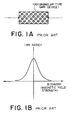
- a size of precipitated or deposited particle falls within the range between about 1 nm and 50 nm in the granular type MR device 100. Further, a distance between particles falls within the range between about 1 nm and 10nm.
- the MR characteristic of the MR device is illustrated in Fig. 1B.
- the MR device is manufactured by precipitating during cooling from a thermal equilibrium state from alloy.
- the MR device is fabricated by precipitating in a non-thermal equilibrium state during sputter vaporization.
- a precipitated state (namely, shape, size and direction of the precipitated particle) becomes irregular. More specifically, the precipitated particle has a long ellipse in accordance with the precipitated condition and thereby, the particles have random sizes.
- an artificial multi-layer structures the GMR device 102 illustrated in Fig. 2A.
- the artificial multi-layer is formed by alternately laminating extremely thin-films consisting of ferromagnetic iron (3nm-thick) and non-magnetic chromium (0.9 nm-thick) 60 times.
- the ferromagnetic iron (Fe) is separated by the non-magnetic chromium (Cr).
- the magnetization of the respective irons is magnetically coupled via the chromium layer because the thickness of the chromium is excessively thin.
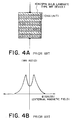
- the MR characteristic of the MR device in Fig. 2A is illustrated in Fig. 2B.
- the magnetization of the irons becomes opposite parallel at every one layer when the external magnetic filed is equal to zero. At this time, large magnetic resistance can be observed for a current which flows in a perpendicular direction for the film.
- the spin-bulb laminate type MR device 104 is formed by combining the laminate type MR device (magnetic bulb type MR device) illustrated in Fig. 1A and the spin-bulb type MR device illustrated in Fig. 2A, as shown in Fig. 4A.
- the spin-bulb laminate type MR device 104 is structured by laminating magnetic materials which are different to each other in coercive force.
- the device characteristic is tried to be improved by changing a thickness of material of a coercive force layer and by interposing a tunnel barrier formed by an oxide aluminum.
- ferromagnetic material such as Fe, Co, and Ni, is precipitated in the non-magnetic electrical conductive layer in the conventional MR device of the granular type.
- the resistance of the device is extremely low (approximately, several tens macro-ohm) because a practical device has a size of 0.24 micron in the perpendicular direction for the plane at several tens micron square.
- this invention provides an MR device which is capable of artificially and readily controlling a magnetic domain of nano-meter size and which has high sensitivity and high gain.
- extremely fine dots (magnetic dots) 1 and 2 formed by magnetic material are arranged in a two-dimensional dot array 10.
- the two-dimensional dot array 10 is embedded or buried in an electric conductor (for example, an aluminum coating 23 illustrated in Fig. 6) which is formed by a non-magnetic electrode material.
- an electric conductor for example, an aluminum coating 23 illustrated in Fig. 6
- MR effect magneto-resistance effect
- a fine magnetic dot for example, iron magnetization reverse dot
- MR magnetic-resistance effect
- the magnetic dot has several tens nm in size
- one dot is occupied in one domain.
- the magnetic dots 1 and 2 of the single domain can be realized, as shown in Fig. 5.
- the MR device having high sensitivity and high gain can be obtained by arranging the fine magnetic dots 1 and 2 in the array shape.
- spin-moment of an electron is kept with longer distance as compared to general electron scattering. Namely, the spin-moment of the electron has long spin diffusion length.
- the electron of the up-spin enters into the magnetic domain of up-spin, the electron has small magnetic scattering probability. Conversely, the electron of the up-spin enters into the magnetic domain of the downspin; the electron has high magnetic scattering probability.
- the electron moves in the MR device (extremely thin-film in which the dot-array is embedded or buried) during energizing, the electron moves with the electron scattering of many times. This is observed as a normal electrical resistance. Moreover, the magnetic scattering in the magnetic domain (magnetic dots 1 and 2) is observed as the MR effect.
- the dots which constitute the two-dimensional dot-array, are structured by two kinds of magnetic dots 1 and 2 having different shapes.
- the dots land 2 are structured by the magnetic dot 1 of ellipse shape and the magnetic dot 2 of circular shape, as illustrated in Fig. 5.
- the MR device illustrated in Fig. 5 has the two-dimensional dot array structure in which the two kinds of magnetic dots 1 and 2 are alternately arranged.
- each magnetic dot 1 and 2 which constitutes the two-dimensional dot array 10, may be structured by two kinds of magnetic dots of different materials (different magnetic magnetization). In this event, the magnetic dots, which have different saturation magnetization, are alternately arranged in the two-dimensional array.
- the two-dimensional dot array 10 is schematically illustrated in Fig. 5.
- the magnetic dots 1 and 2 having different saturation magnetization are alternately arranged.
- the reference numeral 3 denotes a chromium (Cr) layer.
- the sensitivity of the MR device for the external magnetic field is determined by the external magnetic field which causes the magnetization reverse of the small magnetic dot 2 in the case of this device shape.
- the resistance of the MR device can be randomly controlled by a shape of the current path in the MR device formed by the two dimensional plane. Namely, it is possible to arbitrarily control the resistance of the MR device between low resistance and high resistance.
- the dot array MR device according to this embodiment is excessively advantageous in matching with the other electronics circuits in the device resistance.
- the dot which constitutes the dot array MR device, by combining two kinds or more of materials that are different in magnetic characteristic.
- the MR effect same as that in Fig. 5 can be obtained when the dot array is structured by combining magnetic materials having different saturation magnetization rate, such as, permalloy with the same dot size, like the conventional laminate structure. In this event, it is effective to optimize the material and the dot shape to optimize the device characteristic.
- the MR device characteristic is obtained in such a state that normal electron scattering and magnetic scattering are mixed in the MR device of the above embodiment.
- the MR device having the tunnel barrier of the oxide aluminum is schematically illustrated in Figs. 9A and 9B.
- the electron scattering effect can be removed from the resistance of the MR device by combining the respective dots 1 and 2 via the tunnel junction by the use of the doran method.
- the resistance of the MR device is mainly determined by junction resistance of the tunnel junction and resistance due to the magnetic scattering.
- the MR device is formed by vaporizing the chromium layer 3 on the dot devices 1 and 2 of the iron.
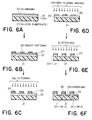
- a thin-film 22 of iron (Fe) having a thickness of 10 nm and a thin-film 23 of aluminum having a thickness of 2 nm are successively deposited on an oxide silicon substrate 21 by the use of the sputtering method, as illustrated in Fig. 6A.
- a resist-pattern 24 is formed on the aluminum thin film 23, as illustrated in Fig. 6B.
- the resist-pattern 24 is structured by forming a dot-pattern by the use of a super high resolution negative resist (calixarene) and the known electron beam lithography.
- the resist-pattern 24 is transferred for the aluminum thin-film 23 by the known ECR etching using chlorine, as illustrated in Fig. 6C.
- an oxide plasma ashing process is carried out in this state, as shown in Fig. 6D.
- the organic resist 24 is removed.
- the aluminum 23 below the resist is oxidized to form a hard mask for milling the iron thin-film 22 (magnetic dot 1 or 2) of a base layer.
- the aluminum film 23 also serves as an insulating film for a surface of the iron film.
- the magnetic dots 1 and 2 consisting of the iron film 22 are formed by the use of the thus-formed hard mask of the oxide aluminum by the Ar ion milling, as shown in Fig. 6E.
- chromium thin-film 25 is deposited by the sputtering method on the surface of the device, as illustrated in Fig. 6F.
- a MR device of the two-dimensional dot array is completed.
- the large magnetic dot 1 of the iron film 22 has along axis of 80 nm and a short axis of 30 nm in size while the small magnetic dot 2 of the iron film 22 has the long axis of 50 nm and the short axis of 30 nm in size.
- both the magnetic dots 1 and 2 are arranged with a pitch period of 100 nm.
- each magnetic dot 1 and 2 becomes a single magnetic domain in these dot sizes.
- a long axis directs one direction and, further, the long axis are adjacent to each other.
- the magnetic dots 1 are magnetically and strongly coupled in the arranged direction. As a result, a strong one-axis anisotropy appears.
- the smaller magnetic dot 2 has a low anisotropy of axis length, and has an approximately circular form in shape. Consequently, the smaller magnetic dot 2 is magnetically soft.
- the magnetization is not readily reversed even when the external magnetic field is turned over.
- the magnetization is readily reversed in the smaller magnetic dot 2 when the external magnetic field is turned over. In consequence, the GMR device having high sensitivity can be obtained.
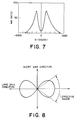
- MR ratio of 80 % can be realized under the magnetic field of 200 gauss, as illustrated in Fig. 7. Further, the directional anisotropy for the external magnetic field indicates the strong directional dependency for the GMR external magnetic field within the range (effective scope in Fig. 8) between +23 degree and - 23 degree for the long axis direction of the dot.
- the shape of the magnetic dot is circular or ellipse.
- the MR device can be also realized by using the dot of a square shape or a triangle shape (not shown).
- the MR device using the magnetic dot of the triangle shape can have maximum of the sensitivity in an object direction three times for the sensitivity of the external magnetic field of the MR device.
- the MR device having the triangle shape can have an applicable range for the device as compared to the MR device which uses the magnetic dot of the ellipse shape. This is because the MR device has the sensitivity maximum of two directions for the direction of the magnetic field.
- the external magnetic field corresponding to the magnetization reverse of the small dot 2 becomes the magnetic field sensitivity of the GMR device.
- the device operates by the electrical conduction in the surface place different from the MR device of the laminate type in the MR device according to this embodiment.
- the width of the device can be set considerably narrow in the MR device according to this embodiment.
- the resistance of the device can be selected significantly high for the GMR device of the plane perpendicular type.
- the thickness (the thickness of the chromium) of the device can be set to about 20 nm while the width of the device can be set to 2 micron.
- the resistance of the MR device according to this embodiment becomes several hundreds-ohm.
- the device resistance is micro-ohm in the laminate type conventional MR device. This is extremely advantageous in the matching with the LSI memory device.
- the iron dots 30 (corresponding to reference numerals 1 and 2 in Fig. 5) as the magnetic dots in the dot array are coupled to each other by the tunnel junction, as illustrated in Figs. 9A and 9B.
- the dot array is coupled as a network by the use of the tunnel junction.
- the dot array is fabricated by applying the known drawn method.
- a stencil-mask 38 is first formed by the use of the double layer PMMA resist or the Ge and MPPA resist.
- the reference numeral 38A denotes a penetration (an opening) for forming an iron dot 30A corresponding to the magnetic dot 1 having the large shape in Fig. 5.
- the reference numeral 38B denotes a penetration (an opening) for forming an iron dot 30A corresponding to the magnetic dot 2 having the small shape in Fig. 5.
- the iron 30 consisting of the iron dot material is vertically vaporized on a substrate 50 via the stencil mask 38.
- the iron dots 30 A (corresponding to the reference numerals 1 or 2) is formed as the magnetic dot.
- aluminum 31 is vaporized from a left oblique direction.
- an aluminum coating 31A is formed on the iron dot 30 A (corresponding to the magnetic dot 1 or 2 in Fig. 5) on the condition that the iron dot 30 A is covered with half by the stencil mask 38.
- the tunnel barrier of the oxide aluminum is formed on a surface of the aluminum coating 31A.
- the aluminum coating 31A and the aluminum coating 32A are connected via the tunnel barrier of the oxide aluminum.
- the adjacent iron dots 30 A (corresponding to the magnetic dot 1 or 2) are wired to each other via the tunnel junction of the oxide aluminum 31A and 31B.
- the MR device having extremely excellent characteristic can be manufactured by controlling the shape and the material of the dot. Further, the device characteristic can readily and arbitrarily be controlled when the magnetic dot and the aluminum coating 31A and 32A are formed.
- the GMR device of the two-dimensional dot array itself is applied to a magnetic head or a magnetic sensor and the like, it may be applied for a random access memory of magnetic recording type (namely, M-RAM) other than them because silicon (Si) is compatible with the device.
- M-RAM magnetic recording type
Landscapes
- Engineering & Computer Science (AREA)
- Manufacturing & Machinery (AREA)
- Magnetic Heads (AREA)
- Hall/Mr Elements (AREA)
- Measuring Magnetic Variables (AREA)
Applications Claiming Priority (3)
| Application Number | Priority Date | Filing Date | Title |
|---|---|---|---|
| JP29133997 | 1997-10-23 | ||
| JP291339/97 | 1997-10-23 | ||
| JP9291339A JP3024612B2 (ja) | 1997-10-23 | 1997-10-23 | 磁気抵抗効果素子およびその製造方法 |
Publications (2)
| Publication Number | Publication Date |
|---|---|
| EP0911892A2 true EP0911892A2 (de) | 1999-04-28 |
| EP0911892A3 EP0911892A3 (de) | 1999-10-13 |
Family
ID=17767649
Family Applications (1)
| Application Number | Title | Priority Date | Filing Date |
|---|---|---|---|
| EP98119768A Withdrawn EP0911892A3 (de) | 1997-10-23 | 1998-10-22 | Magnetowiderstandseffektvorrichtung und Herstellungsverfahren |
Country Status (3)
| Country | Link |
|---|---|
| US (1) | US6183890B1 (de) |
| EP (1) | EP0911892A3 (de) |
| JP (1) | JP3024612B2 (de) |
Cited By (1)
| Publication number | Priority date | Publication date | Assignee | Title |
|---|---|---|---|---|
| EP1814172A1 (de) * | 2006-01-27 | 2007-08-01 | IEE International Electronics & Engineering S.A.R.L. | Magnetfeldsensorelement |
Families Citing this family (6)
| Publication number | Priority date | Publication date | Assignee | Title |
|---|---|---|---|---|
| JP2003198004A (ja) * | 2001-12-27 | 2003-07-11 | Fujitsu Ltd | 磁気抵抗効果素子 |
| JP4073002B2 (ja) * | 2002-03-27 | 2008-04-09 | キヤノン株式会社 | 磁気記録媒体の作製方法 |
| US7207098B2 (en) * | 2003-06-27 | 2007-04-24 | Seagate Technology Llc | Hard mask method of forming a reader of a magnetic head |
| US7672086B1 (en) * | 2004-04-28 | 2010-03-02 | Western Digital (Fremont), Llc | Method and system for providing a magnetic element having a current confined layer |
| RU2320051C1 (ru) * | 2006-10-27 | 2008-03-20 | Государственное учреждение "Научно-производственный комплекс "Технологический центр" Московского государственного института электронной техники" | Способ изготовления магниторезистивных датчиков |
| RU2312429C1 (ru) * | 2006-10-27 | 2007-12-10 | Государственное учреждение "Научно-производственный комплекс "Технологический центр" Московского государственного института электронной техники" | Магниторезистивный датчик |
Family Cites Families (9)
| Publication number | Priority date | Publication date | Assignee | Title |
|---|---|---|---|---|
| FR2692711B1 (fr) | 1992-06-23 | 1996-02-09 | Thomson Csf | Transducteur magnetoresistif. |
| JP3532607B2 (ja) | 1993-03-12 | 2004-05-31 | 株式会社東芝 | 磁気抵抗効果素子 |
| US5585196A (en) | 1993-03-12 | 1996-12-17 | Kabushiki Kaisha Toshiba | Magnetoresistance effect element |
| US5585198A (en) | 1993-10-20 | 1996-12-17 | Sanyo Electric Co., Ltd. | Magnetorsistance effect element |
| EP0629998A2 (de) | 1993-06-18 | 1994-12-21 | International Business Machines Corporation | Magnetoresistiver Film, Verfahren zu seiner Herstellung und magnetoresistiver Sensor |
| JPH07312312A (ja) | 1993-10-20 | 1995-11-28 | Sanyo Electric Co Ltd | 磁気抵抗効果素子 |
| JPH08225871A (ja) | 1994-11-02 | 1996-09-03 | Alps Electric Co Ltd | 磁気抵抗効果材料および磁気抵抗効果多層膜 |
| JP3262695B2 (ja) | 1995-10-09 | 2002-03-04 | アルプス電気株式会社 | 磁気抵抗体とその製造方法 |
| JP3286131B2 (ja) | 1995-10-13 | 2002-05-27 | アルプス電気株式会社 | 粒子分散型磁気抵抗体とその製法 |
-
1997
- 1997-10-23 JP JP9291339A patent/JP3024612B2/ja not_active Expired - Fee Related
-
1998
- 1998-10-22 US US09/176,797 patent/US6183890B1/en not_active Expired - Lifetime
- 1998-10-22 EP EP98119768A patent/EP0911892A3/de not_active Withdrawn
Cited By (3)
| Publication number | Priority date | Publication date | Assignee | Title |
|---|---|---|---|---|
| EP1814172A1 (de) * | 2006-01-27 | 2007-08-01 | IEE International Electronics & Engineering S.A.R.L. | Magnetfeldsensorelement |
| WO2007085633A1 (en) * | 2006-01-27 | 2007-08-02 | Iee International Electronics & Engineering S.A. | Magnetic field sensing element |
| US8022696B2 (en) | 2006-01-27 | 2011-09-20 | Iee International Electronics & Engineering S.A. | Magnetic field sensing element having magnetic nanoparticles |
Also Published As
| Publication number | Publication date |
|---|---|
| EP0911892A3 (de) | 1999-10-13 |
| JP3024612B2 (ja) | 2000-03-21 |
| US6183890B1 (en) | 2001-02-06 |
| JPH11126931A (ja) | 1999-05-11 |
Similar Documents
| Publication | Publication Date | Title |
|---|---|---|
| DE69923386T2 (de) | Bauelement mit magnetischem Material und Adressierverfahren dafür | |
| US6756237B2 (en) | Reduction of noise, and optimization of magnetic field sensitivity and electrical properties in magnetic tunnel junction devices | |
| US6882145B2 (en) | Wheatstone bridge containing bridge elements, consisting of a spin-valve system and a method for producing the same | |
| DE10113853B4 (de) | Magnetspeicherelement und Magnetspeicher | |
| JP3967237B2 (ja) | 磁気抵抗効果素子及びその製造方法、磁気再生素子並びに磁気メモリ | |
| EP1308741B1 (de) | Magnetoresistiver Sensor und sein Herstellungsverfahren | |
| US7285835B2 (en) | Low power magnetoelectronic device structures utilizing enhanced permeability materials | |
| US20010025978A1 (en) | Magnetic random access memory capable of writing information with reduced electric current | |
| KR20000023047A (ko) | 자기 소자, 자기 메모리 디바이스, 자기저항 효과 헤드 및자기 저장 시스템 | |
| KR100643067B1 (ko) | Cpp 스핀 밸브 소자 | |
| DE19811857A1 (de) | Magnetoresistiver Kopf | |
| US6611034B2 (en) | Magnetic device and solid-state magnetic memory | |
| JP3383007B2 (ja) | 磁気抵抗トランスデューサ | |
| EP0844679A1 (de) | Magnetowiderstandseffekt-element, magnetowiderstandseffekt-magnetkopf, speicherelement und herstellungsverfahren | |
| US20020031008A1 (en) | Magnetic device and method for manufacturing the same, and solid magnetic memory | |
| KR20040101391A (ko) | 고밀도 mram 어플리케이션을 위한 합성-페리자성체센스-층 | |
| JPWO1997045883A1 (ja) | 磁気抵抗効果素子、磁気抵抗効果型ヘッド、メモリー素子およびその作製法 | |
| US6291993B1 (en) | Magnetic field sensor and method for making same | |
| US6183890B1 (en) | Magneto-resistance effect device and method of manufacturing the same | |
| Castano et al. | Magnetization reversal in sub-100 nm pseudo-spin-valve element arrays | |
| JP2002368306A (ja) | 磁気抵抗効果膜およびそれを用いたメモリ | |
| Gawade et al. | Spin valve sensor with integrated on-chip longitudinal permanent magnet biasing for linear sensing applications | |
| Vögeli et al. | Patterning processes for fabricating sub-100 nm pseudo-spin valve structures | |
| JPH08180328A (ja) | スピンバルブ磁気抵抗効果素子及びその製造方法 | |
| JP3277898B2 (ja) | 磁気抵抗効果素子 |
Legal Events
| Date | Code | Title | Description |
|---|---|---|---|
| PUAI | Public reference made under article 153(3) epc to a published international application that has entered the european phase |
Free format text: ORIGINAL CODE: 0009012 |
|
| AK | Designated contracting states |
Kind code of ref document: A2 Designated state(s): DE FR GB |
|
| AX | Request for extension of the european patent |
Free format text: AL;LT;LV;MK;RO;SI |
|
| PUAL | Search report despatched |
Free format text: ORIGINAL CODE: 0009013 |
|
| AK | Designated contracting states |
Kind code of ref document: A3 Designated state(s): AT BE CH CY DE DK ES FI FR GB GR IE IT LI LU MC NL PT SE |
|
| AX | Request for extension of the european patent |
Free format text: AL;LT;LV;MK;RO;SI |
|
| 17P | Request for examination filed |
Effective date: 19990916 |
|
| AKX | Designation fees paid |
Free format text: DE FR GB |
|
| 17Q | First examination report despatched |
Effective date: 20020807 |
|
| GRAH | Despatch of communication of intention to grant a patent |
Free format text: ORIGINAL CODE: EPIDOS IGRA |
|
| RAP1 | Party data changed (applicant data changed or rights of an application transferred) |
Owner name: TDK CORPORATION |
|
| STAA | Information on the status of an ep patent application or granted ep patent |
Free format text: STATUS: THE APPLICATION IS DEEMED TO BE WITHDRAWN |
|
| 18D | Application deemed to be withdrawn |
Effective date: 20030603 |