EP0913197A1 - Méthode de récupération et de recyclage des éléments de catalyseur - Google Patents
Méthode de récupération et de recyclage des éléments de catalyseur Download PDFInfo
- Publication number
- EP0913197A1 EP0913197A1 EP19980308998 EP98308998A EP0913197A1 EP 0913197 A1 EP0913197 A1 EP 0913197A1 EP 19980308998 EP19980308998 EP 19980308998 EP 98308998 A EP98308998 A EP 98308998A EP 0913197 A1 EP0913197 A1 EP 0913197A1
- Authority
- EP
- European Patent Office
- Prior art keywords
- palladium
- cobalt
- phenol
- diphenyl carbonate
- extraction
- Prior art date
- Legal status (The legal status is an assumption and is not a legal conclusion. Google has not performed a legal analysis and makes no representation as to the accuracy of the status listed.)
- Withdrawn
Links
Images


Classifications
-
- B—PERFORMING OPERATIONS; TRANSPORTING
- B01—PHYSICAL OR CHEMICAL PROCESSES OR APPARATUS IN GENERAL
- B01J—CHEMICAL OR PHYSICAL PROCESSES, e.g. CATALYSIS OR COLLOID CHEMISTRY; THEIR RELEVANT APPARATUS
- B01J31/00—Catalysts comprising hydrides, coordination complexes or organic compounds
- B01J31/16—Catalysts comprising hydrides, coordination complexes or organic compounds containing coordination complexes
- B01J31/18—Catalysts comprising hydrides, coordination complexes or organic compounds containing coordination complexes containing nitrogen, phosphorus, arsenic or antimony as complexing atoms, e.g. in pyridine ligands, or in resonance therewith, e.g. in isocyanide ligands C=N-R or as complexed central atoms
- B01J31/1805—Catalysts comprising hydrides, coordination complexes or organic compounds containing coordination complexes containing nitrogen, phosphorus, arsenic or antimony as complexing atoms, e.g. in pyridine ligands, or in resonance therewith, e.g. in isocyanide ligands C=N-R or as complexed central atoms the ligands containing nitrogen
-
- B—PERFORMING OPERATIONS; TRANSPORTING
- B01—PHYSICAL OR CHEMICAL PROCESSES OR APPARATUS IN GENERAL
- B01J—CHEMICAL OR PHYSICAL PROCESSES, e.g. CATALYSIS OR COLLOID CHEMISTRY; THEIR RELEVANT APPARATUS
- B01J31/00—Catalysts comprising hydrides, coordination complexes or organic compounds
- B01J31/02—Catalysts comprising hydrides, coordination complexes or organic compounds containing organic compounds or metal hydrides
- B01J31/0234—Nitrogen-, phosphorus-, arsenic- or antimony-containing compounds
- B01J31/0235—Nitrogen containing compounds
- B01J31/0239—Quaternary ammonium compounds
-
- B—PERFORMING OPERATIONS; TRANSPORTING
- B01—PHYSICAL OR CHEMICAL PROCESSES OR APPARATUS IN GENERAL
- B01J—CHEMICAL OR PHYSICAL PROCESSES, e.g. CATALYSIS OR COLLOID CHEMISTRY; THEIR RELEVANT APPARATUS
- B01J31/00—Catalysts comprising hydrides, coordination complexes or organic compounds
- B01J31/02—Catalysts comprising hydrides, coordination complexes or organic compounds containing organic compounds or metal hydrides
- B01J31/04—Catalysts comprising hydrides, coordination complexes or organic compounds containing organic compounds or metal hydrides containing carboxylic acids or their salts
-
- B—PERFORMING OPERATIONS; TRANSPORTING
- B01—PHYSICAL OR CHEMICAL PROCESSES OR APPARATUS IN GENERAL
- B01J—CHEMICAL OR PHYSICAL PROCESSES, e.g. CATALYSIS OR COLLOID CHEMISTRY; THEIR RELEVANT APPARATUS
- B01J31/00—Catalysts comprising hydrides, coordination complexes or organic compounds
- B01J31/16—Catalysts comprising hydrides, coordination complexes or organic compounds containing coordination complexes
- B01J31/22—Organic complexes
- B01J31/2204—Organic complexes the ligands containing oxygen or sulfur as complexing atoms
- B01J31/2208—Oxygen, e.g. acetylacetonates
-
- B—PERFORMING OPERATIONS; TRANSPORTING
- B01—PHYSICAL OR CHEMICAL PROCESSES OR APPARATUS IN GENERAL
- B01J—CHEMICAL OR PHYSICAL PROCESSES, e.g. CATALYSIS OR COLLOID CHEMISTRY; THEIR RELEVANT APPARATUS
- B01J31/00—Catalysts comprising hydrides, coordination complexes or organic compounds
- B01J31/16—Catalysts comprising hydrides, coordination complexes or organic compounds containing coordination complexes
- B01J31/22—Organic complexes
- B01J31/2204—Organic complexes the ligands containing oxygen or sulfur as complexing atoms
- B01J31/2208—Oxygen, e.g. acetylacetonates
- B01J31/2226—Anionic ligands, i.e. the overall ligand carries at least one formal negative charge
- B01J31/223—At least two oxygen atoms present in one at least bidentate or bridging ligand
- B01J31/2239—Bridging ligands, e.g. OAc in Cr2(OAc)4, Pt4(OAc)8 or dicarboxylate ligands
-
- B—PERFORMING OPERATIONS; TRANSPORTING
- B01—PHYSICAL OR CHEMICAL PROCESSES OR APPARATUS IN GENERAL
- B01J—CHEMICAL OR PHYSICAL PROCESSES, e.g. CATALYSIS OR COLLOID CHEMISTRY; THEIR RELEVANT APPARATUS
- B01J31/00—Catalysts comprising hydrides, coordination complexes or organic compounds
- B01J31/40—Regeneration or reactivation
- B01J31/4015—Regeneration or reactivation of catalysts containing metals
- B01J31/4023—Regeneration or reactivation of catalysts containing metals containing iron group metals, noble metals or copper
-
- B—PERFORMING OPERATIONS; TRANSPORTING
- B01—PHYSICAL OR CHEMICAL PROCESSES OR APPARATUS IN GENERAL
- B01J—CHEMICAL OR PHYSICAL PROCESSES, e.g. CATALYSIS OR COLLOID CHEMISTRY; THEIR RELEVANT APPARATUS
- B01J31/00—Catalysts comprising hydrides, coordination complexes or organic compounds
- B01J31/40—Regeneration or reactivation
- B01J31/4015—Regeneration or reactivation of catalysts containing metals
- B01J31/4023—Regeneration or reactivation of catalysts containing metals containing iron group metals, noble metals or copper
- B01J31/4038—Regeneration or reactivation of catalysts containing metals containing iron group metals, noble metals or copper containing noble metals
-
- C—CHEMISTRY; METALLURGY
- C22—METALLURGY; FERROUS OR NON-FERROUS ALLOYS; TREATMENT OF ALLOYS OR NON-FERROUS METALS
- C22B—PRODUCTION AND REFINING OF METALS; PRETREATMENT OF RAW MATERIALS
- C22B11/00—Obtaining noble metals
- C22B11/04—Obtaining noble metals by wet processes
- C22B11/042—Recovery of noble metals from waste materials
- C22B11/048—Recovery of noble metals from waste materials from spent catalysts
-
- B—PERFORMING OPERATIONS; TRANSPORTING
- B01—PHYSICAL OR CHEMICAL PROCESSES OR APPARATUS IN GENERAL
- B01J—CHEMICAL OR PHYSICAL PROCESSES, e.g. CATALYSIS OR COLLOID CHEMISTRY; THEIR RELEVANT APPARATUS
- B01J2531/00—Additional information regarding catalytic systems classified in B01J31/00
- B01J2531/80—Complexes comprising metals of Group VIII as the central metal
- B01J2531/82—Metals of the platinum group
-
- B—PERFORMING OPERATIONS; TRANSPORTING
- B01—PHYSICAL OR CHEMICAL PROCESSES OR APPARATUS IN GENERAL
- B01J—CHEMICAL OR PHYSICAL PROCESSES, e.g. CATALYSIS OR COLLOID CHEMISTRY; THEIR RELEVANT APPARATUS
- B01J2531/00—Additional information regarding catalytic systems classified in B01J31/00
- B01J2531/80—Complexes comprising metals of Group VIII as the central metal
- B01J2531/82—Metals of the platinum group
- B01J2531/822—Rhodium
-
- B—PERFORMING OPERATIONS; TRANSPORTING
- B01—PHYSICAL OR CHEMICAL PROCESSES OR APPARATUS IN GENERAL
- B01J—CHEMICAL OR PHYSICAL PROCESSES, e.g. CATALYSIS OR COLLOID CHEMISTRY; THEIR RELEVANT APPARATUS
- B01J2531/00—Additional information regarding catalytic systems classified in B01J31/00
- B01J2531/80—Complexes comprising metals of Group VIII as the central metal
- B01J2531/84—Metals of the iron group
- B01J2531/845—Cobalt
-
- B—PERFORMING OPERATIONS; TRANSPORTING
- B01—PHYSICAL OR CHEMICAL PROCESSES OR APPARATUS IN GENERAL
- B01J—CHEMICAL OR PHYSICAL PROCESSES, e.g. CATALYSIS OR COLLOID CHEMISTRY; THEIR RELEVANT APPARATUS
- B01J27/00—Catalysts comprising the elements or compounds of halogens, sulfur, selenium, tellurium, phosphorus or nitrogen; Catalysts comprising carbon compounds
- B01J27/06—Halogens; Compounds thereof
- B01J27/08—Halides
- B01J27/10—Chlorides
-
- Y—GENERAL TAGGING OF NEW TECHNOLOGICAL DEVELOPMENTS; GENERAL TAGGING OF CROSS-SECTIONAL TECHNOLOGIES SPANNING OVER SEVERAL SECTIONS OF THE IPC; TECHNICAL SUBJECTS COVERED BY FORMER USPC CROSS-REFERENCE ART COLLECTIONS [XRACs] AND DIGESTS
- Y02—TECHNOLOGIES OR APPLICATIONS FOR MITIGATION OR ADAPTATION AGAINST CLIMATE CHANGE
- Y02P—CLIMATE CHANGE MITIGATION TECHNOLOGIES IN THE PRODUCTION OR PROCESSING OF GOODS
- Y02P10/00—Technologies related to metal processing
- Y02P10/20—Recycling
Definitions
- This invention relates to catalyst recycle, and more particularly to the conversion and recycle of the constituents of catalyst compositions used to conduct chemical reactions.
- catalysts of various transition metals are known.
- catalyst constituents in common use are compounds of the Group VIIIB metals, including those having atomic numbers of at least 44 (i.e., ruthenium, rhodium, palladium, osmium, iridium and platinum), hereinafter "heavy Group VIIIB metals"
- Group VIIIB metals having atomic numbers less than 44 i.e., iron, cobalt and nickel
- lightly Group VIIIB metals are often especially useful and valuable.
- Bromide sources are also frequently present in various catalyst compositions. These include trialkylamine hydrobromides and tetraalkylammonium, tetraalkylphosphonium and hexaalkylguanidinium bromides.
- phenol is combined with a compound of a heavy Group VIIIB metal, most often palladium, and other catalytic species which may include organic and inorganic co-catalysts and at least one bromide source.
- a heavy Group VIIIB metal especially cobalt, compounds are often used as inorganic cocatalysts, and the use of tetraalkylammonium or hexaalkylguanidinium bromides as bromide sources is frequently advantageous.
- the resulting mixture is pressurized with carbon monoxide and oxygen to yield a product mixture containing diphenyl carbonate, unreacted phenol and by-products which include palladium in elemental and/or combined form and cobalt compounds.
- transition metals such as palladium and cobalt and bromide sources are expensive, it would be highly desirable to recover them from the product mixture, after which they could be reconverted to catalytically active species capable of employment in further carbonylations.
- One aspect of the invention is a method for removal of catalytic materials from an organic material having limited solubility in water and comprising a first metal which is a Group VIIIB metal having an atomic number of at least 44, a second metal which is a transition metal and a bromide source, which method comprises at least one of the following:
- aspects of the invention further comprise steps of separation of the complexes thus obtained from other catalytic metals or their compounds and conversion of said complexes to catalytically active species.
- Such conversion may be achieved by such varied means as direct chemical reactions or reduction to elemental metal followed by oxidation to active compounds.
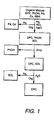
- FIGURES 1-3 are flow charts of illustrative integrated processes according to the invention, for recycle of palladium, cobalt and bromide source catalyst constituents.
- FIGURES 4-5 are flow charts of portions of the process related to separation of palladium from cobalt.
- Three separation steps are features of the method of this invention. They may be employed separately or in combinations which may include two or all three of said steps. When employed in combination, they may be performed in various orders as exemplified hereinafter. Thus, the letter designations of the separation steps are not intended to prescribe an invariable order in which those steps are performed.
- the method of the invention is considered particularly applicable to carbonylation reaction mixtures comprising at least one diaryl carbonate, at least one hydroxyaromatic compound and catalyst constituents including a heavy Group VIIIB metal compound, cocatalysts (usually inorganic and organic, the inorganic co-catalyst being at least one transition metal compound) and a bromide source, and it will be described hereinafter solely in terms of such reactions.
- the product a diaryl carbonate such as diphenyl carbonate, is essentially water-immiscible and thus does not migrate in appreciable amounts to the aqueous extractants employed as described hereinafter. Unreacted hydroxyaromatic compound, such as phenol, may also be present. It is considerably more soluble in water than is diaryl carbonate, and consequently its migration to the aqueous phase is preferably minimized in certain stages by the employment of highly ionic aqueous solutions, also as described hereinafter.
- Typical palladium compounds which are employed as carbonylation catalysts are the salts of divalent palladium with carboxylic acids such as acetic acid and ⁇ -diketones such as 2,4-pentanedione (acetylacetone).
- Typical cobalt compounds include simple cobalt salts such as cobalt(II) acetate and cobalt(II) chloride, and cobalt complexes such as cobalt(II) 2,4-pentanedionate and the cobalt(II) complex of bis[3-(salicylalamino)propyl]methylamine, said complex hereinafter being designated "CoSMDPT".
- Bromide sources include tetraalkylammonium and hexaalkylguani dinium bromides; illustrative are tetramethylammonium bromide, tetra-n-butylammonium bromide and hexaethylguanidinium bromide.
- Suitable organic cocatalysts include various terpyridine, phenanthroline, quinoline and isoquinoline compounds, with 2,2':6',2"-terpyridine often being preferred. These compounds and the by-products formed therefrom are generally incorporated in the organic phase during carbonylation.
- the major product of the carbonylation reaction is usually a substantially homogeneous organic liquid containing diaryl carbonate (typically diphenyl carbonate); excess hydroxyaromatic compound (typically phenol); and palladium compounds, inorganic co-catalytic compounds or their by-products and bromide sources or their by-products. Also present may be organic co-catalysts such as terpyridines, or their by-products.
- Step A of the method of the invention is the removal of elemental and combined palladium from the organic liquid by extraction with an aqueous solution.
- the extraction solution used in this step comprises at least one strong inorganic acid as illustrated by hydrochloric, hydrobromic, nitric and sulfuric acids, in combination with ions capable of forming a stable complex with palladium.
- the preferred ions of this type are halide ions, which form such complexes as tetrahalopalladate. Bromide and chloride ions are preferred, with chloride ions being especially preferred.
- elemental palladium is oxidized to the divalent state.
- a particularly suitable aqueous solution is a dilute hydrochloric acid solution, since it is strongly acidic and also contains the necessary complexing anions.
- concentration of the aqueous hydrochloric acid solution is most often in the range of about 1-35% by weight.
- Extraction with the aqueous solution is typically performed at a temperature in the range of about 20-100° and preferably about 50-100°C. It may be performed in a single step, in multiple steps or continuously. Continuous (e.g., countercurrent) or multiple step extractions are often preferred to ensure removal of substantially all of the palladium.
- Step B of the method of the invention is the removal of cobalt, also by extraction.
- the nature of the aqueous extractant used therefor is not critical, provided it is non-basic since diaryl carbonate is rapidly hydrolyzed upon contact with a basic aqueous medium. Thus, cobalt will be removed concurrently with palladium if step A precedes step B.
- the extractant employed in step B is preferably a non-basic aqueous solution of an ionic compound.
- Suitable ionic compounds include amino acids and inorganic acids which form complexes with divalent cobalt, and their salts, typically containing metal and preferably alkali metal cations such as sodium or potassium.
- suitable amino acids are glycine, alanine, ⁇ -alanine, iminodiacetic acid and nitrilotriacetic acid.
- suitable inorganic acids are hydrochloric, hydrobromic and sulfuric acids. The chlorides, and especially hydrochloric acid, sodium chloride and combinations thereof, are generally preferred.
- the proportion of ionic material present in the extractant for step B is generally in the range of about 1-35% by weight. Extraction may take place at a temperature in the range of about 20-100° and preferably about 50-100°C. As in step A, a single extraction or multiple or continuous extractions may be performed.
- Step C is the removal of bromide source from the organic reaction mixture, and it is achieved by simple extraction with water.
- the use of water rather than an ionic solution is beneficial since the solubility of bromide sources in ionic aqueous solutions is much less than in water, to the point where extraction may not be optimally effective if an ionic solution is employed.
- phenol may make difficult the removal of the bromide source or its chloride analog.
- phenol concentrations above about 40% by weight can cause poor aqueous-organic phase separation and concentrations above about 20% can result in relatively large amounts of phenol being extracted into the aqueous phase. It is frequently preferred, therefore, to remove a substantial proportion of phenol from the carbonylation mixture prior to step C, typically by vacuum stripping, to produce an organic phase typically containing up to 20% phenol.
- step C it may also be preferred to precede step C with hydrochloric acid treatment, for example step A, so as to convert the bromide to chloride.
- hydrochloric acid treatment for example step A, so as to convert the bromide to chloride.
- Extraction in step C may also be single, multiple or continuous. It is typically conducted at a temperature in the range of about 20-100° and preferably about 50-100°C.
- step B it is generally not preferred to employ water alone in step B since a substantial proportion of bromide source, and possibly also unreacted hydroxyaromatic compound, may be extracted at the same time to form a mixture which will require one or more further separation steps.
- an initial extractant which includes complex-forming ions such as chloride and a strong inorganic acid such as hydrochloric acid will cause simultaneous extraction of palladium and cobalt, which may then be separated by reduction of the palladium from solution or by ashing followed by separation as described hereinafter.
- FIGURE 1 is a flow chart of an illustrative integrated embodiment of the invention, in which steps A, B and C are combined and a single extraction employed for both of steps A and B.
- an organic carbonylation reaction mixture comprising diphenyl carbonate (DPC), phenol (PhOH), elemental and combined palladium (Pd), combined cobalt (Co) and bromide source (SBR) is first treated with an aqueous solution of hydrochloric acid and sodium chloride, whereupon combined palladium and cobalt are extracted into the aqueous phase.
- DPC diphenyl carbonate
- PhOH phenol
- Pd elemental and combined palladium
- Co cobalt
- SBR bromide source
- the resulting first extracted organic mixture now comprising diphenyl carbonate, phenol and chloride equivalent (SCL) of the bromide source (hereinafter "converted bromide source"), is then subjected to vacuum stripping to remove a major proportion of the phenol and yield a second extracted organic mixture comprising diphenyl carbonate and converted bromide source. Finally, the second extracted organic mixture is extracted with water to remove the converted bromide source, leaving diphenyl carbonate of enhanced purity as the organic phase.
- SCL chloride equivalent
- the first step is extraction of the organic mixture with aqueous sodium chloride solution to remove divalent cobalt.
- the resulting first extracted organic mixture is then further extracted with an aqueous solution of hydrochloric acid to remove divalent palladium, leaving a second extracted organic mixture containing diphenyl carbonate, phenol and converted bromide source.
- This residue is then subjected to the same concluding steps as in FIGURE 1 to yield a third extracted organic mixture and, finally, diphenyl carbonate of enhanced purity.
- FIGURE 3 depicts still another integrated embodiment in which the first step is extraction with water to remove combined cobalt and bromide source, which may then be separated by precipitation of a water-insoluble cobalt(ll) salt such as the 2,4-pentanedioate.
- the first extracted organic mixture resulting from the extraction is further extracted with aqueous hydrochloric acid to remove elemental and combined palladium, yielding a second extracted organic mixture from which phenol is stripped to leave diphenyl carbonate of enhanced purity.
- the invention includes steps of recovery of catalyst constituents for recycle.
- the palladium may be recovered by reduction to elemental palladium, reoxidation to the divalent state and conversion to a catalytically active species.
- Cobalt if present with the palladium, generally remains for the most part in combined form, either divalent or trivalent.
- Reduction to elemental palladium may be accomplished by treatment with a suitable reducing agent, examples of which are formic acid, elemental hydrogen, hydrazine and sodium borohydride.
- a suitable reducing agent examples of which are formic acid, elemental hydrogen, hydrazine and sodium borohydride.
- Formic acid, employed in aqueous solution, and elemental hydrogen are preferred by reason of their effectiveness and relative environmental harmlessness.
- FIGURE 4 depicts one example of this option. It comprises a single step of treatment with aqueous formic acid solution, whereupon the palladium is reduced to the elemental state (Pd 0 ) and may be separated by filtration to leave an aqueous solution of divalent cobalt.
- More complete separation of palladium from cobalt may be accomplished by oxidizing the solid palladium to produce an aqueous divalent palladium solution, using an oxidizing agent such as nitric acid, bromine, sodium chlorate or hydrogen peroxide, with nitric acid often being preferred, especially in contact with hydrochloric or acetic acid. treatment. Most often, a mixture of glacial acetic acid and concentrated (about 68% by weight) nitric acid is employed in a volume ratio of about 20-50:1. At temperatures in the range of about 50-120°C, the elemental palladium readily dissolves to form palladium(ll) acetate.
- an oxidizing agent such as nitric acid, bromine, sodium chlorate or hydrogen peroxide
- nitric acid often being preferred, especially in contact with hydrochloric or acetic acid. treatment.
- a mixture of glacial acetic acid and concentrated (about 68% by weight) nitric acid is employed in a volume ratio of about 20-50:
- the resulting combined palladium can then again be reduced as described above to produce a second crop of solids consisting essentially of elemental palladium, with cobalt remaining in solution.
- the elemental palladium may be separated and reoxidized to divalent palladium, which may be recovered by conventional means ; if the palladium compound is palladium(ll) acetate, it is ready for recycle as a catalyst constituent.
- the palladium salt is converted to a salt of at least one aliphatic ⁇ -diketone.
- ⁇ -diketone is meant a compound containing two keto carbonyl groups separated by a single carbon atom, usually, but not necessarily, in the form of a CH 2 linkage.
- Suitable ⁇ -diketones include 2,4-pentanedione, 2,4-hexanedione and 3,5-heptanedione.
- 2,4-Pentanedione is generally preferred because of its availability, relatively low cost and particular suitability.
- the proportion thereof employed should be at least an equivalent proportion (i.e., 2 moles per mole of divalent palladium) and preferably an excess, typically of up to about 50%.
- the palladium salt of the ⁇ -diketone may be prepared by simple reaction and isolated by conventional means including such operations as filtration. It may then be dissolved in an organic compound, e.g., phenol, to produce a solution with especially high catalytic activity.
- an organic compound e.g., phenol
- Reconversion of cobalt to a catalytic species is usually fairly easy, since a major proportion of the cobalt, usually essentially all thereof, remains in the combined state in the form of a compound having substantial catalytic activity. If desired, it may be converted to a compound having even greater catalytic activity, such as CoSMDPT. This may be done by simply contacting an aqueous or alcoholic solution of the cobalt with the ligand.
- the bromide source is generally recovered either in its original form, in which it is catalytically active and may be recycled for use in further carbonylation reactions without further treatment, or as the chloride which may be easily reconverted to the bromide by ion exchange.
- the extracts were boiled to dryness and ashed in air at 500°C to yield 1.226 g of ash.
- a 426.4-mg portion of the ash was contacted with 10g of a 1:1 (by weight) mixture of water and formic acid at 90°C for 6 hours, thus reducing the palladium to the elemental state.
- the resulting liquid containing most of the cobalt, was decanted.
- the remaining solid was contacted with an aqueous solution of 9% hydrochloric and 10% nitric acid and the combination was warmed slowly to 80°C, whereupon the solid dissolved.
- the solution was evaporated to dryness and the solid was dissolved in water at 80°C.
- the deposited elemental palladium (134.2 mg) was dried under nitrogen and contacted at 80°C with a mixture of 3.5 ml of acetic acid and 0.1 ml of nitric acid, whereupon it dissolved to form a brown liquid.
- the liquid was evaporated to dryness, producing palladium(ll) acetate as a brown solid which was dissolved in 5 g of acetone.
- 2,4-Pentanedione, 1 g was added and the acetone was evaporated to yield 348 mg of palladium(ll) 2,4-pentanedionate as a catalytically active yellow-orange solid. It was found by analysis to contain 33.28% palladium (theoretical value 34.92%).
- a second portion (554.5 mg) of the ash was similarly treated with aqueous formic acid, hydrochloric/nitric acids and formic acid.
- the deposited elemental palladium was found to weigh 178.3 mg. It was treated at 90°C with a mixture of 4.5 ml of acetic acid and about 0.1 ml of nitric acid, whereupon it dissolved.
- the solution was evaporated to dryness and the residual palladium(II) acetate was similarly dissolved in acetone and treated with 2,4 -pentanedione.
- a precipitate formed and was separated and dried; it weighed 103 mg and was found to contain 32.74% palladium as palladium(II) 2,4-pentanedionate.
- the acetone was removed from the liquid phase and the remaining solid (312.5 mg) was found to contain 35.57% palladium. Total recycle efficiency in the two recovery steps was 48%.
- the carbonylation reaction mixture contained 449 ppm of palladium, 292 ppm of cobalt, 32.3% diphenyl carbonate and 57.6% phenol.
- a 12.6-g sample thereof was extracted for 30 minutes at 90°C with 8.2 g of 9% aqueous hydrochloric acid solution. After the extraction, the aqueous phase was found to contain 2.8% phenol.
- the organic phase contained 174 ppm of palladium, 19.69 ppm of cobalt, 31.5% diphenyl carbonate and 53.9% phenol.
- the carbonylation reaction mixture was free from 2,2':6',2"-terpyridine and contained 341 ppm of palladium and 325 ppm of cobalt.
- a 34-g sample thereof was extracted for 30 minutes at 90°C with 23.7 g of 15% aqueous hydrochloric acid solution. After the extraction, the organic phase contained 5.72 ppm of palladium and less than 4 ppm of cobalt.
- the carbonylation reaction mixture contained 140 ppm of cobalt, 24% diphenyl carbonate and 70% phenol. A 10-g sample thereof was extracted twice over 2 hours, at 90°C, with 14 g of a 14% aqueous solution of trisodium nitrilotriacetate. After extraction, the organic phase contained 3 ppm of cobalt.
- a further 10-g sample of the carbonylation reaction mixture employed in Example 4 was extracted for two hours at 90°C with 11.16 g of a 10.4% aqueous solution of disodium iminodiacetate. After extraction, the organic phase contained 5 ppm of cobalt.
- the carbonylation reaction mixture contained 159 ppm of cobalt, 31.5% diphenyl carbonate and 61.3% phenol. A 10-g sample thereof was extracted for 2 hours at 90°C with 10.56 g of a 5.3% aqueous glycine solution. After extraction, the organic phase contained 20 ppm of cobalt.
- the carbonylation reaction mixture contained 141 ppm of cobalt, 32.6% diphenyl carbonate and 61.2% phenol. A 10-g sample thereof was extracted for 3 hours at 90°C with 10 g of a 10% aqueous sodium chloride solution. After extraction, the organic phase contained 27 ppm of cobalt.
- the carbonylation reaction mixture contained 158 ppm of cobalt and 36% of diphenyl carbonate. A 10-g sample thereof was extracted for 3 hours at 90°C with 10 g of a 10% aqueous ⁇ -alanine solution. After extraction, the organic phase contained 35 ppm of cobalt.
- the carbonylation reaction mixture contained 141 ppm of cobalt, 17.5% diphenyl carbonate and 77.7% phenol.
- a 10-g sample thereof was shaken for 2 minutes at 90°C with 16.7 g of a 9% aqueous hydrochloric acid solution, after which the phase were allowed to settle for 2 minutes. After extraction, the organic phase contained less than 5 ppm of cobalt.
- the carbonylation reaction mixture contained 28.2% diphenyl carbonate, 68.2% phenol, 286 ppm of cobalt and tetra-n-butylammonium bromide as a bromide source.
- a 12.4-g sample thereof was extracted for 10 minutes at 90°C with 12.4 g of water.
- the aqueous phase after extraction contained 6.75% phenol.
- the organic phase after extraction contained 13 ppm of cobalt.
- the carbonylation reaction mixture contained 25.1% diphenyl carbonate and 69.2% phenol. An 11.2-g sample thereof was extracted for 10 minutes at 90°C with 11.2 g of an aqueous solution containing 3% hydrochloric acid and 10% sodium chloride. The aqueous phase after extraction contained 2.96% phenol. An extraction with water under similar conditions produced an aqueous phase containing 8.72% phenol.
- Example 13 The carbonylation reaction mixture of Example 13 was extracted twice at room temperature with 9% aqueous hydrochloric acid solution to remove palladium and cobalt. It was then extracted repeatedly with water as in Example 13. The results are listed in Table II. Extractions Guanidinium salt content, % 0 4.08 1 1.99 3 0.19 5 0.10
- Examples 1-3 show the effectiveness of steps A and B to remove palladium and cobalt from a carbonylation mixture, with Example 1 further demonstrating the conversion of palladium to the active catalytic species palladium(II) 2,4-pentanedionate.
- Examples 4-10 furnish additional evidence of the effectiveness of step B.
- a comparison of Examples 10 and 11, as well as Example 12, reveals the improvement provided by the use of an ionic solution rather than water to suppress extraction of phenol into the aqueous phase.
- Examples 13-18 demonstrate the effectiveness of step C.
- Examples 13-14 show the effectiveness of multiple water washes to remove hexaalkylguanidinium bromide
- Examples 15-16 provide similar showings about the removal of tetra-n-butylammonium chloride
- Examples 17-18 show the higher efficiency of bromide removal with shorter alkyl chains in the quatemary bromides.
Landscapes
- Chemical & Material Sciences (AREA)
- Engineering & Computer Science (AREA)
- Materials Engineering (AREA)
- Organic Chemistry (AREA)
- Chemical Kinetics & Catalysis (AREA)
- Inorganic Chemistry (AREA)
- Manufacturing & Machinery (AREA)
- Mechanical Engineering (AREA)
- Metallurgy (AREA)
- Organic Low-Molecular-Weight Compounds And Preparation Thereof (AREA)
- Catalysts (AREA)
- Processing Of Solid Wastes (AREA)
- Manufacture And Refinement Of Metals (AREA)
Applications Claiming Priority (2)
| Application Number | Priority Date | Filing Date | Title |
|---|---|---|---|
| US963109 | 1997-11-03 | ||
| US08/963,109 US5981788A (en) | 1997-11-03 | 1997-11-03 | Method for recovering and recycling catalyst constituents |
Publications (1)
| Publication Number | Publication Date |
|---|---|
| EP0913197A1 true EP0913197A1 (fr) | 1999-05-06 |
Family
ID=25506763
Family Applications (1)
| Application Number | Title | Priority Date | Filing Date |
|---|---|---|---|
| EP19980308998 Withdrawn EP0913197A1 (fr) | 1997-11-03 | 1998-11-03 | Méthode de récupération et de recyclage des éléments de catalyseur |
Country Status (5)
| Country | Link |
|---|---|
| US (1) | US5981788A (fr) |
| EP (1) | EP0913197A1 (fr) |
| JP (1) | JPH11216371A (fr) |
| CN (1) | CN1216718A (fr) |
| SG (1) | SG71860A1 (fr) |
Cited By (4)
| Publication number | Priority date | Publication date | Assignee | Title |
|---|---|---|---|---|
| WO2003055602A1 (fr) * | 2001-12-27 | 2003-07-10 | Bayer Materialscience Ag | Procede de separation de melanges reactionnels et de recyclage de sels quaternaires |
| WO2003055603A1 (fr) * | 2001-12-27 | 2003-07-10 | Bayer Materialscience Ag | Procede de decomposition de melanges de reaction et de recyclage de sels quaternaires et de bases |
| EP1140775B2 (fr) † | 1998-12-18 | 2009-09-30 | General Electric Company | Regeneration de catalyseurs metalliques utilises dans la production de carbonates de diaryle |
| EP2659964A4 (fr) * | 2010-12-28 | 2016-02-24 | Tosoh Corp | Procédé de récupération de métaux précieux à partir d'une solution contenant des ions de métaux précieux, agent d'extraction ou d'adsorption utilisé dans ledit procédé, et agent de contre-extraction ou de désorption |
Families Citing this family (16)
| Publication number | Priority date | Publication date | Assignee | Title |
|---|---|---|---|---|
| KR20020084251A (ko) * | 2000-04-07 | 2002-11-04 | 데이진 가부시키가이샤 | 방향족 카보네이트의 분리회수방법 및 제조방법 |
| US6310232B1 (en) * | 2000-11-10 | 2001-10-30 | General Electric Company | Method for recycle of bromide-containing catalyst constituents |
| FR2818638B1 (fr) * | 2000-12-27 | 2003-02-07 | Rhodia Polyamide Intermediates | Procede de preparation d'acides carboxyliques par carbonylation au palladium |
| US6410774B1 (en) | 2001-03-30 | 2002-06-25 | General Electric Company | Method for recovery of catalyst components |
| US6683015B2 (en) | 2001-07-31 | 2004-01-27 | General Electric Company | Method for reactivating a catalyst composition |
| DE10332697A1 (de) * | 2003-07-18 | 2005-02-03 | Bayer Materialscience Ag | Methode zur Abtrennung von metallischen Katalysatorbestandteilen aus Reaktionsmischungen der Herstellung aromatischer Carbonate |
| JP5076557B2 (ja) * | 2007-03-06 | 2012-11-21 | 富士通セミコンダクター株式会社 | 半導体装置の製造方法 |
| WO2008153887A1 (fr) * | 2007-06-05 | 2008-12-18 | Recycling Coordinators, Inc. | Recyclage de boue de catalyse |
| US8343608B2 (en) | 2010-08-31 | 2013-01-01 | General Electric Company | Use of appended dyes in optical data storage media |
| KR101972368B1 (ko) * | 2013-06-21 | 2019-04-25 | 에스케이이노베이션 주식회사 | 공중합체 제조공정으로부터 지방족 폴리카보네이트 중합체와 촉매를 분리하는 방법 |
| KR101813747B1 (ko) * | 2014-11-14 | 2018-01-02 | 롯데첨단소재(주) | 유기금속 촉매의 분리방법 |
| JP6893621B2 (ja) | 2015-04-21 | 2021-06-23 | エクシール ワークス コーポレイション | 有機溶媒中の貴金属を選択的に浸出および抽出するための方法 |
| CN110075866B (zh) * | 2016-09-22 | 2022-03-29 | 福建省福大百阳化工科技有限公司 | 一种钯催化剂再生方法 |
| CN110643822B (zh) * | 2019-10-31 | 2020-07-28 | 清华大学 | 一种利用硒醚提炼与富集金元素的方法 |
| CN112973693B (zh) * | 2021-03-23 | 2022-01-04 | 北京师范大学珠海校区 | 一种微纤复合纳米金属催化剂及其制备方法和应用 |
| CN115700286B (zh) * | 2021-07-22 | 2024-04-12 | 谷育英 | 废Pd/Al2O3催化剂中Pd的回收方法 |
Citations (4)
| Publication number | Priority date | Publication date | Assignee | Title |
|---|---|---|---|---|
| FR2176031A1 (fr) * | 1972-03-16 | 1973-10-26 | Montedison Spa | |
| US4390473A (en) * | 1981-06-22 | 1983-06-28 | Eastman Kodak Company | Recovery of rhodium and cobalt low pressure oxo catalyst |
| WO1997005949A1 (fr) * | 1995-08-09 | 1997-02-20 | Rhone-Poulenc Fiber And Resin Intermediates | Procede de separation d'un catalyseur au palladium |
| EP0790231A1 (fr) * | 1996-02-13 | 1997-08-20 | Bayer Ag | Procédé pour la séparation extractive de carbonates de diaryle et de composés hydroxylés aromatiques correspondants de solutions réactionnels |
Family Cites Families (7)
| Publication number | Priority date | Publication date | Assignee | Title |
|---|---|---|---|---|
| US4069169A (en) * | 1975-11-24 | 1978-01-17 | Mitsui Petrochemical Industries Ltd. | Process for preparation of catalyst component supported on high performance carrier |
| EP0550743B1 (fr) * | 1991-07-29 | 2001-05-09 | General Electric Company | Procede de production de carbonates organiques et aromatiques |
| JPH0641020A (ja) * | 1992-06-01 | 1994-02-15 | Mitsubishi Gas Chem Co Inc | 芳香族炭酸エステルの製造方法 |
| US5284964A (en) * | 1992-08-17 | 1994-02-08 | General Electric Company | Method for making aromatic carbonates |
| US5231210A (en) * | 1992-08-17 | 1993-07-27 | General Electric Company | Method for making aromatic carbonates |
| DE69408968T2 (de) * | 1994-01-12 | 1998-07-30 | Mitsubishi Chem Corp | Verfahren zum Herstellen eines aromatischen Carbonates |
| DE19614062A1 (de) * | 1996-04-09 | 1997-10-16 | Bayer Ag | Verfahren zur kontinuierlichen Herstellung von Diarylcarbonaten |
-
1997
- 1997-11-03 US US08/963,109 patent/US5981788A/en not_active Expired - Fee Related
-
1998
- 1998-10-28 SG SG1998004337A patent/SG71860A1/en unknown
- 1998-10-30 JP JP30928198A patent/JPH11216371A/ja not_active Withdrawn
- 1998-11-02 CN CN98124665A patent/CN1216718A/zh active Pending
- 1998-11-03 EP EP19980308998 patent/EP0913197A1/fr not_active Withdrawn
Patent Citations (4)
| Publication number | Priority date | Publication date | Assignee | Title |
|---|---|---|---|---|
| FR2176031A1 (fr) * | 1972-03-16 | 1973-10-26 | Montedison Spa | |
| US4390473A (en) * | 1981-06-22 | 1983-06-28 | Eastman Kodak Company | Recovery of rhodium and cobalt low pressure oxo catalyst |
| WO1997005949A1 (fr) * | 1995-08-09 | 1997-02-20 | Rhone-Poulenc Fiber And Resin Intermediates | Procede de separation d'un catalyseur au palladium |
| EP0790231A1 (fr) * | 1996-02-13 | 1997-08-20 | Bayer Ag | Procédé pour la séparation extractive de carbonates de diaryle et de composés hydroxylés aromatiques correspondants de solutions réactionnels |
Cited By (5)
| Publication number | Priority date | Publication date | Assignee | Title |
|---|---|---|---|---|
| EP1140775B2 (fr) † | 1998-12-18 | 2009-09-30 | General Electric Company | Regeneration de catalyseurs metalliques utilises dans la production de carbonates de diaryle |
| WO2003055602A1 (fr) * | 2001-12-27 | 2003-07-10 | Bayer Materialscience Ag | Procede de separation de melanges reactionnels et de recyclage de sels quaternaires |
| WO2003055603A1 (fr) * | 2001-12-27 | 2003-07-10 | Bayer Materialscience Ag | Procede de decomposition de melanges de reaction et de recyclage de sels quaternaires et de bases |
| US6734325B2 (en) | 2001-12-27 | 2004-05-11 | Bayer Aktiengesellschaft | Process for the separation of reaction mixtures and the recirculation of quaternary salts |
| EP2659964A4 (fr) * | 2010-12-28 | 2016-02-24 | Tosoh Corp | Procédé de récupération de métaux précieux à partir d'une solution contenant des ions de métaux précieux, agent d'extraction ou d'adsorption utilisé dans ledit procédé, et agent de contre-extraction ou de désorption |
Also Published As
| Publication number | Publication date |
|---|---|
| SG71860A1 (en) | 2000-04-18 |
| CN1216718A (zh) | 1999-05-19 |
| JPH11216371A (ja) | 1999-08-10 |
| US5981788A (en) | 1999-11-09 |
Similar Documents
| Publication | Publication Date | Title |
|---|---|---|
| US5981788A (en) | Method for recovering and recycling catalyst constituents | |
| EP0283740B1 (fr) | Dissolution oxydante d'arséniure de gallium et séparation du gallium et de l'arsénic | |
| US3968134A (en) | Process for recovering catalyst systems from raw hydroformylation products | |
| US5256187A (en) | Separation of precious metals by an ion exchange process | |
| US20070142674A1 (en) | Process for the recovery of phosphorus and iodine containing catalyst components | |
| US5478376A (en) | Method for the separation of rhodium and/or iridium from solution | |
| CA1036363A (fr) | Separation des metaux | |
| CA1335376C (fr) | Procede d'extraction de metaux precieux et nouveaux biimidazoles utilises pour l'extraction | |
| US5085835A (en) | Process for recovering rhodium | |
| US4687514A (en) | Process for the recovery of noble metals from solutions | |
| JP3989590B2 (ja) | 白金族金属含有触媒系の再活性化方法 | |
| US3718458A (en) | Liquid-liquid separation of cobalt from ammoniacal solutions | |
| US6090737A (en) | Removal of lead from organic diaryl carbonate reaction mixtures | |
| CN1149187C (zh) | 回收用于生产碳酸二芳酯的金属催化剂 | |
| EP0504277B1 (fr) | Procede de recuperation de rhodium secondaire d'oxydation | |
| US4155750A (en) | Recovery and purification of rhodium | |
| US5206000A (en) | Process for the recovery of rhodium from aqueous solutions containing rhodium complexes | |
| US5201942A (en) | Recovery of rhodium | |
| EP1339493A1 (fr) | Procede de recyclage de constituants de catalyse renfermant du bromure | |
| US6683015B2 (en) | Method for reactivating a catalyst composition | |
| US7309675B1 (en) | Method for regenerating platinum catalysts | |
| CA1046045A (fr) | Activation de sels de cuivre catalysant l'oxydation des phenols | |
| JP3862705B2 (ja) | パラジウムの凝集・沈澱剤、およびこれを用いるパラジウムの分離・回収方法 | |
| JP2771218B2 (ja) | 水溶液からのパラジウムの回収方法 | |
| JPH04254535A (ja) | 白金族金属の分離方法 |
Legal Events
| Date | Code | Title | Description |
|---|---|---|---|
| PUAI | Public reference made under article 153(3) epc to a published international application that has entered the european phase |
Free format text: ORIGINAL CODE: 0009012 |
|
| AK | Designated contracting states |
Kind code of ref document: A1 Designated state(s): BE DE ES FR GB IT NL |
|
| AX | Request for extension of the european patent |
Free format text: AL;LT;LV;MK;RO;SI |
|
| 17P | Request for examination filed |
Effective date: 19991108 |
|
| AKX | Designation fees paid |
Free format text: BE DE ES FR GB IT NL |
|
| 17Q | First examination report despatched |
Effective date: 20011109 |
|
| RIC1 | Information provided on ipc code assigned before grant |
Ipc: 7C 07C 68/08 B Ipc: 7C 22B 11/00 B Ipc: 7B 01J 31/40 A |
|
| GRAP | Despatch of communication of intention to grant a patent |
Free format text: ORIGINAL CODE: EPIDOSNIGR1 |
|
| STAA | Information on the status of an ep patent application or granted ep patent |
Free format text: STATUS: THE APPLICATION IS DEEMED TO BE WITHDRAWN |
|
| 18D | Application deemed to be withdrawn |
Effective date: 20070601 |