EP0913433B1 - Verbesserte Tintenzusammensetzungen für termischen Tintenstrahldruck - Google Patents
Verbesserte Tintenzusammensetzungen für termischen Tintenstrahldruck Download PDFInfo
- Publication number
- EP0913433B1 EP0913433B1 EP98115834A EP98115834A EP0913433B1 EP 0913433 B1 EP0913433 B1 EP 0913433B1 EP 98115834 A EP98115834 A EP 98115834A EP 98115834 A EP98115834 A EP 98115834A EP 0913433 B1 EP0913433 B1 EP 0913433B1
- Authority
- EP
- European Patent Office
- Prior art keywords
- ink
- amount
- weight
- percent
- imidazole
- Prior art date
- Legal status (The legal status is an assumption and is not a legal conclusion. Google has not performed a legal analysis and makes no representation as to the accuracy of the status listed.)
- Expired - Lifetime
Links
- 239000000203 mixture Substances 0.000 title claims description 160
- 238000007641 inkjet printing Methods 0.000 title description 8
- XLYOFNOQVPJJNP-UHFFFAOYSA-N water Substances O XLYOFNOQVPJJNP-UHFFFAOYSA-N 0.000 claims description 142
- 239000007788 liquid Substances 0.000 claims description 101
- 239000000463 material Substances 0.000 claims description 68
- 239000003086 colorant Substances 0.000 claims description 64
- PZYDAVFRVJXFHS-UHFFFAOYSA-N n-cyclohexyl-2-pyrrolidone Chemical compound O=C1CCCN1C1CCCCC1 PZYDAVFRVJXFHS-UHFFFAOYSA-N 0.000 claims description 47
- KWIUHFFTVRNATP-UHFFFAOYSA-N Betaine Natural products C[N+](C)(C)CC([O-])=O KWIUHFFTVRNATP-UHFFFAOYSA-N 0.000 claims description 41
- KWIUHFFTVRNATP-UHFFFAOYSA-O N,N,N-trimethylglycinium Chemical compound C[N+](C)(C)CC(O)=O KWIUHFFTVRNATP-UHFFFAOYSA-O 0.000 claims description 41
- 229960003237 betaine Drugs 0.000 claims description 41
- 238000000034 method Methods 0.000 claims description 35
- 150000001768 cations Chemical group 0.000 claims description 13
- OAYXUHPQHDHDDZ-UHFFFAOYSA-N 2-(2-butoxyethoxy)ethanol Chemical compound CCCCOCCOCCO OAYXUHPQHDHDDZ-UHFFFAOYSA-N 0.000 claims description 4
- WAEVWDZKMBQDEJ-UHFFFAOYSA-N 2-[2-(2-methoxypropoxy)propoxy]propan-1-ol Chemical compound COC(C)COC(C)COC(C)CO WAEVWDZKMBQDEJ-UHFFFAOYSA-N 0.000 claims description 4
- 239000004973 liquid crystal related substance Substances 0.000 claims description 4
- 238000004519 manufacturing process Methods 0.000 claims description 3
- 229940028356 diethylene glycol monobutyl ether Drugs 0.000 claims description 2
- JCGNDDUYTRNOFT-UHFFFAOYSA-N oxolane-2,4-dione Chemical compound O=C1COC(=O)C1 JCGNDDUYTRNOFT-UHFFFAOYSA-N 0.000 claims description 2
- RAXXELZNTBOGNW-UHFFFAOYSA-N imidazole Natural products C1=CNC=N1 RAXXELZNTBOGNW-UHFFFAOYSA-N 0.000 description 445
- 239000000976 ink Substances 0.000 description 427
- KRKNYBCHXYNGOX-UHFFFAOYSA-N citric acid Chemical compound OC(=O)CC(O)(C(O)=O)CC(O)=O KRKNYBCHXYNGOX-UHFFFAOYSA-N 0.000 description 228
- 239000004615 ingredient Substances 0.000 description 118
- 239000003981 vehicle Substances 0.000 description 94
- 239000007787 solid Substances 0.000 description 84
- NBVXSUQYWXRMNV-UHFFFAOYSA-N fluoromethane Chemical class FC NBVXSUQYWXRMNV-UHFFFAOYSA-N 0.000 description 81
- 239000000975 dye Substances 0.000 description 77
- 239000008367 deionised water Substances 0.000 description 63
- 229910021641 deionized water Inorganic materials 0.000 description 63
- 230000003115 biocidal effect Effects 0.000 description 33
- 239000003139 biocide Substances 0.000 description 33
- 125000000129 anionic group Chemical group 0.000 description 30
- 238000010586 diagram Methods 0.000 description 28
- FTZLWXQKVFFWLY-UHFFFAOYSA-L disodium;2,5-dichloro-4-[3-methyl-5-oxo-4-[(4-sulfonatophenyl)diazenyl]-4h-pyrazol-1-yl]benzenesulfonate Chemical compound [Na+].[Na+].CC1=NN(C=2C(=CC(=C(Cl)C=2)S([O-])(=O)=O)Cl)C(=O)C1N=NC1=CC=C(S([O-])(=O)=O)C=C1 FTZLWXQKVFFWLY-UHFFFAOYSA-L 0.000 description 25
- 229920000642 polymer Polymers 0.000 description 21
- 238000005119 centrifugation Methods 0.000 description 15
- 150000004786 2-naphthols Chemical class 0.000 description 13
- 230000000694 effects Effects 0.000 description 13
- 238000002156 mixing Methods 0.000 description 10
- 238000003860 storage Methods 0.000 description 10
- 239000000758 substrate Substances 0.000 description 9
- 239000002245 particle Substances 0.000 description 7
- 239000000049 pigment Substances 0.000 description 6
- IMNIMPAHZVJRPE-UHFFFAOYSA-N triethylenediamine Chemical class C1CN2CCN1CC2 IMNIMPAHZVJRPE-UHFFFAOYSA-N 0.000 description 6
- SXQCTESRRZBPHJ-UHFFFAOYSA-M lissamine rhodamine Chemical compound [Na+].C=12C=CC(=[N+](CC)CC)C=C2OC2=CC(N(CC)CC)=CC=C2C=1C1=CC=C(S([O-])(=O)=O)C=C1S([O-])(=O)=O SXQCTESRRZBPHJ-UHFFFAOYSA-M 0.000 description 5
- RAXXELZNTBOGNW-UHFFFAOYSA-O Imidazolium Chemical compound C1=C[NH+]=CN1 RAXXELZNTBOGNW-UHFFFAOYSA-O 0.000 description 4
- VYPSYNLAJGMNEJ-UHFFFAOYSA-N Silicium dioxide Chemical compound O=[Si]=O VYPSYNLAJGMNEJ-UHFFFAOYSA-N 0.000 description 4
- 239000006229 carbon black Substances 0.000 description 4
- 235000019241 carbon black Nutrition 0.000 description 4
- 150000002170 ethers Chemical class 0.000 description 4
- 239000002502 liposome Substances 0.000 description 4
- 239000004094 surface-active agent Substances 0.000 description 4
- NECRQCBKTGZNMH-UHFFFAOYSA-N 3,5-dimethylhex-1-yn-3-ol Chemical compound CC(C)CC(C)(O)C#C NECRQCBKTGZNMH-UHFFFAOYSA-N 0.000 description 3
- OKTJSMMVPCPJKN-UHFFFAOYSA-N Carbon Chemical compound [C] OKTJSMMVPCPJKN-UHFFFAOYSA-N 0.000 description 3
- LYCAIKOWRPUZTN-UHFFFAOYSA-N Ethylene glycol Chemical compound OCCO LYCAIKOWRPUZTN-UHFFFAOYSA-N 0.000 description 3
- 239000004677 Nylon Substances 0.000 description 3
- DNIAPMSPPWPWGF-UHFFFAOYSA-N Propylene glycol Chemical compound CC(O)CO DNIAPMSPPWPWGF-UHFFFAOYSA-N 0.000 description 3
- 239000007864 aqueous solution Substances 0.000 description 3
- 238000001914 filtration Methods 0.000 description 3
- 229950006187 hexamethonium bromide Drugs 0.000 description 3
- 150000002460 imidazoles Chemical class 0.000 description 3
- 229920001778 nylon Polymers 0.000 description 3
- 238000007639 printing Methods 0.000 description 3
- FAPSXSAPXXJTOU-UHFFFAOYSA-L trimethyl-[6-(trimethylazaniumyl)hexyl]azanium;dibromide Chemical compound [Br-].[Br-].C[N+](C)(C)CCCCCC[N+](C)(C)C FAPSXSAPXXJTOU-UHFFFAOYSA-L 0.000 description 3
- 238000002525 ultrasonication Methods 0.000 description 3
- MCTWTZJPVLRJOU-UHFFFAOYSA-O 1-methylimidazole Chemical compound CN1C=C[NH+]=C1 MCTWTZJPVLRJOU-UHFFFAOYSA-O 0.000 description 2
- QKNYBSVHEMOAJP-UHFFFAOYSA-N 2-amino-2-(hydroxymethyl)propane-1,3-diol;hydron;chloride Chemical compound Cl.OCC(N)(CO)CO QKNYBSVHEMOAJP-UHFFFAOYSA-N 0.000 description 2
- KPGXRSRHYNQIFN-UHFFFAOYSA-N 2-oxoglutaric acid Chemical compound OC(=O)CCC(=O)C(O)=O KPGXRSRHYNQIFN-UHFFFAOYSA-N 0.000 description 2
- MCMFEZDRQOJKMN-UHFFFAOYSA-O 3-butyl-1h-imidazol-3-ium Chemical compound CCCCN1C=C[NH+]=C1 MCMFEZDRQOJKMN-UHFFFAOYSA-O 0.000 description 2
- QGZKDVFQNNGYKY-UHFFFAOYSA-N Ammonia Chemical compound N QGZKDVFQNNGYKY-UHFFFAOYSA-N 0.000 description 2
- QGZKDVFQNNGYKY-UHFFFAOYSA-O Ammonium Chemical compound [NH4+] QGZKDVFQNNGYKY-UHFFFAOYSA-O 0.000 description 2
- PEDCQBHIVMGVHV-UHFFFAOYSA-N Glycerine Chemical compound OCC(O)CO PEDCQBHIVMGVHV-UHFFFAOYSA-N 0.000 description 2
- SECXISVLQFMRJM-UHFFFAOYSA-N N-Methylpyrrolidone Chemical compound CN1CCCC1=O SECXISVLQFMRJM-UHFFFAOYSA-N 0.000 description 2
- 239000002253 acid Substances 0.000 description 2
- 150000001298 alcohols Chemical class 0.000 description 2
- 150000001408 amides Chemical class 0.000 description 2
- 235000013877 carbamide Nutrition 0.000 description 2
- 230000000052 comparative effect Effects 0.000 description 2
- 150000001875 compounds Chemical class 0.000 description 2
- 230000001747 exhibiting effect Effects 0.000 description 2
- FPVGTPBMTFTMRT-NSKUCRDLSA-L fast yellow Chemical compound [Na+].[Na+].C1=C(S([O-])(=O)=O)C(N)=CC=C1\N=N\C1=CC=C(S([O-])(=O)=O)C=C1 FPVGTPBMTFTMRT-NSKUCRDLSA-L 0.000 description 2
- 235000019233 fast yellow AB Nutrition 0.000 description 2
- 238000010438 heat treatment Methods 0.000 description 2
- 150000003839 salts Chemical group 0.000 description 2
- FSYKKLYZXJSNPZ-UHFFFAOYSA-N sarcosine Chemical compound C[NH2+]CC([O-])=O FSYKKLYZXJSNPZ-UHFFFAOYSA-N 0.000 description 2
- 239000000377 silicon dioxide Substances 0.000 description 2
- 239000000243 solution Substances 0.000 description 2
- 239000002904 solvent Substances 0.000 description 2
- -1 sulfolane) Chemical class 0.000 description 2
- LENZDBCJOHFCAS-UHFFFAOYSA-N tris Chemical compound OCC(N)(CO)CO LENZDBCJOHFCAS-UHFFFAOYSA-N 0.000 description 2
- 238000009736 wetting Methods 0.000 description 2
- RKMZJVBSOAVGQS-UHFFFAOYSA-N 1-methylsulfonylethanol Chemical compound CC(O)S(C)(=O)=O RKMZJVBSOAVGQS-UHFFFAOYSA-N 0.000 description 1
- SJEYSFABYSGQBG-UHFFFAOYSA-M Patent blue Chemical compound [Na+].C1=CC(N(CC)CC)=CC=C1C(C=1C(=CC(=CC=1)S([O-])(=O)=O)S([O-])(=O)=O)=C1C=CC(=[N+](CC)CC)C=C1 SJEYSFABYSGQBG-UHFFFAOYSA-M 0.000 description 1
- DUFKCOQISQKSAV-UHFFFAOYSA-N Polypropylene glycol (m w 1,200-3,000) Chemical class CC(O)COC(C)CO DUFKCOQISQKSAV-UHFFFAOYSA-N 0.000 description 1
- 108010077895 Sarcosine Proteins 0.000 description 1
- XSQUKJJJFZCRTK-UHFFFAOYSA-N Urea Chemical compound NC(N)=O XSQUKJJJFZCRTK-UHFFFAOYSA-N 0.000 description 1
- 239000002250 absorbent Substances 0.000 description 1
- 230000002745 absorbent Effects 0.000 description 1
- 239000000980 acid dye Substances 0.000 description 1
- 150000003973 alkyl amines Chemical class 0.000 description 1
- 150000008055 alkyl aryl sulfonates Chemical class 0.000 description 1
- 125000000217 alkyl group Chemical group 0.000 description 1
- 150000001414 amino alcohols Chemical class 0.000 description 1
- ORBBVPFDROYXQS-UHFFFAOYSA-N ammonium perfluorononanoate Chemical compound N.OC(=O)C(F)(F)C(F)(F)C(F)(F)C(F)(F)C(F)(F)C(F)(F)C(F)(F)C(F)(F)F ORBBVPFDROYXQS-UHFFFAOYSA-N 0.000 description 1
- 230000005540 biological transmission Effects 0.000 description 1
- 238000009835 boiling Methods 0.000 description 1
- 230000003139 buffering effect Effects 0.000 description 1
- 239000004202 carbamide Substances 0.000 description 1
- 125000004432 carbon atom Chemical group C* 0.000 description 1
- 150000001735 carboxylic acids Chemical class 0.000 description 1
- 239000006231 channel black Substances 0.000 description 1
- MTHSVFCYNBDYFN-UHFFFAOYSA-N diethylene glycol Chemical class OCCOCCO MTHSVFCYNBDYFN-UHFFFAOYSA-N 0.000 description 1
- SZXQTJUDPRGNJN-UHFFFAOYSA-N dipropylene glycol Chemical compound OCCCOCCCO SZXQTJUDPRGNJN-UHFFFAOYSA-N 0.000 description 1
- 239000000982 direct dye Substances 0.000 description 1
- 238000001035 drying Methods 0.000 description 1
- 150000002148 esters Chemical class 0.000 description 1
- 239000004744 fabric Substances 0.000 description 1
- 238000009472 formulation Methods 0.000 description 1
- 239000006232 furnace black Substances 0.000 description 1
- 235000011187 glycerol Nutrition 0.000 description 1
- 125000001475 halogen functional group Chemical group 0.000 description 1
- 239000003906 humectant Substances 0.000 description 1
- 125000001183 hydrocarbyl group Chemical class 0.000 description 1
- 238000005286 illumination Methods 0.000 description 1
- 238000010348 incorporation Methods 0.000 description 1
- 238000007689 inspection Methods 0.000 description 1
- 150000002576 ketones Chemical class 0.000 description 1
- 238000002372 labelling Methods 0.000 description 1
- 150000002596 lactones Chemical class 0.000 description 1
- 239000006233 lamp black Substances 0.000 description 1
- 229910052751 metal Inorganic materials 0.000 description 1
- 239000002184 metal Substances 0.000 description 1
- 150000002739 metals Chemical class 0.000 description 1
- 239000004033 plastic Substances 0.000 description 1
- 229920003023 plastic Polymers 0.000 description 1
- 229920000867 polyelectrolyte Polymers 0.000 description 1
- 229920001223 polyethylene glycol Polymers 0.000 description 1
- 229920001451 polypropylene glycol Polymers 0.000 description 1
- 238000002360 preparation method Methods 0.000 description 1
- HNJBEVLQSNELDL-UHFFFAOYSA-N pyrrolidin-2-one Chemical compound O=C1CCCN1 HNJBEVLQSNELDL-UHFFFAOYSA-N 0.000 description 1
- 239000000985 reactive dye Substances 0.000 description 1
- 229940043230 sarcosine Drugs 0.000 description 1
- HXJUTPCZVOIRIF-UHFFFAOYSA-N sulfolane Chemical compound O=S1(=O)CCCC1 HXJUTPCZVOIRIF-UHFFFAOYSA-N 0.000 description 1
- 150000003457 sulfones Chemical class 0.000 description 1
- 150000003462 sulfoxides Chemical class 0.000 description 1
- 239000000725 suspension Substances 0.000 description 1
- ISIJQEHRDSCQIU-UHFFFAOYSA-N tert-butyl 2,7-diazaspiro[4.5]decane-7-carboxylate Chemical compound C1N(C(=O)OC(C)(C)C)CCCC11CNCC1 ISIJQEHRDSCQIU-UHFFFAOYSA-N 0.000 description 1
- 239000004753 textile Substances 0.000 description 1
- JSPLKZUTYZBBKA-UHFFFAOYSA-N trioxidane Chemical class OOO JSPLKZUTYZBBKA-UHFFFAOYSA-N 0.000 description 1
- 150000003672 ureas Chemical class 0.000 description 1
- 239000003643 water by type Substances 0.000 description 1
- 239000002023 wood Substances 0.000 description 1
Images




Classifications
-
- C—CHEMISTRY; METALLURGY
- C09—DYES; PAINTS; POLISHES; NATURAL RESINS; ADHESIVES; COMPOSITIONS NOT OTHERWISE PROVIDED FOR; APPLICATIONS OF MATERIALS NOT OTHERWISE PROVIDED FOR
- C09D—COATING COMPOSITIONS, e.g. PAINTS, VARNISHES OR LACQUERS; FILLING PASTES; CHEMICAL PAINT OR INK REMOVERS; INKS; CORRECTING FLUIDS; WOODSTAINS; PASTES OR SOLIDS FOR COLOURING OR PRINTING; USE OF MATERIALS THEREFOR
- C09D11/00—Inks
- C09D11/30—Inkjet printing inks
- C09D11/38—Inkjet printing inks characterised by non-macromolecular additives other than solvents, pigments or dyes
Definitions
- the present invention is directed to ink compositions and to processes for the use thereof. More specifically, the present invention is directed to compositions suitable for use in ink jet printing processes.
- U.S. Patent 5,019,166 discloses a thermal ink jet printing composition comprising a dye, a liquid medium, and a surfactant selected from the group consisting of polyoxyalkylated ethers, anionic bitail fluorothio alkyls, alkyl aryl sulfonates, alkyl amine quaternary salts, and mixtures thereof. Also disclosed is a process for generating images which comprises causing the ink compositions disclosed herein to be ejected from a thermal ink jet printer in imagewise fashion onto a substrate.
- U.S. Patent 5,401,303 discloses a process wherein the halo effect seen at the interface between a first ink, exhibiting sharp edge acuity, and a second ink, having low surface energy, is addressed by adding certain fluorocarbon compounds to the first ink. Edge acuity of the first ink is maintained.
- a need remains for ink compositions with surface tension values of greater than 25 dynes per centimeter.
- a need remains for ink compositions with improved wetting characteristics.
- a need remains for ink compositions which exhibit improved recoverability characteristics in ink jet printers.
- ink compositions which enable a wide color gamut.
- ink compositions which enable prints with reduced curl when the inks are printed onto substrates such as paper.
- ink compositions with improved latency characteristics there is a need for ink compositions with improved latency characteristics.
- a need additionally remains for ink compositions which exhibit reduced showthrough when printed on paper.
- ink compositions which are suitable for printing on a wide variety of substrates In addition, a need remains for ink compositions which remain homogeneous over extended periods of time. Further, a need remains for ink compositions which exhibit further improvements in intercolor bleed characteristics when prints generated therewith are subjected to drying-assisting processes such as heating, microwave drying, or the like.
- Inks of the present invention contain an aqueous liquid vehicle.
- the liquid vehicle can consist solely of water, or it can comprise a mixture of water and a water soluble or water miscible organic component, such as ethylene glycol, propylene glycol, diethylene glycols, glycerine, dipropylene glycols, polyethylene glycols, polypropylene glycols, tripropylene glycol monomethyl ether, amides, ethers, urea, substituted ureas, ethers, carboxylic acids and their salts, esters, alcohols, organosulfides, organosulfoxides, sulfones (such as sulfolane), alcohol derivatives, carbitol, butyl carbitol, cellusolve, ether derivatives, amino alcohols, ketones, N-methylpyrrolidinone, 2-pyrrolidinone, cyclohexylpyrrolidone, hydroxyethers, amides, sulfoxides
- the water to organic ratio typically ranges from about 100:0 to 30:70, and preferably from 97:3 to 40:60.
- the non-water component of the liquid vehicle generally serves as a humectant which has a boiling point higher than that of water (100°C).
- the liquid vehicle is typically present in an amount of from 80 to about 99.9 percent by weight of the ink, and preferably from about 90 to about 99 percent by weight of the ink, although the amount can be outside these ranges.
- a colorant Also contained in the ink composition of the present invention is a colorant. Any suitable colorant can be employed, including dyes, pigments, and mixtures thereof.
- Suitable dye or mixture of dyes compatible with the ink liquid vehicle include acid dyes, direct dyes, and reactive dyes, with water soluble anionic dyes being preferred.
- the dye is present in the ink composition in any effective amount, typically from 0.5 to 15 percent by weight of the ink, and preferably from 11 to 10 percent by weight of the ink, although the amount can be outside of these ranges.
- suitable pigments for the inks of the present invention include various carbon blacks such as channel black, furnace black, and lamp black. Colored pigments include red, green, blue, brown, magenta, cyan, and yellow particles, as well as mixtures thereof.
- the pigment particle size is as small as possible to enable a stable colloidal suspension of the particles in the liquid vehicle and to prevent clogging of the ink channels when the ink is used in a thermal ink jet printer.
- Preferred particle average diameters are generally from 0.001 to 5 microns, and more preferably from 0.1 to 1 micron, although the particle size can be outside these ranges.
- the pigment is present in any effective amount to achieve the desired degree of coloration. Typically, the pigment is present in an amount of from 0.1 to 8 percent by weight of the ink, and preferably from 2 to 7 percent by weight of the ink, although the amount can be outside these ranges.
- X + is a cation and n is an integer of from 3 to 20, preferably from 4 to 15, and more preferably from 5 to 11.
- suitable cations include ammonium, (HO-CH 2 CH 2 ) 2 NH 2 + , (HO-CH 2 CH 2 ) 3 NH + , (HO-CH 2 CH 2 )NH 3 + , an imidazolium cation such as imidazolium, N-methyl imidazolium, or N-butyl imidazolium, tris(hydroxymethyl)aminomethane hydrochloride, tris(hydroxymethyl)aminomethane hydrocitrate, and protonated 1,4-diazabicyclo[2.2.2]octane.
- LODYNE P-502 Materials of this formula are available from, for example, Ciba-Geigy, Ardsley, New York (Greensboro, NC) as LODYNE P-502, containing a mixture of compounds wherein n has varying values and has an average value of about 9.
- the fluorinated material is present in the ink in any effective or desired amount; typically, the amount ranges from 0.1 to 10 percent by weight of the ink, preferably from 0.25 to 6 percent by weight of the ink, more preferably from 0.5 to 5 percent by weight of the ink, and even more preferably from 1 to 4 percent by weight of the ink, although the amount can be outside these ranges.
- the fluorinated material is of the formula wherein n is 5.
- This material is available from, for example, Ciba-Geigy, Ardsley, New York (Greensboro, NC) as LODYNE P-502L, containing the fluorocarbon wherein substantially all of the material has exactly 6 carbon atoms in each of the fluorinated hydrocarbon chains. Inks containing this material exhibit improved shelf stability, even when the fluorocarbon and/or the ink are not subjected to ultrasonification or high shear mixing.
- inks containing mixtures of fluorocarbons of the above formula wherein n has varying values may be compatible with some dyes and may exhibit reduced shelf stability with other dyes.
- the ink fabrication process is accordingly simplified, with no need for procedures other than simple mixing of the ingredients to obtain optimal performance.
- the ink also contains another fluorocarbon material of the formula wherein n is an integer of from 8 to 20 and B is a cation. In one specific embodiment, n is 10 and B is (HO-CH 2 CH 2 ) 2 NH 2 + .
- Suitable cations include ammonium, (HO-CH 2 CH 2 ) 3 NH + , (HO-CH 2 CH 2 )NH 3 + , an imidazolium cation such as imidazolium, N-methyl imidazolium, or N-butyl imidazolium, tris(hydroxymethyl)aminomethane hydrochloride, tris(hydroxymethyl)aminomethane hydrocitrate, and protonated 1,4-diazabicyclo[2.2.2]octane. Materials of this formula are available from, for example, Ciba-Geigy, Ardsley, New York (Greensboro, NC) as LODYNE P-201.
- the ink comprises water, a colorant, a material of the formula wherein X + is a cation and n is an integer of from 3 to 20, and a penetrant material selected from betaine, cyclohexyl pyrrolidinone, butyl carbitol (diethylene glycol monobutyl ether), tripropylene glycol monomethyl ether, or mixtures thereof.
- the penetrant material is present in any effective or desired amount, typically from 0.1 to 20 percent by weight, and preferably from 3 to 15 percent by weight, although the amount can be outside these ranges. Inks of this specific embodiment are preferred over those containing a surfactant because of frequently reduced viscosity.
- the ink compositions are generally of a viscosity suitable for use in thermal ink jet printing processes. At room temperature (i.e., about 25°C), typically, the ink viscosity is no more than 10 centipoise, and preferably is from 1 to 5 centipoise, more preferably from 1 to 4 centipoise, although the viscosity can be outside this range.
- Ink compositions of the present invention can be of any suitable or desired pH.
- typical pH values are from 7.75 to 9.25, and preferably from 8.25 to 8.75, although the pH can be outside of these ranges.
- the ink is subjected to ultrasonification to reduce the particle size of the liposomes in the ink formed by the fluorocarbon material.
- the ink is subjected to ultrasonication at relatively low intensity, typically for from 5 to 90 minutes, preferably from about 10 to 60 minutes, and in a preferred embodiment for about 20 minutes.
- the fluorocarbon material is subjected to ultrasonification prior to admixing it with the other ink ingredients.
- the fluorocarbon in this second embodiment, can be ultrasonicated either in the form in which it is received from the supplier (assuming said form is a liquid containing the fluorocarbon) or after admixing it with water, mixtures of water and one or more desired buffering components, or mixtures of water and one or more other desired ink components.
- the ultrasonicated liquid contains the fluorocarbon material in an amount of about 15 percent by weight and water in an amount of about 85 percent by weight.
- the ultrasonicated liquid contains the fluorocarbon material in an amount of about 15 percent by weight, 1,4-diazabicyclo[2.2.2]octane in an amount of about 20 percent by weight, and water in an amount of about 65 percent by weight.
- the ultrasonicated liquid contains the fluorocarbon material in an amount of from 9 to 10 percent by weight, 1,4-diazabicyclo[2.2.2]octane in an amount of from 6 to 7 percent by weight, a bisquaternary compound, such as hexamethonium bromide, in an amount of from 4 to 5 percent by weight, an acid, such as citric acid, in an amount of from 2 to 3 percent by weight, and the balance water.
- LODYNE P-502 obtained from Tricon Colors as an aqueous solution containing about 15 percent by weight of the fluorocarbon, is divided into 25 gram portions. In each instance, a 25 gram portion of the LODYNE P-502 is placed in a 30 gram vial. The vial is placed into a 550 SONIC DISMEMBRATOR (obtained from Fisher Scientific Co.) tuned at 20 kiloHertz and the LODYNE P-502 is subjected to ultrasonification for a period of 10 minutes at an amplitude setting of 5, with the power turned on and off every 30 seconds. Thereafter the vial is allowed to stand overnight, after which the top layer in the vial is used to prepare ink compositions.
- SONIC DISMEMBRATOR obtained from Fisher Scientific Co.
- the ink can be jacked cooled during the process, and/or the ultrasonification can be pulsed instead of continuous; for example, for a process entailing application of ultrasonification for 5 minutes, the process can be pulsed at one second on and one second off alternately for a period of 10 minutes.
- Reduction in liposome size by ultrasonification enables advantages such as enhanced shelf life of the ink and reduced ink viscosity. Ultrasonification also results in a narrower range of liposome particle diameters.
- neither the fluorocarbon nor the ink is subjected to ultrasonification during the formulation process.
- Inks suitable for ink jet printing exhibiting a liquid crystalline phase at certain temperatures are known, as disclosed in, for example, U.S. Patent 5,492,559, U.S. Patent 5,551,973, and U.S. Patent 5,643,357.
- Fluorocarbon materials such as LODYNE P-502, available from Ciba-Geigy, when received from the manufacturer, contain liquid crystals as observed by microscopic inspection under polarized illumination.
- the resulting multicolored images exhibit improved intercolor bleed repression characteristics compared to inks of identical composition but wherein the fluorocarbon was ultrasonified prior to incorporation into the ink composition and inks of identical composition which were subjected to ultrasonification subsequent to ink preparation.
- the inks of the present invention may be used in a process which entails incorporating an ink composition of the present invention into an ink jet printing apparatus and causing droplets of the ink composition to be ejected in an imagewise pattern onto a substrate.
- the printing apparatus employs a thermal ink jet process wherein the ink in the nozzles is selectively heated in an imagewise pattern, thereby causing droplets of the ink to be ejected in imagewise pattern.
- any suitable substrate can be employed, including plain papers such as Xerox® 4024 papers, ruled notebook paper, bond paper, silica coated papers such as Sharp Company silica coated paper, and JuJo paper, transparency materials, fabrics, textile products, plastics, polymeric films, and inorganic substrates such as metals and wood.
- the process entails printing onto a porous or ink absorbent substrate, such as plain paper.
- LODYNE P-502 obtained from Ciba-Geigy as an aqueous solution containing about 15 percent by weight of the fluorocarbon, was divided into 25 gram portions. In each instance, a 25 gram portion of the LODYNE P-502 was placed in a 30 gram vial. The vial was placed into a 550 SONIC DISMEMBRATOR (obtained from Fisher Scientific Co.) tuned at 20 kiloHertz and the LODYNE P-502 was subjected to ultrasonification for a period of 10 minutes at an amplitude setting of 5, with the power turned on and off every 30 seconds. Thereafter the vial was allowed to stand overnight, after which the top layer in the vial was used to prepare ink compositions.
- SONIC DISMEMBRATOR obtained from Fisher Scientific Co.
- ink compositions were prepared by simple mixing of the following ingredients, wherein the relative amounts of dye and biocide were constant for all inks prepared and the relative amounts of LODYNE P-502, imidazole, and water were varied over the indicated ranges:
- Ingredient Supplier Amount (% b.w.) Acid Yellow 17 dye (solids) Tricon Colors 3 DOWICIL 150 biocide Dow Chemical Co.
- LODYNE P-502 (as supplied; contains 15 percent by weight fluorocarbon solids) Ciba-Geigy 1 -- 80 imidazole Aldrich Chemical Co.
- the ink compositions thus prepared were tested for shelf stability characteristics by observing the effects of varying amounts of LODYNE P-502 and imidazole in the ink system.
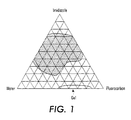
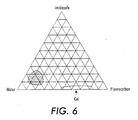
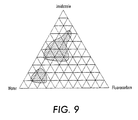
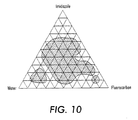
- a stability diagram was prepared from this information and is shown in Figure 1.
- the triangle represents the relative amounts of water, LODYNE P-502, and imidazole in the ink with respect to each other (and ignoring the other ink ingredients).
- Each apex of the triangle represents an ink wherein the water/LODYNE P-502/imidazole system contained 100 percent by weight of the ingredient with which the triangle apex is labeled and 0 percent by weight of the other two ingredients.
- the left triangle apex represents an ink containing water, but no imidazole and no LODYNE P-502.
- Each side of the triangle represents ink compositions wherein the water/LODYNE P-502/imidazole system contained varying amounts of the two ingredients labeling each triangle apex with which the triangle side is connected but contained 0 percent by weight of the ingredient with which the apex opposite the triangle side is labeled.
- the bottom edge of the triangle represents inks containing water and LODYNE P-502 in varying amounts, but containing no imidazole.
- Ink compositions containing all three ingredients in varying amounts are represented within the boundaries of the triangle.
- the inks remained homogeneous under centrifugation at 2,400 revolutions per minute for 30 minutes in an 8-foot arm centrifuge when the inks contained relative amounts of water, imidazole, and LODYNE P-502 (with respect to each other and ignoring the other ink ingredients) as follows: Ingredient Relative amount range (% b.w.) imidazole 15 -- 75 LODYNE P-502 (as supplied; contains 15% b.w. fluorocarbon solids) 1 -- 60 deionized water 0.01 -- 65 The inks with ideal shelf stability characteristics thus contained the following ingredients in the indicated amount ranges.
- Example I The process of Example I was repeated with the exception that the inks all contained a fixed amount of citric acid.
- Ingredient Supplier Amount (% b.w.) Acid Yellow 17 dye (solids) Tricon Colors 3 DOWICIL 150 biocide Dow Chemical Co. 0.1 citric acid Aldrich Chemical Co. 1
- LODYNE P-502 (as supplied; contains 15% b.w. fluorocarbon solids) Ciba-Geigy 1 -- 80 imidazole Aldrich Chemical Co. 0 -- 80 deionized water - - - 0 -- 80
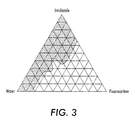
- the ink compositions thus prepared were tested for shelf stability characteristics by observing the effects of varying amounts of LODYNE P-502 and imidazole in the ink system.
- Example la The process of Example la was repeated with the exception that the pH of the inks prepared was adjusted in each instance to 8.75 by the addition of citric acid.
- Ingredient Supplier Amount (% b.w.) Acid Yellow 17 dye (solids) Tricon Colors 3 DOWICIL 150 biocide Dow Chemical Co. 0.1 citric acid Aldrich Chemical Co. 0 -- 4 LODYNE P-502 (as supplied; contains 15% b.w. fluorocarbon solids) Ciba-Geigy 1 -- 80 imidazole Aldrich Chemical Co.
- the inks remained homogeneous under centrifugation at 2,400 revolutions per minute for 30 minutes in an 8-foot arm centrifuge when the inks contained relative amounts of water, imidazole, and LODYNE P-502 (with respect to each other and ignoring the other ink ingredients) as follows: Ingredient Relative amount range (% b.w.) imidazole 25 -- 65 LODYNE P-502 (as supplied; contains 15% b.w.
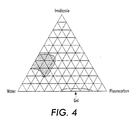
- Example la The process of Example la was repeated with the exceptions that the inks all contained a fixed amount of betaine and that the pH of the inks prepared was adjusted in each instance to 8.75 by the addition of citric acid.
- Ingredient Supplier Amount (% b.w.) Acid Yellow 17 dye (solids) Tricon Colors 3 DOWICIL 150 biocide Dow Chemical Co. 0.1 betaine FinnSugar Bioproducts 15 citric acid Aldrich Chemical Co. 0 -- 5 LODYNE P-502 (as supplied; contains 15% b.w. fluorocarbon solids) Ciba-Geigy 1 -- 80 imidazole Aldrich Chemical Co.
- the inks remained homogeneous under centrifugation at 2,400 revolutions per minute for 30 minutes in an 8-foot arm centrifuge when the inks contained relative amounts of water, imidazole, and LODYNE P-502 (with respect to each other and ignoring the other ink ingredients) as follows: Ingredient Relative amount range (% b.w.) imidazole 0.01 -- 80 LODYNE P-502 (as supplied; contains 15% b.w.
- Example Ia The process of Example Ia was repeated with the exceptions that the inks all contained a fixed amount of cyclohexylpyrrolidinone and a fixed amount of citric acid.
- Ingredient Supplier Amount (% b.w.) Acid Yellow 17 dye (solids) Tricon Colors 3 DOWICIL 150 biocide Dow Chemical Co. 0.1 cyclohexylpyrrolidone BASF 2 citric acid Aldrich Chemical Co. 1 LODYNE P-502 (as supplied; contains 15% b.w. fluorocarbon solids) Ciba-Geigy 1 -- 80 imidazole Aldrich Chemical Co.
- Example la The process of Example la was repeated with the exceptions that the inks all contained a fixed amount of cyclohexylpyrrolidinone and that the pH of the inks prepared was adjusted in each instance to 8.75 by the addition of citric acid.
- Ingredient Supplier Amount (% b.w.) Acid Yellow 17 dye (solids) Tricon Colors 3 DOWICIL 150 biocide Dow Chemical Co. 0.1 cyclohexylpyrrolidone BASF 2 citric acid Aldrich Chemical Co. 0 -- 5 LODYNE P-502 (as supplied; contains 15% b.w. fluorocarbon solids) Ciba-Geigy 1 -- 80 imidazole Aldrich Chemical Co.
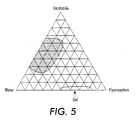
- Example la The process of Example la was repeated with the exceptions that the inks all contained a fixed amount of cyclohexylpyrrolidinone and that the pH of the inks prepared was adjusted in each instance to 8.25 by the addition of citric acid.
- Ingredient Supplier Amount (% b.w.) Acid Yellow 17 dye (solids) Tricon Colors 3 DOWICIL 150 biocide Dow Chemical Co. 0.1 cyclohexylpyrrolidone BASF 2 citric acid Aldrich Chemical Co. 0 -- 5 LODYNE P-502 (as supplied; contains 15% b.w. fluorocarbon solids) Ciba-Geigy 1 -- 80 imidazole Aldrich Chemical Co.
- the inks remained homogeneous under centrifugation at 2,400 revolutions per minute for 30 minutes in an 8-foot arm centrifuge when the inks contained relative amounts of water, imidazole, and LODYNE P-502 (with respect to each other and ignoring the other ink ingredients) as follows: Ingredient Relative amount range (% b.w.) imidazole 2 -- 25 LODYNE P-502 (as supplied; contains 15% b.w.
- Example la The process of Example la was repeated with the exceptions that the inks all contained a fixed amount of SOLSPERSE 27,000 polymer and that the pH of the inks prepared was adjusted in each instance to 8.75 by the addition of citric acid.
- Ingredient Supplier Amount (% b.w.) Acid Yellow 17 dye (solids) Tricon Colors 3 DOWICIL 150 biocide Dow Chemical Co. 0.1 SOLSPERSE 27,000 ICI 0.1 citric acid Aldrich Chemical Co. 0 -- 5 LODYNE P-502 (as supplied; contains 15% b.w. fluorocarbon solids) Ciba-Geigy 1 -- 80 imidazole Aldrich Chemical Co.
- Example la The process of Example la was repeated with the exceptions that the inks all contained a fixed amount of betaine and a fixed amount of cyclohexylpyrrolidinone, and that the pH of the inks prepared was adjusted in each instance to 8.75 by the addition of citric acid.
- Ingredient Supplier Amount (% b.w.) Acid Yellow 17 dye (solids) Tricon Colors 3 DOWICIL 150 biocide Dow Chemical Co. 0.1 betaine FinnSugar Bioproducts 15 cyclohexylpyrrolidone BASF 2 citric acid Aldrich Chemical Co. 0 -- 5 LODYNE P-502 (as supplied; contains 15% b.w.
- the inks remained homogeneous under centrifugation at 2,400 revolutions per minute for 30 minutes in an 8-foot arm centrifuge when the inks contained relative amounts of water, imidazole, and LODYNE P-502 (with respect to each other and ignoring the other ink ingredients) as follows: Ingredient Relative amount range (% b.w.) imidazole 0.01 -- 80 LODYNE P-502 (as supplied; contains 15% b.w.
- Example la The process of Example la was repeated with the exceptions that the inks all contained a fixed amount of betaine and a fixed amount of SOLSPERSE 27,000 polymer, and that the pH of the inks prepared was adjusted in each instance to 8.75 by the addition of citric acid.
- Ingredient Supplier Amount (% b.w.) Acid Yellow 17 dye (solids) Tricon Colors 3 DOWICIL 150 biocide Dow Chemical Co. 0.1 betaine FinnSugar Bioproducts 15 SOLSPERSE 27,000 ICI 0.1 citric acid Aldrich Chemical Co. 0 -- 5 LODYNE P-502 (as supplied; contains 15% b.w. fluorocarbon solids) Ciba-Geigy 1 -- 80 imidazole Aldrich Chemical Co.
- Example la The process of Example la was repeated with the exceptions that the inks all contained a fixed amount of cyclohexylpyrrolidinone and a fixed amount of SOLSPERSE 27,000 polymer, and that the pH of the inks prepared was adjusted in each instance to 8.75 by the addition of citric acid.
- Ingredient Supplier Amount (% b.w.) Acid Yellow 17 dye (solids) Tricon Colors 3 DOWICIL 150 biocide Dow Chemical Co. 0.1 cyclohexylpyrrolidone BASF 2 SOLSPERSE 27,000 ICI 0.1 citric acid Aldrich Chemical Co. 0 -- 5 LODYNE P-502 (as supplied; contains 15% b.w.
- the inks remained homogeneous after shelf storage for 6 months when the inks contained relative amounts of water, imidazole, and LODYNE P-502 (with respect to each other and ignoring the other ink ingredients) as follows: Ingredient Relative amount range (% b.w.) imidazole 2 -- 25 LODYNE P-502 (as supplied; contains 15% b.w.
- Ingredient Amount (% b.w.) Acid Yellow 17 dye (solids) 3 DOWICIL 150 biocide 0.1 cyclohexylpyrrolidone 2 SOLSPERSE 27,000 0.1 citric acid 0.035 -- 0.85 LODYNE P-502 (as supplied; contains 15% b.w. fluorocarbon solids) 0.21 -- 0.71 imidazole 0.7 -- 17 deionized water 78 -- 81
- Example la The process of Example la was repeated with the exceptions that the inks all contained a fixed amount of betaine, a fixed amount of cyclohexylpyrrolidinone, and a fixed amount of SOLSPERSE 27,000 polymer, and that the pH of the inks prepared was adjusted in each instance to 8.75 by the addition of citric acid.
- Ingredient Supplier Amount (% b.w.) Acid Yellow 17 dye (solids) Tricon Colors 3 DOWICIL 150 biocide Dow Chemical Co. 0.1 betaine FinnSugar Bioproducts 15 cyclohexylpyrrolidone BASF 2 SOLSPERSE 27,000 ICI 0.1 citric acid Aldrich Chemical Co. 0 -- 5 LODYNE P-502 (as supplied; contains 15% b.w.
- the inks remained homogeneous under centrifugation at 2,400 revolutions per minute for 30 minutes in an 8-foot arm centrifuge when the inks contained relative amounts of water, imidazole, and LODYNE P-502 (with respect to each other and ignoring the other ink ingredients) as follows: Ingredient Relative amount range (% b.w.) imidazole 2 -- 25 LODYNE P-502 (as supplied; contains 15% b.w.
- Ingredient Amount (% b.w.) Acid Yellow 17 dye (solids) 3 DOWICIL 150 biocide 0.1 betaine 15 cyclohexylpyrrolidone 2 SOLSPERSE 27,000 0.1 citric acid 0.035 -- 0.85 LODYNE P-502 (as supplied; contains 15% b.w. fluorocarbon solids) 0.21 -- 0.71 imidazole 0.7 -- 17 deionized water 78 -- 81
- An ink composition was prepared as follows. Deionized water (94.75 grams) and imidazole (obtained from Aldrich Chemical Co., Milwaukee, WI, 20 grams) were admixed to form a mixture having a pH of 10.18 at 23.7°C. The pH of the mixture was then adjusted by the addition of phosphorous acid (obtained from Rhone-Poulenc, Cranbury, NJ, 0.8074 gram), thereby bringing the pH of the mixture to 8.75 at 25.0°C.
- phosphorous acid obtained from Rhone-Poulenc, Cranbury, NJ, 0.8074 gram
- betaine obtained from Finnsugar Bioproducts, Helsinki, Finland, 30 grams
- DOWICIL 150/200 biocide obtained from Dow Chemical Co., Midland, Ml, 0.2 gram
- SURFYNOL GA surfactant obtained from Air Products and Chemicals Co., Allentown, PA, 0.8 gram
- PROJET FAST YELLOW 2 dye obtained from Zeneca Colours, Dighton, MA, solids only (solvent removed), 6 grams
- LODYNE P-502 (14.2 percent by weight solids, obtained from Ciba-Geigy, Ardsley, NY, 42.26 grams, first subjected to ultrasonification by the process described in Example la), and additional deionized water (5.18 grams).
- the mixture was then roll milled for 30 minutes, followed by filtration through a 1.2 micron 47 millimeter Versapore-1200 filter at 2 pounds per square inch over a period of 10 minutes and 12 seconds.
- the ink composition thus prepared exhibited a viscosity of 3.96 centipoise at 25°C, a surface tension of 22.9 dynes per centimeter, a pH of 8.77 at 23.5°C, and a conductivity of 7.10 millimhos. After 6 months of shelf storage, the ink exhibited a viscosity of 4.01 centipoise.
- An ink composition was prepared as follows. Deionized water (23.68 grams) and imidazole (obtained from Aldrich Chemical Co., Milwaukee, WI, 5 grams) were admixed to form a mixture having a pH of 10.95 at 18.7°C. The pH of the mixture was then adjusted by the addition of 2-keto glutaric acid (obtained from Aldrich Chemical Co., Milwaukee, WI, 0.2504 gram), thereby bringing the pH of the mixture to 8.75 at 20.4°C.
- sarcosine obtained from Aldrich Chemical Co., Milwaukee, WI, 7.5 grams
- DOWICIL 150/200 biocide obtained from Dow Chemical Co., Midland, Ml, 0.05 gram
- SURFYNOL GA surfactant obtained from Air Products and Chemicals Co., Allentown, PA, 0.208 gram
- PROJET FAST YELLOW 2 dye obtained from Zeneca Colours, Dighton, MA, solids only (solvent removed), 1.5 grams
- LODYNE P-502 (14.2 percent by weight solids, obtained from Ciba-Geigy, Ardsley, NY, 10.56 grams, first subjected to ultrasonification by the process described in Example la), and additional deionized water (1.25 grams).
- the mixture was then roll milled for 30 minutes, followed by filtration through a 1.2 micron 47 millimeter Versapore-1200 filter at 2 pounds per square inch over a period of 3 minutes and 22 seconds.
- the ink composition thus prepared exhibited a viscosity of 4.84 centipoise at 25°C, a surface tension of 25.2 dynes per centimeter, a pH of 8.56 at 24.5°C, and a conductivity of 8.56 millimhos.
- An ink composition was prepared by simple mixing of the following ingredients: Ingredient Supplier Amount deionized water - - - 17.56 grams imidazole Aldrich Chemical Co. 6.01 grams citric acid Aldrich Chemical Co. 0.3 gram betaine Finnsugar Bioproducts 9.01 grams DOWICIL 150 biocide Dow Chemical Co. 0.06 gram Acid Red 52 dye (10% by weight dye solids) Tricon Colors 15.03 grams LODYNE P-502 Ciba-Geigy 12.1 grams The mixture was filtered through a 1.2 micron VERSAPORE-1200 filter at 10 pounds per square inch over a period of 30 seconds. The resulting ink exhibited a viscosity of 2.25 centipoise at 25°C.
- the ink After maintaining the ink for 5 days at 50°C, the ink exhibited a viscosity of 2.21 centipoise at 25°C. The ink exhibited a conductivity of 8.84 millimhos per square centimeter, a surface tension of 28.6 dynes per centimeter, and a pH of 8.78 at 24.8°C. The ink remained monophase after centrifugation for 30 minutes at 2,700 revolutions per minute. The ink remained monophase after being undisturbed for 5 days. When the ink was coated onto Courtland 4024 DP Image Series Elite paper (felt side) with a #3 wire-wound rod, the resulting image dried in 3 seconds.
- An ink composition was prepared by simple mixing of the following ingredients: Ingredient Supplier Amount deionized water - - - 8.19 grams imidazole Aldrich Chemical Co. 3.01 grams citric acid Aldrich Chemical Co. 0.15 gram betaine Finnsugar Bioproducts 4.5 grams cyclohexylpyrrolidone BASF 0.61 gram DOWICIL 150 biocide Dow Chemical Co. 0.03 gram Acid Red 52 dye (10% by weight dye solids) Tricon Colors 7.51 grams LODYNE P-502 Ciba-Geigy 6.05 grams The resulting ink exhibited a viscosity of 3.21 centipoise at 25°C.
- the ink After maintaining the ink for 5 days at 50°C, the ink exhibited a viscosity of 3.11 centipoise at 25°C. The ink exhibited a conductivity of 3.75 millimhos per square centimeter, a surface tension of 26.3 dynes per centimeter, and a pH of 8.67 at 22.8°C. The ink remained monophase after centrifugation for 30 minutes at 2,700 revolutions per minute. The ink remained monophase after being undisturbed for 5 days. When the ink was coated onto Courtland 4024 DP Image Series Elite paper (felt side) with a #3 wire-wound rod, the resulting image dried in 0.5 second.
- An ink composition was prepared by simple mixing of the following ingredients: Ingredient Supplier Amount deionized water - - - 8.19 grams imidazole Aldrich Chemical Co. 3 grams citric acid Aldrich Chemical Co. 0.15 gram betaine Finnsugar Bioproducts 4.5 grams butyl carbitol Van Waters & R 0.6 gram DOWICIL 150 biocide Dow Chemical Co. 0.03 gram Acid Red 52 dye (10% by weight dye solids) Tricon Colors 7.5 grams LODYNE P-502 Ciba-Geigy 6.03 grams The resulting ink exhibited a viscosity of 2.86 centipoise at 25°C.
- the ink After maintaining the ink for 5 days at 50°C, the ink exhibited a viscosity of 2.81 centipoise at 25°C. The ink exhibited a conductivity of 4.02 millimhos per square centimeter, a surface tension of 25.6 dynes per centimeter, and a pH of 8.51 at 22.6°C. The ink remained monophase after centrifugation for 30 minutes at 2,700 revolutions per minute. The ink remained monophase after being undisturbed for 5 days. When the ink was coated onto Courtland 4024 DP Image Series Elite paper (felt side) with a #3 wire-wound rod, the resulting image dried in 0.5 second.
- An ink composition was prepared by simple mixing of the following ingredients: Ingredient Supplier Amount deionized water - - - 7.3 grams imidazole Aldrich Chemical Co. 3 grams citric acid Aldrich Chemical Co. 0.15 gram betaine Finnsugar Bioproducts 4.5 grams tripropylene glycol monomethyl ether Dow Chemical Co. 1.5 gram DOWICIL 150 biocide Dow Chemical Co. 0.03 gram Acid Red 52 dye (10% by weight dye solids) Tricon Colors 7.5 grams LODYNE P-502 Ciba-Geigy 6.03 grams The resulting ink exhibited a viscosity of 3.86 centipoise at 25°C.
- the ink After maintaining the ink for 5 days at 50°C, the ink exhibited a viscosity of 3.86 centipoise at 25°C. The ink exhibited a conductivity of 2.81 millimhos per square centimeter, a surface tension of 24.1 dynes per centimeter, and a pH of 8.58 at 23.3°C. The ink remained monophase after centrifugation for 30 minutes at 2,700 revolutions per minute. The ink remained monophase after being undisturbed for 5 days. When the ink was coated onto Courtland 4024 DP Image Series Elite paper (felt side) with a #3 wire-wound rod, the resulting image dried in 0.5 second.
- An ink composition was prepared by simple mixing of the following ingredients: Ingredient Supplier Amount deionized water - - - 8.68 grams imidazole Aldrich Chemical Co. 3 grams citric acid Aldrich Chemical Co. 0.15 gram betaine Finnsugar Bioproducts 4.5 grams SURFYNOL GA Air Products & Chemicals Co. 0.12 gram DOWICIL 150 biocide Dow Chemical Co. 0.03 gram Acid Red 52 dye (10% by weight dye solids) Tricon Colors 7.5 grams LODYNE P-502 Ciba-Geigy 6.03 grams The resulting ink exhibited a viscosity of 6.71 centipoise at 25°C.
- the ink After maintaining the ink for 5 days at 50°C, the ink exhibited a viscosity of 4.81 centipoise at 25°C. The ink exhibited a conductivity of 3.42 millimhos per square centimeter, a surface tension of 26.0 dynes per centimeter, and a pH of 8.62 at 21.9°C. The ink remained monophase after centrifugation for 30 minutes at 2,700 revolutions per minute. The ink remained monophase after being undisturbed for 5 days.
- An ink composition was prepared by simple mixing of the following ingredients: Ingredient Supplier Amount deionized water - - - 31.08 grams 1,4-diazabicyclo[2.2.2]octane Aldrich Chemical Co. 0.6 grams citric acid Aldrich Chemical Co. 0.36 gram betaine Finnsugar Bioproducts 9 grams hexamethonium bromide hydrate Aldrich Chemical Co. 1.5 grams cyclohexylpyrrolidone BASF 1.5 grams DOWICIL 150 biocide Dow Chemical Co.
- An ink composition was prepared by simple mixing of the following ingredients: Ingredient Supplier Amount deionized water - - - 9.48 grams 1,4-diazabicyclo[2.2.2]octane Aldrich Chemical Co. 0.6 grams citric acid Aldrich Chemical Co. 0.36 gram betaine Finnsugar Bioproducts 9 grams hexamethonium bromide hydrate Aldrich Chemical Co. 1.5 grams cyclohexylpyrrolidone BASF 1.8 grams DOWICIL 150 biocide Dow Chemical Co.
- An ink composition was prepared by admixing the following ingredients: Ingredient Supplier Amount (grams) deionized water - - - 31.8 Acid Yellow 17 dye solution Tricon Colors 30 betaine FinnSugar Bioproducts 15 cyclohexylpyrrolidone BASF 3 SOLSPERSE 27,000 ICI 0.1 DOWICIL 150/200 Dow Chemical Co. 0.1 LODYNE P-502 Ciba-Geigy 20 roll mill 30 minutes The resulting ink was then filtered through a 1.2 micron 47 millimeter Magna nylon filter at 2 pounds per square inch over a period of 7 seconds.
- the ink composition thus prepared exhibited a viscosity of 2.14 centipoise at 25°C, a pH of 7.73 at 25°C, a surface tension of 19.0 dynes per centimeter, and a conductivity of 5.15 millimhos.
- the ink composition thus prepared was then incorporated into a Hewlett-Packard 694C thermal ink jet printer and printed onto Xerox® 4024 DP paper and Xerox® Image Series Elite paper. Black images were also printed on the paper with the standard HP694 carbon black containing ink. The prints thus formed exhibited low intercolor bleed with a MFLEN value of 15.
- An ink composition was prepared by admixing the following ingredients: Ingredient Supplier Amount (grams) deionized water - - - 41.8 Acid Yellow 17 dye solution Tricon Colors 30 betaine FinnSugar Bioproducts 15 cyclohexylpyrrolidone BASF 3 SOLSPERSE 27,000 ICI 0.1 DOWICIL 150/200 Dow Chemical Co. 0.1 heptadecafluorononanoic acid ammonium salt Aldrich Chemical Co. 10 roll mill 30 minutes The resulting ink was then filtered through a 1.2 micron 47 millimeter Magna nylon filter at 2 pounds per square inch over a period of 3 minutes.
- the ink composition thus prepared exhibited a viscosity of 2.09 centipoise at 25°C, a pH of 10.2 at 25°C, a surface tension of 21.6 dynes per centimeter, and a conductivity of 9 millimhos.
- the ink composition thus prepared was then incorporated into a Hewlett-Packard 694C thermal ink jet printer and printed onto Xerox® 4024 DP paper and Xerox® Image Series Elite paper. Black images were also printed on the paper with the standard HP694 carbon black containing ink. The prints thus formed exhibited high intercolor bleed with a MFLEN value of 45.
- An ink composition was prepared by admixing the following ingredients: The resulting ink was then filtered through a 1.2 micron 47 millimeter Magna nylon filter at 2 pounds per square inch over a period of 20 seconds.
- the ink composition thus prepared exhibited a viscosity of 2.07 centipoise at 25°C, a pH of 8.4 at 25°C, a surface tension of 18.3 dynes per centimeter, and a conductivity of 29.8 millimhos.
- the ink composition thus prepared was then incorporated into a Hewlett-Packard 694C thermal ink jet printer and printed onto Xerox® 4024 DP paper and Xerox® Image Series Elite paper. Black images were also printed on the paper with the standard HP694 carbon black containing ink. The prints thus formed exhibited high intercolor bleed with a MFLEN value of 30.
Landscapes
- Chemical & Material Sciences (AREA)
- Life Sciences & Earth Sciences (AREA)
- Engineering & Computer Science (AREA)
- Materials Engineering (AREA)
- Wood Science & Technology (AREA)
- Organic Chemistry (AREA)
- Inks, Pencil-Leads, Or Crayons (AREA)
- Ink Jet Recording Methods And Recording Media Thereof (AREA)
- Ink Jet (AREA)
Claims (10)
- Tintenzusammensetzung, umfassend (a) ein Färbmittel und (b) einen flüssigen Träger, der (i) Wasser und (ii) ein fluoriertes Material der Formel [(F3C(F2C)nCH=CHCH2OCH(OH)CH2)2NCH2COO-][X+]umfasst, wobei X ein Kation darstellt und n eine ganze Zahl von 3 bis 20 ist.
- Tintenzusammensetzung nach Anspruch1, wobei n 5 ist.
- Tintenzusammensetzung nach Anspruch 1, wobei das Material der Formel [(F3C(F2C)nCH=CHCH2OCH(OH)CH2)2NCH2COO-][X+] in einer Menge von 0,1 bis 10 Gewichtsprozent vorliegt, bezogen auf die Tinte.
- Tintenzusammensetzung nach Anspruch 1, weiter umfassend ein Material der Formel [(F2n+1CnCH2S)2(CH3)C-CH2CH2COO-][B+], worin n eine ganze Zahl von 8 bis 20 ist und B ein Kation darstellt.
- Tintenzusammensetzung nach Anspruch 1, weiter umfassend einen Penetrationsverstärker, ausgewählt unter Betain, Cyclohexylpyrrolidon, Butylcarbitol(diethylenglycolmonobutylether), Tripropylenglycolmonomethylether oder Mischungen daraus.
- Tintenzusammensetzung nach Anspruch 5, wobei der Penetrationsverstärker in einer Menge von 0,1 bis 20 Gewichtsprozent vorliegt, bezogen auf die Tinte.
- Tintenzusammensetzung nach Anspruch 1, wobei die Tintenzusammensetzung Flüssigkristalle umfasst.
- Verfahren zur Herstellung einer Tintenzusammensetzung, umfassend (i) Unterwerfen einer Zusammensetzung, enthaltend ein Material der Formel [(F3C(F2C)nCH=CHCH2OCH(OH)CH2)2NCH2COO-][X+], worin X ein Kation ist und n eine ganze Zahl von 3 bis 20 ist, einer Ultraschallbehandlung; und (ii) Mischen eines Färbmittels mit der Zusammensetzung, wodurch eine Tinte geformt wird, wobei besagte Tintenzusammensetzung weiter Wasser enthält.
- Verfahren nach Anspruch 8, wobei weiter in Schritt (i) Wasser mit dem Material der Formel [(F3C(F2C)nCH=CHCH2OCH(OH)CH2)2NCH2COO-][X+] gemischt wird.
- Verfahren nach Anspruch 8, wobei Wasser mit dem Material der Formel [(F3C(F2C)nCH=CHCH2OCH(OH)CH2)2NCH2COO-][X+] und mit dem Färbmittel in Schritt (ii) gemischt wird.
Applications Claiming Priority (2)
| Application Number | Priority Date | Filing Date | Title |
|---|---|---|---|
| US08/961,118 US5855656A (en) | 1997-10-30 | 1997-10-30 | Ink compositions for thermal ink jet printing |
| US961118 | 1997-10-30 |
Publications (2)
| Publication Number | Publication Date |
|---|---|
| EP0913433A1 EP0913433A1 (de) | 1999-05-06 |
| EP0913433B1 true EP0913433B1 (de) | 2003-01-02 |
Family
ID=25504087
Family Applications (1)
| Application Number | Title | Priority Date | Filing Date |
|---|---|---|---|
| EP98115834A Expired - Lifetime EP0913433B1 (de) | 1997-10-30 | 1998-08-21 | Verbesserte Tintenzusammensetzungen für termischen Tintenstrahldruck |
Country Status (4)
| Country | Link |
|---|---|
| US (1) | US5855656A (de) |
| EP (1) | EP0913433B1 (de) |
| JP (1) | JP4122098B2 (de) |
| DE (1) | DE69810425T2 (de) |
Families Citing this family (13)
| Publication number | Priority date | Publication date | Assignee | Title |
|---|---|---|---|---|
| US6290762B1 (en) | 1996-09-10 | 2001-09-18 | Macdermid-Acumen, Inc. | Method of selecting an ink set of an ink jet printer |
| US6193792B1 (en) * | 1999-04-28 | 2001-02-27 | Xerox Corporation | Ink compositions for ink jet printing |
| US6306204B1 (en) * | 1999-11-24 | 2001-10-23 | Xerox Corporation | Ink jet ink compositions and printing processes |
| US6383274B1 (en) * | 1999-11-24 | 2002-05-07 | Xerox Corporation | Ink jet ink compositions and printing processes |
| US6254670B1 (en) * | 1999-12-27 | 2001-07-03 | Eastman Kodak Company | Additive for ink jet ink |
| US6352340B1 (en) * | 1999-12-27 | 2002-03-05 | Eastman Kodak Company | Ink jet printing method using a pigmented ink |
| US6436180B1 (en) | 2000-03-31 | 2002-08-20 | Hewlett-Packard Company | Color ink composition for graphic art ink jet image printers |
| US6630017B2 (en) * | 2000-03-31 | 2003-10-07 | Hewlett-Packard Development Company, L.P. | Inkset for graphic art ink jet image printers |
| US8157347B2 (en) * | 2005-07-08 | 2012-04-17 | Canon Kabushiki Kaisha | Ink jet recording head and ink jet recording head cartridge |
| US7632344B2 (en) * | 2007-01-31 | 2009-12-15 | Hewlett-Packard Development Company, L.P. | Ink-jet ink formulations containing imidazole |
| JP5167178B2 (ja) * | 2009-03-18 | 2013-03-21 | 株式会社リコー | 強光沢バリアブル印刷用メディアおよび記録方法 |
| US10669183B2 (en) | 2018-01-24 | 2020-06-02 | Owens-Brockway Glass Container Inc. | System for preheating glass melting furnace batch materials |
| US12252430B2 (en) | 2018-01-24 | 2025-03-18 | Owens-Brockway Glass Container Inc. | System for preheating glass melting furnace batch materials |
Family Cites Families (14)
| Publication number | Priority date | Publication date | Assignee | Title |
|---|---|---|---|---|
| US3948668A (en) * | 1974-03-15 | 1976-04-06 | E. I. Du Pont De Nemours And Company | Fluorocarbon-containing printing ink and process for image printing |
| US4880565A (en) * | 1983-08-31 | 1989-11-14 | The Dow Chemical Company | Fluorine containing viscoelastic surfactants |
| US5019166A (en) * | 1989-06-22 | 1991-05-28 | Xerox Corporation | Thermal ink jet compositions |
| JPH04211478A (ja) * | 1990-03-27 | 1992-08-03 | Seiko Epson Corp | インクジェット記録方法およびインク組成物 |
| US5156675A (en) * | 1991-05-16 | 1992-10-20 | Xerox Corporation | Ink for ink jet printing |
| US5389133A (en) * | 1992-12-17 | 1995-02-14 | Xerox Corporation | Ink compositions for ink jet printing |
| US5560770A (en) * | 1993-10-26 | 1996-10-01 | Seiko Epson Corporation | Ink composition for ink jet recording |
| US5401303A (en) * | 1994-04-26 | 1995-03-28 | E. I. Du Pont De Nemours And Company | Aqueous inks having improved halo characteristics |
| JPH08290648A (ja) * | 1995-04-21 | 1996-11-05 | Seiko Epson Corp | インクジェット記録方法 |
| US5560766A (en) * | 1995-06-07 | 1996-10-01 | Xerox Corporation | Thermal ink jet composition |
| US5540765A (en) * | 1995-06-07 | 1996-07-30 | Xerox Corporation | Thermal ink jet composition |
| US5531815A (en) * | 1995-06-07 | 1996-07-02 | Xerox Corporation | Thermal ink jet composition |
| US5690722A (en) * | 1996-10-28 | 1997-11-25 | Hewlett-Packard Company | Use of tetrafluoropropanol as co-solvent in ink-jet ink vehicles |
| US5766325A (en) * | 1997-10-30 | 1998-06-16 | Xerox Corporation | Ink compositions for thermal ink jet printing |
-
1997
- 1997-10-30 US US08/961,118 patent/US5855656A/en not_active Expired - Lifetime
-
1998
- 1998-08-21 DE DE69810425T patent/DE69810425T2/de not_active Expired - Lifetime
- 1998-08-21 EP EP98115834A patent/EP0913433B1/de not_active Expired - Lifetime
- 1998-10-22 JP JP30046998A patent/JP4122098B2/ja not_active Expired - Fee Related
Also Published As
| Publication number | Publication date |
|---|---|
| JP4122098B2 (ja) | 2008-07-23 |
| US5855656A (en) | 1999-01-05 |
| EP0913433A1 (de) | 1999-05-06 |
| JPH11222572A (ja) | 1999-08-17 |
| DE69810425T2 (de) | 2003-05-15 |
| DE69810425D1 (de) | 2003-02-06 |
Similar Documents
| Publication | Publication Date | Title |
|---|---|---|
| EP0604097B1 (de) | Tintenzusammensetzungen | |
| EP0913433B1 (de) | Verbesserte Tintenzusammensetzungen für termischen Tintenstrahldruck | |
| US4840674A (en) | Ink compositions | |
| JP4129081B2 (ja) | インクジェット印刷用インク組成物 | |
| US4659382A (en) | Waterfast ink jet compositions and process | |
| US5785745A (en) | Amphiphilic dyes | |
| JP4125433B2 (ja) | インキ組成物 | |
| EP1056808B1 (de) | Monoazofarbstoffe, diese enthaltende zusammensetzung und tinte für das tintenstrahldruckverfahren | |
| EP0515089B1 (de) | Tintenzusammensetzungen mit verminderten Trocknungszeiten | |
| US5977209A (en) | Ink compositions | |
| US5935309A (en) | Ink-jet inks for improved print quality | |
| US5897695A (en) | Ink compositions | |
| JPH11323218A (ja) | インク組成物 | |
| JP2002513066A (ja) | アニオン性有機染料及び四級アンモニウム化合物の均質な液状複合体並びに着色方法 | |
| JP4173592B2 (ja) | インキ組成物 | |
| KR19980086513A (ko) | 수불용성 염료 및 안료를 갖는 리포솜 잉크 조성물 | |
| EP0913435B1 (de) | Verbesserte Tintenzusammensetzungen für thermischen Tintenstrahldruck | |
| JP4122096B2 (ja) | インキ組成物 | |
| US5938827A (en) | Ink compositions | |
| EP0913437B1 (de) | Verbesserte Tintenzusammensetzungen für thermischen Tintenstrahldruck | |
| JPH11199818A (ja) | インキ組成物及びその調製方法 | |
| JP4173593B2 (ja) | インキ組成物 | |
| JP4173589B2 (ja) | インク組成物及びこれを調製する方法 | |
| EP2158273B1 (de) | Färbungszusammensetzung, tinte und druckverfahren | |
| GB2349153A (en) | Pigmented ink jet inks |
Legal Events
| Date | Code | Title | Description |
|---|---|---|---|
| PUAI | Public reference made under article 153(3) epc to a published international application that has entered the european phase |
Free format text: ORIGINAL CODE: 0009012 |
|
| AK | Designated contracting states |
Kind code of ref document: A1 Designated state(s): DE FR GB |
|
| AX | Request for extension of the european patent |
Free format text: AL;LT;LV;MK;RO;SI |
|
| 17P | Request for examination filed |
Effective date: 19991108 |
|
| AKX | Designation fees paid |
Free format text: DE FR GB |
|
| 17Q | First examination report despatched |
Effective date: 20001212 |
|
| GRAG | Despatch of communication of intention to grant |
Free format text: ORIGINAL CODE: EPIDOS AGRA |
|
| GRAG | Despatch of communication of intention to grant |
Free format text: ORIGINAL CODE: EPIDOS AGRA |
|
| GRAH | Despatch of communication of intention to grant a patent |
Free format text: ORIGINAL CODE: EPIDOS IGRA |
|
| GRAH | Despatch of communication of intention to grant a patent |
Free format text: ORIGINAL CODE: EPIDOS IGRA |
|
| GRAA | (expected) grant |
Free format text: ORIGINAL CODE: 0009210 |
|
| AK | Designated contracting states |
Kind code of ref document: B1 Designated state(s): DE FR GB |
|
| REG | Reference to a national code |
Ref country code: GB Ref legal event code: FG4D Free format text: 20030102 |
|
| REF | Corresponds to: |
Ref document number: 69810425 Country of ref document: DE Date of ref document: 20030206 Kind code of ref document: P |
|
| ET | Fr: translation filed | ||
| PLBE | No opposition filed within time limit |
Free format text: ORIGINAL CODE: 0009261 |
|
| STAA | Information on the status of an ep patent application or granted ep patent |
Free format text: STATUS: NO OPPOSITION FILED WITHIN TIME LIMIT |
|
| 26N | No opposition filed |
Effective date: 20031003 |
|
| PGFP | Annual fee paid to national office [announced via postgrant information from national office to epo] |
Ref country code: DE Payment date: 20100818 Year of fee payment: 13 |
|
| REG | Reference to a national code |
Ref country code: DE Ref legal event code: R119 Ref document number: 69810425 Country of ref document: DE Effective date: 20120301 |
|
| PG25 | Lapsed in a contracting state [announced via postgrant information from national office to epo] |
Ref country code: DE Free format text: LAPSE BECAUSE OF NON-PAYMENT OF DUE FEES Effective date: 20120301 |
|
| REG | Reference to a national code |
Ref country code: FR Ref legal event code: PLFP Year of fee payment: 18 |
|
| PGFP | Annual fee paid to national office [announced via postgrant information from national office to epo] |
Ref country code: GB Payment date: 20150724 Year of fee payment: 18 |
|
| PGFP | Annual fee paid to national office [announced via postgrant information from national office to epo] |
Ref country code: FR Payment date: 20150727 Year of fee payment: 18 |
|
| GBPC | Gb: european patent ceased through non-payment of renewal fee |
Effective date: 20160821 |
|
| REG | Reference to a national code |
Ref country code: FR Ref legal event code: ST Effective date: 20170428 |
|
| PG25 | Lapsed in a contracting state [announced via postgrant information from national office to epo] |
Ref country code: FR Free format text: LAPSE BECAUSE OF NON-PAYMENT OF DUE FEES Effective date: 20160831 Ref country code: GB Free format text: LAPSE BECAUSE OF NON-PAYMENT OF DUE FEES Effective date: 20160821 |